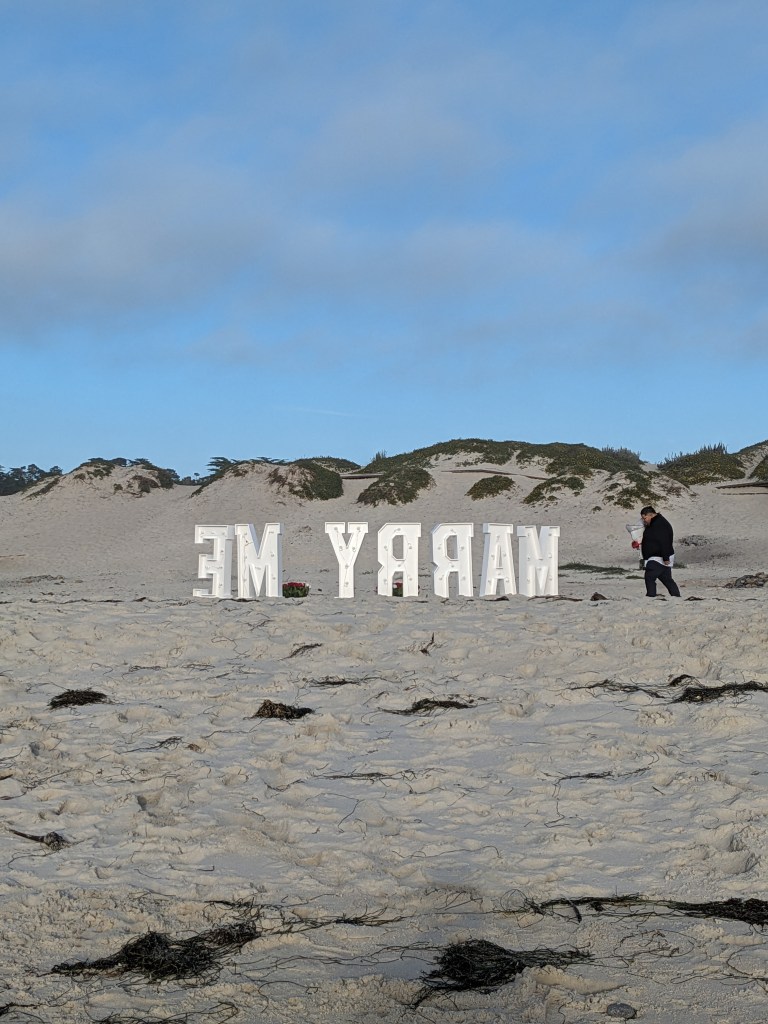
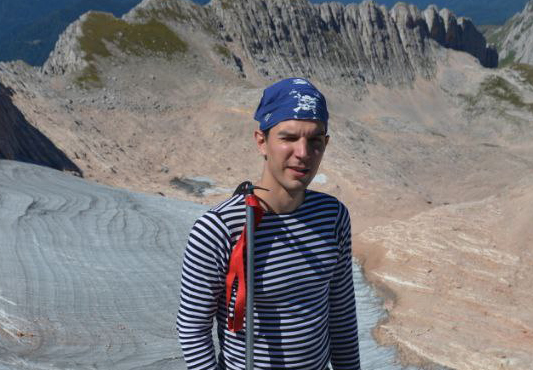
Asilomar State Beach, 21 July 2023. Photo by the Russian Reader
Who is Girkin?
Igor Girkin (Strelkov) is an ethno-fascist FSB officer and the warlord who prepared the ground and then launched the war in Donbas in 2014. He stated that without him, “there wouldn’t be any war”. He is also responsible for ordering the execution of numerous civilians, for which he still face justice. He was sentenced to life imprisonment in absentia by the International Criminal Court on November 17, 2022 as perpetrator of the downing of Malaysian Airlines 17 and the murder of 298 people—a war criminal.
Stunning drone footage has revealed details of the Batagaika crater, a one-kilometer-long gash in Russia’s Far East that forms the world’s biggest permafrost crater.
In the video two explorers clamber across uneven terrain at the base of the depression, marked by irregular surfaces and small hummocks, which began to form after the surrounding forest was cleared in the 1960s and the permafrost underground began to melt, causing the land to sink.
“We locals call it ‘the cave-in,'” local resident and crater explorer Erel Struchkov told Reuters as he stood on the crater’s rim. “It developed in the 1970s, first as a ravine. Then by thawing in the heat of sunny days, it started to expand.”
Scientists say Russia is warming at least 2.5 times faster than the rest of the world, melting the long-frozen tundra that covers about 65% of the country’s landmass and releasing greenhouse gases stored in the thawed soil.
After the court hearing [in his criminal case], Oleg Orlov read out a long list of names of people convicted of “disseminating fake news” or “discrediting the army.” He mentioned Alexei Gorinov, Dmitry Ivanov, Samiel Vedel (aka Sergei Klokov), Vladimir Kara-Murza, Ilya Yashin, Maxim Lypkan, and many others.
“I am not imprisoned, and I can say what I deem necessary. I can answer your questions. But how many of my and your kindred spirits are deprived of this opportunity,” Orlov reminded. “I consider it my duty to read out the list. These are only some of the people who have been imprisoned for their anti-war stance.”
After reading out the names, Orlov cited data from OVD Info. “634 people from 78 regions [of Russia] have faced criminal charges for anti-war protests, for words and statements,” the human rights activist said. “And 200 of them have already been incarcerated. Let’s remember these people.”
Orlov stressed that he was fighting not only for his own sake. “Both my lawyer Katerina Tertukhina and my public defender Dmitry Muratov — we are fighting like this and trying to prove the nullity of the charges [against him], the nullity of the [prosecution’s] expert witness analysis, because we are trying to fight for all people.”
Crimean Tatar-led underground movement is already active behind Russian lines and hundreds of young Tatar men are ready to take up arms to liberate the occupied peninsula, a veteran community leader has said.
Mustafa Dzemilev, widely seen as the godfather of the Crimean Tatar rights movement, pointed to operations by the Atesh guerrilla group, comprising Crimean Tatars, Ukrainians and Russians, in Crimea and other occupied Ukrainian regions.
Atesh, which means “fire” in Crimean Tatar, was created in September last year, primarily to carry out acts of sabotage from within the ranks of the Russian army. It claims more than 4,000 Russian soldiers have already enrolled in an online course on how to “survive the war” by wrecking their own equipment.
There is no evidence linking the group to the latest attack on the Kerch Bridge, early on Monday morning, but the group has claimed a string of smaller-scale attacks, blowing up Russian checkpoints, assassinating Russian officers, setting fire to barracks and feeding sensitive information to Ukrainian intelligence. It recently accused Russian sappers of laying mines in the Krymskyi Titan chemical works in Armiansk, northern Crimea. An explosion there could spread an ammonia cloud across the land bridge between the peninsula and mainland Ukraine.
“Atesh is very deep underground,” Dzhemilev, 79, told the Guardian in an interview in Kyiv. “There was not a single arrest among Atesh members, but they are working inside Crimea territory blowing up targets.”
Hello! This is Alexandra Prokopenko with your weekly guide to the Russian economy — brought to you by The Bell. In this newsletter we focus on the Kremlin’s decision to seize the Russian assets of two major foreign companies and what it means for the business climate and the other Western businesses who cannot — or will not — leave Russia. We also look at Friday’s interest rate hike and new Western sanctions on Russia.
Nationalization of Western assets heralds broader property redistribution
Finland’s Fortum and Germany’s Uniper saw their Russian assets seized by the Kremlin earlier this year. This week was the turn of France’s Danone and Denmark’s Carlsberg. It feels like we are witnessing the final chapter in the history of Western business in post-Soviet Russia. If the transfer of Fortum and Uniper’s energy assets to external management was explained as a response to the European Union’s treatment of Russian energy companies, there is no such obvious reason for the behavior toward Carlsberg and Danone and it likely reveals the Kremlin’s real intentions. This is direct nationalization — and opens the door to a new distribution of property in Russia.
The Arkhangelsk Region has allocated 800 million rubles to the occupied Ukrainian city of Melitopol, which will be used to repair the city, which has suffered from Russia’s invasion. However, the region itself does not have enough money to repair its own housing. Arkhangelsk is considered the capital of the Russian North, but has been informally dubbed the “capital of dilapidated housing.” Many people live in substandard housing: the city is chockablock with barracks and crumbling wooden houses. Watch Valeria Ratnikova’s report on how the region copes with a budget deficit while its money is spent on the war.
00:00 Opening 02:15 Ruins, barracks, and crumbling houses 06:00 Brevennik Island: expensive prices and derelict housing 10:56 Natalia Zubarevich about the lack of money in the region 12:04 The campaign against waste haulage to the region 16:18 The authorities are taking revenge on opposition activists opposed to landfills 31:35 Denunciations and criminal cases for statements about the war 33:22 One of the protesters went to the war 36:15 What residents say about the war 38:26 Getting fired for criticizing the war 39:40 A female student fled to Lithuania — the authorities wanted to jail her for talking about the war 46:25 The region’s environmental problems 49:10 Journalists detained during Putin’s visit 51:11 How the war has affected life in the region
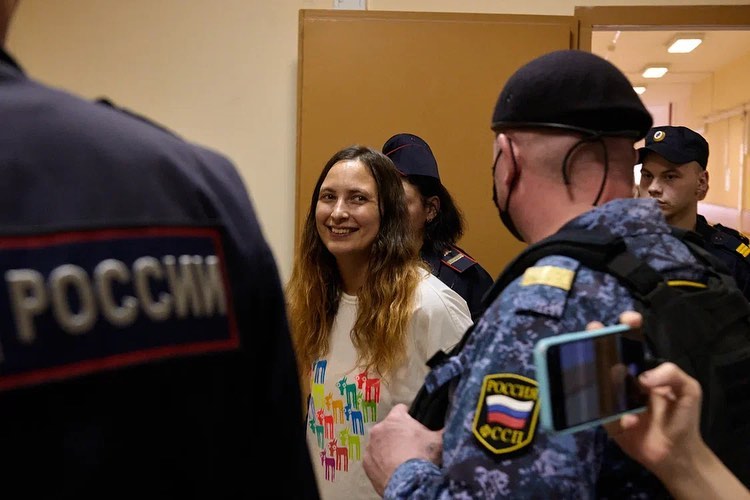
Sasha Skochilenko, facing ten years in prison for anti-war price tags. Vasileoostrovsky District Court, St. Petersburg, 18 July 2023
Today’s hearing lasted almost nine hours!
It was finally possible to resume the cross-examination of Olga Safonova, on whose linguistic analysis of the price tags the prosecution’s case is largely based. At the last hearing it transpired that Safonova is actually a political science specialist who is brought in to provide linguistic (!) expertise on “political” issues. Moreover, she has already admitted that she cannot judge whether the information on price tags was “knowingly false,” although she wrote just the opposite in her expert analysis.
The cross-examination of Safonova took up most of the hearing, and it involved the lawyers, the independent expert Svetlana Drugoveyko-Dolzhanskaya, Sasha [Skochilenko]herself, and Prosecutor Gladyshev. (The defense requested that Gladyshev be recused for a number of reasons—including because he distorted the facts about Sasha’s income—but the motion was denied.) Safonova had a visibly hard time answering questions about the content of individual price tags and the linguistic terms she employs, and how she was able to identify motives of “political enmity” in the texts she analyzed. In fact, experts cannot assess an author’s motives, but Safonova refused to confirm this outright. “Just stay that this is not within your competence,” the lawyer Novolodsky asked her. “I won’t,” she replied.
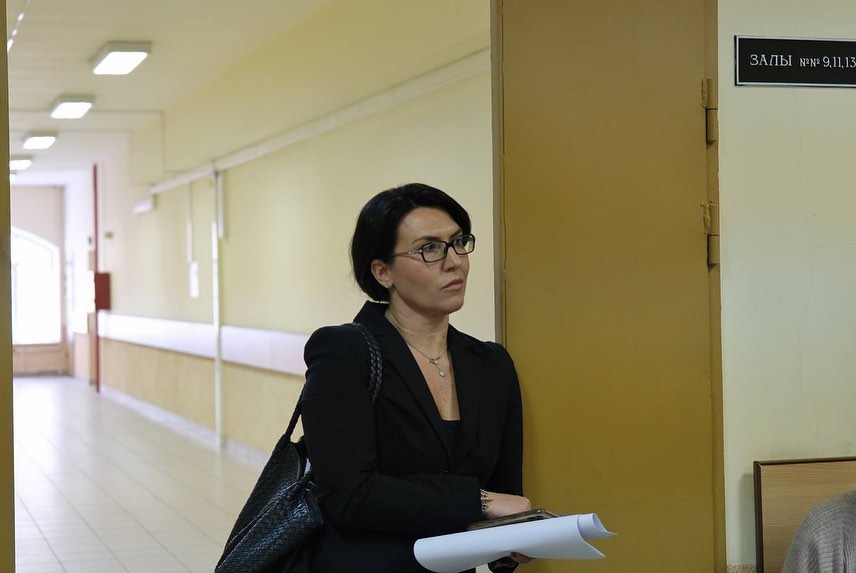
Olga Safonova, expert witness for the prosecution. Vasileoostrovsky District Court, St. Petersburg, 18 July 2023
This was not the only occasion for laughter at today’s hearing. During a discussion of the texts on the price tags, Safonova also claimed that Russia is not a fascist state, since “a fascist state is totalitarian, while Russia is democratic.” She also asked that the defense not “examine every word [said or written] by expert witnesses with a magnifying glass, for crying out loud!” (She said this, I would like to remind you, at a criminal trial that could send Sasha to prison for ten years.)
As always, we want to say a huge thank-you to the journalists who have been covering Sasha’s case, and to everyone who came out to support Sasha! The next hearing will be held on September 14, after the judge’s vacation. Safonova will be summoned to court again. In addition, the court ordered the linguist Grishanina, the co-author of the expert analysis, forcibly delivered to the hearing.
P.S. We will have more to say about today’s hearing, so stay with us!
On June 28, the 2nd Western District Military Court sentenced nineteen-year-old Valeria Zotova to six years in prison in a criminal case fabricated by the FSB.
The court has not yet provided a copy of the verdict to either Valeria or her lawyer. Therefore, the lawyer could not prepare a full-fledged appeal. But he did file a brief complaint to meet the deadline: an appeal must be filed within fifteen days of the date of sentencing.
The appeals process is a very important component of legal proceedings. Until the appeals stage has been completed and the sentence comes into force, there is hope that the verdict will be reversed or changed and Valeria will not be sent to a penal colony at this time.
You can always support Valeria by writing her a letter or sending a parcel.
Address for letters and parcels:
Zotova Valeria Igorevna (born 2003)
10 ul. Portovaya nab., SIZO-1
Yaroslavl 150001 Russian Federation
Source: Solidarity Zone (Facebook), 16 July 2023. Translated by the Russian Reader. People living outside of Russia will find it difficult or impossible to send parcels to Russian prisons or to use the FSIN-Pismo and Zonatelecom services to contact Russian political prisoners. In many cases, however, you can send letters (which must be written in Russian or translated into Russian) via the free, volunteer-run service RosUznik. As of this writing, Ms. Zotova has not appeared on their list of supported addressees. You can also ask me (avvakum@pm.me) for assistance and advice in sending letters to her and other Russian political prisoners.
Valeria Zotova, 19, from Russia’s Yaroslavl has been sentenced to six years behind bars for plotting to set a military aid collection point on fire, Solidarity Zone reports.
The woman was found guilty of attempted “terrorist attack”. The state prosecution wanted eight years in prison for Zotova.
“However, the case materials, correspondence received by the lawyer and Valeria’s own words indicate that the case was a provocation staged by the FSB, whose agents actively persuaded the woman to set the aid collection point for the Russian military ablaze. Zotova may have attracted the attention of the special services due to her anti-war stance,” human rights activists said.
A criminal case against Zotova was opened in February. The woman went for a walk with her friends in mid-February. Later that night, law enforcers showed up at her place for a search without any explanation. During the search, the detainee’s mother was threatened with promises to make her a suspect in her daughter’s case for “participating in anti-war rallies”. She denies these accusations: despite her anti-war views, she did not participate in rallies against the Ukraine war. The news emerged later that Valeria was held in a detention centre in Yaroslavl.
In April, Russian authorities placed Valeria’s mother Svetlana Zotova on the extremist list. The woman had previously been charged with “calls” to commit terrorist and extremist actions. The charges stemmed from comments allegedly posted by Svetlana Zotova on Telegram channels. The woman was prohibited from leaving the country. She could face up to ten years in prison on the charges.
Petersburg anti-war activist and political prisoner Sasha Skochilenko at her trial, 7 July 2023. Photo: Alexandra Astakhova
At today’s hearing, the issue of remand was considered. The court could have released Sasha [Skochilenko] to house arrest or restricted her from doing certain things, or left her in pretrial detention for another three months.
This hearing might not have happened if the court had agreed to consider the issue during the remaining time at the previous hearing. But that did not happen, and today Sasha was once again transported from the pretrial detention center, and had to spend another day without food in poorly ventilated rooms. In an effort to ease Sasha’s suffering, the defense petitioned to move the hearings to an air-conditioned courtroom, to permit Sasha to drink water during the hearings, and to turn on the microphones and speakers in the courtroom so that the windows and doors could be opened. Judge Demyasheva ruled all these petitions “extra-procedural” and ignored them.
Prosecutor Gladyshev could not produce a single argument in favor of leaving Sasha in pretrial detention. He only repeated the vague arguments, made earlier by police investigators, that Sasha would resume her “criminal behavior” and could leave the country, possibilities which had already been ruled out by the court at previous hearings. Most memorably, the prosecutor declared, bombastically, “Skochilenko committed a grave crime against public safety, undermining the foundations of the Russian state.” (After he said this, the bailiffs had to remove a member of the public who had burst out laughing from the courtroom, and the judge declared a recess.) When Sasha’s lawyer Yana Nevodinnova pointed out to the prosecutor that his arguments were unfounded, Gladyshev was cut to the quick. “Reprimand the lawyer,” he asked the judge, “She insults Russia’s judicial system!”
Despite the numerous arguments about the critical state of Sasha’s health, which the defense had made at the previous hearing, the judge ordered that Sasha remain in pretrial detention until October 10.
Many thanks to everyone who keeps coming to court! The next hearing—this time on the merits of the case—will take place very soon, on July 18 at the Vasileostrovsky District Court. Please come out and support Sasha!
Igor Paskar in court. Photo courtesy of Solidarity Zone
On 31 May the Southern District Military Court in Rostov-on-Don sentenced Igor Paskar to eight-and-a-half years’ imprisonment on charges of “vandalism” and “terrorism”. He was found guilty of burning a Z-banner [a pro-war symbol] and the symbolic firebombing of the FSB [Federal Security Service] building in Krasnodar. The day before his sentencing, Igor gave his final statement in court. Here is a translation of his speech:
Almost a year has gone by since I carried out this action. During that year, I pictured this moment time and again, the moment when I would be given the opportunity to make my final statement. I agonised over the words I would say, and the motives that drove me to act as I did.
During the last sitting, your honour, you asked whether I regret my actions. I understood that the extent of my professed regret would influence the severity of the sentence. But if I renounced my beliefs, I would be acting against my conscience.
On the contrary, during the time I have been in prison, I have seen firsthand the injustices perpetrated against the people who we call our brothers: both prisoners of war who have served in the Ukrainian armed forces and ordinary Ukrainian citizens.
The war – or whatever term we use to label it – came to their homes, destroying their lives as they knew them. No matter what slogans and geopolitical interests we use to varnish this, in my eyes it cannot be justified.
Do I regret what has happened? Yes, perhaps I’d wanted my life to turn out differently – but I acted according to my conscience, and my conscience remains clear.
Rather than reflecting on who is right and who is guilty, I would like to pose this question: what did each of us do to stop this nightmare? What, ten or fifteen years from now, will we tell our children and grandchildren about these troubled times?
Unfortunately, God has not granted me the joy of fatherhood; the people who were closest to me have gone, and I am left alone with myself. It was easy for me to do what I did, even though I was well aware of the consequences. There was no-one to agonise about my fate, no-one to worry about me, or to cheer me on. But what I really did not expect was the huge number of letters and messages of support that I have received.
People have written from every corner of Russia, and not only Russia. Many were grateful for my position, so completely at odds with the notion of unanimous national support for what is being perpetrated. There were so many messages of encouragement: “stay strong”, “don’t despair”. So many warm words, so much sympathy.
But I’ll be so bold as to read just one part of a letter that I received in May, which really touched me, and pushed me to write this final statement to the court. Here it is:
“There is very little left of everyday life. It turns out that we can’t live everyday lives anymore. I am listening to the memoirs of prisoners from the 1930s, 40s and 50s. Right now, I’m on the breath-taking biography of [the actress] Tamara Petkevich [who spent seven years in a prison camp]. She was arrested in 1943 and lived until 2017. When they came for her, she was only 22 – just a girl, half the age I am now. I have not read Solzhenitsyn’s GulagArchipelago, and I never got round to Shalamov’s Kolyma Tales either. But now I’m listening to Petkevich, and it’s making me realise that this is exactly what we must listen to, what we must read at school. As a country we are obsessed with the past, but we hardly ever think about the present or the future. The Americans have their American dream: something to strive for. We have nothing but a fixation on that which happened long ago, that which cannot return. But time and again we try to bring back what has passed, and these attempts are absolutely pointless. It’s as though the whole country is stuck in the mud. As individuals we are caught in our feelings. It’s terrible that even now, for as long as we stubbornly turn our heads back, we will never live happily, never the way we want to. Let’s hope people can find happiness in the little things.”
You can support Igor Paskar by sending letters:
□ Address: Russia 344022, Rostov-on-Don, 219 Maksim Gorky Street, SIZO-1, Igor Konstantinovich Paskar (d.o.b. 1976)
□ You can send letters online via the volunteer service RosUznik.
Solidarity Zone gives full support to Igor Paskar. His legal representative is Felix Vertegel.
Note. Letters sent to Russian detention facilities that are not in Russian are unlikely to be delivered to prisoners, and RosUznik is also a Russian-language service. If you send short messages to Igor via Solidarity Zone supporters in the UK at 2022ukrainesolidarity@gmail.com, we will arrange for them to be translated and passed on.
□ More about Solidarity Zone on Facebook and Telegram. A report of the organisation’s work in May is here. Links to more information in English here. Russian original of Igor Paskar’s statement here.
Source: People and Nature, 8 June 2023. Thanks to Simon Pirani for the translation, the hard work, the heads-up, and his shining example of solidarity, which helps keep me going when times are tough.||| TRR
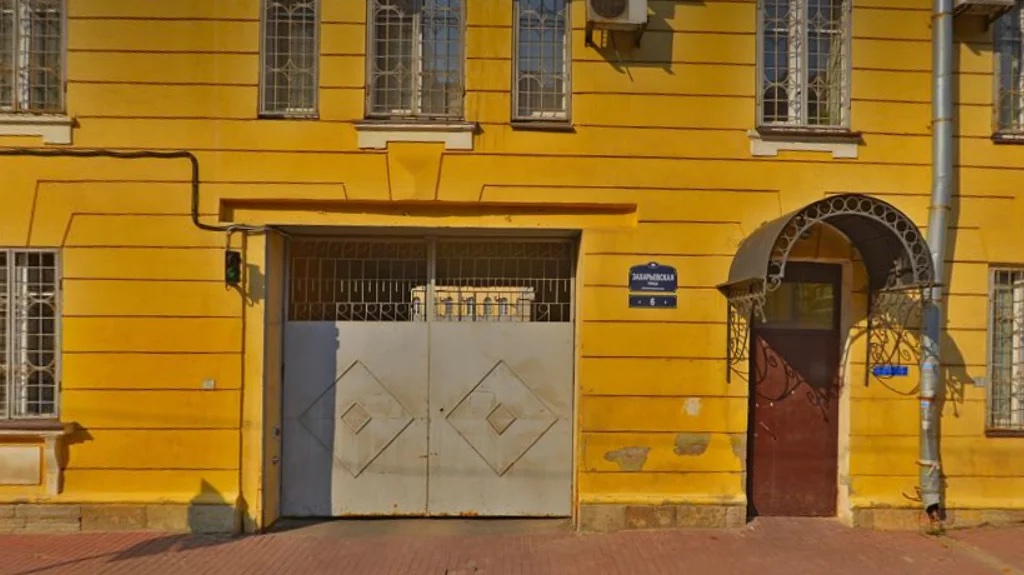
The special detention center at Zakharyevskaya 6 in downtown Petersburg. Image courtesy of Yandex Maps via mr7.ru
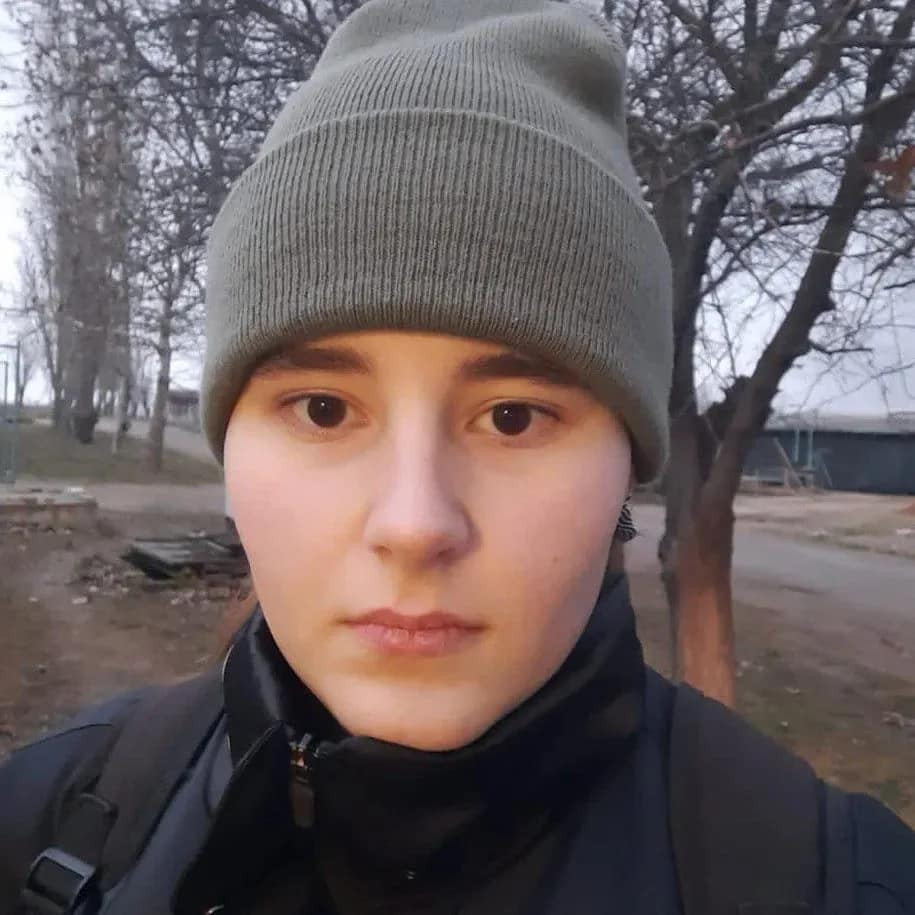
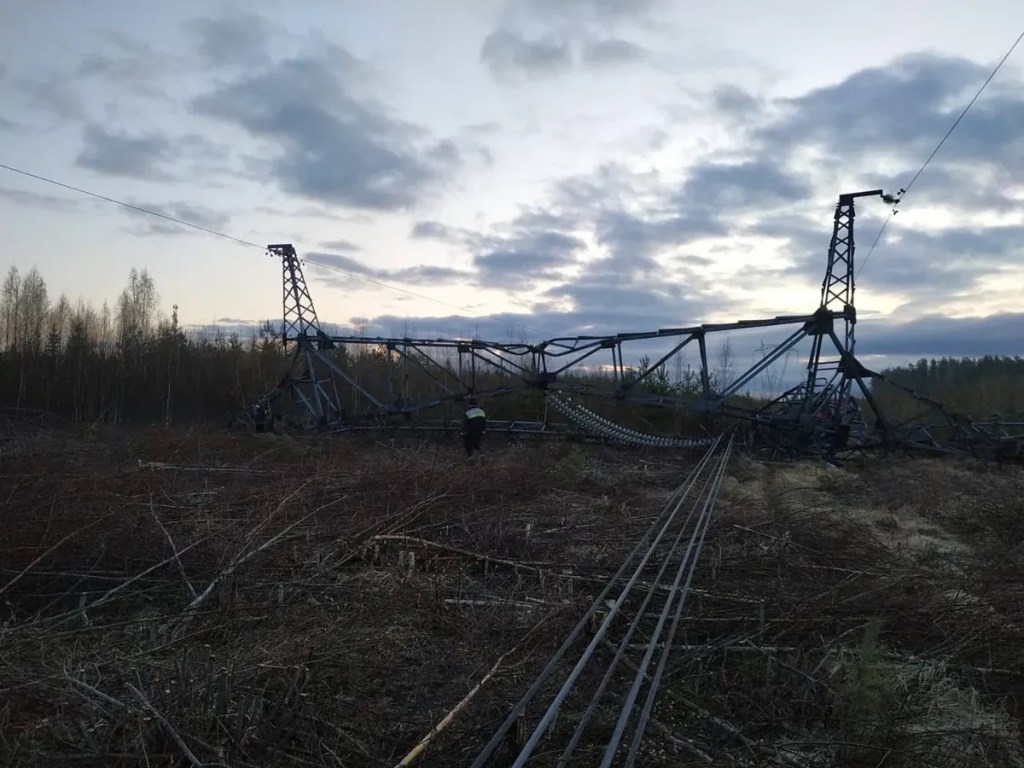
Police have detained Ekaterina Kishchak, a 20-year-old resident of Crimea, a citizen of Ukraine and Russia, and the daughter of Yuri Kishchak, a suspect in the bombing of a power line in the Leningrad Region. The young woman is currently at a special detention center in St. Petersburg, said lawyer Vitaly Cherkasov.
Ekaterina’s relatives turned to the lawyer for help. They said that on May 4, the young woman and her boyfriend, Dilyaver Gafarov, were supposed to cross the Russian-Georgian border at Upper Lars to go on holiday in Georgia. At the border checkpoint, the young woman texted to her father, who is living in Belgium, that they were on the verge of crossing the border, after which she stopped answering his calls.
Only fifteen days later, on May 19, did Ekaterina get in touch with her family. In a conversation with her father, she said that she had been detained at the border with Georgia and jailed for fifteen days—that is, until May 21. After this conversation, Ekaterina’s father had a heart attack and underwent surgery.
Ekaterina’s sister, Anna Petrishina, wrote to the Russian Federal Prosecutor General Igor Krasnov asking that the lawyer be notified if the young woman faced criminal charges, or to place her on the federal wanted list if law enforcement agencies were not involved in her disappearance. The letter states that, over the phone, Ekaterina claimed that the police officers who detained her “only ask[ed] questions about her father,” and said that if he did not return to Russia, she and her boyfriend “[would] be tried for his deeds.”
Later, Ekaterina wrote to her father again. According to the lawyer, the young woman said that she had been “taken to St. Petersburg to be arraigned in his criminal case.” Ekaterina’s message was answered by her father’s wife, who replied that she would not pass on her stepdaughter’s message because it would only worsen her husband’s condition.
A lawyer from the Krasnodar Territory who was first engaged by the young woman’s relatives went to Vladikavkaz and discovered that Ekaterina and Dilyaver had been jailed for fifteen days on charges of “disorderly conduct”(per Article 20.1 of the Russian Federal Administrative Offenses Code). It also transpired that the detained young man had telephone his father on May 23 and informed him that the couple had been jailed a second time.
Yesterday, June 3, Cherkasov learned that Ekaterina and her boyfriend were in custody in the special detention center at 6 Zakharyevskaya Street in St. Petersburg—again on charges of disorderly conduct, per the decision of the city’s Smolny District Court. The lawyer attempted to meet with the young woman, but Ekaterina filed a written refusal to communicate with the human rights advocate.
“What happened there made me realize that FSB officers had arrived at the special detention center. I was asked for my identity card again, although they had already made a photocopy of it. When I had waited an hour, I approached the officer on duty and asked why it was taking so long. He replied, ‘Wait, they’re writing a statement in there.’ I was surprised: who did he mean by ‘they’ if I was waiting only for Ekaterina?
“An hour and a half later, the same officer appeared in the visiting room and bashfully handed me a statement, written in Ekaterina’s hand, that she did not want to communicate with me until the end of her stay at the special detention center.
“I asked the on-duty officer the standard question: did he understand that she had been pressured into [writing the statement]? He looked down and said that he had nothing to do with it, thus letting me know that he was carrying out someone else’s instructions,” Cherkasov told mr7.ru.
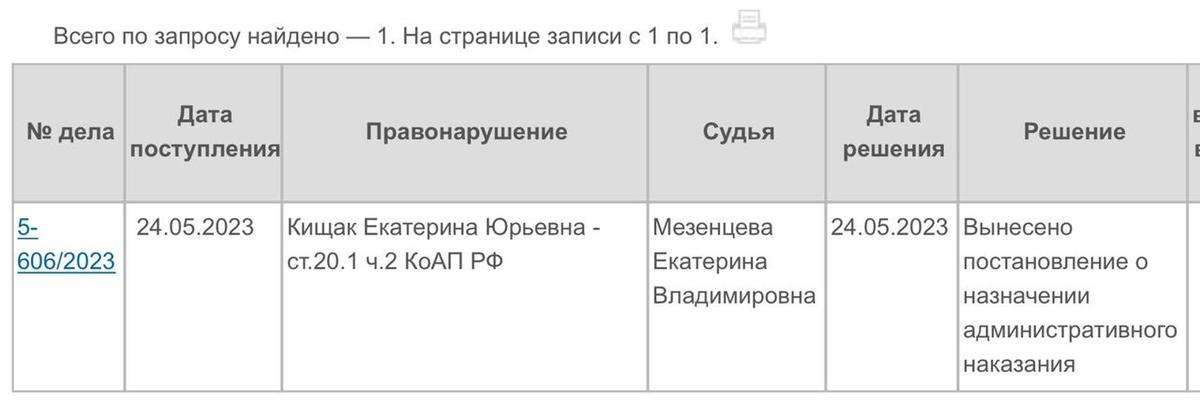
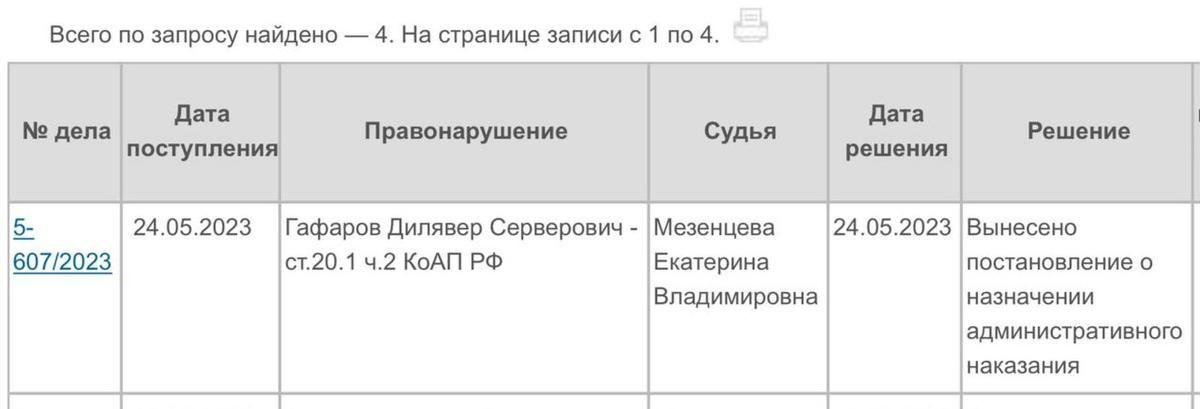
The lawyer plans to familiarize himself with the administrative case against Ekaterina Kischak in the Smolny District Court. There is information on the court’s website that the young woman and her boyfriend were convicted on May 24 by decision of Judge Ekaterina Mezentseva under Article 20.1.2 of the Russian Federal Administrative Offenses Code (i.e., “disorderly conduct involving disobeying a legitimate demand by an officer of the state”).
Screenshots of the Smolny District Court’s website, showing that Kishchak and Gafarov were convicted on 24 May 2023 by Judge Ekaterina Mezentseva of violating Article 20.1.2 of the Russian Administrative Offenses Code and sentenced to “administrative punishment.” Courtesy of mr7.ru
“We need to understand how, having arrived in St. Petersburg involuntarily, in fact, under the escort of regional FSB officers, Ekaterina and her boyfriend could have engaged in disorderly conduct,” the lawyer said.
You will recall that, on May 25, the FSB reported that it had detained two Ukrainian nationals: 44-year-old Alexander Maystruk aka Mechanic, and 48-year-old Eduard Usatenko aka Max. Yuri Kishchak aka YBK, a 59-year-old Ukrainian and Russian national who is currently in Belgium, was put on the wanted list.
The FSB claims that, in September 2022, the Foreign Intelligence Service of Ukraine (SZRU) recruited the three suspects to sabotage upwards of thirty pylons on the high-voltage power lines running from the Leningrad and Kalinin nuclear power plants (the latter is located in the Tver Region).
According to the FSB, on the Leningrad NPP power line the saboteurs managed to blow up one pylon and rig four pylons with explosives, while on the Kalinin NPP power line they planted IEDs under seven pylons. One of the pylons in the Leningrad Region collapsed due to the blast, but no one was injured, and the power supply was not disrupted.
Oleg Vazhdayev has been transferred to Rostov-on-Don, where the court will begin to try his case the day after tomorrow.
Vazhdayev, an auto mechanic, was detained in late September on charges of attempting to set fire to a military enlistment office in Krasnodar. After his arrest, the police tortured him, demanding that he confess to receiving funding from Ukraine.
The building in which the military enlistment office is housed was not damaged, but this did not stop the security forces from charging Vazhdayev with committing a “terrorist act” (per Article 205.1 of the Russian Federal Criminal Code). He faces ten to fifteen years in prison if convicted.
The criminal case against Vazhdayev has been submitted to the Southern District Military Court, and he was recently transferred from the Krasnodar pretrial detention center to Rostov-on-Don.
The trial of the case on the merits should begin the day after tomorrow. Come to the trial!
2:00 p.m., 31 May 2023
Southern District Military Court (Judge Maxim Mikhailovich Nikitin), 75B Mechnikov Street, Rostov-on-Don
If you are going to the trial, don’t forget to bring your internal passport with you and leave all blades and means of self-defense at home.
You can also write to Oleg or send him a package.
Address for letters and parcels:
Vazhdayev Oleg Igorevich (born 1988)
219 ul. Maksima Gor'kogo, SIZO-1
Rostov-on-Don 344022 Russian Federation
(It is possible to send emails via the service Zonatelecom.)
Solidarity Zone is supporting Oleg Vazhdayev and his family.
Source: Solidarity Zone (Facebook), 29 May 2023. Translated by the Russian Reader. People living outside Russia will find it impossible to use the Zonatelecom service. It is also probably impossible to send parcels to Russian detention facilities from abroad. But you can ask me (avvakum@pm.me) for assistance and advice in sending messages to Russian political prisoners.
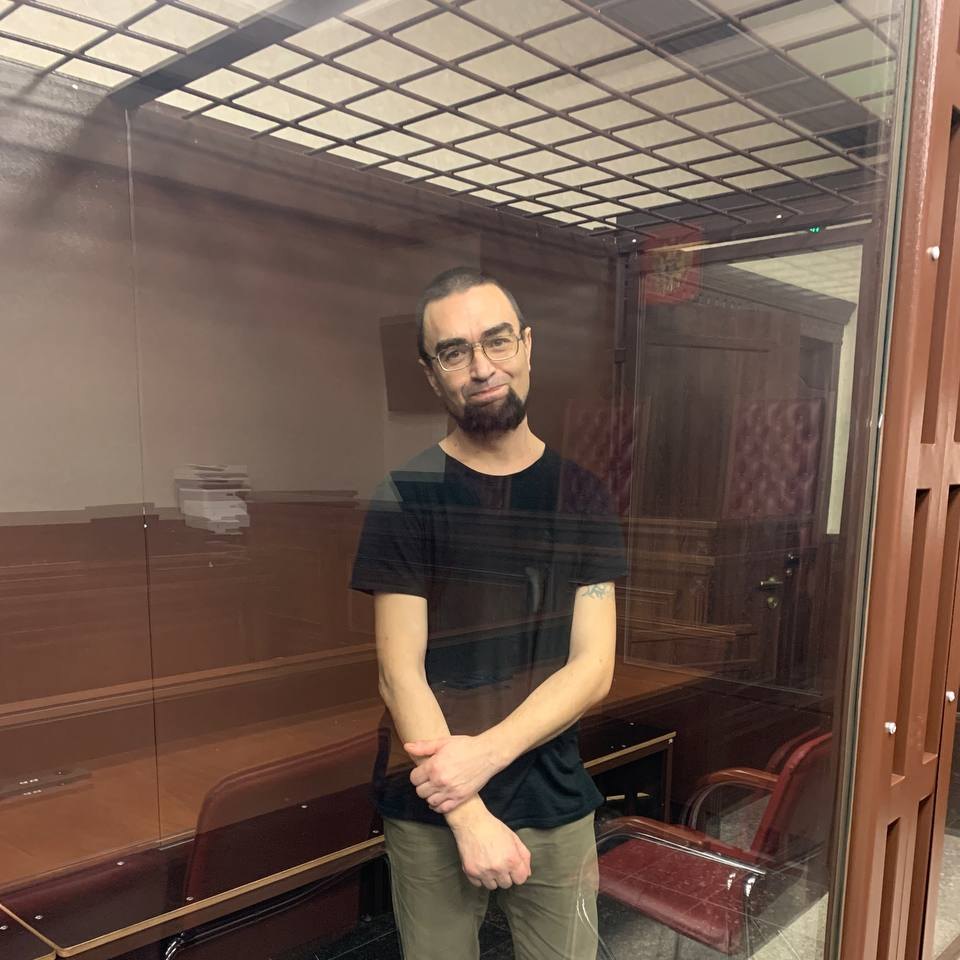
Nikita Tushkanov (above left), in the cage at his trial. Photo courtesy of RFE/RL
Nikita Tushkanov, 29, a history teacher from the town of Mikun in the Komi Republic, has been sentenced to five and a half years in a medium-security penal colony on charges of “repeatedly discrediting” [the Russian army] and “condoning terrorism” over posts and comments he made on the VKontakte social network. It took the court about nine hours to consider all the evidence in the criminal case and render its verdict. Sever.Realii takes a look at the trial and the basis of the prosecution’s case.
The criminal trial against Nikita Tushkanov, a 29-year-old historian and history and social studies teacher from the Komi Republic, ended with this brief closing statement by the defendant:
“I think we know the verdict in advance. So I cannot influence the decisions you make with my closing statement. I will not change my stance on the events in Ukraine. Moreover, I condemn them and consider them criminal. At the outset of the hearing, I asked for a recusal. It was not granted, of course. In this regard, I would like to say that I don’t want to ask you for justice, but I can’t ask you for mercy.”
The next day, a judge with the Second Western District Military Court sentenced Tushkanov to five and a half years in a medium-security penal colony over a post and several comments published on VKontakte about the war in Ukraine and the explosion on the Crimean Bridge on 8 October 2022, which the Russian authorities have declared a terrorist attack. Essentially, the judge needed only a single working day, 10 May, to review the evidence and testimony and reach a verdict. Nikita’s relatives, who were witnesses in the case, were not allowed to attend the first half of the hearing, at which the findings of a forensic examination were read into the record.
“A birthday gift for Putler”
The criminal case against Nikita Tushkanov was launched in December 2022. He was initially accused only of “condoning terrorism” over a post about the bomb blast on the Crimean Bridge, but subsequently he was also charged with “repeated discrediting” of the Armed Forces of the Russian Federation, also over posts he made on VKontakte.
[…]
The Russian authorities declared the blast on the Crimean Bridge a terrorist attack a day after the incident. The entries on Nikita Tushkanov’s social media page were made on 8 October, the day of the blast, when the incident had not yet been declared a terrorist attack.
Tushkanov was arrested in early December 2022. He later recounted that the police had been monitoring his VKontakte page for several months before the criminal case was launched. He had been written up on administrative charges of “discrediting the army” over social media posts.
The accusations were triggered by a post that read, “A birthday present for Putler. Grandpa turned 70 years old. The last anniversary of the last shithead. P.S. The Crimean Bridge was blown up today. De jure, the Ukrainians have destroyed their own bridge, what psychos…,” and discussions of the events in the comments to this post.
What other phrases were cited in the case against Nikita Tushkanov?
In addition to the post about the blast on the Crimean Bridge, the evidence in the case included comments that Tushkanov made beneath the post. Among the comments that were entered into evidence were the following (the original spelling and punctuation have been preserved — SR):
“Desktop photo for phone”
“Crimea was annexed (if you understand such words at all)”
“It’s delightful that the aggressor is getting f*****”
“My country carries out terrorist attacks by attacking peaceful cities in Ukraine. Any more questions?”
“Maybe you consider yourself a part of this state. I don’t. I didn’t elect this president, the government, and all the rest of it. My homeland has been seized by fascists and I don’t consider myself a part of it”
“How is it a terrorist attack? I don’t understand. Destroying the infrastructure and a symbol of Putin’s Russia, that’s a terrorist attack?”
“For what people? Ukraine did not ask [Russia] to build a bridge on its own land”
“Should we be sad?”
“Putin annexed the occupied territories”
“That’s what the ‘partial’ deadening mobilization does!”
“I *** didn’t get it, but it’s very interesting. What information? They weren’t annexed? Or were there no armed people there while the ‘referendum’ was going on? What’s wrong? Are the Armed Forces of the Russian Federation beating the **** out of the Armed Forces of Ukraine? Then why the mobilization? And what about ‘Z Power of PraVda’?”
The criminal case against Tushkanov was based on a forensic examination conducted by an expert from the Federal Security Service’s Komi Republic office. During the trial, Tushkanov asked the expert to explain how “discrediting” differs from ordinary criticism. The expert replied that discrediting involves creating a negative image, while criticism involves making suggestions to rectify a situation.
In the forensic examination itself, the expert found that there was no evidence in Tushkanov’s posts of his calling for the blast, but there were “signs of acknowledging the ideology and practice of perpetrating the blast that warranted support and imitation” and “discrediting” the Armed Forces of the Russian Federation.
The expert detected condoning of terrorism in the phrase about the “gift”: the word “gift” and the phrase “the Ukrainians destroyed their own bridge,” constituted, according to the expert, an attempt to condone the blast.
The purpose of the word “Putler,” according to the expert, was to “destabilize the activities of the authorities of the Russian Federation or impact their decision-making.”
The comment “Desktop photo” constituted “a positive assessment of the explosion on the Crimean Bridge, voiced as a desire to save” the picture.
The expert also detected justification for the explosion on the Crimean Bridge in the phrase “my homeland has been seized by fascists”: it was “expressed by the justification for the explosion: ‘My homeland has been seized by fascists’ (exploding the bridge is a response to the fact that the Russian Federation has been seized by fascists).”
The FSB expert also found evidence of discrediting the Armed Forces of the Russian Federation in Tushkanov’s comments about the annexation of the occupied territories, “the deadening mobilization,” and armed people during the “referendums” on annexation of the Ukrainian territories occupied by Russia.
Tushkanov’s relatives and his close friends were also questioned in court. They described Tushkanov positively and said that they had not touched on political topics in personal conversations.
Nikita Tushkanov. Photo courtesy of the Moscow Times
Testifying in court, Tushkanov again stressed that he had not renounced his comments and did not understand how he could be tried for condoning terrorism if his post had been published a day before the Russian authorities declared the explosion on the Crimean Bridge a terrorist attack. Here is a complete transcript of Tushkanov’s testimony:
I, Nikita Alexeyevich Tushkanov, date of birth 24 April 1994, was born and grew up in the small village of Chuprovo in Komi’s Udora District. My mother was a teacher and, later, the director of the school, while my father was the director of the House of Culture. My grandmother was a home-front worker and the daughter of a frontline soldier who was killed in the fight against Nazism on 1 January 1945 and was awarded the Order of the Red Star. Grandfather was the son of an exiled kulak from Voroshilovgrad (Luhansk), and his mother had been denounced by a neighbor and subjected to political persecution.
I grew up in this environment. From childhood I learned about the horrors of war and the horror of losing parents, through the tears of my grandmother and my grandfather I knew how hard it was for the children of victims of political persecution to live.
With this knowledge and a sense of duty, I joined a search party in 2013 and until 2019 was involved in searching for unburied soldiers and officers of the Winter War of 1939–40 and the Great Patriotic War of 1941–45 and reburying them with full military honors.
I loved my homeland and continue to love it, but my love changed due to the way my country, Russia, has behaved towards its own citizens (including veterans, leaving them on the sidelines of life, without assistance) and in the international arena.
I used to see no difference between the concepts of “State” and “Homeland,” but now they are absolutely opposed concepts for me. How did this happen?
It all started in 2014, and not with the annexation of Crimea, which I accepted, as did the majority of the [Russian] populace. It all started with combat involving unidentified military units in which my comrades served. They told me firsthand about what went on there and who did what.
Strelkov (Girkin)[…] has himself admitted on numerous occasions that he, a former FSB officer, “pressed the button that launched the war.” This was followed by the downing of Flight MH-17 and the emergence in Russian territory of fresh graves for soldiers and military personnel from the “they aren’t there” echelon. Since 2014, my State has supported the separatists and thrown more and more victims into the furnace of war.
[…]
We have had to pay for it all. Sanctions were imposed, and the so-called pension reform was carried out, but they simply confiscated the populace’s hard-earned money. They froze the invested part of pensions, raised the VAT, and much more. In the name of what?
It’s not the sea that drowns people, but the puddle.
I was baffled by the building of the Crimean Bridge. Didn’t we have other places where bridges needed to be built? There were thousands of possible places for this. But [they built the bridge] on territory that Ukraine recognizes as its own, as does the entire international community.
The Russian authorities called construction of the bridge a “historic mission,” one of the key tasks in the “final unification of Crimea and Russia.” Meanwhile, people’s salaries were not paid on time, and roads and bridges fell into disrepair. Why weren’t we building bridges to Sakhalin?
While still engaged in searches [for WWII soldiers still missing in action], I realized that war was pretty only at parades and musters, but in fact it was only DEATH and those whose remains I carried out of forests, fields, and swamps could tell the whole truth about war. Only the dead and the maimed know the truth about war! War is a crime, and unleashing it is a crime for which there is no justification.
The Anschluss of Austria took place in the same way as [Russia’s] “reunification” with Crimea. My state unleashed a war in Ukraine in 2014, and in February 2022, led by the President, it unleashed a full-scale war while simultaneously ensnarling the whole world by unleashing a world war, the third world war. It was my state that doomed tens of thousands of people to death and doomed millions to suffering. And the so-called special military operation has been going on for more than a year.
And now I am charged with violating two articles of the Russian Federal Criminal Code.
Article 205.2.2
I should say that I reject terrorism. I do not approve of acts of terrorism, and I regard them only negatively, no matter who commits them. I have not made calls for terrorist attacks, and I have never sought to condone their goals.
The Russian authorities allegedly declared on 8 October that the damage that had occurred on the Crimean Bridge was a terrorist act, but the media reported this only on the evening of 9 October, and the President of the Russian Federation himself did not refer to the damage to the bridge as a terrorist attack in his initial comments. Information about the terrorist attack also appeared on the [web] page of the Russian Investigative Committee in the late afternoon of 9 October.
The [social media] post in question [in the case against Tushkanov] was published on 8 October at 10:04 a.m. Moscow Time. I could not have foreseen the fact that the damage to the bridge, a military target, would be declared a terrorist attack.
From the very launch of the (auto and rail) bridge, it was used by the Armed Forces of the Russian Federation, including during preparations for the 24 February 2022 invasion of Ukraine. There were relevant publications on this topic, the use of the bridge (logically) as military infrastructure. The bridge is part of the military logistics chain for supplying the Southern Grouping of Troops in the war with Ukraine.
Thus, the damaging of the bridge as a facility used for military purposes (i.e., the transport of equipment, missiles, personnel, and provisions) cannot be declared a terrorist attack, just as is the case with all military facilities that are fair targets for damage and/or destruction. The sinking of the warship Moskva was thus also a “terrorist attack,” judging by the rationale of the Russian authorities.
Despite the fact that terrorism and acts of terrorism pursue clear goals of generating publicity and pressure [on their targets], no one has claimed responsibility for the incident on the bridge, no terrorist organization has made demands, and there have been no statements [of responsibility].
It was an act of sabotage, targeting a site that is still used for military purposes. So I thought at the time [when I published my social media post] and I still think so to this day. But it was in no way an act of terrorism.
Ukraine considers Crimea its own territory and is in the active phase of hostilities, which also points to the fact that [the attack on the Crimean Bridge] was and is an instance of sabotage.
In any military action, bridges are key targets for disrupting the logistics and supplying of enemy troops, as illustrated by the famous “rail wars” on the Berezina River during the Second World War and in this “special military operation,” which has been going on for over a year. The Armed Forces of the Russian Federation blew up and destroyed bridges in the Novomoskovsk District of the Dnipropetrovsk Region (22 April 2022), the Preobrazhensky Bridge in Zaporizzhia, and other bridges even BEFORE the incident on the Crimean Bridge.
In any war, bridges are key supply routes for armies, such as the bridges blown up by the Armed Forces of the Russian Federation, and the bridges under the control of the Armed Forces of the Russian Federation that have been attacked by the Armed Forces of Ukraine.
But while accusing Ukraine of engaging in terrorism by sabotaging the Crimean Bridge, the Russian authorities have continuously launched more than 18,000 missile strikes on Ukraine and, according to the Ukrainian authorities, 97% of those strikes targeted civilian sites, including (just to mention a few) Kyiv thermal power plant no. 5, Zmiivska thermal power plant, Kharkhiv thermal power plant no. 5, Burshtyn thermal power plant, and so on.
In response to the attacks on the Dnieper and the Kremenchuk hydroelectric stations, Russian President Vladimir Putin said that the bombing of civilian infrastructure was a response to a strike by Ukrainian drones on ships of the Russian Black Sea Fleet in Sevastopol. Fifty of [Ukraine’s] energy infrastructure has been damaged, and attacks continue, rendering cities literally uninhabitable.
These strikes did not affect the supplying of weapons and other materiel to the front. They affected such critical [civilian] infrastructure as heating, water supply, and healthcare.
And all of the above attacks on civilian targets took place before the attack on the Crimean Bridge. Who committed a terrorist attack after that?
When I published my post on the explosion on the Crimean Bridge I regarded it as damage to a military target. And I regarded the country [allegedly responsible for the sabotage], a country which is under direct attack from the Armed Forces of the Russian Federation, as involved in a war, as indicated in [my] comments to the text.
According to the Supreme Court of the Russian Federation, public condoning of terrorism constitutes a crime from the moment it is disseminated. [My] post was published on 8 October at 10:04 a.m., while the media reported the declaration of the incident as an act of terrorism on the evening of 9 October 2023.
Article 280.3.1
The concept of “discrediting” the Armed Forces of the Russian Federation is not specified anywhere and is not substantiated. There is no such concept in the case files or the indictment, and it is absent in regulatory acts.
As for the “maintenance of international peace,” after the outbreak of hostilities in Ukraine, Russia was subjected to sanctions that caused great damage to many of its economic structures, and caused many manufacturers to exit the Russian market.
According to the international community, the main purpose of the strikes on Ukraine’s energy grid was the desire to sow fear among the populace and make people’s lives unbearable!
As a result of this “defense of its own interests and its citizens,” Russia has turned into a worse scarecrow than Afghanistan.
On May 22, 2022, the Verkhovna Rada of Ukraine declared Russia a terrorist state.
On August 2, 2022, the Saeima of Latvia declared Russia a sponsor of terrorism.
On October 13 (after the bombing and destruction of a portion of the Ukrainian power grid), the Parliamentary Assembly of the Council of Europe declared the Russian government a terrorist regime.
On October 18, Estonia declared the Russian Federation a state sponsor of terrorism.
On October 26, Poland declared the Russian regime a terrorist regime, and Russia a state that supported and implemented terrorist measures.
On November 13, the Czech Parliament declared the Russian regime a terrorist regime.
On November 21, the NATO Parliamentary Assembly adopted a resolution stating that the Russian Federation and its current regime are acting as a terrorist organization.
On November 23, the European Parliament declared that Russia uses the means of terrorism and is a state sponsor of terrorism, due to Russian strikes on civilian targets in Ukraine, energy infrastructure, hospitals, schools, and shelters.
On November 24, the Netherlands declared the Russian Federation a sponsor of terrorism.
In 2022, after Russian strikes on vital infrastructure sites in Ukraine, from the. legal point of view Russia meets the criteria of a “terrorist state,” as adopted in the United States and the EU.
The world is on the verge of a nuclear war, and it all started with the actions of the Armed Forces of the Russian Federation and personally their commander-in-chief.
However, [the borders of Ukraine] were recognized by both parties (Ukraine and Russia) back in 1992.
[The borders] of the Russian Federation are fixed in the Constitution of the Russian Federation, which can be changed only by means of a referendum, in which the whole country, its entire multinational people, approves them. Amendments to the Constitution and its articles made arbitrarily by the President or anyone else are illegal and constitute a crime.
According to the laws of the Russian Federation, these are also crimes:
Planning, preparing, unleashing, or waging a war of aggression (per Russian Federal Criminal Code Article 353)
Publicly calling for war to be waged (per Russian Federal Criminal Code Article 354)
Genocide (per Russian Federal Criminal Code Article 357)
Engaging in mercenary activities (per Russian Federal Criminal Code Article 359)
Engaging in international terrorism (per Russian Federal Criminal Code Article 361)
Along with all of the aforesaid, I would like to say that no one apart from the authorities of the Russian Federation and the Armed Forces of the Russian Federation threatens international security, but the citizens of the Russian Federation, including myself, have no right or possibility to countervail the actions of the authorities and the Armed Forces of the Russian Federation.
The purpose of my posts was to show my disagreement with the horror that has gone on for over a year, a horror in which hundreds of people die every day. In the name of what?
With the start of the special military operation, war broke out not only on the front lines and in the international arena, but also in the soul of every person. The hearts of millions of Russians are in the firing line. We are all now in a state of mental civil war, a civil war that was unleashed by the Commander-in-Chief of the Armed Forces of the Russian Federation (Vladimir Putin), the Federation Council, the Security Council, and the State Duma of the Russian Federation.
I think we know the verdict in advance. I don’t think I can influence the decisions you make with my closing statement.
I have not changed my stance about the “incident” or, I don’t know, “the events that occurred in Ukraine”: it remains what it was. I condemn the war. I consider it criminal. Just like all aggression.
Well, even in the Criminal Code there is an article about necessary self-defense. Which is being employed by the other side [the Ukrainian military].
At the outset of the hearing, I asked for a recusal. You, of course, did not grant it. In this regard, I would like to say…
I don’t want to ask you for justice, but I can’t ask you for mercy.
On March 29, Oleg Belousov was the first person in St. Petersburg to be convicted on charges of disseminating “fake news” about the Russian army. Judge Eva Gunter sentenced him to five and a half years in a medium-security penal colony.
Formally, Belousov was charged for comments he made on the community social media page “St. Petersburg Diggers.” The case was launched after Belousov was denounced to the authorities by Sergei Chmyhun, another person involved in the community page. The court handed down a guilty verdict despite the fact that Belousov has a third-class disability and a disabled son as a dependent.
Bumaga wrote to Oleg. We have published his slightly abridged reply below. Oleg writes about his health problems, his love for his son, and his gratitude to the people who supported him.
Oleg Belousov, amateur archaeologist, member of the MIA searchers movement, and political prisoner. Photo by Andrei Bok for Bumaga
Thank you so much for informing readers and following my case as it unfolded. As many people as possible should find out about this regime’s mendaciousness, about phrases taken out of context, and the trumped-up case. Before my arrest, I still had some doubts about whether I had been mistaken about something, whether I was wrong. But after seeing all the dirt and lies, my doubts were dispelled!
For health reasons. I received ointment for dermatitis of the eyelids: my sister looked for one [kind?], and a young woman from the support group (unfortunately, I don’t know her name) looked for the other one. The medical worker muttered [my] last name and asked, “Who sent it?” I replied that I was a political prisoner and anyone could have sent it, not only relatives. I get letters from all over Russia, and not only from Russia.
Would that I [had received the ointment] right away, but I had to suffer for three months—you won’t get medical help in here. My sister also sent two bottles of [eye]drops, but to get them, you have to go through a whole quest. To begin with, you get an appointment with a doctor, then the doctor has to make a note in your medical record and file an application to be allowed to send it, and then there’s the sending and receiving…
Due to numbness in my right arm and left leg, I do exercises for the cervical spine and the joints. It’s all based on the body’s internal forces, there is no osteopath in her.
Everything is alright, I can’t be broken. I’m more worried about my son. There were a lot of things that I hadn’t done for him yet, that I didn’t teach him to do. He is a disabled child: he suffers from a residual organic lesion of the central nervous system. He certainly lacks my help. He has problems with work too: it’s no so easy for him to find a job. My sister, my niece, and her husband also have health problems. So I’m more worried about them. But me, I’ll get stronger, I’ll toughen up. I’m not afraid of challenges. They won’t shut my mouth, I have a right to my own opinion.
Since I’ve been behind bars, I’ve seen my son only at the court hearings. He worries, of course. When I was arrested, he hugged me and said, “How am I going to live without you?” I will never leave him, of course, and when I get out, I will help him as long as I live.
I now see how many good, honest, decent people there are in Russia who are not afraid to express their opinions. I feel their support, and it gives me strength.
As for the verdict, it was expected, so I took it calmly. How else [could the case have ended]? You can’t expect anything else from liars. It would be smarter for them not to instigate such cases, not to disgrace themselves before the whole world, but they think with a different part of their bodies.
About the provocateur/informer. I had thought earlier that he was a fool, a narrow-minded man. After his denunciation — well, the bastard turned out to be a repeat of 1937. But for every scoundrel, there are thousands of people in Russia who are responsive and ready to help. So what can I say about my feelings for this [person]? It’s like stepping in shit. It’s better not to meet such “people.”
Thanks so much to everyone who writes letters, sends food parcels, and worries about me, my son, and my loved ones! Don’t be afraid to speak the truth, to voice your stance publicly! What kind of freedom is it if you are forced to remain silent? All my cellmates and all the prison employees see and understand the whole situation and what is happening.
Nothing’s gone to change me. I have been an honest, decent person, and I will come out one too! Be kind! May the skies above your head be peaceful!
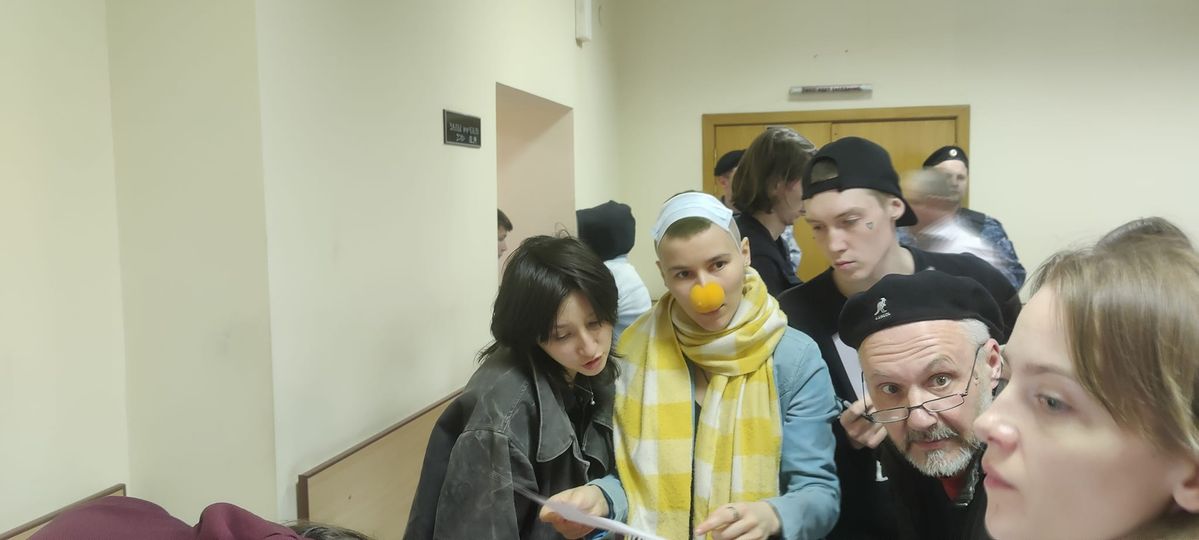
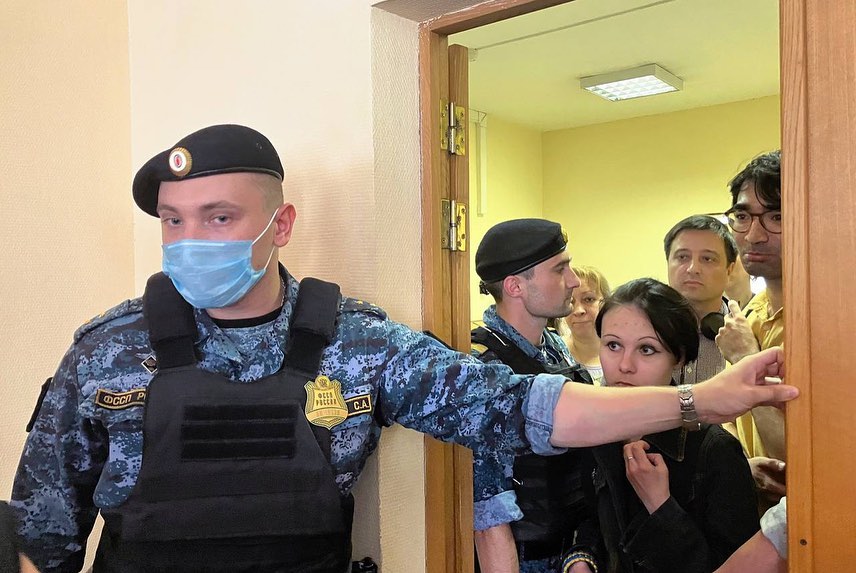
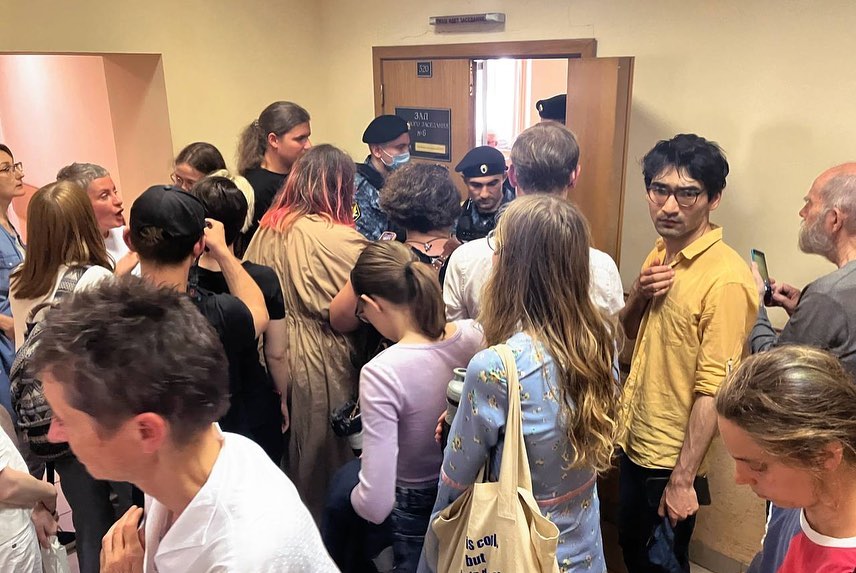
The latest hearing in the case against Sasha Skochilenko took place. I think the group of her supporters has only grown more numerous. In any case, I didn’t make it into the courtroom: right as I was about to go in, we were told that there were no more seats, although there were still a fair number of people left waiting in the hallway.
And so a campaign was born to file complaints about the fact that people who want to attend the hearings are not being let into the courtroom. The complaints were submitted and stamped at the front desk.
“What you do mean, where? In courts, in support groups [for political prisoners]. It’s good people who’ve convened here…”
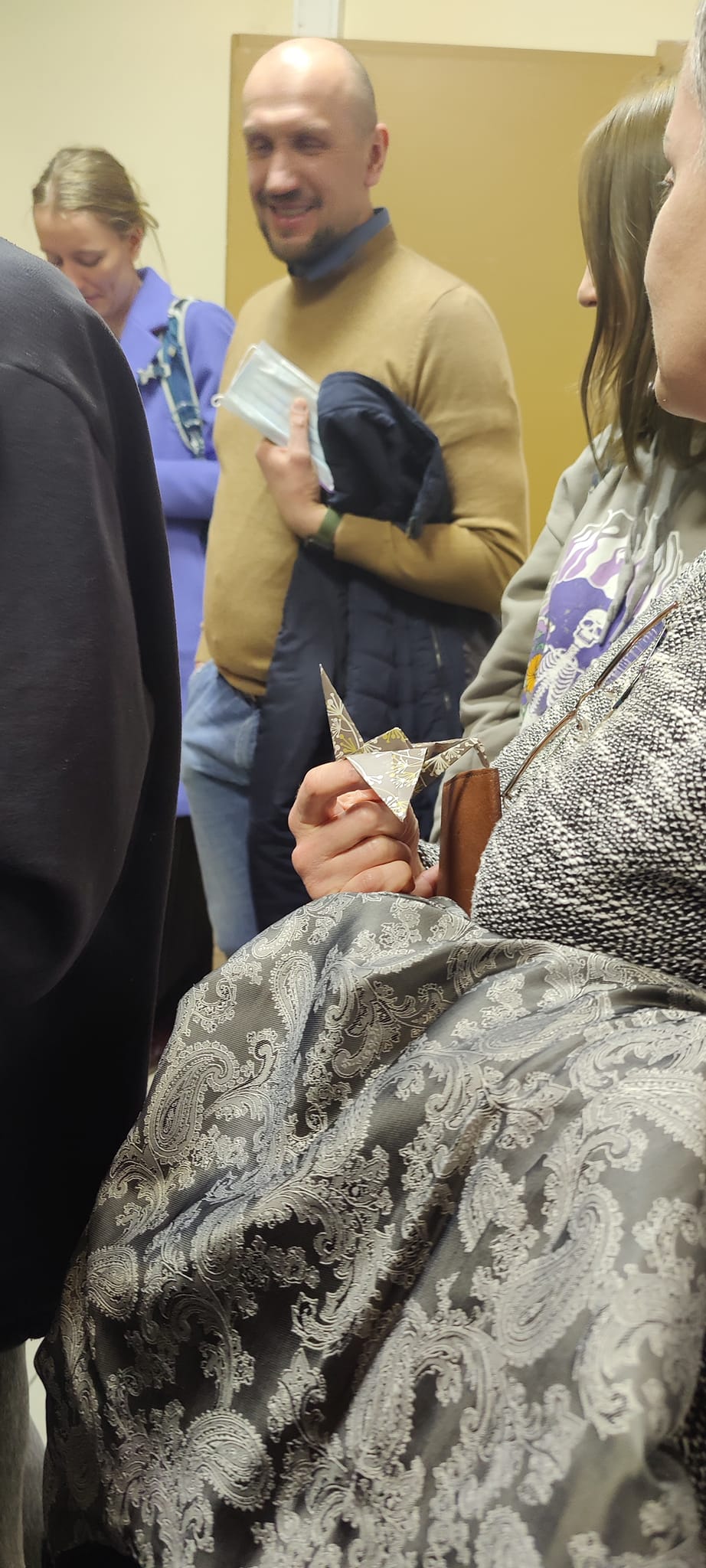
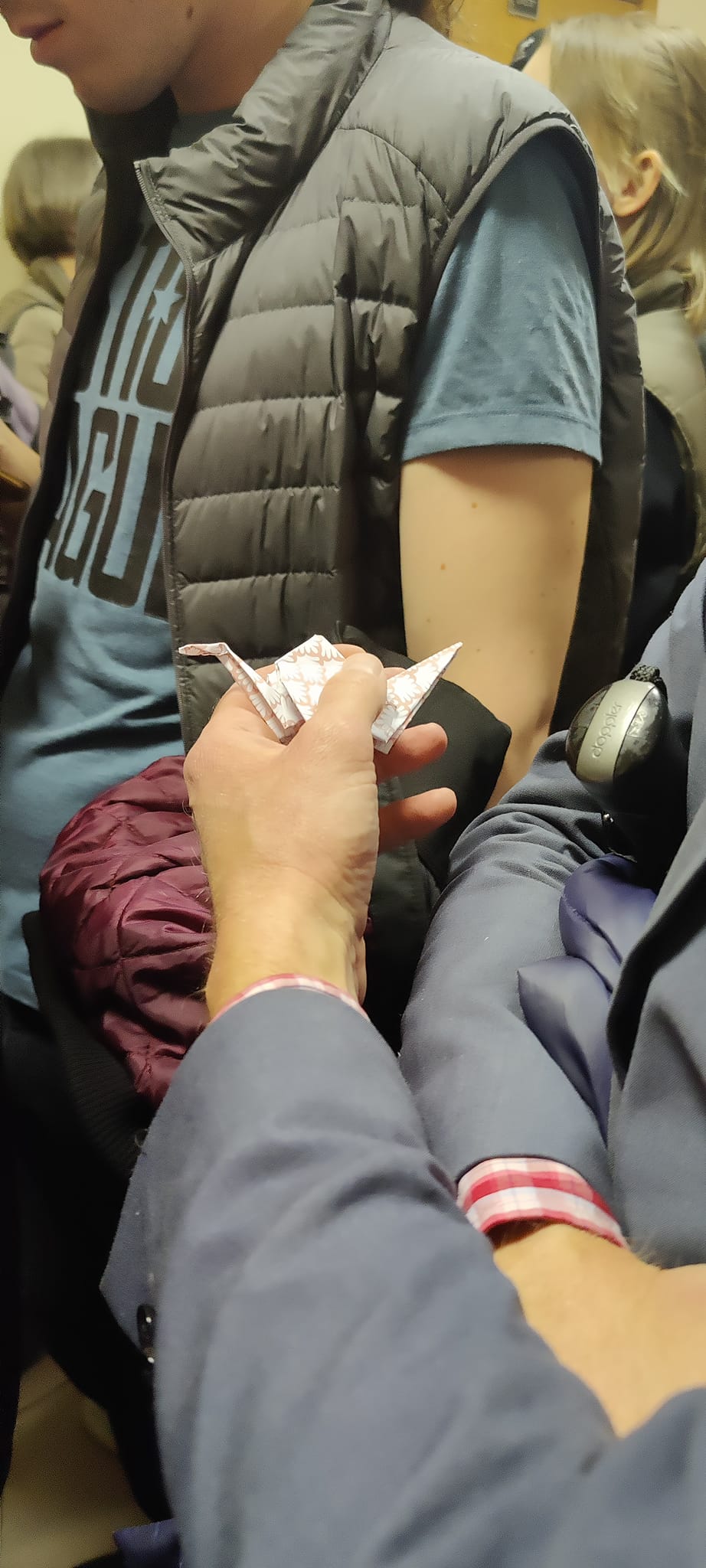
A young woman handed out small handmade paper cranes. Representatives from four [foreign] consulates and [Petersburg municipal district councillor] Sergei Troshin were in attendance.
The hearing itself was brief, less than two hours long. An expert witness testified that, after a detailed examination, she had been unable to find any evidence of the alleged crimes in the [anti-war] price tags [that Ms. Skochilenko supposedly attached to shelves in a Petersburg supermarket].
Sasha is holding up well, but is coughing a little. They say her cellmate tested positive for coronavirus.
The next hearing in the case is scheduled for May 24.
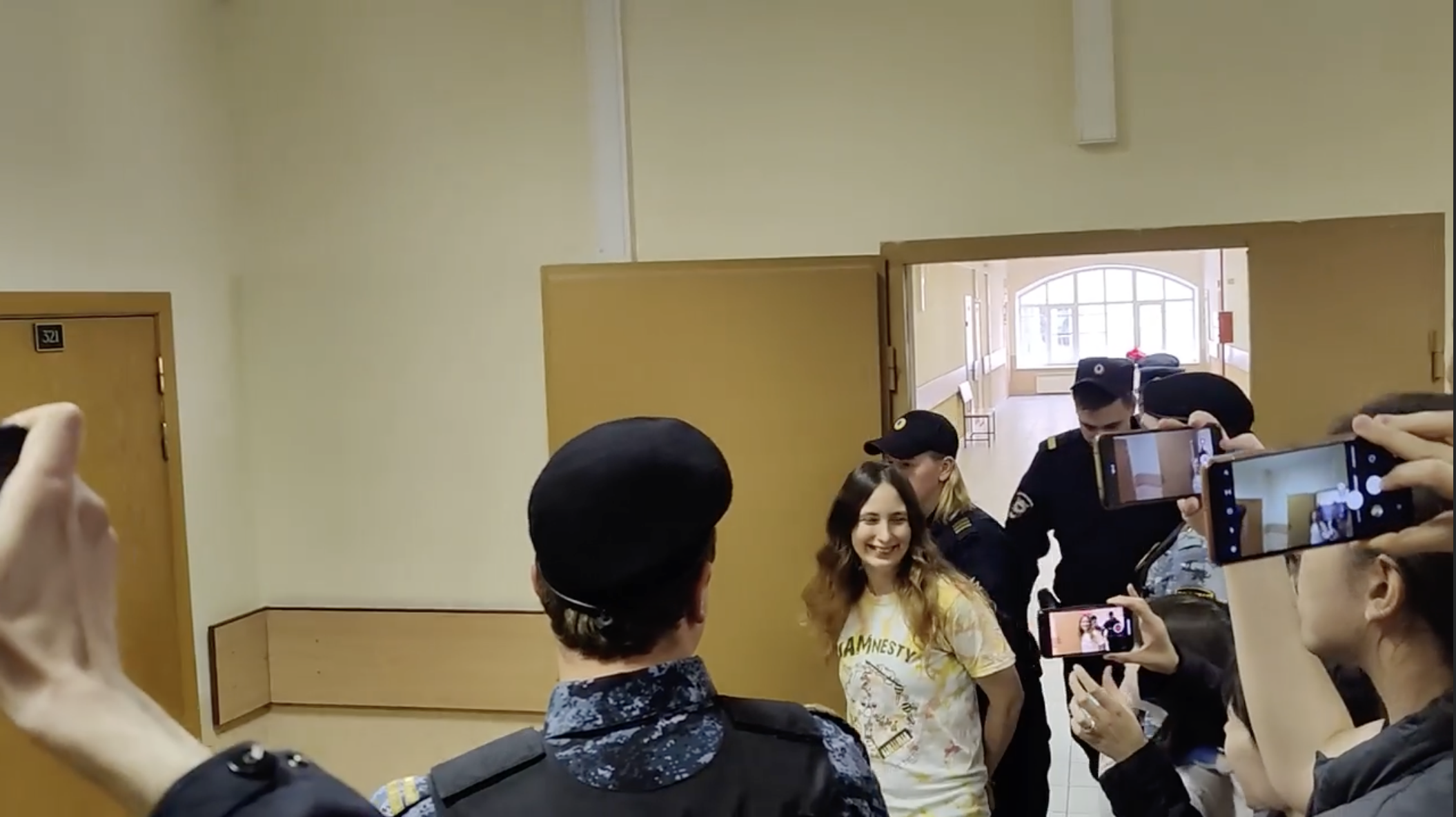
Source: Alexei Sergeyev (Facebook), 2 May 2023. The original post contains two short videos shot by Mr. Sergeyev, one of which shows Ms. Skochilenko being led into the courtroom by guards and being cheered by her supporters. I’ve inserted a still from the video, above. Translated by the Russian Reader



 Address for letters and parcels: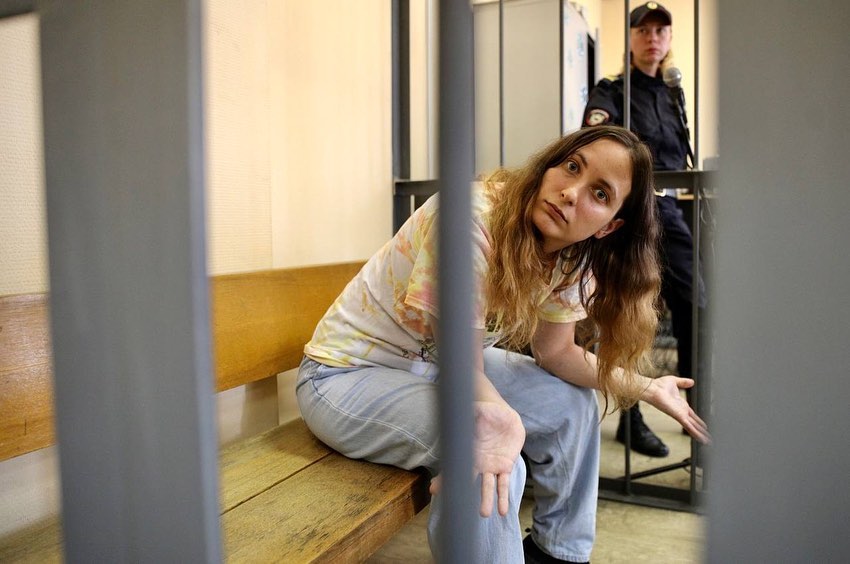


 2:00 p.m., 31 May 2023
 Southern District Military Court (Judge Maxim Mikhailovich Nikitin), 75B Mechnikov Street, Rostov-on-Don
 If you are going to the trial, don’t forget to bring your internal passport with you and leave all blades and means of self-defense at home.