Sergei Vilkov: Everything You Thought You Knew About the Russian Working Class Was Wrong

kalashnikov workersWorkers of the Kalashnikov plant in Izhevsk, Russia, on September, 20, 2016. Photo by Mikhail Svetlov (Getty Images). Courtesy of Fortune

The Heroes of the Day: What We Know about the Russian Working Class
How the Proletariat Stopped Fearing TV and Came to Dislike It
Sergei Vilkov
News.ru
April 30, 2019

It has been a tradition on the eve of May Day to recall the working class, which in Russia has seemingly been usurped by televised images of the “patriots” and regular blokes who work at the Uralvagonzavod plant in Nizhny Tagil.

Actually, Russia’s workers are a genuine black hole to sociologists. No one had seriously researched their circumstances, sentiments, and views for thirty years.

The first tentative attempts to research today’s Russian industrial laborers have produced a portrait that many had not expected. It transpires that today’s proletarians, at least, the most politically and civically dynamic among them, almost never watch television. They have a sober take on politics. They are immune to state propaganda. They have a relatively relaxed attitude toward migrant workers.

They regard themselves as outside observers in the debates between the regime and the opposition, not finding their own interests reflected in them. They are more likely to feel trampled upon by plant management than by a new law passed in the State Duma.

It is the factory where they fight their battles, which are usually invisible to official statisticians. Most important, according to researchers, they have more in common with early twentieth century social democrats than with current parties who try and speak on behalf of workers. However, the new research leaves a lot to be desired, to put it mildly. News.ru took a look at it.

They Got What They Fought For
According to official data, 26 million people in Russia or over 36% of the able-boded population are employed in industry, transport, agriculture, fishing, and several similar sectors. These figures do not include, for example, the large numbers of people employed in commerce and services. Overall, however, sociologists estimate that workers make up 40% of Russia’s population. They identify them as the largest group in society.

These people dwell on the dark side of Russia’s moon, as it were. It would be hard to say when someone last tried to examine them through an academic lens. However, understanding the nature of Russian society and its largest segments is, perhaps, the most ambitious humanities research project in the country today.

In government reports, Russia’s workers are imagined as a passive, homogeneous milieu that positively exudes tranquility. In 2017, Rosstat, the state statistics service, recorded only one strike, while in the preceding years their official number oscillated between two and five strikes annually.

By comparison, in 2005, according to official data, there were 2,600 strikes in Russia. And yet the following year, Rosstat claimed the number of strikes had decreased by a factor of 325. Since then, according to official statistics, it has remained consistently scanty, despite the economic crises of 2008 and 2014.

However, the Center for Social and Labor Rights, which has monitored the situation on its own, claims there were an average of 240 labor protests between 2008 and 2014. In 2016, when the political opposition was quiet, there were twice as many labor protests, while in the first six months of 2018, the last period for which it has data, the center recorded 122 strikes and acts of civil disobedience. Nearly half of these incidents led to workers downing tools.

Since 2014, a year dominated by an apparent “patriotic” consensus in politics, the number of strikes has increased abruptly due to an upsurge of resistance in provincial cities, including district seats. The largest number of walkouts and protests occurred in industry, especially the machine building and metalworking sectors, which have accounted for 28% of the overall number of strikes. The transport sector has accounted for the same percentage of strikes and protests, despite the fact they have mainly been carried out by employees of private transport companies based in the cities. The construction industry has accounted for 19% of strikes and protests during the period.

The main cause of protests and strikes remains unpaid back wages, which accounted for 60% of incidents. Demands to raise pay were factors in 19–20% of incidents.

The Center for Social and Labor Rights noticed a curious thing. In 2018, the number of spontaneous, unorganized protests by workers rose abruptly by 22%. Trade unions were involved in a mere 17% of all strikes and protests. The experts claim this was partly due to the fact that the Russian hinterlands, where there have been no real trade unions for the last one hundred years, have taken the lead in labor activism, along with sectors dominated by precarious employment.

Shop Floor Intellectuals
Someone has been organizing these strikes and protests, however. It is evident there is a core of energetic progressive activists among Russia’s workers.

On April 22, Alexander Zhelenin gave a lecture at a round table held in the offices of Novaya Gazeta newspaper.

Zhelenin is a well-known expert on workplace conflicts, and part of his talk dealt with a research study on the Russian proletariat. In July and September 2018, he and his fellow researchers did a small-scale qualitative sociological research study in Kaluga and Omsk that focused on the self-identification and sociopolitical views of workers.

A total of twenty-three people were interviewed. The small sample was offset by a thorough probing, through in-depth interviews, of the respondents’ attitudes and views, which are never revealed by run-of-the-mill public opinion polls. The workers interviewed by the sociologists were somehow connected to independent trade unions, which had, apparently, supported the research study. However, in the main, the interviewees were not politically engaged: only one of them was a member of a political organization.

We should also not forget it is usually the most energetic people who agree to be interviewed for ordinary official public opinion polls, which affects their outcomes.

In Kaluga, the respondents worked in the food industry and the new auto assembly plants, while in Omsk, they were employed at old Soviet military-industrial complex plants. They ranged in age from twenty to fifty, and included women and men. They were quite well-paid technicians who were proud of their contributions to society. On the other hand, they had a constant sense of their status as subordinates. They tended to strongly associate themselves with their workplaces. Family “labor dynasties” were a possible factor in their outlooks.

Most of the workers interviewed at the auto plants had been abroad one or more times, and this partly had to do with Volkswagen’s work exchange programs. One of the things they had learned on these trips was independent trade unions were ordinary, valuable organizations.

On the contrary, a foreign-travel passport was a rarity among the workers of the old defense plants, and yet both groups of workers tended to spend their holidays on the Black Sea coast. Some respondents in Omsk said they had never seen the sea or had seen it in early childhood.

Mortgages were the main financial obstacles to holidays away from home. Financially, the skilled workers felt they were members of the so-called middle class. In terms of standards of living in their regions, however, they noticed the gap between the more affluent segment of the populace and themselves. Thus, they had a keen sense of the difference in life chances for their children and the children of rich families, talking about it with great indignation.

Pavel Kudyukin, ex-minister of labor and employment and a lecturer in public administration at the Higher School of Economics, commented on the growing social segregation in Russia.

“It comes to the fore when talk turns to children’s futures. It is an aspect that will become more acute, because we are moving from segregation to social apartheid. I think it will facilitate [grassroots] civic activism,” he said.

The authors of the report did not hide their amazement at the fact that the respondents were quite well-educated, intelligent people. Nearly a third of them had a higher education or an uncompleted university degree. Many of them pointed out it was ordinary to find university-educated workers on the shop floor.

Tellingly, a man from Kaluga, identified as Anatoly, who did not finish his university degree, and whose outward appearance (a bespectacled intellectual), cultivated manner of speaking, and hobbies (music and organizing non-profit music festivals) gave the researchers the impression he was a local intellectual, although he said he had been employed as a skilled laborer for over eleven years. Like some other respondents, Anatoly noted he had become a laborer because life had worked out that way and he had to earn money. Industry was the only place where it was possible to earn a more or less decent wage, the study noted.

They Have Their Own Values
And yet 74% of of the respondents unambiguously identified themselves as workers, stressing their difference from other groups in society and their direct involvement in production. The remaining 26% preferred to call themselves “employees” and supported the notion of so-called social partnerships with management. However, despite their decent standard of life, it followed from the interviews that the workers believed they occupied one of the lowest rungs on the social ladder. This had to do with their palpably subordinate positions at work and the lack of prestige in their occupations. This circumstance was painfully apparent in the tension between blue-collar and white-collar workers at one plant, a tension exacerbated by the arrogance of the latter towards the former.

The workers were very annoyed by the fact that, as Sergei, a grinder who was involved in the Omsk focus group, said, “In terms of wages and education, the blue-collar workers often outperform the office workers, but the latter still treat them as inferiors.”

In Omsk, for example, the wages of workers fluctuated between 20,000 and 30,000 rubles a month, but workers at some defense plants could earn up to 70,000 or 80,000 rubles a month. However, according to the same interviewee, the well-paid jobs were “inherited.”

Besides, he said, to earn such a wage, one virtually had to live at the factory, working twelve hours a day and enjoying only one day off a week, something not all workers would do. Meanwhile, office workers at the same plant could earn only 20,000 rubles a month, but they treated the workers “as if they were above [them],” said Sergei.

“A really interesting thing is the split in self-identification as workers and members of the middle class,” said Kudyukin. “It clearly manifests the pressure exerted in society by hegemonic views. It is like what Marx wrote: ‘The ideas of the ruling class are in every epoch the ruling ideas, i.e. the class which is the ruling material force of society, is at the same time its ruling intellectual force.’ Since the notion of the middle class is constantly in the air, people give no thought to the fact that it’s a sociological fiction. People realize they are workers. They work on an assembly line or operate a machine. Yet in terms of income they identify themselves as middle class in the sense that they are neither rich nor poor. Maybe this has to do with the notion that the middle class is formally defined by income.”

“Russia is a quite highly stratified country, and it is constantly becoming more stratified,” explained Gregory Yudin, a professor at the Moscow School of Social and Economic Sciences. “It’s not a matter of income gaps, but of what these people say: the sense of symbolic superiority in cases where there is no income gap. When this sense takes root at a particular factory, what happens is quite predictable. In this sense, Marx was more or less right.”

Speaking about their place in production, the workers voiced the opinion their plants could run without managers, but without them the shop floors would grind to a halt. However, they sensed the arrogant attitude towards manual labor that had emerged in other parts of society. They realized that, from this perspective, their status was not considered prestigious at all. The factory laborers responded by opposing the values of their milieu to “other” values, saying that nowadays the chic thing to do was to steal and mooch, to make lots of money for doing nothing.

“I think this is an ordinary means of compensation, a psychological defense mechanism. We are considered impoverished in some way, whereas in fact we are the salt of the earth, and everything would grind to a halt without us. Their sentiments are quite justified. Despite the importance of managerial work, if you got rid of the management staff, the shop floor would function all the same. But if the workers suddenly disappeared, the plant would shut down,” said Kudyukin.

The research study showed the respondents perceived Russian politics as an established system that ignored their interests. This applied not only to the government but also to the opposition. Nearly half of the respondents consciously refrained from voting. By comparison, during the last presidential election, in March 2018, the Central Electoral Commission reported that 32.5% of registered voters did not vote.

Some of the respondents voted for the CPRF (Communist Party of the Russian Federation), A Just Russia, and LDPR [Vladimir Zhirinovsky’s party], although they noted these parties were entangled in establishment and supported workers’ interests more in words than in actual deeds. They were not a serious opposition.

What they had to say on the matter was telling.

“I have little trust in politicos and parties. I have more faith in the people here, the people with whom I work, the people I know. Here, at the local level, there are decent people among the members of different [political] movements. But the leadership is usually a bloody shambles,” said Sergei, 35, a grinder at the Aggregate Plant in Omsk.

“There are currently no parties that would defend workers’ interests. We need to create such a party,” said Sergei, who works at the Volkswagen plant in Kaluga.

Volodya, who also works at Volkswagen in Kaluga, was likewise certain such parties did not exist.

“All of them are against us [workers]. They represent business and big money, even the CPRF and A Just Russia. Those parties just use the ‘movements’ to score political points. They have great jobs. United Russia try and pass bad laws. They have the majority in the Duma, so [the three other parties represented there] can pretend to oppose them, since the bad laws will be passed all the same,” he said.

He quoted Mark Twain.

“If voting made any difference they wouldn’t let us do it.”

The federal government was a source of considerable irritation to the workers, especially in connection with the pension reform.

Roman, a 45-year-old worker at Volkswagen in Kaluga, was the only respondent in either city who said he had always voted for Putin and United Russia, but since the pension reform had passed, he was severely disenchanted and was more inclined to vote for the CPRF.

Vladislav, a 28-year-old worker at Volkswagen in Kaluga, had a confession to make despite the fact he had never voted.

“I was never opposed to Putin. But I did not believe to the last that he would say yes to this cannibalistic reform,” he said.

“Their statements jibe with what we see in other studies,” said Yudin. “People are depoliticized, yes. They distrust the system profoundly. This distrust grew even deeper last year. It’s a typical Russian scenario, and I am not entirely certain it has something specifically to do with workers. It typifies many segments of the populace. People who espouse this worldview serve as the base for different populist projects.”

Researchers describe their views as a contradictory mix of spontaneous anarchism and paternalistic expectations from the state. They would like to see the state solving society’s problems and intervening in the economy to raise wages, create jobs, and distribute incomes more fairly.

Igor, a worker from Omsk, had a typical view of the matter.

“The government should definitely solve these issues if workers have hired them to serve the people. When are they going to handle all of this if they work six and seven days a week? They just don’t have the time to deal with their own improvement [sic],” he said.

However, their political beliefs were more leftist and democratic than conservative and reactionary, even when it came to ethnic, religious and gender issues.

“The workers with whom we spoke, irrespective of whether they believed in God, wanted to lived in a secular state, while hoping the Russian Orthodox Church would be behave more modestly when it came to secular issues and would be less politicized. The views of workers on gender roles, the place of women in families, society, and the state were generally quite democratic. In terms of their worldviews, the workers had more in common with classic leftists than with a good number of current leftist parties and movements in Russia,” write the study’s authors.

Cool Heads
The researchers claim the workers they surveyed were clearly not victims of government propaganda. Their attitude towards Russia’s involvement in the conflicts in Ukraine and Syria was generally very restrained, if not sharply negative. Many of them argued that Russia’s foreign policy, as defined by the country’s leadership, had nothing to with their interests and was even capable of harming them. They also had a skeptical attitude to the promotion of great-power patriotism, seeing it as a means of distracting working people from real problems. But while they openly voiced their attitudes to foreign policy, the workers were cautious about discussing it, emphasizing a lack of information on the subject.

Many of them said society was not told everything.

To the surprise of the sociologists, most of the interviewees (78%) identified the internet as their main source of information, despite the fact they were asked about this part of their lives in a way that mentioned television and newspapers first, while the internet was among the information sources listed last.

By comparison, in March 2018, Levada Center published a poll claiming 85% of Russians got most of their information by watching television; moreover, 72% of respondents preferred watching state-controlled Channel One. On the contrary, only five of the workers (22% of the focus group) watched news and political programs on television. They regarded what they saw on television quite skeptically, trying to detect the influence of certain third-party interests.

They had a rather low opinion of the state of the nation.

“Lately, I’ve been ashamed of my people,” said Roman, a worker at Volkswagen in Kaluga.

Another worker, Vladimir, countered Roman.

“To stop feeling ashamed of your nation, just don’t identify yourself with it. Russia, the people, and the nation are illusions that have been pounded into our heads. There is just the earth and the people who live on it. The people who lived before us dreamed up border: here is Russia, there is Ukraine, here is America. In fact, we are all people. If you look at things from this standpoint, everything falls into place. For example, I don’t acknowledge the existence of national Olympic squads. My world is the people I know. When they say, “Our guys are playing football,” I think of “our guys” as my neighbors, workmates, family members, and the clerks at the shop. I could not care less what is going on in Syria and Donbas,” said Vladimir.

The researchers got rather unexpected and ambivalent results when they asked the workers about their attitudes towards migrant workers. In July 2018, Levada Center reported that 67% of Russians regarded them negatively. It is such sentiments that currently fuel nationalism and xenophobia. Among the workers in the survey, however, the intensity of these sentiments was considerably lower.

The different focus groups were split in their opinions of migrant laborers.

“Why hide it? I have a positive attitude toward them, because they are former brothers [within the Soviet Union]. We have the same troubles as they do. They get paid under the table, and so do we. And sometimes they are not paid at all,” said Mikhail, a 55-year-old freight handler.

“I tend to believe we need to create jobs for our own people first, and only then can we create jobs for migrants. As a worker, I consider them competitors, but as a human being I have no problems with them. On the other hand, how do we employ Russians if no Russians want to work as janitors?” said Svyatoslav, a truck driver at the Volkswagen plant.

Ultimately, 45% of the respondents took anti-migrant worker stances. In Omsk, the breakdown between migrantophobes and internationalists was six to four. In Kaluga, on the other hand, where the focus groups and in-depth interviews were dominated by workers from modern, foreign-owned production facilities, there were seven internationalists, as opposed to three migrantophobes.

The study’s authors argue the discrepancies are due to the different types of industry in the two cities, contrasting the workers from the old Soviet defense plants with the employees of foreign companies. However, we would be remiss not to note the relatively low level of nationalism in all the groups surveyed.

“In our view, this is because the workers have closer and more frequent contacts with migrant workers, and thus have more personal experience with them, something that always shatters stereotypes. It is yet another testimony to the fact that the dominant media coverage in Russia has less impact on the views of workers,” argue the study’s authors.

As for attitudes towards religion, twelve of the twenty-three respondents identified themselves as believers, while eleven identified themselves as atheists or agnostics. Two of the respondents regarded themselves as deeply religious Russian Orthodox believers. However, all the respondents said they wanted to live in a secular country in which the Russian Orthodox Church should have a smaller role in secular issues and politics.

The views of the workers on gender relations and the place of women at home and in society were quite democratic. According to the researchers, nearly all the men agreed women had the right to pursue any career or calling. They would not stop their own wives from getting involving in public life and politics or pursuing a career.

However, they regarded female politicians in the State Duma quite skeptically, since they did not see them as politicians who hailed from the grassroots. The respondents named German Chancellor Angela Merkel and Croatian President Kolinda Grabar-Kitarović as positive examples of women involved in politics.

At the same time, both of the experts we interviewed, Pavel Kudyukin and Gregory Yudin, agreed the research study had serious methodological flaws. Besides, it gave its readers no sense of the particular life experiences that had prompted the workers to embrace particular outlooks.

Thanks to Alexander Zamyatin for the heads-up. Translated by the Russian Reader
Russia Without Putin

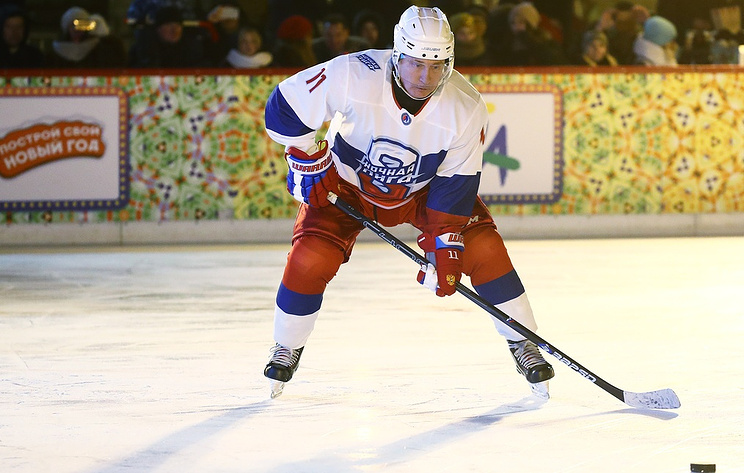
1211505Vladimir Putin playing hockey Moscow’s Red Square on December 29, 2018. Photo courtesy of Valery Sharufulin/TASS and RA’s Daily News Blast
Yana Teplitskaya
Facebook
December 27, 2018

Police officers usually realize that, whatever they do, they are breaking the law or disobeying standing orders, and since they are afraid of being found out, they definitely don’t talk to the press. Here we have a different story, which I don’t know how to explain. Petersburg opposition activists are well aware of a police officer from the “Third Department” by the name of Ruslan Sentemov, while other people have not heard of him, likely as not. For some reason, Sentemov operates quite openly, going so far as to give the local news website Fontanka.ru a detailed interview about his work.

I don’t knowwhat happened to Petersburg opposition activist Shakhnaz Shitik at the Yabloko Party’s Petersburg office, but this is what happened at the police precinct, as related by Shakhnaz. It has been corroborated by one police officer, nor has it been refuted by the other officers who were present. According to the shift commander, during the incident, all or nearly all the officers at the 78th Police Precinct were in the duty room and were separated from the incident by a glass door. I also understand that Shakhnaz’s account is borne out by the videotape that civil rights activist Dinar Idrisov and Petersburg city councilman Boris Vishnevsky have seen.

Sentemov and two of his colleagues (their names are also known) used force on Shakhnaz. They pressed her head hard to her chest, causing her agonizing pain. Consequently, in the incident report, according to the social defender, in addition to the injuries she suffered at the Yabloko office, damage to her cervical vertebrae was caused at the police station.

Moreover, the officers grabbed Shakhnaz’s telephone by sticking their hands down her painties. No public witnesses or female police officers were present during this search, nor was an incident report filed. Taken from her but not officially confiscated, her telephone lay in the police department, along with her blouse and other clothing, prior to the Public Monitoring Commission’s visit. During the incident, Shakhnaz was wearing a bra. The blouse was returned to her only at the hospital.

__________________________________________________

Concerning the sadistic tendencies of our police investigators and judges, I would argue this is an allegory, artistic embellishment. Otherwise, what kind of judicial system do we have? These were your words: the judicial system. The system includes the Constitutional Court and the Supreme Court. Are they sadists, too? We should choose our words more carefully. I realize you wanted to rouse us, you wanted to get our attention. You did what you set out to do. Thank you.

The courts and law enforcement agencies are staffed by our fellow Russian citizens. They live in the places we live in. They [were] raised in the same families in which we were raised. They are part of our society. There are probably all kinds of different people everywhere, in all large organizations. If you have a look at the percentage of law enforcement officers convicted of crimes, it has recently increased and increased considerably.

This suggests the work of housecleaning has not stood still. It has intensified and produced certain results. In order to minimize this, however, we do not need repressive actions against the justice or judicial system. We need serious, multi-pronged, multi-faceted work. That is what we have been trying to do on this Council.

Source: Vladimir Putin, Meeting of the Presidential Council for Civil Society and Human Rights, The Kremlin, Moscow, December 11, 2018. Thanks to Yevgenia Litvinova for the heads-up.

__________________________________________________

Open Russia Activist Whom Police Assaulted in October Detained in Lipetsk
OVD Info
December 12, 2018

Alexander Kiselevich, the Open Russia activist assaulted by four police officers in October, has been detained in Lipetsk. He has reported the incident to OVD Info.

Kiselevich was stopped near his home by traffic police. After checking his papers, they asked Kiselevich to follow them to the Izmalkovo District Police Department, where he was charged with breaking Article 19.3 of the Administrative Offenses Code (disobeying a police officer’s lawful orders). The policemen told Kiselevich he would be taken to court from the police station.

In October, on the eve of an election to choose the head of the Izmalkovo District Council, Kiselevich was beaten by police officers before being taken to a psychiatric hospital for a compulsory examination. Kiselevich was thus unable to present himself to the competition committee, and his name was struck from the ballot

Kiselevich was charged with breaking Article 19.3 after the incident in October. The police claimed Kiselevich resisted them when they were forcibly delivering him to the psychiatric hospital.

Kiselevich is a well-known opposition activist in Lipetsk Region. In 2016, he was elected head of the Afanasyevo Village Council, but shortly thereafter the majority of council members voted to dismiss him. Kiselevich was charged with embezzlement (Article 160 of the Russian Federal Criminal Code).

UPDATE. Kiselevich has reported to MBKh Media that a court in Lipetsk has found him guilty of disobeying a policeman’s lawful orders and fined him 500 rubles. Kiselevich plans to appeal the sentence.

Translated by the Russian Reader

Igor Averkiev: Elections That Kill Democracy

photoIgor Averkiev

There Are Elections That Build Democracy, and Elections That Kill It: The Tricks Is Not to Confuse Them
Igor Averkiev
igor-averkiev.com
March 13, 2018

1. If you relate to elections solely as a value, you will never grasp their essence. You will never tame them.

2. In the modern world, the presence of elections per se in a particular country is neither an achievement nor a value, except for liberal democratic fundamentalists. In the modern world, it is the political outcome of elections that is an achievement and value. In some countries, elections build democracy, while in other countries they kill democracy. In Russia, they kill democracy.

3. There are about two hundred countries in the modern world. The vast majority of them (around one hundred and eighty) hold elections more or less regularly. Around fifty countries in this vast majority are more or less classic democracies. There are another forty countries that hold elections and are more or less classic authoritarian regimes. The other hundredsome countries that hold elections are ruled by a variety of transitional, semi-authoritarian, and hybrid regimes. Meaning that elections per se do not vouchsafe democracy at all. Morever, in most of the world’s countries, people voting in elections does not produce democracy.

4. Elections are merely a social know-how that can be used by anyone for any purpose.  Know-how is a simple thing: if you wield it, you can profit from it in keeping with your interests. An axe is similar in this respect. It matters who wields it: a carpenter or a killer. In the hands of some people, elections produce a democratic regime, while in the hands of others they produce an authoritarian regime. Democracy is not programmed into electoral know-how itself. Democratic elections thus coexist on our planet with authoritarian elections: everything is decided by the person who presides over the elections. If you want elections in Russia to produce democracy, first you have to gain control of them. Elections serve democracy only when they are monitored at all phases by political forces with a stake in democracy. Nor is it only a matter of monitoring the tallying of votes.

5. Elections serve democracy only when the question of power has already been resolved to the benefit of pro-democratic forces or during an unstable transition period in which an authoritarian regime is still in power, but can longer dismiss pro-democratic forces out of hand. Therefore, in order to use elections to advance democratic interests, they must first be taken away from the old authoritarian boss. Or he must be so scared he has to take the interests of pro-democratic forces into account when elections are held. There is no other way. This is how things are done the world over, but millions of freedom-loving Russians for some reason still believe that regularly going to vote in elections presided over by someone else will in itself hasten democracy’s victory in Russia.

6. What is democracy? I won’t go into high-flown arguments, but the democracy that freedom-loving Russians like so much gels only when the country is run by politicians who have no desire to restrict political competition. They are willing, if push comes to shove, to lose elections; moreover, they are willing to accept defeat until the next elections. That’s all there is to it. That is why there is no democracy in Russia: because the people in power restrict political competition and have no intention of losing elections under any circumstances, much less accepting defeat. They are assisted in their restriction of political competition by the selfsame democratic know-how and institutions. It is just that without democratic politicians inhabiting them, this know-how and these institutions are only formally democratic, not democratic in fact.

7. The pro-democratic forces include not only the liberal democratic parties but also all political and civic organizations—leftist, nationalist, imperialist, religious, environmentalist, alternative leftist, alternative rightist, etc.—whose political interests are not bound up with Vladimir Putin’s personalist regime, who have no plans to limit political competition in Russia, and are willing, depending on the outcomes of elections, not only to come to power but also to cede power. Putin’s authoritarian regime can be opposed only by a broad pro-democracy coalition, without necessarily becoming a formal coalition. The trial version of this broad pro-democracy coalition presented itself to the country during the nationwide protest movement that kicked off in December 2011. We should not expect extremely well-coordinated joint actions from a broad pro-democracy coalition. (The “Decembrists” overplayed their hand in this respect.) It is enough to head in the same direction along more or less parallel routes, coordinating actions at certain critical points.

8. An electoral authoritarian regime, such as Russia’s, is organized quite simply. All the democratic know-how a modern country is supposed to have—elections, representation, separation of powers—functions smoothly, but not all comers have access to it. It is even simpler than that. An authoritarian regime simply does not allow potential competitors, that is, leaders and organizations, to get on their feet politically and grow organizationally to the extent they would be able to surpass the two- or three-percent minimumthreshold of votes needed for admission to the political arena. It does this by refusing to register parties, intimidating leaders, limiting freedom of speech and freedom of assembly in a pinpoint fashion, etc. If, despite everything, they nevertheless grow and thrive, they are simply not admitted to elections, as I have mentioned. In Russia, therefore, democratic procedures do not serve democracy. The soul of democracy is not know-how, procedures, and institutions, but people willing to use them in a particular way. In Russia, politicians interested in democracy simply do not make it into formal democratic politics. Thanks to the political regime built by Vladimir Putin, year after year only pro-authoritarian political forces make it into Russia’s formally democratic politics, and year after year they limit the involvement of pro-democratic forces in democratic procedures. It is a vicious circle. There is democracy, and there is no democracy at the same. Putin’s authoritarian regime is even elegant after a fashion.

9. Elections in authoritarian countries do not increase the supply of democracy, nor do they prepare the way for it, since they do not facilitate competition, do not put the opposition through its paces, and do not put rank-and-file voters in circumstances where the country’s fortunes depend on the choices they make. In authoritarian countries, elections function as a full-fledged authoritarian institution for legitimizing the regime. In authoritarian countries, elections are required only as a source of power, nothing more. Everyone involved in these elections is involved solely in legitimizing the regime. They are doing nothing else.

10. In authoritarian and hybrid countries, including modern Russia, elections have another vital political function. Elections are also an outlet for the liberal public, a valve, installed by the regime, for releasing oppositional steam and keeping opposition politicians busy somehow. The Putin regime has used elections to satisfy the need many freedom-loving Russians have to “fight for democracy” in a safe, comfortable way, a way that lets them feel like decent dissidents honestly doing their duty. Everyone comes out on top. The liberal public engages in self-actualization, and the regime does not find it frightening.

11. If the liberal democratic opposition’s sole aim is symbolic involvement in election campaigns within the authoritarian regime, but year after year the regime does not permit it to grow politically and organizationally, and does not allow it to run in elections, the opposition will gradually wither and become marginalized. This, in fact, is the kind of opposition we have nowadays. If we realize, however, that elections serve democracy only after the question of power has been decided to the benefit of pro-democratic forces, it means we need a different opposition altogether, one radically different from the opposition that has filled the niche the past fifteen years. We need a liberal democratic opposition that is not hung up on being involved in meaningless elections governed by someone else’s hostile rules. We need an opposition focused on vigorous, direct political action and a propaganda duel (a fight over values) with the regime in order to command the attention and respect of the so-called Putinist majority, those very same “ordinary people” who, when a window of opportunity opens, would at least not oppose the new, free-minded political alternative. There is a big problem with the word “new,” however.

12. The creation of a new, free-minded opposition is encumbered by the liberal democratic fundamentalism that holds sway in the minds of Russia’s freedom-loving public. One manifestation of this fundamentalism is, in fact, the irrational cult of elections: all elections are good, regardless of their political essence and their consequences. Two other burdens are the extreme political impracticality and even archaicism of today’s liberal democratic platform. Currently, we have nothing to offer people from the standpoint of a future regime. Here is a simple question. What can we offer the average Russian family, something they would really need and value, that the Putin regime either cannot give them or promise them? The keywords in this case are “really need and value.” Moreover, in the obviously adverse conditions of a post-Putin Russia, the current liberal democratic prescriptions would necessarily lead the country into new crises the very first year they were implemented and, consequently, to new outbursts of the conservative revolution. It is ridiculous to discuss this with educated people, but thinking outside the box is now more important than doing things. At very least, it is more important than running off to vote in Putin’s elections.

13. For free-minded Russians and Russian politicians, the issue today is not how to win Putin’s authoritarian elections, but how to behave and build a reputation in society today in order to win future democratic elections in which the former so-called Putinist majority would be among the voters. If you want to facilitate the collapse of the Putin regime, you need to work less with the Putinist state and more with the Putinist majority.

14. The main problem freedom-loving Russians face in the impending presidential election is not what choice to make, whether to vote or not, and certainly not who they should vote for. The main problem is that whatever choice each of us makes—to vote or not vote, to vote for Yavlinsky or Sobchak—it will have no impact whatsoever on the fortunes of Vladimir Putin and his political regime. Any electoral action we take will change nothing about the election or the regime. Judging by various opinion polls [sic], there are between ten and fifteen million of us in Russia. Even if we assume the incredible—that all of us would act in concert in this election, and thanks to our monitoring the elections themselves would be extraordinarily fair—we cannot have a significant impact on the outcome of the election, even if each of us to the last man boycotted it or we all voted for Ksenia Sobchak or Grigory Yavlinsky.

15. Everything is seemingly quite simple. In Putin’s Russia, elections have nothing to do with building democracy and vanquishing the Putin regime. Why, however, does something so evident not get through to many advocates of liberty and diversity in Russia? How did the perverted cult of mandatory involvement in all elections take hold among such a considerable segment of the Russian liberal public? There are explanations. First, many opposition politicians, speakers, opinion leader, and experts have a professional stake in Putin’s elections. Some of them try and run in these elections (the simplest way of being an opposition politician in an authoritarian regimes), while others assist the elections professionally, serve as polling station monitors, analyze the whole megillah or write about it. This entire mob would simply be out of a job, in the broad sense of the word, if the opposition-minded public did not vote in authoritarian elections. Thus, in the opposition milieu, they are the principal propagandists and agitators for the idea of voting in these demonstrative non-elections. Since, as a rule, they are the most intelligent, energetic, and authoritative people in opposition-minded communities, their opinion is quite important. Second, as I have mentioned, above, involvement in authoritarian elections (“but they are elections all the same”) has served a considerable segment of the liberal public as a safe, comfortable way to “fight for democracy,” a way that lets them feel like decent dissidents honestly doing their duty. The notion that it is foolish and nasty for an advocate of democracy to vote in authoritarian elections immediately nullifies the opposition’s semantic space, the space of election enthusiasts, plunging them into the “desert of the real.” Everything is so painful and disturbing in that desert. You have to acquire a new civic faithfulness to yourself, redefine yourself in terms of the meanings and tools of your opposition, what normal risks are, who your supporters and opponents are within the opposition, and so on. “No, it’s better to vote in Putin’s elections.”

16. On the other hand, if nothing really depends on us in Putin’s elections, is it worth persuading our allies not to vote in them? Why hassle people? Why prevent them from doing what they deem important? Because things won’t get any worse for us if they do vote in the election anyway, right? I think it is still worth pestering them. Politics, after all, depends on political sentiments and emotions, and thoughts are tangible things even when they are not true. If millions of people who hunger so much for freedom and diversity in Russia think, “How can I vote in authoritarian elections the right way, so that it benefits the opposition’s cause?” that is one kind of opposition. But if millions of people who hunger so much for freedom and diversity in Russia think, “What else, besides voting in authoritarian elections, can I do to dismantle the Putin regime and bring about the victory of freedom and democracy in Russia?” that is a completely different opposition.

Igor Averkiev is the chair of the Perm Civic Chamber. Photo courtesy of Igor Averkiev. Thanks to Comrade Koganzon for the heads-up. Translated by the Russian Reader

“The Rowdies Have to Be Apprehended Legally, So We Can Have a Celebration in the City on March 18, not Bedlam”

8792CD92-EE28-452C-859C-77B15F02744B_w1023_r1_sThe political performance “Clanking Chains,” March 11, 2018, Petersburg. Photo by Tatyana Voltskaya. Courtesy of RFE/RL

Petersburg Puts Oppositionists on Pause: Eight More Activists Detained
Maria Karpenko, Kseniya Mironova and Anna Pushkarskaya
Kommersant
March 13, 2018 (updated March 14, 2018)

The arrests of opposition activists continue in St. Petersburg. In the last two days, police have apprehended eight activists, three of whom ended up in police custody at the courthouse, where they had gone to support their comrades. The court has already remanded eight people in custody for their alleged involvement in a protest rally that took place a month and a half ago. At Petersburg city hall, Kommersant was told, “The rowdies have to be apprehended legally, so we can have a celebration in the city on March 18, not bedlam.”

On Tuesday, Smolny District Court in St. Petersburg sentenced three opposition activists—Viktor Cherkassov, Yekaterina Shlikhta, and Ilya Gantvarg (son of Mikhail Gantvarg, ex-rector of the St. Petersburg Conservatory and Russian Federation People’s Artist)—to ten days in jail. Police had apprehended them on Monday for involvement in the so-called Voters Strike, a protest rally held on January 28 by supporters by Alexei Navalny. Yegor Ryabchenko, who was also apprehended, was only fined.

On Tuesday, police apprehended another three activists—Vladimir Kazachenko, Alexander Kirpichov, and Darya Mursalimova, who had come to support their comrades—right in the courthouse. Mursalimova and activist Sergei Belyaev, also apprehended on Tuesday, were sentenced by the same court around 11 p.m. in the evening. Mursalimova was given fifteen days in jail for repeated involvement in an unsanctioned rally, while Belyaev was sentenced to seven days in jail and twenty hours of correctional labor.

Kazachenko and Kirpichov’s court hearing was scheduled for Wednesday.

The new wave of arrests was prefaced by a flash mob [sic], entitled “Clanking Chains,” during which ten activists marched down Nevsky Prospect in chains and prisoners’ outfits. The [performance], which took place on March 11, was held in support of oppositionists who had already been jailed.

The defense attorneys of all of the activists jailed on Tuesday plan to file appeals in St. Petersburg City Court. If the appeals are unsuccessful, the activists will be released only after the presidential election on March 18, just like the three oppositionists already in police custody on the same grounds.

In early march, the court sentenced Alexei Pivovarov, Open Russia’s regional coordinator, Denis Mikhailov, head of Alexei Navalny’s Petersburg headquarters, and Artyom Goncharenko, an activist with the Vesna (“Spring”) Movement, to twenty-five days in jail for their involvement in the Voters’ Strike.

Moreover, Mr. Mikhailov had just served thirty days in jail for organizing the same event, while Mr. Goncharenko had not attended the rally at all. He had merely displayed an inflatable yellow duck in the window of his apartment building, past which the protesters marched. St. Petersburg City Court rejected an appeal to overturn their jail sentences, despite arguments made by the defense that the “deferred punishment” for violating the rules on rallies was “politically motivated.”

The January 28 protest rally was peaceful. Police detained around twenty people, which was very few compared with previous unauthorized protests in Petersburg. Except for Denis Mikhailov, all of the detainees were released from police precincts after police had so-called preventive conversations with them. They were not even written up for administrative violations.

Our source at Petersburg city hall explained what was happening.

“The rowdies have to be apprehended legally, so we can have a celebration in the city on March 18, not bedlam.”

Thanks to Comrade NN for the heads-up. Translated by the Russian Reader

Lev Schlosberg: The Veil of Public Opinion


Lev Schlosberg is a member of the Pskov Regional Assembly and the Yabloko Democratic Party’s national political committee. Photo courtesy of Pskovskaya Guberniya Online

The Veil of Public Opinion: Russian Opinion Polling Has Become Part and Parcel of State Propaganda 
Lev Schlosberg
Pskovskaya Guberniya Online
1 March 2018

Public opinion polls are constant companions of politics and national election campaigns. In democratic countries, polls are reflections of the public discourse surrounding politicians, ideas, political platforms, and conflicts. They echo public opinion in all its fullness and thus facilitate the public discourse itself regardless of who is involved in it: the authorities, the opposition or society at large. In twenty-first century Russia, political pollsters have a different job. They are tasked with persuading society the regime is terrific and everything (or nearly everything) is going great. During elections, they are supposed to generate the illusion of nationwide support for the authorities.

Polling is a tool of political manipulation in the hands of bureaucrats. Polling data is meant not merely to testify to broad support for the authorities but also to persuade dissidents they are few and far between, to discourage them and sap them of their will.

There is a whole set of techniques behind manipulating public opinion. The findings of public opinion polls, allegedly obtained scientifically, by means of formal research methods, are supposed to convince people of their objectivity and impartiality.

Honest political polling and sociological research is something that goes on in free, democratic societies. When answering questions on a questionnaire or taking part in a group or individual focused interview, a person should be sure she can speak openly and safely, even when she criticizes the authorities.

Fear is the enemy of honest polling. In authoritarian and, especially, totalitarian societies, people are afraid of making critical statements with their names attached to them, whether that entails filling out a standardized questionnaire or answering a question openly and at length. The classic set-up is when the interviewer knocks on someone’s door or comes up to someone on the street and asks, “How would you rate Vladimir Putin’s performance? Do you support him completely, partially or not at all? To ensure the quality of our poll you may get a follow-up telephone call. Please give me your name and telephone number.”

How do you think approximtely 86% of respondents would behave? Well, that is, in fact, how they behave: by giving the “right” answer.” There are many examples of this.

Now put yourself in the shoes of rank-and-file Russians, who are regaled round the clock with tales of Putin’s 86% popularity rating by all manner of mass media: TV, radio, newspaper, the internet.  People who do not agree with the authorities but are not experienced in the nitty-gritty of politics will imagine they belong to an obvious, hopeless political minority. They are social outcasts, virtually bereft of kindred spirits.

This is the impression the people behind such political pressure polling want to achieve. A picture of absolute political domination stifles a person’s will and reduces his willingness to voice his stance and take action. This extends to getting involved in politics and voting in elections.

When a person feels insignificantly small, she is made tired and exhausted by the very feeling of her smallness and insignificance. Thoughts of emigrating often occur to people who feel they are in the minority, trapped in a political ghetto.

Political pressure polling is a new means of combating dissent, of attacking the opposition.

VTsIOM recently reported that, according to the findings of an extensive telephone poll (one of the least reliable polling methods), 81% of voters plan to vote in the March 18 Russian presidential election.

Enthusiastic nationwide support is the dream of all dictators. As people who suffer from hypertrophied inferiority complexes, dictators compensate by demanding the entire nation love, adore, and admire them. This popular love must be constantly corroborated by public opinion polls and elections.

Under authoritarian regimes, all authentic democratic institutions are reduced to imitations and desecrations, and public opinion polls are very revealing instances of this.  The mirror of society is turned into a fake painted on a blank wall.

Political pressure polling performs another vital function by setting the bar for electoral fraud.  If the polls anticipate a voter turnout of 81%, officials at all levels will work to ensure an 81% turnout. If the polls say 70% of Russians support the so-called national leader, officials will encourage election commissions at all levels to ensure he takes home 70% of the popular vote.

A vicious circle is produced. One lies begets another, and the lies generate fear and violence. To top it all off, lies generate aggression. Public opinion research serves as a means of zombifying and corrupting public opinion.

Instead of a portrait of society, we see a caricature of society.

At the same time, the authorities lose society’s feedback. They do not know or understand what people think and want, sending themselves and the entire country into a dead end. In the absence of honest polling, the authorities and society are blinded. God knows where the road could lead if no one can see the road itself and no one understands where the country is headed.

Political pressure polling is a veil that conceals the truth of events from the authorities and from society. This is quite dangerous and can produce tremendous shocks.

Until the last minute, the dictator has no clue what people think about him. Then the moment of disaster dawns. On the eve of his overthow and execution, Nicolae Ceaușescu’s official popularity rating was 95%. It did not protect him, but rather hastened his terrible demise.

Currently, Russian society lacks a reliable map of public opinion, because fear has paralyzed many people, and because when the authorities pimp an honest profession, far from all of the people who practice it remain faithful to its standards. Doing so is difficult and takes great courage.

Enveloped in such darkness, we need to understand a few things.

First, it is impossible to stop the course of history. An unfree society will yield to a free society. Our responsibility is to go in the right direction.

Second, the less the authorities know the truth, the sooner the regime will come to an end. It takes time and patience.

Third, in order to know and understand the truth, it is enough to ask yourself, “What do I think? What do I believe? What are my convictions?” Under no circumstances should you give up on yourself.

The job of free people in today’s Russia is not to lose face.

Ultimately, it will change the face of the entire country.

Thanks to Comrade Preobrazhenskaya for the heads-up. Translated by the Russian Reader

Maria Eismont: Moscow’s Municipal District Opposition

DSCN0811
Like other municipal district councils in Russia’s major cities, Petersburg’s Vladimirsky Municipal District Council has a meeting space and offices, and enough money to publish a newspaper and fund very minor improvements in the neighborhood, but it has virtually no political power and survives only at the mercy of city hall and the city’s legislative assembly. Photo by the Russian Reader

How Things Are Going for the Municipal District Opposition
New politicians searching for a new agenda
Maria Eismont
Vedomosti
November 23, 2017

Sergei Sokolov was the only opposition member in the previous sitting of Moscow’s Konkovo Municipal District Council.

“I could not beat pro-regime council members when things were put to a vote, but I still managed to discourage them from doing things the neighborhood did not need,” says Sokolov, recalling his preceding five-year term on the municipal district council.

In September 2017, a team of Konkovo activists, led by Sokolov, won neighborhood elections, taking eight of the fifteen seats on the municipal district council. Sokolov was named head of the district, since Konkovo’s charter stipulates a simple majority of votes by council members to elect a district head, unlike other municipal districts. In other neighborhoods where the opposition won majorities on councils, their candidates for district heads ran into problems, since they needed the backing of two thirds of council members to win the posts, but they came up short on votes.

For the first time in many years, independent candidates won majorities in several Moscow municipal districts. In several instances, they won overwhelming majorities, but the question of whether grassroots self-government is possible in Moscow remains open.

The fact that Moscow’s municipal council members have scanty means at their disposal and insufficient powers was well known before and during the campaign. Yet now the new democratic politicians, who have taken power at the lowest level of Russia’s political totem pole, must show themselves and their voters that this is, in fact, the beginning of big and important changes in Russia.

Opposition politician Ilya Yashin, now head of the Krasnoselsky Municipal District, has already gone public with the new council’s first legislative undertaking. They have suggested eliminating the current system of so-called golden parachutes for outgoing municipal district council members and municipal district heads.

Konkovo’s independent council members have gone further. Within ten days of taking office, Sokolov sent the Moscow City Duma a request for 19 million rubles [approx. 275,000 euros] in additional funds for Konkovo’s budget, paid for with an increase in the allocation of personal income tax revenues.

“There are no rational explanations for the inexplicably low, discriminatory amount of personal income tax revenues allocated to the Konkovo Municipal District’s budget,” Sokolov wrote.

Council members have proposed spending the money on neighborhood improvements, accessible legal aid for low-income people, and a Southwest Moscow History Museum.

Last week, Konkovo council members came out with a legislative initiative to amend the Moscow City Law “On the Budget’s Structure and the Budgetary Process in the City of Moscow,” proposing to set the amount of allocations to municipal district budgets from personal income tax revenues at five percent. (It is currently set at 0.96%.) Economist Vladimir Milov helped draft the bill.

“I had been thinking about this initiative for a long time, and our team was organized for this purpose,” says Sokolov.

There are traces of picture frames that once held photographs of the president and prime minister on the wall in Sokolov’s office. They have been replaced by a hand-drawn portrait of slain opposition leader Boris Nemtsov.

“I have no illusions about the bill. United Russia still has a majority in the Moscow City Duma,” says Sokolov. “I don’t yet know how we are going to lobby the bill, but we will  be employing our usual methods: media outreach, rallies, and similar public things.”

It is difficult to imagine the circumstances in which Moscow city officials would meet the opposition municipal districts halfway, voluntarily giving up some of their money and authority. But it seems extremely important the reform of local self-government continues to be discussed and elaborated.

Translated by the Russian Reader

Three Years Later: Suicide by Crimea

Suicide by Crimea
Nikolay Klimenyuk
oDR
March 17, 2017

As long as Russia maintains its grip on the Ukrainian peninsula, significant changes for the better at home are impossible.

In the three years that have passed since the annexation of Crimea, a consensus has taken shape in Russia. Everything having to do with the Ukrainian peninsula is Russia’s internal affair, and far from the most important one.

The “accession” of Crimea has even quite succesfully happened in the heads of the regime’s opponents. In November 2016, while arguing on Facebook with Crimean Tatar journalist Ayder Muzhdabaev, Mikhail Khodorkovsky expressed a stance then supported by many publicly prominent liberals, including activists and intellectuals. Russian society, he argued, wants to deal with other problems. The opposition’s biggest task is regime change, but returning Crimea to Ukrainian jurisdiction by democratic means would be impossible because public opinion would be opposed. Crimea is not mentioned at all in Alexei Navalny’s 2018 presidential campaign platform.

Russian media outlets generally considered “liberal” (these media usually eschew the word “opposition”) havealso swallowed the annexation and most of the rhetoric surrounding it without a peep. TV Rain, RBC (even before its top editors were replaced), and the online Meduza, which operates out of Latvia and is not not subject to Russian laws, have all long routinely called and depicted Crimea as part of Russia. The standard explanation—it is required by Russian law, and insubordination is fraught with penalties—sounds like an excuse. The law does not require that questions about Crimea be included in a quiz on knowledge of Russian cities (which was amended after public criticism) or that reporters term the annexation a “reunification” (Meduza edited the latter term to “absorption.”)

At the same time, Russian reporters usually have no problem demonstratively violating Ukrainian laws (which require them to enter the occupied territory through the checkpoint at Perekop) and flying to Crimea from Russia (as Deutsche Welle reporter Yuri Resheto did), because it’s cheaper, faster, and simpler, and because Ukraine’s rules are cumbersome, inconvenient, and nonbinding.

After that, you can write critical reports on human rights violations in Crimea till the cows come home, but it won’t change what matters. The voluntary observance of inconvenient Ukrainian rules is tantamount to acknowledging Ukraine’s sovereignty over Crimea, and hardly anyone in Russia wants to do that.

In fact, the seizure of Crimea has been the cause of many pressing problems in Russia that have been on the Russian opposition’s agenda. It has laid bare peculiarities of Russian society that existed longer before the attack on Ukraine.

For example, not only did the extent of imperialist moods become clear but also Crimea’s place in how Russians see themselves as a society and a nation. The imperial myth, still alive and well in Russia, was concocted during Catherine the Great’s reign. From the moment they were implemented, Peter the Great’s reforms had provoked a mixed response. They smacked of “sycophancy,” and modeling the country on Holland seemed somehow petty.

Catherine, on the contrary, conceived a great European power, rooted in antiquity, Byzantine’s direct heir, the Third Rome, a Europe larger than Europe itself. Her ambitious Southern Project, which involved defeating Turkey, uniting all the Orthodox countries in a single empire, and installing her grandson the Grand Duke Constantine on the throne in Constantinople, was brought low by political reality. The only one of her great fantasies she made come true was seizing the Crimean Khanate, in 1783.

The conquest was extremely atypical of Russia. A troublesome neighbor was not subjugated. Rather, the annexed lands were completely reimagined and rewritten. The rewriting was attended by the first mass expulsion of the Crimean Tatars. They did not fit at all into the pictures of the radiant past that Grigory Potemkin was painting in reality on the annexed lands. Crimea was resettled with Plato and Aristotle’s Orthodox descendants: Pontic Greeks, Great Russians, and Little Russians (i.e., Ukrainians). Naturally, all these particulars have been forgotten long since. What has not been forgotten is Crimea’s central place in the self-consciousness of a “great European nation,” as manifest, for example, in the absurd, endlessly repeated expression, “Crimea has always been Russian.”

The saying perfectly illustrates the peculiarities of historical memory in Russia. Crimea’s current “Russianness” is the outcome of over two hundred years of the uninterrupted genocide and displacement of the “non-Russian popuation,” which culminated during the Second World War. After the two Soviet deportations of 1941 and 1944 (ethnic Germans, Greeks, Bulgarians, Italians, Armenians, Karaites, and Crimean Tatatrs were deported), losses during battles, and the Nazi extermination of Jews and Crimeans, only a third of Crimea’s pre-war inhabitants were left. It was resettled with people from Russia and Ukraine, especially by military officers and veterans of the Party and the secret services.

Naturally, few people in Russia today regard Crimea as a conquered and ravaged country, in which a full-fledged state existed until relatively recently, an indigenous culture was long maintained, and Russians were never the ethnic majority even during the lifetimes of the present elder generation.

Regarding Crimea as a territory, not a society, and treating Crimeans as an annoying inconvenience, was a habit in Catherine’s times and has survived into the present. The formal excuse for the Russian incursion was the “defense of Crimea’s Russophone population,” and yet the “Crimea is ours” attitude of Russians to the peninsula’s residents has been quite skeptical from the get-go. They imagine the main business of Crimeans is leaching off tourists, and the only thing that attracts them about Russia is high wages.

Moreover, this opinion is common across the entire political spectrum. Sergei Parkhomenko, a liberal journalist and public figure, expressed it in a very telling way.

“If first you take five days to explain to the population of Crimea that if they return to Ukraine’s jurisdiction, their wages and pensions will be increased, and they’ll also be permitted to build even more chicken coops for holidaymakers in the coastal zone, and only then you ask them to vote in a referendum, 95% will vote for going back. […]  These people have proved they could not care less what country they belong to. And if there is anyone for whom I now feel not an ounce of sympathy as I read about how they are being fooled, robbed, milked, and put under the rule of gangsters pretending to be officials and bosses, it is the population of Crimea.”

The massive support of Russians for the annexation has much more serious and immediate consequences than a display of deeply rooted chauvinism. Having signed off on “Crimea is ours,” Russians have deemed their own power above the law and sanctioned its use in violating all laws and treaties for the sake of higher interests or “justice.” The Russian authorities had behaved this same way previously, but now they have obtained the relevant mandate from society. Quite naturally, the crackdown following the seizure of Crimea has been chockablock with spectacular acts of lawlessness.

One such act was the demolition of commercial kiosks and pavilions in Moscow, which happened despite legalized property rights and court rulings. There was nothing accidental about the fact the Moscow authorities justified their actions by citing the law adopted for settling real estate disputes in Crimea. And the twenty-year-sentence handed down to Oleg Sentsov set a new ceiling for verdicts in political trials. Before Crimea, activists would get a dvushechka (two years) for especially vigorous protests. After Crimea, the Russian authorities have been sentencing people for reposts on VK and holding solo pickets.

Actually, any regime that tasks itself with establishing the rule of law in Russia will first have to annul this “mandate to lawlessness.” The Russian opposition’s attitude to Crimea shows the rule of law is not among its priorities at all. Bewitched by the figure of Putin, the opposition does not regard regime change as a product of the rule of law. The fact that it cannot offer a realistic scenario for regime change is not a problem in itself. Russia’s currrent regime does not presuppose a peaceful change of power. Systemic change might happen as it did in the Soviet Union, at the behest of the bigwigs and under the impact of external circumstances: the state of the economy, public sentiment, foreign policy factors.

The opposition’s most serious problem is that it doesn’t have a meaningful outline of what would come next.

If we believe the alternative to Putin is neither Navalny, Khodorkovsky nor anyone else, but a democratic state based on the rule of law, there are two obstacles in our way: Crimea and Chechnya. The opposition has no vision of how to establish control over Chechnya and incorporate it into Russia’s legal system, but it is possible in theory, at least. There is no such possibility with Crimea. It is impossible to hope for international recognition of the peninsula as part of Russia, and if we keep regarding it as part of Russia, it will thus remain a legal anomaly. Moreover, no rule rule of law is even formally possible without observance of international law.

When discussing Crimea, the Russian opposition evinces a notion of democracy that differs little from Putin’s, although it is consonant with the rhetoric of Donald Trump and the European populists: that democracy is rule based on majority support and not burdened by the observance of laws, procedures, and international obligations. Khodorkovsky, for example, considers “democratic procedure” not the restoration of law, but the adoption of a decision on Crimea based on the opinion of the majority, which, allegedly, is against giving Crimea back to Ukraine. Navalny has suggested holding a new, “normal” referendum.

Yet what the majority really thinks, whether there is such a thing as public opinion on any issue and how to measure it, obviously means nothing at all either to Khodorkovsky, Navalny or many other members of the opposition. By the same token, since Putin is supported by the majority of the Russian population, there is nothing for the opposition to do at all. All these contradictions can be eliminated only by unconditionally recognizing both the illegality of Crimea’s annexation and the total impossibility of keeping it in the Russian Federation on any grounds.

With Crimea in tow, Russia has no positive alternative to the current regime. And as long as the Russian opposition is concerned only about regime change and avoids discussing Crimea, the only thing it can offer is a Putinist Russia sans Putin. Whoever ends up in his place, however, the changes won’t be too noticeable.

Nikolay Klimenyuk writes about politics and culture in Germany and Russia. He was an editor at Forbes Russia, Bolshoi Gorod, and other periodicals. He has lived in Berlin since 2014 and writes for Frankfurter Allgemeine Zeitung and other German mass media. Translation and photo by the Russian Reader

Alexei Gaskarov: What Politics?

Alexei Gaskarov: Many People Ask Whether I Am Going to Take up Politics. But What Politics Are There Nowadays?
Olesya Gerasimenko
Snob
November 1, 2016

Anti-fascist Alexei Gaskarov has been released from prison after serving three and a half years in prison for alleged involvement in the Bolotyana Square riot in Moscow in 2012. Snob asked Kommersant special correspondent Olesya Gerasimenko to meet with Gaskarov to discuss the Bolotnaya Square case, life and education in the penal colony, and the death of the protest movement. 

Alexei Gaskarov. Photo courtesy of Tanya Hesso/Snob
“Why would they ask me about organizing a riot if they knew no one organized it?”

Was your trial fair?

I regret we agreed to be involved in it. Like Soviet political prisoners, we should have stood with our backs turned and kept our mouths shut, and not treated it as an attempt to get at the truth. I had illusions after Khimki. [In 2010, Gaskarov was arrested and charged with attacking the Khimki town hall during a protest in defense of Khimki Forest, but the court acquitted him. — Snob] Several videos showed clearly that the incidents involving me happened before the riot kicked off, according to police investigators themselves. In the end, I ticked off the evidence, the judge nodded her head, but there was no reaction. The entire trial looked as if the decision had already been made, the sentence written out, and let’s get this over as quickly as possible.

So did you push a policeman and pull a soldier out of the police cordon?

I never denied it from the get-go. A year had passed since the rally on Bolotnaya Square. I was working on an important project. I had a week to go, and it was uncool to have to go to jail. I had to go to work on the Sunday the cops came for me. I had gone to the shop to buy food for the cat, and the whole clown show was waiting outside my building: two jeeps and a van. Young dudes half dressed like boneheads stepped out of the van. I decided they were from BORN [a group of radical right-wing nationalists who carried out a series of murders and assaults — Snob]. I was pondering what moves to make, but they produced their IDs.

Did you feel relieved?

No, just the opposite. I could have run from BORN or done something else. So they detained me and kept mum about what the charges were for a long while. They made me lie face down in the van and  the whole works. There were lots of things they could have detained me for. We had been defending the tenants of the Moscow Silk (Mosshyolk) dormitories from eviction and the Tsagov Forest in Zhukovsky from logging by developers. And shortly before my arrest, people who are now serving in the Azov Battalion attempted to assault my wife and me. I tussled with them, and it ended up on camera. So there were different possibilities. I was not thinking about Bolotnaya at all. When it finally became clear why I had been detained, I stared at them.  It was total rubbish. I told them I agreed to admit what I had done. We had been walking amid the crowd, when a riot cop attacked this dude. A dogpile ensued, and people pulled them apart. I was accused of pulling a policeman’s leg. The evidence was a poor quality video and a forensic report that concluded it was not me. But I knew it was me. So I told them right away, Guys, let’s do this the right way. But they could not have cared less whether I admitted my guilt or not. It would have been a different story if I had confessed to violating Article 212 of the Criminal Code (organizing a riot) or testified against someone else.

Were you asked?

They didn’t even mention it. Why would they ask me about organizing a riot if they know no one had organized it, including from their own wiretaps? They kept the charges to the incident with the leg pulling. Then they found a second incident. A stampede started in front of the police line. People were falling on the ground, and I tugged one policeman by the shoulder to make room. The indictment said I had broken the police line so that everyone could get to the riot. But this line had been at the passage in the other direction.

OIesya Gerasimenko and Alexei Gaskarov. Photo courtesy of Tanya Hesso/Snob

Did you expect such a sentence?

They had already told me at the Investigative Committee they were going send me down. I said, Well, of course. Later, the Center “E” guys showed up and threatened me with ten years in prison, but I know that could not happen. The rules of the game are still followed, and punishment for a particular crime is usually consistent with ordinary practice.

How do you feel about the case of Udaltsov and his associates?

I have very negative feelings about it, of course. I ran into [Leonid] Razvozzhayev in the pre-trial detention facility, but I wasn’t really able to chat with him, because he was always in very bad shape. Udaltsov and his associates operated like real con men. Before May 6, 2012, they had no clue how the march would go, and there is no mention of sitdown strikes and rushing police lines in the wiretaps. But after everything had happened on Bolotnaya, they began acting in their meetings with Targamadze as if everything had gone according to their plans. Their initial excuse, that they had traveled to Georgia to talk about wine and mineral water, was pure idiocy. Naturally, it is not against the law to have meetings and discuss business. But there is a political ethic that does not let you behave this way. You go meet dudes from the government of another country, a country with whom [your country] recently had a conflict. You ask for money, and you take money. If these meetings had not taken place, the Kremlin would have failed to generate the image of the Bolotnaya Square case that it did. We should not have had to answer for things over which we had no control. The benefits to Udaltsov were personal, but everyone shared the risks.

So you received no money from Givi Targamadze?

Are you kidding? What money?

Who was the anonymous anarchist informer who testifed against you?

I didn’t even find out. I have had nothing to do with them for many years. The guys still have their little movement. Like Tolkien fans, they attend meetings and discuss for hours on end how they should make a revolution. They have been doing this for the last twenty years. It was of no interest to anyone. The FSB sent its people in. They went and had a look at it and said, Well okay, you have a cool club. When Center “E” was established, they went after them big time to push up their arrest stats. All anarchist meetings are open, anyone can come. So they are known to the authorities. The teenager from this scene who went to Bolotnaya and was involved in breaking through police lines was identified in this way. They put the squeeze on him: either we send you down or you tell us what we want to hear. I have no idea why this was necessary, because he just said I was a bad dude and the leader of the anti-fascists and anarchists. But nobody charged me with that.

“The rules of survival are simple: don’t do anyone harm”
Alexei Gaskarov. Photo courtesy of Tanya Hesso/Snob


Tell me about life in prison. Everyone is interested in that. You know, reveille at six, lights out at ten.

Yeah. As you understand, people who are drug addicts, people going through withdrawal, basically live at night. After lights out, they either smoke or brew chifir [a super strong tea brewed in Russian prisons]. You just set that aside. You have your routine, and basically it is good for you. No one limits the amount of exercise you do: there is a horizontal bar, parallel bars, and a few weights. You are either working or busy with your own things. I got into shape there like I never have before. The point is to come up with as many things to do as possible so you have no spare time at all.

What did you read?

The library there was okay, because everyone who does time gets books and then leaves them behind. They see who has been nominated for the Booker Prize and order their books. It’s not hard to find new releases in prison. I also subscribed to several pro-Kremlin publications, and I read lots of your articles, too. And I read The New Times and Novaya Gazeta. I wanted different viewpoints. Plus, there is a legal video link in there. It is limited to fifteen minutes a day, but in fact nobody keeps track of the time.

Who were your cellmates? 

I spent half my sentence in a pre-trial detention facility. The dudes in there had been charged under Article 228 of the Criminal Code [purchase, storage, production, and sale of narcotics — Snob]. Their stories were horrible. One group of teenagers had gotten hash in the mail from Holland, and they had been sentenced to fifteen years in prison. Or there were the dudes who decided to cook amphetamine using a recipe they found on the Internet. They got nineteen years in prison. I was even ashamed to explain what my case was about, because I was surrounded by people facing over ten years in prison.  When the trial began, we were kept in Butyrka Prison. They were thieves, crazies, teenagers, street kids, and Dagestanis in there. I also met defendants in the Rosoboronexport case, the APEC Summit case, and the Sochi Olympics case, and I went to the gym with Alexander Emelianenko.

The general population at the penal colony consisted of three hundred men. Eighty percent of them were local dudes from Tula Region who had attacked somebody while drunk, stolen things from dachas, and committed petty robberies. But what is the catch about the general population? That a homeless man who broke into someone else’s dacha to spend the winter got sent down to the penal colony, and his life there is better than on the outside, and he is in the same place as a big-shot businessman who has lost a billion rubles and used to go sailing on his yacht on the outside.

Does this lead to lots of conflicts?

There are lots of conflicts, but the instigator always takes the rap for a fight. That doesn’t mean there are no fights. They are criminals, after all, and they tend to take risks. But the rules of survival are simple: don’t do anyone harm. If you watch TV after lights out, turn down the sound. Don’t drag in dirt. It’s all basic.

Alexei Gaskarov. Photo courtesy of Tanya Hesso/Snob

Was it easy for you to understand them?

Yeah. In 2010, I was in a pre-trial detention facility with repeat offenders and learned the tricks. And during my early days in the penal colony I read Shalamov and Solzhenitsyn’s stories about the prison camps.

Like a set of rules?

Yes. The Center “E” officer who led the investigation in my case told me a lot and advised me what books to read. When I was on the inside, people asked my advice on how to behave.

When you got out you said the main thing had been to maintain contact with reality and your health. How did you maintain your health? Was the food there okay?

Due to the fact that support from the outside was good, I almost never ate in the cafeteria.

But what about hot meals?

There is a microwave there. The Federal Penitentiary Service (FSIN) now has taken the approach of not keeping you from improving your living conditions. They need to implement their strategy for improving conditions in the penal colonies, but their budget has been trimmed. When you arrive, everything is crappy. Water is dripping from the ceilings, and there is mold. But they don’t mind if you want to invest your own resources. You write everything up as humanitarian aid, and you get electric kettles and microwaves. We had a projector hanging in our cell for watching films.

Now everyone will want to roll back two years to read books and watch films on a projector.

We also purchased a bunch of armchairs from IKEA. So when the head office comes to make an inspection, they show them how cool everything is in their colony.

I think you wanted to get another degree in prison.

Unfortunately, it turned out the university with which the colony collaborates is just a degree mill that sells them for money. I did something else there. At work, I would often teach the basics of entrepreneurship and planning. There were people doing time in the colony with whom it was interesting to talk, bank chairmen and ministry officials. There was a space, an evening school. I brought around fifty people together and asked the wardens permission to run something like seminars. Everyone had to come up with his own project, and over eight months (my sentence was coming to an end) we would try and whip it into shape, with a business plan as the outcome. At first, they turned me down outright, saying I was in for the Bolotnaya Square case and would lead political discussions. But then there was a change in management at the penal colony, and they met us halfway. It was like a little piece of the outside world.

Generally, of course, the colony’s disciplinary and educational function has been tapped out. There are no resources. The majority of guys in there do not have the most basic skills. They cannot write a letter, but there is no one there at all to educate them. There is this option of watching films on the weekends. They show this rubbish, total nonsense. I went to the wardens and said, Let’s make a selection of good films; we can watch ordinary films in our cells. But they could not even decide to do that. They get their action plans from the head office, where the theorists work. They say, Let’s hold a sports day, even though athletic clothing is prohibited in the general population.

“They aren’t winning this game by turning to crackdowns”
Olesya Gerasimenko and Alexei Gaskarov. Photo courtesy of Tanya Hesso/Snob

While you were away, the Khimki Forest was cut down. The Moscow Silk tenants were evicted. Anti-fascists fell out over Ukraine. Many of the people who rallied on Bolotnaya have emigrated. When you all; were being arrested one by one, everyone said it would be the case of the century, that everyone would close ranks because of you and for your sake, but ultimately you have got out of prison, the Bolotnaya Square case is still underway, and there is no longer any interest in it. Maybe you went to prison for nothing?

What does that mean, “nothing”? I had no choice. It’s good that the anti-fascist thing is no longer on the front burner. Nowadays, there are no more clashes with neo-Nazis, who were killing people in the early 2000s. Back then, they really needed a counterweight. Our job was to point out the problem and make things decent on the streets. We succeeded in doing this. But the anti-fascist movement cannot defeat xenophobia in society.

What do you think about the split among anti-fascists, that one group went to Kiev, while the other went to Donbass? They were at each other’s throats.

I always assumed that very different people joined the anti-fascist movement, and that was fine. There were aspects that just did not make sense to me. For example, why were European leftists strutting their stuff in Donbass? It looks as if they were totally conned.

As for Bolotnaya, choosing to be involved in this movement was fraught with risks. If we draw an analogy with Ukraine (although many people don’t like to do this), I don’t think that if the events on Bolotnaya had gone further those people would have balked at shooting the crowd. A bunch of people were killed in Kiev, while here in Moscow we were supposed to be scared off by prison sentences. They randomly picked a group of people and put them in prison. The rationale is clear. Whoever you are, if you oppose the tsar, you will suffer. How can we respond to this? We have to debunk the myth that such crackdowns are effective.

But that is what happened. Everyone really was afraid of being hit once with a truncheon, to say nothing of prison. Many members of the opposition have said the fight against the regime is not a worth a centimeter of their personal comfort. You are practically the only who does not think this way. Don’t you feel lonely?

Most people haven’t been to prison, and they really imagine it is the end of world. If I go to prison, I can kiss my life goodbye, they think. I just dealt with it more or less normally. But this is how I see it. When the authorities crack down on dissent, people lower their level of activism. They lose the desire to invest themselves in something. Ultimately, the system falls apart, rather than becoming more stable, as the authorities imagine. The country becomes less competitive. In prison, I saw many people who were doing time for economic crimes, and they all said approximately the same thing. People who have satisfied their material needs develop political demands, and that is fine. Everyone wants to be involved in changing things. When this desire for change is blocked, they are blocking the segment of society that generates the most added value. They aren’t winning this game by turning to crackdowns. Especially because the system is not as terrible as it makes itself out to be.

But people need to remain minimally active. It is too bad that many people have chosen the passive way. I have just got out, and it really seems to me that a lot has changed, even in Moscow itself. Although, theoretically, I saw it all ten years ago, only in Europe. We can live this way a long time. Hence the complexity of the political arguments around Bolotnaya. Given the resources we have have, we could live better, but the way things are also suits lots of people. In this case, the system can survive for a long while. We should not get involved in direct confrontations. This was clear to me on Bolotnaya Square as well. We wanted to get the hell out of there, because it was obvious the sitdown strikes and so on were just what the authorities wanted. But there are other ways of doing things. We don’t have to limit ourselves to demonstrations and rallies.

Alexei Gaskarov. Photo courtesy of Tanya Hesso/Snob

What ways?

There are the demands made at Bolotnaya—fair elections and the transfer of power—but there is the option of engaging in specific targeted campaigns in order to develop one’s ideas under the existing regime.

You mean the theory of small deeds?

Among other things. For example, I read that many Bolotnaya activists have gone into charity work. In fact, that is not so bad. What matters is maintaining the energy. Or there is the successful fight against corruption, all those publications that impact the system, whatever you say. Or there are people in the leftist milieu who think there should be progressive taxation: they can also advance their arguments. Or form an anti-war movement given all the conflicts underway.

In prison, I realized how strongly the regime affects people’s brains. There are people who show up there who are not inclined to heavy discussions. Real peasants. All the myths that exist are in their heads. But when you are around them, you don’t even have to argue. Even the most impenetrable guys would change their minds just as a result of conversation. So any work aimed at disseminating information and minimal education is vital.

What did you change their minds about?

A variety of things, including their overall attitude to the opposition. In the beginning, it was even convenient for me, like there were only drug addicts at Bolotnaya, that they all had gone there to score heroin, and everybody would leave me alone [after I would say that]. But over time people see what you read, what films you watch on the Culture channel, that you can help draft a court appeal, and they understand you are not an idiot and would not have gone to a protest rally for a dose of heroin. There were lots of conflicts over Ukraine, especially because there were many people doing time who had managed to fight in Donbas, come back to Russia, and get sent to prison.

Olesya Gerasimenko and Alexei Gaskarov. Photo courtesy of Tanya Hesso/Snob

For what?

Disorderly conduct, theft, and armed robbery. They were typical soldiers of fortune. We even managed to talk about this most difficult issue and iron out our differences.

Is Crimea ours?

I have a simple position on this issue. People went out on the Maidan because they did not like the current regime. I think what happened to Crimea was Putin’s attempt to punish them for this. The Ukrainian people made their choice, Putin didn’t like it, and [Russia] acted like the interventionists during the Russian Civil War. It is not a matter of what the inhabitants of Crimea wanted. It was an action directed against all the values we tried to defend on Bolotnaya.

So it’s not ours?

I consider it a real violation of international law. It was unethical and wrong. Clearly they did this to stick an example in everyone’s face: see what protests have done to the country. But I don’t have an opinion about what should happen next.

To return it or not?

Well yes. Because it is clear that most people who live there want to be part of Russia.

You went to prison in one country, but came out of prison in another country. What was it like finding out on the news about the historic events that were happening on the outside? Did you feel sorry you were observing them from afar? Or, on the contrary, was it easier?

To be honest, the latter. It was often difficult to make up my mind. For example, when refugees left Ukraine en masse, they would come work in the penal colony. You communicate with them and realize there is ideology, and then there are people’s stories, and it was hard to make up one’s mind. I actually thought it was cool this was going on in the background.

Alexei Gaskarov. Photo courtesy of Tanya Hesso/Snob

What is your work situation? What are you planning to do?

Of course, I would like to do the work I was educated to do, as a financial systems analyst, as it says in my diploma. My old job did not survive the crisis. I will have problems, of course.  I have even asked acquaintances at several companies, but I was told no way, especially in offices that work on state commissions or state projects. So things are rough. I will have to start everything from scratch. But I am sure that the fourteen percent have some businesses. [Gaskarov has in mind VTsIOM’s polling data, showing that 86% of Russians support Putin — Snob.]

Earning money is my priority now. Many people have asked me whether I am going to take up politics. Everyone has so many expectations, but what politics are there nowadays? It is impossible to be involved in politics without having your own resources. Of course, I say you shouldn’t be afraid of prison, but it is a serious setback all the same: three and a half years. A lot of missed opportunities and a backlog of problems.

Translated by the Russian Reader. Thanks to Gabriel Levy for the heads-up

A Guide for the Perplexed Russian Voter

A Voter’s Strategy
Grigorii Golosov
Polit.ru
September 6, 2016

Campaigning on the streets of Moscow, August 23, 2016. Photo courtesy of Kirill Zykov and Moscow City News Agency

Compared with previous elections to the Duma, the parliamentary elections scheduled in Russia for September 18, 2016, have a number of peculiarities. And it is not only because the elections will be held under a mixed system, proportional and majoritarian simultaneously. The 2016 election campaign is different from all previous campaigns.

Grigorii Golosov, a political scientist and professor at the European University in St. Petersburg, talked to Polit.ru about the unusual aspects of the current election campaign, its likely outcome, and alternative scenarios and strategies that the politically active segment of society should keep in mind.

It is obvious what is unusual about these elections: they are taking place in September rather than December. They were not scheduled for September accidentally, of course, but to things easier for United Russia.

The election campaign has gone completely unnoticed. In addition, it is quite short compared with the campaigns we have had earlier. It is completely obvious [the regime] is counting on the fact that it will fail to catch voters’ attention at all.

Campaigning on the streets of Moscow, August 23, 2016. Photo courtesy of Kirill Zykov/Moscow City News Agency

This means people are basically expected not to have political motivations to vote in these elections. What motivations could they have if they simply know nothing about the elections or who is running in them? This, in turn, means the people organizing the election campaign are counting on the fact that the bulk of voters will be people who are obliged to vote for one reason or other, or have a material stake in voting.

We essentially know what segments of the populace these are: employees of state-funded organizations; pensioners; and employees of certain major enterprises where management may be able to influence how they vote. Since their reasons for going to vote are so unpolitical, they will vote as they are told to vote, meaning for United Russia.

Voting during United Russia’s primaries in Khabarovsk, May 22, 2016. Photo courtesy of United Russia

Given such a scenario, it follows that United Russia will receive a substantial majority. I think this year they won’t go after the really big numbers that you can achieve only by falsifying the turnout. Probably, however, the optimal scenario for the authorities would involve United Russia’s getting fifty to fifty-five percent of the proportional vote according to party lists.

In addition, it is already clear, given the fact that the electoral districts are mainly controlled by the regional authorities, that United Russia will also get an overwhelming majority of the seats in the [single-mandate] districts. Thus, in tandem with their numbers in the proportional voting part of the ballot, United Russia will again be able to control the Duma completely and reliably support the legislation drafted by the presidential administration and the government.

The alternative scenario would consist in more people coming out to vote, and some of them coming out for political reasons.

Frankly speaking, even those people who support Vladimir Putin have no particular political motivation to vote for United Russia, because Dmitry Medvedev is heading the party in these elections. He bears no responsibility for foreign policy, whose successes have been trumpeted constantly. Both Medvedev and United Russia are linked in voters’ eyes with domestic policy and, thus, with the economic situation in Russia. A considerable part of Russian society now senses that it is getting worse.

Dmitry Medvedev meeting with pensioners in Lipetsk on August 30, 2016. Photo courtesy of United Russia

However, many parties involved in these elections exhibit no less loyalty to Putin and his foreign policies than United Russia does, and under these circumstances, politically motivated voters have no particular incentive to vote for the ruling party.

We should also not forget that support even for Putin’s foreign policy is not universal in Russia, and pollsters have always recorded a fairly considerable group of people who do not support this policy in any way and oppose Putin. Strategically, the current election campaign is meant to discourage this segment of Russian voters from going out to vote at all. They have been sent a variety of signals to the effect that voting is pointless, the elections are pointless, and they had better stay home.

Will it work? It is quite likely that it will, and so I find United Russia’s optimistic scenario more plausible. However, there will undoubtedly be a certain number of politically motivated voters turning out for the elections. How many votes the United Russia list will garner in proportional voting will depend on this number.

Regardless of the published opinion poll results, the spread could be quite wide. I would suggest somewhere between forty percent (in the event that the turnout of political motivated voters is quite high) and fifty-five percent. But this will have no significant impact on the makeup of the State Duma, because in any case it will be controlled through the single-mandate MPs.  Besides, many parties who might get votes from politically motivated voters are not likely to clear the five-percent barrier for entering the Duma.

However, precisely because the outcome of these elections are politically unimportant in terms of controlling the State Duma, they could be politically important as a demonstration of Russian society’s attitude toward the authorities in general, meaning the attitude of its politically engaged segment. In this sense, I would argue opposition-minded voters should understand they can reduce United Russia’s vote total, thus showing it does not enjoy unanimous support, or they can increase it by not coming out to vote.

What should they do if they do come out to vote?  If they do not dislike it intensely, they can vote for the party that has adopted a directly oppositional stance, i.e., for PARNAS. Or they can vote for a party that, while generally deferent to the authorities, exercises this deference in a particular way, i.e., for Yabloko.

PARNAS on the campaign trail. Photo courtesy of Alla Naumcheva and PARNAS

Taking into account what I have said about small parties not clearing the five-percent barrier, voters can, nevertheless, vote for the small parties. If, for whatever reason, they definitely do not feel like voting for either PARNAS or Yabloko, they can vote for other small parties, even if they do not particularly like them.

It would probably be pointless to vote for parties who have no chance of garnering votes, but there is a limited number of minor parties that have some chances. I would identify the Communists of Russia, the Pensioners Party, the Party of Growth, and, possibly, Motherland. I have mentioned Motherland partly because there is nationalist feeling within society, and party because they ended up in the first slot on the voting ballot. During the free elections that took place in Russia in the 1990s, first place in the voting ballot always gave the party listed there a palpable bonus of about one percent of the vote.

Communists of Russia campaigner handing out the party’s pamphlets. Kirov Region, September 6, 2016. Photo courtesy of comros.info

It is not a matter of whether these parties are decent or not. During these elections, if they espouse genuinely oppositional views, the strategy of politically motivated voters should be based not on facilitating a particular candidate’s victory or impacting the breakdown of mandates. (From this point of view, it does not matter who gets into the Duma.) Their strategy should be based only on showing the policies now pursued by the Russian authorities do not enjoy unanimous support. And this can be achieved by doing what I have talked about.

Translated by the Russian Reader