Talk of the Town

You would be forgiven if you imagined Russia’s liberal, leftist, technical, creative, conservative and other intelligentsias were abuzz right now with righteous anger or triumphant glee about what the country’s air force (now officially known, bizarrely, as the Russian Aerospace Forces or VKS) has been up to in Syria and, more specifically, Aleppo, these days.

No, many of them are terribly exercised, in various directions, about the controversy over an exhibition by American photographer Jock Sturges in Moscow.

This was borne out by the websites of some of the country’s leading dailies this morning.
vedomosti-syria

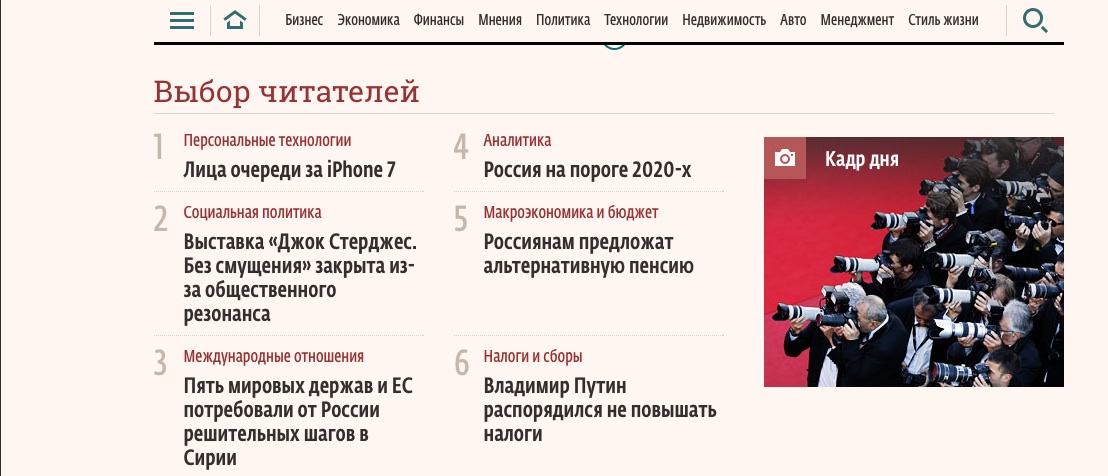
The liberal Vedomosti, a business-oriented newspaper, listed its top stories this morning. The top story was entitled “Faces in a Queue for the iPhone 7”; the second most-read story was about the Sturges show.

True, Vedomosti readers are serious lads and lassies, so the number three story was about Syria. It was headlined, “Five World Powers and EU Demand Decisive Steps from Russia in Syria.”

Earlier today, I posted a few bits from the bizarre article about yesterday’s emergency meeting of the UN Security Council, published in the country’s other serious, formerly liberal, business daily, Kommersant.

Similarly, Moskovsky Komsolomets could not figure out what its readers would find more titillating: reading about how the VKS’s top guns were bombing Aleppo to smithereens or how astroturfed patriots were threatening the God-given right of every self-respecting intelligent to implement Dostoevsky’s maxim that beauty would save the world.

mk-syria

By way of splitting the difference, this morning’s website featured a picture of a chap obviously meant to embody the most average-looking Russian bloke on earth, sadly contemplating one of Sturges’s blasphemous nudes, while a sidebar headline shouts, “Everyone [sic] Is Bombing: Churkin Thinks Peace Impossible in Syria.”

Izvestia has become a particularly noxious loudspeaker for the regime in the past years, so the front page of its website contained a fair number of articles and op-ed pieces chockablock with baldfaced lies about the bloodbath in Aleppo, but at least it had the dignity not to yield to the fake moral panic brewing around the Sturges show.

The relative paucity of Russian media coverage of the Syrian conflict and publicly accessible grassroots reactions was confirmed by the following completely unscientific Google search.

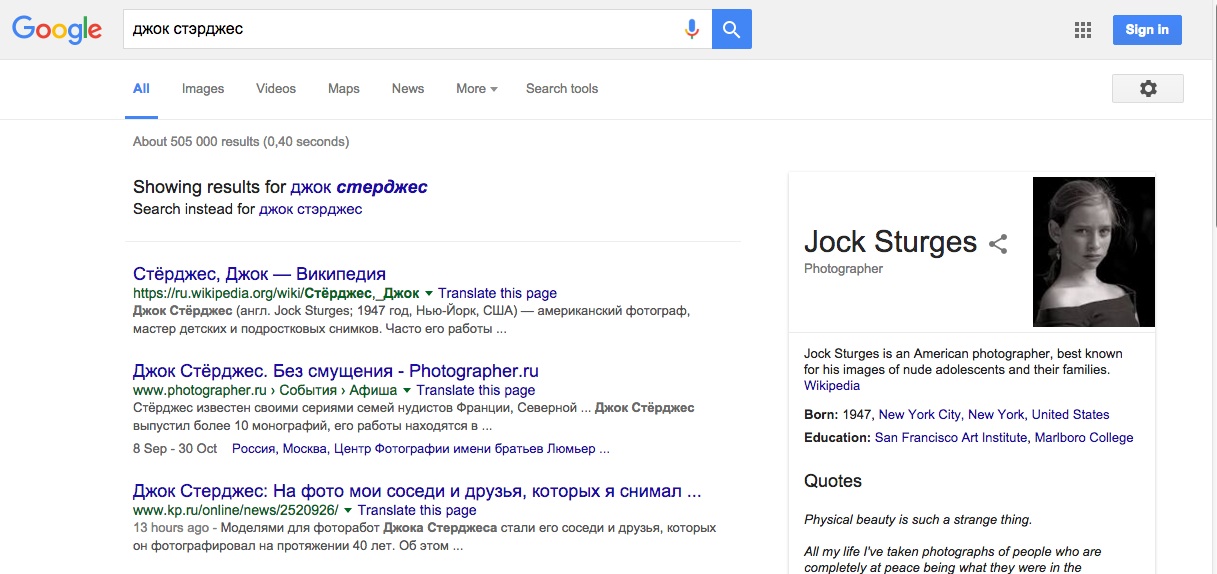
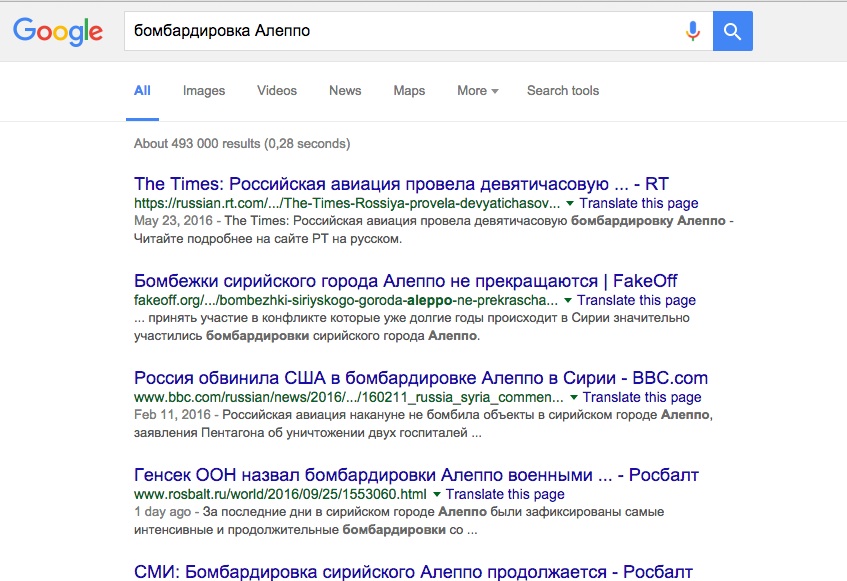
“Джок Стержес” (“Jock Sturges”) got 12,000 more hits than “бомбардироква Алеппо” (“bombing Aleppo”), even though, one could argue, the bombing of Aleppo by somebody or other has been a more topical item in the news for a longer time than Jock Sturges, whatever his longevity or virtues as a contemporary artist.
Results of Google search for
Results of Google search for “Jock Sturges” in Russian, September 26, 2016
Results of Google search for
Results of Google search for “bombing Aleppo,” in Russian, September 26, 2016

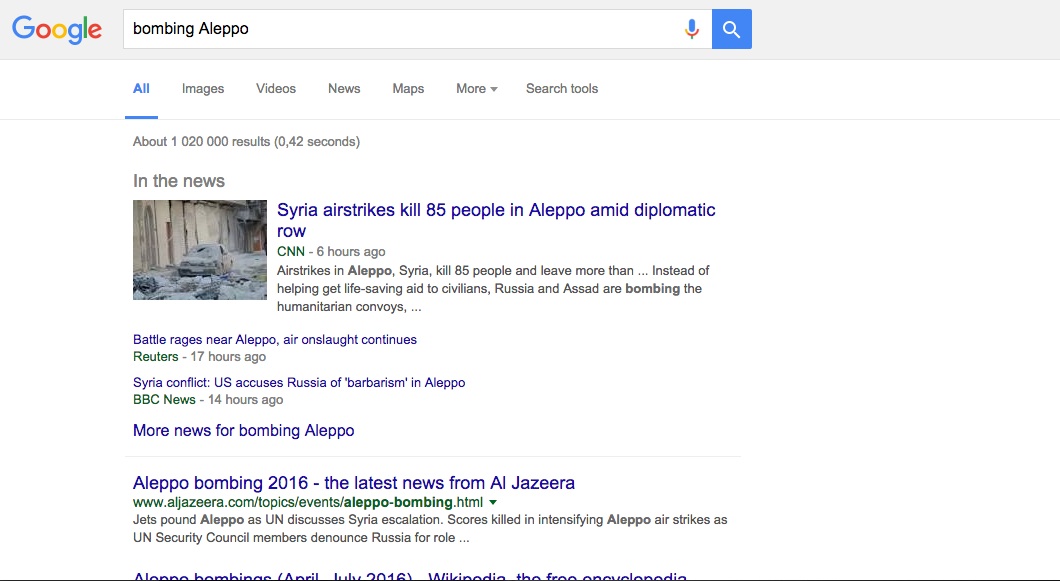
When I did the same search (“bombing Aleppo”) in English, I got over a million hits.
Results of Google for
Results of Google search for “bombing Aleppo,” in English, September 26, 2016

Certainly, we immediately have to factor in the sheer numbers of Anglophone media and readers in the world. There are quite a few more of both than there are Russophone media and readers, and so one would expect to find more responses to particular topics of global interest in English than in Russian.

But what about the vox pop?

An even more unscientific survey of the Russophone segment of Facebook this morning (that is, the part of the segment to which I have access, amounting to several hundred people, most of whom could be identified as intelligentsia or quasi-intelligentisa) showed that quite a few people were up in arms over the Sturges show or coolly editorializing about it to their extended communities of invisible friends, while literally no one was writing anything about Syria.

This has been the case for the past year. Not only that, but I have shared a fairly large number of articles and opinions about Syria, including my own, over that time, and have elicited a total of zero likes and comments from my Russian Facebook friends.

Non-Russian friends, on the contrary, like and comment on these posts in the same numbers as they and their Russian counterparts usually react to the other, non-Syrian things I write about.

Maybe I have the wrong Russian friends, but my hypothesis is that “politically engaged” or “socially conscious” Russians are literally afraid to say or write anything in public about the Syrian conflict. They have the good sense to know that their president-for-life has sunken his teeth into this geopolitical chew toy and has no intention of unclenching them.

Hence, anyone foolish enough to comment on this catastrophic attempt to reassert an increasingly impoverished country as a super power might get themselves in trouble with the powers that be. Over the last year, they have been hauling in utterly ordinary people  on “extremism” charges in fairly large numbers for reposting or commenting on the most innocuous things on Facebook and its Russian equivalent, Vkontakte.

Even more telling, there has not been a single public demonstration in Russia against Russian military involvement in Syria during the past year—to my knowledge, at least.*

Again, this has to be taken with a grain of salt. The current Russian regime has gone out of its way to make public demonstrations and pickets an unattractive pastime for all but the bravest of Russians.

Still, the war in Syria is the central international conflict of our time, and Russia’s best and brightest have literally nothing to say about it, even though their nominally elected government has not been merely a party to the conflict, but has come firmly down on one side, arguably, the wrong side, the side causing the most damage.

I find this deafening public silence about Syria more disturbing than anything else happening in Russia right now.

* After I posted this, Comrade BN wrote the following to me: “In Moscow last year there were some very small pickets protesting against the war in Syria, and the people who organized it attempted to set up an anti-war committee. As far as I know, though, the authorities pretty much intimidated them with varying degrees of extremity into giving up.”
Sparta F.C.

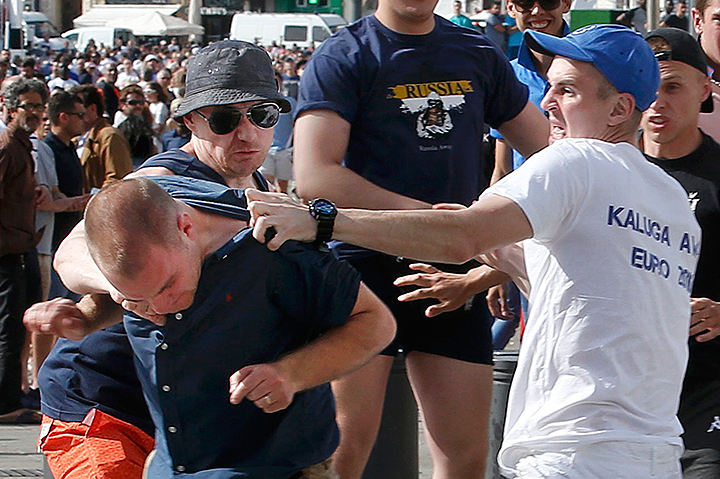
Russian football hooligans attacking an opponet in Marseille. Photo courtesy of tribuna.sports.ru
Russian football hooligans attacking an opponent in Marseille. Photo courtesy of tribuna.sports.ru

Come on I will show you how I will change
When you give me something to slaughter
Shepherd boy (Hey!)
Everybody sing (Hey!)
Better act quick (Hey!)

Be my toy
Come on have a bet
We live on blood
We are Sparta F.C.

The Russian National Football Hooligans Squad: The Russia They Represent in Marseille
Sergei Medvedev
Forbes.ru
June 14, 2016

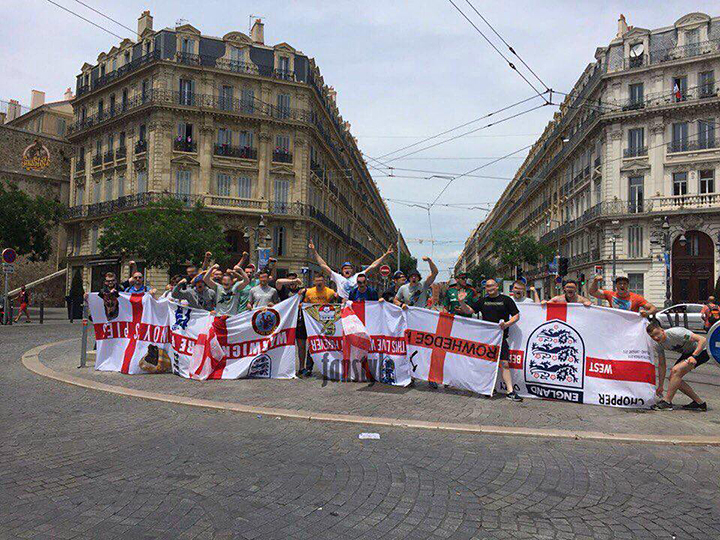
Russia has fought yet another small victorious war. On the eve of the national squad’s first match in Euro 2015, a couple dozen Russian fans routed the numerically superior forces of the English fans in the Old Port of Marseille. A day later, right after the match, they went berserk in the English sector at the stadium, beating up everyone in their path, including spectators with families and elderly people. The results were distressing. At least thirty-five people were injured, and a fifty-year-old English fan who was crowbarred over the head is at death’s door. As punishment, UEFA has provisionally suspended the Russian team until the end of Euro 2016 (if the violations are repeated, we will be completely disqualified from the championship) and fined the Russian Football Union 150,000 euros, including for the racist behavior of the Russian sector during the match against England. On June 14, French police detained fifty people from the Russian Union of Supporters, led by the notorious Alexander Shprygin (aka Kamancha) and held them for twenty-four hours. Russian fans made the top world news headlines (isn’t it what they wanted?), and Russia’s chances of losing the right to host the 2018 World Cup have seriously increased.

This shameful episode perhaps should not deserve such attention. Football hooliganism has long ago turned into a sanctuary of violence and a near equivalent of world war. Fans of all countries fight and run rampant, and massacres happen too, like the tragedy at Heysel Stadium in Brussels, which left thirty-nine people dead and led to all English clubs being banned from UEFA competitions for five years. And Marseille well remembers the English fans during the 1998 World Cup, who staged a donnybrook with fans from Tunisia and smashed up half the town.

But the difference lies elsewhere. While in England, supporters are unanimously condemned by society and politicians in the wake of such scandals, over the last few days the football hooligans have figured almost as national heroes in Russia. Dmitry Yegorov, a reporter for Soviet Sport, live tweeted the carnage, commenting it like a football match and admiring the organization and physical training of the Russians. Social media have been buzzing with approval for the supporter, who smacked the spineless English upside the head and stood up for Russia like the three hundred Spartans at Thermopylae. A blog by sports journalist Andrei Malosolov entitled “Why the Victory of Russian Supporters in the Port of Marseille Is Cool!” has been especially popular.

What is even more curious, the Russian hooligans have enjoyed the backing of high-ranking officials. Russian Investigative Committee spokesman Vladimir Markin commented on the reaction of the Marseille authorities on Twitter, calling the Russian fans “well-trained fighters.”

“A normal man, as he should be, surprises them,” he wrote. “They’re used to seeing ‘men’ at gay parades.”

LDPR State Duma deputy Igor Lebedev (whose aides include Shprygin aka Kamancha), a member of the Russian Football Union’s executive committee, wrote, “I don’t see anything terrible about fans fighting. On the contrary, our guys were great. Keep it up!”

“If [Russian sports minister Vitaly] Mutko had been with the fans in the stands, he would have fought too,” Lebedev suggested later, in an interview.

Here we have to acknowledge one unpleasant thing. The fans in Marseille supply a honest picture of official policy and conventional wisdom in post-Crimea Russia.

They are waging the same hybrid so popular in our propaganda, infiltrating well-trained fighters, skilled in hand-to-hand combat and disguised as “holidaymakers,” into France, using force selectively and purposefully, attacking in unexpected places. The web is now full of rumors the hooligans were really Russian military intelligence (GRU) special ops units, who had infiltrated the championship to intimidate Europeans, so pumped-up, organized, and sober did the Russian hooligans appear in the numerous videos, but we shall leave this hypothesis to fans of conspiracy theories. As I imagine it, a joint detachment of so-called ultras from different “firms” of fans, fighters experienced in street brawling, converged in Marseille, attacking beer-bellied English “Kuzmiches,” i.e., simple fans who had come not fight, but to cheer and show off, some accompanied by their families.

One Russian fan admitted as much in an interview that our guys had come to fight.

“It doesn’t matter what cities our fans are from and what teams they support. What matters is that we are from Russia and are going to fight against the English. They have always said they are the main football hooligans. We are here to show that English fans are girls.”

Russian football hooligans displaying captured English flags. Photo courtesy of tribuna.sports.ru

So even if the Russian assault was not really a planned military operation, such rumors do not come out of nowhere. First, Russia is not a novice at “hybrid” interventions in social movements in Europe. It has organized rallies and agitprop campaigns, worked skillfully through the media to fuel anti-immigrant sentiments, cooperated with right-wing radical and neofascist movements, and supported scandalous populists and European separatists. Just as in Soviet times the Comintern engaged in subversion in western countries, Russia has been worming its way into the cracks and fissures of European society. It has been trying to weaken the west from within, explaining it in terms of a total “information war.” Alarmed Europeans see the Russian ultras in this light.

Second, football supporters really are one of the combat units of the regime, which has an irresistible attraction to various groups of mummers who try and make a show of strength, such as Cossacks, bikers, and football supporters. Members of these stern fraternities are invited to drink tea with high officials. They are identified as exemplars of patriotism. They are awarded civil society development grants. And when push comes to shove, they are sent out on so-called Russian Marches and sicked on opposition rallies and individual dissidents. However, the football hooligans are as alien to the football tradition as the Surgeon’s latex bikers, with their Orthodox banners and Saint George’s ribbons, are to the rebellion and freedom of Easy Rider, and the paunchy “Cossacks,” with their glued-on topknots and cardboard medals, specialists in fighting gays and theater productions, are to the honor and glory of Russian Cossacks. They are all fakes in the era of Putin and Pelevin. When “the public” is a total simulation, protest countercultures turn into vehicles for dull officialdom and perfunctory patriotism, into tamed grant recipients.

Finally, the Russian fans (at least the ones who are photographed by reporters) are the readymade products of official propaganda, reproducing on their clothes and bodies all the typical corny kitsch of the era of Crimea and “getting up off our knees”: t-shirts emblazoned with slogans like “polite people” and “we don’t abandon our own,” budyonovkas and earflap caps twinkling with red stars, banners displaying toothy bears and Slavic Siegfrieds, kids in Armata tank t-shirts and, as the apotheosis of all this patriotic trash, a gigantic tricolor, covering half the Russian sector at the stadium, inscribed with the message “YOU’RE FUCKED.” Apparently, these people see this as the new Russia’s national idea.

This mayhem, however, kicked off long before Crimea. Russian fans have usually reserved the most boorish displays of great-power chauvinism and racism for trips abroad. In the Czech Republic, Russian hockey fans unfurled banners emblazoned with tanks and the promise to reprise 1968. In downtown Warsaw in 2012, football supporters staged a march in honor of Russia Day, nearly provoking a battle royal with Polish ultras. Fueled by beer and egged on by propaganda, Russian resentment shows itself to the hilt in the stands at football and hockey matches, taking symbolic revenge for the Soviet empire. Yeah, we forfeited a great power and never have learned how to play football, but we can smash chairs and smack Europeans in the kisser, “kick the shit” (otbutskat) out of them, as Vladimir Putin once put it, invoking a football supporter coinage. Ultimately, wasn’t it Putin who shared a bit of popular wisdom drawn from a tough childhood in Petersburg’s courtyards, i.e., you have to hit first?

The fans in Marseille did just that, and in this sense they are worthy ambassadors of Putin’s Russia.

As MP Lebedev would have it, they should be greeted at the airport as heroes, just as the bikers have been greeted when they return from their patriotic motorcycle rallies. They should be secretly awarded state honors, as the “polite people” were in their time for bringing Crimea back into the fold. And they should be elected to seats in the Public Chamber and State Duma. Football hooliganism is a matter of national importance in hybrid Russia.

The term “football hooliganism” (okolofutbol) quite precisely reflects the essence of events. Despite the adult budgets of its premier league teams and national squad, despite the purchase of international stars (a typical strategy of superficial modernization), Russia has remained an average performer in the world rankings, both in terms of its own national championship and the performances of its national team. Before the start of the Euro 2016, our country was ranked twenty-ninth in FIFA’s world ratings. But, at the same time, a fan movement based on the British model has very quickly and naturally put down roots in Russia. Books by Dougie Brimson, who has written authoritatively on England’s football fan culture, have achieved cult status among Russian supporters. Without becoming a world football power, Russia has succeeded brilliantly in hybrid football hooliganism, spewing its entrenched and publicly recognized culture of violence onto the international arena.

But Russia has been engaged in the same hybrid “football hooliganism” in Ukraine, where it has not been waging an open war, but delegating well-trained groups of fighters, and in Syria, where it arrived with its own agenda and has been bombing targets for reasons known only to it, and in Europe, where it has banked on populism, separatism, and breaking up the European Union.

Football hooliganism substitutes fair play, real work, and the painstaking cultivation of institutions with violent action and demonstrative bullying. This is not the first year the entire Russian state has been playing at football hooliganism. The hooligans in Marseille are merely its away side.

Sergei Medvedev is a journalist, historian, and faculty member at the Higher School of Economics (HSE) in Moscow. Translated by the Russian Reader

__________

Russia Year Zero

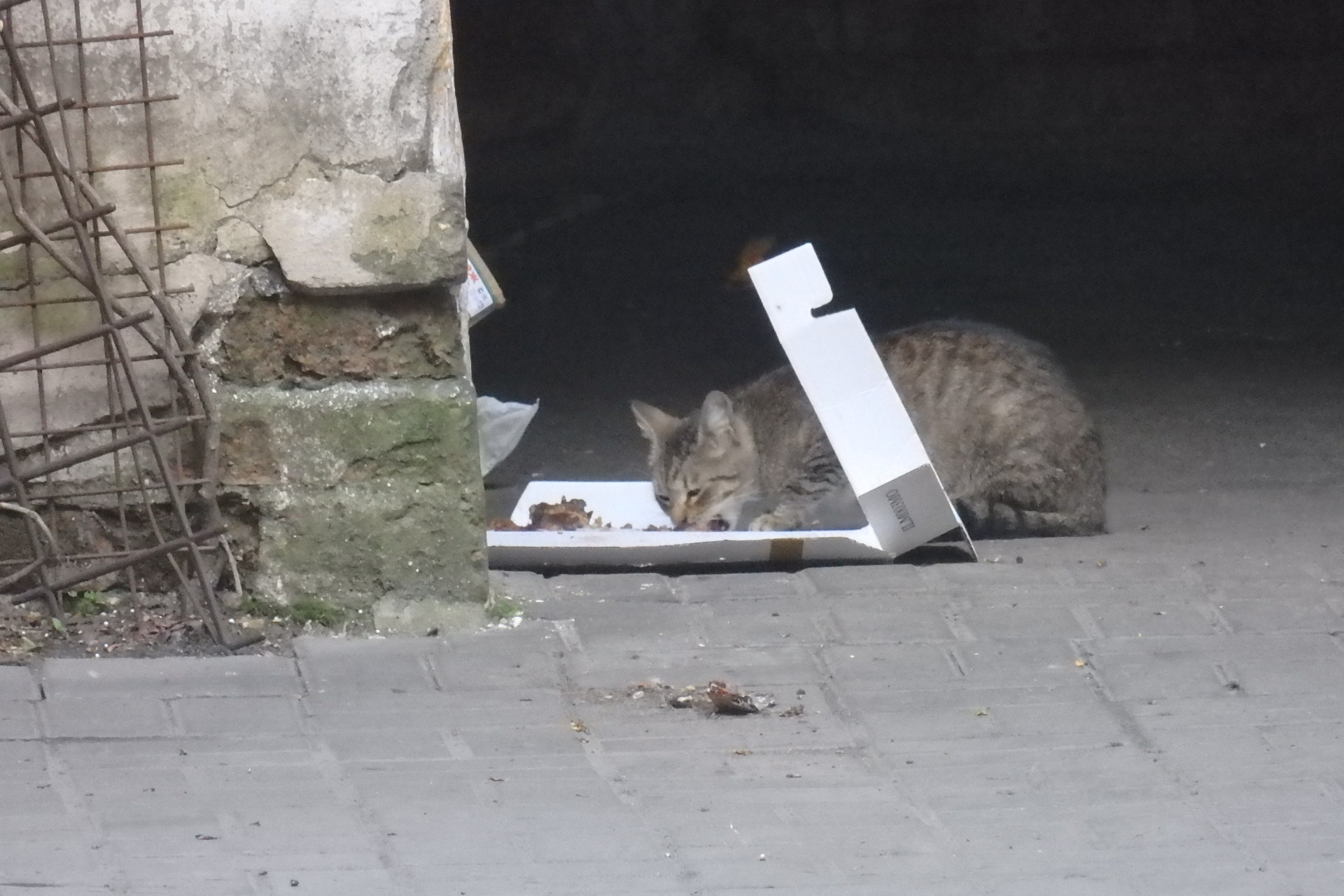
Cat eating scraps from pizza box. May 24, 2016, Petersburg. Photo by the Russian Reader
Cat eating scraps from pizza box on May 24, 2016, in Petersburg. Photo by the Russian Reader

Zero Sum
When nothing is produced, all power belongs to the man who divides and distributes
Maxim Trudolyubov
Vedomosti
May 27, 2016

It is probably already clear to everyone that the implicit “social contract,” about whose existence it was customary to natter in the fat years, was a hoax. Rejecting political subjectivity, ordinary folks and not-so-ordinary folks, big business, and regional elites were able to enrich themselves and, in the consumerist sense, converge with Europe.

It was not, however, a one-off deal with a perpetually fixed rate of profit, but a protracted process. We voluntarily became political zeroes. We gave up free speech, the right to elect and be elected, and the right to demand accountability from our politicians, and part of the population gave up the right to funded pensions. But the unit of prosperity we got in return was given to us not as property but was lent to us. Now the government has collected the debt. The zeroes remain, but the unit will soon run out. The government has no other sources for funding projects, but unpredictable and expensive projects—military campaigns as in Syria, for example, and infrastructural projects like the Kerch Strait Bridge—are the whole point of Russian politics.

The authorities supported the population during the crisis of 2008, but by 2011, dissatisfaction with government policy and the Putin-Medvedev castling move had sparked protests. The Kremlin learned its lesson, and it is ordinary people who are now primarily bearing the burden of the crisis, not the state. Having surrendered their rights to the Kremlin, people will now have to surrender not only their pension savings but also their savings accounts and, so to speak, the fat they have saved up on their bodies if they do not decide to take back their political rights. People’s well-being is, in fact, the “source of growth” that President Putin has asked his economic advisers to find. Actually, he was kidding: the source has never been lost.

When the president, in May 2016, summons his economic council, having forgotten about its existence for two years or so, and says the country needs new sources of growth, how are we to understand this? How were we supposed to understand his proposal to reduce economic dependence on the oil price, which he voiced in the autumn of 2015? It is like offering to grow oneself a new liver after sixteen years of binge drinking.

The Kremlin has created the current situation by consistently rejecting any measures that could have, long ago, reduced dependence on oil and generated stable sources of growth beyond the extractive and defense industries. It is impossible to fix in a month what has been done over sixteen years. Moreover, the very same people have been summoned to do the fixing, people still divided by irreconcilable contradictions. What joint effort at seeking ways out of the crisis are Alexei Kudrin and Sergei Glazyev capable of mounting? The sum of their efforts will inevitably be zero.

It would appear this zero quite suits the Kremlin, as economist Konstantin Sonin argued in a recent interview with Slon.ru. Incidentally, efforts are also needed to maintain zero growth, and those efforts are being made. Certain malcontents might not like the “zero” economy, but the Kremlin really likes it, because it strengthens the power of the front office, where decisions about redistribution are made. When nothing is produced, all power belongs to the man who divides and distributes.

Translated by the Russian Reader

The 501st: Russian Death

russian death
“Russian Death”

‘Sociologist Denis Volkov from Moscow’s independent Levada Center pollster, on the other hand, says the bill is unlikely to make Russians more wary about what they post on the Internet. “Most people are not aware of these laws,” he says.’

Ha-ha. It’s good that reporters are forced to turn to “sociologists” and “pollsters” for quotable quotes, and that the Putinist state decided at some point long ago it would pollocratize everyone and their cousin into submission, because otherwise the “independent” Levada Center would have had to pull up stakes long ago and move to Nevada to start calling odds on the trifecta at Santa Anita racetrack.

I have already seen the chilling effect that the bill and the generally malignant, soul-destroying climate of the last year or so have had on what people talk about politically (or not) in daily life, much more dare to post on the Internet, e.g., Russia’s role in Syria, which absolutely no one I know has discussed, publicly or otherwise, under any circumstances for a very, very long time now. And that is just the top of the list.

A fair number of Russians, young and old, know very well how to read signals coming from on high and when to keep their mouths shut. Or how to substitute abstract, self-important chatter or furious trivial pursuits for meaningful conversations about what is happening in their country and what to do about it. Now is one of those times, and it is absolutely depressing.

All it will take is a few more “light touches,” and the country will essentially be dead, that is, waiting for its Supreme Leader to kick the bucket (when? twenty years from now?) so it can rejoin the rest of the world and resume building “democracy,” “capitalism” or whatever it has been pretending to do the last twenty-five years.

Photo courtesy of the Facebook page of Russkaia smert’ (Russian Death)

Base?

pensions
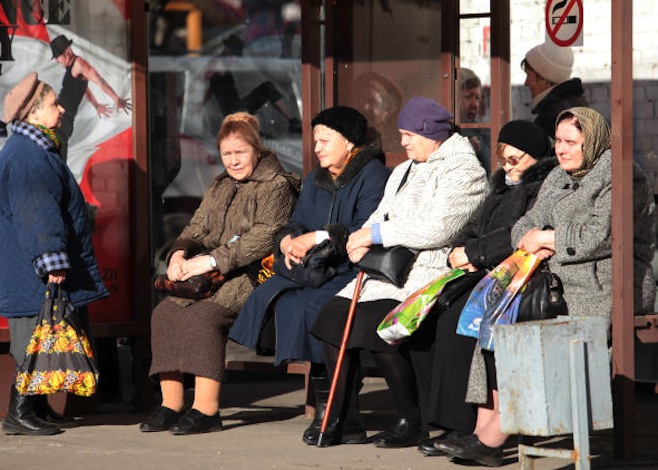
Russia’s old-age pensioners: menace to Russian liberal democracy?

Slava Rabinovich
October 2, 2015
Facebook
#‎ConcreteWall‬

Inflation: 14-17% in rubles.

Consumer basket inflation: 25-70% in rubles (depending on the specific consumer basket).

Currency devaluation:  50%. The value of foreign currency has risen 100%.

The government has decided to index pensions for inflation only by 4% in 2016.

Pensioners vote for Putin.

Putin has stoked and burnt their money in Crimea, Donbass, and Syria, and on an insane military and security services budget, and has stolen trillions right from the same budget.

Pensioners vote for Putin.

Putin has lucked out with pensioners.

________

And yet a little over ten years ago, it was the old-age pensioners (rather than portfolio investors like Mr. Rabinovich or the “rising middle class”) who mounted the first serious, massive grassroots challenge to Putin’s policies and his rule. 

Maybe the old-age pensioners have gone silent now and no longer want to mount such challenges to Putin’s rule. But it is quite amazing to observe so many able-bodied and mentally competent folks in the prime of their life engaged in casting around for whole (mostly imaginary, mostly disempowered, mostly lower) classes of people to blame for Russia’s slide into totalitarianism lite. What sense does it make to say that any whole class of people “votes” for Putin and constitutes his “base,” when we know that elections in Russia are rigged six  ways to Sunday? 

This is not say that Russia’s old-age pensioners shouldn’t be distressed by their deteriorating economic fortunes, as reflected in the distressing and real figures cited by Mr. Rabinovich, above, but the search for the “rubes” who have buttressed Putin’s rise to minor godhood should start with the classes of Russians who have really benefited from his rule. It has most signally not been the mass of old-age pensioners who have made out like bandits, although they may be more vulnerable, in some instances, to Putin’s propaganda machine and, at the local level, to the blandishments offered by the United Russia electoral machine.

If anything, my own (albeit limited) experience of grassroots protest campaigns in Petrograd has shown me that, more often than not, retirees and oldsters do more than their fair share of shouting, tussling, and scrapping with the powers that be.

But it must be nice for Russia’s worldly and well-heeled urban hipsters, thirty- and fortysomethings, and go-getters (whose brains, again in my limited experience, are no less addled by the popular prejudices of the Putin era, and whose bodies are no less averse to putting themselves in harm’s way) to imagine that Putin’s “base” is made up of old-age pensioners, the chronically poor, blue-collar workers, and residents of the Russian hinterlands.

__________

Putin Reforms Greeted by Street Protests
Steven Lee Meyers
January 16, 2005
New York Times

KHIMKI, Russia, Jan. 15 – Mikhail I. Yermakov, a retired engineer, has never before taken to the streets to protest — not when the Soviet Union collapsed, the wars in Chechnya began, the ruble plummeted in 1998 or President Vladimir V. Putin last year ended his right to choose his governor.

On Saturday, however, he joined hundreds of others in the central square of this gritty industrial city on the edge of Moscow in the latest of a weeklong wave of protests across Russia against a new law abolishing a wide range of social benefits for the country’s 32 million pensioners, veterans and people with disabilities.

Demonstrations were held in at least three other cities in the Moscow region, in the capital of Tatarstan and, for the fourth straight day, in Samara in central Russia. In St. Petersburg, several thousand demonstrators blocked the city’s main boulevard, with some calling for Mr. Putin’s resignation.

Taken together, the protests are the largest and most passionate since Mr. Putin came to power in 2000. They appear to have tapped into latent discontent with Mr. Putin’s government and the party that dominates Parliament, United Russia.

“It is spontaneous, and this is the most dangerous thing for the authorities,” said Mr. Yermakov, 67, as speakers denounced the government from a step beneath a hulking bust of Lenin. “It is a tsunami, and United Russia does not understand that it is going to hit them.”

The law, which took effect on Jan. 1, replaced benefits like free public transportation and subsidies for housing, prescriptions, telephones and other basic services with monthly cash payments starting at a little more than $7.

In a sign of bureaucratic inefficiency, some of those eligible have yet to receive any payments.

Mr. Putin and United Russia’s leaders have defended the law as an important reform ending a vestige of the old Soviet Communist system, but they clearly failed to anticipate the depth of opposition from those who relied most on the subsidies: millions of Russians living on pensions of less than $100 a month.

The protesters have denounced the payments as insufficient to cover the cost of the benefits and as miserly for a country that recently reported a budget surplus of nearly $25 billion.

As the protests unfolded in city after city across Russia, the Patriarch of the Russian Orthodox Church, Aleksei II, who typically allies himself with what is known here as “the party of power,” questioned the law and the government’s handling of it.

“What counts is that this policy should be fair and effective,” he said in a statement on Thursday. “It should be met with understanding by the people. The latest events show that these principles are not observed in full.”

Aleksei P. Kondaurov, a Communist member of the lower house of Parliament, said the law and the protests underscored the shortcomings of the political system that had evolved under Mr. Putin, one dominated by United Russia, which has refused to debate with opposition parties, let alone compromise with them.

“It was clear that it was not carefully calculated,” Mr. Kondaurov said of the new law in an interview.

Mr. Kondaurov predicted the protests would grow and spread to other pressing social issues, which he said Mr. Putin’s government and United Russia were ignoring.

At a minimum, the protests have raised doubts about Mr. Putin’s other proposed reforms, including those in banking, housing and electricity, which were supposed to be the centerpieces of his second term.

“It’s not going to be like Ukraine,” Mr. Kondaurov said, drawing a parallel, as some have here, to the far larger demonstrations that overturned the election there for president in November. “But it is clear to me that a political and economic crisis is taking shape in Russia.”

After first brushing off the protests, United Russia’s leaders have begun scrambling to respond. They have accused the Communists and other parties of inflaming tensions and have tried to deflect blame to regional governments, which they say are responsible for implementing the benefit changes.

Some local governments, most prominently the Moscow city administration, have vowed to reinstate the benefits stripped at the federal level, but few other regions are wealthy enough to afford to do so.

On Friday, the chairman of Parliament’s social and labor committee, Andrei N. Isayev, said that next week, lawmakers would consider raising pensions by 15 percent in February, rather than 5 percent in April, as now planned.

Others in United Russia have also tried to distance themselves from Mr. Putin’s new government, which has been in place for only 10 months. The deputy speaker of Parliament, Lyubov K. Sliska, said Friday that she did not rule out the dismissal of Prime Minister Mikhail Y. Fradkov and his cabinet.

But the protests have continued to grow. They began quietly, with a rally organized by the Communist Party in Solnechnogorsk, near Moscow, on Jan. 9, the 100th anniversary of the 1905 uprising.

A day later, here in Khimki, several hundred people briefly blocked the main highway to St. Petersburg in what several of those involved called a spontaneous uprising. After a scuffle with the police, 12 elderly protesters were arrested, but initial threats to prosecute them were quickly dropped.

Since then the protests have erupted in at least a dozen other cities, drawing thousands. In Tula, 110 miles south of Moscow, aging protesters clashed with bus conductors who refused to allow them to board city transport without paying, prompting the city to post police officers on the buses.

In Novosibirsk, in Siberia, a dozen pensioners mailed their cash payments for transit — the equivalent of a little more than $3 — to Boris V. Gryzlov, the leader of United Russia and parliamentary speaker, according to the Regnum news agency.

The protesters here in Khimki’s central square on Saturday represented those who have fared the worst in Russia’s post-Soviet transition.

Mr. Yermakov’s monthly pension equals roughly $85 a month. As a resident of the Moscow region, a separate administration from that of the city government, he qualified for a supplement of $7 to replace the subsidies lost under the new law. The bus fare for three trips to the small tract of land he is allowed for planting a vegetable garden, four miles away, will take nearly half that amount.

Vladilena T. Berova, whose given name is an homage to Vladimir Lenin, served at the end of World War II as a corporal in Soviet intelligence and went on to work as a psychotherapist for five decades in Moscow. Now 78 and widowed, she survives on 2,000 rubles a month, about $71.

“The fascists took my youth,” she said, referring to the war. “And now these people are taking away my old age.”

The protests have included something still rare in today’s Russia: personal criticism of Mr. Putin, who has remained popular by projecting an image of stability, one carefully protected by officials and state television.

“Instead of listening to us, he is listening to an organ,” Mr. Yermakov said, referring bitingly to Mr. Putin’s participation in the unveiling of a newly restored organ in St. Petersburg on Friday with Germany’s president, Horst Köhler.

The benefits law has already been credited, at least in part, with a slip in Mr. Putin’s ratings, as well as a general decline in the public’s mood.

A poll by the Levada Center, released on Saturday, said that only 39 percent of Russians considered Mr. Putin the most trusted politician. That is still higher than anyone else, but a drop from 58 percent a year ago.

Sergei Y. Glazyev, a member of Parliament who challenged Mr. Putin during the election for president last year, said in an interview that “the people’s struggle for social rights” should be decided in a national referendum, rather than imposed by the Kremlin and its governing party. Voters, he said, had been fooled.

“A majority of those who voted for Putin,” he said, “had a quiet different expectation of what they would get.”

Mr. Rabinovich’s Facebook post translated by the Russian Reader. Image, above, courtesy of the Moscow Times

Syrias

Here are four very different but complementary reflections on the dangers of Putin’s new Syrian adventure by, respectively, an electrician and veteran grassroots activist, a sociologist, a magazine editor, and a political scientist and leftist activist.

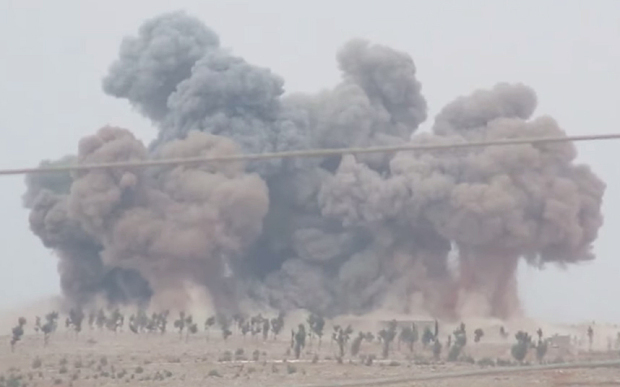
A video released on YouTube claimed to show Russian air raids targeting the ruins of al-Rabiyah and Shinsharah near Kafranbel

George Losev
October 1, 2015
Facebook

Russia pacified the North Caucasus just as the US pacified Afghanistan. The Taliban have disappeared from the news but not from life.

The US has started many wars, and the Russian Federation has already started two. The US has got into conflicts in the Middle East primarily for domestic political reasons, and the Russian Federation has done the exact same thing.

The US lies constantly, and the Russian Federation does, too. (As do the EU, Israel, Iran, Saudi Arabia, and everybody else.)

But is there even a single reason to support the dispatch of Russian forces to Syria? There are no such reasons, just as there were no reasons to support the NATO bombing of Libya or the [US/UK] bombing of Iraq.

And now, as in the case of the war in Ukraine, just watch carefully and take note of what you see.

P.S. That is, while there is no chance to do anything more substantial.

__________

Greg Yudin
October 1, 2015
Facebook

You would have to be Putin, of course, to support Assad by way of restoring order.

Assad is a man who, in the past four years, has:

  • let slip an armed grassroots uprising;
  • permitted a civil war with hundreds of thousands of victims;
  • used chemical weapons against his own citizens;
  • allowed the full-scale deployment of an international terrorist group;
  • and lost control of two-thirds of his country.

And this man, of course, is the man who will pacify all of Syria and calm everyone down.

It has often been said of Putin that he takes a cynical (i.e., “realistic”) approach to foreign policy. It is nothing like this. In the case of Syria, it is Obama, who says we should get together and appoint them a leader who can restore order, who has taken the cynical approach.

The approach of Putin and his elite, however, is not cynical but stupid. The point of this approach is that you should always support the current regime. Simply put, the boss is always right just because he is the boss. They arrived at this hard-won conviction through their own uncomplaining obedience. This belief is the basis of their power and their philosophy in life. For its sake they are even willing to entangle themselves in an international conflict.

________

Alexander Feldberg
October 1, 2015
Facebook

Until today, this business with Syria seemed strange to me in the sense that it would not be easy to sweep the Russian people off its feet with it. I understand about small victorious wars, but I imagined that this was not like Ukraine, which is next door, or Hungarian geese, which we could even fondle with our own hands until recently. And then, we are talking about a country that has lived through a war in Afghanistan, despite the incomparable scale of the conflicts and so on. But this morning I was riding the subway and saw this guy, an ordinary guy in his forties with a decent face, even, a guy who looked a little like actor Yevgeny Mironov. This guy was riding the subway and looking at something on his telephone. He was not just looking but literally devouring the phone with his eyes and putting it next to his ear from time to time to make out the sound over the roar of the subway. (For some reason he was not using earphones.) I peeped a little and saw that Sergei Ivanov was on the screen of the dude’s phone. This was when I got curious and a bit anxious, because, on the one hand, it is hard to imagine a situation in which a normal person would get so excited by a speech by Sergei Ivanov. On the other hand, in the morning I had heard on the radio about the Federation Council, which Putin had again asked for authorization, just like that other time, and that had made me a little queasy. So I broke down and gently asked the man what was happening.

yevgeny mironov
Russian actor Yevgeny Mironov

“Sy-ri-a!” he mouthed to me, clearly afraid to miss something important in the broadcast.

Then he briefly turned to me again and sighed, “We are going to bomb!”

He said it as if a weight had finally been lifted from his shoulders, as if the going had been tough, but now, thank God, it had been decided.

And at that moment I had the terrible desire not to be here, to disappear somewhere completely. I realize this was cowardice, a momentary weakness, but I felt it all the same. And I also remember a conversation I had with Bob when we were sailing down the Irrawaddy River, and thought that perhaps he had been right: “You may hate him, but you cannot get rid of him.” I don’t want to be responsible for these motherfuckers. I don’t want to think constantly about whom else they have taken it into their heads to crush or bomb. Let them build underwater chapels for scuba divers and invisible bus stops, but please, please, don’t let them bomb anyone.

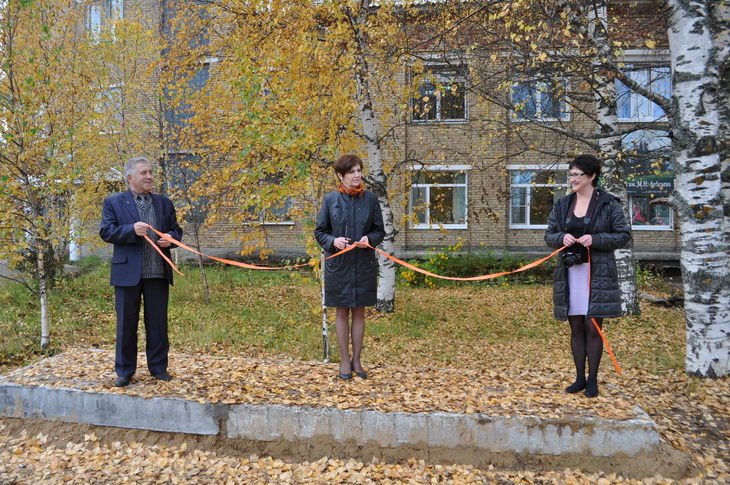
invisible bus stop
Officials opening an “invisible” bus stop in the village of Körtkerös, Komi Republic, on September 22

Bob
Bob, an Australian who looked like a gray-haired Homer Simpson, spoke intermittently and passionately, now and then dipping his elongated head into his third glass of claret.

“Very well, I know you Russians have it hard. You always have someone to answer for, either Putin or Stalin. ‘He’s Russian? Very well, let’s ask him about Putin.’ It’s the same crap with the Americans. At the drop of a hat they get told, ‘It’s all because you made a mess of things in Iraq, fellows!” You guys are constantly confused with someone else, with some big, important motherfucker. We have it much easier in this sense. ‘Australia? Isn’t that the place where there are kangaroos ?’ We are just Aussies, you know, Alex? I travel where I wish, live where I can earn money, and nobody is going to torment me with your Putin.”

“I already told you,” I replied, “I don’t like Putin.”

“Bingo!” Bob roused himself. “You may hate him, but you cannot get rid of him. Although I know that things are even more complicated in Russia. You Russians hate yourselves most of all.”

Then, in keeping with the conventions of bad movies, Bob laughed heartily and, winking conspiratorially, said, “I’ve read Tolstoyevsky!”

__________

Ilya Matveev
October 1, 2015
Facebook

If I were in Putin’s shoes I would think hard about the following paradox. Of course, you can accuse America of “destroying sovereignty” everywhere from Libya to Ukraine all the time. But America cannot just up and destroy sovereignty. It can encourage the opposition. It can even drop bombs. But it is not capable of just up and destroying state institutions themselves. The problem is that wherever a state has collapsed, it had already been weak. And a state’s weakness lies in the absence of its autonomy vis-à-vis narrow group interests, be they elite clans, oligarchs, tribes, and so on. A weak state is also labeled “patrimonial,” meaning it has been “privatized” by particular interests. This weak state syndrome was typical of absolutely all the countries Putin thinks the State Department got to. The paradox is that the Russian state, the Putinist state, is weak. It has low autonomy vis-à-vis elite groupings, and its formal institutions are window dressing for backroom deals. The more Putin “immunizes” the state from the opposition, the “fifth column,” and so, the more he strengthens precisely these same elite groups, all those Sechins and other “friends of the president,” who have an interest in weak institutions. Thus, everything Putin does only weakens the state. The easiest way to illustrate all this is with the dilemma of his successor. Putin has built a state in which no one knows what will happen after Putin, including himself. Ukraine-scale chaos is quite possible at the very least; Libya-scale chaos, at the very most. But unlike Libya and even Ukraine, Putin will only have himself to blame for this. After fifteen years, there is nothing left of the government, the parliament or the courts. All that remains are Putin’s “friends” and his “manual control.” It is a sure bet that the State Department and American imperialism are not to blame for this. In this case, it is homemade.

__________

My thanks to George Losev, Greg Yudin, Alexander Feldberg, and Ilya Matveev for their permission to translate and publish their remarks here. Click on the links, above, to read their previous contributions to this blog. Images courtesy of the Telegraph/YouTube, Tochka.net, and Zvezdakomi.ru