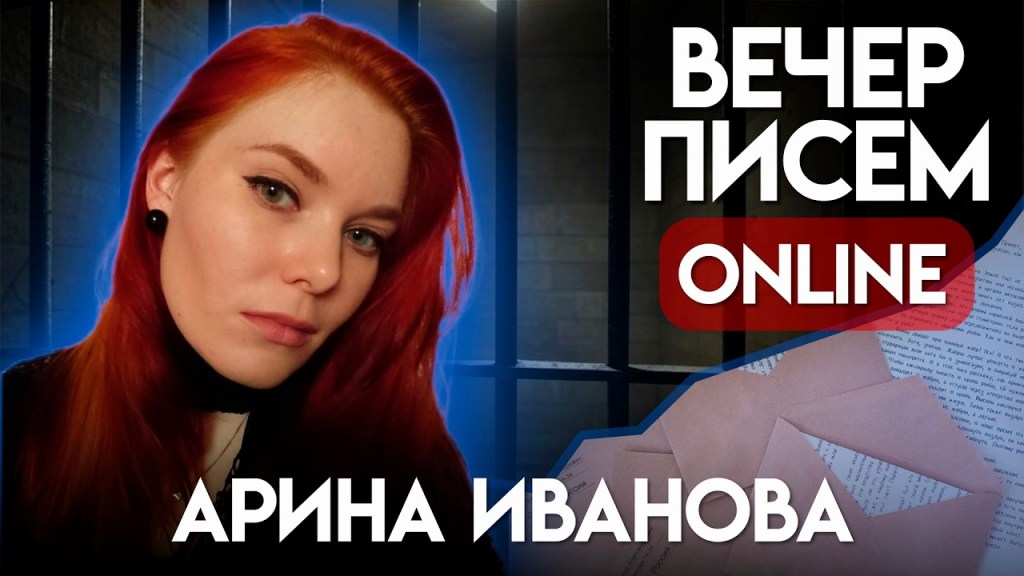
A “Turgenev Girl” and Her Cats: The Case of Siberian War Resister Arina Ivanova

Arina Ivanova. Image courtesy of Sotavision

In the autumn of 2024, Arina Ivanova packed a tracksuit, socks, a change of underwear, soap, a toothbrush, and a few dishes into a bag. Once she was ready, she made her way to a friend’s place and waited. In August 2025, Ivanova was sentenced to five years in a penal colony for disseminating “fake news” about the Russian army. In January, she was transferred to a penal colony, and there has been no contact with her since.

Thirty-eight-year-old Ivanova was born and raised in Novokuznetsk, a coal and iron ore mining town in the southern Kuzbass (Kemerovo) Region of Siberia. On 13 August 2025, three days after Arina’s birthday, local media outlets reported on inspections of local schools in the runup to the new academic year, a military recruiting officer caught taking bribes, and the sale of an “elite three-bedroom apartment.”

Arina was sentenced to five years in a penal colony the same day, but there was no mention of it in the city’s media. Neither journalists nor human rights activists knew about Arina until Darya, who was working as a news editor at OVD Info, accidently discovered her in a Novokuznetsk pretrial detention center.

“Some colleagues of mine noticed on a court website that an Arina Sergeyevna Ivanova had been sentenced in Novokuznetsk for violating the law on ‘fake news.’ They sent them an official request for information,” recounts Darya. “The reply came back that the defendant had been sentenced to five years in prison. I took an interest, partly because I’m from Novokuznetsk myself. We turned up several administrative charges for various antiwar statements, and we sensed that this person had a firm stance, that she had convictions, which made us even more determined to locate and help her. Then I googled something like ‘Novokuznetsk woman fined for discrediting army” and found a news item about her on “Kuzbass without Extremism,” a [Telegram channel] for Center “E” [anti-extremism police] officers.

A post there dated 13 October of last year reports that an administrative offenses case had been launched against “Citizen Arina I.” for displaying Nazi symbols (per Article 20.3.1 of the Administrative Offenses Code), specifically for posting the slogan “Glory to Ukraine.” It further alleges that Ivanova “deliberately committed this offense with the aim of obtaining political asylum.”

Further down in the post are a few seconds of audio labeled “Arina I. Conversation with a Girlfriend.” The voices have been altered, and the words are barely decipherable: “Well, yes, I deliberately posted those comments so I could get political asylum.” “Do you realize that’s dangerous? They could even put you in jail for that.”

“They could show up any day now”

On the morning of 24 December 2024, a man identifying himself as a police investigator called Karina, a childhood friend of Arina’s, on her mobile phone. He told her they needed to meet to talk about Arina.

She immediately told Arina about the call, as Arina had been staying at Karina’s home since the autumn. Arina went to the door. Standing on the other side of it were men in uniform.

Ivanova was first summoned to the police in October 2023. The grounds for the summons, as stated in the case file, was an antiwar post of hers on [the Russian social media network] VKontakte, featuring a video titled “StopRussianfascism” and “an image of human figures arranged in the shape of a Nazi swastika.” Arina was fined 1,500 rubles under the Administrative Offenses Code article prohibiting the public display of banned symbols (Article 20.3.1). She was handed a second fine, in the same amount, for violating the same article, over a message posted on Telegram containing a “slogan used by Ukrainian nationalists.”

“She said she was having endless panic attacks,” Karina recalls. “The walls felt like they were closing in. She knew that any day now they could show up and take her away, and she, a ordinary, law-abiding person, would end up in prison for things she had said.”

In the autumn of 2024, Arina once again confided in her friend that she was having a hard time, and Karina suggested she come stay with her, just as before. Arina moved in with Karina four months prior to her arrest.

Karina says that her friend didn’t try to leave the country, even after being slapped with several administrative citations.

“People react to stress in different ways: some are proactive, while Arina just freezes up and takes a ‘come what may’ attitude,” Karina recounts. “We talked about the possibility of her leaving and seeking political asylum. I tried to urge her to go, but when I got home from work, she would just be lying there watching TV. That’s just how her psyche responded: she retreated into her shell and couldn’t find her way back out. Arina didn’t do anything at all, because she was scared, I think.”

On the morning of 24 December, three men entered Karina’s apartment.

“I didn’t want to let them in at all at first,” she recalls. “They asked whether I knew that Arina was on the wanted list. I didn’t. They went downstairs, brought back an arrest warrant, and said that if I didn’t let them in, they would break down the door and come in without asking me.”

“They don’t give a damn how many cats you have”

“She used to say, ‘They won’t take me away because I have so many cats,'” recounts Karina. “She’s a kind, naive gal, and telling her the truth felt like twisting the knife, but I had to snap her out of it and bring her back down to earth, because she was completely living in a fantasy world. I told her, ‘Arina, it makes absolutely no difference to them how many cats you have; they don’t give a damn. They’ll just show up, take you away, open the door, let the cats out, and that will be the end of it.'”

It wasn’t just her loved ones who noticed her bewilderment. Through mutual acquaintances, Arina got in touch with Yevgeny, a lawyer in Novokuznetsk. According to him, it was already clear at the time that things wouldn’t stop at just an administrative offenses case.

“Arina came to my office,” recalls Yevgeny. “She seemed lost and didn’t fully grasp what was happening. She had no clear plan: all her actions appeared chaotic and disjointed. I drafted a formal complaint regarding the administrative offense case free of charge, but it was never filed. Nor did Arina go to see the lawyer I had advised her to consult. I got the impression that she didn’t understand the gravity of the situation—specifically, how the mechanism for prosecution and imprisonment actually works.”

Realizing that arrest was imminent, Arina entrusted her cats to Svetlana, a volunteer. Arina had previously brought animals to Svetlana for spaying and neutering, and had sought her advice on their medical treatment and care. Svetlana, by her own account, runs a temporary foster facility located within a veterinary clinic.

When she was already in pretrial detention, Arina learned that the volunteer had demanded that the animals be retrieved, threatening to euthanize them otherwise.

“In my opinion, [Svetlana] isn’t a terribly rational woman. She wrote to me saying that ‘winter is coming’ and that she would have to euthanize these [cats] in order to take others in from the streets,” says Karina. “I don’t know what became of them…. I asked that woman to stop doing this work and to stop ‘rescuing’ animals.”

“My childish love for animals grew into something bigger”

“Like many others, I couldn’t decide what I wanted to be early on in life,” Arina writes in a letter from the detention center. “Everything was decided by chance. When I was seventeen, I was looking for a summer job, and I stumbled upon a job posting for a small flower shop. I’ve always loved flowers, so I decided it was a good opportunity to learn something new.”

After graduating from a technical college specializing in construction, Arina worked as a florist for about fifteen years. When she realized that arranging bouquets no longer brought her the joy it once had, she decided to turn her hobby—cooking—into a career.

During the ten years previous to 2024, Arina and Karina had little contact with each other. Their paths began to diverge when Karina started a relationship and had a son.

“Arina mostly stayed at home,” recalls Karina. “We lost touch for a time. I would try to get us back in touch and would invite her over. It’s not like she turned me down exactly, but she was seemingly avoiding spending time with me, and so finally we settled on merely congratulating each other on holidays and birthdays. Then she took up volunteering, and she and her mom started taking in stray cats from everywhere. Then her mom emigrated and she stayed behind [in Russia] with the cats.”

Arina writes that she had been surrounded by animals since childhood. She would drag every stray cat and dog home, and spend all her pocket money on their medical care.

“I thank Mom for supporting me in this,” she writes in the letter. “My childhood love of animals grew into something bigger. Volunteering became not only a hobby but an important part of my life. Thanks precisely to the animals who acted as my lifeline, I stayed afloat in the wake of the events of February [2022].”

Arina’s mother Tatyana, born in the town of Perevalsk in [Ukraine’s] Luhansk Region, also had a tough time when the war broke out. She has been living for the past ten years in South Korea and, according to her, had been writing antiwar social media posts intended for Russian immigrants to South Korea who “support the whole thing.”

“I’m from Ukraine myself, and Arina and I traveled there so many times,” says Tatyana. “[The war’s outbreak] was a tragedy for me and sent me into a depression. I would scroll through my news feed to see what was happening there, and it was unthinkable. Arina naturally couldn’t help thinking about it either.”

“I relied on her like she was an adult”

Tatyana is sixty years old. In South Korea, she works as a hotel housekeeper. She had worked as a train conductor in the 1990s in Russia. She got the job when “salaries at some workplaces were delayed for a year, but there was a stable income on the railway.” But even there, the screws began to tighten: wages dropped, while responsibilities increased. When Arina was twenty-five, her mother moved to South Korea.

“We would have an ancient railcar, yet it had to look brand-new for the federal inspection commission,” Tatiana recalls. “Sometimes we would buy paints and varnishes—even a toilet seat—with our own money. My gut told me that things in Russia were only going to get worse, and that I needed to escape this hopelessness.”

According to Tatyana, Arina became independent at an early age. Her mother would leave for long stints working on the railroad, and the girl would be left alone in their apartment: there was simply no other way to feed the family, since unemployment was rampant throughout the country. Tatyana and Arina’s father had separated long ago, and Tatyana had no other relatives, so mother and daughter relied entirely on one another.

“It would happen that I’d travel to Simferopol or Kislovodsk, where fruit was cheap. I’d buy several bucketfuls, bring them home, hand them over to my daughter, and leave the same evening. When I came back home, there would be the jars of jam that my ten-year-old child had made. I relied on her like she was an adult.”

When Tatyana tried to find common ground with the investigator in Arina’s case, she described her daughter as a “Turgenev girl” and underscored that Arina had never had a boyfriend.

Since childhood, Arina had described herself as a “bookworm.” She tried to spend as little time in public as possible and avoided big groups. Even going to the supermarket was stressful for her, and so, according to Tatyana, she had the groceries delivered more often.

Karina has her own views of Arina’s relationship with her mother. The girls became friends when Karina was thirteen and Arina eleven. Karina says that Tatyana often manipulated Arina by suggesting that she couldn’t live without her, “that if Arina left, she would drop dead on the spot.”

“Arina would often leave home and live at our place,” says Karina. “One time her mom came and got her only after [she had been gone for] two weeks. To me as an outsider, it seemed that her mom used her like her own personal Cinderella. She did all the chores and had no personal life.”

Karina argues that this upbringing made Arina eager to please. Once, when Arina was staying with her, Karina had fancied “a particular kind of belyash,” and so Arina had brought her these belyash every single day, recalls Karina.

“Sad to say, I didn’t grow up in the happiest family, so I know firsthand what domestic violence is,” Arina writes from Pretrial Detention Center No. 2 in Novokuznetsk. “My parents got divorced when I was around five years old. When I turned nine, the man who would become my stepfather appeared in our lives. The problems started almost immediately: my stepfather turned out to be a maniacally cruel man. There were rows nearly every day at home, rows that would end with him beating up my mom. When I would try to defend her, he would beat me as well. […] [Once] my stepfather came home at night and woke us up. He sat me on the bed, put a knife to Mom’s neck, sat down opposite me, and said that if I tried to get up he would slice her throat. And so I sat there till morning.”

Arina writes that calls to the police were of no help. To get away from her mother’s live-in partner, they moved frequently, but the man always learned where they were.

“He was a terrible man,” Tatyana recounts. “He drank a lot and suffered from a maniacal persecution complex. I would rent [other] apartments to hide from him. I would ask the police to intervene and then write to the prosecutor’s office because the police would take no action. But like a cunning worm, he would go to ground and vanish—and then it would all begin over again. That hell lasted nine years.”

Arina says that she left home at thirteen due to the situation there, “because it was unbearable, but after a month or so I came back since I was worried about Mom.”

Tatyana recalls this story differently. As she tells it, Arina had got mixed up with a bad crowd that used hard drugs, and it was during this time that she left home.

“Arina means everything to me: she’s my air, my sunshine, my life,” says Tatyana. “When I realized I couldn’t bring her back, I went to the hairdresser’s and got my hair done, bought a bottle of sleeping pills, and got ready to end my life. I was sitting in an armchair, the pills and a glass of water in front of me on a stand. I thought that I’d watch a TV program and that would be it. I was watching the TV, without seeing or understanding anything, when suddenly the phone rang. I picked up the telephone, and it was Arina.”

“I’m in outer space without her”

Karina telephoned Arina’s mom after her arrest and told her everything. They are now in constant contact and trying support each other.

“I’m only just coming to my senses, thanks to the antidepressants,” says Tatyana. “Until April, I was going out in my winter clothing and didn’t even realize that summer was round the corner: I was still living back in December, when they arrested her. You can’t even imagine how difficult it is for her and me that we’re separated. I have the feeling that I’m in outer space without her.”

On 13 August of last year, Novokuznetsk’s Kuibyshev District Court sentenced Arina Ivanova to five years in a medium-security penal colony for antiwar social media posts and comments on the law criminalizing the dissemination of “fake news.”

“I heard those comments in court,” says Karina. “I realize that she’s partly in the wrong: you shouldn’t speak out against your country at such a time. There are people who try to hold protest rallies against their country, and that’s a criminal offense because such people can cause trouble for the country. But I can say for certain that if Russia were picking a bone with Kazakhstan, Arina would be worried about the civilians there as well. I don’t get why the people who are baying for blood and writing ‘let’s nuke them’ on social media don’t get in trouble for it, while a person calling for peace is in the wrong.”

Pretrial Detention Center No. 2 in Novokuznetsk is an elongated brick building. Karina headed there on 30 December, bearing a care package with which she hoped to cheer up her friend on the eve of the New Year’s holiday. Karina had never been in a place like that before.

“It’s a majorly depressing place,” she says. “There are nasty women who bark at you like dogs and treat you like an inmate. The first time I left that place, I felt so horrible that I cried all day and didn’t want to talk to anyone. That kept happening until I saw [Arina] in court, where she kept her chin up.”

Karina is also taking antidepressants now. She says that over the past year the overwhelming sense of injustice she feels had caused her to cry “a ton of tears.”

“I’m finally starting to get a grip on reality,” adds Tatyana. “Previously, I felt total apathy. I could think only about her. I worked like a robot, not even realizing I was working. The pills have kicked in now, but I’m having a hard time all the same. Why did they arrest my child and hand her such a long sentence? Because she loves people? Because she’s warm and compassionate? I just can’t wrap my head around it.”

In mid-November 2025, the appellate court upheld Arina’s sentence.

“Although I knew this would be the outcome, I was upset anyway,” Arina wrote. “In the near future, I have to get ready for the transfer to the penal colony. It is terrifying for me.”

I managed to speak with Svetlana, the volunteer to whom Arina entrusted her cats. According to her, she had seen Arina’s antiwar posts and advised her to delete them.

“I said to her, ‘Do you remember Solzhenitsyn’s The Oak and the Calf? You won’t be able to change things. Think about the animals. You need to be thinking about them.'”

She says that the animals are alive (only three elderly cats have died, of natural causes) and that she had blurted out the remark about euthanasia to Karina “in the heat of the moment,” simply because Karina had not responded to her calls and messages.

According to Svetlana, she is currently fostering around forty cats. Some of the fourteen cats handed over to her by Arina have already been placed in new homes. Others remain in her care to live out their days, and “none have been euthanized.”

“I’m feeling so many emotions that I’m at a loss for words,” Arina wrote in reply to my letter recounting the plight of her kitties. “I spent the whole year feeling guilty for the animals’ death. Not a day went by when I didn’t remember them. And then, on Christmas Eve, I get such a letter. I don’t know any other word for it but a miracle!”

Arina was transported to the penal colony in the town of Yurga in January. There has been no contact with her since then. She has not answered letters from her mom, Darya, or me.

“There was a short prayer in the last letter I sent her. Later, she wrote that she’d been labeled a ‘religious extremist’ in the pretrial detention center and was threatened that such people were treated differently in the penal colonies. It was after that that she was sent to the penal colony, and there’s been no word of her for three months now. I don’t know what to think,” says Tatyana.

As this article goes to press (on 24 April 2026), we have still had no contact with Arina.

Source: Marina-Maia Govzman, “‘They won’t take me away because I have a lot of cats’: How Arina Ivanova, a ‘Turgenev girl,’ ended up in prison (and what happened to her cats),” OVD Info, 24 April 2026. Translated by the Russian Reader
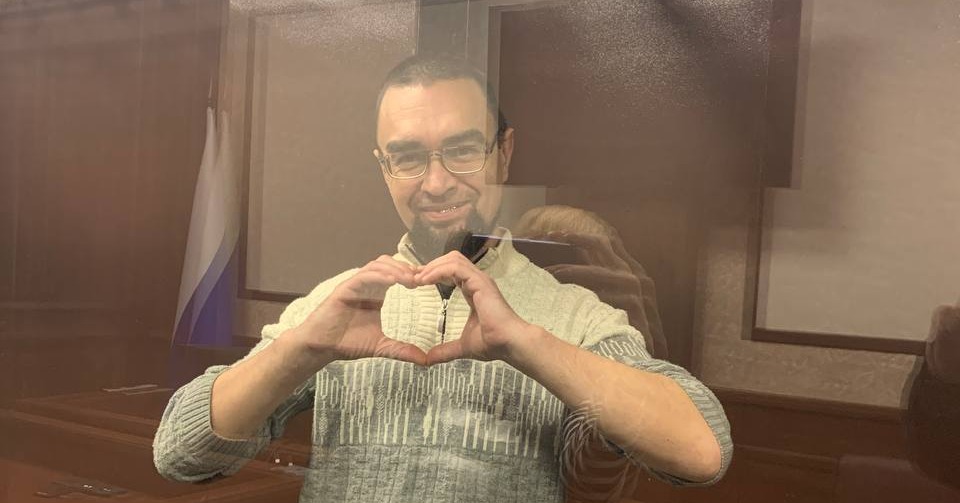
Igor Paskar: The Case File

Igor Paskar has been sentenced to eight-and-a-half years’ imprisonment for two anti-war actions. In June 2022, in the centre of Krasnodar, Igor set fire to a “Z” banner [a symbol of support for the Russian military]. Two days later, he protested at the local office of the Federal Security Service (FSB), by throwing a Molotov cocktail at the stone porch of the building, while his face was painted with the colours of the Ukrainian flag. The FSB and the courts defined this as “vandalism” and an “act of terrorism.”

Igor Paskar

Igor Paskar was born in Nikolaevsky village, a working-class community in the northern part of Volgograd Region. He went to school there. After doing national service on building sites in Samara, he worked as a courier, and for haulage and construction companies.

Paskar had three previous convictions. The first time he went to court, at the age of 22, was for possession of a few grams of cannabis: he was given a five-year suspended sentence. “In the milieu in which I grew up, half of the people I knew – if not more than half – smoked cannabis. It was not considered to be asocial or objectionable. But the motherland has decided that, in contrast to drinking alcohol, that’s serious criminal behaviour,” Igor said. Three years later, Paskar was in court again, and this time was sentenced to two years in prison for the theft of, and possession of, drugs. He points out that, from the moment of his first time in court, the police searched him regularly, and said quite openly that they were looking for weed. Igor’s third time in court was in 2006, when he received a one-and-a-half year suspended sentence for possession of narcotics. “That’s how I came to the attention of our law enforcement agencies. And from then on, I didn’t have a life,” he recalled. Given these circumstances, in 2013 Igor moved to Moscow.

In the capital, Igor continued working in various jobs, and helping his mother, until she died in 2017. This was around the time his social conscience took shape.

“As far back as I remember, even when I was very young, I was always concerned about what was happening in our country. Our motherland, in the guise of the Russian state, always seemed like a stepmother to me, not a real mother. I was never indifferent to the pressure that the state brought to bear on those who dissented or disagreed,” Igor said in court.

In 2020 Igor went to the Belarusian embassy to express solidarity with those who protested after the blatant falsification of the results of the presidential election, in which Belarusian president Alyaksandr Lukashenko gave himself 93% of the votes. “That summer and autumn, in 2020, when Belarus’s tinpot dictator was pushing his people around, I was still hoping that here in Russia we would avoid that kind of thing,” Igor says.

In 2021 Igor participated in a big protest staged after the arrest of Alexei Navalny. He was detained, brought to court and fined 10,000 rubles.

The all-out Russian invasion of Ukraine in 2022 decided things for Igor once and for all. He decided to undertake a symbolic anti-war action, to support people in Ukraine. On 12 June 2022, the Russia Day national holiday, Igor set fire to a pro-war banner displaying the letter “Z” and the militarist slogan “We don’t abandon our own.” However, the action did not attract the attention Igor had hoped it would.

He decided on a second protest. On 14 June he threw an improvised Molotov cocktail at the stone porch of the FSB offices in Krasnodar. It set fire only to a plastic mat. As Igor later stated in court, his action was entirely symbolic and posed no threat to anyone’s life. For Paskar, the action was an expression of solidarity with people in Ukraine, and a signal to those in Russia who did not support the war that they were not alone. My action was peaceful, and aimed to show all who opposed this monstrous war that they were not isolated, and to show our Ukrainian neighbours, that we [in Russia] have not all been turned in to zombies by state propaganda,” he said in court.

Igor was arrested a few minutes after throwing the Molotov cocktail at the FSB building. “I stood outside the building and waited for them. I made no attempt to hide or to evade arrest,” Igor recalled in court. The police arrived, asked if it was him who had started the fire, and, when he confirmed that it was, they put him in handcuffs and took him in to the FSB premises.

“There were people in uniform, perhaps six to eight of them,” Igor said. “They snapped a photo of me on a phone: that picture is in the case file, and it shows that I had no injuries. Then they asked me what I wanted, why I did that. I answered that I wanted to make use of Article 51 of the Constitution, that gives you the right not to incriminate yourself. They obviously found that funny, because a split-second later a sack was put over my head. The next few hours were among the very worst of my life.”

Continue reading “Igor Paskar: The Case File”

Old Deaf Joke

Old Deaf Joke

A Russian and a Cuban and an American were on a train
It quickly came to pass that the Russian took out a bottle of vodka and after a few swigs he tossed it out the window
The other two men exclaimed why throw still have vodka good waste why
The Russian opened his fur coat and showed them rows and rows of bottles and he said there Russia vodka plenty
The two men said oh and settled back in their seats
After a while the Cuban took out a cigar and after a few puffs he tossed it out the window
The other two men exclaimed why throw still have left good cigar waste why
The Cuban opened his suit and showed them rows and rows of cigars and he said there Cuba cigars plenty
The two men said oh and settled back in their seats
After a while a young man came whistling into the car from the next one
The American grabbed him by the collar and belt and tossed him out the window
The other two men exclaimed why throw still young good man waste why
The American made an expansive sweep with his hands and said here America hearing people plenty
The two other men said oh and settled back in their seats

Source: John Lee Clark, How to Communicate (W.W. Norton, 2022), which has been nominated for the 2023 National Book Award in Poetry and won the 2023 Minnesota Book Award for Poetry. Mr. Clark (born 1978) is an American deafblind poet, writer, and activist from Minnesota.


Apart from a detailed peace plan to end Russia’s invasion of Ukraine, President Volodymyr Zelenskiy has a less conventional idea for ending geopolitical crises like these: let dogs run the world.

In the rare downtime he gets as a wartime leader, Zelenskiy, speaking to Reuters by video link on Wednesday, suggested man’s best friend might fare better when it comes to getting along on the global stage.

“Sometimes I’m … looking at all these wars or looking at all the crisis, Middle East crisis. It’s not only Ukraine, everywhere in Africa and the Middle East.

“Sometimes I’m looking at this and think that the best way (is) if this planet will be the planet of dogs,” he said at the Reuters NEXT conference in New York, responding to a question about what still makes him laugh.

The Kremlin’s war in Ukraine, now in its 21st month, has upended Europe’s security architecture and sent ripple effects through Africa and Asia, which have seen food shortages thanks to Russia’s de facto blockade of the Black Sea.

ReutersNEXT Newsmaker event in New York

Kyiv’s Western partners have provided crucial financial and military support, but are now also dealing with the conflict in Gaza.

Along the front line, Ukrainian forces have been fighting for months to reclaim Russian-occupied territory in a counteroffensive but have made only incremental gains.

Zelenskiy, who is promoting a 10-point peace proposal, said his dogs provide much-needed relief when he spends time with his wife and children, and are “always funny”.

“Sometimes I don’t understand people, really,” Zelenskiy added with a smile.

To view the live broadcast of the World Stage go to the Reuters NEXT news page: https://www.reuters.com/world/reuters-next/

Source: “Zelenskiy hopes for “planet of dogs” to solve world’s crises,” Reuters, 8 November 2023


Today we ask you to support one specific and very important project — Navalny’s Propaganda Machine. It functions very simply: volunteers telephone people in Russia and talk with them, persuading them to turn from Putin supporters into doubters, and from doubters into opponents of Putin and the war.

The more people in Russia start asking questions and stop tacitly supporting everything that the Putin regime is doing, the better for our country. The volunteers of Navalny’s Propaganda Machine are working on this right now.

You can become a volunteer by sending an email to antiwar@navalny.com or supporting the project with a donation. A one-minute call costs two cents. That is, your $10 will turn into 500 minutes of conversation. And $20 is a thousand minutes of conversation with actual residents of Russia, who, thanks to you, can learn the truth and get motivated to fight. Make your contribution at https://acf.international.

Thank you for being on our side!
The Navalny Team

“Navalny has been in prison for 1,025 days”

Source: email newsletter from the Navalny Team (Anti-Corruption Foundation), 9 November 2023. Translated by the Russian Reader
“It’s Too Late for Me to Be Afraid”: Olga Nazarenko’s Solo Anti-War Protests

Olga Nazarenko: “I’m a Russian citizen who opposes the war. Send Putin to The Hague!”

Olga Nazarenko, a lecturer at medical university in Ivanovo, got involved in protests supporting Ukraine back in 2018. Since February 24 of this year, she has gone on an anti-war picket almost every week. Over this time, five cases have been opened against her for administrative offenses. Recently, Nazarenko was fined 150 thousand rubles [approx. 2,350 euros] for an anti-war picket. Only a few people in Ivanovo support the lecturer, so she usually stands alone with a placard. There are incomparably more people in her city who disagree with her position. Once, when Nazarenko was returning home, a passerby doused her face with spray paint on a dark street. People have written the Z symbol and the words “Ukrainian scum” on the associate professor’s mailbox. Nazarenko paints over the insults with yellow and blue flowers.

Nazarenko spoke to Radio Svoboda about her resistance to the war.

What was February 24 like for you?

– I didn’t believe until the last moment that war was possible. I can describe my reaction to the news about the outbreak of war with Ukraine only with obscene language. That same day, I went on a solo picket with an anti-war placard, and the next day too. Since then, I have been going on pickets every week, sometimes once every two weeks.

– You have already been convicted once for “discrediting the armed forces.” Why do you risk being prosecuted?

– My conscience won’t let me do otherwise. In the twenty-first century, problems in interstate relations are not solved by war. It’s barbaric. This war is an injustice on Russia’s part, and I cannot remain silent when I see injustice. A [solo] picket is now the only way to voice one’s stance publicly. Yes, most passersby do not voice their opinion in any way while I am picketing. But at each picket I see that two or three people support me. I understand that it is vital for each of them to see that they are not alone. Also, I have friends and acquaintances living in Ukraine. I worry about them, of course, and I know that for them my support — at least in the sense that I am not silent — is also vital.

– What was the trial at which you were fined 150 thousand rubles like?

– On February 27, I went out with a placard that read, “I’m a Russian citizen who opposes the war. Send Putin to The Hague!” Half an hour later, I was detained after a disgruntled passerby denounced me to the police. In April, the court recognized that my right to a defense had been violated due to the fact that my lawyer was not given the charge sheet to sign. The police appealed this decision, and the court found me guilty under Article 20.2 of the Russian Federal Administrative Offenses Code for, allegedly, “organizing a public event” and fined me 150 thousand rubles. I told the court about my anti-war stance and that our courts are cemented into the power vertical, and so they make the rulings that the Russian authorities need them to make. I also told the court that Russia is waging an unjust war against Ukraine, that people are dying, and that I opposed it. In my opinion, the judge’s ruling had been made in advance.

– Do passersby often react aggressively to your anti-war pickets?

– Of course, there are people who react aggressively to my position. They drew the Z symbol and wrote “Ukrainian scum” on my mailbox. I painted over the inscription with yellow and blue flowers, making it beautiful. Once on the street late at night, a young man doused my face and clothes with spray paint. Fortunately, my glasses protected my eyes from injury, while my clothes turned a golden color. My down jacket even became beautiful, iridescent, but only on one side, sadly. Once, at a picket in support of the boys from the Network Case, a man came up and said that people like me should be shot. He tried to take my placard away and hurt my finger in the scuffle. But I kept him from getting my placard.

– At what point did you decide to go on pickets?

– I have been actively voicing my position since 2014. I was outraged that Russia, at a difficult moment for Ukraine, committed a treacherous act against it by annexing Crimea. This was the first thing that angered me, and the second was the lies that supported it. I realized that in such circumstances I could not remain silent. At first, I went to various protest rallies and marches. But they were held rarely and I wanted to voice my civic stance more often. At first, I was bashful about going out on solo pickets. But on social media I saw that people were doing solo pickets. At some point I decided to try to picket too and got sucked into it.

I have been going on pickets in support of Ukraine since 2018. A friend of mine and I protested for the release of the Ukrainian filmmaker Oleg Sentsov. After all, a hybrid war had essentially been waged since 2014, and I had always opposed it. I was brought up on the principle that you couldn’t take what doesn’t belong to you, which also applied to international relations. Crimea is Ukrainian by all international standards. I could not approve of Russia’s interference in the affairs of a sovereign state, and from that moment I took an unambiguous stance. On February 24, everything became completely transparent.

– In February of last year, you hung a large banner that read “The FSB is a disgrace to Russia” on a railway bridge. What made you decide to do this protest?

– I believe that the FSB now holds all the power in our country, because Putin is from the FSB. So, the FSB lets itself break any law and torture people with impunity — such as, for example, the defendants in the Network Case. I think it important to voice my negative attitude to this. The banner hung for about half an hour until police officers arrived and tore it down.

I was detained right there and taken to the police department, where they took my statement and released me. This is not the first time I have publicly condemned the actions of the FSB. For example, I picketed against the Network Case outside the FSB headquarters in Ivanovo.

Olga Nazarenko

– Aren’t you afraid to publicly criticize the FSB?

– Yes, that organization has a lot of power, but I have no respect for it.

– I know that you sued Center “E” last year. Please tell us how that happened.

– I was doing community service at the zoo for a video in which I had talked about the problems of our region and called for peaceful protest. I was charged with “organizing an unauthorized event” for these actions. Right when I was cleaning the bird cages, a Center “E” officer came and videotaped me without my permission. The video was posted on the Telegram channel “A Cop’s Life: Ivanovo,” along with what they imagined was a funny comment. I decided that the Center “E” officer had violated my right to privacy. I filed an administrative lawsuit against the Interior Ministry, but my suit was dismissed.

– Not long ago, you were accused of resisting the police because you tried to help a friend at an anti-war picket. What did you do then?

– A female acquaintance decided to go on a picket on February 24 and asked on a chat for support. I responded to this request and arrived at the picket site. As soon as the young woman held up her placard, a policeman approached her and tried to detain her. She was opposed to being detained, so I got between her and the policeman. Consequently, we were both detained. The next day, I was taken to the police department, charged with resisting the police, and sentenced to 80 hours of community service. I’ve already done them. But soon I will have to do another 180 hours for a fresh administrative offense related to publicly voicing my anti-war position.

– How do the heads of the medical school where you work look at your pickets and court hearings?

– They are still relatively friendly to me at work. The bosses said that I could do anything as long as it was not during working hours. I never engage in activism to the detriment of my work: I don’t lobby anyone in the classroom. So I have no problems at the university now. For the time being I can juggle work and activism.

– Does your family support your anti-war position?

– My loved ones worry about me, but they don’t try to dissuade me. My husband and I try not to talk about politics. His point of view runs counter to mine, and we don’t discuss politics to avoid spoiling our relationship. As it is, there are so many situations in which I have to get harsh to defend my position, but at home I want to live in peace and tranquility. My little son and adult daughter worry about me and support me emotionally.

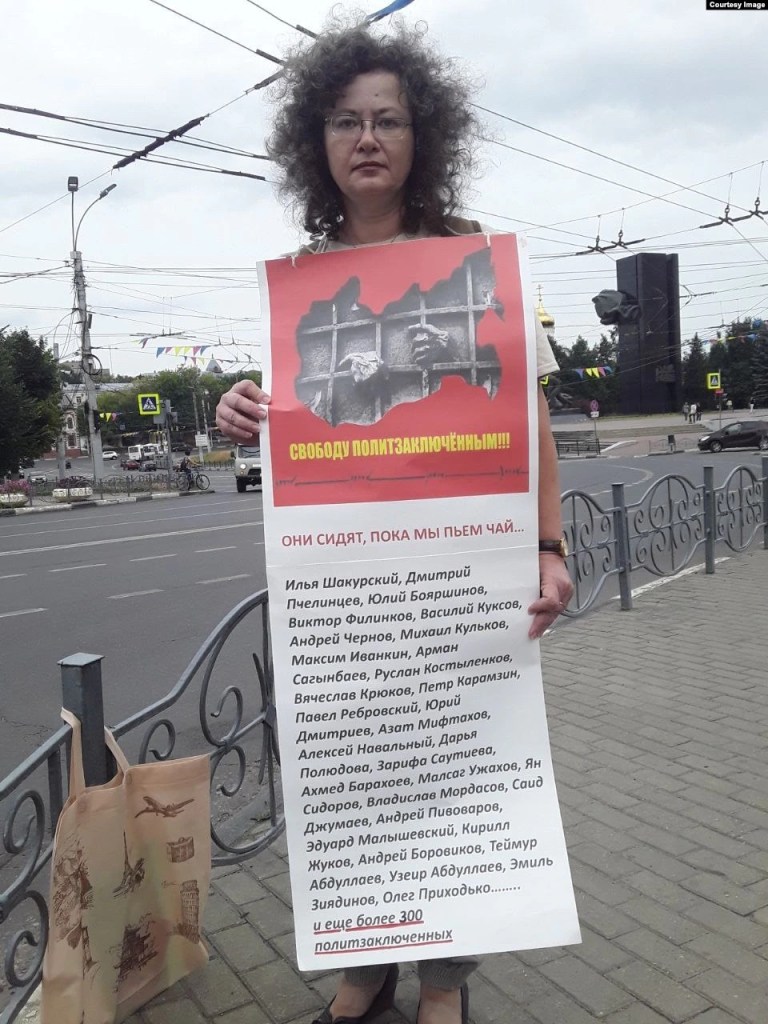
Olga Nazarenko, holding a placard that reads, “Free political prisoners!!! While we drink tea, they’re in prison.” It features a long list of current Russian political prisoners, nearly of all whose cases have been covered on this website.

– How are you going to pay the 150 thousand ruble fine?

– Friends and friends of friends helped me to pay the previous fine of 75 thousand. I don’t know yet how I will raise this amount. I’ll probably have to turn to public organizations for help.

– Putin recently passed laws that give [law enforcement] even more possibilities to crack down on grassroots activists. Aren’t you afraid to continue going on pickets when this is the reality?

– It’s too late for me to be afraid. If the security forces want to sanction me, they have enough material against me. I have already passed the phase of being afraid.

– Do you think your numerous pickets have affected the attitude people in Ivanovo have toward the war with Ukraine?

– Everything in society has only gotten worse over the years. In the big scheme of things, such protests cannot change a thing. They matter only to the person who does them and to people who think the same way, as well as for those supported by them.

– Why are you taking such a big risk in this instance?

– I just act on the principle that you do what you have to do, come what may. This is how I was brought up as a child. I realize that there could be unpleasant consequences for me, but I don’t think about it.

– How exactly were you brought up?

– My parents are teachers. They are decent people who shaped my principles, such as the literature I read as a child. My favorite books were Alexandra Brushtein’s trilogy The Road Goes Off into the Distance.

– But many Russians have read those books. Aren’t you angry that so few Russians protest publicly?

– I am a little annoyed, rather, that people cannot act in keeping with their conscience. And I realize that if more Russians had openly voiced their position when it was not less dangerous, the situation would be slightly different now.

Most people let their personal interests outweigh [other things], and this is normal. My instinct for self-preservation is a little dull, and perhaps this is not entirely normal. I don’t condemn Russians, but still I think that, in the current situation, it is impossible to remain silent.

– Now, after almost five months of war in Ukraine, many Russian activists complain of burnout and fatigue. Do you have such problems?

– I don’t have burnout and depression, but nor do I have any hope that things will change quickly. Perhaps in a hundred years our great-grandchildren will be able to change something — if we manage to raise our children the right way, and then they raise their children the right way. At some point, there will be enough people to change things here. But my generation won’t live to see it.

– Are you not planning to leave the country if a criminal case is opened against you?

– I’m not going anywhere. Russia is my country: it doesn’t belong only to those in power and their supporters. I won’t let anyone kick me out of my own country. I’m ready for a possible prison sentence. If it happens, I will serve my time, and then I will get out and continue my pickets. I’m not too afraid of prison: people somehow live in there too. You can’t jail everyone, and you can’t shut everyone up.

Source: Darya Yegorova, “‘It’s too late for me to be afraid’: Olga Nazarenko’s solo pickets,” Radio Svoboda, 16 July 2022. All images courtesy of Ms. Nazarenko via Radio Svoboda. Thanks to Comrade Koganzon for the heads-up. Translated by the Russian Reader
Yevgenia Litvinova: “The Buskers Played Pink Floyd’s The Wall”

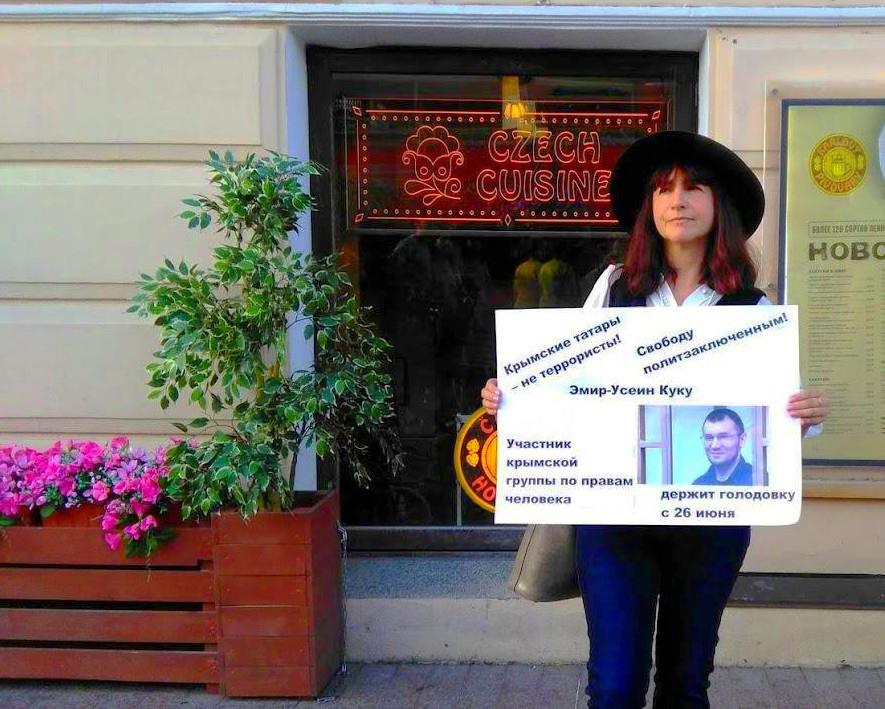
litvinovaYevgenia Litvinova. Her placard reads, “Crimean Tatars are not terrorists! Free political prisoners! Emir Hussein Kuku, a member of the Crimean Human Rights Group, has been on hunger strike since June 26.” Photo courtesy of Ms. Litvinova’s Facebook page

Yevgenia Litvinova
Facebook
July 19, 2018

July 18, 2018

We arrived at Strategy 18 ahead of time yesterday, but we started our pickets half an hour later.

An unauthorized rally against raising the retirement age was planned to take place on Malaya Sadovaya Street. They might have needed help. Paddy wagons were lined up on the Nevsky. It was understood people would be arrested. That was what happened.

Two hundred people attended the protest rally. Fourteen of them were detained, including Father Grigory Mikhnov-Vaytenko, a member of the St. Petersburg Human Rights Council. The detainees were driven from one police precinct to another for three hours. They were released around midnight.

Why do so few people defend their own interests? Are they afraid? Yes. Was the rally poorly advertised? That, too. But there is also an indifference to everything and everyone, including oneself.

Around a year ago, in September 2017, we organized a Peace March. It was also unauthorized, of course. Approximately three hundred people showed up. It was understandable: people are fed up with the antiwar agenda. They want to isolate themselves from other people’s corpses and the crimes of their own government.

Pensions affectly them directly, however. They are the ones whose money is being stolen, lots of money when you add it up. Yet people are again okay with everything.

“Should I bring the rope [to hang me]?”

At seven-thirty, we went back to our own plan, pulling out placards about the persecution of the Crimean Tatars. Natalia Voznesenskaya and I stood together for reasons of safety. There were tons of hired thugs [titushki] out on the Nevsky yesterday. They all claimed to be Crimeans who had just arrived from Crimea. You would have thought Crimea had sent a landing force to the shores of the Neva.

When they walked by us, they would shout the same thing.

“It’s not true! It doesn’t exist! You’re making it all up!”

What doesn’t exist?

My placard featured a picture of Emir Hussein Kuku, who has gone on hunger strike. What was not true? Did Kuku not exist? Did he not go on hunger strike?

There has been good news from Kuku’s wife. He ended his hunger strike today, July 19. However, his hand was forced by the rapid deterioration of his health.

That was today, though. His hunger strike lasted twenty-four days.

I have a young lady friend who is three years old. “No” and “not” are currently the keywords in her vocabulary.

When the first two lines of Samuil Marshak’s famous children’s poem “What a Scatterbrain”—”A scatterbrained man lived / on Basin Street”—are read to Sonya, she comments, “He did not live. He was not a man. He was not scatterbrained. It was not on Basin Street.”

It was exactly like that at our protest yesterday. A woman holding a child’s hand shouted the memorized text at us. She didn’t hesitate to look that way in front of the child. Or she thought the child didn’t understand what mom was saying.

There was also an attack on one of our picketers. Alexander Khmelyov was standing on Anichkov Bridge. One of the hawkers who encourages people to go on boat trips, a huge man in his thirties who could just as well have been tossing heavy sacks for a living, tore Alexander’s placard from his hands and tossed it into the Fontanka River.

We complained to the police. We pointed the attacker out to them.

Their response?

“Go to the precinct and file a complaint.”

The guardians of order didn’t bother to go up and talk to the attacker.

The buskers were playing Pink Floyd’s The Wall.

Translated by the Russian Reader
