A court in St. Petersburg has begun hearing the case against translator Elena Abramova, who has been charged with repeatedly “discrediting” the Russian army because she engaged in public protests brandishing placards that called for the release of Alexei Navalny and all other political prisoners, and an end to Russia’s war against Ukraine. Because of the criminal case against her, Abramova is no longer permanently employed, although she has stayed in Russia.
Elena Abramova was born and raised in Magadan. Her parents met as students at a teachers institute. Her mom worked as an insurance agent, and her dad, Arnold Yeryomenko, was a Russian language and literature teacher. In the late 1980s, Yeryomenko was imprisoned for two and a half years over his manuscript “October Vanquished,” which detailed “his thoughts on the regime, the Soviet government, and the Soviet legacy.” The family does not have the text of the manuscript: although Abramova’s mother asked the FSB for a copy, she was told that the document had been lost.
“I don’t know for sure whether Dad planned to publish his manuscript officially, or if he was hoping [to publish it] in samizdat. But he definitely talked about it, and someone in his entourage was aware of its contents. That someone was probably an informant, which is how the KGB found out about the manuscript. Informers probably think they are doing something useful in this way, so they inform on people,” Abramova says.
Yeryomenko spoke at protest rallies and led a pro-democracy movement in Magadan, which “held meetings with supporters, but was not involved in electoral politics.” He was asked to run for office but declined.
“I don’t think Dad had any political ambitions. Power never appealed to him. He had his job, which he enjoyed, he spent time with his family, and he read a lot — we had a very extensive library. In short, he had other interests,” says Abramova. “My father’s principled position was that the individual human being had supreme worth. There should be no pressure [on the individual], no compulsion to [hold particular] views or [adhere to] any particular ideology. He always advocated for de-ideologizing society, for the possibility to freely voice one’s thoughts, to speak out freely, to freely participate in peaceful political campaigns. This is what we lack now.”
Yeryomenko’s political activism peaked in the mid-1980s, after he was released from prison, and waned in the 1990s.
“My family welcomed the fall of the Soviet Union,” says Abramova. “I had to wear a Young Pioneer tie for a year, and I remember how we constantly made up excuses to avoid wearing it: that it was supposedly in the laundry, or something else was the matter. When it was all over, I remember the feeling of relief that now I wouldn’t have to do it: there was something contrived about it. I thought that now we would be able to live in peace, without these tokens of the Soviet regime. It seems to me that after the collapse of the Soviet Union, when that short period of freedom dawned, many people just relaxed. It was such a contrast with the past that everyone wanted to get on with their own lives finally, to enjoy the advantages that became available after the regime changed.”
Abramova says that her own views, on the one hand, come from her family, although she was not particularly interested in politics before Russia’s invasion of Ukraine. Her father died in 2008, and five years later she left her job at a large gold mining company and moved to St. Petersburg, where she got a job as a translator. She was buried in her own cares, including working and raising a child.
“I lived my life. Now I look back and recall that my interest in politics emerged not so long ago, and it was provoked by the outbreak of hostilities to a large extent. Before that, I was aware of certain events, of course, and I had opinions on certain issues. I was simply shocked when I heard that [the war in Ukraine] had beguin. At that moment, I was not up to speed at all, I didn’t folloow in detail what was going on. When I saw [the President’s televised] address [announcing the war], I didn’t even realize what was happening. I couldn’t believe that such a thing was even possible, and it took me several days to just to get my head around it. I read news feeds like crazy and watched YouTube. It was a complete surprise, I didn’t think it would happen. The catastrophe is that people are being killed every day,” Abramova says.
Abramova held her first protest picket in late 2022. At the time, she was not only reading news about the hostilities in Ukraine but also following the political trials [in Russia].
“Ilya Yashin was sentenced on December 9. I decided that I had to protest publicly. Although it would be a purely symbolic gesture, I had to do it because I was ashamed. I was ashamed that my country had been plunged into such chaos and darkness. I didn’t know when it would end, and it was clear that this solo picket wouldn’t change anything, but it was a public statement I had to make, which I had to make against all the odds, despite the restrictions. I was a bit scared: I had no prior experience of solo pickets. I had gone to rallies in support of Navalny, and after [Boris] Nemtsov was murdered. But I had not been to the protest rallies that were held at the very outset [of the war]. I was not subscribed to any [social media] communities and didn’t know where they were held, who had made arrangements with whom, or where to go. But this time I decided that I had to go out,” says Abramova.
Abramova’s first picket lasted for only five minutes, although the site — the square outside the Mariinsky Palace — was not very crowded.
“[I stood for] five minutes, maybe a little longer. I soon noticed law enforcement officers approaching me — slowly, demonstratively slowly, as it seemed to me. They detained me quite politely, they weren’t rude. But there was one man in civilian clothes, in a tracksuit, who was also at the police station later, and he asked the most questions. While I was standing there, I saw someone from the opposite side of the street taking a picture of me. Some people walked by and said “thank you” — it was a young couple, I think. Others pretended not to notice. My placard that time out read “No War.” A couple of months later, in February [2023], a court hearing took place, at which I was fined 30,000 rubles [approx. 380 euros at the time],” Abramova recalls.
Abramova was sentenced to another fine for taking part in a protest rally against the military mobilization, and in late April 2023 she held another solo picket outside Gostiny Dvor. She was able to stand there for a few seconds before she was detained. She held her third picket on [June 4], the birthday of politician Alexei Navalny.
Elena Abramova
“I took up my position on the Field of Mars, were there were no police officers at all. Later, I went to Gostiny Dvor, where I was detained immediately. An arrest sheet was drawn up for the second picket, but the case did not go to court. After I left the station, they telephoned me and asked me to come in for ‘additional testimony.’ They probably realized this was already my second arrest. But it was not listed in the arrest sheet, and so I declined to go in. After my third picket I was taken to the same station, and this time the police pulled my rap sheet and opened a criminal case against me,” says Abramova.
Several men in balaclavas, an investigator, and Center “E” officers (officers from the Interior Ministry’s “anti-extremism” unit) soon came to search Abramova’s home.
“I said I had to get dressed, and they said I literally had five seconds to do it. I began to get dressed, but they were banging on the [front] door and practically breaking it down. My child was asleep, so I woke him up, told him not to worry, and explained there was going to be a search. When they were already inside the apartment they behaved themselves, but they confiscated my phone and didn’t even let me call work to warn them I wouldn’t be coming,” says Abramova.
During the investigation, it came to light that the criminal case against Abramova had been launched illegally. Since she is a voting member of an election commission, a criminal case can only be initiated through a special procedure, which had been violated. Formally, then, the case against Abramova was launched twice: first in the summer of 2023, and again in May 2024.
The criminal case against Abramova is currently being heard in court. According to Russian law, for two antiwar pickets she faces a huge fine, forced labor, or up to five years in a penal colony. Abramova attends the court hearings and has no intention of leaving Russia.
“I don’t see any use for myself abroad. I had difficulties finding work in St. Petersburg, especially after the criminal case was opened and I was fired, back in September of last year. I missed a day of work because of the search, and I was immediately asked to turn in my resignation. It was a commercial firm, and the management was probably afraid of scrutiny from law enforcement. But still, I can’t imagine what I would do if I weren’t in Russia. I think that there may come a time when people will need to be here, but the people who need to be here won’t be here. And then, even if I leave, I can’t stifle my feelings. I also feel my share of the guilt for what is happening — for my indifference and lack of involvement. And the pain over the fact that my country unleashed a war against a neighboring country would still remain. I would still have to live with it. Changing locations wouldn’t affect this much,” says Abramova.
In late July 2024, 39-year-old pianist Pavel Kushnir died in a Birobidzhan pretrial detention center. His musician friends and musicologists have no doubt he was a genius. Many of them had been unaware of his arrest in May 2024 on charges of “publicly calling for terrorist activities.” The grounds for his arrest were his anti-war videos, although his YouTube channel had only five subscribers at the time.
According to close friends, Kushnir himself had wanted to go “far from the capitals,” so he chose Birobidzhan hoping that he would not be forced to perform WWII Victory Day concerts amidst the ongoing war against Ukraine. As soon as the war started, Kushnir wrote social media posts opposing it, posted antiwar leaflets, and staged hunger strikes in protest. Before he was taken to the detention center, he had gone on at least two protest hunger strikes, one of which lasted for over one hundred days.
“He was almost a professional faster, so I don’t think he could have died in the pretrial detention center solely due to that,” his close friend Olga Shkrygunova told Okno.
“We Live in a Fascist Society”
“I am a musician, a pianist, and I graduated from the Moscow Conservatory, where I studied under Victor Merzhanov. I worked as a soloist at the Kursk Regional Philharmonic for seven years, and as a soloist at the Kurgan Philharmonic for three years. I have also tried my hand as a writer, and published an anti-war novel called ‘Russian Mash-Up’” was how Kushnir introduced himself in one of the interviews his friend Olga quoted to Okno.
Kushnir was born in Tambov, where his closest relatives still live. He studied at the music school and the Rachmaninoff Music College in Tambov. After graduating from the Moscow Conservatory, he worked in the Kursk and, later, the Kurgan philharmonic orchestras. In 2023, Kushnir was appointed soloist to the Birobidzhan Regional Philharmonic, and he was arrested in Birobidzhan in May 2024.
The person closest to him, his father Mikhail Borisovich Kushnir, a music school teacher in Tambov and a promoter of musical cognition, died several years before the Russia-Ukraine war started. Many of his friends note that had Kushnir senior lived to see this day, he definitely would not have survived his son’s death.
“They had a very close relationship. Mikhail Borisovich had great faith in him and was proud of him. They laughed a lot together, and he was very supportive of him,” Olga recalls. “The loss of his father was hard for [Pavel].”
Kushnir’s friends invariably call him super-talented, and even more often they call him a brilliant pianist.
“Pasha was just an incredible person. Ever since he was a child, everyone has talked about his incredible ear for music. For me, he was always a genius, both as a person and as a musician. A genius is an idealist who brooks no compromise, who battles on behalf of love, creativity, and freedom. His inexhaustible imagination knew no bounds. He once studied the language of Avatar and wrote a poem in it. He loved the cinema and knew it well, and he read a lot. He loved Vonnegut’s Cat’s Cradle. He wrote an anti-war novel, Russian Mash-Up: it is an original dystopia with references to Russian literature, and the main idea is to denounce the state dictatorship. Pavel was able to send me the manuscript of the new novel by mail. I hope that we friends of his can pool our efforts and publish it soon,” says Olga, who left Russia for Germany in 2012.
It was then, twelve years ago, that Kushnir last visited Shkrygunova in Moscow. In May 2012, he went to Bolotnaya Square to take part in the large-scale protests that were sparked by the fraudulent elections to the State Duma.
Kushnir’s description of his anti-war leafletting in Kurgan.
“He still believed back then that things could be fixed,” Olga says, sighing. “I know that Pavel protested the war in 2018 by going to pickets against the annexation of Crimea and the war in Donbas. When in May 2018 he went to Pushkin Square [in Moscow] holding a placard that said ‘Down with war, freedom for Russia,’ his homemade sign was torn apart [by police]. After the military invasion, he bitterly observed that nowadays [the police] would tear him apart at such a picket. So, he replaced pickets with leaflets, and leaflets with hunger strikes. They were his form of protest against fascism. He didn’t argue that we should give up picketing, but he understood that it required great courage, ‘because we live in a fascist society,'” Olga quotes her friend as saying.
As Kushnir admitted in his letters to friends, “the turning point and epiphany” for him had been Bucha.
“I think that the Bucha massacre is a disgrace to our motherland. Fascism is the death of our motherland. Putin is a fascist. Our motherland sacrificed millions of the best lives so that fascism would not exist, and we will not accept it. The criminal, despicable war which Putin’s fascism has been waging in our name is a challenge to my conscience, to all my personal hopes, to all the best things in me. I am sure I am not alone. For many people of my generation, accepting the war, ignoring the war, is unthinkable. Two nations are dying in this war. It must be stopped as soon as possible,” Olga quoted him as saying.
In 2022, Kushnir produced anti-war leaflets and posted them around Kurgan.
“At night, he put up large A4-sized leaflets, and during the day he put up small ones with peace symbols and biblical quotes in public places,” says Olga.
“Hunger Striking Is a Peaceful Form of Protest”
On 9 May 2023, Kushnir declared his first hunger strike, which was to last twenty days.
By his own admission, Kushnir did not expect a positive response from the authorities, but he hoped that other people would embrace his peaceful form of protest.
“I expect people to think hard about their attitude to the war, to end their silence. I expect a miracle,” he wrote.
According to his friends, Kushnir easily tolerated hunger and scheduled his next hunger strike, which was to last one hundred days, in the winter and spring of 2024.
“He went on and off [hunger strikes] absolutely systematically,” says Olga. “In March, when he had finished, he called us to say that everything was fine, that he felt good. He had been drinking water, apple juice, and coffee. As an illustration of his hunger strike, he suggested we imagine a glass of apple juice. So I don’t think he could have died from the hunger strike alone. I don’t believe it. I can’t rule out that they could have beaten him up in the detention center or in some other way they exacerbated his condition.”
In late May 2024, Kushnir was detained by the FSB. A criminal case was launched against him on charges of “publicly calling for terrorist activities” (per Article 205.2 of the Russian Criminal Code). The community Vkontakte page Atypical Birobidzhan was the first to report Kushnir’s arrest, claiming that four videos posted on Kushnir’s YouTube channel had served as grounds for the charges. It also reported that Kushnir was allegedly found in possession of a “homemade FBI agent’s ID.”
The short anti-war video which Pavel Kushnir posted on his “Foreign Agent Mulder” YouTube channel on 5 January 2024
“Pavel had been running the channel ‘Foreign Agent Mulder’ since 2011, and there are only four videos posted there. All of them criticized the war and the policies of the current Russian government. Before Pavel’s death, the channel had exactly five subscribers,” says one of Kushnir’s friends. “Now there are [507] subscribers.”
Many of his friends first learned of Kushnir’s death in late July and only then that he had been behind bars when he died.
“Unfortunately, Pavel’s arrest has come to light only now. I, for example, do a monitoring of court proceedings in the regions quite often, but I missed the news of Pavel’s hearing… I think this was a case when publicity could have saved the prisoner. I learned about Pavel’s death from Arshak Makichan, with whom I was involved in environmental activism; Arshak later left Russia, but he had known Pavel at the conservatory. I think that the intervention of such well-known activists in the case could have prevented Pavel from taking such a desperate step,” says Marina, an activist who corresponds with political prisoners. “Pavel’s cellmates testify that his death resulted from a dry hunger strike, and there is no reason not to trust them. As I understand it, the family is afraid of publicity, as the Moloch of the political crackdowns may strike them as well, so we don’t really know anything yet. But if you watch Pavel’s interviews and listen to his statements, I think it is clear that he was a man of genius, a talented, brilliant, and sensitive man. Unfortunately, such people do not have the ability to stand up to brute, base force, and the only protest that was available in the pretrial detention center was a hunger strike, apparently. Many anti-war activists—Ivan Kudryashov, Maria Ponomarenko, and dozens of others—have gone on hunger strike. When there is no communication with the outside world, no media contacts, alas, this is all that is left to a person. It’s scary to imagine what Pavel went through. The country has yet to realize who we have lost.”
Anna Karetnikova, a human rights activist who for many years aided prisoners as a member of the Moscow Public Monitoring Commission and, later, as a lead analyst in the Federal Penitentiary Service’s Moscow office, argues that the official cause of Kushnir’s death will not be listed as hunger strike, even if that was the cause. According to her, concealment of the real cause of death is a common practice in the Russian penitentiary system, so there are no statistics for hunger strikes in pretrial detention centers and penal colonies.
Pavel Kushnir’s messenger service announcement of a hunger strike, dated 9 May 2023 (celebrated in Russia as WWII Victory Day): “I’m going on a hunger strike. I demand the liquidation of the fascist regime, cessation of the war in Ukraine, and release of all political prisoners.”
“Pavel Kushnir’s death in the Birobidzhan pretrial detention center has been attributed to his hunger strike, a dry hunger strike in which the detainee refuses not only food, but also water. In my experience, cases of hunger strikes in places of detention are frequent and fall into two main categories: those triggered by criminal cases, and those protesting conditions of detention. They can be both for serious reasons, such as gross violations of human rights, and for trifling reasons, such as an investigating officer refusing to bring an inmates cigarettes. They can also be individual and collective. But dry hunger strikes are quite rare, because most detainees realize that it can eirquickly lead to th death,” says Karetnikova. “The law provides for a detainee’s refusal to eat, but it also stipulates what actions wardens should take in such cases. After receiving a written application for a hunger strike, the wardens at a pretrial detention center must notify the person in charge of the criminal case, as well as the supervising prosecutor. In addition, the hunger striker is entitled to a daily checkup by a doctor, during which their temperature, blood pressure, and weight are measured and recorded, and, if possible, to be placed in a separate cell from which all food has been removed. Every day, they will be brought food, which is left on a table, or on the feeder tray if it is open. Also a mentor will come and try to persuade them to give up this waste of time. Information about hunger strikers in each institution is entered daily into the penitentiary service’s overall statistical summary.”
“Forced feeding of detainees is provided for by law. Most often, in agreement with the hunger striker, they are given glucose drips, possibly with something else added to the mix to support them. If their lives are threatened, they can be force fed through a tube.”
“I don’t think hunger strike was listed as the cause of Kushnir’s death, however. I think that only his relatives and friends and cellmates knew that he was on a hunger strike. Even after the publicity, for example, a medic could be punished if he forgot to perform certain formalities— for example, doing a physical examination and taking the inmate’s temperature. He could be reprimanded and, at worst, dismissed. In a similar case, the head doctor of the hospital at the Matrosskaya Tishina prison in Moscow was fired. Of course, no one explained the reasons for his dismissal, and a different cause of death was listed . But the [inmate] had been quite emaciated, and it was feared that the truth could come out. If it had come out, [the doctor] could have been jailed for negligence, for example, or endangerment.
“Force feeding is not practiced as a matter of principle in Russia, because, for example, in order to force feed Alexander Shestun[the ex-head of the Moscow Region’s Serpukhov District (2003–2018) and chair of its Council of Deputies, Shestun was sentenced to fifteen years in a penal colony on charges of fraud and money laundering, but Memorial listed him as a political prisoner] they contacted headquarters a hundred times, since they could not understand what to do and how to do it. But they didn’t get any reasonable instructions from headquarters either, except ‘do something or we’ll punish you,'” Karetnikova says.
According to Karetnikov, the hunger striker loses weight, their vitals deteriorate, and sometimes they are unable to walk.
“There are stomach pains, different organs can fail, and in the long term, people can become confused and sometimes go crazy. Some people engage in self-harm. This is not the case with dry hunger strikers: I usually was able to convince them to give up, in exchange for my promises to do something to help, promises which I tried to keep,” says Karetnikova. “Some detainees starved for months. The longest well-known hunger strikers included Nadiya Savchenko, Alexander Shestun (who was subjected to force feeding), Sergei Krivov, and many other people who were released, but whom I don’t want to identify here. One of the hunger strikers was a stoma patient. One can live without food for about two months, on average. However, many hunger strikers took week-long breaks that enabled them to go without food for months at a time, and they were also put on IVs while on hunger strike. If you give up water too, you can die within a week.”
“He Played for God”
After Kushnir’s death, it was revealed that that he had long foreseen his own arrest, as evidenced in correspondence with his friends.
“He often wrote ‘I haven’t been jailed yet,’ and he sent me interviews where he openly spoke of the current system in Russia as fascist. I tried to persuade him, especially when he was looking for a new place to work a year ago, to come to Germany. I said we would take him in and he would find a job. He agreed but then immediately refused to write a bio, which is what you have to do if you want to play concerts. Those are laws of the music market, what can you do. But he was uncompromising: ‘I am a musician, my music speaks for me,'” Olga recalls. “Then there was the hope that he would be hired in a remote city, as he had decided to stay in Russia. Basically, he strove to be far from the capitals, so that the political pressure would be minimal. For example, he did not want to be forced to perform those selfsame Victory Day concerts.”
“Maybe I’ll be able to get a job in Russia. Anyway, I had an audition for the Philharmonic, and it seems to have gone well. Anyway, they treated me well, even though I have a ‘no war’ status on my Facebook page… or maybe they just didn’t notice it,” Pavel wrote to Olga at the start of his tenure with the Birobidzhan Philharmonic. “I traveled across the entire country on the Moscow-Vladivostok train, and I looked out the window at the nature, at the people in the parlor car. We have a tragic country, and miserable, predatory people, but so much beauty. We can’t give it to the fascists. Before the audition I ate, so my hunger strike demanding an end to the war was a waste of time. (I had held out for more than twenty days after all.) Probably, a person is free in everything except their own profession. It holds you and doesn’t let you sink, but it also doesn’t let you soar. It’s an anchor of normality.
A letter from Pavel Kushnir to a friend
Kushnir often gave interviews, and the All-Russia State Television and Radio Broadcasting Company even did a story about him. In one of his conversations with journalists, the pianist said that he planned to stay in Birobidzhan: “I had an audition [with another orchestra] but I canceled it. I decided to take a risk to stay and work here for twelve years. If I am not imprisoned, drafted into the army, or fired, I hope I will be with you for the next twelve years.”
“He just wanted to play. Without ingratiating himself to anyone, without making connections, without bending to anyone. Apparently, the ‘plain old’ cities of Russia, unlike Moscow, seemed to him better suited for this. He spoke fondly of Birobidzhan, sent me a map [of the city], and told me that he goes on walks there a lot,” Olga says. “I think he could have been happy there. He could have been happy in any place where you could just say what you think and do what you think. He had a lot of faith in God. He played for God. Maybe now he’s found that place.”
Pavel Kushnir’s concert recordings, even the most amateurish ones, garnered thousands of views, unlike his YouTube channel.
“Pasha Kushnir was in our class,” writes his Moscow Conservatory classmate Julia Wertman.
“We became friends somewhere in the middle of third year, I don’t remember exactly when,” she continues. “We lived in the dormitory, and there was a time when he would often visit my roommate and me for a glass of tea.
“Pasha would recite Brodsky from memory for hours, for days on end. Pasha had a shabby beige overcoat with a bulging pocket. Under the coat he was always dressed in black, and a half-liter bottle of vodka often stuck out of his pocket. (In most cases, it was just there for image. Pasha cultivated the image of a dissident, as if he were Venedikt Yerofeev.)
“Pasha could avoid sleeping, eating, or living, and yet still play absolutely stunningly. There’s an interview with him, linked to in the comments, in which he talks about some genius contemporaries who could prepare for a solo in half an hour under any conditions. As far as I remember, Pasha himself was like that.
“Once, at five in the morning, I went to the dorm kitchen to make breakfast. An incredible scene unfolded before my eyes. Kushnir, as clear-headed as piece of glass, stood at the open window and gazed at Malaya Gruzinskaya Street with a sad, detached look. Before him, a drunken German student with whom he had been living it up way past midnight was crawling on his knees. The German’s speech was so slurred that not even his accent was audible. He was literally sobbing a river of tears.
“‘Brother! Forgive me! Forgive me if you can, for….. Forgive me!’ [he said]. ‘Forgive my grandfather, forgive my great-grandfather, forgive me!!!’
“One Hanukkah, he brought my roommate and me a menorah and candles. I had very little idea at the time what to do with them. I only remember reading on the label: ‘The light of the Hanukkah candles reminds us of G-d’s constant presence in our lives.’
“That was when we nicknamed him ‘Hasid,’ a nickname that stuck.
“‘That’s good,’ Pasha said. ‘Yes, call me that. I think it suits me…’
“Then Hasid showed up at the prom. My favorite person and I were drinking champagne and eating leftover cake. While all the graduates were eating the cake, we danced a waltz somewhere that only we could hear. And G-d knows where Kushnir had been, but he too came have a last piece of cake.
“‘Guys! Be happy! Cheers, guys! [he said]. ‘The main thing now is not to fuck away your diploma!’
“We were only happy for a little while. Hasid went back home to his dad in Tambov, and we went to graduate school. That is, we didn’t fuck away our diplomas. On the contrary, we got PhDs. You basically know what happened after that.
“I tried several times to find the pianist Pavel Kushnir. I found show bills, all of them for concerts in provincial towns. Two years ago, I found out that he was in Birobidzhan. I thought, Well, he’s getting closer to his roots, so maybe he’ll come [to Israel] soon.
“But he didn’t come. Instead, he wound up on on an Israeli news feed, and from there, just now, he came to my attention.
“Was he a rebel? Was he openly calling for some kind of nightmare? I don’t think so.
“He always said what he wanted to say. He didn’t bite his tongue. He wasn’t swayed by stereotypes. He didn’t fit into any system. He lived his own life, thought his own thoughts, and searched his own search. He tried to get to the heart of the matter, like Pasternak. But in all other respects, he was probably more like Vysotsky.
“Hasid, I don’t know what your mother’s name was. Pavel, son of Mikhail, a great pianist, may your memory be blessed.
“And there will be Hanukkah, and there will be light.”
“We will defeat the ogres, and their descendants will ask our forgiveness again.”
Muscovite Ivan Astashin knows firsthand what human rights activism, Russian prisons, and terrorism and arson charges look like. As a young man, he was close to Eduard Limonov’s National Bolsheviks and was arrested as part of the high-profile Autonomous Combat Terrorist Organization (ABTO) case, in which a group of young men were charged with a series of arson and terrorist attacks.
At the turn of the 2000s and 2010s, this story was widely discussed in the media, sparking debates over whether the arson attacks were justified. Astashin was convicted of torching an FSB district office in 2012 and spent over nine years behind bars.
Upon his release, Astashin worked for Andrei Babushkin’s Committee for Civil Rights and was involved in defending the rights of prison inmates. In February 2022, Astashin joined the protests against the invasion of Ukraine and was soon forced to leave Russia.
Astashin is now involved in the campaign Solidarity Zone, which aids Russians who have been arrested for radical anti-war protests.
How did the “Solidarity Zone” come into being?
When full-scale war broke out, large protests took place in many Russian cities, and criminal charges were filed against protesters, both charges of “violence against police officers,” which have been routine at protest rallies (police officers themselves use violence, but they don’t pay for it), and charges that were newish for Russia.
There was Anastasia Levashova, who threw a Molotov cocktail at police officers. There was the case against Anton Zhuchkov and Vladimir Sergeyev: they were detained near Pushkin Square in Moscow on 6 March 2022 on their way to an anti-war rally. A Molotov cocktail was found in Sergeyev’s backpack. The police did not know what they guys were planning, so they were able to accomplish part of what they’d planned. Zhuchkov and Sergeyev had planned to commit suicide publicly at an anti-war rally as a sign of protest—they were so desperate. As they were being detained, they took lethal doses of methadone. The police failed to notice this. They put them in a paddy wagon and beat them up there, but on the way to the station the police realized that their detainees were quite sick and took them to hospital. They were saved in the intensive care unit at the Sklifosovsky Institute.
Zhuchkov and Sergeyev were sent from the intensive care unit to a pretrial detention center after being charged with “attempted disorderly conduct.” According to police investigators, the men had been planning to set fire to empty paddy wagons. When detained, Sergeyev said that they “wanted to torch a couple of paddy wagons,” emphasizing that it was empty vehicles they had intended to target. At first, we wanted to find out the address where we could write to Zhuchkov and Sergeyev at the pretrial detention center, so we asked OVD Info, but we also learned that OVD Info would not defend them, as theirs was not a peaceful protest.
We realized that none of the existing human rights organizations was willing to take on such cases. We decided to take on Zhuchkov and Sergeyev’s case: we published the address to which people could send them letters and found them a lawyer. A little later, the authorities started charging people with arson attacks on military recruitment centers, and so we decided that we should also aid such people. By September 2022, we had launched Solidarity Zone’s social media accounts and expanded our work.
Do I understand correctly that the attitude of OVD Info, Memorial, and other human rights organizations to people engaging in “non-peaceful” anti-war protests has changed? Have their motives become clearer to these human rights organizations?
Yes, their attitude has changed. As I see it, it changed after the military mobilization, when people began setting fire to military recruitment offices en masse in protest. Now it is easier to get announcements of fundraisers for such detainees reposted. But the position of human rights organizations has remained the same.
We had a public discussion with Sergei Davidis, head of Memorial’s Support for Political Prisoners project. He said these people should certainly be supported, that in most cases they have been wrongfully charged with violating Article 205 of the Russian Criminal Code (“terrorism”), but that whereas the criminal code articles on “discrediting” the army and “disseminating fake news” about the army clearly contradict Russian law and international conventions, and people charged with violating these laws can be designated political prisoners without a detailed examination of their cases, then with regard to people who attempt to torch military recruitment centers, Memorial examines the cases in detail and is guided by international criteria. They have designated twenty such people political prisoners, but the number of these cases is many times greater.
All human rights organizations have their own focus. OVD Info deals with cases related to peaceful protest; First Department, with high treason cases; and the Net Freedoms Project, with freedom of expression cases. Our cases do not fit these criteria. Before we started, there was no organization which was willing to support such people.
Is your campaign volunteer-driven? How many people are you assisting now? How do you define the people you support?
We support people who have been arrested for anti-war protests, for radical anti-war actions, although nowadays virtually all anti-war protests are radical. We handle cases where people actually set fire to a military recruitment center or a railroad signal relay box, and cases where they were merely planning to do such things.
Or they weren’t even planning to do such things, but the security services have fabricated a case against them, alleging that they were planning to torch a military recruitment center, as happened to Ivan Kudryashov.
We are currently supporting nineteen political prisoners. In almost all cases we pay their defense lawyers and organize fundraisers to this end, and in many cases we are also involved in arranging for parcels and care packages to be sent to the prisoners and replenishing their personal commissary accounts at their detention facilities. We talk publicly about their cases and similar criminal cases. We did a count in September 2023, and at that time there were around three hundred people in Russia facing criminal charges over radical anti-war protests. There was no further info on half of these people: we could not find out whether they were under arrest or wanted by the police.
We try to cover such cases as much as we can because we are a volunteer organization: we don’t get paid or have permanent funding, although we would certainly like to have such things. We raise money for political prisoners through cryptocurrency and PayPal donations. We also do personal ruble-denominated fundraisers to pay lawyers through the platform Zaodno (“In Cahoots”).
In the first quarter of 2024, we spent 900 thousand rubles (approx. 9,100 euros) paying for care packages and one-off visits by defense lawyers. When lawyers defend our prisoners in court, we organize personal fundraisers. Sometimes we hold events in Europe to raise money, and sometimes other campaigns hold events to raise money for us.
Let’s imagine that a programmer in Tver has been arrested for attempting to set fire to a military recruitment center. His relatives are scared: they are unlikely to want to do business with a volunteer campaign based in Europe. How do you reach out to those accused of anti-war protest?
Actually, we are increasingly being approached by relatives of arrestees as we are becoming famous. We are recommended in various chat rooms dealing with support for political prisoners. Often people contact OVD Info, and they suggest contacting us.
Aftermath of an arson attack on a military recruitment center in Kemerovo
We also search for information on detainees ourselves. If you have at least a first name and a surname, you can find the rest of the information in the public domain. But sometimes you cannot find out which thirty-year-old native of Voronezh has been detained. There are such case, unfortunately. Information can be obtained when a person is added to the list of “terrorists and extremists” via court filing. When a person is in the database, the locale of the pretrial detention center where they are held is identified as well. In many cities there is only one pretrial detention center, so we can dispatch a lawyer there to offer assistance to the arrestee and get their take on the case.
Some argue that publicity is not always beneficial to defendants in political criminal cases given the current conditions. Does Solidarity Zone not take this approach?
Our opinion is that publicity is beneficial in most cases. Despite everything, the security services still don’t like their lawlessness to become public. This still entails inspections, which, although they are formal procedures, are still unpleasant for them.
Publicity is a defense against torture and coercion. Also, you cannot raise money to pay a lawyer if there is no publicity. Without publicity, a person will not receive letters from supporters and well-wishers, but letters are very important. Publicity has practically no effect on the sentence nowadays, neither positively nor negatively.
So the lawyer is the prisoner’s link with the outside world? If a person ends up in this situation, they will still get a brutal sentence of ten, fifteen or twenty years or more, won’t they?
The lawyer is the only person who can visit someone in pretrial detention centers and penal colonies without limits on the number and length of visits. During the investigation phase of a case, relatives usually do not have visitation rights, especially if the individual has not pleaded guilty. So the support of a lawyer is very important.
As time goes on, this is less and less the case, but what the lawyer does can still affect the sentence. If a person has a court-appointed defense lawyer, they often tell them to agree to every deal offered by the prosecution and to sign every paper they ask them to sign, so the sentence will be shorter. Ultimately, however, the investigators and prosecutors add new charges, and the sentence is huge. But if there is a lawyer who really defends their client, they at least make sure that no new charges are filed.
A lawyer can go after the gross violations on the part of the state. Take Ivan Kudryashov: there was no evidence in his case, and so he should have been acquitted. But there are no acquittals in Russia, so he was sentenced to six years for “planning a terrorist act.” This is a short sentence by today’s standards, but his lawyer got it reduced on appeal to four years and ten months.
Although Ilya Baburin was just sentenced to twenty-five years in prison for violating six articles of the Criminal Code. For one incident—planning to torch a military recruitment center—he was charged with violating four different articles, for one and the same thing! And the lawyer could do nothing.
Ilya Baburin in court
There are news stories of phone scammers conning people into torching military enlistment office, of people being offered money on Telegram to torch railway signal relay boxes. Do you handle these cases?
We have been approached about such cases. Those people shouldn’t be in jail, of course. It is doubly cynical that the pensioners who were conned have also been charged with terrorism, although in terrorism cases what matters most is the person’s intent. We have limited resources, however, so we only assist people who take an anti-war stance, which is an important criterion for us.
You also have the criterion that the defendant not testify against anyone else. Whether they pleaded guilty or not doesn’t matter.
What matters is that they didn’t willingly testify against others. Anything can happen under torture.
The number of people who go down the road of torching military recruitment centers and railway relay boxes has not been decreasing, has it? Not all those who oppose the war and Putin have left the country or gone to jail, have they?
On the contrary. Whereas previously we tried to write about all arrests on such charges, we now realize that our small team cannot cover all the arrests because they occur almost daily. Often little is known about the detainees, but the news reports say that the person was on a mission for the Free Russia Legion, meaning that the person has an anti-war stance.
When a person engages in such actions, they seemingly first of all undergo an existential crisis because they live in a quasi-fascist empire that has also attacked its neighbors. Does this person want to do something even though they realize that their life may be in danger?
Yeah, that’s right. In the cases that are well known, the defendants say they wanted to do something, to take radical action by way of protesting.
In 2022, Navalny supporters were often detained for such actions, such as Igor Paskar, who threw a Molotov cocktail at an FSB building, or Vladimir Zolotarev, who set fire to a Russian National Guard building in Komsomolsk-on-Amur. People used to go to protest rallies, but then there were no more protest rallies. Another motive we can observe among such people (Zolotarev and the anarchist Alexei Rozhkov, who set fire to a military recruitment center in March 2022, spoke of it) is that they couldn’t tear themselves away from the news about Ukraine. At some point it was impossible for them to just read all of it: they had to do something as well.
When the military mobilization began, people realized that all of this was not happening somewhere far away, but could affect them. Many people realized that they would go to jail, but they went to commit arson because they thought it was better to go to jail than to go fight a criminal war. Roman Nasryev and Alexei Nuriyev were sentenced to nineteen years each for attempting to set fire to a military registration office in the Chelyabinsk Region. This phrase in Nasryev’s correspondence jumps out: “It’s time to start—or we’ll die as slaves.”
There are now people who are primed for a long-term confrontation with the military machine, for guerrilla actions, and for greater degrees of security. And if you look at the reports of sabotage, not every one leads to the capture of the perpetrators.
It is clear what could have prompted radical action in February 2022. In the autumn of 2022, it was the mobilization. But how can it be that someone tolerated the war for a long time and decides to act only now? Or are these just “guerrillas” who have avoided capture for a long time?
That is a good question, to which I have no answer. We know generally about those detained for radical protests in 2022, but there is still little data even for 2023. We can assume that some people went abroad in 2022, but had to return to Russia because they could not settle down here. Some people may not have resisted in 2022 because they hoped that everything would end quickly, but now they see that nothing ends by itself.
The case of Sergei Okrushko can be cited as an example. He is Ukrainian but has a Russian passport. In 2022, he went to Moldova, whence he wanted to enter Ukraine and work on humanitarian projects. But he was not allowed to enter Ukraine because of his Russian passport. He was forced to return to Russia. He got a job at an oil refinery (as an electrician) and set off an explosion there.
Are you also a wanted man in Russia? What are the charges?
The authorities have not yet responded to inquiries about what the criminal charges are, although my lawyer submitted a request over a month ago.
After this interview was recorded, Moscow’s Cheremushkinsky District Court published information that it had been petitioned to arrest Ivan Astashin in absentia on charges of “condoning terrorism.” Other details of the case are still unknown.
Nikita Tushkanov (above left), in the cage at his trial. Photo courtesy of RFE/RL
Nikita Tushkanov, 29, a history teacher from the town of Mikun in the Komi Republic, has been sentenced to five and a half years in a medium-security penal colony on charges of “repeatedly discrediting” [the Russian army] and “condoning terrorism” over posts and comments he made on the VKontakte social network. It took the court about nine hours to consider all the evidence in the criminal case and render its verdict. Sever.Realii takes a look at the trial and the basis of the prosecution’s case.
The criminal trial against Nikita Tushkanov, a 29-year-old historian and history and social studies teacher from the Komi Republic, ended with this brief closing statement by the defendant:
“I think we know the verdict in advance. So I cannot influence the decisions you make with my closing statement. I will not change my stance on the events in Ukraine. Moreover, I condemn them and consider them criminal. At the outset of the hearing, I asked for a recusal. It was not granted, of course. In this regard, I would like to say that I don’t want to ask you for justice, but I can’t ask you for mercy.”
The next day, a judge with the Second Western District Military Court sentenced Tushkanov to five and a half years in a medium-security penal colony over a post and several comments published on VKontakte about the war in Ukraine and the explosion on the Crimean Bridge on 8 October 2022, which the Russian authorities have declared a terrorist attack. Essentially, the judge needed only a single working day, 10 May, to review the evidence and testimony and reach a verdict. Nikita’s relatives, who were witnesses in the case, were not allowed to attend the first half of the hearing, at which the findings of a forensic examination were read into the record.
“A birthday gift for Putler”
The criminal case against Nikita Tushkanov was launched in December 2022. He was initially accused only of “condoning terrorism” over a post about the bomb blast on the Crimean Bridge, but subsequently he was also charged with “repeated discrediting” of the Armed Forces of the Russian Federation, also over posts he made on VKontakte.
[…]
The Russian authorities declared the blast on the Crimean Bridge a terrorist attack a day after the incident. The entries on Nikita Tushkanov’s social media page were made on 8 October, the day of the blast, when the incident had not yet been declared a terrorist attack.
Tushkanov was arrested in early December 2022. He later recounted that the police had been monitoring his VKontakte page for several months before the criminal case was launched. He had been written up on administrative charges of “discrediting the army” over social media posts.
The accusations were triggered by a post that read, “A birthday present for Putler. Grandpa turned 70 years old. The last anniversary of the last shithead. P.S. The Crimean Bridge was blown up today. De jure, the Ukrainians have destroyed their own bridge, what psychos…,” and discussions of the events in the comments to this post.
What other phrases were cited in the case against Nikita Tushkanov?
In addition to the post about the blast on the Crimean Bridge, the evidence in the case included comments that Tushkanov made beneath the post. Among the comments that were entered into evidence were the following (the original spelling and punctuation have been preserved — SR):
“Desktop photo for phone”
“Crimea was annexed (if you understand such words at all)”
“It’s delightful that the aggressor is getting f*****”
“My country carries out terrorist attacks by attacking peaceful cities in Ukraine. Any more questions?”
“Maybe you consider yourself a part of this state. I don’t. I didn’t elect this president, the government, and all the rest of it. My homeland has been seized by fascists and I don’t consider myself a part of it”
“How is it a terrorist attack? I don’t understand. Destroying the infrastructure and a symbol of Putin’s Russia, that’s a terrorist attack?”
“For what people? Ukraine did not ask [Russia] to build a bridge on its own land”
“Should we be sad?”
“Putin annexed the occupied territories”
“That’s what the ‘partial’ deadening mobilization does!”
“I *** didn’t get it, but it’s very interesting. What information? They weren’t annexed? Or were there no armed people there while the ‘referendum’ was going on? What’s wrong? Are the Armed Forces of the Russian Federation beating the **** out of the Armed Forces of Ukraine? Then why the mobilization? And what about ‘Z Power of PraVda’?”
The criminal case against Tushkanov was based on a forensic examination conducted by an expert from the Federal Security Service’s Komi Republic office. During the trial, Tushkanov asked the expert to explain how “discrediting” differs from ordinary criticism. The expert replied that discrediting involves creating a negative image, while criticism involves making suggestions to rectify a situation.
In the forensic examination itself, the expert found that there was no evidence in Tushkanov’s posts of his calling for the blast, but there were “signs of acknowledging the ideology and practice of perpetrating the blast that warranted support and imitation” and “discrediting” the Armed Forces of the Russian Federation.
The expert detected condoning of terrorism in the phrase about the “gift”: the word “gift” and the phrase “the Ukrainians destroyed their own bridge,” constituted, according to the expert, an attempt to condone the blast.
The purpose of the word “Putler,” according to the expert, was to “destabilize the activities of the authorities of the Russian Federation or impact their decision-making.”
The comment “Desktop photo” constituted “a positive assessment of the explosion on the Crimean Bridge, voiced as a desire to save” the picture.
The expert also detected justification for the explosion on the Crimean Bridge in the phrase “my homeland has been seized by fascists”: it was “expressed by the justification for the explosion: ‘My homeland has been seized by fascists’ (exploding the bridge is a response to the fact that the Russian Federation has been seized by fascists).”
The FSB expert also found evidence of discrediting the Armed Forces of the Russian Federation in Tushkanov’s comments about the annexation of the occupied territories, “the deadening mobilization,” and armed people during the “referendums” on annexation of the Ukrainian territories occupied by Russia.
Tushkanov’s relatives and his close friends were also questioned in court. They described Tushkanov positively and said that they had not touched on political topics in personal conversations.
Nikita Tushkanov. Photo courtesy of the Moscow Times
Testifying in court, Tushkanov again stressed that he had not renounced his comments and did not understand how he could be tried for condoning terrorism if his post had been published a day before the Russian authorities declared the explosion on the Crimean Bridge a terrorist attack. Here is a complete transcript of Tushkanov’s testimony:
I, Nikita Alexeyevich Tushkanov, date of birth 24 April 1994, was born and grew up in the small village of Chuprovo in Komi’s Udora District. My mother was a teacher and, later, the director of the school, while my father was the director of the House of Culture. My grandmother was a home-front worker and the daughter of a frontline soldier who was killed in the fight against Nazism on 1 January 1945 and was awarded the Order of the Red Star. Grandfather was the son of an exiled kulak from Voroshilovgrad (Luhansk), and his mother had been denounced by a neighbor and subjected to political persecution.
I grew up in this environment. From childhood I learned about the horrors of war and the horror of losing parents, through the tears of my grandmother and my grandfather I knew how hard it was for the children of victims of political persecution to live.
With this knowledge and a sense of duty, I joined a search party in 2013 and until 2019 was involved in searching for unburied soldiers and officers of the Winter War of 1939–40 and the Great Patriotic War of 1941–45 and reburying them with full military honors.
I loved my homeland and continue to love it, but my love changed due to the way my country, Russia, has behaved towards its own citizens (including veterans, leaving them on the sidelines of life, without assistance) and in the international arena.
I used to see no difference between the concepts of “State” and “Homeland,” but now they are absolutely opposed concepts for me. How did this happen?
It all started in 2014, and not with the annexation of Crimea, which I accepted, as did the majority of the [Russian] populace. It all started with combat involving unidentified military units in which my comrades served. They told me firsthand about what went on there and who did what.
Strelkov (Girkin)[…] has himself admitted on numerous occasions that he, a former FSB officer, “pressed the button that launched the war.” This was followed by the downing of Flight MH-17 and the emergence in Russian territory of fresh graves for soldiers and military personnel from the “they aren’t there” echelon. Since 2014, my State has supported the separatists and thrown more and more victims into the furnace of war.
[…]
We have had to pay for it all. Sanctions were imposed, and the so-called pension reform was carried out, but they simply confiscated the populace’s hard-earned money. They froze the invested part of pensions, raised the VAT, and much more. In the name of what?
It’s not the sea that drowns people, but the puddle.
I was baffled by the building of the Crimean Bridge. Didn’t we have other places where bridges needed to be built? There were thousands of possible places for this. But [they built the bridge] on territory that Ukraine recognizes as its own, as does the entire international community.
The Russian authorities called construction of the bridge a “historic mission,” one of the key tasks in the “final unification of Crimea and Russia.” Meanwhile, people’s salaries were not paid on time, and roads and bridges fell into disrepair. Why weren’t we building bridges to Sakhalin?
While still engaged in searches [for WWII soldiers still missing in action], I realized that war was pretty only at parades and musters, but in fact it was only DEATH and those whose remains I carried out of forests, fields, and swamps could tell the whole truth about war. Only the dead and the maimed know the truth about war! War is a crime, and unleashing it is a crime for which there is no justification.
The Anschluss of Austria took place in the same way as [Russia’s] “reunification” with Crimea. My state unleashed a war in Ukraine in 2014, and in February 2022, led by the President, it unleashed a full-scale war while simultaneously ensnarling the whole world by unleashing a world war, the third world war. It was my state that doomed tens of thousands of people to death and doomed millions to suffering. And the so-called special military operation has been going on for more than a year.
And now I am charged with violating two articles of the Russian Federal Criminal Code.
Article 205.2.2
I should say that I reject terrorism. I do not approve of acts of terrorism, and I regard them only negatively, no matter who commits them. I have not made calls for terrorist attacks, and I have never sought to condone their goals.
The Russian authorities allegedly declared on 8 October that the damage that had occurred on the Crimean Bridge was a terrorist act, but the media reported this only on the evening of 9 October, and the President of the Russian Federation himself did not refer to the damage to the bridge as a terrorist attack in his initial comments. Information about the terrorist attack also appeared on the [web] page of the Russian Investigative Committee in the late afternoon of 9 October.
The [social media] post in question [in the case against Tushkanov] was published on 8 October at 10:04 a.m. Moscow Time. I could not have foreseen the fact that the damage to the bridge, a military target, would be declared a terrorist attack.
From the very launch of the (auto and rail) bridge, it was used by the Armed Forces of the Russian Federation, including during preparations for the 24 February 2022 invasion of Ukraine. There were relevant publications on this topic, the use of the bridge (logically) as military infrastructure. The bridge is part of the military logistics chain for supplying the Southern Grouping of Troops in the war with Ukraine.
Thus, the damaging of the bridge as a facility used for military purposes (i.e., the transport of equipment, missiles, personnel, and provisions) cannot be declared a terrorist attack, just as is the case with all military facilities that are fair targets for damage and/or destruction. The sinking of the warship Moskva was thus also a “terrorist attack,” judging by the rationale of the Russian authorities.
Despite the fact that terrorism and acts of terrorism pursue clear goals of generating publicity and pressure [on their targets], no one has claimed responsibility for the incident on the bridge, no terrorist organization has made demands, and there have been no statements [of responsibility].
It was an act of sabotage, targeting a site that is still used for military purposes. So I thought at the time [when I published my social media post] and I still think so to this day. But it was in no way an act of terrorism.
Ukraine considers Crimea its own territory and is in the active phase of hostilities, which also points to the fact that [the attack on the Crimean Bridge] was and is an instance of sabotage.
In any military action, bridges are key targets for disrupting the logistics and supplying of enemy troops, as illustrated by the famous “rail wars” on the Berezina River during the Second World War and in this “special military operation,” which has been going on for over a year. The Armed Forces of the Russian Federation blew up and destroyed bridges in the Novomoskovsk District of the Dnipropetrovsk Region (22 April 2022), the Preobrazhensky Bridge in Zaporizzhia, and other bridges even BEFORE the incident on the Crimean Bridge.
In any war, bridges are key supply routes for armies, such as the bridges blown up by the Armed Forces of the Russian Federation, and the bridges under the control of the Armed Forces of the Russian Federation that have been attacked by the Armed Forces of Ukraine.
But while accusing Ukraine of engaging in terrorism by sabotaging the Crimean Bridge, the Russian authorities have continuously launched more than 18,000 missile strikes on Ukraine and, according to the Ukrainian authorities, 97% of those strikes targeted civilian sites, including (just to mention a few) Kyiv thermal power plant no. 5, Zmiivska thermal power plant, Kharkhiv thermal power plant no. 5, Burshtyn thermal power plant, and so on.
In response to the attacks on the Dnieper and the Kremenchuk hydroelectric stations, Russian President Vladimir Putin said that the bombing of civilian infrastructure was a response to a strike by Ukrainian drones on ships of the Russian Black Sea Fleet in Sevastopol. Fifty of [Ukraine’s] energy infrastructure has been damaged, and attacks continue, rendering cities literally uninhabitable.
These strikes did not affect the supplying of weapons and other materiel to the front. They affected such critical [civilian] infrastructure as heating, water supply, and healthcare.
And all of the above attacks on civilian targets took place before the attack on the Crimean Bridge. Who committed a terrorist attack after that?
When I published my post on the explosion on the Crimean Bridge I regarded it as damage to a military target. And I regarded the country [allegedly responsible for the sabotage], a country which is under direct attack from the Armed Forces of the Russian Federation, as involved in a war, as indicated in [my] comments to the text.
According to the Supreme Court of the Russian Federation, public condoning of terrorism constitutes a crime from the moment it is disseminated. [My] post was published on 8 October at 10:04 a.m., while the media reported the declaration of the incident as an act of terrorism on the evening of 9 October 2023.
Article 280.3.1
The concept of “discrediting” the Armed Forces of the Russian Federation is not specified anywhere and is not substantiated. There is no such concept in the case files or the indictment, and it is absent in regulatory acts.
As for the “maintenance of international peace,” after the outbreak of hostilities in Ukraine, Russia was subjected to sanctions that caused great damage to many of its economic structures, and caused many manufacturers to exit the Russian market.
According to the international community, the main purpose of the strikes on Ukraine’s energy grid was the desire to sow fear among the populace and make people’s lives unbearable!
As a result of this “defense of its own interests and its citizens,” Russia has turned into a worse scarecrow than Afghanistan.
On May 22, 2022, the Verkhovna Rada of Ukraine declared Russia a terrorist state.
On August 2, 2022, the Saeima of Latvia declared Russia a sponsor of terrorism.
On October 13 (after the bombing and destruction of a portion of the Ukrainian power grid), the Parliamentary Assembly of the Council of Europe declared the Russian government a terrorist regime.
On October 18, Estonia declared the Russian Federation a state sponsor of terrorism.
On October 26, Poland declared the Russian regime a terrorist regime, and Russia a state that supported and implemented terrorist measures.
On November 13, the Czech Parliament declared the Russian regime a terrorist regime.
On November 21, the NATO Parliamentary Assembly adopted a resolution stating that the Russian Federation and its current regime are acting as a terrorist organization.
On November 23, the European Parliament declared that Russia uses the means of terrorism and is a state sponsor of terrorism, due to Russian strikes on civilian targets in Ukraine, energy infrastructure, hospitals, schools, and shelters.
On November 24, the Netherlands declared the Russian Federation a sponsor of terrorism.
In 2022, after Russian strikes on vital infrastructure sites in Ukraine, from the. legal point of view Russia meets the criteria of a “terrorist state,” as adopted in the United States and the EU.
The world is on the verge of a nuclear war, and it all started with the actions of the Armed Forces of the Russian Federation and personally their commander-in-chief.
However, [the borders of Ukraine] were recognized by both parties (Ukraine and Russia) back in 1992.
[The borders] of the Russian Federation are fixed in the Constitution of the Russian Federation, which can be changed only by means of a referendum, in which the whole country, its entire multinational people, approves them. Amendments to the Constitution and its articles made arbitrarily by the President or anyone else are illegal and constitute a crime.
According to the laws of the Russian Federation, these are also crimes:
Planning, preparing, unleashing, or waging a war of aggression (per Russian Federal Criminal Code Article 353)
Publicly calling for war to be waged (per Russian Federal Criminal Code Article 354)
Genocide (per Russian Federal Criminal Code Article 357)
Engaging in mercenary activities (per Russian Federal Criminal Code Article 359)
Engaging in international terrorism (per Russian Federal Criminal Code Article 361)
Along with all of the aforesaid, I would like to say that no one apart from the authorities of the Russian Federation and the Armed Forces of the Russian Federation threatens international security, but the citizens of the Russian Federation, including myself, have no right or possibility to countervail the actions of the authorities and the Armed Forces of the Russian Federation.
The purpose of my posts was to show my disagreement with the horror that has gone on for over a year, a horror in which hundreds of people die every day. In the name of what?
With the start of the special military operation, war broke out not only on the front lines and in the international arena, but also in the soul of every person. The hearts of millions of Russians are in the firing line. We are all now in a state of mental civil war, a civil war that was unleashed by the Commander-in-Chief of the Armed Forces of the Russian Federation (Vladimir Putin), the Federation Council, the Security Council, and the State Duma of the Russian Federation.
I think we know the verdict in advance. I don’t think I can influence the decisions you make with my closing statement.
I have not changed my stance about the “incident” or, I don’t know, “the events that occurred in Ukraine”: it remains what it was. I condemn the war. I consider it criminal. Just like all aggression.
Well, even in the Criminal Code there is an article about necessary self-defense. Which is being employed by the other side [the Ukrainian military].
At the outset of the hearing, I asked for a recusal. You, of course, did not grant it. In this regard, I would like to say…
I don’t want to ask you for justice, but I can’t ask you for mercy.
A piece of street art featuring a crucified Jesus Christ and two soldiers with no insignia on their uniforms has appeared on Vasilievsky Island’s Kosaya Liniya. As the author of the work, artist Vano Bogomaz, writes on Instagram, it is a collage that uses images from the internet and reproductions of Diego Velasquez’s painting Christ Crucified.
In his description of the work, Bogomaz quotes the words of Jesus on the cross: “Forgive them, for they not what they do.”
“Two thousand years have passed, and yet we still can’t stop doing evil,” Bogomaz writes. The work was occasioned by Good Friday.
Here we give our readers a glimpse of what the collage looks like and how passersby reacted to it.
Yegor Balazeikin is sixteen years old. In late February, he was detained in Kirovsk, a town in the Leningrad Region: according to police investigators, he wanted to set fire to a military enlistment office, and now he stands accused of “attempted terrorism.” Later, a second criminal case was launched against the schoolboy, also for allegedly attempting to torch a military enlistment office, this time in Petersburg. Our correspondent found out how a teenager who had supported the war in Ukraine a year ago changed his views one hundred eighty degrees and how this has impacted his entire family.
After Yegor was detained, he admitted that he had in fact tossed homemade Molotov cocktails at a military enlistment office, but none of them had started a fire or caused other serious damage. Now the teenager is at risk of going to prison and spending as many years there as the time he has already spent on earth. His family are convinced that the security forces want to ruin the boy’s life. His parents and his lawyer have been forbidden from sharing information about the case with third parties.
Yegor turned sixteen last August. He loves the humanities, especially history and social studies. After finishing school, he wanted to enroll in the law school or economics faculty at [St. Petersburg State U]niversity. His parents had transferred him to School No. 166, one of the leading liberal arts prep schools in St. Petersburg.
“Yegor has always done very well at school. He passed the OGE (the basic state exam taken by pupils after they complete the ninth grade) with flying colors. It was decided to apply to several Petersburg schools at once, and School No. 166 was among them. His parents spent a long time talking it over. They were prepared for the fact that Yegor would have a long commute, since they lived in a single-family dwelling in Otradnoye[forty kilometers east of Petersburg]. Consequently, Yegor’s knowledge so impressed the headmaster at the 166th (who is a historian, by the way) that Yegor was unconditionally accepted into the tenth grade,” says Natalia Krylova, a friend of Yegor’s mother. (Her name has been changed to protect her identity.)
Natalia is close to Yegor’s family. She has know the boy since he was four. She is aware of the details of his life and had tutored him in English. According to her, Yegor’s father, Daniel, was quite supportive of his passion for Russian history.
“He was especially interested in military history and studied all the wars. When Yegor was still a little boy, he got interested in the history of weaponry at his father’s suggestion. I remember his getting books about tanks for New Year’s. He’s just such a dogged young fellow — if he starts doing something, he goes all the way. He knew all the places connected with the Great Patriotic War, he went several times to historical sites near Petersburg, and he often visited military museums,” says Natalia.
Yegor’s interest in military history was also encouraged by his uncle Dmitry, Daniel’s older brother. Dmitry [was] a professional military man with combat experience. He had always been an authority for Yegor when it came to complex historical matters.
When Yegor had just started school, he began having health problems. His mother, Tatiana Balazeikina, took him to the doctors, and they discovered that the boy had a serious disease — autoimmune hepatitis.
“To put it simply, his immune system attacks the liver cells for some reason. Maybe there is some kind of pathogen or virus hidden there, and so the immune system went crazy and began attacking its own tissues in an attempt to get this virus. It is a serious problem, especially if the liver is involved,” says Natalia.
The disease proved to be hereditary: Yegor’s mother also has an autoimmune disease, only it affects a different organ in her body.
“His parents spent so much time with Yegor at all kinds of hospitals trying to understand what was happening to their child that there was practically nothing left in his life except medical tests. He was even classified as a disabled person, a status that was later rescinded,” Natalia recalls. “When he was ten, they had to do something to prevent him from seeing himself as disabled. That’s why they signed him up for kyokushin, a style of Japanese karate.”
Yegor lucked out with his coaches and grew quite fond of this difficult, harsh style of karate. He took part in competitions, often winning, and the Balazeikin home was chockablock with martial arts trophies and medals. After emerging victorious at regional championships, Yegor often judged children’s competitions himself.
But Yegor had to give up his promising sporting career due to his transfer to the new school and having to study for the state exams. His disease eventually went into persistent remission, but he still has to visit a hematologist every three months, have a comprehensive physical once a year, and constantly take life-saving medications.
When Yegor transferred to the new school, his load seriously increased: his classes were harder, and every day he had to spend several hours traveling to the prep school and back. His parents eventually rented him a room directly opposite the school. The family had no extra money for this. Tatiana, who worked as an English teacher, had to go into business as freelance tutor, although there were few lessons to be had, mostly with the children of friends and acquaintances. The family’s main source of income are the wages that Daniel earns as an electrician.
“The child was dying from fatigue, from the huge workload, but his studies were important to him. After arriving home, it would happen that he would fall asleep in the hallway with his coat and shoes still on. Can you imagine how tired he was? Yegor would stay the night at this [rented] room [in the city] when he realized that he could not make it home after school. He would spend all weekends at home. The media has written that his mother left her son to live alone, but this is a lie. He did very well at the new school. Although it was difficult, he got excellent marks. He was looking at several fields to go into. For a long time he dreamed of becoming a diplomat and started studying English in depth, but then he settled on studying history, law, and economics,” says Natalia.
According to Yegor’s new classmates, he is a very kind and intelligent boy. He unfailingly attended all outings, electives, and lectures, and not only always took a clear stance on historical issues, but also knew how to argue his point well.
“Yegor is not terribly talkative, and he didn’t hang out a lot with many people, but he always gave the impression of being a decent, good person. It is a pity that he is in such circumstances now,” a female classmate told our correspondent.
His teachers and the parents of his classmates spoke well of Yegor.
“My son spoke very positively of Yegor. He is a very good boy. It would be a pity to ruin the young fellow’s life,” says one of the parents.
According to Yegor’s relatives, the family had always respected his right to his own opinion and position, and always gave him the opportunity to choose. With the support of his parents, he had grown up to be an individual interested in the history of his country.
When the war in Ukraine began, life in the Balazeikin family changed a great deal. At first there were no disagreements between the parents and the teenager: they all fully supported Vladimir Putin’s decisions.
“I found it strange, but we never quarreled about it, because we are adults who can share their own opinions in the spirit of friendship and grant the other person the right to be different. At first, Yegor was like everyone in his family, like his mom, his dad, his grandmother and, especially, his father’s brother, his uncle, a professional military man. But Uncle Dima was killed almost at the outset of the special military operation. And after his uncle was killed, Yegor’s position began to change,” recalls Natalia Krylova.
It was early April. Dmitry Balazeikin, Yegor’s uncle, volunteered to go to Ukraine as part of an army reserve unit (BARS). He was no longer of military service age, but had a lot of experience. He had served in hot spots, and his relatives called him a “real officer.”
“He didn’t say anything to anyone — he just went off to the front. And he was almost immediately killed near Izyum, where there were terrible battles and heavy losses last March and April,” says Natalia. “He died with dignity, as Tanya told me: he was a platoon commander and was defending his soldiers. But it happened that it was at the beginning of the special military operation, when everything was still unorganized, and he was a volunteer, so his funeral was quite difficult to arrange, including financially. His body had to be claimed and all the paperwork done. Tanya took care of this, since Dima’s mother was completely unable to do it. Besides, she was in Kazakhstan. Dima’s two ex-wives, who have children to care for, couldn’t handle it either.”
It so happened that it was Yegor’s parents who took on most of the chores associated with Dmitry’s funeral, and Yegor watched the whole difficult process unfold.
“It was the first funeral in the family for him. Some time before, his paternal grandfather had died from covid. But Yegor was not involved in any funeral-related events at that time: the covid restrictions were still in effect, and only his father flew to the funeral. The funeral of his uncle, who had been killed, was bound to leave a mark on him,” says Natalia.
“At first, the intensity of his emotions was off the scale. It seems to me that he felt quite conflicted. His uncle had been killed, but you go on the internet and there’s hoople. It’s the same thing on TV. At school, Yegor’s class was studying the First World War, it seems. If it had been me, I really wouldn’t have been able to handle it. It’s a lot of stress at sixteen. I remember when Tanya and I were talking about what was happening in our families, she spoke in great detail about how Yegor was having a rough time processing events, that he was against people getting killed on either side. I thought the right thing to do would be to advise her to take Yegor to a therapist, because it’s a little odd that a child of his age is not interested in girls and friends, but is all tense like a coiled spring. You see, he steered almost all conversations to a single topic, to how Russia was doing wrong. I think everything overlapped so terribly, both this war and his inner emotions,” Natalia says, sighing.
On the evening of February 28, Yegor’s mother received a call from the police informing her of her son’s arrest. According to Russian National Guard officers, it was Yegor who had thrown the Molotov cocktail at the military enlistment office in Kirovsk. The bottle “had broken, but nothing had caught on fire.”
“That day, I received a message from Tanya. It opened with the words, ‘Our family is dead.’ Later, she told me that Yegor had taken his arrest calmly. Perhaps he had anticipated it. He hadn’t tried to break free or run from the police. So far, he has been behaving absolutely calmly, as far as I know. It’s quite strange. I can’t understand it. Apparently, he had thought through all the options, including this one. A person who has decided to carry out a protest like that must be mentally prepared for such an outcome,” Natalia says.
Before she was forbidden to talk about the case, Tatyana Balazeikina managed to tell the media that, immediately after her son’s arrest, she was able to have a short conversation with him, during which he said, “If I hadn’t done what I did, I would probably have hanged myself, because I can’t go around with this weight in my heart, seeing how many people are getting killed.” Yegor was first charged with arson, but later charged with attempted terrorism. According to his mother, during the interrogation, “the investigators very clearly pushed” the teenager to say what they wanted to hear. As was reported on the Telegram channel in support of Yegor, FSB officers threatened that he would be raped in the pretrial detention center and sent to a mental hospital, to which Yegor said, “Do with me what you wish, I will not change my position.”
The 12 March 2023 broadcast of the TV Rain program “Here and Now.” The interview with Tatiana Balazeikina begins at the 48:02 mark.
Yegor is currently in custody at Pretrial Detention Center No. 5. His relatives and other people directly involved in the case have been forced to sign an agreement not to disclose any information about it. His mother was able to deliver to him the medicines and textbooks he needed, along with warm clothes, because it is cold at the detention center. According to Natalia, Yegor has been trying to work out in his spare time and has been thinking a lot about what is happening in the country.
“No one takes into account the age of the offender. There are different circumstances, different life experiences, different motives, and different people. Why can’t he be put under house arrest? He’s just a kid! My only hope and all my prayers are that the criminal code article under which has been charged will be changed. Initially, when he was detained, he was under investigation for violating a completely different article. Now [if he is convicted] he will be imprisoned for ten to fifteen years — at the age of sixteen. This is neither education nor social adaptation. It is a very deep trauma, so many years of isolation. Our state does not value human life as much as it does its own peace of mind,” says Natalia, indignantly.
“Despite their differences over the war, Yegor’s dad has supported his son,” she says. “What has happened has very much brought the family together. Such tragedies either break up families, or, on the contrary, people become even closer to each other. In their case, the second has happened. I think Yegor’s father blames himself for what happened, no less than his mother. Tanya said, ‘Did we bring him up wrong? But how? I really did want him to be a good person…’ I can say that he is in fact a good person. After all, bad deeds don’t always make you a bad person. Everyone can make mistakes. It is a life experience for which you bear responsibility.”
His relatives and human rights activists have launched a Telegram channel in support of Yegor on which they report on his condition. According to Natalia, he really wants people to write him letters.
Petersburg lawyer Leonid Krikun, who is known for having defended a number of activists and public figures, is confident that the court will return a guilty verdict and the length of the sentence it hand downs will depend directly on the defendant’s admission or non-admission of guilt in court.
“With a full confession, the extent of punishment may be smaller. If there is no confession, judges give close to the maximum [sentence] within the scope mandated by the criminal code. The current regime is aware of the populace’s discontent with the mobilization and has been doing everything to stop attempts to prevent it from implementing the mobilization. If criminal cases are launched against disapproving social media posts about mobilization, then for direct actions aimed at disrupting the mobilization, the authorities would have people shot if they could,” Krikun argues. ” The authorities punish assaults on ‘sacred thing’ to the fullest extent of the law, which changes at any time at their discretion.”
Without reliable information about an arsonist’s objectives, the investigating authorities are free to launch criminal proceedings in cases of arson under various articles in the Criminal Code, but after receiving testimony from the suspect, the article under which they are charged may be changed..
Krikun notes that the strictest form of pretrial restriction — detention in a remand prison — is mandated for “undesirables,” and [their lawyers and loved ones] are prohibited from disclosing the investigation’s preliminary findings. The general public thus has no information about the civil rights violations committed by police investigators. Meanwhile, the security forces do not even take into consideration who exactly they are dealing with, even when the suspect is a teenage boy, a young woman, or an elderly lady.
“This is how the authorities intimidate detainees in these cases in order to persuade them to make a full confession of guilt and to repent, and to present them to society not as opposition activists, but as lost sheep who have realized that their own behavior was mistaken,” the lawyer argues.
Source: Yelizaveta Dobrovinskaya, “‘Our Family Is Dead’: The Story of Yegor Balazeikin, Suspected of Torching a Military Enlistment Office,”Sever.Realii (Radio Svoboda), 22 March 2023. Translated by the Russian Reader. If you don’t want the Russian Reader to turn into a chatbot, or for it to be switched off altogether, show your support today by liking, commenting, sharing, or donating. I have to see that there are other human beings out there reacting tangibly to my unpaid labor of love, which is now in the middle of its sixteenth year. I have received only $117 in donations so far in 2023. That’s not enough financial support for me for to keep doing this much longer, considering that last year, for example, my overhead costs alone were $1,620 (for internet, hosting, and subscriptions to online independent Russian media), against only $1,403 in reader donations on the year. ||| TRR
Ruslan Zinin is a real Russian hero, but you won’t find many Russians talking about his heroism or his current plight for the simple reason that they’ve convinced themselves that there is nothing more to be said or done about their country’s dreadful criminal invasion of Ukraine. It is now up to Ukrainians and the “collective West” to stop Putin, whatever the cost. The vast majority of Russians have better things to do, apparently. In the last few days alone, I’ve seen smart Russian friends of mine, people I definitely consider to be among the country’s best and brightest and even (in other circumstances) the most courageous, writing angrily about alleged government bank bailouts in the US and the supposed tendency of US “taxpayers” to vote for conservative politicians, or how they can’t talk about the things that matter to them on social media due to the war (about which they emphatically don’t want to write because enough has been said about it already), or wondering aloud why it took so long for “them” (i.e., the “international community”) to issue an arrest warrant for Putin.||| TRR
Ruslan Zinin
Ruslan Zinin transferred to solitary confinement
Ruslan Zinin’s mother Marina Zinina has reported that on March 21 [her son] was transferred to a solitary confinement cell without explanation.
“They came and took him away, saying, ‘Let’s go to another place.’ They put him in the basement in a solitary confinement cell. […] The conditions are terrible. It’s damp and cold and reeks of sewage, and rats are running around, and there’s nothing in the cell at all, except for a cot. There’s nowhere to store food, nowhere to get water, there’s no kettle, there’s nothing.”
Marina Zinina also said that Ruslan has not received any letters for two weeks, despite the fact that FSIN-Pismo [the Russian penitentiary system’s electronic correspondence service] has been sending people notifications that their letters had been vetted by the censor and handed over to Ruslan.
Solitary confinement is one of two forms of punishment for violating the rules in a pretrial detention center. (The second is a reprimand.) The warden of the pretrial detention center or his deputy can impose these penalties. But before imposing a penalty, the prisoner is given the opportunity to write an explanation about their alleged violation, and they must be notified of the penalty in writing.
Zinin was not charged with violating the rules of the pretrial detention center, and was not informed of any such decisions on the part of the warden.
We consider Zinin’s transfer to solitary confinement to be an escalation of pressure on the prisoner, an attempt to silence him and get him to consent to unfounded accusations of “terrorism.”
A logging truck driver from Ust-Ilimsk (Irkutsk Region), Zinin fired several shots from a sawn-off shotgun at the local military commissar in the midst of the mobilization announced in September of last year. He was incited to do this by the draft notice that had arrived for his brother. The military commissar survived the attack.
In early March, Zinin was charged with committing a “terrorist act” (per Article 205.2.b of the Russian Federal Criminal Code).
Despite the fact that letters are not being handed on to Ruslan at the moment, they remain an important support tool. A large flow of letters shows the wardens at the pretrial detention center that a lot of people are concerned about Ruslan’s plight. An even greater flow of letters and complaints in connection with their non-receipt has repeatedly been shown to be capable of breaking through the information blockade that the authorities impose on political prisoners.
Address for letters and parcels to Ruslan:
Zinin Ruslan Alexandrovich (born 1997)
63 ul. Barrikad, SIZO-1
Irkutsk 664019 Russian Federation
You can send letters electronically from anywhere in the world via the FSIN-Pismo service (subject to payment with a Russian-issued bank card) or the free, volunteer-run resource RosUznik (which allows you to remain anonymous).
❗️ If in the last two weeks FSIN-Pismo has sent you a notification of delivery, write to the service’s support team that your letter was not passed on to Ruslan. (You can say that you found about this in the media.)
You will also find sample complaints about non-receipt of letters on our Telegram channel.
Solidarity Zone has been providing comprehensive assistance to Ruslan Zinin and his family.
Source: Solidarity Zone (Facebook), 22 March 2023. Translated by the Russian Reader. People living outside Russia will find it difficult, if not impossible, to use the Russian Federal Penitentiary Service’s FSIN-Pismo service. It is also probably impossible or nearly impossible to send parcels to Russian detention facilities from abroad. But you can send letters — translated into Russian (if you don’t know a competent translator, you can use a free online translation service such as Google Translate) — to Ruslan Zinin (and many other Russian political prisoners) via RosUznik, as mentioned above. You can also ask me (avvakum@pm.me) for assistance and advice in sending letters.


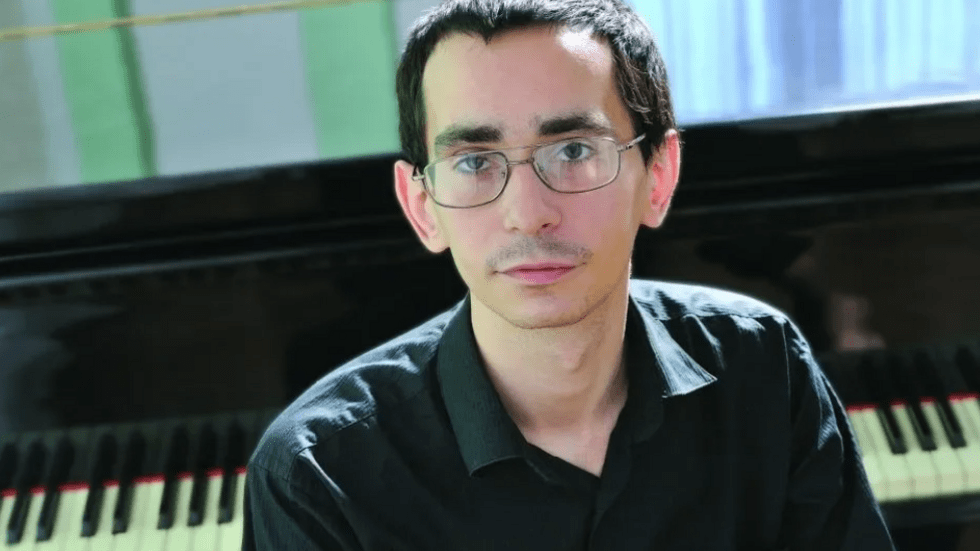
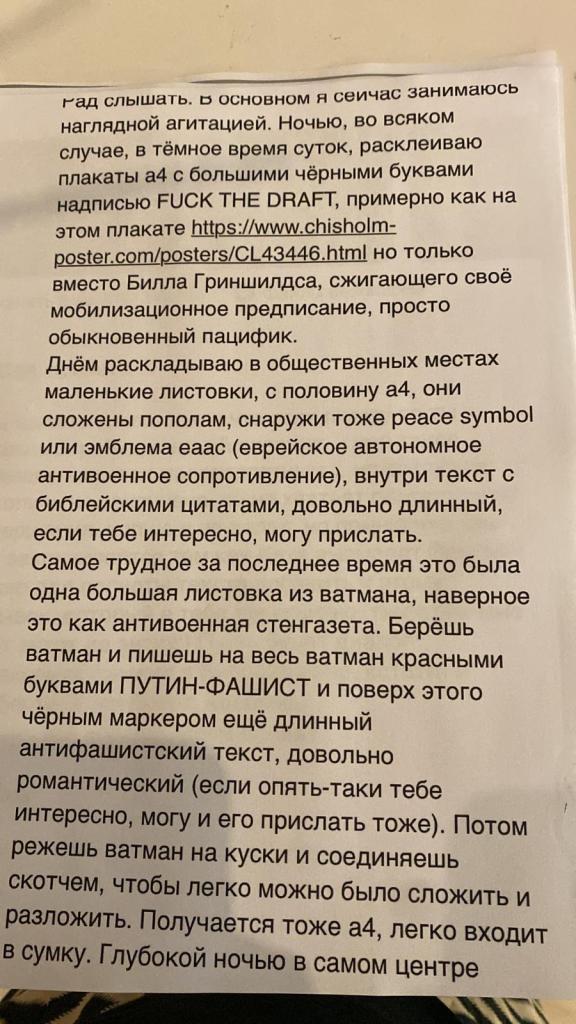
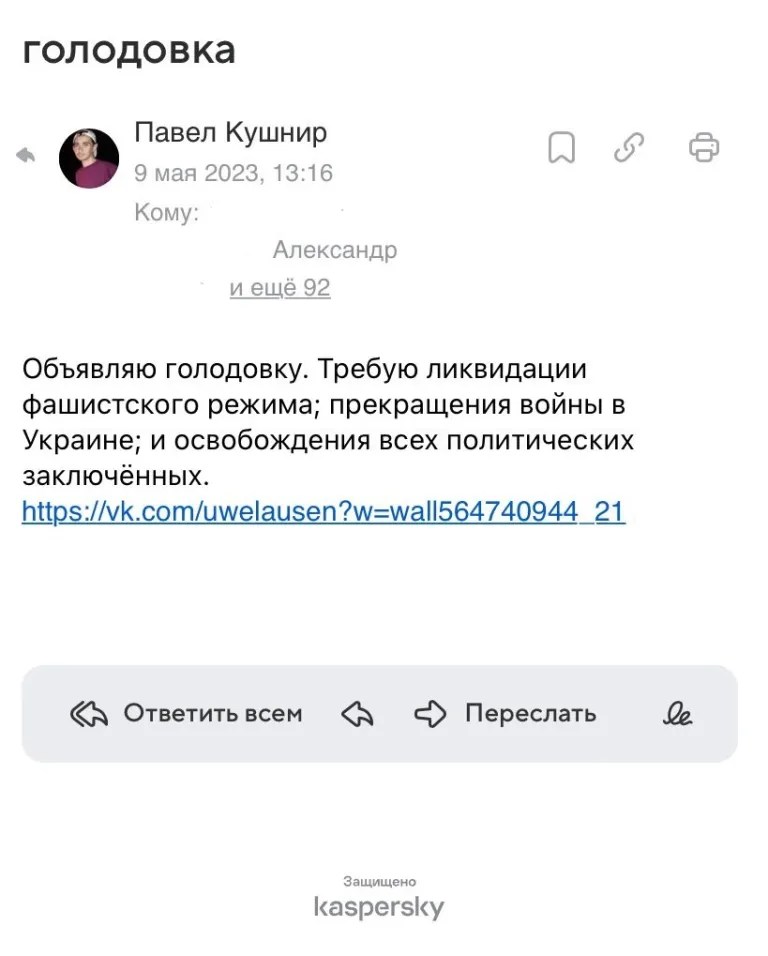
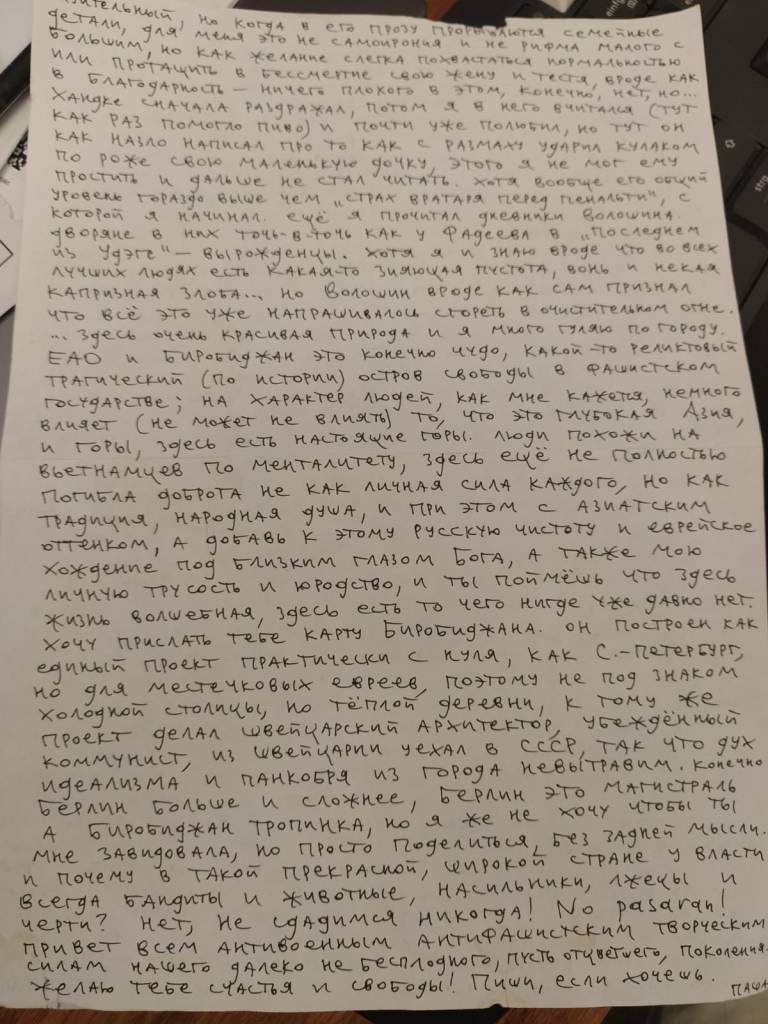
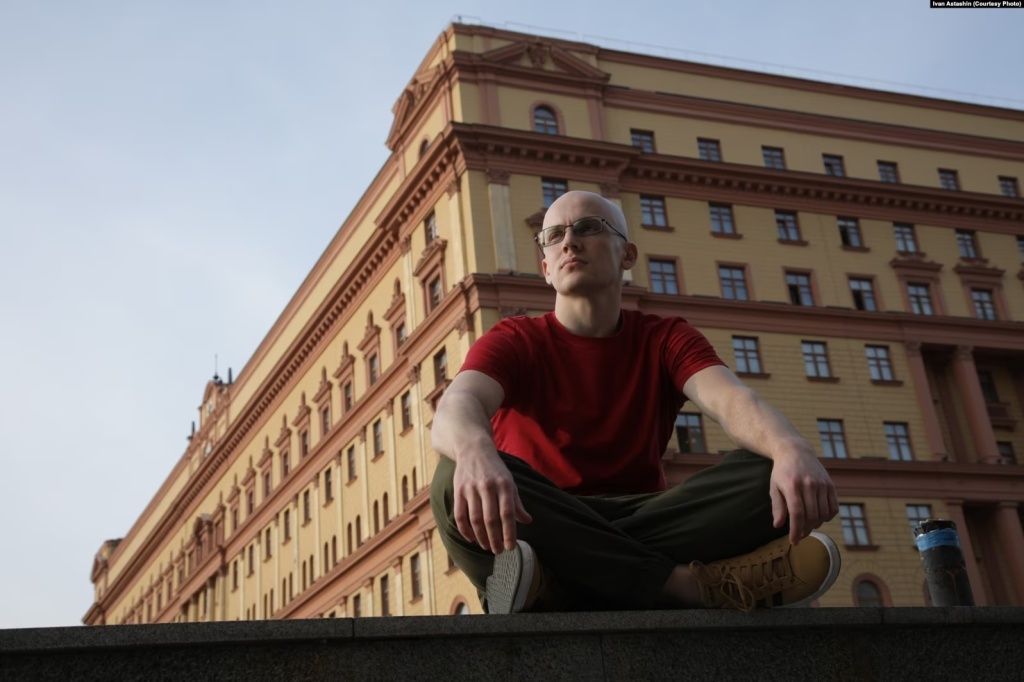
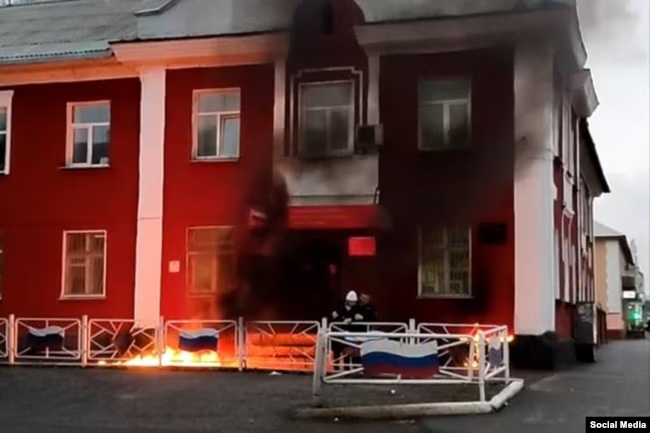
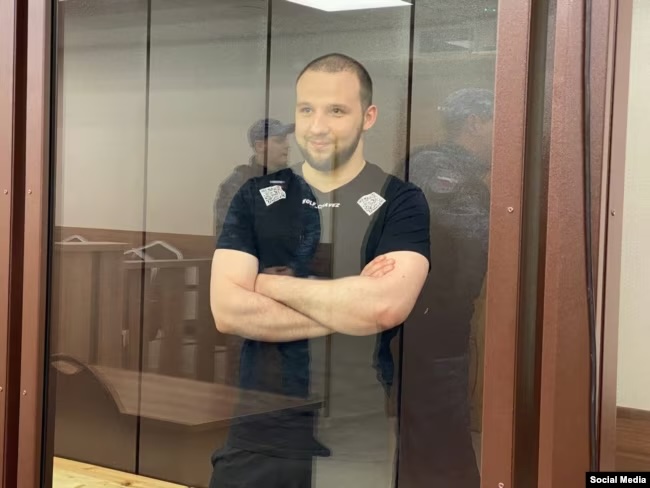


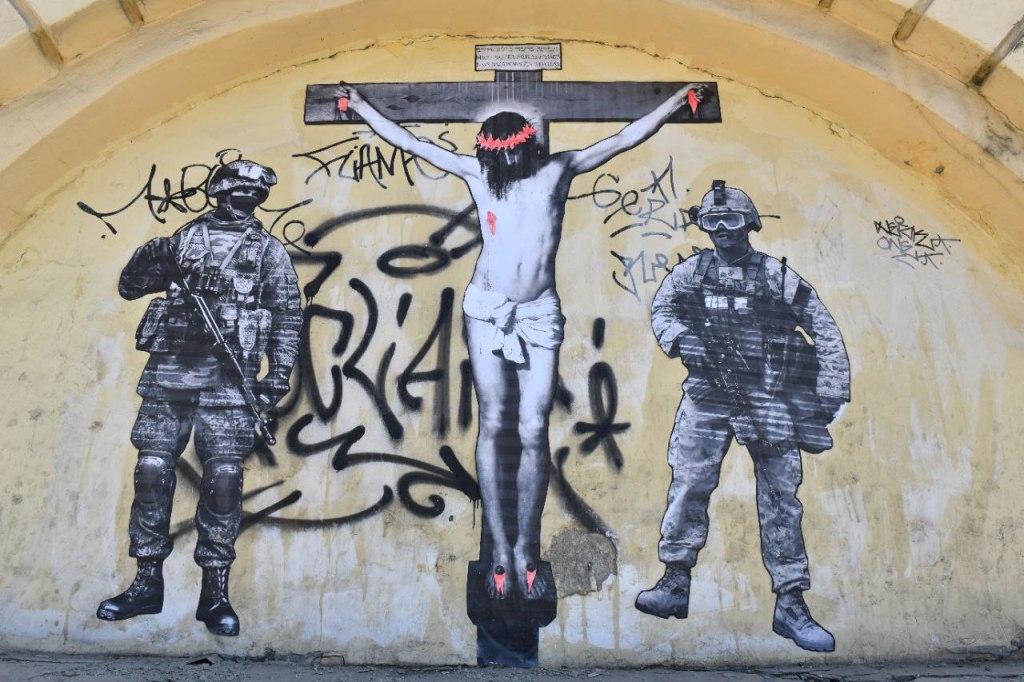
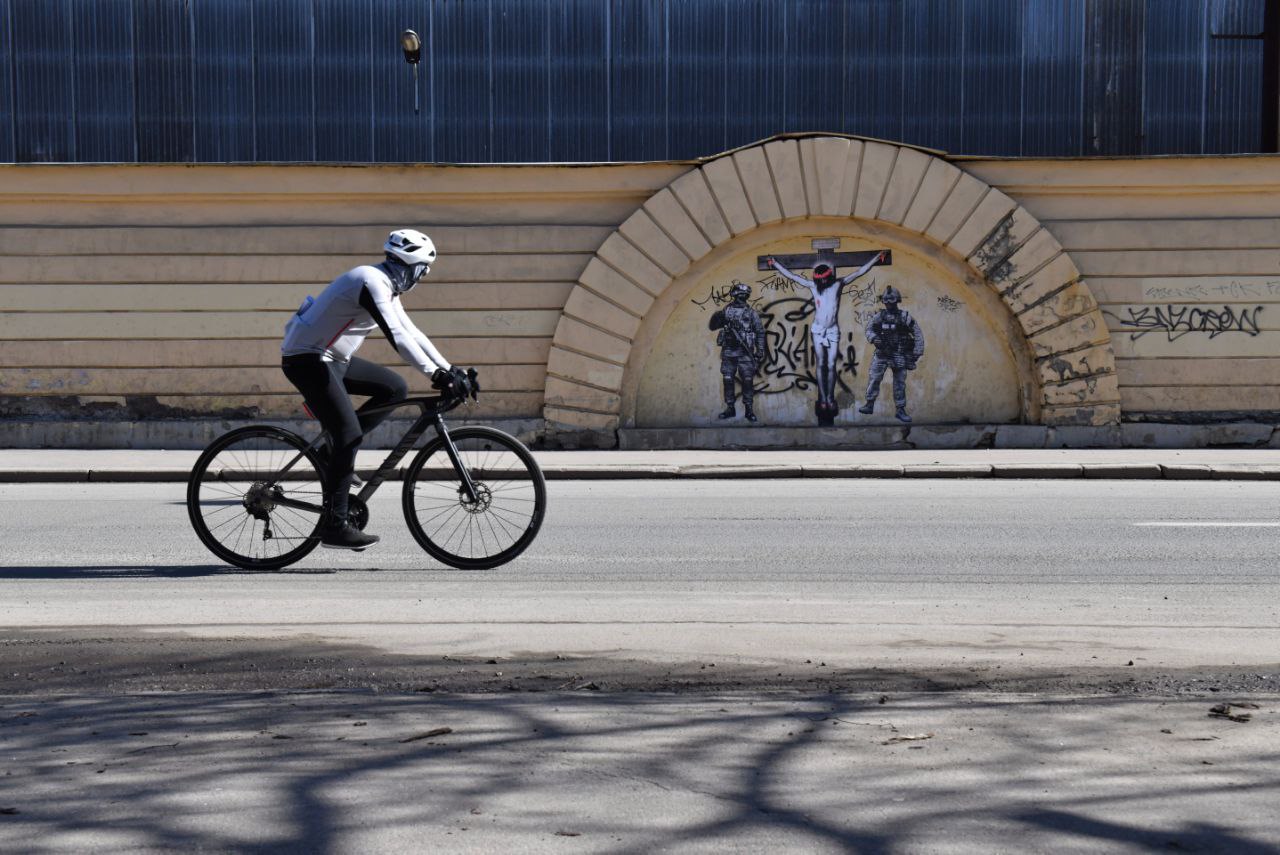
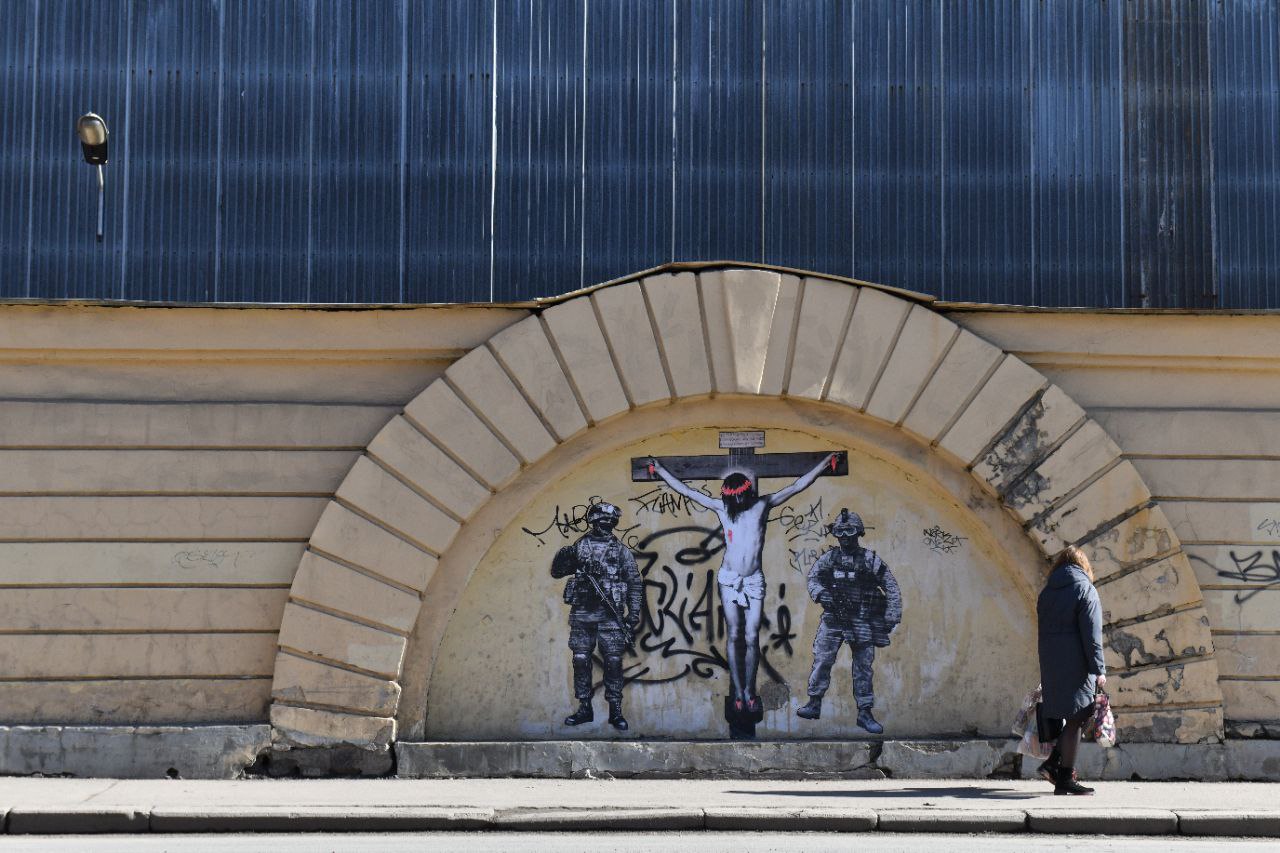
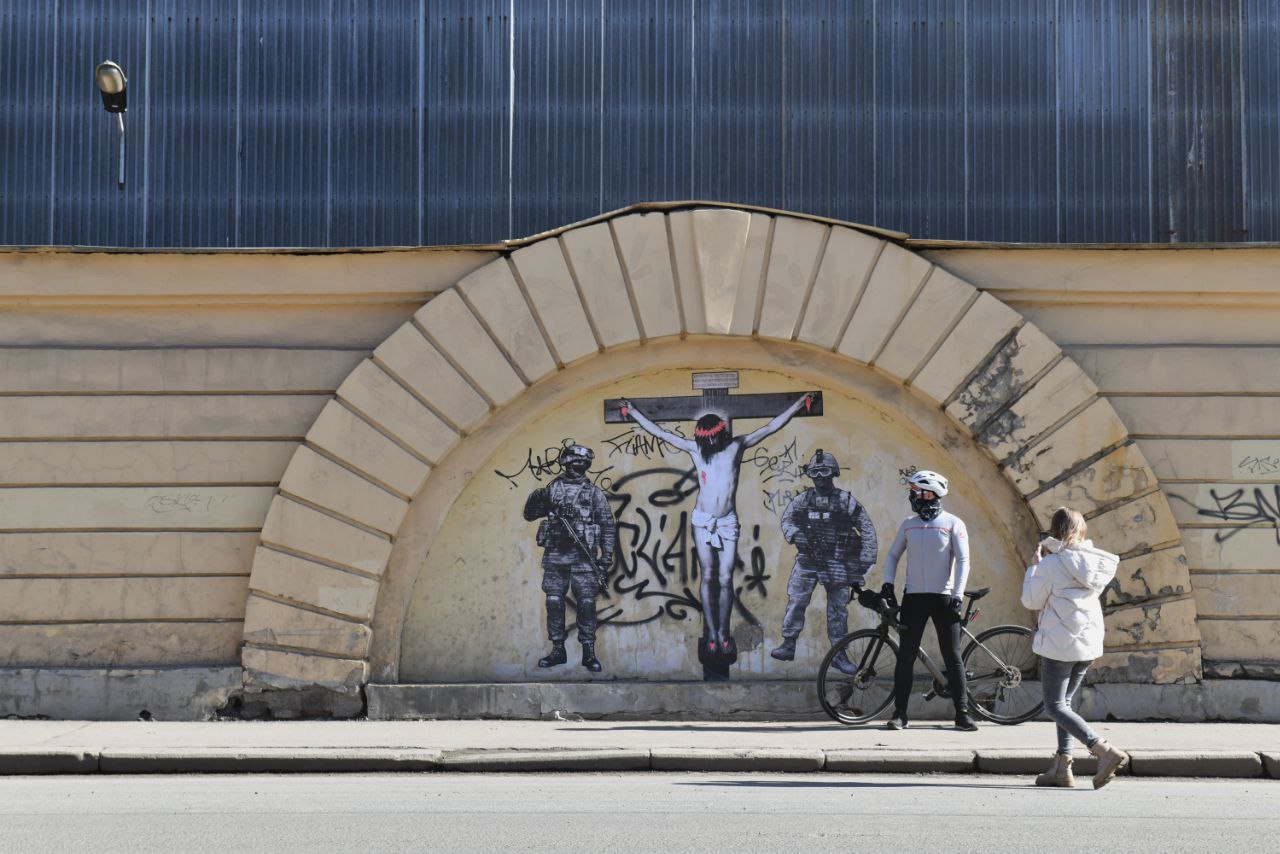


 Ruslan Zinin transferred to solitary confinement
 Address for letters and parcels to Ruslan:
 You can send letters electronically from anywhere in the world via the