Russia’s Federal Security Service (FSB) is preparing a new case, for high treason, against Ruslan Siddiqi, the Russian-Italian anarchist serving a 29-year sentence for sabotaging a train carrying munitions to the Ukrainian front.
Siddiqi wasconvictedin May last year, and the Military Court of Appealupheldthe sentence on 1 July this year. In 2023 he blew up railway tracks in the Ryazan region, derailing a freight train carrying munitions, and organised a drone attack on the Dyagilevo military airfield.
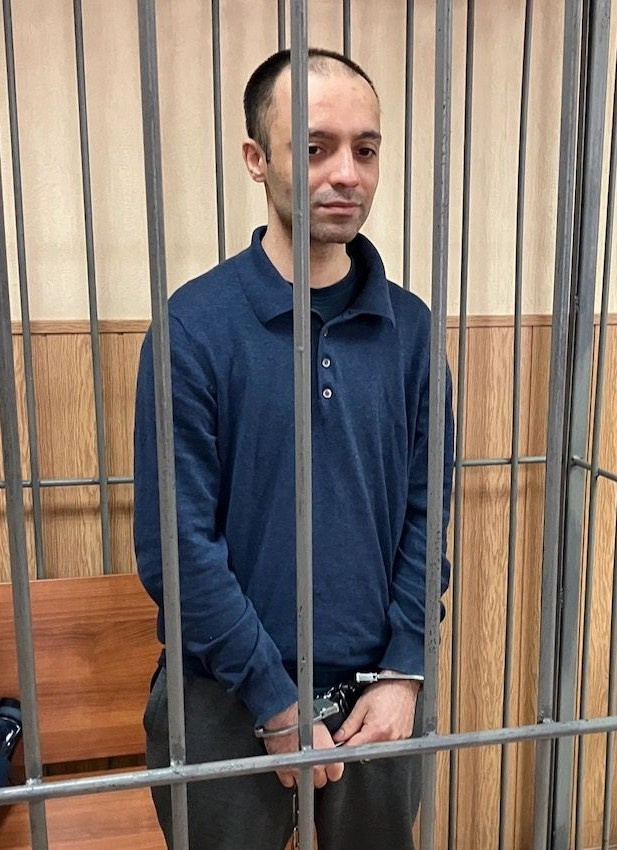
Ruslan Siddiqi in court last year
Siddiqi confessed to these actions and told the court he sees himself as a partisan, opposing Russia’s war on Ukraine. He denied a further charge of preparing another attack. He was tortured extensively during questioning, but the authorities have refused to investigate.
Fires of Freedom, who give legal and other support to Siddiqi,saidthat, although he should have been transferred to prison after conviction, he is being held at a pre-trial detention centre (SIZO) in Ryazan. Transfer has now been delayed because of the new case.
Here isa Facebook postabout the new charges by Ivan Astashin, who campaigns in defence of political prisoners, translated by Giuliano Vivaldi:
“Isn’t that enough for them?” is the first thought that automatically springs to mind upon hearing the news of a new criminal case against anarchist Ruslan Siddiqi, who has already been sentenced to 29 years in prison for two anti-war acts of sabotage and has now also been charged with treason.
And yet for the security forces, everything is much more mundane, has a more practical raison d’etre. The sentence itself plays no role here.
It was the Investigative Committee [a federal agency answerable directly to the Kremlin] who took on the first case against Ruslan. And not just some district department, but the central bureau of the Investigative Committee — or, to be precise, the department for investigating war crimes, genocide, and the rehabilitation of Nazism, which [Investigative Committee chairman Aleksandr] Bastrykin established in 2022.
At the same time, under the Code of Criminal Procedure, only the Federal Security Service (FSB) can investigate cases of high treason. So if the Investigative Committee had “discovered” signs of high treason in Ruslan’s actions, it would have had to hand the case over to the security services.
Naturally, the Investigative Committee did not want to give such a juicy case to anyone else, so they “didn’t discover” high treason, but only terrorism, terrorism, and once again terrorism … which the Investigative Committee has the right to investigate on an equal footing with the FSB.
At the same time, the version that Ruslan was cooperating with Ukrainian military intelligence, which has now become the basis of the treason charge, was always foregrounded. Indeed, it was one of the central elements of the prosecution’s case.
The investigation explicitly proceeded on the assumption that Siddiqi coordinated his actions with representatives of Ukraine’s Chief Directorate of Intelligence. It was precisely through this framework that his actions were classified, among other things, as having been committed by an “organised group”.
So the evidence on which the FSB is now building a new treason case was already there in the materials of the first case. But turning this evidence into a separate charge based on the violation of Article 275 [on high treason] would have meant transferring the case to another agency, the FSB.
The central office of the Investigative Committee took on a high-profile case, “investigated” it itself, gathered the “evidence” itself, brought nine (!) criminal charges, and saw the case through to a conviction. There was absolutely no reason for it to hand such a case over to another agency.
Now the Investigative Committee’s work is finished. The verdict has been handed down; the appeal has been heard. And this is where the baton is already passed to the FSB Directorate for the Ryazan region.
For them, it’s a perfect case. The accused is already in custody. The skeleton of the case has been assembled by colleagues from another agency. All that remains is to rewrite the Investigative Committee’s material to fit the structure of the article of the criminal code on treason, and receive a ready-made crime against state security that has already been “solved”.
I have already told a similar story about Aleksander Leleko: he was convicted as a teenager for setting fire to railway relay cabinets, and several years later the FSB began reworking those same events into a new treason case. [Leleko, from the small Siberian town of Sharypovo, was arrested in 2023, then aged 16, and sentenced to six-and-a-half years. In April this year it was reported that he was in prison hospital, and being administered psychtropic drugs, while investigators sought to put together the new case.]
Therefore, the question “Really, is 29 years not enough for them?” hardly makes sense here. It’s not about the sentence, but about the crime-solving rate, which our investigative authorities so badly need to improve. Especially now, when generals are being blown up and shot at home.
This situation illustrates my point very well that a repressive system has rules. It can produce an utterly monstrous result, but internally it still remains a bureaucratic machine with jurisdictional boundaries, departmental interests, reporting requirements, and its own rules.
An all-powerful security official cannot simply take any desirable article of the Criminal Code and put it into his casework. Even when the decision to imprison someone has already been taken, you still have to properly document who exactly is supposed to imprison them and under which article.
Perhaps, in Ruslan’s case, there also exists a more personal motivation on the part of the Ryazan security services officers. They could not find Ruslan after the first action, caught him only three weeks after the second, and subjected him to brutal torture.
But a much more mundane and so perhaps more frightening mechanism is quite enough to explain the emergence of a new case: the agency needed a criminal case of its own; a ready-made defendant was available with a “body of evidence” already sitting on their desk.
For the security agencies, the people involved in these cases are primarily numbers in a report, not human beings.
□ Fires of Freedom, which supports Ruslan, is on Telegram (Russian only). In English, there are reports on Ruslan Siddiqi’s case, and information about how to give support, on the Autonomous Action site e.g. here, here and here. Ivan Astashin was interviewed here.
□ Ruslan Siddiqi’s final statement in court, and letters describing his anti-war action and arrest, are included in the book Voices Against Putin’s War, free to download here. The letters were published by the Russian Reader here.
Lida Moniava, a prominent advocate for critically ill children’s care, has been charged with spreading false information about the military, her attorney told Russian media on Wednesday.
Moniava was arrested following a police search of her home in Moscow earlier in the day and questioned by officials from the Investigative Committee, Russia’s top investigative body.
Moscow’s Simonovsky District Court is expected to rule on pre-trial detention measures, her attorney told the news outlet RBC.
The charge of spreading false information about the military carries a maximum sentence of 10 years in prison.
Moniava is the founder of the Moscow-based charity Lighthouse, which operates hospices for seriously ill children and young adults in the Russian capital and surrounding region.
After Russia’s full-scale invasion of Ukraine in 2022, Moniava created a foundation that provided shelter, medical supplies and food to people fleeing from the war. The organization also later helped Armenians fleeing from conflict in Nagorno-Karabakh, as well as Russians displaced from the Kursk and Belgorod regions.
That foundation suspended operations last September due to the dwindling number of refugees arriving in Moscow and the Moscow region.
Moniava was previously detained in January and in February. She was fined 45,000 rubles ($520) after being found guilty of “discrediting” the Russian military in posts on Telegram.
Despite facing pressure from the authorities, Moniava has refused to leave Russia.
“If I leave, critically ill children will end up in nursing homes and intensive care units for longer periods. Knowing that, I doubt I could live happily in some other country,” she wrote earlier this year.
Lidia Moniava is being forced out of Russia. First, her hospice was slapped with an administrative fine. Then she was threatened with criminal prosecution. Next, a criminal case was launched against her, her home was searched, and she was interrogated. Now, the court has sentenced her to non-custodial remand. It’s the standard playbook: we’re about to lock you up, so hurry and leave; take advantage of this last chance. In unison with the punitive organs, the lucky political émigrés are chiming in, “Run, Lida, run!” Escape is the very essence of their political activism. Fleeing is their means of survival.
Forcing an undesirable person to leave is the best option for the authorities. That much is obvious. But it is also obvious that this “undesirable person” has a different set of values, different views on life and on her place in it. She cannot abandon a cause she considers important; she cannot betray the people who have placed their trust in her, the people she cares for. Personal responsibility is what Russian society so desperately lacks today.
She won’t have an easy time of it. It’s hard for a free person to live in an unfree country. But it’s a noble choice, one that only people who are free on the inside can understand.
I always thought she was exactly what a Christian should be like.
Lida Moniava, the director of Lighthouse children’s hospice, has been accused of circulating “fake news” about the army. she has been detained and faces up to ten years in prison.
It is clear who is running a country where righteous people are behind bars.
On the evening of September 3, Simonovsky Court placed Lida Moniava, founder of Dom s Mayakom (“Lighthouse Charity Foundation”), under a set of restrictions in a criminal case accusing her of spreading “fake” information about the Russian military. Moniava is one of the leading figures in contemporary Russian philanthropy: she founded the Dom s Mayakom charity and its hospices for children with severe and incurable illnesses. Dozens of people came to Simonovsky Court in Moscow to support her. The news outlet Bereg recounts what happened — and shows how Moniava’s supporters celebrated her release. Meduza is translating the report in full.
A hearing on pretrial restrictions for Lida Moniava, founder of the Lighthouse Charity Foundation, is scheduled for 5 p.m. on September 3. A full hour before the hearing, Muscovites who have come to support Moniava are already gathering outside the Simonovsky Court building.
Police searched Moniava’s home early on the morning of August 2 as part of a criminal case over spreading “fake” information about the Russian military, then arrested her. The case stems from a post Moniava published on her Telegram channel to mark the first anniversary of Russia’s invasion of Ukraine. “For a year now, my country has been sending missiles, tanks, and soldiers into Ukraine. For a year now, innocent people have been dying because of it,” she wrote.
A short young woman named Nadezhda stands in the parking lot reserved for official vehicles directly in front of the courthouse. She is visibly nervous. She introduces herself as Moniava’s goddaughter.
“I’m waiting for justice. If someone like Lida is sent to prison, something truly terrible will happen to the world,” Nadezhda says.
A mixed crowd gradually gathers by the parking lot: young people who might be described as part of the alternative scene, middle-aged people, and elderly members of the support group. Some call themselves Moniava’s friends and acquaintances; others, like red-haired Makar, dressed all in black, learned about her from recent news coverage.
“When I read about Lida, I realized she’s just an incredibly good person — kind, with the noblest intentions,” Makar tells the independent Russian outlet Bereg. “Of course, it’s a real shame things turned out this way.”
Makar says he is trying not to get his hopes up that the charges against Moniava will be dropped or that she will be released from custody, “so I don’t end up disappointed.”
Mikhail, an acquaintance of Moniava’s, is also there to support her. He speaks about her much as dozens of others have in Facebook posts supporting her over the past day.
“I admire what she does, what she stands for, and the fact that she’s open about it. That’s genuinely brave,” Mikhail says. “You can do charity work and still be a conformist because you think charity makes up for everything. But Lida did good work without becoming a conformist just to keep doing it.”
When Russia launched its full-scale invasion of Ukraine, Moniava stayed in the country and continued helping children with incurable illnesses. She also set up a fund to help refugees from Ukraine and Nagorno-Karabakh, as well as residents of the Kursk region’s border areas affected by the Ukrainian military’s incursion in August 2024.
While helping people affected by Russia’s invasion of Ukraine, Moniava also wrote antiwar posts on Facebook. In February 2026, Russian authorities fined her 45,000 rubles for “discrediting” the Russian military over those posts. She wrote about children killed in a Russian missile strike on Kryvyi Rih and the deaths of the Martynenko family — a father, a mother, and their 11-year-old son — in a strike on Sumy.
After the February hearing at which a judge imposed the fine, Moniava thanked her followers for their support and said in a post that she had “received a lot of advice to leave Russia”:
When Center E is banging on your apartment door, it’s scary, of course. But look at this photo — Anya and I are having such a great time on our shift [at the hospice]. She’s a girl who spent 19 years behind the walls of a residential institution. If I leave, children in palliative care will spend more time in residential institutions and intensive care units. I doubt I could live happily in some other country knowing that. So emigration isn’t in the plans.
In the same post, Moniava added: “I also can’t stay silent as if there’s no war. Trying to live honestly comes first for me.”
Natalya, who came to Simonovsky Court, does not know Moniava personally but has long followed her work. “I’m just in shock over what’s happening,” she says. “It’s probably to be expected, but it’s still very hard for me to accept. I’m an outsider looking on, and I simply respect her work, so I came here to support her. Lida is a wonderful person who helps others live and survive. That’s very important in our world. In turbulent times, we need to support each other somehow and do something.”
Others who came to support the Dom s Mayakom founder included Nobel laureate Dmitry Muratov, former editor-in-chief of the independent Russian newspaper Novaya Gazeta; Nyuta Federmesser, founder of the Vera Fund, which helps people with incurable illnesses; actress Tatyana Drubich, co-chair of the same fund; and Daniil Maksimov, a Vera Fund employee and founder of an inclusive magazine about sex for people with disabilities.
Maksimov, a blogger, writes on social media about living with spinal muscular atrophy (SMA) and the problems wheelchair users face. Several people in motorized wheelchairs gathered outside Simonovsky Court on the day of Moniava’s hearing.
The Lighthouse Charity Foundation needs support. In recent days, it has lost many donations and some of its donors. You can donate from Russia in rubles on the foundation’s website.
Shortly before 5 p.m., a prison transport van parked outside the courthouse pulls away. By now, around 200 people have gathered. Someone in the crowd says, “This one’s probably leaving now, and the next one will have Lida in it.” When another prison van drives onto the court grounds soon afterward, people start chanting, “Lida! Lida!”
The van’s barred windows make it impossible to see who is inside. The van pulls into the garage.
People line up to enter the courthouse, and the line moves very slowly. One woman in a blue jacket stands out among the crowd, holding a copy of Viktor Vilisov’s book Nas Vsekh Toshnit (We’re All Sick to Our Stomachs) with a bright orange cover. Off to one side stands Yekaterina Duntsova, head of the Rassvet (“Dawn”) party; somewhere in the same crowd are Tatyana and Valery Yashin, the parents of convicted politician Ilya Yashin, who was sent to Germany in a prisoner exchange.
“So many people showed up. This is a really high-profile case,” someone in the crowd says.
Forty minutes later, the line still has not cleared. Two young men carrying tripods come out of the courthouse toward the line. Someone in the crowd asks hopefully:
“So, any news?”
“No, nothing at all.”
It is a little after 5 p.m. when Nyuta Federmesser, who had entered the courthouse near the front of the line, comes back outside. “Lida hasn’t arrived yet,” she says. “We came down because it’s impossible to breathe in there. There’s no point in standing here anymore because they’ll start kicking everyone out soon. The court closes at 6 p.m.”
Some of those who came are in no hurry to leave, even though it is very stuffy inside. Dmitry Muratov takes a spot right by the courtroom entrance. One woman who came to support Moniava offers people postcards to write warm messages on, which will later be delivered to Moniava. A police officer comes upstairs and asks everyone to leave the building: the court has closed for the day.
Everyone heads down to the courtyard, which is packed with people. In the middle, a group shares a pie. Police soon drive everyone out of the courtyard as well, and the gates close. Now everyone waits for Moniava by the fence.
Traffic police officers watch the crowd from cars with their emergency lights on. One of them approaches the crowd. What he says is familiar from rallies and pickets:
“Citizens, do not obstruct the passage of other citizens!”
“We’ve heard that one before,” a woman over 60 says. “I’m so sick of you!”
Word eventually spreads that Moniava has been brought to the courthouse after all and that the hearing has begun. The press is not allowed to attend.
“I know Lida personally,” says Fatima, who came to Simonovsky Court to support her. “Lida is a wonderful person. She’s done a lot in our country to help children with severe and incurable illnesses, and she built a palliative care system. Of course, it’s pretty horrifying that she’s inside the Simonovsky Court building at all.”
Neither Fatima nor Mikhail, who respects Moniava for refusing to conform, expects “anything good” to come of the judge’s decision.
Half an hour later, the crowd starts to stir. The courthouse doors open, and two security officers appear in the doorway. Several people start chanting “Lida!” but she is nowhere in sight. A few men come out, followed by a woman. “The workday is over,” someone in the crowd says.
As they wait, someone starts singing, but the words are impossible to make out.
Finally, Moniava’s defense attorney, Mikhail Biryukov, says from inside the courtroom that the court is releasing Moniava from custody and placing her under a “ban on certain activities.” While the investigation continues, she is barred from going outside between 8 p.m. and 8 a.m., communicating with witnesses, or using the internet.
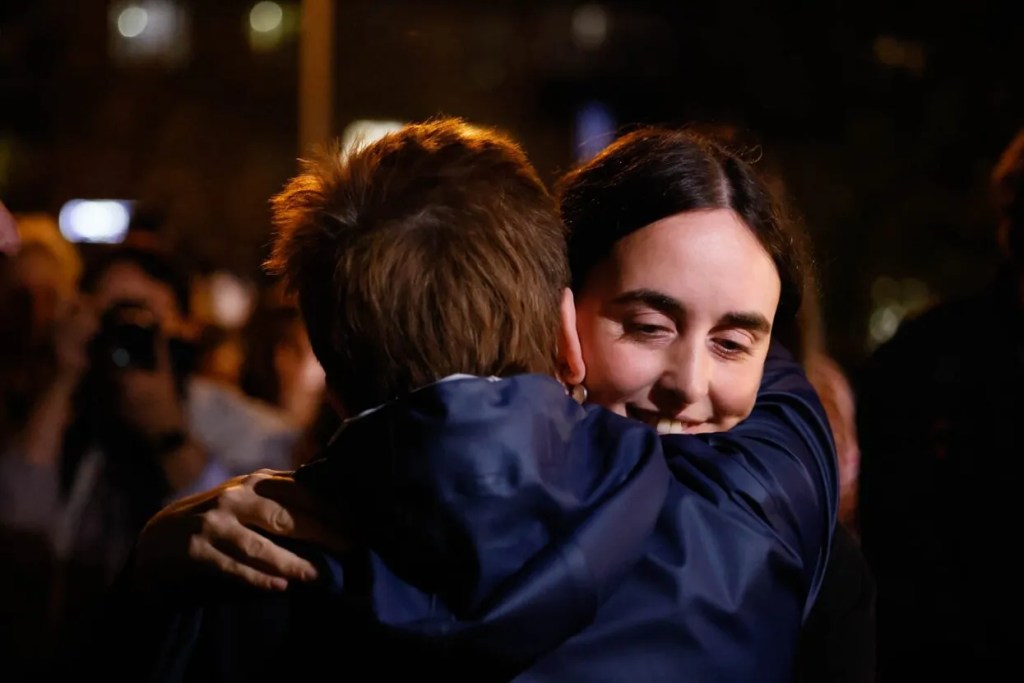
Sometime between 8 and 9 p.m., Moniava and Biryukov emerge from the courthouse. The people waiting behind the fence chant Moniava’s name and applaud. Once outside the gates, she tells the crowd: “I thought I was going to get 10 years in prison. Some kind of miracle.”
She says investigators spent “many hours” trying to persuade her to admit guilt: “For some reason, it’s very important that the defendant say they feel guilty. I don’t feel guilty. I want the war to end as soon as possible.”
“Is there anything you want to do right now?” journalists ask Moniava.
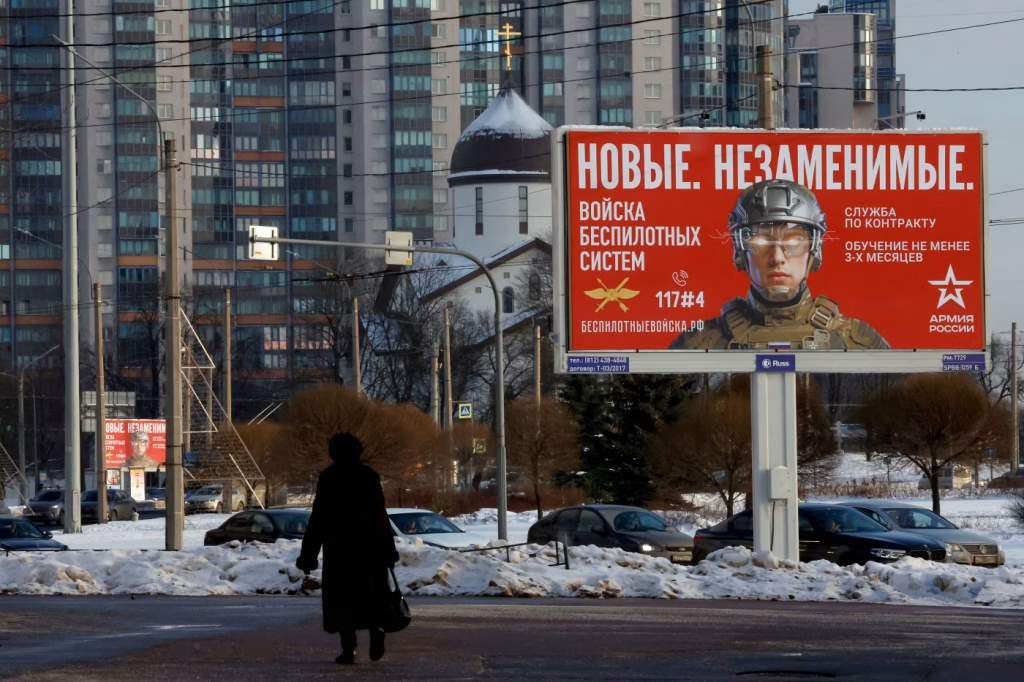
A billboard advertising voluntary (“contract”) military service in St. Petersburg, Russia. Source: Wall Street Journal
Raids aimed at forcing men to fight in the war against Ukraine have become widespread throughout Russia’s regions. In the Penza Region, where law enforcement, in concert with officials from military registration and enlistment offices, have been carrying out such raids in a particularly aggressive manner, local residents have banded together to “take back their men,” as they put it.
“They took him away, but we caught up with them halfway and got him back”
On 23 July, unknown men in plain clothes drove up to the home of Sergei Teplyakov, an employee of a local security firm in Bashmakovo, a district council town in the Penza Region with a population of around nine thousand).
“One of them introduced himself as the new neighborhood beat cop and demanded to see [Sergei’s] passport. Sergei then started phoning the real neighborhood beat cop. [The intruders] flew into a rage, grabbed him, and dragged him into their car. It was a straight-up abduction: no grounds for his arrest, no names, no paperwork whatsoever were provided,” says Oksana, a resident of the town. (We have changed the names of those whom we interviewed for their own safety.) “Sergei’s son, who had been telephoned by the neighbors, arrived, started filming it on his phone, and shouting at them. They let [Sergei] go. But the next day, [Alexei] Denisenko was caught in a raid.”
According to the locals, two unknown men grabbed Denisenko in a park where he was cutting grass to work off court-ordered community service hours for drunk driving.
“They threatened [Denisenko]. They said he would suffer the consequences if he didn’t go with them to the district council offices. A female council staffer was in the car with the ‘trappers,’ and so [Alexei] believed them. Plus, the license plates on the car were local, and it was a council vehicle,” says local resident Artyom. “He was told they were taking him to the council to ‘verify his details.’ But witnesses noticed they drove him off towards Penza and they called his family. His sister was able to chase them down halfway there, less than a hundred kilometers from Penza. She forced them to stop their car and she wrested Alexei from their clutches. These ‘recruiters’ are local officials working for the Defense Ministry by supplying them with unsuspecting folk. It’s utter lawlessness: these recruiters barge straight into people’s homes. If a man is walking down the street a bit tipsy, he’s definitely at risk. But basically, they’ll grab anyone.”
According to Mediazona, which has been compiling a name-by-name list of fallen Russian servicemen since 2022, more than two thousand residents of the Penza Region are known to have been killed in combat. The list of those killed from Bashmakovo includes twenty-five people.
Bashmakovo residents say that they had never met any of the “recruiters” before.
“We looked up the drivers of these vehicles—it turned out that one of them works as a bailiff!” says Artyom. “The plates of the second vehicle (O217XR) are registered to the Bashmakovo District Council. The families of Denisenko and Teplyakov reported the attempted abduction and coercion into signing military contracts to the police. Recently, two more men were also abducted. They managed to get a lawyer sent to them, but it wasn’t possible to get them out of the recruitment center on Skladskaya Street in Penza: they’d already been pressured into signing up there. According to the lawyer, one of them was threatened with ‘criminal charges’ over debts, even though the amount he owed didn’t warrant criminal prosecution. In other words, they were basically hoodwinked.”
Following these incidents, the locals decided to form a neighborhood watch group to defend the men.
“I joined the patrols almost straight away. It all happened spontaneously,” says Galina, a resident of Bashmakovo. “The guys set up [an online chat] group and started posting there about what was happening in the town and how they were rounding up the men. Gradually, people simply got together on VKontakte. That’s where we coordinate our efforts: we’ve split into shifts and we patrol the town around the clock. Around 250 people have joined the vigilante group. It’s much more effective to take back people on the spot, before they’re sent to the police station or the military recruitment office, because there’s simply no legal basis for detaining them.”
She says that almost everyone in the vigilante group has personal motives.
“There’s fear for our loved ones, of course. God forbid that my husband goes off to work and then disappears: you already know what might have happened to him. In June, they took my cousin away. He has two children. I recently found out that he had some sort of unpaid loan. I don’t know where he is now and what’s become of him.”
Galina says the members of the neighborhood watch patrol Bashmakovo every day and even at night: those who have cars drive around the town to check for suspicious vehicles or strangers. The volunteers chip in for petrol. They also use a community fund to cover unexpected expenses. Recently, during a patrol, there was a minor road accident in which two cars were damaged. They were repaired free of charge by acquaintances at a garage, and the only cost was for the spare parts.
Galina herself has been called out in response to a report of an attempted abduction.
“I was with my mom at the hospital when a message came through the group chat saying that two police officers were trying to force their way into Pavel Berdechenkov’s house. My mom and I drove over there, and the rest of the crew joined us. In the end, the police had nothing to say: they got into their car and drove off. There was another incident when we were patrolling a neighboring village and spotted a GAZelle van we didn’t recognize. All such reports go straight to our private group.”
She estimates that the vigilante group’s members have managed to prevent at least five or six people from being abducted in this way. But their methods doesn’t always work.
“Today we weren’t able to rescue a man because the alert came in too late. Within forty-five minutes, they’d already taken him far away. That’s why what matters most is that we’re notified straight away. Then we can get to the scene.”
A member of the volunteer group claims that at least two vehicles belonging to district authorities have been used in the raids. According to her, a Lada Granta, which residents have dubbed “401,” belongs to the Bashmakovo District education department, while a Lada Largus 217 belongs to the district council. Locals blame the council’s chair, Tamara Pavlutkina, for what is happening and feel that reporting incidents to the local police is pointless.
“There’s no point in complaining to the police. We believe the district council chair gives the orders and the rest just carry them out. She gets everything done by proxy,” says Galina.
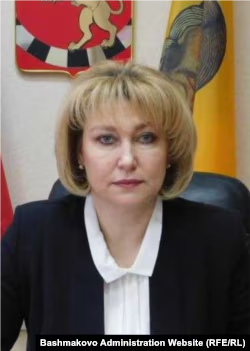
Tamara Pavlutkina
As an example, she cites the story of fifty-eight-year-old Sergei Milkin from the village of Podgornoye, sixteen kilometers from Bashmakovo. According to her, the local beat cop, Sinyov, invited Milkin to the village council “for a chat,” after which he disappeared. Milkin, says Galina, had serious heart problems: he’d had a bypass operation. The day after his chat with the police officer, he rang his family from the Rostov recruitment center and told them he was being sent to the war. Ten days later, he died, basically on the front line.
“We wrote to every relevant authority: the military prosecutor’s office and Bastrykin at the Investigative Committee, and we appealed to the television. Our complaint was registered, and then there was silence.
Another member of the vigilante group, Alexei, joined it after his relative was nearly sent off to war.
“He was summoned by letter to the military registration and enlistment office to ‘verify his details.’ We happened to be visiting him at the time and witnessed the whole thing. The round-ups had begun in Penza by then, but not here yet. What’s more, he didn’t go alone but with a friend, so we felt a bit more reassured. He’d left his phone at home,” says Alexei. “Two hours went by, but he wasn’t back yet. Three hours passed, and still nothing. His friend returned alone and said, ‘Your relative’s gone to Penza for a medical board.’ We were in a panic. I rang the infamous Penza military registration and enlistment office at 19 Skladskaya Street. They replied, ‘We’ve got no one by that name here.’”
Alexei says that at that moment the village chair came to the house and asked for the missing man’s military service card.
“I started filming her straight away. ‘What grounds do you have for asking to see his papers?!’ I ask her. She replies, ‘The council sent me.’ I ask her to give me names and job titles, but she refuses. We take a taxi to Penza. At 19 Skladskaya Street, we race up and down all the floors. We come across a drunk man whom someone had brought in, while the bloke accompanying him boasts that he’s already brought in and ‘handed over’ two people that day. Then we meet a tearful mother: her son had been snatched straight from their home, and she’d rushed there hot on their heels. Her [other] two sons were already at [the front]. She said she won’t hand over the third one.”
Alexei spotted his relative right on the steps of the military registration and enlistment office.
“He had been brought there in a private car by an ‘acquaintance’ of the village council chair. When we shouted at this man, he claimed that he had nothing to do with it: he had just ‘kindly’ given [my relative] a lift to Penza. Then he scrammed. We immediately took our relative by the arms, but by that point he had already been ‘psyched out’: they’d explained to him that after the medical examination he would have to sign some papers, supposedly to verify his details. What sort of people are they? They’re a disgrace. They’re prepared to take people’s lives for these payments.”
Meanwhile, Oksana, who has also joined the group, told [Radio Svoboda] that the local authorities had begun putting pressure on them.
“The security forces have already threatened us. Do you know what they threatened to do us? To send us off to the war! What’s more, they’ve been openly persecuting those who have criticized the raids or written about them on social media. Police officers went straight to the home of Vera Makavtsova and, in front of her four children, threatened her with criminal charges. They are threatening to charge her under Article 319 (“insulting a public official”). All because, in a post of hers, she called the district council accomplices to the abductions, and its chair, Tamara Pavlutkina, a co-organizer of press-ganging people into combat.”
In an audio recording made during Makavtsova’s arrest, police officers can be heard bursting into the house and demanding that the woman “come with them.” This is because she allegedly “poses a threat to Russia’s national security,” posts all manner of “extremist” content on social media, and takes part in meetups of residents.
“You don’t have a warrant,” Makavtsova says.
“Do you have a fucking warrant to gather in the city center on Saturdays?!” the police officer replies.
“In the end, they busted down the door and detained her. Of course, it’s not domestic violence, her husband beating her [that brought the police to Makavtsova’s home]. It was a post attacking an official and the Defense Ministry. That was grounds for the police to ‘intervene.’ They never responded to the complaints from Denisenko and the Teplyakovs. I’m sure Pavlutkina herself filed the complaint [against them],” Oksana says indignantly.
“The chair of the council has two sons,” adds Galina. ‘When I asked her why she wasn’t sending her own sons [to the front], she said, ‘I didn’t give birth to them for that.'”
Meanwhile, on 25 June, a ceremony was held at the Bashmakovo District Council to present state awards to the local families of men killed during the invasion of Ukraine. Relatives and loved ones of the soldiers, who had returned home as “Cargo 200,” received honors and medals. The ceremony was attended by the local military enlistment officer, Alexei Valygin, and Pavlutkina, a member of the ruling United Russia party, who assured those present that “should any questions arise, citizens can always contact the district council.”
[Radio Svoboda] reached out to Pavlutkina, asking her to comment on reports that the district council had been involved in detaining residents and forcing them to volunteer for the army. As this article went to press, she had not responded.
In early August, Penza-based blogger Stanislav Morozov set up a support chat group for men who have been detained and pressured into enlisting in the army. He called on residents to unite to resist such detentions.
“We are doing this out of desperation, because we simply have no other choice. We are people who are standing up for our fundamental rights and freedoms—the right not to be treated as a commodity and not to have our free will taken away under the threat of a truncheon. When lawful means of self-defense cease to work, the only shield left is a neighbor’s shoulder. Our strength now lies in this compulsory yet consciously chosen consolidation,” Morozov explained in the chat’s overview.
Within the first twenty-four hours, 300 people had joined the chat, and within a week the number of participants had exceeded 1,200. Morozov calls on eyewitnesses to report arrests promptly and promises to help find lawyers for those detained. He warns that security forces and provocateurs may have joined the chat and asks everyone to be careful with what they say.
Amid the raids, other ways of warning people about them have emerged. In early August, an online service launched featuring a map on which users could mark the locations of arrests. A few days later, its developers reported that the service and its associated Telegram channel had been hacked, and the website had started redirecting users to a porn site, according to the Telegram channel Mobilization. The project’s creators speculated that the law enforcement agencies might have taken an interest in them, but it is not yet possible to independently ascertain who was behind the hack.
“They’ve taken a blind man away!“
All across Russia, men are being deceitfully lured into the war against Ukraine.
On 8 August, an incident involving abduction and the forced signing of a military service contract took place in Omsk.
According to Valentina, on Saturday morning three unknown men grabbed her 31-year-old brother, Danil, straight from the courtyard of their home in Omsk’s Kirovsk District.
“He has a wife and children. This morning, he took a can of beer and went to sit on a bench by the entrance to his block. That’s where they picked him up. It was a private vehicle, but luckily, the neighbors managed to write down the license plate number. While we were looking for him, he came back on his own. He told us they’d taken him to a ‘volunteer’ recruitment center at 8 Maryanovskaya Street. He had barely managed to break free and escape, and he hadn’t signed anything. Well, we calmed down a bit,” says Valentina.
But that same evening, she says, they came for him again.
“Danil was out in the courtyard with his wife and children. Some men arrived in a Niva [off-road vehicle]. They twisted his arms behind his back and took him away to parts unknown. The children were screaming, and his wife tried to fight them off, but to no avail. We were terrified: what should we do? We started dashing off statements to the military prosecutor’s office, the military Investigative Committee, and the police. We found out he was back on Maryanovskaya Street. We’re demanding his release, but they won’t even let us speak to him on the phone. It’s a proper kidnapping.”
Her brother was released after some time, but, according to Valentina, he had been beaten up beforehand and forced to sign a “voluntary” military enlistment contract.
“They’ve finally let him go, but they intimidated him so much and beat him up so badly, that he signed the contract. We’re in shock at the moment, trying to raise money for lawyers. What else can we do? He’s at home for now, but they’ve got that contract they forced him to sign. They could turn up and break down the door, after all. What’s going on is just horrific.”
In August in Russia’s Maritime Territory, according to Ivan, a former soldier, the military stopped his brother Mikhail, who has a category 1 visual impairment.
“On 3 August, Misha went to the shop. He was stopped by two soldiers who initially asked him to sign a contract with the Defense Ministry,” says Ivan. “My brother refused. He told them straight away that he was a person with a category 1 visual impairment. They kept pressuring him: ‘Then you’ll be building barracks in Sibirtsevo’ (a village in the Maritime Territory’s Chernigovsky District, where military unit 16871 is stationed). He explained to them at length that he could hardly see anything at all. He’d been making his way to the shop by memory and by touch, after all. Then they grabbed him and took him away by force.”
The following day, Ivan (who had himself been discharged due to an injury sustained in combat in Ukraine) brought all his brother’s medical records to the recruitment center in Ussuriysk.
“They were holding him at the recruitment center on Lermontov Street. I showed them his medical records and his Category 1 disability certificate. I was certain they’d sort it out and let him go. But early the next morning, Misha rang and said they were putting him on a bus to the airport,” says Ivan. “That was it! He was off to Ukraine to fight. How on earth will he manage there?! He can only cope here on his own because he knows the streets like the back of his hand. But over there, he won’t even be able to get around. What do they want with him?!”
Mikhail’s family filed a complaint with the military prosecutor’s office claiming that he had been coerced into signing a contract.
“They said they had thirty days to respond. But how can we wait when a blind man has been whisked off to a war zone? He’s in danger there every single minute!” exclaims Ivan indignantly.
Human rights defenders note that after someone signs a contract volunteering for the army, it is extremely difficult to get the agreement annulled, even if he alleges that he was coerced into signing it.
“Coercion is illegal in theory, but if the contract has already been signed, annulling it at one’s own request is nearly impossible. In this case, one also has to file a written request with the military commissar to withdraw from the contract,” says Yaroslav Mukhin (whose name has been changed for his own safety), a lawyer specializing in cases involving conscientious objectors. “But experience shows that even medical certifications of disability are no longer of any help. The case may well go to court, but by the time the proceedings are over, a conscript in such poor health will already have been killed [in combat].”
Raids on men in Russia have been taking place amid growing challenges with recruiting volunteers. The Financial Timesreports that the Kremlin and the Defense Ministry tasked the regions with recruiting 409,000 men in 2026, and it is up to local officials to fulfill the recruitment quotas. Meanwhile, the costs of recruiting itself have increased. Important Storiescalculated that in the first quarter of 2026 alone the regions paid recruiters 3.2 billion rubles [approx. 33 million euros], which is more than twice the monthly average a year earlier.
In early August, the Wall Street Journalreported on complaints of men being detained and forced to volunteer for the army in Penza, Ulyanovsk, Rostov, Amur, and Yaroslavl regions, as well as Udmurtia, Tatarstan, Voronezh, and Arkhangelsk. According to the newspaper, American officials believe that the Kremlin is considering a larger-scale option: a new round of mobilizations. If such a decision is made, the newspaper’s sources expect it to be implemented after national parliamentary elections on 18–20 September. Russian authorities deny plans for another mobilization.
Yabloko supporters outside the Russian Supreme Court, which decided whether the party should be barred from upcoming parliamentary elections (10 August 2026). Photo: Yevgeny Messman/TASS/Picture Alliance via DW
Following a nine-hour hearing, the Russian Supreme Court sided with the suit brought by the Motherland (Rodina) party and disqualified the Yabloko party’s federal list of candidates in the upcoming State Duma elections. Most of the plaintiffs’ claims concerned alleged copyright infringements in Yabloko’s campaign materials. In addition to these allegations against Yabloko, suspicions of “extremist” activity and foreign funding were also raised.
The case was heard by Judge Vyacheslav Kirillov, who has previously been involved in high-profile political trials. In particular, he ruled that the human rights organization Memorial was “extremist” and dismissed Alexei Navalny’s suit against the Federal Penitentiary Service and the wardens at the penal colony where he was imprisoned.
At least five hundred people gathered outside the Supreme Court building. They handed out apples [because yabloko means “apple” in Russian] and sang songs in support of the party. After the hearing concluded, security forces threatened the protesters with arrest and told the young people amongst them that they would be sent to a military enlistment office. Yabloko’s chair, Nikolai Rybakov, stated that the party had not broken the law and would appeal against the court’s decision within the five-day period stipulated by law.
“Moscow, 10 August 2026. Hundreds of people came to support the Yabloko party. Party chair Nikolai Rybakov had called on supporters to come to the Russian Supreme Court’s hearing of a lawsuit to disqualify the party from the elections. The suit was filed by the pro-Kremlin Motherland party. Alexei Zhuravlyov, Motherland party chair: ‘Freedom of speech is a word that would be good to shut up.’ The Yabloko party supports ending the war. Nikolai Rybakov: ‘We support the signing of a ceasefire agreement so that people stop getting killed.'”
Yabloko’s co-founder Grigory Yavlinsky wrote on Telegram that the authorities were afraid of the party’s campaign platform, which urged voters “to vote for peace, life, and liberty without fear,” because it is supported by an ever-growing number of people from across the political spectrum.
“Disqualifying a party with precisely this manifesto from the elections without any real grounds is a clear demonstration of the political system’s true nature,” he said.
DW has rounded up reactions to the court’s decision and asked experts what Yabloko’s disqualification means for the elections to the State Duma, which are slated for 18–20 September 2026.
Navalnaya: The Kremlin got scared and switched to ‘Plan B’
Motherland filed suit against Yabloko in the Supreme Court just as exiled Russian opposition politicians and cultural figures had publicly called on Russians to support Yabloko in the State Duma elections. Amongst those who had joined this appeal were Yulia Navalnaya, Lyubov Sobol, Ilya Yashin, writer Dmitry Bykov, and human rights activist Oleg Orlov.
After the court’s ruling was made public, Yulia Navalnaya, the widow of Anti-Corruption Foundation founder Alexei Navalny and the organization’s current leader, said that the Russian authorities had originally planned to let Yabloko run in the elections but not let it garner more than two percent of the vote. [Parties need to clear a five-percent threshold to be seated in the Duma.] Later, however, “the Kremlin got scared” and “switched to Plan B,” disqualifying the party, she opined.
“They saw something happening that they didn’t want to see: people are beginning to unite. It wasn’t even a matter of support for Yabloko. The fact of the matter is that millions of Russians have a chance to say what they really think about Putin and about the war,” Navalnaya wrote on Telegram, adding that the Anti-Corruption Foundation had its own “Plan B.”
Exiled politician Andrei Pivovarov, coordinator of the Russian Antiwar Committee’s Consuls project, told DW that the opposition did not regard their support of Yabloko as a way of achieving instant political change or ending the war. Rather, they wanted to demonstrate the scope of antiwar sentiments in Russian society.
“There are a dozen parties on the ballot who support the war and one that supports peace. Even if Yabloko was seated in the Duma, the war wouldn’t end. But it would show that there are many antiwar Russians,” Pivovarov said. He argued that Yabloko had become the symbol of protest voting and the public’s antiwar sentiments wouldn’t vanish with the party’s disqualification from the elections.
Why did the authorities want to let Yabloko stand in the elections?
Political analyst Ivan Preobrazhensky, speaking to DW, suggested that Yabloko’s removal from the race could have been the result of “Kremlin bungling” or a power struggle amongst various influential factions. One of his theories is that a security forces bloc linked to the FSB may have backed Yabloko as a counterweight to New People, which is seen as the pet project of Sergei Kiriyenko, the first deputy head of the presidential administration. According to another theory, Kiriyenko himself was attempting once again to generate the appearance of political competition, but underestimated the strength of antiwar sentiment.
According to Preobrazhensky, the authorities have underestimated the number of antiwar Russians who are willing to rally behind any political force advocating an end to the war. He noted that even official opinion polls point to significant support for this. He believes that Yabloko’s eligibility to stand in the elections had been agreed in advance, but the rise in support for the party alarmed the authorities.
Political analyst Ilya Grashchenkov wrote on his Telegram channel that the Supreme Court’s ruling could lead to a rise in the poll ratings of the mainstream opposition parties. According to him, Yabloko was initially allowed to stand in the election to act as a spoiler for New People: the assumption was that the votes of antiwar voters would be split between the two parties and thus would not go to a single political force calling for an end to the war.
“We’re expecting VTsIOM’s poll results in a week’s time. I reckon part of the opposition will see a bump again,” he wrote.
Political analyst Mikhail Vinogradov also expressed surprise at Yabloko’s removal from the ballots. In his view, the party’s presence would have enabled the authorities to announce a modest outcome at the polls for it, present this as evidence of public support for the war, and provoke fresh disillusionment amongst antiwar Russians. Furthermore, the campaign would have helped to single out new politically engaged citizens. Even if Yabloko had secured a mandate in the State Duma, Vinogradov believes, this could have been used to demonstrate to voters the futility of the party’s presence in parliament.
“There are certainly advantages to Yabloko’s not being registered. But the authorities are keeping this under wraps for the time being,” he concluded.
What does Yabloko’s ouster from the elections mean?
Yabloko’s ouster will complicate matters for independent election observers since the party loses the right to dispatch its own representatives to polling places, Roman Udot, an expert on elections in Russia, argues. In the past, Yabloko eagerly provided passes to independent observers, although they can still get accreditation from other parties, including the Communists, New People, and even United Russia, Udot adds.
“Besides, it’s not a certainty that a schoolteacher who back in the day would help to rig elections because she was told that this was how her school would get moneys for repairs will behave the same way when her husband or son could be called up for combat. People’s interests are at stake here: it’s every man for himself, especially with all the talk about a mobilization,” says Udot.
Udot argues that the involvement in the campaign of New People, with its proposal to end the war in Ukraine, is significant, even if the party is controlled by the Kremlin: politicians are forced to respond to public sentiment.
“We may see a shift from hawks to lesser hawks, and then to doves,” says Udot.
Furthermore, in rigged elections, it is not only the official result that matters but also the public’s impression of the election campaign, he says.
“It all depends on the mood of the populace. If the people show that the wind is changing and that there is a certain desire, and people start casting their votes for a particular stance, then some politician will catch the wind and capitalize on it.”
Do the authorities have a grip on the situation?
Elections to the Duma are taking place amidst growing anxiety in Russian society, Margarita Zavadskaya, a senior researcher fellow at the Finnish Institute of Foreign Affairs, reminded DW in an interview. She pointed out that FOM (Public Opinion Foundation) reported that 57% of the Russians it polled in late July were anxious about the state of affairs in their country, the highest percentage recorded by the pollsters since the military mobilization of autumn 2022. Although FOM’s polls should be treated skeptically, an uptick like this at the height of summer testifies to the fact that “something is out of whack,” Zavadskaya argues.
Zavadskaya sees a connection between the public’s dour moods and the increasingly frequent Ukrainian drone attacks, the deaths of civilians and warehouse fires caused by these attacks, and rumors of a new military mobilization. According to her, the summer of 2026 has been the most anxious since Russia’s full-scale invasion of Ukraine in February 2022. At the same time, the numbers of the most bellicose pro-war Russians have likely been dropping.
Anxiety is mounting in the Kremlin as well, since it is the authorities who have the most at stake in the election results, the political analyst argues.
“The ideal scenario for the Kremlin is boring elections with a sparse turnout in which nothing happens. But we can see that this scenario is now unlikely to materialize, because what’s happening on the eve of the elections doesn’t look normal, nor does it suggest that the authorities have a grip on the situation,” Zavadskaya told DW.
Statement of (partial) interest: Ages ago, in another life, I took part in a protest rally led by Ilya Yashin, then head of Yabloko’s youth wing, on Nevsky Prospekt in Petersburg. Also, my boon companion is personallly well acquainted with current Yabloko party chair Nikolai Rybakov who, they fear, will soon be arrested and imprisoned for his temerity. ||||| trr
Son of political prisoner Oleg Belousov sentenced to 7 years in prison
The 1st Western District Military Court in St. Petersburg sentenced Daniil Belousov to seven years in prison on multiple counts of “condoning” terrorism,” our correspondent reports. The indictment states that Belousov was an administrator of the project Media Partisans, which was declared a “foreign agent” in March of this year.
The prosecutor had requested a nine-year sentence. Belousov’s case was heard in closed chambers.
Bumaga first learned of Daniil’s arrest in March in a letter from Pavel Sinelnikov, a defendant in the Vesna Case. At the time, Belousov was being held in the Crosses pretrial detention center.
The case stemmed from a message posted in a public chat group called “No to War” (Net voine), Sinelnikov reported. Bumaga located a chat with that name where Belousov had posted photos of a pro-Ukrainian rally, organized by Ukrainian refugees near the [Moldovan] parliament building in Chisinau. The chat is linked to the Media Partisans project.
In April, Ostorozhno, Peterburg reported, citing a source in the FSB, that an administrator of the Media Partisans chat had been detained in Petersburg. According to security officials, the detainee had urged Russians to join the Russian Volunteer Corps and the Free Russia Legion. SOTA clarified that the individual in question was Daniil Belousov.
Daniil Belousov has a disability dating back to childhood: he suffers from a residual organic lesion of the central nervous system. He finds it difficult to secure employment and requires constant care, Oleg Belousov toldBumaga. Oleg Belousov raised his son as a single parent. And yet, according to the website Kino-teatr.ru, Belousov junior has appeared in several Russian films over the past three years.
Oleg Belousov is an amateur archaeologist from Petersburg who in late March 2023 was sentenced to five and a half years in a medium security penal colony under the law prohibiting the dissemination of “fake news” about the Russian army. According to investigators, Belousov senior had called Putin a war criminal and wrote about war crimes in Bucha, Hostomel, and Irpin in a private VKontakte chat group for treasure hunters.
Before his imprisonment, Oleg was unemployed and lived on state benefits, as he has a third-class disability due to an arm injury. In February, the EU identified the judge who sentenced Belousov senior as “culpable of serious human rights violations.”
There has been no contact with political prisoner Andrei Trofimov since April. He has not responded to letters and has not been brought out to meet with a lawyer. The situation was reported by journalist Vladimir [Raevskiy], who has been corresponding with Andrei.
‘We have tried every possible avenue, but we are told that “he does not want to maintain contact with anyone” — which is nonsense, he is one of the most outgoing people I know — and that “he already has a lawyer”, which is untrue. On one occasion, a lawyer we had hired even travelled to Petrozavodsk at our request, but Andrei Trofimov was not brought out to see him,’ Vladimir [Raevskiy] wrote.
In March, it emerged that Andrei Trofimov had arrived at Penal Colony No. 9 in Petrozavodsk, Karelia. There has been no information to suggest he has since been transferred to another facility.
Andrei Trofimov was sentenced to ten years in 2023. According to the court, he had sent the Freedom of Russia Legion a completed candidate application form, which it classified as preparation for participation in an unlawful armed formation under Part 1 of Article 30 and Part 2 of Article 208 of the Russian Criminal Code. He was also convicted of incitement to extremism under part 2 of Article 280, and of disseminating ‘military fakes’ under paragraph ‘e’, part 2 of Article 207.3, in connection with posts on social media.
During the trial, Andrei Trofimov held up placards reading ‘No to War’ and ‘Putin is a dickhead’, and shouted ‘Glory to Ukraine!’ The trial was then closed to the public. He delivered his closing statement in an empty courtroom, but managed to have it published outside.
‘Honourable court, everything the prosecution says I wrote online, I did indeed write. I did the right thing, I admit no guilt and I have no regrets. I publicly justify, strongly approve of and support the explosion on the Crimean Bridge in autumn 2022 and the Ukrainian drone strikes on the Kremlin and other targets in Moscow and the Moscow region in May 2023. Because Ukraine is a victim of Russian aggression and has the right to carry out retaliatory strikes against military targets in the aggressor state. And for myself, I demand the maximum sentence. Because I despise you. I will not walk the same ground as you or live in the same state as you. Since I cannot now go to Ukraine, lock me up in prison for ever. Victory will belong to those who are destroying Putin’s scum with weapons. Glory to Ukraine! Putin is a dickhead,’ Andrei Trofimov said.
The statement became the basis for a new criminal case — for justification of terrorism under Article 205.2 of the Russian Criminal Code. In 2025, his sentence was increased to thirteen years. Before the second verdict was handed down, he addressed the court:
‘Honourable court, Russia’s attack on Ukraine on 24 February 2022 was made possible because modern Russia is a victim of negative selection. A country of cowards, fools and dreary filth. There is no place for me here, because I am neither the first, nor the second, nor the third.’
In 2019, Mediazona published testimonies from people who had served time at Penal Colony No. 9 in Karelia, and from their relatives, describing systematic and severe torture at the facility, which had in some cases led to the deaths of prisoners. In October 2019, a video appeared on YouTube showing a prisoner being beaten; the description stated that the beating was being carried out by the governor of the colony, Ivan Savelyev, and his deputy, Ivan Kovalyov. Both officers were initially transferred to other facilities following the video’s publication, and in 2020 were detained on charges of abuse of authority. Savelyev was held in remand custody for just over two weeks; Kovalyov spent around seven months under house arrest. In 2023, both were sentenced to seven years in a penal colony; in 2025, the unserved portion of their sentences was commuted to compulsory labour.
In 2020, a witness in the case concerning the murder of Anna Politkovskaya died in Penal Colony No. 9 in Petrozavodsk. His sister is convinced that his death was a consequence of torture.
“I don’t want to get used to the war” was the message painted on a fence outside the former Stables Department building in Petersburg in February 2025. Photo: Bumaga
Author of graffiti “I don’t want to get used to the war” released after sentencing
The Petrograd District Court sentenced activist Alexander Arseniev to twenty months in prison on criminal charges of vandalism and “discrediting” the [Russian] army, his lawyer, Alexei Pryanishnikov, reported on his Telegram channel.
Arseniev was released in the courtroom after his stay in a pretrial detention center was counted as time served. According to Arseniev’s case file on the court’s website, the final hearing in the case took place today. As this article went to press, the court’s decision had not yet been entered into the file.
Arseniev wrote “I don’t want to get used to the war” on a fence near the Stables Department and at Gazprom Arena in February 2025. The graffiti outside the stadium was repainted overnight.
Last March, Arseniev was detained in Moscow and extradited to Petersburg, where he was remanded in the pretrial detention center. Spray paint cans and an acrylic marker were found police searched his flat.
Repression in today’s Russia is not on par with the mass repression of the country’s past. Nevertheless, it fulfills the same function by intimidating society and changing the behavior of millions.
Many people also feel that this repression is intensifying. But human rights data show the opposite: for a year now, the number of new politically motivated cases has remained at the same level — around 500 per quarter.
In the “Repression Barometer” report for the first three months of 2026, researchers from Memorial’s project in support of political prisoners made clear that Russian authorities appear to regard the current level of politically motivated arrests — which plateaued at 500 per quarter — as optimal.
Out of a population of around 140 million, that is not very many cases. By comparison, around four times as many murder cases are opened over the same time frame. Repression does not affect the majority. In 1937–1938, for example, more than 1.37 million people out of the U.S.S.R.’s population of 162 million were arrested in cases involving “counter-revolutionary crimes” and around half of them were shot.
But modern repression performs the same role as the mass repressions of the 1930s by creating a sense of an all-powerful, punitive hand of the state that effectively changes the behavior of millions.
But why is it so powerful when only a small number of people are punished? Political cases become a weapon for intimidating the population not through scale, but through unpredictability.
Hundreds of thousands, if not millions, of people make online comments that could be classified as “fake news,” “discrediting” the Armed Forces or “justifying terrorism.”
But criminal cases are opened against only a few — and it is precisely this selectiveness that makes the system so effective. It is impossible to predict where the boundaries of permissibility lie and at what point the state will decide to impose a punishment.
The same logic applies in cases involving “extremist” symbols, a category that today includes many things from the logos associated with Alexei Navalny’s activities to pentagrams and rainbow flags. In reality, such images can be found on many social media pages, but criminal cases are opened only in isolated instances.
Each such case sends a signal. Formally, rules exist. But in practice, they are applied selectively — and no one can be certain they will not be next.
The state cannot currently imprison millions. But it does not need to. Imprisoning hundreds unpredictably is more than enough to create the impression that anyone could end up behind bars.
The wording of the relevant laws also plays into this. They are extremely vague and even lawyers cannot always calculate the risk of simple actions. For most people, doing nothing is the best way to make sure they remain on the right side of the law.
A good example is cases involving “foreign agents,” where the law does not forbid private users from reposting or quoting their content without a disclaimer. But because of the chilling effect of a growing number of restrictive laws, people are afraid to quote or repost material from such branded outlets. The problem is compounded by the existence of other statuses like “undesirable” and “extremist,” for which legal consequences for sharing their material do exist. But many people, fearful of crossing the line, prefer to keep away.
Fear takes hold first and foremost among the most informed and engaged people who read independent news and follow human rights organizations. Aware of the risks, they begin to express themselves more vaguely, participate less often in public discussions and withdraw from active involvement.
The victims of unpredictable repression, meanwhile, are increasingly ordinary people who write comments or publish posts on VKontakte without realizing the risks they are taking.
Despite covering barely a quarter of the total number of incidents, the media — both pro-government and independent — plays a major role in creating the impression of widespread repression. Absurd and plainly unjust cases receive such wide coverage — like the story of the hookah on an Easter kulich — that their very absurdity intensifies the fear of the unpredictability of repression.
Within this logic, criminal cases against public figures who have left the country — writers, actors, bloggers, politicians and television presenters — look like a separate area of work for the security services. There is no practical point to these repressions: hardly any of these people will be extradited from Europe, where they have settled. But such cases receive widespread public attention, which further helps create an atmosphere of fear. Celebrities are not spared, so what can ordinary mortals expect?
Thus, contemporary Russian repression does not need to become mass repression at all. Its effectiveness rests on a combination of unpredictability and public signaling: most cases remain almost invisible, but individual stories become a signal to everyone else.
If human rights defenders are right and the authorities really do regard the current level of repression as “optimal,” then perhaps they believe nothing more is required. There is no need to imprison millions to frighten millions more. It is enough to maintain a constant stream of cases and, from time to time, show society that anyone could be next.
Over four years into Russia’s war in Ukraine, some of the Russians imprisoned in its early days are still in jail. Even people with no previous political activism have been landed with long prison sentences in order to crush dissent.
Yevgeny Zateyev and Anna Arkhipova attend a court hearing in the case against the Vesna movement, one of the leading voices of antiwar protest in Russia. A court in St Petersburg sentenced six defendants in the case to prison terms of up to 12 years. (Andrei Bok/ SOPA Images/LightRocket via Getty Images)
Russia’s political prisoners are “outcasts in their own land,” Sergei Dudchenko, a biker tortured and framed by the security services, told his trial judges this month before being handed a seven-year prison sentence.
Those arrested for opposing the war in Ukraine had “fewer rights than a stray dog, and on top of that they bear the humiliating brand of ‘terrorist’ — and all this for their active civic stance.”
Dudchenko and his friend Nikolai Murnev, who received the same sentence, were arrested with others in October 2022 in Stavropol, in southern Russia.
While in detention on minor charges (petty hooliganism and drug possession), they were brutally tortured. A case was put together that they were preparing a “terrorist act” — setting fire to a military recruitment office. Another of the group died in pretrial detention, one fled the country, and one turned state’s witness.
The invasion of Ukraine on February 24, 2022, “split life into before and after, it divided the world into black and white,” Dudchenko told the court.
Russians, Ukrainians, Belarusians, Armenians, Georgians, Azerbaijanis, Kazakhs, Turkmens, Jews, and others had “paid an unimaginable price” to resist Nazism in World War II. How, decades later, could “so much hatred and anger” be directed against Ukraine?
Within days of the invasion, Dudchenko made a solo protest — a motorbike ride with the Ukrainian flag. In court, four years later, he said: “When I sped along, with the banner of the oppressed streaming behind me, past an astonished crowd of militarists, I felt the human in me come into bloom.”
Dudchenko is one of dozens of wartime protesters who have exercised one of the few constitutional rights that remains accessible: to say a “final word” before sentencing.
Some who exercise this right, like Dudchenko, are citizens whose antiwar protest was their first political action. Some, like the powerlifting champion Yulia Lemeshchenko, are Russians who joined the Ukrainian armed forces. She told her trial, in November of last year: “I am not a citizen of the country for which I decided to fight, but for me, Ukraine is home.”
Some are political activists, like Anna Arkhipova, one of six members of the Vesna protest network sentenced at a show trial in St Petersburg last month. “When the war began, it was my conscience that would not let me stand idly by,” she stated.
On Sunday May 17, Try Me For Treason: anti-war protesters’ speeches in Russian courts, an English-language film featuring readings of speeches, will be released on YouTube.
The title comes from a speech by Andrei Trofimov, who is serving ten years for pro-Ukrainian statements on social media — plus three for ending his “final word” to a closed court by saying: “Glory to Ukraine! Putin is a d–khead.”
At the second trial, before getting the three extra years, Trofimov scorned the charges of “discrediting the armed forces” and “justifying terrorism,” and invited prosecutors to charge him for deserting to Ukraine’s side. “Try me for treason. I betrayed your deranged state,” he told the judges.
The fifty-minute documentary was put together on a zero budget by a group of actors in Britain, to make the Russian antiwar movement more visible internationally.
Maya Willcocks, the actor-producer who reads a speech by Darya Kozyreva, said: “These are not well-known political leaders, they are people who have taken a stand against the state. I felt it was very important to have their words translated into English and out there for people to hear — to send the message that occupation is a crime, whether in Palestine or in Ukraine.”
Anthony Aldis, the videographer, said: “What I found compelling about these stories is that the beginning of any fightback is very often when people stand up against an apparently unassailable power.
“These people are not organized. It’s a raw push against something that they don’t believe they can beat, but they think they have to take a stand anyway, in solidarity with someone else who is being attacked and murdered.
“That idea is very important to us in the West, given what we face here in the UK, and in the USA, with the rise of the far right.”
As one of a small group of translators that helped prisoner support groups, I worked on the script, and on the book Voices Against Putin’s Warfrom which it derived.
Having traveled to Russia and Ukraine since Soviet times, I was struck by the political depth and heterogeneity of antiwar protest, even as it is constrained by state terror to individual acts of defiance. Those punished with long sentences range from pacifists who quote Leo Tolstoy to Soviet-era dissidents who ooze contempt for the judges, and Russians who go out of their way to justify Ukraine’s defensive military action.
It would be easy — and stupid — to dismiss the “final words” as atomized cries into a dark, authoritarian night. Rarely are they pleas to judges or government; more often, they are consciously crafted appeals to society.
The “last words” often try to situate those who say them historically. Sergei Dudchenko, born in 1987, said in court that “people like us will always keep emerging, to pick up the fallen banner of good and reason” . . . and recalled the seven protesters arrested on Red Square in 1968 for opposing the Soviet invasion of Czechoslovakia.
Noteworthy, too, is the infrastructure of support for political prisoners, comprising established human rights organizations such as Memorial: Support Political Prisoners, OVD-Info, and Mediazona; newly formed groups such as Fires of Freedom and Solidarity Zone, a website featuring “last words” going back to the 1950s; and Telegram groups caring for individual prisoners.
From California to the Caucasus, dozens of informal groups of Russians in exile gather and write letters to prisoners.
All these organizations support lawyers and activists in Russia who visit prisoners, send parcels, and support relatives — themselves now risky activities.
Bohdan Ziza, who features in our film, has family and friends who know where he is. (He is serving fifteen years for throwing blue and yellow paint, the colors of the Ukrainian flag, as well as a petrol bomb that was quickly extinguished by a security guard, at a municipal council’s office in Crimea.) So do many Crimean Tatar activists victimized by Russia’s racist, Islamophobic crackdown in the peninsula in 2017–19.
But hundreds, possibly thousands of Ukrainians are at unknown locations in Russia’s twenty-first-century gulag.
The Ukrainian government today counts ninety thousand people as “missing”: many are soldiers, imprisoned or killed, but at least sixteen thousand are civilians, according to the Organisation for Security and Cooperation in Europe. Many are victims of abductions, widespread in the territories occupied by Russia. Ukrainian lawyers and human rights activists have compiled a register of more than five thousand “enforced disappearances,” in addition to the widely publicized cases of kidnapped children.
Long prison sentences, imposed with little or no pretense of legal procedure, and savage torture — especially of those suspected of sympathizing with Ukrainian resistance — are ubiquitous in the occupied territories. The indefatigable Kharkiv Human Rights Protection Group’s website reports a stream of life-destroying sentences for peaceful activities deemed dissident.
Doing all we can to provide practical support for political prisoners and engaging with their compelling articulations of their motives is central to international solidarity.
Try Me For Treason premieres on Sunday, May 17. You can sign up to watch it here.
In this newsletter we will share how much support of political prisoners really matters.Darya Kozyreva, a 20-year-old activist from St. Petersburg (and a former defendant of OVD-Info), was set free from prison this spring. Her story became an example of how publicity can bring attention and support from all around the world.
Darya Kozyreva in court 18 April 2025. Photo: Andrey Bok for OVD-Info
Darya’s troubles with Russian repressive laws began when she was just 18. She was kicked out of medical school because she spoke out against the war. Then, she was arrested for putting a poem by Ukrainian poet Taras Shevchenko on his monument in St. Petersburg. This, along with an interview where she criticized the war, led to her being sent[enced] to a penal colony for over two and a half years.
Her case got a lot of attention in Russia – and surprisingly, outside of it too. A popular group called A Mighty Girl shared Darya’s story, showing her courage and giving a link to our Vestochka service so people could write to her. The post got over 38,000 reactions, proving that one act of sharing can bring many people together to help.
Because of this media attention and the kind people who helped, Darya received more than 600 letters from abroad. For someone in prison for political reasons, a letter is more than just a message from a stranger – it’s a connection to the outside world. For people who lost their freedom for their beliefs, it shows them that people remember them, that their fight matters, and they are definitely not alone.
Darya’s release was also made possible by the financial support of people like you. OVD-Info organized three major fundraising campaigns to pay for her legal defense, including her lawyer’s work in the appeals court and visits to the detention center. Together, we raised over 500,000 rubles (over €5,000) to ensure she had the best possible protection.
Right now, our Vestochka list has 1,098 people who are still in prison. Many of them don’t get the same media attention that Darya did. These people are in prison because of their political beliefs or anti-war views. They deserve human connection and support just as much. For them, a letter can be the only source of comfort and hope.
> 2100 people in Russia are behind bars because of their political views. We believe that no one should face this kind of injustice alone.
You can bring that comfort. You don’t need to know their whole story to help. You can write to a random person, or find someone with similar interests to be a pen-pal. This can give someone in prison a bit of warmth and attention.
You don’t need to speak Russian to help! Our volunteers translate your messages. This makes sure your letters can get past prison censors and reach the people who need them most.
Write a Letter: Go tovestochka.ioand pick someone to write to. You can write to a random person or find someone with similar interests.
Support Vestochka: Running a service that translates and sends thousands of letters for free (for both the sender and the recipient) costs money. Your donation helps us keep this important service going.
Remember: everything OVD-Info does from legal help to sending letters is only possible because of you. Since we can no longer take donations in rubles, support from other countriesis more important than ever.
Thank you for being with us and for believing that no one should face the system alone.
The following two stories turned up next to each other in my inbox several mornings ago. The first story (about the hidden costs of common areas in Petersburg’s new estates) was promoted as its “Article of the Week” by the business daily Delovoi Peterburg, whose chronicles of post-Soviet capitalism on the march in my favorite city I have been reading and sharing here for two decades, usually against the grain. The second story (about how the authorities in Kaliningrad hushed up the recent death by self-immolation of an antiwar protester at the city’s main WWII memorial) was published by the exiled investigative journalism website Important Stories aka IStories, which is celebrating its sixth birthday. Seemingly written on different planets in different languages, they give an accurate sounding of the bewildered, muted condition of the “Russian soul” (i.e., Russian society) after four-plus years of a vicious, genocidal war unleashed by a thoroughly corrupt “post-fascist” dictatorship. ||||| TRR
Photo: Sergei Yermokhin/Delovoi Peterburg
When she buys a flat—a fifty-square-meter flat, for example—a tenant also gets into the bargain several hundred square meters of lobbies, corridors, and stairways, for whose upkeep she will pay monthly. Those same square meters determine whether she will be able to squeeze past her neighbor in the lift lobby, whether it is easy to push a pram into the building , and whether coming home is a pleasurable experience.
The common areas are the only part of the apartment block the buyer does not choose although she passses through them every day.
How many square meters are not allocated to flats
The proportion of sellable space in apartment blocks depends primarily on their category.
“In the comfort class, the average is sixty-five to seventy percent; in the business segment, sixty to sixty-five; in the premium class, sixty; and it’s fifty to sixty for the elite class,” explains Olga Ryankel, head of residential property research at Nikoliers.
ELEMENT product director Alexander Matyushkin cites a target figure of up to seventy percent in his firm’s projects, with the actual average standing at around sixty-five percent
Lenstroytrest reports a ratio of seventy-five to eighty-two percent, and considers this to be balanced. According to Maxim Zhabin, development director at the Edino Group, the range for market heavy hitters hovers between sixty-five and eighty-five percent.
“If a developer artificially ‘squeezes’ common areas for the sake of the ratio, this is usually interpreted in practice as cutting corners on the facilities,” he says.
What constitutes non-residential space
An increase in total floor area is determined not by a single factor, but by a combination of factors, and the contribution of each depends on the project category and architectural designs.
In the mass-market segment, the primary contributors to floor area are landings, corridors, and stairwells. And yet, an increase in the number of lifts expands the non-sellable area by fifteen to twenty percent, smoke-free stairwells add a further eight to ten percent, and complexly designed building exteriors also increase the non-sellable perimeter, notes Matyushkin.
Zhabin also cites lift lobbies and stairwells as primary factors, adding to them the utility areas and entrance lobbies.
Optional spaces the developer includes over and above the standard requirements comprise a separate category.
Natalia Kukushkina, head of product and analytics at the CDS Group, differentiates between two categories of common spaces.
“The total floor area includes both essential elements, such as stairwells, basements, entrance lobbies, and communal facilities on each floor, spaces without which a building cannot be constructed, as well as spaces added at the developer’s discretion. These may include non-essential spaces such as spacious lobbies, coworking spaces, pram storage rooms, gyms, swimming pools, communal terraces on top floors, and so on.”
Where comfort ends and excess begins
Ultimately, each developer decides for themself how much common space to include in their project. Yekaterina Zaporozhchenko, chief executive officer at PRO Aparty, suggests a specific indicator: arrears on maintenance fees exceeding ten percent are a sign that residents do not feel the spaces they are paying for are value for their money.
“There should be just enough common spaces for them to be used, and the maintenance budget should not exceed the average figures for the segment,” she explains.
Yudita Grigaite, marketing director at Lenstroytrest, is convinced that excessive common space increases costs and operational burdens without adding any value.
Matyushkin highlights the reverse risk: excessive optimization is also dangerous. A shortage of lifts or narrow corridors diminish the quality of the built environment more than is apparent when a tenant is purchasing an apartment.
“A well-designed common space sets down a clear daily route from courtyard to flat without imposing unnecessary obstacles, and it provides practical arrangements for dealing with prams and deliveries, adequate ventilation and lighting, and clearly defined areas of liability,” says Zhabin in describing the working model.
Inefficiency arises when maintenance costs are high yet residents are unclear about what exactly they are paying for.
How square meters of common space are converted into a line item on the bill
The ratio of sellable space to total floor area translates into two figures residents encounter on a regular basis: the price per square meter at the time of purchase and the maintenace charges they pay after they move into their flat.
The math is straightforward: the higher the percentage of common space, the more expensive each square meter of living space. Developers figure the cost of building and finishing common space into the price of flats.
“The ratio between living space and total floor area directly impacts both the cost of a square meter and future operating expenses, all of which are reflected in the maintenance rates. Therefore, a building’s economic model should be balanced. The comfort of the common areas should be in line with the project’s class and the buyer’s expectations, while maintenance costs should be reasonable,” says Anzhelika Alshayeva, commercial director at the KVS Group, when asked to describe the process.
The difference in maintenance bills among segments is tenfold.
According to PRO Aparty, the difference ranges from sixty to six hundred rubles per square meter. Kukushkina warns of the scenario that this gap generates in practice.
“All additional expenses in a maintenance bill are regarded as too high, and some residents absolutely refuse to pay them. Ultimately, a building might end up with a swimming pool which is closed, a common terrace which is not cleaned, and facade lighting which is turned off.”
The third factor is density which, as Zhabin reminds us, is manifested in “queues to the lift, acoustics, and the amount of traffic in the courtyard,” that is, in factors which are not visible when potential buyers look at flats but which are felt daily.
What buyers don’t see
Ryankel notes a systemic problem in the mass-market segment: prams.
“Unfortunately, the spaces for storing prams and bikes are not separated n the majority of new apartment blocks, ultimately giving rise to a conflict of interests and the impossibility of organizing the space comfortably. And yet, developers often mention a pram storage area without specifying its size. As a result, a space of just seven square meters ends up trying to accommodate prams, bicycles, and tires.”
“Up to eighty percent of the user experience is shaped not inside their flat, but on the way there: from the building’s entrance to their front door. This includes logistics, how the lift works, acoustics, traffic flow, and the convenience of the infrastructure,” says Matyushkin.
There is also a time-related factor that is not taken into account at all when purchasing a flat.
Zaporozhchenko points out the costs of renovating furniture in common areas and maintaining the building’s utility systems after five to seven years, as well as keeping the building’s exterior clean—expenses that no buyer factors into their budget when signing the contract.
Zhabin adds that without a cleaning schedule and proper ventilation even the most luxurious finishes in a building’s entrance lobby will cease to feel “upscale” after a few years.
According to the market players surveyed, pressure on profit margins in the mass-market and comfort-class segments will soon compel developers to increase the share of floor space sold while maintaining visible indicators of quality, such as high ceilings in lobbies and high-quality finishes in entrance areas.
Club-style venues—coworking spaces, community centers, and gyms—will remain a key marketing tool, but some of them will be switched to a fee-based model or be leased out to external management companies on a commercial basis to ease the burden on utility bills.
The gap between rates in the mass-market and premium segments will continue to grow, along with the number of conflicts over maintenance bills in buildings whose infrastructure is at odds with the financial solvency of its residents.
Information about the self-immolation of a resident of Kaliningrad born in 1988 in protest against the war was first published in an open report of the Estonian Foreign Intelligence Service. The authors of the report did not disclose the name of the deceased. We managed to find out the details of the incident together with Delfi Estonia and Lithuanian broadcaster LRT. We reconstructed what happened based on Russian Investigative Committee documents, conversations with Okunev’s relatives and colleagues, and European security sources.
Five CCTV cameras are installed in front of the 1200 Guardsmen Memorial in Kaliningrad, the USSR’s first monument to soldiers killed in the Great Patriotic War, 1941–1945. In the center of the memorial is the Eternal Flame. From time to time, various incidents occur near the memorial, which are then widely reported in the local news, and their perpetrators become the subjects of criminal cases. Since last year, for the “desecration of war memorials,” a sentence of up to five years in prison has been [stipulated].
Thus, in February this year, a drunken Kaliningrad resident wanted to light a cigarette from the fire and warmed his feet over the flames. In January 2026, a couple of residents stole a basket of flowers from the monument. In September 2025, another couple had sex at the memorial.
Six months before that, around 5 am on February 24, 2025, 37-year-old Kaliningrad resident Alexander Okunev burned himself alive at the memorial to 1200 Guardsmen in protest against the war — and no one found out about it.
“He was sitting in a corner, not where all the people were”
In the 2010s, Kaliningrad earned the title of the protest capital of Russia, and a series of large-scale rallies even led to the replacement of Governor Georgy Boos.
However, since the start of the full-scale war in Ukraine, the city has not exhibited any notable protest activity. In the first days of the invasion, a wave of anti-war actions swept through Kaliningrad. At one point, the city became a leader in the number of protocols issued for “discrediting” the army. But almost immediately, protests died down as they did throughout the country. Igor Luzin, a Kaliningrad activist and former employee of Navalny’s local headquarters, explains that the “political field” in Kaliningrad has been cleaned up just like the rest of Russia.
Alexander Okunev was not an activist. He avoided talking politics at work (he was a sysadmin at a firm selling retail equipment), did not argue about the full-scale war with his family, and apparently was not active on social media. Okunev had almost no friends, had no girlfriend, and lived alone.
He practically did not talk to his colleagues, could ignore even his superiors: he could keep silent in response to a greeting or not answer the questions. At corporate parties, New Year’s Eve, for example, he tried not to leave his office.
“Was sitting there in a corner, not where all the people … Somehow always in himself, lived his own life,” recalls his former colleague. “Closed. Strange.” However, there were no complaints about his work: “His programmer’s brains were cool”. His colleague believes that Alexander could have made a good career, “but it feels like he didn’t care much about money”. When Okunev decided to quit (about six months before the incident), everyone was upset.
“We asked him, have you found another job? No. Are you going somewhere? Maybe. No one had any idea what or why he left,” says his former colleague. Acquaintances call Okunev “kind, responsive, fair”: “He always helped everyone”. He was fond of origami, and when one of his colleagues had a birthday, he could secretly put “some flowers” on their table. Regarding his hobbies, people close to him say that he liked to watch movies and ride a bicycle.
After the dismissal, Okunev really did not find another job. “Sat at home, practically did not communicate with anyone,” heard his ex-colleague.
Cleanup
Having decided on such a desperate protest act as self-immolation, Alexander Okunev did not seem to be trying to attract attention. Maybe he was afraid that someone could stop him. But he obviously chose the date (the anniversary of the Russian full-scale invasion of Ukraine) and the place (the main war memorial in the city) for a reason. Perhaps the time too: the Russian missile struck Kyiv on February 24, 2022, began just about five in the morning.
Okunev’s charred corpse, despite the numerous cameras at the memorial, was discovered by a random passerby only at around 6:40 a.m. The snow appears to have been spray-painted with the words “No to War”. Employees of the investigative department for the Leninsky district of Kaliningrad went to the scene. In the report of the events of the night, Okunev’s self-immolation is mentioned along with reports of two other corpses and a ninth-grade girl who had left home.
The incident was reported to the head of the city administration, Elena Dyatlova. She immediately took everything under her control, the European intelligence officer knows. She was assisted by Evgeny Maslov, head of the local service for the protection of cultural heritage. The main thing for them was to quickly get rid of the body and the words on the snow — the officials were worried mostly that journalists would know what happened. The Minister of Culture and Tourism of the Kaliningrad Oblast, Andrey Yermak, was especially worried that the self-immolation took place near the monument of the Great Patriotic War — too symbolic.
Everything was settled by 9:15 am. Traces of the incident were removed, and authorities were relieved to report to the local governor and other local officials that no one had seen anything, the source of IStories Media said.
Information about the self-immolation of an unnamed Kaliningrad resident first went public only along with a report by Estonian intelligence in the winter of 2026: “On the third anniversary of Russia’s full-scale war, at five o’clock in the morning on February 24, 2025, a man born in 1988 wrote ‘No to War’ in the snow near the monument to a Russian soldier in Kaliningrad and set himself on fire in protest.”
None of the Kaliningrad media ever reported the news. There were no local or propaganda Telegram channels or other social media posts about Okunev. [Alexander’s] family did not spread the word about the incident either. “What’s the point of somehow publicizing and telling all this? What for?” one of them told reporters.
“There is another way”
An acquaintance of Okunev says that on the eve of his suicide, he behaved “absolutely normally.” There was no hint of what he was going to do, and “what happened came as a shock to everyone.” Okunev’s relatives speak of some “expert examinations” conducted as part of the investigation, which found that “there was no outside influence” on A[l]exander. The family was questioned by the local Investigative Committee; the police came to Okunev’s former colleagues for a “character [profile]” but came away with “Worked well, did not communicate with anyone.”
A close friend of Okunev recounted to IStories Media the content of his suicide note.
“He wrote that there is another way. Apparently, he meant a world with peace. And he didn’t want to live in the world we have, so he made this decision… But we are all aware that world peace is a utopia.”
The note also shows that Okunev understood that “most likely, it will not be in the news anywhere, it will not be widely covered anywhere,” the source tells IStories Media.
Elena Maslova, head of the Kaliningrad administration, and Evgeny Maslov, head of the cultural heritage protection service, have not responded to journalists’ requests.
Culture Minister Andrei Yermak replied that he was not familiar with the results of the investigation of this “accident”, so he would not comment on anything. He expressed confidence that law enforcement agencies “will comment on the situation as soon as the investigation is finalized.”
“These people are afraid not of the people, but of their superiors”
In January 1969, the self-immolation of Jan Palach, a philosophy student at Charles University, brought tens of thousands of people onto the streets and became a symbol of resistance to the Soviet occupation in Czechoslovakia. The self-immolation of street vendor Mohammed Bouazizi provoked mass protests in Tunisia, which eventually led to the resignation of the country’s president.
In Russia, the self-immolations of journalist Irina Slavina and Udmurt scientist Albert Razin did not lead to any notable collective action. Could Okunev’s suicide have provoked some protest if people had learned about it?
Sociologist Margarita Zavadskaya thinks not.
“Self-immolation is a powerful symbolic act,” she says, “but public outrage alone is not enough to trigger large-scale collective action under conditions of severe repression and limited access to information.”
So why did the Russian authorities try so hard to conceal information about what happened? To prevent “protest contagion” and imitation, she explains. Moreover, such an anti-war suicide contradicts the government’s theory of a universal public consensus on war. And local officials would look incapable of maintaining control in the eyes of their superiors.
Political scientist Ekaterina Shulman also does not believe that fear of further protests was behind the Kaliningrad authorities’ actions.
“Local authorities are not afraid of the people, not of protests. They are afraid of their superiors,” she says, “they were afraid to hear: ‘You oversaw, allowed a scandal, there are media publications, what do you eat your bread for?'”
“Authoritarian regimes are afraid of symbolic sparks. They understand that a single act of protest may not cause an immediate mass movement, but can become a moral symbol around which scattered anxiety and discontent begin to crystallize,” says Lithuanian political scientist Nerijus Malukiavicius. “That is why such regimes seek to ‘clean up’ the scene, silence history, and discredit the victim.”