Tests on Protest Rallies and Compulsory Voting in Workplaces: What Is Happening in Petersburg’s Public Sector Institutions as the Election Nears
Vladislav Chirin and Sofia Volyanova Bumaga
March 7, 2018
In early March, a test about the law on protest rallies was distributed to lecturers in Petersburg’s tertiary educational institutions. Pupils at Petersburg schools have been forced to take the same test, while employees of schools and hospitals report they have been forced to apply for absentee ballots and vote at different polling stations under threat of punishment.
Bumaga has been monitoring the goings-on in Petersburg’s public sector institutions in the run-up to the March 18 presidential ballot. In the following article, we discuss what violations have already surfaced.
Schoolchildren Required to Pass Test about Law on Protest Rallies
Pupils at a school in the Vyborg District told Bumaga that on March 6 all groups had been excused from classes in order to take a test on protest rallies. In particular, the pupils were quizzed on whether participants of public events had the right to bear arms and under what circumstances demonstrations could be held on Palace Square and Nevsky Prospect.
“Tests like this have been handed out in Petersburg schools. This is only the second page of the test, featuring questions about the Field of Mars, invitations to protest rallies via the internet from persons unknown, etc.” Post courtesy of Telegram channel Somebody Else
According to senior pupils at the school, teachers removed them from their second period classes and made them stay during the break to familiarize them with the test. In the event, the teachers explained to the pupils what the right answers were.
When the pupils asked whether the test was connected with protest rallies organized by opposition politican Alexei Navalny, the teahers replied the test was being administered since a pupil at the school had been detained at one such rally and fined.
Central District School Headmaster and Vocational School Employee Talk about Compulsory Test
Svetlana Lebedeva, headmaster of Gymnasium No. 168 in Petersburg, also talked about the test. According to her, the prosecutor’s office had sent them the test, demanding it be administered to upperclassmen.
“It was by order of the district prosecutor’s office. The order was sent to Nelly Simakova, head of the Central District education department. They sent it to us. All the schools did it. The test was on Saturday, and today the pupils who were absent on Saturday took the test,” Ms. Lebedeva told MR7.ru.
On March 6, the same test was administered to students at all the city’s vocational schools, an employee at one of them told Bumaga.
MR7.ru also published a screenshot of the letter sent to educational institutions. The letter makes it clear the testing had been administered at the behest of the city’s education committee after an urgent request from the Petersburg prosecutor’s office.
A pupil at Lyceum No. 126 has also told Bumaga that, during an event for war veterans on March 6, one of the guests took to the stage and urged attendees to vote for Vladimir Putin.
The prosecutor’s office and the education committee did not return our telephone calls.
Council of Rectors Sent Test on Protest Rallies to Lecturers at Tertiary Educational Institutions
Lecturers at Petersburg’s tertiary educational institutions allegedly received the same test about the law on protest rallies, only electronically.
Echo of Moscow reporter and Higher School of Economics graduate student Valery Nechay published a letter allegedly sent to Petersburg’s tertiary educational institutions. The letter asks university employees to take the test online “at the request of the Council of Rectors.”
“Dear colleagues! At the request of the Council of Rectors, staff at all educational organizations in St. Petersburg, including the Higher School of Economics, are being tested in order to determine the level of their knowledge of the laws on rules for holding and attending large-scale public events and the penalties for violating them. We strongly encourage to take ten minutes from your busy schedules and answer the questions before March 12, 2018. The correct answers will be provided immediately after you complete the test. To take the test, follow this link.” Post courtesy of Telegram channel Unexpected Joy.
The test, a link to which Nechay has published, features questions about the rights of people attending protest rallies and punishment for extremism. Some of the questions describe particular circumstances, for example, “You have been invited on the internet to attend a protest rally on the Field of Mars. The rally in question has not been authorized by the relevant executive authorities for the exact time or day listed. You are curious, however, and so you go to the rally. Have you violated the law?”
Students at Petersburg University Say They Have Been Forced to Monitor Elections
First-year students at the Petersburg campus of the All-Russian State University of Justice have been assigned “compulsory on-the-job training” on March 18: they must attend the presidental election as grassroots monitors. They told the organization Petersburg Observers about their plight.
The correspondence published by Petersburg Observers makes it clear that if the students fail to report for duty they have been threatened with administrative punishments and bad marks in their permanent record. But if they show up for duty, they allegedly will have a day off on Monday, March 19, and be sent official thank-you letters.
“Where do the fake election observers come from? On March 4, 2012 [the date of the previous presidential election] grassroots oversight was usually portrayed by pensioners and state employees. Over the past six years, however, the fake election observers movement has mastered the streams of financing, gone large scale, and become much younger. For example, first-year students at the Petersburg campus of the All-Russian University of Justice received this message from their class leader: ‘March 18 is a school day, compulsory on-the-job training, meaning that everyone will be a grassroots election observer at the polls. Sponsored by the Association of Lawyers, our university is officially taking part in the Observers Corps for Clean Elections event, so if you do not show up you face administrative penalties and a bad mark in your permanent record.’ In addition to free food and transportation on voting day, letters of gratitude and a day off from classes on March 19 have been promised to the students. Basically, this is how correct public opinion is forged: in return for a day off, free grub, and a certificate of [political] trustworthiness.” Screenshot of a post on the VK community page of Petersburg Observers for Fair Elections
A student at the Petersburg campus of the Russian Presidential Academy of National Economy and Public Administration (RANEPA) has told Bumaga that out-of-town students at the academy are going to be forced to vote in the presidential election. However, he was unaware of whether the students would be encouraged for turning out or punished for failing to vote.
“Very Important Information! In the next 30 minutes ALL out-of-two students need to shoot back the following information: what resources you will use to vote in the March 18 Russian presidential election; where you will vote (at what polling station); how you will register to vote. Send it to https://vk.com/%5Bdeleted]. […] Basically, we have been asked by [illegible] to register as many people living in each section as possible to vote. Meaning that each manager is responsible for his section and, subsequently, for sending everyone off to vote. The section in which the most people vote will get the Prize Sector [a reference to the “prize” section on the spinning wheel in the Russian version of Wheel of Fortune]. Ideally, you could assemble your entire section and all go together to the district voting commission. This is a mandatory request that concerns everyone. I think it is in our interest to give our vote . . .” Screenshoots of correspondence among RANEPA students. Courtesy of Bumaga
Schoolteachers and State Employees in Petersburg Say They Are Being Forced to Apply for Absentee Ballots and Vote Somewhere Other than Their Own Polling Stations
A teacher at a school in the Central District has told Bumaga that the school’s headmaster has obliged the entire teaching staff to report to the polling station in School No. 183 [an English-language magnet school on Kirochnaya Street in downtown Petersburg] on voting day. According to her, the teachers in all Central District schools have been given the same orders.
According to the teacher, if staff fail to vote as instructed, they will be given extra work during the spring holidays, from March 26 to April 1. When the voting is over, the headmasters of the Central District’s schools will receive lists of teachers who reported to the polling station in School No. 183, the teacher said. Her headmaster added, however, the orders were “not his whim,” but that all school headmeasters had received the same orders from the “top brass.”
Instances in which the heads of state-sector institutions have tried to force staff and students to apply for absentee ballots and vote at other polling stations have been reported by Petersburgers claiming to be employed at the Center for the Social Rehabilitation of Disabled People and Disabled Children in the Krasnoye Selo District, the Center for Social Assistance to Families and Children in the Central District, the Alexander Hospital, Children’s Health Clinic No. 68, Children’s Health Clinic No. 71, the Leningrad Regional School for Culture and Art, School No. 684 [a kindergarten and grammar school in the Kirov District in the city’s south], and the Municipal Monitoring Center.
Violations Reported by Members of Several Petersburg Election Commissions
Member of Precinct Election Commission No. 1164, located in City Hospital No. 15, have reported that Irina Nikolich, the polling station’s deputy chair, had drawn up absentee ballot declarations, based on photocopies of four voters’ internal passports, although the voters themselves were not present at the polling station, and Nikolich came to the polling station when it was not her shift.
The polling station was visited by police officers, who interviewed witnesses and submitted the evidence to the Investigative Committee.
Members of Territorial Election Commissions No. 1 and No. 14 have reported to Bumaga that in their electoral districts, precinct commissions had in several instances approved four ballot boxes for at-home voting, although only three ballot boxes are legally required. The extra ballot boxes could lead to vote rigging and ballot box stuffing.
UPDATE
On the evening of March 7, Territorial Election Commission No. 1 reduced the number of mobile ballot boxes in its district to three.
Students at St. Petersburg State University of Film and Television Complain They Have Been Forced to Vote (Updated March 10, 2018)
A student at the University of Film and Television told Bumaga he and his classmates in the Screen Arts Department had received a message from the student leader of second-year students.
The message made it clear that the master of the filmmaking course had informed the student leader that students who did not vote would be threatened with explusion, said the source. The dean’s office had allegedly issued the orders, and all students were required to register to vote at the same polling station.
Another student at the university told Bumaga she and her classmates had received messages containing a list of five polling stations at which they had to register to vote. Information about whether a student had registered to vote or not would allegedly be reported to their department. The students were promised they would be given postcards at the polling stations that could be used to get into a private screening of the film Dovlatov, the young woman told us.
This one-ruble coin, minted in 2014 and sporting the newish symbol for the ruble, adopted in 2013, won’t buy you love or much anything else.
Poor Russians Go into Debt
Tatyana Lomskaya Vedomosti
October 11, 2017
Low-income Russians have been unable to wait for an uptick in incomes and have turned to loans to meet their consumer needs. Experts, including the Central Bank, believe such borrowers are a danger to the economy.
The demand of Russians for loans has been growing. In August, their arrears to banks rose to levels not seen since the spring of 2014. Ruble-denominated loans reached their maximum historic high, according to RANEPA’s monthly newsletter Monitoring the Economic Situation in Russia. Banks have been vigourously issuing loans. In July, they provided Russians with 23% more loans than at the same time last year. Consumer loans have been the fastest growing. According to the National Credit History Bureau, such loans increased by 27% over the past eight months.
Loans have been playing a growing role in the budgets of Russian families, notes the newsletter. In the first six months of the year, new loans made up 21% of household final consumption expenditures. This is significantly higher than the crisis levels of the last two years (15–18%), although it is still below the peak levels of 25–27% in 2013–2014. With virtually no increase in the real incomes of individuals, this generates additional risks to their financial circumstances, noted RANEPA’s analysts.
Residents of poor and distant regions are the biggest borrowers of consumer loans at the moment, along with the poorest segments of the populace, notes Natalya Zubarevich, director of the regional program at the Independent Institute for Social Policy. This is how they offset falling incomes. Wages in Russia have been growing since August 2016, but real incomes have continued to fall.
People cannot skimp and save forever. People turn to loans to meet their needs, says Zubarevich. What matters is that banks not issue too many loans, which would raise the specter of a huge number of defaults.
The debt burden has been growing more quickly in regions with the highest poverty levels, according to the FR Group, although the situation varies from region to region, notes project manager Anastasia Zyurkalova.
Russians have been spending more and more of their income on consumption. According to some indications, they have abandoned the savings model of financial behavior, acknowledges Yelena Grishina, head of RANEPA’s research laboratory on pension systems and social sector actuarial forecasting. One of the ways they survive is by taking out loans. Certain segments of the populace have outlived the means they once had for limiting consumption. In the first six months of 2017, a linear dependence bwtween increases in the volume of loans and poverty levels in the regions was observed, says Grishina. Russians are now more positive than a year ago: they have assessed the changes in their welfare, and the percentage of those who skimp on food and clothing has decreased, note RANEPA’s analysts [sic].
The burden of non-mortgage loans is highest in regions with high unemployment and a poorer populace, Alfabank’s chief economist Natalya Orlova wrote last autumn. The middle class [sic] would be unlikely to emerge as the main source of the growth in demand for retail loans, she noted. The average borrower is more likely to be someone with a limited income. Judging by the numbers for the first six months of 2017, nothing has changed, says Orlova. It is still less well-off Russians who want to bring their consumption up to average levels. The increase in retail loans in the poorest regions is likely due to people’s tapping out their savings and and trying to maintain a certain level of consumption, agrees Karen Vartapetov, an analyst at S&P.
A significant portion of the demand for consumer loans comes from people whose incomes are less than the median income in Russia. Often, their incomes are unstable as well, and their debt burdens are high, noted analysts in the Central Bank’s research and forecasting department. (Their opinions may differ from the financial regulator’s official stance.) Yet banks currently do not really have the capacity for an increase in lending, and so even a moderate uptick in consumer loans is fraught with risks no less serious than during the 2010–2012 loan boom. To limit these risks, the Central Bank has been working out individual debt burden indicators, notes a source at the regulator. The share of an individual’s expenditures on repaying loans should be such she could continue to pay back the loan even if negative events were to occur.
For the time being, the largest banks surveyed by the Central Bank have reported that the percentage of borrowers with increased levels of debt burdens has not grown, and the number of people with monthly incomes of less than 20,000 rubles [approx. 290 euros] who have taken out cash loans has fallen, says the source at the regulator. The banks have been forced to behave more conservatively. Everyone well remembers the wave of late payments in 2012–2013, says Yuri Gribanov, CEO of Frank RG.
After the crisis of 2015, the quality of loan applicants has not improved considerably, notes Sergei Kapustin, deputy board chair of OTP Bank. There are still many people with problematic debts that have not been managed and refinanced at another bank. According to certain channels, the share of such debts is ten percent, and banks have been forced to lower the number of loans they issue. In addition, a number of bankers issue unsubstantially large loans to people who have borrowed money at other banks in amounts disproportionate to their incomes.
The demand for consumer loans is currently quite high, says Mikhail Matovnikov, Sberbank’s chief analyst, and there are still a lot of extant bad loans at high interest rates, especially among low-income Russians. This not at all what the economy needs, and it is bad for borrowers, too, he argues.
The banks’ fight against such loans has pushed borrowers into the arms of microfinance institutions, where the circumstances can be even worse. This year, the microlending market has grown from 186 billion rubles to 242 billion rubles [approx. 3.5 billion euros]. The banks have not met the steadily growing demand for loans, according to research by microlender Home Money.
A screenshot from Russian microlender Home Money’s website. “It’s simpler to make a phone call than to borrow from somebody! Call if you need to! New services: personal legal consultant; home protection; credit history.”
Measures to limit interest rates cooled the consumer lending market in 2015–2016, notes Dmitry Vasilyev, an analyst with Fitch. Currently, the portfolio’s growth matches the nominal growth in incomes of Russians (2–3% during the first sixth months of 2017) and the percentage of risky and unsecured loans has lowered. Some borrowers have drifted to the microlenders, while some banks have been weeded out due to noncompliance with tougher standards, says Vasilyev.
Orlova points out the banking sector is at a crossroads. Maintaining quality lending means not taking on as clients people working in the informal sector and incapable of confirming how much they make and microlenders currently lending at very high rates. Or banks could increase their appetite for risk and take on inferior borrowers to increase their market shares and loan portfolios. Banks have to earn money. If there are no borrowers willing to pay (for example, the government, which would have to become much more active in the state debt market), the issue would become particularly critical. Prospects for income growth in the coming year are worsening, and the risk that not very well-off people would not be able to service their loans is growing, warns Orlova. Poverty will not seriously decline in Russia in the coming year, if we believe the government’s three-year macro forecast, as submitted to the State Duma. It will drop from 12.8% of the populace this year to 11.2% in 2020, i.e., it will not drop to the levels of 2012–2013 (lower than 11%).
Translation and image of the ruble coin by the Russian Reader. Thanks to Comrade Koganzon for the heads-up. The original article, as published yesterday by Vedomosti on the front page of its paper edition, was behind a paywall. Thanks to Press Reader for providing me with the text of the article.
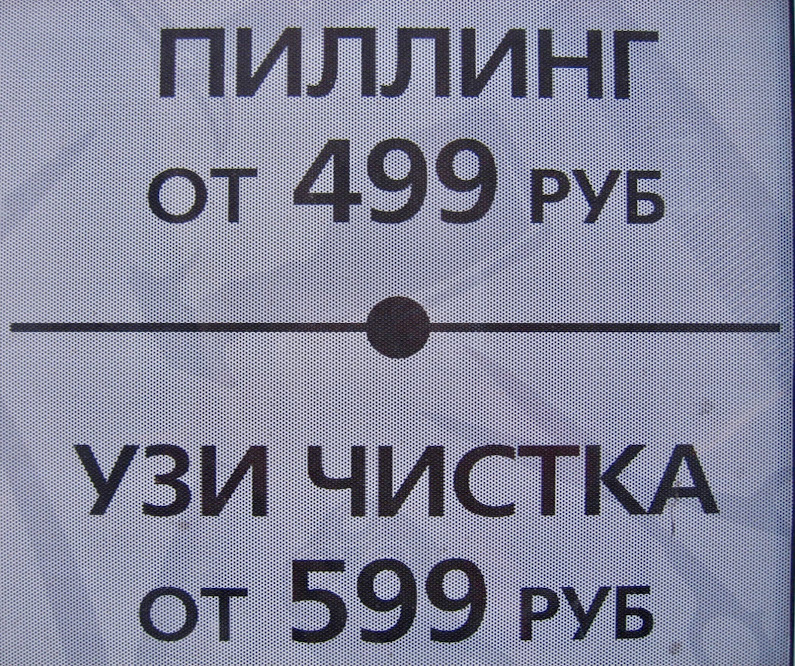
“Pilling from 499 rubles. Ultrasound cleaning from 599 rubles.” Photo by TRR
More Than Five Million Russians Have Trouble Paying Back Loans Takie Dela
May 30, 2017
Around five and half million Russians have trouble servicing their debts. Their debut burden is more than 60% of their income, reports Gazeta.ru, quoting a statement by Vladimir Shikin, deputy marketing director at the National Credit History Bureau.
According to experts, this figure is regarded as a critical indicator. Among the main reasons for arrears are the unreliability of borrowers and the lack of means to finance current debts.
Residents of the Kemerovo, Tyumen, and Novosibirsk Regions are the most indebted. According to the National Credit History Bureau, three million people cannot make payments on loans, which is 8% of all borrowers. Their current debt load exceeds half of their monthly incomes.
According to Shikin, the share of overdue loans remains at 16%, even as the number of new loans grows. The majority of Russian borrowers have several loans, and the average economically active Russian owes creditors 146,000 rubles [approx. 2,300 euros].
Meanwhile, research done by RANEPA shows that the debt burden of Russians is not critical. As Natalya Orlova, chief economist at Alfa Bank, stressed, the debt of Russians is estimated at 12% of GDP.
“In developed countries, debt is 60% to 80% of GDP, so the market has potential for growth,” emphasized Orlova. However, she argues that Russia issues a relatively small percentage of mortgages, whereas in developed countries, mortgages account for nearly 90% of all loans.
Experts hope that the debt burden of Russians will not rise greatly. After the 2014–2015 crisis, banks were more way about issuing loans, so the debut burden of Russians will fall. In the near future, banks will be even more cautious. In particular, the Central Bank has planned to consolidate the data of major of credit history bureaus in a single data base to combat indebtedness.
Earlier, the United Credit reported that half of Russian borrowers had been applying for new loans to pay off old loans. According to its figures, 45 million Russians with old loans had taken new loans in banks. Over half of them had done this to pay off old loans.
The analysis shows that 53% of borrowers had taken new loans in cash to partially or fully pay off already existing loans. 27% of the borrowers had spent more than half of the new loans on paying debts.
________________________
Almost 60% of Russians Admit They Have No Savings Takie Dela
May 29, 2017
Around 59% of Russian families have no savings, reports Rambler News Service, citing a report from the polling and market research firm inFOM.
According to a survey commissioned by the Central Bank, the figure has remained stable [sic] the last three months. In December 2016, 64% of those surveyed had no savings.
Yet a quarter of Russians believe that now is a good time to save money, while 44% hold the opposite opinion. According to experts, the tendency to save has grown noticeably since the beginning of the year. In February, fewer than 17% of respondents answered the question positively.
The majority of respondents replied that spare cash should be saved or put away for a rainy day, while a third of Russians would spend the money on expensive, major purchases.
The poll showed that 40% of respondents prefer to keep their savings in a bank account, 26%, in case, and 20%, partly in a bank, and partly in cash.
Two thousand respondents, aged eighteen and older, from fifty-five regions of Russia were involved in the survey.
According to research by RANEPA, the share of Russians who save money dropped by a third in 2016, from 55% to 40%. Moreover, in March, 40% of Russians claimed they had only enough money for food.
________________________
VTsIOM: 67% of Russians Skimped on Groceries during the Past Year Takie Dela
May 30, 2017
During the past year, 67% of Russian skimped on groceries in one way or another; 27% of them in a substantial way. Pensioners and residents of big cities had to skimp most of all. These figures were reported by pollsters VTsIOM.
The survey dealt with Russians’ attitudes to government regulation of the food market. 82% of respondents were against the idea of limiting supermarket opening hours on weekdays and weekends. According to 68% of them, if the government decided to do this, it would cause a number of problems. It would be hard to buy groceries in the evenings, and the selection would be reduced. Nearly 40% believed that limiting competition would generate price rises in small shops and produce markets.
Only 15% of Russians favored limiting competition, mostly pensioners aged sixty and older. When replying about what they thought about regulating prices for basic foodstuffs as a way of supporting the poor, Russians were divided in their opinions. Exactly half of them said such restrictions were ineffective, while 32% supported a combination of government and market measures, while 14% believed the government should solve the problem.
The VTsIOM survey showed that Russians were concerned about the government’s restricting prices for basic products. 55% said it would lead to the closure of stores, while 28% said it would lead to shortages, price gouging, and disruption of supplies. However, a quarter of respondents believed that prices would subsequently drop, and life would improve.
Russians see the government’s key role in regulating the produce market in support for domestic producers and developing farming, as well as in quality control. However, according to Yulia Baskakova, head of social modeling and forecasting at VTsIOM, “While worrying with all their heart for domestic producers, supporting improved food quality, and supporting the development of farming, Russians are not willing to sacrifice their comfort and put up with a reduction of the range of goods to which they are accustomed and its becoming less available. The survey showed that 88% of Russians are not willing to put up with a drop in their quality of lives to reduce the price of essential foodstuffs.”
The poll was occasioned by a suggestion, made by Federation Council member Sergei Lisovsky, thatregional authorities could decide how large store chains should operate. Lisovky also suggested prohibiting supermarkets from opening at nights and on Sundays, and permitting them to work on Saturdays only until four o’clock in the afternoon. Lisovsky has argued that such measures would support small business and promote small-scale trade.
Translation and photo by the Russian Reader. Faithful readers might wonder why I have cited Russian opinion polls at such length after making a big effort, over the past couple of years to show that this pollocracy, while real enough as a practice, does not tell us much or anything at all about what actual Russians thinking or are planning to do. I have made an exception in this case, however, because I think the three news items, above, show, between the lines, as it were, what really afflicts the Russian economy, and how the feigned populism of the political/economic elite rears its head, quite often in fact, to suggest impracticable solutions to the knotty problems their own mammoth corruption and instinctive hatred of small business and independent individuals generates the dead end they claim to want to alleviate by, among other thing, commissioning one “public opinion poll” after another while stubbornly failing to notice that their enthusiastic terrorizing of Krasnodar farmers, independent truckers, and Moscow street vendors show they have no interest whatsoever in small business, much less reducing the prices of basic foodstuffs for pensioners. The only thing that interests them is getting richer and making their power untouchable. TRR
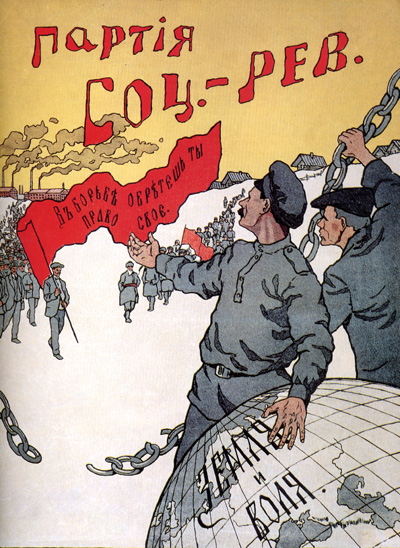
Socialist Revolutionary election poster, 1917. “Party of the Socialist Revolutionaries. Through struggle you will attain your rights. Land and freedom.” Courtesy of Wikimedia
The SR Alternative
Yaroslav Shimov Radio Svoboda
March 8, 2017
“On the morning of February 23, the workers who had reported to the factories and shops of the Vyborg District gradually downed tools and took to the streets in crowds, thus voicing their protest and discontent over bread shortages, which had been particularly acutely felt in the above-named factory district, where, according to local police, many had not had any bread whatsoever in recent days.”
Thus read a report by agents of the Okhrana on the first day of a revolution that forever changed Russia, February 23, 1917 (March 8, New Style).
Revolutionary events such as the unrest in Petrograd, which the bewildered tsarist regime failed to put down, Nicholas II’s abdication on March 2 (15) at Dno Station near Pskov, and the establishment of the Provisional Government were recalled by contemporaries as happening so swiftly that they were unable to understand where Russia was headed so wildly and who would ultimately benefit from the changes. In February 1917, no one would have predicted that less than year later the Bolsheviks, a radical faction of the Social Democrats who had been on the sidelines of Russian politics, would emerge victorious, and Bolshevik leaders themselves were no exception in this regard.
But an enormous thirst for social justice was apparent from the revolution’s outset. Russia had emerged a quite leftist country. In the stormy months following the monarchy’s fall, it transpired that a definite majority of the country’s citizens sympathized with socialist ideas in one form or another. This was reflected in the outcome of the first free elections in Russian history, which took place in the autumn, when the chaos and anarchy on the war front and the home front were obvious. The newly elected Constituent Assembly was meant to define the country’s future. The Socialist Revolutionaries (SRs), a party that had consistently, albeit violently and bloodily, waged war against the Romanov Dynasty, but in 1917 had favored peaceful but radical reforms, primarily land reforms, scored a convincing victory in the elections.
Soldiers who had gone over to the revolution and armed city dwellers on the streets of Petrograd, 1917
If the country had managed to slip past the threat of dictatorship, issuing from the left (the Bolsheviks) and from the right (radical counter-revolutonaries), the SRs would definitely have been post-revolutionary Russia’s ruling party for a time, argues Konstantin Morozov, a professor in the Institute of Social Sciences at RANEPA and convener of a permanent seminar, Leftists in Russia: History and Public Memory. In an interview with Radio Svoboda, he reflects on why this did not happen and what the SR alternative would have meant to Russia.
*****
What was the condition of the Socialist Revolutionary Party in February 1917?
I would say the the party was then in a state of organization disarray. A considerable part of its prominent leaders was abroad, while the other part was in prison, exile, and penal servitude. It had to be rebuilt from scratch, and it was the SRs who had withdrawn from revolutionary work in 1905–07 but who basically returned to the party in 1917 who mainly engaged in the rebuilding. It was they who organized all the party’s new cells. There were also serious problems among the SRs in terms of internal rifts, especially due to differing viewpoints on the war. In March, the SRs began to rebuild themselves as a single party, which was implemented subsequently at the party’s 3rd Congress in May and June. In my view, this was a mistake, because the disagreements within the party were such that it could not function, manage itself, and take decisions as a united party. A factional struggle immediately ensued. Accordingly, it ended in collapse and the inability to hew to a single internal party policy in 1917.
Due to the first phase of their history, the SRs are associated in the popular imagination with violence and terrorism, which they had long renounced by 1917. What were the views of the SRs and the leaders on violence as a principle of political struggle? The baggage of their terrorist pasts still haunted Viktor Chernov and other party leaders, after all. How did they view it in 1917?
The Socialist Revolutionary Party discussed the question of terrorism throughout its existence. At first, such figures as Mikhail Gots and Viktor Chernov, who advocated he inclusion of terror in the party’s tactics, had the upper hand. But even then the SRs included people who advocated a popular, mass-based party, who favored propaganda and agitation among the peasantry and proletariat rather than focusing on terror. Their ideal was a grassroots socialist party, something like the Second International’s exemplary party, the German Social Democracy. It went from bad to worse. During the 1905 Revolution, the party’s grassroots combat squads were keen on practicing expropriation and many other things that party leaders dubbed “revolutionary hooliganism.” But after 1909–11, in the aftermath of Evno Azef‘s exposure, the voices of those SRs who had argued for giving up terrorism grew ever stronger. By February 1917, there was no longer any talk of terror. The last terrorist act carried out by SRs had taken place in 1911, after which they basically ceased engaging in terrorism. Terrorist sentiments in the Socialist Revolutionary Party were resurrected only in the wake of October 1917, especially after the Bolsheviks forcibly disbanded the Constituent Assembly. Even then, however, the greater number of SR leaders were against engaging in terrorism against the Bolsheviks. These SR leaders argued that first they had to get the grassroots on their side using the methods of a popular political party.
In his memoirs, Boris Savinkov quotes his friend Ivan Kalyayev, a member of the SR Combat Organization who killed the Grand Duke Sergei Alexandrovich. Kalyayev said that an SR without a bomb was not an SR. In reality, however, the majority of SRs were not involved in terrorism, and they would have disagreed with Kalyayev’s statement. It can be argued that use of terrorist tactics dealt a huge blow to the Socialist Revolutionaries who wanted the party to be a grassroots socialist party, a party that could carry out the will of Russia’s “triune working class” (in which the SRs included the proletariat, the working peasantry, and the working intelligentsia), and a party that proposed an evolutionary and democratic path to progress. Essentially, the SRs were not terrorists, of course. They had more or less given up terrorism in 1911. What mattered politically was that they were able to propose a program, both agrarian and federalist, that excited the sympathies of millions of people. By the autumn of 1917, the Socialist Revolutionary Party had more than a million members, while the Bolsheviks had only 350,000 members. Most important, the SRs won the elections to the Constituent Assembly, taking 41% of the vote.
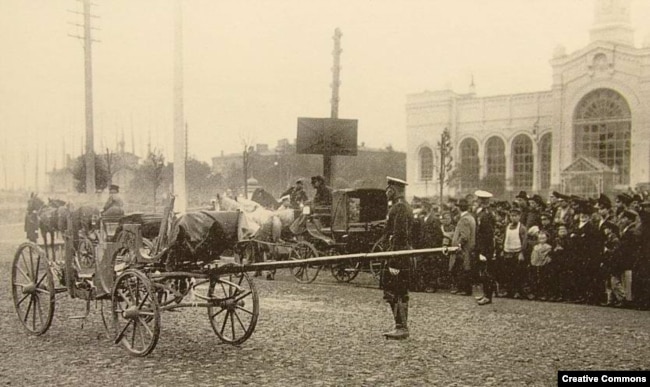
SR terrorism in the early 20th century: the carriage of Interior Minister Vyacheslav Pleve, killed on July 15 (28), 1904, in St. Petersburg
So 1917 was the heyday for the SRs: they had a million members, and they won the elections to the Constituent Assembly. Why, ultimately, were they unable to take advantage of this? How did it happen that the SRs, despite their popularity, ceded power to the Bolsheviks later as well, despite attempts to the contrary? What predetermined their failure?
There are two sets of causes, objective and subjective, meaning, the mistakes made by the SRs themselves. What I think is fundamentally important is that it is extremely difficult to campaign for democratic reforms while a world war is underway. The fact that the Revolution took place during the First World War considerably predetermined the entire subsequent course of events. What is a world war? On the one hand, it involves a collapse in living standards and a aggravation of all the contradictions that have been accumulating in society over decades. On the other hand, it involves millions of people getting used to killing other people. This causes quite serious psychological changes. Extreme cruelty is combined with societal expectations pushed to the limit. These expectations had amassed to such an extent that in 1917 very many people wanted everything right away. Say, workers were no longer satisfied they had trade unions that the selfsame socialists would meet halfway. The workers wanted more. They wanted control and management of the factories. Practically, the Mensheviks and SRs could not take this step, because it would have led to serious industrial management issues. And the peasants wanted the land right away.
Here we turn to the mistakes made by the Socialist Revolutionaries. It was wrong to delay the convocation of the Constituent Assembly. Rather, it was wrong to go along with the liberals in the Provisional Government, the Kadets, who tried to postpone the Constituent Assembly any way they could. The liberals realized the leftist parties were stronger. They would have an outright majority in the Constituent Assembly, and consequently the peasantry and proletariat would get much of what they had been demanding. So the Kadets postponed the Constituent Assembly. That was a big, serious mistake.
Did the subjective factor play a role in the fact that the SRs failed? Let’s take a closer look. On the one hand, they were a party who styled themselves as the party of “land and freedom.” They were supported by the peasants. On the other hand, most SR leaders were members of the urban intelligentsia, not the salt of the earth. Did this contradiction factor in the SR electoral victory, but one in which their supporters were unwilling to secure their political power?
It was a lot more interesting than that. The program for socializing land ownership, advocated by the SRs, did not fall out of the sky. It was the outcome of quite serious work on the part of Populist economists and sociologists. It was revenge, if you like, for the failure of the “going to the people” campaign of 1874. In the aftermath, Populist economists, sociologists, and statisticians undertook a serious study of how peasants really lived. Within twenty or thirty years, they had figured out how the Russian peasantry really lived and what it wanted. The SRs based their own land socialization program on this research. Moreover, the SRs tended not to act like typical Russian intelligentsia, who often preferred philosophizing and imposing their own values on others. The SRs always tried to maintain feedback from the peasantry. I came across a quite curious document, a survey of sorts, which the SR Central Committee sent out in 1906 or 1907 to their local organizations, who were supposed to conduct this sociological survey, which asked peasants about their attitudes towards the regime, the army, and the clergy, and what they thought about the land, and how it should be distributed and managed. So it was no wonder the Socialist Revolutionary Party and their program, crafted over many years and through the efforts of many people, were seen by the peasants as their party and their program. On the other hand, there was a fairly powerful peasant lobby in the Socialist Revolutionary Party. The grassroots level of party activists and functionaries consisted of the so-called popular intelligentsia: physician’s assistants, schoolteachers, agronomists, surveyors, and foresters.
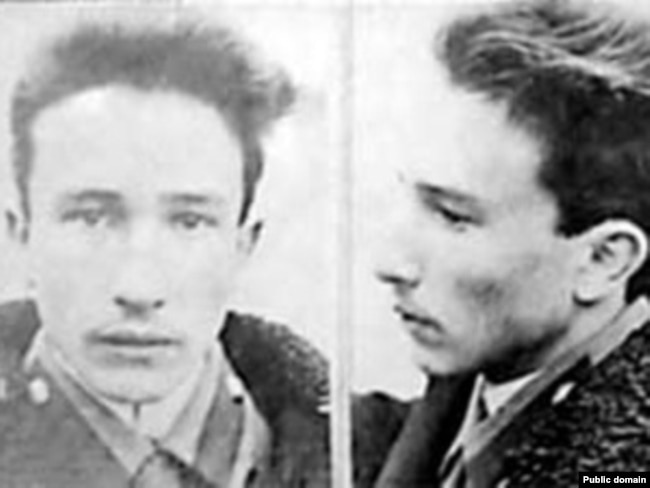
One of the most prominent SRs, Boris Savinkov, in his youth. Photos from his police file
The problem was that the SRs did not fully take the peasantry’s interests into account in 1917. The revolutionary authorities were afraid to cede land to the peasants, because, on the one hand, the army’s quartermasters argued that the supply of provisions to the army would immediately collapse. On the other hand, there were fears that the rank-and-file soldiers, who were actually peasants dressed in greatcoats, would immediately desert the front and run home. Later, at the party’s Fourth Congress, Yevgeniya Ratner, a member of the SR Central Committee, put it quite aptly. She said that for the war’s sake, for the front’s sake, they were forced into compromises with the bourgeois parties and thus were unable to defend the class interests of the peasantry and workers, and this was their huge guilt in the face of history. According to Ratner, they should have convoked the Constituent Assembly two or three month earlier, i.e., in August or September 1917, and set out to implement agrarian reforms. We should point out that some of the SRs had wanted to do this: Chernov, for example, insisted on it. There were ideas for forming a socialist government. In September 1917, the SR Central Committee was leaning towards this option.
By a socialist governmment, do you mean one that would have included all leftist parties, including the Bolsheviks?
There were two options. The first was the most leftist and quite adventuresome, or at least it seemed that way to the SRs themselves. It was proposed by Maria Spiridonova. She suggested the SRs should simply take power and form their own homogeneous SR government.
Meaning, they should have done what the Bolsheviks did finally?
It’s another matter that the Bolsheviks immediately set about tweaking their slogans and their actions. That is, they adopted the same slogans, but over time all of this was transformed into something else entirely. But getting back to the SRs, the majority of them wanted a coalition socialist government that would have included the Bolsheviks. At some point after October 1917, there were negotiations between the Bolsheviks and the socialist parties about forming such a government, but without Lenin and Trotsky. It was Lenin who in many ways destroyed this option. Was the formation of a socialist government a viable alternative if it had been agreed, say, in September? I think so. This would have been followed by elections to the Constituent Assembly, where the socialist parties obtained a majority. The SRs took the top spot, and the Bolsheviks won 25%, meaning they were the second largest faction. Clearly, they would have carried a lot of weight, but this course of events would, nevertheless, have made it possible to maintain a parliamentary democracy. Obviously, after a while, the SRs would have lost power in elections, as we see in Europe, where power swings back and forth between the right and the left. There was a chance then to set up a similar scheme for changing power through democratic procedures, via parliament. After all, the Constituent Assembly was highly regarded in society. It had been elected in the first genuinely free ballot in Russian history.
You have already touched a bit on the period after the Bolshevik coup. But let’s go back in time a bit. One of the key figures of 1917 was Alexander Kerensky. How did the other SRs regard him, and what role did he ultimately play in the party’s history?
It’s a very good question, but before answering it, I would like to voice a more general consideration. You just mentioned the “Bolshevik coup.” On the one hand, centrist and Right SRs used the term themselves. On the other hand, the Left SRs and anarchists would later come to favor the concept of a single Russian revolution that lasted from 1917 to 1921. That is, they saw it as a unified revolutionary process in which there was February and October, followed by the civil war. Currently, this is more or less how it is discussed. Those who rejected the concept argued that October 1917 was not a revolution on its own terms, because it did not involve a spontaneous popular movement. Until the early 1920s, the Bolsheviks themselves would also often speak of a coup, of their coup. But some of the SRs, Mark Vishnyak, for example, rightly noted, in my opinion, that the events of October 1917 could be interpreted as a sort of “staff revolution,” organized from above. It was a symbiosis of a revolutionary process with traits of a coup. When someone simply speaks of a coup, that is not entirely right, because there was definitely support from the workers and soldiers. Besides, the word “coup” itself suggests an analogy with Latin American-style military coups. Whatever the case, we must continue to make sense of those events conceptually.
What if we return to Kerensky?
The SR leadership definitely saw Kerensky as a fellow traveler, as the term was then. He had been in the SR movement during the Revolution of 1905–07. Elected as an MP to the State Duma, he tried to unite different Populist groups. On the other hand, some SRs might have simply envied him. Kerensky was one of the most popular people in Russia. Socialist Revolutionaries who had spent years fighting in the underground and building the party, wound up in the background, while he, who had declared himself an SR, was regarded by society in 1917 as the most important SR. Chernov had harsh things to say about Kerensky. According to Chernov, Kerensky played a quite negative role in the Socialist Revolutionary Party, because he had almost no contact with the SR leadership and did not follow the Central Committee’s instructions. The Right SRs and right-centrists supported Kerensky, while the Left SRs tried to break with him. At the party’s Third Congress, in May and June 1917, the Left SRs sabotaged Kerensky’s election to the party’s Central Committee. He was rejected outright. It was a real slap in the face.
Alexander Kerensky, chair of the Provisional Government, was a symbol of democratic Russia and its collapse in 1917.
What does that tell us? That, unlike the Bolsheviks, the SRs were not a leaderist party, remaining a more collectivist force?
Democrats are generally less inclined to leaderism, and this was fully borne out by the SRs. This does not mean there were no authoritarians among the SRs. It was another matter that the leaders had to adapt to the moods and ideas of the revolutionary milieu, to the subculture of the Russian revolutionary movement. The notions of decentralization, self-reliance, and independence fromthe leadership were quite strong in the Socialist Revolutionary Party. Initially, they had a sort of collective leadership. At various times, it consisted of different people, usually three or four people. Plus, we have to speak here of three or four generations of SRs. The first generation had been been members of the People’s Will, while the last generation joined the party in 1923–24. Meaning, we are looking at a fairly complicated picture. But generally, yes, there was no single leader. Many historians and contemporaries were of the opinion this was a cause of the failure of the SRs in 1917. Chernov argued that if Gots and Grigory Gershuni had still been alive, the three of them could have led the party in 1917. Gershuni was highly charismatic, even more charismatic than Lenin, and perhaps he would have had a chance to keep the party under control. On the one hand, there is a certain point to these hypotheses, but we have to consider the weakness and division existing within the party at the time of the revolution, in particular, the strong differences between the SRs on the issue of the war. Very many people regarded Chernov as a good theorist, but not as a leader and organizer. However, he had the outstanding ability to reconcile different points of view, and he played a unifying role. His opponents dubbed him the “universal bandage.”
Let’s try and sum up. Should we regard the SRs as a failed historical alternative to Bolshevism? Or, given their looseness and perennial internal division, did the SRs nevertheless lack the strength, ideas, and people to lay claim to a truly great historical role?
I think that victory in the elections to the Constituent Assembly, in which they received a plurality and, in fact, adopted the first two laws, including the law socializing land ownership, were in fact the beginnings of a democratic alternative, an SR alternative. Would they have been able to lead the country down this road? I support the viewpoint of my German colleague Manfred Hildermeier, who as early as 1992 wrote in an article that, since one of Russian’s main problems was the huge gap between city and country, the SRs were well suited to play the role of a party voicing the interests of the peasantry, proletariat, and intelligentsia. I would also add we should not exaggerate the extreme peasantness of the Socialist Revolutionary Party. If you look at their program, you see they attempted to unite a European conception of socialism with certain nativist ideas. They argued that the peasantry’s skull was no worse than the skulls of the proletariat and intelligentsia, and was quite capable of taking the ideas of socialism on board. It was one of the first attempts in the world to fuse European values and ideas of modernization with the values of a traditional society, to merge a significant part of the Russian peasantry into the new society as painlessly as possible. The SRs assumed that for many decades to come progress would follow the bourgeois path and there would be a market economy: socialism would not soon emerge. In this sense, they were evolutionists. They were essentially the first to propose an idea that is currently quite fashionable around the world, the idea of peripheral capitalism, according to which capitalism in developed countries and capitalism in second-tier and third-tier countries are completely different things. In peripheral capitalist countries, including Russia, capitalism shows it most predatory features and is the most destructive.
Maria Spiridonova, future leader of the Left SRs, in her youth
The SRs also argued the Russian people were definitely capable of adapting to democracy. Moreover, they thought that the Russian traditions of liberty and community self-government afforded an opportunity for magnificent democratic progress as such. The SRs wanted to unlock the people’s democratic collectivist potential. By the way, they did not idealize the peasant commune, arguing it had to be transformed, of course. They counted on the cooperative movement, which had progressed quite powerfully in early twentieth-century Russia. It was entirely under the ideological leadership of the SRs. They believed it was necessary to rely on the working peasant economy. It would then be possible to modernize the country and eventually follow a socialist path. The main thing was that despite a certain utopianism to their views, the SRs were capable of evolving, of course. Another important thing was that the SRs, more than the other parties, were capable of acting as a venue for reconciling different interests. This is basically the road European social democracy took. However, the party’s looseness and internal conflicts were important features of its history. I think that sooner or later the Socialist Revolutionary Part would definitely have split into several parties. If we speak of the SRs as a democratic alternative, then the Maximalists and Left SRs do not fit this bill. Unlike the other SRs, they cannot be considered adherents of democratic socialism. By the way, the SRs and Mensheviks used this term quite vigorously from the 1920s onwards. Later, in the mid twentieth century, the European socialist parties would also speak of democratic socialist values. From this perspective, some SRs and Mensheviks were, undoubtedly, adherents of democratic socialism, which gave rise to the Socialist International.
********
The demise of the Socialist Revolutionary Party was tragic. During the Russian Civil War, the SRs finally split. The Right SRs were involved in the anti-Bolshevik movement, while the Left SRs tended to collaborate with the Bolsheviks. In the summer of 1918, however, finally convinced that Lenin and his entourage were taking Russia down the road to dictatorship, the Left SRs undertook a failed attempt to overthrow “commissarocracy,” their term for the Communist regime. In the 1920s, the party was finally finished off. In the summer of 1922, twelve SR leaders were sentenced to death at a special trial. The executions, however, were postponed, turning the convicts into hostages in case the remnants of the Socialist Revolutionary Party decided to return to its terrorist methods, now against the Communist regime. One SR leader, Yevgeniya Ratner, was held in prison with her young son, causing her to complain to Dzerzhinsky. Subsequently, their death sentences were commuted to various terms of imprisonment and exile. Most prominent SRs who stayed in Russia were victims of the Stalinist crackdowns. Several former SRs, including Maria Spiridonova and her husband Ilya Mayorov, were among those massacred in the Medvedev Forest, outside Orlyov, in September 1941.
Translated by the Russian Reader. Thanks to Comrade Koganzon for the heads-up
Burrow City versus Hipster Urbanism Sociologist Victor Vakhshtayn on why Moscow is a metropolis for newcomers
Viktoria Kuzmenko
August 1, 2015 Lenta.ru
Why do Moscow residents not trust each other? Why do they not want to live here? Why is Moscow still “rubbery”? Who perverted the concept of hipster urbanism and why? Lenta.ru discussed this with Viktor Vakhshtayn, director of the Centre for Sociological Research at the Russian Presidential Academy of National Economy and Public Administration (RANEPA) in Moscow and a professor at the Moscow School of Social and Economic Sciences[.]
You have repeatedly said that one percent of the population in Moscow trusts each other, meaning this is a society of mutual distrust. But what is Moscow really like in terms of interpersonal communication?
Victor Vakhshtayn: When sociologists talk about interpersonal communication in cities they usually mention two interrelated topics.
The first is the problem of public spaces, places where urbanites meet face to face. It is thought that such spaces shapes the identity of the city, because this is where its inhabitants face each other not as colleagues, friends or drinking buddies, but namely as urbanites. In Moscow, (as, indeed, in many large Russian cities), the problem of public spaces is very serious. In recent decades, they have either been privatized and redeveloped or strategically destroyed. The example of Moscow’s Manege Square, a source of constant concern for the authorities, is telling in this instance. When the Okhotny Ryad shopping center was being designed, the architects were tasked with making it impossible for large numbers of people to gather in this space. The problem was solved elegantly. The square was made the roof of the [underground] shopping center, which, however, did not prevent protesters from spontaneously mobilizing a few years ago.
A city that has no public spaces is rigidly divided into home, work, and transit. Your life is divided among apartment, office, and subway, car or commuter train. Hence the horror of the entryways in Russian apartment buildings, and the specific perception of the city that architects dub “burrowness.” (Bedroom communities are containers for burrows, and the subway is the crossing point between apartment-as-burrow and office-as-burrow.)
Things packed for moving, outside the entrance of a residential house on the outskirts of Moscow. Photo: Grigory Sobchenko/Kommersant
In recent years, much has been done in Moscow to bring public spaces back to life, but now the process of revitalization have stalled. We partly have ourselves to blame: the theme of public space very quickly began to be perceived à la the hipster urbanism of Richard Florida and Jan Gehl, meaning in terms of things like bike lanes, lawns for doing yoga, and eating cotton candy outdoors. The people who returned public spaces as a focus of discussion and planning preferred not to recall that the prototype of such spaces is not the promenade, but the Greek agora and the Roman Forum. Khimki Forest and the field in Troparevo-Nikulino are much more public spaces than Sokolniki Park.
But what about local communities?
The problem of local communities is the second talking point about communication in the city. Two thirds of Moscow’s permanent residents were not born here. More than half of them do not own their own dwellings. The average apartment rental lasts between two and three years. In other words, this is a city of nomads constantly on the move between rented encampments and the steppes of the office blocks. That is why it is nearly impossible to answer a seemingly simple question: how many people live in Moscow? According to official statistics, the figure is twelve and a half million people. But economists have calculated that twenty million people consume food daily in Moscow. It is hardly the case that twelve million people are eating for twenty million.
So the argument that Moscow is overpopulated has to be corrected. The nomads have not overpopulated the steppe. At worst, they have trampled it.
The metaphor of a city of nomads also nicely describes Moscow’s relations with the surrounding areas. When Pavel Stepantsov and I attempted to measure the density of social ties in Moscow and Moscow Region, we discovered that an alienation belt had formed round Moscow. In the surrounding towns, no urban life as such is left. Moscow attracts all the resources (primarily, of course, human resources).
So talking about local communities, as urbanists in Moscow like to do, is just ridiculous in such circumstances. As recent studies by the Moscow Institute of Sociocultural Programs (MISCP) have shown, local ties and identities have been preserved primarily in New Moscow and Zelenograd Administrative District. But these are the areas that are the least urbanized.
Photo: Sergei Kovalyov/Russian Look
The price for the nomadic lifestyle is people’s total mistrust of each other and the place where they live. Moscow is a rare metropolis where parents see their children to the subway and ask them to call when they get downtown. People see their own neighborhoods as more dangerous than the city center, although statistics show the exact opposite: most crimes are committed in the central districts. According to our study “Eurobarometer in Russia” (RANEPA) and the latest research by MISCP, half of Muscovites do not know the neighbors on their landing, much less in their stairwell. More than sixty percent believe that returning home late at night is either dangerous or very dangerous. About a quarter of the Russian population believe that people are not such malevolent creatures, and they can generally be trusted, but in Moscow this figure tends toward zero. (More precisely, only one percent of Muscovites believe people can be trusted.)
Hence the expectations for courtyard culture and local communities as little factory for the production of trust in the city. The argument that we need to work with local communities has become the new ideological cliché (like a few years earlier the argument that we had to make this city an interesting place to live). But I would caution against such community optimism. City and neighborhood are antonyms. As a final illustration, I can give you fresh data from MISCP’s project “Mechanics of Moscow.” It turned out that people feel anxious about their places of residence if they don’t know any of their neighbors by sight and have no acquaintances living in the neighborhoods. The feeling of insecurity wanes if they recognizer neighbors by site and develop a few weak, friendly ties. But when strong ties of friendship emerge in people’s habitat and their number grows, the feeling of insecurity and mistrust of the area is again high. When neighbors and friends are the same people, it is the first sign of ghettoization. In the end, the urban community’s ultimate is the ghetto, not the courtyard.
As a person who considers himself a Muscovite, you think that twelve to twenty million residents is a normal figure for Moscow and doesn’t need to be reduced, that the city and its transport system can serve so many people?
Again, nomads cannot overpopulate the steppe. If you cannot say for sure whether twelve or twenty million people live here, it is strange to speak of overpopulation. Is twelve million people a lot? What about eleven million? How many people is normal? At what point does it begin to be a lot?
It’s not a matter of infrastructure or service, but the impact people make. The economic rise of Moscow in the 2000s was in part an effect of its overcrowding and hyperconcentration of resources.
Photo: Sergei Kovaylov/Russian Look
Okay, your stance on the issue of the number of people living in Moscow is clear. But this raises another topic: the capital’s population is constantly increasing. You yourself mentioned the economic upturn of the 2000s was triggered by the influx of new people in the city. Hence the conclusion: if Russia has this center of gravity that is constantly growing, is it worth leaving everything as it is and keep expanding the city? And then everyone will want to move to Moscow, it will expand, and in thirty years or so, it will be twice as big. In this case, is a metropolis where, thirty years from now, forty million people, for example, a problem? And is it necessary to address this issue, for example, by moving some administrative offices and headquarters of major companies, developing other cities, and making them more appealing places to live?
That’s a good question. But first, let’s deal with the economic history. There was an American urban planner Robert Moses, to whom we owe much of the look of modern New York and the whole despised ideology of modernist urbanism. Moses was a bit like a New York Luzhkov, but with a better understanding of the urban economy. He understood that the main competitive advantage of the metropolis is the hyperconcentration of heterogeneous resources in a limited area. His idols were the density, speed, and mobility that make the city a “growth machine.” The more human, economic, administrative, and cognitive resources are compressed in one place, the higher the return, the faster the pace of urban development.
Now let me digress a bit. In 1997, a UK parliamentary committee led by Ron Dearing tried to answer the question of why Scottish universities were consistently outperforming English universities on all fronts. It turned out their competitive advantage was historical: the first (“ancient”) universities of Scotland—Edinburgh, Aberdeen, Glasgow, and St Andrews—were founded as centers of English political influence, and hence they were built in the major cities of the time. Conversely, the English universities of Cambridge and Oxford were established far from the bustle of the city, in the image of the monasteries. When rapid industrialization kicked off in the nineteenth century, urban universities stood to gain due to their location. They become resources for the economic growth of their host cities, and the cities, resources for their development. This is why ideology of hyperconcentration—having the all universities, factories, people, money, and power in one place—is not so absurd and outdated an idea as it might seem to a normal person.
Moscow today is a hypermobile city, 1870s Edinburgh and 1950s New York at the same time. I hesitate to say 1930s Vienna, although in some respects, this parallel is also not without grounds. The city’s economic growth in recent decades is not so much the cause as a consequence of the influx of migrants. Moreover, the migrants are very different: they include qualified young professionals willing to work for thirteen to fourteen hours a day to pay for food and rent, and unskilled migrant workers, who have become targets of exploitation unknown in Marx’s time. People who with a contemptuous grimace hold forth today about the “problem of migration” are usually the same people whose incomes and rapid career growth have been secured by the influx of migrants, who took the jobs they otherwise would have had to take.
Photo: Dmitry Dukhanin/Kommersant
Decentralizing Moscow is not just a utopia. It is a dystopia for a city that is a melting pot of people, money, power, and knowledge. As long it is being stoked with firewood, it can afford to grow. Forty million? Even fifty million people is possible if nothing changes. But change is inevitable. It can be triggered by both internal and external factors.
The external factors are more or less clear, and we are now seeing their effect on the city’s economy. The internal changes begin with the question, What it is like to live in a melting pot? What is it like to raise children and ensure a decent life for elderly parents in a melting pot? When such issues arise, then the stage of economic history in which the city is a machine of economic development is over.
Rising prosperity has side effects such as increased expectations for the quality of the urban environment. People no longer want to live and die in an office or on a construction site. The above-mentioned “Eurobarometer in Russia,” recorded an interesting effect two years ago: Moscow’s appeal had begun to rapidly decline, and within Moscow even more rapidly than outside Moscow. A rather remarkable group of potential migrants who put the quality of the urban environment above economic opportunities had taken shape. Economist Sergei Guriev and I then came up with a project: calculating the value of the ruble in Moscow. Because if you make money in a city where you don’t want to spend it, if you feel deeply unhappy and leave whenever possible (for example, on the weekend) for somewhere far away, it is possible that at some point you would prefer to make less money but in better conditions. And then the Moscow ruble is worth less than, for example, . the Petersburg ruble. Alas, for obvious reasons [Sergei Guriev’s emigration from Russia – Lenta.ru], the project has not been implemented.
This, then, is an interesting point. If the capital’s appeal is shrinking, the quality of the urban environment does not satisfy people, could Moscow in thirty years become a city for migrants only? As you say, one big office, only on a larger scale, where the houses have been turned into dormitories for workers and employees, and Muscovites themselves, no longer wishing to live in this office, en masse become rentiers and depart, for example, to comfortable suburban agglomerations or Thailand? Many are already doing this now. Will Moscow 2045 be a city unfit for normal life?
No, of course not. By 2045, Moscow will be radically decentralized. All the organs of state power will have been transferred to Petersburg and Vladivostok. Left without work, migrants will disperse to other cities and countries, and the residential areas, inhabited mainly by indigenous Muscovites, will all fit inside the Boulevard Ring. People will again visit each other at home and move around the city on foot.
But what will be left for them to do when unemployment is at seventy percent? By the way, there is a remarkable study, done at Columbia University, on how the pace at which men and women walked changed when there was mass unemployment. It was found that during the most severe years of the Great Depression in the United States, men began to walk more slowly around the city, and women, more quickly. Because women, unlike men, did not have less to d0.
Town-planning scale model of Moscow at the VDNKh. Photo: Vasily Shaposhnikov/Kommersant
Both scenarios we have described, yours and mine, are probably products of a morbid Muscovite imagination and have little to do with the urban reality. But yours is more realistic, with suburban Moscow dachas playing the role of Thailand, bedroom districts standing in for workers hostels, and the very meaning of normal life in the metropolis rapidly mutating. It is this situation that brought the ideology of hipster urbanism, probably the best thing that has happened with Moscow in recent years, onto the scene. But this is a separate and a slightly sad story.
I will elaborate on the topic by mentioning two talking points. The first is changing perceptions of law enforcement under these circumstance. According to “Eurobarometer in Russia,” forty-three percent of Moscow residents believe that “the police are a threat to ordinary people, perpetrating lawlessness and violence.” (Fifty-one percent of respondents hold the opposite opinion). This is even more than in the Republic of Dagestan (34%), which holds the second place in our sample.
Another talking point is who in Moscow feels most like Muscovites. According to our data, it is not people who were born in Moscow, but those who came here over ten years ago. They have the strongest Muscovite identity. They are the most active users of the city (from museums and exhibitions to citywide celebrations). It is they, rather than the notorious hipsters, who have shown the most lively response to transformations of the urban environment in recent years.
The main thing to remember is that these people arrived in Moscow ten to twenty years ago not for a “normal” life but for the sake of self-realization. And it is they who now define Moscow.
I understand that you are not a big fan of hipster urbanism. What is bad about it?
To be honest, today I regret that a few years ago I came up with the phrase hipster urbanism. Then it was necessary to more accurately capture the object of our study: the impact on specific urban spaces of the metaphor of the city as a stage, which had gained a foothold in the language of policy makers and officials. I naively supposed that if this concept were terminologically defined in an academic paper, the risk of erosion would be minimal. However, the phrase hipster urbanism caught on first as a cliché in critical journalism, then as a self-designation. Sergei Kapkov [Moscow’s former culture head] then decided to give a lecture on hipster urbanism. Some people in Samara, responsible for the reconstruction of the embankment, authoritatively reported they were working in terms of hipster urbanism. These words can stand for anything today. They do not refer to anything specific and only vaguely link Kapkov’s Moscow and abstract hipsters in a loose associative unity.
Photo: Konstantin Kokoshkin/Russian Look
Essentially, the modern city is less an arena where social groups, stable community or collective agents clash, and more an arena where languages, models of representation, and different urban ideologies clash. The metaphor of the city is the hard core of ideology; it determines how people see urban space, and what decisions they take in regard to it. Imagine officials from two rival departments at a planning meeting on “mayor’s Tuesday” dealing with city parks. For the some of them, the city is a giant organism in which the parks have been the given the place of “green lungs.” The parks are tasked with producing oxygen. Accordingly, they should be financed in terms of the number of green spaces. For the other officials, parks are public spaces, the city’s “stages.” And they should be financed according to the number of activities staged there, the number of people who attended them, and the public eventfulness they generate. The conflict of metaphors will have real consequences for the city.
At some point, the hipster metaphors—city as stage, city as generator of experiences, city as a set of events—suddenly comes into competition with the two Big City metaphors of the twentieth century: city as growth machine (modernist urbanism) and city as generator of inequality (Marxist urbanism). Moreover, in Moscow the hipster ideology beat out the other ways of thinking about the city for a short period. This is a very curious phenomenon that remains to be researched.
My criticism of hipster urbanism concerned the rhetorical strategies it employed (the way it substituted societal [obshchestvennye] spaces with “public” [publichnye] spaces, its use of vague clichés like creative class and livability), its blind spots (its inability to discuss, for example, migration), and its superficiality and unbending utopianism.
But today, it must be recognized, it is a quite workable ideology that changed the look of the city. Now, when a very different rhetoric and semantics has engrossed the minds of city managers, hipster urbanism looks like the last conquest of public policy. It reminds us of those glorious times when decisions were still determined by the clash of metaphors and ways of thinking, and even city managers needed to answer the question, What is a city?
Under these new cultural circumstances, I will defend the achievements of hipster urbanism to the last.
People relaxing on Olive Beach in Gorky Park. Photo: Alexander Miridonov/Kommersant
How do you think the city has changed under the impact of newcomers from the Russian provinces and migrants?
That is a funny way of putting the question. You used the words migrants (apparently from Central Asia) and newcomers (apparently from the provinces). I do not want to upset you, but the newcomers are also migrants, and the migrants are also newcomers. And, given the statistics I cited above, the category of migrants and newcomers must encompass two thirds of the adult population of Moscow, including the Russian president and the mayor of the capital. I find it difficult to answer the question of how their migration has impacted the image of our city.
In general, the notion of the city and migrants as two opposing forces (something like the Eternal City of Rome and the barbarians besieging it) is mistaken, to put it mildly. Because the city equals migration. This just applies to Moscow a bit more than to other Russian metropolises.
Translated by the Russian Reader. Thanks to Comrade ASK for the heads-up.

 “Tests like this have been handed out in Petersburg schools. This is only the second page of the test, featuring questions about the Field of Mars, invitations to protest rallies via the internet from persons unknown, etc.” Post courtesy of Telegram channel Somebody Else
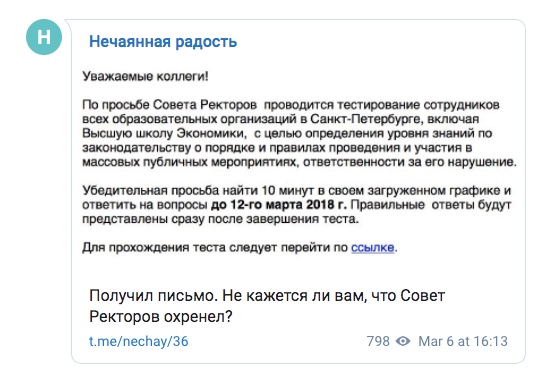 “Dear colleagues! At the request of the Council of Rectors, staff at all educational organizations in St. Petersburg, including the Higher School of Economics, are being tested in order to determine the level of their knowledge of the laws on rules for holding and attending large-scale public events and the penalties for violating them. We strongly encourage to take ten minutes from your busy schedules and answer the questions before March 12, 2018. The correct answers will be provided immediately after you complete the test. To take the test, follow this link.” Post courtesy of Telegram channel Unexpected Joy.
 “Where do the fake election observers come from? On March 4, 2012 [the date of the previous presidential election] grassroots oversight was usually portrayed by pensioners and state employees. Over the past six years, however, the fake election observers movement has mastered the streams of financing, gone large scale, and become much younger. For example, first-year students at the Petersburg campus of the All-Russian University of Justice received this message from their class leader: ‘March 18 is a school day, compulsory on-the-job training, meaning that everyone will be a grassroots election observer at the polls. Sponsored by the Association of Lawyers, our university is officially taking part in the Observers Corps for Clean Elections event, so if you do not show up you face administrative penalties and a bad mark in your permanent record.’ In addition to free food and transportation on voting day, letters of gratitude and a day off from classes on March 19 have been promised to the students. Basically, this is how correct public opinion is forged: in return for a day off, free grub, and a certificate of [political] trustworthiness.” Screenshot of a post on the VK community page of Petersburg Observers for Fair Elections
  “Very Important Information! In the next 30 minutes ALL out-of-two students need to shoot back the following information: what resources you will use to vote in the March 18 Russian presidential election; where you will vote (at what polling station); how you will register to vote. Send it to https://vk.com/%5Bdeleted]. […] Basically, we have been asked by [illegible] to register as many people living in each section as possible to vote. Meaning that each manager is responsible for his section and, subsequently, for sending everyone off to vote. The section in which the most people vote will get the Prize Sector [a reference to the “prize” section on the spinning wheel in the Russian version of Wheel of Fortune]. Ideally, you could assemble your entire section and all go together to the district voting commission. This is a mandatory request that concerns everyone. I think it is in our interest to give our vote . . .” Screenshoots of correspondence among RANEPA students. Courtesy of Bumaga
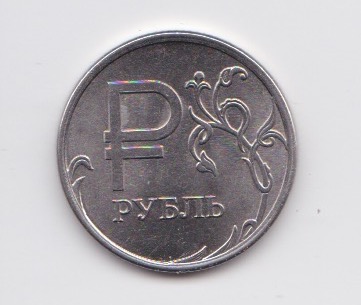 This one-ruble coin, minted in 2014 and sporting the newish symbol for the ruble, adopted in 2013, won’t buy you love or much anything else.