The Two-State Solution (Racism and the Russian Intelligentsia)

Boris Akunin
Boris Akunin

Boris Akunin:

In Russia, two distinct, completely dissimilar peoples live side by side, and these peoples have long been bitterly hostile towards each other. (May the Byzantine double-headed eagle that Ivan the Third selected as the country’s emblem go to hell in a hand basket.)

There is Us and there is Them.

We have our own heroes: Chekhov, Mandelstam, Pasternak, and Sakharov.

They have their own heroes: Ivan the Terrible, Stalin, Dzerzhinsky, and now Putin.

Members of the two nations recognize each other at first glance and experience a pang of acute dislike that selfsame second. We do not like anything about Them: the way They look, talk, carry themselves, rejoice and grieve, dress and undress. Their favorite singers, films, and TV shows make us sick. They pay Us in kind, and with interest.

Apart from Us and Them, there are just plain folk, who make up the majority of the population. We and They are constantly trying to win over this neither-fish-nor-fowl, to introduce them to our values.

What do you think should be done with this reality? Should we kill each other?

—Excerpted from Boris Akunin and Mikhail Shishkin, “Conversation between a Novelist and a Writer,” July 30, 2013
Our Swimmer

While there seems to be a fair amount of self-irony, in the comments, above, by the famed Russian detective novel writer Boris Akunin, I cannot help laughing when I read such exercises in self-praise by the so-called Russian intelligentsia and, at the same time, recall something that happened to me several years ago when I was running a summer study program in Petrograd for an American university.

Our students lived with Russian host families, and fitting student to host family was not always a snap, but it was mostly doable. That particular summer, however, more students had signed up for the program than ever before, and our limited resources were stretched thin. So I was taking recommendations from whomever I could get them, rather than relying only on the list of potential host families provided by our partners at the state university here in town.

That is how found myself visiting a couple in their flat somewhere in the city’s Central District. It was in a Stalin-era building, but the couple proudly informed me right away that Oleg Basilashvili, a well-known screen and stage actor and liberal intelligentsia icon, was a neighbor. They, too, were members of the creative intelligentsia. One of them was a theater critic, while the other had something to do with the Conservatory, I seem to remember.

The point, as I had already told them over the phone, was that I had one student left to place with a family, a male student. They, it transpired, had a teenage daughter. Would it be a problem for them to have a male student living in the same flat as their daughter? No, it would not be a problem, they told me.

Given the reputation of the university I was representing, they might have imagined I would be setting them up with a blond scion of New England old money, so if their daughter was whisked off her feet over the summer or merely made useful connections in high places, what could be the harm?

As we were wrapping up our conversation at their flat, having ironed out almost all the practical details, the couple thought to ask me what the young man’s name was.

“Diego,” I said.

My answer literally sent their eyes spinning in circles and smoke shooting from their ears. All it took was the “wrong” name for them to imagine a summer of their daughter basking in the glow of old American money with a patina of academic respectability turning into the constant threat of rape and ravishment at the hands of a “hot-blooded Latino.”

And they told me that in so many words, all the while denying that they were what they were—racists.

The funny thing was that Diego was gay in every sense of the word: fun to be around, a kind, sweet-hearted young man, and no “threat” to their precious daughter. But since Oleg Basilashvili’s neighbors had already outed themselves as racists, I did not want to hang around and find out whether they were homophobes as well.

I was more naïve than I am now. Although I had already had many encounters with “casual” racism and anti-Semitism Russian style, Petrograd had not yet arrived at the bad part of its mid noughties, when more proactive racists than my intelligentsia couple would ever want to be began assaulting and murdering immigrants, foreigners, anti-fascists, and members of Russian ethnic minorities in especially large numbers.

But I was not naïve enough to try and plead Diego’s case to these assholes. I immediately left their precious den of culture-vulturehood and hit the streets, cursing them out loud while also trying to think of a back-up plan.

That it is when I thought of our long-time acquaintance F.A., who had nannied the young son of a friend for years, and even had cooked for our family for a short while when we were in a bad spot. By no means was F.A. a member of the ballyhooed intelligentsia, which was not to say that she was uneducated or crude or anything but kind, loving, funny, smart, warm, and one of the best cooks I have ever met in my life. Besides that, she had worked in a factory her whole life, doing quality control, and she was Jewish.

When I telephoned her and told her what the deal was, she did not hesitate a second to welcome Diego into her home.

Needless to say, Diego and F.A. hit it off and had a great time in each other’s company that summer.

So when, a while later, I was asked to find temporary summer accommodation in Petrograd for another young gay Latino man, I could think of no better hostess than F.A. They also hit it off famously.

This is my roundabout way of saying something that has only been confirmed ten thousand times since by experiences both personal and vicarious: the liberal Russian intelligentsia is not all it is cracked up to be. It is often not particularly liberal or progressive, and is just as likely to be as Putinist or more Putinist than Putin’s mythical alleged “base” among industrial workers and peasants in the “Russian heartlands” or the “simple folk” in the big cities. If anything, my own experience has been that, on the contrary, these simple folk are not so simple and not so automatically inclined to putinize the world around them, much less racialize it.

There are just as many bigots and racists among the “Russian liberal intelligentsia” as there are among the Russian lower classes, maybe more.

Whatever the case, the fact that many Russian liberals have loose reactionary, racist screws in their brains has become apparent from the rabid reactionary discourse that has sprung up within Russia’s talking, thinking, and writing classes around the “refugee crisis” in Europe and the fresh clashes between Israelis and Palestinians.

Yegor Osipov and Kirill Kobrin’s attempts, below, to counter this utterly irrational discourse might seem mild outside of this context, but they are welcome contributions to a debate that is most remarkable for its near-total absence from Russian public life.

Yegor Osipov
Yegor Osipov

Humanizing Palestinians
Yegor Osipov
October 21, 2015
Radio Svoboda

“Maybe Israel does not behave perfectly in the Occupied Territories, but this is no justification for terrorism.” This comment on Facebook is nearly the most moderate gesture of support for Israel in connection with the new wave of Palestinian terrorism. Despite the fact that nothing justifies terrorism, the situation requires clarification.

Unfortunately, Russian commentators often forget the fact that Israel occupies around 60% of the West Bank and has been building settlements there for its own citizens. (Despite the fact that the Oslo Accords stipulated this state of affairs was only temporary.) They forget the Jewish settlements are built so as to significantly impede the movement of Palestinians between their towns and prevent the expansion of these towns. They forget that between 2000 and 2012 Israel demolished over two and a half thousand Palestinian buildings, buildings for which it, as the occupying power, had not issued construction permits. They forget that Israel restricts the access of tens of thousands of Palestinians to water, forcing them to pay much more for it than Jewish settlers living nearby. They forget that the IDF keeps troops in the West Bank who are engaged only in maintaining the occupation: a noise grenade there, a noise grenade here, searches of houses (women to the right, men to the left), and so on every other night. This tactic is called “mak[ing] our presence felt,” and sometimes it leads to innocent victims. Without knowing this, you might think that Israel and the West Bank were different planets, but in fact both political entities depend on each other. The West Bank depends on virtually everything that happens in Israel, while Israel (and this becomes clear during waves of terror) depends on the social climate in the West Bank.

The situation with the Gaza Strip, about which Russians also do not know very much, is quite different. In 2005, after the withdrawal of Israeli settlements and military personnel, the Gaza Strip was declared territory to which Israel had no obligations because it had “ended the occupation,” although it continued to implement land, sea, and air control of the Strip. After Hamas came to power and began rocket attacks on the southern part of the Jewish state, Israel proclaimed the Strip a “hostile entity” and established a blockade of the area along with Egypt, essentially locking around 1,800,000 people in an open-air prison.

In July 2014, in response to the murder of three Jewish teenagers by Palestinian terrorists, Israel launched an operation in the Gaza Strip, killing more than 2,200 people. Last summer, Jewish terrorists tossed Molotov cocktails at an Arab house, burning alive three members of the family who lived there, including an 18-month-old baby. Israel has yet to indict the terrorists. Some people manage to include this in the “Jewish people’s struggle for survival.” I think it only plays into the hands of anti-Semites the world over. But anti-Semitism, according to a newly released US State Department report on levels of religious freedom in the world, is once again on the rise, and the bias of the UN Security Council and the world’s leading media in favor of Palestine [sic] has not gone away.

Whether Israel will cope with the current wave of terror is a big question, because what is happening is not an intifada, which involves the coordination of armed protest. Today, we are seeing one-off attacks by ordinary Palestinians in no way linked to terrorist organizations. This is desperation after nearly half a century of occupation and the continuing colonization of Palestinian lands by Israelis. Last Friday, Benjamin Netanyahu, who during the recent elections declared there would be no Palestinian state on his watch, urged Mahmud Abbas to negotiate. But it is very likely that, as Israel’s main partner (just compare Abbas and Arafat), Abbas will be unable to help calm the situation. According to reports by Israel’s security services, the leader of the Palestinian Authority has been trying to resist the current wave of violence as it is. All this only shows that the situation is critical.

However, for the Russian intelligentsia, Israel continues to be a place it prefers to discuss with eyes wide shut and using generalizations like the “clash of civilizations.” Divided, like Europe, over the issue of taking in refugees, when it comes to the Arab-Israeli conflict, Russian intellectuals, with few exceptions, adopt an uncompromising pro-Israeli stance. Reposts of videos from Israeli hospitals showing “ungrateful” Arabs are accompanied by captions such as “Watch this!” or “Read this!” Others post pictures of the Israeli flag emblazoned with the slogan “Yes! I stand with Israel! Share if you do, too!”

​​The rising wave of support for Israel points to the Orientalist bent of Russian minds, with the classic traits of Orientalism. The eastern, Arab world of Islam is incapable, allegedly, of solving its own problems. This world must always be guided by an “intelligent” West, a role that is often assigned to Israel, because Arabs are fundamentally incapable of changing themselves and their societies. The great Edward Said writes in the preface to Mourid Barghouti’s book I Saw Ramallah that the novel’s translator has done her job excellently, and in the English translation “[t]he Palestinian experience is therefore humanized and given substance in a new way.” Russian intellectuals, however, are not yet willing to humanize Palestinians. Indeed, what difference does it make that Asraa Zidan Tawfik Abed, who tried to stab a soldier in Afula and was gunned down, is a mother of three who holds a degree from Technion University in Haifa?

It is unclear how the conflict will end. It is clear only that the conflict is likely to be another turning point in Israel’s history, the next step after the withdrawal from the Gaza Strip. What can the Russian intelligentsia do if it wants to help Israel deal with these as-yet-unclear new realities? At the very least, it should cease losing its self-control and speaking the language of the “clash of civilizations,” see, finally, what the Palestinian territories are like and how closely bound the West Bank is to Israel, realize the gravity of the situation in the Gaza Strip, and try and work out a positive agenda. In the end, it is this that has not happened the last twenty years. The occupation of and crimes against the Palestinians are, alas, not the problem. The problem is talking about the occupation and crimes of the Jewish state.

In his popular book Memoirs of a Jewish Extremist, Yossi Klein Halevi, once a member of the radical fringe of American Jewry, describes the process of his transformation from an ultra-rightist radical to a centrist. When Halevi’s first daughter, Moriah, was born in 1985, he moved all his books about the Holocaust (which had once played a key role in his life as a member of the second generation) onto the upper shelves of his bookcases. He noticed that he put away even books with no pictures. He writes that this was his way of saying to himself these books were no longer the center of his life. Just as Halevi put away books about the Holocaust, the Russian intelligentsia needs to remove the imaginary radio broadcasting news either about the Six-Day War or Yitzhak Rabin’s murder and replace it with two maps: a map of the Middle East and a map of Israel and the Palestinian territories. The old threats to Israel are ever fewer, while we have a hard time imagining the new threats.

Yegor Osipov is a Russian journalist living in the Netherlands.
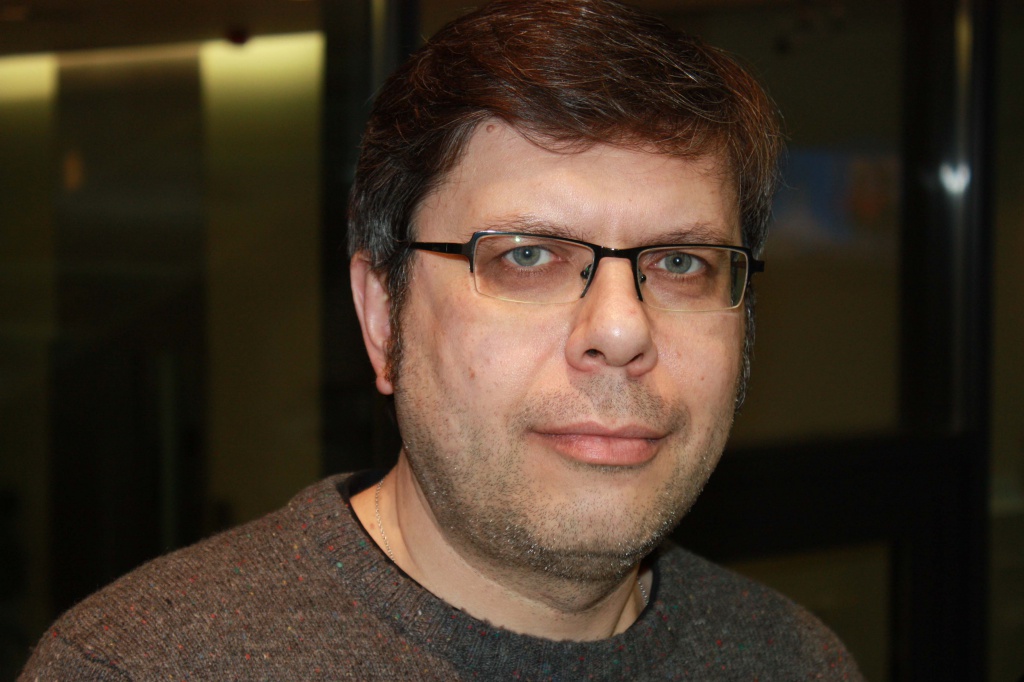
Kirill Kobrin
Kirill Kobrin

The Intelligentsia and Racism
Kirill Kobrin
October 23, 2015
Current Time

Nationalism was born two hundred years ago. At first, it was the theoretical labor of the early Romantics, poets, folklore compilers, and forgers of nonexistent ancient epics of their own peoples. Only then was it put into practice: amidst the gun and cannon smoke of the Napoleonic epic, in the secret Carbonari societies, on the revolutionary barricades.

In the late nineteenth century, nationalism generated several new nation-states. They became more numerous after 1918, not to mention the post-1945 period.

The process of carving countries up according to ethnicity continued even after 1991. The further disintegration of big countries into small countries, and small countries into tiny countries, was just barely avoided. And yet, until recently it was thought that nationalism in today’s Europe was the bailiwick of football hooligans and political outsiders. However, as recent events have shown, many, many people think in terms of “blood and soil.”

It has transpired that there is no vaccine against nationalism and even racism not only for so-called ordinary people. Wordsmiths, intellectuals, and even liberals chronically suffer from them as well. Russian liberals have proven especially vulnerable, or rather, members of the educated class who consider themselves liberals. We are not engaged in political analysis in this column, but we will look at the ethnic mindset of current Russian liberals as a historic phenomenon.

Russian intervention in the Syrian civil war has excited many people dissatisfied with the Putin regime, even those who resisted the Crimean temptation. For example, one well-known Internet figure, who has somehow passed for a political expert, shook the air with bloodthirsty calls to kill as many Syrians as possible, since they are Arabs and, therefore, enemies.

Whoever bombs Syria today, I very much welcome it, and if it is wiped off the face of the earth I won’t be the least bit disappointed. I will only say thank you.
—Anton Nossik

Many have voiced a slightly more restrained variation on this viewpoint, and one progressive media outlet has published an article that discusses, in particular, the indisputable superiority of Jewish men over Arab men in the sense of devotion to their families and courage. In connection with the influx of Syrian refugees, concern for the purity of European is voiced. The article in question is permeated with hidden and flagrant sexual motifs. The subtitle refers to “Raped Europe,” and in the opening paragraphs the author complains it is unfair that “girls love” starry-eyed defenders of refugees rather than defenders of European values.

Fear and loathing towards an alien tribe (the authors of such texts usually do not distinguish Arabs from Kurds, Kurds from Turks, and so on) and an alien religion, Islam (whose sense and essence they are too lazy to understand) have reached a fever pitch. Like all hysterics, Russian “racialist liberals” have been winding themselves up, and the noise level has been steadily increasing.

We are faced with a typical nineteenth-century and early twentieth-century mindset. Take, for example, the motif of the “raped motherland” (or “native culture”). Motherland and Fatherland had become a “mother” back with the Romantics, and later, Alexander Blok, a Late Romantic congenial to proto-fascist views, even proclaimed Russia his wife.

Oh, my Russia! My wife! Painfully / Clear to us is the long road!
—Alexander Blok

In this scheme of things, any outsider is seen as a threat to the mother’s purity, to her sexual serenity. But war and other hostile (or seemingly hostile) actions are attempted rape. Curiously, the identification also works in reverse. An ordinary woman belonging to “our” people is treated as the Mother, the symbol of the nation.

The further we go into the twentieth century, the clearer the purely ethnic and biological features in the countenance of the Woman/Mother become. She is sexually threatened by telltale-looking strangers: Nazi anti-Semitic propaganda was chockablock with depictions of handsome blonde beauties harassed by swarthy apelike creatures.

For current Russian liberals, the role of the Mother threatened by violence is now played by the whole of Europe. It is strange that these folks so rarely invoke the mythological motif of the rape of Europa, in which the maiden Europa is abducted by Zeus in the shape of a bull, who spirits her away—across the Mediterranean!—to Crete, where has his way with her. The discussions of the newfangled national-liberals about the “rape of Europe” naively retell the myth in the most unpretentious racist manner. The “rapist,” “alien” or “suspicious Muslim” crosses the Mediterranean and, once in Europe, rapes her, meaning he bends her to his will. Just imagine that not so long it was said that classic Freudianism and Jungianism were half-forgotten things of the past. But now it turns out that all these things (combined with Social Darwinism and racial theory about the “inferiority” of certain nations) are alive and dominant in the minds of people, moreover, the minds of people whose job it is to reflect on things and generate meaning.

You can, of course, seek out the historical parallels, for example, the steady rightward drift of the liberal segment of the first Russian emigration or the fascist sympathies of such champions of freedom and justice as G.K. Chesterton. But all historical analogies obscure the essence of the matter. And the essence of the matter is this. Suffocating nationalism, moreover, on both sides of the current Putinist divide, is the principal legacy of seventy years of Soviet rule. While preaching internationalism, the communist ideology and the communist regime were weaker than the primitive xenophobia and fear of outsiders that permeated the minds of the Soviet intelligentsia. The collapse of ideology has brought these sentiments to the fore. Aside from everything else, another thing has become clear. The Russian intelligentsia, which considers itself liberal, knows no more about the world than their predecessors from some Turgenev novel.

By the way, have you heard there was a decisive battle on the Danube? Three hundred Turkish officers killed, Silistra has been taken, and Serbia has declared its independence. Don’t you think that you, as a patriot, should be thrilled? As for me, my Slavic blood is just boiling! However, I advise you to be more cautious. I am sure you are being watched. The spying here is horrible! Yesterday, a suspicious person came up to me and asked whether I was Russian. I told him I was Danish.
—Ivan Turgenev, On the Eve

Everything was clear then: we were fighting for our “fellow Slavs” and wishing death on the “bloodthirsty Muslims.” The only difference is that today the names of the people we should be protecting from the villains are very different. We are witnessing a cynical pathetic remake of the novel On the Eve.

Kirill Kobrin is a writer, historian, journalist, and editor living in London.

The texts by Boris Akunin, Yegor Osipov, and Kirill Kobrin were translated by the Russian Reader.

Why Such Hatred? (The Death of Umarali Nazarov)

Откуда такая ненависть?
Why Such Hatred?
Nina Petlyanova
October 22, 2015
Novaya Gazeta Saint Petersburg

The parents of a dead five-month-old child from Tajikistan do not understand

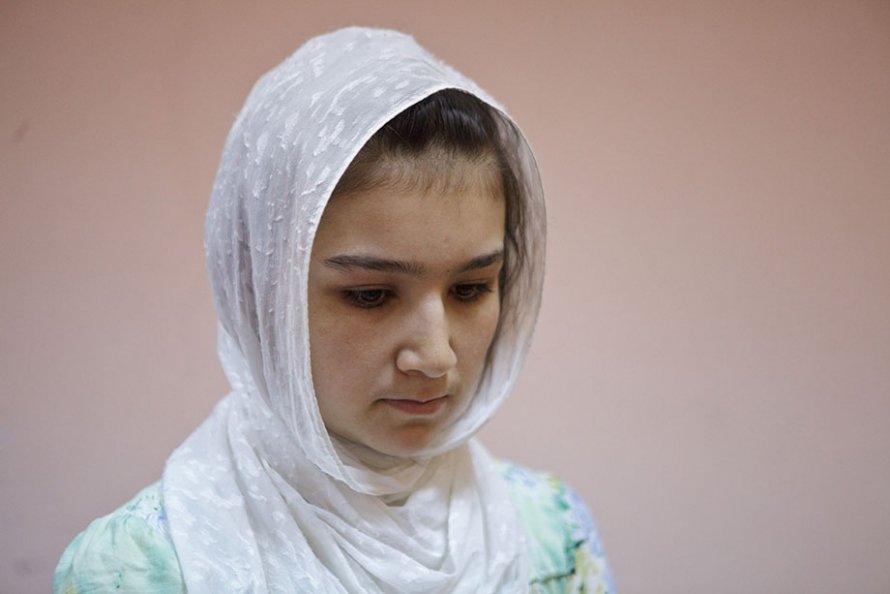
When a Tajik family was in the process of being expelled from Petersburg, their baby son was taken from its mother. Umarali Nazarov (born May 20, 2015) spent almost five hours at a police station [on October 13, 2015]. He was in the hands of strangers, and deprived of food and warm clothes. No one was allowed to dress or feed the baby. He screamed and cried. The baby was then taken to hospital, where he died the same night. The causes of death are still unknown. The Investigative Committee opened a criminal case only a week later.

Federal Migration Service (FMS) employees, police officers, and doctors are suspected of “negligent homicide owing to the improper discharge by a person of his professional duties.” However, neither the boy’s parents nor members of the Petersburg Tajik diaspora believe the guilty parties will be found and punished. Moreover, Umar’s father and mother, Rustam Nazarov and Zarina Yunusova, are themselves currently under suspicion. Police have carried out searches at the flat where they live. The authorities are now attempting to prosecute the couple for allegedly failing to discharge the duties of bringing up a minor.”

Federal Children’s Ombudsman Pavel Astakhov, Petersburg Governor Georgy Poltavchenko, and the Tajikistan Embassy in Russia have promised to monitor the investigation.

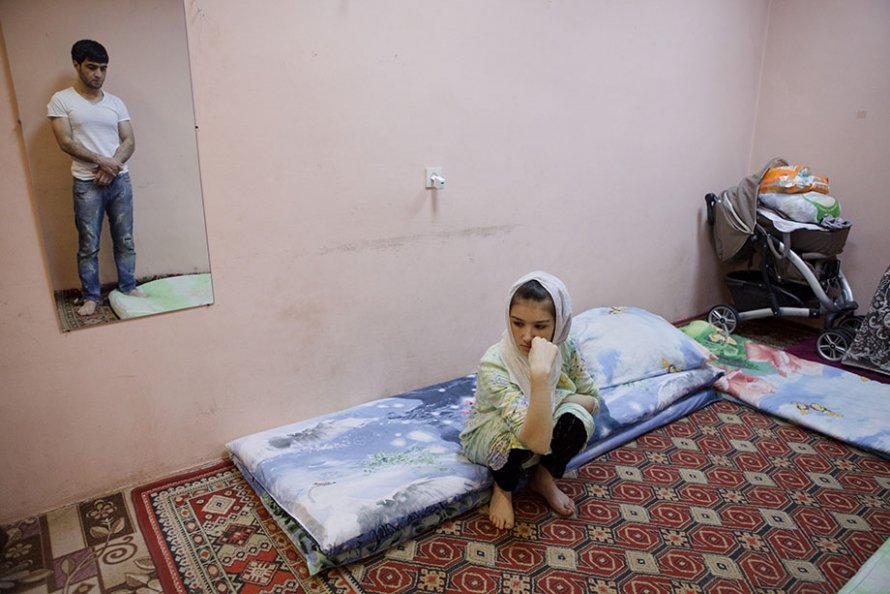
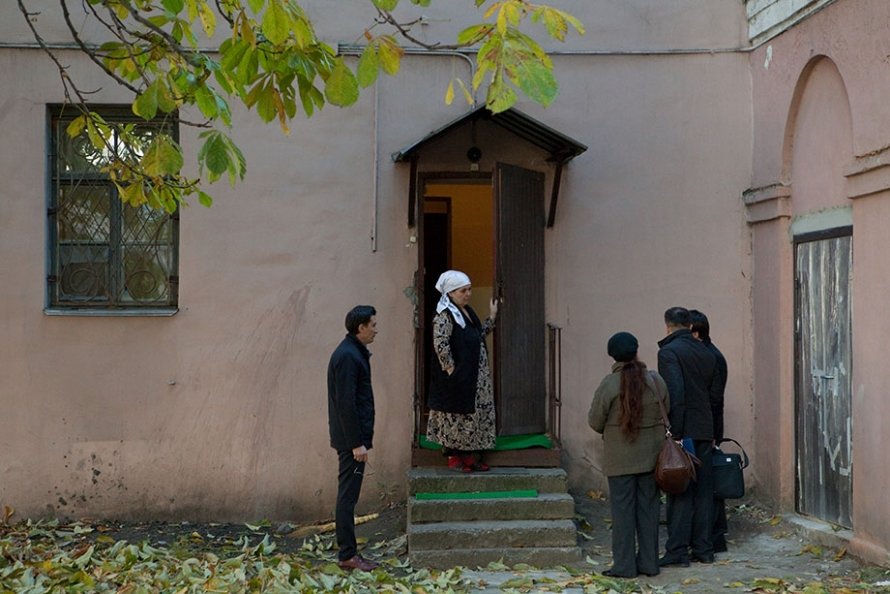
FMS officers raided the flat rented by the Nazarovs at Lermontov Prospect, 5, at around ten in the morning on October 13. The head of the family, Mehriniso Nazarova, the mother of five children (ranging in age from seven to twenty-seven), had already accompanied her youngest son, a first former, to school and had gone to work: she washes dishes at a café near the house. Nazarova’s 17-year-old son Daler and 21-year-old daughter-in-law Zarina were at the flat with Umar. Zarina’s husband, 25-year-old Rustam Nazarov, works at a construction site and was also not nearby when the FMS paid its visit.

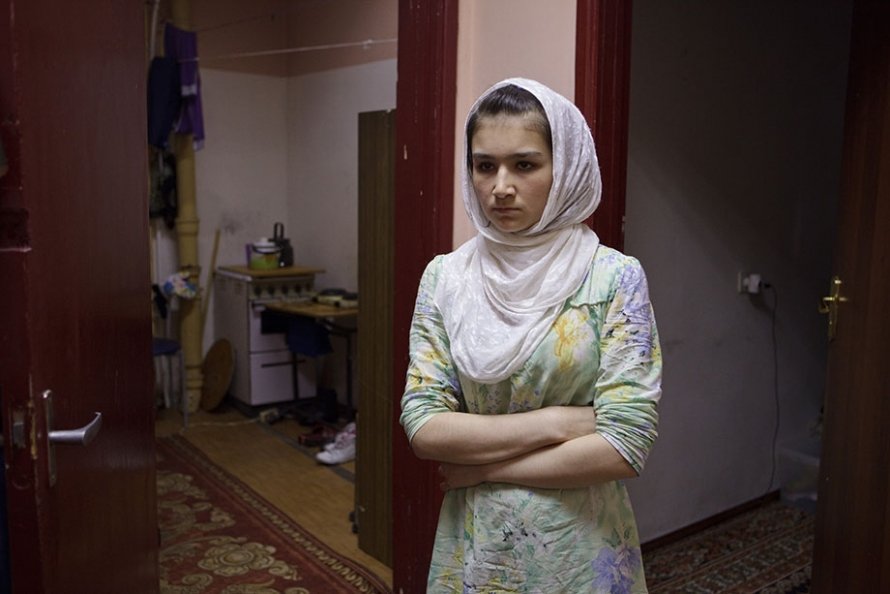
Zarina Yunusova

Zarina does not speak Russian at all. Her account of what happened is translated by her mother-in-law.

“Three unknown men burst into the flat. They grabbed Daler, Zarina, and the baby. Although Daler is a minor,” Mehriniso adds, “and they had no right to touch him. They were all taken to a police station. They were not even allowed to dress Umar: he was taken as he was, in a blue woolen unitard. They didn’t even let them put a hat on him.”

“Around 10:30 a.m., I got a call from Daler,” continues Nazarova. “He said they were at Police Precinct No. 1. I hurried there, grabbing a bottle of milk formula for the baby at home on the way there. I was at the police station around twelve. I went up to the on-duty window, and they kicked me out into the hall. I could hear Umar screaming. The child was screaming and crying the whole time at the precinct. I begged and pleaded to feed him. The formula was still warm. An on-duty officer took the bottle from me and put it in the window. I was crying and saying, “He is tiny and hungry.’ ‘I could care less,’ the policeman replied. There was a young woman there, a senior lieutenant: I begged her. No one fed the child.  They mocked and laughed at me: ‘We don’t understand you; we need a translator.’ They called me a wog [chernozhopaya] and said, ‘Wogs have no rights.'”

Around 2:30 p.m., according to Nazarova, an ambulance arrived at the police station, and the police handed the baby over to medics.

“I was scared,” says Nazarova. “I asked the doctors what was a happening with my baby. Had he fallen ill? He had never been ill. Just the day before, he had been healthy. I begged them to hand over my boy or take me along! But two women in white jackets pushed me away, got into the vehicle, and drove away.”

“Come tomorrow”
Zarina and Daler were delivered to court around 3 p.m. They were tried by 9 p.m. Each was fined 5,000 rubles and ordered to leave Russia in fifteen days.

As soon as they left the court, the Nazarovs rushed to the police station to find out where the child was. They were told he was at Tsimbalin Children’s Hospital and to pick him up the next day. The parents did not accept this and said they were coming right away.

“It’s already late, they won’t let you in,” the police objected.

The Nazarovs called the hospital and were told the same thing: “Come tomorrow.”

Rustam Nazarova and Zarina Yunusova

“Around 8 a.m., Mom took my youngest brother, a first former, to school,” says Rustam Nazarov. “We called a taxi to go to the hospital and pick up Umar. But right then we got a telephone call: ‘You need not come: your son has died.'”

The family was at the hospital within half an hour. But they were too late: the baby had already been transported to the morgue. Nazarov went there. At the morgue, however, he was not shown the child. Nazarov began going to the morgue every day.  It was only on the fourth day, after the autopsy, that he was able to take a look at his son.

“I didn’t even recognize him,” admits Nazarov.

Routine and lawful
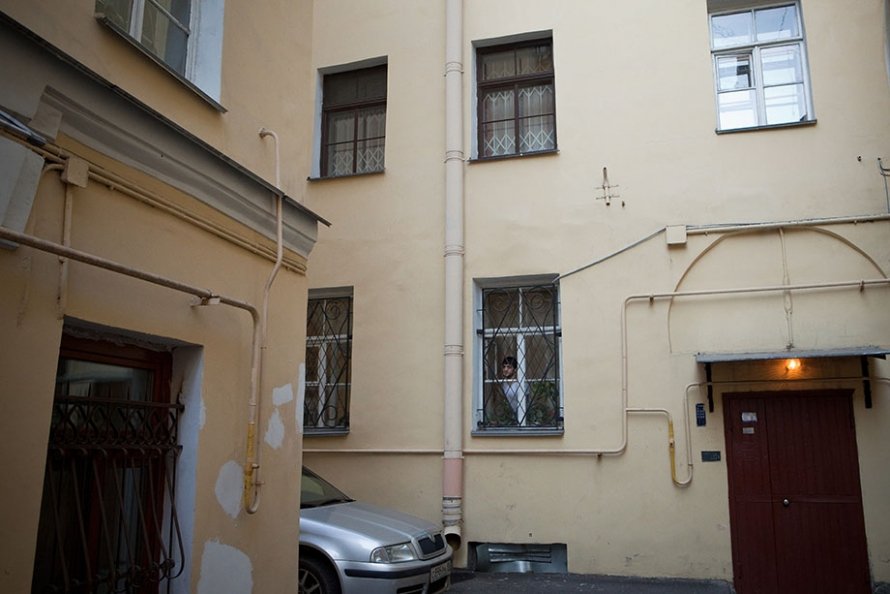
As the FMS Petersburg and Leningrad Region Office explained to Novaya Gazeta, the raid had been routine. At the request of the district administration, several addresses were checked that day.  District officials had informed the FMS about the Nazarovs. The illegal immigrants were living, allegedly, in a resettled house with no water or electricity.

Rustam Nazarov looks out the window of the ostensibly resettled house at Lermontov Prospect, 5

Novaya Gazeta‘s correspondents spent half a day in the two-room flat the Nazarovs rent for 25,000 rubles [approx. 360 euros] a month. The place has water and electricity, and is so warm that all the vent panes in the windows are opened. We saw offices on the first floor of the building, and quite habitable flats on the upper floors.

“The citizen of Tajikistan discovered at Lermonotov, 5, could not explain her relationship to the child, so he was also taken to the police station,” Darya Kazankova, press secretary for the FMS Petersburg and Leningrad Region Office told Novaya Gazeta. “However, FMS staff do not work with minors and children, so we handed both [Daler and Umar] over to juvenile affairs inspectors and subsequently dealt only with Yunusova.”

Kazankova insists the FMS officers had an interpreter with them. Zarina did not notice any interpreter.

Zarina Yunusova’s papers are really not in order. The young woman arrived in Petersburg from Tajikistan little over a year ago to be treated for infertility. The treatments were successful. The long-awaited Umar was born on May 20, Rustam’s birthday. It was a gift for both the mom and the dad.

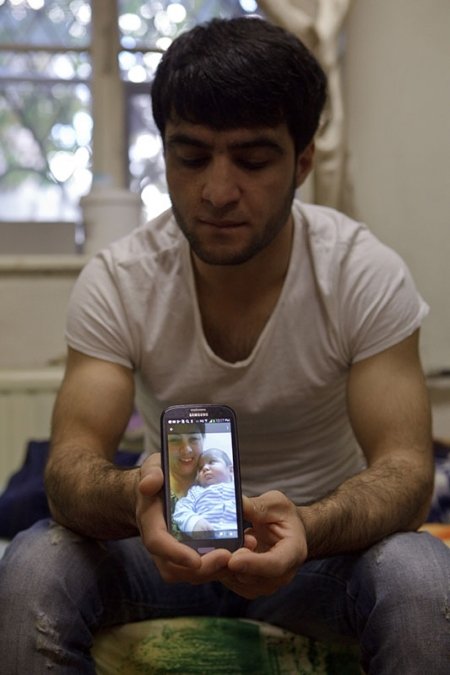
Rustam Nazarov shows a picture of his son on his mobile phone

“According to the law on immigrants [Federal Law No. 115, July 25, 2002], foreign citizens can stay temporarily in Russia without a visa for no longer than ninety days [if they are from countries whose citizens do not require a visa to enter the Russia — RR],” explained Tajik diaspora lawyer Uktam Akhmedov in an interview with Novaya Gazeta. Akhmedov is now defending the Nazarov family in all legal proceedings. “But when the ninety days ran out and legally she should have gone back to Tajikistan, Zarina was pregnant. The doctors did not recommend traveling. Besides, pregnancy is a reasonable excuse for staying. We are going to challenge the court’s decision to expel her,” said Akhmedov.

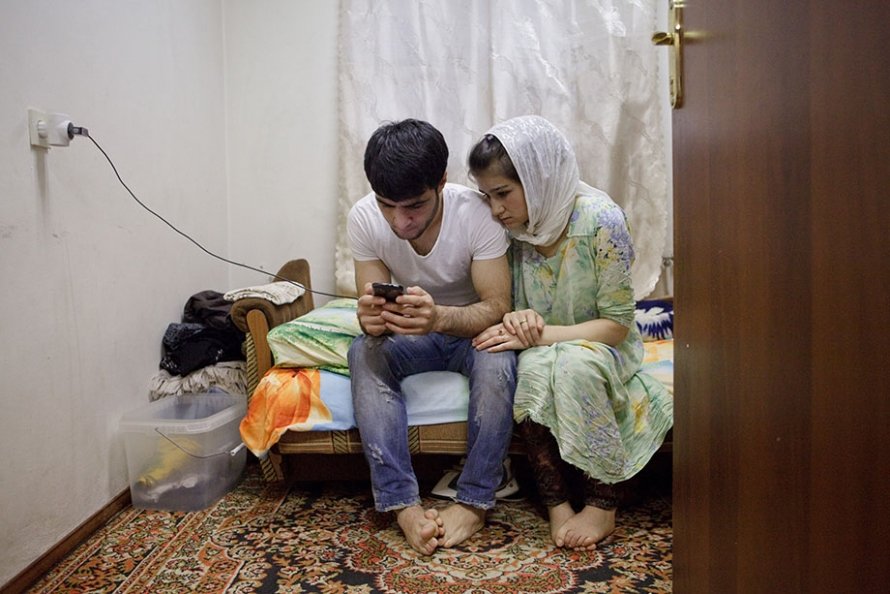
Rustam and Zarina looking at pictures of their son

The case will not be solved soon
The five-month-old child’s death has shocked the Petersburg Tajik diaspora.

“Every day since October 14, between fifty and eighty people have gathered outside Police Precinct No. 1,” Uktam Akhmedov told Novaya Gazeta. “The most massive grassroots gathering happened on October 17 at the Tajikistan Consulate in Petersburg. Around a hundred people came. They demanded justice and punishment for the perpetrators. People were very agitated. We could hardly contain their emotions.”

Assistant Consul Manouchehr Hamzayev came out to address the protesters. He asked them not to engage in provocations and promised to keep them updated.

Umar’s grandmother Mehriniso Nazarova meets workers from the Tajikistan Embassy in Russia

On October 18, the Tajik diaspora sent official appeals to Russian Human Rights Ombudsman Ella Pamfilova and Petersburg Governor Georgy Poltavchenko.

On October 19, Pavel Astakhov reacted to the incident in the Northern Capital. Besides a surprised entry on Twitter (“A five-month-old baby has died suddenly”), he asked the Interior Ministry and the Prosecutor General’s Office to “conduct a thorough investigation of the actions of the FMS and police.”

On October 20, the Petersburg Office of the Investigative Committe’s Central Investigation Department opened a criminal case under Article 109.2 of the Russian Federal Criminal Code (“Negligent homicide owing to the improper discharge by a person of his professional duties”).

“According to the preliminary investigaton, the boy died in the early hours of October 14 from an acute respiratory viral infection,” the Central Investigation Department informed Novaya Gazeta. “But the forensic examination will ultimately establish the cause of death.”

Doctors at Tsimbalin Children’s Hospital, where the city prosecutor’s city has been carrying out an inspection since October 20, declined to comment. According to Novaya Gazeta‘s sources, doctors have explained to investigators that the child had many diagnoses [sic], and in addition, he had been born prematurely.

The parents do not deny this. Umar had been born in the thirty-fourth week with a weight of 2,2000 grams. But he had been steadily growing and gaining weight. By five months he had weighed about eight kilos. The Nazarovs likewise claim the child had regular visits from the district nurse, and had been examined by doctors at a clinic. They had not referred Umar to any specialists: no serious ailments had been detected.

Looking for a bomb in a cradle
On October 21, the day after the criminal case was opened, the Interior Ministry’s Petersburg and Leningrad Region Office took countermeasures.

“Police officers are conducting a preliminary investigation concerning the deceased boy’s parents, in whose actions there is evidence of a crime as stipulated by Article 156 of the Russian Federal Criminal Code (“Failure to discharge the duties of bringing up a minor”),” the regional office of the Investigative Committee’s Central Investigation Department informed Novaya Gazeta.

“Now they come here and do searches nearly every day,” the Nazarov brothers tell us. “Two times they came with dogs. Why? Are they looking for a bomb in the cradle?”

“Why such hatred? Why such hatred?” Rustam repeats like a mantra and waits for a response.

Zarina says nothing and cries.

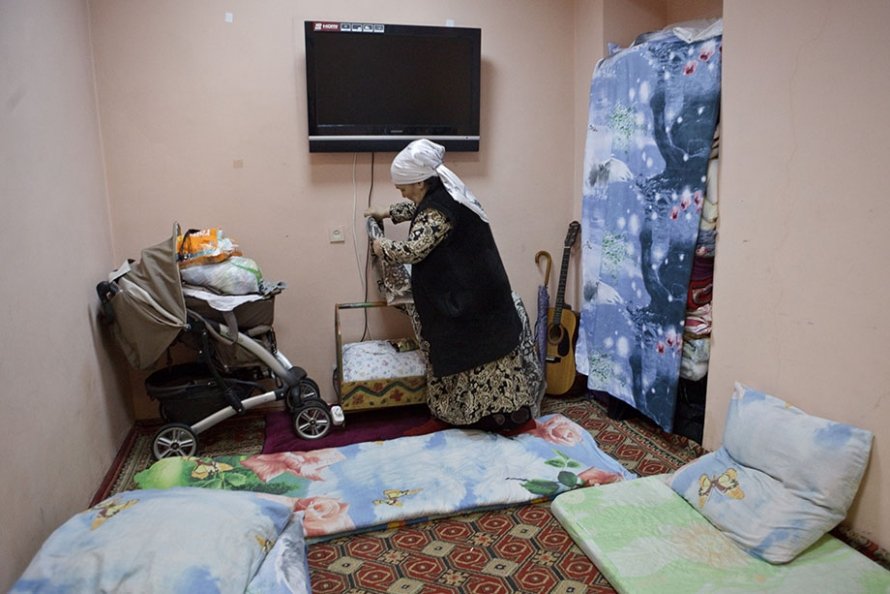
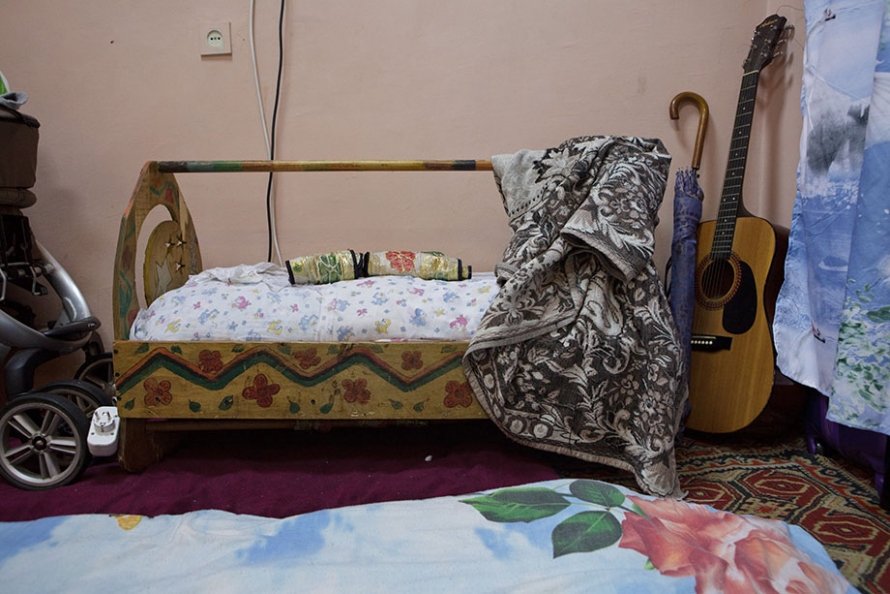
Mehriniso Nazarova next to her grandson Umar’s cradle

Mehriniso is not crying. She is sobbing over the cradle, which Rustam built for his son and which she just cannot bear to remove from the room.

“This city has now taken a second boy from me.”

The Nazarovs have lived in Petersburg for fifteen years. In 2004, persons unknown armed with knives attacked Mehriniso’s 12-year-old-son near their house. He died from stab wounds to the chest and neck. The child’s murder remains unsolved to this day.

Translated by the Russian Reader. Photos by Elena Lukyanova

See also: “Tajikistanis Hold Gathering Outside Consulate in Petersburg over Death of Detained Immigrants’ Son,” Rosbalt, October 17, 2015 (in Russian)

“The Australian Prime Minister Has Done It Again!”

I hate to get down and dirty with you all, but this is what the current prime minister of Australia actually looks like.

2588176-3x2-940x627-640x427

Malcom Turnbull, the actual prime minister of Australia. Photo courtesy of newskaada.com


His name is Malcolm Turnbull, and he is the new leader of the Liberal Party of Australia, which currently governs Australia in coalition with the National Party of Australia.

Mr. Turnbull is new at his job, because he ousted the rather wretched Tony Abbott in what the Australians quaintly call a “leadership spill” less than a week ago.

While I don’t like Mr. Turnbull’s politics for the most part, he will be a real improvement over Mr. Abbott, if only because he is less prone to saying and doing blatantly stupid and awful things. Mr. Turnbull comes across as an intelligent, affable and well-spoken fellow.

But that is beside the point.

I wonder whether events like this ever make the news in Russia, because frighteningly large numbers of Russians think that Kevin Rudd (of the Australian Labor Party) is still the prime minister of Australia.

Or, alternately, they think that John Howard (Liberals) or Julia Gillard (Labor) is the prime minister of Australia.

Basically, for the Russian “grassroots” imaginary, it doesn’t really matter who the prime minister of Austrialia is, because whoever she or he is (or isn’t), the “prime minister of Australia” is a folklore character with a penchant for making outrageously Islamophobic, anti-immigrant, and, now, in a new twist, rabidly pro-Zionist statements such as this:

В отношениях евреев и арабов Израиля, да и всей Палестины в границах мандата Лиги Наций. хозяин страны и земли в этой стране НЕ ТОТ, КТО ПРОЛИЛ БОЛЬШЕ ЧУЖОЙ КРОВИ, А ТОТ, КТО ЕЁ СТРОИЛ, ЗАЩИЩАЛ И ТРУДИЛСЯ ДЛЯ ЕЁ ПРОЦВЕТАНИЯ. Из этого следует что мировой порядок не может определяться голосованием в ООН, созданной коалицией , организовавшей массовое истребление евреев в 1933-1945 годах и пытавшейся завершить это истребление в 1953 году – коалицией из Британии, СССР, США, Германии и Франции Эти государства своими тайными и открытыми действиями на протяжении 1933-1945 годов активно участвовали в истреблении еврейского народа и сумели в лагерях и поездах, в расстрельных рвах сожженных сооружениях методично и организовано уничтожить не менее 12 миллионов беззащитных жертв, избранных по национально-расовому признаку. И они же создали организацию ООН и при ней – UNWRA – НЕ ТОЛЬКО ПРОДОЛЖИТЬ ПОЛИТИКУ ДИСКРИМИНАЦИИ ЕВРЕЙСКОГО НАРОДА, НО И СОЗДАЛИ НОВЫЙ “НАРОД” с единственной задачей – не допустить выполнения решений Лиги Наций о СОЗДАНИИ В ПАЛЕСТИНЕ НАЦИОНАЛЬНОГО ДОМА для еврейского народа,

Историческое тайное решение о ликвидации еврейского народа принимали правительства перечисленных выше государств на конференции в Эвиане и неких тайных совещаниях. . И сегодня, когда над миром, над всей Западной цивилизацией нависла исламская угроза Третьей Мировой войны для Европы и Америки, пора опомниться и присоединиться к Австралии и Японии и остановить самоубийство человечества.

[Source: NewRezume.org]

I won’t even bother to translate this fake crap into English. If you are curious, go to Google Translate and let the smart robots there do the hard work for you.

The forger of the above libel goes on to express his and “the Russian world’s” delight in the “Australian prime minister’s” continuing campaign against Islam:

Премьер-министр Австралии снова сделал это!! Этого человека следует назначить королем мира..[sic] Более правдивых слов никогда не говорили..[sic]

The Australian prime minister has done it again! This man should be appointed king of the world… Truer words were never spoken.

God knows that real Australian prime ministers have done and said a lot of really awful things in their time, although, if actual truth be told, besides being remembered for being a fairly goofy customer himself, Mr. Rudd is also remembered for his apology, in parliament, to Australia’s Indigenous people for the so-called Stolen Generations.

Again, that is not the point. The point is that there are rather vigorous forces in Russian society, both at the top and the grassroots, who are keen on putting the most dire spin on current events while also fostering the illusion that their bleak outlook or their own aggressive, imperialist policy has lots of fans in the outside world.

If you are wondering why Kevin Rudd (or, rather, the “prime minister of Australia”) is such a folk hero on the Russian internets, the simple answer is that not enough Russians speak or read English well enough to be able to sort out hoaxes like this.

In more vegetarian times, this would not have mattered as much, but now the Kremlin has been actively priming the pump with fake news and commentary via its “active operations” on social media.

I hope to be describing another such recent hoax, involving a non-existent Finn named Veikko Kerhonen from Oulu, in the next day or so. Here is a sample of the imperialist Russian screeds this non-existent Finn is into posting, exclusively in Russian!

In the meantime, you can reread my recent, obviously futile attempt to expose the “Australian prime minister” canard.

Nicola Sturgeon, Prime Minister of Australia

Remember the old “Prime Minister of Australia/Muslims Out of Australia” canard that a while back was making the virtual rounds of enfeebled minds duct-taped to the Rusnet and other nets?

Nicola Sturgeon, the pro-Russian, Islamophobic prime minister of Australia. Photo courtesy of The Independent.


That hoax was especially popular among folks who a) did not have the slightest clue about anything Australian, and/or b) did not read English and could not (or, rather, would not) do the elementary double-checking that would have shown the whole “news story” to have been a crude hoax.

Mostly, though, they just wanted to BELIEVE that somewhere out there in the big white world there was someone as Islamophobic, anti-immigrant, and racist as they were, but endowed with real political power to implement or, at least, shamelessly voice his or her racist views. (“Her,” because John Howard, Kevin Rudd AND Julia Gillard took it in turns as the particular “Australian prime minister” attached to this Islamophobic libel as they succeeded each other in Canberra.)

I will not be the first person to point out that the current refugee crisis has been a field day for racists, xenophobes, twilight-of-Europeanists, and other factually challenged folks in Risen from Its Knees (among other places). This new moral panic has been fueled both from the top and the grassroots.

As with the classic “Australian PM/Muslims Out” viral canard, many of the “facts” and “news items” traded like playing cards among the Russian grassroots via social media have been spun from whole cloth, to wit:

Голос России
September 9
Шотландия сделала громкое заявление по России: у Евросоюза нет другого выхода, миграционная ситуация на пределе. Глава правительства Шотландии Никола Стерджен выступила с заявлением о необходимости привлечения Российской Федерации к разрешению миграционного кризиса в Европе.

Voice of Russia
September 9
Scotland has made a sensational statement concerning Russia: the EU has no choice, the migration situation is at the breaking point. Head of the Scottish government Nicola Sturgeon made a statement on the need to involve the Russian Federation in resolving the migration crisis in Europe.

Try and find any corroboration of Scottish First Minister Sturgeon’s “statement” about the need for Russian involvement in the fact-based world.

All I could find that was remotely related was this item in The Guardian, about Sturgeon’s alleged willingness to welcome Syrian refugees into her own home.

There is no mention of Russia in this article, of course.

Now a comrade has just informed me that the “Australia PM” canard was cited on Rossiya 1’s Special Correspondent TV program last night as if it were a real, historical, factual, true fact. (The reference is made by the notorious Natalia Narochitskaya between the six- and seven-minute mark of the program.)

This is not very surprising, sadly. It is a perfect illustration of how the Russian mainstream media have pushed off into a parallel universe of their own devising with lots of encouragement, alas, from large swathes of the country’s grassroots. [TRR]

“American Ambassador”

Ilya Yashin
September 10, 2015
Facebook

Today I was having another meeting [with voters] in a residential courtyard in Kostroma. A few old women sat on a bench, while journalists stood on the sidelines.

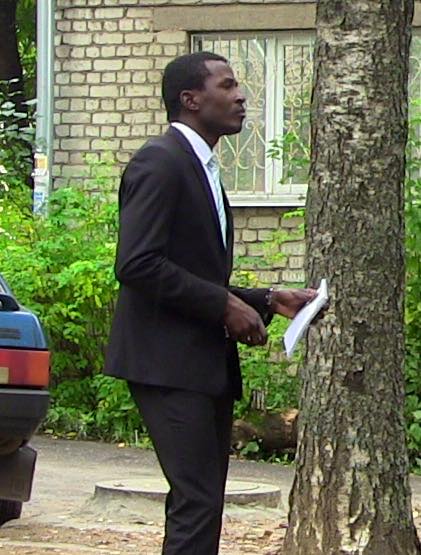
Suddenly, a car with red diplomatic license plates drove into the yard. A black man in a suit got out of the car and said, in broken Russian, “Hello, I represent the American ambassador.”

yashin-1

Everyone was struck dumb.

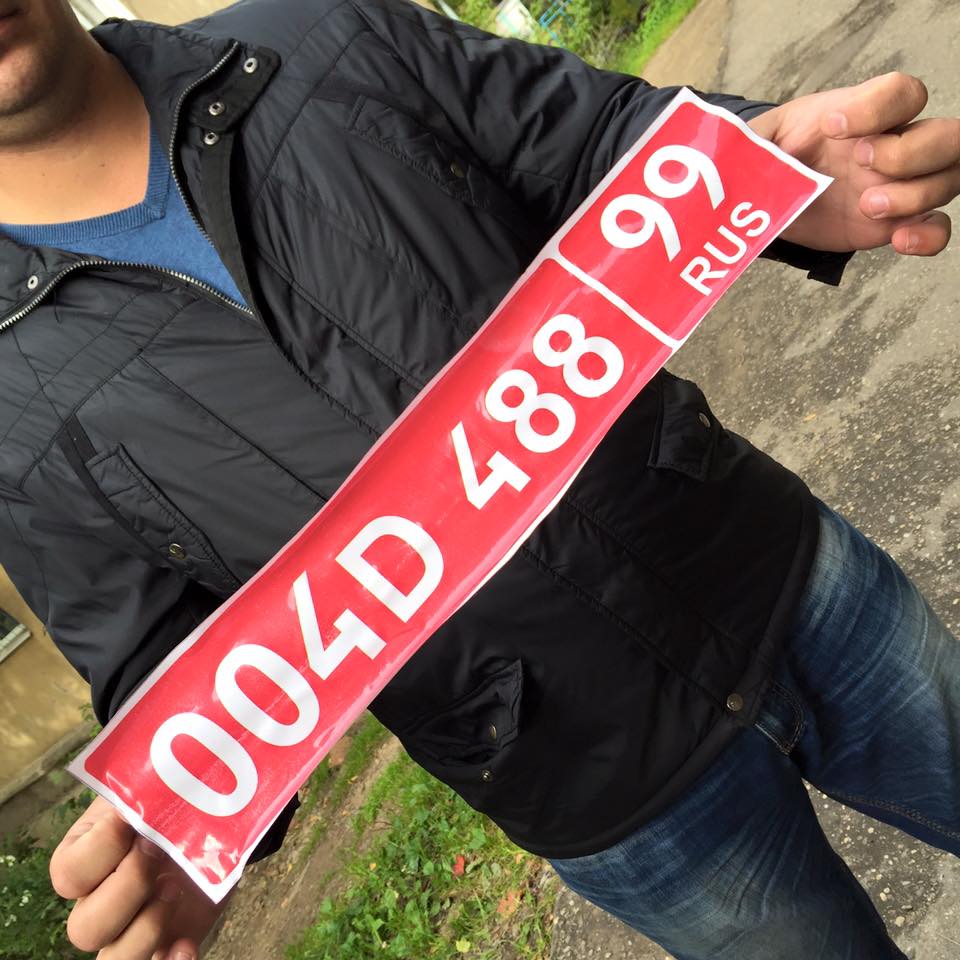
The first to get his bearings was Andrei, who went up to the car and neatly tore  off the “diplomatic license plate.” It was a sticker that had been pasted over the real license plate (which was Russian, of course).

yashin-2

By the way, driving with fake license plates is a crime.

The fake “diplomat” took cover in the car and drove off.

You can reach your own conclusion about the methods of our opponents from United Russia.

Ilya Yashin is a well-known liberal politician running for the regional parliament in Kostroma on the Democrat Coalition ticket. Thanks to Comrade SC for the heads-up. Translated by the Russian Reader

Germany Going Down the Tubes, or, Lies Come in All Sizes

Greg Yudin
September 2, 2015
Facebook

Excellent, just excellent. I look and see that Ulyana Skoibeda has published a diary about how terrible life is in Germany [in the mass circulation newspaper Komsomolskaya Pravda]. I think, what is this crap? What would Skoibeda know about Germany? I have a look: the entire structure of their propaganda and the stuff of which it is made are visible after three paragraphs.

b_2a67b16725839005f2a25b51ebfa9bb8
Ulyana Skoibeda (center) and friends

The diary’s author is a certain Galina Ivanova, who moved to Germany but is now escaping it in horror at the influx of immigrants and the inaction of Germans. Since the text is executed in the “eyewitness” genre, it has immediately become wildly popular. To drive the point home, Skoibeda has supplied the diary entries with “links to major German media and speeches by officials.” She is thus hinting that every piece of evidence of Europe’s disintegration is backed up with a reference in perfect German. This is not the story of the three-year-old boy, allegedly crucified in Slovyansk by Ukrainian soldiers, but since proven a fake, she seems to say. You won’t nitpick this one to death.

What is great is that if you follow these links and start reading, you will find that almost all of them are total lies. And the lies come in all sizes. Some of the links lead to off-topic stuff like poverty statistics. Or, for example, the diary’s author angrily reports that Muslims have been abusing Germans to such an extent that “in many school cafeterias, pork sausages, salami, and pâté have been banned.” The link leads to a story about a crazy Egyptian family who asked a court to ban pork dishes. This happened in Vienna (which, for Skoibeda’s information, is in Austria) and was laughed off by the local legal community. But does it really take much to scare Russian readers?

Or, for example, there is a tear-jerking story about German pensioners having to dig in trash urns to collect empty bottles. The link is to an item in Die Republikaner in which there is not a single (!) mention of pensioners. The item itself is about how a society in which people are forced to collect bottles (by the way, have you never seen such a society outside of Germany?) should deal with this rather than facilitating the collection of bottles.

And then there is the top of this pop chart, which, of course, consists in the fact that the majority of the links in the text (including the links to newspapers, officials, and various sensational news items) in fact lead to one and the same site, Netzplanet, a collective right-wing blog that went online two years ago. The bloggers there complain about immigrants and scare each other over Islamization. Their Facebook page has already been blocked because its owners were not willing to provide the necessary information about themselves. The site itself is registered to a company in Panama. I won’t go on.

No “Galina Ivanova” really exists, of course. (In any case, it wasn’t she who wrote this text, unless Galina Ivanova is Skoibeda’s real name.) Because at any newspaper, even this one, there are fact checkers, and if Skoibeda really had been sent a “diary with links,” she would have found people with a knowledge of German and verified the information.

But the miserable PR people and degenerates from the security service who were given the task of collecting facts about problems with immigrants in Germany do exist. And they blew it. And now Skoibeda’s byline is attached to an article with a thousand proofs that she lies.

I always recommend the first thing university students do is learn foreign languages. Because you are surrounded by tons of people who intend to mess with your brains, and your own government is engaged in this above all. It is not the gullible who are most easily manipulated, but those who don’t know how to check things. Languages are the best chance of navigating the world on one’s own. It is impossible to know all languages, but if you know one foreign language, and your friend knows another one, the government will find it much harder to put one over on you. That is exactly why our MPs are so keen to ban the study of foreign languages in schools. Then Skoibeda will be able to tell readers that people with dogs’ heads inhabit Europe.

Greg Yudin is a research fellow and lecturer at The Higher School of Economics in Moscow. Photo courtesy of Trud.ru. Translated by The Russian Reader

China Friendly, Part Two: “There Are Lots of Them, and a Few of Us”

Russian literature is often credited with a rich tradition of satire, parody, and absurdism, a tradition associated with writers otherwise as different as Gogol, Dostoevsky, Saltykov-Shchedrin, Chekhov, Bulgakov, Kharms, Ilf and Petrov, and Zoshchenko. But this is a misconception. All these writers were stone-cold realists. You only have to live in Russia for a time and know the language well enough to realize they did not make anything up. They just had to turn on their tape recorders, so to speak. As reporter Elena Rotkevich did for the following article.

There is also no little irony in the fact that this article was going to press just as reports had begun coming in that the almighty Chinese economy was going pear-shaped. Although that now-dubious omnipotence seems to have been achieved at a totally unacceptable cost.

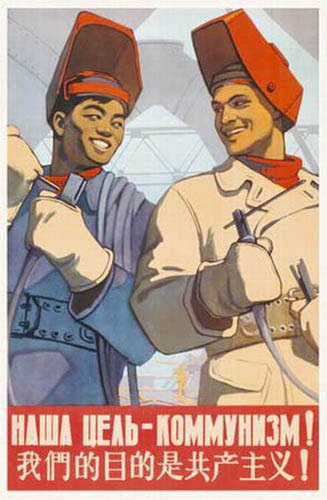
“Our goal is communism!”

___________

“The Hermitage is not particularly interesting to the Chinese”
Elena Rotkevich
July 6, 2015
Gorod 812

Red itineraries will be popular if they are pitched properly to tourists from the PRC. Tourist guide and interpreter Ekaterina Guseva shared her impressions of working with Chinese groups.

Are the Chinese really interested in Lenin?

I think the Chinese will find tours to Lenin and revolutionary sites interesting, especially the fifty-something generation. It is this generation that mainly comes to Russia, because they studied our history and know our literature and culture fairly well. The Chinese were raised on stories about the Soviet Union. It was Big Brother who helped them. They call us a great or militant nation, and they are very curious about how this great nation is faring right now. Do we still sing “Katyusha”? Do we respect Lenin? They often ask whether life under communism was good and whether we miss the communist regime.

They are very interested in domestic details: what our daily schedule is like, whether we eat black bread, how many benefits we have, whether there is still free medical care, whether apartments are provided for free. The questions are not always easy.

And what do you say to them?

We try and reflect the real facts when we answer them. For example, that apartments were distributed for free in the Soviet Union, but some people miss those times, while others don’t.

The most popular sight in Petersburg among the Chinese was the cruiser Aurora, but now, unfortunately, it is undergoing restoration. The main museums—the Hermitage, Peterhof—are not particularly interesting to them. They don’t like boring, highly detailed tours, for example, when the kinds of woods used in the unique parquet floor in the Throne Room are listed. They like something a little more fun.

Touring Lenin sites is not a bad idea. At present, they are not taken to Lenin museums. We only drive up to the Smolny, but we don’t go inside. The demand for red tours will hinge on the right advertising campaign and cooperation with Chinese tour agencies. We could combine Petersburg with Finland and Sweden: with the right revolutionary commentary, Scandinavia will also be popular. The main thing is pitching the material.

Have the numbers of Chinese tourists increased?

This year we had a 300% increase in the flow of tourists from China. We lack licensed Russian tour guides. We have gone public about the problem on more than one occasion since the deficit is made up for by illegals. Semi-legal Chinese tourist firms operating in Petersburg hire similarly illegal Chinese immigrants as tour guides. Someone lends them a young [Russian] woman licensed to lead tours in English or Spanish, and under the guise of this young woman, they show groups around the city. These illegals badly mangle our history, and they distort the characteristics of Russians and Russian culture. I myself once saw a female Chinese tour guide on the grand staircase [in the Catherine Palace] at Pushkin make a sweeping gesture with her hand, pointing to everything in the vicinity, and heard her say to her group, “The Russians stole everything you see here. They went everywhere with warriors, tried to conquer everybody, and stole and stole wherever they went.” We are trying to combat this, but there are lots of them, and a few of us.

Isn’t it time to do the signage on the streets, in the subway, and in museums in Chinese?

In terms of quantity, Chinese tourists outnumber all other foreign tourists, of course. But Chinese tourism is usually group tourism. Quite often they have a group visa, which theoretically does not imply they will be navigating the city independently. They don’t walk the streets or ride the subway on their own, only with a guide. So there is probably no need for this.

Is it hard to work with the Chinese?

It is a lot more pleasant to work with Chinese tourists than with Americans, for example, or Canadians because from the get-go they have a more positive attitude toward Russia and Russians. They buy the same souvenirs as everyone else: matryoshka dolls and scarves. And they love amber.

Translated by the Russian Reader. This article was published on page 19 of the July 6, 2015, print edition of Gorod 812. So far, it has not been published in the magazine’s online edition. This post is a sequel of sorts to a collage of translated material on Russia’s “Chinese turn,” published here last autumn.

Happy Russia Day!

At three-thirty this afternoon I was awoken from a well-deserved nap by an incoming SMS on my cellphone, which read:

Уважаемый Клиент, поздравляем Вас с Днём России – праздником свободы, мира, равноправия и справедливости! Искренне желаем Вам и Вашим близким душевного тепла, достатка, счастливой, долгой и благополучной жизни! С праздником, Ваш “Билайн”

I.e.,

Dear Customer, we congratulate you on Russia Day, a holiday of freedom, peace, equality, and justice! We sincerely wish you and your family warmth, prosperity, and a long, happy, safe life! Congratulations, Your Beeline

Aside from irritating the drowsy me to no end, the SMS inadvertently reminded me of an article I had read earlier in the day on the topic of equality in Russia.

One in six Russians lives below the poverty line
June 11, 2015
ru.euronews.com

The numbers of Russians whose income is below the subsistence level increased by 3.1 million people in the first quarter of this year, up to 22.9 million. These figures have been published by Rosstat. The poverty rate rose to 15.9%, meaning that every sixth Russian falls into this category.

From January to March, the average subsistence level reached 9,662 rubles [approx. 155 euros] per person per month (a year ago it was 7,688 rubles). But inflation has also surged, which has been an especially painful blow to the poor.

The embargo on food imports from Europe and the United States, [introduced] in August 2014, fueled an inflation of food prices, and the 200% drop in the ruble’s value at year’s end drove up the prices of imported goods. As a result, by the end of the first quarter, the annual inflation rate in Russia had reached a thirteen-year maximum, 16.9%, according to Rosstat. By May, the figure had dropped slightly to 15.8%.

The statistics agency blames the increase in poverty on inflation. Average per capita monthly income, now at 25,210 rubles [approx. 400 euros per month], seems to have increased compared with the first quarter of 2015 by 11%, but fell by a quarter compared with the fourth quarter of last year.

Do you wonder how many Russians 15.9% is? The hipsters at The Village told their readers the answer yesterday evening as the latter were gearing up for the long holiday weekend: 22,900,000.

But how many people live in Russia?

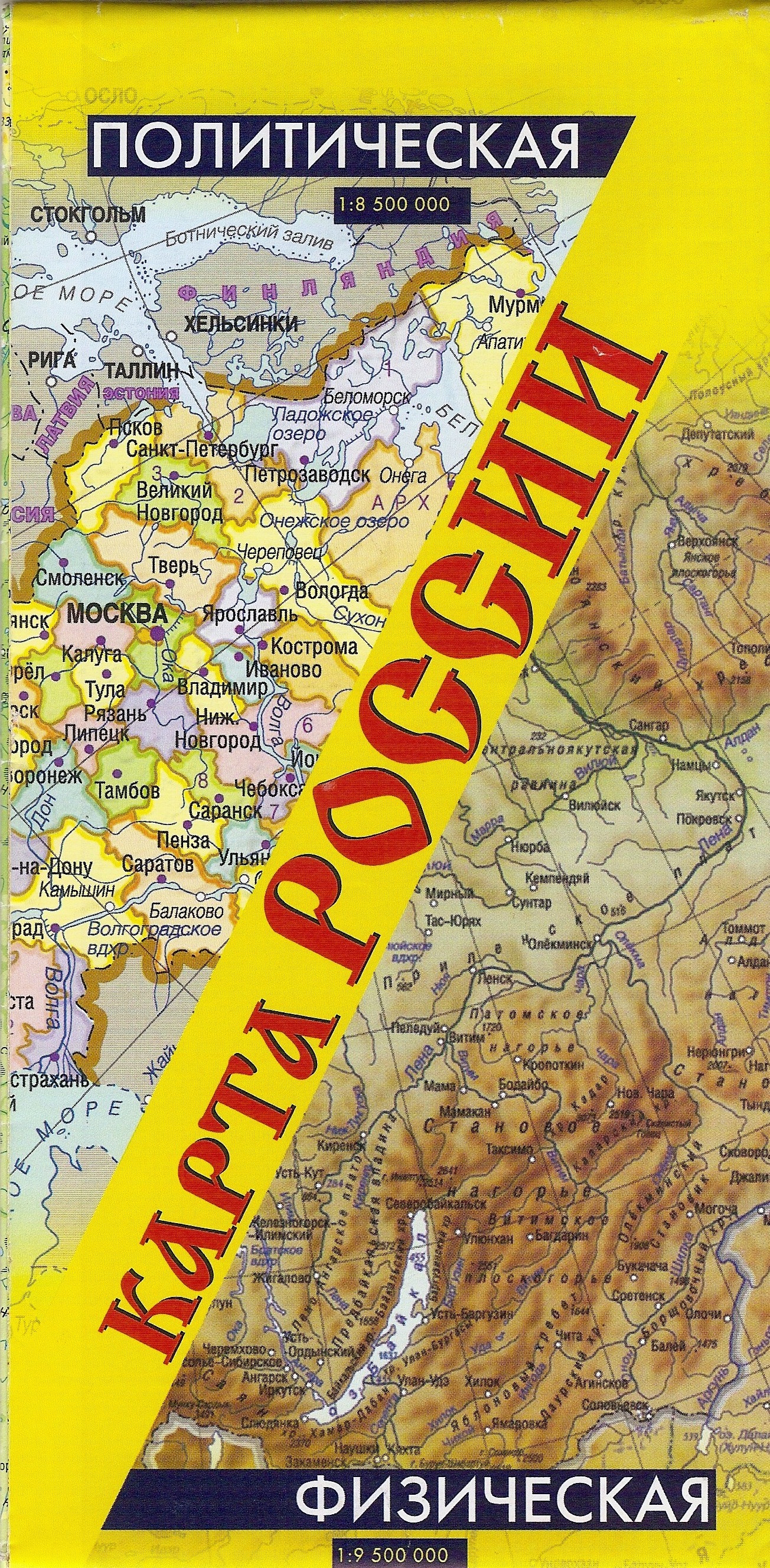
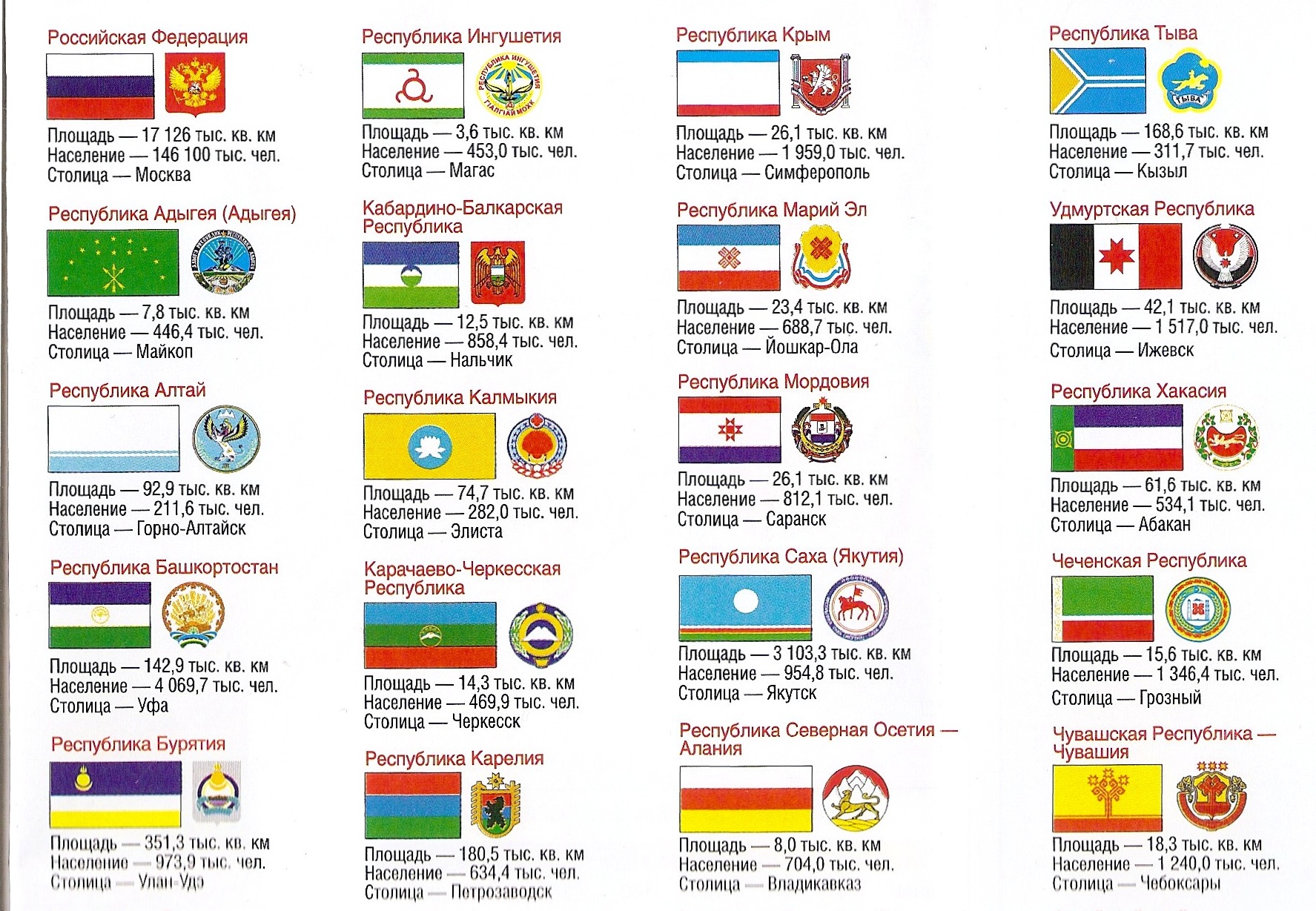
According to the handy Political and Physical Map of Russia, published by AST Publishers in February 2015, which I recently picked up at my local French-owned hypermarket, the Russian Federation’s population stands at a healthy 146,100,000, now, apparently, that is, that the Republic of Crimea’s nearly two million former wayfarers have returned to home port.

map 1

map 3map 5

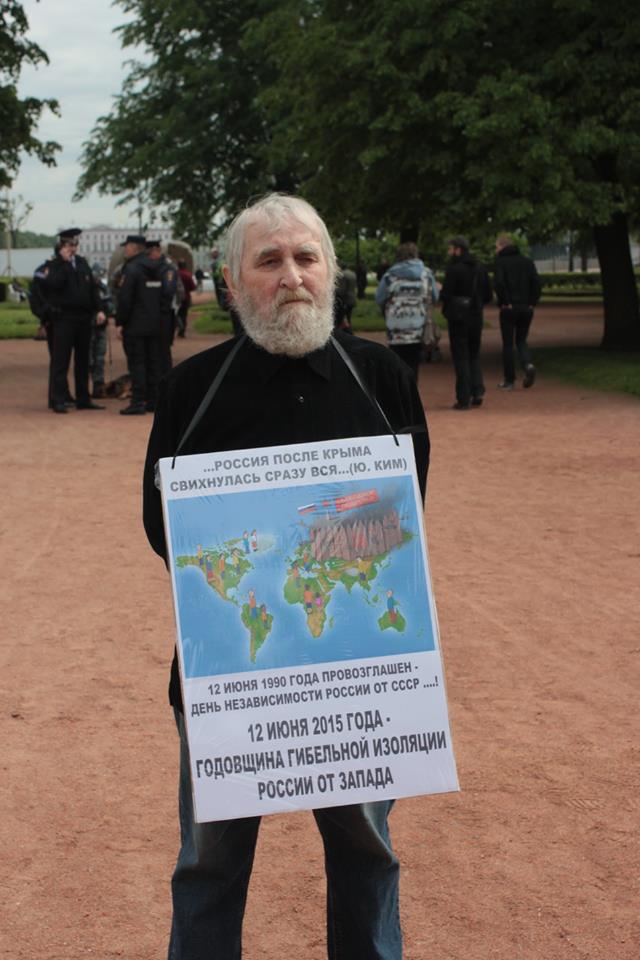
But there are a handful of malcontents who bristle at this new method of fighting poverty by annexing the territory and populations of other countries. One of them is  a stalwart of the Petersburg protest scene, Igor “Stepanych” Andreyev, who showed up to a “prayer for deliverance of the Fatherland from the oppression of lawless men in power” this afternoon, at the city’s Solovetsky Stone, sporting a provocative but veritable downer of a placard.

stepanych-2

Russia immediately went mad after [the annexation of] Crimea (Yuly Kim). On June 12, 1990, Russia’s day of independence from the USSR was proclaimed! June 12, 2015, is the anniversary of Russia’s destructive isolation from the West.

Source: Facebook (Vadim F. Lurie)

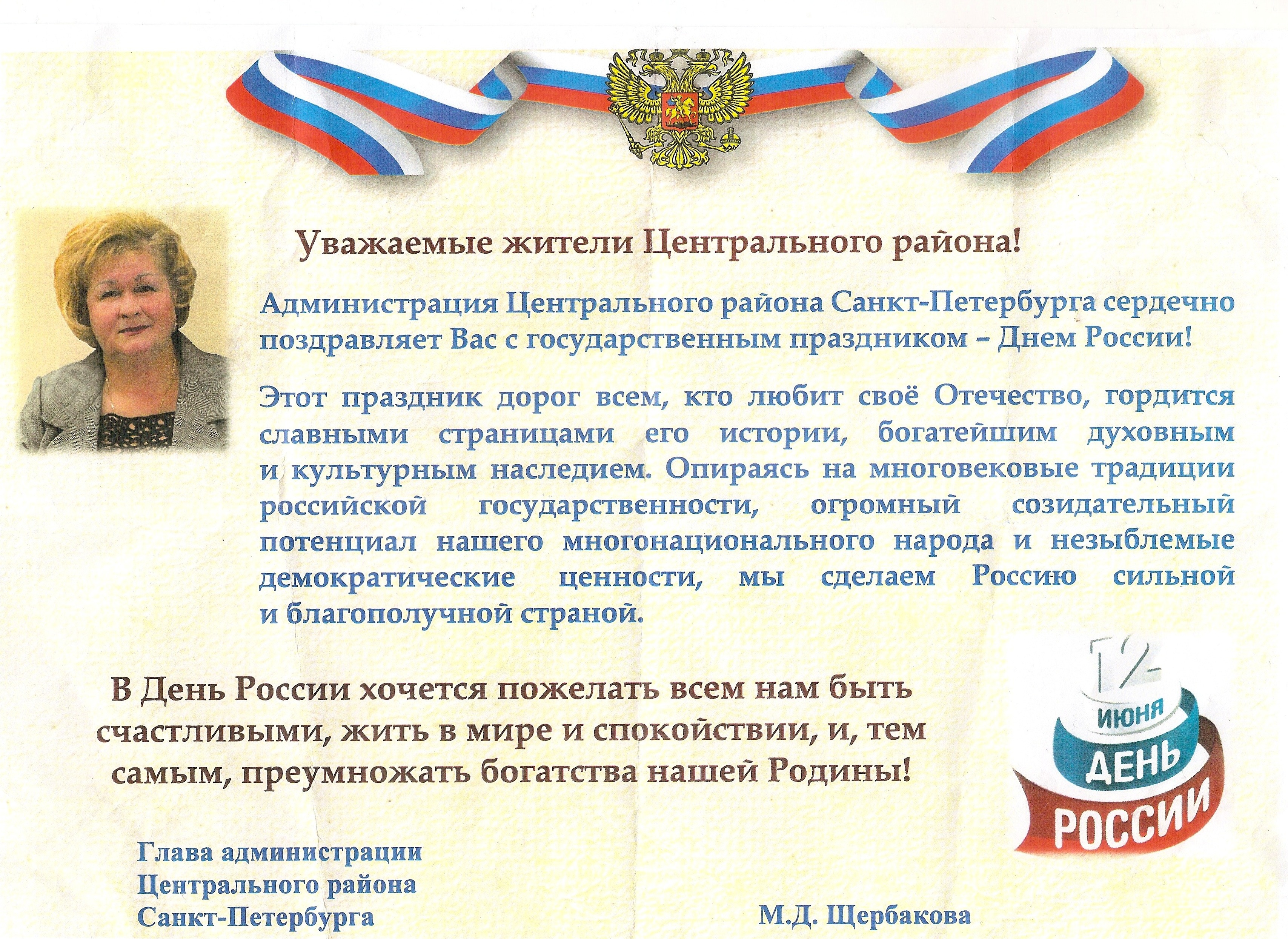
Fortunately, the Russian authorities are not as down in the mouth as the sour old multiple arrestee Stepanych. For example, Maria Shcherbakova, the seemingly perpetual head of the city’s Central District, had these uplifting holiday congratulatory printouts pasted on every front door in our neighborhood the other day.

shcherbakov kongrats

Dear Central District Residents!

The Administration of Saint Petersburg’s Central District warmly congratulates you on the national holiday, Russia Day.

This holiday is dear to everyone who loves their Fatherland and takes pride in the glorious pages of its history and its extremely rich spiritual and cultural legacy. Based on the centuries-old traditions of Russian statehood, the huge creative potential of our multi-ethnic people, and unshakeable democratic values, we will make Russia a strong and successful country.

On Russia Day, I would like to wish all of us to be happy, to live in peace and tranquillity, and to thereby multiply the riches of our Motherland!

M.D. Shcherbakova
Chief Executive, Central District of Saint Petersburg

Earlier today, President Putin expressed similarly upbeat patriotic sentiments while handing out state prizes for achievements in science, technology, literature, and the arts:

“These ideals of patriotism are so deep and strong that no one has ever been able and will ever be able to recode Russia, to convert it to fit their formats. We cannot be separated, torn, and isolated from our native roots and origins.”

Who would want to “recode” and “reformat” Russia anyway? Grumpy old Stepanych? The nearly twenty-three million Russians now living on less than 155 euros a month?

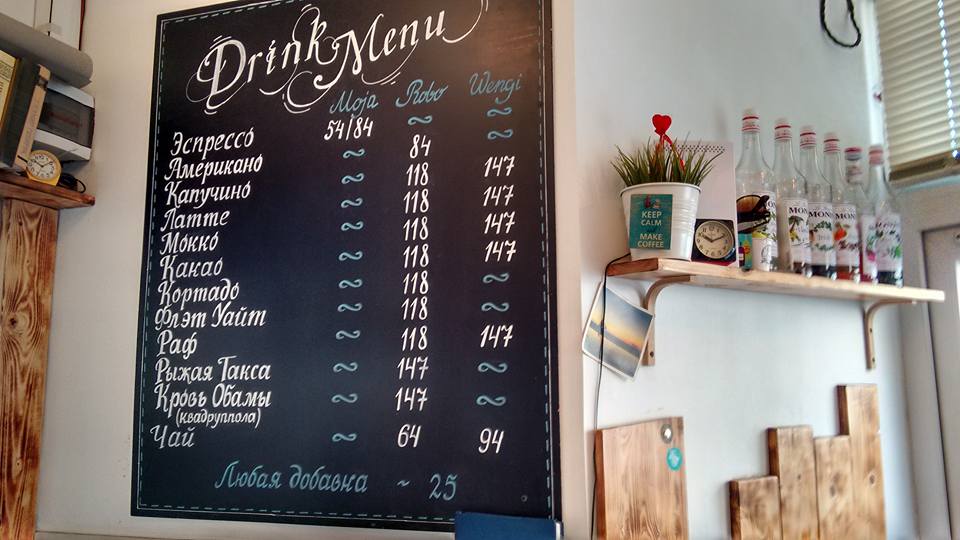
Of course not, you sillies. It is that wicked, black-as-tar, uppity Negro from across the seas, Barack Obama, as the hipster baristas in the coffee hut on the corner of Liteiny Prospekt and ulitsa Belinskogo have pointed out in their own droll way.

obama's blood

We continue our trek around Petersburg’s fashionable spots:

“What is Obama’s Blood?”

“A quadruple espresso.”

“And why did you call it that?”

“That’s just what we came up with.”

Source: Facebook (Alexander Nazarov)

At 147 rubles a cup, Obama’s Blood is the most expensive item on the menu, as a friend has pointed out to me, but when you convert it to euros (€2.36) or dollars ($2.66), it is practically a steal.

And it will get in you in the mood for a fun albeit nerve-wracking Russia Day.

* * * * * *

Russia Day (Russian: День России, Den’ Rossii) is the national holiday of the Russian Federation, celebrated on June 12. It has been celebrated every year since 1992. The First Congress of People’s Deputies of the Russian Federation adopted the Declaration of State Sovereignty of the Russian Soviet Federative Socialist Republic on June 12, 1990.

Solidarity, Community, Internationalism (and Good Public Broadcasting)

Yle, the Finnish public broadcaster, asked four recent immigrants to Finland, people who are still in the process of studying Finnish and integrating into the society, to interview representatives of the country’s main political parties in the run-up to parliamentary elections, which will take place there on April 19.

The catch was that Yle also asked the parties to send as interviewees party members who were immigrants and had themselves learned Finnish as adults or teenagers. Among other things, the interviewees were asked to explain how they had come to join the particular parties they now represented.

Interestingly and unsurprisingly, the Finns Party (Perussuomalaiset), notorious for its anti-immigrant views, was unable to provide an interviewee for the program.

The Left Alliance (Vasemmistoliitto) sent as its representative Suldan Said Ahmed, a young entrepreneur and politician originally from Somaliland. (Somaliland is an autonomous region of Somalia that seeks recognition as an independent country from the rest of the world, but as yet hasn’t got it.)

According to Said Ahmed, solidarity, community, and internationalism are the three words that best sum up the Left Alliance for him.

If like me, you are someone studying Finnish, you should love listening to Said Ahmed, because his Finnish is much easier to understand and “correct” than that spoken by “real” Finns, what with their variety of local dialects and reliance on puhekieli (conversational language), which is often shockingly at variance from the “proper” textbook Finnish we foreigners and immigrants learn on courses.

I found a recent article profiling Said Ahmed in the leftist Finnish newspaper Kansan Uutiset.

Selkouutisten+puolueprojekti+Suldaan+Said+vas

Suldaan Said Ahmed. Photo: Kalevi Rytkölä / Yle

It seems Said Ahmed has political ambitions in his native Somaliland as well. He would like to become the youngest MP there and is planning to stand, apparently, in this year’s upcoming parliamentary elections there.

Said Ahmed would also like sometime in the future to be president of Finland, but that job, alas, is constitutionally only open to native-born Finns. (So far, I would like to think for his sake.)

I find all of this so fascinating in part because, just last week, I had to go verbally postal on a few of my classmates in the advanced Finnish course I have been taking here in the former capital of All the Russias. For the second or third time this semester, they regaled the rest of us with dark tales of how Somalians like Said Ahmed are ruining the fair country of Finland by moving there in droves to become—yes—welfare scroungers. Meanwhile, the government has decided, allegedly, not to let more Russians to move to Finland, even though generally it wants to encourage more immigration to the country to help care for its aging population, etc.

You get the drift.

It might rock my classmates’ world to find out that one of the interviewers in the “Let’s Meet the Parties” program (along with a man from the Philippines, a woman from Lithuania, and a woman from South Korea) is Svetlana Siltanen, who emigrated to Finland from Russia last year.

selkouutisten+puolueprojekti

Svetlana Siltanen. Photo: Mikko Kuusisalo / Yle

My “dream a little dream” today would be to put Yle in charge of public broadcasting for a year in Russia. What a difference that could make to people’s outlooks here.