“Smash the Kikes and Save Russia!”

Smash the Kikes and Save Russia (2015)
Hard on the heels of migrants and gays, another minority has begun to fear for its safety: Jews. Svetlana Reiter spoke with two women who feel directly threatened
Svetlana Reiter
March 2, 2015
Colta.ru

Leokadia Frenkel
Program Coordinator, St. Petersburg Jewish Community Center
I set up a volunteer program to help the children of migrants three years ago, in May. Basically, we teach Russian to children of migrants from Central Asia, primarily from Uzbekistan, but there are children from Kyrgyzstan and a few from Georgia. Twice a week, they have Russian lessons, and every Sunday in the summer we go to a museum, take a trip to Pavlovsk or Peterhof, or just walk around the city. The younger group, preschoolers and first graders, we teach conversational language through games. We teach the older children, who already know how to read and write, Russian as foreign language. There are fourteen children in the younger group, and eight in the older group. I cannot say that they attend constantly. Some get ill, while others leave the country.

I myself am a philologist by training. Previously, I taught Russian language and literature in schools. I am Jewish.
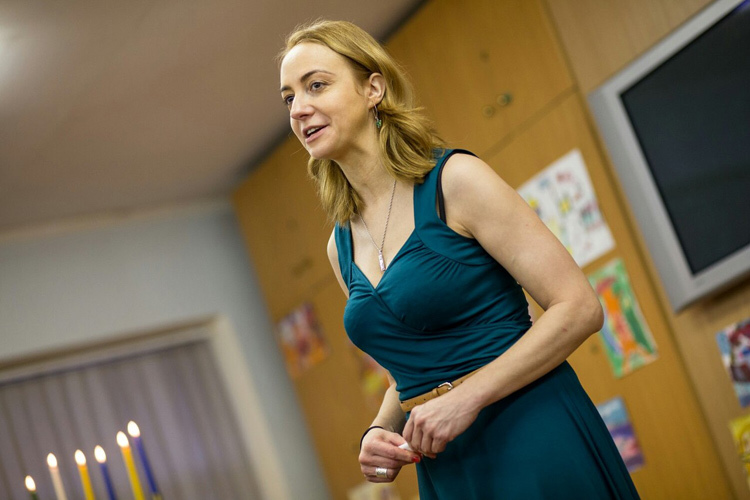
detailed_pictureLeokadia Frenkel

When we opened, practically no one was working with migrant children. There were no classes: it had occurred to no one that something needed to be done with them. Naturally, when we opened, various media visited us to shoot segments and write articles. When I read the comments to these articles, I often felt uneasy: people wrote very harshly about migrants and their children. But I could scarcely have foreseen what has happened now.

I posted an ad for volunteers in Facebook and VKontakte. We cannot take just anyone: we need professional philologists, people able to work with children. We cannot take the average person who just feels sorry for migrants, and real teachers are few and far between. So I am constantly posting ads in social networks: look at what wonderful children we have, come and help us.

Not long ago I posted two more ads. A group on VKontakte calling itself Morality reposted one. I had a look. Morality’s moderator, Mikhail Kuzmin, put together an album containing 161 photos of me and published a post in which he wrote that the kike-liberal public goes to protest rallies and teaches Russian to “black” (chernye) children. This group is absolutely fascistic and anti-Semitic. They are constantly writing that migrants commit the majority of crimes in Russia. That “black” children attend our schools and spoil our children, the migrant children are wild animals who are uneducable. And those are the mildest things they write.

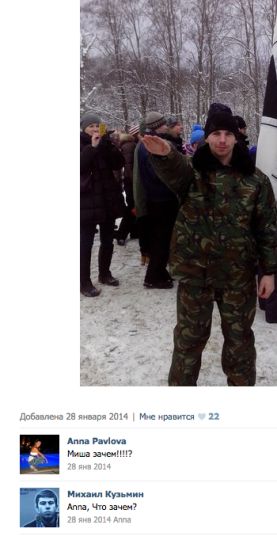
When this community was informed that a Jewish woman was teaching migrants, they were faced with what they understood as pure evil. Three and a half thousand people gladly lashed out at me. Kuzmin posted information about my son and my husband, and published an additional post about my family. He was outraged: how could it happen that kikes were teaching savages?! There is no place for either group in our society. Down with the kike-liberal opposition! Moreover, judging by his photographs, Kuzmin himself goes to LGBT rallies and beats up gay activists. He has an athletic physique: he practices boxing and fisticuffs at Sosnovka Park. In one photo, he is wearing a police uniform and sporting a badge. I don’t know whether he is really a policeman, but the photograph exists, just like snapshots where he is giving the Hitler salute or standing next to Deputy [Vitaly] Milonov [author of Petersburg’s infamous homophobic law].

The worst thing, of course, is that he not only haunts the social networks but that he walks the streets. I complained to the administration of VKontakte. They replied that if I didn’t like this group, I shouldn’t look at their postings, and that they close only those groups that directly threaten someone’s life.

I have said nothing to the migrant children. I am a good teacher; I know how to work with children. Ultimately, my job is to help those who have it worse than I do, not to make their lives even more unbearable. You see, in the schools these children accumulate hatred: teachers don’t like them and classmates fear them. These things give rise to reciprocal aggression.

It is hard to say whether the folks from Morality are threatening my life. If they practice fisticuffs at Sosnovka Park, what prevents them from visiting our Jewish center? Maybe one of their three and a half thousand subscribers will decide to harm me directly. And you know, I am less afraid to read things like “the black-assed bastards are uneducable, ask any teacher” and “the kike lady is out of her mind for black-assed goys” than to read what Kuzmin wrote about my son and my husband. I’m really afraid for my family.

The level of aggression is now completely crazy. Some moron could show up when I am teaching the children. We have no security guard armed with a machine gun at our center. The only thing I can do to protect myself somehow is talk about it publicly.

I always remember that the migrants have it worse off than I do. Their children have no beds. They sleep on the floor, and they are lucky if they have a mattress. And yet they go to school and study as much they can until they leave for home.

I have noticed that if I really come to like a pupil, he or she leaves immediately. Rarely do they study with us longer than two years. There were two lovely girls, half Kyrgyz, half Uzbek. They drew beautifully and sang beautifully. They were here for three years, now they have gone back home. I still correspond with one girl from Uzbekistan, Sitora, who is now seventeen years old. I remember she once told me she had never been to the theater in her life. Not once, can you imagine? But we take the children to the theater when we get free or discounted tickets.

During the winter break, we went to the Kunstkamera. Some Uzbek girls later asked why the Chinese have such strange, narrow eyes. And I told them, “Well, I have a big nose. What’s strange about that? All people are different.”

Tamriko Apakidze
Former lecturer at the Petersburg Institute of Jewish Studies
I moved to Germany this fall. I am trained as an Orientalist and religious scholar, and I taught at the Institute of Jewish Studies in Saint Petersburg. I encountered the Morality group quite by accident. A year ago, on March 14, I went to a demonstration at Kazan Cathedral. I had two small placards with me: “Crimea is Ukraine” and “Make love, not war.” Despite the warnings, I took the placards out periodically, not realizing that they turned my actions into a solo picket, especially because there were other people with placards.
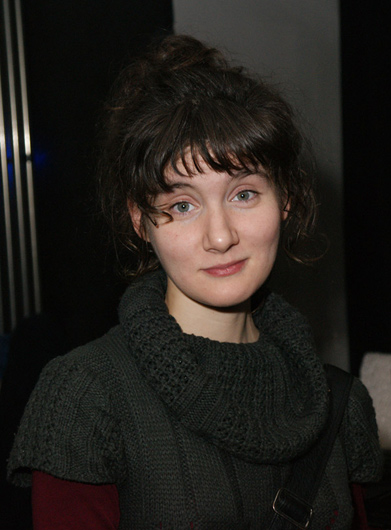
fileTamriko Apakidze. Photo by Nikolai Simonovsky

The police nabbed me fairly quickly, at first along with my husband, but he was soon kicked out of the paddy wagon, and I spent four hours in the company of seven rather rude, in my opinion, police officers. It was they who took me to the station.

I had never been to a police station before, so at first I thought it was fun. But when they confiscated my internal passport and did not let me make a phone call, I was not amused. Aside from the rude cops, there was a nondescript young man who was quite polite. He listened courteously and attentively to the questions the police were asking me. He got quite excited when he heard I worked at the Institute of Jewish Studies. He asked what I taught there and whether I had worked there long. Then this guy was released, and I was given an arrest report and told to wait for a summons to court.

I left the police station late at night, believing I had got off very lightly. The next day, acquaintances sent me a link to the group Morality. It turned out that my companion at the cop shop had been Mikhail Kuzmin, the group’s moderator. He had posted his report, where he wrote something to the effect that he had being going to God’s temple to pray, but the police took him for a liberast and arrested him. The report was entitled correspondingly: “Who attends liberast rallies.” My entire biography was there. What surprised me most was that there were details there that he could not have found out from our conversation. He quite obviously had access to other sources.

Naturally, it said there that I worked at the Institute of Jewish Studies but that I pass myself off as a Georgian, although it is not clear who I am. There was this phrase: “The young woman herself is not involved in homopiggery, but she supports homos.” And the best part was an album of photos of me, twenty-five of them: one from the protest rally, and the rest pilfered from Facebook. This was so that the comrades would know their enemy by sight. The album’s crowning touch was a screenshot from the Institute of Jewish Studies website containing my schedule. I felt sick.

I looked at the pictures of Kuzmin himself: he was giving the Nazi salute and wearing a Nazi uniform. My husband wrote, “You shitty Nazi, remove the photographs of my wife immediately.” “I’m not a Nazi, because all Nazis are kikes,” Kuzmin eagerly replied. There was no more discussion with him, but his comrades in the struggle wrote comments under the photographs of me: how many Banderites had fucked me, and stuff like that. I never thought that I would encounter something like this in life. We sent a complaint to the management of VKontakte, but the group was not shut down.

For a while, I was very afraid. Of course, this was not the reason we left for Germany, but when I saw that screenshot of my schedule at the institute, I was quite scared to go to work. I became paranoid that I would be assaulted on the street or that our dog would be poisoned. I suspect that Kuzmin works in tandem with the police. First, I think he was with me at the police station as a provocateur. Second, when I was in the paddy wagon, the cops uttered his surname several times.

We moved to Germany at the end of August. We had been planning to do this for a long time, but had kept delaying and putting it off. After last March, my husband immediately found a job and we left Russia. I haven’t heard anything more about Kuzmin.

The community Morality has been active on the VKontakte social network for a year and a half. At present, the group numbers around four thousand subscribers. The group’s founder and moderator, Mikhail Kuzmin, was born April 12, 1986. He is married, a graduate of the Northwest Branch of the Russian Academy of Justice, and a member of the Petersburg branch of the Great Russia party.

______________________________

VKontakte group close for inciting hatred
Ethnic strife flares up on the social network. Petersburg woman with Jewish surname fears for her life
Polina Khodanovich
March 4, 2015
Metro

Petersburger Leokadia Frenkel, who teaches Russian to migrant children, has been victimized by the social network group Morality and its administrator Mikhail Kuzmin.
Screen Shot 2015-03-03 at 1

Mikhail Kuzmin. Screenshot courtesy of Metro newspaper

“He reposted 161 photographs of me and wrote a text to accompany them entitled ‘The Kike-Liberal Opposition,” Frenkel told Metro. “That Jews were teaching migrants was the ultimate source of indignation for him.”

According to Frenkel, openly threatening comments appeared under photographs of her, and she seriously feared for her life.

“But when my friends complained to VKontakte management, they got evasive replies to the effect that if you don’t like this group, don’t look at it.”

Mikhail Kuzmin himself likes to do the Nazi salute and have his picture taken in Nazi uniform. He invariably refers to Jews as “kikes,” and conducts surveys on topics such as “Should migrants be sterilized?” The group consists of about 3,500 active participants. Unfortunately, we were unable to reach Mikhail Kuzmin for comment.
Screen Shot 2015-03-03 at 2

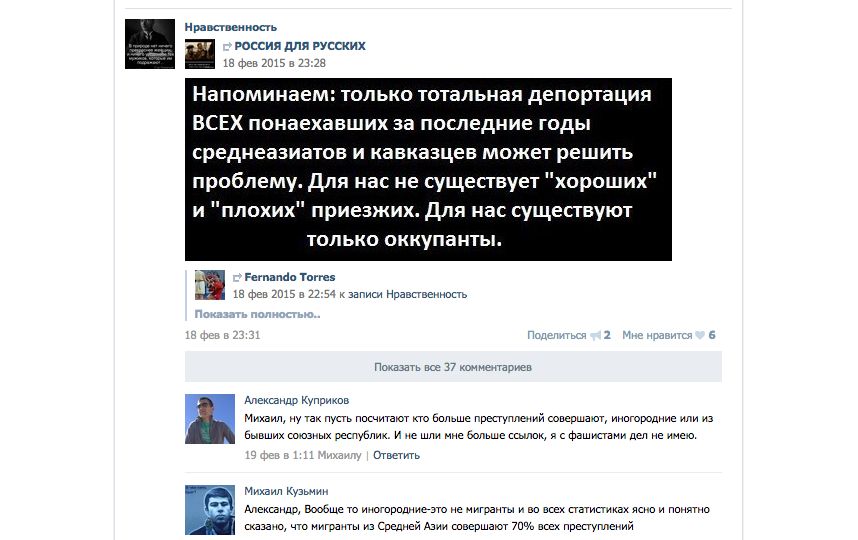
“Morality” group  page on the VKontakte social network. The highlighted passage reads, “Reminder: only the total deportation of ALL the Central Asians and Сaucasians who have overrun the country in recent years can solve the problem. For us there is no such thing as ‘good’ and ‘bad’ immigrants. For us there are only occupiers.” Screenshot courtesy of Metro newspaper

Metro asked the Saint Petersburg office of the Investigative Committee’s Investigative Department to comment on the situation. Sergei Kapitonov, head of their press service, was terse.

“Anything is possible anywhere. I don’t understand what the matter is. I suggest you send an official inquiry addressed to our general and explain what you want to him.”

Roskomnadzor told Metro that they could do nothing themselves.

“The law on extremism in the Internet is administered by the Prosecutor General’s Office,” press secretary Vadim Ampelonsky said. “Only they can send us a request to block the group.”

Ultimately, Metro had no choice but to personally ask VKontakte’s press secretary Georgy Lobushkin to pay close attention to the controversial group Morality. And soon the newspaper received the following reply: “Good day. Our moderators are now checking this group for violations of website rules and Russian federal laws.”

On the evening of March 3, the group was temporarily blocked “for incitement to acts of violence.”

Vera Alperovich, expert on nationalism and xenophobia, SOVA Center for Information and Analysis:

“Any incitement to ethnic violence is covered by Article 282 of the Criminal Code. The activities of this group and its administrator should definitely be investigated. That the Investigative Committee is paying no attention to this group means they are waiting until someone is killed. In addition to a criminal complaint, one could start with a warning, which can facilitate getting the offending content deleted. Aside from the Criminal Code, there are also ethical norms. Such groups should cause a wave of public outrage.”

______________________

The Fall of “Morality”
A neo-Nazi group on VKontakte that has bullied a Jewish woman was closed only after public pressure
Veronika Vorontsova
March 5, 2015
Novye Izvestia

Yesterday, after repeated requests by users, administrators at the social network VKontakte blocked the group Morality. The community had positioned itself as a platform for instilling “Slavic values,” but in fact it contained a lot of material prohibited by law, including neo-Nazi material. The group’s closure had long been sought by a female Saint Petersburg resident against whom group members had organized a genuine hate campaign. For a long while, administrators at the social network had turned a blind eye to her complaints, and she succeeded in having the group blocked only after broad publicity and intervention by the media.

The group Morality, which allegedly promotes “moral education based on historical Slavic values,” has been closed for a month for calls to unlawful actions, VKontakte spokesman Georgy Lobushkin informed Novye Izvestia. If the community’s creators do not remove the illegal content within thirty days, the group will be blocked in perpetuity.

The cause of the group’s closure was the campaign of persecution its members organized two week ago against Leokadia Frenkel, program coordinator at the Saint Petersburg Jewish Community Center, whose activities include teaching migrant children and helping socially adapt.
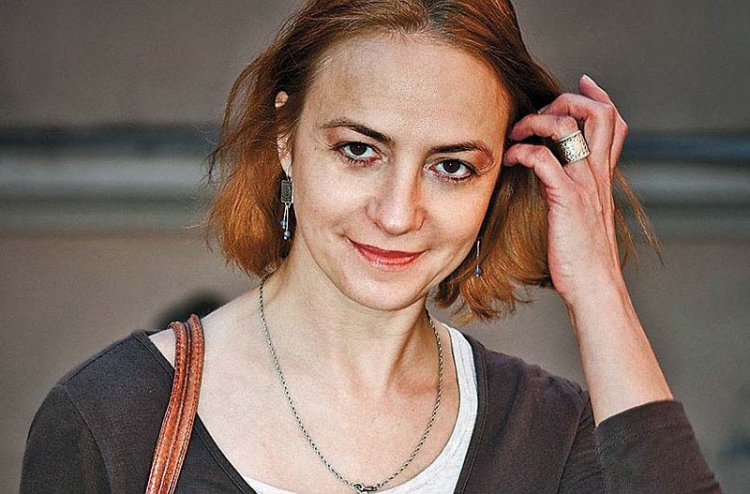
1425494405051Leokadia Frenkel

It all started when Frenkel placed an ad on the social network recruiting volunteers to work with the children at the center. The call was copied to the Morality group, where it was commented in an abusive and illegal manner. As Frenkel told Novye Izvestia, a genuine campaign of persecution was unleashed in comments to the post: group members insulted her ethnicity, and some threatened her with violence. Later, the group’s moderators made a selection of photographs featuring not only Frankel but also her husband and her son, placing it in open public access.

Frenkel decided to send a written request to VKontakte to close the group. Many of her friends followed suit. They soon received a rejection letter. The social network’s administrators explained there was nothing illegal in the information contained in the community. “If you do not like the group, do not look at their materials. We close only those groups which directly threaten someone’s life.” This was the response from VKontakte management.

This explanation did not hold water, says Frenkel. She notes that VKontakte’s published rules contain a list of actions prohibited by company management. Paragraph “e” disallows the “incitement of racial, religious, and ethnic hatred, as well as the promotion of fascism or racial supremacist ideology.” In the group Morality, which was completely open to the public, one could see many images of swastikas and direct calls for violence. Examining group moderator Mikhail Kuzmin’s personal page, Novye Izvestia also found many images of Nazi symbols. In some photos, he was posed in a Wehrmacht uniform; in others, in front of a Russian imperial tricolor.

Initially, VKontakte administrators really did see nothing illegal about the group, the social network’s press secretary Georgy Lobushkin explained to Novye Izvestia.

“There are many discussion communities where users discuss various issues. We do not block them, even if some comments are outside the scope of the Constitution,” he said in conversation with Novye Izvestia. However, “after a more thorough study of this group, experts nevertheless concluded that it contains incitements to violence.”

Two weeks passed between the time of Frenkel’s complaint and the group’s closure. She believes the reason for a more thorough review of her complaint was several reports in the media and the broad publicity they generated.

Although the group Morality has been closed, Novye Izvestia has found a number of similar communities where Frenkel’s identity and ethnicity continue to be discussed to the hilt.

As Novye Izvestia reported yesterday, early in the week, a court ordered Smolensk journalist Polina Petruseva to pay a fine of 1,000 rubles for “promoting Nazi symbols.” The court case was occasioned by Petruseva’s publishing a photograph of her own building’s backyard during World War Two on her social network page. The photograph shows German soldiers standing in formation next to the flag of the Third Reich. On Tuesday, the Russian Constitutional Court confirmed the ban on displaying any Nazi paraphernalia or symbols.

But law enforcement agencies have not yet responded to the controversy involving Leokadia Frenkel. The police are reluctant to accept such complaints, because there is almost no mechanism for working with such cases, Mikhail Pashkin, chair of the Moscow Police Union’s coordinating council, told Novye Izvestia. According to him, criminal charges are filed in such instances only to make an example of someone, “which is probably what happened in the case of the journalist from Smolensk.”
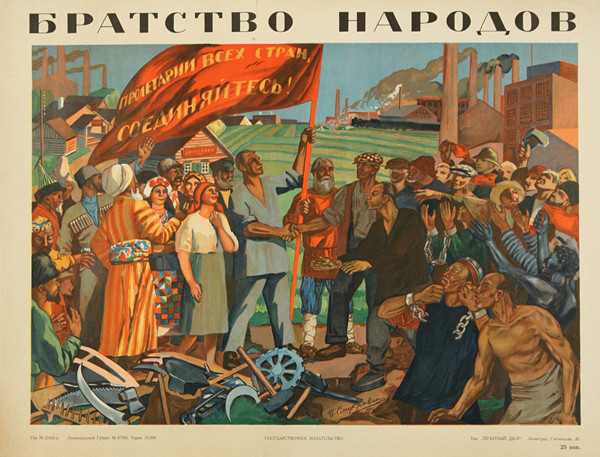
Brotherhood of Nations

8094541_1_l
P.  Smukrovich, Brotherhood of Nations,  1927

Russian TV Explains Health Benefits Of Racism
Glenn Kates
December 17, 2014
Radio Free Europe/Radio Liberty

You always want to avoid drinking with somebody during the holiday season. Maybe it’s that politically incorrect uncle of yours. Or maybe it’s a nagging in-law.

The well-known host of a health show on Russian state-run First Channel has another suggestion: shun those whom she calls “people of the Mongoloid race.” But it’s for their own protection, of course.

The segment, titled “whom not to drink with on New Year’s” begins with Yelena Malysheva, host of the program “Live Healthfully,” inviting an audience member up on stage.

A man named Shukrat, who identifies himself as an Uzbekistan native, is met with hearty laughter when he explains that he “wouldn’t want to drink with the police or the Federal Migration Service.”

Then Malysheva gets into the meat of her presentation, noting that Russians are “a white race, a Slavic one ” and “now we will talk about what race not to drink with on New Year’s.”

And just so there are no misunderstandings, she adds, “There is no discrimination here, just an understanding of the physiology that makes every race different.”

Shukrat then cuts in, noting that he “grew up in the Soviet Union, so I’m not a nationalist” and “can drink with black people and all people, to be honest.”

Malysheva reiterates that “when we talk about who not to drink with this New Year’s, we do not mean to cast scorn on anyone. We’re talking about the threat to their own health.”

She then turns to Dmitry Shubin, a “doctor” on her team and asks him to explain who not to drink with.

“In the interests of safety, one shouldn’t drink — no, not shouldn’t but mustn’t — drink with people who come from the Mongoloid race,” Shubin says, using a term to describe Asians that can be seen as derogatory. This group, he explains, includes Chinese, Koreans, Japanese, and others in the Russian Far North.

Perhaps worried there may be confusion, Malysheva, using her fingers to press her own eyes together, explains that these “Mongoloids” can be identified by their narrow eyes and round facial features.

Just in case it still isn’t clear, she exhibits a slideshow of Asian-looking faces to avoid when in the presence of alcohol.

Shubin then explains the reasoning: Asians have a “genetic defect” that prevents them from properly metabolizing alcohol.

To demonstrate, he gives Shukrat and Malysheva liver-shaped containers, which are each apparently filled with black liquid (they don’t actually show what’s in Maysheva’s container before the experiment). As they both pour alcohol into their respective livers, Shukrat’s remains black. Malysheva’s becomes clear.

“Mongoloid: people with narrow eyes and crescent-shaped faces — [for them] alcohol is toxic,” Malysheva says, pointing to the fake liver a perplexed-looking Shukrat is holding. “And so the first people you should never drink with on New Year’s are representatives of the Mongoloid race. It is bad for them”

Research has shown that some people of East Asian descent — about one-third according to one expert — have a gene that causes difficulty in breaking down alcohol that could lead to long-term health consequences.

But doctors don’t generally recommend that non-Asians take the matter into their own hands by excluding people of Asian ethnicity from social drinking.

In Russia itself, according to a recent study in The Lancet medical journal, a quarter of Russian men die before the age of 55 — a rate far higher than the rest of Europe. And one of the chief causes is excessive alcohol consumption.

_________

“WHETHER OR NOT YOU WANT TO, YOU HAVE TO GO”
December 12, 2014
adcmemorial.org

From Tajikistan to Russia: Vulnerability and abuse of migrant workers and their families

Paris, St Petersburg, 10 December The situation of Tajik migrants in Russia is deteriorating, said FIDH and ADC Memorial in a report released today. Increasingly restrictive migration laws are pushing migrants into irregular situations and increasing their vulnerability, while exploitation goes unchecked.

The dire economic situation in Tajikistan, where around 40% of the population of working age is unemployed, continues to push hundreds of thousands of men and women to leave for Russia every year. According to official statistics, in 2014 there were over a million Tajik citizens in Russia. The remittances sent back represent 47% of Tajikistan’s GDP, the highest percentage of any country worldwide. For most families, they are the main source of income. This trend looks set to continue.

Despite recent measures announced by the Tajik authorities, migrants remain highly vulnerable to abuse. As a result of increased restrictions on entry and stay in Russia, deportations have multiplied and tens of thousands of migrants have been subjected to re-entry bans. Migrant workers interviewed by FIDH and ADC Memorial reported extortion by Russian police and border guards, arbitrary arrests and police violence. Fuelled by xenophobic political discourse and media reports, vigilante attacks on migrants are on the rise. Those responsible for attacks benefit from almost complete impunity. The report also documents non-payment of wages, poor living conditions, and lack of access to medical treatment.

“The multiplication of legal restrictions, raids on migrants like Operation Migrant 2014, launched this November, and rising xenophobia are resulting in serious violations of migrants’ human rights. We are deeply concerned about recent acts of violence against migrants, on the part of the police and civilians, which have gone unpunished”, said Karim Lahidji, FIDH President. “In December, it became clear that Operation Migrant 2014 would be ongoing. Mass arrests and detention of migrants in Moscow and St. Petersburg continue.“

The report addresses the human rights impact of migration on women in particular. Hundreds of thousands of women are left behind in Tajikistan to bring up children, working in the fields and markets, and depending on their in-laws for support. Those whose husbands stop sending money or disappear completely can find themselves destitute. Over the past several years, there has also been a sharp increase in numbers of Tajik women migrating to seek work. It is estimated that today around 15% of migrants are women. Women migrants, especially those who leave the country alone, are seen as challenging traditional roles and often suffer stigmatisation from their families and communities in Tajikistan, while in Russia they are particularly vulnerable to exploitation and violence.

In 2012, Tajikistan was examined by the United Nations Committee on the Rights of All Migrant Workers and Members of their Families. The Committee raised particular concerns about corruption among border guards and some consular staff and the lack of effective complaint mechanisms for victims of abuse.

“Consular protection for Tajik migrants in difficulty in Russia remains inadequate and the Tajik Migration Service has not established an effective complaints procedure. Cases of exploitation by employers and intermediaries, including forced labour, are not properly investigated by the authorities of either country,” said Stefania Koulaeva, head of ADC Memorial.

Since 2011, FIDH and ADC Memorial have undertaken a series of joint investigations to document the situation of Tajik migrant workers in Russia and the violence, xenophobia and serious violations of economic and social rights they face there.

*****

Interview with Stephania Koulaeva, head of the Memorial Anti-Discrimination Centre, on the situation of migrants in Russia

At the end of October the Russian government launched a huge operation called Migrant 2014 to crack down on migrants in an irregular situation in Russia. FIDH and ADC Memorial reported 7,000 arrests during the operation. What happened to those migrants and their families? Where are they now?

When we first reported on the 7,000 arrests, Migrant 2014 had only just begun. According to official figures published by the Moscow police and Moscow department of the Federal Migration Service (FMS, by the end of the operation on 4 November, over 50,000 migrants had been arrested by the police. Almost 2,000 expulsions were conducted and hundreds of migrants were detained. Simultaneously, the FMS in Moscow carried out a wave of inspections that resulted in the expulsion of 1,500 people. Another 3,000 people were barred from re-entry. The total revenue from penalties imposed on these migrants was almost 50,000,000 rubles (approximately 1 million Euros.)

Repression of migrants in Moscow alone during the week-long operation resulted in more than 3,500 expulsions and tens of thousands of cases of administrative punishment.

As to the current whereabouts of the arrested migrants, we can assume that many of them had to leave the country, often with a ban on coming back for a number of years. Although others could continue their life and work in Russia, they have had to pay a high price for permission to do so.

What does this operation say about the Russian government’s approach to migration? How does the Russian migration policy impact other countries in the region?

The Russian government policy on migration is controversial. On the one hand, it has close ties to the main business structures that employ migrant workers, in such fields as construction, communal services, and sales. This system allows Russia to benefit from a cheap labour force without spending on social needs. On the other hand, the very people who profit from the hard work and low wages of migrants are the ones who organised the operations against them, and use xenophobic rhetoric in the government-controlled media in order to pander to nationalist sentiments of the population. Migrants have become scapegoats for the immense problems that Russia now faces on the political and economic level, despite the fact that the country cannot function without migrant work.

The Russian government plays a complicated strategic game in the region on migration issues. For example, Russia allows Tajik migrant workers to work in Russia in exchange for military and geopolitical support from Tajikistan. Tajikistan meanwhile benefits from the remittances that working migrants send back to their families.

What are the main problem faced by migrants in Russia?

Migrants in Russia face a multitude of problems, including widespread discrimination, the stigma of illegality, the risk of detention and deportation, and xenophobia, in particular towards migrants from the Caucasus and Central Asia. Those who are not formally employed face a prohibition on staying in Russia longer than three months, which, in practice, forces almost all children of migrants into illegal status.

Migrant workers receive lower wages for the very same work done by Russian nationals and suffer from the absence of social security in case of illness, injury or death.

Conditions of detention are another major problem. There is an absence of judicial control over the duration of detention of migrants accused of violating migration laws, which can last up to two years on purely administrative grounds.

These problems are compounded by the lack of support demonstrated by the migrants’ countries of origin. In some cases, such as in Uzbekistan, migrants even face repression from their government for working abroad.

Read the report From Tajikistan to Russia : Vulnerability and abuse of migrant workers and their families

Editor’s Note. I have lightly edited this article to make it more readable.

__________

Migrant workers are leaving Petersburg: soon there won’t be anyone to work in construction and communal services
Elena Rotkevich
December 17, 2014
Gorod 812

On January 1, new rules for migrant workers, allowing them to work almost anywhere without restrictions, will be introduced in Russia. The authorities hope this will increase the flow of cheap labor from the CIS. In fact, the opposite is happening.

The Russian Federal Migration Service, which initiated the new rules, has said they fundamentally change the approach to labor migration. As of January 1, 2015, quotas will be abolished on the numbers of migrant workers from the CIS and other visa-free countries who can be employed in Russia.

The need to obtain a work permit will also be abolished. Instead of this document, migrants will need to buy a license. Its price will be different in each region, as set by the local authorities. In Petersburg and Leningrad Oblast, it will cost 3,000 rubles; in Moscow, 4,000 rubles. As of January 1, each legally employed migrant worker, except for those who still have valid, previously issued documents, must have this license, no matter where they work.

The abolition of quotas means that any number of migrant workers can be employed at any enterprise. When there were quotas, the number of migrant workers in each sector of municipal services and industry were strictly regulated. For example, in 2014, only 164,000 migrants could legally work in Petersburg within the quotas. [Although the actual number of migrants working in the city is undoubtedly much higher.]

As of 2015, this ceiling will not be limited in any way. It would seem that the city should be flooded with migrants, but it isn’t, and the reason is the economy.

“The quotas are abolished, but there won’t be more migrants. They are already leaving the city. If the exchange rate of the ruble does not grow, they will stop coming here altogether, because it is not worth it. Salaries paid in rubles are not increasing in value. For example, if a person working at a construction site used to get 25,000 rubles a month, and that was roughly equivalent to 750–800 dollars, now it is worth 400–450 dollars. That does not even cover the person’s expenses. It is easier to make money at home,” says Suratbek Abdurahimov, chair of Uzbegim, the Uzbek National Cultural Autonomy of Saint Petersburg.

According to him, it makes no difference to migrants whether they have to get a license or a work permit. It is expensive and troublesome all the same. There is, however, an obvious drawback: after the new rules are adopted, the official price of a license in Petersburg will increase from two to three thousand rubles. But the real price of the document cannot be predicted at all. Given the cost of medical certificates, insurance, and everything else, migrants now pay between twelve and fourteen thousand rubles for a license, while getting a work permit costs around twenty thousand rubles. Abdurahimov believes that under the new rules a license will also cost at least twenty thousand. It is cheaper to stay at home.

Mahmut Mamatmuminov, board chair of the Assistance Fund for Migrant Workers from Central Asia, agrees with him.

“Of course, soon it will make more sense economically to stay at home. First, because of the exchange rate. Second, because migrants have to take exams in Russian, history, and law. It is hard: even an educated person finds these tests confusing. I have heard that exam certificates are already selling on the black market. Also, the number of migrants is dropping because the Federal Migration Service in Petersburg has banned many people from entering the country for different violations. According to Federal Migrant Service statistics, more than a million migrants have been banned from entering Russia over the past year,” says Mamatmuminov.

The major sectors in Petersburg where guest workers are employed are construction, retail, street cleaning and housing maintenance, services, and transportation. According to experts, if migrant workers pull up stakes and fly home en masse, there will soon be no one to do this work in Petersburg.

__________

Saturday, December 20, 2014
Window on Eurasia: Massive Exodus of Migrant Workers from Russia Begins
Paul Goble

Staunton, December 20 – The collapse of the ruble and the test of Russian language knowledge they will soon be required to take are prompting gastarbeiters in the Russian Federation to leave in massive numbers, with the leader of the Federation of Migrants now predicting that more than a quarter of them will depart by early next year.

While some Russians may be glad to see them go, their departure will make it more difficult for the Russian economy to escape the looming recession. But even more seriously, their return to their homelands in such numbers will create problems there, given that none of those economies can easily absorb them.

The returning migrants are thus likely to become a source of additional instability in places that in many cases already are far from stable, and to the extent they are not absorbed into the economies, some of them may become recruits for radical Islamist groups that want to overthrow the existing order.

Mukhammed Amin, the head of the Federation of Migrants of Russia, told Newsru.com yesterday that “more than 25 percent” of the more than 10 million immigrant workers in Russia plan to return home or move to other countries in the coming months (newsru.com/russia/19dec2014/ishod.html).

He suggested that the main reasons for that are two: the collapse of the ruble exchange rate means they have less money to send home – most of their transfer payments have been in dollars – and concerns about the impact and cost of the test of Russian language knowledge they will be forced to take as of January 1.

Karomat Sharipov, the head of the Tajik Labor Migrants organization, confirmed that this is the case and said that many of his co-nations intend to leave Russia.  He added that because jobs at home are scarce, at least some of them might join the ranks of extremist groups as mercenaries in order to support their families.

Russia’s Federal Migration Service had already reported that with the decline in the value of the ruble, the size of transfer payments by gastarbeiters in Russia to their homelands had sharply fallen (newsru.com/finance/12dec2014/migrants.html). That too will harm the economies of countries like Tajikistan, Kyrgyzstan, and Azerbaijan from which most migrants have come.

Some Russians are pleased by the departure of the gastarbeiters, either because they view such people as culturally alien or because they think that such foreigners are taking jobs that Russians should get. But Russian officials are more concerned by the possibility that those leaving will join radical Islamist groups or become part of “so-called ‘Jihad tourism.’”

That term refers to Muslims from one country who travel to another to take part in and make money from radical Islamist groups fighting elsewhere.  According to the Russian government, there are at least 1500 such people from CIS countries now fighting for the Islamic State; the departure of the gastarbeiters will likely boost that number further.

Russian officials fear that these people will not only destabilize neighboring countries but also in some cases return to push their causes within the borders of the Russian Federation, yet another frightening consequence of Vladimir Putin’s policies in Ukraine.

Image courtesy of liveauctioneers

Vladimir Bukovsky on “Political Correctness” in Britain

We don’t want to be racists: we’re all civilized people. But the situation is absurd. [In Britain] TV news anchors . . . it’s a requirement that she be black, swarthy. And the other one has to be something else. The recruitment of these minorities is huge. And you can’t find two news anchors. It turns out that a TV channel’s best bet is to hire a legless negro lesbian single mother. That’s great: she meets all the criteria. But if you don’t do this, you might be sued for discrimination. People do this [hire minorities] not because they’ve come to love everyone or accepted the theory of Marcuse, but because they can be sued. Sued and bankrupted. Suddenly there’s this big campaign [in Britain]: for some reason there are very few women in private companies, on boards of directors. Well, go figure, huh? It’s a national tragedy. But what do you know: these companies are forced to find women so that these women sit there stormily. This isn’t a joke, this is serious. This is private business: they don’t need these people. They need people who will work. But as a result it turns out that not only does this not produce any fairness in society, but also suspicion grows, racism grows. You go to the hospital and there’s a Pakistani doctor. For all I know he got his diploma because he’s politically correct. I don’t want to be treated by him. I would prefer to be treated by one of our guys, by a Russian immigrant. At least I know that he studied properly and learned a thing or two. But this guy [the Pakistani]? I don’t know who gave him his diploma and why. Maybe because he’s dark-skinned.

Vladimir Bukovsky, Smolny College of Liberal Arts, Saint Petersburg, 28 November 2007