How “Stability” Has Really Been Achieved in Russia

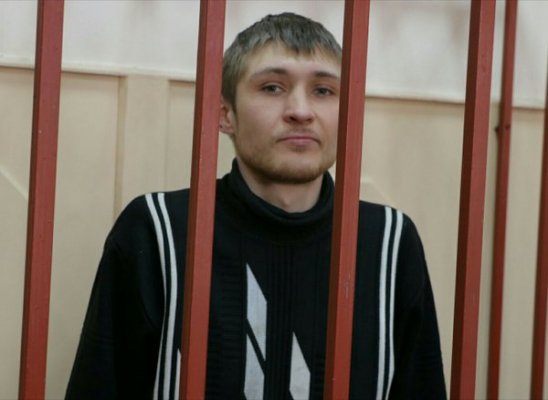
photo_2018-01-24_22-04-13Viktor Filinkov. Photo courtesy of Filinkov’s wife and OVD Info

Petersburg Anarchist Viktor Filinkov, Arrested in Terrorism Case, Says He Was Tortured
Mediazona
January 26, 2018

Antifascist Viktor Filinkov, arrested for alleged involvement in a terrorist network, has told members of the Public Monitoring Commission (PMC) he was tortured, according to the PMC’s report, which Mediazona has in its possession.

According to the PMC report, injuries “inflicted in the last two or three days” were discovered on Filinkov’s body, including numerous traces of burns from an electric shocker all over his right thigh, a hematoma on his right ankle, and burns from an electric shocker on his thorax.

Filinkov explained he suffered the injuries on January 24 in the car in which he was put by FSB officers after he was detained at Pulkovo Airport in Petersburg. The activist was then taken to the local Interior Ministry headquarters, and from there to a hospital. Filinkov was then driven into woodlands and held in the car for five hours.

FSB officers were seated in the front of the car, according to Filinkov. The middle row of seats was occupied by a man wearing a mask, while Filinkov and another man wearing a mask sat in the back of the vehicle. The injuries were inflicted between seven and eight o’clock in the morning.

According to the PMC’s report, “The FSB officers demanded that Filinkov confess, and having obtained his consent, they forced him to memorize the particular wording [of his confession].”

The masked men said very little, while the FSB officers threatened Filinkov that if he subsequently reneged on the confession, the beating they had given him would be a “light version” of the beating he would get later.

Afterwards, Filinkov signed a statement, addressed to the local Interior Ministry headquarters and the local FSB headquarters, in which he informed them of all the things he had been prompted to say. The FSB officers then demanded he not deny the statement in court, threatening to place him in a pretrial detention center with tuberculosis patients.

The only things the masked men said were “Stop twitching!” and “What you shouting for?”

Filinkov was transferred to another car in the woodlands, a Lada Priora, and taken to the local Interior Ministry headquarters. According to Filinkov, the masked men seemed to know their way around the building, as if they had been there many times. They also discussed the fact they should keep their faces hidden because of the security cameras in the building.

The PMC’s report notes that the men wiped the blood off Filinkov’s face with his own hat and with snow, and traces of bood were left on the hat. The leftist activist was also told that if he behaved badly, the FSB would “get to” his wife “even in Kyiv.”

On January 24, Filinkov’s wife told OVD Info her husband had disappeared on his way to Petersburg’s Pulkovo Airport. The antifascist was scheduled to fly to Kyiv at eight o’clock in the evening on January 23. The last time they communicated that day was three o’clock in the afternoon, when Filinkov texted his wife that he was headed to the airport and would text her again after he arrived there.

On January 25, it transpired that the Dzerzhinsky District Court in Petersburg had remanded Filinkov to police custody for two months on suspicion of involvement in a terrorist network (per Article 205.4 Part 2 of the Russian Criminal Code). According to police investigators, Filinikov and unidentified persons who “supported the anarchist ideology” were branch members of a terrorist network whose purpose was to engage in terrorist activities, propaganda, and justification of terrorism.

Today, the wife of another Petersburg antifascist, Igor Shishkin, reported he was missing. Shishkin went missing after his home was searched and he was taken away by law enforcement officers.

Translated by the Russian Reader
A Little Pepper Spray Never Hurt Anyone

33
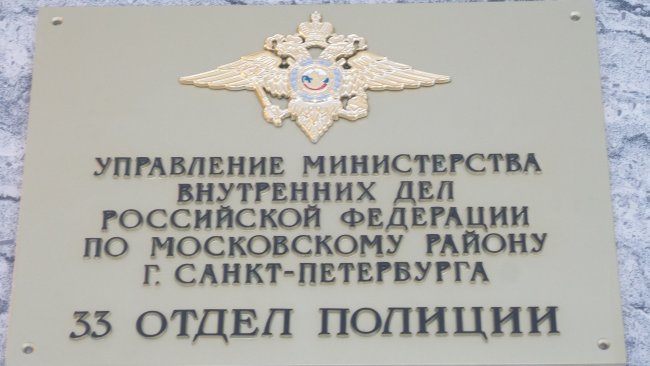
The sign outside the 33rd Police Precinct in Petersburg’s Moscow District. Courtesy of Google Maps and OVD Info

Petersburg Police Confirm Pepper Spray Used in Precinct
Radio Svoboda
June 19, 2017

The Interior Ministry Directorate for St. Petersburg has confirmed that pepper spray was employed in the 33rd Police Precinct, where detainees from the June 12 anti-corruption protest rally were being held, reports Rosbalt.

As the police’s press service reported, a man was brought to the precinct for minor misconduct. After the man attempted to harm himself, police officers doused his cell with pepper spray. The Interior Ministry claims that after the spray was deployed, the people who had been detained at the protest on the Field of Mars were taken to a meeting room.

Earlier, OVD Info reported that the protest rally detainees complained the pepper spray had spread into neighboring cells. They asked that a doctor be summoned to the precinct, since one of them suffered from bronchial asthma, but police officers did not react. One of the detainees, who had his mobile phone with him in the cell, managed to summon doctors. Subsequently, seventeen people, who had been left to spend the night at the precinct, were transferred to a basement room, where they were held until the evening of the following day. They were not given food, only one bottle of water each.

Alexander Shishlov, Petersburg’s ombudsman for human rights, said he would formally investigate the incident.

More than six hundred people were detained during an unauthorized [sic] protest rally against corruption in Petersburg. The city courts registered 546 cases against the detainees. They were charged with involvement in an unauthorized rally and disobeying the police.

Translated by the Russian Reader. Thanks to Comrade NS for the heads-up

Don’t Recite “Hamlet” in Public, or, The Moscow Police Always Get Their Man

bad kid
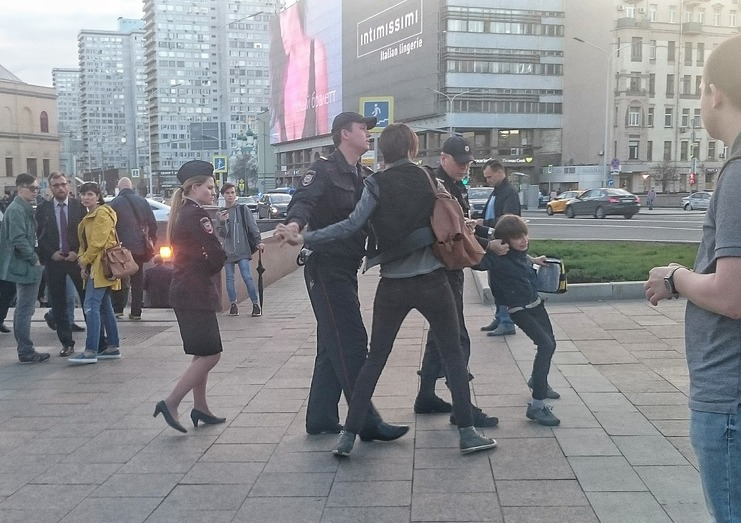
Eyewitness photo of incident. Courtesy of Mediazona

Moscow Police Detain Child Reciting Poetry
Takie Dela
May 26, 2017

Police detained a child reading poetry aloud on Moscow’s Vozdvizhenka Street. Takie Dela was informed about the incident by the website OVD Info‘s person on duty.

The child, reportedly ten years old, and his mother were relaxing near Arbatskaya subway station. The mother was sitting on a bench and reading, while the boy recited poetry a little ways away from her. A police patrol stopped near the boy, and police officers forced the boy into their car. They refused to let the mother talk to her son, explaining he would be charged with begging.  In addition, the police pushed the woman, causing her to drop and smash her tablet computer.

The boy was taken to Arbat Police Precinct. He was transported there without his parents. Later, his mother was brought to the same precinct. The child’s father arrived at Arbat Police Precinct later.

According to unconfirmed reports, the father could be charged with the administrative offense of insulting a police officer. He refused to sign a charge sheet accusing the parents of not fulfilling their parental duties, since he did not agree with the charges. The child is currently at the police precinct. As of this writing, Arbat Police Precinct is refusing to answer their telephone.

An eyewitness has posted a video showing the child screaming inside the police car.

Update, 10:10 p.m. The boy’s father, Ilya Skavronski, has told Mediazona that the boy goes to a theater workshop and was reciting Hamlet. The police officers in question conversed with the boy for a time at a distance of twenty to twenty-give meters from his mother, who approached them only when the boy had been forced into their car. According to Skavronski, the policemen cursed and behaved rudely while detaining his son. He added that the precinct’s deputy head had threatened to detain the boy’s mother on charges of resisting law enforcement officers.

Update, 12:00 a.m. The Moscow Police’s Information Response Department explained that the boy had been detained because he was alone and had been going up to “one car after another.” According to OVD Info, he has been released from the police precinct. Skavronski has been charged with violating Article 5.35 of the Administrative Offenses Code (non-fulfillment by parents of their child-raising duties of minors). Earlier, attorneys had arrived at the precinct, as well as Anatoly Kucherena, chair of the Interior Ministry’s Public Council. The lawyers are filing complaints against the actions of the police.

Translated by the Russian Reader. Image courtesy of Mediazona

It Was a Good Week in the Supah Powah, or, The Return of the Green Lanterns (OVD Info)

‘In 2016, Donald Trump rode a wave of popular discontent to the White House on the promise that he would “make America great again.” As Russia’s presidential election, scheduled for March 2018, draws nearer, President Vladimir Putin may try a similar tactic — by contending that he has already restored Russia’s greatness.’

Blogger Norwegian Forester

The authorities have been using every trick in the book to counteract the plans of Alexei Navalny’s supporters to hold events against corruption on March 26 in scores of cities. Authorities have been refusing to authorize the protests under different pretexts. Rally organizers in different regions have been arrested on trumped-up changes, summoned to the police, fined for inviting people to rallies on the social networks, and written up for holding meetings with activists. Volunteers have been detained for handing out stickers.

More Navalny

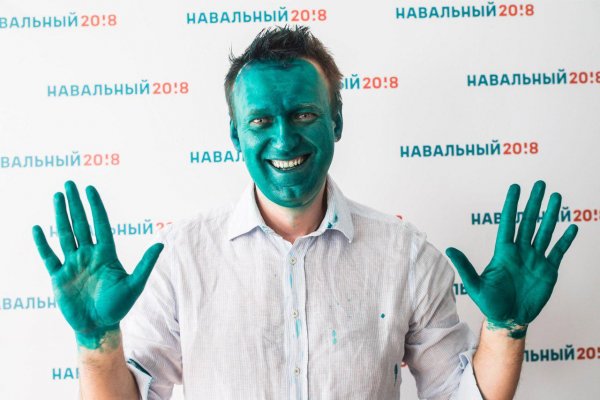
At the same time as he has been getting ready for the anti-corruption protests, Navalny has been opening election campaign headquarters in different cities. These events have also been subject violent attacks. In Barnaul, Navalny was doused with Brilliant Green antiseptic (zelyonka). In Petersburg, the door of his headquarters was set on fire. In Volgograd, Navalny was dragged by his feet and nearly beaten.

Alexei Navalny

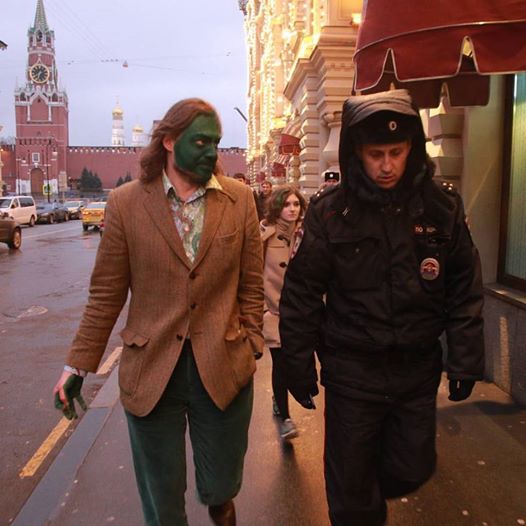
In Bryansk Region, a schoolboy was sent to the police for setting up Navalny support groups on the social networks: the police demanded he delete the accounts. In Krasnoyarsk University, a lecturer was fired for showing Navalny’s exposé of PM Dmitry Medvedev, Don’t Call Him Dimon. In Orenburg, a coordinator of the Spring youth movement was summoned to the rector, who asked him questions about Navalny. In Moscow, famous blogger Norwegian Forester was detained for going onto Red Square, his face painted green, in support of Navalny.

Not Only Navalny: Crackdowns on Freedom of Assembly

Long-haul truckers have planned a nationwide strike for March 27. Around twelve people were detained during a meeting of truckers in Vladivostok. Police claimed they had received intelligence on a meeting of mafia leaders. In Krasnodar Territory, an activist got three days of arrest in jail for handing out leaflets about the upcoming strike.

Krasnodar farmers have planned a tractor convoy for March 28. However, organizer Alexei Volchenko was arrested for twelve days for, allegedly, not making alimony payments. Another tractor convoy participant, Oleg Petrov, had his internal passport confiscated by police.

Judge Vladimir Vasyukov

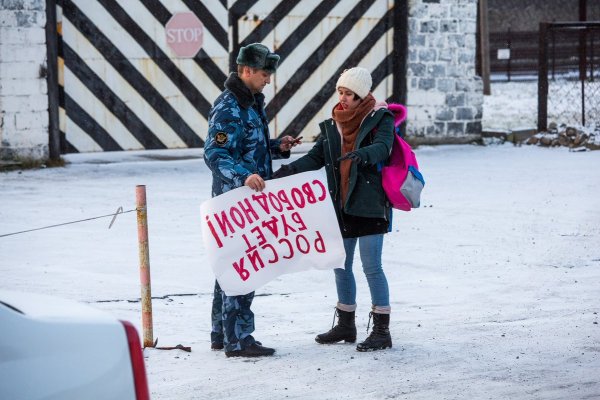
In Petersburg, Dzherzhinsky District Court Judge Vladimir Vasyukov during the past week imposed fines of 10,000 rubles [approx. 160 euros] each on three women, involved in a feminist protest on International Women’s Day, March 8, 10,000 rubles [approx. 160 euros], elderly activist Igor “Stepanych” Andreyev, accused of walking along a building during a solo picket, and activist Varvara Mikhaylova for picketing outside the Segezha Men’s Penal Colony in Russian Karelia in support of civic activist Ildar Dadin, who was recently released.

Varvara Mikhaylova. Photo courtesy of David Frenkel

In Murmansk, the authorities refused to authorize three marches against inflated utilities rates, food prices, and public transportation costs, while Moscow authorities refused to authorize a protest rally against the planned massive demolition of five-storey Soviet-era apartment buildings. In addition, Moscow police demanded a party at Teatr.doc be cancelled.

Moscow City Court ruled that meetings of lawmakers with their constituents should be regarded as the equivalent of protest rallies.

The Constitutional Court ruled the police can detain a solo picketer only if it is impossible to ensure security. The very next day, two solo picketers bearing placards on which Vyacheslav Makarov, speaker of the St. Petersburg Legislative Assembly, was depicted as a demon were detained by police.

Criminal Prosecutions and Other Forms of Coercion

Sergei Mokhnatkin, whose spine was broken in prison, was sentenced to two years in a maximum security penal colony for, allegedly, striking a Federal Penitentiary Service officer.

Sergei Mokhnatkin

As for talk of a new Thaw, two Ufa residents, accused of involvement in Hizb ut-Tahrir, had their suspended sentences changed to four years in a penal colony.

In Stavropol, Kirill Bobro, head of the local branch of Youth Yabloko, was jailed for two months, accused of narcotics possession. Bobro himself claims police planted the drugs on him.

Kirill Bobro

A graduate student at Moscow State University was detained and beaten for flying a Ukrainian flag from the window of his dormitory. In addition, he was forced to sign a paper stating he agreed to be an FSB informant. Ukrainian journalist Roman Tsymbalyuk was detained while trying to interview the graduate student.

What to Read

LGBT activist Dmitry Samoilenko describes how he has been persecuted in Kamchatka for a brochure about the history of gender identity in the Far North. Activist Rafis Kashapov, an activist with the Tatar Social Center, who was convicted for posts on the social networks, sent us a letter about life in a prison hospital.

Rafis Kashapov

The Week Ahead (March 26—April 1)

Closing arguments are scheduled for March 27 in the trial of Bolotnaya Square defendant Maxim Panfilov, who has been declared mentally incompetent. Prosecutors will apparently ask the judge to sentence him to compulsory hospitalization.

On March 29, an appeals court is expected to hear the appeal against the verdict of Alexander Belov (Potkin), co-chair of the Russians Ethnopolitical Movement.

Thanks for Your Attention

We continue to raise money for our monitoring group, which collects information on political persecution and takes calls about detentions at protest rallies. Thanks to all of you who have already supported us. You can now make monthly donations to OVD Info here.

Translated by the Russian Reader

“The Delirium of Religious Reformism”: Punitive Psychiatry Makes a Comeback in Chelyabinsk

Alexei Moroshkin. Photo courtesy of Memorial
Alexei Moroshkin. Photo courtesy of Memorial Human Rights Center

Chelaybinsk Resident Alexei Moroshkin’s Stay in Mental Hospital Extended Six Months
OVD Info
January 11, 2017

On January 10, the Soviet District Court in Chelyabinsk extended Alexei Moroshkin’s forced confinement in a psychiatric hospital for another six months, according to his mother Tatyana Moroshkina. Moroshkin had been sentenced to compulsory psychiatric treatment after having been accused of calling for violation of the Russian Federation’s territorial integrity.

According to Moroshkina, the court paid no attention to any of the arguments made by the defense, neither that her son’s actions and statements did not pose a threat to others, nor that, according to his medical record and the opinion of his physician, he was not dangerous and there was no need to hospitalize him. In making its ruling, the court was guided by the unsubstantiated opinion of court-appointed experts that Alexei Moroshkin could be dangerous, said his mother.

Moroshkin was committed to Regional Clinical Mental Hospital No. 1 in Chelyabinsk in December 2015. Prior to this, a court had considered the charges of calls for separatism made against him in connection with texts, posted on the VKontakte social network, about the need to establish a Ural People’s Republic. In November 2015, a court absolved Moroshkin of criminal liability, declaring him mentally incompetent on the basis of opinions submitted by medical forensic examiners, who during the police investigation had diagnosed him with paranoid schizophrenia, adding that he suffered from the “delirium of religious reformism.” This diagnosis was occasioned, apparently, by Moroshkin’s online publications and interviews dealing with the virtual Church of the Chelyabinsk Meteorite, which he had invented. At present, acccording to his mother, the medical experts do not mention delirium, but nevertheless consider her son mentally ill and a danger to others.

Before criminal charges were filed against him, Moroshkin had never been under a psychiatrist’s care.

According to his mother, Moroshkin’s physical condition has deteriorated: he suffers from a heart disease. The court also failed to take this circumstance into account.

In October 2016, Moroshkin was suddenly transferred to a wing with worse living conditions than before. Shortly before this, the hospital’s head physician was fined for refusing to provide information about Moroshkin to his defense attorney.

Currently, another case involving Moroshkin is under investigation. He has been accused of painting a bust of Lenin in Chelyabinsk in the colors of the Ukrainian flag and charged under Article 214.2 of the Criminal Code (vandalism).

Translated by the Russian Reader

Anna Karetnikova: Monitoring Moscow’s Prisons

karetnikova
Anna Karetnikova

Anna Karetnikova: “The worse things are in Russia and the less money there is, the worse things are in the system”
OVD Info
October 27, 2016

As promised, OVD Info has published the full version of our interview with Anna Karetnikova, civil rights activist and member of the last three Moscow Commissions for Public Monitoring of Detention Facilities. The term in office of the third Moscow Public Monitoring Commission (PMC) is coming to an end, and by law anyone who has sat on the same commission for three consecutive terms cannot apply to serve on it again. Karetnikova had applied to serve on the Moscow Region PMC, but was not included in the new commission’s lineup. Similar things happened to a large number of civil rights activists who tried to get appointments to PMCs in other parts of Russia.

The interview was conducted shortly before the new lineups of the oversight commissions were made public. In conversation with OVD Info, Karetnikova summed up the work of the Moscow PMC and talked about the Russian penitentiary system’s numerous problems.

What is a PMC?

A PMC is a public monitoring commission of detention facilities. On the basis of Federal Law No. 76, its members are admitted into institutions that have such facilities, from police stations to remand prisons, including temporary detention centers, military prisons, and so on. They see the conditions of detention and can make recommendations on enforcing the law, eliminating violations, and otherwise furthering the legal interests of the persons imprisoned there.

How would you assess the work of the current commission? During your term have you been able to effect changes in the system, in the treatment of inmates, and the way the system interacts with civil rights activists?

I would rate it quite highly. I can speak only about the Moscow PMC. We succeeded in implementing serious reforms in meal services, accountability, and expanding the range of products that can be delivered to inmates in remand prisons. We made definite improvements to the Kaluga Federal Unitary State Enterprise, the [online] prison store or shop where inmates’ relatives can order things for them.  We definitely improved the conditions in Women’s Remand Prison No. 6. Unfortunately, among the things that have remained beyond our control and are getting worse, in my opinion, is medical care. The more we try and get on top of it, the worse it gets.

Medical care has remained a fallow field despite the huge effort we made to improve it just a bit. It was like running up the down escalator.

Nothing can be done. I understand the situation with healthcare is the same nationwide, but it is particularly horrible in our remand prisons.

What do you mean by accountability?

Registering complaints. If we are not around, say, the only way an incarcerated inmate can get something is by filing a complaint or petition. We expended a great deal of effort making sure these complaints and petitions were registered normally, because basically they save lives. It can happen that someone asks to see a doctor for six months and submits petitions to this effect, but none of them is registered. Then he dies, and we are sent an official reply that he never requested medical treatment. Continue reading “Anna Karetnikova: Monitoring Moscow’s Prisons”

The Extremist Schoolboy from Perm Territory

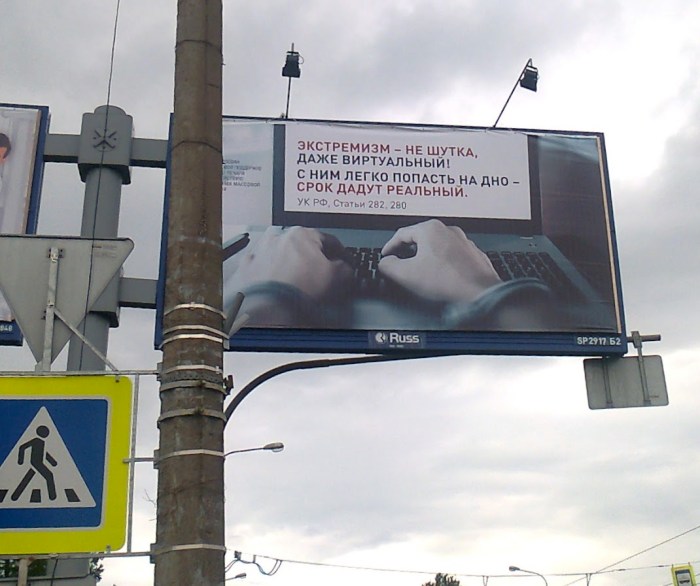
"Extremism is no joke, even virtual extremism. You can easily go down for it, and get a harsh sentece. Russian Federal Criminal Code, Articles 282 and 280." Public service billboard, Lesnoy Prospekt, Petersburg, August 7, 2016. Photo by the Russian Reader
“Extremism is no joke, even virtual extremism. You can easily go down for it, and get a harsh sentece. Russian Federal Criminal Code, Articles 282 and 280.” Public service billboard, Lesnoy Prospekt, Petersburg, August 7, 2016. Photo by the Russian Reader

FSB Detains Schoolboy on Extremism Charges in Perm Territory
OVD Info
December 19, 2016

16-year-old Mark R. was detained by FSB officers right in the middle of classes in the village of Uralsky, located in Perm Territory’s Nytva District. The teenager has been charged with calling for extremist actions (Criminal Code 280.2). The local news agency Periskop reported the incident, citing its own sources.

The schoolboy was interrogated at the regional FSB office. Mark has now been released on his recognizance and is attending school.

The charges were filed in connection with a entry made last spring on the social network Vkontakte. During a discussion with Christian friends, the schoolboy had written to them that “churches should be burned down.” Experts from the Interior Ministry office for the Republic of Udmurtia conducted a linguistic forensic examination and concluded the “statement was hortatory in nature and encouraged hostile action.”

Translated by the Russian Reader

The Extremist Proofreader from Kaluga

photo0327
“Extremism is no joke, even virtual extremism. You can easily go down for it, and get a harsh sentece. Russian Federal Criminal Code, Articles 282 and 280.” Public service billboard, Lesnoy Prospekt, Petersburg, August 7, 2016. Photo by the Russian Reader

Kaluga Resident Faces Criminal Charges for Two-Year-Old Repost
OVD Info
December 19, 2016

On November 17, FSB officers came to Kaluga resident’s Roman Grishin workplace and took him away to an investigator. After being interrogated on camera, Grishin was informed he stood accused of inciting enmity and hatred (Criminal Code Article 282.1) for reposting a video in 2014. Grishin wrote about the incident on Facebook on December 18. He was released on his own recognizance as a suspect in a criminal case.

“A group of FSB officers in balaclavas and special kit showed up in the morning at my work, plunging my coworkers into a considerable stupor,” writes Grishin.

The video is entitled “New Hit from Kharkov! This Is Russism, Baby.” Acccording to Grishin, it is freely accessible on YouTube.

As Grishin told OVD Info by telephone, the main topic of his interrogation by FSB officers was his regular trips to Ukraine. They asked why he had his picture taken on the Maidan. Grishin visits the country as a tourist, stays with friends, and stresses that he does not collaborate with any organizations in Ukraine.

Grishin lives in Kaluga. Educated as a philologist, he works as a proofreader. The FSB’s scrutiny has been a real shock to him.

“I never voiced any appeals [for enmity or hatred]. You could say I’m a couch activist,” he said.

This is not the first case of persecution for publishing the video to Boris Sevastyanov’s song “This Is Russism, Baby.” Previously, however, its posting was the occasion for filing misdemeanor charges of disseminating extremism matter (Administrative Offenses Code Article 20.29). In April 2016, Krasnodar LGBT activist Nina Solovyova was convicted of commmitting a misdemeanor for posting the video and sentenced to ten days in jail. Solovyova told her story to OVD Info in April of this year.

Translated by the Russian Reader

In No Mood for Songs and Dialogues (OVD Info)

In No Mood for Songs and Dialogues
OVD Info
July 2, 2016

Hello. We continue to raise money for the work of our monitoring group. Watch the following video, in which Artyom Loskutov, co-founder of the annual Monstrations, talks about what champs we are.

You can donate money to us by heading to this page.

Last week, Moscow courts left two suspects in the Bolotnaya Square case, Dmitry Buchenkov and Maxim Panfilov, in police custody, along with Petersburg architect Sergei Akhmetov, accused of tearing epaulettes from a policeman’s uniform during a gathering in support of Alexei Navalny and Pyotr Ofitserov. Curiously, police investigators have been unable to produce convincing evidence that Buchenkov and Akhmetov were actually at the scene of the crimes of which they have been accused.

Maxim Panfilov. Courtesy of OVD Info

Other Criminal Prosecutions

No less predictable was the rejection of Oleg Navalny’s petition for parole, especially considering the fact that, a week before his court hearing, he received three reprimands for poor conduct at the penal colony where he has been imprisoned.

Totally unpredictable, however, was the return to Moscow of Ildar Dadin, sentenced to two and a half years in a prison colony for “repeated violations” at public protests.  Dadin had been held for over two months in a Petersburg remand prison, and it was anticipated that sooner or later he would be transferred to a penal colony. For some reason, however, this has not happened.

News came of the first criminal charges filed for “willful refusal” to obey the law on “foreign agents.” Charges were filed against Valentina Cherevatenko, chair of Women of the Don Foundation.

Valentina Cherevatenko. Courtesy of Frontline Defenders
Valentina Cherevatenko. Courtesy of Front Line Defenders

Shapi Biyakiyev, a Petersburg trucker involved in the recent nationwide protests by truckers against the new Plato toll system, was charged with using violence against a police officer.

The week would not be complete without news of more “extremism” cases. Yuri Yekishev, a support of Colonel Vladimir Kvachkov, was arrested. He has been accused of having incited hatred with a video recording. Perm resident Vladimir Luzgin was found guilty of rehabilitating Nazism and fined 200,000 rubles for reposting an article about collaboration between “communists and Nazis” during WWII. But the case of Stavropol resident Viktor Krasnov, accused of offending the feelings of religious believers, has been suspended, because the court has expressed its doubts as to the legitimacy of the forensic examination of Krasnov’s statements, taken out of context from an online discussion.

Detentions

In Hurzuf, Crimea, residents upset that a local beach had been transferred to the Artek Young Pioneers Camp were detained by police.  Meanwhile, in Moscow, tempers flared around construction of the so-called Northeast Chord highway. First, a cyclist was detained for protesting the felling of trees in Kuskovo Park, and then people opposed to the felling of trees on Krasny Kazanets Street in Veshnyaki were detained.

“Murder of 200-Year-Old Oak in Kuskovo Park,” posted July 2, 2016, by Ecowalker First

Moscow police also detained people in a hunger strike organized by the Moscow Queue Waiters [i.e., ocheredniki, people on a waiting list for affordable housing—TRR] twice in a single day outside the constituent reception offices of the ruling United Russia party. When the detainees were released from a police station after the first detention, they went back to the reception offices and were rearrested. But Makhachkala outdid everyone: around eighty believers were detained after Friday prayers outside a Salafist mosque.  Meanwhile, Dagestan public figure and parliamentary candidate Rasul Ismailov was detained in Khasavyurt.

Cellist Semyon Lashkin, detained last week while busking in Moscow, was fined 10,000 rubles for “deliberately creating a crowd and preventing pedestrian movement.”

Other Forms of Persecution

An unnamed 23-year-old resident of Salekhard was sentenced to five days in jail for posting “extremist” music, presumably songs by Krovostok and Kolovrat, on a social network.

Daniil Alexandrov, a freelance correspondent for online newspaper Meduza, was ticketed for working without accreditation in Karelia, where he gone to cover the story of the children who died on Lake Syamozero.

FSB agents raided the Mayakovsky Library in Petersburg in connection with the fact that it served as the venue for Dialogues, monthly public discussions of political topics. The project’s founder, Nikolai Solodnikov, resigned his post at the library, which will no longer host the events.

In Krasnodar, people involved in solo pickets against the policies of current Mayor Vladimir Yevlanov and in support of Communist Party MP Sergei Obukhov were assaulted, while in Kemerovo, local opposition activist Stanislav Kaliniсhenko was detained, taken to a police station, and, allegedly, beaten up by police.

Opposition activist Stanislav Kalinichenko after his alleged beating by police in Kemerovo. Courtesy of his blog

Karelian village council member Vladimir Zavarkin, sentenced to a fine for calling for a referendum to decide whether the republic should secede from Russia, was stripped of his mandate.

Read

Two plus two does not always make four: how Russian courts calculate prison terms in criminal cases and jail terms in administrative cases.

Translated by the Russian Reader
It’s Been a Quiet Week in the Motherland (The News from OVD Info)

Maxim Panfilov
Maxim Panfilov

Hello! One of the main events of the past week for us was not Putin’s “Direct Line,” but the arrest of a man who spoke with Putin a year ago. Anton Tyurishev, a construction worker at the Vostochny Cosmodrome in the Russian Far East, complained to the president that he and his mates were not being paid their wages.  Putin promised to get to the bottom of it, but a year on nothing had changed. Tyurishev promised that in response protests would kick off. Later, he was summoned to the police station, where the “Law on Rallies” was read out to him. The day before the “Direct Line” broadcast, he was detained and sent to jail for five days, allegedly, for swearing in public.

Criminal Prosecution

The new defendant in the Bolotnaya Square Case, Maxim Panfilov, who suffers from Tourette’s syndrome and yet was taken into police custody, is not getting the medicines he needs. Instead, he is being administered substitutes that do not alleviate his condition. Panfilov has been appointed an outpatient psychiatric examination. The investigator has agreed to let defense attorneys attend it.

Ildar Dadin, convicted of “multiple violations of the rules for holding public events,” was convoyed from Moscow to Petersburg right on his birthday, which means he will serve his sentence in Leningrad Region.

Ildar Dadin
Ildar Dadin

Last week, it transpired that Magomednabi Magomedov, imam of the Eastern Mosque in Khasavyurt, had been arrested, accused of incitement to terrorism and inciting religious and ethnic hatred. Magomedov, who was transported from one place of confinement to another over several days, complained he had been tortured. Pretrial detention facility officers had beaten him and forced him to kneel, demanding that he confess to the charges.

Euromaidan participant Alexander Kostenko, convicted of harming a Berkut riot police officer, was transferred to solitary confinement shortly before a hearing where his request for parole was to be examined. Naturally, Kostenko’s parole request was rejected.

Alexander Kostenko
Alexander Kostenko

It seems soon Alexei Navalny will have no allies who are not undergoing criminal prosecution. Ivan Zhdanov, head of the Anti-Corruption Foundation’s legal service, and a candidate for the council of deputies in the Moscow suburb of Barvikha, has been charged with evading conscription.

Freedom of Assembly

In Ulyanovsk, police diligently searched for activists who had blocked a road in connection with construction of a residential complex. They visited one activist at work, and telephone another and asked him to report for questioning. When he demanded an official summons, they threatened him with criminal charges. Administrative charges have been filed against three people.

In Volgograd, the leader of the regional Union of Entrepreneurs and Freight Haulers has been slapped with three administrative charges for calling people to a protest rally before the rally was authorized. The court threw out two of the three charges, while the third resulted in a fine.

The confrontation continues in Moscow’s Dubki Park. Defenders of the park, who oppose construction there, are fined for disobeying the police. A female journalist’s arm was injured when an assembly of defenders was dispersed. When he was detained, one of the activists, Dmitry Boinov, was beaten so badly that he has been in hospital for a week recovering from fractures.

Beatings

In Podolsk, three men attacked Maxim Chekanov, a past participant of protest rallies. The incident began when they called Chekanov by name, asked him questions about the “Kiev junta,” called him a “Banderite scumbag,” and then invited him to go round the corner. During the ensuing fight they smashed Chekhanov’s face.

Popular Chechen singer Hussein Betelgeriev, who disappeared in late March, has returned home beaten. It is unknown where he was all this time. Relatives and friends suggest he was abducted, and connect the abduction with his comments on social networks and the fact he ignored the call to attend a pro-Kadyrov rally on March 23.

Reading

Olga Sutuga, mother of anti-fascist Alexei Sutuga, currently serving time at a penal colony in Irkutsk Region, talks about the international aid project Political Prisoners University.

Thanks for your attention!

_________

OVD Info is an independent human rights media project dedicated to political persecution in Russia. We are engaged in daily monitoring of detentions at public events, and publish information about other kinds of political persecution. We believe that information liberates and protects, and analyzing the data we collect can help change the situation for the better in the future.

Editor’s Note. OVD Info sends out a weekly email news roundup, in Russian, to its supporters. I thought that, despite its brevity, this week’s roundup provided a fairly eloquent picture of the state of affairs in this country at present and not just this particular week. You can sign up to the mailing list by going to the bottom of any page n the OVD Info website and entering your email address where you see the phrase ПОДПИСАТЬСЯ НА РАССЫЛКУ.