Ukraine (The Betrayal)

Source: “The World in Brief,” The Economist, 15 February 2025


Today, there was one happy man in the Kremlin. Vladimir Putin banked his legacy on an all-out war that, at one point, looked all but lost for him. But he waited long enough to see the tides change in his favor.

Three years in and hundreds of thousands of deaths after, the U.S. president is calling Putin, offering peace talks on Russia’s terms.

Hi, my name is Oleksiy Sorokin, I’m the deputy chief editor of the Kyiv Independent, and this is the latest issue of our Russia-themed newsletter.

Today we will talk about how Russia is about to win the war.

It’s a topic of debate when authoritarian Russia began morphing into a totalitarian state, but Feb. 24, 2022, is a point that finalized this transformation. A point of no return.

The all-out war was supposed to be quick. It was supposed to be a victory of a new world order and of a new Russia, once again a force that would decide the fate of the world, a force that people would fear.

Taking Kyiv, installing a new Russian-controlled government, and forcing Ukraine to recognize Crimea, Donetsk, and Luhansk as Russian was to be achieved within months, if not days.

The country Putin attempted to subjugate, however, was fiercely resisting. Something that Russian political and military leadership didn’t expect and didn’t prepare for.

Yet, over and over, Russian President Putin was bailed out by the West.

In 2022, Russia was making fortunes on selling off its energy resources to the West. When Russian troops were murdering civilians of Mariupol and nearing Kyiv, Moscow’s war chest was being replenished by Europeans.

The slow phasing out of Russian energy resources in the West allowed Russia to iron out its pivot to the East, building a formidable shadow fleet to transport its energy resources to anyone willing to buy.

When Russia began to lose ground and prepare for a Ukrainian counteroffensive, the U.S. was slowing down military shipments, giving Moscow further breathing room.

Seeing that the West was unwilling to support Ukraine to the fullest and was willing to allow Russia to continue, Russia, well, continued.

Russian leadership doubled down, increasing attacks on Ukraine, making committing war crimes a state policy, and simultaneously choking all forms of dissent at home.

Ukrainian civilians and prisoners of war were tortured and often murdered, and children from occupied territories were abducted.

Domestically, Russia outlawed speaking against the war, with people receiving hefty prison terms for criticising the invasion.

For the majority, however, the state made sure their economic well-being and daily routines remained unchanged, allowing ignorance to flourish. The Russian economy was doing fine.

All this made Putin confident. He knew that time played in his favor. The U.S. would surrender, and Europe would be in no position to object. He was right.

While on the campaign trail, Donald Trump had made it clear that he has little interest in continuing to support Ukraine’s fight against Russia.

His comments of ending the war in “24 hours” were a figure of speech, but it was clear that some sort of peace plan would be presented by the incoming administration.

Russia listed its demands, Ukraine listed theirs. Both waited. The fighting went on along the front line.

Russia was in a better position to negotiate. The West’s unwillingness to truly stop Russia, especially if it meant causing any sort of inconvenience at home, allowed it to regroup and begin a major offensive, ongoing to this day.

What came next was too good to be true… for Russia.

On Feb. 11, U.S. Defense Secretary Pete Hegseth began his European tour. Off the bat, he made public the U.S. position concerning the upcoming peace talks.

Hegseth said, “Returning to Ukraine’s pre-2014 borders is an unrealistic objective,” and that NATO membership for Ukraine is not an option, effectively agreeing with Russia’s demands.

Then, Trump called Putin.

“We both reflected on the great history of our nations and the fact that we fought so successfully together in World War II, remembering that Russia lost tens of millions of people,” said Trump following the call, parroting the Kremlin’s favorite line of the huge sacrifice Russia undertook in a war that ended 80 years ago, and how it is for whatever reason relevant today.

“As we both agreed, we want to stop the millions of deaths taking place in the war with Russia/Ukraine. President Putin even used my very strong campaign motto of ‘common sense’,” Trump added.

“We agreed to work together, very closely, including visiting each other’s nations. We have also agreed to have our respective teams start negotiations immediately, and we will begin by calling President Zelensky of Ukraine, to inform him of the conversation,” he went on.

The next day, Trump proposed to return Russia to G7, the intergovernmental political forum of the most developed democratic countries from which Moscow was kicked out following the start of its war in 2014.

Russian officials and pro-war public figures were openly excited about Trump’s moves.

“The movement that has begun is the result of the heroic work of our fighters and the principled position of Vladimir Putin, who speaks of openness to negotiations but firmly defends Russia’s national interests,” said lawmaker Evgeniy Revenko, deputy head of Putin’s United Russia party.

“Zelensky’s days are numbered, and Trump’s arrival at the Victory Parade in Moscow no longer seems like a fantasy,” he added.

“The phone call between Putin and Trump will go down in the history of world politics and diplomacy. It is not a breakthrough yet, but perhaps the first step towards one. I am sure that in Kyiv, Brussels, Paris, and London, they read Trump’s lengthy commentary on his conversation with Putin with horror and cannot believe their eyes,” said Russian Senator Aleksey Pushkov.

I can’t believe I’m saying this, but I agree with Mr. Pushkov.

Following the call, the Kremlin said, “We, of course, understand that our main counterpart in this process is Washington.”

And here we are today. It took three years, but Russia is where it wanted to be from the start — at a table with the U.S. deciding the fate of the world without the world’s consent.

Putin will push for more, seeking to squeeze the most out of Washington, and give nothing in return.

Russia would demand to keep the territories it controls, and most likely try to take the ones it doesn’t. According to Russia’s new constitution, Russia sees Ukrainian Crimea, and four oblasts — Donetsk, Luhansk, Zaporizhzhia and Kherson — as its own. Russia doesn’t have full control of any of the four.

With NATO off the table, other demands might be thrown at Trump, reducing Kyiv’s army or legalizing Russian language and influence in Ukraine.

Whether the U.S. will agree, and most importantly, whether Kyiv and the EU will go by the agreements that Moscow and Washington are set to achieve behind their backs, remains to be seen. There’s a strong chance that they won’t.

But overall, the sun is now much brighter for Putin than it was just a few days ago.

Eleven years of fighting against Ukraine, three years of all-out war and thousands of war crimes committed, Putin isn’t a pariah anymore. His worldview is on track to become mainstream, and it’s the leader of the free world who is leading him back to the table.

Source: Oleksiy Sorokin, “WTF is wrong with Russia” (newsletter), Kyiv Independent, 13 February 2025


In this week’s bulletin: Russia used US banks to dodge sanctions/ Private military companies at war/ Crimean 2024 human rights report/ Further evidence of Russian tortureexecution of prisoners, fabrication of evidence and withholding of medical aid in occupied areas/ New wave of detentions in Crimea

News from the territories occupied by Russia:  

Young people who have quit the occupied areas: “It’s like being freed from a horrible stench” (Ukrainska Pravda, 9 February)

Stadiums under occupation: sports facilities in Donbas today (Ukrainska Pravda, 7 February)

Russia uses medical torture to fabricate its ‘trial’ of disabled 74-year-old Volodymyr Ananiev (Kharkiv Human Rights Protection Group, February 7th)

Russians refuse to sell insulin and other vital medicines to Ukrainians without Russian passports, reports Ukrainian intelligence (Ukrainska Pravda, February 7th)

How can Ukraine solve the problem of documents from the occupied territories? Human rights defenders share their vision with international partners (Zmina, February 7th)

A janitor, a cook, an informer — who is being tried for collaborating with the enemy? (Kharkiv Human Rights Protection Group, February 6th)

Russian FSB carry out new terror raids and arrests by quota in occupied Crimea (Kharkiv Human Rights Protection Group, February 6th)

Human rights and humanitarian legal norms: 2024 review (Crimea Human Rights Group, 5 February)

Viktor Dzytsiuk was almost tortured to death in occupied Donbas. Now Russia is continuing his torment (Kharkiv Human Rights Protection Group, February 5th)

ZMINA took part in a discussion on the cultural decolonisation of Crimea (Zmina, February 4th)

Russian FSB uses shoddily faked video to charge 63-year-old woman abducted from occupied Ukraine with ‘terrorism’ (Kharkiv Human Rights Protection Group, February 3rd)

First prosecution in Crimea for “childfree propaganda” (Crimea Human Rights Group, 2 February)

The situation at the front:

Russian forces advance on Pokrovsk (Meduza, 5 February)

News from Ukraine – general:  

Support for war victims: human rights defenders presented new roadmap of draft laws (Zmina, February 5th)

Defying Odds In Ukraine  (They Said So, February 4th)

Ukrainian Holocaust survivor: Hitler wanted to kill me as a Jew. Putin is trying to kill me because I’m Ukrainian (Kharkiv Human Rights Protection Group, February 3rd)

How Ukraine lost faith in the Red Cross and UN (Kyiv Independent, January 22nd)

Ukraine: Bikis, our feminist year (Europe Solidaire Sans Frontières, January 20th)

Ukraine: And yet he remained a human  (Europe Solidaire Sans Frontières, January 4th)

War-related news from Russia:

Draft exemptions as Russians know them are ending (Meduza, 6 February)

Rebranding private military companies for the war in Ukraine (Posle.media, 5 February)

Support fundraisers for Solidarity Zone’s recipients in court (Solidarity Zone, 5 February)

Russia used US banks to send billions to Turkey, dodging sanctions (Kyiv Independent, February 3rd)

The Russian far right: “an affinity for violence brings them together” (Posle.media, 29 January)

Analysis and comment:

US Aid, Russia and Ukraine (The Russian Reader, 4 February)

A girl from the burnt village: the story of Maria Nevmerzhytska (Commons.com.ua, 3 February) 

Statement by human rights organisations: another wave of searches and detentions of Crimean Tatars (Crimean Human Rights Group, 2 February) 

Research of human rights abuses:

Prison medicine: ways to humanize it (Kharkiv Human Rights Protection Group, February 7th)

UN monitors report sharp increase in executions of Ukrainian POWs, and point to Russian officials’ effective incitement to kill (Kharkiv Human Rights Protection Group, February 7th)

The Centre for Civil Liberties Participated in the First World Congress on Enforced Disappearances  (Centre for Civil Liberties, February 6th)

“I Urge You to Make Every Effort to Release Ukrainian Prisoners of War And Unlawfully Detained Civilians ” Maksym Butkevych at the UN Security Council (Centre for Civil Liberties, February 6th)

“Crimes Against Peaceful Civilians Warrant Your Action” The Center for Civil Liberties Appealed to PACE Members  (Centre for Civil Liberties, February 6th)

Upcoming events:

Saturday 15 February, 11.0 am — 4.0 pm, Conference: End the Russian invasion and occupation. National Education Union, Mabledon Place, London, WC1H 9BD. Register here.

Saturday 15 February, 11.0 am – Palestine solidarity demo. To join the Ukraine-Palestine solidarity contingent, with our banner, “From Ukraine to Palestine – Occupation is a crime”, meet outside Banqueting Hall, corner of Whitehall and Horseguard Avenue, London SW1A

Saturday 22 February, 12.00 , Demonstrate at the Russian embassyAssemble 12 noon – St Volodymyr statue, W11 3QY Rally 1pm – Russian embassy, W8 4QP. Flyers are available for distribution – email info@ukrainesolidaritycampaign.org and ask for them.

==

This bulletin is put together by labour movement activists in solidarity with Ukrainian resistance. To receive it by email each Monday, email us at 2022ukrainesolidarity@gmail.com. To stop the bulletin, reply with the word “STOP” in the subject field. More information at https://ukraine-solidarity.org/. We are also on twitterBlueskyFacebook and Substack, and the bulletin is stored online here

Source: News from Ukraine Bulletin 133 (10 February 2025)


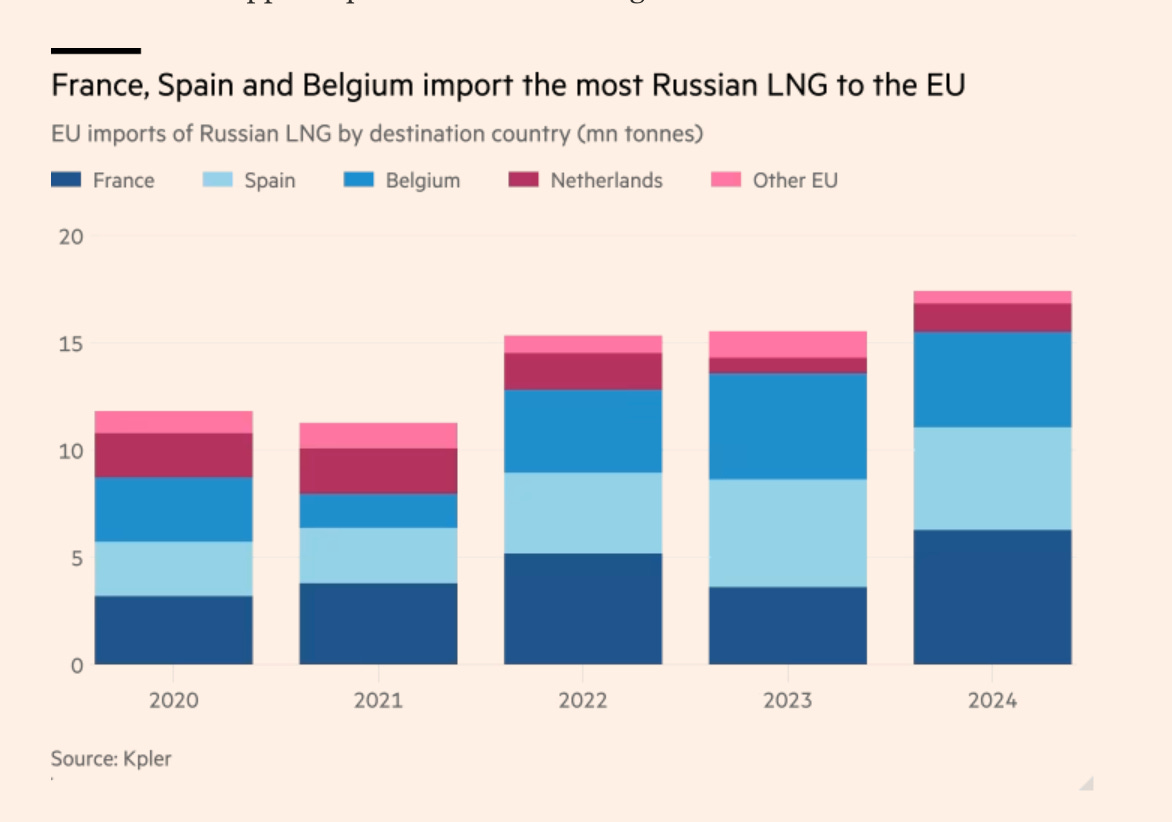
Europeans still like cheap Russian LNG
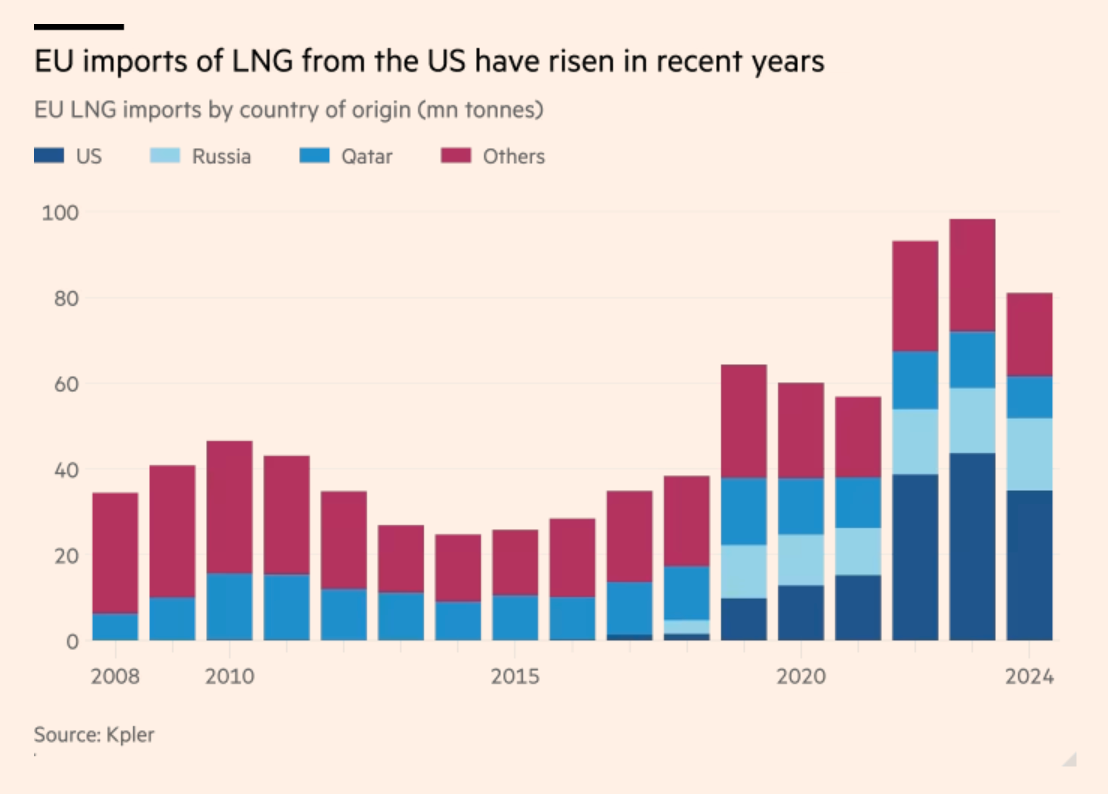
France, Spain and Belgium are the biggest buyers
Source: FT

Source: Adam Tooze, “Why Europe and India are still buying Russian energy. Friedman and Schwartz disaggregated. Cuba in Africa and the decline of the all-nighter,” Chartbook, 15 February 2025


Russia’s full-scale invasion of Ukraine in 2022 prompted a refugee crisis in Europe. News footage showed people piling onto trains and into cars, desperate to escape the threat of bombs and Russian occupation. In Kharkiv, a taxi driver named Sergii told me how in those chaotic early days of war, he had helped evacuate people as Russian missiles turned his bustling neighbourhood of Saltivka into a ghost town.

“I survived by praying to God,” Sergii said, pointing to the icon of the Virgin Mary dangling from his cab’s rearview mirror. “I helped people with no money get out of Saltivka, because people with money had already left.” He narrowly avoided death himself, he added, explaining a rocket had destroyed his apartment as he went out to his cab to retrieve the mobile phone he’d left on the front seat.

Nearly seven million people have now fled Ukraine. The majority have settled in European countries, many of which responded to the war by waiving visa requirements for Ukrainian refugees. Around 250,000 came to the UK, which decided not to fully lift restrictions but to instead introduce two emergency visas: the Ukraine Family Scheme and the Homes for Ukraine scheme.

At their outset, both visas granted Ukrainian nations the right to live, work and study in the UK for up to three years. Now, as the third anniversary of Russia’s invasion rolls around, anybody who arrived in the early days of the war is about to see their right to remain expire.

Yet this week, many Ukrainians faced the prospect that they may never be able to return to their homes. US President Trump announced he had spoken to his Russian counterpart, Vladimir Putin, to begin peace negotiations that risk handing over occupied regions of Ukraine to Russian control.

Residents of Ukrainian towns and cities previously liberated from Russian control, such as Bucha and Izium, have spoken about the reign of terror and cruelty they endured under occupation, including torture, rape, summary executions and false imprisonment. Should the peace deal go ahead on Putin’s terms, Ukrainian refugees in the UK face an increasingly uncertain future, with those whose homes are in the occupied territories potentially unable to return.

But even before the announcements from the White House and the Kremlin, the UK’s visa schemes have long presented problems for the vulnerable Ukrainians they are supposed to support.

“Before the full-scale invasion, I had a normal life,” Nastya*, aged 24, told openDemocracy “I worked in a supermarket and a fabric factory. Everything was absolutely good. And then on 22 February 2022, the war started.”

At the time, Nastya lived in Uzhorod, a city near the Slovakian border. As missiles battered the country’s major cities and the Russian forces occupied cities such as Izium and Mariupol, committing war crimes in Bucha and Irpin, she decided to flee with her husband.

“It was a stressful time,” she admitted. “I did not know what the future would be and my family were scattered around the world, some in England, some in Germany and some in Ukraine.”

Nastya and her then-husband travelled to Germany, where her mother was living, before coming to the UK on the Ukraine Family Scheme in August 2022. “It was hard to get a job in Germany, especially as I don’t speak German,” she explained. “I didn’t want to live on benefits, I wanted to support myself and live independently. I had heard in the UK there were opportunities for work, so I relocated.”

Nastya and her husband’s visas took only a few days to be approved, and the pair moved in with her sister-in-law in Leeds, where Nastya found a job in a local factory. “The work was hard and physical with lots of heavy lifting but I was earning some money which is good,” she said.

After three months in the UK, Nastya discovered she was pregnant with her first child. It was happy news, but it came as her marriage was falling apart. “It was quite difficult,” she said. ‘My husband was very sad and there were a lot of horrible moments. I decided to separate from him and go to Germany to be with my mother to have the baby.”

Nastya gave birth to a beautiful baby girl, who shares her bright brown eyes and dark hair. While she had wanted to be with her own mother during the birth, as a newly single mum Nastya was keen to return to the UK, where her father and grandmother were living, to get a job, support her daughter, and start a new life.

She had assumed that as she had the right to live and work in the UK, her daughter would be able to join her on the same family visa scheme.

But what Nastya did not realise is that while she was caring for her newborn in Germany, the Conservative government had been quietly restricting Ukrainians’ right to enter the UK. The family visa scheme had been closed and Ukrainians were no longer allowed to sponsor fellow refugees to arrive on the Homes for Ukraine visa.

Now, if Nastya wanted to come to the UK, she would have to leave her daughter behind.

War in Europe

When the Homes for Ukraine scheme was launched in 2022, members of the British public could open their homes to Ukrainian refugees in exchange for an initial monthly payment of £350 from their local council, while Ukrainians who successfully applied for the scheme were granted the right to live, study and work in the UK for three years.

But in February 2024, the then-Tory government brought in a series of changes. It halved the length of time a new Ukrainian applicant would be able to stay in the UK to 18 months, and amended the rules so that only people with British citizenship can sign up to become hosts. At the same time, it cancelled the family visa scheme, meaning Ukrainian nationals living in the UK can no longer sponsor family members to join them.

These changes have effectively made it impossible for Ukrainian nationals in the UK to help loved ones to settle here to escape the war. Now, Ukrainians wanting to come to the UK are reliant on there being an available British citizen who will take them in. But this, too, has suffered changes that have made it a less appealing prospect for many hosts.

In November, the Labour government announced all British citizens signed up to the Homes for Ukraine scheme will be paid £350 a month, regardless of how long they have been hosting. Households who have been hosting for more than a year are currently paid £500 a month.

Even before this announcement, the number of hosts was in decline, according to openDemocracy’s analysis of government data. In the third quarter of 2023, 100,061 households in England received the monthly ‘thank you’ payment, but by the third quarter of Q3 2024, this had fallen to 48,533 households, the lowest number since the full-scale war began.

This decrease in hosts was also apparent in our review of Homes for Ukraine Facebook pages. While at the start of the war, posts from Ukrainians looking for sponsors received multiple comments from potential hosts, these days they often garner no responses or are met with ‘jokes’, with one commenter saying: “I’d rather be in Mykolaiv than London”. Others respond telling those who wish to relocate to the UK from another European country, like Nastya, that the scheme is not for them: “People in the UK would prefer to sponsor people who are in Ukraine and need to be saved from war.”

“Instead of putting more and more administrative barriers in front of people fleeing war, the UK government must show it can match the solidarity and empathy shown by the people of the UK,” said Alena Ivanova, committee member of the Ukraine Solidarity Campaign, which is organising a march to the Russian embassy in London to mark the third anniversary of the full-scale invasion.

“We know that the vast majority of Ukrainians in the UK are vulnerable women, small children and elderly people who carry significant trauma as a result of Russia’s brutal war. The least we as a country can do is not put them further at risk and increase their anxiety but help them settle and rebuild their lives,” Ivanova added.

Those who arrived in the UK through either the Homes for Ukraine or Ukraine Family Visa scheme in the early days of the war are about to see their right to remain expire. But with the conflict ongoing, they can extend their visas via the Ukraine Permission Extension Scheme.

While this extension is undoubtedly needed, the process for obtaining it is fraught – and may put vulnerable people at risk of falling out of the system.

People needing an extension can apply only when they have 28 days or less left on their right to remain, which may impact their ability to work or be housed, with landlords and employers nervous about accepting Ukrainians who may not have the legal right to be in the country. Those who miss the extension window are at risk of becoming undocumented and therefore will be considered to be in the UK illegally. Although the war means it is unlikely these people will be deported, they would be unable to work or access housing, and are at risk of being removed in the future.

And applications for extensions can only be made from within the UK – a problem for women like Nastya in Germany, or for anyone visiting family in Ukraine.

Polling by the Office for National Statistics found that while the majority of Ukrainians are aware of the visa changes and the need to apply for an extension, a small minority of mainly vulnerable refugees, such as the elderly or young, are not.

Uncertainty is also built into the extension scheme. People will be able to extend their right to stay in the UK by only 18 months, half the three years they were initially granted. If they stay for the full term, a Ukrainian refugee’s total residency in the UK will have been four and a half years – six months short of the five years that a person must have continuously lived here to be eligible for the right to settle permanently.

There is also uncertainty for those British nationals hosting Ukrainians. If their guest is granted an extension, their host will need to reapply for thank you payments.

openDemocracy asked the UK government how it plans to deal with the temporary nature of the visas should the conflict continue for another 18 months. We also asked what plans they have in place should a peace deal cede Ukrainian territory to Russia, with those fleeing the occupied regions unable to return home. They did not respond.

‘I feel loneliness’

Nastya had always planned to return from Germany to the UK with her daughter. Here, she could work and have her own home where she, her daughter and her new partner, who is also Ukrainian, could live as a family.

Now, the changes to the visa schemes have cut her and her daughter off, leaving her living in limbo. She and her daughter face a choice: living in Germany where she struggles to find work and faces eviction from her refugee accommodation in the coming year, or returning to Ukraine which endures daily bombardment by Russian bombs and drones.

“In Germany, I face going into a refugee camp, which is no place to raise a child,” Nastya warned. “My mother lives in a separate city and so we cannot see each other regularly.”

Worse, the heartbreak of being separated from her father and grandmother has been devastating.

“They have never had the chance to meet their granddaughter and great-granddaughter,” she said, the pain of separation clear in her voice. “I have not been in touch with them face to face, and they would really like to meet. I want to see my father and grandmother and it is impossible.”

The changes to the visa schemes have left women like Nastya experiencing a double displacement. First, the full-scale invasion forced them from their homes in Ukraine. Now, changing government policy has separated them from family members in the UK.

“I have cried a lot,” said Nastya. “I feel loneliness, it is so hard that I can’t put it into words. I am crying a lot but I don’t want to blame anyone. If I would receive a visa for my daughter it would be really nice and I would be able to meet my family.”

Nastya has some hope. Last month, the Labour government partially reversed the changes made by the previous administration, allowing Ukrainians to bring their children to join them in the UK, a change described as a “welcome step in the right direction,” by Mubeen Bhutta, British Red Cross director of policy, research and advocacy. The charity has supported Nastya and her family.

“Our teams have supported people who had been unable to reunite with young children,” she said. “We’ve seen their pain and suffering and know this will mean a lot to families who have been torn apart. However, even with these changes many family members will remain separated.

“It is still very difficult for displaced Ukrainians to help elderly parents or partners find safety in the UK. It is vital that the government addresses these obstacles and helps more Ukrainians reunite with their loved ones.”

Nastya, who has a legal right to be in the UK, can now apply for an extension and for her daughter to join her. Her partner, however, must find a British national to sponsor him.

“It is really hard to be a refugee,” she said. “It is impossible to see a future for Ukraine. It would be really nice to go to the UK to work, to rent a flat, to pay taxes. This is what I need, simple things to be satisfied. I want my daughter to be happy, to have a good education.”

*Names have been changed to protect identity
Source: Sian Norris, “Harsh UK visa schemes leave Ukrainian families in limbo and torn apart,” openDemocracy, 14 February 2025

Trump’s War on Trans: An American Story

Late Monday evening, President Donald Trump signed an executive order that effectively lays the groundwork for a sweeping ban on the 15,000 transgender troops currently serving in the United States military. The order, delegating much of its implementation to Defense Secretary Pete Hegseth, declares that being transgender is “incompatible with service.” It further mandates that all transgender personnel must be misgendered in official military communication and policy. Most notably, the order frames transgender identity as inherently at odds with “a soldier’s commitment to an honorable, truthful, and disciplined lifestyle, even in one’s personal life.”

The executive order, titled “Prioritizing Military Excellence and Readiness,” claims its purpose is to “protect unit cohesion” from “ideologies harmful” to it—explicitly targeting the service of transgender troops. It asserts that the medical needs of transgender individuals are incompatible with military service, despite evidence that treatments like hormone therapy result in no operational downtime. Aware of this contradiction, the order offers an additional justification for the ban, framing transgender individuals as inherently “selfish” and “false.”

See the rationale given by the order here:

Consistent with the military mission and longstanding DoD policy, expressing a false “gender identity” divergent from an individual’s sex cannot satisfy the rigorous standards necessary for military service. Beyond the hormonal and surgical medical interventions involved, adoption of a gender identity inconsistent with an individual’s sex conflicts with a soldier’s commitment to an honorable, truthful, and disciplined lifestyle, even in one’s personal life. A man’s assertion that he is a woman, and his requirement that others honor this falsehood, is not consistent with the humility and selflessness required of a service member.

While the order itself is vague on the specifics of implementation, its intent is clear: to serve as a ban on transgender service members. It declares that being transgender is “inconsistent with service” and mandates that pronouns used by the military must “accurately reflect an individual’s sex.” The order gives Defense Secretary Pete Hegseth 60 days to implement these directives, including ending “invented and identification-based pronoun usage” and prohibiting transgender service members from bunking with others of their gender.

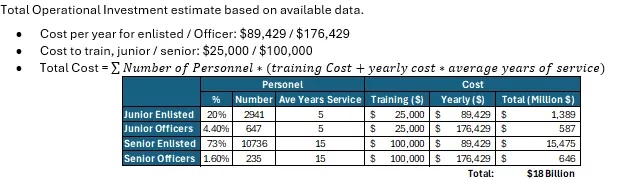
If implemented broadly, the ban will have immediate and damaging consequences for both transgender service members and military readiness across the United States. SPARTA, a leading transgender military advocacy organization, estimates that removing 15,000 transgender service members would result in the loss of an $18 billion capital investment, with the Palm Center projecting an additional $1 billion cost to recruit and train replacements. Notably, up to 73% of these service members are senior enlisted personnel with 12-21 years of experience—expertise that cannot be easily replaced by the U.S. government.

You can see SPARTA’s figures here:

When asked about the potential for a ban when it was first floated in November, Emily Shilling, President of SPARTA, stated, “The most immediate impact is that transgender people serve in every theater of the world. If it were a fairly fast-moving ban, you would be pulling these individuals out of their units, leaving critical gaps in skill sets, experience, and leadership positions that you’re just not going to be able to fill with equivalent people anytime soon, especially given the shortfalls in recruiting,”

A transgender officer with years of military experience, speaking anonymously about the rumors of an impending transgender military ban, shared that she had recently spoken with several transgender service members deeply concerned about the possibility. When asked about claims that transgender people are a liability to the military, she dismissed the notion outright, stating, “Every trans service member that I have observed performing their job excels at their job, and that’s because we have to… Every trans sailor, every trans soldier, every trans Marine, and airman that I have known has excelled at their job.”

It remains unclear how swiftly or extensively Defense Secretary Hegseth will implement these changes, how many transgender service members will face discharge, or whether the administration will revert to a “don’t ask, don’t tell” approach—forcing transgender personnel back into the closet or demanding their detransition. What is clear, however, is the administration’s framing of being transgender not as an inherent aspect of human diversity but as a dishonorable and incompatible choice. This rhetoric signals a chilling disregard for the thousands of transgender service members who have served with distinction for decades, suggesting the administration feels no obligation to temper its actions with respect or restraint.

Source: Erin Reed, “Trump Military Ban Says Being Trans Conflicts With ‘Honorable, Truthful, Disciplined Lifestyle,” Erin in the Morning, 27 January 2025


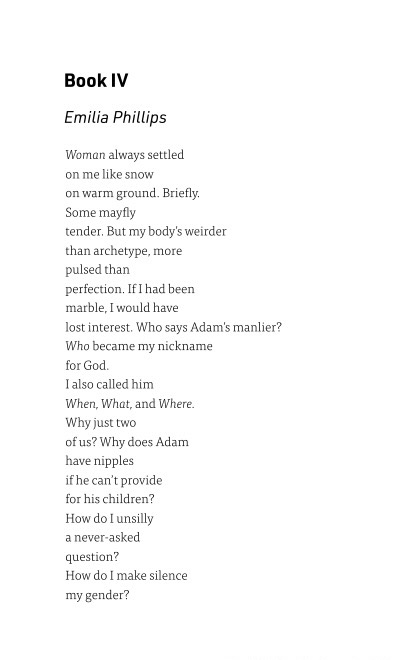
Source: Poetry Daily


Within hours of his inauguration, President Trump signed an executive order titled “Defending women from gender ideology extremism and restoring biological truth to the federal government”, following a whipping up of anti-trans feeling during the US election.

The order states that Trump’s administration will make it “the policy of the United States to recognise two sexes, male and female. These sexes are not changeable and are grounded in fundamental and incontrovertible reality.”

The response from LGBTQ+ groups was dismay and fear. Quoted in the Detroit Free Press, trans woman Rachel Crannell-Crocker remarked that Trump “wants to say we are not real,” while Bobbie Hirsch said “I’m scared, I’m really scared for my future.” Kimberly Frost, co-director of ILGA World, said Trump was “emboldened by anti-gender movements” to “use the lives of trans people as tools to sow divisions in society. Our communities deserve better.”

Trump’s move is not unexpected. During a fraught and divisive election campaign, Republicans spent nearly $215m alone on network TV ads that vilified transgender people, according to recent data from AdImpact. The past few years have seen a rush of anti-trans bills in red states, such as banning changes to birth certificates or defining sex as immutably set at birth. Books featuring LGBTQ+ content have been banned, and drag shows have faced protests and been subject to lurid conspiracy theories by Trump’s far right supporters.

Having spent nearly a decade reporting on far right threats to gender rights, the order’s purpose is clear to me: it sits squarely within the attack on so-called “gender ideology” with the ultimate aim to restore a “natural order” of white male supremacy. And while the target is trans people, the threat goes much wider, potentially laying the groundwork for further attacks on the US’s already degraded abortion rights.

What is gender ideology?

Originating in the mid-1990s in Catholic and other conservative Christian circles, the term “gender ideology” sprung up in response to feminists seeking to place “gender” into a United Nations report on its 1994 women’s conference. Initially the term focused on abortion rights, but quickly expanded to criticise any rights related to gender and sexuality, including LGBTQ+ and trans rights.

As the term gathered momentum, it became framed as a threat to ‘traditional’ – see conservative and Christian nationalist – values. LGBTQ+ activists and feminists were accused of imposing “gender ideology” on everything from schools to families and government, determined to “indoctrinate” children and young people with the “transgender agenda.”

Attacks on “gender ideology” were amplified by conservative writers such as Dale O’Leary who popularised the term in her book Gender Agenda, and picked up by the Vatican, as well as the anti-abortion, anti-LGBTQ+ ‘religious freedom’ organisations such as Alliance Defending Freedom and the Heritage Foundation. The right-wing think tank is behind the controversial Project 2025, with ADF on the project’s advisory board.

The project – which brings “together … over 100 respected organizations from across the conservative movement, to take down the Deep State and return the government to the people” – is key to understanding Trump’s move.

Project 2025 published a “Mandate for Leadership”, providing an anti-rights blueprint for the incoming administration. It offered policy ideas to demolish so-called “gender ideology”, demanding that “enforcement of civil rights should be based on a proper understanding of those laws, rejecting gender ideology.” It demanded that “gender ideology” be removed from school curricula and, in language echoed in Trump’s order, warned “radical gender ideology is having a devastating effect on … young girls.”

The project also called on the government to “reverse the DEI [diversity, equality, inclusion] revolution in Labor policy”. Trump’s order did so willingly, revoking previous executive orders that protected against discrimination and stating that government agencies must “take immediate steps to end Federal implementation of unlawful and radical DEI ideology.”

A threat to abortion?

While the executive order is first and foremost a frightening attack on trans people, its wording sets alarm bells ringing for abortion rights, too. It will be no surprise that curtailing abortion rights is a key focus of Project 2025 – the mandate mentions “abortion” 199 times.

Trump’s previous administration created a conservative-majority Supreme Court that overruled Roe vs Wade, opening the door for individual states to implement deadly and devastating abortion bans across the US. Now, the executive order’s wording suggests a wider attack on reproductive rights.

The order defines “female” as meaning “a person belonging, at conception, to the sex that produces the large reproductive cell”, while male is defined as “a person belonging, at conception, to the sex that produces the small reproductive cell.”

As well as being troubling for trans identity, the wording defines male and female foetal personhood from conception. If the foetus is recognised as a person at conception, then that foetus legally has the same rights as a born person, with catastrophic consequences for pregnant women and people. Foetal personhood means a woman can be prosecuted for murder if she has an abortion, as it violates the right to life. She can face manslaughter charges if she has a miscarriage for which she is blamed.

Bethany Van Kampen Saravia, senior legal and policy adviser at the gender rights NGO Ipas, told openDemocracy that “the language used in this cruel and dehumanising executive order is undoubtedly deliberate and deeply flawed on several counts. Simply put, it is outside of the executive authority to declare a fertilized egg a ‘person’ who has constitutionally protected rights.”

This is not a new threat. So far, 24 US states have included foetal personhood language in laws regulating or banning abortion, while 17 states have foetal personhood by law or judicial decision that applies to either criminal or civil law, or both. There have already been multiple cases where women in the States have been criminalised for miscarriage.

“Personhood arguments have long been used by anti-rights actors in attempts to fully ban and criminalize abortion and to punish pregnant people,” warned Van Kampen Saravia. “This language can also ban some forms of birth control and fertility treatments like IVF. This is a clear and deliberate signal of what is to come from this Administration.”

“It is outside of the executive authority of the President to instate a nationwide abortion ban, yet there is much that he can do to limit access to medication abortion and those threats need to be taken seriously,” she added. “Ipas US condemns these egregious acts of hate and bigotry. These executive orders are nothing shy of human rights violations and the world should be paying very close attention now to what is being feigned as ‘defending women’ and who is actually being targeted and criminalized.”

The ideology behind the ‘natural order’

The attacks on abortion and LGBTQ+ rights are often interlinked, as both pose a threat to the far right idea of a ‘natural order’ which has been undermined by feminism and human rights, and must be returned to through reversing social progress and protections.

The idea that there is a ‘natural order’ which needs to be re-established has its roots in fascist ideology, and its intent is found in almost all attacks on gender rights including from Trump, Putin, and anti-gender ideologues in Europe. It valorises male supremacy, female subordination, and declares the non-existence of LGBTQ+ people.

As I write in my book, the existence of trans people is a grave threat to the natural order and its advocates who want to reassert male supremacy and abolish the rights of LGBTQ+ people. The goal of male supremacist, anti-gender movements is to ‘naturalise’ gendered stereotypes about men’s and women’s behaviour and status: they want to naturalise male supremacy and female inferiority.

The far right wants to tie women’s inferiority to biology, and to claim that harmful gendered stereotypes are biologically innate in order to pin women to specific roles in society. These same stereotypes are used to justify women’s oppression: women are just more nurturing, or they are bad at leadership, for example, they should stay in the domestic sphere and leave the public sphere to the boys. The anti-gender movement wants to claim that women’s oppression is natural, rooted in women’s biology, and therefore cannot be challenged.

But biology is not destiny, as the famous feminist slogan states. The ‘natural order’ of female inferiority and male supremacy is disrupted by feminists saying women can have control over their fertility, or LGBTQ+ people saying one can express their gender identity as they choose. They therefore have to be stopped.

This order has nothing to do with “defending women” from “extreme gender ideology.” The extreme gender ideology is the one that tries to push women into oppressive boxes, ban abortion, and seek to abolish the existence of trans people and the LGBTQ+ community more widely.

The extreme gender ideology is the movement that elects a President after a judge in New York found a rape allegation made against him to be “substantially true”. It is the movement that celebrates his election with the slogan “your body, my choice.”

Source: Sian Norris, “Trump’s new anti-trans executive order is a ‘human rights violation’: Trump’s first act in office is part of the global far-right’s war on so-called ‘gender ideology’,” openDemocracy, 23 January 2025

Daria Saburova: Why Ukrainians Should Support Palestinians

 A car burns inside the yard of a hospital in Mariupol, southern Ukraine, 9 March 2022
Evgeniy Maloletka/AP Photo, courtesy of Al Jazeera

As Israel’s assault on Palestine continues, apparent similarities with Russia’s invasion of Ukraine grow. Israel’s “complete siege” of the Gaza Strip – cutting off water, electricity and food to more than two million inhabitants – echoes Russia’s intentional destruction of our energy infrastructure last winter. This, among other things, earned Russia the label of a “terrorist state” among Ukrainians.

From the moment an evacuation order for northern Gaza’s 1.1 million inhabitants was announced, Ukrainians must have known it would expose the most vulnerable – the elderly and sick – to certain death. We know that when people have no viable alternatives, they often prefer to stay.

The images of widespread devastation that reach us from Gaza, which suggest the Israeli army’s disregard for international humanitarian law, also resemble those from Mariupol or Bakhmut last year. Israel – like Russia in Ukraine – has been accused of bombing residential areas, evacuation corridors and the only exit point from the city, Rafah.

Of course, Hamas’s brutal attacks on civilians in Israeli kibbutzim also appear similar to Russia’s massacres in Bucha in March 2022. It is only right that these were condemned by Ukrainian president Volodymyr Zelenskyi and the Ukrainian Foreign Ministry. But their messages of support for victims and their families were accompanied by problematic assertions, including Zelenskyi’s truly catastrophic conclusion that Israel has the unconditional right to defend itself.

Since then, Ukrainian officials have avoided talking directly about Israel’s ‘Operation Iron Swords’, despite the death toll in Gaza having exceeded 3,500 in the 11 days since its launch, according to the Palestinian authorities.

But Ukraine’s carte blanche to any response that Israel deems necessary makes little sense given historical or recent Ukrainian-Israeli relations, which have been marked by tensions over occupation and respect for international law. Given the security problems Ukraine faces, its foreign policy remains faithful to the promotion of two causes: respect for territorial integrity and nuclear disarmament.

Diplomatic tensions

Unlike the US and its European allies, Ukraine has systematically supported UN resolutions condemning the illegal occupation of Palestinian lands, not without concern for consistency over its own territorial claim on occupied Crimea.

In 2014, Israel did not vote on a UN resolution that denounced Russia’s annexation of Crimea and reaffirmed the territorial integrity of Ukraine. Two years later, Ukraine passed a resolution condemning Israeli settlements in Jerusalem – prompting Israeli prime minister Binyamin Netanyahu to cancel a visit to Israel by a Ukrainian representative, then prime minister Volodymyr Groysman.

These tensions have become heightened over the past year – including when Kyiv supported two UN resolutions in November 2022. The first was for the nuclear disarmament of the Middle East, directed against Israel’s nuclear program, and the second for the opening of an international investigation into Israel’s “prolonged occupation, settlement and annexation of the Palestinian territory”, reaffirming Palestinians’ right to self-determination.

Then, in July 2023, the Israeli Ambassador to Ukraine, Michael Brodsky, condemned Ukraine’s support for 90% of the UN’s “anti-Israel” resolutions, which he described as an “abnormal situation, especially given the fact that Ukraine quite often turns to Israel for various requests”. These requests have also been the subject of tension between the two countries, with Israel having sent humanitarian aid to Ukraine but refusing to send weapons, including defensive weapons, saying that Israel, unlike NATO member states, can only rely on itself.

Israel has also been cautious in its stance on Russian aggression against Ukraine, seeking to maintain cordial diplomatic relations with Russia in light of its own military interests in Syria. It did not join many Western countries in imposing sanctions on Russia and abstained from voting on a UN resolution in favour of Russia’s reparations for its destruction in Ukraine. Since the full-scale invasion, Israel has welcomed 30,000 Ukrainians – including 15,000 Ukrainian Jews as part of a repatriation programme – far fewer than have been taken in by other countries.

Explaining the silence

Most Ukrainian politicians and diplomats likely consider the history between Israel and Palestine too complex to distinguish between aggressor and victim. But this does not explain their silence on Israel’s violations of international law in recent days, which are not dissimilar to actions they have denounced previously. Their silence likely has three sources.

First, Ukraine has sought to distance itself as clearly as possible from Hamas – labelled “the new Nazis” by Netanyahu – and its ruthless methods, which have been used to arbitrarily target Israeli civilians. This is not least because Russia’s justification for the invasion of Ukraine – the alleged need to “denazify” the country – has been effective in the Global South and in certain fringes of Western civil society. Yet in the dominant discourse set by Western governments it is impossible to distinguish between the actions of Hamas and the more general struggle of Palestinians for freedom and justice, which consists of multiple and varied forces. Ironically, diplomats have warned that the lack of support for Palestine will almost certainly result in diminishing support for Ukraine in the Global South.

Prevailing Western discourse is often seen to conflate anti-Semitism and criticism of Israel – another reason why the Ukrainian government is particularly careful with its official statements in the international arena. This is in part because Ukraine is one of the countries most marked by the Holocaust, with nearly 1.5 million Jews killed between 1941 and 1945, but also because Ukrainian nationalist movements, which sheltered people directly responsible for these massacres, have been whitewashed and heroised inside Ukraine.

And finally, Ukraine’s position may simply be geopolitical pragmatism. Ukraine’s Association Agreement with the European Union provides a clause on “convergence on foreign policy and security issues” that requires Ukraine to align itself with positions expressed by European officials. And its dependence on Western humanitarian and especially military aid predisposes its leaders to line up behind its allies, particularly the US, at the risk of being deprived of this support. The fact that Hamas maintains privileged links with Russia only reinforces this loyalty.

recent statement from the Ukrainian Foreign Ministry, published on 17 October, reflects the ambiguity and the competing principles of Ukraine’s foreign policy. It reaffirms support for Israel’s “efforts to counter terrorist acts”, but it also “advocates the settlement of the Palestinian-Israeli conflict with the help of political and diplomatic means”.

The following day, after the strike on the Al-Ahli Hospital that killed hundreds of Palestinians, which both Israel and Hamas deny responsibility for, Ukrainian officials released their first statement on the humanitarian situation in Gaza. The statement stresses that both parties should “abide by the rules of warfare and respect the norms of international humanitarian law” but fails to call for an immediate ceasefire.

The need to speak out

While Ukraine’s official position is dictated by pragmatic diplomatic considerations, Ukrainian civil society is not obliged to echo its government’s silence on Israel’s punitive operation against Gaza.

Israel’s injustices in Palestine, as well as Russia’s in Ukraine, go far beyond mere failure to respect the laws of war. Ukrainians rightly repeat that Russia’s war against the Ukrainian people did not begin on 24 February 2022. It has occupied part of Ukraine since the annexation of Crimea in 2014, and the colonisation by the Russian Empire of the peoples who inhabit Ukrainian territories dates back to the 17th century.

This history, which continued during the Soviet era, involves episodes of a genocidal nature. These include the Holodomor, a great artificial famine that killed several million Ukrainians in 1932 and 1933, and massive displacements of populations such as the 238,000 Crimean Tatars deported from Crimea to other Soviet republics under Stalin’s orders in 1944. Almost half of the Tatars died of starvation and disease during the following years.

Similarly, Israel’s war against the Palestinian people did not begin on 7 October 2023. It began with the Nakba of 1948, when more than 700,000 Palestinians were expelled from their lands. In 1967, at the end of the Six Day War, Israel occupied the rest of the Palestinian territories, causing a new Palestinian exodus and the installation of new Israeli colonies.

Palestinians often say that the Nakba is a perpetual process, since the dispossessions and colonial crimes have never ended. They have been fragmented and experience different situations depending on whether they live in the West Bank, Israel, Gaza or are refugees. But all are affected by the apartheid regime. Gazan Palestinians particularly suffer from the blockade imposed by Israel since 2006 with the collaboration of Egypt, making the Gaza Strip the world’s largest open-air prison.

The evil that has killed both Israeli and Palestinian civilians in recent days is rooted in the continued occupation and colonisation by Israel of the Palestinian territories. In this sense, the oppression of the Ukrainian and Palestinian peoples has similarities: it is about the occupation of our lands by states with nuclear weapons and overwhelming military force, which mock the resolutions of the UN and international law, putting their causes above any diplomatic dialogue.

As Ukrainians, as supporters of the Ukrainian cause, we have a special responsibility to understand and raise our voices in the face of what is happening. We must point out the inconsistencies of Western governments that support our anti-imperialist struggle while backing Israel’s colonial violence. The tragedy we are currently experiencing must sharpen our sensitivity to similar human experiences.

Following Russia’s invasion, we discovered how little the international community knew about the history of Ukraine. But what do we know about the history of Palestine? In a world where polarisation is increasing, where colonial wars of staggering scale and violence are resurgent, only solidarity between oppressed peoples and curiosity about our respective struggles, beyond geopolitical divisions, can show us the way to just and lasting peace.

Source: Daria Saburova, “Why Ukrainians should support Palestinians,” openDemocracy, 19 October 2023

Support openDemocracy’s Coverage of Ukraine, Russia, and the Region!

Hi everyone!

So, oDR – openDemocracy’s Ukraine, Russia and wider region team – is at severe risk of closure.

What can I say apart from the fundraising has not been lucky, to put it mildly.

But we’re fighting: a huge last-ditch effort to turn the ship around and keep some of the best journalists, researchers and activists writing for our audience.

To do that, we’ve launched a crowdfunder to help match £50,000 we’ve already raised from private donors. This will buy us time to sort the long-term financing we need.

I’m not sure if folks want to hear about why we’re important, so I’ll be brief:

– Ukrainian journalists writing about Russia’s war

– Belarusian journalists writing about Russia’s war

– And Russian journalists writing about Russia’s war

And that’s aside from our brilliant collaborators in Central and South Caucasus.

So please help us spread the word, and help us keep fighting. There are so many important causes right now, so if you can’t afford – just push this on to people who can.

Source: Tom Rowley (Facebook), 28 June 2023. I just made a donation to oDR’s crowdfunder via PayPal, and I would urge you to do the same. ||| TRR


Dear readers,

openDemocracy’s dedicated coverage of Russia and Ukraine is one of our greatest achievements. But now, the team behind that work is under threat of closure. 

The two of us helped to found openDemocracy in 2001 to make a space for a global conversation about justice, human rights and democracy and how they are threatened by unaccountable power. Today, at its core is our project on Russia, Ukraine and the wider region. 

The project provides an irreplaceable space for voices from the region that do not represent official Ukrainian, Russian, European or American interests.  

  • It gives prominence to Ukrainian journalists reporting Russia’s invasion and its brutalities, alongside threats to economic rights, social welfare and independent journalism
  • It provides an extremely valuable platform for coverage of Russia from Russian journalists and writers in Russian as well as English
  • It publishes Ukrainians, Russians and Belarusians who are fighting for democracy alongside one another, creating a framework for analysis and exchange that is unique during the pain of Russia’s war
  • And because, thanks to openDemocracy, the coverage is translated into Spanish and Portuguese without a paywall, readers across Latin America can learn directly about the experience of what is unfolding 

With three million readers annually, and a world-wide reputation, the coverage, grouped together here, is needed more than ever. 

It is put together by a small team. Focusing on publishing original, vital, stories on the impact of the Ukraine invasion, whilst keeping everyone secure from the consequences of war as well as Covid, means they have struggled to raise the vital funding essential to survival. 

We have to reignite funding fast – very fast. In fact, immediately. 

Or the brilliant team – Katia, Tom, Valeria, Polina and Tanya – will be made redundant. 

We are doing everything we can to secure, enhance and deepen their work.

Please join us. 

We have already secured match-funding of £50,000 from private donors. Now we urgently need your help to unlock this money. Every £10, €10 or $10 you donate will be matched. 

£100,000 will give us the time to negotiate with foundations to ensure this project enjoys a long life – long-enough to outlast Putin! 

When Israel invaded Lebanon in 2006, John le Carré was furious and headed a funding campaign for openDemocracy: 

Let’s support openDemocracy to the hilt. Intelligent, unbought, unspun opinion, uncomfortable but necessary truths and a lot of good horsey argument: heaven knows they are in short enough supply!

We love the ‘horsey’. A master of words, le Carré appreciated that some of our articles are untamed. But that’s because they are unbought and unspun.

Never, ever, has there been a greater need for this than now with respect to Ukraine and Russia. Please help the team publish necessary truths, on-the-ground reporting, much needed level-headed debate, and even good horsey argument, so that the irreplaceable media space they have created survives and grows.

So please, send us £50, €50 or $50 or more if you can; £/€/$25 if that’s possible; or whatever you can. Every donation will be gratefully received.

Thank you, 

Anthony Barnett & Susan Richards

Source: openDemocracy. I just made a donation to oDR’s crowdfunder via PayPal, and I would urge you to do the same. ||| TRR

“Our Songs Are For Those Who Have Stayed” (The Russian Draft Goes Online)

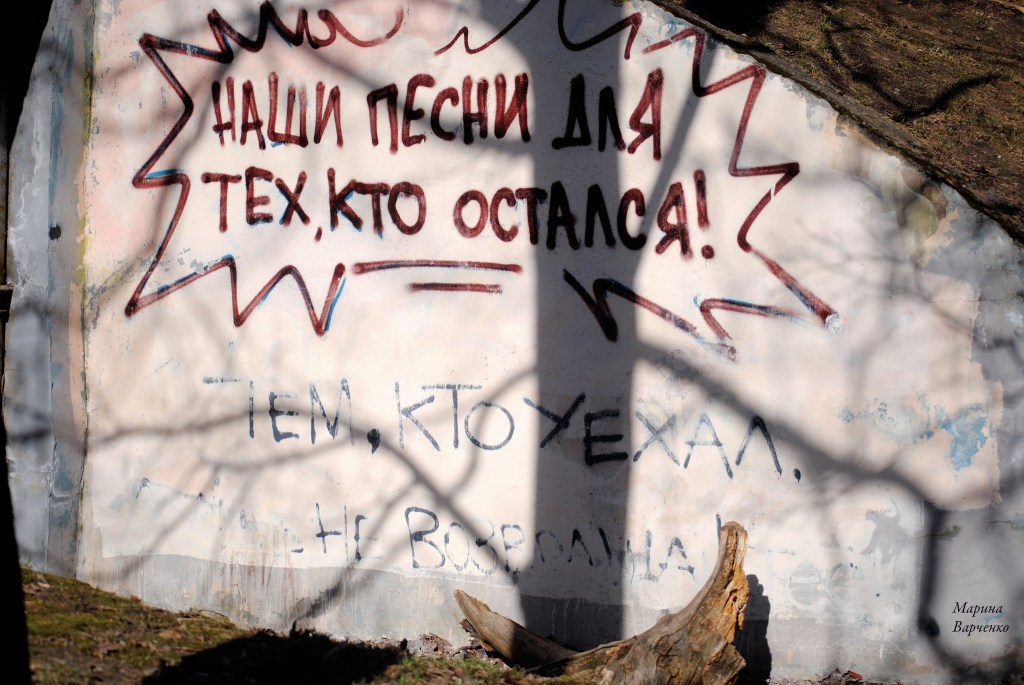
“Our songs are for those who have stayed [in Russia]. To those who have left: don’t come back.”
Photographed by Marina Varchenko on Vasilyevsky Island in Petersburg, 13 April 2023

Today, coming out of the front door of my building, I saw the following tableau. A neighbor from the third floor, who is somewhere between thirty-five and forty, was, on the contrary, coming in the front door. Judging by the bag he was carrying, he had just been grocery shopping. He doffed his baseball cap, clamped it under his arm, and crossed himself three times as he looked at the mailboxes. Then he peered into his own mailbox and let out a sigh of relief. His draft notice had not yet arrived, apparently. To be honest, it took a while for the meaning of his maneuvers to dawn on me. Of course, I pretended that I hadn’t noticed any of it.

Source: Marina Varchenko (Facebook), 13 April 2023. Translated by TRR


On Wednesday, April 12, Samara journalist Sergei Podsytnik posted on the website Change.org a petition calling for the repeal of amendments paving the way for the introduction of electronic military draft notices, as passed the previous day by the State Duma and the Federation Council.

“These amendments violate our rights. A citizen cannot be stripped of their rights without a trial, but now this right has been given to the staff of military enlistment offices,” the petition says. Podsytnik draws attention to the fact that the public services portal Gosuslugi, through which it is planned to serve draft notices to Russians, has a number of vulnerabilities. In addition, not all residents of the country have access to their accounts on the portal, and almost thirty percent of Russians over thirty are not active internet users.

According to the amendments as adopted, if a conscript did not receive a paper summons and did not log into his Gosuslugi account, the summons will still be considered delivered within seven days after it was entered into the register of draft notices. He will then be banned from leaving the country. After twenty days, new bans will come into effect: those who failed to report to a military enlistment office will not be able to work as individual entrepreneurs, manage real estate, drive a car, or take out loans.

“To deprive people of the ability to sell real estate, drive a car, or travel abroad at the request of a person with no specialized legal education is an outrage against our rights and freedoms,” the petition says. At the time this story went to press, the petition had been signed by more than thirty thousand people, and their number was growing rapidly. For the amendments to go into effect, they must be signed by Vladimir Putin and published.

Source: Dmitry Vadchenin, “Tens of thousands sign petition against electronic draft notices,” Deutsche Welle, 12 April 2023. Translated by TRR. As of 11:54 p.m. Moscow time on April 13, the petition had been signed by over 94,453 people.


[…]

The legislative changes mean that once a Russian citizen has received a military summons online, they will be automatically forbidden from leaving the country, and therefore avoiding the call-up.

If they fail to appear at a draft office within 20 days, they will face a range of restrictions, including a ban on using their own vehicle, selling property or receiving a loan. They also face a fine of between 500 and 3,000 rubles (£5 to £29).

The head of Russia’s parliamentary committee on defence claimed that these measures will only come into force during the next conscription campaign.

The new system also anticipates a unified database where personal data about Russian reserve personnel can be collated by a range of government institutions, such as the tax service, law enforcement, the pension fund and medical facilities.

Such a database will make it “practically impossible” for reservists to avoid being called up, anti-conscription lawyer Alexey Tabalov told independent Russian media outlet Verstka, because military registration offices will have more detailed information about an individual’s home and work address.

This changes the advice he has been giving people who want to avoid mobilisation, Tabalov says.

Whereas he previously recommended that people avoid receiving the physical summons document, that “recommendation has lost all meaning” now, he said. “If you don’t want to serve, don’t go to the military registration office, but you’ll still face restrictive measures,” Tabalov said.

[…]

Source: Thomas Rowley, “Russia plans crackdown on men avoiding the draft,” openDemocracy, 11 April 2023


[…]

Andrei Kartopolov, head of the State Duma defense committee, spelled out tough penalties for those who do not respond to electronic summonses, including potential bans on driving, registering a company, working as a self-employed individual, obtaining credit or loans, selling apartments, buying property or securing social benefits. These penalties could apply to the thousands of men who are already outside the country.

The electronic summons will be issued via a government services portal, Gosuslugi, used for all manner of state payments and services including taxes, passports, housing services, social benefits, transport documents, medical appointments, employee insurance and countless other matters.

Under the law, personal data of conscripts including identity documents, personal tax numbers, driver’s license details, phone numbers and other information will be transferred by Gosuslugi to military enlistment offices. Universities, business employers, hospitals and clinics, government ministries, law enforcement agencies, the electoral commission and the tax authority are also required to transmit data to the military.

[…]

Source: Robyn Dixon, “Russia moves to tighten conscription law, pressing more men to fight,” Washington Post, 11 April 2023

Support openDemocracy’s Coverage of Russia and Ukraine!

My name’s Tom and I run openDemocracy’s coverage of Russia and Ukraine.

Do you remember where you were when Putin’s invasion started? I do: I remember texting friends and colleagues in Ukraine, who were in the middle of packing their bags. In the space of a few hours in February, I tore up my plans for the year. I knew our incredible team would face a challenge like no other.

It’s a nightmare that has taken all their skills and contacts to cover for you.

I’m not going to lie, it’s been a very difficult year. But our coverage has been so effective that it’s got our website blocked in Russia. (Don’t worry, we’ve found other ways to get our news to readers there.)

Will you please set up a regular donation to help our team in Ukraine keep covering the war? We’re a small, independent, non-profit news site and we rely on the generosity of readers to keep going.

Yes, I’ll set up a donation

One of our long-standing journalists in Kyiv somehow wrote an article on that first day of the Russian invasion – a day, she said, that felt like a week.

While some Ukrainian journalists took up arms to defend their country, others braved bombs, bullets and capture to tell the world about the Russian invasion.

To support journalists in the Ukrainian media, we asked readers to help them through some of the most difficult months of their lives. We raised £40,000 – money from openDemocracy readers to support journalists from other organisations as they were forced to relocate, cover new costs and advertising dried up. Those funds went to media outlets and journalists who don’t usually get grants or international support.

Now, we need your support for our work. Could I ask you to set up a regular donation to support our team as they face another difficult year, please? The hard truth is that without reader donations we will have to scale back our reporting of the war. But with your help we can keep telling the truth about Putin’s aggression. Every donation will make a real difference to our work.

Yes, I’ll support you

Thank you for helping openDemocracy,

Tom Rowley
Lead editor on Eastern Europe and Central Asia, openDemocracy

PS: openDemocracy relies on our supporters to spread the word about our work. Can you help by sharing the links below with friends and colleagues?

Read more

Thank you for helping raise £42,000 for journalists in Ukraine

Roubles and repression: how life in Russian-occupied Kherson is changing

Ukrainian prisoners of war reveal torture and humiliation in Russian jails

Russia forced them to fight. Ukraine tried them for treason

Source: openDemocracy email newsletter, 8 December 2022

The Moldova Story

In 1994, my friend Nikolai, a retired agronomist from Moldova adrift in a large American city, dictated the following story to me in Russian.

1.

In Moldova in the month of April the weather is warm and rainy. Spring is coming.

The peasants all together set about the spring fieldwork. Nature is waking up. Gardens are blooming.

After the warm days and showers on the fields the first shoots of the field crops appear all at once.

2.

The best season of the year is summer. In this season the days are hot. Fruits, berries, early vegetables, and different kinds of table grapes appear on the vine.

The water in the river Dniester and the lakes becomes warm, and people swim and sunbathe.

3.

Three million people live in Moldova. Moldavians make up the indigenous population, but other nationalities live there as well: Russians, Ukrainians, Georgians, Romanians, and Jews.

Moldova is an independent nation at the present time.

__________

Pic of recent massive demonstration outside Moldovan Parliament

Moldova: A mouse roaring a truth
Paul Canning
February 24, 2016

This story might appear obscure but it reflects a bigger issue: about how Russian revanchism is reported back through democratic Europe’s free media. The issues it describes have also often been the story in Ukraine. How solid, liberal ideas like ‘balance’ and reporting ‘both sides’ can become a failure to tell the truth. How inserted reporters don’t pay attention to the locals. How the messy ‘European ideal’ needs much closer reporting if we’re to truly live up to any democratic ideal.

In the 1959 British comedy The Mouse That Roared a tiny, obscure European country ends up through comedic slight-of-hand being feted by both sides in the Cold War. In comedy, it showed how much of Europe is to the British ‘Ruritania‘, an inexplicable country whose peoples and cultures all mess into one. As the article explains this approach lives on with today’s lens of geopolitics and ideas of ‘colour revolution’ (via Russian infowar) muddying the coverage yet more.

 Read the rest of the story on oDR.