Make (Blank) Great Again

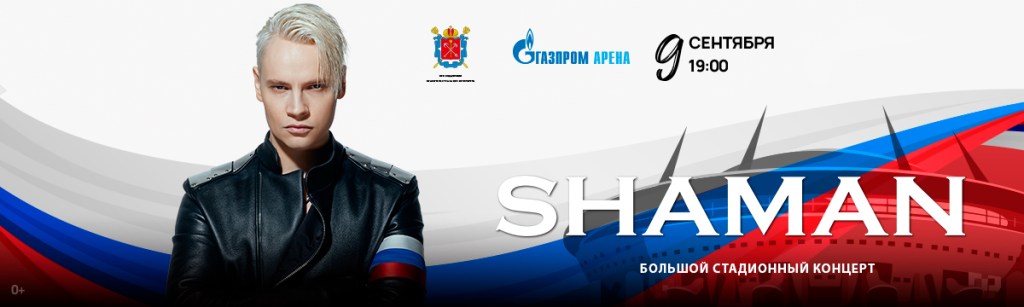
This ad for a “big stadium concert” by the Russian nationalist pop singer Shaman, scheduled for 7 p.m., September 9, at Petersburg’s Gazprom Arena, showed up this morning (for the second or third time in the last mont) in the weekly email newsletter I get from Bileter.ru, a Russian online retail ticket vendor. The aesthetic here is both strikingly fascistic/nationalistic and pointedly un-Russian. I would say it’s almost American in its inspiration, if I didn’t know better. ||| TRR


This showed up in my mailbox today too:

За последние две недели в редакции произошли изменения. У нас теперь новый руководитель редакции, а потому скоро вы ощутите изменения, которые make Inc. great again.

Here’s my translation:

There have been changes to [our] editorial board over the past two weeks. We have a new editorial director now, and so you will soon feel the changes that [will?] make Inc. great again.

These days, all “progressive” Russians are fluent in English, supposedly, and this is often how they signal their “progressive” values to each other: by shouting out their true reactionary colors in Rusglish.

In this case, the progressive reactionaries hale from Inc. Russia, “a magazine for entrepreneurs [that] focuses on small and medium-sized businesses, advanced technologies, and the people behind it all.” Founded in the US in 1979, the Russian edition has been in existence since 2016.

The passage that I quoted and translated, above, led off Inc. Russia‘s weekly email newsletter.

Immediately after Russia’s brutal, unprovoked invasion of Ukraine, the Russian Inc.ers were openly dismayed by the sudden turn of events in their otherwise entrepreneurially progressive country—without, however, ever going so far as to oppose the war explicitly. This dismay and confusion gradually and visibly diminished as the war continued. Now, apparently, Inc. Russia has come full circle: they are determined to show that they and their readers live in nearly the best of all possible entrepreneurial worlds. They’ve definitively stopped paying any mind to their country’s breakneck plunge into fascism, much less to the war itself.

And yet the new realities occasionally puncture Russian Inc.‘s otherwise now-placid surface, as in this news item published on their website earlier today:

English to become optional in the subway

It may become option to duplicate information in subways in English. The Transport Ministry has published a law bill addressing the matter. The Moscow subway stopped duplicating [station] names back in 2021, while Nizhny Novgorod and Kazan do not plan to give up English until instructions are received.

As reported by Kommersant, the Transport Ministry has published a draft law on amendments to the orders regulating the “standard rules” for the use of subways, monorails, funiculars, and suspended cable cars.

Carriers are currently required to duplicate all information on diagrams, signs, inscriptions, and station announcements in English. The Transport Ministry proposes doing away with this obligation, leaving the decision to the regions.

The proposal was prompted by “numerous appeals from citizens and [regional governments], due to the considerable informational burden on passengers and taking into account the socio-political situation.”

Moscow’s Metro, Central Circle, and Monorail stopped announcing stations in English back in 2021, after a drop in the number of tourists due to the pandemic and “passenger complaints about additional information.”

Oleg Yaushev, director of the Nizhny Novgorod Metro, said that none of the city’s residents had complained about the English dubbing in the city’s subway, so the company does not plan to remove it.

“We installed this information system relatively recently and spent a lot of money on it. Why remove it now? Tourists who are native English speakers travel to the city. The language is widely spoken, and we welcome them. Of course, if there is a directive to remove everything and leave it only in Russian, we will comply. But it’s not worth freaking out about it,” he said.

Kazan’s Metroelectrotrans also expressed its willingness to execute the order, “if it is issued.” However, local residents there have also not petitioned the company to cancel the dubbing of station names in English.

Source: Inc. (Russia), 14 August 2023. Translated by the Russian Reader


Russian streaming service Amediateka (thanks to the good offices of sanctions busters HBO) keeps its viewers comfortably ensconced in an alternate reality dominated by the Great Satan’s pop culture:

The second season of the sports series “Winning Time: The Rise of the Lakers Dynasty” recounts the period between 1980 and 1984. It deals with the rivalry with the Boston Celtics, as well as with the personal lives of the players, which prove no less emotional and striking than their play on the court. Jerry Buss wants to get his sons involved in working with the Lakers, Magic Johnson learns to be a good father, and Larry Bird plunges into family squabbles. Won’t this prevent the lads from becoming NBA champions?

Source: Amediateka email newsletter, 14 August 2023. Translated by the Russian Reader


Finally, here is yet another reflection of the Russian petite bourgeoisie’s (and, hence, Russian officialdom’s) peculiar love-hate, cargo-cultish relationship with the “collective west” (i.e., the United States) and the English language.

This past weekend, reports Bumaga, local sporting enthusiasts took part in the Bubble Baba Challenge — 2023 [sic, in English], “an event held in the rapids of [the] Vuoksi River whereby contestants race in the water using sex dolls as flotation devices.” The event took place in Kiviniemi, aka Losevo, in the occupied Karelian Isthmus, approximately 60 miles north of Petersburg.
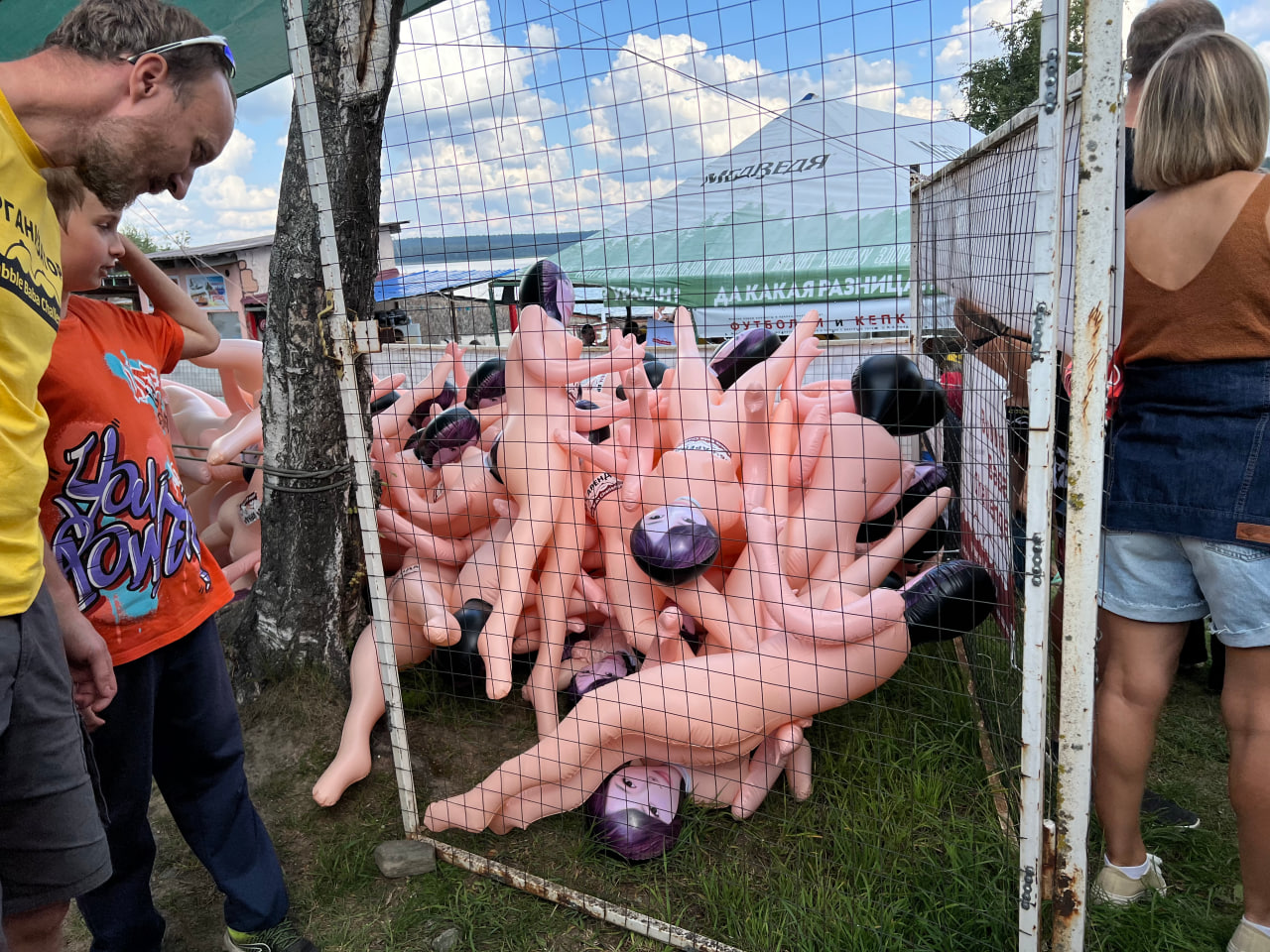
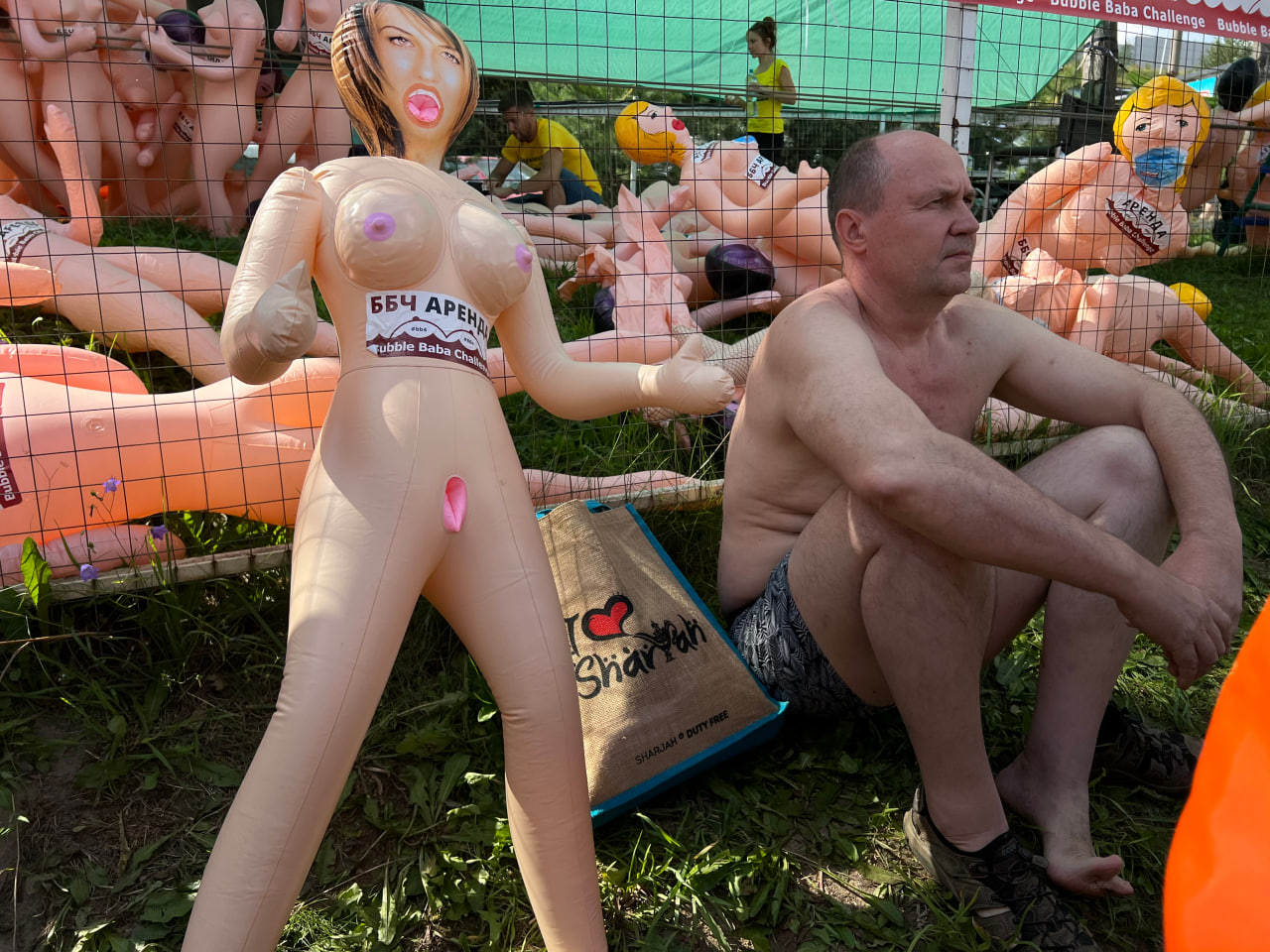
Photos by Pavel Daisi for Bumaga (@paperpaper_ru)
Fascism with a Human Face

Russian President Vladimir Putin, speaking at a session of the Valdai Discussion Club, acknowledged a decline in the real incomes of our compatriots.

He noted that the issue was being resolved in cooperation with the trade unions, RIA Novosti reports.

This dialogue continues. We see that people’s nominal incomes are growing, but real incomes have become slightly lower. Bearing in mind the state of the Russian economy, we can solve these problems and should do so in accordance with the existing plans of the Russian government.

Vladimir Putin, President of the Russian Federation

The head of state also said that it was necessary to fight for wage increases. At the same time, he addressed his appeal to both Russians and “ordinary citizens” of the United States and Europe.

Since the start of the special operation by Russian troops in Ukraine, people have experienced a loss of income and savings. Putin also noted earlier that many Russians were at risk of layoffs.

Source: Andrei Gorelikov, “Putin urged both Russians and citizens of western countries to fight for higher salaries,” Rabota.ru, 28 October 2022. Translated by the Russian Reader


“There are more than 485 air fresheners in operation: they were installed in the air ducts of the climate control system. They spread the fragrance around the car every ten minutes. The fragrance is called ‘Moscow Metro,'” explain the metro’s press service , stressing that all the aromas were safe, hypoallergenic, and complied with regulations.

In 2019, during a vote on the project’s implementation, ninety percent of passengers surveyed said they would prefer an air-freshened carriage to a regular one. Muscovites especially wanted the smell of cherry blossoms in the subway.

Source: “Air fresheneres installed on the Filyovskaya metro line,” Russkii pioner, 3 November 2022. Photo courtesy of Russkii pioner. Translated by the Russian Reader


What attracts people [to the shot bar Fedya, the Wildfowl!]? The irony and the simplicity, but at the same time the pleasant crowd. Here you can meet people who, the day before, dined on sets [sic] of scallops and dill sauce at designer restaurants, but they are glad to eat belyash and kvass at Fedya’s. Every other table orders kebabs (from 325 rubles) and drinks tinctures and macerations. Security guards monitor everything: if you swear loudly, they will politely ask you to leave.

Source: “From brilliant shot bars to giant food halls: 12 Petersburg openings in 2022 — Vitya Bar, Noise Cabaret, Moskovsky Market, and the inclusive Outside Entrance,” The Village, 5 December 2022. Photo courtesy of The Village. Translated by the Russian Reader


The “Fedya, the wildfowl!” scene from the beloved Soviet comic crime caper The Diamond Arm (1969), starring Andrei Mironov and Yuri Nikulin

Riding the Moscow Subway with the Ceausescus

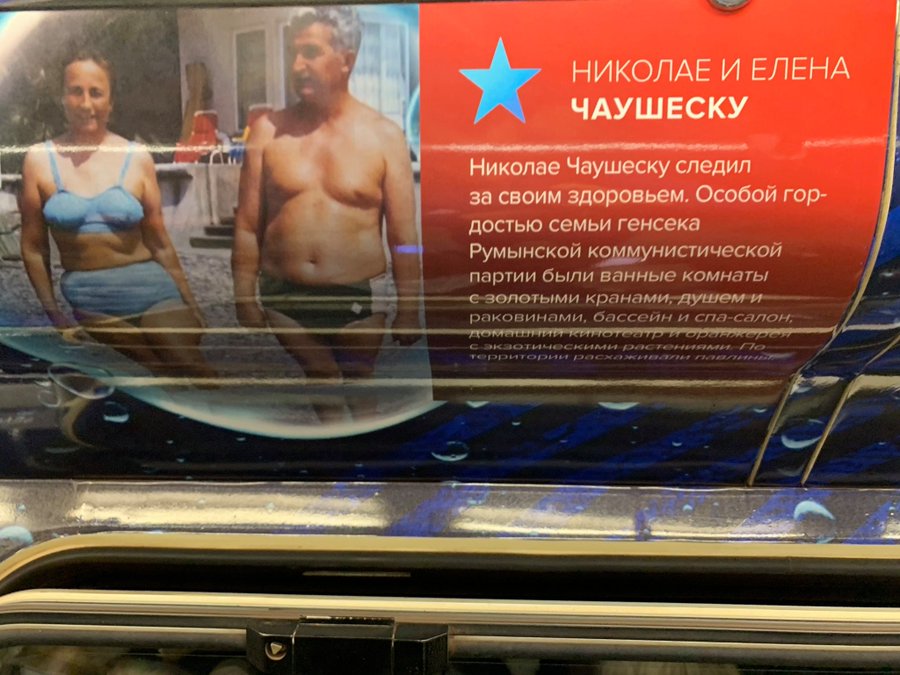
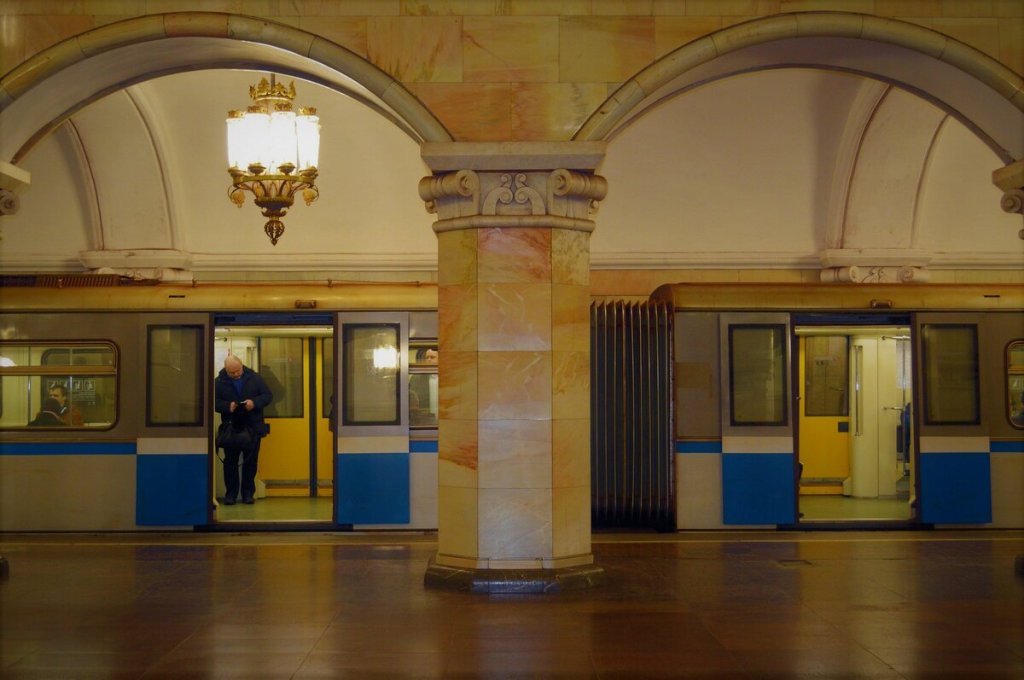
ceausescus“Nicolae and Elena Ceausescu. Nicolae Ceausescu looked after his health. The family of the Romanian Communist Party’s general secretary was especially proud of their bathrooms, equipped with gold faucets, shower, and sinks, their swimming pool and day spa, their home movie theater, and their greenhouse with exotic plants. Peacocks roamed the premises…” Photo courtesy of Tatiana Tanja Yarikova
Tatiana Tanja Yarikova
Facebook
January 16, 2020

Many trains in the Moscow subway are decked out thematically. There is, for example, an Oleg Tabakov train with pictures of him in every car, photos of him in various roles in the theater and cinema, and so on. And there are many other oddly themed trains. No one pays them any mind anymore. Yesterday, however, I found myself on the “Health” train on the Ring Line for the first time. There were pictures on the walls of pumped-up athletes and champions, and of Brezhnev and Khrushchev for some reason. And, believe it or not, of CEAUSESCU! Who comes up with this stuff? Who gets paid money for this nonsense?! Maybe they can stop prettifying Moscow?

Thanks to Sergey Abashin for the heads-up. Translated by the Russian Reader

Dynamo Stadium Builders Getting the Run Around

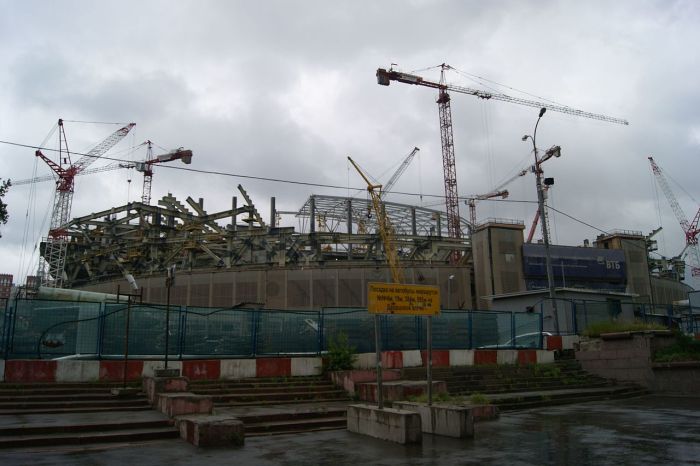
Dynamo Stadium under reconstruction. Photo courtesy of Wikipedia

Dynamo Stadium Builders Getting the Round Around
MPRA
February 6, 2017

Workers at StroyProf, Ltd. (aka SMP, Ltd.) have been on strike since January 9. The firm has done electrical work in the Moscow subway, Dynamo Stadium, and other facilities. StroyProf is yet another example of the fraud thriving in the Moscow construction industry.

Like workers at other construction companies such as SMU-77, Ingeocom, and Horizon, workers at StroyProf have been hoodwinked. Instead of the 30,000 to 40,000 rubles a month they were promised, they have been issued 500 to 2,500 rubles from time to time for food and travel expenses. This has been going on since November 8, 2016. In early January, StroyProf owed different workers between 30,000 and 60,000 rubles.

StroyProf skimps altogether on working conditions and occupational safety.

“One day, the foreman tried to restrict our lunch break to ten minutes. We replied we wouldn’t be eating lunch for an hour. It wouldn’t be ten minutes, either, but as long as we needed. […] On November 14, we went to work at Dynamo Stadium. We were installing ducts. On the first day, we expected the uniforms and shoes required for safety. We were only offered the uniforms and shoes of workers who had the day off. We turned them down, since that doesn’t meet sanitary requirements,” the workers recalled.

In addition, management attempted to force the electricians to work alone on jobs that, according to work safety rules, can be done only by two workers.

On January 9, the workforce downed tools. The strikers contacted the MPRA trade union that had already been coordinating the campaign mounted by workers at SMU-77 and Horizon. On February 9, Horizon and StroyProf workers plan to pay a collective visit to the Moscow office of the Investigative Committee.

The Investigative Committee has become actively involved in the search for Anzor Khubuluri, head of SMU-77, which owes back wages to subway construction workers. Criminal charges have been filed.

The situation with Horizon’s workers, who had been working without contracts, is not as hopeful. The company has officially claimed the workers demanding back pay did not work for them, but off the record they have offered to pay back part of their debt, using the Tajik Migrant Workers movement as mediators.

StroyProf management has also been trying to avoid accountability for their actions. They have threatened workers they will be charged with extortion for demanding payment of wages. However, the example of the subway construction workers, who with MPRA’s help have achieved an appropriate response from law enforcement agencies, has given hope to other groups of hoodwinked workers.

Based on reporting from MPRA Moscow and Moscow Region

Translated by the Russian Reader. Thanks again to Comrade Ivan Ovsyannikov for the heads-up. MPRA is the Interregional Trade Union Workers Association. MPRA is affiliated with the IndustriALL Global Union.

“You’ll Be Gone in Three Minutes. I’m Going to Kill You”

“You’ll Be Gone in Three Minutes. I’m Going to Kill You”
Elena Srapyan, Civic Assistance Committee
refugee.ru
April 12, 2016

On Friday, April 8, between Novye Cheryomushky and Kaluzhskaya subway stations in Moscow, an elderly man fired a trauma pistol several times into the head of a man of non-Slavic appearance. The wounded man is now in the intensive care ward of City Clinic Hospital No. 1 in serious condition. The Civic Assistance Committee has taken charge of the victim’s legal defense.

сулаймон саидов
Sulaimon Saidov

On the evening of Friday, April 8, Sulaimon Saidov, a 38-year-old Tajik national, was traveling home from work to Tyoply Stan. He was accompanied by his 19-year-old nephew Mukhammajon Khakimov, who had recently arrived in Moscow from Tajikistan. Saidov has lived in Moscow for over thirteen years. Like most of his relatives, with whom he rents a small flat in Tyoply Stan, he works in construction. The job enables Saidov to feed his four children.

This time, the trip home on the subway proved disastrous. It all began quite casually. At Profsoyuznaya station, a drunken middle-aged man who could barely stand on his feet burst into the subway car. He immediately spotted Khakimov. He went right up to him, pushing him and shouting.

“Who the hell are you? Where are you from? What are you doing here?” he asked Khakimov.

Khakimov modestly replied he was from Tajikistan.

The assailant called Tajiks “black monkeys,” swore, and demanded that uncle and nephew immediately leave the car because it was “only for [ethnic] Russians.” Khakimov went over to his uncle, seeking protection. Saidov stood up, pushed his frightened nephew behind him, and tried to calm him.

“The man is just drunk. Don’t look at him. Don’t pay any attention,” he said.

Staring point blank at Saidov, the assailant said, “You’ll be gone in three minutes. I’m going to kill you.”

As Saidov relates it, he felt no danger: the threat from the elderly, frail-looking man seemed too absurd. Even when he spotted a pistol in the assailant’s hands, he did not believe it. He thought it was a toy. However, the pistol was real, a trauma pistol, and the assailant began firing.

He managed to squeeze off several shots at both Tajiks. He missed Khakimov, but he hit Saidov three times in the head and once in the stomach. At short range, the shots could have been deadly. One of the bullets entered Saidov’s eye and damaged the sclera, while another left a huge wound in his skull.

Saidov realized he had to fight for his life. He felt no pain. In a state of shock, he grabbed for the assailant’s pistol and managed to wrest it from his hands. At that moment, the doors of the subway car opened, and assailant and victim found themselves on the platform of Kaluzhskaya subway station. According to police, there was no CCTV camera in the car, but on the station’s cameras what happened looks like a fight. Rushing to the scene, police detained the man holding the pistol: Saidov. Police grabbed him, wrested the weapon from him, and put his hands behind his back. Only when bystanders shouted that he was the victim was Saidov released.

The assailant managed to escape the scene, but was detained quite soon thereafter. When witnesses identified the attacker on video surveillance recordings at the station, it turned out the man’s face was familiar to police. After the pistol was fingerprinted, there could be no doubt: the assailant was 58-year-old local resident Sergei Tsaryov, who had been detained at the same subway station a week earlier.

Tsaryov was brought in literally minutes later. However, police were unable to talk with him for a long time. The man was so drunk he could not answer clearly. At the same time, relatives of the victim were giving testimony in another office. Saidov was almost immediately taken away by ambulance. His injuries were so severe that doctors feared for his life.

Saidov’s cousin Dilshod Saidov, who speaks Russian well, soon arrived at the scene. At the time, Police Captain Ilyinsky was questioning relatives and witnesses, and drawing up an incident report. Dilshod Saidov assisted the captain by translating for Khakimov. But when Ilyinsky read the interview record aloud, Saidov was struck by the differences between it and Khakimov’s testimony. Saidov began verifying the interview record phrase by phrase. According to the text, it was Khakimov who had got a rise out of the passenger with whom Sulaimon Saidov had later fought.

“As if Mukhammajon had provoked the assailant by the mere fact of his existence,” said an indignant Dilshod Saidov. “I had to fight for every word in his testimony: that alone took two hours. They also tried to give me a hard time. They said, ‘Who the hell are you? Let’s check you out.’ Only I wasn’t scared. I’m a regular guy: all my papers are in order. Yeah, the night at the police station was just awful.”

But most importantly, the ambulance doctors managed to get Sulaimon Saidov to City Hospital No. 1 quickly, where he immediately underwent surgery. Thanks to the efficiency and professionalism of his doctors, Saidov survived.

Saidov’s family are alsop grateful to a young female witness who went with them to the police station and stayed there to the end. Unfortunately, they were unable to exchange telephone numbers. The police were vigilant and made sure that communication between them was impossible.

Saidov’s relatives stood watch outside the intensive care ward all through the evening of April 8 and the early hours of April 9.

“I was at work when it happened,” says Dilafruz Sharapova, a close friend of the victim’s. “I called Sulaimon, but he didn’t answer. That usually doesn’t happen, and I got scared right away. Then his nephew picked up the phone. First he said  they were just on the subway. He didn’t want to scare me. When I got home, his cousin called and told me everything. I remember I immediately said to him, ‘Come and get me, and let’s go to the hospital.’ I couldn’t just sit there, you know? We arrived at the hospital, and I waited so long for the doctors to say at least something that it was frightening. I was able to see him only a day later. The operation was over, and the danger had passed. Things will probably be rough for us now, because he won’t be able to work. But I’m not thinking about that for the time being. I am only worried for him. I can’t think about anything else.”

The doctors are now optimistic in their prognoses. Although Saidov suffered a severe bruise to the crown of his head, the brain was not affected. Saidov remembers everything perfectly, and has no problems speaking. The biggest worry is his eye, but the doctors hope to be able to save it despite the damage to the sclera. Perhaps another operation, a more expensive one, will be necessary. The Civic Assistance Committee plans on announcing a fundraiser for Saidov when details have become clear and his relatives have received the necessary medical documents.

The Civic Assistance Committee is defending the interests of the victim, Sulaimon Saidov, in the case.

“For the incident to be qualified correctly it is vital that our lawyer begin working as quickly as possible,” said Marina Leksina, head of the project for the victims of hate crimes. “Because we already have cause to assume that they will try to acquit the assailant by presenting Sulaimon as an active party to the conflict. From what Sulaimon has told us, the attack was motivated only by xenophobia. It was direct aggression, which the assailant accompanied with corresponding language.”

Representing the victim will be Filipp Shishov, an attorney for Memorial Human Rights Center’s Migration and Law Network. Shishov previously represented Maratbek Eshankulov, the young man who unable to return home for four years because of the “dissimilar” photograph in his passport.

Photo courtesy of the Civic Assistance Committee. Translated by the Russian Reader