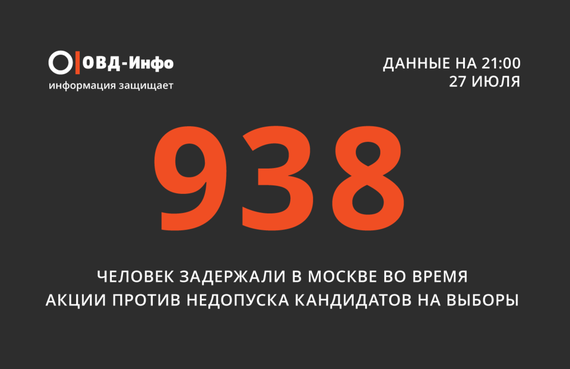
938

ovd info-938

According to OVD Info, as of 9:00 p.m. Moscow Time today, July 27, 2019, 938 people had been detained in Moscow for taking part in an “unauthorized” grassroots protest against the disqualification of independent candidates who had registered to stand in the September 8, 2019, election to the Moscow City Duma.

Opposition politician Alexei Navalny, who called for this protest at last week’s “authorized” rally, which drew over 22,000 people, was arrested and sentenced to thirty days in jail earlier in the week. Several of the disqualified candidates and people associated with the opposition had their homes searched by police this past week as well. Several of them were also summoned for questioning to the Moscow office of the Russian Investigative Committee, which announced it had launched a criminal investigation of the opposition protests under Article 141 of the Russian Criminal Code, which criminalizes the “obstruction of voting rights or the work of electoral commissions.”


Russian Opposition Hit with New Wave of Searches and Arrests

Russian Opposition Hit with New Wave of Searches and Arrests
Yelena Mukhametshina
Vedomosti
July 25, 2019

On Wednesday evening, Moscow’s Simonovsky District Court jailed politician Alexei Navalny for thirty days for calling on Muscovites to go to the mayor’s office this weekend to protest irregularities in the upcoming elections to the Moscow City Duma. Law enforcement agencies simultaneously launched a dragnet against the Russian opposition. Investigators searched the homes of ex-MP Dmitry Gudkov, his colleague Alexander Solovyov, Ivan Zhdanov, director of Navalny’s Anti-Corruption Foundation (FBK), and municipal council member Nikolai Balandin.

The search in Gudkov’s home lasted around two hours. Investigators confiscated the politician’s computers, smartphone, and all portable electronic storage devices. Gudkov’s press secretary Alexei Obukhov said the search warrant mentioned the confiscation of all computer discs [sic] in connection with the protest rallies and pickets outside the Moscow City Elections Commission on July 14, 15, and 18. Identified as a witness in a criminal investigation, Gudkov was given a summons to an interrogation at the Main Investigative Department of the Investigative Committee’s Moscow office on Thursday morning. Navalny’s colleague Leonid Volkov reported that, after his home was searched, Zhdanov was taken immediately to the Main Investigative Department.

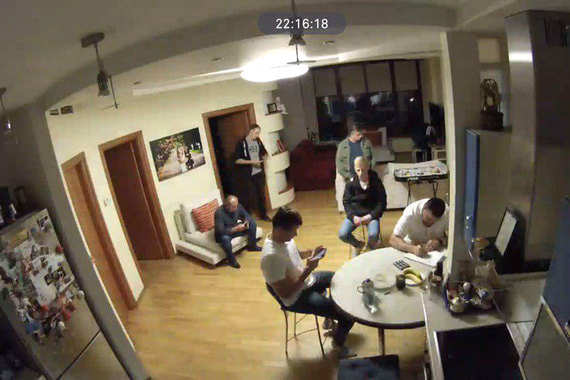
gudkovPolice searching Dmitry Gudkov’s apartment. Courtesy of Dmitry Gudkov’s Telegram channel and Vedomosti

FBK lawyer Lyubov Sobol, municipal district council member Yulia Galyamina, and ex-MP Gennady Gudkov have also been summoned to interrogations on Thursday morning.

“Would that they went after criminals this way. They are just scumbags!” Gudkov, Sr., wrote in an emotional post on his Twitter page after receiving a phone call from an Investigative Committee investigator.

On Wednesday afternoon, the Main Investigative Committee reported it had launched a criminal investigation into the protest rally that was held outside the Moscow City Elections Commission on July 14 by opposition candidates to the Moscow City Duma under Article 141 of the Russian Criminal Code, which criminalizes the “obstruction of voting rights or the work of electoral commissions.” In July 2019,  the Main Investigative Office writes, members of a particular movement organized illegal and unauthorized rallies and pickets outside the Moscow City Elections Commission in order to exert pressure on members of the election commissions and obstruct their work. People who attended the rallies threatened election commissions members with violence, the Main Investigative Offices reports. It did not specify which part of Article 141, in its view, had been violated. It could choose to indict people under Article 141.2, which carries a maximum punishment of five years in prison.

The protests out the Moscow City Elections Commission were sparked when district election commissions found flaws, allegedly, in the signature sheets of people intending to run as independent candidates in the September 8 elections to the Moscow City Duma. The flawed signature sheets, allegedly, disqualified them as candidates, and the local election commissions refused to register them. Among the disqualified candidates were municipal district council members Ilya Yashin, Konstantin Yankauksas, Anastasia Bryukhanova, Galyamina, and Dmitry Gudkov; Navalny’s colleagues Sobol and Zhdanov; and Yabloko Party members Elena Rusakova, Kirill Goncharov, and Sergei Mitrokhin.

All last week, the opposition kept up its protests, which had not been vetted by the mayor’s office, on Trubnaya Square. On Saturday, an estimated 22,500 people attended an authorized protest rally on Sakharov Avenue. During the rally, Navalny told the crowd that if all the independent candidates were not registered in the coming week, people should go to the mayor’s office on July 27.

On Wednesday afternoon, opposition politicians told Vedomosti they were prepared to rally outside the mayor’s office on Saturday.

“The criminal investigation is obviously an attempt to intimidate us. We want to run in the elections, but they refuse to put us on the ballot. Now they say they have launched a criminal investigation. We will keep defending our rights,” said Yashin.

Galyamina also believes the authorities are trying to intimidate the opposition.

“On July 14, [Moscow City Elections Commission chair Valentin] Gorbunov was at his dacha, and the commission was closed for business. It is unclear whose work we could have obstructed,” she said.

Gorbunov told Vedomosti that he was not at the commission’s offices on July 14, but that during election campaigns the commission’s working groups and members work weekends as well.

“Time is short and we have to wind things up,” he said.

Gorbunov learned about the criminal investigation from the press. He had no idea who had filed the complaint.

“I believe people need to act within the law. [Central Elections Commission chair Ella] Pamfilova said that rallies were not a form of political campaigning, that people had to work within the bounds of the law. I can only say that the rally outside the Moscow City Elections Commission was not authorized, but it is up to law enforcement agencies to comment on criminal liability for what happened,” he said.

However, on July 14, Gorbunov had told Vedomosti the commission was closed on Sundays.

“They [the opposition] might as well have gone to some factory that was closed on Sunday,” he said then.

The criminal investigation is probably meant by the security forces as a way to intimidate protesters, argues a person close to the mayor’s office. This source said it was clear police would detain people who attempted to attend an unauthorized rally on July 27.

According to court statistics, people have been charged and convicted of violating Article 141 extremely rarely. In the last ten years, the most “fruitful” years were 2009 and 2011, when fifteen and eleven people, respectively, were charged and convicted of violating the article.

In 2009, six people were indicted under Article 141 due to numerous abuses in the mayoral election in Derbent. In 2011, Andrei Ruchkin, head of the Engels District in Saratov Region, was charged under Article 141.3 for meddling with the work of the local election commission. In 2018, members of the Yabloko Party in Pskov were charged under Article 141 for encouraging voters to spoil their ballots in the gubernatorial election, but the charges were dropped for lack of evidence.

Criminal Code Article 141 is peculiar it is mainly employees of the executive branch who obstruct the exercise of voting rights and the work of election commissions, but they are almost never charged with violating the law, explains Andrei Buzin, co-chair of Golos, a Russian NGO that defends voting rights and monitors elections.

“It was not considered kosher to file criminal charges, and so several years ago a similar article was inserted into the Administrative Violations Code. Several election observers were charged under this law,” he said.

Buzin argues that the situation has been turned upside down.

“The protesters were defending voting rights, so it would truer to say that it has been the election commissions that have been obstructing citizens,” he said.

“There is almost no case law for Article 141. It is hard to say who could be charged with violating the law. We have had no experience with it,” said Pavel Chikov, head of the Agora International Human Rights Group. “There was an incident in the Moscow Region. Candidates were assaulted, but we were not able to get criminal charges filed.”

Now the article was being used to punish political “crimes,” he argued.

“It is a variation of the Bolotnaya Square case of 2012, only somewhat lighter. The defendants in that case were charged with rioting,” he said.

Chikov added that we should probably expect more arrests in the wake of the searches.

Translated by the Russian Reader

Migrant Worker Blues

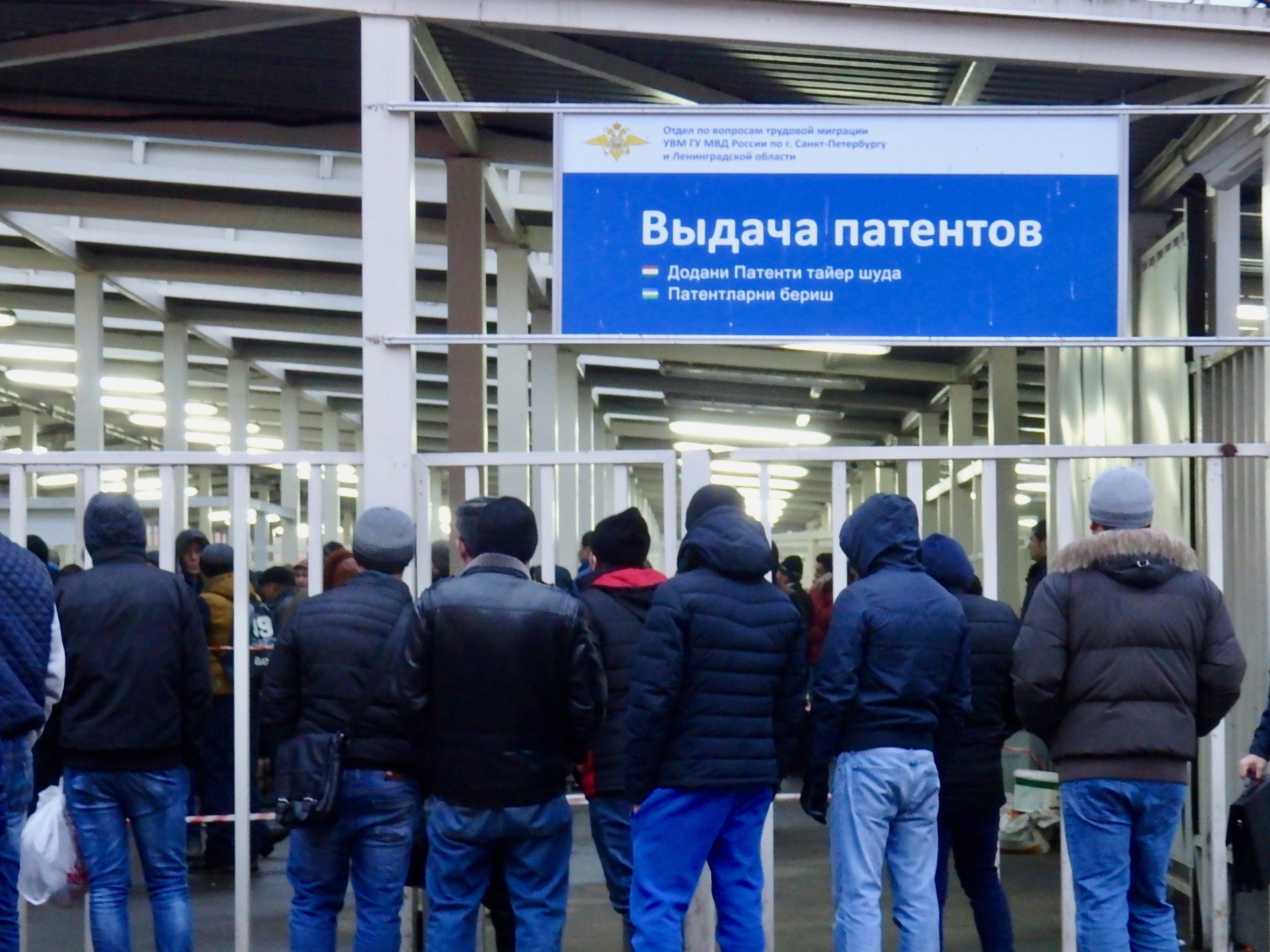
OLYMPUS DIGITAL CAMERACentral Asian migrant workers queuing outside the Russian Interior Ministry’s work permit application center on Red Textile Worker Street in St. Petersburg. Photo by the Russian Reader

Should Everyone Disappear into the Shadows? What the Fee Increase for Migrant Worker Permits Entails
Yekaterina Ivashchenko
Fergana News
November 29, 2018

The license [in Russian, patent] system for foreign nationals seeking permission to work in Russia was introduced in 2015. The cost of a work permit has varied from one region to the next. In Moscow, for example, it initially cost 4,000 rubles a month. In 2016, the price rose by 5% to 4,200 rubles, and in 2018, it rose by 7% to 4,500 rubles.

It is absolutely necessary to have a work permit. Without it, a migrant worker faces up to 7,000 rubles in fines, expulsion from Russia, and a ban on entering the country for a period of three to ten years. Employers who hire employees without work permits are punishable by fines, and their operations can be suspended for up to ninety days.

Something important happened on November 21, 2018. The Moscow City Duma approved a law bill increasing the cost of a work permit in Moscow. In 2019, it will rise by 500 rubles (11%) and cost 5,000 rubles a month (approx. $75).

The next day, November 22, Moscow Mayor Sergei Sobyanin said the city’s revenues from legal migrant workers had been growing and would exceed 16 billion rubles ($241 million) by year’s end.

“By paying such a high price for permits, migrant workers have come to occupy a fair position vis-à-vis Russian nationals [rossiyane] working in Moscow, because in the past they paid nothing at all, and, of course, it was profitable to employ them, but the situation has changed today,” said the mayor.

On January 1, 2019, the cost of a license for migrant workers seeking employment in Moscow Region will increase by 450 rubles. The Moscow Region work permit, which cost 4,300 rubles ($64.60) in 2018, will cost 4,750 rubles ($71.50) per month in 2019.

Taras Yefimov, chair of the Moscow Regional Duma’s budget, finance and tax committee, said the measure would enrich the region’s coffers by around one billion rubles [approx. $15 million]. In 2018, Moscow Region made six billion rubles [approx. $90.5 million] on migrant work permits.

St. Petersburg has decided to raise the price of the work permit from 3,500 to 3,800 rubles a month. City officials noted the decision was made because foreign nationals had begun earning considerably more money.
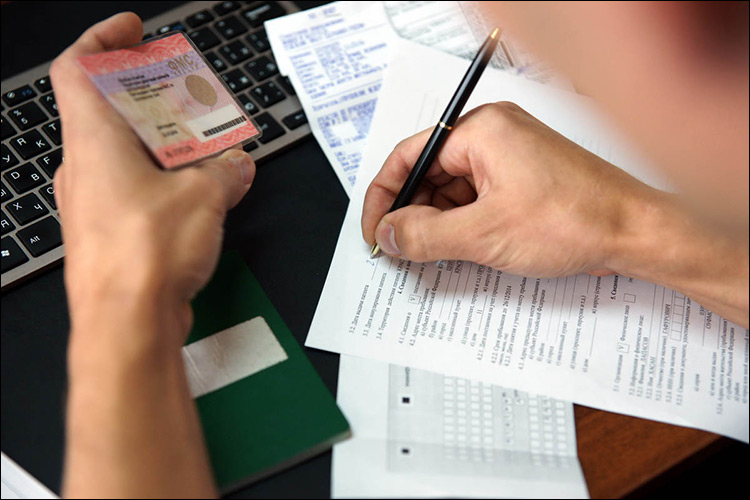
Filling out the forms for extending a work permit. Photo courtesy of Fmskam.ru and Fergana News

Wages Are Not Growing
Svetlana Salamova, director of Migranto.ru, a website for migrant workers looking for jobs and employers seeking to hire migrant workers, has not seen the real growth in the wages of migrant workers that officials have cited.

“The wages of foreign nationals who are employed on the basis of work permits has remained at the level of 29,000 rubles to 35,000 rubles [$435–$525] a month. Maybe the Moscow authorities are focused on high-profile specialists who make 168,000 rubles a month officially?” Salamova sarcastically wondered.

Salamova has noticed wage increases only among Kyrgyz nationals. After Kyrgyzstan joined the EAEU (Eurasian Economic Union), employers offered them 40,000 to 45,000 rubles a month.

“But they work without permits. (EAEU nationals can work in Russia without permits as long as they have an employment contract — Fergana News.) Besides, many Kyrgyzstanis agree to low wages of 19,000 to 20,000 rubles a month. They work part time in several places at once, and so ultimately they make a decent amount of money,” explained Salamova.

Salamova did not discount the possibility that fees for work permits have been raised in light of the fact that employers must index wages for inflation as of the new year. Perhaps the authorities decided to increase the cost of permits for foreign national because they took into account this indexation of wages on the Moscow job market.
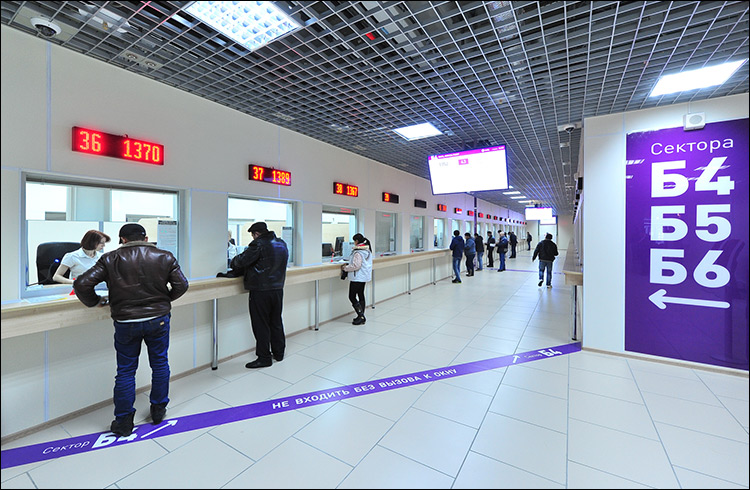
Immigration center in Moscow. Photo courtesy of Mos.ru and Fergana News

But what do migrant workers themselves have to say about it?

“Since 2015, the fee for the work permit has increased three times, but I have not even once received a raise. We spend little as it is: 4,500 rubles for the permit, plus the fee for residence registration; 6,000 rubles on rent, 5,000 on groceries, 2,000 on transportation. I sometimes buy clothes and medicines, and there are unforeseen expenses, like when my phone stops working. So, I have only 10,000 rubles left over from my monthly salary of 35,000 rubles. The latest 500-ruble increase will definitely affect my expenses. 6,000 rubles a year is a lot of money: an average family in Tajikistan could live for a month on that amount. It means my relatives back home will have to get by one month of the year without receiving a remittance from me,” said Magomed, who comes from Khujand, Tajikistan’s second-largest city.

Pushed into the Gray Economy
In June 2017, Mayor Sobyanin said the problem of illegal migrant workers in Moscow had been solved and had ceased to be a source of concern for Muscovites. Most migrant workers were employed legally and duly paid their taxes.

Experts believe the increase in the price of the work permit could lead to a rise in the number of foreign workers who decide not to pay taxes.

“The cost of the work permit will increase by 11%. An extra 6,000 rubles a year might not seem like a huge amount of money. But for migrant workers, who earn this money literally with their blood, living far from their families, and undergoing numerous hardships and risks, this is not a small amount at all: the overall cost of a permit for a year will be 60,000 rubles or $900. Some migrant workers will thus decide to go off the books. Consequently, Moscow’s budget is unlikely to get a huge boost, but the city will be supporting a policy of pushing migrant workers into the gray economy with all the attendant social consequences,” says Professor Sergey Abashin.

“It is odd that Moscow MPs say we will start earning more. Every migrant worker pays around 12,000 rubles to get a work permit in the first place. Then every month he pays for the work permit and his residence registration, he pays the rent, and he buys groceries. He even has to pay bribes to the police. People are taking money from us at every turn. What will we have left to send home?” said Muhammad, who is originally from Samarkand.

Batyrzhon Shermuhammad, a lawyer and founder of the website Migrant, also sees no signs of a wage increase.

“If you look at the want ads, you will see that the wages of migrant workers who are employed on the basis of work permits range from 25,000 rubles to 35,000 rubles a month. We monitor the job market, and no one mentions anything about a salary of 40,000 rubles a month. On the contrary, the economic crisis in Russia has been deepening. There is inflation, and the dollar/ruble exchange rate has been rising, which affects the remittances sent by migrant workers,” Shermuhammad said.

The latest increase in the cost of the work permit will force migrant workers to retreat into the shadows, he argues.

“One could understand the increase if the economic situation had improved, but the trends are negative: the prices in shops have increased, and the dollar has become more expensive vis-à-vis the ruble. People have no money, and so they have been having problems with residence registrations. Also, by law you cannot be late paying for your work permit even by a day. If a migrant worker is paid his wages late, he cannot pay the fee for his work permit, and he has no way of shelling out approximately 12,000 rubles to have a new work permit drawn up. While introduction of the work permit system brought migrant workers out of the shadows, the subsequent tightening of immigration laws and the increase in their expenses has been leaving migrant workers with fewer chances to stay legal, even if they would want to,” Shermuhammad said.
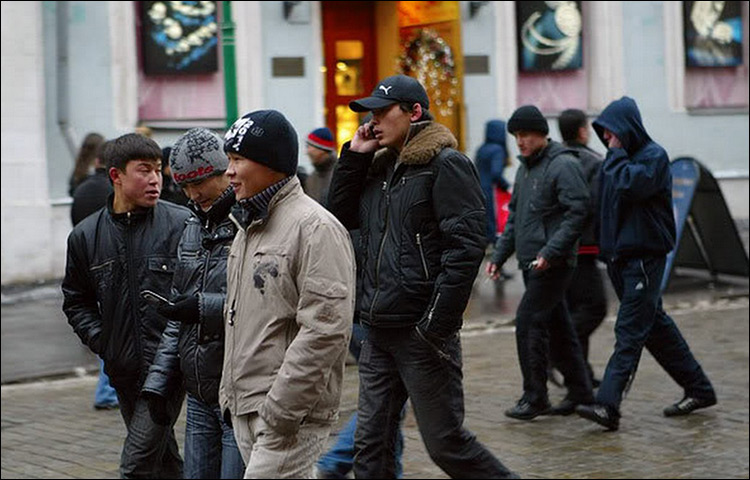
Migrant workers from Kyrgyzstan. Photo courtesy of Kloop.kg and Fergana News

“Even though I make good money, a 6,000-ruble increase in the price of the work permit is a serious expense, and I have huge expenses aside from the permit. My mother, sister, and I pay 33,000 rubles a month for a place to live. That is 11,000 rubles per person, plus utilities. In addition, I have to pay the fees for my studies twice a year: that is another 100,000 rubles each time. We don’t spend a lot on food, no more than 10,000 rubles per person a month. I also spend money on transportation, clothes, and gifts, and I spend 5,000 to 7,000 rubles a month for English lessons. Lately, we have not been sending a lot of money home, $200 to $300 per month at most. Mom and I used to be able to save money, but in the last six months our expenses have skyrocketed, and after the new year they will increase even more due to the work permit. Basically, the increase in the work permit fee means I won’t be able to pay for English lessons for a month,” said Ilkhom, who hails from Tashkent.

“For migrant workers, 500 rubles is a mobile phone connection for a month,” said human rights active Karimjon Yorov. “It is the cost of a week’s worth of subway trips. It is two lunches, finally. For families with children, it means being able to buy school supplies or pay for school lunches. In short, 500 rubles is a lot of money.”

Yorov argues that raising the cost of the work permit will make migrant workers not want to pay for it, meaning that revenues to Moscow’s coffers will actually decrease.

“Migrant workers will prefer to work without a permit and cross the border every three months. Currently, a trip to the border and back (i.e., exit and re-entry) costs 8,000 rubles in total, while the cost of a work permit for three months is 13,500 rubles, meaning they save 5,500 rubles by exiting Russia and re-entering it. This comes to 22,000 rubles, plus 12,000 rubles for the initial paperwork. The total is 34,000 rubles, which is the same as the cost of round-trip plane ticket to Uzbekistan. When you do the maths, it makes more financial sense for migrant workers to be off the books. The authorities themselves are forcing migrant workers underground, especially now that the laws on immigration registration have been tightened. Whether you get a work permit or not, if you do not live at the address where you are registered, you will be deported. Migrant workers will emerge from the underground only when the law on immigration registration has been abolished,” Yorov concluded.

Thanks to Sergey Abashin for the heads-up. Translated by the Russian Reader

Maria Eismont: Moscow’s Municipal District Opposition

DSCN0811
Like other municipal district councils in Russia’s major cities, Petersburg’s Vladimirsky Municipal District Council has a meeting space and offices, and enough money to publish a newspaper and fund very minor improvements in the neighborhood, but it has virtually no political power and survives only at the mercy of city hall and the city’s legislative assembly. Photo by the Russian Reader

How Things Are Going for the Municipal District Opposition
New politicians searching for a new agenda
Maria Eismont
Vedomosti
November 23, 2017

Sergei Sokolov was the only opposition member in the previous sitting of Moscow’s Konkovo Municipal District Council.

“I could not beat pro-regime council members when things were put to a vote, but I still managed to discourage them from doing things the neighborhood did not need,” says Sokolov, recalling his preceding five-year term on the municipal district council.

In September 2017, a team of Konkovo activists, led by Sokolov, won neighborhood elections, taking eight of the fifteen seats on the municipal district council. Sokolov was named head of the district, since Konkovo’s charter stipulates a simple majority of votes by council members to elect a district head, unlike other municipal districts. In other neighborhoods where the opposition won majorities on councils, their candidates for district heads ran into problems, since they needed the backing of two thirds of council members to win the posts, but they came up short on votes.

For the first time in many years, independent candidates won majorities in several Moscow municipal districts. In several instances, they won overwhelming majorities, but the question of whether grassroots self-government is possible in Moscow remains open.

The fact that Moscow’s municipal council members have scanty means at their disposal and insufficient powers was well known before and during the campaign. Yet now the new democratic politicians, who have taken power at the lowest level of Russia’s political totem pole, must show themselves and their voters that this is, in fact, the beginning of big and important changes in Russia.

Opposition politician Ilya Yashin, now head of the Krasnoselsky Municipal District, has already gone public with the new council’s first legislative undertaking. They have suggested eliminating the current system of so-called golden parachutes for outgoing municipal district council members and municipal district heads.

Konkovo’s independent council members have gone further. Within ten days of taking office, Sokolov sent the Moscow City Duma a request for 19 million rubles [approx. 275,000 euros] in additional funds for Konkovo’s budget, paid for with an increase in the allocation of personal income tax revenues.

“There are no rational explanations for the inexplicably low, discriminatory amount of personal income tax revenues allocated to the Konkovo Municipal District’s budget,” Sokolov wrote.

Council members have proposed spending the money on neighborhood improvements, accessible legal aid for low-income people, and a Southwest Moscow History Museum.

Last week, Konkovo council members came out with a legislative initiative to amend the Moscow City Law “On the Budget’s Structure and the Budgetary Process in the City of Moscow,” proposing to set the amount of allocations to municipal district budgets from personal income tax revenues at five percent. (It is currently set at 0.96%.) Economist Vladimir Milov helped draft the bill.

“I had been thinking about this initiative for a long time, and our team was organized for this purpose,” says Sokolov.

There are traces of picture frames that once held photographs of the president and prime minister on the wall in Sokolov’s office. They have been replaced by a hand-drawn portrait of slain opposition leader Boris Nemtsov.

“I have no illusions about the bill. United Russia still has a majority in the Moscow City Duma,” says Sokolov. “I don’t yet know how we are going to lobby the bill, but we will  be employing our usual methods: media outreach, rallies, and similar public things.”

It is difficult to imagine the circumstances in which Moscow city officials would meet the opposition municipal districts halfway, voluntarily giving up some of their money and authority. But it seems extremely important the reform of local self-government continues to be discussed and elaborated.

Translated by the Russian Reader

Two Hours in an Empty Tank

I am an anti-fascist anti-Faust . . .

40g_smooth_rock_build_1_940x506

Nothing Russian about AIDS
Moscow City Duma Proposes Fighting HIV Epidemic with Heterosexual Monogamous Family
Alexander Chernykh
Kommersant
May 31, 2016

Yesterday [May 30, 2016], the Moscow City Duma discussed the spread of HIV in Moscow. Virtually no physicians spoke at the hearing. Instead, the deputies chatted with experts from the Russian Institute for Strategic Research (RISS), who told the MPs that HIV was part of the west’s information war against Russia and that, rather than preventing HIV, condoms were, on the contrary, an indirect cause of the epidemic. The deputies were thus led to conclude it was not HIV that needed to be combated, but the populace’s moral laxity.

Lyudmila Stebenkova, chair of the Moscow City Duma’s health care committee, opened the hearing. She reminded the MPs that, a year ago, they had discussed HIV “because there had been all sorts of insinuations in the press that we, allegedly, had a huge number of HIV-infected people.”

In May of last year, Vadim Pokrovsky, head of the Federal AIDS Center, said that Russia had an HIV epidemic and called the situation a “national catastrophe.”

It was then Moscow MPs asked to verify the data and ordered a “well-grounded report on HIV infections.” To prepare the report, Moscow authorities turned not to doctors but to RISS, a government think thank founded by presidential decree in 1992. According to RISS’s website, the institute deals with “issues of national security provision” and “prevents the falsification of history.”

As Stebenkova explained, “Previously, they produced a stunning report on various NGOs funded by the west.”

RISS took nearly a year to produce the report. Yesterday, the institute’s deputy director, [Tamara] Guzenkova, presented it to Moscow MPs. According to RISS’s website, Ms. Guzenkova has nothing to do with medicine. She has a doctoral degree in history. In her publications, she has criticized the new Ukrainian authorities and spoken out on the “EU’s decline.”

She approached HIV from a familiar angle, arguing that “the problem of HIV/AIDS has been employed as part of the information war against Russia.”

In its report, RISS claims there are two models for fighting HIV. The western model includes “neoliberal ideological content, insensitivity to national idiosyncrasies, and the total priority given to high-risk groups such as drug addicts and LGBT.”

In turn, the Moscow model “takes into account the cultural, historical, and psychological idiosyncrasies of the Russian populace, and is based on a conservative ideology and traditional values.”

According to Ms. Guzenkova, when the international community proposes that Russia should employ western approaches to fighting the disease, it turns the epidemic into a “political issue” by “opposing Russia as country that permits itself to pursue an independent foreign and domestic policy.”

RISS’s deputy head Oksana Petrovskaya, who also has a doctoral degree in history and is a specialist on the history of the southern and western Slavs, continued comparing the two concepts. The institute’s website features her articles on the “fate of Russian cemeteries abroad” and the “identity crisis in Poland.”

Ms. Petrovskaya explained that Moscow was doing a better job of fighting HIV than Saint Petersburg, and then offered her own explanation why this was the case.

“The reasons are not only geographical and regional but also have to do with a focus on traditional values,” she said. “We can regard Moscow as a symbol of native Russian values, and Saint Petersburg as a symbol of Western European cultural values.”

RISS’s report is even more specific on this point.

“The earthy primordiality of the spontaneously emergent holy lands of Moscow is opposed to artificially and rationally organized Petersburg, the main component of whose myth has been the apocalyptics of the doomed city. Formed in the wake of perestroika, the counterculture of Petersburgers is based on a conception of personal freedom as freedom from contradiction.”

The report’s third co-author, Igor Beloborodov, a Ph.D. in sociology, heads RISS’s department of demographics, migration, and ethnic and religious issues. He listed the sources of HIV transmission.

“It is the contraceptive industry, which has a stake in pushing their products and, thus, in getting as many juveniles as possible to engage in early sex. The pornography industry: despite all our laws, you can get all the stuff you want in two clicks.”

Mr. Beloborodov also roundly criticized the sex products industry, dubbing them “lobbyists who have a direct stake in perverting the populace.”

He even argued the idea of sexual education for children had been imposed by the west in order to “demographically deter countries regarded as geopolitical competitors.”

But Mr. Beloborodov nevertheless believes condoms are the main enemy. He recounted his conversation with Spanish [epidemiologist] Jokin de Irala.

“He argues that contraceptives eliminate the self-preserving role of personal behavior. And that five [sexual] contacts involving a condom during adolescence are the equivalent of one unprotected contact.”

“Either way, no one has come up with a better means of preventing sexually transmitted diseases and, in particular, AIDs, than the monogamous family—the heterosexual monogamous family, I should underscore—who are faithful to one another,” said Mr. Beloborodov. “And I hope no one will ever come up with anything better.”

It is worth noting that Mr. Beloborodov rather loosely recounted the stance taken by Professor de Irala. In interviews and articles, the epidemiologist has said that abstinence alone does not help, and he promotes the concept of “abstinence and condoms.”

MP Stebenkova stressed she was not opposed to condoms as a means of preventing pregnancy, but did not believe in their efficacy against HIV. She recounted how she had recently been told the story of a young woman who had protected sex and yet had still tested positive for HIV.

“The risk is still reduced,” Alexei Mazus, head of the Moscow AIDS Center, who attended the hearing, suddenly noted.

“But condoms do not provide total protection,” the MP snapped back.

Mazus did not bother to object.

In summary, Stebenkova told the audience that “this report will play a very large role in further action.”

“In the long run, it is not AIDS we must fight, but drugs and promiscuity,” she said.

Translated by the Russian Reader. Photo courtesy of Vivarium Works

P.S. This horrorshow reminds me of a completely anonymous TV “documentary” I saw on one of the then-new and possibly now-defunct local channels in the mid nineties while channel surfing late at night. The documentary claimed in no uncertain terms, but without producing a shred of real evidence, that Russia’s rampant drug addiction problem was a plot by the CIA. Since back in those halcyon days you could not find “documentaries” of this sort on the main channels and broadcast in prime time, it occurred to me that the “documentary,” consisting only of a montage of any vaguely relevant or suggestive footage the filmmakers could get their hands on, backed by an ominous voiceover narrative, was the handiwork of a group of disgruntled veterans from some recently disbanded KGB sub-directorate. Now all of those disbanded sub-directorates have reformed with names like the Russian Institute for Strategic Research and the Kremlin. They are literally on the verge of running the country into the dirt, alas. TRR