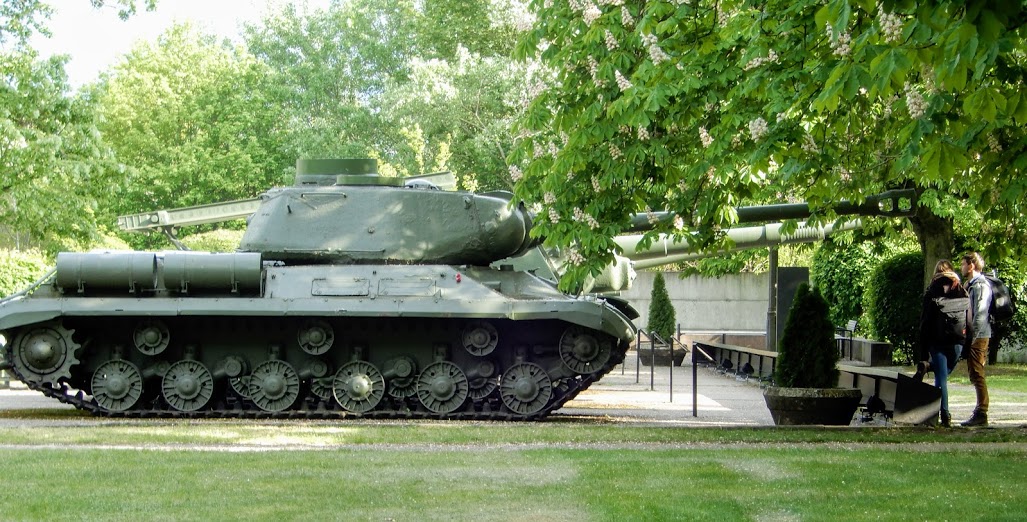
 A WWII-era Soviet tank, its muzzle pointed toward downtown Berlin, in the yard of the so-called German Russian Museum in the city’s Karlshorst neighborhood. Until 1994, it was known as the Capitulation Museum, since German high command formally surrendered to the Soviet high command in the building that houses the museum. Photo by the Russian Reader
At this point in their downward spiral towards worldwide moral and intellectual superiority, it is sometimes as hard to compliment Russians as it to make common cause with them or, on the contrary, argue with them.
I was thinking about this in a different connection when my attention was drawn to this column by Masha Gessen, published two days ago by the New Yorker.
The column is an odd beast.
First, Ms. Gessen makes a sound argument, based on hard, easily verifiable facts, but then she does an about-face and acts as her argument’s own resentful, miserably uninformed whataboutist, drawing false parallels between commemorations of the Second World War in Russia and the US, and the roles played by Putin and Trump in tarnishing these memorial events with their own sinister political agendas.
She is thus able to set readers up for the column’s takeaway message: “[T]he Trumpian spin on [the Second World War] is all maga, which makes it essentially the same as Putin’s.”
Ms. Gessen once was one of my favorite reporters, especially back in the days when she wrote for the weekly Russian news magazine Itogi. Later, I adored her poignant, richly rendered dual portrait of her grandmothers and the turbulent times of their younger years. I would still urge anyone curious about what the Soviet Union was really like under Stalin and after his death to put the book, Ester and Ruzya, at the top of their reading lists.
Nowadays, however, Ms. Gessen finds herself in what should be the unenviable position of having no one willing to call her on the carpet. Whatever she writes and says is regarded as the gospel truth, apparently, by her editors, readers, and listeners. In any case, I have never come upon any criticism of her work, at least in Anglophonia.
Her editor at the New Yorker, David Remnick, himself a Russia expert of sorts, has gone missing in action when it comes to editing critically what she writes about the country of her birth, and so has everyone else who could be bothered to notice the sleights of hand and sophistry in which she now indulges all too often.
In this case, it is simple. In the United States, there has been nothing like the overbearing politicization of victory in the Second World War as there has been in Russia since Putin took power twenty years ago.
The US does not even have a public holiday commemorating victory in the war, whether on the European front or the Pacific front. I think this says something. Maybe what it says is bad, but the importance of the “victory” for US society, especially now that nearly seventy-five years have passed since the victory was declared, has been waning with every passing day.
More to the point, whatever deplorable uses Trump may have made of the war, he has had a mere two years in office to do his damage, while “decisive victory” in the Great Fatherland War (as the war is called in Russian) has long played a central role in Putin’s eclectic, opportunist but extraordinarily reactionary ideology.
It is an rather odd stance, since the Kremlin regularly speaks and acts almost as if the Putin regime and the current Russian Armed Forces achieved victory over the Nazis in 1945, rather than the Stalin regime and the Red Army.
Victory in the war has been used as much to bludgeon the regime’s “traitors” and “enemies” into submission as it has been used to brainwash the Russian people into a false sense of national unity and international moral superiority.
Of course, there have been periods since 1945 when victory in the war was politicized by the US establishment, too. We need only think of Tom Brokaw’s “greatest generation” and, years before that last gasp, the ways movies and TV shows about the war functioned as surrogates for reinforcing western capitalist ideology during the Cold War.
As should naturally be the case, however, since the war ended a long time ago, and most of the people who witnessed it and fought in it have died, it has meant less to the rising generations in the US than it did to the generations of my grandparents (who fought in the war, if only on the home front) and my parents (who were born just before or during the war), and even to my own generation (who grew up in a vernacular culture still permeated by memories of the war, sometimes embodied in our own grandparents and their age mates, and a popular culture still awash in books, comic books, TV serials, movies, toys, and other consumerist junk inspired by the war).
A gradual waning of interest in the war should have happened in Russia as well, albeit in a manner that acknowledged and honored the war’s much greater impact on the country and all the other former Soviet republics.
In the nineties, under the “villainous” Yeltsin, this was on the verge of happening.
I remember going to the Victory Day parade on Nevsky Prospect in Petersburg in 1995. It was the fiftieth anniversary of the war’s end in Europe, but the main event consisted only of columns of real war veterans, some in uniform, some in civilian dress, all of them wearing their medals, marching down the Nevsky accompanied by a few marching bands and a military honor guard, if memory serves me.
Tens of thousands of Petersburgers lined the pavements, cheering the veterans, crying, and occasionally running out into the parade to hand them flowers, kiss their cheeks, and thank them personally for their courage.
It was simple, dignified, and moving.
But then a new mob took over Russia. The new mob wanted to rob the country blind and install themselves in power for as long as they could, so they had to convince their victims, the Russian people, of a number of contradictory things.
One, the highway robbery, as committed by the new mob, was for their own good. Two, the highway robbery was making them better and their country great again; it would bring “stability.” Three, the highway robbery was spiritually underwritten by the former country’s former greatness, as demonstrated, in part, by its victory over the Nazis in the Great Fatherland War.
It is not true that all or even most Russians have swallowed all or even most of this dangerous nonsense.
Putinism, however, has destroyed politics in Russia not only by demolishing all democratic institutions and persecuting grassroots activists and opposition politicians in ever-increasing numbers.
It has also disappeared most real political issues and replaced them with non-issues, such as nonexistent “threats” to the glory of Russia’s victory in WWII, as posed by “traitors” and hostile foreign powers, the completely astroturfed “upsurge” in “love for Stalin,” and several other fake zeitgeist events that have been designed purposely to set the country’s dubious troika of official pollsters polling like never before and take up oodles of space in the real media, the social media, and ordinary people’s minds and their bar-stool and dinner-table conversations with strangers, friends, relatives, and coworkers.
I am much too fond of French philosopher Jacques Rancière’s distinction between “politics”—what happens in the public space around real sources of political and social conflict in democratic societies or societies striving towards freedom and equity) and “police”—the opposite of “politics,” the utter control of public space and a monopoly on decision-making by a tiny anti-democratic elite.
“Police” as a concept, however, encompasses not only real policemen kicking down the doors of “extremists” and “terrorists,” and casing and tailing everyone suspicious and “unreliable” every which way they can.
In Russia under Putin, it has also involved tarring and feathering all real political discourse and political thinking, while promoting sophistry, scuttlebutt, moral panics, two minutes hate, and intense nationwide “debates” about non-issues such as “the people’s love of Stalin” and “victory in the war.”
The point of substituting artificial “police” discourses for wide-open political debate has been to prevent Russia from talking about bread-and-butter issues like pensions, the economy, healthcare, housing, the environment, war and peace, and increasingly violent crackdowns against political dissenters, businessmen, migrant workers, ethnic minorities, and religious minorities.
Russians are capable of talking about these things and do talk about them, of course, but a steady diet of nothing, that is, immersion in a topsy-turvy world in which the state, mainstream media, and many of your own friend will try, often and persistently, to engage you in “serious” conversations about chimeras and phantoms, has had an innervating effect on serious political discourse generally.
Try and talk to Russians about politics and, often as not, you will soon find yourself talking “police” instead.
If Ms. Gessen had decided to write a substantive article about the Putin regime’s use and abuse of the “victory,” popular acquiescence to its campaign, and grassroots pushbacks against, it would have familiarized Ms. Gessen’s readers with a story about which they know either nothing or almost nothing.
I cannot imagine anyone better qualified to tell the story than Ms. Gessen herself.
But, as is the case with many other Russians, the straight talk in Ms. Gessen’s recent printed work and media appearances about what has been happening in Russia under Putin has been veering off, sooner or later, into whataboutism and a series of well-worn memes whose hysterical repetition passes for political argument these days.
There is a different but curiously overlapping set for every political tribe in Putinist Russia, from nominal nationalists to nominal liberals and leftists.
What is my own takeaway message?
There can be no politics in Russia in the Rancierean sense or any other sense until the Russian liberal intelligentsia (with whom Ms. Gessen has explicitly identified herself on several occasions, obviously considering them vastly superior intellectually and morally to the American mooks with whom she has been condemned to spend too much time, Russiansplaining everything under the sun to them as best she can, mostly to no avail) and all the other intelligentsias and political tribes in Russia give up their pet sets of non-issues and non-solutions and revive the deadly serious politics and political discourses of the pre-Revolutionary period, if only in spirit.
However, the efficacy of “police” under Putin has been borne out by the way in which nearly everyone has united, time and again, around the very non-issues the regime and state media has encouraged them to discuss.
On the contrary, several painfully real issues, for example, Russia’s ruinous, murderous military involvement in Syria, have never been vetted by “police” for public hand-wringing of any kind.
As if obeying an unwritten rule or a tape reeling in their heads, nobody ever talks about them, not even the great Masha Gessen. {TRR}
Thanks to Comrade GF for bring Ms. Gessen’s column to my attention.