Trans(national) Solidarity

“Yara Tychina, a young transgender woman and Astana resident, picketed on Vodno-Zelyoniy Boulevard next to the House of Ministries and the Parliament. Unfurling a handmade transgender flag, she demanded that the Senate, the Presidential Administration, and the President reject the ‘LGBT propaganda’ amendments. She was taken to the Yesilskoye District Precinct of the Astana Police. Further details are in the video.”

[In which video Ms. Tychina says] Hello! I am Yara Tychina. I’m an ordinary citizen of Astana. I work in the coffeehouse [?] industry. I’m an openly trans women. I am protesting peacefully today because there are no other means to impact my country’s repressive policies. I don’t simply oppose this law. [It] violates my rights and freedoms, the rights and freedoms of my friends, my colleagues, the people in my life and, most importantly, my family, over half of whom are members of the LGBT minority community. I have carefully scrutinized this law and I can say truthfully that it has nothing whatsoever to do with ‘propaganda,’ since in black and white it says that any mention of LGBT—in a positive vein, in a neutral vein, it doesn’t matter which; in personal profiles, in personal conversations with people, it doesn’t matter where—is considered ‘propaganda.’ The fact that I’m an openly trans woman makes me a criminal, according to the new amendments. These amendments also don’t have anything whatsoever to do with ‘protecting children,’ since hundreds of Kazakhstani LGBT children, who had no way of influencing [who they are], will find themselves outlawed. They will be banned. They will be forbidden from talking about themselves on social media. They will be forbidden from gathering together in public or in private.

[Ms. Tychina is interrupted by Astana police officers, who claim she is violating the law. She repeatedly states her willingness to go with them to the police station. She then continues.] I heartily and tearfully implore the Presidential Administration, the Senate, and the President of the Republic of Kazakhstan, Kassym-Jomart Tokayev, and the Constitutional Court, if that doesn’t work, to reject these amendments. Otherwise, hundreds of thousands, if not millions, of Kazakhstanis, will unavoidably suffer. With these amendments, you will bridge the gap between Kazakhstan and Russia, but you will also drive away all international investments and significantly harm Kazakhstan’s standing in the international arena. But first of all you will harm people. You will harm my family. I implore you to stop it. Thank you!

[Responding to a reporter, who asks her name, Ms. Tychina says] My name is Yara Tychina. I’m in the coffeehouse [?] industry. I have a small business. I’m an ordinary [female] citizen. [Responding to a question about her flag, she says] It’s a transgender flag, the flag of my identity. It’s homemade. [To the police officers] Let’s go! Thank you! [A police officer explains to the press that Ms. Tychina has not been detained but has voluntarily agreed to go with them to the station.]

Source: werequest.kz (Instagram), 3 December 2025. Translated, from the Russian, by the Russian Reader. Thanks to Peter Leonard for the heads-up.


Police in Kazakhstan’s capital detained a transgender activist for staging a solitary protest against pending legislation prohibiting so-called “LGBT propaganda.” Yara Tychyna held up a handmade transgender flag near government buildings in downtown Astana and called for the Senate and the presidential administration to reject changes to the law, which are designed to proscribe “propaganda of non-traditional relations,” a formulation broad enough that positive portrayals of same-sex relations could be treated as prohibited content. Lawmakers have been debating the measure since the lower house approved it in November. Officials insist the restrictions are framed as child-protection rules. Critics warn that the draft’s language is vague and that equating LGBT themes with harmful content risks legitimising discrimination.

Source: Peter Leonard, “Central Asia’s week that was #82,” Havli, 3 December 2025


On Wednesday, November 12, the [lower house of the] Parliament of Kazakhstan (Mäjilis) unanimously passed a law banning “LGBT propaganda” in the media and on the internet. Violators face fines, and in the case of repeat violations, up to ten days in jail.

“Endeavoring to protect children from information detrimental to their health and development, provisions have been made to restrict the dissemination of information promoting pedophilia and non-traditional sexual orientation in public spaces, as well as via the media, telecommunications networks, and online platforms,” the document states.

The changes will affect nine laws. Violations of the ban will be punishable by a fine of up to forty minimum calculation indices (in 2025, this amounted to 157,000 tenge, or approximately 260 euros, or 24,500 rubles), or up to ten days in jail.

Kazakhstan’s Deputy Minister of Culture Yevgeny Kochetov explained that materials containing “propaganda of non-traditional relationships” would have to be labeled “18+.” Content that violates the law would be blocked.

Kochetov added that the strictures currently apply primarily to those who distribute materials. If minors attend a screening of a film rated 18+, the cinema’s managers, not the parents, would face a fine, he explained.

“If, for example, [men] are holding hands in the park, this is not considered propaganda. These are their personal boundaries, and there are no questions here,” said one of the sponsors of the bill, MP Yelnur Beisenbayev.

The Mäjilis initially sought to ban “LGBT propaganda,” in April 2024, by amending the law “On Mass Media.” They later proposed criminalizing “LGBT propaganda” and equating it with incitement to ethnic, social, or religious hatred.

When MPs began discussing banning “LGBT propaganda,” a petition entitled “We oppose open and covert LGBT propaganda in the R[epublic of] K[azakhstan]” was posted on the website E-Petition.kz. It was the third petition in the country to gather the fifty thousand signatures required for consideration by the government.

The Ministry of Culture and Information decided to partly accede to the petitioners’ demands—when it came to strictures aimed at “protecting and shielding adolescents and children from the promotion and cultivation of sexual relations.”

Consequently, the ban was presented as an amendment to the draft law on archiving.

Traditional values

In recent months, Kazakhstan President Kassym-Jomart Tokayev has repeatedly spoken about the need to protect “traditional values.” The day before the Mäjilis passed the bill, and ahead of his visit to Moscow, Tokayev published an article in Rossiiskaya Gazeta in which he spoke about the friendship between the two countries.

“We are united by a common take on traditional values, similar views on the pressing issues of contemporary life, and cooperation in ensuring the welfare of [our two] brotherly peoples,” Tokayev wrote.

In Russia, the law banning “LGBT propaganda” among minors was first introduced in St. Petersburg in 2011, and then at the federal level in 2013. In 2023, the Russian authorities went so far as to declare the “international LGBT movement” extremist.

As of July 2025, Human Rights Watch had catalogued more than one hundred criminal indictments and convictions [in Russia] for involvement in the “international LGBT movement” or for displaying symbols which the authorities attribute to this movement.

Following Russia’s lead, “LGBT propaganda” was banned in Hungary in 2021, and in Georgia in 2024.

LGBTQ+ in Kazakhstan

Homosexuality was decriminalized in Kazakhstan de facto in 1997 and de jure in 1998. Since 2003, transgender people have been able to change their gender marker in official documents.

In 2021, the Williams Institute at UCLA School of Law ranked Kazakhstan 154th out of 175 countries in terms of public acceptance of LGBTQ+, below Uzbekistan, Russia, and Afghanistan.

The online platform Equaldex, which researches the rights of sexual minorities around the world, writes that “[a]ccording to recent survey data, there appears to be strong opposition to LGBTQ+ rights in Kazakhstan.”

Many human rights organizations have already criticized Kazakhstan’s ban on “LGBT propaganda.”

Human Rights Watch urged lawmakers to reject the bill. The NGO argues that the proposed amendments violate fundamental human rights and could make LGBTQ+ people in Kazakhstan more vulnerable.

Organizations including ILGA-Europe (the European branch of the International Lesbian, Gay, Bisexual, Trans and Intersex Association), the World Organisation Against Torture (OMCT), and TGEU (Trans Europe and Central Asia) have also issued a joint statement against the bill.

The Kazakhstani organization Queer.kz commented on the Mäjilis’s passing the amendments banning “LGBT propaganda” as follows: “We continue to write letters! Our organization will continue to work together with our colleagues to defend human rights and freedom!”

Source: “Kazakhstan parliament votes to ban ‘LGBT propaganda,'” BBC Russian Service, 12 November 2025. Translated by the Russian Reader. Thanks to Peter Leonard for the heads-up.


Over the past four years of America’s modern anti-transgender panic, Missouri has been one of its chief laboratories. Each legislative session brings a flood of new proposals targeting transgender people—with each year opening with often more than a dozen bills—and 2026 is already shaping up to continue that pattern. In the first batch of early bills, lawmakers introduced 21 anti-LGBTQ+ measures, many escalating the state’s enforcement tactics beyond even last year’s cruelties. One stands out in particular: a bill that would ban “social transition” in schools—blocking teachers from using a student’s chosen name or pronouns, even with parental consent.

The bill, SB1085, filed by Senator Joe Nicola, states in its summary that it would prohibit “public school staff members from encouraging minor students in their ‘social transition,’” which the measure defines as engaging in any activity “with the goal of helping a student become perceived as a member of the opposite biological sex.” The text defines social transition broadly—“participating” in a student’s gender transition based on “details such as his or her name, appearance, or behavior”—and bars schools from taking part in any conduct that could contribute to a student “not being perceived and treated as a member of the student’s biological sex.”

The bill explicitly forbids all school staff and faculty from “the use of alternative pronouns or names for the minor student, either in school records or otherwise.” Notably, it contains no provision for parental consent—meaning the restrictions apply not only to unsupportive parents but also to parents who affirm their transgender children. The measure appears to single out trans students exclusively: nothing in its text bars name changes for any other reason unrelated to gender transition.

You can see the provisions here:

The bill marks the latest front in anti-transgender legislation: an effort not just to ban medical transition for trans youth, but to prohibit any form of transition at all, including social transition. Earlier this year, reporting out of Texas showed how a similar law led teachers to suddenly deadname students who had used their affirmed names for years without issue. Variations of this language have surfaced in several states, but Missouri’s proposal is among the most explicit and far-reaching attempts yet to regulate social transition in schools.

The ban on social transition—even with parental permission—underscores a shift in how anti-trans legislation is being sold to the public. For years, supporters of bathroom bans, sports bans, and “don’t say gay” policies framed their efforts as battles for “parental rights.” Increasingly, though, that language has fallen away as lawmakers move to strip supportive parents of any authority at all, mirroring the approach in medical transition bans that override parental consent entirely. Under Missouri’s proposal, parents would have no right to approve their child’s affirmed name or pronouns, and any teacher who honors a family’s wishes could face the loss of their license.

The social-transition ban is just one front in a broader offensive. Missouri lawmakers have already filed bills to outlaw public drag by defining it as prurient “male or female impersonation,” to strip Pride flags from public schools, and to roll back nondiscrimination protections for transgender people in housing, employment, and public accommodations. And more proposals are almost certain to follow. When the legislature gavels in on January 8, the real question for observers won’t be whether these bills appear—they already have—but which ones Republican leadership chooses to fast-track. That early movement will signal just how aggressive Missouri intends to be in advancing its anti-LGBTQ agenda this session.

Source: Erin Reed, “New Missouri Bill Would Ban “Social Transition” In Schools, Even With Parental Permission,” Erin in the Morning, 3 December 2025


On April 27, 2023, Kansas became the first state in the country to institute a statewide definition of sex. “A ‘female’ is an individual whose biological reproductive system is developed to produce ova,” the law declared, “and a ‘male’ is an individual whose biological reproductive system is developed to fertilize the ova of a female.” Since then dozens of state legislatures have introduced similar bills; sixteen have passed. In Indiana and Nebraska governors have issued executive orders to the same end. Each of these measures effectively strips transgender people of legal recognition.

The language of these policies usually distinguishes men from women by their reproductive capacity, which is assumed to be determined at birth or even at conception. Each statute mandates that its definitions of “sex,” “female,” and “male” be used whenever those words appear in any part of the state code. Some purport to be establishing a “women’s bill of rights,” as the titles of Kansas’s and Oklahoma’s bills suggest; Louisiana’s is titled “The Women’s Safety and Protection Act.” (On the other hand, the name of North Dakota’s bill—into which legislators slipped another term they wanted to define—captures the arbitrariness involved: “The Definition of Female, Male, Sex, and Scrap Metal Dealer.”)

This legislation is part of a broader onslaught. In the past few years Republican-controlled state legislatures have introduced thousands of bills targeting trans people, with measures to ban puberty blockers and hormones for trans youth, bar trans girls and women from sports, mandate that bathroom access be based on birth sex, outlaw drag performances, and more. So far more than two hundred of these laws have passed, with grave, often life-changing consequences for the trans residents of red states across the country.

Continue reading “Trans(national) Solidarity”
Don’t Press the Button

I read on social media yesterday that Russian ebook giant LitRes had added a button on its website for readers who want to file a complaint against any of the books it offers for violating Russian laws. To see whether this was true, I punched up the most popular recent Russian book among readers of this website, Katerina Silvanova and Elena Malisova’s runaway LGBTQ+ romance bestseller A Summer in a Young Pioneer’s Tie.

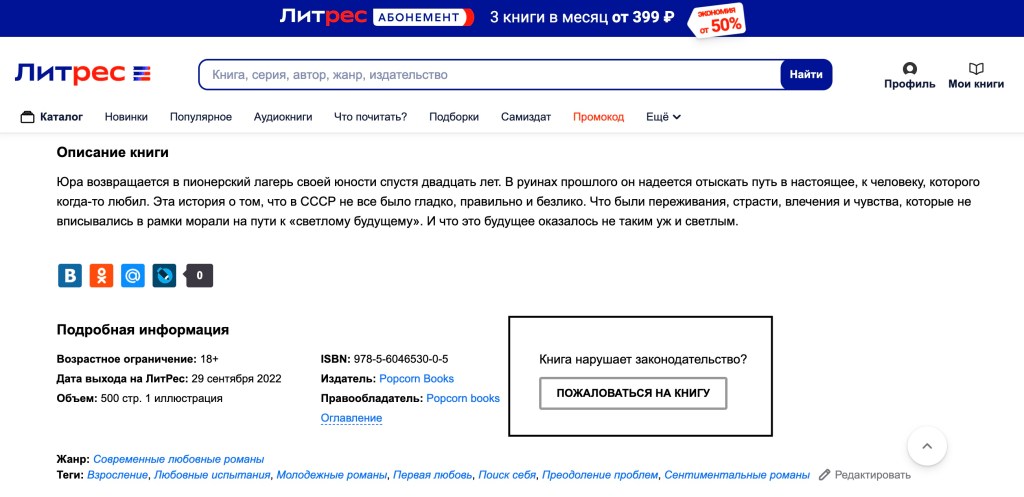
Indeed, there is such a button, located below the book’s description and right next to a summary of its front matter. In the screenshot I took, above, I’ve drawn a black box around the button, which reads, “Does the book violate the law? Complain about the book.”

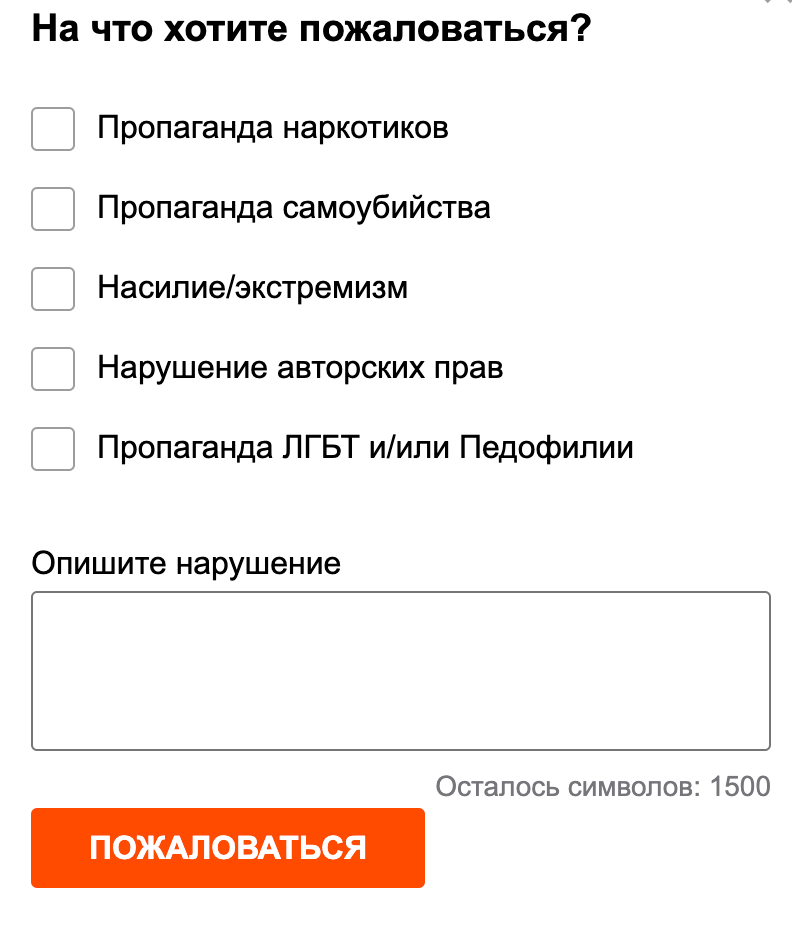
If you do the unthinkable and press the button, a window pops up:

“What do you want to complain about?” the prompt asks. The choices are “Promotion of narcotics,” “Promotion of suicide,” “Violence/extremism,” “Copyright violation,” and “Promotion of LGBT and/or Pedophilia.” You are then asked to “describe the violation” in 1,500 characters or less and dispatch your complaint to LitRes’s law-abiding overlords by hitting the big orange-red “Complain” button.

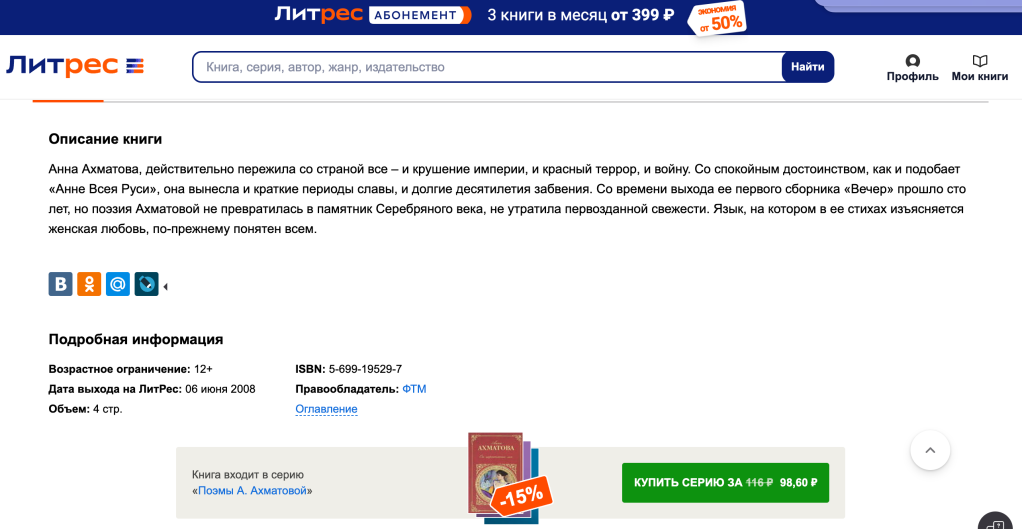
A quick scan of the 113 titles in my own “bookshelf” on LitRes and some of the book’s suggested to me by the service revealed, however, that readers cannot file a complaint against any book they wish. Anna Akhmatova’s Requiem, for example, is beyond suspicion, as you can see in the screenshot, below. ||| TRR

Love in a Young Pioneer’s Tie

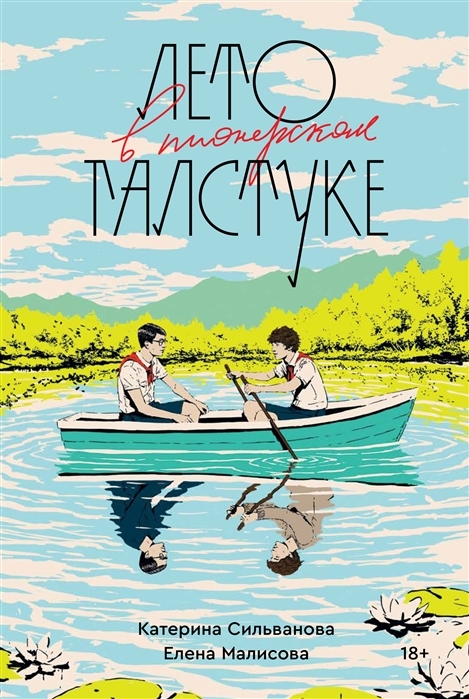
The cover of “A Summer in a Young Pioneer’s Tie,” as designed by Adams Carvalho

Katerina Silvanova was born and raised in Kharkiv, but moved to Russia at the age of twenty-two. She majored in forestry engineering, but never finished her studies. She has worked in sales all her life. Elena Malisova is a Muscovite and married, and works in IT. The girls [sic] had never been associated with literature, but both have had a passion for writing since childhood. One day, chatting on the internet after a hard day’s work, the friends agreed that they had to do something together. So, the idea of the novel A Summer in a Young Pioneer’s Tie was born.

Musician Yuri Konev arrives at the abandoned Swallow Young Pioneer Camp in the Kharkiv region to encounter the ghosts of his past. Something happened there that turned his life upside down, changing it forever. There he met the camp counselor Volodya, who became more than a friend to the teenager.

Walking through streets of the camp, overgrown with grass, Yura recalls how rapidly and stormily his relationship with Volodya developed, how they had been afraid of what was happening between them. And yet, they had gravitated to each other. The trip to the camp is a new revelation for Yura. He was sure he had buried the past there, that its rebellious echo would never again disturb him . And yet, Konev will have to come face to face again with what already turned his life around once. Apparently, not all the ghosts of the past are willing to hide in memory’s back alleys forever.

Why should you read A Summer in a Young Pioneer’s Tie?

  1. It’s a new extraordinary look at the late Soviet period of history.
  2. It’s a novel about sincere first feelings, cloaked in mystery and shame, condemnation and doubts.
  3. It’s an absolute bestseller, one of the year’s most anticipated and controversial books.

Book Description
Yura returns to the Young Pioneer camp of his youth after twenty years. In the ruins of the past, he hopes to find a path back to the present, to the person he once loved. This story is about the fact that not everything in the USSR was smooth, straight-laced, and impersonal, that there were experiences, passions, drives, and feelings that did not fit into the moral framework leading to the “bright future,” and that this future was not so bright.

Source: LitRes. Image courtesy of Wikipedia. Translated by the Russian Reader


Leto v pionerskom galstuke (LVPG) [A Summer in a Young Pioneer’s Tie] is a novel co-written by Elena Malisova and Katerina Silvanova. The book deals with the relationship between two young men, the Young Pioneer [sic] Yura and Volodya, who meet at Young Pioneer camp in the summer of 1986.

[…]

Twenty years later, the musician Yuri Konev returns to the place where the Swallow Young Pioneer Camp was once located, recalling the summer of 1986, which spent there, and his love for the MGIMO student and camp counselor Vladimir Davydov. Yura and Volodya were jointly involved in staging a play, and a strong friendship arose between them, which gradually developed into teenage love. Throughout the book, Volodya refuses to accept his homosexual orientation, periodically insisting on ending the relationship and explaining that he is trying to “steer Yura off the right path” and that he is homophobic himself. At the end of the their stay at the camp, the young men bury a kind of time capsule under a willow tree, agreeing to dig it up in ten years. After parting, Yura and Volodya continue to communicate by correspondence for some time, but after a while they lose touch with each other. In 2006, after finding the time capsule, Yura learns in a letter that Volodya sends him that he had failed to “overcome” his orientation and still loves Yura.

The novel, which was originally posted on the website Ficbook.net, was published by Popcorn Books in 2021. By the end of May 2022, the book had sold more than 200,000 copies, not counting electronic sales. The novel took second place in the list of the most popular books among Russians in the first half of 2022, compiled by the Russian Book Union, and sales of the book amounted to about 50 million rubles. August 2022 saw the release of a sequel, What the Swallow Won’t Say, which takes place twenty years after the events described in A Summer in a Young Pioneer’s Tie.

[…]

Critic Galina Yuzefovich gave a generally positive review of the novel, noting that “life in the Soviet Union differed little from life today, and emotions, relationships, and the desire to love and be loved do not depend on ideology.” Book blogger Anthony Yulai (Anton Ulyanov) rated the novel positively on the whole, noting that the authors keep the reader “in a state of emotional shock due to the alternation of sweet moments with sad ones and an abrupt change in the tone of the narrative towards the novel’s end.”

Zakhar Prilepin harshly condemned the book and its publishers on his Telegram channel: “Popcorn Books (which inevitably suggests “porn books”) is are celebrating their triumph and counting their profits. They will regard this post as good fortune, too. That’s what they were counting on. I won’t hide it: I’d burn down your whole office while you’re sleeping at home!” A video featuring a negative review of the book was released by Nikita Mikhalkov. He read aloud an excerpt from the novel and deems its publication a “violation of the Constitution.” He also noted that the abbreviation “LVPG,” as the novel is known among fans, is very similar to “LGBT.”

N.A. Ostanina, chair of the State Duma Committee on Family, Women and Children, sent a request to Roskomnadzor to examine the contents of the book to determine whether a criminal case could be launched against it in the future. A similar request was sent by the news agency RIA Ivan-Chai, but received a negative response.

Source: Wikipedia. Translated by the Russian Reader


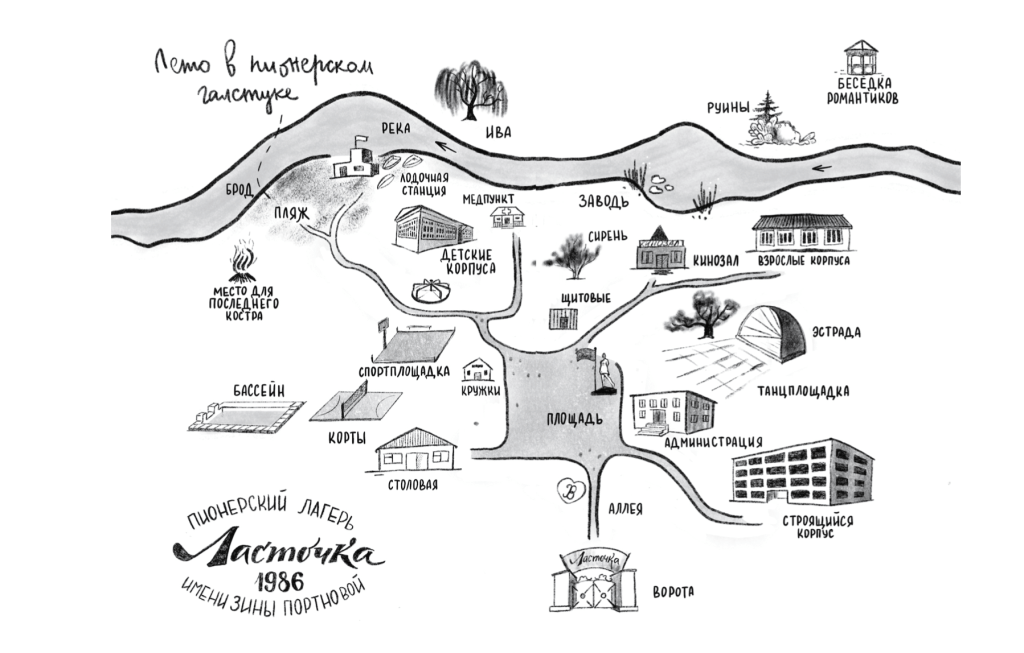
A map of the Zina Portnova Memorial Swallow Young Pioneer Camp in 1986, as featured in the novel’s front matter.

“Aren’t you exaggerating?”

Seeing Volodya’s slightly condescending smile, Yurka was embarrassed. He probably thought that Yurka remembered their dance too well and was still jealous, so he was ready to accuse Masha of anything. And if Volodya really thought so, then he was right. Yurka’s ardent desire to jump out of the bushes and catch the spy red-handed was caused precisely by jealousy. But Yurka also had arguments in defense of his theory.

“It’s not the first time she’s been out at night. Do you remember when Ira came to the theater and attacked me, asking me what I’d been doing with Masha and where I’d been walking? And it’s true, no matter where we are, she’s always there. Volodya, we have to tell them about her walks!”

“Deal with Irina first.”

Yurka did go find her almost immediately. All the same, his mood was spoiled, and Volodya was paranoid again, and he constantly froze, listening and looking around and not even letting him touch his hand. And the evening was already coming to an end.

After hastily saying goodbye to Volodya, Yurka returned to his unit and found the counselor. He expected her to frown and scream at him as soon as he walked in. He was already ready to babble excuses, but Ira stared at him in surprise.

“Actually, no, I wasn’t looking for you,” she said. Yurka had already put his hands up to stop his jaw from dropping, when Ira yelled.

“Where have you been, by the way?”

“With Volodya.”

“Did you even notice what time it is?! Yura, who are they playing lights out for?! If you’re going to be late, you have to warn me!”

Yurka fell asleep, struggling with mixed feelings full of anxiety. Volodya was constantly surrounded by girls, but it seemed to Yurka that Masha popped up too often. It must be jealousy after all. And to top it all off, he apparently had been infected with Volodya’s paranoia.

Source: Elena Malisova and Katerina Silvanova, A Summer in a Young Pioneer’s Tie (Popcorn Books, 2021), p. 155, as chosen by the True Random Number Generator. Translated by the Russian Reader


In an industrial block in northeastern Moscow on a recent Friday night, organizers of an L.G.B.T.Q.-friendly art festival were assiduously checking IDs. No one under 18 allowed. They were trying to comply with a 2013 Russian law that bans exposing minors to anything that could be considered “gay propaganda.”

The organizers had good reason to be wary: Life has been challenging for gay Russians since the law passed, as the government has treated gay life as a Western import that is harmful to traditional Russian values and society.

Now Russia’s Parliament is set to pass a legislative package that would ban all “gay propaganda,” signaling an even more difficult period ahead for a stigmatized segment of society.

The laws would prohibit representation of L.G.B.T.Q. relationships in any media — streaming services, social platforms, books, music, posters, billboards and films — and, activists fear, in any public space as well. That’s a daunting prospect for queer people searching for community, validation or an audience.

“I’m afraid for my future, because with these kinds of developments, it won’t be as bright as I would like it to be,” said a drag artist who uses the stage name Taylor. Taylor’s performance on Friday before a small but enthusiastic crowd tackled themes of domestic violence, mental health and AIDS.

The proposed laws are part of an intensifying effort by President Vladimir V. Putin to cast Russia as fighting a civilizational struggle against the West, which he accuses of trying to export corrosive values.

The Kremlin is coupling the crackdown on L.G.B.T.Q. expression with its rationale for the war in Ukraine, insisting that Russia is fighting not just Ukraine but all of NATO, a Western alliance that represents a threat to the motherland.

[…]

Source: Valerie Hopkins and Valeriya Safronova, “‘I’m Afraid for My Future’: Proposed Laws Threaten Gay Life in Russia,” New York Times, 4 November 2022

Why They Fight

I’m writing once more about the Donbas and our true goals in carrying out the SMO. Everyone should know this, given that there are still many Russians wondering what it was all for. This category of people should know that the events in Donbas did not arise in a vacuum.

We are fighting not only for the liberation of peaceful people from years of Nazi tyranny. We are fighting for the future of our country, Russia — for our traditions and identity, for spiritual and moral values, for religion and the triumph of justice.

If we have been saying for many, many years that NATO’s force should not threaten us and prance at Russia’s borders, it only meant that we would not sit still and watch them place the sword of Damocles over us.

If we kept saying for a long time, patiently, discreetly, but intelligibly, that they shouldn’t torture and exterminate the Russian-speaking population of Donbas, it simply meant that they should be treated equally, respectfully, without prejudice.

Further, if we said that the Crimea is ours, [and] that this is the choice of Crimeans themselves, then it was not worth regularly and monotonously repeating that you would invade this area at the first opportunity.

Finally, if we persistently repeated that you could cherish and lust after your faceless LGBT masses as much as you wanted, but don’t impose it on us, it just meant that we wouldn’t allow it at home. We do not understand or accept it. But even in this case, sanctions were imposed on Russia — just for rejecting LGBT values.

Listen to the combat general, Hero of Russia, and commander of the Akhmad special forces battalion Apti Alaudinov. He uses accessible, simple words, and speaks reasonably and intelligibly. Everything he says is very clear and precise!

Source: Kadyrov_95 (Ramzan Kadyrov), Telegram, 10 September 2022. Translated by the Russian Reader


The apparent collapse of the Russian forces has caused shock waves in Moscow. The leader of the Chechen republic, Ramzan Kadyrov, who sent his own fighters to Ukraine, said if there are not immediate changes in Russia’s conduct of the invasion, “he would have to contact the leadership of the country to explain to them the real situation on the ground.”

Source: Steve Hendrix, Serhii Korolchuk and Robyn Dixon, “Amid Ukraine’s startling gains, liberated villages describe Russian troops dropping rifles and fleeing,” Washington Post, 11 September 2022


Communist Party leader Gennady Zyuganov, speaking in the State Duma on Tuesday, September 13, dubbed the “special operation in Ukraine” a war and called for a nationwide mobilization in Russia.

“How does a special military operation differ from a war? You can stop a military operation at any time. You cannot stop a war: it ends either with victory or defeat. I’m suggesting to you that there is a war going on, and we have no right to lose it. We must not panic now. We need a full mobilization of the country; we need completely different laws,” the online publication Sota quotes Zyuganov as saying.

Gennady Zyuganov, chair of the Central Committee of the Communist Party of Russian Federation (KPRF):
“Today, Russia’s fate depends on victory in Donbas. We need a total mobilization of the country.
We need completely different laws.” Source: Sota

Earlier, Communist Party MP Mikhail Matveyev suggested that governors and MPs volunteer for the front. For his part, Mikhail Degtyarev, the governor of Khabarovsk Territory, said a few days ago that he would like to go to Ukraine as a volunteer, but he could not, because he had no right to resign his post. Residents of the region launched a petition proposing to “help the governor realize his dream to go to fight in Donbas.” It has been signed by several tens of thousands of people.

Later, the press service of the Communist Party commented on the party leader’s statement. Zyuganov had spoken primarily about mobilizing Russia’s economy, political system and resources in the face of the impending threat, said Communist Party press secretary Alexander Yushchenko. He claimed that [Zyugannov’s statement] had nothing to do with the military. “Some groups are engaged in outright provocations, like the people who have spread this news. I would would say that such people should generally be executed,” Yushchenko said.

[…]

Source: Sergei Romashenko, “Zyuganov says a war, not a special operation, underway in Ukraine,” DW, 13 September 2022. Translated by the Russian Reader

This Blog Is Gay

Felix Glyukman, as seen in a screen shot of his “controversial” YouTube video, courtesy of Sota

YouTube demands that an LGBT blogger living in the United States remove a video that violates Russian law
OVD Info
January 4, 2022

YouTube has demanded that the blogger Felix Glyukman, who lives in the US, delete his [Russian-language] video “How I Realized I’m Gay.” The news was reported by Sota, who quoted Glyukman’s Facebook post on the matter.

The video hosting service referred to a letter it had received from Roskomnadzor. The notice states that the video, which the blogger posted in 2019, violates the Russian law “On Information, Information Technologies and Information Protection” and contains information prohibited for distribution. YouTube informed Glyukman that it would block the video if he failed to delete it.

“I actually found the video in Roskomnadzor’s registry. By the way, in it I talk about how I became aware of my sexual orientation in adolescence and how my preferences manifested themselves even in childhood. I also recommended the book This Book is Gay. Apparently that’s why the hardworking asses of Roskomnadzor’s staffers caught on fire: because it was about me as a minor,” commented Glyukman.

The blogger adds that he has not lived in Russia since 2017, and shot the video in Miami.

Translated by Thomas H. Campbell

Welcome to Estonia

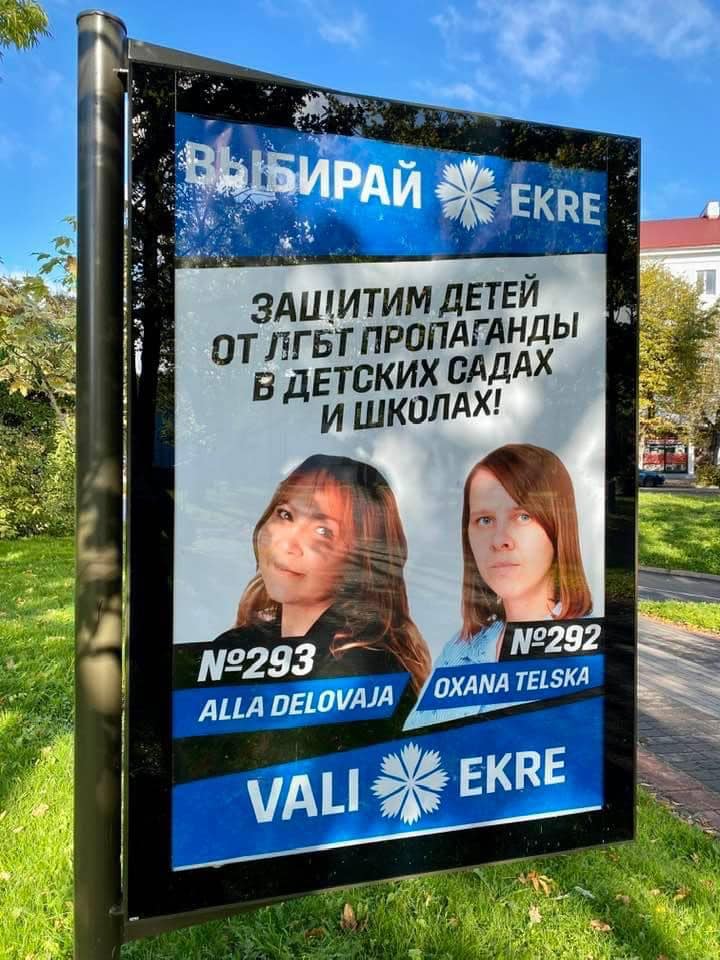
Welcome to Narva (Estonia)! This campaign billboard from the EKRE party (Conservative People’s Party of Estonia) claims (in Russian, not Estonian) that the party will “defend children from LGBT propaganda in kindergartens and schools.”

As the person who posted this on social media explains (in Estonian), among other things the billboard violates the country’s language laws, which dictate that all such ads include text in Estonian that is displayed just as prominently.

Nearly twenty-five percent of the Estonian population is “Russian” — that is, Russophones who moved to the country when it was occupied by the Soviet Union and their descendants. For good or for ill, many of these “accidental” colonizers never bothered to learn Estonian, and the language divide persists there to this day, exploited by nationalists on both sides of the border.

Although I believe that if you deliberately avoid learning the majority language in the country where you live, insisting on your right to speak only the language of the former colonial/occupying power, you are making a very pointed political statement. When it gets entangled with homophobia, etc., that statement becomes altogether obnoxious. Especially when it’s made on behalf of Estonian fascists.

Thanks to the ever-vigilant Raiko Aasa for the heads-up. ||| TRR

[EKRE] has also been labelled “far-right” by Kari Käsper, the Executive Director of Estonian Human Rights Centre, and in foreign media by BBC News and the Christian Science Monitor. According to Fox News Channel, EKRE is a far-right party, “considered by some to have Fascist-Neo-Nazi sympathies similar to many other flourishing nationalist parties in the Baltics and Eastern Europe.” The Simon Wiesenthal Center has called EKRE youth organization’s annual torchlight procession an “extreme right march.”

Death to F—-ts

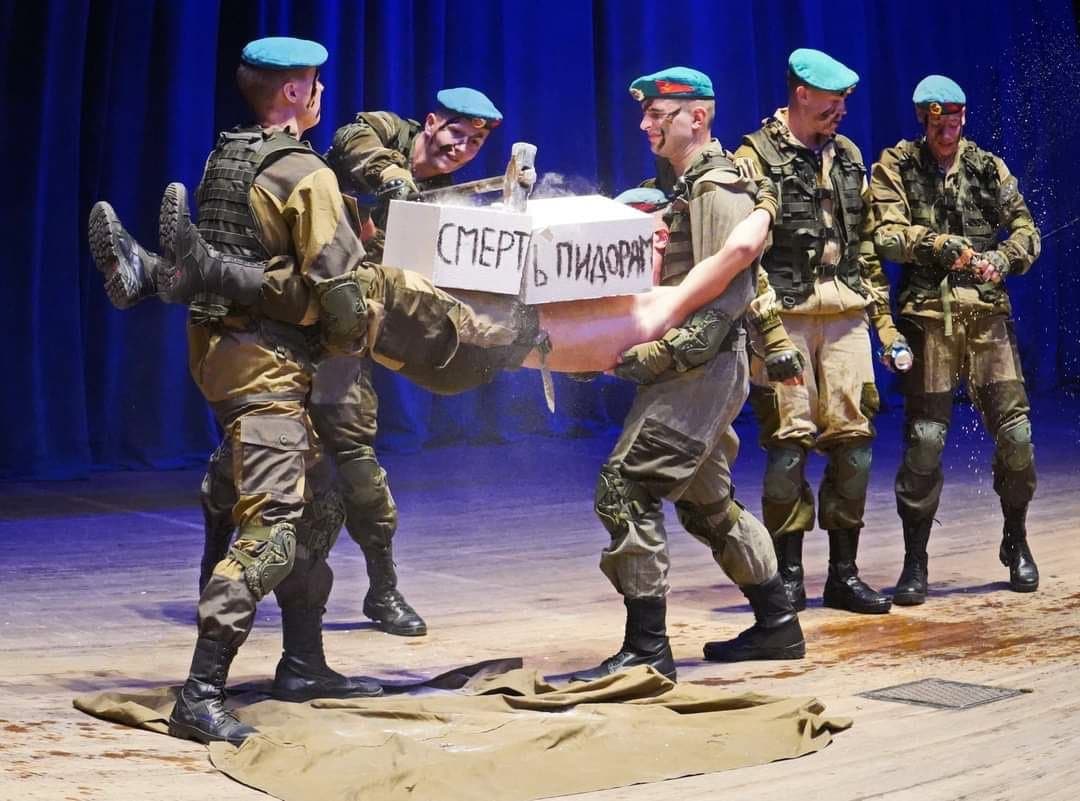
“Death to faggots.” Photo courtesy of Baza via Mediazona

Performers at show in honor of Yaroslavl patriotic club’s 20th anniversary smash stage prop with the inscription “Death to faggots” using sledgehammer 
Mediazona
August 31, 2021

During a performance by the military patriotic club Paratrooper in Yaroslavl, the regional news website 76.ru has reported, the performers used a sledgehammer to smash a stage-prop brick inscribed with the phrase “Death to faggots.”

According to the website, a performance in honor of the club’s 20th anniversary was held at the Dobrynin Palace of Culture in Yaroslavl on August 29. The performers took their comrade, placed a prop shaped like a white brick, inscribed with the phrase “Death to faggots,” on him and smashed it with a sledgehammer.

Andrei Palachev, the head of Paratrooper, explained to 76.ru that the club members had been joking.

“The kids just decided to make a joke and drew this inscription at the last moment. Faggots have no business being in Russia at all. […] And why should [the performers] be punished? They just don’t like fudge packers, and I don’t like them either. The family should be traditional: a boy and a girl, and not all this faggotry,” Palachev said.

Igor Derbin, the palace of culture’s director, stressed that this part of the performance had not been vetted with him.

“We are outraged. Initially, the event was supposed to be pleasant and joyful. We weren’t expecting their stunt. It was not planned in advance or agreed upon, because they knew that we would not allow it. By doing what they did, they canceled all the good impressions made by the event,” he added.

Taras Sidorin, the head of the Yaroslavl branch of the veterans organization Defender, said that he had filed a complaint with the police about the incident. “We consider such outburst incitement to murder. […] There were small children in the audience. This behavior is simply unacceptable,” he said.

Translated by the Russian Reader

Yuma, Mila, Barcelona (The VkusVill Refugees)

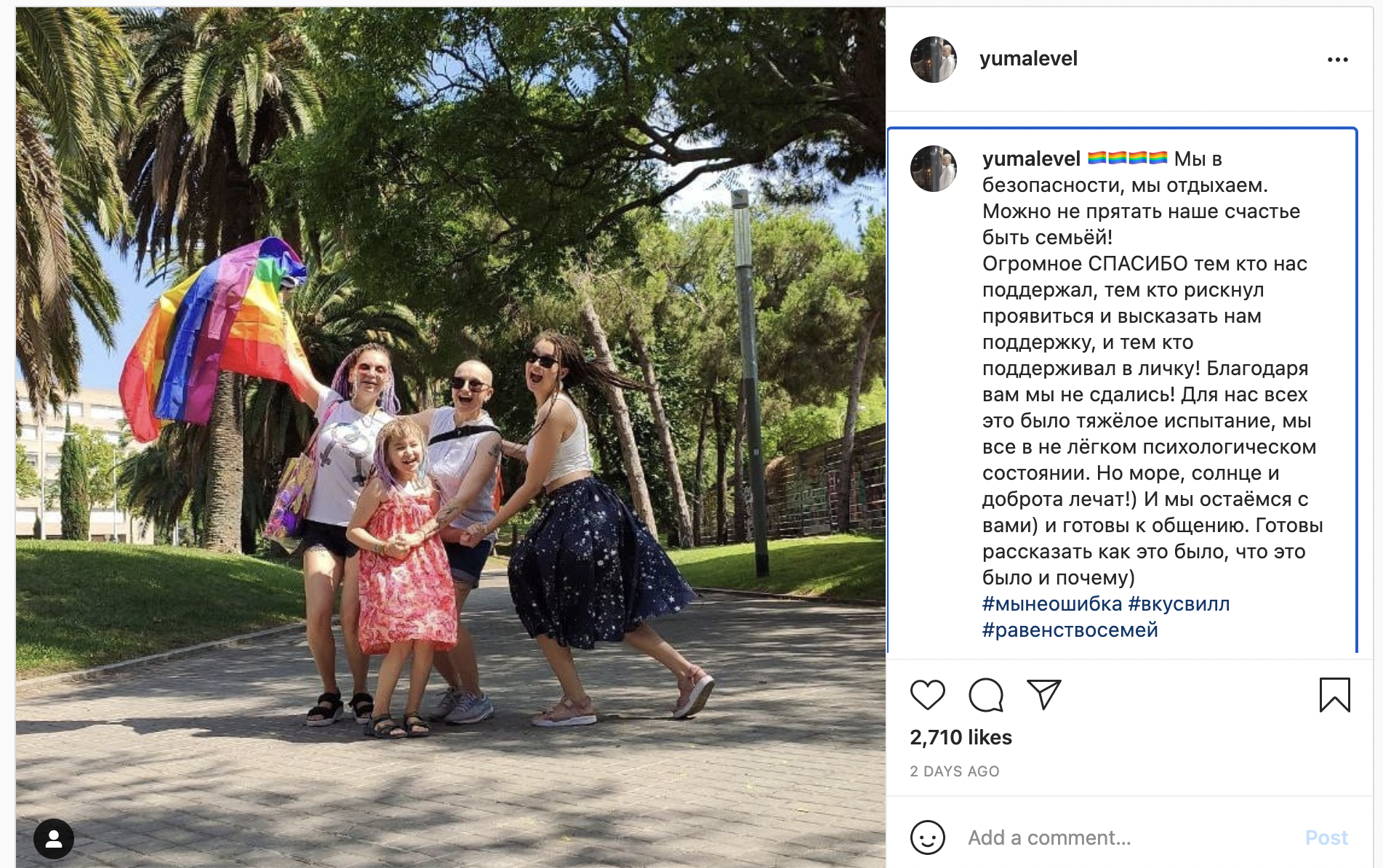
Yuma’s Instagram “postcard” from Barcelona: “We are safe, we are resting. We cannot hide our happiness at being a family. Many THANKS to those who supported us, to those who dared to make themselves visible and express their support to us, and to those who supported us in person! Thanks to you, we have not given up! It was a difficult ordeal for all of us, we are all in rough psychological shape. But the sea, the sun and kindness are healing [us]) And we are still with you) and are ready to communicate. We are ready to tell you how it happened, what happened, and why) #wearenotamistake #vkusvill #familyequality
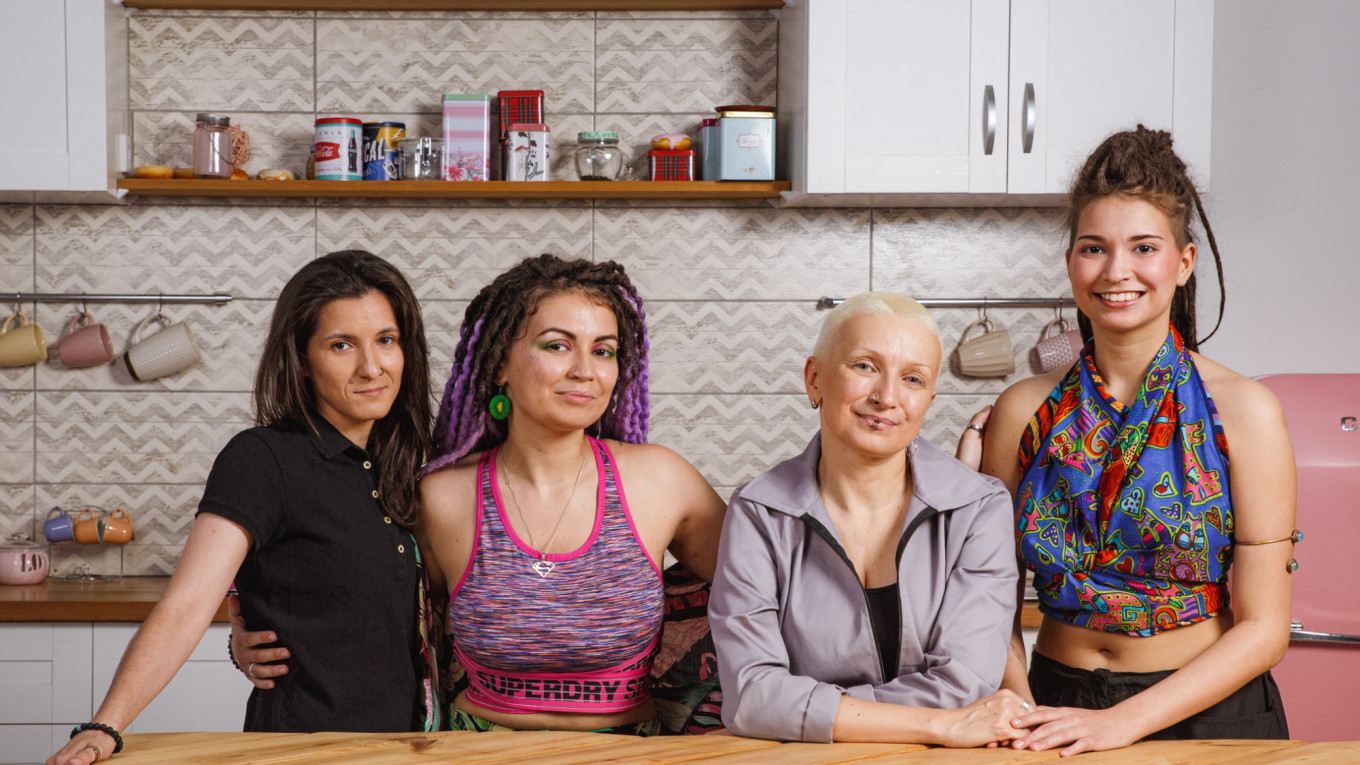
“We were left without work and without a home”: The young women from the deleted VkusVill ad have left Russia

ACCORDING TO ROSKOMNADZOR, UTOPIA IS A PROJECT OF THE NASILIU.NET [“NO TO VIOLENCE”] CENTER WHICH, ACCORDING TO THE JUSTICE MINISTRY, PERFORMS THE FUNCTIONS OF A FOREIGN AGENT

Why is this not the case?

Women featured in an ad for the VkusVill supermarket chain, which was removed due to homophobic threats, have left Russia for Spain. Yuma, the head of the family, has written about this on Instagram.

“We are safe, we are resting. We cannot hide our happiness at being a family. […] It was a difficult ordeal for all of us, we are all in rough psychological shape. But the sea, the sun and kindness are healing [us],” she wrote.

Yuma’s daughter Mila has asked [her Instagram] followers for help in finding a job. She writes that she can only work remotely, and receive a salary in euros. “Unfortunately, due to this difficult situation with VkusVill, we were left without work and without a home. […] Now my family and I really need to get settled in Barcelona, we are having a difficult time and we need friends, and maybe your friends’ friends or their friends will help us start a new life in Barcelona,” the post says.

Mila’s Instagram appeal for help finding a job

In late June, the supermarket chain VkusVill published photos of families who are their customers and their favorite products on its website and social networks. Among the photos was a family consisting of a mother, two daughters, and the wife of one of them. After the photos were published on Instagram, users divided into two camps: some called for a boycott of the store and threatened the company and the women with violence, while others supported the campaign.

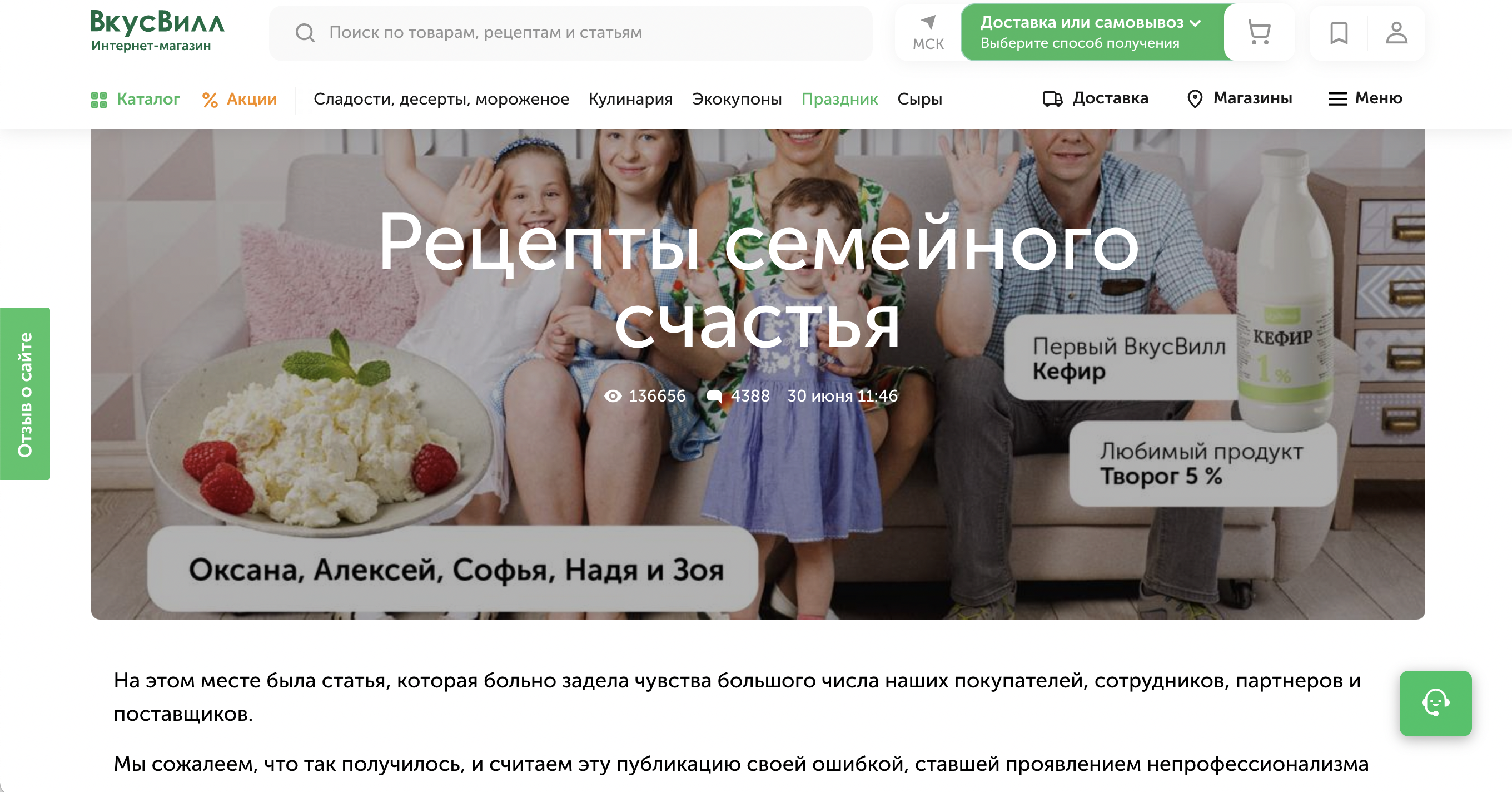
Four days later, VkusVill deleted the photos, and an apology appeared in their place: “This page contained an article that has hurt the feelings of a large number of our customers, employees, partners and suppliers. We regret that this happened, and we consider this publication our mistake, which manifested the unprofessionalism of individual employees.” The apology was signed by Andrey Krivenko, the chain’s founder, and eleven top managers.

VkusVill’s Instagram apology, along with their image of a “proper” Russian family

The removal of the ad caused an even more violent reaction — users most often called it a “disgrace” and “support for homophobia.” Utopia published different opinions on the incident.

Source: Utopia, 3 August 2021. Thanks to Maria Mila for the heads-up. Translated by the Russian Reader

Recipes for Domestic Bliss

VkusVill removes ad featuring queer family, apologizing to customers and suppliers for “hurt feelings”
Takie Dela
July 4, 2021

The retail chain VkusVill has apologized for an advertisement featuring a queer family. The company’s press release notes that the deleted piece “hurt the feelings of a large number of our customers, employees, partners and suppliers.” In the release, which was signed by company’s founder and its regional managers, the advertisement was dubbed a “mistake that manifested the unprofessionalism of individual employees.”

On June 30, VkusVill published on its website the story of a family consisting of a mother and two daughters [sic], one of whom is engaged to a young woman [sic]. In addition, the “Consumer School” section contained stories from other customers of the store: a woman who lives with a dog, a couple without children, a large family, and a single mother. They talked about themselves and their favorite VkusVill products.

After the advertisement was published, VkusVill and the queer heroines of the article began to receive threats.

Roman Polyakov, the manager of the store’s content factory, told Takie Dela that the store’s employees regularly touch on hot-button topics, including the problems of refugees, people with autism, and people with Down syndrome, and the topic of garbage recycling. He told Takie Dela that VkusVill valued examining issues from different sides.

He added that “it would be untrue” to say that there are no such families among VkusVill’s clients, so he had decided to include [the queer family] in the feature.

According to Polyakov, employees of the content factory consulted with lawyers on how to correctly submit information about LGBT people from the legal point of view, and also discussed with smm specialists and hotline employees how to react to customer dissatisfaction.

Translated by the Russian Reader

_________

A screenshot of the page containing VkusVill’s abject apology to violent Russian homophobes for their queer-positive ad. The page is entitled “Recipes for Domestic Bliss.”

This page contained an article that has hurt the feelings of a large number of our customers, employees, partners and suppliers.

We regret that this happened, and we consider this publication our mistake, which manifested the unprofessionalism of individual employees.

Our company’s goal is to enable our customers to receive fresh and delicious products every day, not to publish articles that reflect political or social views. In no way did we want to become a source of discord and hatred.

We sincerely apologize to all our customers, employees, partners and suppliers.

Respectfully,

Andrey Krivenko, Founder
Valera Razgulyaev, Information Manager
Alyona Nesiforova, Unified Concept Manager
Yevgeny Kurvyakov, Development Manager
Yevgeny Rimsky, Quality and Procurement Manager
Tatyana Berestova, Regional Manager
Lyubov Frolova, Regional Manager
Renata Yurash, Regional Manager
Svetlana Lopatina, Regional Manager
Larisa Romanovskaya, E-Commerce Manager
Kirill Shcherbakov, Micromarket Department Director
Maxim Fedorov, Order Manager

Source: VkusVill website. Translated by the Russian Reader

_________

VkusVill’s ad spotlights a “matriarch,” her partner and two daughters who practice ethical veganism, support fair trade and provide shelter to LGBT people in need. Image: VkusVill Natural Products/Facebook/Moscow Times

Russian Food Retailer Defies ‘Gay Propaganda’ Law With LGBT Family-Featuring Ad
Moscow Times
July 2, 2021

Russian organic food retailer VkusVill has featured an LGBT family in its new promotional material this week, defying the country’s law against “gay propaganda toward minors.”

As part of a series of health-conscious families, VkusVill spotlights a “matriarch” Yuma, her partner Zhenya and two daughters Mila and Alina, who practice ethical veganism, support fair trade and provide shelter to LGBT people struggling to find acceptance in their own families.

“We believe not featuring the families of our real customers would be hypocritical,” VkusVill said, warning readers to “weigh all the pros and cons” before continuing further.

The popular retail chain marked its June 30 promotional piece with an “18+” label to comply with the anti-LGBT propaganda law.

“Family is blood ties or a stamp in a passport. Let’s rethink this. In the 21st century, it’s primarily people who love us, those who will always shield us, people with whom we go through life together,” the promotion says.

Law enforcement authorities, who usually file misdemeanor charges against violators — the most recent of which were the authors of a Dolce & Gabbana Instagram ad showing kissing same-sex couples — have not yet commented on VkusVill’s publication.

Notorious anti-gay St. Petersburg lawmaker Vitaly Milonov took to social media to condemn the “pagan” ad.

Other social media users — which the MBKh Media news website reported swarmed VkusVill’s social media after a notorious anti-LGBT hate group reposted the article — posted threats against the chain.

Western countries and human rights activists have criticized Russia’s 2013 “gay propaganda” law as well as 2020 constitutional changes that contain a clause defining marriage as between a man and a woman only.

_________

yumalevel
Perhaps the most important thing to our family is care and acceptance. And we also fiercely protect each other and all support each other as much as possible. And we also try to help others. And today @vkusvill_ru posted a piece featuring us, and I’m amazed at how much support I saw there!!! “Others” are not so different at all))) it turns out that we are all our kind!!!

I love you! Kind, caring, accepting, gutsy, brave, making the world a world)
💞 💞 💞 💞 💞 💞 💞

Source: Instagram/Moscow Times. Translated by the Russian Reader

In the Year 2035

“Will You Choose This Russia?”: Federal News Agency Releases Pro-Constitutional Amendments Ad in Which Male Couple Adopt Child as Sad Music Plays 
Bumaga
June 2, 2020

The Petersburg-based news website Federal News Agency, affiliated with Yevgeny Prigozhin and the so-called troll factory, has posted a pro-constitutional amendments ad on social media that shows two gay men adopting a child, thus reminding viewers that one of the proposed amendments to the Russian Constitution would enshrine the concept of marriage as a union between a man and a woman.

[. . .]

The action of the Federal News Agency video takes place in the year 2035. In the ad, a boy is collected from an orphanage by an adoptive father who is preparing to introduce him to his adoptive mother. “Mom” turns out to be another man, who is a recognizable caricature of a homosexual. As sad music plays, the boy gets upset, and a female employee of the orphanage spits on the ground and walks away. The video ends with the couple kissing and the phrase, “Will you choose this Russia? Decide the future of the country—vote for the amendments to the Constitution.”

The video has been heavily criticized on social networks for homophobia and its unrealistic portrayal of homosexuals. Many viewers did not understand the connection between the events in the video and the Constitution.

[. . .]

The video was created by the Patriot Media Group, which includes Federal News Agency and other media outlets associated with the troll factory. Patriot’s board of trustees is headed by Yevgeny Prigozhin, “Putin’s chef.”

Nikolai Stolyarchuk, the head of Patriot Media Group, said that the video was not aimed against the LGBT community, but defended “the institution of the family as a union of a man and a woman.” According to Stolyarchuk, homosexual couples should not adopt children. He added that this was only the first video in a large series of ads. The campaign, according to Stolyarchuk, was funded exclusively by Patriot, not by the Russian state.

The actor who played the role of “Mom”, told Coda that he was neutral towards homosexuals and did not think that the video would generate such a strong public response. He said that although he had never voted before, on July 1 he would vote against the amendments to the Constitution because he had been detained by police and fined for violating self-isolation rules.

photo_2020-06-02_15-14-34Actor Alexander Filimonenko plays “Mom” in the homophobic campaign ad. Photo courtesy of social media and Coda

The vote on the amendments to the Constitution has been scheduled for July 1, despite the ongoing coronavirus epidemic in Russia.

In Petersburg, activists demonstrating against the proposed constitutional amendments have been detained by police on several occasions. On March 15, activists laid carnations outside the doors of the Constitutional Court on Senate Square. They called their protest action a “funeral event.”

Translated by the Russian Reader