Welcome to the Golden Age

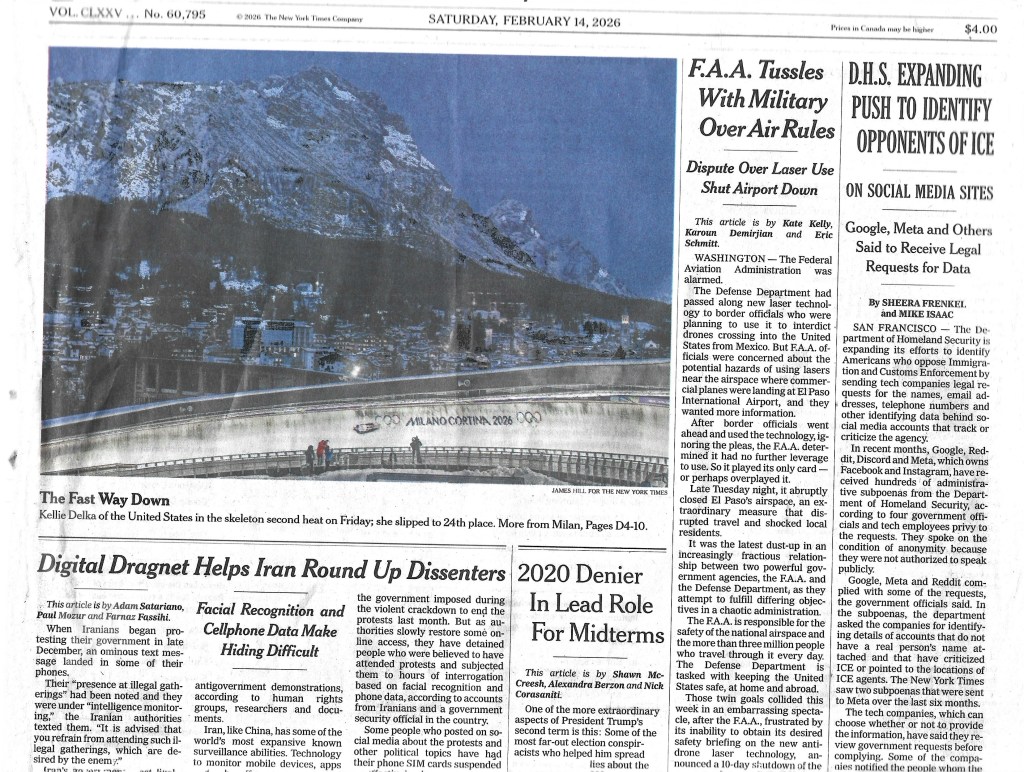
Both the pot (Iran) and the kettle (the U.S.) are “rounding up” their detractors.

Trump’s White House website welcomes visitors with a pop-up that reads: “WELCOME TO THE GOLDEN AGE!” But on this heavy news day a year into Trump’s second term, it is increasingly clear that as his regime focuses on committing the United States to white Christian nationalism, the country is becoming increasingly isolated from the rest of the world, and its own economy is weakening.

At the Munich Security Conference over the weekend, Secretary of State Marco Rubio’s endorsement of white Christian nationalism does not appear to have swayed European countries to abandon their defense of democracy and join the U.S.’s slide toward authoritarianism. Instead, as retired lieutenant general and former commander of U.S. Army Europe Mark Hertling wrote, it squandered the strategic advantage its partnership with Europe has given the U.S.

Foreign affairs journalist Anne Applebaum noted that the word in Munich was that “Europe needs to emancipate itself from the U.S. as fast as possible.” In Germany, Der Spiegel reports plans to bring Ukrainian veterans to teach German armed forces drone use and counter-drone practices the Ukrainians are perfecting in their war against Russian occupation. Canada’s prime minister Mark Carney is working to reduce Canada’s defense dependence on the U.S., ramping up domestic defense production.

Carney has advanced a foreign policy that centers “middle powers” and operates without the U.S. That global reorientation has profound consequences for the U.S. economy, as well. Canada is leading discussions between the European Union and a 12-nation Indo-Pacific bloc to form one of the globe’s largest economic alliances. A new agreement would enable the countries to share supply chains and to share a low-tariff system. Canada also announced it is renewing its partnership with China. As of this week, Canadians can travel to China without a visa.

Today France’s president Emmanuel Macron and India’s prime minister Narendra Modi upgraded Indian-French relations to a “Special Strategic Partnership” during a three-day visit of Macron to Mumbai. They have promised to increase cooperation between the two countries in defense, trade, and critical materials.

Trump insisted that abandoning the free trade principles under which the U.S. economy had boomed since World War II would enable the U.S. to leverage its extraordinary economic might through tariffs, but it appears, as economist Scott Lincicome of the Cato Institute wrote today for Bloomberg, that the rest of the world is simply moving on without the U.S.

While Trump boasts about the U.S. stock market, which is indeed up, U.S. markets have underperformed markets in other countries. Today, Carl Quintanilla of CNBC reported that the S&P 500, which measures 500 of the largest publicly traded companies in the U.S., is off to its worst year of performance since 1995 when compared to the All Country World Index (ACWI), an index that measures global stocks.

In May 2023 the Florida legislature passed a law requiring employers with 25 or more employees to confirm that their workers are in the U.S. legally. The new law prompted foreign farmworkers and construction workers to leave the state. Now, the Wall Street Journal reported in a February 6 editorial, employers “are struggling to find workers they can employ legally.”

The newspaper continued: “There’s little evidence that undocumented migrants are taking jobs from Americans. The reality is that employers can’t find enough Americans willing to work in the fields or hang drywall, even at attractive wages. Farm hands in Florida who work year-round earn roughly $47,000, which is more than what some young college graduates earn.” “The lesson for President Trump is that businesses can’t grow if government takes away their workers,” the Wall Street Journal Editorial Board concluded.

Today Florida attorney general James Uthmeier reacted to the Wall Street Journal editorial, explaining on Fox Business that the Republican Party expects to replace undocumented workers with young Americans: “We need to focus on our state college program, our trade schools, getting people into the workforce even earlier. We passed legislation last year to help high school students get their hands dirty and get on job sites more quickly. So I think there’s a lot more we can do with apprenticeships, rolling out, beefing up our workforce, and trying to address the demand that is undoubtedly here in the state.”

Steve Kopack of NBC News reported on February 11 that while the U.S. added 1.46 million jobs in 2024, the last year of former president Joe Biden’s administration, it added just 181,000 jobs in 2025. That makes 2025 the worst year for hiring since 2003, aside from the worst year of the coronavirus pandemic. Manufacturing lost 108,000 jobs in 2025.

Peter Grant of the Wall Street Journal reported today that banks that have loaned money to finance the purchase of commercial real estate are requiring borrowers to pay back tens of billions of dollars as the delinquency rate for such loans has climbed to a high not seen since just after the 2008 financial crisis. About $100 billion in commercial real estate loans that have been packaged into securities will come due this year and probably won’t repay when they should. More than half of the loans are likely headed for foreclosure or liquidation.

Trump vowed that he would cut “waste, fraud, and abuse” out of the country’s government programs, but cuts to social programs have been overwhelmed by spending on federal arrest, detention, and deportation programs, as well as Trump’s expansion of military strikes and threats against other countries. In his first year back in office, Trump launched at least 658 air and drone strikes against Iraq, Somalia, Iran, Yemen, Syria, Nigeria, and Venezuela.

Just today, U.S. Southern Command announced it struck three boats in the eastern Pacific and the Caribbean yesterday and killed 11 people it claims were smuggling drugs, bringing the total of such strikes to more than 40 and the number of dead to more than 130. Now Trump is moving American forces toward Iran, threatening to target the regime there.

The administration is simply tacking the cost of these military adventures onto government expenditures, apparently still maintaining that the tax cuts for the wealthy and corporations Republicans extended in their July “One Big Beautiful Bill Act” and tariffs will address the growing deficit and national debt by increasing economic growth.

The nonpartisan Congressional Budget Office (CBO) last week projected that the deficit for the fiscal year ending September 30, 2026, will be $1.85 trillion. Richard Rubin of the Wall Street Journal notes that for every dollar the U.S. collects this year, it will spend $1.33. The CBO explained that the Republican tax cuts will increase budget deficits by $4.7 trillion through 2035.

If the American people have suffered from Trump’s reign, the Trump family continues to cash in. Today Trump’s chair of the Commodity Futures Trading Commission, Michael Selig, announced he will try to block states from regulating prediction markets, saying they “provide useful functions for society by allowing everyday Americans to hedge commercial risks like increases in temperature and energy price spikes.”

Republicans insist that prediction markets are more like stock trading than like betting, but a group of over 20 Democratic senators warned last week in a letter to Selig that prediction market platforms, where hundreds of millions of dollars are wagered every week, “are offering contracts that mirror sportsbook wagers and, in some cases, contracts tied to war and armed conflict.” They added that the platforms “evade state and tribal consumer protections, generate no public revenue, and undermine sovereign regulatory regimes,” and urged Selig to support regulations Congress has already put into law.

Prediction markets also cover the actions of President Trump, whose son Don Jr. is both an advisor to and an investor in Polymarket and a paid advisor to Kalshi. Polymarket and Kalshi are the two biggest prediction markets, and both are less regulated than betting sites. The Trump family has announced it is starting its own “Truth Predict.”

David Uberti of the Wall Street Journal reported that Eric Trump is investing heavily in drones, particularly in Israeli drone maker Xtend, which has a $1.5 billion deal to merge with a small Florida construction company to take the company public. The Defense Department has invited Xtend to be part of its drone expansion program.

And yet it is clear the administration fears the American people. The Minnesota Bureau of Criminal Apprehension (BCA), a statewide program that specializes in police shootings, said yesterday that it has received formal notice that the Federal Bureau of Investigation (FBI) will not allow it any “access to information or evidence that it has collected” related to the shooting death of Minneapolis intensive care nurse Alex Pretti. The BCA says it will continue to investigate and to pursue legal avenues to get access to the FBI files.

Fury at ICE continues to mount, with voices from inside the government complaining about Homeland Security Secretary Kristi Noem. Gordon Lubold, Courtney Kube, Jonathan Allen, and Julia Ainsley of NBC News reported today on her alienation of senior officials at the Coast Guard as she has shifted their primary mission of search and rescue to flying deportation flights. Noem’s abrupt removal of Coast Guard commandant Linda Fagan only to move into her vacated housing at Joint Base Anacostia-Bolling herself also rankled, along with Noem’s lavish use of expensive Coast Guard planes.

Daniel Lippman and Adam Wren of Politico reported today that Noem’s spokesperson, Tricia McLaughlin, is resigning.

Marissa Payne of the Des Moines Register reported today that in Iowa, Republican state lawmakers are working to rein in the power of the state governor before the 2026 elections, a sure sign that they are worried that a Democrat is going to win the election.

That fear appears to be part of a larger concern that the American people have turned against the Republicans more generally. Last night, late-night talk show host Stephen Colbert told viewers he had been unable to air an interview he did with a Democratic candidate for the U.S. Senate from Texas, James Talarico. “I was told…that not only could I not have him on, I could not mention me not having him on,” Colbert said. “And because my network clearly doesn’t want us to talk about this, let’s talk about this.”

Talarico is a Texas state lawmaker studying to be a minister, who criticizes the Republican use of Christianity as a political weapon. Such politicization of Christianity both distorts politics and cheapens faith, he says. The true way to practice Christianity is simple but not easy, he says: it is to love your neighbor. Political positions should grow out of that to feed the hungry, welcome the stranger, and heal the sick. “[T]here is nothing Christian about Christian nationalism,” he told Colbert. “It is the worship of power in the name of Christ, and it is a betrayal of Jesus of Nazareth.”

Although Talarico is locked in a tight primary battle with Representative Jasmine Crockett, his message offers a powerful off-ramp for evangelicals uncomfortable with the administration, especially its cover-up of the Epstein files. Without evangelical support, MAGA Republicans cannot win elections.

Talarico has the administration nervous enough that Federal Communications Commission (FCC) chair Brendan Carr opened an investigation of the morning talk show The View after Talarico appeared on the show earlier this month. Lawyer Adam Bonin explained that Carr changed the FCC’s enforcement of the Equal Time Rule (which is not the Fairness Doctrine). It says that when broadcast networks (not cable) give air time to someone running for office, they have to give the same time to any other candidate for that office. The obvious exception is when a candidate does something newsworthy outside the race, in which case a network can interview that person without interviewing everyone else.

For 20 years, that rule has applied to talk shows, but Carr announced last month that if a non-news talk show seems to be “motivated by partisan purposes,” then it will not be exempt. For Colbert’s show, it would have meant that after interviewing Talarico, the network would have had to give equal time to all other Democrats and Republicans running for the Senate seat. CBS could have challenged the rule but chose not to.

Why is the administration worried about Talarico in a state Trump won in 2024 by 14%? “I think that Donald Trump is worried that we’re about to flip Texas,” Talarico said. “Across the state there is a backlash growing to the extremism and the corruption in our politics…. It’s a people-powered movement to take back our state and take back our country.”

As of 10:00 tonight, Colbert’s 15-minute interview with Talarico has been viewed on YouTube 3.8 million times. Forbes says it is Colbert’s most watched interview in months.

Source: Heather Cox Richardson, Letters from an American, 17 February 2026


The Late Show with Stephen Colbert, “Rep. James Talarico On Confronting Christian Nationalism, And Strange Days In The Texas Legislature”

Stephen Colbert hosts Texas State Rep. James Talarico for an online-exclusive interview that touches on the issues raised in Talarico’s campaign for the Democratic nomination for Senate including the separation of church and state, the dangers of consolidated corporate-owned media, and the fabricated culture wars pushed by Republicans in states like Texas.

Source: The Late Show with Stephen Colbert (YouTube), 16 February 2026


The Department of Homeland Security is expanding its efforts to identify Americans who oppose Immigration and Customs Enforcement by sending tech companies legal requests for the names, email addresses, telephone numbers and other identifying data behind social media accounts that track or criticize the agency.

In recent months, Google, Reddit, Discord and Meta, which owns Facebook and Instagram, have received hundreds of administrative subpoenas from the Department of Homeland Security, according to four government officials and tech employees privy to the requests. They spoke on the condition of anonymity because they were not authorized to speak publicly.

Google, Meta and Reddit complied with some of the requests, the government officials said. In the subpoenas, the department asked the companies for identifying details of accounts that do not have a real person’s name attached and that have criticized ICE or pointed to the locations of ICE agents. The New York Times saw two subpoenas that were sent to Meta over the last six months.

The tech companies, which can choose whether or not to provide the information, have said they review government requests before complying. Some of the companies notified the people whom the government had requested data on and gave them 10 to 14 days to fight the subpoena in court.

“The government is taking more liberties than they used to,” said Steve Loney, a senior supervising attorney with the American Civil Liberties Union of Pennsylvania. “It’s a whole other level of frequency and lack of accountability.” Over the last six months, Mr. Loney has represented people whose social media account information was sought by the Department of Homeland Security.

The department said it had “broad administrative subpoena authority” but did not address questions about its requests. In court, its lawyers have argued that they are seeking information to help keep ICE agents in the field safe.

Meta, Reddit and Discord declined to comment.

“When we receive a subpoena, our review process is designed to protect user privacy while meeting our legal obligations,” a Google spokeswoman said in a statement. “We inform users when their accounts have been subpoenaed, unless under legal order not to or in an exceptional circumstance. We review every legal demand and push back against those that are overbroad.”

The Trump administration has aggressively tried tamping down criticism of ICE, partly by identifying Americans who have demonstrated against the agency. ICE agents told protesters in Minneapolis and Chicago that they were being recorded and identified with facial recognition technology. Last month, Tom Homan, the White House border czar, also said on Fox News that he was pushing to “create a database” of people who were “arrested for interference, impeding and assault.”

Silicon Valley has long had an uneasy relationship with the federal government and how much user information to provide it. Transparency reports published by tech companies show that the number of requests for user information from different governments around the world has climbed over the years, with the United States and India among those submitting the most.

Some social media companies previously fought government requests for user information. In 2017, Twitter (now X) sued the federal government to stop an administrative subpoena that asked it to unmask an account critical of the first Trump administration. The subpoena was later withdrawn.

Unlike arrest warrants, which require a judge’s approval, administrative subpoenas are issued by the Department of Homeland Security. They were only sparingly used in the past, primarily to uncover the people behind social media accounts engaged in serious crimes such as child trafficking, said tech employees familiar with the legal tool. But last year, the department ramped up its use of the subpoenas to unmask anonymous social media accounts.

In September, for example, it sent Meta administrative subpoenas to identify the people behind Instagram accounts that posted about ICE raids in California, according to the A.C.L.U. The subpoenas were challenged in court, and the Department of Homeland Security withdrew the requests for information before a judge could rule.

Mr. Loney of the A.C.L.U. said avoiding a judge’s ruling was important for the department to keep issuing the subpoenas without a legal order to stop. “The pressure is on the end user, the private individual, to go to court,” he said.

The Department of Homeland Security also sought more information on the Facebook and Instagram accounts dedicated to tracking ICE activity in Montgomery County, Pa., outside Philadelphia. The accounts, called Montco Community Watch, began posting in Spanish and English about ICE sightings in June and, over the next six months, solicited tips from their roughly 10,000 followers to alert people to the locations of agents on specific streets or in front of local landmarks.

On Sept. 11, the Department of Homeland Security sent Meta a request for the name, email address, post code and other identifying information of the person or people behind the accounts. Meta informed the two Instagram and Facebook accounts of the request on Oct. 3.

“We have received legal process from law enforcement seeking information about your Facebook account,” the notification said, according to court records. “If we do not receive a copy of documentation that you have filed in court challenging this legal process within ten (10) days, we will respond to the requesting agency with information.”

The account owner alerted the A.C.L.U., which filed a motion on Oct. 16 to quash the government’s request. In a hearing on Jan. 14 in U.S. District Court for the Northern District of California, the A.C.L.U. argued that the government was using administrative subpoenas to target people whose speech it did not agree with.

Sarah Balkissoon, a Department of Justice lawyer representing the government, said the Department of Homeland Security’s position was that it was “within their power to investigate threats to its own officers or impediments to their officers,” according to a court transcript viewed by The Times.

Two days later, the subpoena was withdrawn.

The Montco Community Watch accounts continue to post almost every day. The Times emailed a request for comment to the address associated with the accounts but did not receive a reply.

On Monday, the Instagram account posted an alert for ICE activity in the Eagleville area of Montgomery County. “Montco ICE alert,” the post said. “This is confirmed ICE activity.”

On Friday, the account posted a video of students at Norristown Area High School protesting against ICE. “We stand with you and are proud you made your voices heard!” the post said.

Source: Sheera Frenkel and Mike Isaac, “Homeland Security Wants Social Media Sites to Expose Anti-ICE Accounts,” New York Times, 13 February 2026


It’s one of the saddest hit songs to grace American music: “Deportee (Plane Wreck at Los Gatos).”

The 1948 Woody Guthrie composition documented a plane crash that killed all 32 people on board in Los Gatos Canyon near the Central Valley town of Coalinga on Jan. 28 of that year. Twenty-eight of the victims were Mexicans being forced back home — some entered the country without papers, some were guest workers whose stints were over — accompanied by the immigration agent charged with making sure they got there, much like the deportation flights of today.

The Associated Press reported that newspapers published across the country the following day — including The Times — listed the names of the Southern California crew on board and the migra man, Frank E. Chaffin of Berkeley.

The Mexicans? The story deemed them “deportees.” They were buried in a mass grave at Holy Cross Cemetery in Fresno under a bronze marker that read: “28 Mexican citizens who died in an airplane accident.” The American government never even bothered to tell their family members. Many wondered what happened to their loved ones for decades.

Guthrie heard the AP report over the radio and was so angered by how the press and government dismissed the deceased that he penned “Deportee.” With mournful chords and vivid lyrics, the working class troubadour attacked an American society that that simultaneously let crops rot “in their creosote dumps” and treated the migrants who picked them “like rustlers, like outlaws, like thieves.”

It’s been covered by some of this country’s greatest musicians — I’m talking Dolly Parton, Bruce Springsteen, Johnny Cash and Willie Nelson (my favorite version is by folk-rock heroes The Byrds).

The Byrds, “Deportee (Plane Wreck at Los Gatos)” (1969)

Even with “Deportee,” this story had fallen out of public consciousness over the decades. Until January, when ICE dredged it up to once again insult the memory of the lost Mexican immigrants.

ICE’s inexplicable recap

On Jan. 28, the social media accounts of Immigration and Customs Enforcement commemorated Chaffin’s death and only his. The caption alongside a grainy black and white photo of him read: “The plane he was on to deport 28 illegal Mexican aliens caught fire and crashed killing all onboard.”

ICE’s unnecessarily inflammatory language not only was ahistorical, but also it didn’t even match up with its own official account. The agency’s Wall of Honor, which commemorates the lives of employees who died in the line of duty, described the migrants who died alongside Chaffin as “Mexican nationals.”

Such warping of the past isn’t accidental but rather part of a long con by the Trump administration to justify its agenda. In an administration that knows no lows, dismissing the Mexican victims of the Los Gatos Canyon disaster as “illegal Mexican aliens” was particularly egregious.

‘It’s disrespectful, it’s dehumanizing, it’s ICE’

I called up Mike Rodriguez, an ethnic studies teacher in Santa Ana who found out in 2015 that his paternal aunt, María Rodríguez Santana, was on that doomed plane.

“First thing I thought was, ‘Well that’s the United States,’” Rodriguez said of ICE’s social media post. “They’re doing the same thing that the government tried to do in 1948 by erasing them.”

He added that la migra didn’t even bother to list the names of the American crew that died, either. “It’s disrespectful, it’s dehumanizing, it’s ICE,” he said.

But Rodriguez takes solace in knowing he and others are doing their part to make sure people know the full story. He regularly speaks about the tragedy and visited both the site of the crash and Holy Cross Cemetery, where a plaque with all of the victims’ names was erected in 2013.

Tim Z. Hernandez, a University of Texas El Paso professor who has spent much of his career trying to track down descendants, interviewed Rodriguez and his uncle for a forthcoming documentary and also featured their story in the 2024 book”They Call You Back: A Lost History, A Search, A Memoir.” The two appeared at an event last year at the Untold Story bookstore in Anaheim, where Rodriguez sung “Deportee” while his son played guitar. He added extra lyrics to honor his Tía María and Hernandez.

“Thankfully, we have truth tellers like Woody Guthrie and Tim,” Rodriguez said. “And I remember what Woody sang — ‘All you fascists bound to lose.’ And that’s the way this is administration is, trying to strip away our constitutional rights. But their day will come.”

Source: Gustavo Arellano, “Essential California” newsletter (Los Angeles Times), 17 February 2026

(Anti)Fascism Today

Brandon Siguenza (center) and his wife, Julia Rose (left) in happier times. Source: Facebook

Good morning,

My name is Brandon Siguenza, and I am a US citizen from Minneapolis. Yesterday, while doing legal observation, ICE stopped their cars to harass my friend and me. They sprayed pepper spray into the vent of our vehicle. We held our hands in the air and told them we were not obstructing, that the car was in park and they were free to drive forward and away. There was no active immigration raid. They returned to their cars, and drove forward a bit, then decided to stop again. They surrounded us, smashed the windows of our car, opened the doors (they were unlocked), ripped my friend and I out of the car and arrested us on charges of obstruction.

I was put in an unmarked SUV, separated from my friend. As I was put in the back seat an ICE agent tore the whistle off my neck and said “I’ll be taking this, I might need it later.” My phone was knocked out of my hand while being arrested. As we drove away I asked the driver and the passenger if they wouldn’t mind buckling my seatbelt, as they were driving erratically. I was ignored. I asked them if I could have the handcuffs loosened, as I was losing circulation, and was told no. At one point the passenger realized his own driver’s license was in the backseat next to mine, and tried to surreptitiously grab it without me seeing it.

We were taken to the Whipple federal building, where I saw dozens of brown people being processed in an unheated garage. I was frisked, told of my charges, and saw buses and vans being prepped. I later learned that these were being filled with detainees and driven to the airport for deportation. As we were led in, I noticed that the building was very busy. I got the impression that one of the 2 agents bringing me around was being trained. At multiple points throughout my stay, government agents were unable to open doors, not sure where they were meant to be going, and overall confused and overwhelmed. They couldn’t figure out how to use the building phones, or complained about a lack of cell service preventing them from checking the internet or making calls.

The people in the cells were extremely scared. We heard people screaming “let me out!”, crying, wailing and terrified screams. There were cells with as many as 8 people. I have no way of knowing how long they have been there, if they were allowed any contact with the outside world, or if they were being brought food or water. Most people were staring at the ground with almost no energy. I was not allowed to talk to anyone imprisoned. I distinctly remember seeing a desperate woman. She was staring at the ground with her head in her hands crying, hopeless, while her friend or family member sat on a bathroom seat observed by 3 men.

My friend and I were put in an area for “USCs,” which we eventually learned meant US citizens, separated by gender. We were imprisoned for 8 hours, during which my friend was never allowed a phone call. I was allowed to call my wife and tell her where I was. During my interview with Special Agent William and Special Agent Garcia, they asked me to empty my pockets. When I pulled out gloves, Agent William said those were meant to be taken when I was processed, and complained about having to fill out the form again. He frisked me once more, where he found glass in my pocket from when our car window was shattered. He filled out the form listing my personal items again, but put the wrong date. I was read my rights, I pleaded the fifth and was led back to my cell.

Food, water, and bathroom breaks were extremely difficult to acquire. I would ask over the intercom provided in the cell for a bathroom break, be told someone was on their way, then ask again 20 minutes later, be told someone was on their way, wait another 20 minutes, etc. Eventually they either turned off the intercom or it stopped working, because no one would respond. I could get water and bathroom breaks by pounding on the glass when someone happened to walk by and beg them directly. Hours would go by without anyone checking on us. I am vegan and the only food they offered were turkey sandwiches, fruit snacks with gelatin, and granola bars with honey. I eventually ate a granola bar out of hunger.

I was in the cell alone for between 1 and 2 hours, then another man was put into my cell, whose shirt was ripped open from his arrest, and an injured toe, who was carried aggressively into an unmarked car during his arrest. After about 4-5 hours, another man was brought in who had a cut on his head from his arrest. He told me he was tackled by 4 or 5 agents during his arrest. At no point was he offered medical assistance.

Later I was told that a lawyer was here to see me, and I was able to speak with him in a visitation room. The special agent told me that the door could not be closed all the way, so it was cracked during my interaction with my lawyer. I got the impression that they were not used to having lawyers present, and were trying to follow procedure as best they could. I asked an agent if the other detainees were allowed lawyers and was not answered.

At one point, 3 men from the department of Homeland Security Investigations brought me into a cell. They insinuated that they could help me out. After inquiring several times what exactly they meant they finally told me that they could offer undocumented family members of mine legal protection if I have any (I don’t), or money, in exchange for giving them the names of protest organizers, or undocumented persons. I was shocked, and told them no.

Finally, after hours of detention, I was told to follow an agent. At no point was I told whether or not I was being charged, or where I was going, but I was led out of the building. I asked if I could use a phone to call my wife to pick me up, and was told I could not. After pleading for several minutes eventually Special Agent William let me use his phone to call my wife. As I was escorted off the property by government agents, I was told to turn right. I was escorted to the protest area, where 5 minutes later, tear gas was deployed and I was struck by a paint ball gun. I was not protesting, I was simply being released without charges after an 8 hour detention. I was on the other side of the street, as instructed by the agents that released me and the agents shouting orders over a bullhorn. A passerby who was tear gassed was panicking and having an asthma attack, so I helped her find a medic to get her an inhaler. I used a stranger’s phone to co-ordinate pickup, and was picked up by my wife.

During my detention I knew that I was being released. I knew that as a citizen of the United States I have legal protection. The hundred or so other people being detained had no such protection. At this time I don’t need your help, it is the families that are being separated, abused, terrorized, harassed and killed that need your help. If this is happening to me, an American citizen born in the United States, then what is happening to the people in here that have no one calling lawyers on their behalf? That have no constitutional rights to due process? What is happening to the people that they will never be released to see their families, go to their jobs, or walk through their city ever again?

Please take care of yourselves, your family, and your community. I am safe and healthy, if you feel compelled to help, please offer your help to the Immigrant Defense Network at https://immigrantdefensenetwork.org/. If you know someone detained by ICE, call or text CAIR-MN at 612-206-3360 for 24/7 legal intake.

Source: Brandon Siguenza (Facebook), 12 January 2025. Thanks to KFK for the heads-up.


KARE 11, “Taken by ICE & Detained | Breaking the News Plus”

What is it like in the Minneapolis ICE Detention Center? Patty O’Keefe & Brandon Siguenza join Jana to discuss their experience being detained for over 9 hours.

Source: KARE 11 (YouTube), 12 January 2026


In this week’s bulletin: Trade Union Confederation statement after January 9th Russian attacks; statement by Ukraine Social Movement on Venezuela; captivity and oppression in the Russian-occupied territories; problems  of the Russian economy; anti-war messages in Russian cities.

News from the territories occupied by Russia:  

Ukrainian, abducted as a teenager from occupied Donbas in 2019, sentenced by Russian court to 22 years (Kharkiv Human Rights Protection Group, January 9th)

Ex-military and Ukrainian: No more needed for Russian ‘treason trials’ and massive sentences (Kharkiv Human Rights Protection Group, January 9th)

The Face of Resistance: The Story of Crimean Tatar Political Prisoner Ismet Ibrahimov (Crimea Platform, January 9th)

‘Russian world’ in occupied Luhansk oblast: no heating and deliberately cut off from mobile telephones and Internet (Kharkiv Human Rights Protection Group, January 8th)

Desperate plea from Russian prison: Ukrainian political prisoners need to be freed now, not after ‘peace deal’ (Kharkiv Human Rights Protection Group, January 7th)

Crimean Political Prisoner Tofik Abdulgaziev in Critical Condition (Crimea Platform, January 7th)

The Woman Who Didn’t Break. Part Two (Kharkiv Human Rights Protection Group, January 6th)

Monstrous 27-year sentence against Ukrainian civilian abducted from Russian-occupied Melitopol (Kharkiv Human Rights Protection Group, January 6th)

Weekly update on the situation in occupied Crimea on January 6,  2026 (Crimea Platform, January 6th)

Even Putin supporter debunks Russia’s lies about a ‘Ukrainian drone attack on civilians’ in occupied Khorly (Kharkiv Human Rights Protection Group, January 5th)

No answers & questions to Red Cross after Russia holds 64-year-old Melitopol journalist prisoner for third year (Kharkiv Human Rights Protection Group, January 5th)

“You must not show that you are afraid”: Tales of captivity in the Kremlin-controlled “People’s Republics” (The Insider, January 5th)

News from Ukraine:

Fire Point’s large missiles and contracts: the story of Ukraine’s most enigmatic defence company (Ukrainska Pravda, January 9th)

More artists killed in Ukraine (The Artist, January 9th)

Statement of the KVPU on the critical situation in Ukraine after January 9 Russian attacks  (Ukraine Solidarity EU, January 9th)

‘Bro-wolfieʼ: The story of a soldier who survived in Mariupol and rebuilt his life (Kharkiv Human Rights Protection Group, January 8th)

All change: why Zelensky needs to reshuffle Budanov, Fedorov, Shmyhal, Maliuk and other top officials (Ukrainska Pravda, January 5th)

Engineers, missile strikes and high technology: can Ukraine produce more weapons in 2026? (Ukrainska Pravda, January 4th)

Denys, a unionised railway worker on the front line (International Labour Network of Solidarity and Struggle, January 1st)  

War-related news from Russia:

Alexander Krichevsky of Izhevsk: Six Years in Prison for a Comment (Russian Reader, January 8th)

The rise and fall of the “Heroes of the Surgut Land”. How the Russian state works with memory of soldiers who died in the war with Ukraine (Mediazona, January 7th)

The streets speak. Anti-war messages in Russian cities (Mediazona, January 6th)

Timofey Anufriev Dies Fighting for Ukraine (Russian Reader, January 6th)

On thinning ice: After almost four years of war, Russia’s central bankers are running out of tricks to keep the economy afloat (The Insider, January 6th)

The Story of Gordey Nikitin: 17 Years for “High Treason”  (Russian Reader, December 31st)

Analysis and comment:

Cedos held a discussion on the impact of research on policy change (Cedos, January 9th)

Behind the Contact Line: How would the 20-point peace plan impact the millions of Ukrainians living under Russian occupation? (Meduza, January 9th)

When Information Starts Working on Its Own (Kharkiv Human Rights Protection Group, January 8th)

From master spy to lead negotiator: what does Zelensky’s new chief of staff, Kyrylo Budanov, bring to the peace talks? (Meduza, January 8th)

Women’s Careers in STEM: Barriers and Motivations  (Cedos, January 7th)

The Non-Peaceful Atom (Posle Media, January 7th)

Key challenges related to possible holding of an all-Ukrainian referendum on changes to Ukraine’s territory (Opora, January 5th)

Social Movement: What’s wrong with US aggression against Venezuela? (Ukraine Solidarity EU, January 3rd)

International solidarity:

Ukrainian leaders in UK call for Kemi Badenoch to sack David Wolfson, Russian assets to be used to aid Ukraine (USC, January 8th)

Upcoming events:

Thursday 15th January, at 7pm, Russia’s War On Ukraine, Us Strategy Review – Stopping The Authoritarians, organised by Ukraine Solidarity Campaign Scotland, register here.

Thursday 5th February, at 6.30pm. Try Me For Treason reading and discussion event at Clore Lecture Theatre, Birkbeck College Clore Management Centre, Torrington Square, London WC1E 7JL. Details here.

This bulletin is put together by labour movement activists in solidarity with Ukrainian resistance. To receive it by email each Monday, email us at 2022ukrainesolidarity@gmail.com.

Source: News from Ukraine Bulletin no. 178, 11 January 2026


Beginning in 1943, the War Department published a series of pamphlets for U.S. Army personnel in the European theater of World War II. Titled Army Talks, the series was designed “to help [the personnel] become better-informed men and women and therefore better soldiers.”

On March 24, 1945, the topic for the week was “FASCISM!”

“You are away from home, separated from your families, no longer at a civilian job or at school and many of you are risking your very lives,” the pamphlet explained, “because of a thing called fascism.” But, the publication asked, what is fascism? “Fascism is not the easiest thing to identify and analyze,” it said, “nor, once in power, is it easy to destroy. It is important for our future and that of the world that as many of us as possible understand the causes and practices of fascism, in order to combat it.”

Fascism, the U.S. government document explained, “is government by the few and for the few. The objective is seizure and control of the economic, political, social, and cultural life of the state.” “The people run democratic governments, but fascist governments run the people.”

“The basic principles of democracy stand in the way of their desires; hence—democracy must go! Anyone who is not a member of their inner gang has to do what he’s told. They permit no civil liberties, no equality before the law.” “Fascism treats women as mere breeders. ‘Children, kitchen, and the church,’ was the Nazi slogan for women,” the pamphlet said.

Fascists “make their own rules and change them when they choose…. They maintain themselves in power by use of force combined with propaganda based on primitive ideas of ‘blood’ and ‘race,’ by skillful manipulation of fear and hate, and by false promise of security. The propaganda glorifies war and insists it is smart and ‘realistic’ to be pitiless and violent.”

Fascists understood that “the fundamental principle of democracy—faith in the common sense of the common people—was the direct opposite of the fascist principle of rule by the elite few,” it explained, “[s]o they fought democracy…. They played political, religious, social, and economic groups against each other and seized power while these groups struggled.”

Americans should not be fooled into thinking that fascism could not come to America, the pamphlet warned; after all, “[w]e once laughed Hitler off as a harmless little clown with a funny mustache.” And indeed, the U.S. had experienced “sorry instances of mob sadism, lynchings, vigilantism, terror, and suppression of civil liberties. We have had our hooded gangs, Black Legions, Silver Shirts, and racial and religious bigots. All of them, in the name of Americanism, have used undemocratic methods and doctrines which…can be properly identified as ‘fascist.’”

The War Department thought it was important for Americans to understand the tactics fascists would use to take power in the United States. They would try to gain power “under the guise of ‘super-patriotism’ and ‘super-Americanism.’” And they would use three techniques:

First, they would pit religious, racial, and economic groups against one another to break down national unity. Part of that effort to divide and conquer would be a “well-planned ‘hate campaign’ against minority races, religions, and other groups.”

Second, they would deny any need for international cooperation, because that would fly in the face of their insistence that their supporters were better than everyone else. “In place of international cooperation, the fascists seek to substitute a perverted sort of ultra-nationalism which tells their people that they are the only people in the world who count. With this goes hatred and suspicion toward the people of all other nations.”

Third, fascists would insist that “the world has but two choices—either fascism or communism, and they label as ‘communists’ everyone who refuses to support them.”

It is “vitally important” to learn to spot native fascists, the government said, “even though they adopt names and slogans with popular appeal, drape themselves with the American flag, and attempt to carry out their program in the name of the democracy they are trying to destroy.”

The only way to stop the rise of fascism in the United States, the document said, “is by making our democracy work and by actively cooperating to preserve world peace and security.” In the midst of the insecurity of the modern world, the hatred at the root of fascism “fulfills a triple mission.” By dividing people, it weakens democracy. “By getting men to hate rather than to think,” it prevents them “from seeking the real cause and a democratic solution to the problem.” By falsely promising prosperity, it lures people to embrace its security.

“Fascism thrives on indifference and ignorance,” it warned. Freedom requires “being alert and on guard against the infringement not only of our own freedom but the freedom of every American. If we permit discrimination, prejudice, or hate to rob anyone of his democratic rights, our own freedom and all democracy is threatened.”

Notes:

https://onlinebooks.library.upenn.edu/webbin/serial?id=armytalks

War Department, “Army Talk 64: FASCISM!” March 24, 1945, at https://archive.org/details/ArmyTalkOrientationFactSheet64-Fascism/mode/2up

Source: Heather Cox Richardson, Letters from an American, 9 January 2026

Peace for Our Time

Trump didn’t win the Nobel Peace Prize, but he’s a lock for the Kremlin’s Employee of the Month.

Source: Andy Borowitz (Facebook), 22 November 2025


The 28-point Russia–Ukraine peace plan—put on the table this week by Steve Witkoff, President Donald Trump’s emissary, and Kirill Dmitriev, a Kremlin aide equally inexperienced at diplomacy—grants Kyiv two favors but otherwise amounts to a Moscow wish list.

It is worth noting that neither Ukrainian President Volodymyr Zelensky nor any European leader was consulted in the backroom drafting. Spokesmen for Russian President Vladimir Putin say, a bit improbably, that they haven’t seen the deal either. Even if its outlines were acceptable to both sides, several of its planks are ambiguous, requiring extensive negotiation. Still, Trump has demanded that Ukraine accept the plan before Thanksgiving.

This timetable seems unlikely, as does the notion that peace is now at hand.

The plan allows Ukraine to apply for membership to the European Union—a significant point, given that, in some ways, the war began back in 2014, when Putin deposed a Ukrainian president who was on the verge of striking a deal with the EU. The plan also commits $100 billion in seized Russian assets to rebuild war-torn areas of Ukraine.

However, the rest is a shambles. It hands much of Ukrainian territory to Russia—including Crimea and the eastern Donbas districts of Luhansk and Donetsk. It reduces the size of the Ukrainian army to 600,000 troops (it currently has about 880,000), while putting no cap on the number of Russian troops on Ukraine’s borders. It demands that Ukraine revise its constitution to prohibit membership in NATO, bars NATO troops from being stationed in Ukraine, and forbids Ukraine from attacking Moscow or St. Petersburg with missiles (a peculiar clause—as Lawrence Freedman asks, “But [attacking] Rostov is OK?”), without barring Russia from firing missiles at cities in Ukraine.

Finally, Ukraine must hold elections within 100 days (nothing about how security might be kept at polling stations in areas still under dispute), all combatants and politicians are granted amnesty (so much for war-crimes trials), and Russia “will be reintegrated into the global community,” complete with restored membership in the G8 and the dropping of sanctions.

A few other articles seem to favor Ukraine at first glance, but not so much upon scrutiny. For instance, “Russia is expected not to invade neighboring countries” (italics added), which sounds like a courteous request, not a legal demand. (By contrast, the same plank—in fact, the same sentence—states, “NATO will not expand further.”)

Another: “Ukraine will receive reliable security guarantees,” but there isn’t a hint on what Moscow would find acceptable in this department. Similarly, “Russia will codify a non-aggression policy toward Europe and Ukraine,” thus allowing Putin to load the codification with whatever loose language and loopholes he’d like.

The plan calls for the creation of a “humanitarian committee” to oversee an “all for all” exchange of prisoners, detainees, and kidnapped children. That’s good, but there’s nothing about who appoints the committee members or how the trades are enforced; for instance, who sends police into Moscow homes to retrieve Ukrainian babies and adolescents? Even assuming the best of intentions (a dubious assumption), this will take a while to formalize.

Similarly, the plan says that Donetsk will be turned into a “demilitarized zone,” with no Ukrainian or Russian troops allowed to enter. Again, fine, but who supplies the armed peacekeepers to enforce this rule—and why should Moscow accept it, given that the deal recognizes Donetsk as Russian territory?

These are not small points. Article 28, the plan’s final plank, states, “Once all parties accept this memorandum, a ceasefire will take effect immediately after both sides withdraw to the agreed points for the start of the agreement’s implementation.” In other words, all of the plan’s ambiguities, loose ends, and remaining disputes have to be settled—and then troop withdrawals have to be completed, not merely started—before a ceasefire takes hold.

This is the opposite of the 20-point peace plan that Trump helped impose on Israel and Hamas in Gaza. It shrewdly demanded a ceasefire and hostage exchange as the deal’s first steps. It is not at all clear that details about the remaining points will ever be negotiated, much less implemented (in fact, most of those points seem politically dead on arrival), but the important thing—Trump and his Arab partners realized—was to stop the killing and to keep it stopped for as long as possible.

The Russia–Ukraine plan does the opposite: It imposes a ceasefire after agreement and action on all the other steps toward a peace—and an unjust peace at that.

The main problem with the plan is that, like its American authors, it fails to recognize the true nature of the war: namely, that Ukrainians are fighting for their sovereignty as an independent nation, while Putin is fighting for the restoration of the old Russian empire, which entails, among other things, the total subjugation of Ukraine.

A Kremlin spokesman said as much on Friday, when he said that any peace deal must address the war’s “root causes.” Putin has made clear a number of times that he regards, as the war’s main root cause, the insistence by the government in Kyiv—which he denounces as an illegitimate “neo-Nazi dictatorship”—that Ukraine exists as a nation with its own history, culture, and language.

The best way to end the war is for Trump to realize this fact—and to convince Putin that the West will not let this imperial dream come true. Short of that, all the rest, including the 28-point peace plan, is at best a distraction and at worst a recipe for democratic Ukraine’s surrender.

Source: Fred Kaplan, “The Closer You Look at Trump’s Ukraine Peace Plan, the Worse It Looks for Ukraine,” Slate, 21 November 2025


Ukraine’s president Volodymyr Zelensky addressed the Ukrainian people today. The current moment, he said, is “one of the most difficult” for the country. “Ukraine may soon face an extremely difficult choice. Either the loss of dignity or the risk of losing a key partner. Either 28 complicated points or the hardest winter yet—and the risks that follow,” Zelensky said.

Zelensky’s use of the word “dignity” recalled Ukraine’s 2014 “Revolution of Dignity” that ousted Russian-aligned president Viktor Yanukovych and turned the country toward Europe.

Zelensky was responding to a 28-point “peace” plan President Donald J. Trump is pressuring him to sign before Thanksgiving, November 27. The plan appears to have been leaked to Barak Ravid of Axios by Kirill Dmitriev, a top ally of Russia’s president Vladimir Putin, and reports say it was worked out by Dmitriev and Trump’s envoy Steve Witkoff. Ukrainian representatives and representatives from Europe were not included. Laura Kelly of The Hill reported on Wednesday that Congress was blindsided by the proposal, which Mark Toth and Jonathan Sweet of The Hill suggest Russia may be pushing now to take advantage of a corruption scandal roiling Ukraine’s government.

Luke Harding of The Guardian noted that the plan appears to have been translated from Russian, as many of the phrases in the text read naturally in that language but are awkward and clunky in English.

The plan is a Russian wish list. It begins by confirming Ukraine’s sovereignty, a promise Russia gave Ukraine in 1994 in exchange for Ukraine giving up its nuclear weapons but then broke when it invaded Ukraine in 2014.

The plan gives Crimea and most of the territory in Ukraine’s four eastern oblasts of Kherson, Zaporizhzhia, Donetsk, and Luhansk to Russia, and it limits the size of the Ukrainian military.

It erases any and all accountability for the Russian attacks on Ukrainian civilians, including well-documented rape, torture, and murder. It says: “All parties involved in this conflict will receive full amnesty for their actions during the war and agree not to make any claims or consider any complaints in the future.”

It calls for $100 billion in frozen Russian assets to be invested in rebuilding and developing Ukraine. Since the regions that need reconstruction are the ones Russia would be taking, this means that Russian assets would go back to Russia. The deal says that Europe, which was not consulted, will unfreeze Russian assets and itself add another $100 billion to the reconstruction fund. The plan says the U.S. “will receive 50 percent of the profits from this venture,” which appears to mean that Europe will foot the bill for the reconstruction of Ukraine—Russia, if the plan goes through—and the U.S. and Russia will split the proceeds.

The plan asserts that “Russia will be reintegrated into the global economy,” with sanctions lifted and an invitation to rejoin the Group of Seven (G7), an informal group of countries with advanced economies—Canada, France, Germany, Italy, Japan, the United Kingdom, and the United States, along with the European Union—that meets every year to discuss global issues. Russia was excluded from the group after it invaded Ukraine in 2014, and Putin has wanted back in.

According to the plan, Russia and “[t]he US will enter into a long-term economic cooperation agreement for mutual development in the areas of energy, natural resources, infrastructure, artificial intelligence, data centres, rare earth metal extraction projects in the Arctic, and other mutually beneficial corporate opportunities.”

The plan requires Ukraine to amend its constitution to reject membership in the North Atlantic Treaty Organization (NATO). It says “[a] dialogue will be held between Russia and NATO, mediated by the US, to resolve all security issues and create conditions for de-escalation to ensure global security and increase opportunities for cooperation and future economic development.”

Not only does this agreement sell out Ukraine and Europe for the benefit of Russia—which attacked Ukraine—it explicitly separates the U.S. from NATO, a long-time goal of Russia’s president Vladimir Putin.

NATO grew out of the 1941 Atlantic Charter. Months before the U.S. entered World War II, U.S. president Franklin Delano Roosevelt and British prime minister Winston Churchill and their advisors laid out principles for an international system that could prevent future world wars. They agreed that countries should not invade each other and therefore the world should work toward disarmament, and that international cooperation and trade thanks to freedom of the seas would help to knit the world together with rising prosperity and human rights.

The war killed about 36.5 million Europeans, 19 million of them civilians, and left many of those who had survived homeless or living in refugee camps. In its wake, communism backed by the Soviet Union began to push west into Europe. In 1949, France, the U.K., Belgium, the Netherlands, and Luxembourg formed a military and economic alliance, the Western Union, to work together, but nations understood that resisting Soviet aggression, preventing the revival of European militarism, and guaranteeing international cooperation would require a transatlantic security agreement.

In 1949 the countries of the Western Union joined with the U.S., Canada, Portugal, Italy, Norway, Denmark, and Iceland to make up the twelve original signatories to the North Atlantic Treaty. In it, the countries reaffirmed “their desire to live in peace with all peoples and all governments” and their determination “to safeguard the freedom, common heritage and civilisation of their peoples, founded on the principles of democracy, individual liberty and the rule of law.”

They vowed that any attack on one of the signatories would be considered an attack on all, thus deterring war by promising strong retaliation. This system of collective defense has stabilized the world for 75 years. Thirty-two countries are now members, sharing intelligence, training, tactics, equipment, and agreements for use of airspace and bases. In 2024, NATO countries reaffirmed their commitment and said Russia’s invasion of Ukraine had “gravely undermined global security.”

They did so in the face of Russian aggression.

Putin invaded Crimea in 2014 after Ukrainians ousted Yanukovych, earning economic sanctions and expulsion from what was then the G8. But Crimea wasn’t enough: he wanted Ukraine’s eastern oblasts, the country’s industrial heartland. Former secretary of state Hillary Clinton, who was running for the U.S. presidency against Donald Trump in 2016, would never stand for that land grab. But Trump was a different story.

According to Special Counsel Robert Mueller’s 2019 report on Russian interference in the 2016 presidential election, in summer 2016, Trump campaign manager Paul Manafort discussed with his business partner, Russian operative Konstantin Kilimnik, “a ‘backdoor’ means for Russia to control eastern Ukraine.” According to the Republican-dominated Senate Intelligence Committee, the plan was for Trump to say he wanted peace in Ukraine and for him to appoint Manafort to be a “special representative” to manage the process. With the cooperation of Russian and Russian-backed Ukrainian officials, Manafort would help create “an autonomous republic” in Ukraine’s industrialized eastern region and would work to have Russian-backed Yanukovych, for whom Manafort had worked previously, “elected to head that republic.”

According to the Senate Intelligence Committee, the men continued to work on what they called the “Mariupol Plan” at least until 2018. Putin has been determined to control that land ever since. And now it appears Russia is pushing Trump to deliver it.

This plan, complete with its suggestion that the U.S. is no longer truly a part of NATO but can broker between NATO and Russia, would replace the post–World War II rules-based international order with a new version of an older order. In the world before NATO and the other international institutions that were created after World War II, powerful countries dominated smaller countries, which had to do as their powerful neighbors demanded in order to survive.

Source: Heather Cox Richardson, Notes of an American, 21 November 2025


Donald Trump’s “peace plan” for Ukraine has caused an international firestorm—perhaps because its origins are surrounded by mystery.

We know the plan is the love child of Trump special envoy Steve Witkoff and Vladimir Putin’s emissary, financier Kirill Dmitriev. But what did Trump know about it? (Apparently not much.) Where does Marco Rubio stand? Did Vladimir Putin greenlight this plan on the Russian side? Does he want it implemented? Can it be implemented? What exactly is in it, and how is it being revised? It’s the proverbial Winston Churchill line about Kremlin politics as a “bulldog fight under a rug”—only now with Jared Kushner under there, holding a leash.

There is widespread agreement that the 28-point proposal is devastating for Ukraine: it would lose the entirety of the Donetsk and Luhansk provinces (including the roughly 15 percent of these territories currently in Ukrainian hands) and the occupied parts of the Kherson and Zaporizhia provinces. The part of the Donetsk province currently controlled by Ukraine is to be converted, after Ukrainian withdrawal, into a “neutral demilitarized buffer zone” de facto recognized as Russian but off-limits to Russian troops. What does that mean? Who will police that zone, especially considering that the proposal rules out NATO troops in Ukraine? Those details are, we imagine, currently being filled in.

The plan also includes a proposed cap on the Ukrainian military that is outrageous in principle since it infringes on Ukrainian sovereignty. The one positive spin may be that the 600,000 cap does not include the National Guard and many other types of troops. And while it’s a substantial reduction from the current 900,000 troop size of the Ukrainian armed forces, that number is elevated precisely because the country is currently at war. Moreover, in their spring 2022 peace talk proposal, the Russians had demanded an 85,000 cap.

Still, many other provisions of the plan are infuriating not only for Ukraine but for the civilized world in general. There is, among other things, the failure to name Russia as the aggressor even once, and Russia’s proposed reintegration into the G-7 and other international structures. And yet some strongly pro-Ukraine analysts, such as expatriate Russian journalist Michael Nacke, argue that the proposal has some equally unacceptable elements for Vladimir Putin. Most notably, it stipulates a guarantee of Ukrainian security similar to NATO’s Article 5: an attack on Ukraine would be treated as an attack on the entire transatlantic structure.

Maybe Russia regards this clause as meaningless and believes NATO will never go to war with Russia over Ukraine. It is also worth noting that Putin has continued to insist that Russia intends to achieve all the goals of the “special military operation”—which would include the demilitarization of Ukraine and its de facto relegation to a Russian satellite. Nacke, like a number of other commentators, believe that whatever Ukraine does, Putin will not sign the Trump peace plan.

So the plan may not be a Kremlin wish list. But it does have a distinct Russian flavor. It’s possible that, as investigative journalist Christo Grozev has suggested, the Russian side of the plan comes not from Putin but from the “dovish” Kremlin faction concerned primarily with trade and improved relations with the West.

In this interpretation, the plan represents not so much a proposal for Ukrainian surrender as Trump administration amateur hour: a plan that was cooked up by a real estate developer and a financier that won’t be acceptable to either side. Will current attempts to revise it yield a better version? They’re happening as we hit send on this email. So stay tuned.

Source: Cathy Young, “Moscow’s Mule,” The Bulwark, 24 November 2025


“Do I understand correctly that there is now a dispute within the administration about whether this ‘peace plan’ was written by Russians or Americans?” foreign affairs journalist Anne Applebaum asked last night on social media.

Applebaum was referring to confusion over a 28-point plan for an end to Russia’s war on Ukraine reported by Barak Ravid and Dave Lawler of Axios last week. After the plan was leaked, apparently to Ravid by Kirill Dmitriev, an ally of Russian president Vladimir Putin who is under U.S. sanctions, Vice President J.D. Vance came out strongly in support of it.

But as scholar of strategic studies Phillips P. OBrien noted in Phillips’s Newsletter, once it became widely known that the plan was written by the Russians, Secretary of State Marco Rubio tried to back away from it, posting on social media on Wednesday that “[e]nding a complex and deadly war such as the one in Ukraine requires an extensive exchange of serious and realistic ideas. And achieving a durable peace will require both sides to agree to difficult but necessary concessions. That is why we are and will continue to develop a list of potential ideas for ending this war based on input from both sides of this conflict.”

And yet, by Friday, Trump said he expected Ukraine president Volodymyr Zelensky to sign onto the plan by Thanksgiving: next Thursday, November 27. Former senate majority leader Mitch McConnell (R-KY) said: “Putin has spent the entire year trying to play President Trump for a fool. Rewarding Russian butchery would be disastrous to America’s interests.”

Yesterday a group of senators, foreign affairs specialists gathered in Halifax, Nova Scotia, for the Halifax International Security Forum, told reporters they had spoken to Rubio about the plan. Senator Angus King (I-ME) said Rubio had told them that the document “was not the administration’s position” but rather “a wish list of the Russians.” Senator Mike Rounds (R-SC) said: “This administration was not responsible for this release in its current form.” He added: “I think he made it very clear to us that we are the recipients of a proposal that was delivered to one of our representatives,” Rounds said. “It is not our recommendation, it is not our peace plan.”

But then a spokesperson for the State Department, Tommy Pigott, called the senators’ account of the origins of the plan “blatantly false,” and Rubio abruptly switched course, posting on social media that in fact the U.S. had written the plan.

Anton La Guardia, diplomatic editor at The Economist, posted: “State Department is backpedalling on Rubio’s backpedal. If for a moment you thought the grown-ups were back in charge, think again. We’re still in the circus. ‘Unbelievable,’ mutters one [of the] disbelieving senators.”

Later that day, Erin Banco and Gram Slattery of Reuters reported that the proposal had come out of a meeting in Miami between Trump’s special envoy Steve Witkoff, Trump’s son-in-law Jared Kushner, and Dmitriev, who leads one of Russia’s largest sovereign wealth funds. They reported that senior officials in the State Department and on the National Security Council were not briefed about the plan.

This morning, Bill Kristol of The Bulwark reported rumors that Vice President J.D. Vance was “key to US embrace of Russia plan on Ukraine, Rubio (and even Trump) out of the loop.” He posted that relations between Vance and Rubio are “awful” and that Rubio did, in fact, tell the senators what they said he did.

Yaroslav Trofimov, chief foreign affairs correspondent of the Wall Street Journal, posted: “Foreign nations now have to deal with rival factions of the U.S. government who keep major policy initiatives secret from each other and some of which work with foreign powers as the succession battle for 2028 begins, is how one diplomat put it.”

[…]

Source: Heather Cox Richardson, Letters from an American, 23 November 2025


This!

Source: Andy Borowitz (Facebook), 24 November 2025

Toxicity

School of Rock performs System of a Down’s “Toxicity” (2022)

Actors Martin and Janet Sheen, John Cusack and Slovenian philosopher Slavoj Žižek have signed an open letter urging Russian prison officials to end the solitary confinement of jailed activist Mikhail Kriger, who has been on a dry hunger strike for more than a week.

They join Garbage frontwoman Shirley Manson, who earlier this week called on the local prison chief to end Kriger’s isolation.

Kriger, 65, first launched a hunger strike in late September. He started a dry hunger strike — meaning abstention from both food and water — last Friday after a planned visit with his daughter was canceled.

Kriger has accused prison authorities of deliberately trying to isolate him to prevent contact with other inmates. 

The latest signatories of the letter to the head of Correctional Colony No. 5 in Russia’s Oryol region claimed Kriger’s condition “has now become critical,” according to the letter published by the exiled news website Mediazona.

“[Kriger’s] speech has slowed, his gaze is unfocused and he is extremely weak. Dry hunger strikes cause organ failure and quickly lead to shock and death,” the Sheens, Cusack and Žižek wrote.

Kriger was in 2023 sentenced to seven years in prison for “justifying terrorism” and “inciting hatred” over anti-Kremlin social media posts. The activist said during trial that he was being persecuted for his anti-war views and open pro-Ukrainian position.

The Nobel Peace Prize-winning human rights group Memorial designated Kriger a political prisoner.

The anti-Kremlin activist group Pussy Riot raised alarm over Kriger’s hunger strike earlier this week, calling on followers to write letters to him and the prison administration. 

It was not immediately clear whether authorities in the Oryol region prison colony intended to respond to the international appeals.

It was also not clear when Kriger was expected to be moved out of solitary confinement and whether his medical condition was being properly monitored.

Kriger’s support group said the activist was taken to a regional hospital on Wednesday for tests, the results of which have not been shared.

Kriger’s lawyer said he was “cheerful, wrote poems and even offered to hop on one leg to show his strength,” the support group said in an update Thursday.

“Forced feeding will only begin if he loses consciousness or doctors deem his condition critical,” Kriger’s support group wrote on Telegram.

Source: “Hollywood Stars Back Jailed Russian Activist on Hunger Strike,” Moscow Times, 17 October 2025


Yegor Shramko holding a placard that reads “No to the war with Ukraine” in Petersburg’s Palace Square

Our correspondent reports that activist Yegor Shramko did an anti-war picket in Palace Square and was detained.

The Petersburg man held a blue-and-yellow placard bearing the slogan “No to the war in Ukraine” and stood this way for around an hour. Shramko told our correspondent that although passersby supported him, the police were summoned by animateurs dressed as Russian emperors and empresses who offer to take photos with them for money on the square.

“I cannot keep silent. A life in which you have to fear everything, keep quiet, and be afraid of every little noise has no value for me,” Shramko explained to Bumaga.

He told RusNews that he had been wanting to stage the protest for four months but only worked up the nerve today.

This past summer, Shramko was jailed for twenty-four hours on charges of “displaying extremist symbols.” The “extremist symbol” in this case was the portrait of Alexei Navalny which Shramko brought to the Solovetsky Stone on the murdered politician’s birthday. At the time, Shramko told Bumaga that Navalny’s own words—”I’m not afraid, and you shouldn’t be afraid either”—had encouraged him to take the plunge and risk arrest by carrying out the proteest.

Source: Bumaga (Facebook), 17 October 2025. Thanks to Hanna Perekhoda for the heads-up.


The activist held a solo picket for about an hour. St. Petersburg residents approached him—some offered words of support, while others began arguing with him. More than 50 minutes after the picket began, security forces in full uniform arrived and detained Yegor.

Source: “Security forces detained activist Yegor Shramko, who was holding a pacifist picket | St. Petersburg,” RusNews (YouTube), 18 October 2025


As you have probably heard, recently, on a Swiss train, a Russian man (with Latvian citizenship) attacked a family. The family was speaking Ukrainian among themselves. He started threatening to kill them and their baby.

It’s easy to dismiss this as just another “fait divers” (which, in a sense, it is), but I think it says something larger. To understand his actions, you have to understand where it comes from.

For centuries, the inhabitants of the Russian state lived in a situation where order depended on fear and extreme forms of violence. This was true in much of the world, but while many countries began to change over the last century (let’s put aside the reasons behind the change), in the Russian/Soviet empire the situation actually became worse. Much worse.

The rules were never something people agreed to follow together (after all, you need to feel a part of a society and thus to share common imaginary to do it, and it is impossible to do it if you live in the empire, however much some contemporary researchers might wish it). It is something they were imposed from above, by the state, or by whoever had power over you at the moment. People learned that laws only mattered when someone strong was watching. So when a person raised in that kind of world finds themselves in a place like Switzerland, where rules work because the majority respects them voluntarily, they see the absence of fear and coercion as a sign that anything goes.

The man in that train was in a setting where no one was looking as capable to physically stop him and he took that as permission to dominate others, those people that he hates for the mere fact of their existence.

This same pattern plays out on a global scale. The Russian state elites see Europe much like that man saw the train: as a place without explicit “real” (military) force. It looks fake, easy to break, like a house of cards, because it relies on trust, and thus, in their view, on NOTHING.

People and societies shaped by fear and domination can’t imagine relationships built on any agreements (that require trust). They assume that if no one is dominating explicitly, it’s an invitation to act.

The man on the train and Putin’s crew are two versions of the same story. Both come from a social setting that sees respect as submission, peace as weakness, agreements as empty shells and absence of explicit force as an invitation to unlimited violence.

Source: Hanna Perekhoda (Facebook), 18 October 2025


Donald Trump told Ukrainian President Volodymyr Zelensky on Friday to make a deal with Russia, pouring cold water on Kyiv’s push for Tomahawk missiles as the U.S. leader pursues a diplomatic solution to the war.

Trump said as recently as last month that he believed Ukraine could take back all its territory — but a day after agreeing to meet Russian President Vladimir Putin for a new summit the American had changed his tune.

After meeting with Zelensky at the White House, Trump said on social media that their talks were “very interesting, and cordial, but I told him, as I likewise strongly suggested to President Putin, that it is time to stop the killing, and make a DEAL!”

Trump also appeared to suggest both sides should accept their current front lines. “They should stop where they are. Let both claim Victory, let History decide!” he said.

Zelensky said after the meeting that Russia was “afraid” of the U.S.-made long-range Tomahawk cruise missiles, but that he was “realistic” about receiving the weapons from Washington.

He told reporters that while he and Trump talked about long-range weapons they “decided that we don’t speak about it because… the United States doesn’t want escalation.”

‘Get the war over’

Zelensky came to Washington after weeks of calls for Tomahawks, hoping to capitalize on Trump’s growing frustration with Putin after a summit in Alaska failed to produce a breakthrough.

But the Ukrainian left empty-handed as Trump eyes a fresh diplomatic breakthrough on the back of last week’s Gaza peace deal.

Trump has appeared far more upbeat about the prospects of a deal since his two-and-a-half hour call with Putin on Thursday, in which they agreed to meet in Budapest.

“Hopefully we’ll be able to get the war over with without thinking about Tomahawks,” Trump told journalists including an AFP reporter as he hosted Zelensky at the White House.

Trump added that he believed Putin “wants to end the war.”

Zelensky, who came to the White House to push for the long-range U.S.-made weapons, said however that he would be ready to swap “thousands” of Ukrainian drones in exchange for Tomahawks.

Zelensky congratulated Trump on his recent Middle East peace deal in Gaza and said he hoped he would do the same for Ukraine. “I hope that President Trump can manage it,” he said.

‘Many questions’

Diplomatic talks on ending Russia’s invasion have stalled since the Alaska summit.

The Kremlin said Friday that “many questions” needed resolving before Putin and Trump could meet, including who would be on each negotiating team.

But it brushed off suggestions Putin would have difficulty flying over European airspace.

Hungary said it would ensure Putin could enter and “hold successful talks” with the United States despite an International Criminal Court arrest warrant against him for alleged war crimes.

Since the start of his second term, Trump’s position on the Ukraine war has shifted dramatically back and forth.

Initially Trump and Putin reached out to each other as the U.S. leader derided Zelensky as a “dictator without elections.”

Tensions came to a head in February, when Trump accused his Ukrainian counterpart of “not having the cards” in a rancorous televised meeting at the Oval Office.

Relations between the two have since warmed as Trump has expressed growing frustration with Putin.

But Trump has kept a channel of dialogue open with Putin, saying that they “get along.”

The U.S. leader has repeatedly changed his position on sanctions and other steps against Moscow following calls with the Russian president.

Putin ordered a full-scale invasion of Ukraine in February 2022, describing it as a “special military operation” to demilitarize the country and prevent the expansion of NATO.

Russia now occupies around a fifth of Ukrainian territory — much of it ravaged by fighting.

On Friday the Russian Defense Ministry announced it had captured three villages in Ukraine’s Dnipropetrovsk and Kharkiv regions.

Source: Danny Kemp (AFP), “Trump Tells Zelensky to ‘Make a Deal’ as Tomahawk Plea Misfires,” Moscow Times, 18 October 2025


All last week, Republican leaders tried to portray the No Kings protests scheduled for Saturday, October 18, as “Hate America” rallies. G. Elliott Morris of Strength in Numbers partnered with Atlanta-based science newsroom The Xylom to estimate that as many as 8.2 million people turned out yesterday to oppose the Trump administration. The mood at the protests was joyful and peaceful, with protesters holding signs that championed American principles of democracy, free speech, equality, and the rule of law. As the Grand Junction, Colorado, Daily Sentinel put it in a front-page headline: “‘This is America’ ‘No Kings’ protests against Trump bring a street party vibe to cities nationwide.”

Then last night, after the protests, the president’s social media account posted an AI-generated video showing Trump in a fighter jet with “KING TRUMP” painted on the side. The president sits in the airplane in front of something round that could be seen as a halo. He is wearing a gold crown; weirdly, the oxygen mask is over his mouth and chin, rather than mouth and nose.

Once in the air, the plane drops excrement on American cities, including what seems to be New York City. The excrement drenches protesters, one of whom is 23-year-old liberal political commentator and influencer Harry Sisson. Journalist Aaron Rupar of Public Notice, who shares media clips that reflect politics, commented: “Trump posts AI video showing him literally dumping sh*t on America.” Historian Larry Glickman noted that media outlets make much of alleged Democratic disdain for ordinary Americans, but have had little to say about the disdain for Americans embodied by Trump’s video.

Several administration videos and images have responded to Americans saying “No Kings” by taking the position “Yes, We Want Kings,” an open embrace of the end of democracy. But they are more than simple trolling. Led by Trump, MAGA Republicans have abandoned the idea of politics, which is the process of engaging in debate and negotiation to attract support and win power. What is left when a system loses the give and take of politics is force.

The idea that leaders must attract voters with reasoned arguments to win power and must concede power when their opponents win has been the central premise of American government since 1800. In that year, after a charged election in which each side accused the other of trying to destroy the country, Federalist John Adams turned the reins of government over to the leader of the opposition, Thomas Jefferson. That peaceful transfer of power not only protected the people, it protected leaders who had lost the support of voters, giving them a way to leave office safely and either retire or regroup to make another run at power.

The peaceful transfer of power symbolized the nation’s political system and became the hallmark of the United States of America. It lasted until January 6, 2021, when sitting president Trump refused to accept the voters’ election of Democrat Joe Biden, the leader of the opposition.

Now back in power, Trump and his loyalists are continuing to undermine the idea of politics, policies, and debate, trying instead to delegitimize the Democratic opposition altogether. Yesterday, during the protests, President Donald Trump, Vice President J.D Vance, and the official White House social media account posted a video of Trump placing a royal crown on his head, draping a royal robe around his shoulders, and unsheathing and brandishing a sword (an image that raises questions about why Trump wanted one of General Dwight D. Eisenhower’s swords so badly that he had the museum director who refused to hand it over fired). In the video, Democratic leaders including former House speaker Nancy Pelosi (D-CA) and what appears to be Senate minority leader Chuck Schumer (D-NY) first kneel and then bow to Trump.

Administration imagery doesn’t simply insult opposition leaders; it undermines the idea of politics by suggesting that Democrats are un-American. Last night the White House continued its racist crusade against Democratic leaders by posted an AI-generated image of Trump and Vance wearing jewel-encrusted crowns positioned above an image of House minority leader Hakeem Jeffries (D-NY) and Senate minority leader Chuck Schumer (D-NY) wearing Mexican sombreros. The caption reads: “We’re built different.”

The administration’s hostility to loyal opposition is translating into direct assaults on our government. House speaker Mike Johnson is refusing to seat a member of the opposition. Voters chose representative-elect Adelita Grijalva (D-AZ) on September 23 to fill a vacant House seat, but Johnson has come up with one reason after another not to seat her. Until she is sworn in, she has no access to government resources and cannot represent her constituents. She also cannot be the 218th signature on a discharge petition that would force a vote on whether to demand the release of the Epstein files, the final signature needed.

Grijalva recorded a video reinforcing the political system, saying: “We need to get to work, get on the floor, and negotiate so we can reopen the government.”

But Republican congressional leaders are refusing even to talk with Democrats to reopen the government, let alone to negotiate with them. They are trying to force Democrats simply to do as they say, despite the fact that 78% of Americans, including 59% of Republicans, support the Democrats’ demand for an extension of the tax credit that lowers the cost of healthcare premiums on the Affordable Care Act markets. Lindsay Wise, Anna Wilde Mathews, and Katy Stech Ferek of the Wall Street Journal reported today that more than three quarters of those who are insured through the ACA markets live in states that voted for Trump.

A video of Trump in a bomber attacking American cities carries an implied threat that the disdain of throwing excrement doesn’t erase. This morning, Trump reinforced that threat when he reminded Fox News Channel host Maria Bartiromo: “Don’t forget I can use the Insurrection Act. Fifty percent of the presidents almost have used that. And that’s unquestioned power. I choose not to, I’d rather do this, but I’m met constantly by fake politicians, politicians that think that, that you know they it’s not like a part of the radical left movement to have safety. These cities have to be safe.”

That “safety” apparently involves detaining U.S. citizens without due process. On Thursday, Nicole Foy of ProPublica reported that more than 170 U.S. citizens have been detained by immigration agents. She reports they “have been dragged, tackled, beaten, tased and shot by immigration agents. They’ve had their necks kneeled on. They’ve been held outside in the rain while in their underwear. At least three citizens were pregnant when agents detained them. One of those women had already had the door of her home blown off while Department of Homeland Security Secretary Kristi Noem watched.”

On Friday, the Trump administration pushed its attempt to use the military in Democratic-led cities, asking the Supreme Court to let it deploy troops in Chicago immediately. Chris Geidner of Law Dork notes that four judges, two appointed by Democrats and two appointed by Republicans, have rejected the administration’s arguments for why they must send in troops. Now the Department of Justice has appealed to the Supreme Court, asking for a decision on the so-called shadow docket, which would provide a fast response, but one without any hearings or explanation.

The administration’s appeal to the Supreme Court warned that there was “pressing risk of violence” in Chicago—a premise the judges rejected—and said preventing Trump from going into the city “improperly impinges on the President’s authority.”

How much difference will the No Kings Day protests, even as big as they were, make in the face of the administration’s attempt to get rid of our democratic political system and replace it with authoritarianism? What good is an inflatable frog against federal agents?

Scholar of social movements Lisa Corrigan noted that large, fun marches full of art and music expand connections and make people more willing to take risks against growing state power. They build larger communities by creating new images that bring together recognizable images from the past in new ways, helping more people see themselves in such an opposition. The community and good feelings those gatherings develop help carry opposition through hard moments. Corrigan notes, too, that yesterday “every single rally (including in the small towns) was bigger than the surrounding police force available. That kind of image event is VERY IMPORTANT if you’re…demonstrating social coherence AGAINST a fascist government and its makeshift gestapo.”

Such rallies “bring together multigenerational groups and the playfulness can help create enthusiasm for big tent politics against the monoculture of fascism,” Corrigan writes. “The frogs (and unicorns and dinosaurs) will be defining ideographs of this period of struggle.”

Source: Heather Cox Richardson, Letters from an American, 19 October 2025


System of a Down, “Toxicity” (2001)

Mal Hombre

Lydia Mendoza, “Mal Hombre” (1934)

Era yo una chiquilla todavÌa
Cuando tú, casualmente me encontraste
Y a merced de tus artes de mundano
De mi honra el perfume te llevaste
Lo hiciste con migo lo que todos
Los que son como tu con las mujeres
Por lo tanto no extrañes que yo ahora
En tu cara te diga lo que eres

Mal hombre.
Tan ruin es tu alma que no tiene nombre
Eres un canalla, eres un malvado
Eres un, mal hombre

A mi triste destino abandonada
Entablé fiera lucha con la vida
Ella recia y cruel me torturaba
Yo, mas débil, al fin caí vencida

Tu supiste a tiempo mi derrota
Mi espantoso calvario conociste
Te dijeron algunos que a salvarle
Y probando quien eres, te reiste

Mal hombre
Tan ruin es tu alma que no tiene nombre
Eres un canalla eres un malvado
Eres un, mal hombre

Poco tiempo después en el arroyo
Entre sombras mi vida dependÌa
Una noche con otra tú pasaste
Y al mirarme oí que te decía:
“¿Quien esa mujer, tú la conoces?”
Y a la vez, respondiste: “¡una cualquiera!”
Al oír de tus labios tal ultraje
Demostrabas también lo que tú eras

Mal hombre
Tan ruin es tu alma que no tiene nombre
Eres un canlla, eres un malvado
Eres un, mal hombre

Source: Musixmatch


Yesterday we learned from a forthcoming book by veteran journalist Bob Woodward that in 2020, while he was president, Trump secretly shipped Covid-19 testing equipment to Russian president Vladimir Putin for his own personal use at a time when Americans could not get it. To be clear, this equipment was not the swabs we now use at home, but appears to be what at the time was a new point-of-care machine from Abbott Laboratories that claimed to be the fastest way to test for Covid-19. 

Journalist Karly Kingsley points out that at the time, central lab testing to diagnose Covid-19 infections took a long time, causing infections to spread. Machines like Abbott’s were hard to get. Trump chose to send them to Putin—not to charge him for them, or to negotiate for the release of Paul Whelan and Trevor Reed, two Americans being held by Russia at the time and later released under the Biden administration, but to give them to him—rather than keeping them for Americans.

It’s hard to overstate just what an astonishing story this is. In 2016, Republicans stood firm against Putin and backed the arming of Ukraine to stand against Russia’s 2014 invasion of Crimea. But that summer, at Trump’s urging, the party changed its platform to weaken its support of Ukraine. In 2020, it appears, Trump chose to give lifesaving equipment to Putin rather than use it for Americans. And in 2024, Trump’s willingness to undermine the United States to cozy up to an adversary his own party stood against less than a decade ago does not appear to be a deal breaker for Republicans.

As Senator Chris Murphy (D-CT) put it: “What has this country come to if the revelation that Trump secretly sent COVID testing machines to Putin while thousands of Americans were dying, in part because of a shortage of testing machines here, doesn’t disqualify him to be President?” He continued: “Donald Trump helped keep Putin alive during the pandemic and let Americans die. This revelation is damning. It’s disqualifying. He cannot be President of the United States.” 

Increasingly, Trump’s behavior seems to parrot the dictators he appears to admire. 

After 60 Minutes called him out for breaking a fifty-year tradition of both candidates talking to 60 Minutes and backing out of an interview to which he had agreed, Trump today accused the producers of 60 Minutes of cutting Vice President Kamala Harris’s answers to make her look good. He suggested that such cuts were “illegal” and possibly “a major Campaign Finance violation” that “must be investigated, starting today!” “The public is owed a MAJOR AND IMMEDIATE APOLOGY!” he wrote. Trump is trying to cover for his own failure by attacking CBS in an echo of dictators determined to control the media.

In a post on his social media site tonight, Trump appears to have declined to appear at another presidential debate with Vice President Harris. After declaring he had won the previous debate with Harris and rehashing many of his grievances, he wrote: “THERE WILL BE NO REMATCH!”

As Beth Reinhard of the Washington Post recounted yesterday, a report from Senator Sheldon Whitehouse (D-RI), who sits on the Senate Judiciary Committee, revealed that the Trump White House prevented a real investigation into sexual misconduct allegations against Trump’s second Supreme Court nominee, Brett Kavanaugh. More than 4,500 calls and electronic messages about Kavanaugh sent to the FBI tip line went directly to the White House, where they were never investigated, and the FBI was told not to pursue corroborating evidence of the accusations by Christine Blasey Ford and Deborah Ramirez although lawyers for the women presented the names of dozens of people who could testify to the truth of their allegations.  

A number of senators said the lack of corroborating evidence convinced them to vote in favor of Kavanaugh’s confirmation. As Steve Benen of MSNBC recalled, Senator Susan Collins (R-ME) said at the time that it appeared to be “a very thorough investigation,” while the late Senator Dianne Feinstein (D-CA) said that the 2018 FBI report “looks to be a product of an incomplete investigation that was limited perhaps by the White House.”

After he left office, Trump told author Michael Wolff that he had gone to bat for Kavanaugh, saying: “I…fought like hell for Kavanaugh—and I saved his life, and I saved his career.” Kavanaugh was the crucial vote for Trump’s right-wing agenda, including ending the federal recognition of abortion rights by overturning the 1973 Roe v. Wade decision.

Ken Bensinger reported in the New York Times today that Trump’s team has refused to participate in preparations for a transition to a potential Trump presidency. Normally, the nonpartisan transition process, dictated by the Presidential Transition Act, has candidates setting up teams as much as six months before the election to begin vetting and hiring political appointees and working with the administration in office to make sure the agencies continue to run smoothly. 

With the election less than a month away, Trump has neither signed the required agreements nor signed the transition’s ethics plan that would require him to disclose private donors to the transition and limit them to contributions of no more than $5,000. Without that agreement, there are no limits to the money the Trump transition can take. Trump has also refused to sign an agreement with the White House requiring that anyone receiving classified information have a security clearance. Currently, his aides cannot review federal records.

Trump ignored the traditional transition period in 2016, cutting off communications with President Barack Obama’s team. He refused to allow incoming president Joe Biden access to federal agencies in 2020, hampering Biden’s ability to get his administration in place in a timely fashion. Now it’s possible that Trump sees no need for a normal transition because Project 2025, on which he appears to be relying, has been working on one for many months. 

It calls for him to fire most federal employees, reinstating the policy he started at the end of his term. To fill their positions, the Heritage Foundation has been vetting loyalists now for months, preparing a list of job candidates to put in place a new, right-wing agenda.  

Yesterday, on California’s KFI radio station, Trump told host John Kobylt that Tom Homan of Project 2025, who as director of U.S. Immigration and Customs Enforcement oversaw the family separation policy at the southern border, will be “coming on board” a new Trump administration. 

This afternoon, Trump told an audience in Scranton, Pennsylvania, that he expects to put former rival Vivek Ramaswamy into an important position in his administration. On October 7, 2024, Ramaswamy suggested on social media that he wants to get rid of Social Security and Medicare. He wrote: “Shut down the entitlement state & you solve most of the immigration problem right there. We need to man up & fix the root cause that draws migrants here in the first place: the welfare state. But no one seems to want to say that part out loud, because too many native-born Americans are addicted to it themselves.”

Trump has expressed frustration with the independence of the Federal Reserve, expressing a desire to make it answer to the president. In an interview with Barron’s, one of his advisors, Scott Bessent, has floated the idea of creating a shadow Fed chair until the term of the current chair, Jerome Powell, ends, thus undercutting him without facing a fight over firing the Fed chair. 

This agenda is not a popular one in the U.S., but Trump is getting a boost as Russian operatives work to swing downballot races toward the Republicans. In a briefing on Monday, October 7, experts from the Office of the Director of National Intelligence (ODNI) told reporters that China and Iran are trying to influence the upcoming election and that “Moscow is leveraging a wide range of influence actors in an effort to influence congressional races, particularly to encourage the U.S. public to oppose pro-Ukraine policies and politicians. Russian influence actors have planned, and likely created and disseminated, content, particularly over social media, intended to encourage the election of congressional candidates that Moscow assesses will oppose aid to Ukraine.”  

Russia, an ODNI spokesperson said, uses “influence-for-hire firms, or commercial firms with expertise in these type[s] of activities.” It also coopts “witting and unwitting Americans to work on Russia’s behalf,” to “launder their influence narratives through what are perceived as more authentic U.S. voices.” 

Not all of Trump’s supporters appear eager to stick around to see if Trump will win another term. Today news broke that Patrick M. Byrne, the former chief executive officer of OverStock, who became a fervent advocate of the idea that Trump was the true winner of the 2020 presidential election, has left the country, apparently permanently, to live in Dubai. Dominion Voting Systems is suing Byrne, as is President Biden’s son Hunter. The younger Biden sued Byrne for defamation last November after Byrne claimed Hunter Biden sought a bribe from Iran. 

In September, Biden’s lawyers were trying to schedule a date for Byrne’s deposition when his lawyer abruptly “claimed for the first time that Defendant has moved his residence to Dubai and if Plaintiff wanted to take his in-person deposition counsel would have to fly to Dubai to do so, to which Plaintiff responded with various related inquiries to try to resolve this matter and defense counsel stated Defendant would not be returning to the United States for the foreseeable future.” 

Byrne claimed to have fled the U.S. because the Venezuelan government has put a bounty on him, but as Biden’s lawyers note, “the Defendant’s truthfulness is directly at issue.” 

[…]

Source: Heather Cox Richardson, Letters from an American, 9 October 2024


Lydia Mendoza, interviewed by Professor Gene Bluestein and Professor Manuel Pena at CSU, Fresno, before performing “Mal hombre.” Courtesy of the UNC Chapel Hill Folk Archives.

I was but a young girl
when, by chance, you found me
and with your worldly charm
you crushed the flower of my innocence.
Then you treated me like all men
of your kind treat women,
so don’t be surprised now that when I tell you
to your face what you really are.

Bad man
your soul is so vile it has no name
you are despicable, you are evil,
you are a bad man.

Abandoned to a sad fate,
my life became a fierce struggle
suffering the harshness and cruelty of the world
I was weak and was defeated.
In time you learned of my downfall
how my life had become a road to hell.
Some people advised you, “You can help her,”
but being who you are, you just laughed.

Bad man
your soul is so vile it has no name
you are despicable, you are evil,
you are a bad man.

Shortly after in a gully
among shadows I defended my life.
One night you passed by with another woman
and on seeing me I heard her ask you:
Who is that woman? Do you know her?
And looking at me you answered: She’s a nobody
and when I heard adultery from your lips
you demonstrated again what you are.

Bad man
your soul is so vile it has no name
you are despicable, you are evil,
you are a bad man.

Source: “Tango in Mexico: Mal hombre (Bad man),” Tango Stories: Musical Secrets, 8 April 2020


Lydia Mendoza (May 31, 1916–December 20, 2007) was born in Houston, Texas, to musically inspired Mexican parents. During Mendoza’s first ten years the family migrated back and forth between Texas and the Mexican city of Monterrey in the state of Nuevo León, as part of her father’s work with the railroad. In the 1920s, when Lydia Mendoza’s father left the railroad, the Mendoza family eked out a living doing musical performance, first in the lower Rio Grande Valley, and then singing for pennies and nickels on the streets of downtown San Antonio, Texas. The ten year-old Lydia Mendoza began her recording career—singing and playing mandolin—in the 1920s and 1930s with the Mendoza family who recorded for the OKeh, Odeon, and Bluebird labels. As a teenager in 1934, Lydia Mendoza did her first solo recording. The recording she made that day was of the song “Mal hombre” (“Evil Man”), which she popularized, and which became closely identified with her throughout her long singing career. In her later years, she recorded with DLB Records (San Antonio) and, in 2001, issued her last concert recording as part of her published life story, Lydia Mendoza’s Life in Music.

Mendoza’s performance career stands as one of the longest in American music history, spanning from the 1920s to the 1980s when a stroke ended her performing life. Following upon her early success with “Mal hombre,” Mendoza continued to tour with her family as an itinerant performance unit that offered a variety of acts. They followed the agricultural labor routes where most of the Mexican American population worked: north to Michigan, back south to the Rio Grande Valley, later to California. Her closeness to her audiences earned her two epithets—“La cancionera de los pobres” (“The Singer of the Poor”) and “La alondra de la frontera” (“Lark of the Border”). As a grassroots idol, she was loved for her ability to articulate a working-class sentimiento (sentiment and sentience) through song and through the breathtaking visual spectacle of her flashy hand-sequined, hand-beaded performance attire whose symbolic designs announced her ancient cultural roots in the Americas. She publicly marked the enduring presence of indigenous Mexican culture even throughout historical periods (from the 1930s to the 1960s) in which public displays of Mexicanness targeted you for governmental harassment and/or deportation by Euro-American officials. Along the migrant agricultural worker routes, she affirmed and celebrated Mexicanness during those decades when eating establishments regularly featured signs that read “NO DOGS, NO MEXICANS.” Lydia Mendoza manifests the social powers of music: her natural speech-like voice, her striking physical presence, and her songs, so beloved among the communities she sang for, symbolically reclaimed and remapped a Mexican America. Mendoza always enacted a space of popular collective expression, an audible Mexican American homeland.

Throughout her performance career Lydia Mendoza adhered to the oral traditional practice of singing by popular demand: she sang what her audiences requested. That traditional practice meant that audience members called out each song and they tended to call out traditional songs associated both with that singer and with the broader norteño cultural matrix. The repertoire of songs was not unchanging, and “Mal hombre” is testament to that. Once Lydia Mendoza recorded the song—a song not originating in the US-Mexico borderlands, nor of a borderlands rhythmical style—audiences welcomed it into the changing body of “traditional songs.” Thus “Mal hombre,” whose rhythm and cadences mark its origins in distant Argentinian tango or milonga repertoires, became one of Lydia Mendoza’s signature songs; audiences requested it from her throughout her performance life. It should, however, be noted that in the course of the several decades of repeated performance, Mendoza indigenized the “foreign” rhythmed “Mal hombre” into the borderlands rhythms of the canción Mexicana. Still, after Mendoza’s performance life ended, “Mal hombre” also vanished from the borderlands circle of songs and has not been recorded by any borderlands singer since then.

“Mal hombre” was, from the onset, something of an anomaly within the Mexican borderlands musical landscape. The early sound media—recordings, radio, and later television—as well as the Euro-colonization process of the last 200 years, introduced music from far-flung places to the borderlands. There were various waves that swept through the Texas-Mexican landscape: tango, foxtrot, big band, polka, bolero, country, canción, cumbia, and more. The Mendoza family repertoire of recorded songs manifests that rich variety of song genres: ranging from the deeply rooted norteño song forms to the more fad-oriented recent arrivals. Along those same lines, Lydia Mendoza performed and recorded a rich variety of genres from the oral tradition accompanied by the full gamut of Mexican borderlands instrumentations—including the button-accordion conjunto, mariachi, guitar trio, and more. Yet Mendoza’s mainstay ultimately became her performance as a solo singer self-accompanied with her 12-string guitar.

Mendoza notably self-designated as a “norteña” (a Northerner) and as a “Mexicana,” marking her musical cultural geo-regional roots as spanning not only the northern Mexican states of Nuevo León, Tamaulipas, Coahuila, Sonora, and Chihuahua, but also what was, until 1848, the northern half of Mexico, today’s southwest United States. As a mature artist, the mainstays of her song repertoire were the hugely popular canción ranchera (ranch song) and corridos (narrative ballads). The canción ranchera genre represents an evolution of the older Mexican canción. In the ranchera evolution, the love song often tends to be infused with imagery, customs, and symbols from the deep cultural matrix of Mesoamerica. During her last concert tour in 1986-87, Mendoza sang almost exclusively rancheras and corridos. She offered for sale her most recent cassette recording “Corridos,” which included, for example, “The Ballad of Joaquín Murrieta” (1829–1853). That corrido (narrative ballad) recounts the heroic acts of an iconic California freedom fighter that organized an army to protect Indians and Mexicans against the Gold Rush invasion. There is some common ground between such historic narrative ballads and the appeal of “Mal hombre”: they are songs from underdogs who face powerful odds against them. Singers such as Lydia Mendoza carried the voices of underdogs and thus impart the life lessons they embody.

“Mal hombre” (“Evil Man”) offers a life narrative in the voice of a woman underdog who at a very young age is seduced by an evil man’s “worldly arts.” The narrative voice in the song describes various stages of sexual exploitation: her seduction as a young girl, her abandonment by the lover, her life-and-death struggle, and her eventual downfall. The song’s popularity can only be understood in the context of the rampant sexual violence inherent of our patriarchal society institutionalized since colonialism. One of “Mal hombre’s” most notable features, however, is its beautiful poetics. No sexual act is described per se. Nor does the narrator offer any realism-based specifics of her demise. In the song, a great deal is left to the listener’s imagination, such as when she references “mi espantoso calvario” (“my horrific cavalry”). The female narrative voice of “Mal hombre” embodies a protracted life struggle, a feature shared by many classical corrido underdog heroes. The redemptive quality of this song, however, has to do with the victim rising to sing, with her strong indictment of the Evil Man, and with the fact that she has the last word in the matter, hurling loaded terms at the Evil Man with this refrain:

Tan ruin es tu alma

que no tiene nombre

Eres un canalla

Eres un malvado

Eres un mal hombre

Your soul is so vile

It is deplorable.

You are a scoundrel

You are a malicious man

You are an evil man

Through songs such as “Mal hombre,” Lydia Mendoza defies the subordination of women of color. She takes a womanist self-affirming stance in a number of her signature songs, such as “Mujer paseada” (“Experienced Woman”) or “Celosa” (“Jealous Woman”). Mendoza’s traditional corridos similarly praise the deeds of collectively cherished and remembered anti-colonial historical figures omitted from mainstream history books. At all times, Lydia Mendoza expressed in song her existential ties to her people.

In 1982, Mendoza became the first Texan named a NEA National Heritage Fellow. She performed for President Jimmy Carter at the Kennedy Center in Washington in 1975. She was inducted into the Tejano Music Hall of Fame in 1984 and into the Conjunto Music Hall of Fame in 1991. In 1999, she received the National Medal of the Arts from President Clinton. Lydia Mendoza passed away on December 20, 2007, at the age of 91.

Yolanda Broyles-González is appointed University Distinguished Scholar at Kansas State University where she serves as head of the American Ethnic Studies Department. She is a Yaqui elder of the Tucson, Arizona Barrio Libre tribal community. Her book publications include El Teatro Campesino: Theater in the Chicano Movement (UT Press); Lydia Mendoza’s Life in Music/La Historia de Lydia Mendoza (Oxford); and Earth Wisdom: California Chumash Woman (Univ. of Arizona Press).

Source: Library of Congress. Image courtesy of Wednesday’s Women

Tim

Source: The Current


On Tuesday, Democratic presidential nominee Kamala Harris announced that her pick for Vice President is Tim Walz, the governor of Minnesota. In recent years, as trans and queer people have come under attack from over a thousand proposed bills, Walz is expected to serve as a source of optimism for LGBTQ+ people. The governor’s long track record on LGBTQ+ rights positions him as a strong oppositional force against what has become a national attack on LGBTQ+ people, particularly transgender individuals.

“I am proud to announce that I’ve asked Tim Walz to be my running mate. As a governor, a coach, a teacher, and a veteran, he’s delivered for working families like his. It’s great to have him on the team. Now let’s get to work. Join us,” read Harris’ statement on Twitter.

Walz has taken decisive action against attacks on transgender people in surrounding states, making Minnesota a refuge for those seeking care. In 2023, he signed an executive order protecting transgender people from out-of-state prosecution if they seek care within Minnesota’s borders. The executive order also issued a bulletin to health insurance companies, mandating coverage and initiating investigations into health insurance denials in the state.

In 2024, Walz signed a bill banning the gay and transgender panic defense. This defense is often used to help individuals avoid murder charges or receive lighter sentences by asserting that they were “deceived” by a romantic partner who was gay or transgender. According to one study, the transgender panic defense has been used at least 351 times.

Walz’s pro-LGBTQ+ record goes back much further than his time as governor. In 1999, he sponsored the first gay-straight alliance at his high school while working as a teacher. In Congress, he co-sponsored the repeal of the Defense of Marriage Act and voted to repeal Don’t Ask, Don’t Tell.

Having a Vice President with a track record of protecting trans and queer people will be important for LGBTQ+ members of the Democratic Party. Currently, 24 states have passed bans on transgender care for youth and some adults. Nationally, Republicans are attempting to negotiate over 50 anti-LGBTQ+ provisions into the national budget, including bans on federal funding for any entity offering gender-affirming care for trans youth, as well as trans military bans for dependent care, threatening to shut down the government over such provisions. Walz’s history of fighting against anti-trans and anti-LGBTQ+ provisions could aid the White House in opposing such policies should Harris be elected President.

As for LGBTQ+ allies and organizations, they appear happy with the pick. Kelly Robinson of HRC stated, “Her pick of Governor Walz sends a message that a Harris-Walz Administration will be committed to advancing equality and justice for all. That is the choice we are faced with in America. A Trump-Vance Administration that would demonize LGBTQ+ people, terrorize our families, send our rights and freedoms back to The Land Before Time and install Project 2025. Or a Harris-Walz Administration that will fight for our freedoms, defend our families, and make America a place where people don’t just get by — but can get ahead.”

Source: Erin Reed, “Tim Walz Took Historic Action To Protect Trans People, Now He’s The Dem VP Choice,” Erin in the Morning, 6 August 2024


The Replacements, “Bastards of Young” (1985)

Ah

God, what a mess, on the ladder of success
Where you take one step and miss the whole first rung
Dreams unfulfilled, graduate unskilled
It beats pickin’ cotton and waitin’ to be forgotten

Wait on the sons of no one, bastards of young
The daughters and the sons

Clean your baby womb, trash that baby boom
Elvis in the ground, no way he’ll be here tonight
Income tax deduction, one hell of a function
It beats pickin’ cotton or waitin’ to be forgotten

Wait on the sons of no one, bastards of young
Now the daughters and the sons

Unwillingness to claim us, ya got no war to name us

The ones love us best are the ones we’ll lay to rest
And visit their graves on holidays at best
The ones love us least are the ones we’ll die to please
If it’s any consolation, I don’t begin to understand them

Wait on the sons of no one, bastards of young
Daughters and the sons

Young, of young, young, young, young

Take it, it’s yours, take it, it’s yours
Take it, it’s yours

Source: LyricFind


Today Vice President Kamala Harris named her choice for her vice presidential running mate: Governor Tim Walz of Minnesota. Walz grew up in rural Nebraska. He enlisted in the Army National Guard when he was 17 and served for 24 years, retiring in 2005 as a command sergeant major, making him the highest-ranking enlisted soldier ever to serve in Congress, according to the House Committee on Veterans’ Affairs.  

He went to college with the educational benefits afforded him by the Army, and graduated from Chadron (Nebraska) State College. From 1989 to 1990, he taught at a high school in China, then became a social studies teacher in Alliance, Nebraska, where he met fellow teacher Gwen Whipple, who became his wife. They moved to Minnesota, where they both continued teaching and had two children, Hope and Gus, through IVF. 

Walz became the faculty advisor for the school’s gay-straight alliance organization at the same time that he coached the high-school football team from a 0–27 record to a state championship. The advisor “really needed to be the football coach, who was the soldier and was straight and was married,” Walz said in 2018. 

Walz ran for Congress in 2005 after some of his students were asked to leave a rally for George W. Bush because one of them had a sticker for Democratic presidential nominee John Kerry. Walz won and served in Congress for twelve years, sitting on the House Agriculture Committee, the Transportation and Infrastructure Committee, and the Committee on Veterans’ Affairs.

Voters elected Walz to the Minnesota state house in 2018, and in his second term they gave him a slim majority in the state legislature. With that support, Walz signed into law protections for abortion rights, supported gender-affirming care, and legalized the recreational use of marijuana. He signed into law gun safety legislation and protections for voting rights, and pushed for action to combat climate change and to promote renewable energy. 

Strong tax revenues and spending cuts gave the state a $17.6 billion surplus, and the Democrats under Walz used the money not to cut taxes, as Republicans wanted, but to invest in education, fund free breakfast and lunch for schoolchildren, make tuition free at the state’s public colleges for students whose families earned less than $80,000 a year, and invest in paid family and medical leave and health insurance coverage regardless of immigration status. 

While MAGA Republicans are already trying to define Walz as “far left,” his votes in Congress put him pretty squarely in the middle.  His work with Lieutenant Governor Peggy Flanagan to expand technology production and infrastructure funding in the state was rewarded in 2023, when Minnesota knocked Texas out of the top five states for business. The CNBC rating looked at 86 indicators in 10 categories, including the workforce, infrastructure, health, and business friendliness. 

Walz checks a number of boxes for the 2024 election, most notably that he hails from near the battleground states of Wisconsin, Michigan, and Pennsylvania and comes across as a normal, nice guy. He favors unions, workers’ rights, and a $15 minimum wage. He is also the person who coined the phrase that took away the dangerous overtones of today’s MAGA Republicans by dubbing them “weird.” As a student of his said: “In politics he’s good at calling out B.S. without getting nasty or too down in the dirt…. It’s the kind of common sense he showed as a coach: practical and kinda goofy.”

Walz is also a symbol of an important resetting of the Democratic Party. He has been unapologetic about his popular programs. On Sunday, July 28, when CNN’s Jake Tapper listed some of Walz’s policies and asked if they made Walz vulnerable to Trump calling him a “big government liberal.” Walz joked that he was, indeed, a “monster.” 

“Kids are eating and having full bellies so they can go learn, and women are making their own health care decisions, and we’re a top five business state, and we also rank in the top three of happiness…. The fact of the matter is,” where Democratic policies are implemented, “quality of life is higher, the economies are better…educational attainment is better. So yeah, my kids are going to eat here, and you’re going to have a chance to go to college, and you’re going to have an opportunity to live where we’re working on reducing carbon emissions. Oh, and by the way, you’re going to have personal incomes that are higher, and you’re going to have health insurance. So if that’s where they want to label me, I’m more than happy to take the label.” 

Right-wing reactionary politicians have claimed to represent ordinary Americans since the time of the passage of the Voting Rights Act—on August 6, 1965, exactly 59 years ago today—by insisting that a government that works for communities is a “socialist” plan to elevate undeserving women and racial, ethnic, and gender minorities at the expense of hardworking white men. 

Historically, though, rural America has quite often been the heart of the country’s progressive politics, and the Midwest has had a central place in that progressivism. Walz reintegrates that history with today’s Democratic Party. 

That reintegration has left the Republicans flatfooted. Trump and J.D. Vance expected to continue their posturing as champions of the common man, but on that front the credentials of a New York real estate developer who inherited millions of dollars and of a Yale-educated venture capitalist pale next to a Nebraska-born schoolteacher. Bryan Metzger, politics reporter at Business Insider, pointed out that J.D. Vance tried to hit Walz as a “San Francisco-style liberal,” but while Vance lived in San Francisco as a venture capitalist between 2013 and 2017, Walz went to San Francisco for the first time just last month. 

Head writer and producer of A Closer Look at Late Night with Seth Meyers Sal Gentile summed up Walz’s progressive politics and community vibe when he wrote on social media: “Tim Walz will expand free school lunches, raise the minimum wage, make it easier to unionize, fix your [carburetor], replace the old wiring in your basement, spray that wasp’s nest under the deck, install a new spring for your garage door and put a new chain on your lawnmower.” 

Vice President Harris had a very deep bench from which to choose a running mate, but her choice of Walz seems to have been widely popular. Representatives [sic] Alexandria Ocasio-Cortez of New York and Joe Manchin of West Virginia, who are usually on opposite sides of the party, both praised the choice, prompting Ocasio-Cortez to post: “Dems in disconcerting levels of array.” 

Harris and Walz held their first rally together tonight in Philadelphia, where Pennsylvania governor Josh Shapiro, who had been a top contender for the vice presidential slot, fired up the crowd. “Each of us has a responsibility to get off the sidelines, to get in the game, and to do our part,” he said. “Are you ready to do your part? Are you ready to form a more perfect union? Are you ready to build an America where no matter what you look like, where you come from, who you love, or who you pray to, that this will be a place for you? And are you ready to look the next president of the United States in the eye and say, ‘Hello, Madam President?’ I am too, so let’s get to work!”

Pennsylvania is a crucial state, and Shapiro issued a statement offering his “enthusiastic support” to the ticket. He pledged to work to unite Pennsylvanians behind my friends Kamala Harris and Tim Walz and defeat Donald Trump.”

Notes:

https://www.businessinsider.com/kamala-harris-vice-president-tim-walz-career-facts-2024-8#tim-walz-was-born-in-rural-west-point-nebraska-in-1964-1

https://www.thenation.com/article/politics/tim-walz-harris-vp

https://www.washingtonpost.com/style/power/2024/08/02/tim-walz-kamala-harris/

https://apnews.com/article/business-minnesota-legislature-state-budgets-government-and-politics-99f78b46d4bd90ccb9f1ce7525f759f9

https://apnews.com/article/election-2024-harris-vice-president-walz-minnesota-006bca6e18be7ce39ef4bfd97547c3b5

https://www.cbsnews.com/minnesota/news/minnesota-ranked-as-a-top-state-for-businesses/

https://www.democracydocket.com/news-alerts/tim-walz-is-kamala-harris-vp-pick-heres-his-record-on-voting-rights

https://abcnews.go.com/Technology/climate-advocacy-groups-call-harris-walz-pairing-winning/story?id=112607332

https://www.inquirer.com/politics/election/how-gov-josh-shapiro-lost-vp-kamala-harris-tim-walz-20240806.html#loaded

X:

Fritschner/status/1820874987315613913

atrupar/status/1820944764843274286

atrupar/status/1820940281572724920

Acyn/status/1820943608595493026

JoshShapiroPA/status/1820827281658446166

metzgov/status/1820872498235253035

AOC/status/1820846151920230812

salgentile/status/1820815724178285013

Source: Heather Cox Richardson, “August 6, 2024,” Letters from an American, 7 August 2024


WHY WALTZ
Josh Shapiro would seemingly have been a much more interesting choice as a vice presidential candidate for Kamala Harris, but her choice was different. Tim Walz, governor of Minnesota, won’t help with his state—Minnesota will vote Democrat anyway—but seems to pose less risk. (Although, it would seem, how much less risk could he pose?) He’s an army veteran, although he wasn’t in combat. He’s white, elderly, rural, and traditional, and he’s from a super reliable political coalition.

What I like about Waltz’s biography is that, before being elected to Congress fifteen years ago and then to the governorship, he was a teacher at a local school for over twenty years. He coached a local American football team that competed almost at the state level, and he was the head of the homosexual/non-homosexual friendship club at his school. I mean, he was just a regular, cool, interesting dude before he went into professional politics in his forties.

Source: Konstantin Sonin (Facebook), 6 August 2024

Traitor(s)

Traitor by Dennis Potter. Source: Internet Archive

Traitor

First broadcast in 1981, this Hidden Treasure play by Dennis Potter stars Denholm Elliott as Harris and Ian Ogilvy as James. It has not been heard for over 40 years.

In a dingy flat in Moscow, he sits alone — a traitor to his family, his friends, his colleagues. Then the international press descend upon him and he gives his first interview — an interview which brings forth terrible, haunting memories.

Adapted for radio and directed by Derek Hoddinott
A BBC World Service Drama production

With thanks to Keith Wickham, Dr Steve Arnold, Ruby Churchill, Louisa Britton, Alison Hindell, Matthew Dodd, Claire Coss, Carl Davies, Helen Toland, Richard Culver, Andrew Jupp, James Peak, BBC Archives and the Radio Circle.

Remastering by Essential Radio.

Source: BBC


On Sunday, Representative Michael R. Turner (R-OH), chair of the House Intelligence Committee, said it is “absolutely true” that Republican members of Congress are parroting Russian propaganda. “We see directly coming from Russia attempts to mask communications that are anti-Ukraine and pro-Russia messages, some of which we even hear being uttered on the House floor,” he said on CNN’s State of the Union.

Turner was being questioned about an interview in which Representative Michael McCaul (R-TX), chair of the House Foreign Affairs Committee, told Russia specialist Julia Ioffe that “Russian propaganda has made its way into the United States, unfortunately, and it’s infected a good chunk of my party’s base.” McCaul blamed right-wing media. When asked which Republicans he was talking about, McCaul answered that it is “obvious.” 

Catherine Belton and Joseph Menn reviewed more than 100 internal Kremlin documents from 2022 and 2023 obtained by a European intelligence service and reported in the Washington Post today that the Russian government is running “an ongoing campaign that seeks to influence congressional and other political debates to stoke anti-Ukraine sentiment.” Kremlin-backed trolls write fake “news articles, social media posts and comments that promote American isolationism, stir fear over the United States’ border security and attempt to amplify U.S. economic and racial tensions” while claiming that “Biden’s policies are leading the U.S. toward collapse.”

Aaron Blake pointed out in the Washington Post that Republicans are increasingly warning that Russian propaganda has fouled their party. Blake notes that Russia specialist Fiona Hill publicly told Republicans during the 2019 impeachment inquiry into Trump that they were repeating “politically driven falsehoods that so clearly advance Russian interests,” but Republicans angrily objected. 

Now Senators Mitt Romney (R-UT), Thom Tillis (R-NC), and John Cornyn (R-TX) and a top aide to Senator Todd Young (R-IN), as well as former South Carolina governor Nikki Haley and even Trump’s vice president Mike Pence, have warned about the party’s ties to Russia. Former Representative Liz Cheney (R-WY) has said the Republican Party now has “a Putin wing.” 

Trump has hinted that he has a plan to end Russia’s war in Ukraine in 24 hours. Yesterday, Isaac Arnsdorf, Josh Dawsey, and Michael Birnbaum reported in the Washington Post on the details of that plan: he would accept Russian annexation of Ukraine’s Crimea and the Donbas region. He refuses to say how he would negotiate with Ukraine president Volodymyr Zelensky, who has been adamant that Ukraine will not give up its territory to an invader, or Russia president Vladmir Putin, who has claimed all of Ukraine, but after meeting with Trump last month, Hungarian prime minister Viktor Orbán said Trump told him he would accomplish “peace” by cutting off funds to Ukraine.

Trump’s team said Orbán’s comment was false, but it is worth noting that this plan echoes the one acknowledged by Trump’s 2016 campaign director Paul Manafort as the goal of Russian aid to Trump’s campaign.

Fiona Hill told the Washington Post reporters that Trump’s team “is thinking…that this is just a Ukraine-Russia thing…rather than one about the whole future of European security and the world order.”

Trump’s MAGA loyalists in the House of Representatives have held up funding for Ukraine for six months. Although a national security supplemental bill that would fund Ukraine has passed the Senate and would pass the House if it were brought to the floor, House speaker Mike Johnson (R-LA) refuses to bring it to the floor. The House returns to work tomorrow after a two-week recess but is so backed up on work that Johnson is not expected to bring up the Ukraine measure this week.  

Clint Watts, the head of Microsoft’s Threat Analysis Center, told the Washington Post’s Belton and Menn: “The impact of the Russian program over the last decade…is seen in the U.S. congressional debate over Ukraine aid…. They have had an impact in a strategic aggregate way.”

[…]

Source: Heather Cox Richardson, Letters from an American, 8 April 2024 

Letters from Two Americans

Today President Zelens’kyi is in Washington to ask Congress for support.

It is right to stand by Ukraine in this war.  It is a situation of unusual moral simplicity.

Ukraine was attacked in violation of international law, and is defending itself.

Russian occupiers in Ukraine commit war crimes, which cease only when territory is liberated.

Russian propagandists say the goal [is] the elimination of the Ukrainian nation as such. 

And America has done well by supporting Ukraine.  It is a situation of unusual strategic gain.

Ukrainians are fulfilling the entire NATO mission by themselves, absorbing and halting a full-scale Russian attack.

Ukrainians are deterring a Chinese offensive in the Pacific by demonstrating how difficult such an operation would be.

Ukrainians are defending the notion of an international order with rules, making war elsewhere less likely.

And there is an important way that doing right and doing well come together.

Ukraine was attacked as a democracy, and is defending itself as a democracy.  It is historically unusual for a dictatorship to try to destroy a democracy by force. 

That Putin’s Russia is trying to do so reminds us that we are [at] a historical turning point.  On one side of the scale are Russia’s ruthlessness and resources.  On the other side are Ukrainians’ sacrifice and our support.  Their sacrifice will be enough, if our assistance will be enough.

Historians will look back at these two years of war and marvel at how much the Ukrainians did for their allies.  I expect they will describe this turning point for what it was, including in its moral dimension.  

What I can’t predict is which way matters will turn, since that depends upon us, and what we do in the next few days.  We have an unusual chance to do well by doing right.  Will we take it?

Source: Timothy Snyder, “Doing well by doing right: American support for Ukraine,” Thinking about…, 12 December 2023


As is sometimes the case in American politics, a bill that many people are likely not paying a great deal of attention to is likely to have enormous impact on the nation’s future. 

That $110.5 billion national security supplemental package was designed to provide additional funding for Ukraine in its war to fight off Russia’s invasion; security assistance to Israel, primarily for missile defense systems; humanitarian assistance to citizens in Gaza and the West Bank, Ukraine, and elsewhere; funding to replenish U.S. weapon stockpiles; assistance to regional partners in the Indo-Pacific; investments in efforts to stop illegal fentanyl from coming into the U.S. and to dismantle international drug cartels; and investment in U.S. Customs and Border Protection to enhance border security and speed up migrant processing. 

President Joe Biden asked for the supplemental funding in late October. Such a package is broadly popular among lawmakers of both parties who like that Ukraine is holding back Russian expansion that would threaten countries that make up the North Atlantic Treaty Organization (NATO). If Russia attacks a NATO country, all NATO members, including the U.S., are required to respond. 

Since supplying Ukraine with weapons to maintain its fight essentially means sending Ukraine outdated weapons while paying U.S. workers to build new ones, creating jobs largely in Republican-dominated states, and since Ukraine is weakening Russia for about 5% of the U.S. defense budget, it would seem to be a program both parties would want to maintain. Today, even Trump’s former Secretary of State Mike Pompeo said: “If Ukraine loses, the cost to America will be far greater than the aid we have given Ukraine. The least costly way to move forward is to provide Ukraine with the weapons needed to win and end the war.”

But now that former president Trump has made immigration a leading part of his campaign and a Trump loyalist, Mike Johnson (R-LA), is House speaker, Republican extremists are demanding their own immigration policies be added to the package. 

Those demands amount to a so-called poison pill for the measure. The House Republicans’ own immigration bill significantly narrows the right to apply for asylum in the U.S.—which is a right recognized in both domestic and international law—and prevents the federal government from permitting blanket asylum in emergency cases, such as for Afghan and Ukrainian refugees. It ends the asylum program that permits people to enter the U.S. with a sponsor, a program that has reduced illegal entry by up to 95%. 

It requires the government to build Trump’s wall and allows the seizure of private land to do it. 

When the House passed its immigration measure in May 2023, the administration responded that it “strongly supports productive efforts to reform the Nation’s immigration system” but opposed this measure, “which makes elements of our immigration system worse.”

And yet House Republicans are so determined to force the country to accept their extreme anti-immigration policies, they are willing to kill the aid to Ukraine that even their own lawmakers want, leaving that country undersupplied as it goes into the winter. 

When he brought the supplemental bill up last week, Senate majority leader Chuck Schumer (D-NY) promised the Republicans that he would let them make whatever immigration amendments they wanted to the bill to be voted on, if only they would let the bill get to the floor. But all Senate Republicans refused, essentially threatening to use the filibuster to keep the measure from the floor until it includes the House Republicans’ demands.

This unwillingness to fund a crucial partner in its fight against Russia has resurrected concerns that the Trump-supporting MAGA Republicans are working not for the United States but for Russian president Vladimir Putin, who badly needs the U.S. to abandon Ukraine in order to help him win his war. 

Media outlets in Moscow reinforced this sense when they celebrated the Senate vote, gloating that Ukraine is now in “agony” and that it was “difficult to imagine a bigger humiliation.” One analyst said: “The downfall of Ukraine means the downfall of Biden! Two birds with one stone!” Another: “Well done, Republicans! They’re standing firm! That’s good for us.”

Today, allies of Hungary’s far-right prime minister Viktor Orbán were in Washington, D.C., where they are participating in an effort to derail further military support for Ukraine (an effort that in itself suggests Putin is concerned about how the war is going). Flora Garamvolgyi and David Smith of The Guardian explained that the right-wing Heritage Foundation think tank, which leads Project 2025—the far-right blueprint for a MAGA administration—and which strongly opposes aid to Ukraine, is hosting a two-day event about the war and about “transatlantic culture wars.”

This conference appears explicitly to tie the themes of the far right to an attack on Ukraine aid. Orbán has dismantled democracy in his own country, charging that the equality before the law established in democracies weakens a nation both by allowing immigration and by accepting that women, people of color, and LGBTQ+ people should have the same rights as heterosexual white men, principles that he maintains undermine Christianity. In Hungary, Orbán has cracked down on immigration, LGBTQ+ rights, and women’s rights while gathering power into his own hands. 

In the U.S. the Conservative Political Action Conference (CPAC) and its allies—including former Fox News Channel personality Tucker Carlson and Arizona representative Paul Gosar—openly admire Orbán’s Hungary as a model for the U.S. Indeed, some of the anti-LGBTQ+ laws Florida governor Ron DeSantis has pushed through the Florida legislature appear to have been patterned directly on Hungarian laws.

Orbán—a close ally of Russia’s president Vladimir Putin, who embraces the same “illiberal democracy” or “Christian democracy” Orbán does—is currently working to stop the European Union from funding Ukraine. Now Orbán’s allies are openly urging their right-wing counterparts in the U.S. to join him in backing Putin. A diplomatic source close to the Hungarian embassy told Garamvolgyi and Smith: “Orbán is confident that the Ukraine aid will not pass in Congress. That is why he is trying to block assistance from the EU as well.”

Former U.S. ambassador to Russia Michael McFaul today noted that even the delay in funding has hurt the U.S. “Delaying a vote on aid to Ukraine, Israel, and Taiwan will do great damage to America’s reputation as a reliable global leader in a very dangerous world. Delay is a gift to Putin, Xi, and the mullahs in Iran,” he wrote. “The stakes are very high.” 

Republican determination to push their own immigration plan seems in part to be an attempt to come up with an issue to compete with abortion as the central concern of the 2024 election. As soon as he took office, Biden asked for funding to increase border security and process asylum seekers, and he has repeatedly said he wants to modernize the immigration system. To pass the national security supplemental appropriation, he has emphasized that he is willing to compromise on immigration, but the Republicans are insisting instead on a policy that echoes Trump’s extreme policies.

Immigration, on which Orbán rose to power, has the potential to outweigh abortion, which is hurting Republicans quite badly.

We’ll see. The story out of Texas, where 31-year-old Kate Cox has been unable to get an abortion despite the fact that the fetus she is carrying has a fatal condition and the pregnancy is endangering her health and her ability to carry another child in the future, illuminates just how dangerous the Republicans’ abortion bans are. Under Texas’s abortion ban, doctors would not perform an abortion, so Cox went to a state court for permission to obtain one. 

The state court ruled in Cox’s favor, but Texas attorney general Ken Paxton immediately  threatened any doctor who performed the abortion, and appealed to the Texas Supreme Court to block the lower court’s order, saying that allowing Cox to obtain an abortion would irreparably harm the people of Texas. All nine of the justices on the state supreme court are Republicans. 

Late Friday night the Texas Supreme Court blocked the lower court’s order, pending review, and today, Cox’s lawyers said she had left the state to obtain urgently needed health care. This evening the Texas Supreme Court ruled against Cox, saying she was not entitled to a medical exception from the state’s abortion ban. 

The image of a woman forced by the state to carry a fetus with a fatal condition at the risk of her own health and future fertility until finally she has to flee her state for medical care is one that will not be erased easily.

Meanwhile, Russian opposition leader Alexei Navalny has disappeared. His lawyer says he was told Navalny was “no longer listed” in the files of the prison where he was being held, and Navalny’s associates have not been able to contact him for six days. 

Source: Heather Cox Richardson, Letters from an American, 11 December 2023