Prosecution Witness in Brinikh Case Recants Grani.ru
March 24, 2016
77-year-old Mugdin Guchetl, a witness for the prosecution in the extremist case against environmentalist Valery Brinikh, recanted from the testimony identified as his in the case file during a court hearing in Maykop City Court in Adygea, as reported by the international human rights group Agora, who cited Brinikh’s defense attorney Alexander Popkov.
In testimony signed “Guchetl,” given during the investigation, it states that Brinikh has insulted not only the witness but the entire Adyghe people with his article “The Silence of the Lambs.” During the trial, however, the witness said he had not read the article, that he had not been in Adygeisk for around five years (although according to the interrogation report he was questioned in Adygeisk), that he had not given testimony to a police investigator, and that he had not signed the interrogation report.
Presiding Judge Vitaly Galagan pressed Guchetl, telling him that if he did not acknowledge his own signature, he would be summoned to court again. The defense protested the judge’s actions and filed a motion for a handwriting analysis to be performed.
The article “The Silence of the Lambs” was published on the website For Krasnodar! in September 2014. It recounts the environmental problems caused by Kievo-Zhuraki Agribusiness JSC, a large pig-breeding facility in Adygea’s Teuchezhsk District. The company was founded by Vyacheslav Derev, Karachay-Cherkessia’s representative in the Federation Council.
The article contains the following passage: “But who or what has forced the Adyghe to breathe manure-polluted air and swim in ponds poisoned by sewage? Nothing but cowardice and a lack of self-esteem.”
On December 17, 2014, Maykop City Court ruled that “The Silence of the Lambs” was extremist. On March 20, 2015, the Adygea Supreme Court reaffirmed the lower court’s decision. In their rulings, the courts claimed the author of the article had insulted ethnic Adyghe, accusing them of cowardice. On January 12, 2016, Brinikh submitted a written petition to Maykop City Court asking it to reexamine its ruling in the light of new circumstances, but on January 21, Judge Irina Ramazanov refused to consider the petition.
The environmentalist had been charged under Articles 33.5 and 282.1 of the Criminal Code (complicity in inciting hatred and enmity) as he was accused of having help to disseminate the article. Subsequently, Major Konstantin Kustov, senior major case investigator at the regional headquarters of the Russian Federal Investigative Committee, recharged the environmentalist, removing Article 33.5 from the charges and accusing the biologist of having authored “The Silence of the Lambs.”
Defense attorney Popkov has noted that over the past year the Investigative Committee has ordered five forensic examinations in the case. However, the lawyer stressed that data from a wiretap of Brinikh’s telephone, conducted by the Federal Security Service (FSB) a few months before “The Silence of the Lambs” was published, has been subjected to a phonological forensic analysis.
Hearing of the case on the merits began on January 26, 2016. Popkov had insisted on sending the case back to the prosecutor’s office, pointing out that a number of pieces of evidence had been falsified, but Judge Galagan rejected his appeal.
During the February 9 hearing of the case, one of the ethnic Adyghes who was questioned refuted the charges against the defendant.
“The environmentalist’s article caused no enmity,” he said. “On the contrary, Brinikh has help the Adyghes fight for the environment.”
Translated by the Russian Reader. Photo courtesy of8772.ru. See my previous posts on Valery Brinikh and the case against him.
Alexander Mikhailovich (center), a co-founder of Sorok sorokov (“Multitude”), a militant Russian Orthodox organization that Patriarch Kirill has identified as his personal “guard”
Right-Wing Saints
Nikolay Mitrokhin
October 26, 2015 Grani.ru
Last week at a meeting of the Holy Synod of the Russian Orthodox Church (ROC), three decisions were adopted that illustrate the further transformation of church leadership into a fascist-type extreme right-wing organization.
The rank of bishop was awarded to Archimandrite Tikhon (Shevkunov), abbot of the Sretensky Monastery in Moscow, who is closely linked to Black Hundreds-like organizations. For the last fifteen years, at least, his public and political reputation had prevented him from moving up into the ranks of the church’s “generals,” despite his successes in advocacy (the Sretensky Monastery’s publishing house is the largest in the ROC) and close ties to the Russian state establishment. Now decency has been cast to the wind, and the path to a big church career has been opened to him.
In another decision, the Synod formed a joint commission of the Russian and Bulgarian Orthodox Churches on the issue of canonizing Archbishop Serafim (Sobolev) of Bogucharsk. It has been emphasized that the commission was created at the personal behest of Patriarch Kirill, who on May 5 sent a formal request to the head of the Bulgarian Orthodox Church. An émigré from Russia and, subsequently, one of the leaders of the Bulgarian Orthodox Church, Serafim is known not only as the man who practically founded modern Bulgarian monasticism. He also penned many xenophobic essays (just like Putin and Nikita Mikhalkov’s favorite philosopher Ivan Ilyin) that mixed the Russian nationalism of his day with a hatred of other faiths. In the 1930s, he vigorously campaigned against the theologians of the St. Sergius Orthodox Theological Institute in Paris, insisting on rejecting all forms of ecumenical cooperation. And of course, like the other so-called Karlovites, the European bishops of the ROCOR (Russian Orthodox Church Outside of Russia), he actively collaborated with the Nazis. This did not stop him, as a Russian patriot, from collaborating just as successfully with the Stalinist regime after the war.
Sobolev’s most prominent Russian disciple and protégé was the young émigré priest known to us as Archpriest Vsevolod Spiller. To a large extent swayed by the ideas of his teacher, he returned in 1949 from Bulgaria to Moscow, where as deputy head of the Department of External Church Relations he was an influential church official. But then his ideas came into conflict with the political reality and, maintaining his post as prior of the Church of St. Nicholas in Kuznetsy, he became an equally influential figure in unofficial church life. In particular, he vigorously supported resistance groups within the church, which attempted to reconcile right-wing views with human rights rhetoric in order to gain greater autonomy for the clergy and the ROC as a whole.
A group of young disciples from the Moscow intelligentsia formed around Spiller. In the early 1980s, they were ordained as priests, and by the middle of the decade they had begun to confront their own former comrades who had chosen a more liberal vision of the church’s future. During perestroika, they founded the most successful ecclesiastical education project of the new era, St. Tikhon’s Orthodox Theological Institute, and in the early 2000s, as a result of a large and successful intrigue, they became the leading ideological faction within the ROC. Members of this faction have held a variety of leadership positions in the church and still control at least two posts at the overall church level. One of these clerics is Archpriest Dmitry Smirnov, head of the Patriarchal Commission on Family and Youth Affairs. Smirnov is known for his aggressive xenophobic and extremist rhetoric (and his involvement in at least one major violent protest action), and he virtually acts as the church’s liaison with the extremist group God’s Will.
There is no doubt that the prospect of Archbishop Serafim’s canonization and, therefore, the church’s blessing to republish and promote his works is the handiwork of St. Tikhon’s Institute, now known as St. Tikhon’s Orthodox University of [the] Humanities, especially since the university’s rector, Archpriest Vladimir Vorobyov, one of Spiller’s principal disciples, is on the canonization commission.
Finally, the third ideologically significant accomplishment of the Synod was the resolution it adopted in connection with the report made by Archpriest Vsevolod Chaplin, chair of the Synodal Department on Church and Society Relations, on “proposals for countering neopaganism.”
“[We] consider concerns about the increasing spread of neo-paganism in countries for which the Moscow Patriarchate is canonically responsible, including the cultural and information sectors, reasonable. [We] emphasize the need to work more vigorously on the overall church and diocesan levels in order to refute the neo-pagan errors. This works must be conducted primarily with young people, with communities of athletes and sports fans, members of military-patriotic clubs, law enforcement officers, and persons in places of incarceration,” wrote the Synod in its resolution.
This is a response to the clear failure in recent years of the Moscow Patriarchate’s efforts vis-à-vis “socially congenial” categories of young people. Despite the patriarchate’s desire to harness the energy of right-wing extremists and militarists in the youth subcultures to its own advantage by implementing the concept of military sports clubs in the parishes (there are definitely two or three such clubs in every region), it has become more and more obvious that the ROC’s “sluggish” stance did not satisfy its “flock” of extremists. Emblematic in this regard was the sensational renunciation, in 2013, of Russian Orthodoxy by Alexander Povetkin, a boxer popular among Russian nationalists, and his virtual conversion to neo-paganism as publicly demonstrated by the tattoos and amulets on his body.
Obviously, the ROC’s balanced position the Ukrainian conflict and its rejection of public anti-Ukrainian rhetoric has also caused dissatisfaction among patriotically minded right-wing radicals and facilitated their rejection of the church’s leadership. No wonder that Vsevolod Chaplin, whom the neo-Nazi gang BORN had considered as a candidate for assassination “for betraying the interests of the Russian people,” is now so worried about the religiosity of football hooligans, policemen, and convicts.
But maybe, in this case, the Moscow Patriarchate really is concerned about the morality of young people? This could be admitted as a possibility if the patriarchate and the patriarch personally had not hired those very same right-wing football hooligans and neo-Nazis as their personal bodyguard. Nor in the text of the Synod’s decision is there a single word of condemnation of “sports fans.” After all, they create idols and worship them, which is a direction violation of the commandment “Thou shalt not make unto thee any graven image.”
Alexander Mikhailovich (center) and his comrades from Sorok sorokov (“Multitude”)
In my opinion, these decisions by the Synod, which hammer away at the same point, are symptoms of the fascization of the church’s leadership. In this case, “fascization” is an academic term describing the process by which a subject of public space is indoctrinated with a certain set of ideas and practices. When it was under the authority of the communist regime, the ROC was frozen in terms of its ideological evolution for seven decades and is now going through the same stages that the major Christian churches of Europe went through during the twentieth century. If the “pre-modern” mystical obscurantism of the Black Hundreds had dominated under Alexy II, Kirill’s ROC has shifted into the phase of modernist fascist experiments, typical of Europe during the 1920s and 1930s. Statements by church leaders about the role of the “national leader,” the desired “unity of the people,” the sacred duty of war, and the special rights of collective subjects, which are more important than individual rights, and even the particular focus on young people are all phenomena from that earlier era and its rhetoric, just like militarized youth organizations in ecclesiastical communities.
Everything having to do with the Russian profession of fascism and other versions of right-wing radicalism, which was quite popular in the Russian émigré community of the 1920s and 1930s, is thus only welcomed in the church at the moment. The Synod’s recent decisions testify to this fact.
While it is a big problem for the church, “fascization” is not of paramount importance to society. The church is too small in terms of numbers [of parishioners] and too fragmented in terms of organization and ideology for these processes, which primarily affect the church’s administrative apparatus, to have a real impact on Russian politics on the federal and even local levels. However much some in the church leadership would enjoy commanding strictly serried ranks of militants, there are fewer and fewer people who would want to join the ranks of these militants, especially just for the heck of it. Therefore, there are many more generals in this army than soldiers.
Meanwhile, the process of fascization, despite its unacceptability to modern society, has a variety of consequences. By itself, fascism was for its time a revolutionary movement, a form of catch-up modernization. It brought with it not only anti-democratic and xenophobic impulses but also the destruction of obsolete social institutions and barriers. It paved the way for new technologies, and provided means of social mobility and opportunities for young people.
In this regard, the work of Patriarch Kirill and his team does not appear so straightforward. The ideological component of Kirill’s reign and his blunders in the realm of information policy have overshadowed to outside observers the efforts made by the patriarch and his supporters within the church over the past five years. Reform of the ROC’s administrative apparatus (the establishment of the Supreme Church Council, changes to the number and function of departments), the creation of quasi-democratic institutions (the Interconciliar Assembly, ecclesiastical courts, congresses of various categories of clergymen), the unification of church law, a significant increase in the number of bishops, and, finally, the retreat from old-fashioned ways of confessing the faith (i.e., the fight against eldership, mysticism, superstition, and flagrant ethnic and confessional xenophobia) and a policy of actively recruiting educated young people all have laid the foundations for the ROC’s further transformation into a more modern church.
For an enormous number of rank-and-file (and not so rank-and-file) priests and lay people, it is not that all the games with black-shirted militants and the flagrant Russian nationalist rhetoric are completely unacceptable, but rather that they are absolutely trivial compared with other truths and values they associate with Russian Orthodoxy. Daily concerns about Sunday school, soup kitchens for the homeless, and, finally, their own wallets are much more important to them than the ideological “deviations” of the Moscow Patriarchate’s leadership. Especially because, even within the church, the leadership has been incapable of ensuring that brains are being washed in the right direction, much less clearly signaling its wishes.
Thus, the real needs and concerns of these people in a modern, post-industrial society make it possible to express very different priorities in the work of Russian Orthodox communities than as seen by the higher-ups. Sooner or later (it is a matter, here, not of years but of “five-year plans”), these priorities will obviously come to be at odds with the church’s ruling elite and its small groups of radical supporters on the ground. And then the ROC will have its own version of the Second Vatican Council, “post-Gulag theology,” priests organizing pancake feeds for aggressive congregants, and all the other things modern Russian society expects from the ROC.
The Closing Statement of Andrei Marchenko Industrial District Court, Khabarovsk, September 30, 2015 Grani.Ru
Exactly one year and two months ago, I had a knock on the door around this time of day. The people knocking identified themselves as election campaigners, but then a huge crowd of people with a video camera turned on burst in as soon as I opened the door. Because of one sentence on the social network Facebook, the FSB had come in connection with the criminal investigation opened against me.
Andrei Marchenko. Photo by Alla Viktorova. Courtesy of Grani.Ru
It was my first search and a lesson for the rest of my life. You should never be afraid of anything, and must know and defend your rights.
Let us start with the fact that I was shown the search warrant in passing, as well as IDs. Apparently that is why I still do not know the first names or surnames of the men who came to search my place. Next, I was denied a telephone call and not allowed to ask neighbors to act as official witnesses during the search. (The official witnesses were soldiers brought by the FSB themselves.)
Naturally, pressure was put on me during the search. But it lasted only until they had checked everything and realized that what they had come for was not in my house (nor could it have been there). There was no money from foreign sponsors, no extremist literature, nothing.
The only thing that gladdened my visitors was the business card of Elizabeth Macdonald, a US consul in Vladivostok, although I do not understand why it is forbidden to communicate with foreigners. In a daze, I signed the search record (which was also a mistake), and they left. They departed, leaving me with a summons to an interrogation.
May it please the court to know that from the outset I considered this criminal case political, and I still do. The charges were filed only to silence me and force me not to voice my personal opinion about the current political situation in the country and the world.
May it please the court to learn that when they were conducting their investigation before criminal charges were filed, the investigators from the FSB Khabarovsk regional office during their so-called private chat with me were intensely and primarily interested in my role in organizing a flash mob in Khabarovsk six years in a row to protest the homophobic policies of the Russian leadership. They asked about my friends from the Khabarovsk LGBT community (both generally and about specific people). They asked about my meetings with a representative of the US Consulate in Vladivostok during her visit to Khabarovsk. I stress it was this aspect of my life that primarily concerned the investigators.
The investigators were also interested in my political views and my personal opinion about the anti-terrorist operation in the east of Ukraine.
I venture to guess that the FSB was investigating me as a “gay foreign agent.”
But after searching my home and questioning witnesses, the investigators at the FSB’s Khabarovsk regional office decided, nevertheless, to charge me with extremism under Article 280, Part 1 [of the Russian Federal Criminal Code].
May it please the court to hear that the forensic examinations made it clear I am not a terrorist and extremist but a simple Russian citizen who takes to heart all the news happening both to Russian citizens and other peoples.
Your honor, when rendering the verdict, I ask you to take into account the propagandistic hysteria that the Russian state media fanned during the summer of 2014.
It was in May and June 2014 that round-the-clock hysteria about “Ukrofascists,” “Banderites,” “crucified boys,” and so on wafted from every TV set. Russians were really being zombified. But I had and have the opportunity to get accurate information from different sources, including Ukrainian, European and American news and analysis channels, and programs on the independent Russian TV station Rain and the radio stations Echo of Moscow and Radio Svoboda.
It was then that my freedom-loving mind (my whole life has been a struggle for justice, for compliance with human rights and freedoms) revolted against all this, and I decided I could freely express my value judgment among like-minded people and friends on the American social network Facebook, which is not subject to Russian laws.
But it turned out (this is in the case file) that my behavior and statements had been monitored for a long while. Although, as a popular blogger, I had heard about total surveillance, it was a shock to me when I learned I was on the list of those being monitored.
Your honor, when I posted the statement for which I have been charged, I was not inciting anyone to carry out acts of violence. It was my impulsive and, perhaps, overly emotional response to the rubbish broadcast that night (Far Eastern Time) by Russian state television.
And, as follows from the results of the forensic examination (volume 2, pages 9–15), the post was my way of expressing my negative attitude towards a specific group of people in Russia who are supporters of fascism and terrorism, and who forcibly seized the territory of another country, Ukraine. I think that, just like me, every honest Russian citizen has a negative attitude towards this group of so-called volunteers. I should emphasize that, according to legal experts at the SOVA Center for Information and Analysis, the current prosecution under Article 280 is unlawful. “Citizens of Russia [who are] supporters of fascism and terrorism and forcibly seized Ukrainian territory” are not a group protected by anti-extremist legislation and, therefore, the use of violence against this group cannot constitute foul play as stipulated by Article 280.
Your honor, I would also like to emphasize that publication of the post mentioned in the charges was nothing more than an expression of my personal point of view. I just wanted to draw attention to the news, to the lies of the propagandists on state television (using their own way of putting things), and to my [Facebook] page.
Your honor, as I have said, this case is purely political and was initiated not because of extremism, but because I, being openly gay and a media figure, have been very civically active and express my opinion, which differs from the general ideological line in Putin-era Russia.
Translated by the Russian Reader
Editor’s Note.According to Grani.Ru, Judge Galina Nikolayeva adjourned the trial until ten o’clock tomorrow morning, Thursday, October 1. It is expected she will announce a verdict in the trial then.
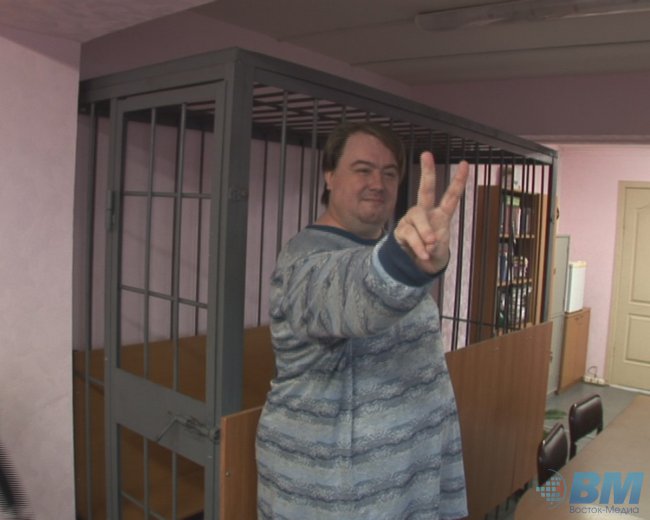
Update. According to an article on the news website Vostok-Media, on October 1, 2015, the Industrial District Court in Khabarovsk found Andrei Marchenko guilty as charged and sentenced him to a fine of 100,000 rubles, but immediately amnestied him as part of a general amnesty celebrating the seventieth anniversary of victory in the Second World War.
Andrei Marchenko celebrating his virtual victory in court. Photo courtesy of Vostok-Media
Prosecutor Requests Two Years in Open Penal Settlement for Khabarovsk Blogger Marchenko
September 28, 2015 Grani.Ru
Prosecutor Olesya Demina has asked Khabarovsk’s Industrial District Court to sentence blogger and LGBT activist Andrei Marchenko to two years in an open penal settlement, as reported by Grani.Ru’s correspondent from the courtroom. Marchenko has been accused of extremism for posts he made on Facebook.
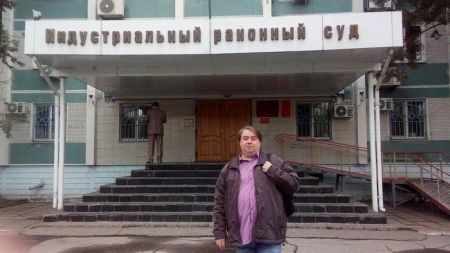
Andrei Marchenko outside of Industrial District Court in Khabarovsk. Photo by Alla Viktorova. Courtesy of Grani.Ru
During closing arguments, defense attorney Natalya Gladych drew the court’s attention to Marchenko’s positive character references, as well as the findings of a psychologist, who concluded that the defendant’s only purpose had been to draw attention to himself and to his position on the war in the east of Ukraine.
“Two years in an open penal settlement is an excessively severe punishment given that the evidence presented by the prosecution is insufficient. The prosecutor speaks of Marchenko as an out-and-out extremist, although the man was simply expressing his opinion. The harsh form in which he delivered it was due only to heightened emotionality,” said Gladych.
On Monday, the defendant was to make his closing statement, but Judge Galina Nikolayeva unexpectedly adjourned until Wednesday, September 30, when Marchenko will deliver his closing statement and the judge will return a verdict.
“I did not expect that the prosecution would request real prison time. There is not a single injured party in the case. There is only the one sentence on Facebook, which did not lead to any real consequences. And for this the representative of the state machine asks the court to sentence me to real prison time,” Marchenko commented to Grani.ru after the hearing.
Marchenko has pleaded not guilty and hopes for an acquittal.
On June 8, 2014, Trinity Sunday, Marchenko published a post on Facebook dealing with the events in the east of Ukraine.
“Impale all the terrorists!!!!!!!!” he wrote. “Kill all of them!! Blood Sunday! Free Ukraine from the fascist Russian terrorists on Trinity Sunday!”
The post was made visible only to Marchenko’s friends in the social network. Nevertheless, it was this publication that led to the blogger’s prosecution.
On August 28, 2014, FSB officers carried out a search at Marchenko’s home during which they seized all his office equipment and mobile phones. The following day, the blogger was charged at regional FSB headquarters under Article 280, Part 1 of the Criminal Code (public incitement to extremism)
Andrei Marchenko. Photo courtesy of amurburg.ru
A week before the raid, the blogger had also been summoned to regional FSB headquarters. There he was shown screenshots of a certain site according to which Marchenko and another Khabarovsk LGBT activist, Alexander Yermoshkin, were the founders and masterminds of a “gay terrorist underground” that were pursuing the goal of organizing an “orange revolution” in Khabarovsk. As Marchenko noted, the FSB investigator was “utterly serious.” Marchenko was then asked why he did not like “Novorossiya.” He was told that his numerous posts in support of Ukraine and criticizing the Kremlin were the reason for the FSB’s concern.
On September 11, 2014, another five phrases from Marchenko’s summertime posts were sent off for forensic examination.
“Including phrases in support of Poroshenko and phrases about the fact that prices are higher but Crimea is ours,” wrote the blogger.
Two weeks later, it transpired that Rosfinmonitoring had placed Marchenko on its list of terrorists and extremists. However, the blogger kept his bank accounts only for withdrawing money he earned through official freelance bureaus from the WebMoney system. For many years, these earnings had been Marchenko’s only source of income. Thus, Rosfinmonitoring’s decision left the activist penniless.
“Now I don’t even have money for groceries,” wrote Marchenko.
The blogger expressed bewilderment at his inclusion in the list, noting that the court had not yet deemed him either a terrorist or an extremist.
NB. Grani.Ru, the opposition news and commentary website that published this article about Andrei Marchenko’s plight is itself banned in Russia as “extremist” and can only be viewed there through VPNs, anonymizers, and mirror sites.
Update. According to an article on the news website Vostok-Media, on October 1, 2015, the Industrial District Court in Khabarovsk found Andrei Marchenko guilty as charged and sentenced him to a fine of 100,000 rubles, but immediately amnestied him as part of a general amnesty celebrating the seventieth anniversary of victory in the Second World War.
Andrei Marchenko celebrating his virtual victory in court. Photo courtesy of Vostok-Media
Guberniya Daily notes that Zavarkin has already given testimony in the case on four occasions. According to the article, he is being defended by a court-appointed lawyer.
At the same time, it is reported that the deputy has filed a complaint with the Russian Investigative Committee in connection with the criminal charges and is preparing an appeal to the Security Council.
Charges were filed against Zavarkin after his speech at a rally on May 20 in Petrozavodsk calling for the resignation of Alexander Hudilainen, Head of the Republic of Karelia. Over two thousand people attended the rally.
Zavarkin described the difficult social and economic situation in Suojärvi and harshly criticized Hudilainen.
He concluded his short speech with the words, “If the Russian Federation does not hear us, we will hold a referendum, I think. [If] Russia does not need Karelia, let’s separate.”
Vladimir Zavarkin’s speech at May 20, 2015, rally in Petrozavodsk, the capital of the Republic of Karelia
A day earlier, Zavarkin had posted a film about the situation in the Suojärvi District on the Vkontakte community page ”Hudilainen Resign!” The annotation to the film quotes Zavarkin’s statement in the film: “I appeal to the people of Finland and the Baltic countries: help us by sending humanitarian aid. You also have relatives in Karelia. Otherwise, we will all die out!”
Zavarkin sits on the Suojärvi Municipal Council’s committee for social issues, public order, and housing and public utilities.
Ripe for Exploitation
Oleg Pshenichny
August 24, 2015 Grani.ru
This morning, instead of giving lessons, the teachers at a school for Syrian refugee children loaded the school’s belongings into a car. Classes had suddenly been cancelled, and the school closed. The proprietor of the room in a private house where classes had been held showed the children and teachers the door.
This happened after local Russian Federal Migration Service (FMS) officers had shown up on Saturday at the house on Rogozhskaya Street where the school was located to carry out a spot check, which had mushroomed into a full-blown search. The officers inspected not only the rooms and the grounds of the house but also the personal belongings and furniture of both the house’s owner and the school.
The occasion for the spot check had been information about a Syrian terrorist who had, allegedly, been registered under false pretenses at the house. As the school’s organizer, Syrian journalist and political refugee Muiz Abu Aljail, told Grani.ru, the reason for the search was contrived. The local authorities had simply wanted to get rid of the school.
Classes had begun in May of this year under the auspices of the Civic Assistance Committee’s Adaptation and Education Center for Refugee Children, with assistance from the United Nations High Commissioner for Refugees. Around thirty Syrian children who had settled in Noginsk in recent years were pupils at the school.
Olga Nikolayenko, director of the Adaptation and Education Center, told Grani.ru that Muiz Abu Aljail had actively helped his compatriots in the Moscow Region by providing legal and other assistance. When he found out that many Syrian children in Noginsk had nothing to do and were simply roaming the streets, Muiz organized a informal study group, initially in Arabic, after which the Civic Assistance Committee got involved and recruited professional teachers.
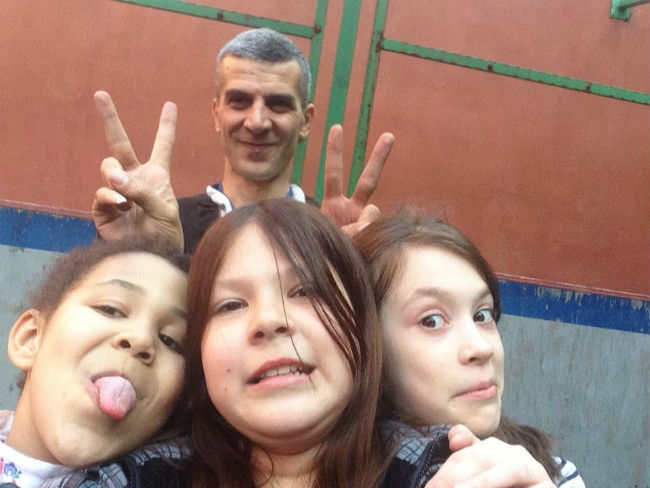
Muiz Abu Aljail and pupils from the Noginsk School for Refugee Children. Photo from Muiz Abu Aljail’s Facebook page
“We organized a Russian language summer intensive course to prepare the children to enroll in regular schools in Noginsk in September,” said Nikolayenko, “As you know, there is now a lawsuit underway against the Ministry of Education in order to force Russian schools to enroll migrant and refugee children regardless of whether they have residence permits. [The Supreme Court will hear the case on August 27 — Grani.ru.] We are counting on winning and wanted to get the children’s Russian up to speed. But now the owner of the house has been thoroughly intimidated. They summoned her for questioning and told her they were looking for an agent of Al Qaeda. Classes have been disrupted.”
According to Nikolayenko, the Noginsk authorities had immediately reacted with hostility to the idea of setting up the school. When people from the Adaptation and Education Center had come to Noginsk in May to secure the assistance of the local education department, a meeting was held at which Alla Artyomova, head of the local FMS office, had categorically stated that no classrooms would be provided for the school, because on paper there were no Syrian children in Noginsk and no one cared about what happened to them.
At the same time, in neighboring Losino-Petrovsky, a similar school for migrant children has received a lot of assistance from the local authorities, who found classroom space and promised to help the children enroll in school. In Noginsk, however, the school was left to its own devices and had to hold classes in a private home.
“The kids really liked it,” says Elena Drozdova, a teacher at the school, “and we managed to get a lot done. After all, teaching a person to read and write Russian from scratch in three months is a big deal. But now we’ve loaded our things in the car, and we don’t know what will happen to the school, what will happen to the children, and after this incident, whether the parents will let their children go to school at all.”
Pupils from the Noginsk School for Refugee Children. Photo from Muiz Abu Aljail’s Facebook page. The placard reads, “We are not animals. Please give us the right to a childhood.”
Muiz Abu Aljail believes the problems are much more serious than red tape. Officials are not interested in helping the refugees to adapt since an unsettled community is a good source of bribes.
“There is a police and FMS mafia who have created a whole system of slave labor and extortion. I once published an investigation entitled ‘Slavery in Russia: A Special Dossier on Syrian Refugees.’ At every stage of the decision-making, the corrupt system gets tens of thousands of rubles from each person. For example, getting registrations costs twenty thousand rubles [approx. 250 euros at current exchange rates], another twenty thousand rubles for your wife, and another twenty thousand rubles for your children. It used to cost from sixty to seventy thousand rubles to get registration, but after the FMS ordered that asylum be granted automatically, the rate went down to twenty thousand rubles. But the price for being granted asylum has risen. In Moscow, a special business has been organized to this end. Getting into the queue costs fifteen thousand rubles. Getting a certificate stating your case is under review costs from three to fifteen thousand rubles. It costs forty thousand rubles to get temporary asylum. Without it, you will either not get a job or be forced to work illegally, which has led to the emergence of entire slave-labor enterprises.”
Alexandra Naumova (née Dukhanina, usually referred to as Sasha Dukhanina), born 1993, was the first person to be arrested in the Bolotnaya Square case, launched by the Russian authorities after a sanctioned opposition march in downtown Moscow on May 6, 2012, the day before President Putin’s re-inauguration, ended in clashes with police. Dukhanina-Naumova was detained at the Occupy Arbat protest camp in Moscow in late May 2012 and has been under house arrest since that time.
Dukhanina-Naumova and her co-defendants Sergei Krivov, Alexei Polikhovich, Artyom Savyolov, Denis Lutskevich, Andrei Barabanov, Stepan Zimin and Yaroslav Belousov are charged with involvement in mass riots and assaulting police officers. At the January 22, 2014, hearing in the case, prosecutors asked the presiding judge, Natalya Nikishina, to sentence each of them to between five and six years in prison.
Dukhanina-Naumova is specifically accused of throwing chunks of asphalt, one of which, allegedly, struck a police officer, slightly bruising him, and splashing a soft drink (kvass) from a liter-size bottle.
A photograph of a riot cop dragging Dukhanina-Naumova away by the neck on May 6, 2012, taken by famed opposition blogger and photographer Rustem Adagamov (aka Drugoi), himself now in exile, has become, perhaps, the most famous image of the “riots” that took place in Moscow that day. Many opposition activists and independent observers have claimed that what happened was in fact a provocation on the part of the authorities aimed at demoralizing the opposition and selectively punishing those who had tried to spoil Putin’s repeat “coronation” by publicly protesting.
Before her arrest, Dukhanina-Naumova was a student at Moscow State University, where she majored in translation and interpretation. An anarchist, she had been involved in such causes as the defense of the Tsagovsky Forest, near Moscow, and Food Not Bombs.
On December 19, 2013, four other defendants in the case, Maria Baronova, Vladimir Akimenkov, Nikolai Kavkazsky and Leonid Kovyazin, were released under an “amnesty” that has been regarded by many as a gesture meant to defuse domestic and foreign criticism of the Putin regime’s concerted attacks on human and civil rights, NGOs, gays and lesbians, migrant workers, and opposition activists.
In any case, this amnesty did not fool the several thousand people who marched in Moscow on February 2, 2014, demanding the release of Dukhanina-Naumova and the other Bolotnaya Square defendants.
Dukhanina-Naumova made the closing statement, below, during the final hearing in the trial, on February 5, 2014, in Moscow.
After Dukhanina-Naumova and her co-defendants had finished making their closing statements, Judge Nikishina announced she would read out the verdict in the trial on February 21, 2014. This is two days before the end of the Sochi Olympics, President Putin’s wildly expensive showcase of his personal triumph over man, nature, and budgetary common sense.
__________
Closing Statement by Alexandra Dukhanina-Naumova at the Bolotnaya Square Trial, Zamoskovoretsky District Court, Moscow, February 5, 2014
At first I thought that this whole trial was a crazy mistake, the result of some mix-up. Now, after hearing the prosecutor’s speeches, and considering the length of the prison terms they are asking for us [Bolotnaya Square defendants], I’m starting to see that what the authorities want is revenge. They want revenge because we were there and saw how things really were. We witnessed who instigated the stampede, how people were beaten, and the unjustified violence. They are getting revenge on us for not bowing down to them and repenting for our nonexistent crimes, neither during interrogations nor here, in the courtroom. They are also avenging me for not helping them further their lies, for refusing to answer their questions.
These are serious crimes that carry a penalty of six years in a penal colony. There is no one else who has earned such a severe punishment, just us. They’re afraid of the real criminals—they imprison the strangers who get in their way while they wouldn’t lift a finger against their own. It is up to you, Your Honor, to decide whether to pay for furthering their happiness—promotions, stars, and medals—with our lives.
Why six years? What are these “no fewer than eight targeted throws” I supposedly dealt? Where did they come from? Whom was I aiming at and whom did I hit? Eight different police officers? Or did I hit the two men they’ve painted as the victims eight times? If so, how many times did I hit each of them? Where are the answers to these questions? Isn’t it up to them to describe the attack in detail and prove their case before putting me in prison? After all, this isn’t fun and games; it’s six years of my life at stake. Otherwise, it isn’t even lies, but mendacious demagoguery unsupported by facts, a game played with a human life in the balance. And if they had 188 videos and not eight, would they allege that there were 188 throws?
You’ve seen the two riot police officers who were my so-called victims. Each one of them is two or three times my size, and on top of that, they were in body armor. One of them felt nothing, and the second one was not injured by me at all and has no grievances. Is this the “rioting” and “violence” that have earned me six years of incarceration?
I almost forgot about the kvass. The bottle alone gets me five years, and the eight targeted blows get me the last one. At least let them say so, that way at least I’ll know the price of kvass. They should also tell me where my “mass rioting” ends and my “violence toward the authorities” begins. What’s the difference between the two? I still haven’t understood the charges against me: what did I burn? What pogroms? What destruction of public property? What does any of this have to do with me? What did I blow up? What did I set on fire? What did I destroy? Whom did I conspire with? What’s the evidence? Am I getting four years in accordance with Article 212 just for being there? Is my mere presence at what began as a peaceful demonstration the “rioting” that I was involved in? All I did was show up.
Take a look at these people. They’re not murderers, thieves or con artists. Putting us all in prison is not only unjust, it’s criminal.
Many people have given me the opportunity to repent, apologize, say what the investigators want me to say, but you know, I don’t find it necessary to repent, let alone apologize, to these people. In our country, it’s widely accepted that they are absolutely untouchable despite the well-known cases of their involvement in drug trafficking, prostitution, and rape. Just a few days ago, that happened in the Lipetsk Region.
The narrative of the charges pinned on us isn’t just funny; it is absurd and based solely on the testimony of the riot police officers. What does this mean, that if a person has epaulettesthey’re a priori honest and holy?
Your Honor, in the course of the past eight months of this trial, you’ve received such substantial evidence of our innocence that if you send us all to the camps, you will be ruining our lives and futures for nothing.
Is the government really so determined to make an example of us that it is willing to take this step? Letting a pencil pusher, rapist or policeman off for [inaudible] is a matter of course: they’re untouchable, one of your own. We, on the other hand, can handle a prison term. Who are we, after all, we’re not even rich? For some reason, I am convinced that even in prison I will still be more free than any of them because my conscience will be clear, while those who remain on the outside continuing their so-called protection of law, order, and freedom will live in an unbreakable cage with their accomplices.
I can admit to making a mistake. If I were truthfully presented with facts and it were demonstrated to me that I had done something illegal, I would confess to it. However, no one has done any such thing: all I’ve witnessed are lies and brute force. You can suffocate someone with force, drag them [inaudible] and all of this has already been done to me. But lies and violence can’t prove anything. Thus, no one has proven my guilt. I am sure that I am right and that I am innocent.
I’d like to close with a quotation from Gianni Rodari’s Cipollino:
“My poor father! They’ve thrown you in the pen with thieves and bandits.”
“Hey now, son,” his father tenderly interrupted him. “Prison is chock full of honest people!”
“Why are they in prison? What have they done wrong?”
“Absolutely nothing, son. That’s why they’re in here. Decent people rub Prince Lemon the wrong way.”
“So getting in prison is a great honor?” he asked.
“That’s how it seems. Prisons are built for people who steal and kill, but in Prince Lemon’s kingdom, it’s all topsy-turvy. The thieves and murderers are in his palace, while honest citizens fill the prisons.”
Translated by Bela Shayevich. Originally published, in Russian, on Grani.Ru. Photograph of Alexandra Dukhanina-Naumova courtesy of Dmitry Bortko