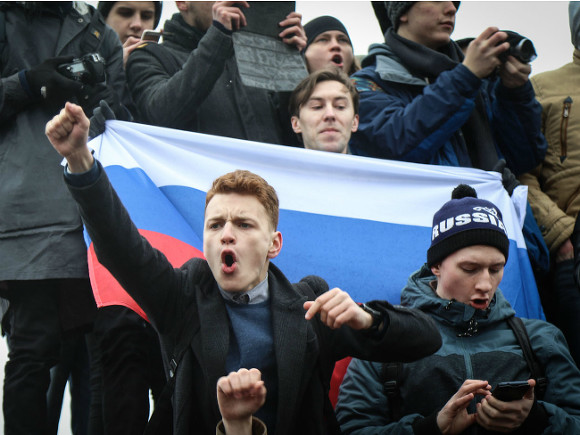
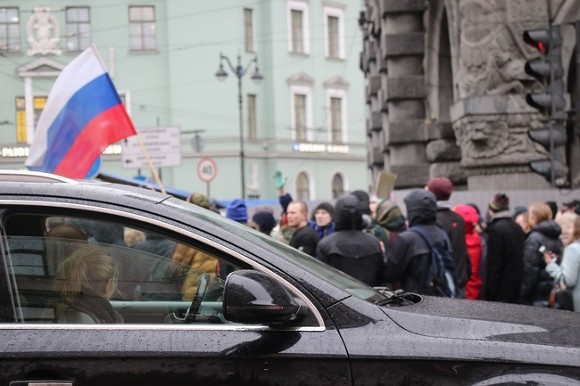
June 12 is a public holiday, Russian Sovereignty Day [sic]. Certain people have been trying to use our national holiday to destabilize the situation in the country. Alexei Navalny has called for Russians to take to the streets of their cities in protest against the current regime.
The administration of Saint Petersburg State University of Film and Television asks you to approach the question of involvement in such events responsibly, not to yield to such calls and other provocative proposals whose objective is inveigle young people in unauthorized mass actions and marches aimed at destabilizing public order, calls and proposals that are transmitted via social networks and other sources of information. We cannot let these people achieve their political ambitions illegally.
Thanks to Comrade VS for the heads-up
“⚡️Gas sprayed on Pushkinskaya Square. Police in gas masks. If you smell gas, wet t-shirts and breathe through them. #12june.”
So, 658 people were detained [in Petersburg]. Minors whose parents were able to come and get them and people with disabilities have been released. Nearly everyone else will spend the night in jail.
There will be court hearings tomorrow. Everyone who can make it should come. The hearings will take place at the Dzerzhinsky District Court [in downtown Petersburg]. The first detainees are scheduled to arrive at the court at 9:30 a.m. Considering the number of detainees, we will probably be there into the night.
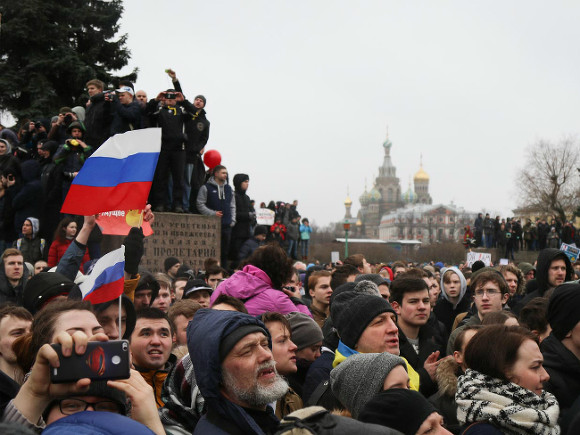
Field of Mars, Petersburg, June 12, 2017. Photo courtesy of Alexandra Polukeyeva/Rosbalt
Alexei Gaskarov
I was invited to speak at the rally on Sakharov Avenue. I planned to talk about why it was important to support the anti-corruption campaign despite our political differences. In short, in order to put a stop to reaction, dissenters need to be represented on a massive scale, so the elites would not even think about just trampling them or not noticing them. Everyone has the same goal right now: resurrecting political freedoms. The contradictions among people are secondary. Considering the scale of protests nationwide, things turned out quite well. You can see that people have stopped fearing crackdowns, and that intimidation no longer works. In Moscow, switching the rally to a stroll down Tverskaya was an absolutely apt response to the Kremlin’s behavior. Everyone who wanted to avoid arrest had the chance to do that. There were downsides as well, but given the colossal confrontation, they don’t seem important.
Ilya Budraitskis
Of course, one cannot help but welcome today’s protests on a nationwide scale. We are witnessing the continuing rise of a new protest movement that emerged on March 26. This movement is indivisible from Alexei Navalny’s presidential campaign and owes both its virtues and weaker aspects to that campaign. Despite the fact that Navalny’s campaign could have launched a broad grassroots movement, on the contrary, it has been built like a personalistic, vertical political machine in which decisions made by a narrow group of experts and approved by the leader are mandatory for the rank-and-file. This raises the majority’s political consciousness to the degree necessary at each specific moment of the campaign. The leader’s political strategy, his objectives, and the meaning of decisions are not up for discussion. Navalny must be believed like a charismatic CEO. What matters is that he is personally honest and “he has a plan.” On the eve of the protest rally, authorized for June 12 in Moscow, the rank-and-file found out a new particular in the plan: everyone had to go to an unauthorized protest march, which would predictably end in arrests and criminal charges along the lines of the March 26 protests. The rationale of the organizers is understandable. They have to pull out all the stops to keep the campaign moving at a fever pitch, keep it in the public eye, and use the threat of riots to pressure the Kremlin. Moreover, this radicalization in the media reduces the complicated picture presented by Russian society to a simple confrontation: the thieves in the Kremlin versus the honest leader who has united the nation. This set-up renders all forms of public self-organization and all social movements secondary and insignificant, and their real interest ultimately boils down to making Navalny president. However, even Navalny’s most dedicated supporters should pause to think today, the day after June 12. Would his campaign be weakened if it were opened up to internal criticism, if horizontal discussions of his political program and strategy were made possible, and the political machine, now steered by a few people, turned into a real coalition, where differences did not get in people’s way but helped them agree on common goals?
Anna Ivanova
“Sakharov Avenue is out,” Navalny said in his morning video message.
Navalny’s adviser Leonid Volkov put it more democratically.
“The hypocritical scum who dreamed up the ‘opposition rally on Sakharov’ will fry on a separate frying pan.”
The rally on Sakharov happened anyway. It was mainly attended by opponents of Moscow’s new law on the large-scale renovation of residential buildings: urban activists and residents of the buildings slated for demolition, as well as defrauded investors in residential building projects, foreign currency mortgage holders, and other victims of the construction sector. Many fewer of them came out, however, than on May 14, even considering that some of the outraged Muscovite anti-renovation protesters followed Navalny over to Tverskaya. Protests rise and ebb like the sea, and this time round the excitement was muted. These people—old women, families with children, old men—were not suitable for getting arrested at an unauthorized protest. Although they realize that Moscow’s problems are merely one logical outcome of the Russian political system, they are in no hurry to support Navalny and other inveterate oppositionists, for what is at stake are their housing and property, not supreme civil liberties.
“Day of Russian Cops” on Tverskaya in Moscow, June 12, 2017
Meanwhile, on Tverskaya, young folks realized that A.C.A.B. Around 700 people were detained in Moscow, and the social networks were flooded with even more photographs of derring-do amidst the so-called cosmonauts [riot cops]. The ultimate damage from the protest might be acknowledged only over time, when we know whether there will be new criminal cases, and if there are, what charges are laid against the protesters. But everyone loves looking at riot porn (and being involved in it), although this hobby devastates and dulls the senses as much as watching ordinary porn. This is the danger of protests “for all things good,” of protests focused on a certain political agenda or figure: neither fat nor thin, neither old nor young, neither socialist nor nationalist, but generally sweet and better than the old protest rallies. In this case, protest risks degenerating into a social order in which everything is decided by Sturm und Drang. Not the worse prospect, some would argue, but others would argue it would be a disaster. But whether you like it or not, “Russia has thousands of young people dreaming of revolution,” for the time abstractly encapsulated in the slogan “Dimon must answer for his actions,” and they have been taking to the streets.
Two worlds did not in fact meet in Moscow today. One world is the world of people who are mostly old, people whose property is threatened with eminent domain and who imagine politics as a way of building an urban environment. The second world is the world of bold young people (and their slightly older idols), who are hellbent on regime change. It would not be a bad thing if these worlds met and acted in concert. This is the only way for a democratic politics to emerge from this.
Notes from the field (the Field of Mars). Putting aside emotions:
1. It’s true there were lots of young people. And they are not afraid of anything.
2. There were many young families, who are likewise not afraid for their children.
3. “We’re fed up” is the key phrase.
4. There were slogans about healthcare, infrastructure, and pension. Well, and about corruption, too.
5. The out-of-town students came out because “it is wrong to drive the regions into a pit like this.”
6. There was a sense of support and public acceptance.
7) The people who came out were true patriots genuinely worried about the country’s future.
8) A spirit of freedom . . .
P.S. On the Six O’Clocks News last night, BBC Radio 4’s Moscow correspondent had the temerity to refer to yesterday’s protest march on Tverskaya as “illegal.” Is this the new tariff for keeping one’s press accreditation under Putin’s perpetual reign? TRR
“We Don’t Want to Live in a Country Where the Regime Robs Its Own People”
Alexander Kalinin Rosbalt
March 28, 2017
High school and university students talked about why they went to the anti-corruption rallies and whether they feared a crackdown.
A huge number of university and high school students attended the anti-corruption rallies in Russia. It was the first time many of the young people had gone to a protest rally. Some protesters even wound up at police stations along with their older comrades. Some high school and university students told our correspondent what had made them take to the streets.
Anti-corruption protesters on the Field of Mars, Petersburg, 26 March 2017
Kristina, 16, tenth-grader from Gatchina
This was my first protest rally. I came to the Field of Mars because, like most of the people here, I wanted to get through to the regime. After watching the film by the Anti-Corruption Foundation, many people had questions. Besides, I see how my relatives, acquaintances, and friends get along. We are often cheated. For example, a relative was illegally sacked from work, and campaigning for United Russia goes on at my school. There are party flags in the health and safety classroom. I argue about it with my teacher all the time. He says he’s a member of the party.
Have you heard the recording in which teachers give high-school students in Bryansk a dressing-down? Basically, the same thing happens at our school. I get D’s and F’s when I talk like that, and I’m sent to the principal for “disrupting class.”
I was wondering how many people would come to the rally. My parents tried to persuade me not to go. They said, “There will be ten people there, and you’ll waste your time.”
I went to the rally with my boyfriend. We made a placard about Shuvalov’s dogs. We drew Welsh corgis against a backdrop of clouds and wrote, “Happiness if flying like a bird in the sky but without wings.” A man on the Field of Mars asked to look at our placard and was surprised we hadn’t unfurled it.
I had never seen such a huge crowd before. I was even a bit scared we would be trampled.
When we went to Palace Square, I heard the roar of sirens. I saw the riot police (OMON) in all their glory for the first time on the square. They formed a line and advanced on the protesters.
A policeman approached us and asked for our papers. We replied by asking him to identify himself and show us his badge number. He looked away from us and went over to detain a man holding a placard. I was ready to be detained. I had read all the posts on the topics and memorized all the articles about what to do when you’re detained by police.
When we went to the Legislative Assembly, people broke up into groups. Some demanded freedom for Oleg Navalny, others talked about what was happening with St. Isaac’s Cathedral, and still others chanted anti-corruption slogans. Then there were people who went to the subway or to a café.
After hanging out at the Legislative Asssembly, we had decided to go home, when we were again approached by a police officer. He asked to check our papers and wondered whether we had been at the rally. We answered that we had.
“Good going!” he said. “I would have gone myself, but I was on duty and I’m afraid of losing my job.”
We were stunned, but it was nice to hear.
My parents knew where I had gone. They followed the news. When I got home, we joked about what would have happened if the police had nabbed me.
I don’t want to be compared with truant schoolchildren (shkolota). The rally was not entertaining in the least, and we had to go to it. We realize this is our future. We keep a close eye on grown-ups. They regard what’s happening with desperation. It doesn’t scare me if the order comes down to give lectures in the schools about the current political situation. I expect it to happen. I love discussing the topic. It’s fun to argue when you are well versed on the subject. Although maybe I won’t be invited to these lessons. The thing is we had a session of the Leningrad Regional Youth Parliament at our school to which regional MPs were invited. The teachers rehearsed the event with us, and the questions were prepared in advance. But when I was going to ask my question, I was politely shut up. They realized I could cause a conflict.
Anti-corruption protesters marching down Nevsky Prospect, 26 March 2017
Ivan, 16, ninth-grader from Kolpino
This was my first protest rally. I made the trip from Kolpino to Petersburg by myself. I was curious how folks would react to Alexei Navalny’s exposé film. I wondered whether people cared or didn’t care about what the powers that be were up to. I didn’t bring a placard with me, but I shouted slogans with the other protesters, although it felt awkward at first. When somebody chanted a slogan from far off, I kept my mouth shout. But I plugged into the process when people next to me shouted.
There were lots of young people, so I didn’t feel alone. At first, police dispersed the people who had climbed atop the memorial next to the Eternal Flame, but then they gave up. When the rally on the Field of Mars was over, I didn’t want to leave. I wanted to keep going
When we marched towards Palace Square, I didn’t hear any negative feedback towards us. On the contrary, individuals supported us by smiling, laughing, and photographing us, while drivers honked their horns. Only the police were upset. They asked us why we had come out.
I felt more confident on Palace Square. I even started some chants first.
The “cosmonauts” (riot police) made their first appearance on the square, but they were very few in number. They didn’t do anything. It was only when the crowd pressed against them that they asked us to disperse, but no one was listening to them. Generally, the police behaved decently.
When we walked towards Insurrection Square, we were followed by police cars and paddy wagons. The arrests took place on the approach to the square. A lot of people were kettled opposite a building on Nevsky Prospect.
I want to watch the arrests, and then go home, but I accidentally bumped a riot cop with my shoulder. He said something about my being broad-shouldered. I probably did the wrong thing. I said to him, “Yeah, I’m broad-shouldered.” Right then, three paddy wagons drove up too the crowd. The cosmonaut grabbed me and put me in one of them. It was my first arrest.
Our ride to the police station was cheerful. No one was upset. We were taken into the station. We stood for around in a hour in the hallway, and then we were led into this weird basement. We were allowed to make a phone call. We chatted with the policemen about whether we had done the right thing by taking to the streets or not. They weren’t aggressive.
The voyage to the police station revved me up. At the precinct, I met a lot of kids. Human rights advocates helped us. They found the precincts where we’d been taken, brought us food, and advised us on how to behave. It was a tremendous feeling of support.
Then Mom came to get me. She and I left the station at 10:00 p.m. I was told only to write a statement, and I was given a report that I had been delivered to the station.
My parents had known I was planning to go to the rally. They told me I might be detained. When I telephoned Mom from the precinct, she was a bit peeved, but there no heavy discussions at home.
I don’t think there will be any blamestorming sessions at school. Most of our teachers say that Russian isn’t a very good country. I think they would have supported my trip to the rally.
The high school students who went to the Field of Mars shouldn’t be dubbed “truants.” Spring holidays had begun. There are lots of dissatisfied young people, so that was why, apparently, they attended the rally. We think about our future. We don’t want to live in a country where the regime robs its own people. But people who are older could not care less anymore, it seems. They’re too lazy to go outside in bad weather.
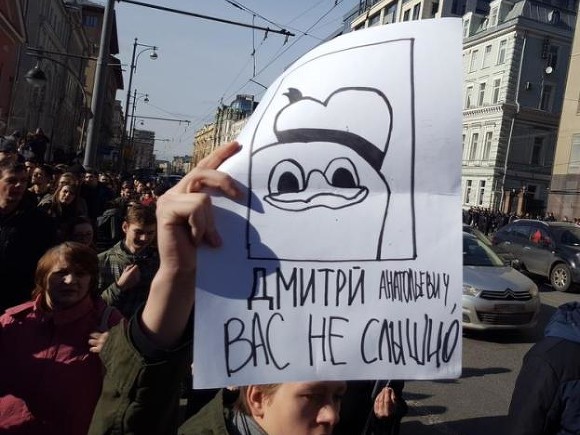
“Dmitry Anatolyevich [Medvedev], we can’t hear you.” Photo courtesy of Denis Goldman/Rosbalt
Mikhail, 16, tenth-grader, Moscow
I had already been in the Boris Nemtsov memorial march and the protests against the Yarovaya package. Like any sensible person, I don’t like the fact our official steal, accept bribes, and build themselves enormous castles in Italy and palaces in Russia. The corruption schemes in Russia are no different from the ones used by the now-ex-president of South Korea. She also laundered money through charities.
The authorities have not reacted to the Anti-Corruption Foundation’s investigation. All that happened was Medvedev banned Navalny on Instagram.
After watching Navalny’s film, I had questions and I wanted answers to them. The Anti-Corruption Foundation argues that the rally was authorized in keeping with the Constitutional Court’s ruling. I consider my arrest illegal, although I was ready for it to happen.
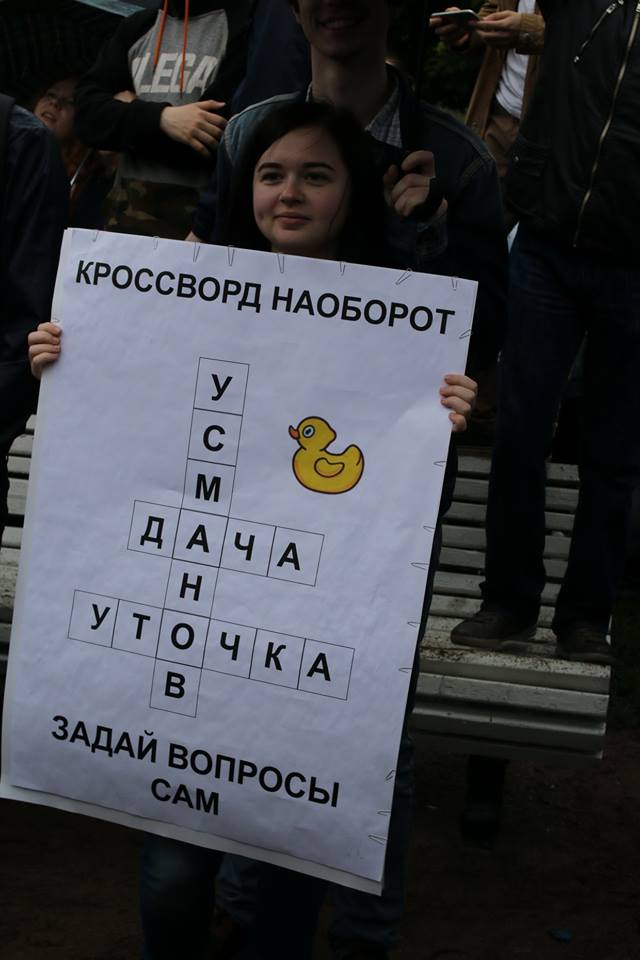
I was walking down the street with my friends. We weren’t shouting slogans, but we were carrying placards featuring Zhdun and the Rubber Duck. Apparently, I was arrested for carrying a placard. My arrest sheet said I had been waving my arms, grabbing people, and running out into traffic. But they wrote that in everyone’s arrest sheet. The only thing they changed was people’s names. Eleven hours passed from the moment of my arrest until I left the police station, although I’m a minor. I should have been released as quickly as possible.
No one told my parents I was at the police station. I telephoned them myself. The police charged me with me violating Article 20.2 of the Administrative Procedures Codes (“Violation of the established procedure for organizing or holding a meeting, rally, demonstration, march or picket”). There will be a court hearing. I imagine the verdict will be guilty. I will appeal it to the European Court of Human Rights.
My parents knew I was going to the rally. They reacted differently to my arrest. My father took it lightly. He remembered his brother, who back in the day had been involved in the events outside the White House. But Mom was upset because I was unable to go to a relative’s birthday party.
I’m glad so many people showed up to the rally. People realize that corruption is an evil, that something has to change. I hope the teenagers who went to the rally will keep involved in civic activism and fight to make our country law-abiding. I don’t think this is the last time you’ll see young people taking to the streets.
As for the consequences, I don’t think there will be a crackdown at my school. I hope the Moscow Education Department doesn’t apply any pressure.
Students confront riot police on Palace Square, 26 March 2017
Svetlana, 17, first-year university student, Petersburg
This was the first protest in my life. I had wanted to attend the rally against transferring St. Isaac’s Cathedral to the Orthodox Church, but it didn’t work out. The reason I attended the rally was Navaly’s exposé film. I didn’t want to stand on the sidelines.
I saw lots of indignant people at the Field of Mars. Initially, I didn’t want to stand out. I even felt uncomfortable chanting with everyone else. Then I went and stood next to some young activists. I felt comfortable with them. Of course, I didn’t want my university to find out I’d been involved in the rally. They don’t like it when students start “uprisings.”
When we were walking down Nevsky Prospect toward Palace Square, I was already in the front. I took the subway to Insurrection Square. When I came out, I saw the police had blocked the road. I didn’t see any of the arrests myself. Friends told me about them.
There is nothing extraordinary about the fact that young people came out for the rally. It’s not the first time they’ve been called a driving force. It is always young people that kick everything off. Lots of people are now talking about what happened. I was pleased to be involved in the beginning of the big fight against corruption.
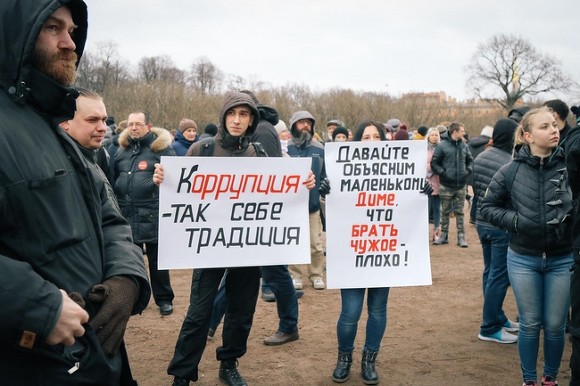
“Corruption isn’t such a great tradition.” “Let’s explain to little Dima that taking other people’s things is bad.” Two protesters holding placards on the Field of Mars, 26.03.2017
Victoria, 18, 2nd-year university student, Petersburg
I used to go to rallies mainly dealing with educational problems. I had been to rallies in defense of St. Petersburg State University, the Publishing and Printing College, and the European University. As a student, I take this issue to heart. I wouldn’t want to find myself in a situation in which my university was being closed.
As for the topic of the March 26 rally, corruption is on everyone’s minds. There is corruption in Petersburg’s universities and colleges, too. Everyone has seen Navalny’s exposé film. It was no longer a question of going to the Field of Mars or not. I had to go. Naturally, I realized the police could nab us, but I didn’t go looking for trouble. I didn’t provoke the police indiscriminately.
I don’t understand, for example, why people had to climb on the monument. But painting one’s face green was a completely innocent gesture.
What I liked about the rally was the spirit of unity, the sense of belonging to a common cause. Ultimately, I went with everyone else from the Field of Mars to Palace Square, and then I went home. I was freezing.
I don’t think there will be crackdowns in the schools and colleges after something like this. First, the teachers and lecturers are themselves dissatisfied with the current state of affairs. Second, none of them wants to find themselves in the role of the Bryansk schoolteachers. After all, high school and university students record all preventive discussions and then post them on the internet. No one wants to be a laughing stock on the web.
Translated by the Russian Reader. Except where indicated all photos courtesy of Alexander Polukeyev/Rosbalt. Thanks to Comrade Uvarova for the heads-up
“Russia is dead, although it seems to be alive. But Nadiya [Nadezhda] can be saved.” Demonstrator at International Women’s Day rally on the Field on Mars, Petrograd, March 8, 2016. Photo by and courtesy of Sergey Chernov
Nadiya Savchenko: Closing Statement in Court
I accept neither guilt, nor the verdict, nor the Russian court. In the case of a guilty verdict there will be no appeal. I want the whole democratic civilized world to realize that Russia is a third-world country, with a totalitarian regime and a petty tyrant-dictator, where human rights and international law are spat upon.
It is an absurd situation when those who abduct people subject them to torture then act as if they have a right to judge them! How can one talk about a fair trial? In Russia, there are no trials or investigations, only a farce played out by Kremlin puppets. And I find it superfluous to waste time in my life participating in it!
And so there will be no appeal, but this is what will happen: After the verdict I will continue my hunger strike for 10 more days, until the verdict comes into force, and this is regardless of the translation [of the verdict] into Ukrainian, because they can drag that out for a long time, too. In 10 days I will begin a dry hunger strike [refusing both food and water], and then Russia will have no more than 10 days to return me to Ukraine, where they abducted me! And I don’t care how they justify it! I have heard that [Ukrainian President] Petro Oleksiyovych Poroshenko is quite adept at diplomacy. I hope his diplomatic skills will suffice to reach agreement in Russia with a certain idiot; after all, he promised my mother that I would be home in time for the May holidays of 2015.
And while they are bargaining over me, my life will be draining away and Russia will return me to Ukraine in any case: it will return me, dead or alive!
Throughout these 10 days, day and night, my sister will be standing at the jail gates, and she will wait and see whether they release me or not. And if you put her in jail, my mother will come and take her place. She is 77, will you put her in jail, too? In that case my friend will take her place, and after her, Ukrainian after Ukrainian! And remember: you can’t shove everybody in here. And while my compatriots are standing there, simple, honest, and decent Russians living in nearby homes will bring them hot tea, sandwiches, and warm blankets, because each one of them understands that tomorrow their child could be in my place, in this prison of all peoples called Russia!
That is how Maidans (revolutions) start! Do you need that?! You fear it like the plague! So it is better for the Kremlin to return me to Ukraine as soon as possible, and alive!
And those in the world with democratic values ought to learn their history lessons before it’s too late and remember that there was a time when Europe was tolerant toward Hitler, and America wasn’t decisive enough, and this led to World War II. Putin is a tyrant with imperial manners and a Napoleon and Hitler complex put together. The [Russian] bear doesn’t understand human language, he understands only the language of force. Therefore, unless we become more decisive and determine the right priorities on time, we will soon have World War III.
And I, as a politician now, won’t shake Russia’s hand in the political arena. It is not right to extend a hand to someone who kept you in handcuffs and your people in chains. But every time I make a political decision, I will always think how it would affect ordinary people, both in Ukraine and Russia. Because in Russia, in spite of everything, there are many honest, kind, and decent people.
Demonstrator at International Women’s Day rally on the Field on Mars, Petrograd, March 8, 2016. Photo by and courtesy of Vadim F. Lurie
On January 19, Petersburg, like its older sister to the south, Moscow, remembered murdered anti-fascists Stanislav Markelov and Anastasia Baburova, as well as other fallen comrades in the struggle against grassroots and state-sponsored fascism and racism.
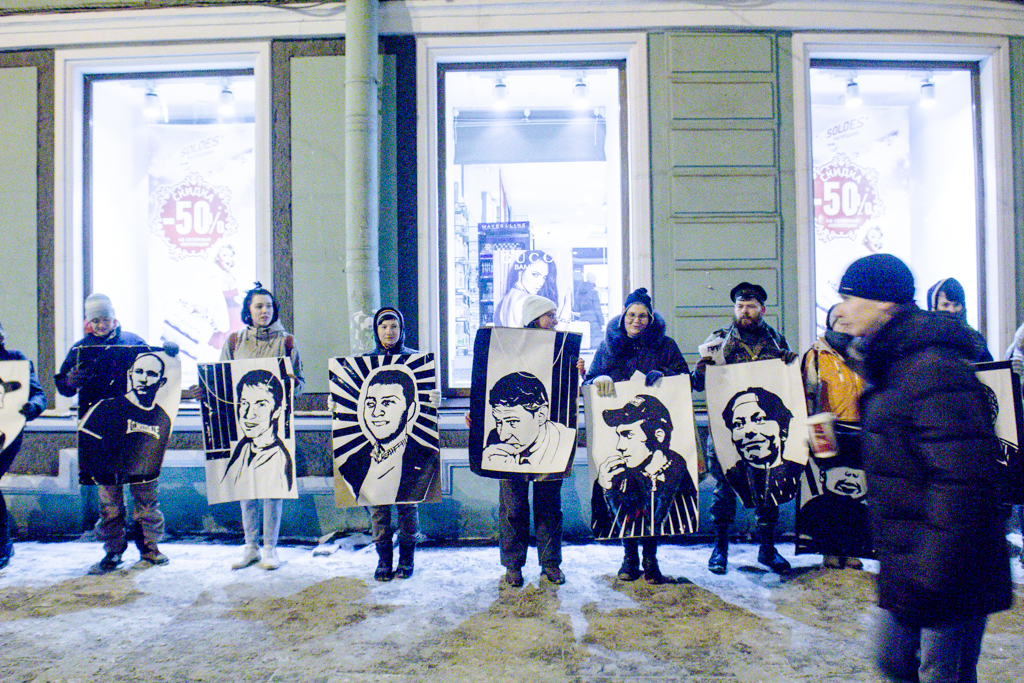
Events included an “exhibition” of posters, commemorating the dead, on the city’s main street, Nevsky Prospect; an unauthorized march to the Field of Mars to lay carnations on the Eternal Flame; and a punk rock concert at a local club to benefit the Anarchist Black Cross and imprisoned Russian anti-fascists such as Alexei Gaskarov and Alexei Sutuga.
Veteran journalist and photographer Sergey Chernov was on the scene to chronicle all these events. I thank him for letting me share some of his photographs with you here.
Picketer holds portrait of slain lawyer on Nevsky Prospect, January 19, 2016. Photo courtesy of Sergey ChernovPicketers hold portraits of Stanislav Markelov, Timur Kacharava, Anastasia Baburova, and other slain anti-fascists on Nevsky Prospect, January 19, 2016. Photo courtesy of Sergey Chernov“I don’t want to dive into a fascist whirlpool.” Photo courtesy of Sergey Chernov
Petersburgers to Light Magic Wands for Alan Rickman paperpaper.ru
January 15, 2016
A memorial event for Alan Rickman will take place in Petersburg. Fans of his works and fans of the Harry Potter saga will gather on the Field of Mars to light magic wands.
As reported on the event’s page, participants will recreate the scene from the movies where the characters pay their last respects to Albus Dumbledore, headmaster of the Hogwarts School. On the day of the professor’s death, students and teachers raise their magic wands and say the spell “Lumos,” which gives light. The fans will use wants and light from flashlights.
The event begins at 6:00 p.m., Saturday, January 16, on the Field of Mars.
Screenshot of the page for the Alan Rickman memorial event on the VKontakte social network. Courtesy of paperpaper.ru
“Yes, the organizers of the meeting are aware that Alan Rickman was not only Severus Snape. Yes, we love him for more than just his role as the professor. But it so happens that we, the organizers, are Potter fans and Snape fans. And this way of saying farewell is the most logical and appropriate for most of us and our friends. We do not think we are insulting the actor’s memory in this way. We are guided by our hearts, and do not see here any disrespect or belittlement of Alan’s merits and achievements,” write the organizers.
Actor Alan Rickman died in London at the age of 69. His career included over fifty films and stage productions.
Translated by the Russian Reader. Thanks to Comrade SY for the heads-up. Readers interested in the venue of today’s memorial should read Ilya Orlov: On the Field of Mars, published on this blog in November 2014.
Near the graves of the victims of revolutions and civil war there has appeared a tombstone in memory of the victims of a new fratricidal war, a war between Russia and Ukraine.
Set up by the Vesna Movement, the new Tomb of the Unknown Soldier is meant to remind people of the hundreds and thousands of our compatriots who have been sent by Putin to the war with Ukraine. They are lied about. It is said they are on leave or that they resigned from the service, but more and and more evidence points to the fact that Russian soldiers have been fighting in the Donbas, and have been coming back wounded or in coffins.
Their graves are concealed, they are not talked about, and their relatives, in return for promises of compensation, lie and say the soldiers died during training exercises. The graves do exist, however. There is this one mock grave on the Field of Mars, and lots of real graves all over Russia.
We are protesting against Putin’s recent decree, making the military’s losses during “peacetime” a state secret. This hypocritical and cowardly decision is of a piece with the Russian regime’s policy of befuddling soldiers with propaganda, sending them off to war, and then lying that they had never existed. And instead of peacetime we have an undeclared war with a fraternal people.
Vladimir Putin has often been credited with the phrase, “We don’t abandon our own guys.” But we have recorded the correct version of the phrase on our memorial: “We don’t abandon our own guys, but those weren’t in fact our guys.” He easily sacrifices both his own and other people’s soldiers to achieve his political objectives.
Putin is a war criminal whose place is in the dock at the Hague Tribunal. That is certainly where he will end up, unless the fate of other dictators who fought with their own people does not catch up with him first.
“An unknown soldier who died in the Donbas during ‘peacetime.’” // “‘We don’t abandon our own guys, but those weren’t in fact our guys.’ V. Putin.” Photo by David Frenkel
Petersburg Activists Rally in Support of Saratov Antifascist Sergei Vilkov David Frenkel
Special to The Russian Reader
June 1, 2015
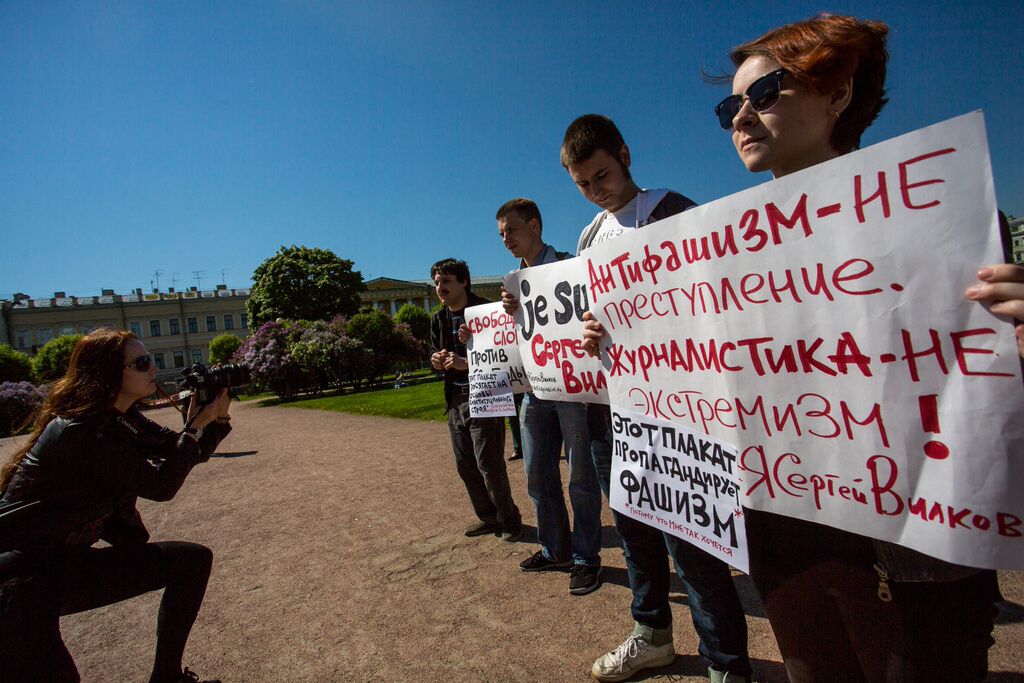
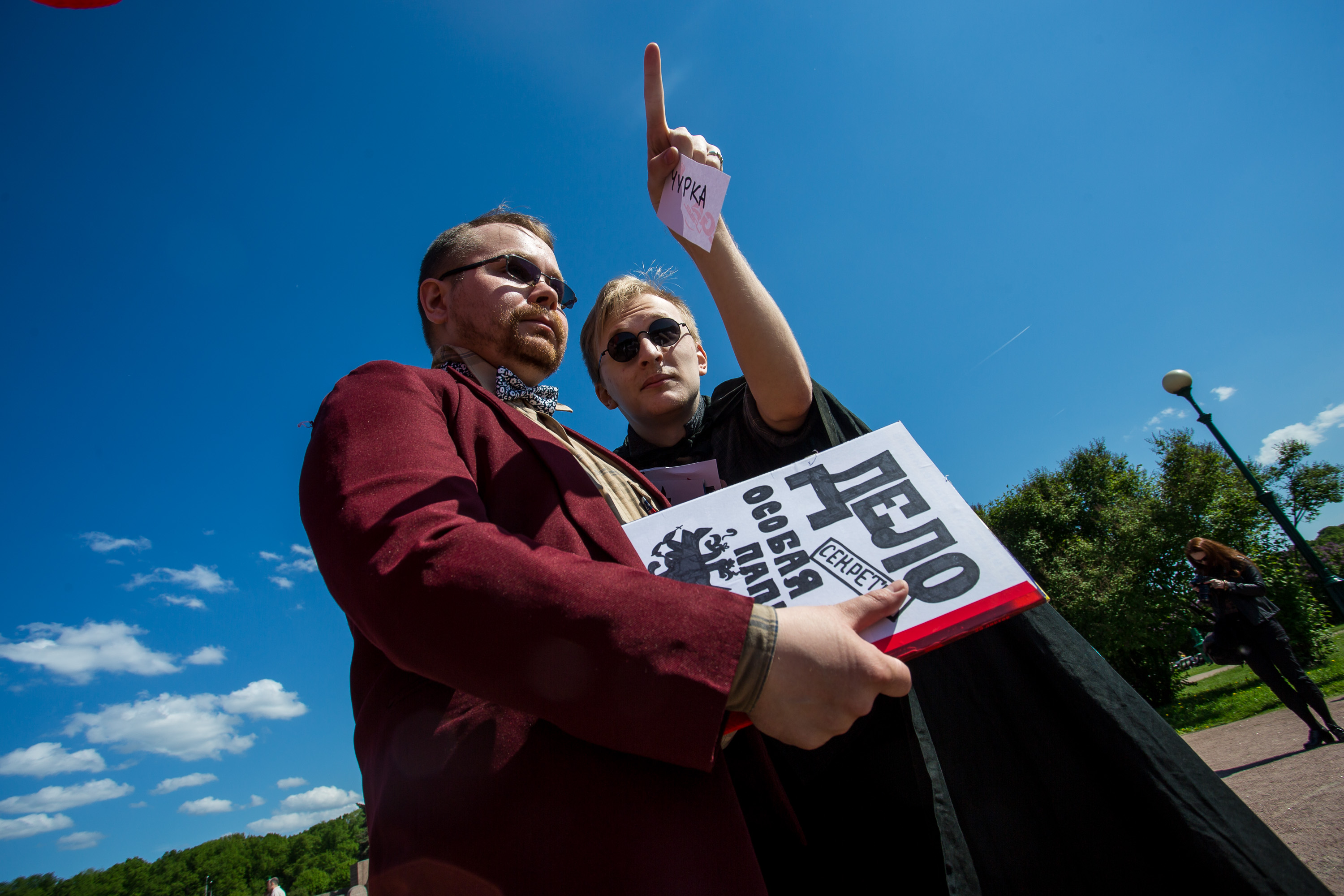
On Saturday, May 30, activists from the Russian Socialist Movement (RSD) organized a theatrical protest rally, entitled “#I Am Sergei Vilkov, or Pinning Labels,” on the Field of Mars in central Petersburg.
Socialist activists rallying in support of Saratov journalist Sergei Vilkov in Petersburg, May 30, 2015. The placard on the far right reads, “Antifascism is not a crime, journalism is not extremism. I am Sergei Vilkov.”
The activists demanded an end to the persecution of Sergei Vilkov, an independent journalist and antifascist in Saratov, who was physically assaulted in January of this year by two unknown assailants and has been accused by various local authorities of “extremism.” In one particular instance in April of this year, Vilkov was fined 1,000 rubles by a Saratov court for having posted, in November 2011, a caricature on his personal page on the VKontakte social network that fused the logo of the ruling United Russia party and a swastika.
Vilkov has blamed his troubles on Saratov businessman and Saratov Regional Duma deputy Sergei Kurikhin. Earlier, Vilkov had published articles in the local monthly news magazine Obshchestvennoe Mnenie (Public Opinion), exposing Kurikhin’s dubious political and business dealings.
Activists at the rally on the Field of Mars held placards demanding prosecution for the persons who, allegedly, assaulted Vilkov in January and decrying censorship.
Symbolizing the alliance between the authorities and business, two activists were dressed as a judge and a “new Russian,” who wore a crimson jacket, popularly regarded as typical attire for gangster businessmen during the “wild nineties” in Russia.
“New Russian” and “Judge” at Saturday’s protest rally
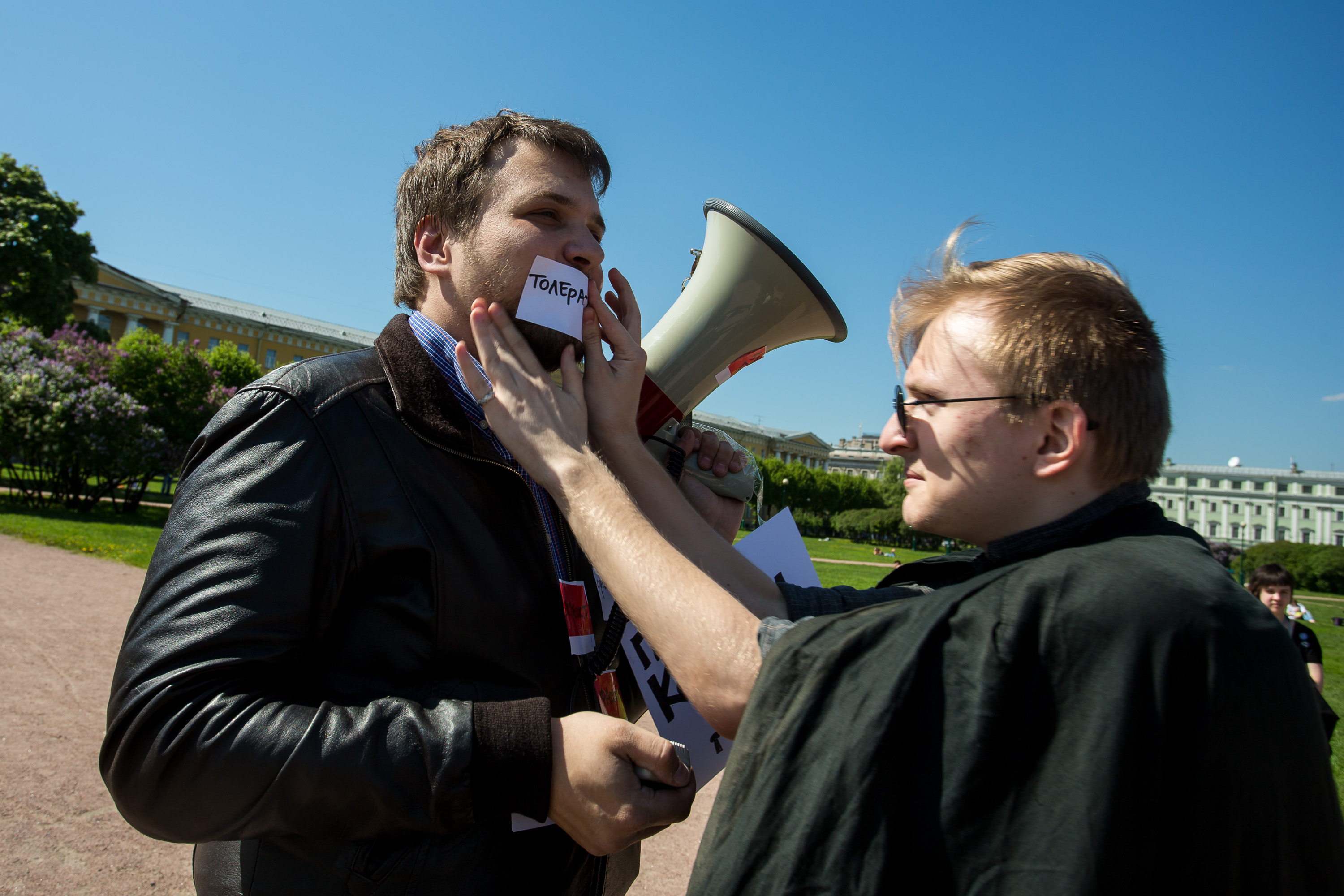
The “judge” and the “new Russian” brought with them a criminal case file full of labels, such as “foreign agent,” “atheist,” “fifth columnist, “tolerast” (an insulting slang term applied to people regarded as having excessively politically correct values), “forbidden by censorship,” and “offends religious sensitivities.” These labels and epithets are typically applied to critics and opponents of the current Russian authorities.
The two men hung and pinned these labels to the other activists who were present in order to “make them feel like Sergei Vilkov.”
“Judge” labels activist a “tolerast” at Saturday’s rally.
The socialist activists are convinced that Vilkov’s case is not an anomaly. Travesties of justice in the courts, political crackdowns against opposition activists, censorship, corruption, and the fusion of political authority and business are rather typical of Russia, they argue.
Ilya Orlov The Field of Mars: Revolution, Mourning, and Memory
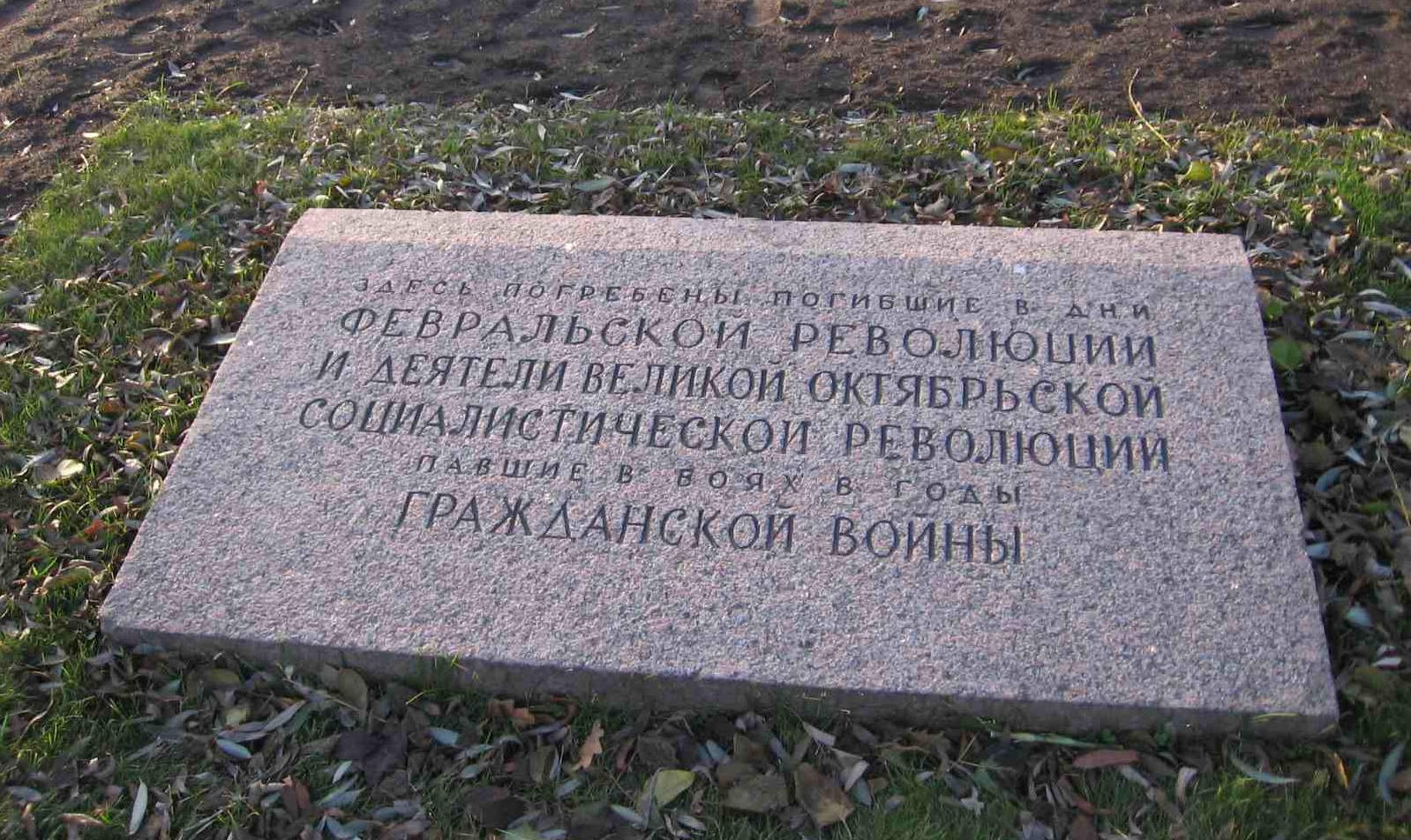
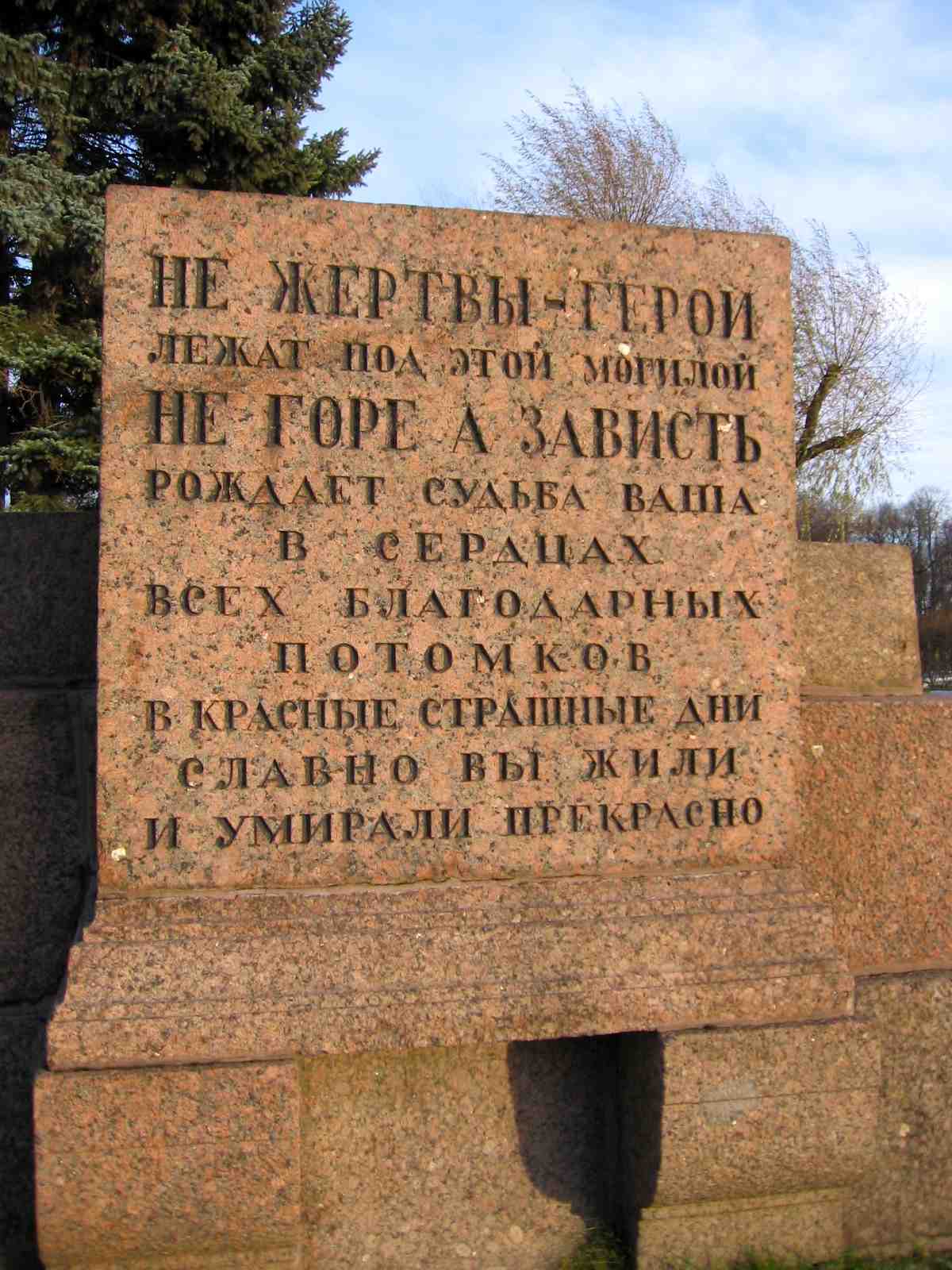
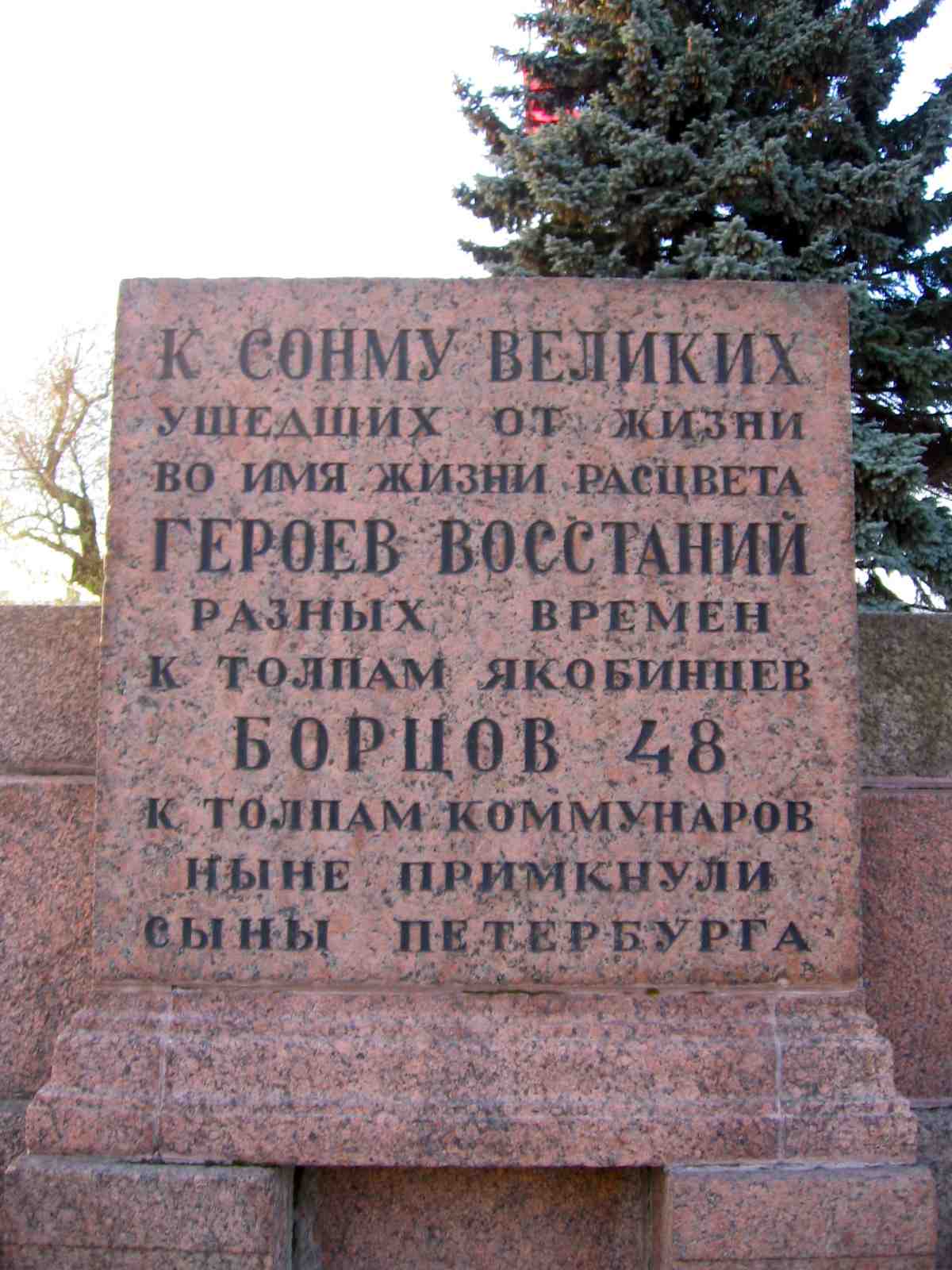
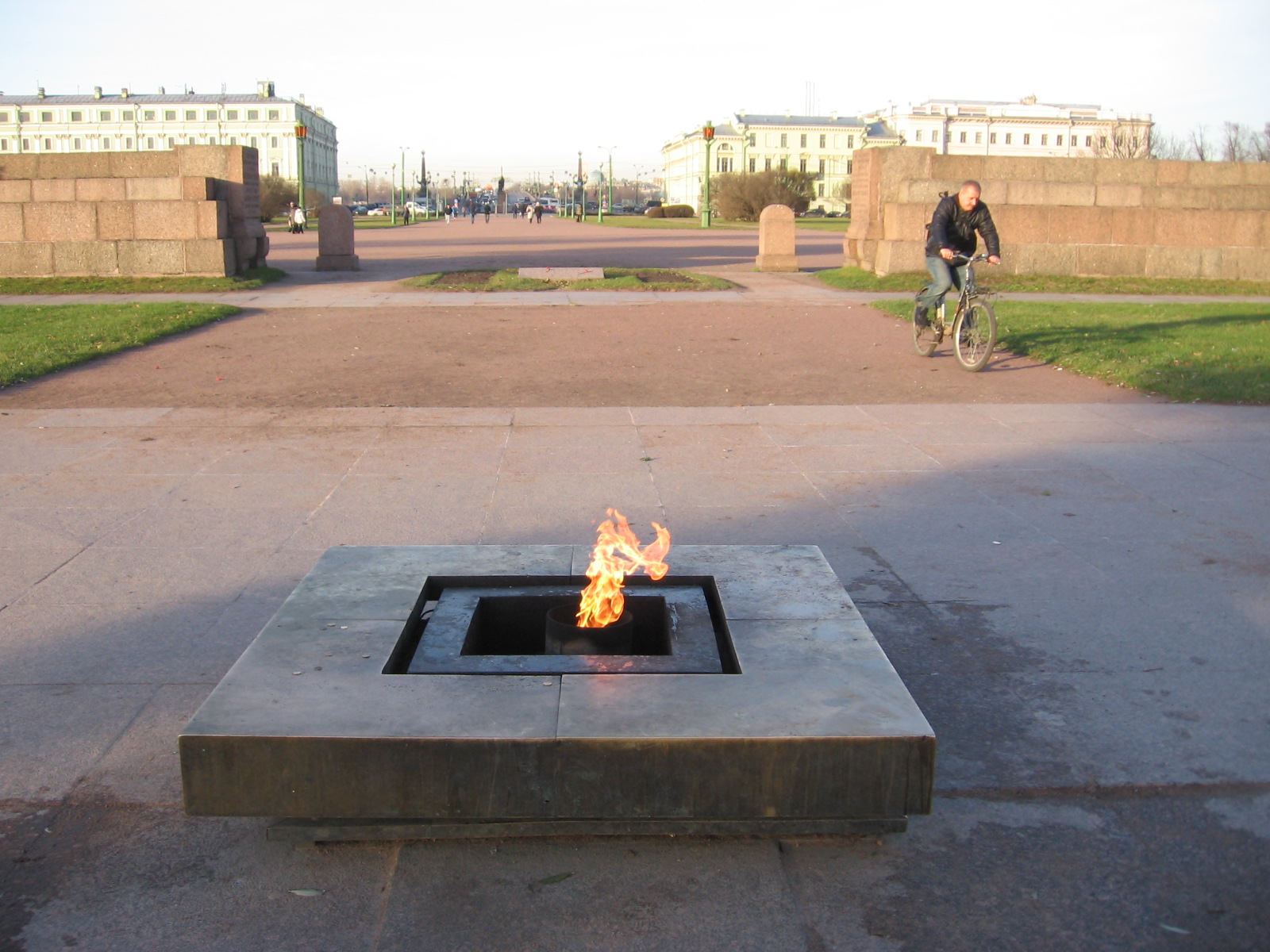
We are on the Field of Mars in Petersburg, at the Monument to the Fighters of the Revolution. That is the official name. The question immediately arises: to the fighters of which revolution? This is not specified in the official name. The epitaphs, penned by the first Soviet minister of education Anatoly Lunacharsky in 1919, are more lyrical than informative, referring to previous revolutions and historical figures, including the Jacobins and the Paris Communards. Only this humble gravestone refers to the primordial event: here lie the victims of the February Revolution of 1917.
I doubt whether anyone pays attention to this gravestone. If you ask passersby what this place is, they are likely to reply that it is some memorial to the victims of some revolution. This is not surprising. Historically, the October Revolution eclipsed the February Revolution. This eclipse happened in Soviet times, and it was reflected in Soviet historiography. And there have been so many other historical events subsequently that now society has almost no memory of this revolution and its victims. In the 1990s, students from the nearby Institute of Culture grilled sausages over the eternal flame at the center of the monument. I have heard such stories firsthand. Perhaps this was a spontaneous denial of Soviet monumentalism and Soviet ideology. But the paradox is that this monument, which was more a revolutionary than a Soviet monument, was created by the revolution. Not to glorify state ideology, but on the contrary, to memorialize those who fought against the state’s tyranny. In this sense, the Field of Mars is a “place of memory, overgrown with grass,” despite this imposing granite monument.
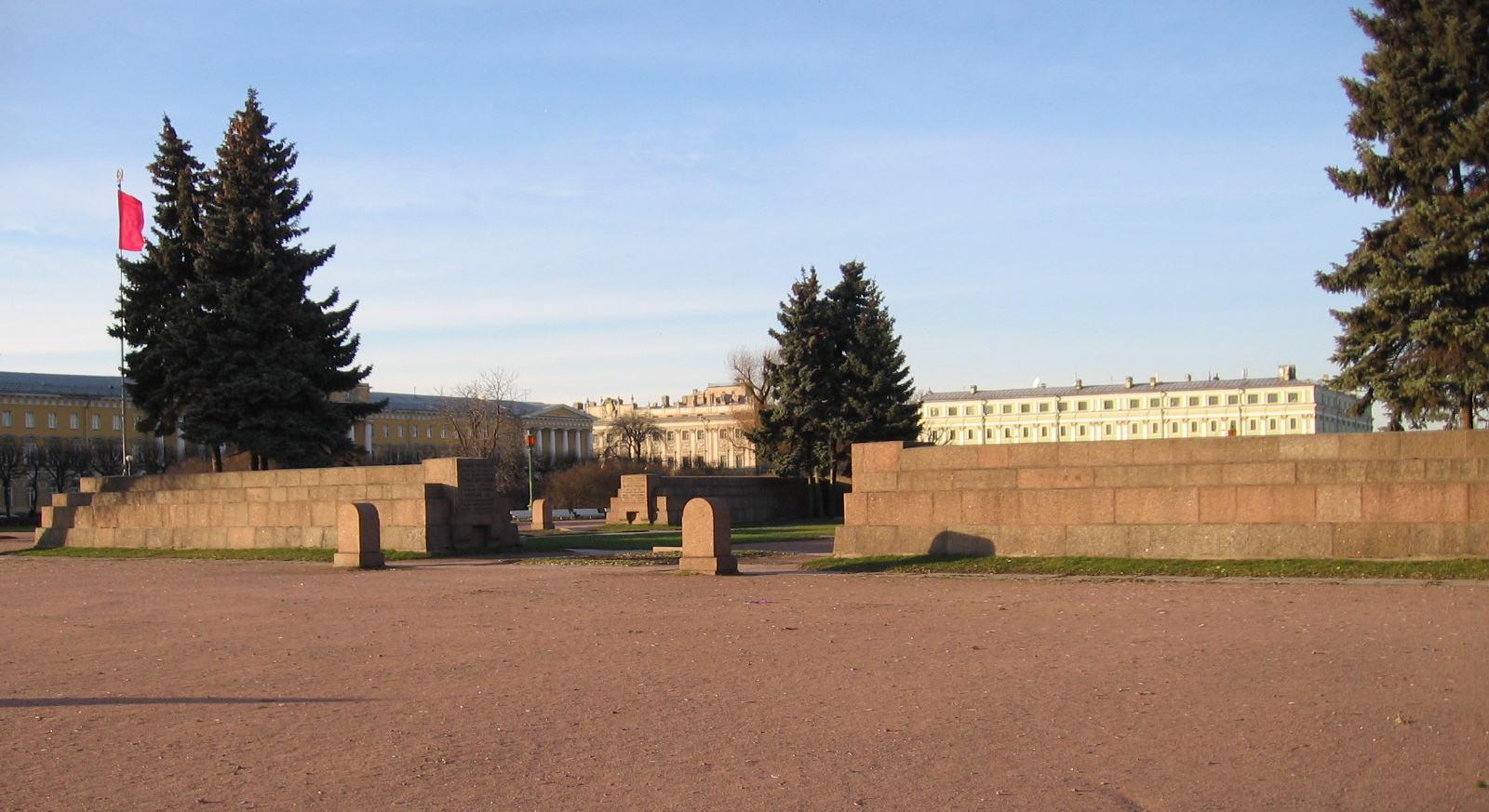
But the shape of the memorial dates to March 1917. Here we see four L-shaped stelae: they were built a year later, in 1918. The L-shape is not accidental. Under the stelae are four L-shaped mass graves containing 184 victims of street fighting between protesters and police in February 1917. The rest of the burial ground—the quadrangular space formed by the stelae—was established soon afterwards, but during a completely different period, after the October Revolution of 1917. Here lie a number of combatants in the Civil War, mostly Bolsheviks, and most of their names are known. Our task today is to recall the original tenor of this memorial site, the tenor of February and March 1917.
The February Revolution was the first of two revolutions in Russia in 1917 (although some historians consider them parts of a single revolutionary process). After spontaneous bread riots, mass strikes and demonstrations in Petrograd (then the capital of the Russian Empire), soldiers from the city’s garrison sided with the protesters. The revolution resulted in the abdication of Tsar Nicholas II. The Provisional Government came to power, its members, mostly liberals and conservatives, drawn from the State Duma (the former monarchy’s parliament). At the same time, local socialists formed an alternative authority, the Petrograd Soviet, which ruled alongside the Provisional Government. There were thus two centers of power, both with problems of legitimacy. It was a very unstable situation, which Lenin defined as a diarchy (dvoevlastie).
The new authorities decreed political freedom, ended capital punishment, released political prisoners, and abolished ethnic and religious discrimination. The result was total euphoria. But such important issues as Russia’s involvement in the First World War, social and economic problems, and labor issues remained on the agenda. Also, the question of the country’s future political constitution was unclear. The new authorities were not ready to answer these questions and deferred their consideration until the future Constituent Assembly met. In 1917, the idea of the Constituent Assembly, a “future master” that would be able to solve all problems, was a sort of fetish. It was, in fact, convened in 1918, but was soon dissolved by the Bolsheviks.
So the beginning of March 1917 was a time of economic crisis and instability, a hard situation at the front, universal euphoria over revolutionary liberation, total uncertainty about the future, and potential social fissure. This is the context in which the Petrograd Soviet raised the question of organizing a gigantic nationwide political manifestation—a solemn funeral for the victims of the revolution.
Numbers
The February Revolution was not bloodless. How many people were killed or wounded? The exact number of dead and wounded has never been precisely determined. According to early Soviet historiography, the total number of casualties did not exceed one and a half thousand. Of these, no more than two hundred people were killed. In later historiography, the numbers increased. But this information is also unreliable, because not all the victims were recorded.
There is also uncertainty over the number of people buried in the mass graves on the Field of Mars. Sometimes, the figures vary even within the same newspaper article. But the maximum number found in the historical sources is 184.
The nationwide funeral of the victims of the revolution or, as it was called, the “great funeral,” was planned by the Petrograd Soviet soon after the victory of the revolution. According to their plan, it was to be a grandiose funeral demonstration, meant to unite all the forces of the revolution, a “parade and review of all the revolutionary forces.” Preparations for the ceremony took more than three weeks. The plans were finally implemented on March 23, 1917.
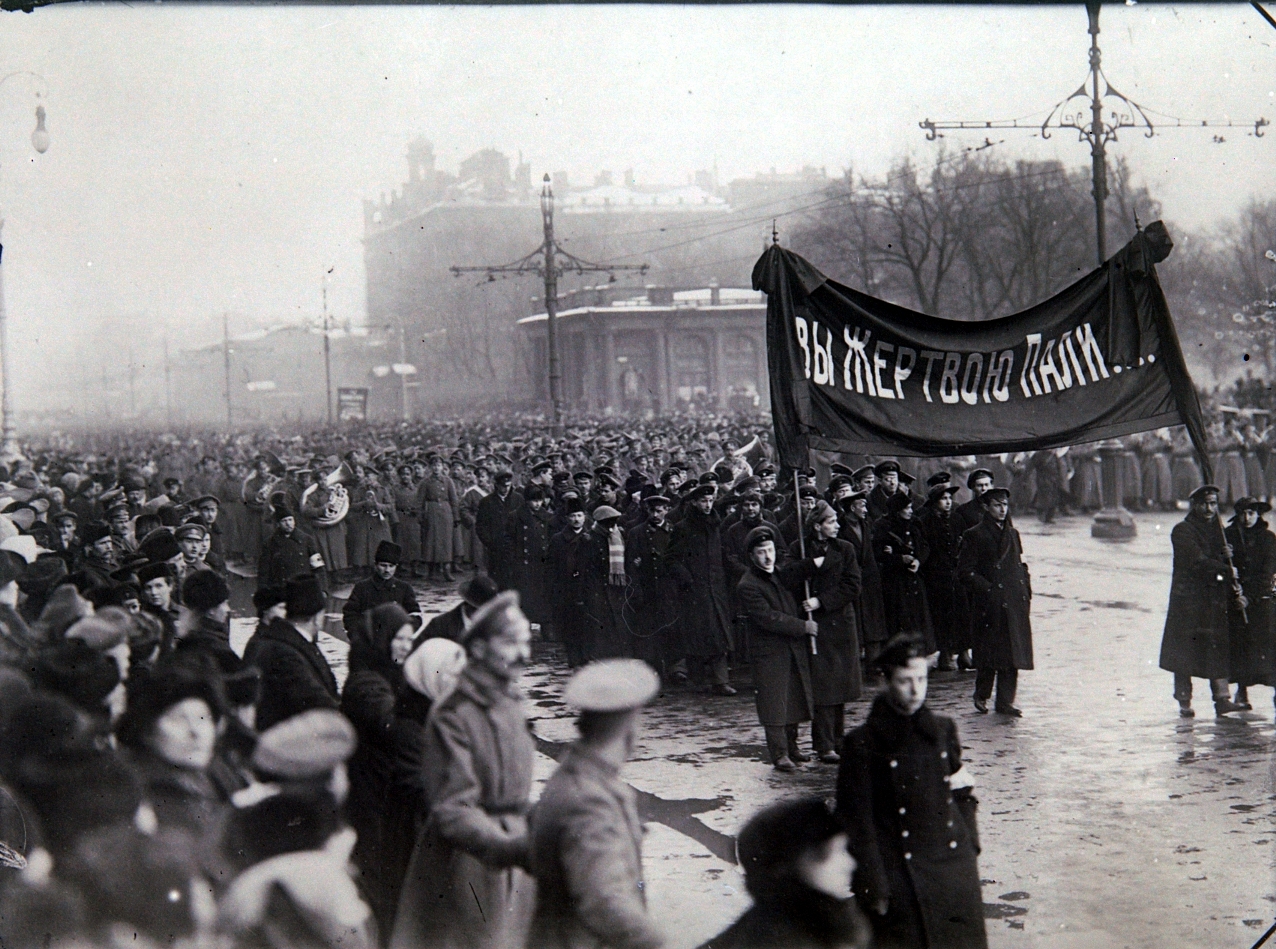
Contemporaries described the events of that day as completely unprecedented. From morning till late night, endless columns of demonstrators relentlessly marched from different quarters of the city to the Field of Mars, carrying red coffins containing the bodies of the victims of the revolution. One after the other, the funeral processions arrived at the Field of Mars. It was a kind of political demonstration where various political, social, ethnic, professional groups and identities were broadly represented. There were columns of workers from different factories, military units, columns from educational institutions, columns made up of workers from various professions and trades, columns from leftist parties (for example, the Social Democrats and the Socialist Revolutionaries), columns representing different ethnic groups, and columns from ethnic leftist parties, for example, the Jewish Bund and the Armenian Dashnaktsutyun party. There were also columns from grassroots organizations, civic committees, and other groups of citizens, including, even, a column of blind people. In a certain sense, it was a symbolic repetition of the revolution itself.
According to official figures, 800,000 people attended the funeral manifestation. According to unofficial tallies, up to two million people attended. Given that the city’s population was around 2.5 million at the time, we can assume the majority of the capital’s inhabitants were involved in the ceremony as participants or spectators.
There is still no historiography specially devoted to this event. The event, however, is well documented: all the newspapers published reports about it, and many photographs were taken. It is curious that photographs of the ceremony are still used as primarily visual matter for books and articles about the February Revolution, even if the funeral is not actually mentioned in them. This is quite understandable: the photographs depict a huge mass of demonstrators, as if this were the revolution itself.
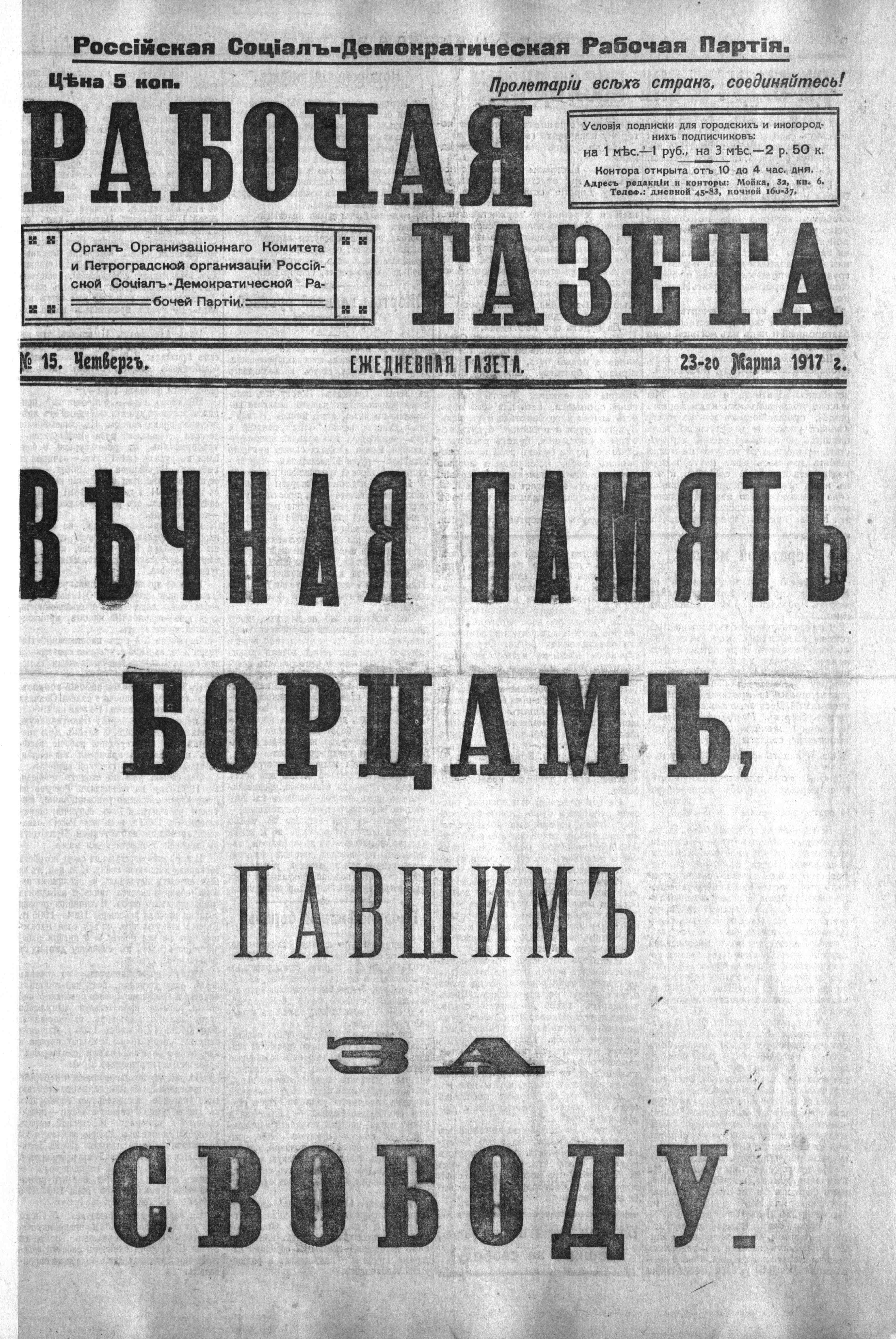
The newspaper reports about the funeral are highly emotional. Sometimes, they even slip from prose into poetry. The rhetoric of “brotherhood” or “revolutionary brotherhood” is quite common in these reports: the victims of the revolution are often referred to as “our dead brothers.” At the same time, these articles have a euphoric tone: they often talk about the coming revival of the country, or about a great celebration of freedom.
Worker’s Newspaper, March 23, 1917: “May the fighters who died for freedom never be forgotten”
Historians have repeatedly noted the anthropological connection between mourning, celebration, and revolution. Specifically, French historian Mona Ozouf talks about this in her book Festivals and the French Revolution. There are other numerous historical examples of this phenomenon, including the Ukrainian Maidan of 2014. Mourning and funeral processions provoke sublime feelings and mobilize people.
It is quite important to note one thing about this funeral. It was fundamentally a civil ceremony. There were no icons, no crosses, and no priests. Numerous requests from clergy to participate in the ceremony were rejected by the Soviet. For the first time in Russian history, a funeral of this scale was conducted without the Church’s participation. This civil ceremony was not just secular, however. It followed the cultural tradition of the revolutionary underground, the tradition of so-called red funerals. This tradition started after Bloody Sunday, the massacre of unarmed demonstrators that sparked the Revolution of 1905. Then, workers had begun to bury their comrades in red coffins, without the ministrations of priests. And more importantly, they turned funerals into political rallies. In defiance of the autocracy and the despotism of capitalism, they seemed to identify the sacred—death—as one of their allies. At the Field of Mars in 1917, this tradition attained official national status for the first time.
The ceremony of this huge demonstration was elaborately planned over several weeks. From the very beginning, it was clear the number of participants would be enormous. (As I have mentioned, it was as many as two million people in the end.) The organizers were afraid there could be a crush or stampede in the crowd. Therefore, they drew up instructions, layouts, route charts, and written rules that explained how the columns of the demonstrators should be self-organized, where and when they should start, how they should move, and which way they should go during the ceremony. These instructions were published before the funeral in newspapers.
The instructions were based on the idea of self-organization by district. Assembly points were located at the hospitals in the city’s six districts where the bodies of the victims of the revolution lay. There was a parallel between this scheme and the structure of the Soviet itself: both were democratic structures based on the representation of districts and small groups. The departure time of the district processions was scheduled in such a way that they arrived at the Field of Mars one after another, and only from the direction of Sadovaya Street.
The main idea of the ceremony’s planners was that the funeral procession would not stop in the square even for a minute. When a column reached the burial site, the demonstrators handed the coffins to workers who directly carried out the burials. The very next moment, the column would continue to move toward the exit, which was located on the opposite side of the field, near Trinity Bridge. This was done to prevent the crowd from being crushed.
Each time a coffin was lowered into a grave, a gun was fired at the Peter and Paul Fortress, on the opposite bank of the Neva River. To coordinate the movement of the columns, telephone wires were laid between the observation points.
The procession moved without stopping through the Field of Mars, and this also excluded the possibility of holding a rally. Therein lay the uniqueness of this mass commemoration: there were no public speeches during the entire ceremony, only funeral music, revolutionary songs, and lots of red flags.
Now I would like to draw your attention again to the structure of the burial ground—the four L-shaped mass graves at the corners of this large square. The funeral procession passed through the space between the graves. Alongside and above the graves, temporary wooden platforms (stages) were erected for the ceremony’s organizers and the leaders of the Petrograd Soviet. There were special hatches on the platforms for lowering the coffins into the ground.
I should emphasize that it was impossible to make a speech or address an audience there, because the procession passed through the square without stopping. So the politicians just stood silently over the graves.
This combination of burial ground and site of political power is also remarkable. In this structure, the political approaches the sacral. The sublime feeling caused by the funeral seemed to reinforce the politics. The sacral became a support for political power. This convergence of politics and mourning was continued in Soviet times, of course, in the structure of the Lenin Mausoleum, with its tribune above the tomb.
What made this large-scale ceremony possible? And why did the Petrograd Soviet devote so much attention, time, and effort to organizing this manifestation in March 1917, when they had a variety of other pressing problems on their agenda?
It was clear what society needed: the victory of the revolution had been unexpected, and such dizzying change is always traumatic. The time was as it were “broken,” and the transition to the new life requires a ritual pattern. The funeral of the victims of the revolution may have played the role of such a therapeutic ritual. It was a kind of funeral of the ancien régime, a funeral of monarchy and despotism. It was thus no wonder it actually turned into joyous celebration of freedom, as witnesses of the event described it. They often dubbed it a “funeral celebration.”
The Soviet’s task was to mobilize society. The idea of organizing a symbolic repetition of the revolution was probably an attempt to overcome chaos and make the situation more transparent. In fact, the speakers in the Soviet clearly declared their intention to arrange a “parade of revolutionary forces,” which obviously meant making these forces visible, represented in the form of a manifestation on the square.
But the more important reason, as might be expected, was the problem of the basis for the new political authorities. Both the Provisional Government and the first roster of the Executive Committee of the Petrograd Soviet suffered from a lack of legitimacy: both were self-proclaimed revolutionary centers of power. Professional politicians had formed both. The Provisional Government had been formed by co-opting liberal and conservative members of the former State Duma. The Petrograd Soviet was made up of leftist Duma deputies and former underground leftist activists, although the Petrograd Soviet was in a somewhat better position, because its deputies had been elected. But its legitimacy had not been realized, either, because the Executive Committee had actually decided to relinquish its power, transferring most of it to the Provisional Government.
Thus, given a lack of solid ground in the present, the new authorities were forced to postpone solving the problem of legitimacy until the future, shifting it onto the shoulders of the Constituent Assembly (which was like putting it off until doomsday) or seeking support in symbolic actions and, in Leon Trotsky’s words, the “strong emotions and memories of the masses.” In fact, they tried to have it both ways. Of course, the traditional mode of sacralizing power (that is, the “divine right” of the monarch) had become impossible, so the most appropriate source of the sacral that remained was mourning—veneration of the fallen freedom fighters, the rhetoric of “sacrifice,” and so on.
Why was the Field of Mars chosen as the burial site? The funeral was preceded by a long discussion, lasting around three weeks, that took place at meetings of the Petrograd Soviet, as well as among the general public. The initial decision was to bury the victims of the revolution on Palace Square, directly in front of the Winter Palace, and for this purpose to pull down the Alexander Column. Palace Square and the Winter Palace were the very heart of the former empire, symbols of the monarchy. Palace Square was also where Bloody Sunday had taken place in 1905. To erect a memorial to the victims of the revolution in this place would have been a strong symbolic gesture, indicating the end of the ancien régime. Initially, the Petrograd Soviet voted the decision unanimously. In a revolutionary society, it was a decision that met with wholehearted support.
The next twist in the plot is almost like out of a detective novel.
Suddenly, members of the bourgeois artistic elite entered the picture. The key figures were art critic and artist Alexander Benois and the architects and artists of the World of Art group with which he was associated. This was a very influential conservative artistic movement that advocated neoclassicism and poeticized “old” Petersburg. Their objective was to maintain their influence in the realm of culture under the new government. They also wanted to establish and lead a new “Ministry of Fine Arts.” And since the architectural ensemble of Palace Square was for them the epitome of high art, they made an effort to change the Petrograd Soviet’s decision.
Through complicated intrigues, connections in the bourgeois Provisional Government, and cynical use of revolutionary rhetoric, they were able to convince the Petrograd Soviet to change their minds. Their ruse was cynical and sophisticated. They urgently drew up and submitted to the Soviet an architectural plan under which a palace to house the future Constituent Assembly would be built on the Field of Mars; hence, supposedly, the memorial to the victims of the revolution should be sited near this new building as well. They also promised the palace would be decorated with statues, “including, perhaps, statues of the current leaders of the revolution.” As a result, the Petrograd Soviet agreed to change the burial site from Palace Square to the Field of Mars.
Architect Lev Rudnev built the monument in 1918–1919. The author of the poetic epitaphs on the monument, as I have mentioned, was Anatoly Lunacharsky.
NOT VICTIMS, BUT HEROES lie beneath this tomb NOT GRIEF, BUT ENVY your fate engenders in the hearts of all grateful descendants in the terrible red days you lived gloriously and died beautifully
THE RANKS OF THE MIGHTY departed from life in the name of life’s flourishing THE HEROES OF UPRISINGS of different ages the crowds of Jacobins THE FIGHTERS OF ‘48 the crowds of Communards are now joined by the sons of Petersburg
In the early Soviet period, the Field of Mars served as a pantheon where Bolsheviks killed during the Civil War were buried. This was before the new pantheon near the Kremlin Wall in Moscow was built.
After Stalin’s death, during the Khrushchev Thaw, official Soviet ideology attempted, in a certain sense, to return to its revolutionary origins. On the fortieth anniversary of the revolution, in 1957, an eternal flame was lit in the center of the memorial.
The fire was brought from the open-hearth furnaces of the Kirov Plant, one of the major machine-building factories in Leningrad. It was the first eternal flame in the country, and it was lit in memory of the victims of all revolutions. It was from this fire that the eternal flames at the Piskaryovskoye Memorial Cemetery, and ten years later, in 1967, the Tomb of the Unknown Soldier near the Kremlin Wall, were lit.
For the rest of the Soviet period, the memorial was one of the most important official places of memory in the country. But it was revered as a monument to “the fighters of all revolutions,” that is, there was no emphasis on the February Revolution, to which it had originally been dedicated. The memory of February was displaced by the memory of October.
In post-Soviet times, the memorial has remained unchanged, but with each passing year it is more and more obviously at odds with the official anti-communist ideology. This has especially been the case in the past few years, given the growing dominance of rightist ideology, the condemnation of all revolutions, and the denial of the revolutionary legacy’s value.
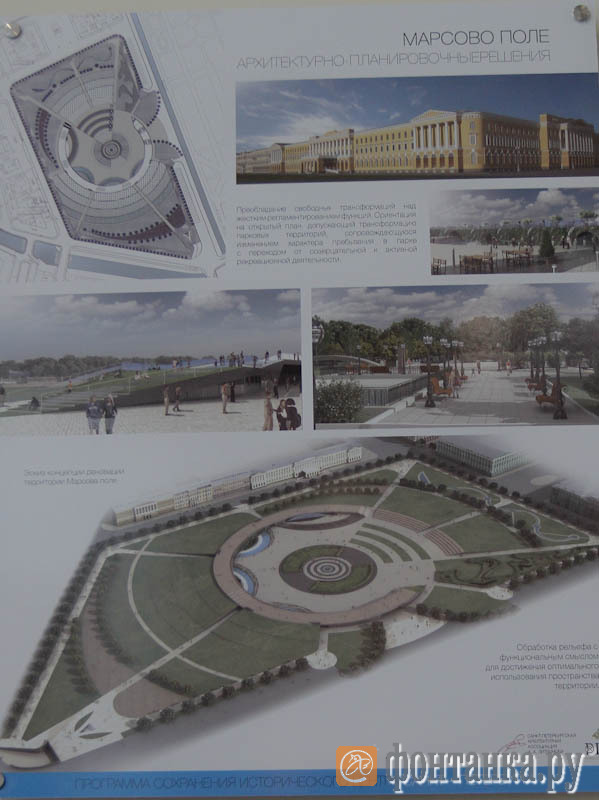
Two years ago, in 2012, an urban development project that called for eliminating the memorial was presented at the Saint Petersburg International Economic Forum. The project proposed moving the graves to another location and creating a recreational area on the Field of Mars. Once again, members of the conservative intelligentsia were involved. Local historian and journalist Lev Lurie and Alexander Borovsky, head of the Russian Museum’s contemporary art department, publicly expressed support for demolishing the memorial. The argument was as follows: the revolutionaries were villains and murderers, the revolution had long been forgotten, and Petersburgers did not have enough recreational areas. A number of historians and public figures came out in defense of the memorial. I also published an article in defense of the place. In any case, for reasons unknown, the project was canned.
Perhaps the following odd episode played a part in this outcome. That same year, 2012, the city police suddenly organized a solemn commemoration at the memorial. The official statement for this strange commemoration claimed the people buried in these mass graves were not, in fact, revolutionaries, but plainclothes gendarmes who had been killed by protesters during the street fighting in February 1917, and that these defenders of the old regime were the real victims of the revolution.
The context of these recent events has been the crackdown on political freedoms in Russia. For example, Petersburg city hall has repeatedly refused to let the opposition hold rallies in the city center. As a result of this longstanding dispute between the opposition and the municipal administration, the authorities proposed establishing a so-called Hyde Park in the city center, choosing the Field of Mars as the site.
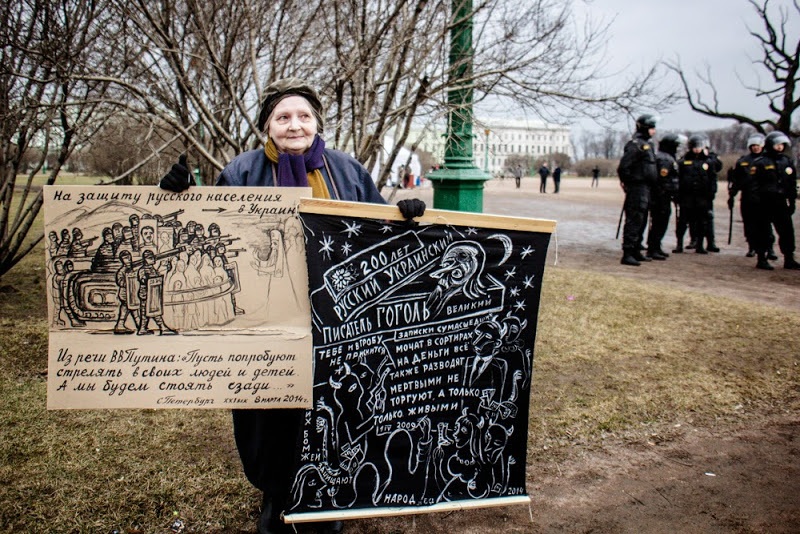
Petersburg artist Elena Osipova at anti-war rally on the Field of Mars, March 8, 2014
For several years now, protest rallies have been held here. As a rule, they are not well attended: the society is intimidated and politically apathetic. The protesters include everyone from liberals and leftists to animal rights advocates. And yet the historical memory of this place has almost been lost: its revolutionary history is almost never has evoked at these rallies. Perhaps it is too far in the past, hidden under numerous layers of history. Or perhaps this is a problem of today’s political movements, which have lost their connection with this great revolutionary tradition that once triumphed in Russia.
***
It is difficult to evaluate, either positively or negatively, the practice of revolutionary commemoration, especially when it is bound up with funerals and the rhetoric of “strong emotions,” as well as the post-revolutionary infatuation with monumentalism. On the one hand, the intention of the authorities to find support for their political power in the sacral (in mourning, in sublime feelings, in the archaic) points to the fact that the government had a problem securing its legitimacy. Paradoxically, it would seem that the most advanced political system—the revolutionary soviets of 1917—could rely on archaic feelings just like the monarchy, which used to refer to its “divine right” to rule. The infatuation with monumentalism also seems like something akin to fetishism, especially when we realize that, after many years, even a heavy granite monument is unable to retain its original meaning. In a sense, this is the counter-revolutionary aspect of revolutionary culture.
On the other hand, the monumental solemnity of this forgotten mass commemoration of March 1917 seems today like valuable know-how, even a lesson for us. The commemoration that took place here in 1917 was an alternative to the commemorations of the ousted regime, both in its form and its content. It remains just as relevant today in its separation of church and state, its reverence not for heroes but for common people, and its commemoration of those who did not support but opposed the state.
Ilya Orlov (born 1973) is a Petersburg-based artist and historian. He graduated from the Faculty of Liberal Arts and Sciences (Smolny College) of Saint Petersburg State University, where he majored in history, philosophy, political science, and art. He wrote his honor’s thesis on revolutionary mourning rituals in 1917, and his M.A. dissertation on the aesthetics of nature in contemporary curatorial studies. Orlov’s recent artistic work has focused on cultural, social, and political issues in post-Soviet reality and the politics of commemoration.
The article above is based on the text of a guided tour Ilya Orlov led to the Field of Mars in October 2014. My thanks to him for permission to publish it here and his generous assistance in locating some of the accompanying illustrations. The text was edited by the Russian Reader. Funeral photographs courtesy of humus and statehistory.ru. Photo of Elena Osipova by Sergey Chernov. Modern-day photos of the Field of Mars (except for aerial view) by the Russian Reader