Crimean Tatar Journalist Ayder Muzhdabaev to Russian Rock Musician Andrei Makarevich: “It Hasn’t Passed, It Hasn’t Stopped Hurting, We’re Not Going to Take a Deep Breath”
Before arriving in Ukraine to clean up at the box office yet again, Russian TV presenter and showman Misha Kozyrev advises Ukrainians not to let the war into their hearts. By the way, he will again be arriving in the country real soon. Someone has to tell the “embittered” younger brothers what to think and how to live. We are clueless on our own.
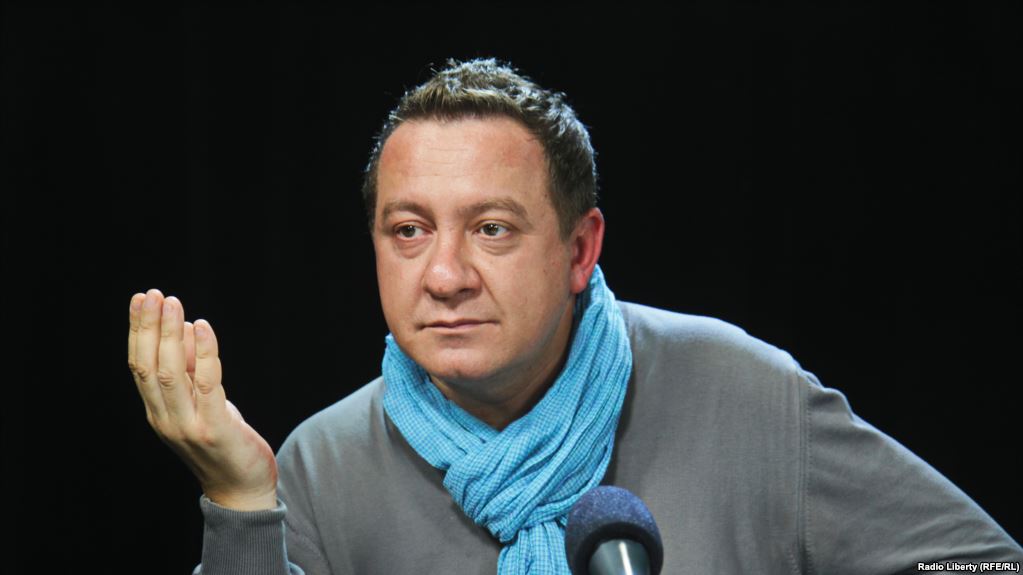
And when Russian musician Andrei Makarevich was asked why he wanted to drag his band Time Machine’s keyboardist Andrei Derzhavin, who signed an open letter to Putin supporting the annexation of Crimea and the war, along with him to Ukraine, he wrote on Facebook it was time to stop discussing events that had happened four years ago. “Learn to take a deep breath,” he wrote. As if everything had passed and stopped hurting. No, it has not passed, and it has not stopped hurting. If someone thinks we have forgotten everything, he or she probably should not come to Ukraine.
If your keyboard player, Mr. Makarevich, still slips into the country under your skirt, so to speak, we will drag him from his dressing room and send him home packing. If you are incapable of understanding such a simple, normal thought, then so be it: we will explain it to you. We have not taken a deep breath, and we are not going to, because we had our homeland stolen from us—or at least part of it. We remember that and we cannot forgive what happened, not only the war and annexation but also the indifference to us.
We are not aquarium fish or serfs who remember nothing and have no right to rage. We do not need any Russians here except those who are wholeheartedly against the Putin Reich, support the return of Crimea and Donbas to Ukraine, and support Ukraine unconditionally, without any provisos. If you are incapable of understanding us, if you lack the humanity to put yourself in our shoes, to feel and share our pain, you had better stay home, in the so-called Russian world.
I hope the so-called Russian world will take it easy on you, Mr. Makarevich. I hope it treats you more gently than it has treated the Ukrainians and Crimean Tatars. Although I do not think it will happen. Life is set up in such a way that right after the Jews were massacred, trouble came for the Germans. But who knows. If you continue to sit still and choose your words carefully, maybe you will be luck personally.
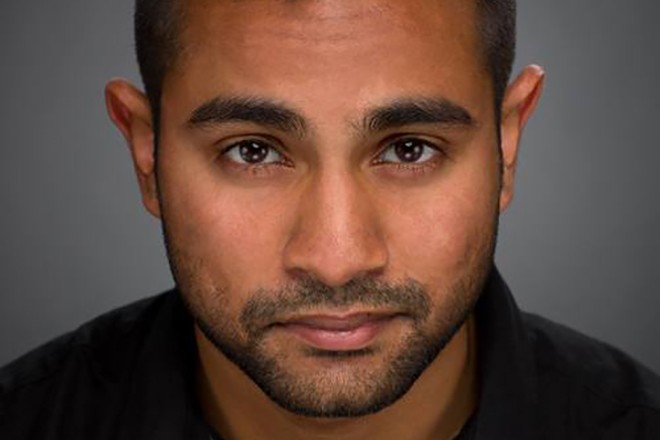
Bhaskar Sunkara (born June 20, 1989) is an American political writer, editor and publisher of Jacobin magazine.
The son of immigrants from Trinidad and Tobago, Sunkara described Jacobin as a radical publication, “largely the product of a younger generation not quite as tied to the Cold War paradigms that sustained the old leftist intellectual milieus like Dissent or New Politics.”
The New York Times interviewed Sunkara in January 2013, commenting on Jacobin’s unexpected success and engagement with mainstream liberalism. In late 2014, he was interviewed by New Left Review on the political orientation and future trajectory of the publication and in March 2016 was featured in a lengthy Vox profile.
Sunkara writes for Vice magazine, Washington Post and The Nation, among other outlets. He has appeared on the PBS Tavis Smiley program, MSNBC’s Up w/ Chris Hayes and the FX show Totally Biased with W. Kamau Bell.
Residents in eastern Ukraine face worst fighting in years in war with Russian-backed separatists
Sabra Ayres Los Angeles Times
February 15, 2017
The news reached Mariupol Mayor Vadim Boychenko via a morning phone call from an assistant: A rocket attack damaged 11 houses on the outskirts of the Ukrainian city.
There were no casualties, but a major concern had become a reality: The escalation of fighting elsewhere in the nation in recent weeks had reached the industrial city, a key component in southeast Ukraine’s struggling economy.
“We’ve gotten used to a peaceful life,” Boychenko said during a recent interview at his office. “I really don’t want to return to the problems we had started to forget.”
Ukraine’s nearly three-year battle against Kremlin-backed separatists in the east erupted into the worst fighting in two years in late January. Exactly why the fighting intensified recently remains unclear, though such encounters have occurred with some frequency during unrest that included Russia’s annexation of Crimea in March 2014.
The small city of Avdiivka, 90 miles north of Mariupol, became the epicenter of the recent violence. The fighting quickly spread along a 300-mile line separating the Ukrainian government-controlled lands and those claimed by separatists in the Donetsk and Luhansk regions.
Mariupol had seen only sporadic fighting over the last two years, primarily in the region’s eastern villages. But as news trickled in about the bombardment of Avdiivka, Mariupol began again hearing the deep rumble of explosions and heavy artillery fire less than 10 miles away.
The fighting halted vital shipments from Avdiivka’s coal processing plant to Mariupol’s massive iron and steel works plants, jeopardizing production at one of the region’s biggest employers.
Many local residents said they feared the renewed violence could quash the growing sense of confidence in Mariupol after nearly two years of relative stability.
One concern in the region is that President Trump and Russian President Vladimir Putin could strike a deal that would lift U.S. sanctions on Russia or force Ukraine to make painful compromises with Moscow. Ukrainian President Petro Poroshenko has urged Western leaders to keep sanctions in place.
“Sanctions are the only way to get Putin to the table,” he said last week in an interview with journalists and academics in Kiev, the capital.
Nationally, there is little faith in the Minsk agreements, a road map to peace brokered in 2014 by European leaders between Ukraine, the Kremlin and the separatist rebel leaders. Poroshenko maintains that Ukraine is committed to its obligations to the agreements.
“Minsk is my plan. Putin accepted it. His signature is there,” he said.
Mariupol has gone through a noticeable transformation since war erupted in eastern Ukraine in the spring of 2014. Once the epitome of a run-down, Soviet industrial port city with two massive metallurgy plants puffing out pollution day and night, Mariupol in the last two years has emerged as a center of civic activism in Ukraine’s southeastern battlefront.
The city was the center of several violent outbreaks in spring 2014, when Ukrainian forces and supporters of the pro-Russian separatist groups fought gun battles in the downtown streets. The charred former police headquarters and city council buildings still stand as reminders. On Jan. 24, 2015, a missile attack hit an eastern region of Mariupol dense with Soviet-era concrete housing blocks, killing at least 30 people.
The previously politically passive, mostly Russian-speaking city created community groups that mobilized to gather whatever money they could to buy medical kits, food, and flak jackets and helmets for Ukraine’s ill-prepared military. The fighting displaced 1.75 million eastern Ukrainians, but locals opened their homes and about 56,000 newcomers settled in Mariupol.
“We don’t call them refugees anymore,” Boychenko said. “They are ‘new Mariupolites’ and have already become part of our city.”
Once-thriving Donetsk is now occupied by rebel forces, so Mariupol, the largest city in the Donetsk region under Ukrainian control, became the de facto cultural hub of the eastern industrial area along the Don River basin, known as the Donbas.
Displaced activists from Donetsk opened an avant-garde theater and creative space that has hosted some of the country’s big names in modern talent.
Small businesses — grocery stores, small restaurants and mom-and-pop shops — whose owners fled the fighting returned, and new cafes have opened. Ukraine’s most popular music group, Okean Elzy, gave a free concert in May attended by more than 30,000 people.
“We’ve been working all year to create a positive mood in the city,” Boychenko said.
Alex Ryabchyn, a deputy in Ukraine’s parliament who was born in Mariupol, said the city is in the early stages of reinvention.
“The population is starting to think of themselves as being the center of southeastern Ukraine. That’s new, “ said Ryabchyn, who was an economics professor in Donetsk State University before fleeing to Kiev after the pro-Russia rebel takeover.
Mariupol faces major challenges, particularly in the economic sphere. Ukraine’s economy has been battered since protests ousted a Moscow-friendly president, Viktor Yanukovich in 2014. The war ripped apart the country’s coal mining and steel processing industry, destroying many plants and severely curtailing production in those that survived.
The aging steel plants need modernization and the economy needs diversification to revitalize the region. Highways linking Mariupol to other cities are so bad that drivers are forced to reroute to avoid the worst sections. Train rides from Kiev to Mariupol, about 500 miles, take 18 hours, and the airport cannot accept commercial flights because of its location near the front lines of fighting.
Mariupol can feel like an isolated peninsula in Ukraine, an image many hoped was changing.
“You can see why [an increase in fighting] is a problem,” Irina Chirkova, 24, a waitress in Mariupol, said as a series of explosions pierced the cold air. “We have a lot of potential here — a big port, an airport and nice beaches. But our infrastructure needs investment, and who is going to invest in us now with this war?”
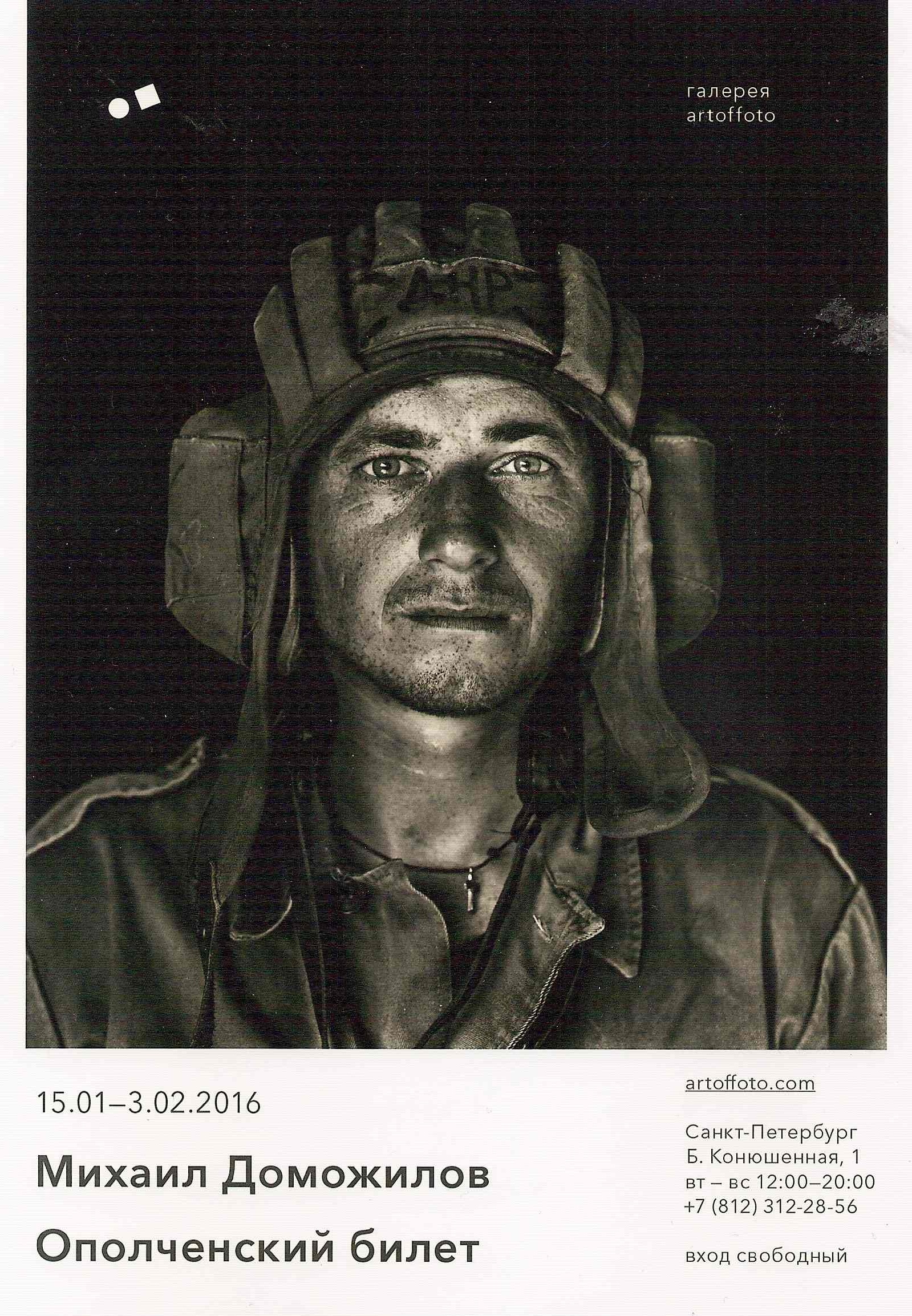
Promo flyer for the exhibition Mikhail Domozhilov, Militiaman’s Pass, ARTOFFOTO Gallery, Saint Petersburg, January 15-February 3, 2016. Courtesy of the gallery
This morning I got an urgent message from a friend, alerting me to the fact a funny sounding exhibition of photographs was underway at a downtown photo gallery I had never heard of.
It was true, as my friend pointed out, that the announcement for the show, an exhibition of portraits of Eastern Ukrainian pro-Russian separatist fighters (opolchentsy), taken by Petersburg photographer Mikhail Domozhilov, sounded quite dicey politically, as posted on the website of the exhibiting gallery, ARTOFFOTO.
It sounded a little less outwardly partisan when translated into English and printed on the flyers I would later find lying on a windowsill in the gallery:
“The self-proclaimed and still unrecognized state [of the] Donetsk People’s Republic appeared as a result of a civil war in Ukraine in April, 2014. The Donbass People’s Militia became the driving force of the new republic. In the year that passed after the declaration of the DPR, its militia transformed from an anarchic group of super activists [sic] divided into small groups and willing to go weaponless and die for an idea into a regular army with all its necessary attributes—[a] code [of military conduct], subdivisions [sic] and their chiefs, headquarters and machinery.
“This episode is about transition and transformation, about a shaky equilibrium between belonging to one country and to another, utopic in its essence. And also about the self-identification of the participants throughout the conflict. In several months former miners, builders, mechanics have become professional warriors, and a new, extreme reality has replaced the ordinary one. With major destruction[], artillery shelling and [a] non-continuous front, these people suddenly found themselves in the middle of historical events and news reports.
“This episode includes several close-up portraits of militia members in mobile studios at military and training bases, as well as on [the] frontlines.”
(English-language flyer for the exhibition Mikhail Domozhilov, Militiaman’s Pass [Opolchenskii Bilet], ARTOFFOTO Gallery, Bolshaya Konyushennaya, 1, Saint Petersburg, January 15–February 3, 2016)
It was also true that the photographer, Mr. Domozhilov, had shown a penchant in his career for subjects that might be characterized as rightist, such as this fascinating series on the ultras for Petersburg’s Russian Premier League side, FC Zenit.
The ultras series featured virtuosic albeit historically and aesthetically coded works such as this.
Mikhail Domozhilov, From the series Ultras, 2010. Courtesy of the photographer’s website
On the other hand, Mr. Domozhilov’s tearsheets included portraits, just as compelling, of pro-Ukrainian fighters on the Maidan in Kyiv.
But I did not think it fair to pronounce judgement on the work on the basis of a couple of websites, so I set off into the winter wonderland that Petrograd has become in the last week to see the show for myself.
“At the military enlistment office, I turned on the Ukrainian national anthem”: 17-year-old Vlad Kolesnikov talks about his decision to combat Putin’s propaganda
Dmitry Volchek
June 10, 2015 svoboda.org
Vlad Kolesnikov
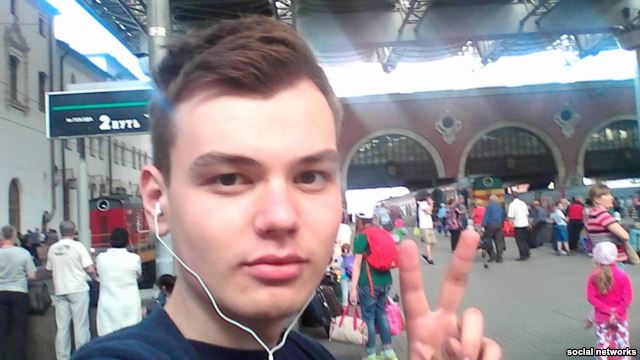
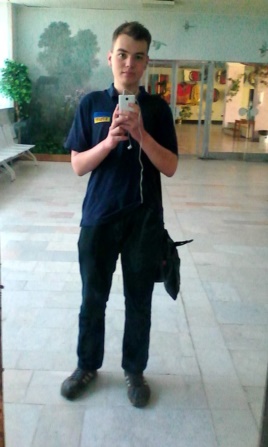
Hundreds of people have been writing to Vlad Kolesnikov, a 17-year-old technical college student from Podolsk. They have been writing with offers of assistance and shelter, and to thank him and advise him to be more careful.
“I cannot express in words the emotions I feel reading Facebook,” says Vlad, his voice trembling with emotion. “There has been so much support from strangers, it is simply incredible.”
Vlad has acquired a lot of friends on the Internet, but his own grandfather, a former KGB officer, has condemned him. At the technical college where he studied he was assaulted. (Vlad asked not to write that he had been beaten up: “It was only a split lip, a couple of bruises, a couple of blows to the head, and three drops of blood.”) And now the police have taken an interest in him.
And all because Vlad Kolesnikov not only does not hide his political views but has also decided to declare them openly.
Vlad Kolesnikov: Putin sits with his pack of criminals and runs the country with the aid of powerful propaganda. This is my subjective opinion. Maybe I am wrong, but I believe it is true. You know the Russian media have been vigorously promoting the image of khokhly [a Russian term of abuse for Ukrainians] and pindosy [a Russian term of abuse for Americans] as enemies. I also supported this until I watched a video on YouTube. It was 2014, and I will probably never forget it, because the video changed my life. The content of the video was completely banal. It was just an American family. The wife is Russian, the husband, American. He gives her a gift, they go to a shooting range. And instead of the propaganda we get—that it is a fascist regime where everyone is obsessed with sex and money, and everyone betrays each other—I saw people like myself. The only difference was that they smiled more. Since then I have been digging more, looking for different kinds of information, and reading the western press. I have realized the Russian media makes lots of mistakes, exaggerates, and in most cases just blatantly lies.
Radio Svoboda: And your relations with your relatives have been complicated because of the fact they do not share your views?
Vlad Kolesnikov: Yes. And not only my relations with relatives, but with everyone, you could say. I know only two people who more or less share my views: my friend Nikolai Podgornov and one other person whom I won’t name. But all the people I know—my whole college, all my relatives—they are all against me. It is just Nikolai and me,
Radio Svoboda: You and Nikolai decided to hang up a banner in Podolsk that read, “Fuck the war”?
Vlad Kolesnikov:Yes, it all started when I was at the military enlistment commission and told them I did not want to serve in the army and did not want to fight against my brethren. Maybe that sounds sentimental, but that is the way it is. We decided we could not tolerate it anymore and would voice it openly. First, we wanted to hang a banner in Moscow, but then we thought it would be torn down quickly, and so we looked for a good place in Podolsk. We walked around for a long time and found a building with an accessible rooftop in the middle of town and decided to hang the banner there. We went to a fabrics shop. We bought a five-meter-long piece of cloth. We spent a long time picking out cloth that would be sturdier. We bought paint. This is expensive for a college student, but it was worth it. We spent all night making the banner and sitting on the rooftop. We fastened the banner to iron cables so that it would hang longer, and we locked the door [to the rooftop] so that it would take the police longer to get in. They had to summon the Emergency Situations Ministry guys. I think we gained two or three hours more time on them that way.
Radio Svoboda: You told the military enlistment commission straight out that you did not want to fight?
Vlad Kolesnikov:I don’t have very good eyesight, so I am not fit for military service. I went through the medical examination, and there was I before the draft board. There were tables shaped like the letter П set up there, and the people who did the assessments were seated at these tables. I had the Ukrainian national anthem recorded on my telephone. I don’t like the Russian national anthem, because I consider it mendacious. Everything it says about freedom and so on is just pure rubbish. Before entering the room I decided to turn on the Ukrainian anthem, because I do not support the Russian army at all and consider serving in it disgraceful. So I turned on the Ukrainian anthem and said, “Guys, I’m not going to fight in the Russian army.”
Radio Svoboda: Vlad, you would agree that you are a very unusual young man. You are immune to propaganda, and are fearless to boot.
Vlad Kolesnikov: In fact, I was just lucky. I just did not have a TV for a certain time, and I did not watch the news. And when I got a TV, I turned it on and saw the nonsense that was going on there. I turned right to that program where [TV journalist Dmitry] Kiselyov fiercely argued that the hearts of gays should be burned. I was sitting there and thinking, Is this a comedy show? Then I realized that a new kind of news had emerged in Russia. It is hardcore, and produced in keeping with all of Goebbels’s principles of propaganda: enemies surround us, the country has been occupied. Total drivel.
Radio Svoboda: So, you turned on the Ukrainian national anthem at the military enlistment commission. The members of the draft board were probably stunned when they heard it, no?
Vlad Kolesnikov: It was something incredible. Some people were dumfounded. Others jumped up and shouted, “What are you doing? Do you know where you are?” After a while, a man came running in. He took me to a separate room and laid two certificates in front of me. One said that I had problems with my eyesight, which is true. The other said that I had a personality disorder and something else. In short, the military enlistment commission had assigned me to the loonies, because I had gone in there playing the Ukrainian anthem and expressed my opinion. That was a turning point. When that certificate was put in front of me, I realized I would not put up with this anymore. I had simply gone in there, and I was immediately classified as a loony.
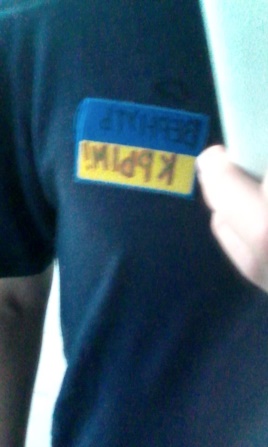
Radio Svoboda: And there is your latest feat. You came to school in a t-shirt with the Ukrainian flag on it.
Kolesnikov arrived at school with an Ukrainian flag on his chest
Vlad Kolesnikov: Yes. I had voiced my political views earlier at the college, and had often argued with the teachers on this score. As you can imagine, nothing good had come of this, but neither did anything super bad, except lowered marks and other trifles. But then it got fun. Near the college, I immediately met the class teacher. At our college, they are called professional masters. I will never forget that look. At first, he looked at me like a normal, decent person. Then he saw what I had on my t-shirt. He looked up at me, and I saw this hatred! Then I went upstairs and walked into the classroom. Within five minutes, the people sitting in front of me turned around (I was sitting in the back row) and said, “Kolesnikov, should we smash your face in now or later?” Well, just you try, I said. As you know, they kept their promises, not that day, however, but a few days later, after I had published my posts, when they had heard a lot of interesting things about themselves. I can argue my position, why I think Crimea was annexed, why Donbas was occupied. I have arguments, I have facts, and I know people who served there. On TV, they say there are no Russian troops there. In reality, of course, it is the other way round. They could not come up with convincing arguments. It all came down to my being a disgrace to the country, and I should tear the flag from my shirt. It is an interesting policy, actually. It turns out if you express your opinion you are disgrace to the country.
The inscription on the flag reads, “Give Crimea Back!”
Vlad Kolesnikov was forced to leave college (he was immediately expelled) and leave Podolsk. His grandfather, with whom he lived, also did not share his political views and sent his grandson to his father in Zhigulyovsk. It was just in time. Kolesnikov called his grandfather to say he had arrived safely and heard the disturbing news that two police officers had come and asked where he had got the Ukrainian flag and where his t-shirt was now.
“All democrats in Russia were sent into exile, and that is how I feel now, as if I am in exile. Many people are now advising me to go to Kiev. But that is the most extreme option. If someone thinks I will sit this out, get a foreign travel passport, leave for Ukraine, and that will be the end of it, they are mistaken. For now, I am planning after Zhigulyovsk to return to Moscow and do a couple of protest pickets,” promises fearless Vlad Kolesnikov.
Russia Day (Russian: День России, Den’ Rossii) is the national holiday of the Russian Federation, celebrated on June 12. It has been celebrated every year since 1992. The First Congress of People’s Deputies of the Russian Federation adopted the Declaration of State Sovereignty of the Russian Soviet Federative Socialist Republic on June 12, 1990.
Editor’s Note. Confused readers might imagine that the following (excerpted) screed from the hilariously named website The Saker (for the ornithologically challenged, the saker is a falcon used in falconry) is an apology for fascism. Actually, they’d be right.
* * * * *
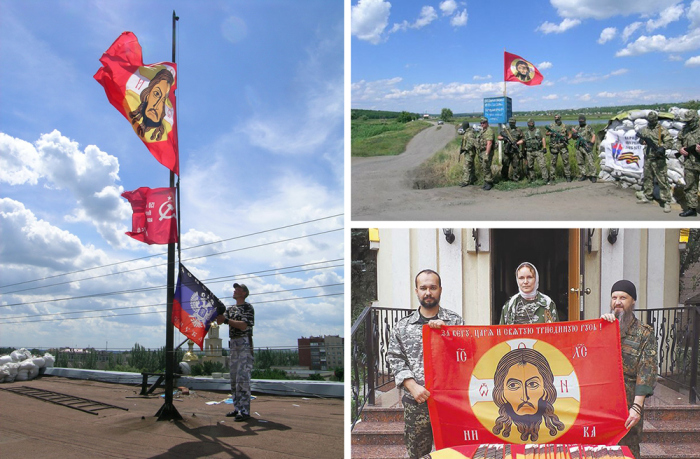
“There are no separate Russia or Ukraine, but one Holy Rus” – Elder Iona of Odessa
The year 2014 saw an unprecedented surge of patriotism in contemporary Russia, which resulted in popularizing the notion of the Russian World. One reason for increased patriotic sentiment was Crimea’s return to the home port after the overwhelmingly positive vote by its majority-Russian residents in a referendum one year ago. The onset of the liberation war in Donbass from the West-backed Kiev regime was the other. This war truly delineated the stakes for the existence of the Russian World. The latter is not an ethnic, but a civilizational concept that encompasses shared culture, history, and language in the Eurasian space within a traditionalist framework. To a certain extent and despite the obvious ideological differences, the Russian Empire and the USSR embodied the same geopolitical entity. A particularly noteworthy aspect of the ongoing crisis in Donbass is the symbolism—religious and historic—that surpasses the commonly used, but outdated Left-Right political spectrum. In the Russian context, this also means overcoming the Red-White divide of the Communist Revolution. That this war pushed Russians to examine their country’s raison d’être is somewhat remarkable: for two decades its citizens did not have an official ideology, prohibited by the Constitution that is based on Western models. The emergence of a new way of thinking in Russia will become clearer once we refer to the meaning of religious insignia, wars—Russian Civil and Great Patriotic, as well as the question of ideology in the Postmodern world.
[…]
In fact, post-Liberal ideology is one of the factors that blinds many Westerners to the realities of the liberation war in Donbass. The current Western model of citizenship is an abstract one: it centers around a set of principles in which individuals are interchangeable—as long as they adopt “European values” or the “American way of life”—instead of the more traditional notions of rootedness in the landscape, cultural and linguistic ties, and ancestral bonds. Thus, those who subscribe to this abstraction have difficulties understanding how belonging to the same people (narod) overrides living in two different states—contemporary Russia and Ukraine—haphazardly formed at the time of the Soviet collapse, and why they seem so attached to their language, culture, religion, history, and land that they are willing to die for them. But even for those Russians that lean toward more traditionalist thought, it took this war—the war that was meant to separate—to ideologically and spiritually unite them with others like them across the border, to begin questioning who they really are, uncertain, but hopeful, forging the idea of the Russian World. Beyond Left and Right, Beyond Red and White.
You would be right in asking, Who the heck is Nina Kouprianova? What does it matter what she thinks? But what this guy thinks does matter and he seems quite on message with Ms. Kouprianova:
Freedom and Social Identity
Hanna Perekhoda
August 11, 2014 OpenLeft.ru
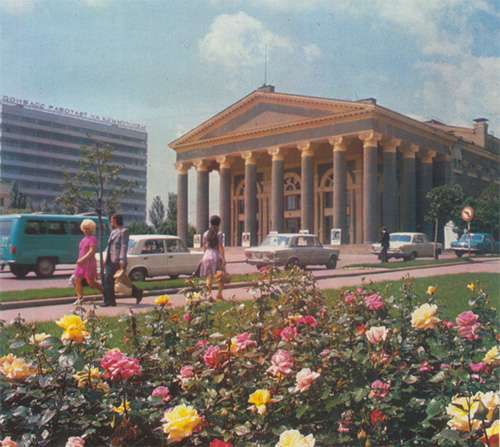
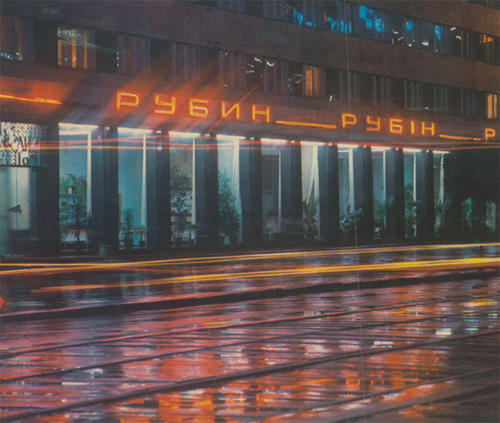
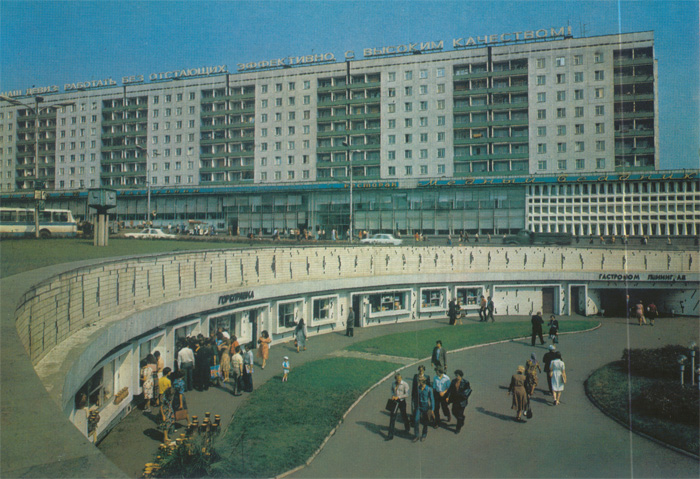
Donetsk. Photo from an album of the 1970s
The past is the locomotive that pulls the future. Sometimes it is someone else’s past to boot. You go backwards and see only what has already disappeared. And to get off the train you need a ticket. You hold it in your hands. But whom are you going to show it to?
—Victor Pelevin, The Yellow Arrow
I was born in Donetsk to a family in whose home there were two diplomas on the bookshelf: a factory furnace builder’s and an artist’s. The holders of these diplomas desperately tried to build their happiness on the ruins of a communism that might have been. But what seemed like temporary measures turned into permanent professions, and now my father is a taxi driver with years of experience, and my mom has been selling flowers for fifteen years. Earnings were laid away; I studied foreign languages, graduated from a lyceum, got into university in Kyiv, and then went to Europe to study. It is time, in my self-imposed exile, to reflect on where I come from and how to live with it.
The Donbas, where I lived for eighteen years and where my friends and family still live, has now borne the brunt of post-Soviet society’s collective hysteria. And so I feel all the consequences of the conflict that has broken out in my country and that rages in the hearts of many of my countrymen. Attempting to analyze what has happened is primarily a way of understanding myself, this flimsy construction of memories, desires, and ideas that threatens to crumble with each new surge of emotions.
In the most difficult moments of internal fragmentation and rethinking, I remember what French writer Amin Maalouf wrote on this subject in his essay “Deadly Identities”: “The identity cannot be compartmentalized; it cannot be split in halves or thirds, nor have any clearly defined set of boundaries. I do not have several identities, I only have one, made of all the elements that have shaped its unique proportions.” However, I have trouble with my identity, and finding its advantages and positive aspects is a matter of survival and mental health.
Today, the line between absurdity and reality has seamlessly disappeared for a long time to come, obviously, and one spends all one’s mental energy only on understanding the causes of what has happened. For example, why did the separatist movement turn from a marginal idea in the east of the country into the cause of a political and military conflict that has riveted the world’s attention for several months? Why does the line of fire run along the borders of the Donetsk and Luhansk regions? What exactly does this line separate? Russia and Ukraine? Asia and Europe? The Soviet Union and the capitalist West? The best minds (and not only the best minds) in different countries have been strenuously and almost fruitlessly reflecting on these questions day after day, especially in Ukraine, for which the situation proved indecently unexpected. I won’t hidе the fact it was a surprise for me as well, and for all the people in Donetsk I know.
Donetsk is a city that had always lived comfortably without any ethnic identity. It is a city of immigrants, ex-prisoners, and a totally impoverished proletariat that owns nothing but the strength of its own hands. Its center was never a church or town hall, and for a long time no public square was provided in the city plan for assemblies or celebrations. The heart of Donetsk was the factory, something terrible, dangerous, and unpredictable, and at the same time necessary, generous, and paternal. The factory and the mine played the role of idols and taboos: they gave life and had the right to take it away.
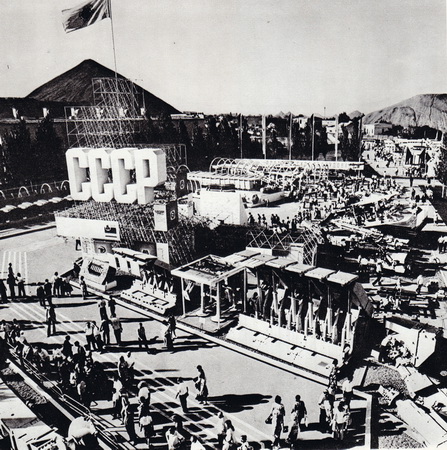
Donetsk. Coal ’75 Expo
Self-definition was based primarily on the principle of “private property,” which clearly divided the proletarianized city and the kulak villages long before these concepts were adopted by the Bolsheviks. The total opposites of the townspeople psychologically, culturally, and economically, the villagers spoke Ukrainian to boot. Few people nowadays know (and usually just deny the fact) that people who spoke Ukrainian had also inhabited the region. The reasons for this memory lapse largely lie in the policy of collectivization, “dizziness with success,” and the famine of 1932–1933. My great-grandmother, a resident of the village of Chicherino in the Donetsk region, was one of three survivors in a family of eleven children. The first time she talked about what she had been through was at the age of ninety, when she was finally convinced the hammer and sickle had been removed from the village council building for good and the yellow-and-blue flag had been hanging there for several years. It was already her grandchildren and great-grandchildren to whom she told her story. She talked about executions and cannibalism, finishing her story with the phrase, “If only Stalin had known.”
According to those whose children and parents had died of hunger, none of it would have happened if Stalin had known. It is quite scary to realize it is the regions that were most affected by the man-made famine that deny this crime most furiously. I am not willing to support Ukrainian politicians who claim it was a genocide of the Ukrainian people. The people who spoke Ukrainian back then did not always think of themselves as a nation, but they did feel the land belonged to them and they held onto it until the bitter end. My great-grandmother’s family suffered not because they spoke Ukrainian, but because they did not want to give up their patch of black earth and their cow. It was easier to nurture the new “Soviet” man on this scorched earth, and it was not hard to convince my grandfather to speak Russian and be ashamed of his uneducated mother, babbling in a dialect alien to the mighty country.
I was born to a Russian-speaking family, but I went to a Ukrainian-language school (then one of fifteen in a city of a million people) only because it was close to home. I never cease thanking the heavens that my teachers were people with “double” identities who gave us the ability to think critically and try on different “folk costumes.” Thanks to our history lessons, Bandera is not a dirty word to me, but nor is he a guiding light. I was never faced with the question of choosing heroes and ideals, because I felt my future should not and would not depend on my country’s past. And the issue of countries never came up. I always loved the Russia “we had lost,” while contemporary Russia mostly inspired pity and disgust, increasingly causing me to try on the Ukrainian embroidered blouse known as “it’s not much of a democracy, but it’s a democracy all the same,” because it obviously fit better.
Donetsk. Photo from an album of the 1970s
While I was wearing embroidered blouses, speaking Russian in Lviv, studying French in Kyiv, and insisting on my proletarian background in the company of European students, life went on its own way in the Donbas. When revolution began in Ukraine, I once again actively reconstructed my identity, organizing fellow citizens to demonstrate outside a UN building in Geneva, giving fiery speeches about my love for Ukraine, feeling I was needed, and also feeling guilty towards those who were risking their lives for our country.
Then one day some Donetsk friends sent me a video. A column of several hundred people with foreign flags and shouting the name of a foreign country march down Ilyich Avenue, where I was born and where I went through more than one stage of socialization. A woman at a bus stop ostentatiously displays her Ukrainian passport, which the marchers snatch from the woman, violently insulting her in the process. I can use bare facts, surveys, and other data to analyze why this happened, but I cannot get my head around the fact that it happened on my street.
As a native of Donetsk, what has surprised me about this situation is the demand of the regions to grant them greater economic and cultural powers. Over many years, not counting the Kravchuk and Yushchenko administrations, the Donbas received unprecedented subsidies, since the Donetsk and Dnipropetrovsk clans were in power. But the local bosses, who tirelessly chanted the mantra that Donbas money was going to feed the idlers in Lviv and Kyiv, pocketed the money. The region’s economy was totally controlled by the local authorities. What greater powers could there be to give? And to whom could they be given? To the same local bosses who all these twenty-three years, working like dogs, “raised the Donbas from its knees”?
They say each region should decide what language to speak and what heroes to honor. But in order to decentralize one fine day, it would be first necessary to centralize the country around a common cultural concept. Complaints about excessive Ukrainization of the region not only do not correspond to reality, but contradict it. Ukrainian was more exotic sounding than Arabic in Donetsk: I never heard anyone speaking Ukrainian on the streets there. No newspapers were published in the language, and the local TV stations did not broadcast in Ukrainian. To find the books I needed on Ukrainian literature, I had to order them from Kyiv. The last step to de-Ukrainization was removing the Ukrainian flags from government buildings, which were the few signs of Ukraine’s presence in its eastern lands. And the popular masses took this step to de-Ukrainization.
The Ukrainian project failed because it did not succeed in making the Donbas part of Ukraine over these twenty-three years. No unifying idea based on a vision of a common future, rather than on the historical legacy, on ethnic and linguistic identity, was found. So Ukraine lived for its heroic and tragic history of the struggle for freedom, while the Donbas was left to dream about returning to the Soviet Union.
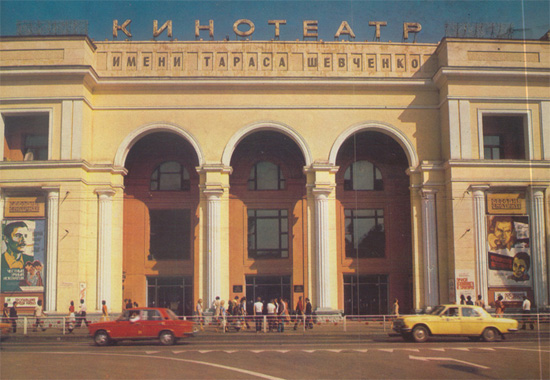
Taras Shevchenko Cinema, Donetsk. Photo from an album of the 1970s
The project of creating a “Soviet people” was a success in the Donbas, and now the hour has come to reap its fruits. The fact that the “Kyiv junta” is being warded off there with two iconic images simultaneously—those of Stalin and Christ—should not be taken seriously. They are merely symbols, shells, talismans, and amulets. People in the Donbas are motivated by the honest desire, which no one makes any bones about, to obey someone who can embody the image of the “father” (or batya, in the common parlance).
Whence this desire for a strong hand? Increasingly, journalists provide a simple explanation: it is all because mentally, physiologically, and almost genetically they are slaves, sovoks (homo Sovieticus), irrational, and uneducated besides. I find explanations like this unacceptable. They render this gap almost biologically insurmountable, and doom attempts to find common ground to failure before they start.
First of all, it is worth remembering this society had no experience of building horizontal social ties. This chance was first given in 1991, but the criminal clans quickly took advantage of it. They grabbed the “strong hand” baton, leaving behind, in terms of social welfare, the working people, who were totally out of their depth and utterly discouraged.
A government that controls nothing, but instead shifts responsibility to its citizens, is a weak government. For example, many people in Donetsk consider democracy a weak form of government. Why are the local housing authorities dysfunctional? Why are there no light bulbs in the stairwells of residential buildings? Because all that has multiplied like rabbits is democracy and freedom, they think. Freedom turned out to be something no one needed, because it was confused with the liberty to do what you want and survive as you can.
Thanks to the experience of living in a European country, I became aware of the inconsistencies in this understanding of freedom. I once had to explain to a Western classmate the perennial dilemma of our society: the question of whether order or freedom was more important. He saw such reflections as something out of the Middle Ages, because for many Europeans it is evident that the freedom of each citizen is the sole guarantee of order. Freedom of choice and democracy are, in fact, the mechanisms that enable society to control those it elects to leadership positions.
Donetsk. Photo from an album of the 1970s
It seems the Donbas lived until 1991, and after that it only survived and was more like a terminally ill patient. It was not only high salaries that disappeared along with prosperity but also the meaning of life, which had been based on a belief in slogans about the invaluable contribution of miners and workers to building the bright communist future. And then it was gone: the privileges, the confidence in the future, and the pride in one’s work. Poverty is easy to manipulate, and the people who stated at every opportunity that “the Donbas feeds Ukraine” and that it “could not be brought to its knees” have secured a comfortable future for themselves at the expense of the region’s population, who live below the poverty line.
All these twenty-odd years, people of the Donbas who had been born in the Soviet Union recalled it with nostalgia, reviving only the good things in their memories. My mother often recalled how there was such delicious fatty milk every day in kindergarten, and how she had been paid a phenomenally high salary for frescoes depicting athletes and cosmonauts on the walls the Mariupol House of Young Pioneers. Even queues for dish sets and rugs, and then for sausage and bread, were recalled as something bright, as a symbol of the people’s unity amidst its misfortune. After all, almost everyone stood in queues for sausage, and those who did not stand in them avoided flaunting their wealth.
People are not looking for politicians who tell them uncomfortable truths. And the truth is that the coal industry has long been a loss-making dead end. The whole industrial structure of the Donbas has to be changed and the process of retraining the region begun: there are no other chances. It is not hard to guess that the population has preferred to be robbed, but consoled. In Orwell’s anti-utopia 1984, there is the following passage: “[Winston] knew in advance what O’Brien would say. That the Party […] sought power because men in the mass were frail, cowardly creatures who could not endure liberty or face the truth, and must be ruled over and systematically deceived by others who were stronger than themselves. That the choice for mankind lay between freedom and happiness, and that, for the great bulk of mankind, happiness was better.” Maybe those born in the Donbas can fully sense the meaning of these lines.
The Soviet-era rhetoric came back pretty quickly, while the standard of living increased very slowly: the population contented itself with the myth of the good life more than the real thing. My neighbors on the landing spoke with pride of what a pretty stadium Rinat Akhmetov (the oligarch and “boss” of the Donbas) had built, and how nice it was that the European football championship was being held in our city. They were genuinely happy, although they had no way of buying a ticket to any of the matches and had no idea who had footed the bill for building stadiums they could only look at from afar.
All reputable political forces in the Donbas persistently promised one thing: union with Russia. No one dared promise a return to the Soviet Union, but the descriptions of Russia were exact copies of a landscape from the lost Soviet paradise. In this fairytale Russia, everyone was equal, loved the motherland and the supreme leader, despised the rotten West, and belonged to the Moscow Patriarchy of the Orthodox Church (the real patriarchy). But most importantly, everything was stable in Russia: there was a normal life there without shocks and unnecessary hassles. Well yes, there were parasites there, too, who scoffed at the government and the church, demanding some kind of freedom, but they were quickly isolated from normal healthy society, thank God.
Honest naïve citizens believed in this caricature of the Soviet Union. They took the flagrant mockery at face value and raised it on a pedestal as a national idea. This unimaginably grotesque amalgam of tsarism, Stalinism, National Bolshevism, Eurasianism, the cult of victory in World War Two, and Orthodoxy was crowned with the name of Putin, who subsequently betrayed the sincere faith of Donetsk’s people.
I am faced with a lot of questions. First, how will these deceived people go on living if the twenty year-old promises of the Russian world do not come true? Second, how will those who never believed in these fairytales live alongside them? How can I return to my hometown? After all, my age-mates, who once waited outside the entrance to my building to scare or insult me for the fun of it are now toting machine guns and having fun the adult way. Who knows when I will get answers to my questions, when I will be able to live at home and not travel in search of gracious hosts willing to shelter me. Who knows when my parents will again find work in desolated Donetsk, where no one takes a taxi nowadays, and flowers are bought only for funerals.
Identity comes at a high price to us. Thousands of people have been killed, and one of the reasons is so that more and more Russian-speaking people in the country can say with confidence, “We are Ukrainians,” not because we speak Ukrainian, but because we want to be free. People are not free if they do not want to know the truth and are comfortable living in ignorance. People who began to think become free. That is why I want Ukraine to become free in the search for truth, which often hurts the eyes, but cleanses the soul.
Hanna Perekhoda, a native of Donetsk, is a student at the University of Lausanne. Translated by the Russian Reader. Images courtesy of OpenLeft.ru.