The New Serfs

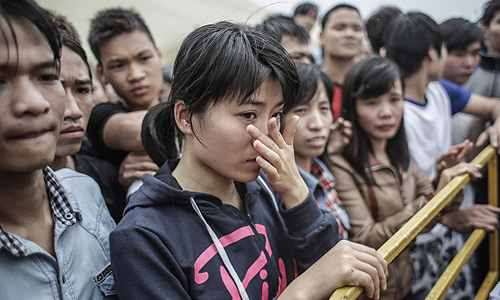
kozyrev-muscovitesPhoto by Yuri Kozyrev for the project Muscovites. Courtesy of Novaya Gazeta

The New Serfs
On July 9, Millions of Migrant Workers and Foreign Students Will Be Stripped of the Right to Freedom of Movement in Russia in a Single Bound. What Has Happened?
Vyacheslav Polovinko and Tatyana Vasilchuk
Novaya Gazeta
July 6, 2018

On June 28, Vladimir Putin signed Federal Law No. 163-FZ, which clarifies the guidelines for immigration registration in Russia. According to the amended law, such notions as a foreign national’s place of residence and the party hosting the foreign national have been defined more precisely. The majority of media outlets have described the new law as making the lives of migrant workers less burdensome, since the new law says foreign workers can be registered as dwelling in construction site trailers. This has provoked grumbling among “tolerant” Russians, who have complained migrant workers will arrive in even greater numbers and occupy all the country’s trailers.

In fact, the situation is quite different. The new rules are a blow to all law-abiding migrant workers and nearly all foreign students. Any legal entity that attempts to hire foreign nationals to work or study in Russia could find itself in violation of the law.

Even people who have all the papers and permissions for staying in Russia could be deemed lawbreakers.

The July Eighth Law
When a foreign national arrives in Russia, she is obliged to present herself to the immigration authorities and register her place of residence. However, she cannot register herself: the people or entities who invited her are obliged to do this. If she has come on a private visit, this would be the owner of the flat she has rented or the hotel where she is staying. If she has come to Russia to study, the university where she will be studying is obliged to register her. If she has come to Russia to work, the company in which she is employed must register her. (The last instance is more flexible, because her company is obliged to register her with the immigration authorities, but they may or may not register her place of residence as they wish, apparently.) Private landlords are a separate topic, but legal entities would take the easy way out. The law used to permit them to register the university or the company’s main address as a student’s or employee’s domicile. However, the foreign national could actually live somewhere else. It was understood, however, that if the police or other competent authorities were looking for her, they could do so at the address where she was officially registered.

The old system had its advantages and its shortcomings.

“There are companies that have five or six thousand foreign nationals on staff. It is convenient for them to register people at their business address to oversee whether their employees are paying for work permits and extending their residence permits on time,” says migration expert Svetlana Salamova.

The other side of the coin has to do with the poor living conditions of some foreign workers. This is most often the case among migrant workers from Central Asia.

“Employers would sometimes accommodate fifteen people at a time in trailers, in which the living conditions were rough. Besides, finding people via their legally registered domicile was often quite complicated,” explains human rights defender Andrei Babushkin.

To solve these problems, the definitions of key notions in the immigration laws have been amended. Actually, however the circumstances of migrant workers and their Russian employers have been considerably worsened, not improved. The amendments signed into law on June 28 stipulate that the place where the foreign national stays cannot be a normal domicile, but it can be other premises where the foreign national or stateless person actually resides, i.e., regularly uses for sleep and relaxation. If she is registered by a Russian organization, the foreigner must live for all intents and purposes in premises belonging to the organization. However, the premises must be equipped as a dwelling space.

In other words, if a foreign worker wants her company to register her with the authorities, she is obliged to reside full time in the company’s living accommodations.

The catch is that most legal entities simply do not having living accommodations. Construction companies will have the easiest time of it. They will now actually be able to register workers as legally residing in trailers and makeshift barracks at construction sites. All other companies have nowhere to accommodate their employees from other countries. A sofa and a microwave are not sufficient conditions for turning a room into a legal residence.

“Legally speaking, a domicile is a place that has been registered as such,” says Salamova. “An office with a sofa in it is not a domicile, but if your company lets you keep your suitcases there and install a stove and refrigerator, theoretically you could be registered as dwelling there. In this case, however, the employee from the personnel department who registers you with the Russian Interior Ministry [i.e., the police] will have to supply the immigration authorities with paperwork showing the room has been registered as a domicile.”

Will Russian companies be willing to turn their offices into bedrooms? The answer is obviously no.

Large auditing and consulting agencies, a field in which many foreign nationals are employed in Russia (not only expatriates but also graduates of Russian universities who are nationals of the former Soviet republics) have started to warn their employees about the need to look for a place where they can be registered as residing. Victoria Plotinskaya, marketing and public relations director at AT Consulting, told us that foreign employees at her company must register at their actual addresses before July 9. Previously, AT Consulting registered them at its business address, but now it is willing to provide them with legal assistance. Plotinskaya assumes their employees will have no difficulties, since registering oneself as residing in a rented flat is not a problem,  she claims.

We, however, have learned that several employees of major companies have been thinking about quitting their jobs or transferring to their home countries because their landlords have no intention of registering them.

“Companies will lose the ability to keep track of the immigration registration of their foreign national employees, while  foreign nationals who live in rented flats will have to negotiate with their landlords about registering them,” says Roman Gusev, director of Ernst & Young’s taxation and legal services department. The company does not plan to lay off any employees.

“In practice,” Gusev continues, “we see that many landlords refuse to deal with this procedure, because they don’t want the added administrative burden. In such cases, foreign nationals will have to urgently look for new accommodations. On the other hand, landlords who agree to meet the new requirements will have to keep close watch over their foreign tenants’ arrivals in the Russian Federation, since they have to be registered with immigration authorities after each such arrival.

“There are also risks for conscientious landlords. If their foreign national tenants arrive in the Russian Federation and fail to inform them, the landlords will be breaking the law without knowing it. On the other hand, foreign nationals could also find themselves in a pickle if their landlords suddenly refuse to register them with the immigration authorities or are simply unable to do what the law requires of them because they happen to be out of town,” concludes Gusev.

Unfortunately, the new rules are also retroactive, apparently, meaning everyone who is registered as residing at a business beyond July 8 will be in violation of the law come this Monday—unless, of course, they are unable to swiftly persuade their landlords to register them. In this case, however, no one can vouch that landlord will supply this service for free. Rental agreements presume that landlords pay taxes on the rent they charge. Verbal agreements to rent someone a flat and register them while not paying taxes could lead to a rise in the price of flats let to foreign nationals in Russia.

Formally, nothing has been said about the retroactive force of the amendments to the law, as signed by Putin. However, human rights activists have already been getting reports of attempts to deport migrant workers for dwelling in places where they are not registered to reside. In fact, the Interior Ministry already has the power to deport a non-Russian national if an inspector discovers him somewhere other than his registered domicile, say, at another flat in the evening.

This was what happened to Uzbek nationals in Omsk Region, says human rights activist Valentina Chupik. The Uzbeks went to a immigration center with registration papers obtained from a middleman, and they were sent off to be deported, allegedly because they did not live at their registered domicile.

In other words, under the new law, migrant workers no longer have the right to spend the night somewhere other than their legally registered, actual residence.

Under Article 54 of the Russian Constitution, laws cannot be applied retroactively. This was underscored by the specialists at Alliance Legal Migration, a firm based in Petersburg. In theory, then, all registrations issued before July 8 should be valid for their full terms. This can be proven only in court, however. Yet Russian courts rarely side with migrant workers.

Dormitory Hostages
Foreign nationals employed by Russian companies are only half of the problem. If push comes to shove, they can pay landlords extra money to register them. All foreign students in Russia are now at risk as well. Previously, universities would register their main buildings as the legal domiciles of their foreign students, but now they will be obliged to register all of them in university dormitories. However, the number of rooms in the dorms does not match the number of foreign students, and out-of-town Russian students have to live in dorms as well. Besides, there are students who do not want to live in dorms and can rent flats, students who have children, for example. Previously, they could count on their universities registering them, but now they will have to take care of their own registration.

The new law also applies to students who left for summer holidays not knowing they would return to Russia in the autumn on new terms. In addition, students who are registered in dorms are virtually their hostages.

Any violation of university regulations or, for example, attendance at an opposition rally gives university deans the chance to opportunity to revoke the registration of “troublesome” foreign students, which automatically means they are in violation of immigration laws and can be deported. Considering the fact that many international students have never experienced serfdom, they behave like free women and men. Their freedom will now be harshly restricted by the hours when the dorm’s main entrance closes.

Universities themselves seemingly have not yet figured out yet what they are going to do. The new rules have been a big surprise to most of them. The main issue they face is how they will now enroll international students if registering all of them legally has become impossible.

The Peoples’ Friendship University of Russia (RUDN) refused to comment on the amended rules. We were told by a spokesperson at the Higher School of Economics (HSE) that they were in the process of working out a way of dealing with the new rules. However, we have in our possession correspondence between students and the HSE’s immigration department, who categorically informed the students they could be registered only at their actual places of residence.

At Moscow State University (MGU), we were told, “The issues of timely migration registration and visa extensions for foreign students residing in rented flats is currently being examined by university management in order to find the optimal solution.”

“The university has not contemplated any limitations to enrolling foreign students due to the adoption of Federal Law No. 163-FZ, dated June 27, 2018,” a MGU spokesperson added.

Other universities failed to respond to our inquiries before this issue of the newspaper was sent to the presses.

“If a university does not have a dormitory or does not have enough room in its dormitories, students can ask for a written request from the university to landlords, asking them to register the students at their actual domiciles. And then the landlords can register them if they want to do so,” explains Salamova.

Closely Watched Flats
You should not imagine that all of the above is a headache for foreigners, but has nothing to do with you.

According to the new rules, Russian nationals who let flats to foreign nationals are automatically regarded as “hosts,” meaning they are obliged to register them as residing in their dwellings and are responsible for them.

“There will also be increased check-ups and fines in the case of noncompliance with the laws for people who let flats to foreigners,” predicts Salamova.

In all fairness, such fines also existed earlier, but they were almost never issued. We have been informed that as soon as the World Cup ends, the police will make an extra effort to inspect all residential buildings and search for unregistered foreigners living in them.

Moreover, Russians are currently responsible for foreign nationals, even if they have left the country but their immigration registration is still valid. A law bill, sponsored by Irina Yarovaya and on the verge of its second reading, has been tabled in the State Duma. If passed, it would make it possible to remove foreigners from the immigration registry instantly and on one’s own via the web. This means landlords would also be able to remove tenants from the registry whenever they wanted, claiming, for example, that they had lost touch with the migrant workers in question. Foreign tenants would thus be subject to the whims of landlords, who could raise their rent at the drop of a hat, threatening to remove them from the immigration registry if they failed to pay. Besides, if a migrant worker does not live in the flat where she is officially registered, she can find herself without papers at any minute because, according to yet another amendment, she can be stricken from the rolls as residing in a particular flat without her knowledge. This means that beat cops can stop her on the street and automatically fine and deport her.

In mid June, the State Duma approved yet another law bill in its second reading. If passed, it would make organizations that invite foreigners to Russia wholly responsible for their actions. For example, if a foreign national works somewhere else than the organization that invited him or “is up to no good,” as MP Viktor Karamyshev has put it, the authorities will pay a call to the foreigner’s primary host organization. In addition, companies would have to make sure that when an employment contract ends, the migrant worker leaves the country instantly. Otherwise, the companies would be fined.

At the same time, the State Duma approved a new list of fines for noncompliance with all these rules on the part of organizations and ordinary Russians.

Under the new regulations in the Administrative Offenses Code, individuals will pay fines of up to 4,000 rubles for violations involving migrant workers, while officials will pays up to 50,000 rubles, and legal entities will pay up to 500,000 rubles [approx. 6,700 euros].

Beneficiaries  
By and large, the batch of laws that have been adopted or are still under consideration (the Interior Ministry, for example, has launched an expert group to draft a Migration Code) should at least be sent back to the relevant committee for revision, since, as Babushkin says, “The harm they do outweighs the good.” But the way the new rules have been drafted and adopted behind the scenes—they did not warrant a single public hearing nor, as far we have ascertained, did their authors consult with independent migration lawyers—suggests their oppressiveness is advantageous as they currently stand.

Who stands to gain, however? MP Irina Yarovaya, for example, argues that certain changes, such as the ability to remove migrant workers from the registration rolls on one’s own, are in the interests of ordinary Russians. She states her case in a clarification to the law bill that the MP’s aides sent to us in reply to a request for comments. On the contrary, human rights activists argue the Interior Ministry, which now has complete oversight over immigration, has received yet another tool for extorting bribes. Any migrant worker can be stopped on the street by the police and threatened with deportation: he will find it easier to pay them off. Any landlord can be intimidated with fines.

The threat of deportation is a convenient tool for dealing with troublesome individuals.

Our newspaper published the story of Gulchekhra Aliyeva and her family. She and her son were locked up for five days without food and water at the Ramenki District Police Station in Moscow. They were let out of their cells twice a day to go to the toilet. According to the Aliyevs and human rights advocates, the police tried to extort them, promising to deport them if they did not pay up. The ostensible cause was the tightening of security on the eve of the World Cup. After human right defenders intervened, the Aliyevs were released, and a criminal investigation into allegations of torture was launched.

“However, when the Aliyevs were summoned for questioning, it transpired  the police planned to deport them for being registered at their place of work rather than where they actually lived,” says Chupik.

Moreover, this happened before the new law had taken effect.

“We basically saved them by escaping the police station,” recalls Chupik.

The special services also stand to benefit from the new law. As we have learned from a source with ties to the academic world, special services officers have connections to the immigration departments in several Russian universities.

This is tantamount to reviving the Soviet system of “working” with international students at universities. Given that they inevitably violate the rules, they can be inclined to “friendship” and “cooperation” when necessary.

Besides, foreigners per se will now be unable to take the slightest step in Russia without official registration. Nationals of our allies Kyrgyzstan and Kazakhstan will also be punished, but that is collateral damage.

Finally, fly-by-night fake migration registrars stand to gain from the law, since their entire business will disappear into the shadow economy. Even now, migrant workers who travel to the Multi-Purpose Migration Center (MMTs) in Sakharovo, in the far southern outskirts of Moscow, cannot have their domiciles registered while other papers are being processed, including their work permits. Human rights activists say the MMTs has lost this right due to the new law.

“Everyone mobs Kazan Station, getting registered by people who give them counterfeit papers,” claims Chupik.

As far as we know, the neighborhood around the Kazan Railway Station, in central Moscow, has the largest number of people offering such dubious services. Moreover, these deals are made more or less in plain view of law enforcement officers, who do nothing about them: maybe they know something important we do not know or know more thane we. The price of counterfeit registration papers is between seven and eight thousand rubles [approx. 95 to 110 euros], a hefty sum of money for migrant workers.

The Interior Ministry stubbornly persists in saying nothing about how the new law will be enforced: it has not published any official clarifications. We have sent the ministry a request to comment, but when this newspaper went to the print, the ministry had not yet responded.

Thanks to Sergey Abashin for the heads-up. Translated by the Russian Reader
Monetizing Russia’s Migration Maze?

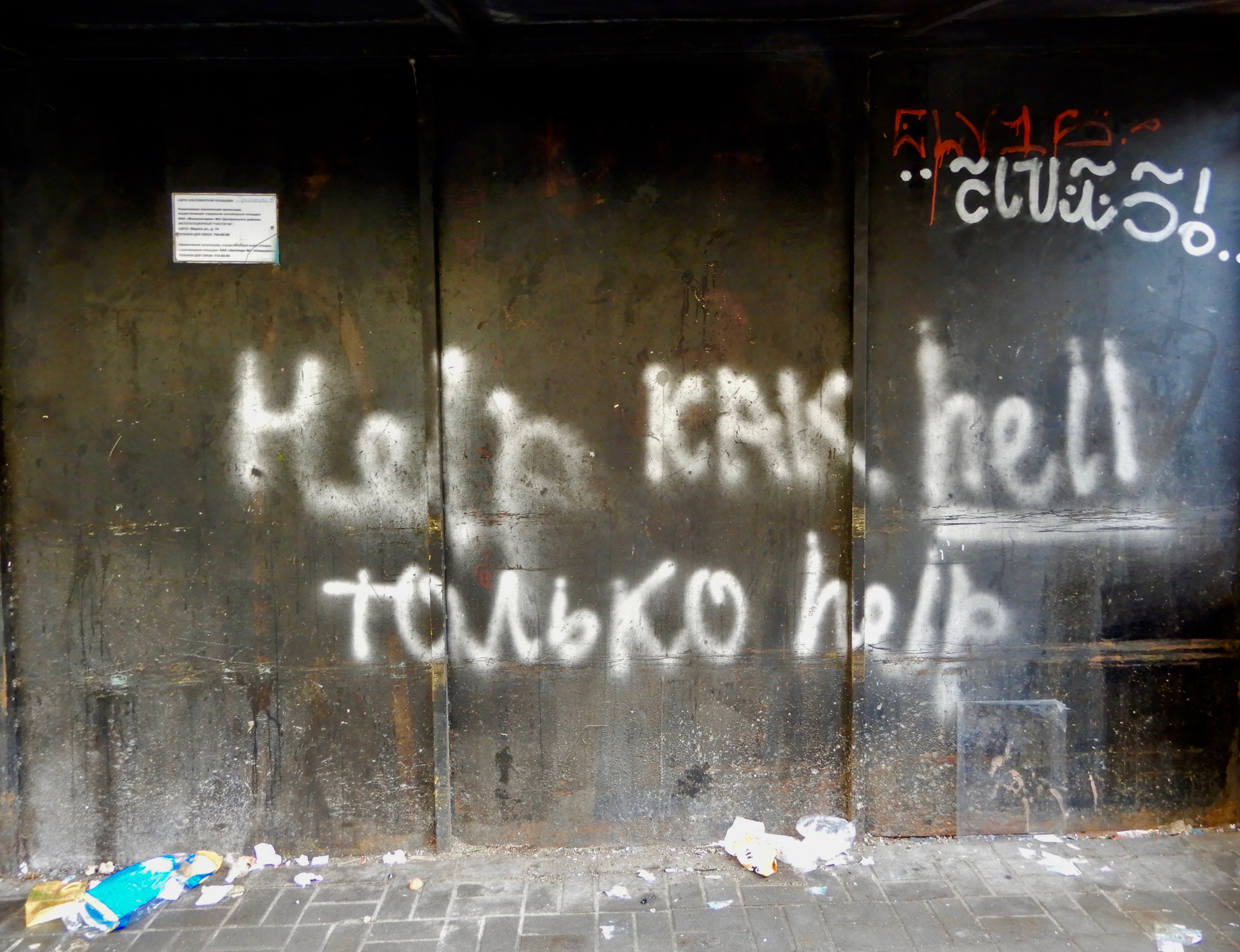
DSCN5633.jpg“Help is like hell, only it’s help.”

Punishment Minus Expulsion
Interior Ministry Develops Individual Approach to Migrant Workers
Anna Pushkarskaya
Kommersant
April 27, 2018

The Russian Interior Ministry has published draft amendments to the Administrative Offenses Code that would permit judges not to expel people from Russia who violated immigration regulations by allow them to take into account mitigating circumstances and substitute monetary fines for expulsion. The individual approach has already been enshrined in several articles of the Administrative Offenses Code by decision of the Russian Constitutional Court, but the police are willing to make it the “general rule for the assignment of administrative penalties.” Meanwhile, the Russian Justice Ministry has reported to the Council of Europe on measures it has taken in response to the complaints of stateless persons, although the rulings of the European Court of Human Rights (EHCR) and the Russian Constitutional Court on these cases have not yet been implemented, experts have noted.

The draft amendments to the Administrative Offenses Code, which would give judges the ability to replace administrative punishment with less harsh penalties, depending on the specific circumstances of the case, have been posted by the Interior Ministry for public discussion until May 4. The police drafted them on the basis of a February 17, 2016, ruling by the Constitutional Court. The ruling was rendered in the case of Moldovan national Mihai Țurcan, who was expelled from Russia for failing to notify the Federal Migration Service he was registered in Moscow Region. (This requirement is stipulated by Article 18.8 Part 3 of the Administrative Offenses Code, and it also applies to stays in Moscow, St. Petersburg, and Leningrad Region.)

Expulsion entails a five-year ban on entering the Russian Federation and reapplying for a residence permit. Courts did not consider the complainant’s work experience and payment of taxes as grounds for mitigating his punishment. The Constitutional Court ruled that these immigration regulations were unconstitutional and obliged legislators to individualize penalties for single violations of the controversial regulation by taking into account the length of an alien’s stay in the country, whether or not s/he has family in Russia, payment of taxes, and law-abiding behavior. Since December 2016, Article 18.8 Part 3 has allowed authorities to avoid explusion except in cases in which the documents confirming the alien’s right to stay have been lost or are lacking. In April 2017, the Constitutional Court’s approach was enshrined in the “General Rules for the Assignment of Administrative Penalties” (Article 4.1 of the Administrative Offenses Code), which deals with violations at official sporting events, for which foreign fans can get off, under mitigating circumstances, with a fine of 40,000 to 50,000 rubles and a ban on visiting stadiums for a period of one to seven years.

In October 2017, First Deputy Prime Minister Igor Shuvalov instructed authorities to extend the approach to all cases of compulsory explusion. If the court concludes that expulsion is an excessive stricture on the right to a private life and is disproportionate to the objectives of administrative penalties, it can be substituted by a fine of 40,000 to 50,000 rubles [approx. 530 euros to 660 euros]. Courts may already opt not to order expulsion in accordance with the clarifications issued by the Russian Supreme Court and Russian Constitutional Court, but now the factors courts should take into account are supposed to be incorporated in the wording of the law, noted lawyer Sergei Golubok. Lawyer Olga Tseitlina told Kommersant the draft amendments are quite important, because courts have, in practice, ignored marital status and other vital circumstances.

At the same time, the Russian Justice Ministry has sent a letter to the Council of Europe’s Committee of Ministers, asking it to recognize that the EHCR’s rulings on complaints filed by stateless persons have been implemented. The virtually indefinite detention of complainants in special Russian Interior Ministry facilities on the basis of rulings by Russian courts and the conditions of their detention in custody were ruled violations of the European Convention on Human Rights. The Justice Ministry reported that compensation had been paid to the complainants. They are now no longer subject to expulsion and deportation, and can “fix their migration status.” Moreover, the State Duma has passed, in their first reading, the admendments to the Administrative Offenses Code drafted by the Interior Ministry to settle the problem, the Justice Ministry reported four years after the ECHR issued its ruling. The Justice Ministry referred to the Constitutional Court’s ruling in the Mskhiladze case. In May 2017, the court also ordered that the Administrative Offenses Code be amended.

The ruling has not been implemented, noted Golubok and Tseitlin, who represented Mr. Mskhiladze. The ECHR’s decision in the case of another of Tseitlina’s clients, Roman Kim, has not been implemented, either, she told Kommersant.

“He has no legal status and de facto cannot apply for [Russian] citizenship or a [Russian] residence permit, since he cannot expunge his conviction due to his unemployment, but he is unemployed because legally no one can hire him,” said Tseitlina.

She stressed the general measures required by the ECHR and the Constitutional Court have not been implemented, either, since no changes have been made to Russian federal laws.

Thanks to anatrrra for the heads-up. Translation and photo by the Russian Reader

I Can’t Get No Satisfaction

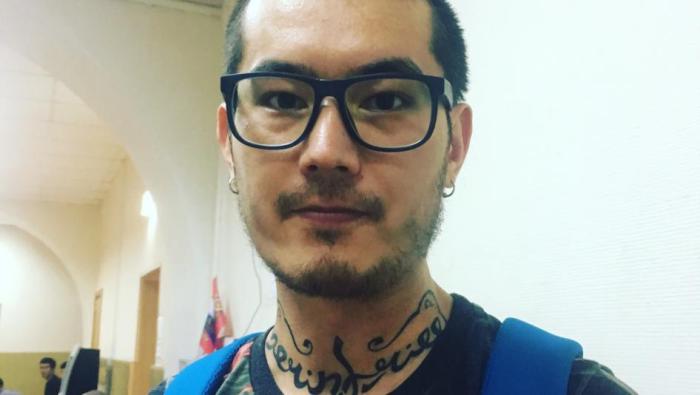
Ali Feruz, a gay Moscow-based journalist threatened with deportation to Uzbekistan, where he faces possible torture and death. Photo courtesy of Human Rights Watch 

Memes of Solidarity
Silly and Serious Acts of Civic Solidarity Will Be Needed for a Long Time to Come
Maria Eismont
Vedomosti
January 25, 2018

The Satisfaction Challenge, a internet flash mob in support of cadets at the Ulyanovsk Civil Aviation Institute, who filmed and uploaded a parody of Benny Benassi’s music video “Satisfaction,” has entered its second week. The institute’s administrators accused the cadets, who are shown dancing in briefs and pilot caps, of “mocking the sacred” and “humiliating the industry,” declaring they had no place in aviation.

Since then, scores of videos supporting the cadets have been posted daily. The latest was filmed by the Novosibirsk hockey club Sibir. Before an auditorium packed to the gills with fans, the club’s mascot, Snowman, dances to “Satisfaction” along with security guards and cleaners. Before Snowman, there were videos by female pensioners in a Petersburg communal flat, costumed theater students in the Russian Far East, horsemen, swimmers, cadets at the Academy of the Emergency Situations Ministry, construction workers, doctors, students at an agriculture college, schoolchildren, housewives, and the presenters of the TV show Evening Urgant. Consequently, a talk show on the TV channel Rossiya 1 and US magazine The New Yorker have identified the Satisfaction Challenge flash mob as a significant event in Russia public life.

“Welders from the Urals Filmed a Satisfaction Challenge Video.” Published January 24, 2018

Obviously, the flash mob has touched some important strings. It is not so much a matter of discussing the boundaries of free self-expression, the clash of different views on what is permitted and appropriate, which, judging by the varying degrees of frankness on the part of the flash mobbers, are also quite different. The key here is solidarity, which has proven the best weapon against bureaucratic stupidity and official hypocrisy. Solidarity with the persecuted is a vital tool for upholding freedom and withstanding crackdowns, for maintaining and reinforcing social connections in an atomized society.

The flash mob in support of the Ulyanovsk cadets is probably the most vivid and funny solidarity campaign in today’s Russia, but it is hardly the only or most important solidarity campaign. The cadets were threatened with explusion, but Novaya Gazeta journalist Hudoberdi Nurmatov aka Ali Feruz, who has already spent five months in a temporary detention center for foreigners awaiting a review of his appeal to the European Court of Human Rights, is threatened with torture and even death in connection with false charges of cooperating with terrorists if he is deported to Uzbekistan, say his relatives, colleagues, and human rights activists.

The solidarity campaign in support of Ali Feruz kicked off this past August, when the Moscow City Court decided to deport him. His colleagues rightly believe that the longer they bring up the case and the more loudly they discuss it, the better are the chances for a positive outcome. So, last week, Theater.doc held another reading of Feruz’s diary, written in the temporary detention center for foreigners. The first reading, entitled “My Friend Ali Feruz,” was held as a sign of solidarity by journalists in late October. During last week’s antifacist march in memory of attorney Stanislav Markelov and journalist Anastasia Baburova, slain by neo-Nazis nine years ago in downtown Moscow, some of the marchers bore placards demanding Ali Feruz’s release. On Wednesday came the news the Russian Supreme Court had overturned the Moscow City Court’s decision to deport Feruz to Uzbekistan and remanded the matter for a new hearing.

The solidarity campaign in support of Karelian historian Yuri Dmitriev, which has ranged from petitions and videos in his defense to organized trips to his trial in Petrozavodsk, has been underway since society learned of his arrest on charges of taking pornographic photographs, charges that carry no weight with anyone who knows him well. If it had not been for the public outcry, there might not have been a second forensic examination, which ruled the photographs in question were not pornographic, nor would there have been a court decision to release Dmitriev from police custody, where he has spent the last year, on his own recognizance.

Currently, Oyub Titiev, head of the Grozny branch of Memorial, is in bad need of solidarity and support. Arrested on drugs possession charges, Titiev managed to warn society any confession he made would only mean he had been tortured into giving it.

“We regard Oyub Titiev’s circumstances as extremely dangerous,” the board of the International Memorial Society said in an appeal to Russian society and the international community. “The only thing we can do under the circumstances is ask Russian society and the international community to monitor Titiev’s case with the same acute interest as has occured in the Dmitriev case.”

Solidarity is one of the few effective tools left in Russian civil society’s arsenal for confronting official coercion. We will have recourse to it again and again for a long time to come. It’s a good thing that sometimes, as in the case of the cadets, it’s also fun.

Translated by the Russian Reader

Put Yourself in Someone Else’s Shoes

Lyubov Moseyeva-Helier
A Korean Adventure in Kaluga
7X7
April 28, 2017

Whew!

Now, after a ten-hour marathon, I can sum up the results.

My son, a member of Kaluga Prisons Public Monitoring Commission No. 3, found a North Korean national in Correctional Colony No. 5 in Sukhinichi in late March 2017.

My son tried to speak with Kim in Russian and English, but Kim understood neither. According to the assistant director of the Russian Federal Penitentiary Service’s Kaluga office, who was present during the meeting, Kim “only shook his head like a Chinese bobblehead.”

The North Korean is the first such inmate who, after he is returned to his country of origin, faces life in a work camp or the death penalty.

In North Korea, inmates are rehabilitated through starvation. They are given one cup of rice daily.

First, I consulted with human rights activist Svetlana Gannushkina. She replied that, in her opinion, Kim faced threats to his life and health in North Korea.

Then I contacted the UNHCR. I informed them that Kim, a North Korean national, had never once been provided with an interpreter during his two and a half years at the Kaluga Correctional Colony. The state of his health was thus unclear, nor was it clear what he wanted himself: to return to his country or move to a safe place.

I posted information about the case on Facebook, asking for a heads-up from Kaluga human rights activists. Kaluga attorney Elvira Davydova read my plea to help the North Korean and decided to help, working the case pro bono.

I signed a contract with Elvira Davydova, a young, vigorous attorney, to defend Kim’s interests for a purely nominal sum of money (I couldn’t afford to spend any more money on the North Korean out of my old-age pension), and the lawyer went to work.

The UNHCR assigned Kim a Korean interpreter.

The lawyer and I made a deal with the assistant director of the Russian Federal Penitentiary Service’s Kaluga office that when the Korean was released, Kaluga prison officials would help Kim get in contact with the UNHCR interpreter.

Unfortunately, this did not happen, although this was to be expected from the Russian Federal Penitentiary Service’s Kaluga office.

At twelve noon, the Russian Federal Penitentiary Service’s Kaluga office handed Kim over to the Kaluga police and the Migration Authority.

I thought Kim would be transferred to the regional center and formally charged with violating Article 18.8 of the Russian Federal Code of Administrative Offenses. (“Violation by a foreign citizen or stateless person of the rules of entry into the Russian Federation or of residence in the Russian Federation.”)

From noon to three p.m., the attorney looked for her client at the Migration Authority’s building, which is way outside the city.

But Kim had been moved to an “alternative jurisdiction.” He was transported to another district, which has a prison for foreigners, a so-called temporary detention center for foreign citizens. The lawyer was unable to go there.

But the lawyer phoned the Dzerzhinsky District Court and found out the name of the federal judge. She asked to speak to him, but was turned down. Moreover, she was told that “Kim already [had] a representative.” Is a Migration Authority official acting as his representative?

The lawyer will make a request to the district court to find out whether a ruling to deport Kim has been issued, and whether Kim had an interpreter with him in court.

The lawyer talked with the guards who escorted Kim, but the Migration Authority officer refused to let Kim talk on the phone with the UNHCR interpreter.

Moreover, someone called the UNHCR and said that he (that someone) would now be handling all contacts with Kim. Apparently, our opponents from the security forces haven’t been dozing, either.

16465267_1265080213580436_242739289438289920_n
This is what the prison for foreigners in the Dzerzhinsky District looks like nowadays. It used to be a village school. Photo courtesy of Lyubov Moseyeva-Helier/7X7

Today, the lawyer filed complaints against the Migration Authority for preventing her from meeting with her client, although they knew Ms. Davydova was Kim’s attorney, and against the on-duty prosecutor.

Ms. Davydova also filed a request with the police to meet with Kim at the temporary detention center for foreign citizens on May 3, 2017.

In the future, we’ll have to go through the same business with the court bailiffs in Kaluga.

Today’s human rights marathon has identified several pressure points, showing that, when it comes to human rights, something is rotten in the state of Denmark known as Kaluga Region.

1. It is impossible to file a complaint in the chancellery at the Migration Authority, whose building is located in the distant outskirts of the regional center. They simply do not accept complaints. To file a complaint, migrants must travel to the Russian Federal Interior Ministry’s Kaluga Region office, which is ten kilometers away, in downtown Kaluga.

2. It is difficult to find anything in the Migration Authority’s building. There is no one to ask for information. Not all the doors have signs on them, and there are no listed working hours for the departments.

3. The lawyer had to wait a long time in the Russian Federal Interior Ministry’s Kaluga Region office for her complaint to be registered and to be issued a receipt.

4. In the Kaluga District Court, it is impossible for a lawyer to learn the name of the on-duty judge who handles administrative violation alleged to have been committed by foreigners.

5. A violation of Article 9, Part 6 of the Russian Advocate’s Professional Code of Ethics was committed in the temporary detention center for foreigner. (“Imposing one’s assistance on individuals and retaining them as clients through the use of personal connections with judicial and law enforcement officers, by promising a favorable resolution of a case, and through other underhanded methods.”)

40436_profileLyubov Moseyeva-Helier is a legal adviser for the Kaluga regional grassroots movement For Human Rights, an expert for the Russian grassroots movement For Human Rights, a lead expert for the project Russian Public Monitoring Commissions: A New Generation, and a voting member of Kaluga Polling Station Commission No. 1139.

Originally published at helier59.livejournal.com on April 28, 2017. Translated by the Russian Reader. Thanks to Comrade Koganzon for the heads-up

Three Years Later: Suicide by Crimea

Suicide by Crimea
Nikolay Klimenyuk
oDR
March 17, 2017

As long as Russia maintains its grip on the Ukrainian peninsula, significant changes for the better at home are impossible.

In the three years that have passed since the annexation of Crimea, a consensus has taken shape in Russia. Everything having to do with the Ukrainian peninsula is Russia’s internal affair, and far from the most important one.

The “accession” of Crimea has even quite succesfully happened in the heads of the regime’s opponents. In November 2016, while arguing on Facebook with Crimean Tatar journalist Ayder Muzhdabaev, Mikhail Khodorkovsky expressed a stance then supported by many publicly prominent liberals, including activists and intellectuals. Russian society, he argued, wants to deal with other problems. The opposition’s biggest task is regime change, but returning Crimea to Ukrainian jurisdiction by democratic means would be impossible because public opinion would be opposed. Crimea is not mentioned at all in Alexei Navalny’s 2018 presidential campaign platform.

Russian media outlets generally considered “liberal” (these media usually eschew the word “opposition”) havealso swallowed the annexation and most of the rhetoric surrounding it without a peep. TV Rain, RBC (even before its top editors were replaced), and the online Meduza, which operates out of Latvia and is not not subject to Russian laws, have all long routinely called and depicted Crimea as part of Russia. The standard explanation—it is required by Russian law, and insubordination is fraught with penalties—sounds like an excuse. The law does not require that questions about Crimea be included in a quiz on knowledge of Russian cities (which was amended after public criticism) or that reporters term the annexation a “reunification” (Meduza edited the latter term to “absorption.”)

At the same time, Russian reporters usually have no problem demonstratively violating Ukrainian laws (which require them to enter the occupied territory through the checkpoint at Perekop) and flying to Crimea from Russia (as Deutsche Welle reporter Yuri Resheto did), because it’s cheaper, faster, and simpler, and because Ukraine’s rules are cumbersome, inconvenient, and nonbinding.

After that, you can write critical reports on human rights violations in Crimea till the cows come home, but it won’t change what matters. The voluntary observance of inconvenient Ukrainian rules is tantamount to acknowledging Ukraine’s sovereignty over Crimea, and hardly anyone in Russia wants to do that.

In fact, the seizure of Crimea has been the cause of many pressing problems in Russia that have been on the Russian opposition’s agenda. It has laid bare peculiarities of Russian society that existed longer before the attack on Ukraine.

For example, not only did the extent of imperialist moods become clear but also Crimea’s place in how Russians see themselves as a society and a nation. The imperial myth, still alive and well in Russia, was concocted during Catherine the Great’s reign. From the moment they were implemented, Peter the Great’s reforms had provoked a mixed response. They smacked of “sycophancy,” and modeling the country on Holland seemed somehow petty.

Catherine, on the contrary, conceived a great European power, rooted in antiquity, Byzantine’s direct heir, the Third Rome, a Europe larger than Europe itself. Her ambitious Southern Project, which involved defeating Turkey, uniting all the Orthodox countries in a single empire, and installing her grandson the Grand Duke Constantine on the throne in Constantinople, was brought low by political reality. The only one of her great fantasies she made come true was seizing the Crimean Khanate, in 1783.

The conquest was extremely atypical of Russia. A troublesome neighbor was not subjugated. Rather, the annexed lands were completely reimagined and rewritten. The rewriting was attended by the first mass expulsion of the Crimean Tatars. They did not fit at all into the pictures of the radiant past that Grigory Potemkin was painting in reality on the annexed lands. Crimea was resettled with Plato and Aristotle’s Orthodox descendants: Pontic Greeks, Great Russians, and Little Russians (i.e., Ukrainians). Naturally, all these particulars have been forgotten long since. What has not been forgotten is Crimea’s central place in the self-consciousness of a “great European nation,” as manifest, for example, in the absurd, endlessly repeated expression, “Crimea has always been Russian.”

The saying perfectly illustrates the peculiarities of historical memory in Russia. Crimea’s current “Russianness” is the outcome of over two hundred years of the uninterrupted genocide and displacement of the “non-Russian popuation,” which culminated during the Second World War. After the two Soviet deportations of 1941 and 1944 (ethnic Germans, Greeks, Bulgarians, Italians, Armenians, Karaites, and Crimean Tatatrs were deported), losses during battles, and the Nazi extermination of Jews and Crimeans, only a third of Crimea’s pre-war inhabitants were left. It was resettled with people from Russia and Ukraine, especially by military officers and veterans of the Party and the secret services.

Naturally, few people in Russia today regard Crimea as a conquered and ravaged country, in which a full-fledged state existed until relatively recently, an indigenous culture was long maintained, and Russians were never the ethnic majority even during the lifetimes of the present elder generation.

Regarding Crimea as a territory, not a society, and treating Crimeans as an annoying inconvenience, was a habit in Catherine’s times and has survived into the present. The formal excuse for the Russian incursion was the “defense of Crimea’s Russophone population,” and yet the “Crimea is ours” attitude of Russians to the peninsula’s residents has been quite skeptical from the get-go. They imagine the main business of Crimeans is leaching off tourists, and the only thing that attracts them about Russia is high wages.

Moreover, this opinion is common across the entire political spectrum. Sergei Parkhomenko, a liberal journalist and public figure, expressed it in a very telling way.

“If first you take five days to explain to the population of Crimea that if they return to Ukraine’s jurisdiction, their wages and pensions will be increased, and they’ll also be permitted to build even more chicken coops for holidaymakers in the coastal zone, and only then you ask them to vote in a referendum, 95% will vote for going back. […]  These people have proved they could not care less what country they belong to. And if there is anyone for whom I now feel not an ounce of sympathy as I read about how they are being fooled, robbed, milked, and put under the rule of gangsters pretending to be officials and bosses, it is the population of Crimea.”

The massive support of Russians for the annexation has much more serious and immediate consequences than a display of deeply rooted chauvinism. Having signed off on “Crimea is ours,” Russians have deemed their own power above the law and sanctioned its use in violating all laws and treaties for the sake of higher interests or “justice.” The Russian authorities had behaved this same way previously, but now they have obtained the relevant mandate from society. Quite naturally, the crackdown following the seizure of Crimea has been chockablock with spectacular acts of lawlessness.

One such act was the demolition of commercial kiosks and pavilions in Moscow, which happened despite legalized property rights and court rulings. There was nothing accidental about the fact the Moscow authorities justified their actions by citing the law adopted for settling real estate disputes in Crimea. And the twenty-year-sentence handed down to Oleg Sentsov set a new ceiling for verdicts in political trials. Before Crimea, activists would get a dvushechka (two years) for especially vigorous protests. After Crimea, the Russian authorities have been sentencing people for reposts on VK and holding solo pickets.

Actually, any regime that tasks itself with establishing the rule of law in Russia will first have to annul this “mandate to lawlessness.” The Russian opposition’s attitude to Crimea shows the rule of law is not among its priorities at all. Bewitched by the figure of Putin, the opposition does not regard regime change as a product of the rule of law. The fact that it cannot offer a realistic scenario for regime change is not a problem in itself. Russia’s currrent regime does not presuppose a peaceful change of power. Systemic change might happen as it did in the Soviet Union, at the behest of the bigwigs and under the impact of external circumstances: the state of the economy, public sentiment, foreign policy factors.

The opposition’s most serious problem is that it doesn’t have a meaningful outline of what would come next.

If we believe the alternative to Putin is neither Navalny, Khodorkovsky nor anyone else, but a democratic state based on the rule of law, there are two obstacles in our way: Crimea and Chechnya. The opposition has no vision of how to establish control over Chechnya and incorporate it into Russia’s legal system, but it is possible in theory, at least. There is no such possibility with Crimea. It is impossible to hope for international recognition of the peninsula as part of Russia, and if we keep regarding it as part of Russia, it will thus remain a legal anomaly. Moreover, no rule rule of law is even formally possible without observance of international law.

When discussing Crimea, the Russian opposition evinces a notion of democracy that differs little from Putin’s, although it is consonant with the rhetoric of Donald Trump and the European populists: that democracy is rule based on majority support and not burdened by the observance of laws, procedures, and international obligations. Khodorkovsky, for example, considers “democratic procedure” not the restoration of law, but the adoption of a decision on Crimea based on the opinion of the majority, which, allegedly, is against giving Crimea back to Ukraine. Navalny has suggested holding a new, “normal” referendum.

Yet what the majority really thinks, whether there is such a thing as public opinion on any issue and how to measure it, obviously means nothing at all either to Khodorkovsky, Navalny or many other members of the opposition. By the same token, since Putin is supported by the majority of the Russian population, there is nothing for the opposition to do at all. All these contradictions can be eliminated only by unconditionally recognizing both the illegality of Crimea’s annexation and the total impossibility of keeping it in the Russian Federation on any grounds.

With Crimea in tow, Russia has no positive alternative to the current regime. And as long as the Russian opposition is concerned only about regime change and avoids discussing Crimea, the only thing it can offer is a Putinist Russia sans Putin. Whoever ends up in his place, however, the changes won’t be too noticeable.

Nikolay Klimenyuk writes about politics and culture in Germany and Russia. He was an editor at Forbes Russia, Bolshoi Gorod, and other periodicals. He has lived in Berlin since 2014 and writes for Frankfurter Allgemeine Zeitung and other German mass media. Translation and photo by the Russian Reader

Good Riddance (Turkish Farmer Akçay Emer Deported)

Deported, but Hopes to Return
Igor Bubnov
Radio Svoboda
April 19, 2016

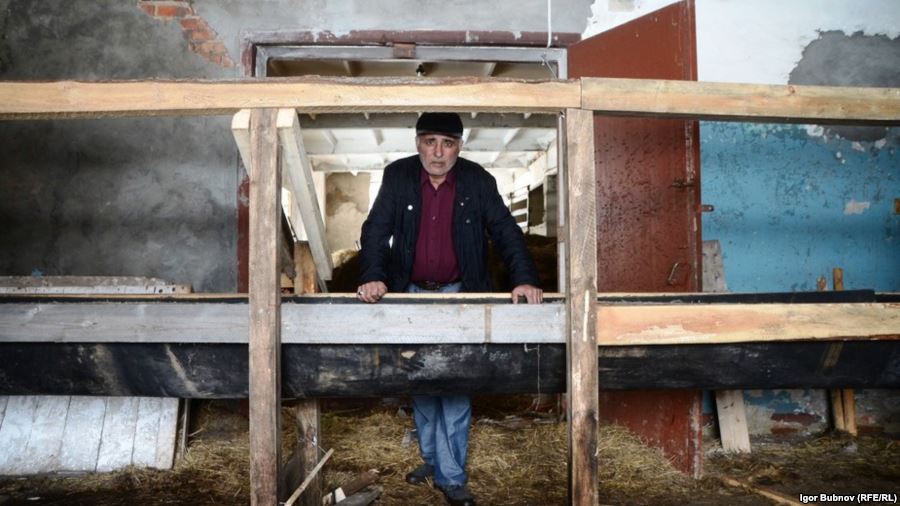
Turkish farmer Akçay Emer, who worked for over twenty years in Syktyvkar, has left Russia. He has been deported, although his Russian residence permit was valid until 2020. On the morning of April 19, Akçay Emer said goodbye to his wife, took his 16-year-old son to school as usual, put his bags in the car, and went to the airport. In Syktyvkar, he has given up his farm: he has been barred from entering Russia for the next two years. His family, friends, and job are here. Akçay Emer hopes to return. After the anti-Turkish campaign kicked off, the Federal Migration Service ordered the farmer to leave the country as he “posed a threat to Russia’s security.”

Akçay Emer
Akçay Emer

Translated by the Russian Reader. Thanks to Comrade VZ for the heads-up. Photo courtesy of RFE/RL and Azadliq Radiosu, where you can read about Akçay Emer’s case in slightly more detail (in Azeri).

Zarina Yunusova: “I Will Never Forgive What They Did to Me”

Zarina Yunusova: “I Will Never Forgive What They Did to Me”
Anora Sarkorova
BBC Russian Service
November 27, 2015

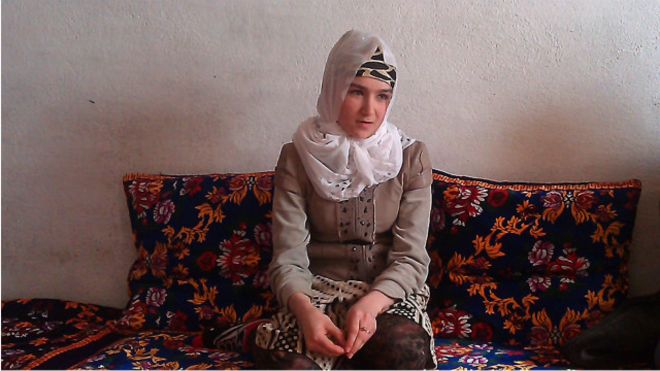
Зарина Юнусова
Zarina Yunusova: “I still remember holding him in my arms, feeling the warmth of his body, and seeing him smiling at me.”

Zarina Yunusova, the mother of the five-month-old baby who died in Petersburg after he was forcibly removed from his parents by Russian police officers, has called on the Russian authorities and concerned Russian citizens to conduct an objective investigation into the causes of her child’s death and reconsider previous decisions in the case.

In addition, the young woman has appealed to the Tajik authorities, who, according to her, should be bolder in defending the interests of Tajikistani citizens.

After returning home and burying her son, Yunusova has gone back to her parents’ home in the remote mountain village of Kandak, in Obi-Garm, in the east of Tajikistan.

Relatives and friends of the young woman that it will thus be easier to survive the loss of the child and rid herself of the painful memories of what she has experienced over the last month and a half.

“I constantly rewind that accursed day in my mind. I remember how the authorities came to our place at six in the morning, how they took the child from me. I did not want to give him up. I fought back, I screamed, I cried, I begged,  and I dragged me on the floor, but they removed the child anyway. I still remember holding him in my warms, feeling the warmth of his body, and seeing him smile at me. I will never forget it and never forgive those who did this to me,” says Yunusova.

Jail Cell, Fine, Deportation
When I met Yunusova at the gate of her house, I noticed that the quite emaciated young woman was limping a little. Her relatives explained that two of her toes were injured at the Petersburg police station where she and the child were taken.

“It happened when they were taking the child. While she was fighting for little Umarali, Zarina injured two toes. For some reason, the Russian Interior Ministry made public only video footage showing a female officer cradling the child, not the part where the child was removed. They should show the whole world how they did it,” says Nazar Boboyerov, a relative of Yunusova’s.

Five-month-old Umarali Nazarov died under mysterious circumstances in the early hours of October 14 after he was removed from his mother, 21-year-old Zarina Yunusova, detained for immigration violations, at a police station in Petersburg’s Admiralty District.

The woman was placed in a temporary holding cell. The same day, the court fined Yunusova 5,000 rubles and ruled that the Tajik migrant should be expelled from Russia.

According to Yunusova’s relatives, she tried to find her son, but the police did not give her the address of the medical center where the baby had been taken.

A day later, the parents were informed of Umarali Nazarov’s death.

Cause of Death

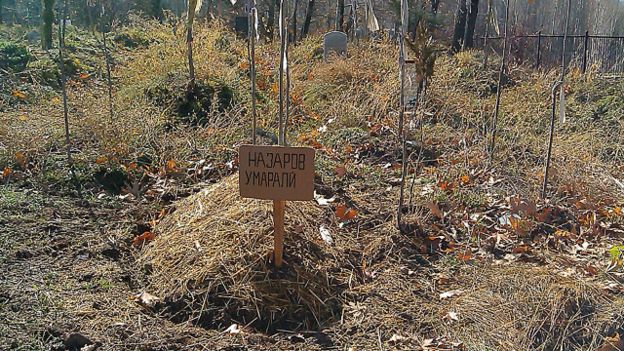
Могила Умарали Назарова
Umarali Nazarov was buried November 15 in the village of Boboi Vali in the Faizobod District.

According to the Petersburg Bureau of Forensic Medicine (BSME), the cause of five-month-old Umarali’s death was a generalized cytomegalovirus infection.

The child’s relatives categorically disagree with the official finding. The parents have numerous medical documents from the clinic where the infant was periodically examined. They suggest that the boy was perfectly healthy.

Umarali was Rustam Nazarov and Zarina Yunusov’s firstborn child. The young people had not met before their wedding. The bride was found on the advice of relatives.

As is typical in many Tajik families, a few months after the wedding festivities, Nazarov went to Russia to work, and later he was joined by his wife.

“We really wanted children. I joined my husband, got pregnant in Russia, and had the child in Saint Petersburg. I took care of the baby, associated only with members of our family, and almost never left the house. I went to the medical clinic where the baby had his examinations only with my husband. I know nothing about immigration laws, rules, and violations. My husband handled all these problems,” recalls Yunusova.

“There Is No Hate, Only Resentment”
Zarina Yunusova grew up in a large family.  She has nine brothers and a sister. She was unable to finish school. The school is located five kilometers from their house. Children have to spend nearly three hours getting to school on mountain slopes, so many children in the village do not attend school.

The majority of girls who do not attend school live in remote rural regions. While the numbers of girls and boys are approximately even in the lower grades, there are many fewer girls in the upper classes, say local teachers. Often parents decide that after the obligatory ninth grade a daughter should quit school and prepare for an early marriage.

At the same time, illiterate brides are valued in rural areas. They are meek, humble, and completely financially dependent on the husband’s family.

Zarina Yunusov went to Russia to be with her husband without fear. Until she traveled to Russia, she knew very little [about the country], but she could not have guessed that anything bad would happen to her.

“After what happened, I will never go to Russia again. How can I forget what they did to me, how treated me? There is no hatred, but the resentment will last a lifetime,” says Yunusova.

The Authorities Did Not Arrive
The body of five-month-old Umarali Nazarov was flown to Dushanbe on November 15. He was buried the same day in the village of Boboi Vali in the Faizobod District, in the east of the country, where the baby’s father comes from. Only several foreign and independent local journalists were on hand to meet the family.

The baby’s relatives waited several hours for officials from the Tajik Ministry of Health, Interior Ministry, and General Prosecutor’s Office, but none of them arrived to meet the Nazarov family, despite promises from the Tajik Consulate in Saint Petersburg that they would be met at the airport and a forensic medical examination would be performed.

Officials from Dushanbe visited Zarina Yunusova several days after her arrival.

At the request of the Tajik Interior Ministry, Yunusova gave blood for a blood test, whose outcome will be known within a week.

In addition, the Tajik police took a statement from Yunusova in which the young woman asks for a criminal investigation into the death of Umarali Nazarov and that the Russian police officers and doctors at the Tsimbalin Children’s Hospital responsible, in her opinion, for his death be brought to justice.

In her suit, Yunusova also asks for 10 million rubles [approx. 141,00 euros] in financial compensation from the Russian side.

“I want to know the cause of my child’s death. The Tajik Interior Ministry explained to me that I had to give blood so they could put an end to all the rumors and prove that I am healthy and that the baby was healthy. When we asked them why the relevant agencies did not show up the day we flew in and conduct an independent examination,  we were told they had not known about the family’s arrival in Tajikistan,” says Yunusova.

Hush Up the Case, Hide the Perpetrators

Каримджон Еров
Karimjon Yerov says that Dushanbe is attempting to hush up the Umarali Nazarov case.

The major case squad in the investigative department of the Tajik Interior Ministry declined to comment on the particulars of the case to the BBC Russian Service while the investigation was still underway.

According to Karimjon Yerov, president of the Russian non-profit partnership ETMOS (Ethnic Tajiks for Responsible Migration by Compatriots), the results of a forensic examination of Umarali’s death would change nothing.

“Russia has never recognized medical records from Tajikistan. All the certificates that Tajik citizens get at home have not been recognized by the Russian side, despite an agreement to that effect. But in this case Russia will recognize an outcome that the parties could have agreed in advance, an outcome that blames the family and helps save face in the name of the so-called strategic partnership,” argues Yerov.

According to Yerov, Dushanbe is also not interested in getting to the bottom of the case and is now doing everything it can to hush the case up.

“The Tajik Consulate in Petersburg repeatedly stated its intention to conduct an independent forensic medical examination. Later, however, people from the Tajik Embassy claimed that such promises had never been made to the Nazarov family. A few days ago, a man identifying himself as an employee of the Tajik Interior Ministry and declared that he had arrived to detain and send home the Tajik nationals who had organized the protest rally outside the Tajik Consulate in Petersburg. I am not certain that Tajik nationals need a Tajik-Russian partnership based on humiliation, disempowerment and the deaths of Tajik nationals,” says the president of ETMOS.

Karimjon Yerov speaking at a November 14, 2015, protest rally at the Field of Mars in Petersburg, demanding an objective investigation of Umarali Nazarov’s death (in Russian). Around a hundred people attended the rally.

The Prosecutor General’s Office told the BBC that the supervisory authority had not opened a criminal case in the death of the Tajik baby and was not currently involved in any investigation of the matter.

“In terms of government agencies, the Tajik side is quite dependent on the Russian side, so it is hardly worth expecting a conflict between them, even over the mother of the deceased child. As for punishing the guilty in Russia, the course of the investigation clearly displays an unwillingness to do this. The mother’s deportation, for example, speaks volumes. It may well turn out that departmental interests will prevail over the rule of law and basic human values. If we don’t manage to insist on a proper investigation of the Umarali Nazarov case now, then in the future we might see numerous such cases throughout Russia,” stresses political scientist Anton Yevstratov.

__________

My previous posts on Umarali Nazarov’s death:

__________

An Example of Senseless Brutality 
Why the Story of the Death of 5-Month-Old Umarali Nazarov Becomes No Less Important over Time 
Maria Eismont
Vedomosti
November 26, 2015

I want to tell you how Zarina Yunusova is doing. Yunusov is the mother of the five-month-old boy Umarali Nazarov, who in mid-October suddenly died in a Petersburg hospital after he was taken from his mother at a police station. Yunusova still hardly eats or sleeps, and she cries constantly. Journalists from the Tajik news website Asia-Plus, who visited her at her parents’ home, where she has lived since she was expelled from Russia, describe her as terribly emaciated and depressed. Yunusova has still not met with a psychologist. The trip to the village is long and hard, and she is not permitted to go anywhere alone without her husband. Her husband, meanwhile, has stayed in Petersburg, where he has been trying to gain recognition as an injured party in the case of his son’s death. The independent forensic examination of the body in Tajikistan they were promised was never performed, but Yunusova herself was recently summoned to the Tajik Interior Ministry, where they took a sample of her blood without really explaining why.

Yes, and the current news agenda is completely different. The Russian public has been discussing the Russian bomber downed by the Turkish air force on the Turkish-Syrian border and the response of the Russian side. Before that, there was news of the deaths of Russian civilian pilots at the hands of terrorists in Mali, and a mere three days before the bloodbath in Bamako, the Russian authorities had officially recognized the Kogalymavia plane crash in the Sinai as a terrorist attack. Convoys of angry truckers have been lining the roadsides and threatening to move on Moscow. Crimea has been plunged into darkness due to the explosion of a power line in Ukraine, and the Military Collegium of the Supreme Court upheld the tellingly cruel sentence (twenty years in prison) against Ukrainian filmmaker Oleg Sentsov, accused of terrorism.

So why I am talking today about Yunusova when Umarali Nazarov died a month and a half ago, was buried ten days ago, and the decision to expel his mother was made long ago and has been carried out? Because however long ago it happened, whatever dramatic and frightening events have filled our lives since then, the Tajik baby’s death has shocked a huge part of active society. Nearly 150,000 people have signed a petition demanding a thorough investigation of Umarali’s death, and dozens of people still ask me how they can help the family and what can be done so that something like this never happens again.

Because Umarali’s story is special. It is an example of pure, completely senseless inhumanity manifested publicly by the system towards the most defenseless people in the total absence of extreme necessity and all political expediency. At each stage of this story—from the Federal Migration Service officers who raided the Nazarov apartment and decided not wait until Umarali’s grandmother brought them the family document’s and did not let Yunusova put a cap on the baby, to Judge Elena Shirokova, who made the final decision to deport the dead baby’s mother—one person with a heart might have entered the picture and everything would have been different. But no such person was to be found.

Neither Yunusova nor her husband, with whom no one has been able to get in touch for several days, can fight for their rights in this case. So it is we who have to demand an objective investigation and punishment for the guilty.

Translated by the Russian Reader

Olga Tseitlina: “Society Doesn’t Understand Why It Should Protect Syrian Refugees”

What Happens to Syrian Refugees in Saint Petersburg
Veronika Prokhorova
September 9, 2015
paperpaper.ru

A flood of refugees from Syria has swept over Europe. The refugees have been passing through Hungary on their way to Austria and Germany. The German government is willing to take in 35,000 refugees. More than four million people have gone to Turkey, Lebanon, Jordan, Iraq, and Egypt. According to Amnesty International, Russia, as, for example, Japan and South Korea, has not officially provided places for refugees, although legally speaking, Syrians still have ways of remaining in the country.

Paper spoke with Olga Tseitlina, a lawyer who works with the Memorial Human Rights Center, about how things really stand in Russia with Syrian refugees.

The human rights lawyer told us how the refugees end up in Petersburg, why, because of legal conflicts, the refugees can neither stay nor be deported to zones of military conflict, and how Syrians who have lived in Russia for long periods become illegal immigrants.

A525E3E4-CA83-4A0B-87A2-2891FE71AD0D_w640_sOlga Tseitlina, human rights lawyer from the organization Migration and Law. Photo by Tatyana Voltskaya. Courtesy of RFE/RL
Why Syrians Go to Russia
Syrian refugees seek safe countries in order to save their own lives. Sometimes, smugglers deceive them, saying they are taking them to Egypt, bringing them instead to Russia. This is common. Some refugees themselves choose Russia because they have family or friends here (there is a diaspora of Syrian refugees in Petersburg), but this is the exception rather than the rule. They do not receive real help from the authorities, since the region lacks a center for receiving and housing displaced people.

It is important to know that only people who are seeking asylum are not held responsible for illegally crossing borders. Those with whom we work had not asked for asylum but were merely trying to get out of our country.

After the court has made its ruling, these people are sent to the Deportation Center in Krasnoe Selo [a far southern suburb of Petersburg], whence by law they should be forcibly removed to Syria, but that is inadmissible, because there is a war going on in their home country. If they are returned, these people might be killed, meaning their right to life would be violated. We cannot forcibly return people to military conflict zones: this is contrary to international law.

Our government agencies do not understand that people are in Russia illegally for long periods not because they are criminals and villains. Sometimes, because of language problems and lack of knowledge, they do not draft their claims properly. They do not know where to turn or how asylum is granted, since there is virtually no information either at the border or at police stations.

Often they turn to the police, who do not send them to the immigration authorities, but immediately cite them for an administrative violation or pass the citation on to the Federal Migration Service. There, the procedure for bringing them to justice and subsequently deporting them is immediately set into motion.

What Syrians Can Expect in Petersburg
Officially, Syrians are entitled to temporary asylum for one year, but that does not always work out, especially in the big cities like Moscow and Petersburg. In Ivanovo, for example, it proved much easier to receive temporary asylum. There it was possible for people who in Petersburg had been turned down even when they asked to start the procedure of granting asylum. In contrast to Ukrainians, no zero quotas for granting asylum to Syrians exist. [Not only have Ukrainians not been granted temporary asylum, but immigration authorities have also refused to take their applications, citing the absence of a quota for Saint Petersburg and Leningrad Region — Paper.]

Syrian refugees often come to big cities. Over a dozen people have turned to us for help in the last three months. In Petersburg, however, there are many more such people. It is just that people turn to our organization only when they are already going through the deportation procedure or cannot get asylum.

Asylum claims are rejected for many reasons. In a number of cases, the authorities refuse to accept claims because people have been in the Russian Federation illegally for some time. If people do not have a valid visa, residence registration, and a job, they are denied asylum and told they are violating Russian law. But here a contradiction again arises. There are refugees who because of the war have simply been unable to return to Syria and renew their student visas, for example. They were forced to break the law. The authorities also attempt to expel them, and the situation known as refugee sur place arises. Others are rejected because they reported false information or they failed to apply on time, although they might simply not have known when and where to apply.

Russian Laws and the European Court of Human Rights
We have managed to bring several attempts to deport Syrian refugees from Russia before the European Court of Human Rights. Only then did the Leningrad Regional Court overturn the decision to deport several people from Aleppo to a military conflict zone. Then, the ECHR asked a crucial question: whether the military situation in Syria had been taken into account when the decision was made. Typically, this issue is not discussed at all by courts either in the case of Syrian refugees or displaced people from Ukraine. It is necessary, however, to take into account the social and political situation in the country of origin and explore the issue of whether it will be safe for asylum applicants to return.

People awaiting deportation are placed in special facilities in Krasnoe Selo. The local conditions of detention were also examined by the ECHR as part of the case of Kim v. Russia. In June 2014, both the ECHR and the Government of the Russian Federation deemed the conditions of detention inhuman and in violation of Article 3 of the Europe Convention on Human Rights. However, they have virtually remained unchanged since then. Moreover, there are no temporary accommodation centers for refugees who have qualified for temporary asylum either in Petersburg, Leningrad Region or Moscow.

How Society Treats Refugees
Now Russians are negatively disposed even towards their “native” Ukrainian refugees, although earlier there was support for them. They say, What do we need these refugees for? We have enough problems of our own. They take our jobs and put an additional burden on infrastructure.

The attitude to Syrian refugees is even worse. These are people from a completely different culture and religion. They might look differently, and they speak a different language. People tend to associate Syrians with ISIL and suspect them of being terrorists. If people are afraid of the refugees from Ukraine, finding volunteers to work with Syrian refugees seems completely unreal in Petersburg and Russia generally. Some people manage to find shelter through churches, but this happens quite rarely. Society does not understand why it should provide protection to Syrian refugees and refugees in general.

Translated by the Russian Reader

Deportation of Crimean Tatars Remembered in Petersburg

Deportation of Crimean Tatars Remembered in Petersburg
David Frenkel
Special to The Russian Reader
May 20, 2015

On May 19, Petersburg democracy activists commemorated the Soviet Stalinist government’s mass deportation of Crimean Tartars on May 18, 1944. Activists held a series of solo pickets on Nevsky Prospect before gathering for an evening event at Open Space, a co-working venue run by the organization St. Petersburg Election Observers.

Several activists, including Vsevolod Nechayev, leader of the Democratic Petersburg coalition, Andrey Zyrkunov of the liberal-democratic party Yabloko, and Igor “Stepanych” Andreyev, a famous local activist, took to the city’s main street with placards calling on fellow citizens to remember the anniversary of the deportation and blaming the current Russian authorities for preventing commemorations in Crimea itself.

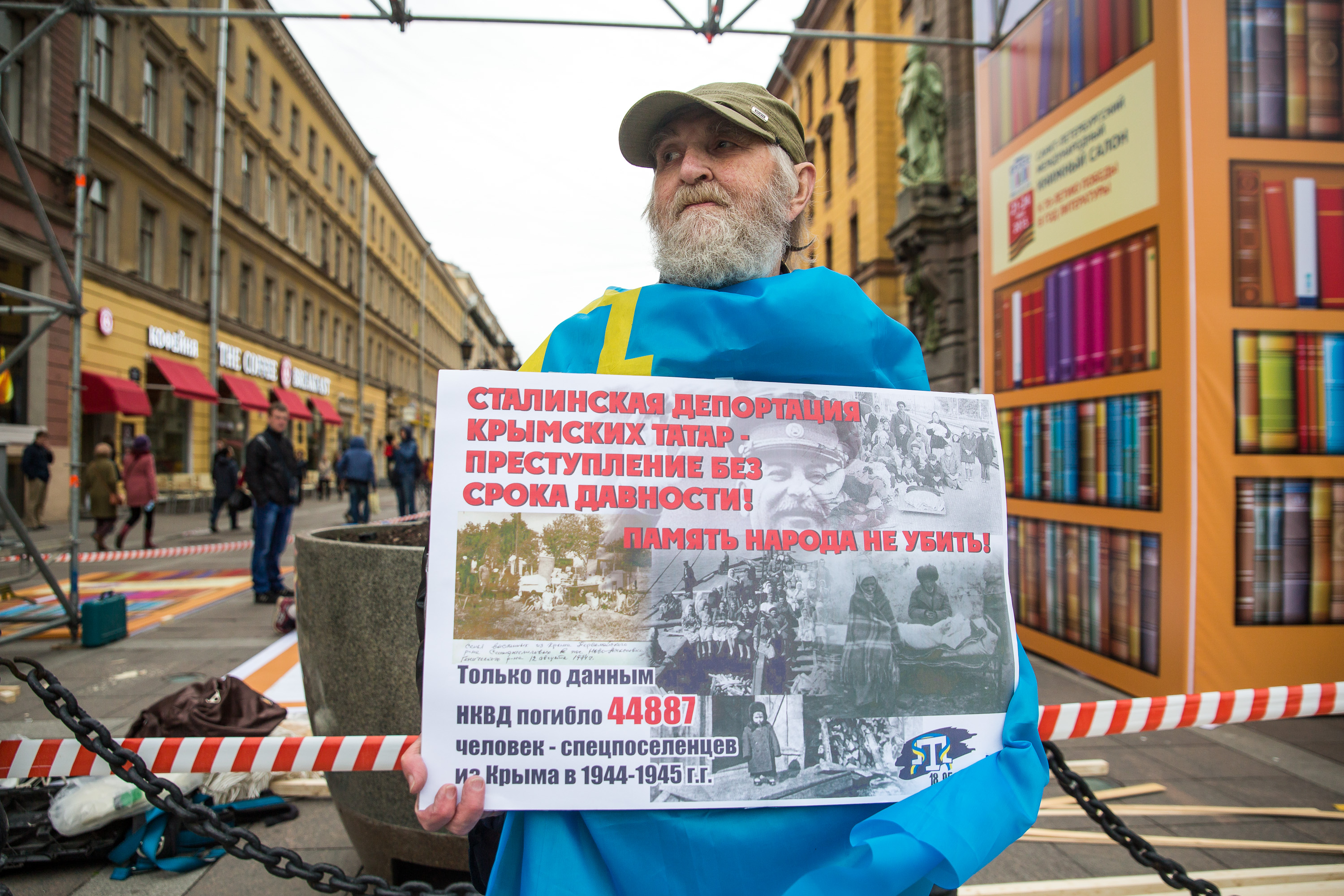
IMG_8818Local activist Igor “Stepanych” Andreyev picketing on Nevsky Prospect, May 19, 2015. His placard reads, “Stalin’s deportation of the Crimean Tatars is a crime with no statute of limitations! A people’s memory cannot be murdered! Even according to the NKVD’s statistics, 44,887 deportees from Crimea died in 1944–1945.”

Apparently inured to pickets and demonstrations of various kinds, passersby mostly exhibited indifference. A couple of young men attempted to harass the protesters, but most passersby merely glanced at the picketers before continuing on their way.

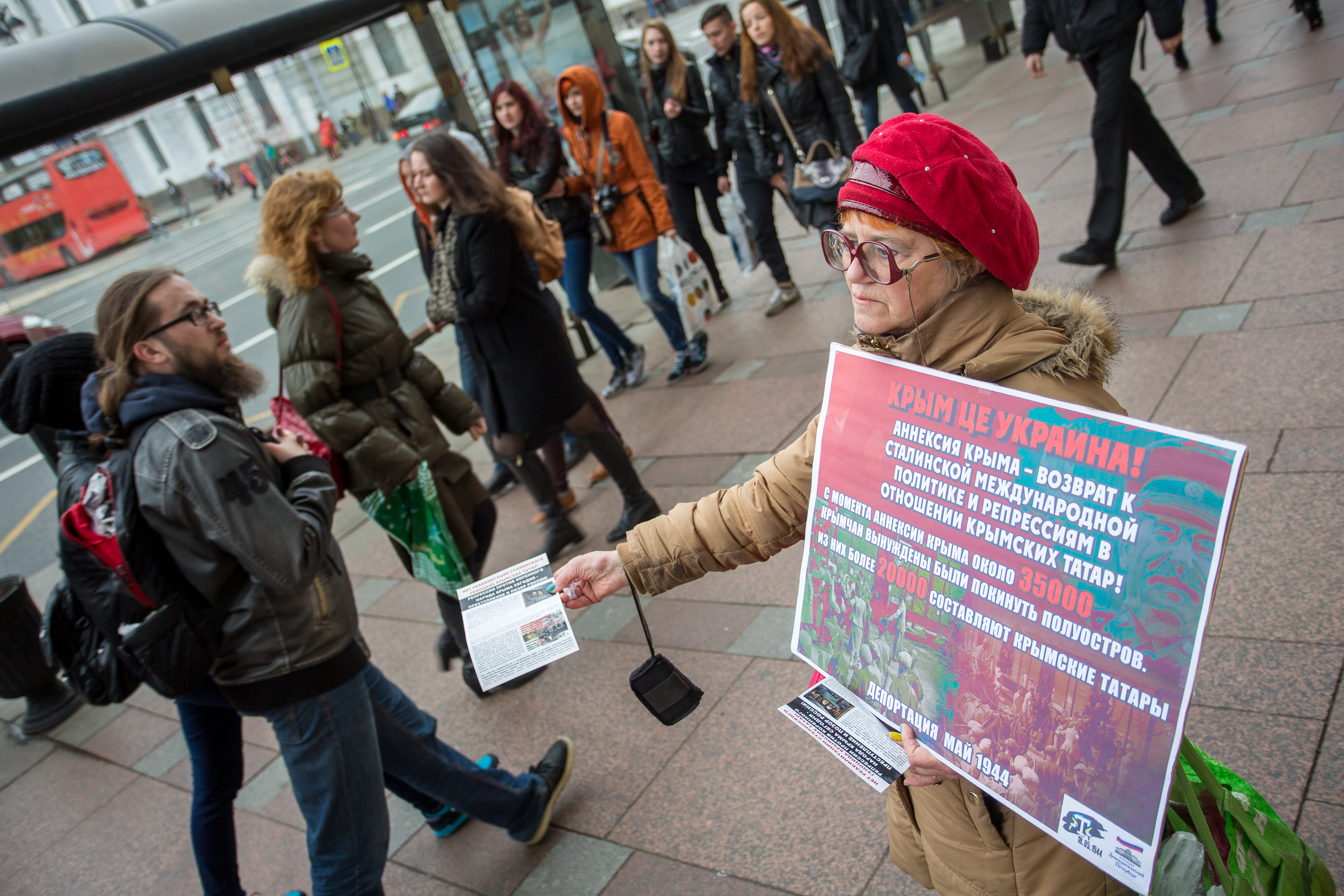
IMG_8836Picketer handing out leaflets on Nevsky Prospect, May 19, 2015

In the evening, activists gathered at Open Space to continue their commemorations. Alexandra Krylenkova, leader of St. Petersburg Election Observers, is field coordinator of the Crimean Field Mission on Human Rights.

Activists viewed a documentary film about the deportation and chatted with Asan Mumdzhi, a member of the Crimean Tatar community in Petersburg.

They also talked via Skype with Zair Smedlya, head of the Qurultay of the Crimean Tatar People. Smedlya described the current situation in the Crimea. Police arrest protesters en masse even at authorized protests and auto rallies, but generally the authorities refuse to grant permission to hold such events.

“The same old story,” muttered someone in the audience.

The current Crimean authorities have tried to turn the commemoration of the 1944 deportation into a celebration of the fact that President Putin signed a decree “rehabilitating” the Crimean Tatars on April 21 of this year.

Mumdzhi compared this to Jews being “rehabilitated” by Germans.

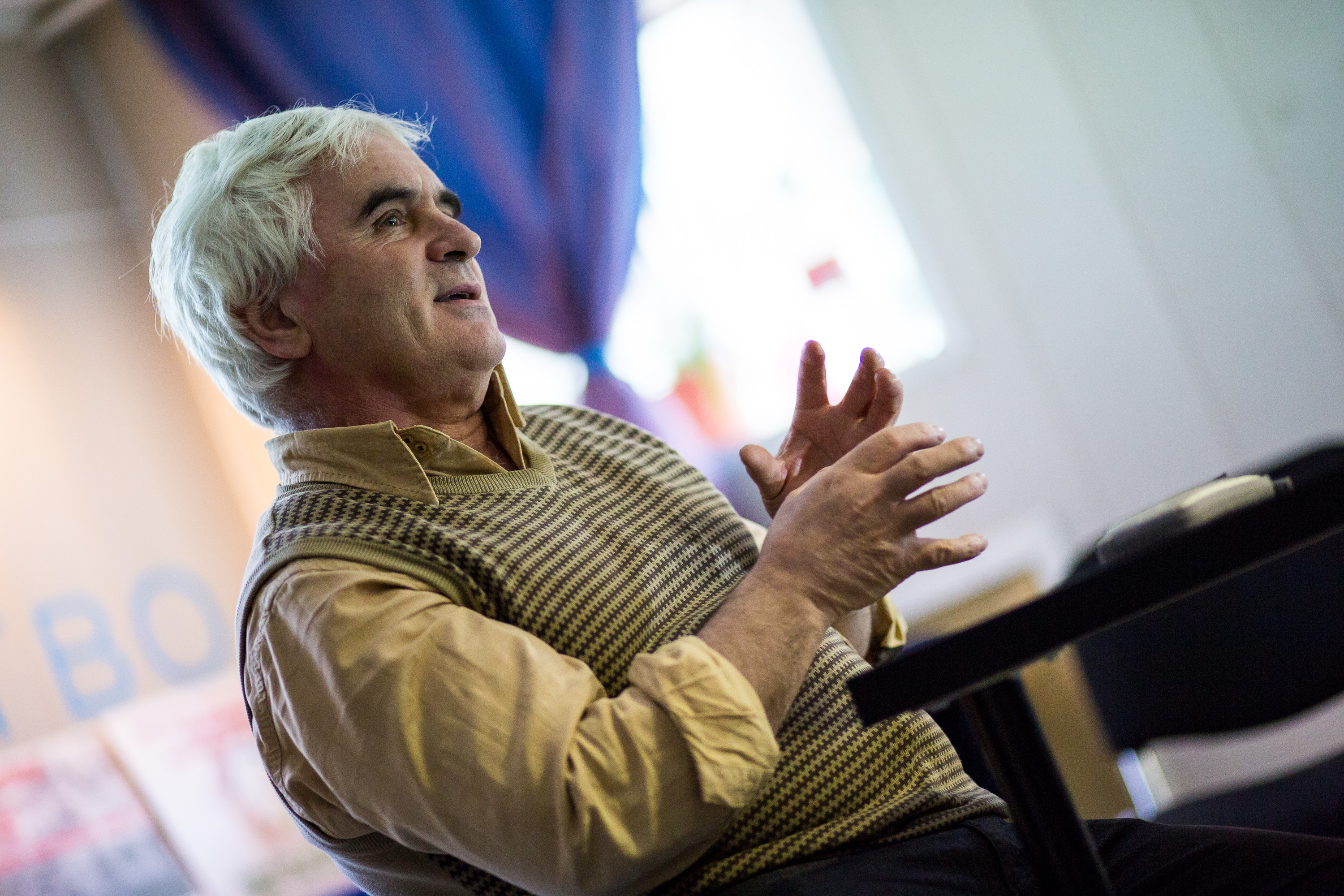
IMG_8905Asan Mumdzhi

Smedlya also claimed that people had been arrested for carrying Ukrainian flags, which is not illegal.

“Crimean policemen didn’t know the Ukrainian laws. Now they do not know the Russian laws,” Smedlya quipped.

The gathering ended with a screening of the Crimean Tatar-language film Haytarma, which tells the story of the highly decorated Soviet fighter pilot Amet-khan Sultan, who accidentally witnessed the deportation and managed to keep his family in Crimea.

 All photographs by and courtesy of David Frenkel

Migrant Labor and the 2018 World Cup in Russia

iuf.ru
Migrant Labor in Russia: From Golyanovo to the 2018 World Cup

On July 11, 2013, the Russian Federal Law “On the Preparation and Staging of the 2018 FIFA World Cup and 2017 FIFA Confederations Cup in the Russian Federation and the Amendment of Certain Russian Federal Legislative Acts” came into force without any uproar, something inadmissible in such delicate matters. (Hereafter referred to as FZ-108 for brevity’s sake, the full text of the law in the original Russian can be found here.)

While the name of the law might not sound too promising, its content opens up truly outstanding prospects for any Russian employer even tangentially connected with the 2018 World Cup. FZ-108 establishes special conditions for the employment of “foreign nationals and stateless persons” (i.e., migrant laborers) involved in the preparations and staging of the World Cup and Confederations Cup.

Article 9 Chapter 4 generously eliminates the need to obtain permits for the employment of migrant labor and notify the relevant authorities of the conclusion or termination of contracts with foreign workers, or of their arrival or departure. Nor are migrant workers themselves required to obtain work permits. Quotas for the issuance of visas and work permits are waived for those employers involved with the 2018 World Cup. Article 10 is even more interesting: it abolishes all regulation and control over the recruitment of foreign nationals and stateless persons as volunteers—that is, it practically and plainly permits employing migrants without remuneration. Article 11 exceeds all limits of generosity. It allows employers to set long working hours right in the contracts of all workers “employed in the preparation and staging of the events” (with no explanation of what that phrase means) and waives the requirements for the compensation of night work, the compensation of work on weekends and holidays, and the duration and compensation of overtime (as stipulated by Articles 154, 113, 153, and 152, respectively, of the Russian Federal Labor Code). The icing on the cake is Article 56 Chapter 14, which exempts all payments made to migrants under labor, civil, and volunteer contracts from obligatory social security and insurance deductions.

This simplified hiring procedure is a clear incentive for employers to employ foreign workers on the widest possible scale.

Here we should stop and ask ourselves to whom FZ-108 applies. The answer: any entity that is a “FIFA business partner.” By law, this means any legal or natural person in a contractual relationship with FIFA or its subsidiaries and involved in “events.” This might be a commercial partnership agreement or an agreement for provision of services, but in any case the provisions of the law apply to the subsidiaries and subcontractors of all these “business partners.”

Thus, the list of organizations with special rights vis-à-vis workers employed in preparing the “events” is very broad. We can safely include in this list the general contractors and subcontractors involved in building the stadiums, suppliers, FIFA sponsors (all thirty-four of them!), FIFA licensees (i.e., companies that have the right to use the World Cup logo on their products), firms providing security at the World Cup, and so on. Of course, all these companies have subsidiaries and contractors—personnel and temp agencies, construction and security companies, manufacturing facilities, cleaning and catering companies, firms involved in maintaining equipment and buildings, supplying brand-name goods, producing and placing ads, and so on and so forth. By the way, the recruiting agency Kelly Services is among the official suppliers of the 2014 Winter Olympics in Sochi. In light of the new law, we can easily imagine the consequences if this or any similar firm signs a contract with FIFA.

It is reasonable to assume the Russian authorities understand they will be unable to get ready for the World Cup employing only Russian citizens and are thus counting on migrant workers. Employers in construction, residential building maintenance, cleaning, retail, and other sectors where the skill requirements are low and cheap labor is the source of profits have long ago discovered this magic wand.

But we cannot help noticing that all these measures have been proposed and ratified by the same government that is literally right now organizing actual raids on migrants and imprisoning them in special camps in Moscow, Saint Petersburg, Yekaterinburg, Volgograd, Samara, Rostov-on-Don, and Kaliningrad. Does this mean that the right hand of the Russian state doesn’t know what the left hand is doing? Not in the least.

All the above-named cities are hosting the 2018 World Cup.

In accordance with FZ-108, any migrant worker needs to do just one thing to obtain legal status: become involved with the preparation and staging of the World Cup or Confederations Cup, that is, enter into an employment, civil or volunteer agreement with one of the organizers of the events, or with their contractors or subcontractors. Thus, for example, a migrant from Vietnam now being held at the camp in Golyanovo, after signing a contract with some subcontractor of a World Cup licensee manufacturing mascot dolls for the championship, will be legalized de jure. De facto, however, he or she will go back to another semi-underground workplace, but now no one will be able to exercise any oversight or supervision. Now the migrants who are liberated from slavery or buried after they burn to death in sweatshops locked from the outside will be absolutely legal. It’s a sleight of hand, as they say.

The anti-migration campaign of the authorities stokes openly racist attitudes in society, shifting public attention from societal and labor issues (which had recently come to the forefront) to the search for scapegoats. Meanwhile, there is no guarantee that the practice of stripping migrant workers who are employed in the preparations for the 2018 World Cup of their rights will not be extended to all foreign workers tomorrow, and incorporated in the Russian Federal Labor Code the day after tomorrow, thus fulfilling the most cherished dreams of the Russian Union of Industrialists and Entrepreneurs.

The fight against xenophobia, the persecution of migrants and the violation of their rights must, therefore, become one of the main issues on the agenda of the trade union and labor movement in Russia.

__________

golianovo_a

Migrants at the deportation camp in Golyanovo, which instantly became a household name. Photo © The Moscow News.

golyanovo_slaves_a

The name Golyanovo had been linked with migration even earlier, however. In the photo we see the liberated “slaves of Golyanovo,” who had been held for years in the basement of a grocery store, and their saviors from non-governmental organizations. Despite the best efforts of human rights activists, the criminal case against the slave owners has fallen apart. Photo courtesy of the LiveJournal blog Living Tomorrow.

egorievsk_a

During a fire at a garment factory in Yegorievsk, fourteen migrants from Vietnam perished. They were locked in the factory and thus could not escape to safety. A year later, punishment for the perpetrators of this crime is still a distant prospect. Photo courtesy of 1.tv.ru.