Petersburgers Protest Destruction of Mephistopheles Bas-Relief
August 30, 2015 Yodnews.ru
Novaya Gazetareports that a popular assembly to protest the destruction of a bas-relief featuring an image of Mephistopheles took place today, August 30, on Lakhtinskaya Street.
Protester with a handmade Mephistopheles t-shirt at Sunday’s rally
“This is not a rally; we are not using amplifiers and posters. People have just come out to show how they feel about vandalism,” said Alexander Kobrinsky, a deputy in the St. Petersburg Legislative Assembly.
About five hundred people attended the rally. They attached a temporary banner with a photo of the bas-relief to the facade of the building from which it had been knocked down.
The people who attended the assembly sang Mikhail Novitsky’s song, “This is our city, this is our city, / We will stand up for it! / This is our city, this is our city, / We will defend it from wild vandals!”
Folk singer and activist Mikhail Novitsky leads protesters in song
The Mephistopheles bas-relief on Lakhtinskaya was demolished on August 26. A petition has been posted on Change.org demanding that those involved in the sculpture’s destruction be brought to justice. It has gathered nearly 2,300 signatures of the necessary five thousand. [As of this writing, 4,887 people had signed the petition — TRR.]
__________
Mephistopheles Facade Facing Orthodox Church Taken Down In St. Petersburg
Anna Dolgov
August 27, 2015 The Moscow Times
A 100-year-old bas-relief depicting the mythical demon Mephistopheles has been removed from the facade of a historical building in St. Petersburg overlooking the nearby construction site of a new Orthodox church, local inhabitants said.
Mephistopheles House sans Mephistopheles
Mephistopheles is a mythical demon that appears as the devil in Johann Wolfgang von Goethe’s play Faust. The bas-relief of the character had been a feature of one of St. Petersburg’s minor landmarks, a building on Lakhtinksaya Street known as the House with Mephistopheles.
Local news outlets and social media users reported that the relief was removed from the building without explanation on Wednesday. According to one Facebook user, historian Dmitry Bratkin, the house was designed by 19th and early 20th century architect Alexander Lishnevsky.
“Naturally, the monument was under protection,” Bratkin said. “Or had been. Fifteen minutes ago, Mephistopheles was knocked off the facade.”
One resident of the building, Kirill Alexeyev, told independent newspaper Novaya Gazeta that “workers showed up at 10 in the morning, did not introduce themselves, and did not say who had sent them.”
Instead, the workers asked the building’s residents to move their cars away from the building to avoid being damaged by falling plaster, and then proceeded with the removal of Mephistopheles, Alexeyev said.
“I said: What have you done, this is after all a monument protected by the state,” he said, Novaya Gazeta reported. “They responded: Not to worry, it is old and dilapidated, and it will be restored in plaster.”
The promise of recreating a version of the bas-relief in plaster indicated that the demolition had been a “planned action,” supposedly approved by the authorities, instead of a grassroot stunt by activists displeased by the sight of a mythical demon, Alexeyev suggested.
However, a spokesperson for the city’s architectural monument preservation department, known by its Russian acronym KGIOP, denied any knowledge of the incident, Novaya Gazeta reported.
The removal of the historical bas-relief has also prompted protests by some local lawmakers. St. Petersburg municipal legislator Boris Vishnevsky has sent a complaint to KGIOP, while his fellow lawmaker Alexander Kobrinsky said he would ask police to open a criminal investigation on charges of destruction of cultural heritage sites, St. Perersburg’s Fontanka news agency reported.
Petersburg legislator Boris Vishnevsky poses with photo reproduction of Mephistopheles bas-relief
Some commentators also claimed that the removal of sculpture might be connected to the construction of an Orthodox church that would face the House with Mephistopheles.
“A couple of days ago, a cross was placed on the roof of the church that is under construction across [from the building],” Bratkin wrote on his Facebook page. “Yesterday, some sprightly people showed up and took photographs of the facade with the Mephistopheles, and today at 3 in the afternoon, a worker hung down from the roof and — whack, whack, whack.”
Russian Orthodox church currently under construction opposite Mephistopheles House
Natalya Levina, another local woman, said her neighbors had spotted “people from the church” looking around and inquiring about the “demon,” the Metro news agency reported.
Historical preservation activists have asked police and the construction firm that is building the church about who had authorized removing the Mephistopheles image, Levina was quoted as saying. Both organizations denied having any knowledge of who authorized its removal, she said, according to the report.
Lishnevsky, the architect, died during World War II after being evacuated to a hospital in Yaroslavl — a historical city 250 kilometers to the northeast of Moscow. Much of his work survived the devastation of the war and the secular policies of the Soviet Union.
The Mephistopheles bas-relief was created in 1910-1911, Fontanka reported.
All photos by and courtesy of David Frenkel. First article translated by The Russian Reader
The current regime presents itself, at home and abroad, as having brought “stability” and prosperity to Russia. Russians, the storyline goes, are enjoying the fruits of their new consumerist society, and thus social conflict, much less outright resistance to the powers that be, is insignificant. Russians are buying into this new “de-ideologized” ideology because it allows them to buy a better life.
Closer to the ground, however, the picture looks different. In fact, all over Russia, workers are struggling to create independent trade unions and improve the conditions of their work; antifascists are battling to stop the scourge of neo-Nazi attacks on the country’s minorities and foreign residents; and human rights activists, opposition activists, and just ordinary folk are working to make the country’s commitment to democracy and law meaningful (to mention only a few, obvious examples). Because the regime has a near-total lock on the media, most of these conflicts are kept out of the public view or presented to the public in a distorting mirror. And, it has to be said, the numbers of resisters nationwide are such that it would be wrong to say that society at large is (for now) gripped by a revolutionary mood.
In Petersburg, the most significant front in this “quiet” or “cold” civil war in the past few years has been the conflict surrounding the rampant architectural redevelopment of the city. The attention of observers both foreign and domestic has been focused on mega-projects such as the planned 400-meter skyscraper that will serve as the centerpiece of Gazprom’s Okhta Center, just across the Neva River from downtown Petersburg, the demolition of the city’s grand, plentiful “architectural heritage,” and the creative, nonviolent resistance mounted by such grassroots groups as Living City. Less attention is paid to efforts to prevent infill construction, which has become a particular plague in the city’s “non-classical” outlying neighborhoods, most of them built during the post-Stalin, pre-perestroika period.
These neighborhoods offer developers an advantage they cannot find in the historic center: “open” space. In reality, this means the tree-filled courtyards, gardens, and parks that Soviet city planners designed into these new estates in order to give citizens the fresh air, greenery, and recreational areas they were so desperately lacking in the densely built environment of the city center.
These “empty” spaces also present another advantage: they already have the infrastructure (gas, water, and sewerage mains, electrical grids and telephone lines, paved roads, and public transportation) that would be expensive to install in the truly undeveloped territories farther away from the center. Developers also do not have to worry about the building height regulations that still, however feebly, hold sway in the inner districts. They are also encouraged by an overheated economy whose main beneficiaries have few other avenues where they can invest their newfound wealth, and by a plentiful supply of cheap labor in the form of immigrants from the impoverished former Soviet republics.
On the administrative side, they are assisted by the “legal nihilism” of which President Medvedev has spoken so eloquently of in recent months, and by the central state’s identification of new housing construction as a national priority. (It matters little that much of the new housing created in Petersburg is functionally and nominally “elite,” meaning that is both unaffordable for most people and, in many cases, principally serves as a financial instrument for local administrations, banks, real estate agents, and buyers. I.e., it is not built as part of a social welfare program.)
In one seemingly insignificant block in the Piskarevka-Polyustrovo micro-district, in the far northeast of the city, all these factors have recently combined to destroy Submariners Garden, a large inner-courtyard grove dedicated to the memory of Soviet and Russian submariners who lost their lives in peacetime. Local residents have known about plans to build a housing complex on the site of the garden and have been resisting them since 2006. Piquancy has added to their struggle by the fact that the project is backed by the FSB, the Federal Security Service, whose officers have, allegedly, been allotted a certain number of apartments in the new buildings.
In May, the conflict went from simmering to hot when construction contractors tried to install a concrete wall around the garden. They were met with furious resistance from residents, who were assisted by local environmental and political activists. In June, further, unsuccessful attempts to install the wall sparked new stand-offs between construction workers, police, neighbors, and activists. This in turn prompted Alexander Vakhmistrov, one of the city’s vice governors and its construction “czar,” to declare a temporary moratorium on all work.
City officials and legislators also tried to calm residents by claiming that their block would be slated for “renovation”—which is what the administration has dubbed its new, ambitious program to replace many of the city’s Khrushchev- and Brezhnev-era residential buildings with new dwellings that will supposedly be built on the same sites as their dilapidated predecessors and will house the people temporarily resettled from those same buildings. The activists and residents of Submariners Garden have mostly rejected this plan, seeing it as an attempt to put a good face on a bad (con) game that never had anything to do with “renovation.”
Despite all these assurances and promises, however, in the early morning of July 21, construction workers, backed by police and “security guards” (i.e. low-level thugs), arrived at Submariners Garden and began clearing trees. Activists and residents sent out a call for help and tried to mount what resistance they could under the circumstances. They were badly outnumbered, however, and in the event, four of them, including their leader, Yelena Malysheva, were arrested. By evening, the “developers” had accomplished what they had set out to do. They had cut down all the trees in the vast, central section of the courtyard and had surrounded it with a concrete barrier.
Activists promised that the fight has not ended, but, in the absence of a solidarity network capable of reacting quickly and in larger numbers to such “fires,” it is difficult to imagine how they and other Petersburgers in similar straits throughout the city can successfully defend their homes and squares. More important, what is lacking is a compelling alternative political practice that would enlist greater numbers of people in the struggle against hegemonic “aggressive development” (Petersburg Governor Valentina Matviyenko’s coinage) and the other predations of oligarchic capital by advocating real grassroots participation in planning and socially oriented development.
Nevertheless, what prevents its emergence most of all are the many micro-practices and everyday discourses through which both the hegemons and the hegemonized persuade themselves and each other that only silly “beautiful souls,” old women, and hysterics worry about old buildings, beautiful panoramas, and humble groves in shabby Soviet-era neighborhoods. Worse, these “losers” are often represented, by politicians and the media, as paid agents of more sinister forces who wish to undermine Russia’s long-sought “stability.” In this case, as in so many others, solidarity with such unattractive types is out of the question. Everyone has more important things to worry about.
Here we present video testimony, in Russian, by some residents of Submariners Garden, Each video is accompanied by a transcript in English.
For a good summary of the day’s events and the conflict in general, see Sergey Chernov’s July 22 article in The St. Petersburg Times (which has been reproduced in full, below).
Submariners Garden, Petrograd, July 21, 2008
[Yekaterina:] Wherever we called, they told us that this was all renovation, although it’s not renovation at all—it’s infill construction. We all were against it. There were public hearings: we all signed [petitions] against this project. There was a vote for [or against] renovation: we signed [petitions?] against this renovation when we learned how it would be carried out. There are two children’s institutions here. They want to build two buildings for the FSB [and] a 150-car parking lot, which we really don’t need here.
They began working around seven-thirty. Who exactly gave them permission? This mainly comes from our governor [Valentina Matviyenko]. That is, she gave them the green light, although there is a law protecting green spaces. There is also a law about human rights in general: [one has the right] to live in one’s neighborhood and have one’s say about what will be [built] there and what won’t. We have been stripped of this right.
We have already filed a suit in the [European Court of Human Rights] in Strasbourg, and we are waiting for our case to be reviewed. What is going on here is total lawlessness: the land was sold, but no one asked us [what we thought about it].
What is at stake here is the value of the land and the value of our infrastructure (our gas mains and electrical cables), which is all ready to use. And the value of our lives: the outer walls in our buildings shake even when a freight train passes by way over there. When a truck passes by below, the outer walls here shake like crazy. We have these huge cracks in the walls, and the ceilings leak in many apartments.
This renovation is not [being done] for us; it’s for someone else. I don’t know what this is. It’s infill construction, ordinary infill construction. We, the residents of Khrushchev-era blocks and five-story houses, are simply being driven out. We have no rights.
My name is Yekaterina. I live literally in the next house over. I have been fighting here for two years. Some people have been fighting for this garden for three years—for this garden, for our green spaces, for our air. The laminated plastics factory periodically sends out fumes. All the children here have allergies. The Avant-Garde plant regularly spits out who knows what. If there is no foliage here, there won’t be any air to breathe. And if there are also going to be 150 cars here or maybe more, then I cannot vouch for what will happen to the health of our children and our own health. I have asthma myself. I cannot breathe the air downtown and I cannot live there.
[Yekaterina:] Our neighborhood has been slated for infill construction. They have slated this place for infill construction, as if it were an empty place. The law on green spaces was passed in 2004. But they slated this little patch—this beautiful, green patch—for infill construction in 2006. Isn’t that a violation [of the law]? It’s a violation. Isn’t it a violation of human rights when we speak out, when we have spoken out against [this project] more than once? They don’t hear us. No one listens to us, no one hears us.
And all the newspapers are silent. We read only articles commissioned [by the authorities or other interested parties]. [We read] that here there is a pitiful bunch of people who have nothing to do with this district. No, we live here. People have lived for forty, fifty years under these trees. How they can ignore this? We plant everything here, we clean the garden up as well as we can, and we have regular volunteer Saturday workdays. Our children ride their bikes here; there’s nowhere else for them to ride. Where should they ride? On the street, on the pavement? Our children play here, parents walk their babies in prams. What kind of demographics will we end up with if our children breathe exhaust fumes and do not see a single green tree their entire childhood?
[Old Woman:] They think they are chopping down trees. They are chopping down our lives. These trees survived the Siege [of Leningrad, during WWII]. Why are trees being felled in the center of the city? Who gave permission to do this?
[Yekaterina:] They included [this neighborhood in the infill construction program] as an empty place, not as a garden, not as a green zone, but as if there were an empty space here. We have a map on which every tree is marked. The city administration has remained totally deaf to our complaints, to our requests. They came and nodded their heads: “Yes, we’ll suspend the project. We’ll put you on the renovation list. Everything’s fine. We’re temporarily suspending construction.”
Now it turns out that [Vice Governor Alexander Vakhimistrov’s] letter ordering a temporary halt in construction was “recalled.” That is, the construction company got the green light to go ahead here. They have already been selling apartments [in the buildings planned for construction on the site of the demolished garden].
[Old Woman:] In Russian, the law is like the shaft on a wagon. They changed their minds [about whether to include our block in the] renovation program three times: first we were in, then we were out. They changed their minds about our park twice: first they included it [in the list of protected green spaces], then they excluded it.
[Yekaterina:] Nevsky Alliance [real estate agency] started selling apartments [in the unbuilt buildings] as soon as the land was sold. In a building that had not been built, apartments have been sold. They have been selling apartments right and left. People have already bought up apartments here.
[Irina Dmitriyevna:] Sixty apartments have been sold in these buildings. Nevsky Alliance is selling them.
[Irina Dmitriyevna:] Only eight percent of these apartments will go to the FSB. The rest are up for sale. That is, when they tell people that the block will be renovated, it’s not true. This is a purely commercial project.
[Yekaterina:] When the head of the local council tried to talk with Sergeyev from the FSB, she got five minutes of pure threats in response.
“You’re standing on the FSB’s land. We’re warning you for the last time. We’ll give you the full treatment if you don’t get your residents off our land.”
I am quoting Mister Sergeyev word for word. All of us were standing nearby.
[Irina Dmitriyevna:] Four people were arrested today: they nabbed them. Moreover, they knew whom to go after. They nabbed our leader, Yelena Malysheva. They [also] nabbed three others. They are active [in our struggle], but not so active as to drag them in.
[Yekaterina:] They weren’t doing anything illegal. One guy was simply standing with us on the sidewalk and was trying to prevent them from beating women. He simply grabbed a policeman by the jacket and was trying to pull him off the women. After that, he was beaten up. Yes, we tried to pull them off, and they tossed us around. They kicked our legs and punched us. They twisted our arms. Six or seven guys dragged [Malysheva] across the asphalt and threw her into the police van. Five men against one woman. She had a heart attack: they took her to the hospital.
[Yekaterina:] Maybe we will win [the garden] back and plant new trees… We still have to live here. No one is going to move us anywhere.
When the project was up for discussion, they showed us this project. The project started right from that little road, as if our houses were not there at all. That is, our houses aren’t taken into consideration in this project at all. No one intends to move us out [to new buildings] or repair [our houses]. Our houses shake as it is, and we don’t know what will happen if they start building here. There is quick clay everywhere. Our gas main also lies on top of this quick clay, unless they end up re-laying it. If they begin building here, we don’t know what will happen. That is the geodesic situation. I suspect we will lose everything.
[Woman:] Seryozha wouldn’t hurt a fly.
[Yekaterina:] He wasn’t doing anything. He was just trying to defend [Malysheva]. [They are] impudent men. Look over there at our beauty. [Points to a falling tree.]
[Yekaterina:] How can we hold on? How can you can hold on when strapping guys beat up women and old ladies?
This is what the deputy head of the [local] administration said. “Hold on a little longer. We’ll help you and get to the bottom of this.”
They are still getting to the bottom of this. When all that is left here is a wasteland, and they start building houses on it, that is when they’ll get to the bottom of it.
[Yekaterina:] They almost cut off his arm with those chainsaws. They were just swinging at him with those saws.
[Yekaterina:] They—the entire mainstream press, the radio stations—officially announced that we had started a riot here. There was no riot. We simply surrounded the construction workers and got them off their equipment. None of us struck a single blow.
Half of them left on their own. They just left everything and turned off the compressor they had been using when they were welding the fence together. Everything was calm and peaceful: there was no riot. The riot began when the police showed up and began beating up the old women who were trying to stop the equipment from getting through. That is when the riot—old women versus the police, if you can call that a riot—began.
[Old Woman:] I said to them, “Who are you fighting? Look at me: I’m eighty-one years old.” He grabs me by the arms and tries to drag me away. All we did was stand in front of the crane so that it couldn’t get by us. How they were tossing us away from that crane, our police!
[Yekaterina:] That’s how our police defend us. People from the FSB arrived; they stood around and observed. Anything happens and they come flying in at the drop of a hat. Last time, when we began to push the fence over, a lot of people got taken down to the precinct. Because last time the fence was illegal however you look at it. [The construction company] was told to take it down, but they didn’t take it down. We tried to push it over: half the green activists were arrested for “unlawful actions.” Putting a fence up without a permit, that’s not unlawful. But pushing it over turns out to be unlawful. That is how the law is interpreted in Russia. Whatever is profitable, whatever is sold, that is legal. But what ordinary citizens, poor citizens, the people, pensioners, ordinary workers and clerks want, that is against the law. Because what they want is not in the financial interests of our powers that be. The regime here is antidemocratic [against the people]. Our authorities are antidemocratic. I have become wholly convinced of this. I don’t believe there is any social safety net, I don’t believe they are worried about demographic growth. What kind of demographic growth will there be if children have nowhere to play?
[Old Woman:] We have no authorities: there is a power vacuum in the city. A total absence of authority. And the power of moneybags. The guy who stole a lot of money, he is the power.
[Ykaterina:] We don’t have democracy; we have oligarchic capitalism. And this is real proof of that. This isn’t a democracy; this is antidemocratic. It’s so antidemocratic. This is visible proof that here, on this lot, oligarchic capitalism has triumphed.
[Old Woman:] Matviyenko promised to make the city green. This is how she is making our city green. Vakhmistrov wrote that there were 16.5 square meters of greenery per person, and by the end of 2008 there would be 20 square meters of greenery per person. Vakhmistrov said this: I still have a copy of the newspaper. Is this how he intends to produce 20 square meters per person?
[Yekaterina:] We gathered 1600 signatures against this. 1600 signatures.
[Old Woman:] They took them to the Smolny [city hall] a few days ago. The police barely let them in. Matviyenko didn’t receive them. [Her assistants] gave her the packet with the signatures. And what did we get in reply? Silence and our trees cut down.
[Yelena Fradkina:] As one of the developers put it, “You’re lumpens.”
[Yekaterina:] They told us this outright: “You’re lumpens. You won’t be able to do anything. We bought this land. Go home, you lumpens, and keep your nose out our business.”
[Other Woman:] “We’ll bury you here, and we’ll build here all the same.”
[Yekaterina:] They will bury us. They will bury us under the ruins of our homes, which will collapse when construction begins.
[Old Woman:] This house is forty-three years old. A prefab building, and forty-three years old. It has not once undergone major renovations. It’s barely standing as it is. What will happen when they begin driving piles in the ground? It’s the same with these five-storey houses. We’ll end up homeless.
[Yekaterina:] Even if they drill them in. The railroad is over there, behind the hospital. When a train passes, my windows shake, the outer wall shakes. What if they begin drilling here? The soil here is quaky. There is quick clay here, quick clay there. There is unstable karstic sand here.
[Yelena Fradkina:] There is vegetation here, greenery, but they don’t understand greenery. The only greenery they understand is dollars. Now that is “greenery,” but this?
[Old Woman:] Vakhmistrov came here. He stood over there and looked at all this. He said, “I don’t see any trees: this is an empty lot.” That’s what Vakhmistrov said right to our faces.
[Yelena Fradkina:] One of their ladies was quoted in the papers (in Novaya Gazeta, I think), one of the developers who has been walking around here. “We could spit on your children, your old people, and your trees. We’re going to build.” What is there to say to that?
[Yekaterina:] The first public hearing was about reconstruction, about resettlement. Infill construction wasn’t discussed at all. When they showed us this project they announced that this was the second hearing. [NB. Russian law requires two public hearings before a construction project can go ahead.] Naturally, we didn’t recognize this second hearing as legitimate. We said that there had been no initial hearing on the project, and nothing was decided during the second hearing. We were categorically against any and all projects. We were totally against any construction in our courtyard. When they tried to palm off this document on us—“Are you for or against renovation? Send us your comments” (they simply circulated this document in our buildings)—we explained to everyone that [the authorities] were trying again to foist infill construction on us under the pretext of renovation. Once again we marked “against” [on the forms], and we went around [to residents] and gathered signatures. We gathered statements from people saying they were against the project. Everyone was against it. But the land had already been sold. So what is the use in our being against this? Who is going to listen to us?
There were constantly these sham members of the public at the hearings, people who aren’t registered in this district, who do not live here. They were just alcoholics who hollered louder than everyone else, “I’m for [the project because] I’ll get resettled.” No one is going to be resettled. The only people who are for the project are the ones whom they tricked by telling them they would get apartments [in exchange for their support]. But for the time being no one is resettling us anywhere, and no one intends to give us apartments. In short, people were simply conned. Even the ones who put down their signatures “for” the project and live on this block, they have simply been conned. Conned in the most elementary way.
They conned us and lied right to our faces. “This [building project] will pay for your resettlement.” “What’s with you? Do you not want your district to be improved?” And many people [fell for this] Or rather, most people didn’t. The majority, the people who have been actively participating [in the protests] [are against the project]… But everyone is at work for the most part, from morning to evening, doing twelve-hour shifts. And so not everyone can take part. Not everyone can actively support [our cause].
So now they simply picked the right moment: half [the neighbors] are at their dachas, half are at work, and it is a Monday. And this is the outcome. The police arrested the kids from the youth organizations [anarchists and National Bolsheviks] who have been supporting us, and their trials are today. They are being tried for these [protest] actions. [They are being tried] for our courtyard, for the fact that they came to the defense of our green spaces and, generally, for defending a normal human life. Their court hearings are today, and that is why they could not come. [The construction company and the authorities] chose the moment, on purpose, so that we wouldn’t be able to do anything. And they will say again that this was an empty spot. The police are standing over there smiling impudently. There you have it.
[Old Woman:] 1600 signatures against renovation. 1600. They didn’t let them into [the Smolny]. A woman came out to meet them at the entrance. She took a look [at the petition] and said, “Okay, maybe. We’ll take it into consideration.” But we haven’t got a response to the documents that were delivered to Matviyenko in the Smolny. We have not heard anything from the Smolny, but meanwhile here they’re already [cutting down the trees]. [The builders] know quite well that they have to break through [our resistance] while no clear decision has been made yet [in the Smolny]. And there [in the Smolny] they are waiting for them to break through. We understood this quite clearly, too. [Matviyenko] and Vakhmistrov are on vacation: how is that? Because [the builders] were told, “If you break through [the residents’ resistance], then you will be in the right here.” And now they have broken through.
They made preparations. They were walking around here for a whole week, surveying everything, and checking everything out. They smiled mockingly at us; they greeted us in this insolent way. And today they are executing all the plans they made over the last week.
Why should they wait for Matviyenko’s decision, for the Smolny? Because they know that the Smolny will decide in their favor all the same, not in ours. Nowadays, the city’s inhabitants are just mud that gums up the works. They’ll knock down our buildings and send us God knows where, beyond the city limits.
Most of the people who live here are native Leningraders. They are quite sharp-tongued and have to be sent away from here.
[Off-screen Voice:] Yeah, there are no New Russians here for sure. Everyone here is a local.
[Old Woman:] Everyone is a local, everyone has worked hard for what they have. And now, in our old age, this is what we get.
When we were young, the war hit us. At least then it was the Germans who attacked us. They were foreigners: we understood who it was that wanted to break us. But we defended Leningrad. Half of our families remained here to lie [in this ground]. The trees stood their ground with us, too.
During the Siege we didn’t cut down trees. People were dying of hunger and cold. They burned furniture, they burned their own books. I lived in wooden houses on Krestovsky Island. Later, we were moved into large buildings, and these houses were leveled and the logs were used for fuel. But not a single tree was touched. Do you have any idea how many trees there are on Krestovsky? They all survived the war, and these trees here also survived the war. But now our new rulers [do things this way], with one flourish of Matviyenko’s pen. If she had come here just once. We asked, “Look at what you’re signing. Why are you doing this?”
Vakhmistrov tells her, “It’s an empty lot.” Okay, people are endlessly asking her to sign things, they are trying to get in to see her. One [TV] channel, then another channel show that there is a park here, that people are struggling [to defend it]. Why does she [act this way]? It was easier to get an audience with the czar than it is to get in to see Matviyenko.
[Old Woman:] First it’s one law, then it’s another. First they put [our garden] on the protected list, then they take it off. First they put us in the renovation program, then they take us off. Then they put us back in. What kind of mockery is this? How long can they mock the people? How many little blazes like this are burning all over the city? Are they waiting until this flows together into one [great blaze]?
The Russian people takes its time getting into the harness, but then it travels quickly. Do they understand this or not? Why are they pushing people to extremes?
Okay, we are old. But we have children and grandchildren. They will come home from work now and see this; they’ll hear our stories. Do they really think the people will be silent forever? The people won’t be silent.
[Vladimir Dmitriyev, deputy in the Saint Petersburg Legislative Assembly, member of the Communist Party of the Russian Federation:] [I was just at Vice Governor Alexander Polukeyev’s office, because Vakhmistrov isn’t here, he’s on vacation. Polukeyev called Roman Filimonov, chairman of the city construction committee, into his office and told him that they had cut down around twenty trees here. [Filimonov] says to me, “Vladimir Yakovlevich, they’re cutting down only old, rotten poplars.”
[Residents:] Go there and look for yourself. Those are birches, maples. . .
[Dmitriyev:] . . . And he says that last week he met with the residents, that he carefully explained everything to them, that people understood everything. . .
[Residents:] Scoundrel.
[Dmitriyev:] . . . true, there were a few individuals who didn’t quite get it.
[Residents:] What a liar. What impudent lies. What an impudent liar. We were promised renovation, but what is that, “renovation”? We were against renovation, we signed a petition against it. 1600 signatures were submitted to Matviyenko in the Smolny.
[Dmitriyev:] I now asked Polukeyev—they went to Pushkin to do an inspection with Matviyenko—I asked him to personally report to her about what is happening here: three people were detained, arrested. . .
[Residents:] Four people. None of them has been released yet. One woman’s heart started acting up, but they are holding her at the police precinct.
[Dmitriyev:] Which precinct?
[Residents:] The 61st Precinct. [The police fought with us.] They dragged her on her back through a puddle. Six guys beat her up and threw her in a police van. We are all witnesses. The boy got a concussion: what do you call that?
The important thing is to stop this somehow: they will destroy our entire courtyard. Can you stop this? Do you have the power to stop this?
[Dmitriyev:] No, of course not.
[Dmitriyev:] [At the moment, it looks as if they have badly] deceived us. Vakhmistrov said, “Include this block in the renovation zone. At the very first session [of the city government?] I’ll raise the issue of”—they’re planning to build not one building, but two buildings for the FSB; for the time being we are talking about two buildings—“We will table this issue then: the administration’s decision to permit construction of these two buildings is declared null and void, and this entire block goes into the renovation zone.”
This is what you were also talking about now. First, there is a search for investors, and then a project proposal. Before a proposal is made, each resident is surveyed and everyone comes to a common denominator. When everything suits everyone, only then do people move from the blueprints to working directly on the lot. And that is what Vakhmistrov [said] to us about this. . . I’ve just come from the Smolny. I sat there for an hour and half waiting for the small cabinet meeting to end.
[Residents:] Stop this before they have cut down all the trees. Can it be stopped?
[Dmitriyev:] I’ll say it again: no one is going to stop this. The highest-ranking official in the city right now is Polukeyev. He said to me, “Vladimir Yakovlevich, you know that this isn’t my issue. It’s Vakhmistrov’s issue, and he is on vacation now. I’m taking care of some of his affairs, but I don’t have a total handle on this issue.”
I said to him, “Then inform Valentina Ivanovna [Matviyenko] right now, when you’re on the bus (they’re going to Pushkin). Lawlessness has broken out again. They’re grabbing people, beating people, and this is happening in plain view.” He said, “Okay, fine.” Then he summoned Filimonov. Filimonov told me that after lunch (he has a meeting now, and people have been called in), right after lunch he will come here himself and have a look.
[Residents:] There is no longer anything to look at. Everything will be chopped down [by the time he gets here].
[Old Woman (looks at the square being destroyed):] Accursed bandits. Bandits. The park stood here for sixty some years. It survived the Siege. And these scumbags. . . A band of thieves.
P.S. A quick glance at the website of the Nevsky Alliance real estate agency confirms many of the fears and arguments of the residents of Submariners Garden. The colored illustration of the future apartment blocks does not include the houses currently on the site. More amazingly, this is how the agency describes the location:
“Compared to other northern districts, the Kalinin District has a quite well-developed social infrastructure. It is characterized by a satisfactory ecological climate [and] a sufficient number of parks and green spaces. The Piskarevka-Polyustrovo micro-district, where the new house is situated [note the use of the present tense: the house has not even been built], is not far from Pioneer Park and Academic [Andrei!] Sakharov Park.”
And, we should add, at 60,400 rubles (1,648.38 euros) per square meter, it’s a steal.
___________
This past winter, Sanoma Independent Media closed the St. Petersburg Times, the city’s only English-language newspaper, which had been published for over twenty years. Sanoma Independent Media also switched off the newspaper’s website, so its invaluable online archives have gone invisible as well. I am thus extremely grateful to reporter Sergey Chernov for providing me with the copy of his July 22, 2008, article on the conflict in Submariners Garden.
Disputed Submariners Garden Hit By Police, Demolition Begins
By Sergey Chernov
STAFF WRITER
The St. Petersburg Times
July 22, 2008 (page 2)
Backed by dozens of policemen and hired guards, a construction company invaded Submariners Garden (Skver Podvodnikov) on Monday to fell trees and install a concrete fence around the perimeter. A number of the area’s defenders were beaten and arrested, according to residents.
Located at the Block 43 Polyustrovo in the north of the city, the garden was named to commemorate Russian submariners who died in non-combat operations after World War II. When visited early afternoon on Monday it had already been partially demolished.
Old women cried as another massive tree trunk fell under the chainsaws and axes of the workers, who were encircled by the policemen and guards. “I planted these trees during the war,” said one. “During WWII, we defended the city, but then it was from foreigners, so it was more clear-cut; it’s worse now,” said another. The defenders said the company’s representatives failed to present any documents showing they had permission to perform the work.
Earlier in the day, four activists who tried to protect the trees, including Yelena Malysheva, leader of the local residents group, were detained by the police and taken to Precinct 61, the residents said, adding that the detainees had also been beaten.
“We tried to stop it, but the police started to beat us,” said local resident Yekaterina, who only gave her first name.
“We were also beaten by some strange men, allegedly from a private security firm. They didn’t identify themselves or show us any papers.” One defender was hospitalized with concussion, while another experienced heart problems, according to the residents.
The latter was also later hospitalized.
“Courageous women have been on watch here every day from morning to evening,” said Yelena Fradkina, a translator and local resident.
“We stopped them before, but today they brought so many men that we couldn’t do anything. Since 8 a.m. we’ve just been standing here, watching [the destruction] and crying.”
Listed in the city’s official register of public parks and green spaces, Submariners Garden, which includes a monument, a memorial oak lane, a playground, and hundreds of trees, has been under threat since 2006, when it became known that developers had plans to build two to four apartment buildings on the site. The apartment buildings have been ordered by the Federal Security Service (FSB), the successor to the Soviet KGB, according to the construction company, Stroikompleks XXI.
Direct confrontation with the authorities and developers began on May 23, when Stroikompleks XXI attempted to erect a fence around the garden. Since then, residents have been guarding the area and on several occasions have tried to stop the workers, who were escorted by guards and the police. Multiple protests and rallies have been held.
Arrests and beatings were reported on several occasions in June when the company attempted to resume work.
Then, on June 17, Vice Governor Alexander Vakhmistrov asked the company to stop any work in the area “due to heightened social tension.” Last week, the residents were promised by the authorities that no work would be undertaken at least until September, when a “renovation” plan would be put into action, instead of the infill construction attempted by developers.
“They deceived us,” said Vladimir Dmitriyev, a Communist Party deputy in the Legislative Assembly, who arrived at the scene on Monday.
According to Dmitriyev, Vakhmistrov was on vacation while Governor Valentina Matviyenko was scheduled to inspect Pushkin, in the south of the city, in the afternoon. He said his faction would appeal to the Prosecutor’s Office to inquire into the construction company’s “unlawful” activities.
The works in the former garden continued, as this issue went to press, with virtually all the trees cut down and the workers surrounding the area with a concrete fence, according to a telephone report from a local resident.
“Of course, it all comes from Matviyenko. [What happened today] means she gave the go-ahead, despite the law protecting parks and gardens, and in violation of our human rights,” said Yekaterina, adding that the garden was the residents’ only protection from the poisonous smoke emitted by local factories.
The residents also worry that construction will adversely affect their fragile Khrushchev-era houses (many of which were built hastily in 1961), as well as gas and sewage works that were designed to serve only a limited number of buildings.
__________
Editor’s Note. I have reprinted this post from seven years ago (which was originally published on Chtodelat News, a blog I edited for a little over five years, and cross-posted the same day on this blog) for a few reasons. First, because I think it is the best thing I ever did on a blog, despite myself, and despite the disparaging remarks I will make about it, below.
However, it never got the attention it deserved, neither then nor since, although it tells you everything about the Putin regime in a nutshell and what many perfectly invisible, ordinary Russians thought about the regime and still think about it now.
I suggested to the nominal publishers of Chtodelat News that they reproduce the post in an anthology of their own written work they were compiling for a big show at an important art institution in London, but was told it “didn’t fit the format” of the planned publication. Although, at the time, the vigorous efforts being made by grassroots groups in Petersburg, Moscow, and all over Russia to push back against things like infill construction and “neighborhood revitalization” (but not only these things) were the biggest story in Russia, and should have got a lot more coverage everywhere else, and a lot more solidarity from leftist intellectuals and creatives back here at home.
But it was not until the much sexier, endlessly self-enamored (and virtually nonexistent) “Snow Revolution” of 2011–2012 that the international media big guns started cranking their rusty turrets in the direction of Moscow (although not anywhere else in Russia, really) because the “revolutionaries” feebly taking to the streets to oppose Putin’s return to the Kremlin and faked election results were supposedly “middle class people just like us and our readers.”
As you can gather from the videos shakily shot by me with a crappy camera, the resisters at Submariners Square were not sexy or middle-classy enough to warrant such top-flight coverage, although the story got (more or less biased) coverage from local media, especially then, because stories of corrupt city officials allied with greedy developers versus folks from all walks of life defending Petrograd’s historic built environment, whether tsarist, modernist, Stalinist or post-Stalinist, from the wrecking balls, was the hot button topic in town at the time.
All the Submariners got “internationally,” however, was my half-assed blog post and an excellent article, also reproduced here, by the stalwart chronicler of alternative culture and the political grassroots in Petersburg, veteran reporter and photographer Sergey Chernov, most of whose efforts from that period have been reduced to naught, as I have already mentioned, by Sanoma Independent Media’s decision to turn off the website of the St. Petersburg Times and thus kill off at least ten or fifteen years of the city’s political, social, and culture history for people who do not read Russian.
By republishing this post, I do not want to suggest that the ultimately futile defense of Submariners Garden was a revolutionary or utopian moment, or a historical bifurcation point, where the wrong turn was taken by society at large, because, first, there have been zillions of such turning points over the past twenty-five years, and the wrong turn has been taken, collectively, at nearly all of them, and second, the mood at the time was black as pitch in any case, not upbeat.
Who knew that it would only get blacker? I think I did. If only because if you are the powers that be, you cannot continuously lie to ordinary people and grind them into the dirt time after time without it finally going to your head and making you think you can get away with anything. Which is what is happening right now.
And if you are the “vanguard of the proletariat” (the anti-Putin intelligentsia, whether leftist or liberal) you cannot continually opt out of such little skirmishes because you have a conference in Budapest to prepare for or an article to write for a Marxist journal published in Chapel Hill, because, in the end, you will wind up in a totally different moral and mental universe from that of the “lumpens” whose testimony we see and hear in this post. Not, of course, that all local leftists and liberals took such an escape route then. To their credit, many still have not.
But the most compelling reason for republishing this post is to show the world at large that ordinary Russians (i.e., “Putin’s base”) are well aware of how things are done in their country, are perfectly capable of puzzling out who profits and who gets shafted by this state of affairs, and even, God forbid, of sometimes organizing themselves and putting up a fight without some newfangled twenty-first-century Lenin leading them into the fray.
That is, they are hardly “lumpens.”
What is strange to me is that the powers that be and the so-called intelligentsia (liberal and leftist) either do not know this or pretend not to know it. And yet they chatter endlessly about these mostly fictional creatures, “the folk” (narod), either in their supposed defense or, on the contrary, to blame their fabled benightedness for all their country’s woes.
What is most amazing is that all this chatter and flagrant manipulation is thought, by the powers that be and the intelligentsia, to constitute “politics,” “political discourse,” and “populism” in Russia.
Woe is them.
P.S. According to an acquaintance who went to school in the neighborhood, those FSB residential buildings did finally get built. This is borne out by Wikimapia, which shows two buildings, euphemistically entitled the Family Residential Complex, occupying the spot where Submariners Garden once flourished, which Wikimapia does mention, to its credit. It also correctly identifies the developer as the Leningrad Regional Directorate of the Federal Security Service.
The original text of my introduction and the testimony of the residents have been lightly edited to make them more readable.
Vista of Vasilyevsky Island’s Bolshoi Prospect Blocked by Western High-Speed Diameter Pylons
July 9, 2015 Kanoner
The pylons of a bridge currently under construction as part of the central segment of the Western High-Speed Diameter tollway have encroached on the vista of Vasilyevsky Island’s Bolshoi Prospect. People with good eyesight can see them from the First Line, on the far eastern end of the avenue.
Fishermen say farewell to their view of the Baltic Sea on a warm May day as the Western High-Speed Diameter’s pylons emerge from the murky depths of the Gulf of Finland. Gavan, Vasilyevsky Island, Petrograd, May 2015. Photo by the Russian Reader
Construction of the tollway’s central segment, which links the Ekateringofka River Embankment and Primorsky Prospect, began in 2013. The general contractor is Northern Capital Thoroughfare, Ltd. The length of the segment is approximately twelve kilometers. According to the investment agreement, it it must be delivered in 2016.
The main segment of the highway will pass over the water on a flyover designed by Stroyproyekt Institute JSC. One part of the thoroughfare is a cable bridge spanning the shipping fairway in the mouth of the Neva River. Pylons are now being erected for the bridge. Two of them are exactly aligned with Bolshoi Prospect on Vasilyevsky Island, it turns out. They are clearly visible both from Gavan (the western section of Vasilyevsky) and from the first Lines, and this despite the fact that currently they have been built to a little over half their projected full height.
Recent Google satellite image showing the emerging cable bridge section of the Western High-Speed Diameter tollway, the mouth of the Neva River, and the southwestern tip of Vasilyevsky Island, including Bolshoi Prospect
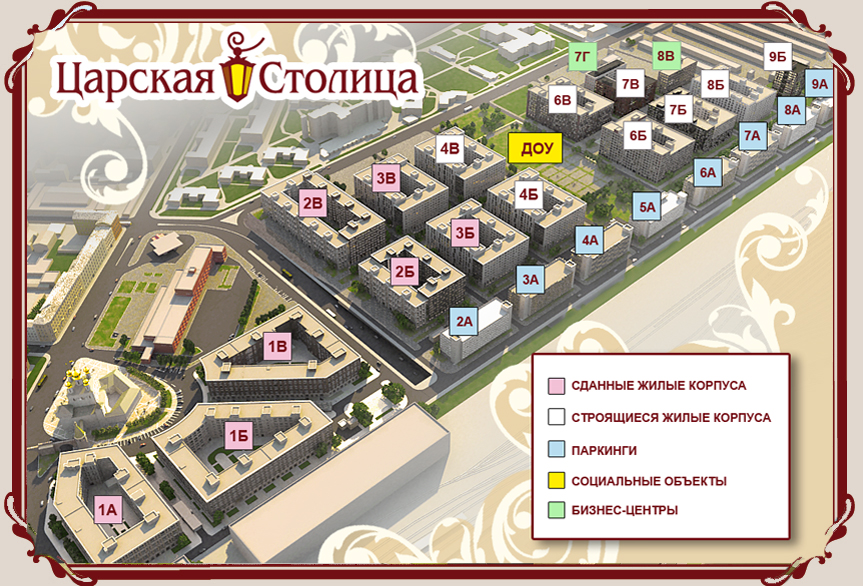
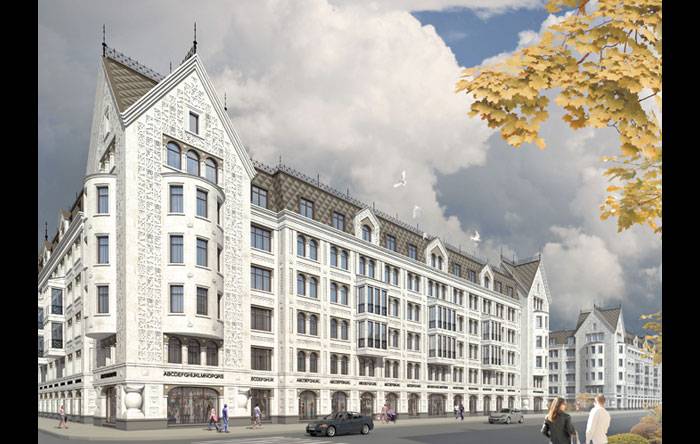
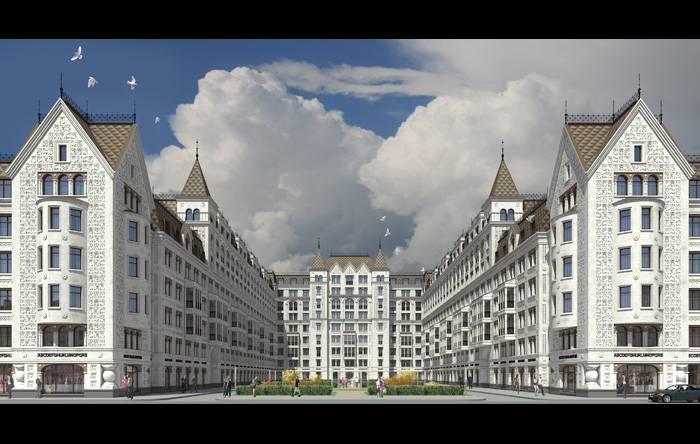
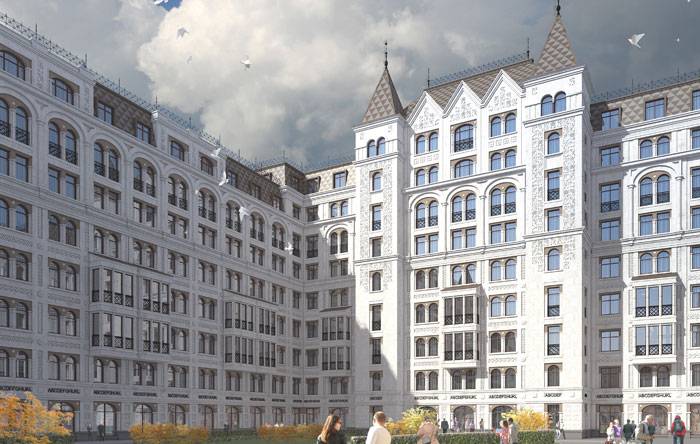
Artist’s rendering of Tsar’s Capital residential complex, currently under construction near the Moscow Station in downtown Petersburg. Image courtesy of LenSpetsSMU developers
_________________________
Hovard Palace Residential Building Encroaches on Vista of Socialist Street
May 13, 2015 Kanoner
Hovard Palace, a residential building currently under construction at Zagorodny Prospect, 19, has significantly encroached on the vista of Socialist Street. It has also changed the look of neighboring Jambyl Lane.
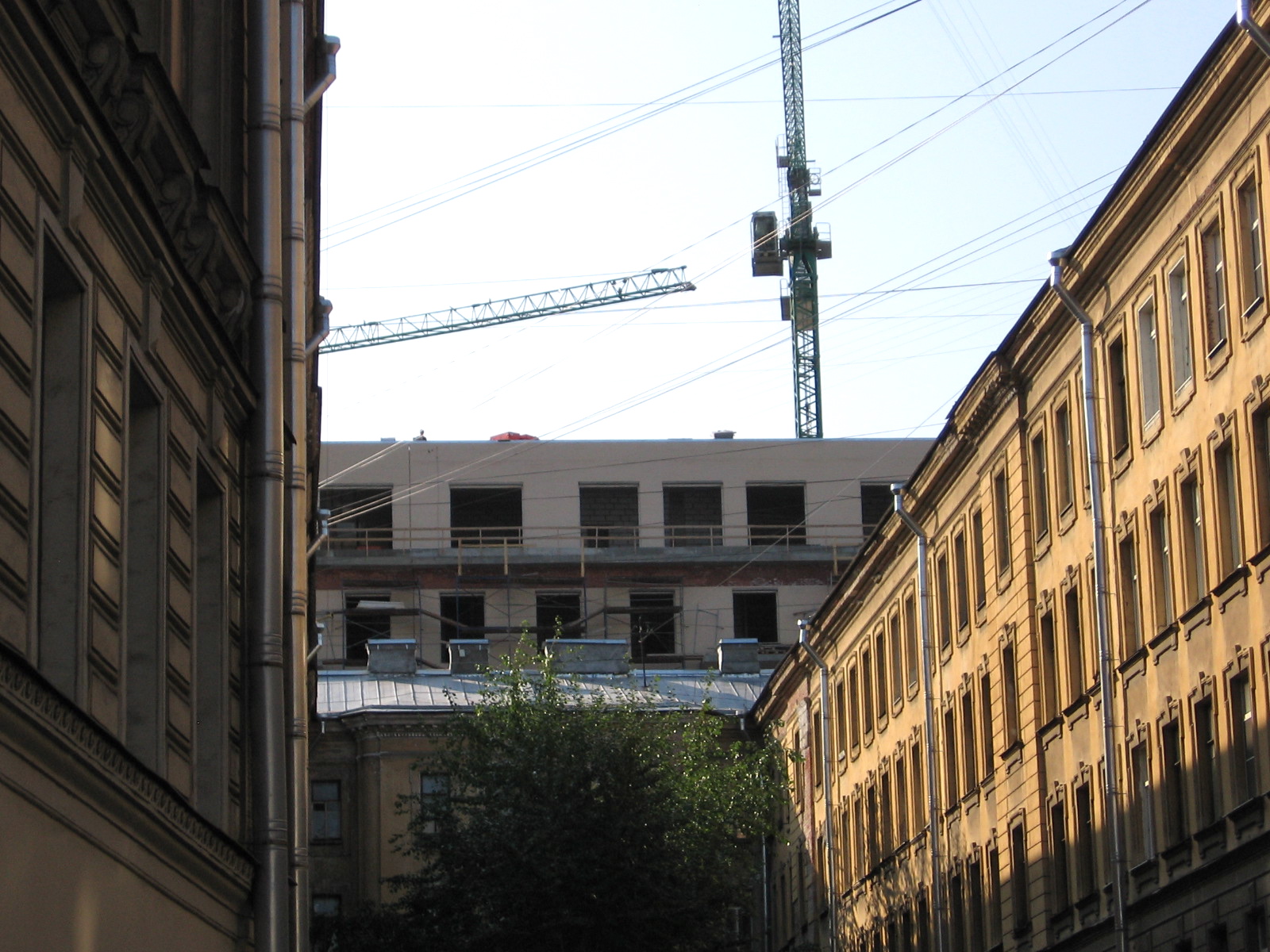
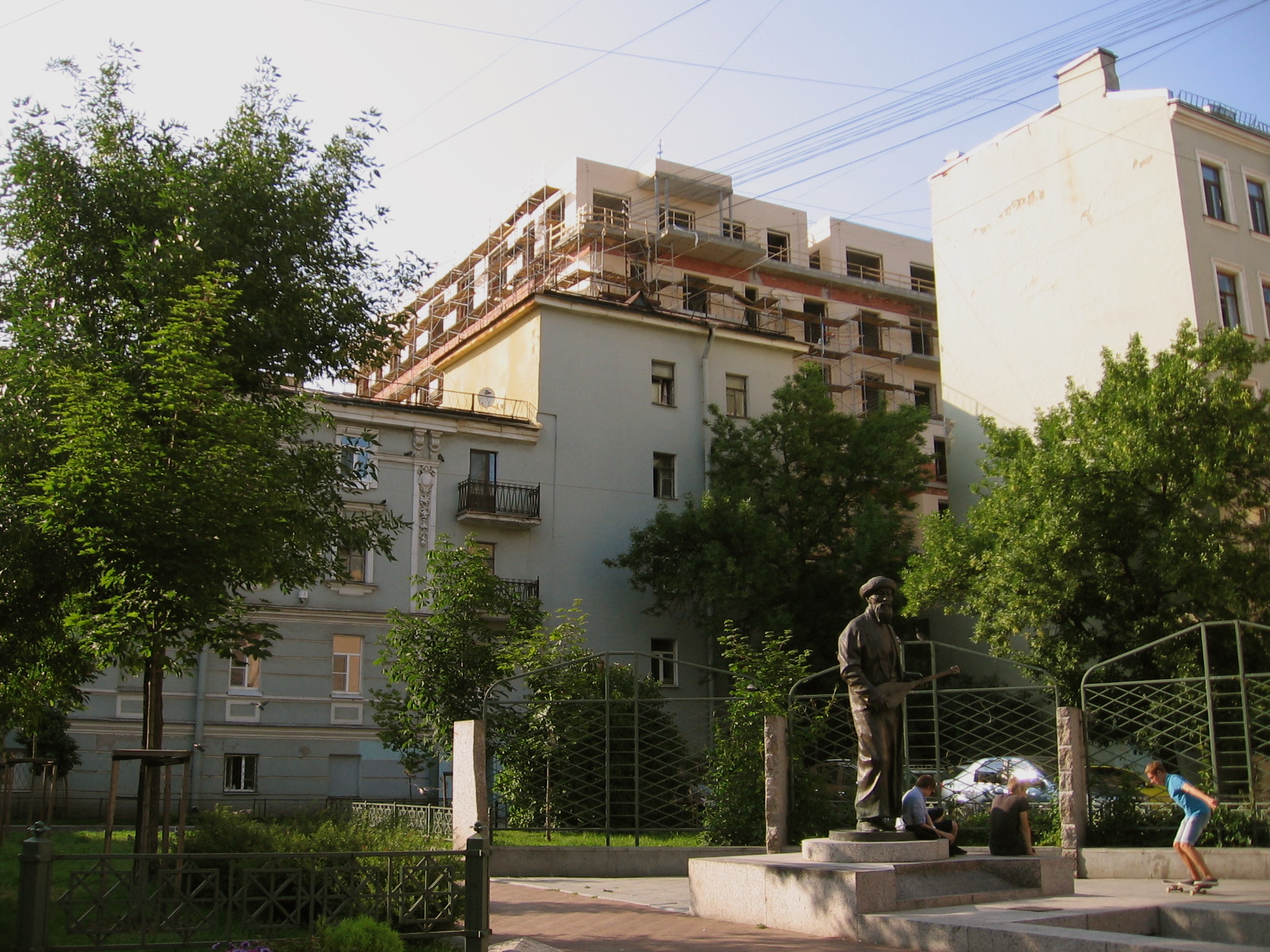
Hovard Palace, currently under construction, rises high above the end of Socialist Street. It is clearly visible from the other end of the street, half a kilometer away. Photo by the Russian ReaderHovard Palace towers above a a square named in memory of the revered Kazakh traditional folk singer Jambyl Jambayev, situated on a lane bearing his name. Photo by the Russian Reader
To make way for the elite complex, a pre-Revolutionary building originally designed as a block of rented flats for State Bank employees was demolished. The five-storey house was built in 1898–1901 and designed by architect Heinrich Bertels. After investor Hovard SPb, Ltd., took an interest in the site (according to rumors, the company has personal ties to former Petersburg governor and current Federation council chair Valentina Matviyenko), residents of the dormitory that had been housed in the Bertels building were forcibly evicted to the village of Shushary, outside the Petersburg city limits. [Translator’s Note.The June 2012 linked to here paints a slightly more complicated picture of how the now-demolished building was resettled.]
City hall officials categorized the forced relocation as having public significance. This was preceded by a personal memorandum from Valentina Matviyenko, in which she wrote, “The site has public significance. Work to find a solution.” The memorandum was addressed to three deputy governors.
This “public significance” made it possible for Hovard SPb to avoid complying several provisions of the law. In particular, it was allowed to demolish the building (although the demolition of pre-Revolutionary buildings is expressly forbidden), and construct the new building higher than stipulated by local height zoning regulations. The environmental impact analysis was conducted by Devros, Ltd., which is directly linked to one of Valentina Matviyenko’s people, Alexei Komlev, ex-deputy chair of the city’s Landmarks Use and Preservation Committee (KGIOP). The analysis show that the new building would be visible behind neighboring buildings, but within tolerable limits.
The eight-storey [sic] residential building was designed by Moscow architect Mikhail Belov. Soyuz 55, Ltd., run by Alexander Viktorov, former chief architect of Petersburg, adapted Belov’s design to local conditions [sic].
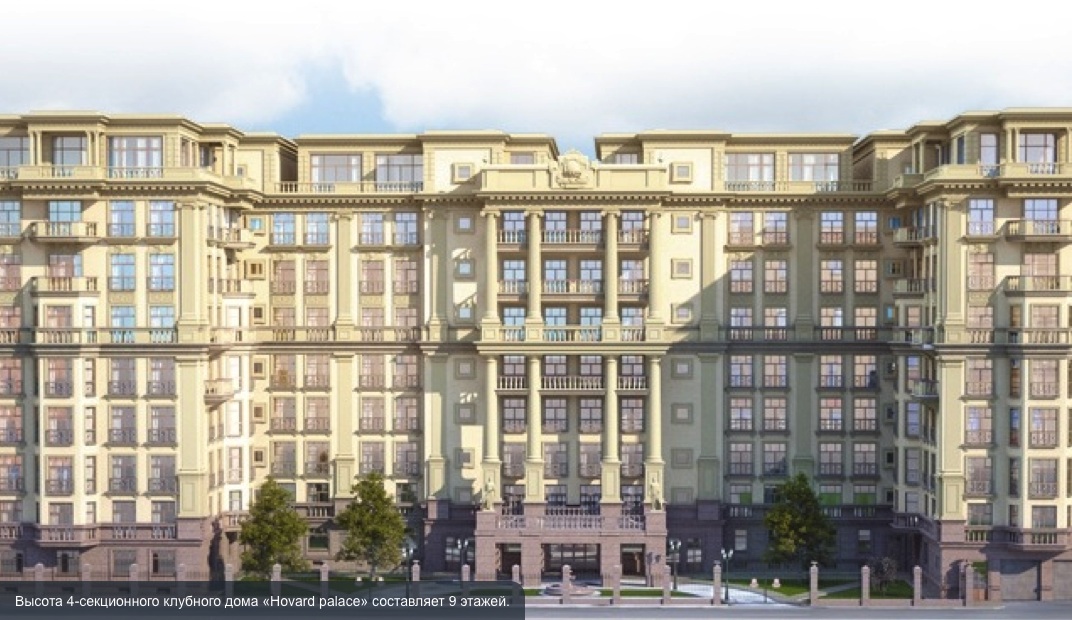
Rendering of Hovard Palace, which the caption, in Russian, says contains nine storeys. Image courtesy of Novostroy-Spb.ru
Now, as the upper floors are being erected, they are clearly visible from the surrounding streets. The building’s impact has been especially acute on the vista of Socialist Street. And from the intersection of Zagorodny Prospect and Socialist Street one can see that the eight-storey building has risen above the cour d’honneur of Simonov House (Zagorodny, 21–23), which forms a small side street.
The look of Jambyl Lane has changed as well. Jambyl Square, containing the monument to Jambyl, looks different, and the bard himself now strums his lute against the backdrop of the new building.
The developer promises to deliver Hovard Palace in the late summer.
Hovard Palace and environs, July 16, 2015. Photo by the Russian Reader
“The residents of new buildings are forced to look at the windows of neighboring buildings and not see the light of day”
Olga Trakhanova and Olga Shamina
July 6, 2015 Bolshoi Gorod
Recently, residents of several new areas of Moscow and satellite cities have been protesting against excessively dense development. Residents of Krasnogorsk, Khimki, and Reutov, among other suburbs, are dissatisfied. The complaints are one and the same. High-rise residential buildings are built too close to each other, the necessary infrastructure is not constructed, and roads and public transport cannot withstand the rapid population growth. More and more often the word “ghetto” is invoked. According to experts, this is the likely future of these areas.
We asked residents of Moscow suburbs who are unhappy with excessively dense development to tell us why they do not like living in their towns. Here, for example, you can see how houses are being built in Reutov. Here are photos of dense development in the Pavshino Floodplain.
Yevgeny Sosedov, Resident of Krasnogorsk, chairman of the Moscow branch of the All-Russia Society for the Protection of Historical and Cultural Landmarks (VOOPIK)
I live in the Krasnogorsk District of Moscow Region. I was born and raised in the village of Arkhangelskoye, but for the last fourteen years I have lived in Krasnogorsk.
I am dissatisfied with the town planning policies of the regional and municipal authorities, which have a negative effect on the quality of life. Practically speaking, in the last few years we have had to live on a giant construction site. The city and the district are being thoughtlessly built over with high-rises (up to forty-five storeys high). All town-planning standards have been violated; green spaces, forests, parks, cultural heritage protection zones, and nature reserves have been destroyed. Just next to my house, two gigantic shopping centers have been built, and several hectares of a historic park were cut down to make way for them. A third shopping center has been built literally ten meters from my windows, blocking the entire view and depriving the residents of our building of sleep during the five years it was being built. To top it off, intolerable conditions for navigating the city have been created: pedestrian paths have been cut off or dug up, parks are cluttered, and there are no sidewalks along highways and roads.
Infrastructural problems have been snowballing. There is no transportation infrastructure. The existing roads cannot cope with the flow of vehicles. There are traffic jams nearly round the clock in the district. To get to work on weekdays, residents have to leave at five or six in the morning.
During rush hour it is almost impossible to get onto commuter trains. People jam into them at a run. These problems are not being solved, they are only getting worse. For example, the Mortongrad Ilinskoye-Usovo development project, approved by the governor, presupposes delivering another fifty thousand people to the already overburdened Krasnogorskaya train platform.
High-rises are being built in the most problematic traffic spots without obliging investors to reconstruct roads and build interchanges. For example, the Moscow Region Urban Planning Committee, chaired by the governor, has approved the construction of the nine 32-storey towers of the Tetris residential complex in Pavshino at the most problematic spot in terms of traffic. This is in addition to the already-existing Youth residential complex, being built by the same firm, and the 45-storey towers of the Krost complex, which was built without any permits at all. (The development plan still has not been submitted.)
The situation is identical with all other infrastructure. Moscow Region is the leader in terms of families waiting in queues for spots in kindergartens. There are huge problems with health care facilities. There are only two functioning clinics in Krasnogorsk, one of which was built in the nineteenth century. And yet, the population increases by several tens of thousands of people annually, and this whole burden is placed on the existing infrastructure. The biggest infrastructural problem in store for us in the coming years is the drinking water supply and sewerage.
One of the main problems associated with real estate development is the rapid deterioration of the environment, which has extremely detrimental effects on the populace’s health and quality of life: the destruction and clear-cutting of thousands of hectares of forests, the shallowing of bodies of water and sources of drinking water, and the redevelopment of agricultural land and nature reserves.
Something must be said about the quality of the new construction. Moscow Region is a leader in terms of putting so-called new substandard housing on line, housing which starts to fall apart as soon as it is put into service, and huge amounts of money are subsequently spent on its maintenance.
None of these housing projects is provided with places of employment. 80–90% of the population of Moscow Region towns near Moscow travel back and forth to work in Moscow every day.
Huge estates of high-rises, built in the middle of fields according to obsolete designs and without the necessary infrastructure and places of employment, will inevitably turn into ghettoes.
Olga Filatova, Resident of Reutov
The town of Reutov is divided into South and North Reutov. There is new construction in both parts. However, North Reutov is adjacent to the subway, and so, apparently, it is being developed more recklessly.
When flats in South Reutov were being presold, the future tenants asked the developer what would be built near their home. The construction company told them there would be a square, shops, and other infrastructure. Instead, however, dozens of residential buildings were built.
A new neighborhood is being built next to us. One of the buildings there has 645 flats. If three people end up living in each flat—and there are several such buildings—what will happen to our town in the next five years? Property prices will fall, and consequently it will be harder and harder to unload a flat in such a “marvelous” place.
While not all the buildings are inhabited, the town is already overcrowded. Population density in Reutov is nearly one and a half times greater than in Singapore.
Because of the dense development, the town’s ecology is deteriorating. All trees are cut down on construction sites. Consequently, South Reutov is almost bereft of greenery. And the residents of news buildings are forced to look at the windows of neighboring buildings and not see the light of day.
Elena Nosova, Resident of Khimki
We, the residents of the Novokurkino District of Khimki, are suffering from the illegal new construction of the PIK Group, a catastrophic lack of infrastructure, the corruption of the local administration, and the inaction of officials and law enforcement agencies. Our district is rapidly turning into a ghetto. We are being deprived of the right to live in humane conditions. We have been trying to put up a fight, but we have remained unheard.
For several months, the district’s residents have been trying to halt the illegal construction of multi-storey residential buildings that the PIK Group has launched on the site of planned infrastructure. Due to excess housing density, the district of Novokurkino, which has a population of 40,000 and includes three microdistricts, is experiencing a catastrophic shortage of infrastructure.
PIK Group has been developing Novokurkino for ten years. The district development plan was approved in 2005; the latest revisions for the sixth and seventh microdistricts were officially approved and went through the compulsory procedure of public hearings way back in 2011. During this time, PIK has built and settled all the residential buildings in the sixth and seventh microdistricts and has begun construction of the next microdistrict, the eighth, but the infrastructure sites stipulated by the plan have not been completed. The construction of schools, kindergartens, and medical clinics has been unacceptably slow, and residents have been unsuccessfully complaining about the situation for several years.
At this point, although 100% of the housing has been built in the sixth and seventh microdistricts, only about 60% of the kindergartens, 50% of the schools, 30% of the medical clinics, and 18% of the parking lots have been built as planned. In the seventh microdistrict, construction of a school, a clinic, a multi-storey car park, and a sports center has not even been started. Consequently, the capacity of kindergartens, schools, and clinics in Khimki and the nearest district of Moscow has been stretched to critical limits. The situation with parking remains catastrophic and continues to worsen.
Despite these circumstances, the developer, PIK Group, has begun building new high-rise residential buildings on the site of the planned infrastructure sites with the permission of local authorities. On the site where, according to the district plan, there should be have been the only sports center in the district, equipped with a parking lot, they have begun building five residential buildings. The building permits were issued on the basis of a city land development plan that was at odds with the district development plan. The Khimki prosecutor’s office confirmed the illegality of the city land development plan, and it was canceled. However, the building permits have still not been withdrawn. Taking advantage of the inaction of the authorities, the developer began construction work, violating all the building codes in the process. At present, the foundation pits of the first buildings have been dug, and piles are being driven into the ground. There is a hoarding on the site advertising that flat are for sale, and pre-booking of spots is underway.
For two and a half weeks, residents who were against the ensuing construction blocked it on their own by parking their cars opposite the driveway to the site, thus preventing construction equipment from entering. However, after almost three weeks of our blocking the construction, the PIK Group moved about twenty well-built young men into workers’ sheds who set about illegally towing away the cars, damaging two of them in the process. The total damage came to about 600,000 rubles [approx. 9,500 euros]. Moreover, the district beat cop was present. He signed the towing tickets, which is not one of his duties, not to mention the fact that the drivers of the cars had not violated any parking rules. Next, PIK fenced off the driveway onto the construction site with concrete blocks, seizing half of the road in the process, meaning they left only one lane for travel. The road is very busy, because it leads to the school. Now all residents, especially children, are also suffering substantial discomfort from this as well.
In addition, permits are being sought for residential construction on two more plots of land, which had originally been zoned for parking lots and a shopping mall with a parking lot.
On July 1, Petersburg developers and architects held a round table to discuss how to eliminate the alleged threat to their happiness and livelihood posed by historical preservationists and local grassroots NIMBY and housing activists, as recounted here by journalist Dmitry Ratnikov.
According to Ratnikov, Elena Smotrova, head of Tellus Group developers, compared the activists to the infamous mafia protection rackets that shook down honest businessmen in the 1990s. Architect Yevgeny Gerasimov recommended calling the police when activists showed up, while Igor Vodopyanov, head of development and management company Teorema, claimed that activists had driven developers from Petersburg. What lay in store for the city, he argued, was a “Cuban historical preservation” scenario, where houses are propped up on wooden stilts (sic), and there is no business.
In fact, pace the anti-populist hysteria of Gerasimov, Vodopyanov, Smotrova and Co., literally everything that has been built and developed in Petersburg in the past fifteen years has been utter garbage by even the most minimal and indulgent international standards.
This is not to mention the ruinous effects of such pseudo-architecture on the historic built environment, but these refined ladies and gentlemen passing themselves off as developers and architects have had the gall to blame the so-called gradozashchitniki (“city defenders”) for their woes. What chutzpah.
So the pushback on the part of local people of good will, had it not happened in the face of such an assault on the city, would have been more mystifying. In fact, practically the only thing worthwhile, in terms of grassroots politics, to come out of Petersburg in the last ten years has been this relatively strong movement of historical preservationists and just plain folk out in the Soviet new estates defending their turf (and the relatively decent Soviet planning therein) from bad developments and even worse architecture.
Given their lack of talent at developing and designing buildings that would complement and enhance one of the world’s most beautiful cities, and their hostility towards the much more refined aesthetical and legal sensibilities of the amateurs who mostly populate the ranks of the activists, it is not surprising that Petersburg’s architects and developers often resort to facile evocations of history to cover up their crimes and misdemeanors, which often involve demolishing listed or perfectly serviceable and comely old buildings and replacing them with variations on post-postmodern listlessness and anomie, whose only real purpose is to occupy as many storeys and square meters as possible and stroke the egos of their “authors” by physically dominating their historic built environments.
And given the current political conjuncture, it is no wonder these historical evocations and gestures are usually deeply reactionary celebrations of Russian imperial history rather than Russian revolutionary history (whose early period produced art, architecture, and theory that people are still marveling over and studying almost a hundred years later, and whose middle and late periods are, at very least, recognizable as legitimate products of architectural and social history).
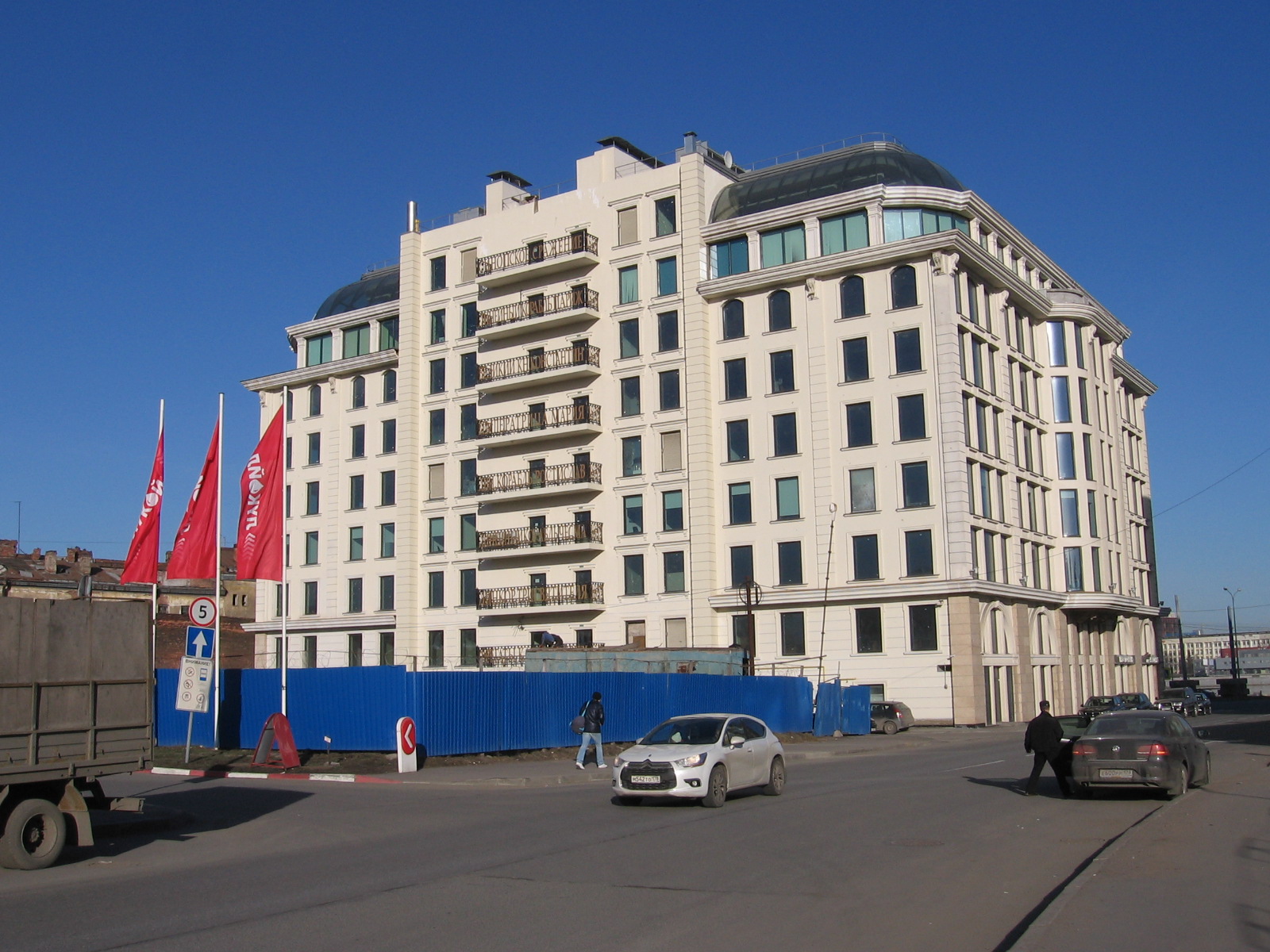
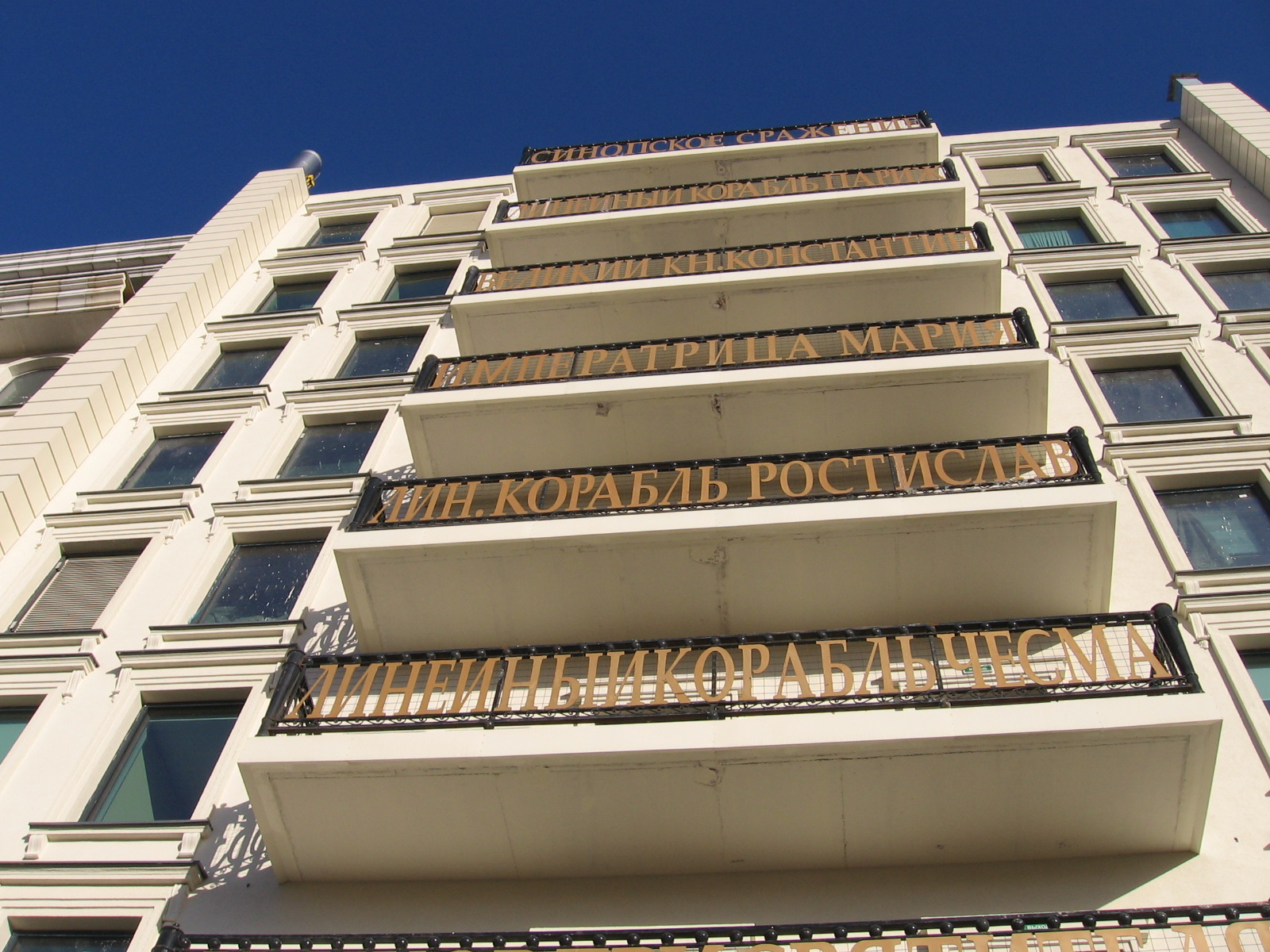
While strolling around the city this past spring, a friend and I came upon this newish oddity on the Sinop Embankment of the Neva River.
Upon closer inspection, it turned out the grillwork on the balconies were emblazoned with rather odd, at first glance, inscriptions.
“Battle of Sinop. The Paris, ship of the line. The Grand Duke Konstantin, ship of the line. The Empress Maria. The Rostislav, ship of the line. The Chesma, ship of the line.”
After pondering this funny list for a few minutes, I realized the inscription on the top balcony read, “Battle of Sinop,” and that listed below it were Russian naval ships that, I discovered later, had taken part in this maritime slaughter of Turkish ships during the distant Crimean War.
The building’s designer, “post-neo-Empire style apologist” Dmitry Lagutin, explained the gimcrack notion behind the building in an August 2012 interview with online local architecture and development watchdog publication Karpovka:
The building was intended as a memorial to the Battle of Sinop, the last battle between sailing ships. The idea arose when we had to get the image across to the client and convince them to build a classical building. We wanted to deliver the building before December 1 of this year, for the anniversary of the Battle of Sinop.
There is a two-storey glass dome at the top of the building, an expensive luxury. It can be seen from the other shore. But if you are walking along the embankment, the dome is not visible. It disappears into the depths, and the building becomes smaller. So there will be a smooth segue from Alexander Nevsky Square with its lower built environment. There is a pediment, which, if you look closely, resembles the stern of a ship. It supports a sculpture of Empress Maria, recalling the name of the flagship Empress Maria, which Admiral Nakhimov commanded in the battle. The names of the ships [involved in the battle on the Russian side] will appear on the gridwork of the facade.
Rendering of the new building on Sinop Embankment, 22. Courtesy of Karpovka.net
[…]
We are communicating with sculptors. There is architecture that includes a place for sculpture. And our building has a lower arcade of six arches. Between the arched windows there are niches that will house sculptures of [four Russian] admirals. Everyone knows Nakhimov. There is Kornilov and Panfilov, whom everyone confuses with Panfilov’s Men. There is Novosilsky. The four admirals who took part in the Battle of Sinop. Real heroes.
Now, as we are selecting sketches, we have to study the story of each admiral to avoid mistakes, starting with how they looked. We have to study every thing down to the epaulettes and buttons. Recently, a monument to Nakhimov was erected on the street of the same name. It was chockablock with crude mistakes.
When the busts of the heroic Russian admirals were unveiled on October 3, 2013, the city’s high and mighty were present for the festivities, as reported by Peterburgskii Dnevnik, the city government’s official newspaper.
Busts of Admiral Kornilov, Pavel Nakhimov, Fyodor Novosilsky, and Alexander Panfilov were unveiled today in a ceremony at Sinop Embankment, 22.
St. Petersburg Governor Georgy Poltavchenko, Russian Museum director Vladimir Gusev, businessman Boris Zingarevich, who initiated the creation and installation of the busts, and sculptor Alexei Arkhipov attended the unveiling.
It is no accident that the sculptures of the great admirals have appeared on the Sinop Embankment. 2013 marks the 160th anniversary of the Battle of Sinop, which was the last battle involving sailing ships. Likewise, sixty years ago, the embankment was named in honor of this naval battle.
“It is twice as nice and important that that we have not forgotten the glorious tradition of the Russian fleet and are unveiling the busts of those who were victorious at Sinop. I thank everyone involved in the project—the architects, designers, and builders—for wanting to recall history and for their initiative,” Georgy Poltavchenko said at the unveiling ceremony.
The designer of the busts, Union of Artists member and sculptor Alexei Arkhipov, said that executing the works was not easy, because there were very few extant images of the admirals. The decorative elements—buttons embossed with coats of arms, and the decorations worn by the admirals—were a particular challenge. In total, the work took around a year.
Petersburg Governor Georgy Poltavchenko (second from left) with naval officials and other dignitaries at unveiling ceremony. October 3, 2013, Sinop Embankment, 22
The dome of the building on Sinop Embankment where the busts of the great admirals have been installed is crowned by a replica of the bas relief from the bowsprit of Admiral Nakhimov’s flagship, which was named after the Empress Maria Feodorovna. In turn, the names of the ships involved in the battle have been inscribed on the railings of the balconies in the building, which will house a business office center.
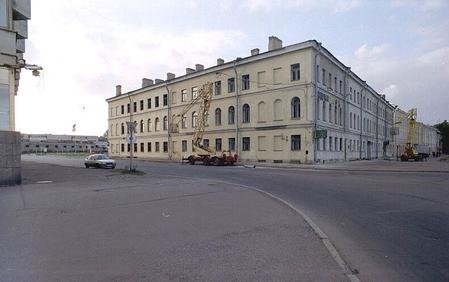
For what it’s worth, before this recent outburst of collective built patriotism, the lot at Sinop Embankment, 22, was occupied, until 2003, by a much homelier but more more recognizably Petersburgian building. Known as the Alexander Nevsky Lavra House, it was erected in 1860 by architect Karl Brandt (1810–1882).
Alexander Nevsky Lavra House in 1993. Photo courtesy of A. Kaidanovskij
And this is what Brandt’s modest building looked like on the eve of its demolition.
Sinop Embankment, 22. Photo courtesy of CityWalls.ru
I was reminded of our springtime encounter with the patriotically dolled-up “business office center” on the Sinop Embankment while investigating one of the Petersburg’s oldest streets, Galernaya, with a group of local psychogeographers a couple weeks ago.
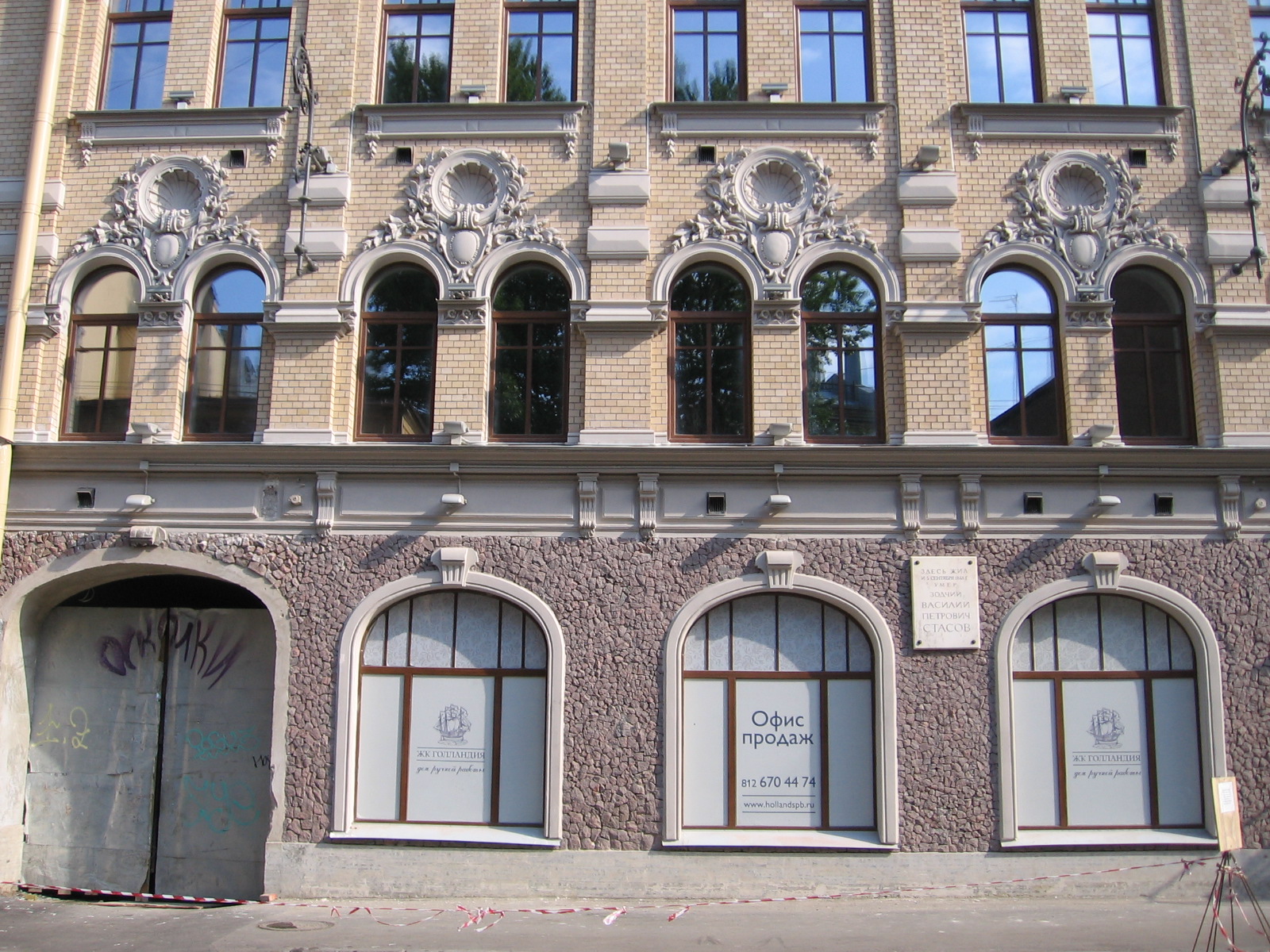
During our drift, we came upon this little Art Nouveau bonbon at Galernaya, 40.
According to CityWalls.ru, it was built by Maxim Kapelinsky in 1905–1907 and 1910 as an apartment building and publishing house for S.M. Propper.
And yet a plaque on the first storey claims that the great Russian architect Vasily Stasov lived and died there on September 5, 1848.
This apparent contradiction is easily explained. When Stasov lived there, the lot was occupied by the Kireev estate, which extended all the way from Galernaya to the Admiralty Canal Embankment on the other side of the block.
The real mystery, however, is not whether Stasov lived here at the end of his rich life, but whether the building now on the site is the same building that Kapelinsky built over a hundred years ago.
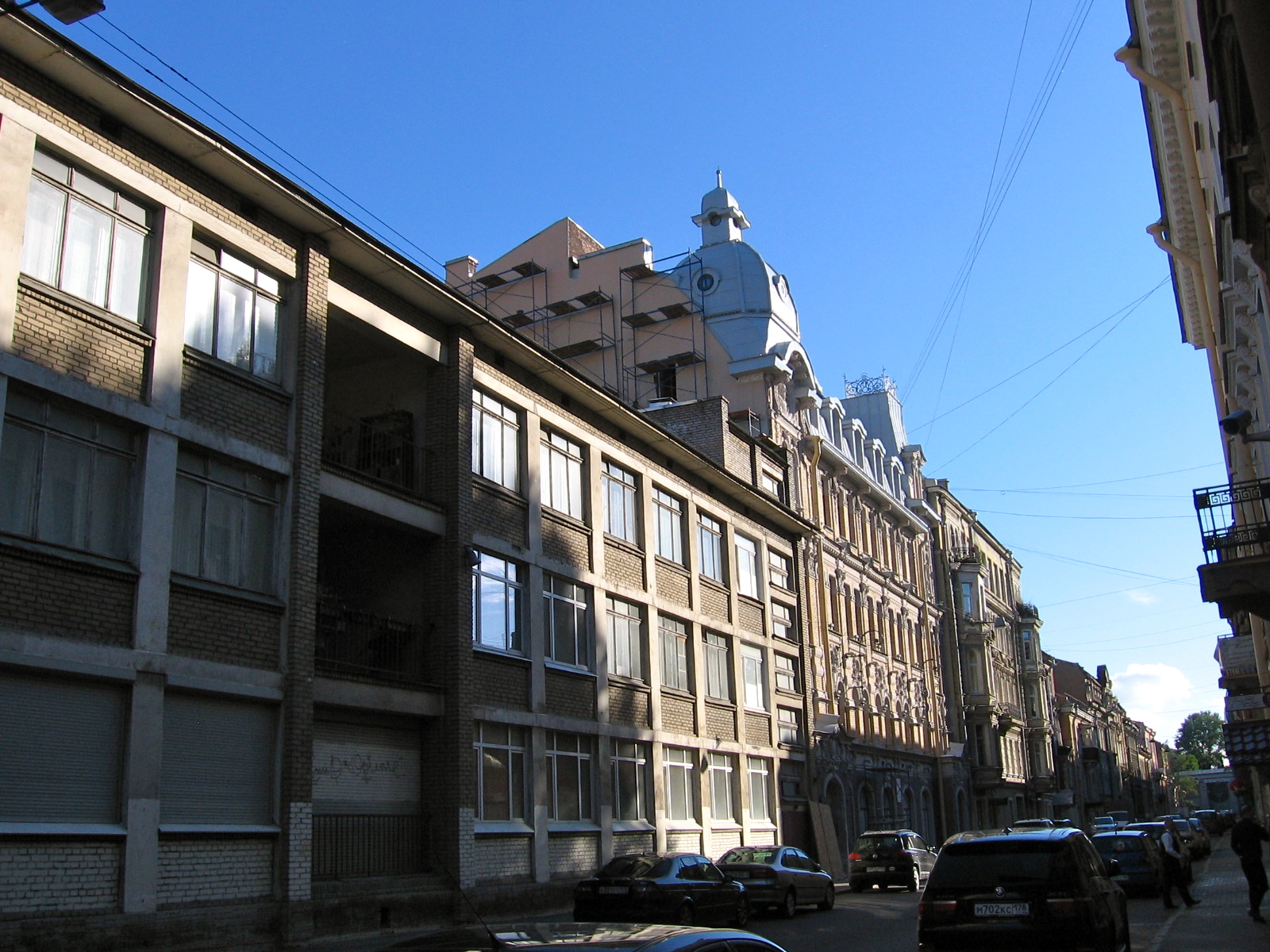
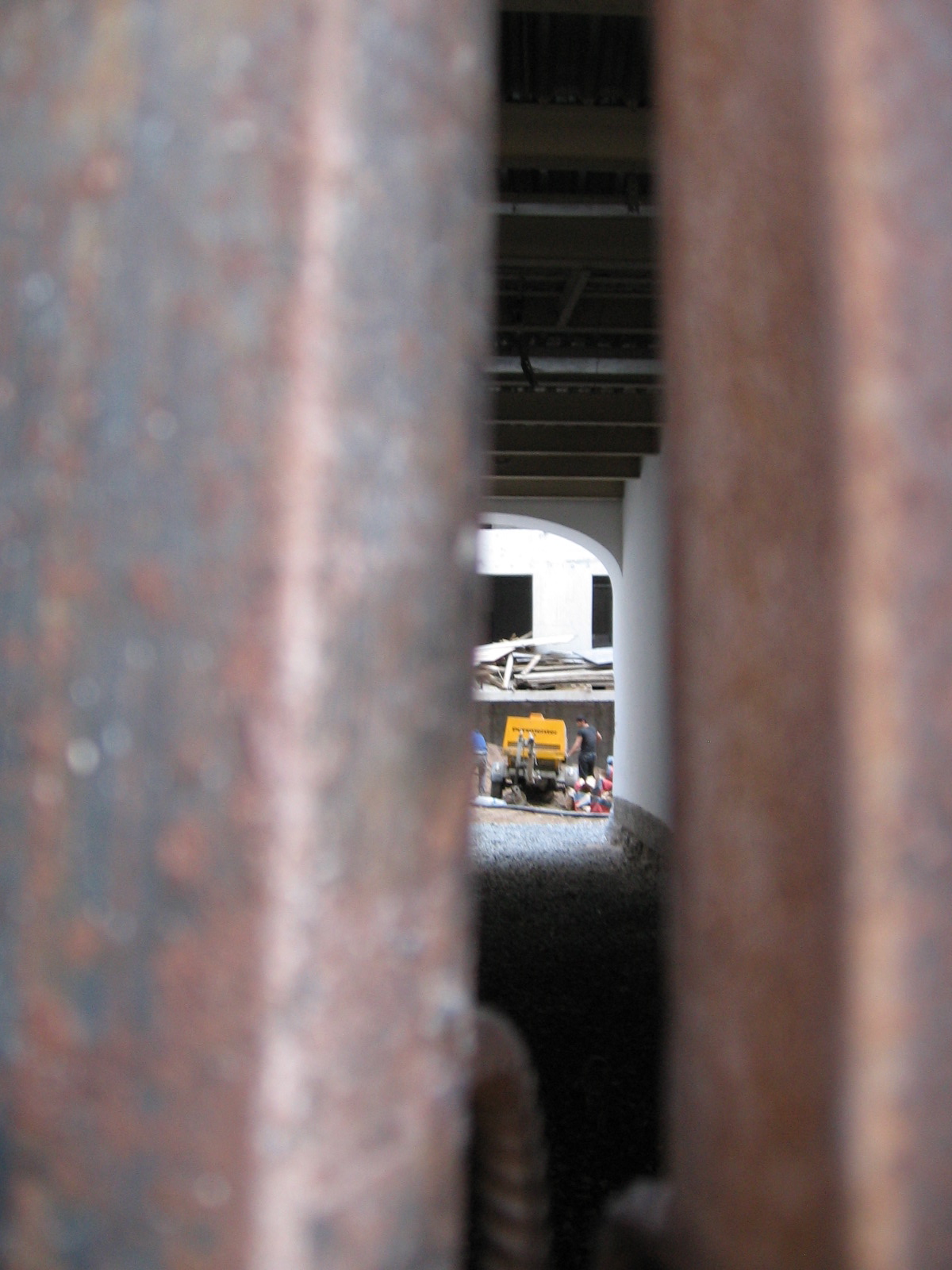
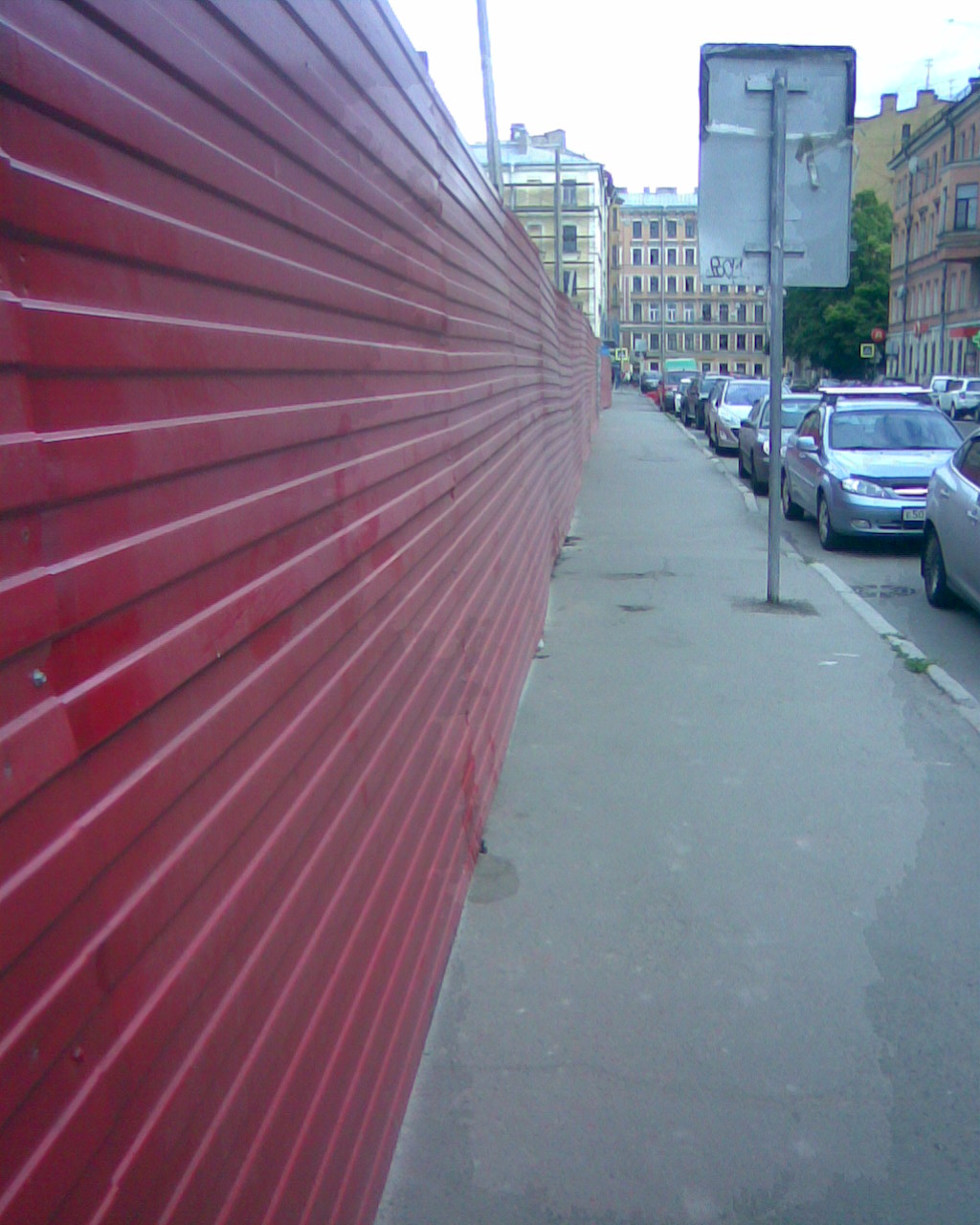
Views from the side and the front, and a glimpse through a crack in the gateway hinted that something fishy might have been afoot at Galernaya, 40.
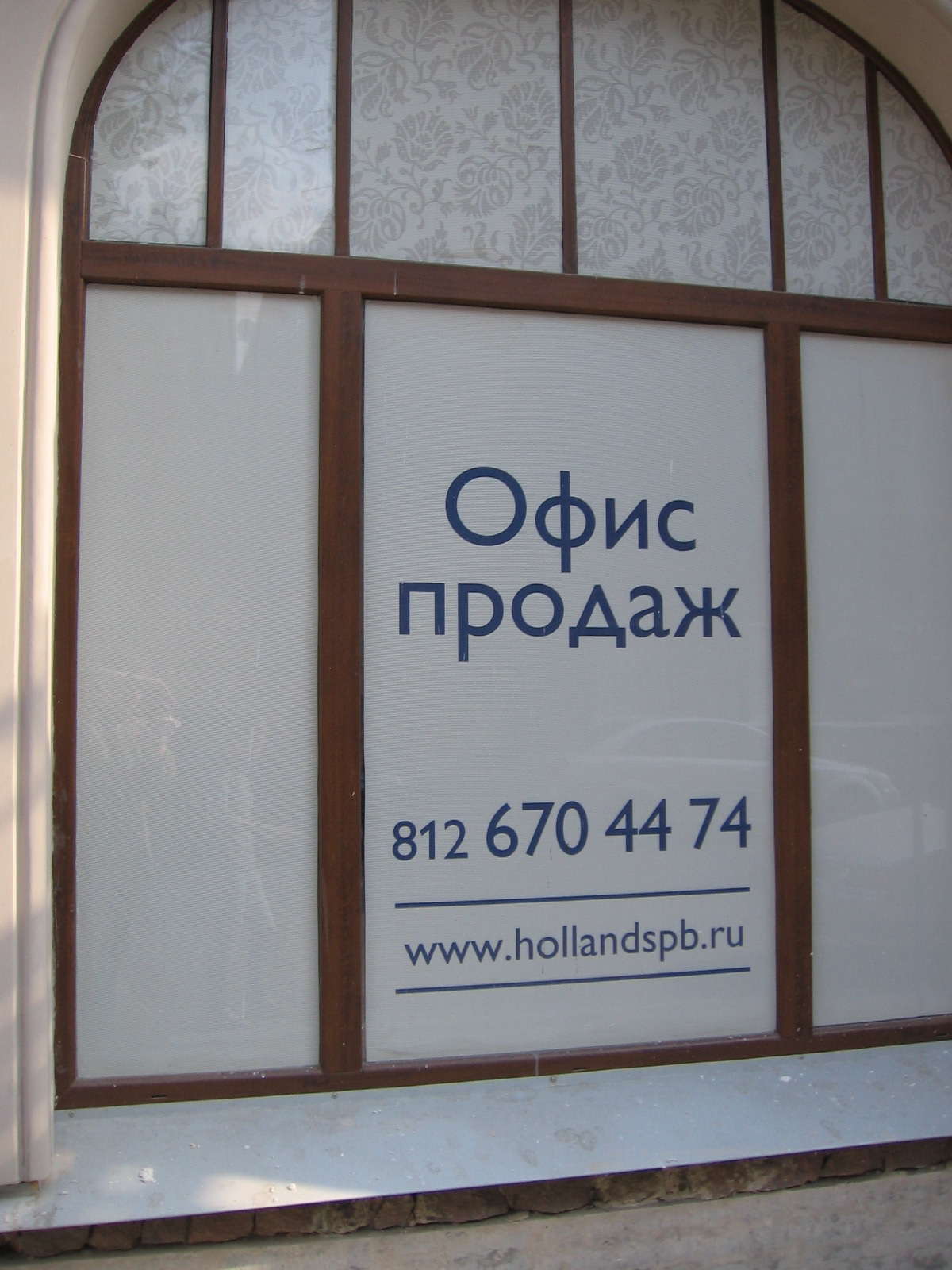
Sales office of Holland apartment complex, Galernaya, 40
In fact, it seems that Kapelinsky’s hundred-year-old Art Deco confection has not been restored, as deceptively suggested by the façades on both ends of the block. Instead, it has been partly or totally reconstructed, its original innards replaced with tonier digs, more storeys and square meters, and its “empty” courtyards righted with a lot of infill construction.
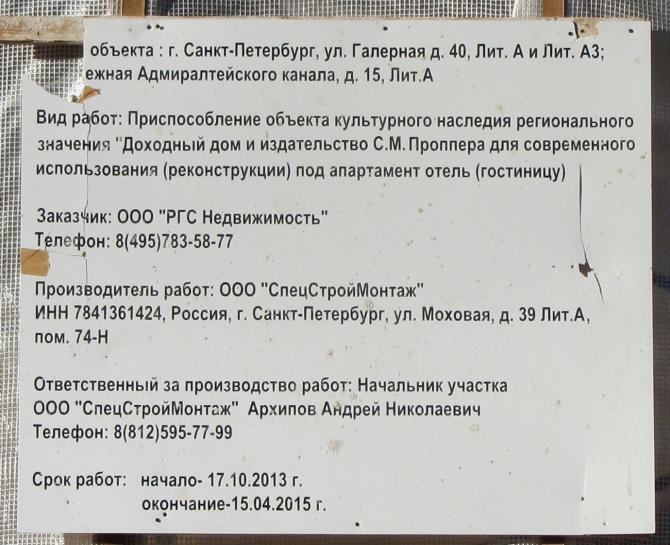
On November 2, 2014, CityWalls.ru user “Vlada” made a snapshot of the official sign that has to be erected, like a permit, outside all such construction sites.
The sign reveals that the Propper House, identified as a listed regional architectural landmark, is being “adapted for modern use (reconstructed) as an apartment hotel.”
As redeveloped by the Clover Group, the Propper House has now been renamed Holland.
I cannot recommend the project’s video presentation (accessed by pressing the big arrow on the home page) or the page where you can select an apartment (and simultaneously take “virtual tours” of various parts of the complex) highly enough, because you will be quickly convinced that the Propper House has indeed been “adapted” (gutted) to make way for a new gentry and their loose cash.
Visualization of penthouse deck, Holland apartment complex, Galernaya, 40
How this brutal approach to a listed regional architectural landmark is compatible with local law, federal law, and the city’s explicit obligations as a UNESCO World Heritage Site, all of which should amply protect the city’s historic center from such predations, is beyond me. This, however, has been the standard practice for the past ten years, a sad fact known all too well by the pesky gradozashchitniki I mentioned at the beginning of this post, and by tens and hundreds of thousands of other Petersburgers who are less active civically, but have seen perfectly well what has been going on and to whose benefit.
But you will not be surprised, I hope, when you learn that Clover Group’s elegant wrecking ball methods have also been sanctified and sanctioned by Russian imperial history, to wit:
The Holland complex consists of three sections, Amsterdam, Hague, and Zandaam, located in historically significant renovated buildings. Ranging in height from five to seven stories, each of the buildings offers luxurious apartments of various sizes (from 27 to 195 meters square). The names given to them were not accidental. These resonant names have their roots in Petrine times. These were the names of the three main stops in Holland during Peter the Great’s Grand Embassy.
If you suspected there might be something in common between the pseudo-historical papering over of what are often latter identified, euphemistically, as “town planning mistakes,” and the current political regime’s uses and abuses of history, you would be on the right track.
Goethe reportedly said that architecture is frozen music. In today’s Russia, new “architecture” is the frozen hysteria of a ruling class and society “enslaved by history” and thus unable to do anything other than salvage and bricolage it to justify its knowingly futureless projects. That this often involves simultaneously destroying real history, such as the historical buildings and cityscapes of the former imperial capital, is only one of the paradoxes generated by this extremely dangerous political moment in Russia. TRR
Here are my early summer evening snapshots of yet another catastrophic urban anti-development in the ex-Capital of All the Russias, this time on Korolenko Street in the Central District.
These snapshots were taken on an old Nokia 3110 that has long suffered from a ghostly “pillar of flame”-like blemish on the lens. The blemish lends shots an extra creepiness when they are taken at the wrong time of day. Sometimes, it is just what the doctor ordered.
After all, rancid, pretentious crap like LSR’s hideous Russky Dom (Russian House) anti-development on Korolenko, designed by local architectural bureau Evgeny Gerasimov and Partners, does not deserve high-quality photography.
It deserves grassroots resistance, but there has never been enough of that, especially lately, under Putin 3.0, and especially when “projects” like this have been battering the old city and the Soviet new estates hotter and heavier than the beleaguered and outnumbered historic preservationists and other local residents and activists have the time or the forces to handle. (For those who read Russian, here is one local press account of attempts by preservationists to resist the demolition of this block in the UNESCO-protected historic center. This mostly verbal skirmish took place almost exactly three years ago.)
Red construction site fences are a rarity in Petersburg. Such fences are almost ubiquitously blue.
In fact, this particular fence apparently began life blue, like most of its other local brethren. But then it was painted red.
“From the creators of Paradny Kvartal,” reads the caption, a backhanded endorsement if there ever was one.
Whatever the ethnically tinted title of the project, Russky Dom, could mean amidst all the ideological, political, economic, social, and physical wreckage of its own site, and its place and time, is beyond me. Except, maybe, that it visually represents the aspirations of the Russian ruling class, their servitors, and their aesthetically stunted fans among the masses. (Whom, I assure you, are far fewer than the eighty-six or eighty-four percent cited by dubious polling organizations and reproduced ad infinitum by Russian and western media alike, who then go further by conjuring up a fake alternate reality to explain these fake ratings.)
The specs include a variable number of storeys (from five to nine), flats from 60 to 250 square meters in size, an underground parking lot for 519 cars, and commercial spaces, as well as “closed yards and a large promenade zone [sic].”
The caption reads, “Unusual flats: panoramic views from terraces on the upper floors; flats with turrets and second levels.”
The description of the project on Gerasimov’s website, aside from the usual boilerplate (e.g., the development is meant to blend into the built environment while also striking a bold pose), reveals, unsurprisingly, that it was inspired by Russian Revival style architecture of the nineteenth and early twentieth centuries.
If this is not an admission of aggressive ideological and aesthetic bankruptcy, I don’t know what is. In this sense, however, Russky Dom tries to blend in not with its built environment but, rather, with the country’s hyper-reactionary zeitgeist.
Duma deputy Irina Yarovaya declared today that Russia’s education system is too “tailored to the study of foreign languages,” according to a report by United Russia, the country’s ruling political party.
“How can we expect to preserve our traditions under these circumstances?” Yarovaya asked worriedly, criticizing the Education Ministry’s plan to make a second foreign language compulsory in the school curriculum and require students to pass a standardized exam in at least one foreign language.
The newspaper Moskovsky Komsomolets published an even more radical quotation from Yarovaya’s statement: “While studying in our schools, students spend 866 hours of instruction on the Russian language and 939 hours on foreign languages. Now the Education Ministry wants to introduce a compulsory standardized exam in a foreign language and mandate the study of a second foreign language. My fellow citizens, what kind of country are we raising here?”
Yarovaya also said the state’s current educational standards focus on “students’ personal success,” which she claims is “foreign to the Russian frame of reference,” instead of developing traditional values. Additionally, she expressed concern about the variety of school textbooks used throughout the country to teach the same subject.
This kid was polite, making a point of getting out of the way when I was snapping pictures, but he was wearing a jacket emblazoned with the word “Russia” and toting a toy AK-47.
Whom or what was he planning to go to war against, Yarovaya and her “traditional values,” which are actually designed to keep the current kleptocratic regime in power in perpetuity and keep people like the little kid poor and disempowered, or “foreign frames of reference”?
* * * * *
I (or, rather, my Nokia) tried to peer through a hole someone or something had punched through the red fence to get a sense of how the Russky Dom was shaping up.
But when I got to the corner of the block, I discovered the construction site’s main gate was wide open, probably because the workday was wrapping up.
Work was proceeding apace on the Russian reactionary elite’s dream home.
As well it should have been, because, according to the site’s “passport” (everyone and everything has a passport in Russia, including built and unbuilt buildings), construction is scheduled to be completed in July 2017, a mere two years from now.
So if you are thinking about getting in on the ground floor of this Russian neo-Revivalist reactionary real estate action, the time to call is now.
It was not that the Leningrad City Executive Committee and Main Internal Affairs Directorate (i.e., police) motor pool garages that previously occupied the lot were things of great beauty (and until they were threatened with demolition, three years ago, seemingly nobody knew that what was left of the barracks of the First Artillery Brigade Life Guards may or may not have also been taking up otherwise expensive land there), but they served some purpose other than driving up real estate values and giving rich people a venue to offload their extra cash, kids, lovers or themselves while on vacation from Goa or London.
They were also part of the city’s real history, for better or worse.
The other day, a friend of mine showed me, on the invaluable but somewhat incomprehensible Regional Geographic Information System, how many “projects” real estate developers had stashed away among the nearly incomprehensible and numerous filings and permit requests they make with the city’s relevant committees.
If all these projects are implemented, Petersburg will be unrecognizable in ten years or fifteen years or so, a bright and shiny Russian Revivalist and “neoconstructivist” no man’s land with lots of elite housing, business centers, entertainment and shopping complexes, and superhighways.
But there will not be much of anything else, because Petersburg’s inner-city light and heavy industries were long ago condemned, under the guise of “developing and preserving” the historic center, to banishment to the far suburbs or even farther, to the outer darkness of the Leningrad Region. The orders were signed by Mayor Anatoly Sobchak, in 1994, and Prime Minister Viktor Chernomyrdin, in 1996, respectively.
The funny thing is that the new powers that be revived this approach a few years ago. As current Governor Georgy Poltavchenko has said recently, “The formula goes like this: ‘Preservation through Development, Development through Preservation.’
Or as a comrade and I have written elsewhere, Petersburg is a “World Heritage Site under permanent reconstruction.”
The other day, a comrade on a leftist email discussion list to which I subscribe sent the list a link to this recent article, published on the website Russian Insider. Russian Insider is a pro-Putin propaganda website whose goal is to further thicken the already briar thicket-thick wool in the heads of many western leftists and any other fellow travelers in the website’s radius as to the realities of what is going in and around Russia and its current regime.
The argument made in the article is well summarized by its headline and subheading: “A Home for Every Russian: How Putin Delivers on the Russian Dream. Russia is in the throws [sic] of a housing boom that is transforming the country and hugely increasing its sense of well-being but which has gone completely unreported in the West.”
The bulk of the article consists of incoherent razzle-dazzle with numbers, whose only purpose is to show that the journalist has done his groundwork, seemingly.
(Another comrade on the email discussion list discovered that the journalist is quite a dicey character himself. This is in keeping with the utter cynicism and recklessness of the Putinist propaganda and “soft power” campaign of the past ten years, especially after the lid blew off a year ago. The Putinist spin-doctors will literally hire anyone without a conscience, especially if they are agile on the keyboard and unencumbered by the need to check in with “fact-based reality” from time to time.)
But all that actually incoherent number crunching is only meant to reinforce the nearly orgiastic joy that will be experienced by many western comrades (longing for the “good old days” they still have not made sense of, really) when they reach the article’s money shot, in its penultimate paragraph:
The fact that the emphasis on house building in Russia remains on cheap affordable homes incidentally confirms something else. This is that the Western image of “Putin’s Russia” as ruled by a “corrupt kleptocracy” selfishly focused on its own interests has to be wrong. The emphasis on cheap affordable housing for the wider population on the contrary shows that Russia, as its constitution says, is very much a “social state”.
This is such utter rubbish that I felt compelled to respond. What follows is an edited version of my original response to the mailing list.
__________
The first thing you should know about the so-called housing boom in Russia is that it has been made possible largely by incredibly cheap, disempowered, heavily abused migrant labor from Central Asia. This labor has often verged on slave labor. It is almost totally non-unionized and dirt cheap and utterly expendable.
As in “If you don’t like the conditions, non-Slavic laborer [my euphemism: this isn’t the local ‘term of art’], fuck off, because we’ll find another ten ‘blacks’ [a term of extreme racial abuse in Russian, although there are much worse epithets] to take your place.”
And the neo-Nazis and skinheads were also, until recently (maybe they are still doing it) coming in to bust heads and slice a few hundred or thousand throats just in case someone had missed the point.
And the laborers have lived in subhuman conditions, such as this shack I photographed four years ago at a site where yet another “elite” block of flats was under construction.
All this stuff has been documented and heavily reported, mind you, but not on fly-by-night Putinist sites like New Cold War(which, it almost goes without saying, picked up and reprinted Russia Insider’s “scoop” on the incredible socialist housing boom in neoliberal capitalist Russia) and Russian Insider, which have sprung up only yesterday just to muddy the waters, and nothing more.
Or they have been financed by co-investor buy-in schemes, in which a large percentage of an apartment’s price or even the whole price is paid up front before the foundation pit has even been dug, and the construction and zoning permits secured from bribed public officials.
Many of these co-op schemes have gone south when the ruthless developers split with the money. The co-op members have been left holding empty bags and staring at unbuilt or partly built apartment blocks. There have been huge numbers of such sad stories over the past ten years, stories that been heavily documented in the Russian and even the western media. Not so strangely, the authorities have usually been very reluctant to help these people get their money back or their apartments built.
There is a special term for these people in Russian, obmanutye dol’shchiki, which can be translated as “hoodwinked investors.” It is a term that literally everyone in the world who speaks Russian knows, except maybe those Old Believer villagers in Oregon.
Do the “militants” at New Cold War and Russia Insider, so desperate to recreate the Comintern, even speak Russian?
At Friday’s May Day festivities in Petersburg, there were whole columns of “hoodwinked investors” and people now staring down the barrels of once-advantageous foreign currency-denominated home loans among the marchers on Nevsky Prospect.
“Where are our apartments? The hoodwinked investors of the Okhta Modern Residential Complex.” Photo courtesy of paperpaper.ru
“We demand an end to the genocide [sic] of foreign-currency-denominated loan borrowers.” Many of the marchers are wearing black t-shirts emblazoned with the slogan “I’m not the slave of a foreign currency-denominated mortgage.” Photo courtesy of alliruk.livejournal.com
The third thing you should know about the housing boom is that, especially in the big cities like Moscow and Petersburg (which are the only places where there have been real housing booms, for the most part), is that it has been realized at devastating expense to the existing built environment, for example, in the older, pre-Revolutionary districts of the cities, which should be heritage listed, and sometimes are, but that has not stopped rapacious developers and their allies in local governments from gutting them in the name of progress (i.e., quick profit).
This has especially been the case in Petersburg, ALL of whose central districts and large parts of its suburbs are a UNESCO World Heritage Site, but the current housing boom (i.e., the precipitate of easy money, criminal greed, and absence of rule of law and normal planning standards) has also impinged badly on the post-war Soviet new estates, which Soviet planners had the wisdom to equip with lots of green space, parks, leafy courtyards, and lots of other great amenities, like schools and kindergartens.
The building of a kindergarten attended by a friend in the late 1970s, now lying in ruins in Petersburg’s Nevskaya Zastava district, July 2011. Photograph by the Russian Reader
All this “empty space” has been a favorite target of the utterly ruthless developers in their quest to squeeze more and more real estate into less and less space. If you had been really interested in what has been going in Russia (and urban Ukraine, by the way) over the past ten years, you would know that one of the biggest grassroots social movements to have emerged was the movement against reckless infill construction both in the inner cities and the Soviet new estates.
You can probably say lots of bad things about radical leftist figurehead Sergei Udaltsov (now doing jail time for “planning a riot” on May 6, 2012) and his Left Front, but there are no doubt tons of ordinary Muscovites who were glad to have them and other partisan (including liberals and other leftists) and non-partisan activists on hand when they were fighting off the ruthless developers trying to destroy their eminently livable, superiorly planned Soviet or pre-Soviet neighborhoods.
The allegation made in the article about the superior quality of the new houses versus the bad old Soviet apartment blocks is also quite hilarious. A friend of mine lives next to a tower of such recently built “elite” flats in southern Petersburg. She told me there had been a rash of burglaries in this building, because the walls had been built so thin the crooks could literally punch their way through them from one flat to the next, and grab whatever loot they liked. And this was in, I repeat, an “elite” block of flats. (“Elite” has been the buzzword among the cutthroat developers over the past couple decades.)
In my own experience, substandard architectural and infrastructural quality has been the rule in the housing boom, because the point has been to throw up as many square meters as possible, as if Russia were still the old Soviet Union, where high figures like this were touted every years a sign of the progress toward communism. But that made some kind of sense back then, because those figures represented real people moving from crowded and often horribly squalid communal flats and barracks into individual flats with indoor plumbing and all the mod cons.
Providing every citizen with a decent home was a problem the Soviet Union never did solveright up to the day of its bitter collapse, but at least it made a much more honest attempt than the current regime, which has never even set itself this goal. Or, rather, it has at times pretended to have set itself this goal, but only as part of the array of populist tactics and NLP it uses to disguise what it has really been up to.
Nowadays, on the contrary, the point has been to do everything as cheaply as possible in terms of labor inputs and environmental impacts, while front-loading as much of the profit onto the preliminary financing stages, which is also when the high-percentage bribes and cutbacks get passed around to compliant and interested officials. This often means that buildings just do not get built at all, because the developers and financiers “go bust” (that money landed somewhere offshore, in Cyprus, for example) before they get built.
When has an out-of-control housing boom ever been a sign of good social or economic policy or, for that matter, of a “social state”? Remember that much of this housing, when it does get built (and lots has been built, especially in “the two capitals,” as Moscow and Petersburg are called nowadays), is not built for anyone to live in, but as investment vehicles for richer Russians with too much cash on their hands and not enough good ways to launder or invest it. Or, at best, it is built to be sold as rental properties, thus sending the rents sky high in Moscow long ago.
They have been going that way in Petersburg for a long time as well, because owners want to milk the rental market for as much as it can bear, and because the demand has been huge.
In 1975, when my wife’s family moved into a three-room apartment in a newly built block of flats in one of Leningrad’s central districts, the apartment was FREE. As in my wife’s family didn’t have to pay a kopeck for it. Not a single kopeck. Similarly, my wife got a terrific free education at a specialized grammar and high school and, later, at Leningrad State University. Her family did not pay a kopeck for any of this, either. It was all FREE.
She also had plenty of free (state-subsidized) opportunities to pursue a career in sports (something she ultimately chose not to do) and explore her passion for biology at a very high level while still a teenager, including going on real scientific field expeditions to the Crimea.
Even more insanely, when my wife got ill as a child and young woman, the medical care she got was also free.
I could go on with this pinko drivel, but you get the picture.
A bust of Lenin stares out at an ugly new “elite” block of flats, erected right across the street from the wooden house where Lenin and his comrades founded the Union of Struggle for the Liberation of the Working Class, in 1895. In recent years, this outer district of Petersburg, Nevskaya Zastava, has been targeted for “renovation” by the new capitalist powers that be. Photograph by the Russian Reader
This system was called, rightly or wrongly, socialism. I am not actually a fan of the Soviet Union for a large number of what I think are serious, almost damning reasons, which I will not go into here, but as western leftists, let us at least acknowledge that there are monumental differences between “actually existing socialism” in the Soviet Union and the Soviet bloc in terms of economic and social policy, and the freewheeling reign of pirates, highwaymen, extortionists, murderers, thugs, and Chicago School boys we have witnessed in the “post-Soviet space” over the last nearly quarter of a century.
After 1991, my wife’s family privatized their flat for free, as did millions of other Russians around the same time.
In 2000, they sold it for around 25,000 dollars. That was the going rate then. At today’s going rate, the same flat would probably sell for around 250,000 dollars.
There is a fairly substantial class of people, although they are a distinct minority, who could afford to buy my wife’s family’s old flat cash on the barrel head, but the vast majority of people living in Petersburg would not be able to do this, unless they had their own, similarly priced, privatized flats that they could sell to generate the cash necessary to trade up (or down, for that matter) to another flat. There are still quite a few people in the big cities who have this important asset, which is a legacy from the Soviet era. One could say that it made life livable to a great extent for many of these people in the lean years.
But it also generated, eventually, a real estate market, which did not exist (or at least exist in this way) in Soviet times. And this real estate market has been as cutthroat as they come. In the 1990s, when I worked for a Big Issue-style newspaper called Na Dne (The Depths), we did a special project where we advertised all over the city asking homeless people to come in and tell us their stories. (These stories were eventually published as an anthology in Russian and English.) What we discovered was that easily over half these people had been swindled out of their flats and their rooms in communal flats, to which they had been legally entitled, by so-called black realtors, many of whom were able to launder their ill-gotten gains and then resell them on the emerging “legal” estate market.
That was how they had become homeless.
“Citizens! Given our indifference, this side of life is the most dangerous. Over 4,000 homeless people die on the streets of Petersburg annually. Find out how to help at Homeless.Ru.”
As for the homes touted by Russian Insider as proof that “Putin delivers,” they are not handed out for free, as most of them would have been under socialism. (In the late Soviet period, there were also co-op houses paid and, to some extent, built by their future inhabitants, but that is another, quite interesting story.) No, they are sold for the going rate, just as in other capitalist countries.
In September 2014, the going rate in Petersburg per square meter in newly built residential buildings was about 94,000 rubles, while the average price per meter in the four historic central districts (Central, Petrograd, Vasilyevsky Island, and Admiralty) hovered between 120,000 and 160,000 rubles, according to real estate websitebsn.ru.
At the then-current exchange rate, this translated into a price range between 2,600 and 4,500 dollars per square meter.
An acquaintance of mine who does IT work and has been trying to organize an independent IT workers union in Petersburg, wrote on his Facebook page the other day that, according to Headhunter.ru, the average (not the median) monthly wage in the city was now 35,000 rubles. At current exchange rates, this comes to around 680 dollars a month.
He also included a screenshot of the Yandex jobs site. It shows that the average monthly wage for the fifty-five thousand some vacancies the site was then currently listing as vacant, in Petersburg, is 33,000 rubles per month, or 640 dollars.
Screenshot from Yandex Work page. Courtesy of Comrade AN
I should add that before the “crisis” set in, that is, during the “boom times,” the average wage in the city was somewhat better, but only marginally so.
So who could afford and can afford all the homes “delivered” by the international left’s new kewpie doll, Vladimir Putin?
A) The wildly and mostly illegally rich, including oligarchs, sub-oligarchs, and corrupt government officials, who need some place (lots of places, actually, if you think about the distorting effect they have had on the real estate markets in London and New York, for example) to park their loads of cash.
B) Honest, hardworking people with average or higher than average salaries who, of course, would have take out loans, sometimes very big loans, to afford these homes.
These homes are sold for big bucks, often to folks who cannot really afford them in terms of their actually meager salaries (see the screenshot, above). These homes are used to hide ill-gotten assets, money that could be used productively elsewhere, e.g., in the real economy, in increasing social benefits for the poor and disadvantaged, and in building the real infrastructure Russia and all other countries will need for a planet-friendly, twenty-first century economy.
These homes are built mostly cheap and poorly, and with no consideration as to their environmental impact and aesthetic effect on the existing built environment.
A soul- and landscape-destroying newly built block of flats near the Parnas subway station in northern Petersburg, March 2013. Photographed by the Russian Reader
They are mostly built by disempowered migrant workers from Central Asia who are a) non-unionized, b) underpaid, c) often cheated out of their wages entirely), and d) constantly hassled and shaken down by police, immigration officials, and skinheads.
I think it might be useful to close these notes with a few recent reminders of what the Putin regime has really represented in terms of social, economic, housing, and urban planning policy:
P.S. A comrade recommended the book on the subject of housing policy in the new Russia, described below. Someone who has studied the subject in depth, apparently, rather than dishonestly fantasized in print on behalf of the Putin regime over the course of an hour, has written it. It seems like a good place to start an honest exploration of housing policy in today’s Russia.
But then again, as the last year has made painfully obvious to me, many leftists are responding to traumas and phantom pains, not to actual economic and political realities, so why would they bother with a book like this or the millions of column inches dealing with these issues printed in magazines and newspapers over the past fifteen years?
In Housing the New Russia, Jane R. Zavisca examines Russia’s attempts to transition from a socialist vision of housing, in which the government promised a separate, state-owned apartment for every family, to a market-based and mortgage-dependent model of home ownership. In 1992, the post-Soviet Russian government signed an agreement with the United States to create the Russian housing market. The vision of an American-style market guided housing policy over the next two decades. Privatization gave socialist housing to existing occupants, creating a nation of homeowners overnight. New financial institutions, modeled on the American mortgage system, laid the foundation for a market. Next the state tried to stimulate mortgages—and reverse the declining birth rate, another major concern—by subsidizing loans for young families.
Imported housing institutions, however, failed to resonate with local conceptions of ownership, property, and rights. Most Russians reject mortgages, which they call “debt bondage,” as an unjust “overpayment” for a good they consider to be a basic right. Instead of stimulating homeownership, privatization, combined with high prices and limited credit, created a system of “property without markets.” Frustrated aspirations and unjustified inequality led most Russians to call for a government-controlled housing market. Under the Soviet system, residents retained lifelong tenancy rights, perceiving the apartments they inhabited as their own. In the wake of privatization, young Russians can no longer count on the state to provide their house, nor can they afford to buy a home with wages, forcing many to live with extended family well into adulthood. Zavisca shows that the contradictions of housing policy are a significant factor in Russia’s falling birth rates and the apparent failure of its pronatalist policies. These consequences further stack the deck against the likelihood that an affordable housing market will take off in the near future.
Time is ruthless toward our notions of what is good and what is bad in architectural style, so the district and, indeed, the entire city are rapidly changing in keeping with the culture of their own time. You walk down certain streets on the Petersburg Side and among the “living” buildings, old albeit in need of repair, are the corpses of young houses. The finish is still fresh, and even the windows with the expensive coating are not dusty yet and glisten in the sun like a mirror, but the building is dead and there is nothing you can do to revive it.
Apparently, the deindustrialization of the district, whose consequences have been that industrial enterprises have been moved out to the suburbs or completely eliminated, has thus not yet been to the Petersburg Side’s benefit. However, the people who think this are those old enough to have seen a different Petersburg Side. It is possible and, perhaps, even likely that their descendants will think otherwise.
Sergei Petrov, On the Banks of the River Zhdanovka (Moscow & St. Petersburg, 2012), pp. 9–10
On [sic] Petrovsky Island Residential Complex, Petrovsky Prospect, 14, Saint Petersburg. Studio 44 Architects, 2007
About the Place: Portlandia is a new project in the convenience store format.
Project creators: Natalia Davydova and Julia Zenka
The idea to create Portlandia* sprang from a love of fellowship, food, the art of cooking, and shared experiences, as well as an acute shortage of quality products (in the broad sense) in St. Petersburg.
It is very important that our customers are always satisfied with not only the quality of the goods but also the range, which boils down to the basics, but things sufficient for comfort: farm-fresh produce, popular high-end products, household goods, and kitchen utensils.
The first thing we care about is the location of the store. Since many neighborhoods in the city center suffer from a lack of hypermarkets, and there are not enough grocery stores with high quality products, we decided to take up residence in apartment buildings.
* Portland is a city in the state of Oregon in the United States. It is considered the undeclared capital of foodies and hipsters. Authentic and incredible gastro festivals and lots of interesting things happen there. Young creative people bent on healthy eating and self-realization live there. They are always coming up with strange pastimes for themselves and are proud of the result. That, in short, is Portland.
In 2011, the American TV series “Portlandia”, which we could not help but fall in love with, premiered. This series, in fact, is our whole life in a nutshell: para-gastronomical insanity, awe over the topic of bars, as well as sketches about the creativity of the silly Portland hipsters with their passion for music festivals, DJ-ing, and all the things that we in Russia (especially in St. Petersburg) are just beginning to go crazy over.
Founding date: November 11, 2014
It sounded odd but potentially interesting, only the address put me on my guard.
That address (Ulitsa Paradnaya 3/Vilensky Pereulok 35) suggested this “hipster’s paradise” was at the heart of a newish high-rise housing estate, Paradny Kvartal, that had been erected a few years ago on the bones of another old neighborhood that should have been wholly protected by city and federal preservation laws and the city’s status as an UNESCO Heritage Site. But this is what went down instead, as reported at the time by Sergey Chernov of the now-defunct St. Petersburg Times, with a little assistance from the now equally defunct Chtodelat News (whose better intentions live on in this blog).
Legality of Demolition of Historic Barracks Contested By Sergey Chernov The St. Petersburg Times May 11, 2011
Another planning controversy is developing in the city, as more historic buildings in the center were demolished last week to make way for luxury apartment and office buildings.
Built by architect Fyodor Volkov in the early 19th century, the demolished buildings on the corner of Paradnaya Ulitsa and Vilensky Pereulok are known as the Preobrazhensky Regiment’s Barracks and used to house one of the Russian army’s oldest regiments, formed by Peter the Great in the late 17th century.
Following a public outcry, Governor Valentina Matviyenko ordered an internal investigation into the legality of a construction permit issued by the St. Petersburg State Construction Supervision and Expertise Service (Gosstroinadzor). The agency is subordinated directly to Matviyenko.
Matviyenko’s orders were based on a memorandum sent to her by City Hall’s Heritage Protection Committee (KGIOP) after the last building was demolished on May 3.
Yulia Minutina, a coordinator of preservationist group Living City, said that Gosstroinadzor issued the construction permit that contradicted the protected zones law.
The local press suggested that the investigation may result in the dismissal of Gosstroinadzor’s head Alexander Ort. Preservationists and public figures such as film director Alexander Sokurov asked Matviyenko to dismiss Ort in a petition in January.
The developer failed to show the demolition permit, according to Minutina.
“Demolition is a separate type of work that requires a separate permit,” Minutina said Tuesday.
“Nevertheless, it was not presented to us, nor have they seen it at the KGIOP and I’m not sure it ever existed. Of course this is a violation.”
“Besides, buildings in the center can only be demolished if they are in a poor condition, but we haven’t seen any document stating that the building was in a poor state and impossible to restore either.”
Minutina said the demolition was one of the issues the preservationists are planning to raise during a planned meeting with Matviyenko on Thursday.
While the last building was being destroyed during the May Day holidays, the authorities did not react to the appeals of concerned residents. At the same time, police reportedly harassed activists who picketed the demolition site, rather than checking whether the developer had the necessary permits.
“We waited for two hours for the police to arrive,” Living City’s Pyotr Zabirokhin said.
“But instead of stopping the demolition, they started checking our passports, copying our placards into their notebooks and threatening to disperse us if we didn’t go away.”
St. Petersburg Legislative Assembly Deputy Sergei Malkov has written a complaint regarding the police actions to the St. Petersburg police chief Vladislav Piotrovsky.
The tactic of demolishing historic buildings during public holidays was recently used when a large portion of the 19th-century Literary House was destroyed on Nevsky Prospekt during the Russian Christmas holidays in January, Zabirokhin pointed out.
“It has turned into a bad tradition that not entirely legal cases of demolition start during or just before holidays, when people are not ready to get mobilized quickly, and while officials are on holiday and nobody can be reached,” he said.
According to the project’s web site, the area previously occupied by the Preobrazhensky Regiment Barracks will be home to an “exclusive” Paradny Kvartal, an isolated “mini city” of 16 office and residential buildings.
Call Now!
“The true adornment of the quarter’s center will be a square with a fountain, comparable in size with that in front of the Kazan Cathedral,” the web site said.
However, apparently as a result of the controversy, the site was no longer available on Tuesday, redirecting to the web site of the developer, Vozrozhdeniye Peterburga. The original site can be viewed as files cached in Google.
Anna Mironovskaya, the marketing director of Vozrozhdeniye Peterburga, a subsidiary of the LSR Group, said Tuesday her company was only a sub-investor and was not in charge of legal matters and permits, citing the Ministry of Defense as the project’s developer and the Pyotr Veliky Construction Company as the commissioner.
One of the main advantages of Paradny Kvartal is the social homogeneity of [one’s neighbors]. Our buyers are people of high social status. That is why we will be able to create “our own world” in which it will be pleasant and comfortable to live.
[…]
— What does the phrase “noblesse oblige,” which is frequently applied to Paradny Kvartal, mean?
The well-known phrase has rightly become not just the slogan but the authentic motto of Paradny Kvartal. It translates as “[one’s] station obliges [one].” For in Paradny Kvartal each detail underscores the project’s elitism, its exclusivity.
I had not been back to that site of class warfare camouflaged as “redevelopment” since that grey unpleasant day in May four years ago, although whenever I was in the vicinity it had been hard to avoid catching sight of Paradny Kvartal towering on the horizon over its older neighbors. Not only had the elitist high-rises probably been built in violation of the height regulations for the historic center, but the whole estate, I disovered when I revisited it a few weeks ago, has been erected on a one-storey-high pile of landfill, probably to accommodate lots of subterranean parking.
Hipster convenience store Portlandia proved quite hard to find amid the vast pseudo-Petersburgian, semi-ghost town that is Paradny Kvartal.
Part of the problem was a lack of sensible signage and maps, but mostly it was hard to find anything when many of the first-floor commercial spaces were still awaiting occupants.
This, by the way, seems to be the “square with a fountain, comparable in size with that in front of the Kazan Cathedral,” mentioned above.
Since the dubious reign of Valentina Matviyenko, who presided over the destruction of the Preobrazhensky Barracks, as well as much else of architectural merit, the city has been fountanized to the point of bursting, with two of its major Lenin monuments also having been juvenilized as water fun parks of a perverse sort. But Paradny Kvartal’s (perhaps non-functioning) fountain had been wisely boxed up for the winter.
I finally found Portlandia the hipster convenience store. I can say that the picture from the prospectus, above, does it justice. It is as empty and pointless as the picture suggests, and “convenient” only if you have been locked inside this mini city and desperately want to buy local craft beer and designer aprons at a heavy mark-up. That is, if you want stuff readily available elsewhere, probably just outside the gates of this noblesseobligeville, but for many fewer rubles.
Even at its most gentrified, the real Portland, Oregon, is a delightful, gritty socialist paradise compared to the soulless, Putinesque anti-Petersburg on display inside Paradny Kvartal.
And the connection with Portlandia the TV show I just don’t get at all. Portlandia is often mildly funny and at least slightly in touch with the city it sends up and where it is filmed. I cannot even imagine a comparable program dealing with Petersburg’s foibles and sillinesses being made here nowadays, in this dark-as-pitch and utterly humorless period, although there were such programs in the “lawless” nineties (e.g., Gorodok and Ostorozhno, modern!).
It’s frightening to think that much greater swathes of the inner city would look like Paradny Kvartal now were it not for the spunkiness of the tiny, embattled, and nowadays almost totally extinguished gradozashchitniki (city defenders) movement, which only six or seven years ago set the entire country on its ear by defeating Gazprom and its planned skyscraper.
But the city’s real salvation, such that it has been, has come from timely economic crises and sheer bureaucratic corruption and incompetence.
And yet Putinism in architecture and city planning has managed to do a lot of damage to this fine city, while signally failing to fix almost any real problems, of which there are almost too many to count.
As I happily exited Paradny Kvartal, a sign reminded me I was leaving the “first fashionable quarter in Saint Petersburg.”
As I dashed down the ramp into the “unfashionable” Petersburg, it was like returning to life after a longish period in cryogenic refrigeration.
One of the first things I saw there in the real city, warts and all, was a memorial plaque, reminding me that once upon a time people in this city had big ideas, and had dreamt of and fought for better futures.
Vladimir Ilyich Lenin lived in this house from August 31 to early October 1893. The period marked the beginning of his efforts to establish a revolutionary Marxist Party in Russia.
Of course, we can argue the merits of different political ideas and the methods of realizing them. But places like Paradny Kvartal are idealess vacuums, pure embodiments of the blackest political reaction and the lack of any vision of the future on the part of Russia’s wildly corrupt ruling classes.
Even the sometimes justly maligned Russian hipster deserves better than Portlandia the inconvenience store and its airless environs.
With a little elbow grease and imagination, the old Preobrazhensky Regiment Barracks could have been transformed into a real hipster’s paradise, into a little village of low-income housing and affordable shops and cafes. Minus the hipsterism, it almost was like that back in the “wild” nineties. At any rate, it was at least as shabbily livable as any other part of the central city back then. Which despite its shabbiness was a hundred times more beautiful than it is now.
A man comes to the ruins again and again.
He was here the day before yesterday and yesterday,
And will show up tomorrow.
The ruins attract him.
He says:
Gradually,
Gradually you learn many things, so many.
You learn how to pick out your own alarm clocks and charred album covers
From the pile of broken rubble.
You get used to
Coming here every day.
You get used to the ruins being there.
You become accustomed to the thought.
Sometimes it seems: so be it.
Sometimes it seems you have learned it all,
And now you can easily chat
With a strange child in the street
And explain everything. So be it.
The man comes to the ruins again,
Whenever he wants to love again,
To wind up the alarm clock again.
It does not occur to us normal people what it is like to come home and find ruins instead of a home. No, we do not know what it is like to lose our legs and our arms under a train or tram. We get word of all this via sad rumors. In fact, this is the required percentage of misfortunes, the rose of disasters.
The man comes to the ruins again.
For a long while he pokes at the wet wallpaper and rubble with a stick.
He bends down, picks something up, and looks.
Someone builds houses.
Someone destroys them forever. Someone builds them again.
The abundance of cities fills us all with optimism.
The man in the ruins has picked something up and looks.
These people usually do not cry.
Even when visiting friends who are (thank God) unharmed,
They look disapprovingly at stacks of photo albums.
“These days,” they say, “it’s not worth taking photos.”
A lot can be built, and just as much destroyed
And built again.
Nothing is more terrible than the heart’s ruins.
Nothing is more terrible than ruins
On which rain falls and past which
New cars speed,
In which, like ghosts, roam
People with broken hearts and children in berets.
Nothing is more terrible than ruins
Which no longer seem metaphors
And become what they once were:
Homes.
1961
original
Photographs by The Russian Reader of the now-demolished Rogov House (top) and Renaissance Hall (formerly, Regent Hall) shopping center (bottom), officially declared a “town planning mistake.” The buildings were once situated next to each other on Vladimir Square and Zagorodny Prospect in Petrograd.
 Protester with a handmade Mephistopheles t-shirt at Sunday’s rally
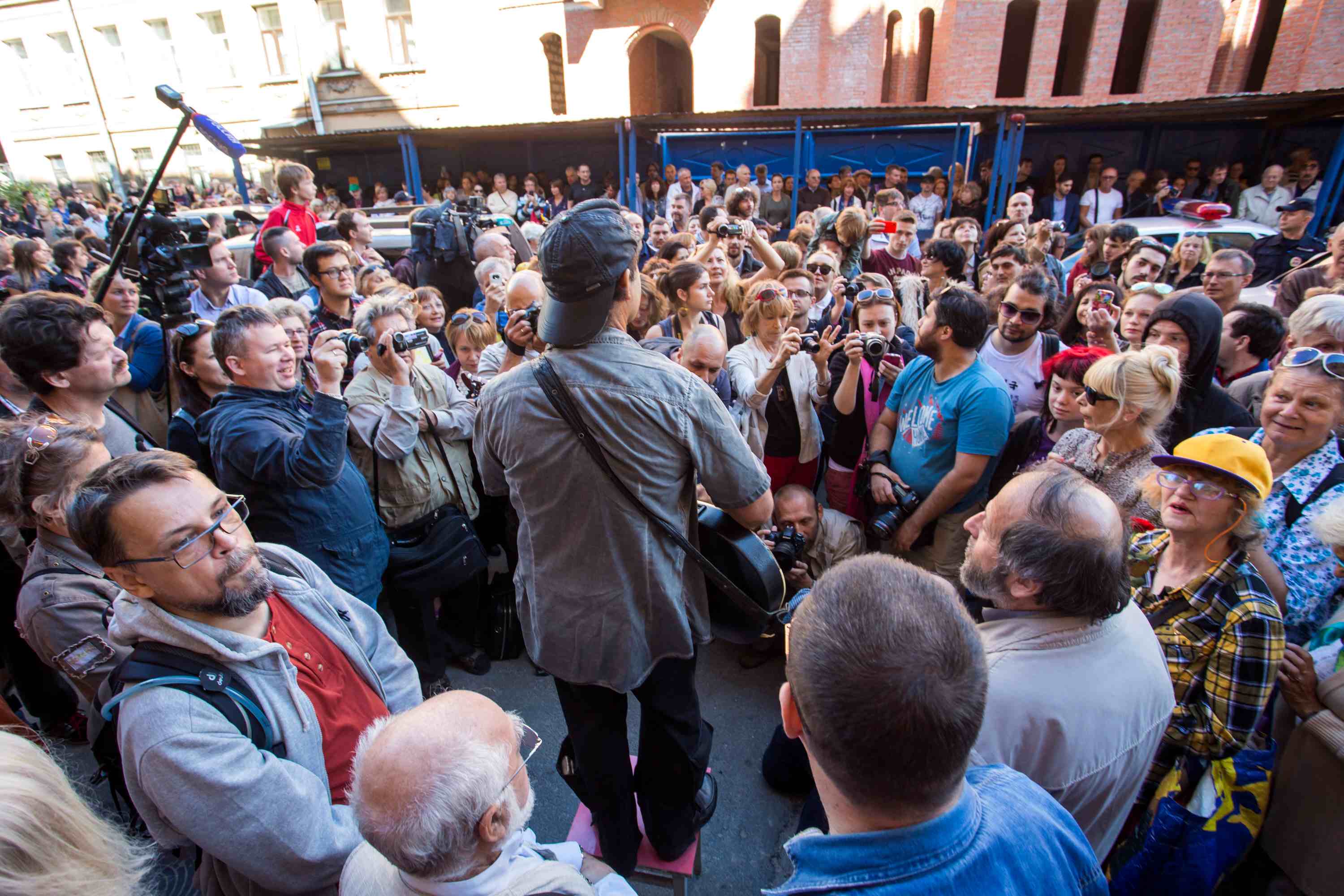 Folk singer and activist Mikhail Novitsky leads protesters in song
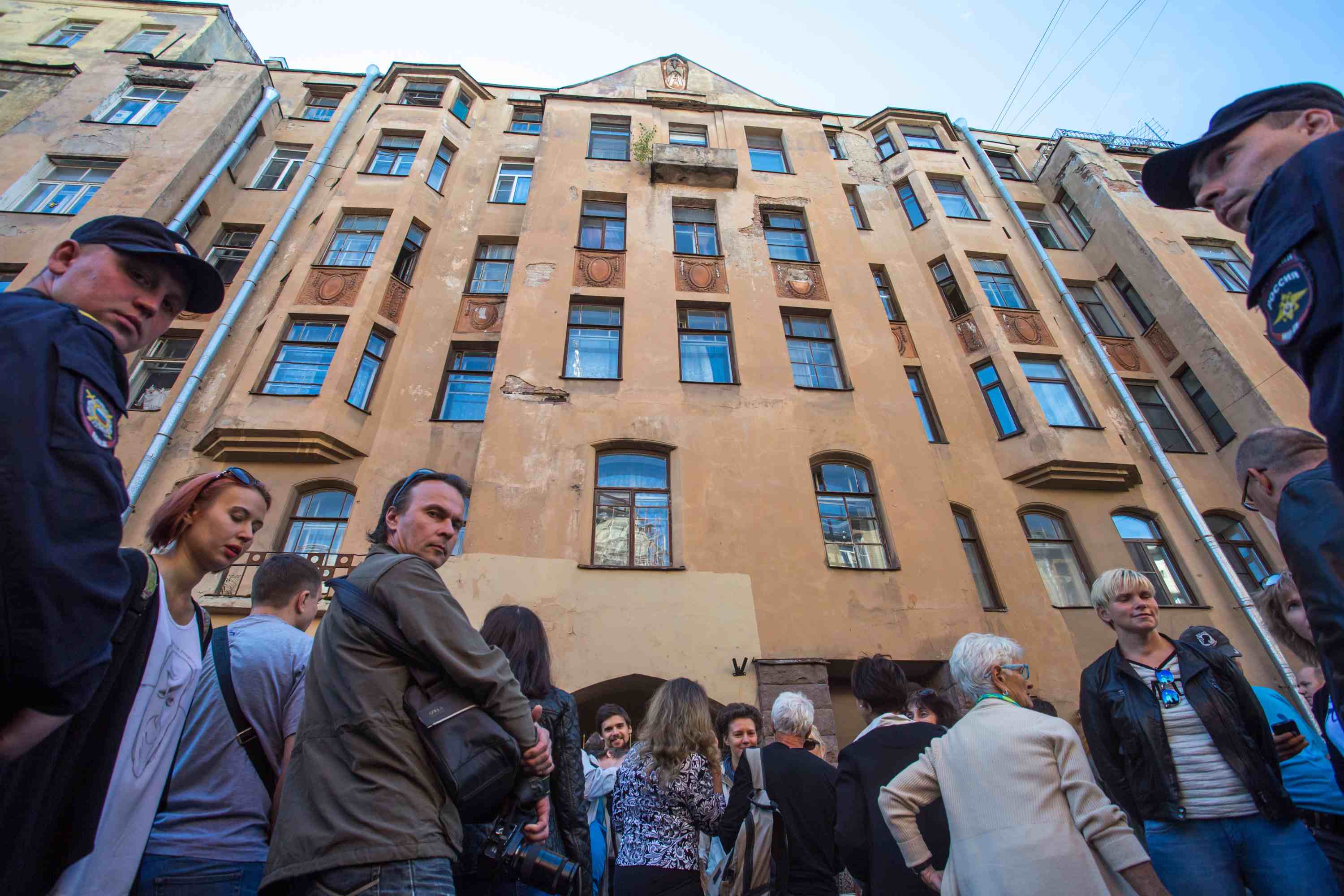 Mephistopheles House sans Mephistopheles
 Petersburg legislator Boris Vishnevsky poses with photo reproduction of Mephistopheles bas-relief
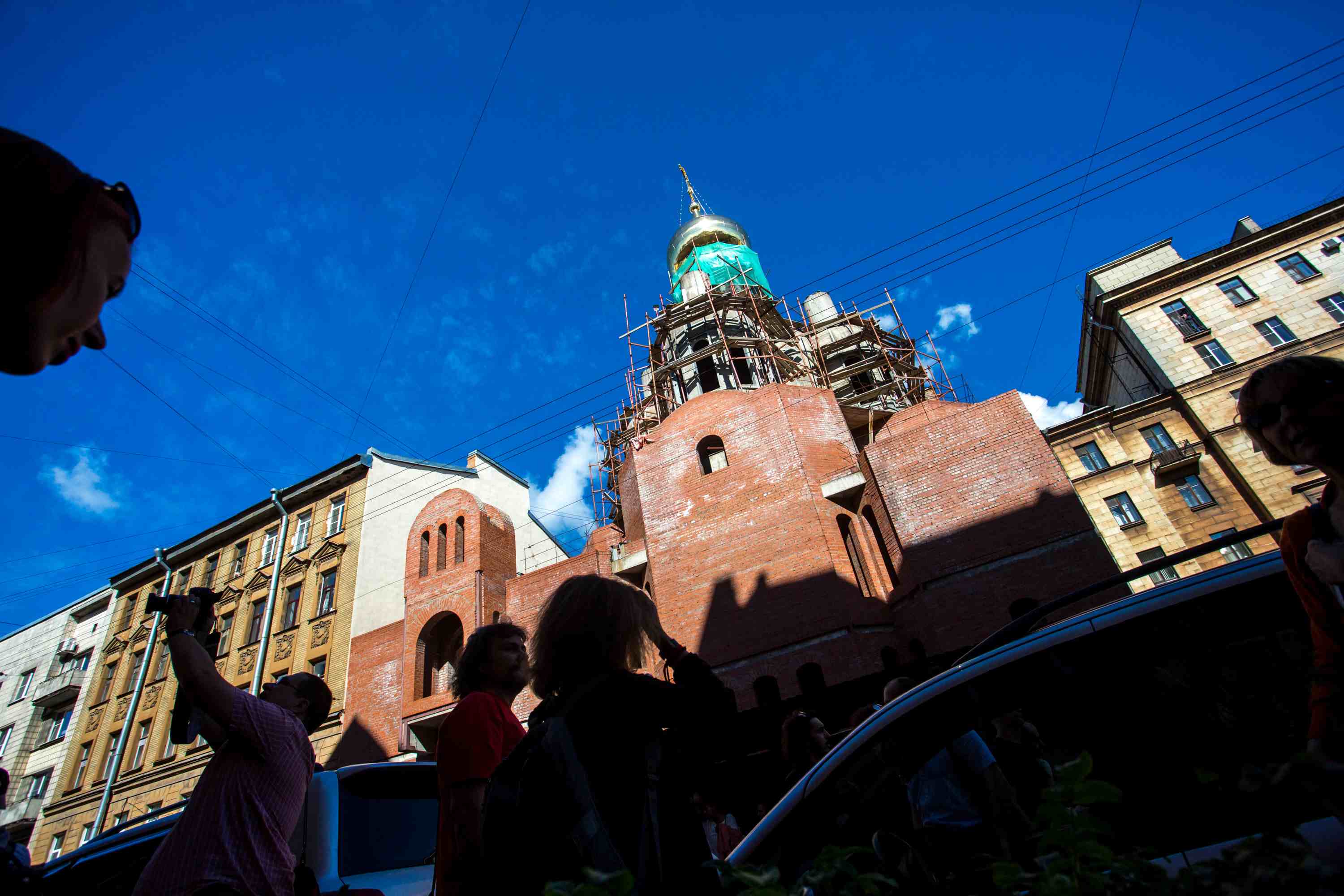 Russian Orthodox church currently under construction opposite Mephistopheles House