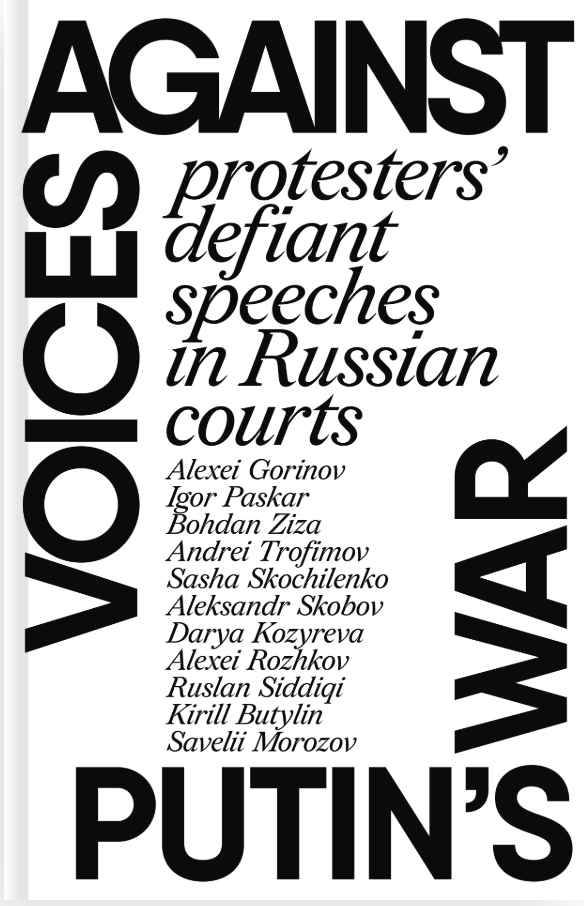
“We Wanted to Show the Whole Range of Anti-War Resistance in Russia”

Thursday 20 November, 7:00 p.m. UK time: TRY ME FOR TREASON – Readings from anti-war protesters’ speeches in Russian courts, and book launch for Voices Against Putin’s War.

You are welcome to attend in person at Pelican House, 144 Cambridge Heath Road, London E1. Or watch the livestream here on Facebook, or on Youtube.

Source: Ukraine Information Group (Facebook), 18 November 2025


What can courtroom speeches by imprisoned protesters tell us about the breadth of anti-war resistance in Russia? British historian Simon Pirani discusses his new book Voices Against Putin’s War with independent Russian journalist Ivan Rechnoy.

Simon Pirani is a British researcher and author who has written about energy and ecology, the history of the Russian Revolution, the labor movement, and post-Soviet Russia. His recent book Voices Against Putin’s War: Protesters’ Defiant Speeches in Russian Courts compiles and analyzes the courtroom speeches of twelve prisoners who were sentenced for resisting Russian aggression in Ukraine. 

— Today in Russia, hundreds of people are serving prison sentences for criticizing the invasion of Ukraine. Twelve of those people are the subjects of your book. How did you select them?

— We wanted to show that opposition to Putin’s war is widespread. What is striking about these people is their diversity. They come from different generations, have different life experiences, and hold different political views. This diversity demonstrates that, despite the absence of public demonstrations and the lack of any real possibility of organizing an open anti-war movement in Russia, an anti-war movement does exist there. It encompasses a very broad spectrum of Russian society as well as people from the occupied territories. For example, the book features the courtroom speech of Bohdan Ziza from Crimea.

We decided not to include some of the most well-known opponents of the war in the book — people who made brave and principled speeches in court, like Ilya Yashin, for example. Their statements had already been widely publicized in the media here. Instead our goal was to draw the attention of English-speaking readers to lesser-known figures. 

On the one hand, there are those who simply said something or posted statements on social media. For example, Darya Kozyreva, the youngest person featured in the book, was arrested for laying flowers at the Taras Shevchenko monument in Saint Petersburg. On the other hand, these are those who did something, such as throwing firebombs — not with the intention of hurting anyone, but to draw attention to the injustice of the war. Igor Paskar and Alexei Rozhkov are among them. These are people who live in smaller towns far from Moscow or Saint Petersburg, where young men are much more likely to receive draft notices from the conscription service. 

We also included the statement by Ruslan Siddiqi, who sabotaged a railway line to stop munitions from reaching Ukraine. 

The texts for the book were put together by a group of friends who, since the February 2022 invasion, had been translating the courtroom statements and some of the posts from the media or social networks. When we were already well into that process, a lot of new material appeared on the website Poslednee Slovo [author’s note: the project’s name translates as “the final statement”]. It’s a terrific project that does an excellent job of collecting and publishing a much broader range of cases than we could cover. 

We limited ourselves to people who have made explicit anti-war statements about the war in Ukraine. However, as you know, there are many other political prisoners who have appeared in court since the 2022 invasion, as well as many more from before that, especially among the Crimean Tatar political prisoners. They are all represented on the Poslednee Slovo website. Another remarkable thing about the website is that it goes back all the way to the Soviet period. They’ve included the 1966 speeches by Andrei Sinyavsky and Yulii Daniel, perhaps the first examples since Stalin’s time of people using the right for a final statement in court as a form of propaganda. 

Our book includes a chapter that lists seventeen additional cases of people who delivered anti-war speeches, beyond the twelve protagonists whose complete statements we published. We hope that either I or my colleagues will eventually translate all of those speeches as well. 

Unfortunately, the final courtroom speech has become something like a literary genre in its own right. This tells us a lot about the difficult and fearful times we are living through.

— How do you envision the audience for this book? Are they people in the West and elsewhere who already have some understanding of the situation in Russia and want to learn more? Or are they readers to whom you want to convey a political message — perhaps even to persuade them of something?

— The book is in English and is therefore intended for English-speaking readers rather than Russian-speaking readers. Only a small percentage of people in the UK, the US, and Europe can read Russian. Since 2022, many of us have been aware of the fate of the anti-war movement in Russia. As you know, it began with large demonstrations, but protesting soon became difficult and then almost impossible. Next came the firebomb attacks on military recruitment centers — actions not meant to harm people, but to draw attention to the anti-war cause. We then started reading, in Russia’s opposition media, the final statements of opposition figures — the courtroom having become, in effect, the last public forum in Russia where protest is still possible. 

However, I think that many people in English-speaking countries remain unaware of all this. 

So, to answer your question, our aim is to reach a wider audience in Western societies: not only those who have closely followed Russia’s attack on Ukraine and its consequences, but also those whose understanding of it comes only from what they have picked up incidentally through the media.

— One of the central figures in your book is Alexander Skobov. One might say he bridges two eras. He was a dissident in the Soviet Union and is once again among the persecuted today. There is another similar example that is not included in the book: Boris Kagarlitsky. How do people in the West perceive the difference between current repressions and the dissident movement during the Cold War? Also, how do they see the difference between the Russian and Western situations now?

— First, I would like to say a few words about Skobov. As someone who regularly travelled to Russia between 1990 and 2019, I was deeply affected by these courtroom speeches. The first one I came across was by Igor Paskar. I thought, “My God, these are such young people — not the youngest, but still much younger than me — who have entered this fight.” Alexander Skobov’s speech also affected me emotionally, perhaps because he is about my age — a year or two younger — and, as you said, he bridges two eras. 

I was particularly touched by the letter that he wrote to his partner, Olga Shcheglova. It was published in Novaya Gazeta Europe, and we also included it in the book. In the letter, Skobov explains that some of his friends and comrades urged him to leave Russia, but he refused. This made it inevitable that he would eventually face trial and imprisonment. In the letter, he explains that he wanted to communicate to the younger generation that the small group of dissidents he once belonged to — the socialist wing of the Soviet dissident movement — stands in solidarity with them in these difficult times. He wanted this message to be recorded in history. 

I think that is a very important statement, and we all owe Alexander Skobov gratitude for linking these two historical periods through his sacrifice. I hope that including his statements in our book will help people in the West understand this continuity more clearly. 

I will try to answer your question about how these movements are perceived. During the Soviet era, people in the West generally considered the dissident movement to be very small and marginal. Given how communication worked back then, it was very difficult for information to break through. Of course, there were large revolts against Soviet power, beginning with the Novocherkassk uprising in the 1960s and other violent revolts in the 1970s and 1980s. I have a friend in Ukraine who studied the major revolt that took place in Dniprodzerzhynsk. These movements were very short-lived, and we hardly knew about them in the West, even those of us who were interested in what was going on in the Soviet Union. 

Today, Russians — and Ukrainians, of course — have a much greater opportunity to have real conversations with people in Western Europe. I think the powers of that time really succeeded in dividing Europe; there really was an iron curtain. But that’s gone now. Millions of Ukrainians and Russians live in Western Europe, the UK, and the US. People are learning to communicate with each other and work together in new ways. 

We can already see examples of this in Germany, in the UK, and elsewhere. I think this conversation must continue — and our book, I think, is part of that ongoing dialogue. 

Of course, it’s not easy to communicate with someone who is literally in a Russian prison. However, through the friends, comrades, and families of the central figures in our book, I hope this conversation will begin and continue over a long period of time. 

— I wanted to ask specifically about the possibility of connecting the Russian-Ukrainian and Israeli-Palestinian agendas. We are, of course, impressed by the huge mobilization in support of Palestine. At the same time, many on the left are frustrated that active support for Ukraine — a country in a situation in some ways similar to that of Palestine — is far less widespread in Europe and the West. Have there been any positive developments in this regard recently? 

— Since October 2023, we have all watched with horror as Israel’s assault on Gaza has unfolded. It has been widely recognized as a genocide, and we now see a larger and more enduring anti-war movement in Western countries than we have seen in decades — comparable perhaps only to the protests against the US-UK invasion of Iraq in 2003, or even the movement against the Vietnam War in the 1970s. 

One of the reasons I felt it was important to translate these texts into English was to show Western audiences how much the Russian anti-war movement has in common with movements here. Of course, their enemies are different, standing on opposite sides of the geopolitical divide, and there are many other differences as well. Yet the similarities are striking — and deeply significant. The motivations of some of those who gave these courtroom speeches — whose statements we have translated — are very similar to those of activists in the UK who have been arrested for supporting Palestine Action, or of those who joined the flotilla recently stopped by Israeli forces as it attempted to reach Gaza. 

I spent much of last year attending the large British demonstrations against Israel’s assault on Gaza and calling for a ceasefire. Together with friends, we carried a banner stating: “From Ukraine to Palestine, occupation is a crime.” Our group wanted to show our fellow demonstrators that Ukraine’s struggle for national self-determination and the Palestinians’ struggle for freedom from Israeli occupation share something essential — the right to decide their futures, free from foreign interference and military threats. 

We received a very interesting response from other marchers. Those familiar with the politics of the so-called left and socialist movements will recognize the reaction we encountered from a small minority, mostly older people, who said things like: “Why are you siding with Ukraine? Ukraine is just a plaything of the Western powers, a puppet of NATO. Why even talk about this issue?” Yet the overwhelming majority — more than ninety percent — of those who approached us said, “Ah, yes, we hadn’t thought about it that way before, but there really is something in common between these struggles.”

Another major obstacle to unity comes not only from the “campism” of certain leftists — those who focus exclusively on American and British imperialism while downplaying or excusing Russian imperialism — but also from the state, the mainstream press, and government propaganda. The official narrative is consistently supportive of Ukraine and entirely condemnatory of Palestinian resistance. Ordinary people sense this imbalance — the racism and discrimination directed at the Palestinian cause, alongside the establishment’s favoritism toward Ukraine. There is some truth in that: the propaganda machinery of our ruling class here is largely sympathetic to Ukraine. Working-class people in the UK and across Europe notice this and grow suspicious. However, I believe that is a suspicion we can overcome — and that has been our experience. 

All of this is my personal opinion. The purpose of the book, however, is to bring to English-speaking readers the voices of our friends and comrades in Russia — those brave people who have found themselves in court and who, in some cases at the risk of additional years in prison, have chosen to exercise their constitutional right (though not always respected by judges) to deliver a final statement before the court. It is a remarkably courageous and difficult decision. 

— I wanted to thank you for the book, and I also wanted to ask you, since you have been interested in this topic for a long time: how did your interest in it arise, and why has Russia become so important to you?

— My connection with Russia began through the labour movement. I first went to Russia in 1990 — to Prokopyevsk, in western Siberia, where the miners’ strikes of 1989 had first broken out. At that time, I was working as a journalist for the mineworkers’ trade union here in the UK. We saw an opportunity to develop links of solidarity between Soviet miners and British miners. And we had some success. Our friends in the British miners’ union established a very close relationship with the Independent Miners’ Union of Western Donbas, based in Pavlograd. This friendship continues even today.

In those days, I was a member of a Trotskyist organisation, and in August 1990, we organised a meeting in Moscow to mark the 40th anniversary of Trotsky’s assassination. This, too, was part of a conversation between Western socialists and people in Russia and Ukraine that had been practically impossible during the “Cold War.”

I continued to follow what’s going on in Russia and Ukraine, and to write about it, and between 2007 and 2021, I worked at a research institute, writing about the energy sectors of those countries. 

Since the pandemic, I haven’t been back to Russia. On February 24th, 2022, when the invasion began, I was at home and was shocked. We were all shocked. The invasion has changed everything, both in Ukraine and Russia, for many years to come. Together with friends, we began translating these courtroom speeches and posting them online. Gradually, that work grew into the idea of making a book.

I hope your readers will read it. Later this year, we’re going to make the book freely available as a PDF, so that everyone can access it. 

If we do make any money — and I should say it is a very cheap book — all proceeds will go to Memorial and political prisoners. Nobody is making a profit from this project. The whole point is to share these voices with a much wider audience.

Source: Ivan Rechnoy, “We Wanted to Show the Whole Range of Anti-War Resistance in Russia,” Posle, 22 October 2025


 Sale! £15.00 £12.00

VOICES AGAINST PUTIN’S WAR
Protesters’ defiant speeches in Russian courts

Speeches by Alexei Gorinov, Igor Paskar, Bohdan Ziza, Mikhail Kriger, Andrei Trofimov, Sasha Skochilenko, Aleksandr Skobov, Darya Kozyreva, Alexei Rozhkov, Ruslan Siddiqi, Kirill Butylin and Savelii Morozov.

Foreword by John McDonnell, Member of UK Parliament

Edited by Simon Pirani

ISBN: 978-1-872242-45-3 (paperback)
e-ISBN: 978-1-872242-47-7 (e-book)
RRP: £15 (pbk)
e-RRP: £7 (Ebook)
196 pages; 140x216mm.
Publication date: September 2025

The E-book can be purchased at the usual online retailers
Any profits will be donated to Memorial: Support for Political Prisoners https://memohrc.org/en

Source: Resistance Books
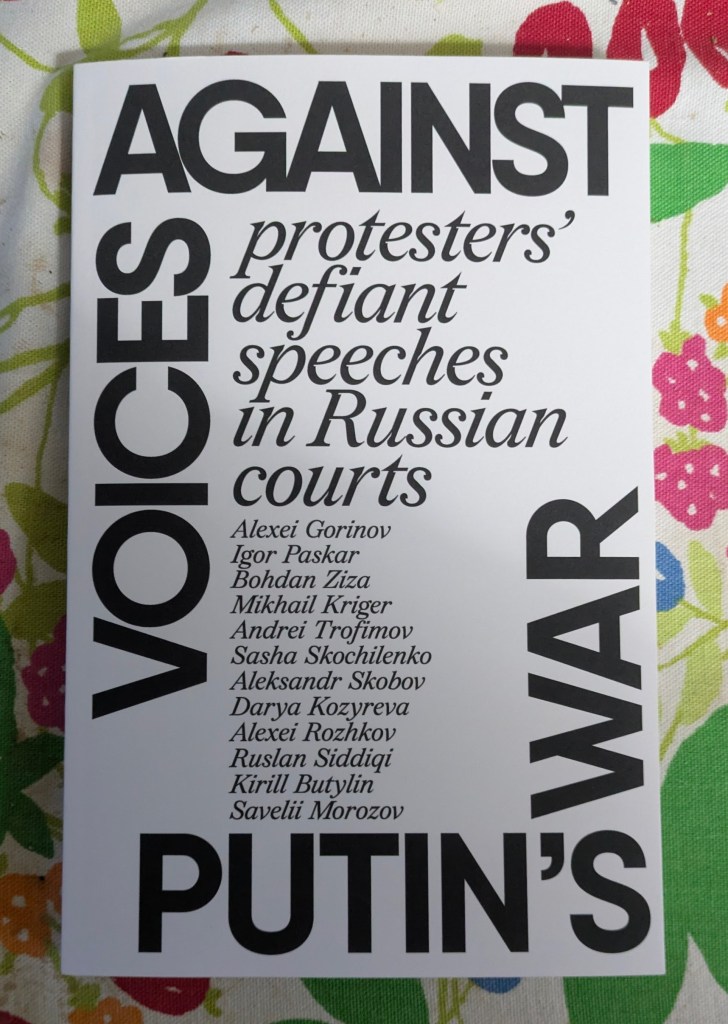
Voices Against Putin’s War

On May 16, 2022, the Ukrainian artist Bohdan Ziza poured blue and yellow paint – the colours of his country’s flag – on to a municipal administration building in his home town, Yevpatoria, in Crimea.

Ziza posted a video of the action online, with a call to “adherents of graffiti culture, all the vandals of Crimea, Russia and Belarus” to protest against “the most horrific war” unleashed by “[Vladimir] Putin and the machine of state.” He was soon arrested and charged with “committing a terrorist act” and “incitement to terrorism”.

In June 2023, Ziza used his final statement to the Russian military court that sentenced him to fifteen years’ imprisonment to denounce the war again: “My action was a cry from the heart, from my conscience, to those who were and are afraid — just as I was afraid — but who also did not want this war.”

Ziza is one of ten anti-war protesters whose speeches are published this month, in English translation, in Voices Against Putin’s War: protesters’ defiant speeches in Russian courts. The collection also includes two statements made outside court, related interviews and letters, a summary of seventeen other anti-war speeches in court, and a survey of the anti-war protest movement and the repression against it.

In Russia, dissenters since the Populist rebels of the 1870s have used their final statement in court to urge resistance to power. The tradition flourished in the workers’ movements that preceded the 1917 revolution, was broken by the 1930s Stalinist show trials with their formulaic confessions, and reborn after the 1950s “thaw”, with dissidents such as the writers Andrei Sinyavsky and Yulii Daniel.

In 2022, Russia’s all-out invasion of Ukraine was followed by a brutal crackdown on civil society in occupied territory, Crimea included, as well as repression of domestic dissent. Protest was driven off the streets. Individual non-violent direct actions like Ziza’s, or writing or speaking against the war, were punished with long jail sentences, such as those now being served by most of the protagonists in Voices Against Putin’s War

Ruslan Siddiqi, the Russian-Italian anarchist, went further: he is serving twenty-nine years’ imprisonment for derailing a train that was carrying munitions to Russian army units in Ukraine.

In court, he declared himself a prisoner of war, rather than a political prisoner: “My targets were Russian military equipment and the logistical chains used to transport military hardware and fuel. I wanted to impede military operations against Ukraine.”

Acting according to one’s conscience, in a dystopian world of militarism and big lies, was a central consideration for many of the protagonists.

Alexei Rozhkov, who firebombed a military recruitment centre in Sverdlovsk region, fled to Kyrgyzstan while on bail, before he was kidnapped by Russian special forces and returned to be put on trial.

He told the court that sentenced him to sixteen years: “Although I have never been a politician or a statesman, I could not remain indifferent when the war began. I have a conscience, and I preferred to hold on to it.”

The book’s protagonists oppose the war from a wide range of political viewpoints. On one hand, there are pacifists such as Sasha Skochilenko, the artist jailed for seven years for replacing labels in a supermarket with handwritten anti-war messages (and later freed in a prisoner swap between Russia and Western countries), who told the court: “Wars don’t end thanks to warriors — they end thanks to pacifists.”

On the other hand, there are political activists who spoke of Ukraine’s right to resist Russia militarily. Aleksandr Skobov, 67, the oldest protagonist, first jailed for activity in the socialist wing of the Soviet dissident movement in 1978, refused to stand when the judge came into court.

Skobov wished death on the “murderer, tyrant and scoundrel Putin.” He said he would never stop calling on honest Russians to join the Ukrainian armed forces, and for air strikes on Russia’s military facilities.

No less adamant in support of Ukraine was the youngest protagonist, Darya Kozyreva, 19, sentenced to two years and eight months’ imprisonment for laying flowers and a poem at the statue of Ukraine’s national poet, Taras Shevchenko, in St Petersburg.

In court, Bohdan Ziza denounced not only the 2022 invasion but also the frenzied assault on Crimean Tatar organisations that preceded it in Crimea, which Russia annexed in 2014. “Those who so passionately seek ‘Nazis’ in Ukraine have not opened their eyes to the Nazism in Russia, with its ephemeral ‘Russian world’,” with which the armed forces have “tried to extirpate Ukrainian identity”.

(Last month Ziza, on his own demand, had the Russian citizenship that was imposed on him along with all Crimean residents revoked. He is today in Vladimir Central jail, where “politicals” have been incarcerated since the 19th century.)

Voices Against Putin’s War results from the work of a small volunteer group of translators supporting Russian anti-war organisations, of which I was part, and is supported by the European Network for Solidarity With Ukraine. On top of the speeches published, we have summarised seventeen more from the wonderful “Poslednee Slovo” (“last word”) website.

The trials highlighted in the book also provide a snapshot of Russia’s wartime lurch towards a form of fascism. Against those who take non-violent direct action, charges under terrorism laws were standardised in 2022, with jail sentences of between ten and twenty years. Torture of detainees is routine.

Long sentences are designed to terrorise people into silence: Andrei Trofimov got ten years for social media posts justifying Ukrainian military actions against Russia.

For his two-minute speech in the military court, which ended “Glory to Ukraine! Putin is a dickhead” he was charged with “condoning terrorism” and “defaming the army”: a further three years were added to his sentence.

The monstrosity of Russia’s domestic repression may properly be understood in the context of the bloodbath it has visited on Ukraine, and especially on the occupied territories.

Hundreds of thousands of Russian and Ukrainian soldiers have been killed and wounded in action, and millions of Ukrainian civilians have been uprooted from their homes by bombing. Added to that, people in the occupied areas have faced enforced imposition of Russian citizenship, mass deportations including of children (the basis of a case against Putin in the International Criminal Court), legal nihilism, and an economic slump.

The primary instrument of social discipline in the occupied areas is enforced disappearances, including imprisonment. In September 2024, Ukraine’s register of persons “missing under special circumstances” counted some 48,324 names, of which 4,700 were confirmed by the Ukrainian government to be in captivity, although the true number may be far higher.

The Organisation for Security and Cooperation in Europe estimated that 16,000 people on the register were adult civilians. The Kharkiv Human Rights Protection Group identified 5,000 victims of enforced disappearances while preparing material for the International Criminal Court, and the Ukrainian ombudsman is working on 1,700 such cases. (All these numbers relate to civilians detained or missing, as distinct from Ukrainian prisoners of war, of which there are some 8,000–10,000.)

In short, Russia has taken many thousands of civilian prisoners in the occupied territories, whose fates often remain unknown. Many are political prisoners: 585 journalists, community leaders and activists from newly-occupied territories identified by human-rights organizations, 265 counted by the Crimean Human Rights Group, and others.

Furthermore, there are the thousands of civilian prisoners jailed by the so-called “People’s Republics” in Donetsk and Luhansk between 2014 and 2022, including for political offences, who have been transferred to prisons in Russia.

Alongside this orgy of violence, Russia’s machine of domestic repression has gone into overdrive.

A swathe of new censorious laws, for instance penalizing “disseminating knowingly false information about the Russian military” (which includes calling the war a war) have been added to the pre-existing laws on “foreign agents”, “undesirable organizations” and “extremism” from the last decade. Deranged police sweeps of people whose critical comments are harvested from social media have intensified.

The leading human-rights organisation Memorial: Political Prisoners Support, now based abroad, lists over 3,000 political detainees today, compared to just 50 in 2015 and 420 in 2021. After the post-Stalin “thaw”, historians reckon the number of political detainees in the Soviet Union fell to 5,000-10,000 in the 1970s (in the fifteen-republic union, with a population nearly twice that of Russia alone).

The trend reflected in these numbers justifies the term we have used in Voices Against Putin’s War: a “21st-century gulag.”

Amidst an international tide of rising right-wing authoritarianism and militarism, culminating in the genocide in Gaza, the speeches in the book are significant far beyond Russia. In his foreword, John McDonnell, a left-wing Labour MP in the UK, calls them “an inspiration to all those across the globe who see an injustice, and who refuse to passively comply”, from Israeli draft refuseniks and Palestine Action supporters in Britain to women demonstrating for life and liberty in Iran. That is where hope lies in our dark times.

□ You can buy Voices Against Putin’s War from the Resistance Books website.  

□ Thursday 20 November, 7:00 p.m. TRY ME FOR TREASON. Readings from anti-war protesters’ speeches in Russian courts, and book launch for Voices Against Putin’s War. Pelican House, 144 Cambridge Heath Road, Bethnal Green London E1 5QJ. Register free on Eventbrite here.  

□ There are English-languages pages on the websites of Memorial: Political Prisoners Support, Solidarity ZoneMediazona and The Last Word.

Source: Simon Pirani, “Raging against Putin’s war machine,” People and Nature, 20 October 2025. Originally published in Jacobin

Are These the Bad Old Days?

Source: Ekaterina Reznikova and Alexey Korostelev, “2024: A study into repression under Putin,” Proekt, 22 February 2024


Russia jails dissident once targeted by Putin at KGB for 16 years

A court in St. Petersburg has sentenced Alexander Skobov, a 66-year-old Soviet dissident and activist, to 16 years in jail on charges of justifying terrorism and joining a terrorist group. Skovov was first arrested more than four decades ago and Vladimir Putin was among the KGB officers who worked on his case. Prosecutors said Skobov justified terrorist attacks on Russian territory and supported the Freedom of Russia legion, which Russia has deemed a terrorist organisation for fighting alongside Ukrainian forces.

  • Skobov will spend the first three years of his sentence in prison (typically reserved for highly dangerous criminals such as kidnappers and terrorists and repeat offenders), with the rest in a high-security penal colony. He will be 80 by the time he can be released, although it is questionable whether he will survive that long in Russia’s harsh prison system. The activist has many health problems, including diabetes, hepatitis C, asthma and glaucoma.
  • At the court hearing, Skobov made clear that he did not believe he was facing a fair trial. He refused to answer questions and did not stand when the judge addressed him. “Today they will ask me again – do I plead guilty? Well, now I’m the one asking,” he said in his closing statement. “It’s me asking the servants of Putin’s regime who are present here, who are small cogs in his repressive regime: do you plead guilty to complicity in Putin’s crimes? Do you repent of your complicity?”
  • In the USSR, Skobov was repeatedly charged with “anti-Soviet” offenses. He was first arrested in 1978 on charges of distributing anti-Soviet leaflets and was sentenced to two years in a psychiatric hospital (punitive psychiatry was widespread in the Soviet Union and used as one of the main tools of repression in the 1960s, 70s and 80s). Skobov was forcibly hospitalized again in 1982 for daubing anti-Soviet graffiti on the walls of a building and then released in 1985. 
  • Vladimir Putin, who worked in the Fifth Department of the KGB that was tasked with combating “ideological sabotage,” was among the KGB officers that handled his original cases, independent media and rights groups reported.

Why the world should care

This is far from the first instance when somebody in Russia has been imprisoned for a post on social media. Since 2010, prosecutors have opened more than 1,000 such criminal cases. But a 16-year sentence for an elderly activist in frail health stands out as particularly punitive. It’s safe to say that treatment of dissidents in modern Russia is growing far tougher than it was in the post-Stalin Soviet Union. 

Source: “THE BELL WEEKLY: Billion-dollar loss for Russia’s Facebook,” The Bell, 25 March 2025


“Illinois Governor JB Pritzker (D-IL) Speaks at the 2025 HRC Los Angeles Dinner,” Human Rights Campaign (YouTube)

The Trump administration and his Republican lackeys in Congress are looking to reverse every single victory this community has won over the last 50 years. And right now, it’s drag queens reading books and transgender people serving in the military. Tomorrow, it’s your marriage license and your job they want to take. Bending to the whims of a bully will not end his cruelty. It will only embolden him. The response to authoritarianism isn’t acquiescence. Bullies respond to one thing, and one thing only, a punch in the face.

But you see, that starts with fully acknowledging what is happening. The meme lords and the minions in the White House are intentionally breaking the American system of government so they can rebuild it in their own image. They’ve shut down cancer research and HIV prevention. They’ve eliminated drinking water and clean air regulations and upended the lives of veterans. They’ve said that a recession that Trump is likely to cause will be worth it, which is an assessment worthy of Trump University.

At its core, what Elon Musk and Donald Trump are doing isn’t about efficiencies or cost savings. It’s about giving their wealthy friends a tax break and making the middle class and veterans and public school kids pay for it. It’s a few idiots trying to figure out how to pull off the scam of their lives.

Meanwhile, the scariest part is that they’re using the power of the presidency to try to delight their base by targeting vulnerable people, people they think can’t fight back, calling them domestic enemies or claiming they’ll ruin American culture. Remember their slogan, “Make America Great Again.” Authoritarians target vulnerable minority communities first because they think that if they can conquer those that they deem weak, and they can show everyone else who’s boss, which is why we can’t sit back right now and wait to see what happens. If we wait, I guarantee you the battle will have already been lost.

Donald Trump cannot take anything from us that we don’t choose to give him. He and his henchmen don’t want people to realize that. But now is the time for us to wake up. The good news is every day I’m seeing more and more people across this country realize that they don’t want to give him much at all.

The question I get asked most right now is, “So what can I do? What can I do?” And I’m going to be blunt about this. Never before in my life have I called for mass activism, but this is the moment. Take to the streets, protest, show up at town halls. Jam the phone lines in Congress, 202-224-3121, and afford not a moment of peace to any elected representatives who are aiding and abetting Musk and Trump’s illegal power grab. This is not a drill, folks. This is the real thing.

Seize every megaphone you have. Go online and make a donation to the legal funds fighting Trump, to HRC, and to the candidates for Congress that vow to take this country backward. And don’t limit your voice to the traditional political channels. Be like Lucy Welch. When JD Vance went to vacation at the Sugarbush Resort in Warren, Vermont, Lucy, who writes the Sugarbush Daily Snow Report, used her report to defend her diverse and wonderful community, ending by saying, “I am using my relative platform as a snow reporter to be disruptive. What we do or don’t do matters.”

What we do and don’t do matters. It matters right now more than it ever has before. When my future grandkids look back on this moment, I want them to know that my voice was one of the loudest in the room, screaming for justice and fighting against tyranny.

And in the midst of this existential fight, this battle that seems to consume everything, well, let’s not take the soul-sucking path of sacrificing the most persecuted for that which we deem to be most popular. I know that there are transgender children right now looking out at this world and wondering if anyone is going to stand up for them and for their simple right to exist. Well, I am. We are. We will.

I know that amidst the ongoing assault on our institutions, it is easy for people to fall into despair about our democratic system. But I love this country too much not to fight for it. You’re here tonight because you do too. And when I think about that love, I think back to all the times in our history when our ancestors had to fight back against tyrants and racists and those who couldn’t understand that freedom and justice are our foundational promises in this country.

That group of people, that small group of people that got together in Chicago to found this country’s first known gay rights organization. Well, it was called the Society for Human Rights. It was 1924 and the flicker of light was brief. It only lasted a matter of months before social persecution and criminal prosecution bankrupted the promise of the group’s charter. But oh, that flicker ignited something. By whisper and by word of mouth, folks around the country started to catch wind of the idea. And eventually, it ended up in the ears of a man here in California who later said the idea of gay people getting together at all was an eye-opener for him.

Well, that man’s name was Harry Hay. And a couple of decades later, he went on to found the Mattachine Society right here in Los Angeles. It was the first sustained gay rights organization in the United States. Harry said that he was first told about the Chicago group as a warning that the idea was too dangerous and nobody should try to pull anything off like that ever again. How lucky the world is that Harry didn’t listen.

When we say history repeats itself, it’s not because the villains and battles don’t evolve with the ages. They do. But the fight itself remains elemental. It’s always men who would be king, blaming the suffering of the masses on those who look different or sound different or live differently. And since the dawn of time, the triumph of good over evil has relied on those who believe in empathy and kindness, summoning the steel spine needed to defend those values that by their nature leave us vulnerable to attack. This community knows that. You have lived and breathed this fight for generations. Our hope, our hope lies in this room.

The fact that we are still here today means that we have the faith and courage that we will win the battles that really matter. Now, when I first ran for governor in 2018, I started every single stump speech by saying, and this will tell you why Donald Trump doesn’t like me very much. I said at the beginning of every stump speech, everything we care about is under siege by a racist, misogynist, homophobic, xenophobic Donald Trump.

Source: Parker Molloy, “Watch Illinois Governor JB Pritzker Reject the Politics of Trans Abandonment,” The Present Age, 24 March 2025. Thanks to Rebecca Solnit for the heads-up.

Closer to the Edge: Plagiarism Disguised as Gonzo Journalism

A screenshot of Closer to the Edge’s homepage (22 March 2025)

Plagiarizing other people’s reporting and translating and bravery, as Closer to the Edge has done with Russian dissident and political prisoner Alexander Skobov’s closing statement and just-concluded trial, is despicable. I looked at the “About” page on their Substack and discovered this bit of sophistry as an explanation of their journalistic highway robbery:

As for sources—sure, we could lace every article with footnotes and hyperlinks, but let’s be real: a name and a citation don’t mean much in a world where half of Washington is reading scripts written by billionaires and lobbyists. Sources can be biased, corrupt, cherry-picked, or outright fabricated, and if you need proof of that, just look at the gibbering circus act that is the modern Republican Party. These are people who think “alternative facts” are a valid concept and that the guy who bankrupted a casino somehow knows how to fix the economy. You think they care about good sourcing?

Besides, bogging our writing down with a mess of citations and academic formalities would wreck the flow faster than a Senate hearing on TikTok. Our job isn’t to hand-hold people through a bibliography—we’re here to tell the story as it is, from the trenches, with all the blood, chaos, and absurdity intact. If you want a research paper, head to JSTOR. If you want the truth with its teeth bared, you’re in the right place.

It’s telling that Closer to the Edge is clueless about the egregious circumstances of Skobov’s actual trial. They paint a vivid picture of Skobov confronting the judges and other shameless Putinist law enforcement officials directly in the courtroom: “On March 21, 2025, the 67-year-old Soviet-era dissident walked into a Russian courtroom, stared down the agents of Vladimir Putin’s dictatorship, and set himself ablaze in words.”

In fact, Skobov took part in the trial via video link from an empty courtroom in Syktyvkar, while the judges meted out their verdict against him over a thousand kilometers away in Skobov’s hometown of St. Petersburg, without looking Skobov in the eye or even breathing the same air as he breathed.

So much for “tell[ing] the story as it is, from the trenches.” ||| TRR

Alexander Skobov: “We Are Witnessing a Disgusting Attempt at a Purely Imperialist Collusion Between Two Predators”

Alexander Skobov. Photo: Mediazona

Today, the 1st Western District Military Court sentenced 67-year-old dissident Alexander Skobov to 16 years in prison and fined him 300,000 rubles (just over $3,500). Skobov, who first faced criminal prosecution in the USSR, was convicted under charges of “participation in the activities of a terrorist community” (for his involvement with the Free Russia Forum, a Russian opposition conference abroad) and “justification of terrorism” (for his social media posts and articles). Mediazona publishes Skobov’s closing statement from today’s trial—a passionate speech in which he continues to openly support Ukraine, defies persecution and denounces judges as accomplices of Putin’s war crimes.


I will not dwell on the fact that the investigation has branded the organisation I have the honour of belonging to, the Free Russia Forum, as a terrorist community. There has been no official ruling from any government body recognising the Free Russia Forum as such. For now, it is merely an “undesirable organization.”

But I have little interest in all this petty mumbling. I prefer to speak about what truly matters. What matters here is the platform of the Free Russia Forum, a platform I was directly involved in shaping, and one that distinguishes the Free Russia Forum from most other opposition organisations.

Let me remind you that this platform is built on three principles. First: we stand for the unconditional return to Ukraine of all its internationally recognised territories occupied by Russia, including Crimea. Yes, Крим це Україна. [Crimea is (part of) Ukraine — TRR.]

Second. We support all those who are fighting to achieve these goals—including citizens of the Russian Federation who have voluntarily joined the Armed Forces of Ukraine. 

And third. We recognise any form of war against Putin’s tyranny inside Russia, including armed resistance. Of course, we are deeply disgusted by the methods of ISIS, when innocent people are targeted, as was the case in Crocus City.

But are the Kremlin’s war propagandists a legitimate target? The Free Russia Forum has not formally debated this issue or adopted any resolutions on it, so what I say next reflects my personal position alone.

I believe that propagandists such as TV host Vladimir Solovyov deserve the same fate as Hitler’s chief propagandist Julius Streicher, who was hanged by the Nuremberg Tribunal. Until these outcasts of the human race are brought before a new Nuremberg Tribunal—and as long as this war continues—they remain legitimate military targets. 

For me, the comparison between Putin’s and Hitler’s propagandists is not mere rhetoric. Much of my public writings has been devoted to proving the inherently Nazi nature of Putin’s regime—a regime with which peaceful coexistence is fundamentally impossible. 

I appeal now, as I have before, first and foremost to Europe, which should remember the origins of the current European system. Since 1945, Europe has been building a world in which predators no longer prevailed, a world based on the principles of law, justice, freedom, and humanity. Europe had achieved much on this path and seemed to have rid itself of massacres and territorial redistributions forever.

Europe once believed that this safe and prosperous world was securely protected by a great powerful ally across the ocean. Today, this world is being torn to splinters by two scoundrels on both sides: the Kremlin and Washington. People with pro-fascist values have come to power in the United States. 

We are witnessing a disgusting attempt at a purely imperialist collusion between two predators. An even more despicable collusion than the Munich Betrayal of 1938. If Putin’s annexations are legalised, it will spell disaster for civilization. Europe, you have been betrayed. Wake up and go fight for your world!

Death to the Russian fascist invaders! Death to Putin, the new Hitler, murderer and scoundrel! Glory to Ukraine! Glory to the heroes!

I usually end my speeches with these words. But today I will be further asked whether I plead guilty.

Well, I am the accuser here.

I accuse Putin’s corpse-stinking clique of planning, unleashing, and waging an aggressive war. Of committing war crimes in Ukraine. Of orchestrating political terror in Russia. Of corrupting my people.

And now, I ask the servants of Putin’s regime present here, mere cogs in the repressive machine: do you find yourselves guilty of complicity in Putin’s crimes? Do you repent?

And with that, I’ve said all I needed to say.

Source: “‘I am the accuser here—I accuse Putin’s corpse‑stinking clique’: Closing statement of dissident Alexander Skobov, sentenced to 16 years in prison,” Mediazona, 21 March 2025


A Russian military court sentenced Soviet-era dissident Alexander Skobov to 16 years in prison on charges of justifying terrorism and being a member of a terrorist organization, the exiled news outlet Mediazona reported Friday.

Skobov, 67, was arrested in April on allegations that he justified an attack on the Russian-built Crimea Bridge in an online post and was a member of the Lithuania-based liberal opposition platform Free Russia Forum, which Russian authorities have outlawed as “undesirable.”

A military court in St. Petersburg convicted Skobov on both charges and sentenced him to serve his time in a maximum-security prison.

Prosecutors had requested an 18-year sentence for Skobov, whose health had deteriorated significantly during pre-trial detention.news

In a defiant last statement in court, Skobov condemned both Russian and U.S. leaders as “predators” engaged in an “imperialist conspiracy” in Ukraine.

“Death to the Russian fascist invaders! Death to Putin, the new Hitler, the murderer and scoundrel! Glory to Ukraine!” Mediazona quoted Skobov as saying.

“I’m the one blaming you here. I accuse Putin’s ruling clique, which stinks of corpses, of preparing, unleashing and waging an aggressive war,” Skobov added.

Russia’s Justice Ministry designated Skobov as a “foreign agent” in March 2024. He is among the few outspoken critics of Russia’s full-scale invasion of Ukraine to remain inside the country despite the risk of facing criminal charges under wartime censorship laws.

A dissident since the late 1970s, Skobov was convicted twice and subjected to punitive psychiatric treatment for “anti-Soviet propaganda.”

Source: “Military Court Jails Soviet-Era Dissident Skobov 16 Years for ‘Justifying Terrorism,’” Moscow Times, 21 March 2025

Alexander Skobov: What It Means to Be Anti-War and Anti-Fascist

The complete text of Alexander Skobov’s speech during closing arguments at his trial today (18 March 2025). Video: SOTAvision

Those who have been following my trial will certainly have noticed that the position of my lawyers and my position are not quite the same. We have emphasized different things, and we have slightly different objectives. My lawyers have sought to draw attention to a problem that is identified in the reports of international organizations as the abuse of anti-terrorist legislation to restrict the freedom of expression, the freedom of speech.

This problem does exist, and in some quite decent countries, particularly the European countries. The European approach to this problem has differed from the American one. The United States of America has the First Amendment of the Constitution, which expressly prohibits any limitations on freedom of speech. In the wake of the severe trauma wrought by the Second World War, the European countries took a somewhat different path. They introduced measures to restrict the dissemination of ethnic hatred, ethnic superiority, and ethnic inferiority — all the ideas associated with Nazism. A whole system of restricting freedom of speech has arisen out of this. Europe has sought a reasonable balance between freedom of speech and its restriction.

I do not regard this experiment as successful. Freedom of speech either exists or it doesn’t exist. Any restrictions on it will always lead to abuse, no matter how well intentioned. The very idea of prohibiting people from condoning anything or anyone is flawed in principle. It means forbidding people from thinking and feeling. Lawyers have the inalienable right to seek to condone their client any way they can, but so does any human being.

Only this whole story has nothing to do with us. There is no abuse of anti-terrorist legislation in Putin’s Nazi Russia. There is legislation explicitly aimed at quashing all expression of disagreement with the authorities. Under this legislation, a theatrical production about the horrible fate of women who were tricked by ISIS fighters into joining their war as their wives is deemed “condoning terrorism.” Those complicit in the guilty verdict against Yevgenia Berkovich and Svetlana Petriichuk have no souls, they are undead, but the law itself is worded in such a way that it can be interpreted this way. Can we speak the language of law with a state which has adopted a law like this and deploys it in this way? Of course we cannot.

My case is fundamentally different from the case against Berkovich and Petriichuk, as well as from the numerous cases against people who limited themselves to voicing moral condemnation of Russia’s aggression against Ukraine. My case is not about freedom of speech, its limitations, and the abuses of these limitations. My case is about the right of a citizen in a country waging an unjust war of aggression to utterly and completely take the side of the victims of the aggression. It is about the right and duty of a citizen in a country waging such a war.

This right is covered by the category of natural law because it cannot, in principle, be regulated by legal norms. All warring states regard going over to the side of their armed enemy as treason. And the aggressor never recognizes himself as the aggressor and calls the robbery and plunder in which they engage “self-defense.” Can we prove legally to the aggressor that they are the aggressor? Of course not.

But Putin’s Nazi dictatorship is an aggressor of a special kind. Having legislatively declared a war a “non-war,” it regards all armed opposition to its aggression as “terrorism.” It does not recognize the existence of a legitimate armed opponent at all. The obligatory reports of the Russian high command persistently refer to the Ukrainian army as “militants.” Does this have anything to do with law? Of course not. But war, in principle, is not compatible with law. By its very nature, the law is a constraint on violence, while war is violence without restraint. When the guns talk, the law is silent.

My case has to do with my involvement in the armed resistance to Russian aggression, even if only as a propagandist. The goal of all my public statements has been to achieve a radical expansion of military assistance to Ukraine, up to and including the direct involvement of the armed forces of NATO countries in combat operations against the Russian army. For the sake of this goal I refused to emigrate and deliberately went to prison. What I say carries more weight and resounds more loudly when I say it here.

Borrowing the wording of the so-called Criminal Code of the so-called Russian Federation, all these actions constitute assistance to a unfriendly foreign power in generating threats to the national security of the Russian Federation, as described in the current Criminal Code’s article on high treason. Why was I not charged with violating this article, nor with violating the many other political articles in the current Criminal Code, charges which should have been brought against me for my publications? The most important of my publications were never included in the indictment, although I had the opportunity to make sure that the investigation was acquainted with them. In addition, the investigation was aware that I had made personal donations to purchase lethal weapons for the Ukrainian army and publicly encouraged others to follow my example. This is the kind of thing for which the authorities now automatically charge people with high treason.

Why didn’t they do it? I think that they didn’t do it not only due to the overloaded repressive apparatus, human laziness, and the typical aversion of Russian authorities to legal norms in general, including their own legal norms. They are our legal norms, they would say. We do what we want with them, we enforce them when and if we want to enforce them. We call the shots.

But there is another reason. Even among the people who have morally condemned the Russian aggression and risked going to prison for it, there are not many who have dared to take the side of the victims of the aggression. The dictatorship is afraid that there will be more such people, and it is afraid of “bad” examples. So it has had a stake in not amplifying my voice too much and not mentioning the specifics of my case, which I have just mentioned. I have tried to focus the public’s attention on these selfsame peculiarities.

Unlike my lawyers, I really have not tried to prove to the aggressor that they are an aggressor who has violated all internationally recognized legal norms. It makes as much sense as discussing human rights with Hitler’s regime or with Stalin’s similar regime. By the way, maybe the judge can recall which article of the Criminal Code criminalizes equating Stalin’s regime with Hitler’s.

But my lawyers and I are unanimous that my case cannot be considered outside the context of the ongoing war. It is a part of this war. And my lawyers’ attempts to speak the language of law with the aggressor’s authorities only illustrate once more that when the guns do the talking, the law is silent.

Free speech is not the issue in my case. In this war, speech is also a weapon that also kills. The Ukrainians write my name on the shells annihilating Putin’s lowlife who have invaded their land. Death to the Russian fascist invaders, death to Putin, the new Hitler, a murderer and scoundrel! Glory to Ukraine, glory to the heroes! I rest my case.

Source: Darya Kostromina (Facebook), 18 March 2025. Translated by the Russian Reader


Alexander Skobov

Prosecutors have requested an 18-year prison sentence for Russian dissident Alexander Skobov, whose trial on charges of justifying terrorism over a social media post he wrote about the Ukrainian bombing of the Crimean Bridge is coming to an end in St. Petersburg, independent news outlet Bumaga reported on Tuesday.

Requesting Skobov be given a six-year sentence for justifying terrorism, as well as a 12-year sentence for “involvement with a terrorist community”, prosecutors also asked the court to ban Skobov from administering websites or Telegram channels for four years and to fine him 400,000 rubles (€4,500). Having openly criticised the regime of Vladimir Putin and opposed both Russia’s 2014 annexation of Crimea and its 2022 full-scale invasion of Ukraine, Skobov was arrested in April over a social media post he wrote about the Ukrainian bombing of the Crimean Bridge, which connects Russia to the annexed peninsula.

Skobov had previously said that the destruction of the bridge was “extremely important from a military-political standpoint” and called a failed Ukrainian attempt to destroy it a “shame”. He had also been fined for his links to the pro-democracy Free Russia Forum, an organisation deemed “undesirable” and thus effectively outlawed in Russia. The Free Russia Forum condemned his detention, calling it “arbitrary”, and demanding his immediate release.

Now 68, Skobov is a well known Soviet-era dissident who was part of the New Leftists opposition movement in the late 1970s. He was forced to spend two three-year stints in a psychiatric hospital, a common fate for political dissidents at the time, for publishing the anti-government magazine Perspectives and for participating in protest actions.

Having been deemed a “foreign agent” by the authorities, Skobov nevertheless refused to leave Russia, despite pleas from his family to leave. While in pretrial detention, Skobov’s health in general, and eyesight in particular, have deteriorated rapidly.

Source: “Prosecutors request 18-year prison sentence for Russian dissident’s social media post,” Novaya Gazeta Europe, 18 March 2018

Alexander Skobov: Closing Statement at Trial

Alexander Skobov’s closing statement at trial:

I was brought up in the Soviet Union to believe that when a malicious, cruel aggressor attacks civilians, you have to take up arms and go do battle with him, and that if you cannot bear arms, you help the people who are doing battle and call on others to do the same.

All my work as a political commentator has been about calling on people to go do battle with the aggressor which has attacked Ukraine, to assist Ukraine with weapons and ammunition.

No one had attacked or threatened Russia.

It was Putin’s Nazi regime which attacked Ukraine, only because of the megalomania of the regime’s ringleaders, because of their inhuman thirst for power over all they survey.

Murdering hundreds of thousands of people is their way of bolstering their self-esteem. They are degenerates, scum, and Nazi riffraff.

The guilt of Putin’s Nazi dictatorship in plotting, unleashing, and waging a war of aggression is obvious and does not need to be proven. We also do not need to prove our right to offer armed resistance to this aggression on the battlefield and in the aggressor’s rear. It would be laughable to expect this right to be acknowledged by a regime which tosses people in prison for morally condemning its aggression out loud. All legal means of protesting Putinist Russia’s aggression have been eliminated.

My calls to resist the aggressor’s regime with armed force have caused me to be charged with terrorism.* I won’t deign to argue with the aggressor’s officials even if they claim my actions constitute pedophilia. Russia’s courts have long ago shown themselves to be appendages of the Nazi tyranny and seeking justice from them is pointless. I will never stand up before these people, who are the lackeys of murderers and scoundrels.

I see no point in arguing with puppets of the dictatorship about how conscientiously they execute their own laws. In any case, these laws are the laws of a totalitarian state and their aim is to stifle dissent. I do not recognize these laws and I will not obey them.

I also have no intention of appealing any rulings made by or actions taken by representatives of the Nazi regime.

The Putinist dictatorship may murder me, but it cannot force me to stop fighting against it. Wherever I find myself, I will keep calling on honest Russians to join the Ukrainian Armed Forces. I will keep calling for airstrikes on military facilities deep in Russian territory. I will keep calling on the civilized world to inflict a strategic defeat on Nazi Russia. I will keep trying to prove that the new Hitler’s regime must be routed militarily.

Putin is the new Hitler, a vampire driven insane by impunity and drunk on blood. I shall never grow tired of saying, “Crush the viper!”

Death to the murder, tyrant and scoundrel Putin!

Death to the Russian fascist invaders!

Glory to Ukraine!


[Grani.Ru:] Thanks to Alexander Valeryevich’s dedicated wife Olga Shcheglova (pictured above). Thanks to SotaVision for filming at the Petersburg military court (Skobov is participating in the trial via video link from Syktyvkar). Thanks to those who didn’t unsubscribe from Grani.Ru after it closed. It’s as if Skobov timed his brave deed to coincide with the final moral collapse of numerous media brands. And yet he will be heard by a handful of his contemporaries. But he has already gone down in history.

* Skobov has been charged with “publicly calling for terrorism,” “publicly condoning terrorism or promoting terrorism using the mass media, including the internet” and “organizing a terrorist community and participating in it.” If Skobov is convicted on these charges, he faces a maximum penalty of ten to fifteen years in prison and fines of up to one million rubles (approx. 9,500 euros) — TRR.

Source: Grani.Ru (Facebook), 15 January 2025. Translated by Thomas Campbell (aka the Russian Reader)

Alexander Skobov: Behind Bars in the USSR and Putin’s Russia

The number of Russians who find themselves behind bars for opposing the authorities who launched the war with Ukraine grows by the day. There are hundreds of political prisoners in the country. We try to remind our readers about these people every chance we get. Today, Mediazona’s David Frenkel tells the story of Alexander Skobov, 67, a historian from St Petersburg, a defendant in the last criminal case against ‘anti-Soviet agitation and propaganda’ in Soviet history, a convinced Marxist, and a veteran of the dissident movement, who after decades has found himself on a very familiar path: searches, arrest, psychiatric ward, jail.

Alexander Skobov is one of the most experienced political prisoners in Russia. In the 1970s and 1980s, he was twice sent to a psychiatric hospital for compulsory treatment: the first time as an editor of samizdat, the second time for slogans in favour of political prisoners, which Skobov wrote on the walls of Leningrad houses.

Almost half a century later, in April 2024, the authorities came after him again. Skobov was accused of ‘justifying terrorism’ because of his post about the explosion on the Crimean Bridge and sent to a pre-trial detention centre. In protest, he refused to take his glasses and medication with him. Later, an article on participation in a ‘terrorist community’ was added to the charge, and Skobov was transferred from St Petersburg to Syktyvkar.

“We were left alone for a long time. The reasoning being: we’ll die out on our own. Or we’ll leave and live out the rest of our lives off the once acquired (quite deservedly) political and moral capital. The blow came to other people, most of them much younger,” he wrote from the pre-trial detention centre.

Skobov maintains an active correspondence in pre-trial detention. He discusses philosophical and political topics, his letters are even published in historical journals. Write to Alexander, argue with him, disagree with him, I’m sure it would be valuable to him. The only thing is that his wife asks that the letters to him be written in 18-point Sans Serif font. Skobov can’t even see his own texts well: he first drafts them on the back of used sheets of paper and then blindly transfers the texts to the reply form.

Address:

167028, г. Сыктывкар, поселок Верхний Чов, д. 99 , ФКУ СИЗО-1 УФСИН России по Республике Коми. Скобову Александру Валерьевичу 1957 года рождения

Please write letters in Russian, otherwise the prison censors won’t let them through. You can send letters online via a special services called PrisonMail.

You can also write in English, using the websites Letters Across Borders and Lifeline, two projects by OVD Info, a media outlet and human rights defense group.

Source: Mediazona, 29 November 2024. I lightly edited the text, above, for clarity’s sake. Featured image courtesy of the Moscow Times. ||| TRR

New Trumped-Up Criminal Charges Against Soviet Dissident and Russian Opposition Activist Alexander Skobov

Alexander Skobov. Photo courtesy of V. Izotov/Deutsche Welle

A new criminal case, on charges of “involvement in a terrorist community,” has been opened against former Soviet dissident and Russian political journalist Alexander Skobov, who has been detained for over a month on charges of “condoning terrorism.” This news was reported on Saturday, 18 May, on Skobov’s official Facebook account by his wife, Olga Shcheglova.

Shcheglova said that she visited her husband on 14 May in the pretrial detention center in Syktyvkar, where he had been transferred from St. Petersburg. During a conversation with him, his lawyer and local police investigators, she learned that Skobov has also been charged with “condoning terrorism” and “involvement in a terrorist community.” The dissident’s wife is convinced that these two charges stem from her husband’s affiliation with the Free Russia Forum.

According to Shcheglova, on 21 May, Skobov will be sent to the regional psychiatric hospital in Komi for a forensic psychiatric examination. Skobov himself has stated that he would not participate in the investigation and forensic expertise, and he would appear in court only if his mother were present at the hearings. Skobov’s defense has filed an appeal, which will be heard by the court on 22 May.

Skobov’s Persecution in the USSR and Russia

On 22 March 2024, Russian authorities designated Skobov a “foreign agent.” According to the Justice Ministry, he had “disseminated unreliable information” about the decisions of public officials, opposed the war, “identified the Russian Federation with a terrorist organization,” been involved in the work of an “undesirable organization,” and produced and distributed “foreign agent materials” [sic], the human rights project OVD Info reports.

In 1978, Skobov was arrested over his active involvement in the Left Opposition group and the samizdat publication of an anti-government magazine. He was later sentenced by the court to undergo treatment at a psychiatric hospital, from which he was released in the summer of 1987.

This time around, the political journalist was arrested on charges of “condoning terrorism.” Skobov was detained in St. Petersburg on 2 April 2024. In protest, the dissident refused to take with him to jail his diabetes medication and his glasses, despite his poor eyesight. According to the Telegram channel Memorial Support for Political Prisoners, the real reason for his arrest was “a [social media] post condoning the bombing of the Crimean Bridge.”

Source: Asya Miller, “New criminal case opened against dissident Skobov,” Deutsche Welle Russian Service, 18 May 2024. Translated by the Russian Reader


In early April, 66-year-old dissident Alexander Skobov was arrested for allegedly “justifying terrorism” in his posts online. For his friends and family members, the arrest came as no surprise.

Skobov, a long-time dissident who was made to spend seven years in a psychiatric ward after taking part in protests against the Soviet authorities in the 1970s, had published multiple posts condemning Russia’s actions in Ukraine since 2014. In March he was named a “foreign agent”, and since then people close to him said his arrest had seemed inevitable.

“He and I talked a hundred times about the fact that he would be arrested — if not today then tomorrow,” said Skobov’s friend Yuly Rybakov, a human rights activist and former deputy in the State Duma, Russia’s lower house of parliament. “People have been imprisoned for much less.”

Skobov’s 90-year-old mother, whom he lives with and cares for, said she had been having nightmares about his arrest for months before it happened, and Rybakov recalled that Skobov himself said he “didn’t understand” why the authorities hadn’t come for him yet.

Skobov’s children, who moved abroad long before Russia’s invasion of Ukraine, urged their father to flee the country when they saw him in Istanbul in early March. Other friends have also tried to convince him to leave and avoid arrest, citing his many health issues, including severe diabetes, hepatitis C, chronic obstructive pulmonary disease and near blindness.

But, Rybakov said, Skobov was resolute, telling him that he “wanted to be part of his own judicial process” when he was inevitably arrested.

Rybakov said that Skobov had been “driven to despair” by what had been happening in Russia in recent years and “felt that someone had to be radical”.

Another friend, Mikhail Sedunov, said that trying to convince Skobov to change his course of action was like “grabbing the wing of a plane that was already accelerating down the runway”.

On 2 April, masked policemen arrived at Rybakov’s flat, where Skobov had been staying. When Rybakov left to take the dog for a walk, the police reportedly entered the property, threw Skobov to the ground, twisted his arms and handcuffed him. According to Rybakov, Skobov “defiantly” refused to take either warm clothing, his diabetes medication, or his glasses with him, intending these gestures as an “act of protest”.

Skobov’s wife, Olga Shcheglova, managed to buy him replacement medication and glasses, which she brought to him ahead of his interrogation by Russia’s Investigative Committee. But Skobov refused to accept them — a reaction Shcheglova said she had “expected” from her husband.

Resistance to the authorities and a fight for justice had defined Skobov’s life for more than four decades. His first foray into political activism was in 1976, when he and other university students in St. Petersburg scattered leaflets calling for the “establishment of true humane socialism” and the “overthrow of the tyranny of officials” ahead of a meeting of the Communist Party of the Soviet Union. The students were expelled from university and brought before a court, and some, like Skobov, were then sentenced to compulsory treatment in psychiatric hospitals because, according to Rybakov, it was believed that “only crazy people could dislike the Soviet regime”.

Skobov’s radical spirit remained unquelled when he was finally released from hospital in 1981, however, and he immediately joined the Free Inter-Professional Association of Workers, a dissident group that led the first attempt to create an independent trade union in the USSR. In 1982 he was arrested for his involvement with the group and sent back to hospital, where he spent another three years.

In the early 1990s Skobov taught history at a secondary school for gifted students, writing and publishing his own award-winning textbooks. But later in the decade political activism again became the focal point of his life as he took part in protests against the Chechen wars.

When Russia annexed Ukraine in 2014, Skobov took to social media to rail against the regime, openly supporting Ukraine and condemning Russia’s military action. The same year, two unidentified men armed with knives attacked him outside his home in what his friends and family members say they are sure was retribution for his criticism of the regime.

Even this did not deter him, however, and his friends said his statements opposing Putin’s rule became “even sharper, more unrestrained, and more radical”. Speaking last year at the Free Russia Forum, an opposition conference held biannually in the Lithuanian capital Vilnius, Skobov condemned the regime more harshly than any of the other attendees, despite being one of the only participants still living in Russia.

Another friend of Skobov, Nikita Yeliseyev, said he doubted Skobov would survive the 7.5-year sentence that he is almost certain to receive.

“He is an old man,” Yeliseyev said. “And he has a number of very serious illnesses.”

Sedunov said all of Skobov’s actions stemmed from a desire to “struggle, as vigorously as possible, against the obvious evil represented by the current Russian government”.

“This is the way he was brought up: he wanted to fight evil any way he could. And this was the only way left,” Sedunov said.

Source: Dmitry Tsyganov, “‘Someone has to be radical’: Former Soviet dissident Alexander Skobov is determined to defend his beliefs — even if it means dying in prison,” Novaya Gazeta Europe, 8 May 2024


Aleksandr Skobov has been a thorn in the side of authoritarian governments for more than four decades, from the Soviet era to President Vladimir Putin’s long rule. And now, in pretrial detention in St. Petersburg and facing prison, he is in no mood for compromise.

“On principle I refuse to comply with fascist laws,” he told RFE/RL late last month, shortly after the Russian government designated him a “foreign agent” on March 22. “I don’t intend to get into debates with the government. I will not try to prove my innocence. I will not label my writings, and I will not write any financial reports for them.”

“A criminal case could be launched at any moment,” he concluded.

He was right: On April 3, the 66-year-old was arrested and charged with “justifying terrorism” for a social-media post about the Ukrainian attacks that damaged the Crimea Bridge that links Russia with the Ukrainian region of Crimea, which Moscow occupied in 2014. The following day, a St. Petersburg court ordered Skobov held in pretrial detention for at least two months.

“If you take any of my articles or YouTube videos, you can find a whole bouquet of possible charges,” Skobov said in the March 31 interview. “Discrediting the army. Inciting hatred and enmity. Justifying terrorism. The rehabilitation of Nazism. I directly equate the actions of the Stalin regime with those of Hitler’s during World War II.”

Another reason for Skobov’s prosecution, his supporters believe, is his leadership role in the Free Russia Forum, a group of mostly exiled opposition figures founded by former world chess champion Garry Kasparov and activist Ivan Tyutrin in 2016 that has been declared “undesirable” in Russia. If he is charged with participation in an “undesirable” organization, he could face up to six years in prison.

“I am a member of the forum’s council, and I regularly participate in its broadcasts,” Skobov told RFE/RL. “I help write its statements and official pronouncements. Several of them I have written myself. I am actively involved, and I do not intend to stop.”

Skobov said he was drawn to the group because “it was the only opposition organization that categorically rejected the idea of the peaceful transformation of Putin’s dictatorship toward democracy using the procedure established by that dictatorship.”

“It was the only organization that, beginning with the annexation of Crimea, unambiguously stood by Ukraine as a victim of aggression,” he added. “We try to help the Ukrainian Army and the Russian volunteer formations that are fighting with them.”

Writing on Facebook after Skobov’s arrest, writer and critic Mikhail Berg said Skobov suffered from “an unbearable fear of being afraid.”

“And that is why he chooses the most painful forms of criticizing the authorities,” he wrote. “He shouts even though the authorities have long been destroying people for whispering or even for just opening their mouths.”

Parallel Lives

Born in Leningrad, as St. Petersburg was called then, in 1957, Skobov participated in his first anti-government protest when he was 19. He and other members of an underground organization threw about 100 flyers calling for “humanistic socialism” from the roof of a downtown building on the eve of the 25th congress of the Soviet Communist Party. Several of the protesters were kicked out of their universities, but Skobov — a first-year history student at Leningrad State University — got off with a disciplinary meeting of the Komsomol youth group.

In October 1978, he was arrested for publishing an underground, anti-government magazine called Perspectives. He spent half a year in a KGB prison before being sentenced to forced psychiatric treatment.

“In the late 1970s and early 1980s, political prisoners in Soviet psychiatric hospitals were rarely forcibly medicated, although there were such cases, of course,” Skobov said. “But I was treated more or less OK. Most of the doctors that I encountered tried to avoid playing the role of executioners or stranglers.”

He spent three years in confinement.

In 1982, he was again sentenced to psychiatric treatment, this time for a samizdat article he wrote defending Chile’s former socialist president, Salvador Allende, who died in unclear circumstances in 1973, and criticizing the rightist dictator General Augusto Pinochet. That article was deemed “anti-Soviet propaganda.”

This time, Skobov spent five years in the hospital before being released in the summer of 1987 during the initial phase of Soviet leader Mikhail Gorbachev’s liberalization campaign.

In many ways, Skobov and Putin led parallel lives during this period. Putin was born in Leningrad almost exactly five years before Skobov and studied at Leningrad State University just before him. But as Skobov became drawn into a life of opposition to authoritarianism, Putin joined the KGB secret police.

The president’s official biography insists that Putin always worked for the KGB’s First Directorate, which carried out counterintelligence operations. However, rumors have persisted for years that he worked for some time in the Fifth Directorate, which was responsible for suppressing internal dissent and prosecuting political dissidents. At the time, a senior figure in that department was Viktor Cherkesov, a longtime member of Putin’s inner circle who served as his deputy when he headed the Federal Security Service — the KGB successor organization — in the 1990s and who died in 2022.

In 2022, journalist and researcher Konstantin Sholmov published a photograph of a KGB archival document from 1976 that he said was on display at the Political History Museum in St. Petersburg. The document, a protocol of a search of the residence of Leningrad artist and dissident Oleg Volkov, named “Lieutenant Putin” as one of the officers carrying out the search.

In 2013, a series of photographs emerged showing a 1989 Leningrad protest during which KGB operatives roughly detained dissident Valery Terekhov. One of the men in the photograph resembles Putin. The Kremlin later denied that the man was Putin, saying the future president had already been sent to East Germany by 1989.

Prominent human rights activist Aleksandr Cherkasov of the banned rights group Memorial told the news outlet Agentstvo earlier this month that he believes Putin was involved in the investigation of Skobov. He said Skobov had told him Putin staked out his Leningrad apartment in November 1982 when prominent dissidents gathered to celebrate Skobov’s birthday.

Despite the danger growing around him after he was designated a “foreign agent,” Skobov refused to consider emigration.

“I’m not going to quit,” he said.

“Today anyone in Russia who disagrees with Putin’s Nazi regime is taking a risk,” he added, “even if he doesn’t really stick out or act publicly. Since the regime has already made the transformation from ‘hybrid totalitarian’ to totalitarian, it demands not just silence from its loyal subjects, but active participation. And even avoidance can be dangerous.”

Opposition leader Aleksei Navalny’s suspicious death in prison on February 16 was “to be expected,” Skobov said.

“Navalny constantly laughed in [Putin’s] face, and a dictator cannot stand that,” he added. “Unfortunately, I don’t think it will be the last death of a political prisoner in Putin’s Russia.”

Source: Robert Coalson & RFE/RL’s North.Realities, “‘I’m Not Going To Quit’: Facing Prison, Soviet-Era Dissident Skobov Speaks Out Against War, Repression,” RFE/RL, 10 April 2024

Alexander Skobov: Molotov-Ribbentropp Pact 3.0

Molotov-Ribbentropp Pact 3.0
Alexander Skobov
Kasparov.ru
December 18, 2021

Major props to Sergei Parkhomenko for bothering to read the preamble to the Kremlin’s proposed treaty with the United States. As he quite rightly pointed out, no one reads the preamble, because the preamble is usually just high-minded blah-blah-blah. You have to look at the specific points and clauses in the main text.

In this case, it’s the other way around. All the points about the non-deployment of missiles are the blah-blah-blah, the bow on the behemoth, the pretty packaging. It is the preamble that contains the  point of the whole undertaking. It expresses the essence of the “brave new world” for which the Chief Salamander in the Kremlin is waging his war on humanity. And it is no Yalta 2.0 at all. It is completely different.

Yalta has been unfairly slandered by modern journalists. There is not a word in any official document issued by the Yalta and Potsdam Conferences about carving up the world into spheres of influence. All the official communiques are strictly in the spirit of Woodrow Wilson’s global liberal project.

Yalta did have a “false bottom,” of course. Behind the scenes, the leading powers did actually try to negotiate spheres of influence. And the Allies did recognize that the new regimes of Eastern Europe should be “friendly” towards the USSR. But no one said that they had to be totalitarian.

Apparently, the Allies imagined the future of Eastern Europe as something on the order of post-war Finland, a country that was quite “friendly” to the USSR, but retained a liberal-democratic political system. Were they naive? Or did they cynically and hypocritically pretend to believe Stalin? In any case, in 1947 they had every reason to conclude that Stalin had hoodwinked them. That is when the Cold War began. Over its entire duration, the west declared support for the struggle for freedom by all peoples who found themselves under totalitarian rule. This support remained firm during periods of extreme tension, and during periods of “detente.”

Today, the Chief Salamander demands that the United States “refrain[] from supporting organizations, groups or individuals calling for an unconstitutional change of power, as well as from undertaking any actions aimed at changing the political or social system” of the Russian Federation and its allies. In the second supplementary protocol to the Molotov-Ribbentrop Pact (the German-Soviet Boundary and Friendship Treaty, signed September 28, 1939) there was an amazingly cynical point. The parties pledged to jointly combat “Polish agitation” in the territories under their control—that is, to assist each other in fighting the Polish Resistance.

The treaty partners then adopted a number of measures against political emigration as “gestures of goodwill.” Hitler was not particularly zealous in this respect, by the way. He limited himself to a rather formal ban on the activities of the White emigre organization NTS — although the Gestapo did not particularly bother preventing the members of this organization from gathering “for a cup of tea.” Stalin went much further. He handed over to Hitler more than 200 German communists who were fleeing the Nazi regime in the USSR. He set a good example of genuine partnership.

The Hitlerite in the Kremlin dreams of a world in which the United States forces its European allies to stop the activities of political emigres from the Russian Federation and its satellites, to ban their conferences and “agitation,” and of course, to extradite them to Moscow at the first request. Putin demands that the United States become a Third Reich. Putin seeks to turn the whole world into a collection of Third Reichs.

* * *

And here’s another thing. The diplomatic gangster Ryabkov has just said that Moscow would negotiate a treaty about NATO solely with the United States. Georgy Kunadze (a former deputy foreign minister), who has always been very restrained in his statements, has called the Kremlin’s demands nonsense.

A question naturally arises. Does Putin’s gang hope to make the Americans knuckle under? Or is it just trolling them, as Alexei Venediktov has argued? If it is trolling them, then why? Why is it itching so insistently for a fight — for the flat refusal that Biden’s team is trying hard to avoid and therefore stupidly stalling for time?

I have my own guess. Apparently, the Kremlin has decided to curtail ties with the countries of the Free World — not only economic ties, but also all others, including informational ties. That is, it has charted a course that involves implementing all manner of Fortress Russia-type projects and transforming Russia into North Korea. So far, the comparisons with North Korea have seemed like an exaggeration. But they don’t seem so farfetched anymore.

The changes to the whole current lifestyle [in Russia] would be profound and painful. Of course, a rather weighty reason is needed for such drastic changes, so the Kremlin is looking for such an excuse. Perhaps its scenario also includes a “little” war in Ukraine. Meaning that the Kremlin imagines it would be a brief war — that it would not lead to a global military clash with NATO, but would force the western countries to cut economic ties with Russia. When that happened we could say that they were the first to destroy all ties —and we could shut down the internet.

The west is trying to avoid this option in every possible way because it is also afraid — not so much of a major war, as of being forced to finally split up the common international space. I will try to write in the near future about why it values this increasingly illusory “common space” so much.

Photo and translation by the Russian Reader