Bashmakovo Bands Together to Battle Press Gangs

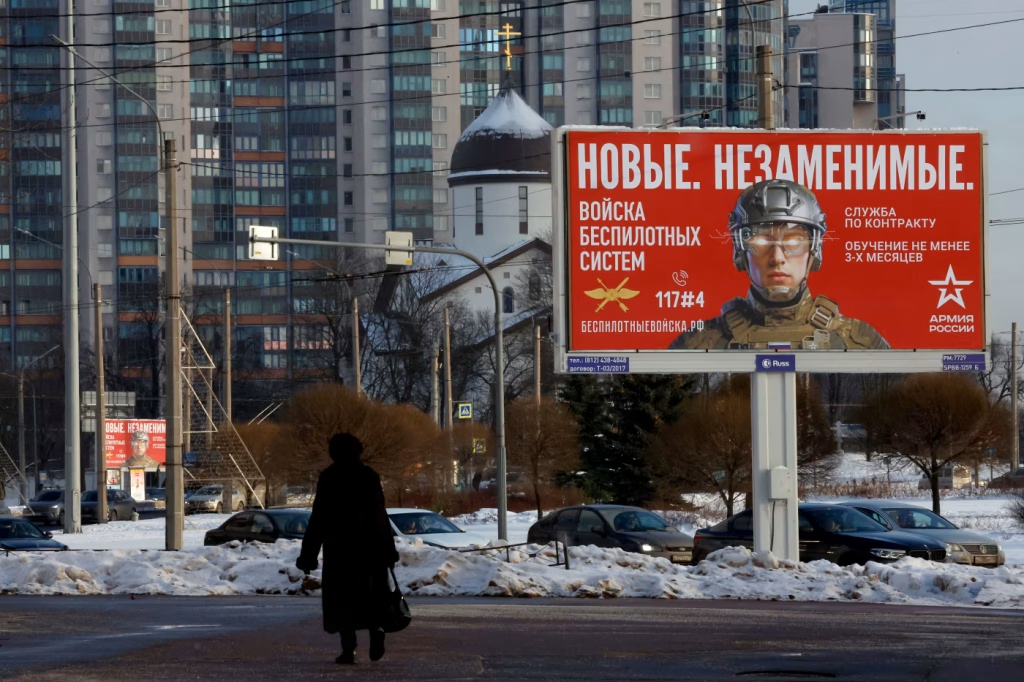
A billboard advertising voluntary (“contract”) military service in St. Petersburg, Russia. Source: Wall Street Journal

Raids aimed at forcing men to fight in the war against Ukraine have become widespread throughout Russia’s regions. In the Penza Region, where law enforcement, in concert with officials from military registration and enlistment offices, have been carrying out such raids in a particularly aggressive manner, local residents have banded together to “take back their men,” as they put it.

“They took him away, but we caught up with them halfway and got him back”

On 23 July, unknown men in plain clothes drove up to the home of Sergei Teplyakov, an employee of a local security firm in Bashmakovo, a district council town in the Penza Region with a population of around nine thousand).

“One of them introduced himself as the new neighborhood beat cop and demanded to see [Sergei’s] passport. Sergei then started phoning the real neighborhood beat cop. [The intruders] flew into a rage, grabbed him, and dragged him into their car. It was a straight-up abduction: no grounds for his arrest, no names, no paperwork whatsoever were provided,” says Oksana, a resident of the town. (We have changed the names of those whom we interviewed for their own safety.) “Sergei’s son, who had been telephoned by the neighbors, arrived, started filming it on his phone, and shouting at them. They let [Sergei] go. But the next day, [Alexei] Denisenko was caught in a raid.”

According to the locals, two unknown men grabbed Denisenko in a park where he was cutting grass to work off court-ordered community service hours for drunk driving.

“They threatened [Denisenko]. They said he would suffer the consequences if he didn’t go with them to the district council offices. A female council staffer was in the car with the ‘trappers,’ and so [Alexei] believed them. Plus, the license plates on the car were local, and it was a council vehicle,” says local resident Artyom. “He was told they were taking him to the council to ‘verify his details.’ But witnesses noticed they drove him off towards Penza and they called his family. His sister was able to chase them down halfway there, less than a hundred kilometers from Penza. She forced them to stop their car and she wrested Alexei from their clutches. These ‘recruiters’ are local officials working for the Defense Ministry by supplying them with unsuspecting folk. It’s utter lawlessness: these recruiters barge straight into people’s homes. If a man is walking down the street a bit tipsy, he’s definitely at risk. But basically, they’ll grab anyone.”

According to Mediazona, which has been compiling a name-by-name list of fallen Russian servicemen since 2022, more than two thousand residents of the Penza Region are known to have been killed in combat. The list of those killed from Bashmakovo includes twenty-five people.

Bashmakovo residents say that they had never met any of the “recruiters” before.

“We looked up the drivers of these vehicles—it turned out that one of them works as a bailiff!” says Artyom. “The plates of the second vehicle (O217XR) are registered to the Bashmakovo District Council. The families of Denisenko and Teplyakov reported the attempted abduction and coercion into signing military contracts to the police. Recently, two more men were also abducted. They managed to get a lawyer sent to them, but it wasn’t possible to get them out of the recruitment center on Skladskaya Street in Penza: they’d already been pressured into signing up there. According to the lawyer, one of them was threatened with ‘criminal charges’ over debts, even though the amount he owed didn’t warrant criminal prosecution. In other words, they were basically hoodwinked.”

Following these incidents, the locals decided to form a neighborhood watch group to defend the men.

“I joined the patrols almost straight away. It all happened spontaneously,” says Galina, a resident of Bashmakovo. “The guys set up [an online chat] group and started posting there about what was happening in the town and how they were rounding up the men. Gradually, people simply got together on VKontakte. That’s where we coordinate our efforts: we’ve split into shifts and we patrol the town around the clock. Around 250 people have joined the vigilante group. It’s much more effective to take back people on the spot, before they’re sent to the police station or the military recruitment office, because there’s simply no legal basis for detaining them.”

She says that almost everyone in the vigilante group has personal motives.

“There’s fear for our loved ones, of course. God forbid that my husband goes off to work and then disappears: you already know what might have happened to him. In June, they took my cousin away. He has two children. I recently found out that he had some sort of unpaid loan. I don’t know where he is now and what’s become of him.”

Galina says the members of the neighborhood watch patrol Bashmakovo every day and even at night: those who have cars drive around the town to check for suspicious vehicles or strangers. The volunteers chip in for petrol. They also use a community fund to cover unexpected expenses. Recently, during a patrol, there was a minor road accident in which two cars were damaged. They were repaired free of charge by acquaintances at a garage, and the only cost was for the spare parts.

Galina herself has been called out in response to a report of an attempted abduction.

“I was with my mom at the hospital when a message came through the group chat saying that two police officers were trying to force their way into Pavel Berdechenkov’s house. My mom and I drove over there, and the rest of the crew joined us. In the end, the police had nothing to say: they got into their car and drove off. There was another incident when we were patrolling a neighboring village and spotted a GAZelle van we didn’t recognize. All such reports go straight to our private group.”

She estimates that the vigilante group’s members have managed to prevent at least five or six people from being abducted in this way. But their methods doesn’t always work.

“Today we weren’t able to rescue a man because the alert came in too late. Within forty-five minutes, they’d already taken him far away. That’s why what matters most is that we’re notified straight away. Then we can get to the scene.”

A member of the volunteer group claims that at least two vehicles belonging to district authorities have been used in the raids. According to her, a Lada Granta, which residents have dubbed “401,” belongs to the Bashmakovo District education department, while a Lada Largus 217 belongs to the district council. Locals blame the council’s chair, Tamara Pavlutkina, for what is happening and feel that reporting incidents to the local police is pointless.

“There’s no point in complaining to the police. We believe the district council chair gives the orders and the rest just carry them out. She gets everything done by proxy,” says Galina.

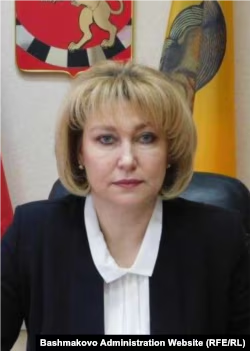
Tamara Pavlutkina

As an example, she cites the story of fifty-eight-year-old Sergei Milkin from the village of Podgornoye, sixteen kilometers from Bashmakovo. According to her, the local beat cop, Sinyov, invited Milkin to the village council “for a chat,” after which he disappeared. Milkin, says Galina, had serious heart problems: he’d had a bypass operation. The day after his chat with the police officer, he rang his family from the Rostov recruitment center and told them he was being sent to the war. Ten days later, he died, basically on the front line.

“We wrote to every relevant authority: the military prosecutor’s office and Bastrykin at the Investigative Committee, and we appealed to the television. Our complaint was registered, and then there was silence.

Another member of the vigilante group, Alexei, joined it after his relative was nearly sent off to war.

“He was summoned by letter to the military registration and enlistment office to ‘verify his details.’ We happened to be visiting him at the time and witnessed the whole thing. The round-ups had begun in Penza by then, but not here yet. What’s more, he didn’t go alone but with a friend, so we felt a bit more reassured. He’d left his phone at home,” says Alexei. “Two hours went by, but he wasn’t back yet. Three hours passed, and still nothing. His friend returned alone and said, ‘Your relative’s gone to Penza for a medical board.’ We were in a panic. I rang the infamous Penza military registration and enlistment office at 19 Skladskaya Street. They replied, ‘We’ve got no one by that name here.’”

Alexei says that at that moment the village chair came to the house and asked for the missing man’s military service card.

“I started filming her straight away. ‘What grounds do you have for asking to see his papers?!’ I ask her. She replies, ‘The council sent me.’ I ask her to give me names and job titles, but she refuses. We take a taxi to Penza. At 19 Skladskaya Street, we race up and down all the floors. We come across a drunk man whom someone had brought in, while the bloke accompanying him boasts that he’s already brought in and ‘handed over’ two people that day. Then we meet a tearful mother: her son had been snatched straight from their home, and she’d rushed there hot on their heels. Her [other] two sons were already at [the front]. She said she won’t hand over the third one.”

Alexei spotted his relative right on the steps of the military registration and enlistment office.

“He had been brought there in a private car by an ‘acquaintance’ of the village council chair. When we shouted at this man, he claimed that he had nothing to do with it: he had just ‘kindly’ given [my relative] a lift to Penza. Then he scrammed. We immediately took our relative by the arms, but by that point he had already been ‘psyched out’: they’d explained to him that after the medical examination he would have to sign some papers, supposedly to verify his details. What sort of people are they? They’re a disgrace. They’re prepared to take people’s lives for these payments.”

Meanwhile, Oksana, who has also joined the group, told [Radio Svoboda] that the local authorities had begun putting pressure on them.

“The security forces have already threatened us. Do you know what they threatened to do us? To send us off to the war! What’s more, they’ve been openly persecuting those who have criticized the raids or written about them on social media. Police officers went straight to the home of Vera Makavtsova and, in front of her four children, threatened her with criminal charges. They are threatening to charge her under Article 319 (“insulting a public official”). All because, in a post of hers, she called the district council accomplices to the abductions, and its chair, Tamara Pavlutkina, a co-organizer of press-ganging people into combat.”

In an audio recording made during Makavtsova’s arrest, police officers can be heard bursting into the house and demanding that the woman “come with them.” This is because she allegedly “poses a threat to Russia’s national security,” posts all manner of “extremist” content on social media, and takes part in meetups of residents.

“You don’t have a warrant,” Makavtsova says.

“Do you have a fucking warrant to gather in the city center on Saturdays?!” the police officer replies.

“In the end, they busted down the door and detained her. Of course, it’s not domestic violence, her husband beating her [that brought the police to Makavtsova’s home]. It was a post attacking an official and the Defense Ministry. That was grounds for the police to ‘intervene.’ They never responded to the complaints from Denisenko and the Teplyakovs. I’m sure Pavlutkina herself filed the complaint [against them],” Oksana says indignantly.

“The chair of the council has two sons,” adds Galina. ‘When I asked her why she wasn’t sending her own sons [to the front], she said, ‘I didn’t give birth to them for that.'”

Meanwhile, on 25 June, a ceremony was held at the Bashmakovo District Council to present state awards to the local families of men killed during the invasion of Ukraine. Relatives and loved ones of the soldiers, who had returned home as “Cargo 200,” received honors and medals. The ceremony was attended by the local military enlistment officer, Alexei Valygin, and Pavlutkina, a member of the ruling United Russia party, who assured those present that “should any questions arise, citizens can always contact the district council.”

[Radio Svoboda] reached out to Pavlutkina, asking her to comment on reports that the district council had been involved in detaining residents and forcing them to volunteer for the army. As this article went to press, she had not responded.

In early August, Penza-based blogger Stanislav Morozov set up a support chat group for men who have been detained and pressured into enlisting in the army. He called on residents to unite to resist such detentions.

“We are doing this out of desperation, because we simply have no other choice. We are people who are standing up for our fundamental rights and freedoms—the right not to be treated as a commodity and not to have our free will taken away under the threat of a truncheon. When lawful means of self-defense cease to work, the only shield left is a neighbor’s shoulder. Our strength now lies in this compulsory yet consciously chosen consolidation,” Morozov explained in the chat’s overview.

Within the first twenty-four hours, 300 people had joined the chat, and within a week the number of participants had exceeded 1,200. Morozov calls on eyewitnesses to report arrests promptly and promises to help find lawyers for those detained. He warns that security forces and provocateurs may have joined the chat and asks everyone to be careful with what they say.

Amid the raids, other ways of warning people about them have emerged. In early August, an online service launched featuring a map on which users could mark the locations of arrests. A few days later, its developers reported that the service and its associated Telegram channel had been hacked, and the website had started redirecting users to a porn site, according to the Telegram channel Mobilization. The project’s creators speculated that the law enforcement agencies might have taken an interest in them, but it is not yet possible to independently ascertain who was behind the hack.

“They’ve taken a blind man away!“

All across Russia, men are being deceitfully lured into the war against Ukraine.

On 8 August, an incident involving abduction and the forced signing of a military service contract took place in Omsk.

According to Valentina, on Saturday morning three unknown men grabbed her 31-year-old brother, Danil, straight from the courtyard of their home in Omsk’s Kirovsk District.

“He has a wife and children. This morning, he took a can of beer and went to sit on a bench by the entrance to his block. That’s where they picked him up. It was a private vehicle, but luckily, the neighbors managed to write down the license plate number. While we were looking for him, he came back on his own. He told us they’d taken him to a ‘volunteer’ recruitment center at 8 Maryanovskaya Street. He had barely managed to break free and escape, and he hadn’t signed anything. Well, we calmed down a bit,” says Valentina.

But that same evening, she says, they came for him again.

“Danil was out in the courtyard with his wife and children. Some men arrived in a Niva [off-road vehicle]. They twisted his arms behind his back and took him away to parts unknown. The children were screaming, and his wife tried to fight them off, but to no avail. We were terrified: what should we do? We started dashing off statements to the military prosecutor’s office, the military Investigative Committee, and the police. We found out he was back on Maryanovskaya Street. We’re demanding his release, but they won’t even let us speak to him on the phone. It’s a proper kidnapping.”

Her brother was released after some time, but, according to Valentina, he had been beaten up beforehand and forced to sign a “voluntary” military enlistment contract.

“They’ve finally let him go, but they intimidated him so much and beat him up so badly, that he signed the contract. We’re in shock at the moment, trying to raise money for lawyers. What else can we do? He’s at home for now, but they’ve got that contract they forced him to sign. They could turn up and break down the door, after all. What’s going on is just horrific.”

In August in Russia’s Maritime Territory, according to Ivan, a former soldier, the military stopped his brother Mikhail, who has a category 1 visual impairment.

“On 3 August, Misha went to the shop. He was stopped by two soldiers who initially asked him to sign a contract with the Defense Ministry,” says Ivan. “My brother refused. He told them straight away that he was a person with a category 1 visual impairment. They kept pressuring him: ‘Then you’ll be building barracks in Sibirtsevo’ (a village in the Maritime Territory’s Chernigovsky District, where military unit 16871 is stationed). He explained to them at length that he could hardly see anything at all. He’d been making his way to the shop by memory and by touch, after all. Then they grabbed him and took him away by force.”

The following day, Ivan (who had himself been discharged due to an injury sustained in combat in Ukraine) brought all his brother’s medical records to the recruitment center in Ussuriysk.

“They were holding him at the recruitment center on Lermontov Street. I showed them his medical records and his Category 1 disability certificate. I was certain they’d sort it out and let him go. But early the next morning, Misha rang and said they were putting him on a bus to the airport,” says Ivan. “That was it! He was off to Ukraine to fight. How on earth will he manage there?! He can only cope here on his own because he knows the streets like the back of his hand. But over there, he won’t even be able to get around. What do they want with him?!”

Mikhail’s family filed a complaint with the military prosecutor’s office claiming that he had been coerced into signing a contract.

“They said they had thirty days to respond. But how can we wait when a blind man has been whisked off to a war zone? He’s in danger there every single minute!” exclaims Ivan indignantly.

Human rights defenders note that after someone signs a contract volunteering for the army, it is extremely difficult to get the agreement annulled, even if he alleges that he was coerced into signing it.

“Coercion is illegal in theory, but if the contract has already been signed, annulling it at one’s own request is nearly impossible. In this case, one also has to file a written request with the military commissar to withdraw from the contract,” says Yaroslav Mukhin (whose name has been changed for his own safety), a lawyer specializing in cases involving conscientious objectors. “But experience shows that even medical certifications of disability are no longer of any help. The case may well go to court, but by the time the proceedings are over, a conscript in such poor health will already have been killed [in combat].”

Raids on men in Russia have been taking place amid growing challenges with recruiting volunteers. The Financial Times reports that the Kremlin and the Defense Ministry tasked the regions with recruiting 409,000 men in 2026, and it is up to local officials to fulfill the recruitment quotas. Meanwhile, the costs of recruiting itself have increased. Important Stories calculated that in the first quarter of 2026 alone the regions paid recruiters 3.2 billion rubles [approx. 33 million euros], which is more than twice the monthly average a year earlier.

In early August, the Wall Street Journal reported on complaints of men being detained and forced to volunteer for the army in Penza, Ulyanovsk, Rostov, Amur, and Yaroslavl regions, as well as Udmurtia, Tatarstan, Voronezh, and Arkhangelsk. According to the newspaper, American officials believe that the Kremlin is considering a larger-scale option: a new round of mobilizations. If such a decision is made, the newspaper’s sources expect it to be implemented after national parliamentary elections on 18–20 September. Russian authorities deny plans for another mobilization.

Source: “‘People have put together a militia’: How Russians are fighting back against recruiters to protect their men,” Radio Svoboda, 14 August 2026. Translated by the Russian Reader. Thanks to Comrade Koganzon for the heads-up.

Space Can’t Kill Puppets

Still from Strange New Worlds, Season 4 Episode 5: “Level-Five Transporter Accident”

Ukraine has been carrying out intensive attacks on Russia’s export infrastructure along the Black Sea coast and on oil refineries across the country. Optimistic observers predict significant challenges for the Russian economy and, as a result, a depletion of the resources it needs to wage war. In light of this, common sense dictates that responsible politicians should return to the negotiating table.

The outlook is bleak because the Russian regime is devoid of responsible politicians who would be swayed by common sense. The political elite inhabit another reality—a reality in which they are doing a crackerjack job with the economy, inflation remains at tolerable levels, there are no hiccoughs with petrol (the Kremlin’s limousines don’t fill up at ordinary petrol stations plagued by kilometers-long queues, after all), the populace unanimously supports the war, and the deaths of hundreds of thousands of men at the front are mere collateral damage, not a serious demographic blow to the country. The regime are doing a great job with everything, and there is nothing to worry about. And the regime has the police, the FSB, the Investigative Committee, the prosecutor’s office, the Russian National Guard, obedient judges, and the penitentiary system to deal with the malcontents.

That is why the political crackdown will ratchet up in synch with the worsening of the military or economic situation and the rise of popular discontent. Russian history is chockablock with examples of when growing discontent, fueled by grassroots hardships, was nipped in the bud by the most brutal terror. Examples include the Russian Civil War and the Holodomor. The Russian authorities have never spared their fellow citizens, whether to further the war effort or to protect their own privilege.

Certain dreamers among the opposition bank all their hopes on a Ukrainian victory: in their reckoning, it would open a window of possibility to rebuilding politics in Russia. This is actually possible: it has happened in Russian history that military defeats have kickstarted democratic reforms. But it happened under weak regimes, despotic regimes which were frittering away their potential. Does anyone imagine that the current dictatorship is on its last legs and willing to make concessions to society?

Pinning hopes on the force of Ukrainian arms is not only naive but also dubious morally speaking. It is naive because by and large Ukraine could not care less about Russian domestic politics. No one will roar into Moscow on Abrams tanks and bestow either liberty or an occupation government on Russians. This is unrealistic, especially considering that Russia’s irresponsible politicians have their hands on nuclear weapons (a big thanks to Soviet physicists). Hypothetically, military defeat could embolden the society to protest, but in this case, as I noted earlier, the Kremlin has a wide range of tools for cracking down on dissent, and it has a wealth of experience in using them.

The hope that Ukraine will emerge victorious from the war is quite popular among Russian political exiles. This is partly because there is nothing else they can do to liberate Russia. Well, almost nothing. Donating to the Ukrainian Armed Forces is easy, and it washes away all their sins as exiles. It’s like going to church, lighting a candle, making a small offering, and assuming you’ve earned your place in heaven. As gestalt therapy it will do the trick, but it is quite dubious politically. It is disgraceful to reap the rewards of others’ hard work. Counting on a Ukrainian victory as a means of liberating Russia from dictatorship is not a particularly honorable strategy for the opposition. Victory must be forged with one’s own hands, not those of others.

In the last century, the White émigré National Alliance of Russian Solidarists (NTS) had a fine slogan: “No one will do Russia’s business for us.” Bitter experience gave birth to this slogan: the White movement’s betrayal by the Entente, the West’s economic aid in industrializing USSR, the surrender of anti-Stalinist military units at the end of the World War Two, and the Yalta Conference, which left the Eastern Europe at Stalin’s mercy. No one cared in the slightest about our misfortunes. At best, they voiced extreme concern.

That’s how it happened in the past, and it’s still the case today. Had Russia not invaded Ukraine, the West would have gone on buttering up the Russian dictatorship regardless of who sat at the very top of the Kremlin’s power vertical. If the war were to end, Western politicians would gradually go back to their old ways of pursuing mutually beneficial trade and joint ventures, exchanging sweet nothings, and turning a blind eye to what is going on inside Russia. It’s not our business, and they should take care of it themselves, the West shall always decide. This is not a particular attitude toward Russia but realpolitik. Wasn’t that the case at the outset of this year, when the West simply stood by as tens of thousands of demonstrators were gunned down in Iran? Does the communist reign of terror in China really have any impact on the West’s economic interests? There are many such example

We must concede that liberating Russia is Russia’s business. There is no use in our relying either on the empathy of foreigners or on their arms. While Ukraine’s current military successes cannot fail to gladden all opponents of the war, of course, there is no point in our placing unwarranted, exaggerated hopes on them when it comes to Russia’s long-term future. It is highly unlikely that these military successes will bring about a sea change in the Kremlin’s political priorities and thus open the floodgates to democracy.

Source: Alexander Podrabinek, “The outlook is bleak,” Radio Svoboda, 24 August 2026. Translated by the Russian Reader
You Could Be in Pictures (Russia’s Elite Universities and the War)

A screen shot of VGIK’s website

The cinematography department of the All-Russian State Institute of Cinematography (VGIK) posted an ad on its VKontakte page about “a special group” being recruited for director [and cinematographer] Mikhail Agranovich’s class. Prospective students are offered free tuition starting in the 2027 academic year, provided they sign a one-year contract with the [Russian] Defense Ministry for service in UAV (drone) units.

The students are also promised free dormitory accommodation, combat veteran status (along with associated benefits), and “expanded technical and financial resources for student film projects.” Contract service will be equated to conscription service, the ad states.

“If you dream of studying at the world’s first film school, the renowned VGIK, now’s your chance. Places in the group are limited,” the ad reads.

Previously, the Higher School of Economics announced free tuition for students serving in unmanned systems units and the BARS (“Leopard”) reservist detachments in Moscow.

Russian universities and colleges have launched a widespread pressure and propaganda campaign aimed at steering students toward the war in Ukraine. Valery Falkov, minister of science and higher education, demanded that two percent of students be sent to the army. Students are promised “guaranteed discharge” upon the expiration of their contracts.

However, Artyom Klyga, head of the legal department at the Movement of Conscientious Objectors (DSO), found that this was a ruse. In reality, students recruited for military service are deployed wherever the command decides and discharged only when the command deems appropriate.

Source: “VGIK recruiting students to fight in war against Ukraine,” Ekho, 29 July 2026. Translated by Brokenhearted Alien Bio-Robot from the Future. The emphasis is mine. |||||| trr


A screenshot of an in-house article on HSE’s website touting its rankings.

Higher School of Economics confirms it is offering students a standard military contract instead of regular one-year conscription, says human rights activist

Vladimir Krotov, head of the department at the Higher School of Economics (HSE) responsible for student military registration, stated in response to an inquiry that those who voluntarily enlisted in the army would be subject to the Defense Ministry’s standard terms. This was reported by Artyom Klyga, a lawyer with the Movement of Conscientious Objectors (DSO).

Earlier, the publication T-Invariant released a letter sent to university staff. The document stated that students facing expulsion were being offered an alternative: a one-year contract with the Defense Ministry. The terms cited included guaranteed discharge after one year and service in unmanned systems units. However, Krotov’s response indicates that those who agreed to enlist would be deployed wherever the command decided and discharged whenever the command deemed appropriate. Only the provision regarding financial compensation is accurate, Klyga notes.

The HSE regularly appears on lists of Russia’s most prestigious universities. The letter to staff noted that they are now required to submit weekly reports on the number of military service notifications sent to students.

Source: Ekho/Novosti (Telegram), 23 January 2026. Translated by Brokenhearted Alien Bio-Robot from the Future

Laura Loomer vs. Lily Lynch

Laura Loomer (left) is an American far-right conspiracist and influencer from Arizona who has suddenly (supposedly) seen the light on Ukraine after actually visiting the country that has endured an unprovoked Russian invasion for the last four and a half years. Lily Lynch (right) is a leftyish American foreign affairs writer from California who, apparently, does not need to see a place with her own eyes to give her readers the all-knowing lowdown on what’s happening there. Whose account of the Ukraine-Russia war rings truer to you?


Volodymyr Zelenskyy’s speech at NATO’s Defence Industry Forum in Ankara earlier this month was a hymn to drone warfare. Drones, the Ukrainian president proclaimed, had heralded ‘revolutionary changes in the very nature of war’ – as significant as the machine gun in the First World War, or as the modern tank in the Second. ‘Disruptive’ drone tech had allowed Ukraine to increase dramatically the number of Russian casualties, intercept Russia’s Shahed UAVs and hit targets as far away as Siberia. Recent attacks had succeeded in blackening the skies over Moscow and striking oil refineries 2,700 km away in Omsk. The country had transformed itself into a ‘drone superpower’, in the words of the Atlantic Council. Before 2022, there were just seven domestic drone manufacturers – today, there are over 500. And now, as restrictions on drone exports are being lifted, Ukraine will soon be selling them to the world.

The man most responsible for putting drones at the centre of Ukraine’s war effort has been the telegenic 35-year-old, now former Defence Minister, Mykhailo Fedorov. This much-hyped tech wunderkind has acquired a following among both patriotic liberals at home and Atlanticists in the West. He has helped promote Ukraine as a kind of ‘start-up nation’ – a high-tech defence industrial powerhouse forged in war. When barely in his thirties, he was appointed Minister of Digital Transformation, where he was responsible for the ‘state in a smartphone’ initiative – which moved government services onto a USAID-funded app called Diiya. Though beloved by the liberal NGO set, Palantir-backed Fedorov has also learned to speak MAGA’s language; in January, he announced his ministry’s objective to kill 50,000 Russians per month, explaining it would ‘make the cost of war for Russia one it cannot sustain, thereby forcing peace through strength’.

In the weeks leading up to the NATO summit, Western media reports alleged that Ukraine had turned the tide in its favour. Russia was in trouble. The narrative was reminiscent of the ‘spring counteroffensive’ of 2023, much hyped in Western media – a supposedly transformational Ukrainian battlefield push that never quite materialized and cost tens of thousands of lives. In Ankara, the latest reversal of fortune was attributed to Ukraine’s drone tech capabilities, its thriving defence industry and its innovative young leadership, who apparently ran the country less like a post-Soviet state and more like a Silicon Valley start-up. 

Just one week later, however, this optimistic story began to fall apart. Zelenskyy abruptly dismissed Fedorov, a move that left many feeling furious and betrayed. Fedorov’s loyalists responded by excoriating Zelenskyy on social media and assembling in Kiev, Lviv and Odessa, holding signs bearing messages like ‘Hands off Fedorov’ and ‘Stop Sabotaging Victory’. Ukraine’s supporters in the West did not hide their opposition to the decision either. ‘Firing Fedorov, one of the smartest, most competent and innovative ministers in all of Europe, is one of the dumbest things Zelenskyy has done’, Estonia’s former president Toomas Hendrik Ilves wrote on X. A consensus formed among the Atlanticist commentariat: Zelenskyy had sided with his sclerotic ‘Soviet’ generals – particularly Russian-born commander-in-chief Oleksandr Syrskyi – against an energetic young reformer. After several days of virulent backlash, Zelenskyy responded by dismissing Syrskyi too.

The decision to remove Fedorov forced a simmering Ukrainian political crisis into the public eye. In Ankara, NATO officials were intent on depicting Russia – and only Russia – as the country in dire political and economic straits. At one briefing, I listened to a senior NATO official speak of possible tensions within the Russian political elite. These days, he said, they look outside their windows and see oil refineries in flames from Ukrainian drone attacks. This, he asserted, must be having a psychological effect, and resentment towards Putin was likely mounting. A fracture could be coming any day now. The Russian economy, meanwhile, was ‘in the worst state it’s been in for decades’. He recited a litany of grim statistics: the federal deficit was now 2.3 times what it was during the same period last year, the economy was now 70 per cent security-related expenditures, which came at the expense of the regular economy and would be ‘very hard to reverse’. And despite rising oil prices due to the war on Iran, Russia would still have to cut non-military spending by 10 per cent this year.

Russia was also reportedly performing poorly on the battlefield and any progress it was making came at an enormous cost. According to the NATO official’s estimates, there had been between 1.3 and 1.5 million Russian casualties in the war, and between 30,000 and 35,000 Russians were now being killed each month. The military was now ‘increasingly relying on convicts, indebted citizens and foreigners’ to fill its ranks. Russia’s territorial gains had also been ‘far less steady’ in recent months: its forces were now purportedly advancing at just 3.79 sq km per day, down from a reported 16 sq km last year. Another morbid statistic touted at the summit was the alleged average life expectancy of a Russian soldier: thanks to Ukraine’s drones, I was told, the average Russian recruit only lived between 20 and 30 minutes at the front. 

Listening to all this, I thought about what I’d heard [sic] about life in Russia. I was certainly aware of the mounting wartime pain. I knew there were now petrol shortages in parts of the country, though these are partly seasonal, and that this has meant long waits outside stations. Whereas the war had previously been experienced by most Russians as a distant conflict – only seen on social media or television – the drone attacks on Russian oil refineries had brought the war home. But the idea that this would inevitably provoke a major anti-government backlash didn’t quite follow. Videos have even surfaced on Russian social media showing people drinking and dancing as they waited in long queues for petrol. As one commentator put it, ‘coronavirus divided us, but petrol shortages brought us together’. The domestic problems were all very real and getting worse, but Russians appeared to be weathering them, at least for now. Prophesies of the Russian economy’s imminent collapse had been issued for years, but had all come to nothing.

Polls from inside Russia also hint at a more stable situation than that depicted at the NATO summit. Russia experts always caution readers to be sceptical of polls from inside the country, but even so, the results suggest that at least some of the graver prognostications might be exaggerated. According to a survey by the independent Levada Center, Putin’s popularity is indeed in decline, but as of May, as many as 79 per cent of Russians polled still said they approved of his performance. Only 15 per cent said they disapproved. In the same survey, 74 per cent of Russians said they supported their country’s actions in Ukraine. (Still, some 60 per cent of Russians reported that they favoured peace negotiations to end the war, and only 30 per cent said they wanted to continue fighting it.) Even adjusting for a degree of wartime self-censorship, these numbers do not exactly hint at a coming cataclysm.

But the question that most nagged at me throughout the summit was: what about Ukraine? The assessment of Russia’s position in the war included a host of criteria: a survey of the situation on the homefront, elite political fractures, the economy, the demography of its soldiers. Yet Ukraine’s position was portrayed according to a single hopeful indicator, its success in drone warfare.

According to a recent Gallup poll (one that was largely buried in the Western press), Ukrainians are even less enthusiastic about fighting this war than Russians are. Less than one in four adults (24 per cent) say Ukraine should keep fighting until it wins the war, while 66 per cent say Ukraine should seek to negotiate an end to the war as soon as possible. And while NATO officials were eager to tout staggering casualty figures for Russia in Ankara, there was naturally far less said about Ukraine’s dead – unless they could be presented in terms of a favourable ‘kill ratio’ with Russia. According to the Washington-based Center for Strategic and International Studies (which receives funding from the US government, Lockheed Martin and NATO among others) the Ukrainian military has suffered between 125,000 and 150,000 fatalities. However, some believe the actual number is higher.

As NATO officials look for cracks in the Kremlin matrix, there are plenty to worry about in Ukraine. In addition to the rupture between Fedorov and the military brass, a ‘spectacular’ corruption scandal has implicated members of Zelenskyy’s inner circle, part of which involves corruption in drone procurement. Meanwhile, the ‘stable stagnation’ of the Ukrainian economy also rests on relatively fragile foundations – continued support from Western partners. Often missing from Western wartime reporting is the brutal economic reality of everyday life in Ukraine: the number of Ukrainians living below subsistence levels has increased dramatically in wartime; while Russians have been inconvenienced in this conflict, most haven’t faced the same material devastation.

The Ukrainian armed forces may be an even worse state than their Russian adversaries. A transition to a corps-based command structure last year may have aligned Ukraine with NATO standards, but no amount of restructuring can change the fundamentals. The average age of a Ukrainian soldier is now 45. Mobilization remains a persistent problem. One of the reasons cited for Fedorov’s dismissal was his failure to fix this (ever the tech solutionist, Fedorov had reportedly pushed for a ‘digitalization’ of mobilization). The brutal practice of ‘busification’ – whereby military age men are snatched off the street – continues to inspire loathing. Reports regularly surface of forcibly conscripted men being beaten or killed. Unsurprisingly, Ukraine is suffering a desertion crisis. Though the exact figures were classified last year, in January, Fedorov said that 200,000 Ukrainian soldiers had gone AWOL.

The Russian armed forces may be filled with convicts and debtors, but they still haven’t had to resort to conscription [sic], while the Ukrainian side is partially composed of men who are middle-aged and don’t want to fight. Ukraine also increasingly relies on foreign fighters; while Russia has recruited hapless Africans to serve as cannon fodder, Ukraine now employs thousands of recruits from Colombia, Brazil and various European countries, designated as ‘volunteers’ to get around anti-mercenary laws. And there remains the fundamental problem of massive asymmetry: Russia still has Ukraine outmanned. Ukraine has attempted to make up for this difference with drones, but this has only succeeded in slowing the pace of Russian advances.

The image of a Ukraine filled with patriotic liberals eager to fight a high-tech war until total Russian collapse is a fiction. In reality, the majority of both Russians and Ukrainians want negotiations to end the war now. Only a minority want to continue fighting until their side’s most maximalist aims are met. Absent the propaganda of a youth-driven drone tech revolution in war, Ukraine looks in a remarkably similar situation to Russia: two countries hurtling toward demographic oblivion, in a conflict directed by a profiteering political elite and fought in part by the unwilling, the coerced, the foreign and the old. At the NATO summit, however, the alliance continued to promote its PR-manufactured image of Ukraine, through selective statistics and polite obfuscation.

This essay was supported by the Alameda Institute.

Source: Lily Lynch, “Costs of War,” Sidecar (New Left Review), 23 July 2026


Laura Loomer became infamous for spreading conspiracy theories online. Now, as she travels across Ukraine to see the damage inflicted by Russia in its years-long war, she wants to admit that she fell for some falsehoods of her own.

A close ally of President Donald Trump, Loomer has completely reversed her longtime criticism of Ukraine and is urging fellow conservatives to be wary of Moscow’s propaganda, which she blames for duping large swaths of the American right.

“You don’t need to listen to a podcaster and let them influence your opinion about a country. You can look at those facts yourself,” she told the Associated Press in Kyiv shortly after returning from a trip close to the front line in Ukraine’s east. The interview was supposed to take place in Loomer’s hotel, but it had to be moved to the building’s underground bomb shelter as the city faced another ballistic missile attack.

Loomer has remained influential with Trump despite not having an official role, and she said they spoke over the phone after she sat down with Ukrainian President Volodymyr Zelenskyy. She also said that she expects to meet with Trump after returning from her trip.

Loomer’s turnaround on Ukraine has been welcomed by the country’s leaders, whose relationships with Trump have been strained at times. But it has also stirred confusion, surprise and suspicion in the United States. She continues to insist that Ukraine is not paying for her travels.

As Trump and Zelenskyy prepare to meet on Tuesday in Washington, Loomer said it’s clear that her trip has already made a difference, refocusing attention on the war as Congress debates new sanctions intended to punish Russia.

“It’s looking good for Ukraine, right?” she said. “Going into this meeting next week at the Oval Office is looking pretty good.”

Loomer says she was ‘bamboozled’ to oppose Ukraine

Loomer had spent years minimizing the war and amplifying Russian propaganda until she made a dramatic reversal this week.

“I’ve come to realize I was bamboozled by Russian propaganda and I came to believe a lot of untrue things about Ukraine. I used to think that this was a country full of Nazis,” Loomer told Zelenskyy as she interviewed him for her show on Rumble, an online video platform.

Loomer blamed her indoctrination on getting banned by American social media platforms, leading her to try Telegram, where Russian media is widely shared.

“The Russians,” she added, “are very good at capitalizing on people’s rage. And I was very angry,” she said, recounting her feelings about the 2020 election, which she falsely maintains was stolen from Trump despite all evidence to the contrary.

She said her change in perspective had been gradual as she started to see podcasters like Tucker Carlson “turn on President Trump” while having their rhetoric amplified by Russian sources.

Loomer, who casts herself as an independent journalist, told the AP she believed her reversal was already changing minds within Trump’s “Make America Great Again” movement.

“Oh, 100%,” she said. “I’ve received messages all day from different people and media and politics and people just who follow me online who said, ’Wow, I didn’t realize how much we’ve been lied to.’ ‘Wow you really opened my eyes.’”

Loomer was welcomed with open arms

Ukrainian officials seemed to recognize the opportunity of winning over an ardent Trump ally with a large online following. In addition to her interview with Zelenskyy, Loomer had audiences with top Ukrainian officials and the country’s chief rabbi.

“It takes courage to come to Ukraine and not be deterred by Russian propaganda or air raid sirens,” Zelenskyy’s office wrote on social media.

Loomer also got a tour of Dormition Cathedral of Kyiv-Pechersk Lavra, a monastic complex that came under Russian attack last month.

“Laura is very powerful and she’s a very authoritative in the U.S., so I hope that everything she has seen by her own eyes will help her to spread the truth when she is back at the U.S.,” Tetyana Berezhna, the deputy prime minister and Ukrainian minister of culture told the AP. “I do really hope and I believe that her visit will have a huge impact on relations with the U.S. administration.”

While some have tried to downplay Loomer’s influence with the president, he has often followed her advice. She occasionally traveled with him during the 2024 campaign, and last year he purged his National Security Council staff after she raised concerns about their loyalty in an Oval Office meeting.

Trump appears to be tracking Loomer’s trip, sharing video of her conversation with Zelenskyy on social media.

“Very good!!!” he wrote on Thursday evening.

The conspiracist denounces conspiracy theories

Loomer has a long history of spreading conspiracy theories. She once shared a video that called 9/11 an “inside job” and amplified a lie about Haitian immigrants eating dogs and cats in Ohio, which Trump went on to repeat during a presidential debate with Kamala Harris.

Although Loomer may have changed her mind about Russia’s invasion, her bigoted views have not budged.

“One thing I really love about Ukraine is I haven’t seen a single Muslim here,” she posted on Saturday. “It’s so refreshing.”

But in the interview, she bemoaned how influential podcasters can spread misinformation.

“They have been able to warp people’s minds to the point where people aren’t even capable of analyzing a subject with common sense anymore because they want to depend on these personalities to give them the opinion that they think they should have,” she said, calling the situation “a major national security threat.”

She said she thinks that “information war” has “the potential to be more destructive than any kinetic war that our country may ever face” and called on the Trump administration to take the threat of Russian propaganda, foreign interference and influence operations more seriously.

“I think that some of our leaders are being influenced by propaganda,” she said.

The White House has routinely downplayed the role of Moscow’s influence, especially because Trump has long chaffed at investigations showing that Russia worked to boost his 2016 candidacy.

Loomer has said repeatedly that Ukraine did not finance her trip and insisted she had traveled in her own capacity.

“I can guarantee you I wasn’t paid by anybody. I certainly wasn’t paid by the government of Ukraine to come here,” she said.

“If it’s fake, why did I risk my life? I’m in a bomb shelter right now. I barely slept this week,” she said.

Source: Illia Novikov, Volodymr Yurchuk and Jill Colvin, “Exclusive: In a Ukrainian bomb shelter, Laura Loomer explains shift on Russia’s war,” Associated Press, 26 July 2026

Reluctant Peacenik vs. Rough Beast

Tokayev reads Putin the riot act in Omsk, 25 July 2026. Source: Vesti (Telegram)

Kazakhstani President Kassym-Jomart Tokayev proposed “freezing” the war in Ukraine during talks with Russian President Vladimir Putin on Saturday, 25 July 2026, in Omsk. TASS published an excerpt featuring Tokayev’s statement and Putin’s reaction.

Tokayev made the remarks during a meeting with Putin at the Forum on Interregional Cooperation between the two countries, which took place 24–25 July. The President of Kazakhstan stated that at present, “no one knows how to resolve the situation, because each side has its own position.” At the same time, he suggested that “perhaps this conflict should already be frozen and we should return to the Istanbul Formula 2.0, since significant results were achieved there.”

According to Tokayev, in connection with the war in Ukraine, he has been “receiving many signals” from Europe and the U.S., about which he had previously informed Putin. And yet, the President of Kazakhstan added that his country refuses to act as a mediator in achieving peace between Russia and Ukraine.

Tokayev: The nature of this conflict is not entirely clear to many people

Tokayev emphasized that the war in Ukraine is an “interstate conflict” and “not some sort of civil war.”

“We have always treated the Ukrainian people, their culture, and their language with respect, and we believe that the nature of this conflict is not entirely clear to many, including us,” the Kazakhstani president noted. He added that “all of this must be stopped,” since the war in Ukraine “plays into the hands” of the opponents of both Moscow and Kyiv.

At the same time, Tokayev noted that Putin had shown “the utmost diplomatic flexibility” during his meeting with U.S. President Donald Trump in Anchorage in August 2025.

Briefly commenting on the Kazakhstani president’s remarks about the war, Putin for his part promised him that he would “definitely provide detailed information” within the day about what was happening on the “Ukrainian front.”

Source: Vladimir Begunkov, “Tokayev suggests Putin ‘freeze’ war in Ukraine,” Deutsche Welle Russian Service, 25 July 2026. Translated by the Russian Reader


Vladimir Putin ventured out in public for the first time in months and walked smack dab into an ambush during a televised meeting that went off the rails.

Fresh off a tightly controlled publicity stunt in Irkutsk on Friday—where the Russian leader, flanked by bodyguards, made a show of inspecting aircraft—Putin sat down with Kazakhstan’s president in the Russian city of Omsk on Saturday.

The 73-year-old Russian president could barely conceal his nervous grimace as Kazakh President Kassym-Jomart Tokayev used the meeting, which was supposed to be about Russia-Kazakh cooperation, to throw Putin under the bus.

“I will not hide that I am receiving many signals—which I have already informed you about by phone—from Europe and the United States regarding the current state of the conflict between Ukraine and Russia,” Tokayev told Putin as a slew of Kremlin-controlled TV outlets filmed the confrontation.

He went on to call BS on the Kremlin’s narrative of the war, saying, “The nature of this conflict is not entirely clear” and seems utterly pointless. Putin, meanwhile, appeared to tense up and stared down at his lap as Tokayev spoke, seemingly caught off guard.

“This all needs to stop,” Tokayev said, urging Putin to “freeze” the war and return to negotiations. He twisted the knife by adding that despite “proposals and appeals,” Kazakhstan “categorically refuses” to act as a mediator in helping to end the war, since “Russia is a great country” and can “manage on its own.”

At the end of Tokayev’s three-minute speech, Putin nervously thanked the Kazakh president and promised to give him a “detailed briefing” on the Ukraine war, before the broadcast abruptly ended.

The tense exchange came a day after Putin flew to Irkutsk, Siberia, for an unannounced visit to the Irkutsk Aviation Plant, his first trip to one of Russia’s regions for domestic issues in more than eight months. He has drastically reduced travel to Russia’s regions and avoided public appearances in recent months, purportedly out of fear of being assassinated. Instead, amid relentless Ukrainian drone strikes and growing public outrage over economic woes, Putin has largely retreated into fortified underground bunkers, where he is said to have at times remained for weeks.

Footage shared by the Kremlin showed him flanked by bodyguards as he inspected the Yak-130M combat jet trainer and an MC-21 passenger jet, which has been plagued by repeated production delays.

The plant had apparently been cleared out for his visit, and Irkutsk locals fumed on social media about the entire city coming to a standstill to make way for what was widely seen as a PR stunt.

“Burn in hell,” one resident commented in response to Putin’s visit on a local website, according to the independent outlet People of Baikal.

“Will we need to bow when the tsar passes through?” another quipped.

“How scared he is of his own people,” a third person noted, only to be reminded, “Well, every other person is ready to kill him.”

Source: Allison Quinn, “Putin Gets Spectacularly Ambushed After Leaving His Bunker,” Daily Beast, 25 July 2026

Wildberries and the War

Photo: Delovoi Peterburg

Enemy drones attacked Wildberries warehouses in Leningrad Region in the early hours of 24 July, reported Alexander Drozdenko, head of Russia’s 47th region.

Governor Alexander Beglov reported that, in Petersburg, “civilian infrastructure on Moscow Highway was targeted.”

The Russian Defense Ministry claimed it had downed 571 Ukrainian Armed Forces drones over Russia’s regions overnight.

Delovoi Peterburg reports below what we know about the latest series of attacks on warehouses in the Petersburg metro area.

Repelling the drone attack in Leningrad Region: Fire in Novosaratovka

Three people were injured and hospitalized in stable condition, Drozdenko said.

“A drone strike caused a fire at Wildberries warehouses in the village of Novosaratovka* in the Vsevolozhsk District,” the governor explained.

In addition, a warehouse belonging to the Severnaya poultry farm in the village of Sinyavino, Kirovsk District, Leningrad Region, sustained damage. No one was injured. Debris from the drone fell onto the grounds of the old hospital, according to Andrei Voropayev, head of the Sverdlov Settlement.

“They’re not letting anyone in there, including us. We don’t know what was there. Just warehouses and more warehouses. Definitely no chemicals. When it was shot down over the Neva, one drone fell on the old hospital in the village. There are only bare walls there, no people, and the firefighters have left,” Voropaev told 47news.

A drone alert was issued in Region 47 at 01:43 Moscow Time on 24 July 2. Drozdenko reported that fifty drones had been shot down over the region. The regional governor lifted the drone threat alert at 06:17 Moscow Time.

“The drone threat in the Leningrad Region has been lifted. Fifty-nine enemy UAVs have been shot down. I thank the anti-aircraft forces for their effective performance,” said Drozdenko.

The Investigative Committee reported that a criminal case had been opened regarding a terrorist act (per Article 205 of the Russian Federal Criminal Code) in connection with “an attack by Ukrainian armed groups on civilian targets in the Leningrad Region.” No further details of the attack were provided in the statement.

Attack on Petersburg: Shushary and Utkina Zavod

The company’s warehouses in Petersburg were also targeted. According to the RWB (Wildberries | Russ) press office, operations at two logistics complexes have been temporarily suspended.

“Operations at the company’s logistics complexes in Shushary and Utkina Zavod (both in Petersburg) have been temporarily suspended. Updates on the resumption of operations will follow,” the press office stated.

The company clarified that there had been no casualties at Wildberries facilities in Petersburg and the Leningrad Region.

Some of the warehouse space and merchandise was salvaged, and a swift evacuation was carried out at the warehouses, such that there were no casualties, Tatyana Kim later reported.

“Dear partners, up-to-date information on the situation is being published on the seller’s website. All our efforts are now focused on redistributing goods across warehouses to ensure more efficient inventory turnover and the economic stability of our partners,” the Wildberries founder wrote on her social media channel.

Eyewitnesses reported that Pyaterochka’s warehouses in Utkina Zavod may also have been hit, but X5 (the discount grocery store chain’s operator) denied this.

“The reports are false. The facility was not damaged and will continue to operate as usual,” X5 told DP.

Governor Beglov reported that efforts are underway to address the aftermath of the attack on a civilian infrastructure facility on Moscow Highway.

“The emergency response headquarters, which I personally head, has been coordinating the work of the municipal services and interagency cooperation,” the governor wrote on Max.

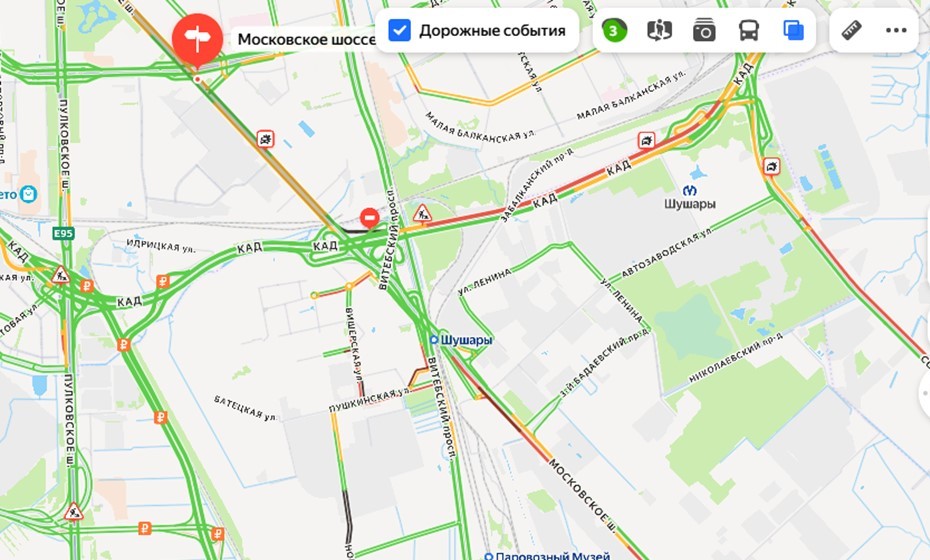
Drivers and eyewitnesses have reported that traffic on Moscow Highway has come to a standstill. The City Transportation Committee announced that, due to the impassability of Moscow Highway, bus lines 179, 192, 196, 197, and 388 have been temporarily rerouted.

“Bus routes Nos. 179, 192, 196, 197, and 388 are running via Danube Boulevard and Sofia Street, then continuing along their regular routes (in both directions). We recommend that residents of Slavyanka take suburban commuter trains. Trains are running every ten minutes,” the transportation committee announced.

Eyewitnesses report major traffic jams in the south and southeast of the city, on the Ring Road and on Sofia Street.

“A massive traffic jam has formed on Sofia Street heading toward the city: it starts past the intersection with Ust-Izhorsk Highway. There is also a major traffic jam on the inner ring road between Murmansk Highway and Moscow Highway; it is caused by the closure of the city-bound exit to Moscow Highway due to roadwork,” reported the city’s Megapolis channel on Telegram.

A live map of the traffic jams in question, in Petersburg’s far south. Image courtesty of Delovoi Peterburg

Residents of a building on Aleksa Dundić Street in the Frunze District were evacuated on the afternoon of 24 July, according to 78.ru. Residents of stairwells 8 through 19 were asked to leave their flats and go outside.

Pulkovo Airport imposed flight restrictions starting at 1:46 a.m. and resumed flight operations at 6:00 a.m. Moscow Time after the drone threat was lifted.

As of that time, over fifty flights had been delayed by two hours or more, and fourteen were waiting at alternate airports. By 8:20 a.m., Pulkovo had handled approximately thirty flights, both arriving and departing. Two flights arrived in Petersburg from alternate airports, according to the VVSS (Northern Capital’s Air Gateway) press service.

“All services are working to fulfill the daily flight plan per the revised schedule,” airport officials said.

UPDATE: As of 9:15 a.m., approximately sixty flights had been dispatched to their destination airports, and seven aircraft had arrived in Petersburg from alternate airports.

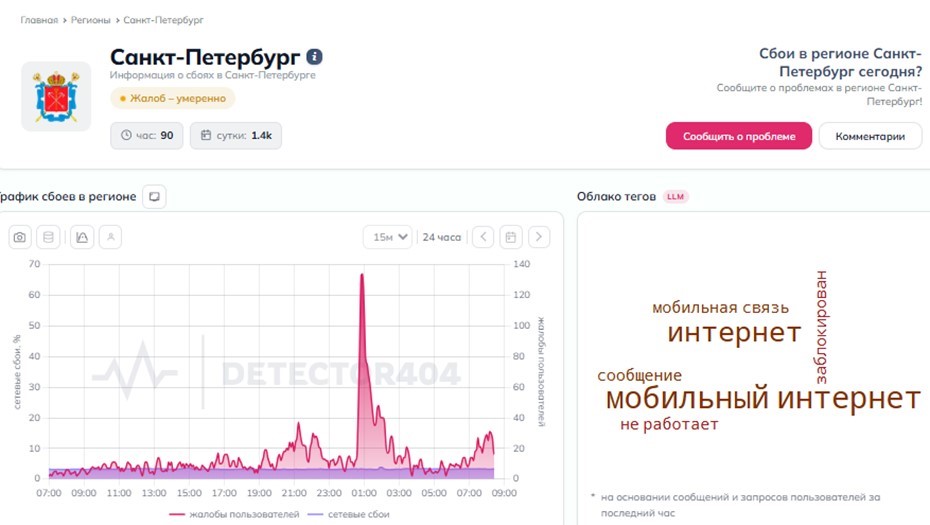
During the drone threat, restrictions on mobile communication were in effect in the metropolitan area, with the peak number of complaints occurring overnight.

A chart showing numbers of complaints about loss of mobile phone coverage in the Petersburg area during the 24 July 2026 drone attack. Image courtesy of Delovoi Peterburg

The damage from the attacks on Wildberries warehouses in the Leningrad Region and Petersburg could reach 76 billion rubles [approx. 861 million euros], according to preliminary estimates done for DP by Sergei Semko, lead analyst at Data Insight, conducted preliminary calculations for DP.

Attacks on Warehouses: A Timeline

In recent days, Wildberries warehouses have been targeted by enemy drones. Just yesterday, two logistics complexes sustained damage in Voronezh.

The first attacks on Wildberries warehouses in Russia took place on 18 July. The strikes targeted the company’s facilities in the Tambov and Moscow regions. At least eight people were killed, and more than sixty civilians were injured. Several of the injured were in critical condition.

On the night of 21–22 July, drones attacked large Wildberries warehouses in Krasnodar and Nevinnomyssk, Stavropol Territory. A local state of emergency was declared in Nevinnomyssk. The head of the Krasnodar Territory reported one fatality resulting from an attack on the oil depot in Armavir and provided an update on the condition of those injured at the warehouses in Krasnodar. The Investigative Committee classified the attacks as acts of terrorism. A criminal case has been opened under Article 205 of the Russian Federal Criminal Code.

DP has reported that the drone strikes on Wildberries warehouses have created problems not only for that particular and the sellers collaborating with it. In fact, a new reality has dawned for the entire Russian e-commerce and logistics market. Everyone will have to restructure their internal procedures and come up with new solutions.

Source: Ksenia Malinovskaya, “Drones Attack Wildberries Warehouses near [sic] Petersburg,” Delovoi Peterburg, 24 July 2026. Translated by the Russian Reader

* Here are some snapshots I took of Novosaratovka during a Sunday Cafe expedition there in December 2015:


Russian businesses have been feeling the effects of the war in Ukraine through tax increases, rising costs caused by fuel shortages, and supply chains disrupted by sanctions. Now, there is another risk to contend with: Ukrainian drone strikes on their facilities.

As Ukraine wages a campaign to bring the conflict home to ordinary Russians, it has opened a new front aimed at the online marketplace Wildberries, a pillar of the country’s retail economy and a potent symbol of modern life in Russia.

In recent days, Ukraine has hit five warehouses belonging to Wildberries, a Russian analogue to Amazon, as well as storage sites for other large retailers. Eight people were killed in attacks on Saturday and one person on Wednesday, the Russian authorities said. The strikes on Saturday alone were reported to have wiped out between 6 and 9 percent of the storage capacity of Wildberries.

Ukraine’s long-range strikes on Russian economic targets, including a months-long campaign of attacks on oil processing facilities, are intended to pressure President Vladimir V. Putin to end the war, in part by hampering his ability to finance it. The oil strikes have caused fuel shortages that have led to lines at gas stations, and they could affect the coming harvest season.

Mr. Putin has signaled no intention of backing away from his objectives in the conflict, and the economy, while weakened by the war, is not on the verge of collapse. Still, analysts said that if the attacks on Russia’s business infrastructure continued, the ripple effects could pose severe economic challenges on top of a range of other war-related strains, reducing tax collections and adding to inflation.

Ukraine has targeted Wildberries warehouses in five regions across Russia, including a reported strike early Thursday in the Voronezh region, south of Moscow. A fire at a warehouse in Elektrostal, a city in the Moscow region, took three days to extinguish.

The day after the initial strikes, Russia unleashed the largest missile attack on Kyiv, the Ukrainian capital, since the war started in 2022, firing at least 35 ballistic and hypersonic cruise missiles.

Ukraine has said that its strikes are in retaliation for Russian attacks on its postal delivery hubs and other civilian infrastructure, a yearslong campaign by Moscow that has been far more devastating than Kyiv’s strikes against Russia. A Russian attack last week on a postal terminal in the northeastern city of Kharkiv left three people dead and 20 injured.

President Volodymyr Zelensky of Ukraine has also said that Wildberries facilities are a legitimate target because the company sells goods to the Russian military. The Kremlin spokesman, Dmitri S. Peskov, has denied the accusation.

Wildberries has a policy of not selling military-grade weapons, but it does sell goods used by soldiers, like commercial drones that can be jury-rigged with explosives, as well as fiber-optic cables, tactical clothing and other so-called dual-use items.

The Wildberries attacks have been calamitous for small Russian entrepreneurs who sell goods through the site, the country’s largest online marketplace.

One of them, Timur, woke up on Saturday morning to news that he had lost clothing and shoes worth about $25,000 as a result of the attacks on the Wildberries warehouses in Elektrostal and in Kotovsk, in the Tambov region, southeast of Moscow.

Timur, who was nervous about speaking with foreign journalists when reached by telephone and asked that his last name be withheld to avoid reprisals, said that his main concern was the uncertainty that he and other Russian entrepreneurs now faced.

He said on Tuesday that it was unclear what would happen next “because most likely they are not the only warehouses that will be attacked.”

Hours later, two more Wildberries warehouses that contained his apparel, in the southern Stavropol and Krasnodar regions, were hit by drones. His losses doubled.

Timur said he had been building his business for five years, “and it can just collapse in a week,” he said, a precarity that Ukrainians have been living with for nearly four and a half years.

He warned of the effects on the Russian economy, saying that continued strikes could cause the Wildberries business model to collapse, raising prices and bringing about shortages.

Alexander Kolyandr, director for Europe at the Eurasia Group, a consulting firm, echoed that view.

“The company itself and all the sellers will likely pay less in taxes than last year, and given the size, it might be pretty substantial, especially at a time when the Russian budget is experiencing a widening deficit,” Mr. Kolyandr said.

Additionally, the cost of protecting, rebuilding and insuring the warehouses will be passed on to consumers, he said, contributing to already high levels of inflation.

The attacks on Saturday in the Moscow and Tambov regions destroyed goods worth almost as much as Wildberries’ entire profit last year, according to expert estimates reported by Kommersant, a Russian newspaper, and by Forbes Russia.

The company’s chief executive, Tatyana Kim, promised financial compensation of about $25,000 to families of the workers who were killed and half of that amount to the injured.

At the beginning of the month, Wildberries and another large online marketplace, Ozon, changed their terms and conditions to stipulate that the companies had no legal obligation to compensate for losses caused by drone attacks.

On Wednesday, however, Ms. Kim announced payouts to small-scale sellers who were “most vulnerable.” She did not disclose the amounts.

Many sellers on Wildberries financed their products with loans, including Timur, who told of interest rates as high as 35 percent. Some vendors risk having their bank accounts frozen as soon as next week if they are unable to make tax payments due in the coming days, according to the business newspaper Vedomosti.

A civilian facility like a warehouse can become a lawful military target if it is being used, or is being prepared to be used, for military purposes, said Michael Schmitt, who teaches international law at the University of Reading in England and is a former legal adviser to the U.S. military.

Combatants, he said, must take into account exactly what kind of materials are inside, have a high degree of certainty about the site’s future military use and make efforts to mitigate harm to civilians.

Maria Snegovaya, a researcher at the Center for Strategic and International Studies, said that Russia’s economic slowdown, related in part to Ukraine’s long-range strikes, had coincided with declining levels of support for the war.

But some in Russia said that the increased drumbeat of attacks could rally Russians around their leader.

“The adversary started doing the job of our propaganda, which is to explain to the nation that a real war is underway, and no one can just lie low,” a Russian military blogger, Roman Saponkov, wrote on Telegram. “At first they switched off fuel at the petrol station, now they took on Wildberries warehouses. Next, it will be beer factories and nail salons.”

Source: Valerie Hopkins and Alina Lobzina, “A New Target for Ukraine’s Long-Range Attacks: Russia’s Version of Amazon,” New York Times, 23 July 2026. Since my digital + weekend delivery subscription to the Gray Lady costs me an arm and a leg (to wit, forty dollars a month), I feel no compunction about reposting their articles on this website, which has always been free to anyone anywhere whose government hasn’t banned it (as Russia’s did in 2022). |||||| trr

Sasha Razor: Who Burns the Lavra?

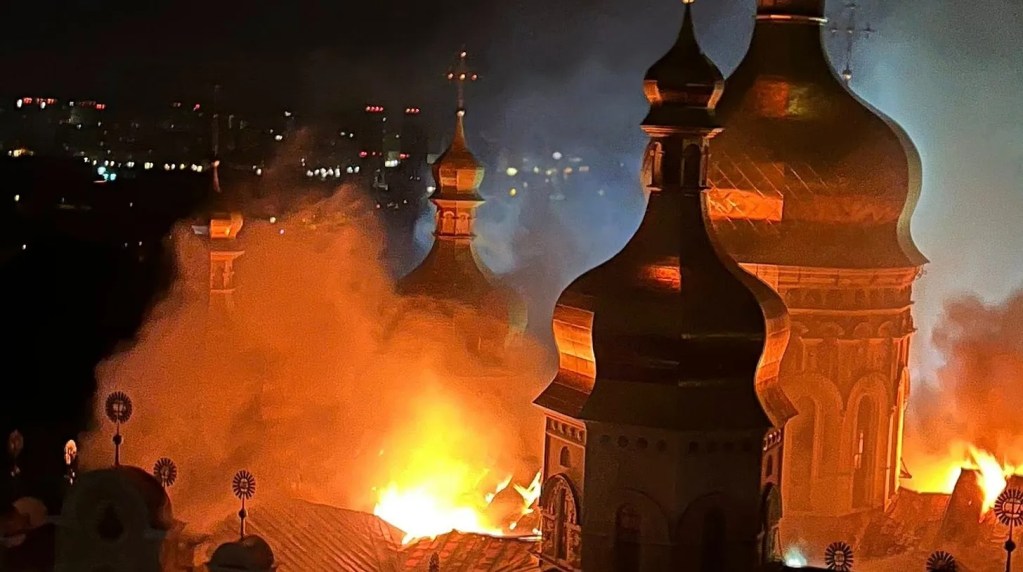
Smoke and flames rise from the roof of the Dormition Cathedral at the Kyiv-Pechersk Lavra in the early hours of Monday, 15 June 2026, after a Russian strike on Kyiv. Image: Bishop Avraamij/Facebook)

On June 15, a Russian strike set Kyiv’s thousand-year-old monastery ablaze. The act was charged to a country, Russia, and to no one in particular. This is an attempt to reconstruct how such a decision gets made, and by whom.

My feed is on fire, and for once the metaphor is indecent, because the fire is literal. On the night of June 15, the roof of the Dormition Cathedral of the Kyiv-Pechersk Lavra burned against the dark while rescuers climbed toward it. The monastery was founded in 1051, at the dawn of monasticism in Kievan Rus’. The cathedral that burned is a reconstruction; the original was blown up in November 1941, after German troops took Kyiv, and whether the Nazis or the retreating Soviets set the charge has never been settled.

The human cost first. In a barrage of seventy missiles and more than six hundred drones, at least eleven people were killed across Ukraine and more than fifty wounded, Ukrainian officials said. In Kyiv, the dead numbered five and the wounded thirty-five, among them a pregnant woman and two children. In Kharkiv, Ukraine’s emergency service said, a second missile struck a rescue site still crowded with the crews working the first, killing four of them for the crime of arriving. The evening before, a one-month-old girl had been among five people wounded when a drone hit the Kharkiv Art Museum.

And the buildings are their own kind of casualty list. The reposts come faster than anyone can read them. The Lavra. The Mystetsky Arsenal, the vaulted hall where the Book Arsenal festival had closed two weeks before. The Oleksandr Dovzhenko Film Studio, where a single strike destroyed what the culture minister called Ukraine’s oldest and largest costume archive: a hundred thousand costumes, three million items of clothing, the wardrobe of a national cinema turned to ash before morning. The House of Organ and Chamber Music in Dnipro. Karpenko-Kary, where Ukraine trains its filmmakers and its actors. A single day reached all of it.

The films made on those lots are what I study, so let me say plainly what burned. A studio’s wardrobe is the material memory of a national cinema, the actual cloth worn in the films through which a country learned to see itself: the embroidered shirts, the uniforms it had to wear on screen and then subvert, the furs and the partisan coats. A costume archive is the primary source by which a culture studies itself. You cannot reshoot the twentieth century. Some of the garments that burned were older than the younger states now debating how to respond.

Russia says none of this happened, or that something else did. The Defense Ministry called the night a strike with high-precision weapons against the defense-industrial complex, and denied hitting the Lavra at all: the cathedral, it claimed without evidence, was struck by a Ukrainian-operated Patriot interceptor. The Foreign Ministry spokeswoman Maria Zakharova called the reports “fakes”. By that account, the cathedral fire was a Ukrainian misfire, the dead rescuers were the fog of war, and the second strike on the Arsenal, launched while firefighters stood exposed at the Lavra, was a coincidence of timing.

Two things are happening at once, and they do not quite match. The grief is public and signed: thousands of people, in a dozen languages, share the same photograph and the same verdict. A Russian strike. Russian barbarism. The attribution is loud, and it is also the easiest one available. It names a culprit and, somehow, no person at all.

What is more, the argument about Russia usually collapses into sentiment. We have learned, rightly, to separate Vladimir Putin from the people we call “ordinary Russians,” many of whom, it is said, do not want this war. But this separation dissolves into the same anonymity that lets a cathedral burn with no hand on the match.

Drone studies calls the drone less a weapon than a chain, an act of violence dispersed across factories, suppliers, programmers, and launch crews until no single hand can be said to hold it, by design. The Shahed, the Iranian-designed drone behind most of that overnight barrage, pushes that logic to its industrial extreme. The burning of the Lavra happened in many places at once, and over many months. In July of last year, a Swiss plant made the microcontroller that would steer the drone. American and German firms, Texas Instruments and Infineon, made the chips that investigators keep pulling from the wreckage. Ukraine’s sanctions commissioner counts more than two million imported components in a single year. Trading offices in Hong Kong and free ports in the Emirates rerouted those parts around the sanctions meant to stop them. In Tatarstan, the Alabuga plant assembled the drone with schoolchildren recruited out of the ninth grade and women brought from Africa through a foreign outreach scheme. And before it ever left the ground, a crew set its route.

And there the trail goes cold. The closest anyone has come to naming the drone operators was for a different weapon entirely. In 2022, Bellingcat, The Insider, and Der Spiegel identified a unit of military engineers inside the General Staff’s Main Computation Centre who program the flight paths of Russia’s cruise missiles, the Kalibrs and the Kh-101s, plotting each trajectory by hand, far from any front. Most are young, many of them former software or game developers. Their commander was an avid coin collector; his phone records show him trading online about an hour before one such salvo hit Kyiv and killed dozens. When reporters reached the engineers, they denied everything, even when shown photographs of themselves in uniform. One said he was a plumber. One said she was a florist. One offered to explain how to butcher a pig. The metadata says these are the people who aim the missiles.

It is worth sitting with how little even that gave us. The Bellingcat investigation is now nearly four years old, and it named the people behind Russia’s cruise missiles, not its drones. The revelation was that a missile had not simply appeared over a city, the way weather appears. It had passed through offices, phones, maps, databases, commanders, and people who could be found, called, photographed, embarrassed, and named. But the war that followed, the Shahed war at industrial scale, has been harder to personify. As the drones multiplied into hundreds a night, the crews who prepare them, program them, and release them into the dark have remained mostly faceless.

The Russian drone operator has become one of the defining figures of the war. He is a technician of distance, converting coordinates, batteries, antennas, video feeds, maps, and orders into impact. Some work near the front, guiding FPV drones and reconnaissance quadcopters by hand. Others belong to more formal formations, including the elite Rubicon drone center, described by Radio Svoboda’s Russian-language investigation as a drone special-forces structure based in the Patriot Park complex, and by the Kyiv Independent as a central feature of Russia’s scaling drone war. But the long-range Shahed crews who send drones toward Ukrainian cities remain almost entirely unnamed. We can follow a microcontroller across three continents and still not put a name to the person who helped send it toward Kyiv. Component-tracing survives because it can be done at a distance. Naming people requires sources, time, physical danger, and the expensive human labor that has been gutted on both sides of the line: criminalized inside Russia, where reporters are exiled or imprisoned, and starved in the West, where the foreign desks that once did this work have been cut to the bone.

If everyone is responsible, it is tempting to conclude that no one is. That conclusion is what the system is built to produce. But responsibility accrues at every link, and it is uneven. It is heaviest where knowledge and choice are greatest, with the engineer who plots the path and the official who signs the order. It is lighter, though never absent, for the smuggled chip and for the schoolchild recruited into what was sold as a college and turned out to be a drone line. The Russia scholar Jade McGlynn, who has argued that this is Russia’s War and not only Putin’s, makes the necessary distinction: not collective guilt, which belongs to individuals tried for their own acts, but collective responsibility, held in different measure by everyone who takes part.

I have no verdict, only a refusal to let “Russia” be the last word. An engineer designed the chip. A broker moved it through Dubai. An official licensed the airframe. A commander signed the order. And a man with a name and a rank plotted the route into a thousand-year-old monastery. The last time it burned, in 1941, the question of whose hand lit it was left to die in the fog of another war. This time it does not have to. The ones who knew what they were doing are not the people we are asked to forgive in advance. So who burns the Lavra? People do, in different measures, with different degrees of knowledge and choice. Naming them scales the act back down from a country to a person and keeps the names where they belong: in the record, and one day, perhaps, in court.

Source: Sasha Razor (Substack), 15 June 2026. My huge thanks to Sasha for writing this and letting me share it here. \\\\\trr

Inner Emigrants

Lena Karbe’s documentary film Inner Emigrants examines what people in Russia think about the war with Ukraine. Deutsche Welle spoke with the filmmaker about making the picture and the conclusions we can draw from it.

One of the psychologists featured in the film “Inner Emigrants” on the job. Still courtesy of Karbe Film GmbH

Lena Karbe’s documentary film Inner Emigrants (Innere Emigranten) is currently playing in cinemas in Germany. Born in Russia, the filmmaker has lived and work in Germany for fifteen years. Her new picture looks at the work of three crisis hotline psychologists in Russia. Viewers see them volunteering their evenings by talking to people in need of counseling.

The film was shot over three years, from 2022 to 2024, in the wake of Russia’s full-scale invasion of Ukraine. The war and people’s thoughts about it are the picture’s focus. Its protagonists oppose the war and wonder whether they can take a stand against the war and society’s attitude to it. Instead of engaging in open protest, they choose inner emigration. Our correspondent sat down with Lena Karbe after a screening of the film in Cologne to talk about how the picture was made and the conclusions we could draw after seeing it.


DW: How and when did you get the idea of making this film?

Lena Karbe: The idea occurred to me immediately after Russia’s invasion of Ukraine. I’m a documentary filmmaker, but I have always done projects about other countries of the world—about China, for example. I “transferred” my interest in political topics to other countries because I’m from Petersburg myself and have lived in Germany for fifteen years, and I probably needed the distance to be able to make a film about the country where I was born. The start of the full-scale invasion was the shock that accelerated these processes for me. I realized that I couldn’t make a film about something else at the moment.

As is often the case in filmmaking, I fortuitously happened upon an article about a crisis hotline and got in touch with its coordinator. He immediately took a big interest in the project, probably because at the time (this was April 2022) all of us were in a state of shock and the idea of starting a project like this seemed like a way of finding a constructive channel for all our conflicting feelings. So all the initial steps happened quite quickly.

Meaning that the hotline’s coordinator and the psychologists to whom you reached out fairly quickly agreed to be in the film. What were their motivations? After all, involvement in this project presents a certain risk for them.

In some sense, they were in absolutely the same situation as their callers and I were in—a situation of absolute uncertainty. We were all in a state of shock. It was absolutely unclear what the future held in store.

All my films follow their characters over the course of several years. I said from the outset that I would like to make a record of the time, meaning that it would not be a quick project. I wanted to document the situation over several years, and this was the film’s psychological function for everyone involved in it. It helped us to cope with our complicated states of mind.

So it helped you figure yourselves out?

Yes. And yet, the context is vital: a crisis hotline that anyone whosoever can dial. We thought it would help us find out more about what the country’s populace actually thinks, because information from Russia is quite limited and one-sided in Germany. Like many others, I found it quite hard to deal with the alleged fact that the entire population of Russia holds the same opinion—if you believe the information out there. I wanted to see and hear it for myself.

How did you manage to do this project? The press release for the film says that it was shot in complete secrecy. At the presentation you said that you shot completely openly in the subway, for example, and on the streets. Didn’t it require a great deal of courage to do that?

As I’ve already said, I’m a documentary filmmaker. It’s my main occupation, and with certain projects it is clear from the get-go that they cannot be done differently. So I wouldn’t call that courage. I think it’s just a consequence of the decisions you make.

Meaning it’s professionalism.

Meaning there’s no other way to do it.

The film is called Inner Emigrants, an allusion to the German term “inner emigration,” which is applied to writers who didn’t flee Germany during the Second World War. Why did you give the film this particular title?

Despite the fact that there isn’t a one-to-one correspondence between the realities of inner emigration in German literature and the situation in Russia, there are very many similar elements in this phenomenon and the behavior of many people in Russia now. It was this particular point that aroused my curiosity.

If you believe certain statistical data, the silent majority makes up somewhere around sixty percent of the Russian populace, and many of those people would say that they are inner emigrants.

The poster for the film “Inner Emigrants.” Image courtesy of Mindjazz Pictures

This kind of film, in which I wanted to understand the moods in Russia after the invasion of Ukraine, could be made ten thousand different ways. It was vital to me that this wasn’t a journalistic project. I endlessly admire the work of my journalist colleagues, but documentary filmmaking, the genre in which I work, is a more universal approach. Its goal is not to inform people but to delve into a phenomenon and make the viewer feel something. I hope that by film’s end the viewer has come to feel for themself the complexity and ambiguity of inner emigration and the contradictoriness of the term itself.

I saw two important points in the film. The first was the way you showed what lies behind the statistics you cited. The psychologists are a kind of mirror. On the one hand, they are the film’s protagonists, who have their own quite ambivalent thoughts and feelings. One of them is disgusted by people who tell him over the phone that they support the war. This disgust is manifested to a lesser degree in the other protagonists. At the same time, they show us what happens behind the scenes. Do you agree with what I took away from the film?

Yes. I think people’s reactions to this film can vary widely, which is quite important. It’s dangerous to lose touch with Russian realities entirely. I’m speaking now from the perspective of those of us living in Germany. Because even in 2022, coverage of events in Russia—video footage—was already quite limited, and now there’s practically none. I would very much like for this film to lead to a dialogue. It’s obvious, but not so obvious to some, that the Russian-speaking population in Germany is quite diverse. And we don’t talk to one another.

Do you mean dialogue with Russians living in Germany?

Yes. And of course, even though we currently have no contact with Russia, it’s important that we don’t completely shut ourselves off from everyone. It seems to me that generalization is the big problem. When it comes to very strong, extreme emotions, we slip into a childish, categorical mindset and start lumping everyone together.

You mean that we divide everything into black and white, while there are in fact shades of gray?

Yes.

My second takeaway from the film boils down to the question “What should we do?” What should we do ourselves, and what should we do about those who are clearly saying things that don’t align with their own beliefs and values? The film both does and doesn’t give an answer to this question. On the one hand, the final shot shows someone going out in public with a placard and protesting the war. The final shot always serves as a highlight. In this way, you show that something can be done. On the other hand, the psychologists in the film argue that they cannot change how people feel about the war, meaning that changing their minds is both impossible and pointless. Do you think this is really the case? Or is there a point in talking with people, say, with the “Putinists” living in Germany?

Filmmaker Lena Karbe. Photo: Julia Weidner

When I speak of dialogue, I mean first of all that we have set aside hatred, if possible. Hatred is a destructive emotion, and we won’t be able to build a future for Russia based on it. I think there is a type of people with whom it is impossible to have a dialogue, nor is it our task to change their minds. I even had in mind a dialogue with ourselves, so that we don’t stop thinking and seeking the truth, so that we avoid being categorical and generalizing. If we lump everyone together, it’ll be tough.

Do you have the will and the means to keep making films in and about Russia?

Definitely not right now, but we’ll see how things change. I hope that this film can be considered a record of its time. Now, at any rate, I’m taking a professional (but not a personal) timeout from observing the situation.

My background is quite important to me. I wouldn’t rule out [making a new film about Russia], but not in the near future

Source: Olga Solonar, “‘Inner Emigrants’ in Russia: How to Survive the War?” Deutsche Welle Russian Service, 19 May 2026. Translated by the Russian Reader


Mindjazz Pictures has acquired the distribution rights in Germany to Lena Karbe’s “Inner Emigrants,” ahead of its world premiere on Monday at Thessaloniki Documentary Festival. The theatrical release in Germany will kick off May 14.

Karbe spent nearly four years traveling undercover to Moscow to chronicle the experiences of three psychologists maintaining an anonymous crisis hotline at the start of the Ukraine war, while at the same time struggling to reconcile their totalitarian regime’s strict demands with their own beliefs.

Born and raised in Russia herself, Karbe (now a German citizen) wanted to explore why Russia’s silent majority was staying silent as the war on Ukraine took hold. “Are they complicit, or — as many Russians say — ‘neutral’?” asks Karbe.

The director says “Inner Emigrants” is “a cautionary tale.”

“What we see in Russia today is that silence allows the totalitarian regime to grow stronger,” she says. “It shows how quickly civil liberties can be dismantled and repression can become normalized, as the majority chooses to turn inward rather than to resist openly.”

Mindjazz Pictures managing director Holger Recktenwald says the film “offers a rare and intimate insight into the psychological inner world of a society living under massive propaganda and state repression since the invasion of Ukraine.”

It asks the question “what silence, conformism and ‘inner emigration’ mean in a totalitarian system,” Recktenwald adds.

It was a film of “strong relevance for German audiences: it sheds light on the mechanisms of authoritarian systems, highlights the psychological strain in the context of war and propaganda, and at the same time opens up a respectful space for debate about responsibility, complicity, resistance, and empathy — without relativizing or blurring perpetrator-victim structures.”

“Inner Emigrants” is produced by Karbe Film and Macalube Films, in co-production with See-Through Films, in co-production with Rundfunk Berlin-Brandenburg, and Mitteldeutscher Rundfunk, with the support of Filmfernsehfonds Bayern, Centre National Du Cinéma et de l’Image Animée, FFA Filmförderungsanstalt, La Région Île-Defrance and Deutscher Filmförderfonds (DFFF).

It is the second feature documentary from Karbe. Her first film, “Black Mambas” (2022), world premiered at CPH:DOX, where it won the F:ACT Award.

Source: Leo Barraclough, “Lena Karbe’s ‘Inner Emigrants’ Sells to Germany Ahead of World Premiere at Thessaloniki Documentary Festival (EXCLUSIVE),” Variety, 9 January 2026

Outcasts in Their Own Land: Russia’s Political Prisoners

Over four years into Russia’s war in Ukraine, some of the Russians imprisoned in its early days are still in jail. Even people with no previous political activism have been landed with long prison sentences in order to crush dissent.

Yevgeny Zateyev and Anna Arkhipova attend a court hearing in the case against the Vesna movement, one of the leading voices of antiwar protest in Russia. A court in St Petersburg sentenced six defendants in the case to prison terms of up to 12 years. (Andrei Bok/ SOPA Images/LightRocket via Getty Images)

Russia’s political prisoners are “outcasts in their own land,” Sergei Dudchenko, a biker tortured and framed by the security services, told his trial judges this month before being handed a seven-year prison sentence.

Those arrested for opposing the war in Ukraine had “fewer rights than a stray dog, and on top of that they bear the humiliating brand of ‘terrorist’ — and all this for their active civic stance.”

Dudchenko and his friend Nikolai Murnev, who received the same sentence, were arrested with others in October 2022 in Stavropol, in southern Russia.

While in detention on minor charges (petty hooliganism and drug possession), they were brutally tortured. A case was put together that they were preparing a “terrorist act” — setting fire to a military recruitment office. Another of the group died in pretrial detention, one fled the country, and one turned state’s witness.

The invasion of Ukraine on February 24, 2022, “split life into before and after, it divided the world into black and white,” Dudchenko told the court.

Russians, Ukrainians, Belarusians, Armenians, Georgians, Azerbaijanis, Kazakhs, Turkmens, Jews, and others had “paid an unimaginable price” to resist Nazism in World War II. How, decades later, could “so much hatred and anger” be directed against Ukraine?

Within days of the invasion, Dudchenko made a solo protest — a motorbike ride with the Ukrainian flag. In court, four years later, he said: “When I sped along, with the banner of the oppressed streaming behind me, past an astonished crowd of militarists, I felt the human in me come into bloom.”

Dudchenko is one of dozens of wartime protesters who have exercised one of the few constitutional rights that remains accessible: to say a “final word” before sentencing.

Some who exercise this right, like Dudchenko, are citizens whose antiwar protest was their first political action. Some, like the powerlifting champion Yulia Lemeshchenko, are Russians who joined the Ukrainian armed forces. She told her trial, in November of last year: “I am not a citizen of the country for which I decided to fight, but for me, Ukraine is home.”

Some are political activists, like Anna Arkhipova, one of six members of the Vesna protest network sentenced at a show trial in St Petersburg last month. “When the war began, it was my conscience that would not let me stand idly by,” she stated.

On Sunday May 17, Try Me For Treason: anti-war protesters’ speeches in Russian courts, an English-language film featuring readings of speeches, will be released on YouTube.

The title comes from a speech by Andrei Trofimov, who is serving ten years for pro-Ukrainian statements on social media — plus three for ending his “final word” to a closed court by saying: “Glory to Ukraine! Putin is a d–khead.”

At the second trial, before getting the three extra years, Trofimov scorned the charges of “discrediting the armed forces” and “justifying terrorism,” and invited prosecutors to charge him for deserting to Ukraine’s side. “Try me for treason. I betrayed your deranged state,” he told the judges.

The fifty-minute documentary was put together on a zero budget by a group of actors in Britain, to make the Russian antiwar movement more visible internationally.

Maya Willcocks, the actor-producer who reads a speech by Darya Kozyreva, said: “These are not well-known political leaders, they are people who have taken a stand against the state. I felt it was very important to have their words translated into English and out there for people to hear — to send the message that occupation is a crime, whether in Palestine or in Ukraine.”

Anthony Aldis, the videographer, said: “What I found compelling about these stories is that the beginning of any fightback is very often when people stand up against an apparently unassailable power.

“These people are not organized. It’s a raw push against something that they don’t believe they can beat, but they think they have to take a stand anyway, in solidarity with someone else who is being attacked and murdered.

“That idea is very important to us in the West, given what we face here in the UK, and in the USA, with the rise of the far right.”

As one of a small group of translators that helped prisoner support groups, I worked on the script, and on the book Voices Against Putin’s War from which it derived.

Having traveled to Russia and Ukraine since Soviet times, I was struck by the political depth and heterogeneity of antiwar protest, even as it is constrained by state terror to individual acts of defiance. Those punished with long sentences range from pacifists who quote Leo Tolstoy to Soviet-era dissidents who ooze contempt for the judges, and Russians who go out of their way to justify Ukraine’s defensive military action.

It would be easy — and stupid — to dismiss the “final words” as atomized cries into a dark, authoritarian night. Rarely are they pleas to judges or government; more often, they are consciously crafted appeals to society.

The “last words” often try to situate those who say them historically. Sergei Dudchenko, born in 1987, said in court that “people like us will always keep emerging, to pick up the fallen banner of good and reason” . . .  and recalled the seven protesters arrested on Red Square in 1968 for opposing the Soviet invasion of Czechoslovakia.

Noteworthy, too, is the infrastructure of support for political prisoners, comprising established human rights organizations such as Memorial: Support Political Prisoners, OVD-Info, and Mediazona; newly formed groups such as Fires of Freedom and Solidarity Zone, a website featuring “last words” going back to the 1950s; and Telegram groups caring for individual prisoners.

From California to the Caucasus, dozens of informal groups of Russians in exile gather and write letters to prisoners.

All these organizations support lawyers and activists in Russia who visit prisoners, send parcels, and support relatives — themselves now risky activities.

Ukrainian human rights groups including Zmina, the Crimea Human Rights Group, and the Kharkiv Human Rights Protection Group have a challenge of a different order in supporting Ukrainian civilian prisoners in Russian jails.

Bohdan Ziza, who features in our film, has family and friends who know where he is. (He is serving fifteen years for throwing blue and yellow paint, the colors of the Ukrainian flag, as well as a petrol bomb that was quickly extinguished by a security guard, at a municipal council’s office in Crimea.) So do many Crimean Tatar activists victimized by Russia’s racist, Islamophobic crackdown in the peninsula in 2017–19.

But hundreds, possibly thousands of Ukrainians are at unknown locations in Russia’s twenty-first-century gulag.

The Ukrainian government today counts ninety thousand people as “missing”: many are soldiers, imprisoned or killed, but at least sixteen thousand are civilians, according to the Organisation for Security and Cooperation in Europe. Many are victims of abductions, widespread in the territories occupied by Russia. Ukrainian lawyers and human rights activists have compiled a register of more than five thousand “enforced disappearances,” in addition to the widely publicized cases of kidnapped children.

Long prison sentences, imposed with little or no pretense of legal procedure, and savage torture — especially of those suspected of sympathizing with Ukrainian resistance — are ubiquitous in the occupied territories. The indefatigable Kharkiv Human Rights Protection Group’s website reports a stream of life-destroying sentences for peaceful activities deemed dissident.

Doing all we can to provide practical support for political prisoners and engaging with their compelling articulations of their motives is central to international solidarity.

Try Me For Treason premieres on Sunday, May 17. You can sign up to watch it here.

Source: Simon Pirani, “Russia’s Antiwar Prisoners Are Outcasts in Their Own Land,” Jacobin, 16 May 2026


TRY ME FOR TREASON: anti-war protesters’ speeches in Russian courts

The trailer to “Try Me for Treason”

The filmYoutube premiere, Sun 17 May, 20.00 https://www.youtube.com/watch?v=7FHacVH8tK8

More info trymefortreason.org

London launch event, Sun 17 May, 18.00 https://ukrainesolidarityorg.wordpress.com/wp-content/uploads/2026/04/invite-colour-bck.png

Source: Ukraine Information Group (Facebook), 15 May 2026. Thanks to Simon Pirani for the trailer.

The Cards

Russian President Vladimir Putin has always been a paranoid man. We know, for example, that he has long eschewed the use of a personal cellphone, all too aware of how easily they can be tracked.

Yet a Kremlin document recently leaked to the press by a European intelligence service lays bare a whole new level of suspicion. Visitors can only approach him after they’ve gone through two layers of screening. His bodyguards now exercise full control over his schedule of appearances; they’ve essentially eliminated visits to any location that has to do with the military. And as for mobile phones: No one who works near Putin is now allowed to have one—they can only carry devices that aren’t connected to the internet. Surveillance systems have been placed in the homes of the cooks, drivers, and cleaners who work for him; they are prohibited from using public transportation. Most revealingly, he and his family members no longer live in their customary residences. Instead, they are sticking to secret locations with extra layers of protection. The document claims that Putin now works only in bunkers dispersed around southern Russia.

It is possible, of course, that the spies who passed this document along to the media are playing a game of their own—perhaps using disinformation to sow dissension and mistrust within the Kremlin. But the details revealed by the leak make perfect sense given the constraints that Putin suddenly finds himself facing.

In January, U.S. forces succeeded in snatching Venezuelan President Nicolás Maduro out of his compound without suffering a single fatality. At the end of February, the Israelis killed Iranian Supreme Leader Ali Khamenei on the first day of the war against Iran—and a host of other top Iranian leaders as well. Nor was it the first time that they were able to finger individual targets in Tehran. The Americans and Israelis have pulled off these operations through a combination of carefully cultivated human sources and signals intelligence, tracking the cellphone calls and internet use not just of the people targeted but also of their aides, guards, and support staffs. All this means that dictators can no longer sleep as easily as they used to.

The former head of Ukrainian military intelligence, Kyrylo Budanov—now chief of staff to President Volodymyr Zelensky—is known to be a student of Israeli targeted killings. His studies have paid off: The Ukrainians have assassinated a string of Russian military officers, politicians, and propagandists—some of them in the heart of Moscow.

In December, a car bomb in the capital took out Lt. Gen. Fanil Sarvarov. That particular hit seems to have sent a collective shiver through Russia’s power elite, allegedly—according to that leaked document—prompting a meeting of top security officials that had them blaming each other for lapses real and imagined. Given that Russia has repeatedly attempted to assassinate Zelensky, Putin has every reason to believe that he, too, has a target on his back.

Putin may well fear internal enemies as much as he does the Ukrainians; rumors of coup plots are rampant in Moscow. But the Russian president’s problems are actually bigger than that. He’s managed to stay in power for 26 years by always keeping a few steps ahead of his enemies. Now he may be running out of room to maneuver.

A Russian offensive planned for this spring has been derailed before it’s gotten off the ground. The Ukrainians claim to have inflicted 35,000 casualties on the Russians in March alone—the fifth straight month, according to Kyiv, that the number of Russians killed and seriously wounded has exceeded the Kremlin’s rate of recruiting fresh soldiers. Perhaps more importantly, the sacrifices of those soldiers were entirely in vain; no major objectives were achieved. “Ukraine is not just doing better than expected,” said Michael Kofman, a senior fellow at the Carnegie Endowment for International Peace. “Time is not on Russia’s side in this war.”

Indeed, the Ukrainians have now actually pushed the Russians back along several stretches of the front. Putin’s military leaders appear to have no new ideas on how to alter the fundamental dynamic on the battlefield. Unless they can change that, throwing fresh manpower into the fight will prove equally fruitless.

The Ukrainians, by contrast, seem to have an endless supply of new ideas. Every day brings the unveiling of some startling new piece of technology or creative use of an old one. Every day also brings news of another audacious strike deep in the Russian heartland. On April 25, for example, Ukrainian drones hit a Russian airfield in the southern Urals city of Chelyabinsk—a little more than 1,100 miles away from Ukraine.

Kyiv’s forces have devoted considerable resources to eliminating Russian air defenses, which now simply aren’t sufficient to protect every strategic target. At one point a few weeks ago, the threat of Ukrainian attacks closed all four of Moscow’s international airports at the same time. Indeed, the growing range of Ukrainian strikes appears to have influenced the Kremlin’s decision to exclude military equipment from taking part in Victory Day celebrations on May 9. Humiliatingly, Putin even felt compelled to ask U.S. President Donald Trump to dissuade the Ukrainians from attacking during the parade. The Russians are clearly rattled.

Yet Kyiv is not staging such strikes for the sake of psychological impact. The evidence suggests that Ukrainian planners are thinking harder than ever about how to maximize the impact of their attacks. At the end of April, a Ukrainian long-range drone attack on an oil refinery in Perm, more than 900 miles away from the border, targeted distillation columns—the systems that enable the separation of crude oil into gasoline and other petroleum products. Hitting storage tanks provides spectacular footage of fires, but they are relatively easy to repair; core infrastructure like these columns is a different matter altogether. “The Ukrainians have developed a theory of victory which involves the destruction of Russia’s oil and gas infrastructure,” said Ben Hodges, a former commander of the U.S. Army in Europe. “Without that, it becomes very difficult for Russia to sustain what they’re doing.”

At the end of March, a Reuters analysis concluded that the strike campaign had succeeded in cutting Russia’s oil export capacity by 40 percent. Admittedly, this may not be enough to fully offset the windfall that Moscow has gained from the sharp rise in global oil prices unleashed by the U.S.-Israeli war against Iran. Even so, in the first quarter of this year, Russia’s budget deficit already exceeded its full-year target. Financial officials cited a 45 percent drop in oil and gas revenues.

This pattern of smart targeting repeats itself across industries. In their attacks on chemical plants, semiconductor fabrication facilities, and steel factories, the Ukrainians keep hitting core components of the industrial processes that feed Russia’s military machine. Strikingly, the Russians seem incapable of paying back Ukraine in the same coin.

The decentralization of Ukraine’s military production—scattered across myriad small factories in inconspicuous locations—is making it extremely hard for the Russians to find effective targets. So they keep attacking power plants and civilians, cruel tactics that may actually serve to stiffen Ukrainian spines.

That the momentum has shifted in Ukraine’s favor is also demonstrated by Zelensky’s increasingly confident tone toward the United States. “In my view, Russia played the Americans again—played the president of the United States,” he said recently, commenting on Trump’s policy of allowing Russia to skirt sanctions on oil sales. The days of flattery and appeasement are over.

Of course, Ukraine has plenty of problems. Its embrace of drones is driven in part by its persistent manpower personnel shortages; many Ukrainian men are refusing to join the military. And the government continues to contend with corruption scandals.

Even so, Kyiv is enjoying a boost in its international standing even as Moscow faces new headwinds. The war in Iran has given new diplomatic openings to the Ukrainians, who have been leveraging their anti-drone expertise to find new friends among the monarchies of the Persian Gulf. Trump seems so sufficiently preoccupied with his own war that he is finding fewer opportunities to pressure Kyiv into unfavorable peace deals.

And the recent electoral defeat of Hungarian Prime Minister Viktor Orban has robbed Putin of his most trustworthy friend in the European Union. Orban’s exit has finally enabled the EU to break the deadlock over a long-anticipated $106 billion assistance package to Kyiv. That’s enough to keep the Ukrainians in weaponry for a long time to come—entirely apart from the variety of joint ventures for arms production that they have created with partners across the world.

Just to add insult to injury, Moscow is also in the process of losing one of its vaunted new allies in Africa: The Moscow-supported military government in Mali is losing its fight against Islamist rebels.

Losing Mali won’t be enough to cost Putin his throne. But losing the war in Ukraine certainly could—especially when combined with a stagnant economy, restless oligarchs, and a population riled by the Kremlin’s recent crackdown on the internet. Even Russia’s military bloggers, long the most enthusiastic supporters of the war, are starting to lose faith. “Little by little, the advantage is going to our enemies,” one of them recently wrote. “[T]he enemy is counterattacking, and he is succeeding.” Other Russians may well be coming to the same conclusion.

Source: Christian Caryl, “Vladimir Putin Is Much Weaker Than You Think,” Foreign Policy, 6 May 2026. You can thank for me for depaywalling this article by encouraging your friends, relatives, and colleagues to check out this website. ||||| trr


Members of a military band stand next to a screen broadcasting Russia’s President Vladimir Putin’s address during the Victory Day military parade in Moscow on May 9, 2026. Photo: Igor Ivanko/AFP via Getty Images

Just days after Vladimir Putin secured a ceasefire from U.S. President Donald Trump to hold his Victory Day parade, Russia launched a massive air assault on Ukraine, killing at least 16 people in Kyiv and injuring dozens more.

Hi, my name is Oleksiy Sorokin, deputy chief editor at the Kyiv Independent, and this is the latest issue of our newsletter about Russia.

Today, let’s once again talk about why attempting to reach a peace settlement with Putin is a waste of everyone’s time.

Russian President Putin held his parade. Normally, the event is designed as a grand demonstration of military strength and imperial confidence.

This year, it lasted just 45 minutes.

There were no tanks. No heavy equipment. The atmosphere felt restrained, almost uneasy — less a celebration of victory than an attempt to preserve the illusion of power.

After securing Trump’s support for a ceasefire that would effectively ensure Ukraine would not exploit Russia’s weakened air defenses on a day of deep symbolic importance, Putin adopted a different tone regarding the war in Ukraine.

“I think (the war in Ukraine) is coming to an end,” Putin said on May 9. He steered clear of many of the triumphalist themes that have long dominated his public rhetoric. In a somewhat amusing shift, Putin referred to Ukrainian President Volodymyr Zelensky as “Mr. Zelensky” for what may have been the first time in years.

Putin had typically resorted to labeling Ukrainian leadership “Nazi sympathizers” or “drug addicts.”

Yet, the three-day-long ceasefire ended, and Russia once again pummeled Ukraine with missiles and drones. The partly collapsed residential building in one of Kyiv’s neighborhoods, with bodies being pulled from under the rubble, became the glaring illustration of Russia’s intent for peace.

What this episode demonstrated, once again, is that Putin treats negotiations not as a path to peace, but as a weapon of war.

Every pause is used to regroup. Every phone call with Western leaders is presented domestically as proof that Russia cannot be isolated. Every public discussion about concessions reinforces the Kremlin’s core belief that time remains on its side.

This is why attempts to “bring Russia to the table” under current conditions do not bring the war closer to an end — rather, they prolong it.

The logic in the White House still seems to be that if Russia is offered enough diplomatic offramps, enough recognition, enough patience, it may eventually choose compromise over continued aggression. But the past four years have shown the opposite. Russia escalates when it senses hesitation. It hardens its demands when it sees fear of escalation on the other side. And it interprets calls for immediate negotiations not as signs of strength or pragmatism, but as exhaustion.

For Putin, the war has never been only about territory. It is about restoring Russian dominance over Ukraine. Russian demands have remained maximalist. Despite mounting military and economic strain, Putin hasn’t moved one inch.

Negotiations, when offered before Russia faces undeniable military, economic, or political pressure, only invite the Russian leader to repeat his maximalist wants.

Ukraine did secure something in return for agreeing to a three-day ceasefire: If everything goes according to plan, a 1,000-for-1,000 prisoner exchange between Ukraine and Russia will take place on May 15.

That alone justifies allowing Putin to hold his parade. If the price of letting Putin stage a carefully choreographed 45-minute parade was bringing 1,000 Ukrainian prisoners home, that is a trade most Ukrainians would take every time.

But it would be a mistake to confuse this with progress toward peace, or a hint that Russia’s attitude toward Ukraine or the West has changed.

Putin’s comments about the war’s nearing end are domestic messaging to assure the public that everything is going according to plan. It does not, but Putin won’t budge.

At this point, negotiations with the Kremlin often resemble a very specific genre of political theater.

And yet, much of the international discussion continues to revolve around finding the right formula, the right incentive, the right “off-ramp” that will finally persuade Putin to stop the war he chose to start.

There is no indication that the Kremlin is currently prepared to accept a settlement that falls short of its broader wartime objectives. Until Russia faces costs that outweigh those ambitions, negotiations are more likely to drag out the war than bring it to an end.

Source: Oleksiy Sorokin, WTF is wrong with Russia? newsletter (Kyiv Independent), 14 May 2026


Russia launched one of the longest and most massive air attacks since the start of its full-scale invasion just days after the recent ceasefire expired.

Over the course of 30 hours, Russia launched more than 1,500 drones at Ukrainian cities, along with over 50 ballistic and cruise missiles, Zelenskyy said.

An approximate map of the May 13–14 Russian strikes on Ukraine, from the Telegram monitoring channel @StrategicaviationT.

After a drone strike on the capital, part of a high-rise apartment building collapsed in Kyiv, and rescuers recovered the body of a 12-year-old girl from the rubble.

“We live in a building across the road,” said Olesia Holub-Korba, a Kyiv resident who was just meters from the high-rise last night.

Olesia typically does not go to the shelter during air raids because she [has] to keep running up and down from the 20th floor at night with her young son.

“I always go and lie down in bed with my child so that if there are any falling fragments, I can cover them with my body, and if it’s a missile, then either we survive together, or we…[die],” she told The Counteroffensive.

Olesia and her family had just gone to bed, not yet asleep, when a very loud explosion sounded. Lying on the floor, she literally felt the building shaking.

“Fuck,” she said to her husband, “it’s a direct hit on us.” Olesia’s husband reassured her that it nothing had hit their building, at least not yet.

Fortunately, her family is safe.

However, twenty people from the damaged residential building are still considered missing from the building, which has a completely destroyed entrance, which prevents survivors inside from escaping. Emergency services continue search operations under the debris, which will apparently last into the night.

On the first day of last week’s ceasefire, Putin told reporters that he thinks the war is “coming to an end.”

Zelenskyy responded: “These are certainly not the actions of those who believe the war is coming to an end.”

Government-funded Ukrainian news organization United24 reported that this was the longest and largest aerial attack since the start of the full-scale invasion, though that superlative could not be independently verified by The Counteroffensive. The assault ended on the morning of May 14.

97 percent of the drones launched toward Ukraine were neutralized, according to a report from the Ukrainian Air Force, as were 73 percent of missiles.

Although the vast majority of air targets were successfully downed, Russia damaged around 180 buildings, including 50 residential buildings across Ukraine. In Kyiv, at least five people were killed and dozens more injured. Over 100 people have been injured across the country.

Russia has changed its tactics and is now deliberately trying to stretch out attacks in order to exhaust Ukraine’s air defenses. During the day, Russia sent hundreds of attack drones mainly to the west of Ukraine to exhaust the air defense. In the late evening, there was a second wave of strikes, followed by missiles, targeting the capital.

Russia’s Defense Ministry described the strike as a “massive retaliatory attack” for recent Ukrainian long-range strikes inside Russia.

Zelenskyy stated that there will be a “fair” response to that.

The massive attacks come just days after a decree from Zelenskyy effectively ‘allowed’ Putin to host his WWII Victory Day Parade in Moscow’s Red Square, though the celebration was scaled down, likely due to fear of Ukraine’s long-range strike capabilities. Putin’s anxiety over the annual event signaled a shift in Moscow’s projection of power.

On May 8, Trump announced the 3-day ceasefire, and both Putin and Zelenskyy agreed to its terms, which included a 1,000 for 1,000 prisoner swap.

That ceasefire, though fragile as ever on the front lines with both sides alleging a breach, technically expired on Tuesday, May 12, marked by a mutual exchange of fire.

Over the course of the past week, Putin and Trump — the latter of whom campaigned on a promise to end this war in 24 hours — both said they think the war will end soon during the days leading up to last night’s attacks.

Also, for the first time ever, Putin said he is prepared to meet with Zelenskyy in a third country, outside of Moscow, but only in pursuit of a final agreement that ends the war.

Source: Mariana Lastovyria and Jacqueline Cole, “NEWSFLASH: Putin launches massive attacks after signaling war’s end,” The Counteroffensive, 14 May 2026. You can thank for me for depaywalling this article by encouraging your friends, relatives, and colleagues to check out this website. ||||| trr