“Face the Wall, Don’t Look Down”: Solidarity Becomes a Criminal Act in Moscow

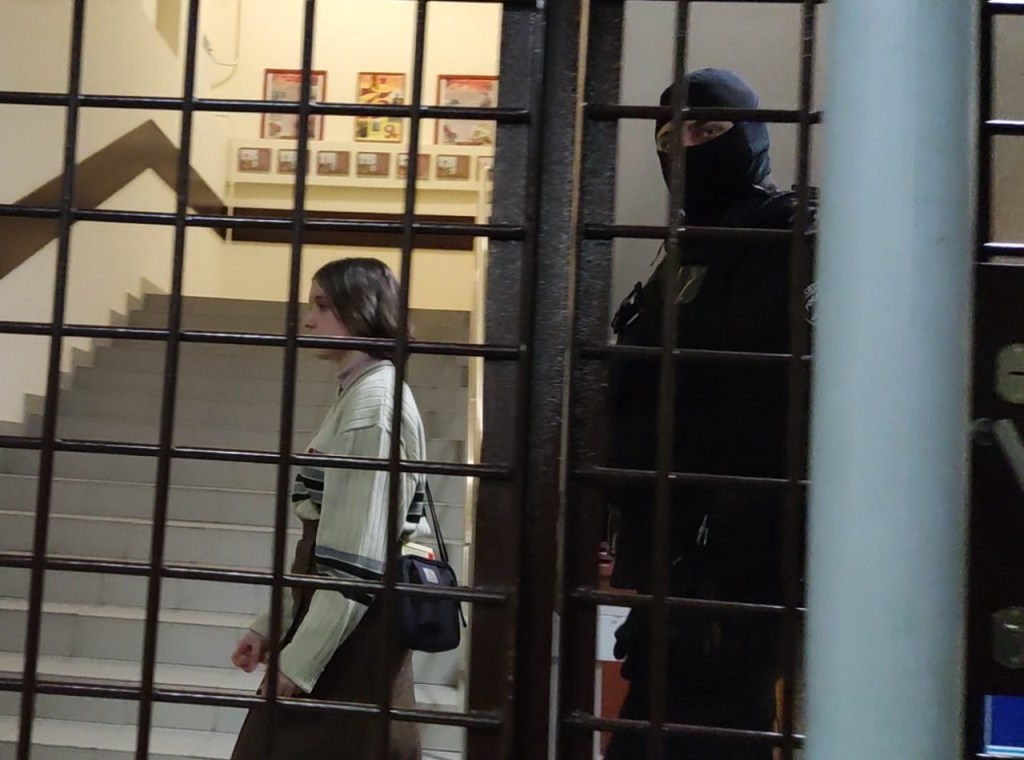
A view of the entrance to Open Space Moscow. Photo courtesy of Mediazona

On the evening of November 24, masked security forces officers broke into Open Space in Moscow, where fifty people had gathered to support the anarchists arrested in the Tyumen Case and write postcards to political prisoners. The security forces, who were probably commanded by a colonel from Center “E”, made the visitors lie down on the floor or stood them facing the wall and held them for several hours, beating some of them. They didn’t let a lawyer inside.

On November 24, an evening of solidarity for the defendants in the Tyumen Case took place in Open Space, a co-working space for activists in Moscow’s Basmanny District. Six anarchists from Tyumen, Surgut and Yekaterinburg have been arrested and charged with organizing a “terrorist community,” and all of them have said they were tortured.

The event was open to the public and had been advertised, for example, by the online magazine DOXA. (Recently, State Duma deputies demanded that the magazine be designated an “extremist organization.”)

The event started around six o’clock, and about forty to fifty people were in attendance, says one of the participants. Some eyewitnesses say that before the security forces arrived, they signed postcards in support of political prisoners, while others said that they recited or listened to poetry. In any case, when an intermission was announced, the guests went outside to smoke — and at that moment a paddy wagon drove up to the building, and masked security forces officers stormed the venue.

Video footage of the beginning of the raid, which the SOTAvision journalist Ksenia Tamurka managed to shoot before she was detained, shows that the masked security forces officers behaved in a demonstratively rough manner. They shouted, kicked over furniture, and knocked the phone out of the correspondent’s hands. After the phone falls, the sounds of blows and shouts are audible in the footage: “Hands behind your head!”, “Legs wider!”, “Face the wall, don’t look down!”

The security forces officers forced some of the young people to lie down on the floor, while they made the rest of them, including the young women, stand facing the wall, forbidding them to move. A young woman who had left the event during the break and unhappily returned to retrieve a tote bag she had forgotten told SOTA that she stood facing the wall for about an hour.

“When I turned my head, I was told to keep facing the wall. An hour later, they apparently took out my passport from my tote bag and summoned me to another room, where most everyone was lying face down on the floor. I sat down and we waited further. Then after, I don’t know, thirty minutes, I was summoned by other Russian National Guard officers. They asked me where my phone was, and I showed them. They asked me to unlock it, but I said no, citing Article 23 [of the Russian Constitution, which enshrines the right to privacy]. They were like no, you’re going to unlock it. And when I had already sat down, there was already a young female journalist after me, and she refused to show them her phone. They dragged her by the hair and she screamed,” the young woman said.

After what she saw, the young woman agreed to unlock the phone, and the security forces wrote down its IMEI. Another woman, who attended event with a child, said that the security forces officers demanded that she show them her Telegram chats and latest bank transfers to find out “whether she sponsored terrorism.”

The young woman who was screaming was SOTA journalist Ksenia Tamurka. The media outlet has not yet published the commentary of the journalist herself. One of the detainees recounted the assault on Tamurka as told by another eyewitness; another young man heard the journalist screaming, although he was in another room.

He said that the security forces treated the young men in various ways: in his opinion, it largely depended on the length of their hair. The young man pointed out that the security forces also detained members of Narcotics Anonymous, whose meeting was going on in the next room. “And when they were asked what they were doing there, they said, We are drug addicts, we don’t know anyone here! Then they were taken away from where we were, and [the police] talked to them separately,” he recalled.

At some point, the security forces perhaps began to behave a little less harshly. In video footage recorded a few hours after the start of the search, it is clear that the detainees were no longer pressed against the wall, but were simply looking at it. The security forces did not detain the journalists who shot the video, but, according to a Sota correspondent, they did drag a passerby inside the building after he looked in the window.

The security forces did not let the lawyer Leysan Mannapova, who arrived at the scene of the raid, inside the building, claiming that her warrant was incorrectly executed. A man who came to rescue his fourteen-year-old brother also failed to get inside the building.

The detainees were loaded into the paddy wagon only a few hours later, and the minors among them were released along the way. The rest were brought to the Basmanny police department.

One of them said that she and four young men were beaten at the station. According to the young woman, the security forces officers “struck her when she was lying on the floor.” One detainee was “beaten with a baton and a book,” and another young man was “thrown on a chair and kicked.” According to her, the police found a balaclava, an emergency hammer from a bus, and a traumatic pistol, which he had a permit to carry, on one of the men who was beaten.

Another young woman could not recall beatings and said only that the detainees wrote statements at the police department “about what they actually did.” Alexei Melnikov, a member of the Public Monitoring Commission who was recently appointed to the Presidential Human Rights Council, went inside the department and saw the detainees while they were making their statements, but also made no mention of possible violence.

The detainees were released from the department around two o’clock in the morning. None of them reported that they were forced to sign any documents other than their statements. Tamurka left the department last, around four in the morning.

Golos coordinator Vladimir Yegorov identified the colonel from Center “E” in video footage of the security forces escorting the detainees to the paddy wagon. According to Yegorov, he was beaten during a search of the Golos office on October 5 on the colonel’s orders. Yegorov does not know the policeman’s name, because it was not listed in the search report. According to SOTA, the masked security officers accompanying the colonel at Open Space serve in the second field regiment of the Interior Ministry’s Moscow Main Directorate.

Correction (7 p.m., November 25): The article originally stated that the journalist Ksenia Tamurka left the police department along with the other detainees around two o’clock in the morning. SOTAvision later clarified that she came out last, around four o’clock in the morning.

Source: Nikita Sologub, “‘Face the wall, don’t look down’: security forces raid solidarity event for defendants in Tyumen Case,” Mediazona, 25 November 2022. Translated by the Russian Reader. This is the second part of a two-part feature on the 24 November raid on Open Space Moscow. You can read part one — journalist Ksenia Tamurka’s first-person account of the incident — here.

The New Normal

Is life in Russia still normal?

Dmitry Vakhtin • Lives in Russia • Jun 3

Life in Russia is a “new normal.”

Shops are full of food, but no Nespresso capsules (I still have some for a couple of months).

Stores are still selling printers, but not ink cartridges (I had to re-fill the used one last week).

There is clothes in shopping centers, but stores I used to go to are closed.

European countries still formally issue visas, but not really, although they might, but probably not, and getting there by air costs the same as becoming a space tourist.

Some countries are still open, but flights abroad are few and expensive and airbnb doesn’t accept payments from Russia, so I have to ask my son living in Germany to pay for our Summer trip.

Speaking of my son, I still can transfer money to him, but sometimes it takes weeks and sometimes they never get through, though sometimes they do, and you never know.

Speaking of the money, I still get my salary, but sometimes it is delayed because transferring money to the right bank account in the right currency in time makes our financial team prematurely gray-haired.

Speaking of the salary, our high-tech company is still working, but neither electronic components, nor equipment, nor people can cross borders, although sometimes they can, and then they don’t, and you never know when and why, and nobody knows it.

I keep reading and watching Youtube videos about the war every day, although it has all become a routine, and I hate myself for that, and I did protest but stopped because it’s all pointless and dangerous, though it isn’t, but it is, and we are all cowards, but it doesn’t matter, though it does.

I want Ukraine to win this war, and I don’t feel as if I am betraying my country but rather that my country is betraying me and itself, and this is probably the only crystal-clear thing in my life.

Yes, life is still normal in Russia.

91.7K views • 6,390 upvotes • 32 shares • Answer requested by Emirey Jackson

Source: Quora


“Blue Eyes,” who physically assaulted Ksenia Tamurka, escorts her around the police station. Photo courtesy of SOTA

SOTA correspondent Ksenia Tamurka was detained along with the other attendees of a solidarity event for the defendants in the so-called Tyumen Case. The event was held at Open Space, an activist co-working space in Moscow The journalist was beaten when she refused to show her phone to men who had their faces covered. Despite this, Tamurka did not succumb to pressure and for several hours defended her rights to police officers. We publish this monologue by our correspondent, from which you can learn how to talk to the security forces and what you must do for your own safety.

Masked security forces officers [siloviki] burst into Open Space, and I started filming. I was either knocked down with a chair, or I tripped over it when I was pushed. I dropped my phone, and they put me face to the wall — they told me to stand like that. People around me were knocked down and thrown on the floor. They were not allowed to turn their heads; they could only look at the floor or at the wall. A Narcotics Anonymous meeting was being held in the basement of the premises, and one of the [recovering drug addicts] was asked what he used and how long he had been going there. They found some kind of book on LGBT topics in his possession and the siloviki read it aloud. In the process, they made nasty jokes about the guy. They said that there was no such thing as a former drug addict, and reproached him for being so young and already hooked. They collected everyone’s phone and papers, including mine and my press pass.

One guy begged them to let him call his mom. When these masked me with no insignia on their black uniforms had broken in, he thought it was a terrorist attack and had written to his family about it. The boy was very afraid that his mother would be worried, but the siloviki laughed, saying, Come on, how could you confuse us with terrorists? Why are you scaring your mother?

Then one of the Center “E” officers [eshnik] — the nastiest, most weaselly one — called me over because he thought I was hiding something when I was tucking in my sweater. He asked me to be a good girl and give him what I had allegedly hid; otherwise they would search me and stick their hands in my underpants. I said that I hadn’t hidden anything, that I was a journalist and had come there on assignment. He asked me strange questions, but I answered reluctantly. I said that I would only answer an investigator’s questions. For this, I was “punished” — I was made to stand with my face to the wall, although the others were sitting. When the siloviki nearby suggested that I sit down too, this eshnik said, “No, she’s being punished. She will stand.”

A couple of hours later I was summoned again. “Point your finger at your phone. Come on, unlock it,” they said. I refused because the request was illegal. Those men in uniform saw that I had Face ID, and they brought my phone close to my face, but I closed my eyes and looked away. The eshnik said all sorts of nasty things to me, getting angry and shouting. One of the masked siloviki, a man with blue eyes, grabbed me by the hair. Someone else hit me in the face and tried to open my eyes with his fingers. I was surrounded by five masked men. I screamed and cried and screwed up my face. I was very afraid to glance lest my phone be unlocked, god forbid. They dragged me back and forth by the hair. They shouted, “A drama queen! Ah, what a drama queen!” The police officers threatened to take me to the Moscow Region and talk to me in a basement.

At Open Space there is a mailbox for postcards designed to look like the bars in a jail. They punished me again by forcing me to stand looking at this box, like I was serving a prison sentence. Every police offer who walked by me thought I was backing away from it and pushed me closer. When one policeman passed by, he snapped his fingers before my eyes. When he was passing by, another policeman inserted a postcard with a beautiful picture in the box and said, “Let’s change the view — gaze at this.” Almost everyone passing by noted the pulled out hair on my clothes. Then that eshnik came up to me and tried to persuade me to unlock my phone. He asked whether I was tired, offered to deal with me “the normal way,” and said that I was delaying everything and would be the last to leave. “Just say the password, just enter it,” he said, but I wouldn’t enter it. They offered to give me a chair, to which I replied, “I’m not going to bargain with you. And bring a high chair.” They brought it. I sat down: I was comfortable, it was great, I looked at the wall. The blue-eyed man who had pulled my hair came up to me. I told him, “You beat me,” and pointed out that it was illegal, but he was like, “I don’t care.” The siloviki also tried to scare me by saying that my mobile phone would be entered into evidence and returned a year later, at the earliest, if we didn’t resolve everything on the spot.

The men in uniform constantly asked the organizers and participants why they supported terrorists and wrote postcards to them, and why the slogans on their walls were so filthy.

The siloviki asked everyone to tell them the PINs to their phones first, and then, if the person refused, they put the device in their hands and told them to enter it personally. They asked them to show their Telegram chats and film rolls and enter some other commands, like they were checking whether the mobile phone was stolen. When I asked what it all meant and why they needed my phone, they replied that they suspected me of theft, that there was a criminal complaint and even an APB out on me. I asked them to show them me and asked whether all those lying and sitting at Open Space had APBs out on them too. The siloviki replied that they would not show me anything because it was official information, and they stopped talking to me.

Everyone was photographed and searched, and their documents were photographed too — illegally, of course. They also took a picture of my father’s library card and public transport pass, although I didn’t consent to this. I was told that I was not in a position to forbid them to do anything. All the time I heard the same conversation: “We are checking your phone for theft, we are checking your phone for theft, enter the IMEI.” And almost everyone agreed to do it! Very few refused — and they were beaten, in my opinion. In any case, they were not treated very pleasantly. The eshnik asked me who I worked with at SOTA, who gave me the assignment, who I knew. He asked me about books and suggested that I read 1984. I told him to read Zamyatin’s We.

Th eshnik tried to make friends with me. He kept asking how I was feeling and complimented me, calling me a “persistent lady.” He even took my number and suggested that we discuss books later. He was constantly trying to get me to talk about “opposition” literature, bragging about his knowledge and telling me about Orwell. This man then invited me to take a stroll with him, but when he saw my face, he wimped out himself. “Well, you don’t want to walk with such scum, do you?” he said.

Ksenia Tamurka. Photo courtesy of SOTA

When I had already lost track of time, the intercessions on my behalf were conveyed to me. I was so glad when I found out that journalists had already gathered [outside], that my colleagues were there too! I was relieved because I had been very worried that I couldn’t contact anyone.

A man who did not agree to unblock his phone was beaten quite hard, judging by the sounds. We were forbidden to turn and look. One boy was whipped on his legs — the police officer made him spread his legs wider and thrashed him with all his might. It was so loud and scary.

They also promised that they would talk to me separately — I was afraid that they would just start torturing me, because I asked the policemen about it, and they either jokingly or seriously answered that yes, they would. There was a moment when everyone was really led away, and I thought, Well, that’s it — it’s about to start. But no, I was just sent to a paddy wagon.

At the station, I realized that everyone was pretty sick of me, judging by the comments that came my way. They called me a dumb broad and a pest. They said that I should be beaten with a rod. Later, in the department, they suggested that I should be “whipped with an officer’s belt in a dark room.” It also transpired that I was a dumb broad because no one was fucking me. They said disgusting things about me. I wrote down everything they said and all sorts of atmospheric details in the blank spaces in the book I had with me, [Vladimir] Sorokin’s Sugar Kremlin. The police saw it and tried to take a peek. Then the blue-eyed duded just stole it from me. They read all my notes in front of me and laughed in my face: “What? Who beat you? No one touched you. Why are you making things up?” But one of them added that I could still be beaten, because there was no other way to make me understand.

I was held separately and constantly harassed. And yet, when I asked to make a phone call, they said that it was specifically forbidden to me. When I asked to let a lawyer in to see me, that was also forbidden to me. I wanted to go to the toilet, but that too was specifically forbidden to me, while everyone else was allowed to go. They lied to me that there was no one waiting for me outside, that no one had any use for me and no one was waiting for me, although I knew that a crowd had already gathered at the station. The policemen discussed my breasts in front of me. Then they asked me my size — I cited Article 51 [of the Russian Constitution] and refused to testify.

When everyone else had already been released, they continued to drag their feet with me. The policemen kept their promise. I had to prove to them that the phone was mine for some reason. But if they had confiscated it from me, they should have known whose phone it was! It was their problem that they didn’t follow the legal procedures and forced me to deal with the consequences of their negligence! Moreover, my phone was the last one. The cunning eshnik and the blue-eyed devil finally decided to punish me too for my perseverance and entered the wrong password many times so that my phone would be blocked.

While we were waiting for the on-duty officer, the fool who dragged me by the hair ran out through another exit. Today I will file a complaint regarding the theft of my book and the actions of those police officers. I also went to the emergency room — I feel that it hurts me to touch it [sic]. I had the assault and battery documented there. The trauma specialist told me that it was an “industrial” injury because I had been on the job.

By the way, the slogan “The people’s trust is the police’s strength” was written on the wall of the police department.

Source: “‘The police threatened to take me to the Moscow Region and talk to me in a basement’: The story of the assaulted SOTA journalist,” SOTA (Teletype), 25 November 2022. Translated by the Russian Reader. The original article contains three embedded Telegram posts featuring video footage taken during the events described above.

The Distance Between Krasnoobsk and Moscow Is 3,420 Kilometers

Five persons unknown abducted and tortured Dmitry Karimov, a 22-year-old resident of Krasnoobsk (Novosibirsk Region), in order to get him to confess to burning a banner in support of the Special Military Operation. The young man told the Telegram channel “Caution, News” [which has 1,443,493 subscribers] about the incident.

According to Karimov, on the morning of October 14, five men in mufti attacked him and pushed him into a vehicle. “I was screaming, calling for help, and they used a cattle prod on me,” he said, adding that they immediately accused him of setting fire to the banner, a crime which he did not commit.

Then, according to Karimov, the men took him to the forest, handcuffed him, strangled him, threatened to shoot him, and offered to convey to his parents his last words if he did not confess to the arson. Karimov confessed under duress. He was taken home, where a search took place, during which the security forces seized electronic devices and a jacket.

The detainee was then taken to the police station. Karimov said that during the interrogation he tried to tell the truth, but he was threatened with being sent to the war in Ukraine, and due to fear and coercion, he confessed.

The detainee’s mother Ekaterina Mikhasyonok said that her son is a third-category disabled person: he has been diagnosed with an organic lesion of the central nervous system, and has hearing and speech problems. She added that when her son did not return from school, she began looking for him. At about nine in the evening, she went to the police station, where she was told that Karimov was there.

Karimov was charged with “intentional destruction or damage to property by arson” (per Article 167.2 of the Criminal Code) and released on his own recognizance.

Source: “Novosibirsk Region resident says he was tortured into confessing to torching pro-SMO banner,” OVD Info, 16 November 2022. Thanks to Jenya Kulakova for the heads-up. Translated by the Russian Reader


Russian President Vladimir Putin on Thursday named several supporters of the war in Ukraine to the presidential Human Rights Council in a shake-up of the body which appeared to purge members who have publicly expressed doubts about the war. 

War correspondent Alexander Kots and two other prominent supporters of the war were added to the council, while 10 members, including the well-known television host Nikolai Svanidze, found themselves removed from the body. 

Kots, a journalist for the Komsomolskaya Pravda tabloid who also runs the popular Telegram channel Kotsnews, has risen to prominence during Russia’s invasion of Ukraine as he has been embedded with Russian forces throughout the war. 

While he has reported on Ukraine since 2014, he has faced repeated accusations of being a mouthpiece for the Kremlin since the start of Russia’s 2022 invasion, most notably for his claim that the massacre of Ukrainian civilians in the town of Bucha was staged by Kyiv.

Also added to the body on Thursday were Yulia Belekhova of the All-Russian People’s Front, an organization that raises money to support pro-Kremlin separatist forces in Ukraine’s Donbas region, as well as Elena Shishkina, a member of the Free Donbas party in the self-proclaimed Donetsk People’s Republic. 

The 10 members removed from the body include Svanidze, who has increasingly voiced his concerns over Russia’s invasion and who called for curbs on the death penalty in the Donetsk region in an open letter to Putin in August.

Prominent rights activist Igor Kalyapin and leading anti-xenophobia researcher Alexander Verkhovsky were also removed from the council in Thursday’s shake-up.

Russia’s Human Rights Council, which was established by presidential decree in 2004 to guarantee and protect human rights in Russia, has been criticized for failing to challenge Putin as members have been ousted and replaced with more Kremlin-friendly figures over the years.

The council has been chaired by journalist and war supporter Valery Fadeyev since 2019.

Source: “Putin Names War Supporters to Russia’s Human Rights Council,” Moscow Times, 17 November 2022

Life’s Rich Pageant: The Case of Yan Sidorov

Yan Sidorov. Photo courtesy of Memorial Human Rights Center

Minus one:Yan Sidorov, a former political prisoner in the Rostov Case, has volunteered for the war.

Sidorov served four years in prison in the Rostov Case, in which the court decided that two posters and thirty leaflets were evidence of “attempted organization of mass disturbances.” The Memorial Human Rights Center recognized him as a political prisoner.

Yan was released from prison a year ago, and he had planned to work in human rights protection. There were no vacancies in human rights organizations, however, and so he had to get a job as a food delivery courier.

Yan socialized with many leftist and liberal activists, but he also maintained relations with the red-brown National Bolsheviks.

Apparently, the latter were nicer to him. Several mutual friends have informed me that Yan Sidorov has joined the ranks of Eduard Limonov’s Other Russia and gone to the front.

I still don’t get how the National Bolsheviks degenerated from a flamboyant opposition party into the vanguard of the Kremlin regime. The late Limonov was always an imperialist, however.

But how — how?! — former political prisoners become defenders of Putin’s dictatorship, no one seems to understand. As one of my cellmates used to say, “Everyone has gone off their fucking gourd!”

Well, before he starts shooting, it’s not too late for him to change his mind. Maybe he will shake himself free of this delusion after all.

Source: Ivan Astashin, Facebook, 27 October 2022. Translated by the Russian Reader


Russian human rights activist Yan Sidorov is facing the prospect of three years under harsh probation conditions, when he is released next week from the penal colony where he has spent the last two years, Amnesty International said today.

Yan Sidorov is a prisoner of conscience, whose attempts to hold a peaceful protest in 2017 resulted in an imprisonment at a Dimitrovgrad penal colony after he had spent two years in pre-trial detention. He is set to be released on 3 November, but on 29 October Dimitrovgrad City Court will hear a request by the authorities to impose a severely restrictive probation period.

“Russian authorities are sending a clear signal to all young activists that participation in peaceful protests can come at huge personal cost. Yan Sidorov has already served four years in prison; he may now have to spend three more under strict police surveillance, forbidden to go out after 10 pm and banned from travelling outside the Krasnodar region,” said Natalia Zviagina, Amnesty International’s Moscow Office Director.

“The Russian penitentiary authorities must immediately withdraw their request to impose additional arbitrary restrictions on Yan Sidorov and release him unconditionally. Yan Sidorov has done nothing but exercise his rights to freedom of expression and peaceful assembly, and this outrageous campaign of punishment must end.”

Background

Two weeks ahead of Yan Sidorov’s release from penal colony IK-10 in Dimitrovgrad (Central Russia), the penitentiary administration requested that the court impose a three-year probation period on him. Conditions include obligatory biweekly registration at the local police station and a curfew between 10 pm and 6 am; Sidorov would also be banned from leaving his native Krasnodar region, and banned from attending or participating in any mass events. The Dimitrovgrad City Court will hear this case on 29 October. On 15 October, the penal colony authorities accused Yan Sidorov of violation of the prison regime regulations – allegedly for not attending morning workout – and placed him in a punishment cell for seven days.

In October 2019, Yan Sidorov and his friend Vladislav Mordasov, who spent almost two years in pre-trial detention, were found guilty of “attempted organization of mass disturbances”, and each sentenced to more than six years imprisonment for organizing a peaceful protest in November 2017. The protest was in support of dozens of people in Rostov-on-Don (Southern Russia) who had lost their homes in mass fires. Their sentences were subsequently reduced to four years on cassation. Vladislav Mordasov serving his sentence in IK-9 penal colony in Shakhty (Rostov-on-Don region) is due to be released on 3 November as well.

Source: “Russia: Prisoner of conscience Yan Sidorov faces further restrictions after release,” Amnesty International, 28 October 2021

News from Ukraine Bulletin 15

News from Ukraine Bulletin 15 (9 October 2022)

A Digest of News from Ukrainian Sources

News from the territories occupied by Russia:

Invaders want to take children and elderly people out of Kherson Oblast  (Ukrainska Pravda, October 8th)

Russia sentences three Ukrainian Jehovah’s Witnesses to six years for ‘threatening state security’ by discussing the Bible  (Kharkiv Human Rights Protection Group, October 7th)

Volodymyr Sakada, Yevhen Zhukov, and Volodymyr Maladyka have been sentenced to six years in prison by a Russian occupation in Sevastopol for being Jehovah’s Witnesses.
Photo: Lutfiye Zudiyeva, Graty. Courtesy of Kharkiv Human Rights Protection Group

Bodies of more tortured victims and Russian torture chambers found in liberated parts of Kharkiv oblast  (Kharkiv Human Rights Protection Group, October 7th)

Mass grave found in liberated Lyman  (Ukrainska Pravda, October 7th)

Two more bodies with traces of torture discovered in Kharkiv region  (Ukrainska Pravda, October 6th)

Over 1.6 million Ukrainians deported to Russia – Zelenskyy (Ukrainska Pravda, October 6th)

Russian atrocities at Bucha may be nothing to those that will be found when Kherson is liberated  (Kharkiv Human Rights Protection Group, October 5th)

Mass graves of civilians found in liberated Lyman  (Ukrainska Pravda, October 5th)

Two bodies tortured by Russian special forces found in liberated Kharkiv Oblast  (Ukrainska Pravda, October 5th)

Russian torture chamber discovered in district police department in Kharkiv Oblast  (Ukrainska Pravda, October 4th)

Russia refuses to return Ukrainian children taken from Kharkiv oblast  (Kharkiv Human Rights Protection Group, October 4th)

Another torture chamber set up by Russians discovered in Kharkiv Oblast  (Ukrainska Pravda, October 3rd)

News from Ukraine – general:

Russia strikes high-rise buildings in Zaporizhzhia with rockets, people trapped under rubble  (Ukrainska Pravda, October 6th)

Open wounds of the Russian-Ukrainian war: Ukrainian victims will share their stories in Milan  (Zmina, October 5th)

13 children killed in Russian attack on civilian convoy in Kharkiv oblast  (Kharkiv Human Rights Protection Group, October 3rd)

How Ukraine’s metal industry is powering this city’s fight against Russia (Open Democracy, September 24th)

Donations worth millions fail to reach Ukraine – sparking calls for change  (Open Democracy, September 20th)

Analysis and comment:

Walking a Tightrope on Ukraine: How India Is Balancing Ties to Russia & United States  (Democracy Now, October 6th)

“Leftists” outside Ukraine are used to listening only to people from Moscow: Interview with anarcho-syndicalists in Eastern Ukraine  (Freedom News, October 4th)

“The minimum task is to restore, without losses, all the civil, political, and social rights that we had before the war.” Interview with Serhii Guz  (LeftEast, October 4th)

One Ukrainian Democratic Socialist’s Opinion On The War  (The Real News, September 20th)

It’s Russia and Europe That Have a Problem With Ukraine (Green European Journal, September 7th)

Research of human rights abuses:

Who attacked the Mykolaiv Region Administration building?  (Tribunal for Putin, October 8th)

Establishment of a tribunal on Russian aggression against Ukraine: High level of responsibility as a safeguard against new conflicts in Europe  (Opora, October 5th)

Solidarity actions:

Solidarity With Trade Unions In Ukraine  (LabourNet TV, October 2nd)

Support Ukrainian unions (Solidarity Collectives, 29 September)


This bulletin is put together by labour movement activists in solidarity with Ukrainian resistance. More information at https://ukraine-solidarity.org/. We are also on Twitter. Our aim is to circulate information in English that to the best of our knowledge is reliable. If you have something you think we should include, please send it to 2022ukrainesolidarity@gmail.com.

To receive the bulletin regularly, send your email to 2022ukrainesolidarity@gmail.com. To stop it, please reply with the word “STOP” in the subject field.  

Yashar Shikhametov: 11 Years in Maximum Security for “Kitchen Conversations”

Yashar Shikhametov

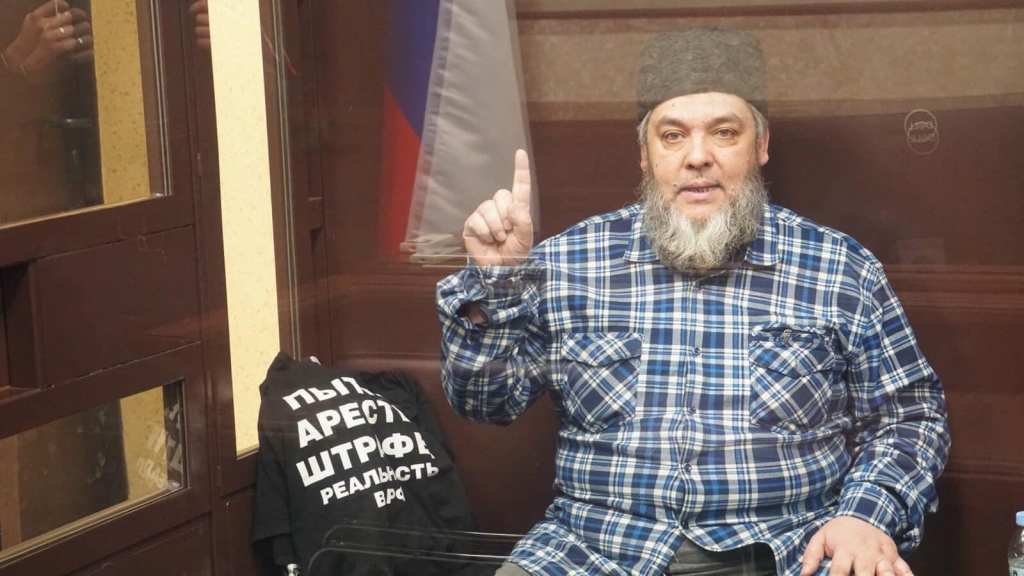
⚡️ Another sentence: 11 years in a maximum security penal colony for a 52-year-old cook from Crimea

Today, the Southern District Military Court [of Russia] announced the verdict in the trial of Yashar Shikhametov, a Crimean Tatar, a cook from Sevastopol, and a political prisoner. He was charged with membership of the Islamist political party Hizb ut-Tahrir, which has been banned in Russia since 2003. In Ukraine and most countries of the world, however, the organization operates without any restrictions in terms of national legislation.

According to the case file, the accused had no weapons, explosives, or ammunition, did not plan to commit a terrorist act and did not call on others to carry out terrorist acts. There is no evidence that he was planning to overthrow the constitutional order of the Russian Federation and seize power. The case materials contain audio recordings on which religion and politics are discussed. In fact, this was the only evidence presented by investigators, along with the testimony of secret witnesses, which cannot be corroborated.

Shikhametov was was arrested on 17 February 2021, and then spent over a year and a half in a pre-trial detention center, where he suffered from many ailments. In July of the same year, his case was submitted to the military court of Rostov-on-Don. The trial of the case on the merits took place over the course of twenty-four hearings.

On August 14, 2022, Prosecutor Sergei Aidinov asked the court to sentence Shikhametov to eleven years of imprisonment in a maximum security penal colony, with the first four years of the sentence to be served in a closed prison.

The verdict issued by the Russian court today gave the prosecutor exactly what he had asked.

At yesterday’s court hearing, the political prisoner complained of feeling unwell. When the court suggested that he take part in the closing arguments, Shikhametov insisted on the need for a recess.

The court turned down the defense’s request to declare a recess.

Judge Alexei Magomadov deemed Shekhametov’s inability to take part in the closing arguments as a voluntary refusal to testify, despite the fact that the defendant had written a twenty-one-page-long closing statement for the hearing. He also turned down [defense] lawyer Alexei Larin’s request to postpone the hearing.

“Did we have a choice in 2014? I will tell you that it’s all true. Ethnically, we are Crimean Tatars; we are Muslim in terms of religion and culture, and we are citizens of Ukraine. Is this proof of my guilt? We do not hide, we do not hide it, but we declare it directly and everywhere. Is that a crime? But the FSB investigator cooks up this whole [case] with remarks made around the kitchen table, and by tormenting people and intimidating them with searches,” Shikhametov wrote in the [closing statement], which he was unable to deliver in court.

Source: Mumine Saliyeva, Facebook, 9 September. Photo courtesy of Crimean Solidarity. Thanks to Natalia Sivohina for the link. Translated by the Russian Reader


Shikhametov is from Orlinoye on the outskirts of occupied Sevastopol.  He earlier appeared as a defence witness in the political trial of Enver Seitosmanov, which may have been the reason that the Russian FSB turned their attention to him.  They added him, six years after the earlier arrests in 2015, to Russia’s first conveyor belt ‘trial’ of Crimean Muslims on charges of involvement in Hizb ut-Tahrir. The latter is a peaceful, transnational Muslim organization which is legal in Ukraine, and which is not known to have committed any acts of terrorism anywhere in the world.  Russia’s prosecutions, under ‘terrorism’ legislation, are based solely on an extremely secretive Russian Supreme Court ruling from February 2003, which declared the organization ‘terrorist’ without providing any grounds or explanation. Russia is increasingly using these charges as a weapon against Crimean Tatar civic activists and journalists, with men who have committed no recognizable crime being sentenced to up to 20 years’ imprisonment. The charges are a favourite with the FSB and their decision to arrest any particular person is a near 100% guarantee that their victim will be imprisoned and receive a huge sentence.

Shikhametov was charged under Article 205.5 § 2 of Russia’s criminal code with ‘involvement’ in a Hizb ut-Tahrir group.  This was seemingly the same fictitious ‘group’ which the FSB claimed that Ruslan Zeytullaev had ‘organized’ (a more serious charge) and that Ferat Saifullaev, Yury Primov and Rustem Vaitov were supposed to have been members of. Russia was still ‘testing the ground’ (and international reaction) in that case and all of the men initially received much lower sentences than required by legislation. The prosecution (or, more likely, the FSB) challenged the sentence against Zeytullaev until they got a 15-year sentence but did not appeal against the other three sentences (more details here). One difference now is that the prosecution almost invariably adds the charge (under Article 278) of trying to overthrow the Russian state. This charge is even more nonsensical, as not one of the men has ever been found to have any weapons, but does enable them to increase the sentence.

Both the earlier ‘trials’ and that against Shikhametov were, as the latter said, based on ‘conversations in the kitchen’ on religious and political subjects. These were sent to FSB-loyal ‘experts’ (from the Kazan Inter-Regional Centre for Analysis and Assessments) who provide the opinion demanded of them.

Russia’s FSB have, however, discovered that such prosecutions do not go to plan, primarily because of committed lawyers who insist on demonstrating the flawed nature of both the charges and the alleged ‘evidence’.  Although the convictions remain essentially predetermined, the men’s lawyers, as well as the important Crimean Solidarity human rights initiative, provide important publicity about the shocking methods used to fabricate huge sentences.

Armed and masked enforcement officers burst into Shikhametov’s home on 17 February 2021 and carried out ‘a search’, before taking the father of three away and imprisoning him. As in all such cases, lawyers were illegally prevented from being present. The officers claimed to have found three ‘prohibited religious books’. The books, which did not have any fingerprints on them, were in a cupboard holding coats and shoes which was a place, as Shikhametov himself told the court, that no practising Muslim would hold religious literature.

During one of the hearings, Shikhametov stated that he considered the real criminals to be those who planted ‘prohibited books’ in his home. Typically, the only outcome of this was that Shikhametov himself was removed from the courtroom. Shikhametov has been open in calling those involved in this prosecution and others “accomplices and criminals” and this was not the only time he was removed from the courtroom.

In July 2021, the FSB carried out an armed search and interrogation of Ferat Saifullayev (who had been released after serving his sentence).They threatened “to come back and find prohibited literature” if he did not give false testimony against Yashar Shikhametov.  During this interrogation, he was neither informed of his rights, nor told what his status (suspect, witness, etc.) was. Saifullayev signed the document thrust in front of him, but later stated publicly that he had only done so because of the pressure and threats against him. He insisted that this supposed ‘testimony’ should be excluded as having been obtained with infringements of the law and issued a formal complaint to the FSB in Sevastopol, naming senior ‘investigator’ Yury Andreyev. 

Prosecutor Sergei Aidinov was never able to explain how Shikhametov, working as a café chef was supposed to have ‘carried out ideological work’ or what such ‘work’ was.

All of this was ignored by presiding judge Alexei Magamadov, together with Kirill Krivtsov and V.Y. Tsybulik who actively took the side of the prosecution. Such bias was seen here, as in all other political trials of Crimean Tatars and other Ukrainians, in the use of ‘secret witnesses’. The only real ‘evidence’ in this ‘trial’ came from people whose identity was not known, and whose supposed testimony could not be verified. In all these trials, the judges invariably disallow questions aimed at demonstrating that the person is lying and that he does not in fact even know the defendant.  

Please write to Yashar Shikhametov! 

He will almost certainly remain imprisoned in Rostov until his appeal hearing. Letters tell him that he is not forgotten and send an important message to Moscow that their persecution of Crimean Tatars and other Ukrainian political prisoners is under scrutiny.

Letters need to be in Russian, and on ‘safe’ subjects. If that is a problem, use the sample letter below (copying it by hand), perhaps adding a picture or photo. Do add a return address so that the men can answer.

The addresses below can be written in either Russian or in English transcription. The particular addressee’s name and year of birth need to be given.

Sample letter

Привет,

Желаю Вам здоровья, мужества и терпения, надеюсь на скорое освобождение. Простите, что мало пишу – мне трудно писать по-русски, но мы все о Вас помним.

[Hi.  I wish you good health, courage and patience and hope that you will soon be released.  I’m sorry that this letter is short – it’s hard for me to write in Russian., but you are not forgotten.] 

Address

344022, Россия, Ростов-на-Дону, ул. Максима Горького, 219 СИЗО-1

Шихаметову, Яшару Рустемовичу, г.р. 1970

[In English:  344022 Russian Federation, Rostov on the Don, 219 Maxim Gorky St, SIZO-1

Shikhametov, Yashar Rustemovich, b. 1970 ]

Source: Halya Coynash, “Crimean Tatar sentenced by ‘accomplices and criminals’ to 11 years in Russian captivity,” 9 September 2022, Kharkiv Human Rights Protection Group

Roman Holiday

A still from the motion picture Roman Holiday (1953). Courtesy of Republic

The debate about whether Schengen visas should cease to be issued to Russian nationals has tilted in a completely wrongheaded direction. In fact, it should not focus on the right of Russian nationals to visit European countries, including as tourists, but on Europe’s right to protect itself and to take measures that establish a direct political and legal link between citizens and the actions of their state. No one can or should deprive refugees or persons who are persecuted for their anti-war stance of the right to request asylum in EU countries. But this right should not be confused with the right to tourism, recreation, use of property or trouble-free business dealings in Europe.

What arguments are made by those who think that European countries cannot and do not have the right to stop issuing certain types of visas to Russian nationals?

Argument No. 1. The Russian intelligentsia argues that Europe, as an axiological benchmark for educated and non-war-supporting Russian nationals, has no right to close its borders to such nationals. This argument is based on a double omission.

Omission No. 1. It is not a matter of defending the right of all Russian nationals to vacation in Europe or find refuge there, but of the rights of only those Russian nationals who have linked their lives to Europe as an axiological (or consumerist) beacon. Everyone else, they imply, can do without visas — meaning it is a matter of triage, not a matter of rights or their lack. But this kind of sorting is a blatant injustice vis-a-vis one’s fellow citizens. Why should Russian nationals who know who Caravaggio and Ibsen are have visas, while those who don’t know who they are do without them?

Omission No. 2. Europe as a political entity is supposed to have a moral obligation toward certain nationals of a state that for six months now has been bombing European cities, from Lviv and Vinnytsia to Mykolaiv and Odesa, without cause and without declaring war. Europe has no such moral obligation.

Europe has a political obligation to protect its nationals from the belligerent state and its “soft” power. It also has a moral obligation to take all necessary, sufficient or at least potentially effective measures to protect the European state that has been subjected to the aggression — meaning Ukraine (which is European, so far, only in a geographical, not legal sense). In this case, everything has been working as it should. The EU has welcomed several million refugees from Ukraine and granted them legal status.

Argument No. 2. A crackdown has begun in Russia: opponents of the war, cultural figures, academics, and artists have been persecuted for their stance. If European visa are canceled, these people will not be able to escape. An analogy is immediately drawn with the philosopher Walter Benjamin, whom the Spanish border service did not let into the country from occupied France during the Second World War. Benjamin committed suicide.

Although this analogy is flattering to those who make it, it has nothing to do with real life. There are at least four countries where it is possible to evacuate from Russia quickly, cheaply, and nearly risk-free: Armenia, Georgia, Kazakhstan, and Kyrgyzstan. There are flights there from Russia, the Russian language is in widespread use there, and no visas are required to stay there. Moreover, you can enter Armenia, Kazakhstan, and Kyrgyzstan without your foreign travel passport.

So it’s not that there is nowhere to run, but that people want to escape “poshly.” They want to escape to Europe. This raises another objection. Fleeing to the EU on a tourist visa not only means slyly embellishing the hopelessness of the situation, but also engaging in deception. Either you choose Kant’s Europe and apply for refugee status and prove the right to be called a refugee, as the President of Ukraine has advised Russian nationals to do. Or you don’t bother with Europe at all if you want to go to there because you want to live according to Kant, but think you can cheat a little to get there.

Argument No. 3 against visa restrictions is that the European countries, by introducing such restrictions, will punish the innocent and encourage those who are not involved. That is, they will consolidate the majority supporting the war and make life difficult for those who do not support the war and just want to travel to Europe. This argument is based on the false and harmful premise that for some unknown reason the EU countries should play a part in Russia’s internal politics as an insider.

For thirty years, Europe invested a great deal of effort and resources in developing civil society in Russia, in supporting education, science, and culture in the country. These investments all went up in smoke on February 24. They proved completely and absolutely unproductive from a political point of view. Despite the possibly credible opinion that popular support for the war is imaginary, and Russian society is actually opposed to it, it is impossible to understand whether this is true or not. How can one continue investing in something that either exists or does not exist, but should exist?

Argument No. 4 is even simpler: Russian nationals have the right to travel to Europe. Period. It is an inalienable human right. This is simply not the case. If we take the Universal Declaration of Human Rights as a standard, it states that “[e]veryone has the right to freedom of movement and residence within the borders of each state,” “[e]veryone has the right to leave any country, including his own, and to return to his country,” and “[e]veryone has the right to seek and to enjoy in other countries asylum from persecution.” Neither the spirit nor the letter of a ban by European countries on issuing tourist visas to Russian nationals will violate these three principles governing freedom of movement as a basic human right.

Argument No. 5 is made in desperation and looks completely ridiculous: defamation. First-rate countries versus second-rate countries. These can versus those cannot. I needn’t remind readers about refugees from Syria, that the EU continues to issue visas to people in countries whose standard of living is much lower than in Russia, and so on. It’s not a question of “quality.” The fact is that every day on the social networks I personally see wholly content Russian nationals (including those who support the war, work for the Kremlin, and get paid for producing propaganda and maintaining the infrastructure that simulates “popular” support for the war inside the country) roaming peaceful European landscapes. Every single day.

The war in Ukraine is not a dictator’s safari. It is a terminal event for Russian statehood. Meaning that it is a terminal event for Russian nationals, too. Europe would be in its rights to underscore this fact by taking a simple decision. Peaceful tourism for nationals of a belligerent country is a political oxymoron. Therefore, and for this reason alone, such tourism should be halted at least for the duration of the war.

Source: Konstantin Gaaze, “No, Europe doesn’t owe us anything: In defense of visa restrictions for Russian nationals,” Republic, 18 August 2022. Konstantin Gaaze is a sociologist and journalist. Translated by the Russian Reader

International Day for the Protection of Children

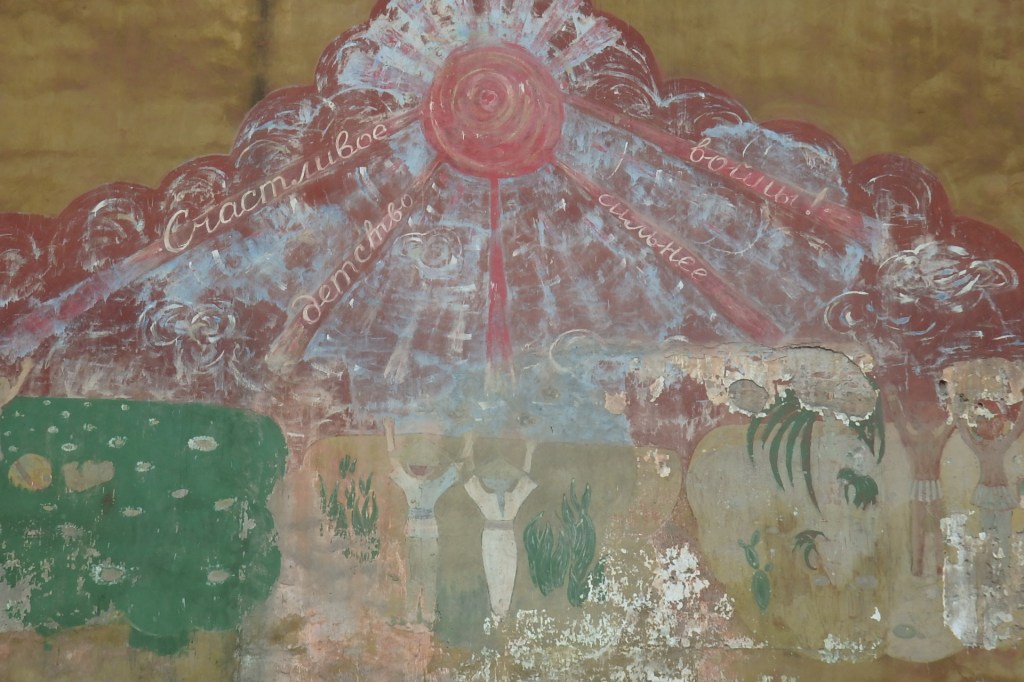
“A happy childhood is stronger than war!”

A ragged urchin, aimless and alone,

   Loitered about that vacancy; a bird

Flew up to safety from his well-aimed stone:

   That girls are raped, that two boys knife a third,

   Were axioms to him, who’d never heard

Of any world where promises were kept,

Or one could weep because another wept.

— W.H. Auden, “The Shield of Achilles”


Wednesday is International Day for the Protection of Children in many former Soviet countries — a joyful celebration typically marked by concerts, outdoor games and arts and crafts.

In Ukraine, it’s a Children’s Day like no other. On Friday, the country will mark the grim milestone of 100 days since the Russian invasion. During that time, at least 262 children have been killed and 415 injured in wartime strikes, according to UNICEF, the U.N. children’s agency, which cited confirmed figures that the United Nations acknowledges are incomplete and much lower than the actual tolls.

Ukrainian officials have said there is little cause to celebrate. The war has left 5.2 million children in need of humanitarian assistance, according to UNICEF, and has disrupted children’s lives and education.

“This year, Children’s Day in Ukraine is celebrated in a different way than usual,” Daria Herasymchuk, an adviser to Ukraine’s president on children’s rights and rehabilitation, said Wednesday, according to the Interfax-Ukraine news agency.

In wartime, children “are forced to hide from the bombing in shelters, in the subway,” Herasymchuk said during a news briefing. “They are forced to leave their homes and seek shelter in safe regions.”

But despite the war, towns and cities across Ukraine still marked the occasion Wednesday — though it looked different than usual.

In the western city of Lviv, the mayor, Andriy Sadovy, posted photos of abandoned school buses, stuffed animals, name tags and backpacks on empty seats, during what Reuters described as an event marking the death of 243 children during the war.

“A school trip that will never happen,” Sadovy wrote in a Facebook post, using the hashtag #emptybuses.

“Stronger than war!”

“Today, the school buses on Ploshcha Rynok [Lviv’s central square] are empty,” he wrote, adding that “243 children will never travel to Lviv again.” He accused Russian forces of “killing children, women and civilians” and continued: “They must be held responsible for every life taken. Today, the whole world must unite to stop these terrible crimes.”

It was not immediately clear whether Sadovy’s figure of 243 referred to children killed in Lviv or more widely in Ukraine.

Meanwhile, soldiers from Ukraine’s army posed with drawings and stuffed animals in a video message for Children’s Day posted on the Defense Ministry’s Twitter account.

“We expect that you know what we do,” the soldiers say in the video. “We defend our native country. And … it is always very important for us to receive support from you, like these kinds of self-made items, pretty drawings and poems. So send them to us. Together, we will pray for our state.”

The video then zooms in on some of the drawings, which bear messages such as “Ukraine will be able to do anything” and “The enemy will not pass.”

In Bucha, where Russian forces were accused of committing war crimes during their month-long occupation of the quiet suburb of Kyiv, photos showed children making “embroidered hearts and paper birds for soldiers on the front line,” according to the Getty photo service.

Most of the 5.2 million children who need humanitarian assistance have been displaced by fighting between Ukrainian and Russian forces, the agency said. On average, the conflict in Ukraine kills at least two children and injures at least four each day, UNICEF and the U.N. agency for refugees said in a news release. It said the casualties occurred “mostly in attacks using explosive weapons in populated areas,” an oblique reference to bombardment by Russia, which went unmentioned in the news release.

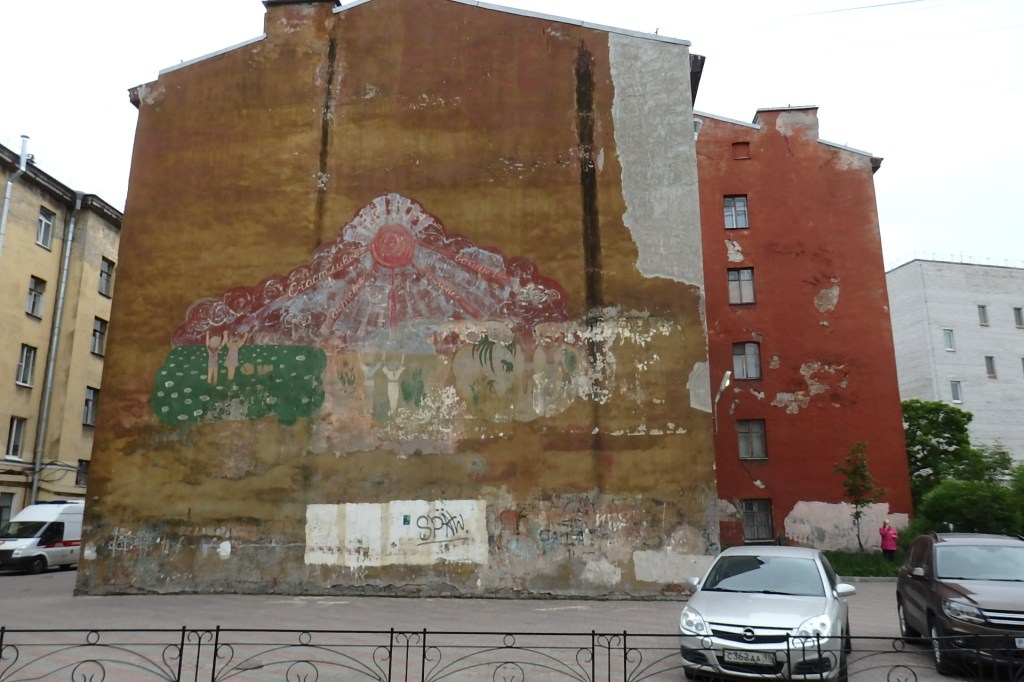
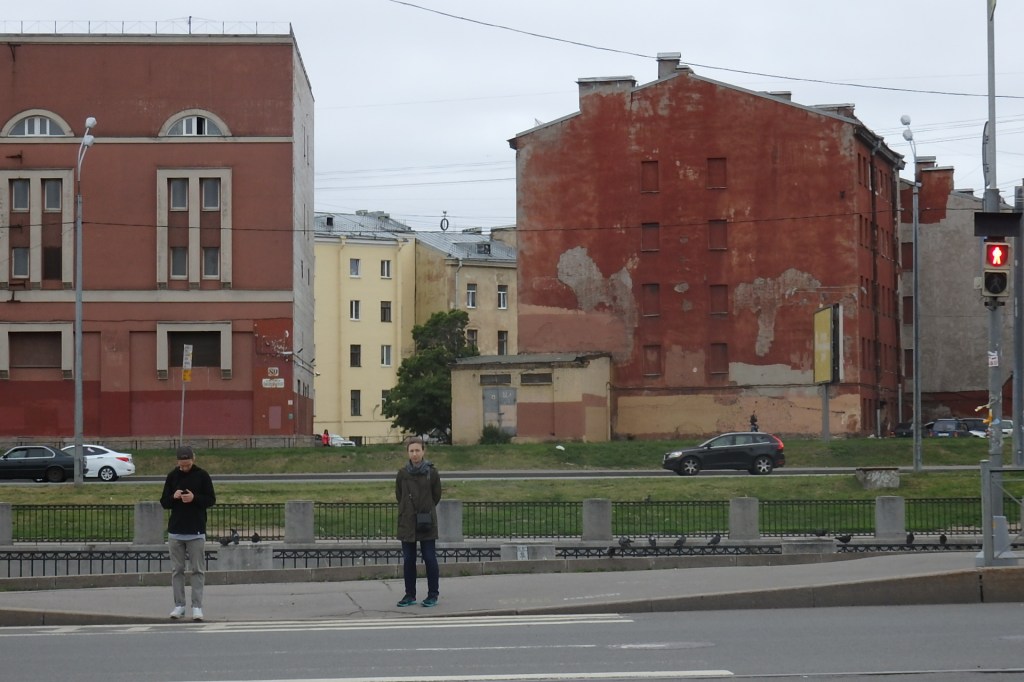
The “pro-children, anti-war” mural is hidden amongst these building on the far side of the Obvodny Canal.

“June 1st is International Day for the Protection of Children in Ukraine and across the region,” UNICEF Executive Director Catherine Russell said in Wednesday’s release. “Instead of celebrating the occasion, we are solemnly approaching June 3 — the 100th day of a war that has shattered the lives of millions of children.”

Russell called for “an urgent cease-fire and negotiated peace” to end the war, without which she warned that “children will continue to suffer — and fallout from the war will impact vulnerable children around the world.”

Source: Annabelle Timsit, “As Ukraine marks Children’s Day, U.N. says 5 million need humanitarian aid,” Washington Post, 1 June 2022. Photos of the late-Soviet or early-post-Soviet-era pro-children, anti-war mural in the courtyard of the residential buildings at the corner of Borovaya Street and the Obvodny Canal in St. Petersburg taken by the Russian Reader on 28 May 2016.


“International Day for the Protection of Children, 1958. USSR Post, 40 kopecks.”

International Day for the Protection of Children is celebrated annually on June 1. Established in November 1949 in Paris by decision of the Congress of the Women’s International Democratic Federation, it was first celebrated in 1950. In addition, World Children’s Day (November 20), International Day of Innocent Child Victims of Aggression (June 4) and African Children’s Day (June 16) are dedicated to children. In terms of international law, the principal relevant document is the Convention on the Rights of the Child, adopted by the UN on November 20, 1989 and ratified by the USSR on July 13, 1990.

[…]

The rights of children in the Russian Federation are protected by the Federal Law “On Basic Guarantees of the Rights of the Child in the Russian Federation,” adopted on July 24, 1998. It guarantees the basic rights and legitimate interests of children as stipulated in the Constitution of the Russian Federation. The State recognizes that childhood is an important stage of human life and prioritizes preparing children for a full-fledged life in society, encouraging them to engage in socially significant and creative activity, and inculcating them with lofty moral qualities, patriotism, and civic consciousness. Russia has a system of local child protection services, which are tasked with monitoring the well-being of children in families in their jurisdictions, as well as local and federal commissioners for children’s rights.

[…]

Abortion opponents have chosen this day to hold events in defense of the right of unborn children to life. In various countries of the world (e.g., the USA, the Czech Republic, Lithuania, Belarus, etc.), they gather on or around June 1 to draw the the general public’s attention to the problem of abortion.

Anti-abortion events have also been held [on this day] in Russia, including a car rally, a procession, a march, a rally, prayer services, pickets, film screenings and discussions, informational leafletting, and suspension of abortions by medical institutions.

In 2016, Patriarch Kirill marked International Day for the Protection of Children with a special appeal to make donations to support women in crisis situations. On May 29, the last Sunday of the month, his appeal was read aloud in every church and [churchgoers were asked to donate] money for the creation of humanitarian aid centers [sic] for women expecting children. The fundraising campaign, which took place throughout the country, garnered 38 million rubles, which were earmarked for the creation of the new humanitarian aid centers.

Source: “International Day for the Protection of Children” (Russian), Wikipedia. Translated by the Russian Reader

Irina Danilovich: A Political Prisoner in Russian-Occupied Crimea

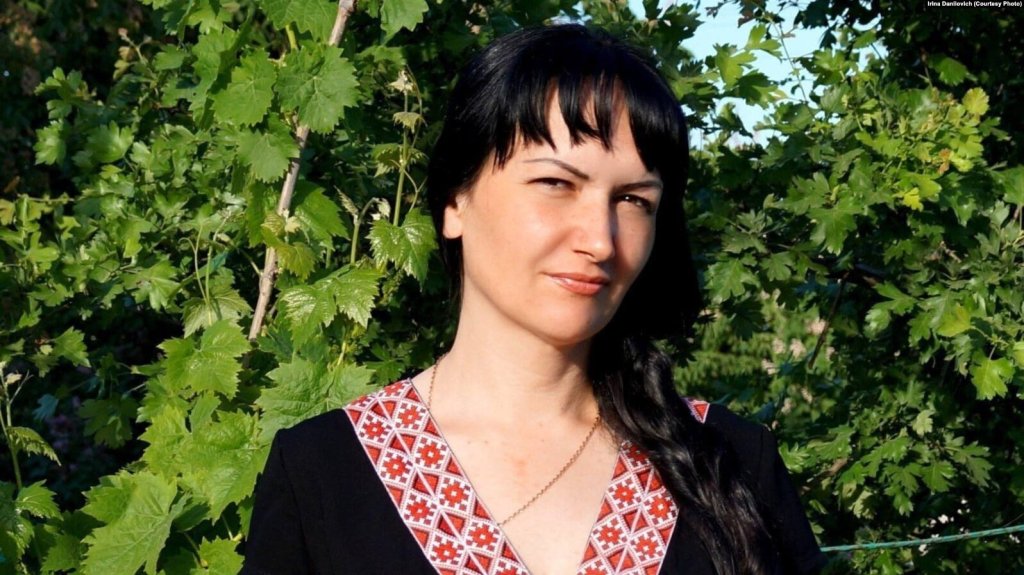
Irina Danilovich. Photo courtesy of Ivan Astashin

Who is Irina Danilovich? Why is she in a remand prison? How can we support her?

The wave of criminal cases directly related to anti-war stances sometimes obscures other politically motivated cases. I want to tell you about one of them.

Irina Danilovich worked as a nurse at Koktebel’s post-stroke rehabilitation center while being heavily involved in civic affairs. Irina can be called a grassroots activist, human rights defender, and journalist. She was, for example, the coordinator of the information campaign Crimean Medicine Without a Cover and in this capacity she harshly criticized the Crimean authorities during the coronavirus pandemic. Danilovich has collaborated with the alternative news website Injir Media and the human rights project Crimean Process. Radio Svoboda reports that Irina defended the interests of medical workers on the peninsula and wrote extensively about violations of their rights. Recently, writes Injir Media, Danilovich had been drawing attention to the war and related problems, including in the healthcare sector.

On April 29, 2022, Irina Danilovich was abducted by the FSB. She was found in the Simferopol pretrial detention center almost two weeks later.

As attorney Aider Azamatov discovered, Irina had been held in the FSB building for eight days, where officers made her take a lie-detector test and threatened to take her into the woods [and shoot her] if she concealed anything from them. She was fed once a day this entire time. After a week of torture, Danilovich was told to sign blank forms in exchange for her release. However, after complying with the demands of the security officers, Danilovich was not released, but sent to the pretrial detention center – allegedly, 200 grams of explosives were unexpectedly found in her eyeglass case.

It is quite obvious to me that the 200 grams of explosives “found” in the eyeglass case of the grassroots activist, journalist, and human rights defender are part of a politically motivated trumped-up criminal case. Especially since this is happening in Crimea. The Memorial Human Rights Center has repeatedly drawn attention to trumped-up criminal cases against Crimeans disloyal to the Russian authorities involving weapons, explosives or ammunition planted during searches.

Now Irina Danilovich is in jail. How can we help her? By doing all the usual things – getting the word about her case out, sending her letters and parcels (there are no restrictions on receiving parcels at the pretrial detention center), and holding solidarity actions.

Crimea became a lawless place after 2014, but public attention to Irina’s case can protect her from further mistreatment and enable her to live to see her release with minimal injuries.

✉️📦 Send letters and parcels to:

295006, Republic of Crimea, Simferopol, Lenin Blvd., 4, SIZО-1,

Danilovich Irina Bronislavovna (born 1979)

Free everyone!

Source: Ivan Astashin, Facebook, 25 May 2022. Translated by the Russian Reader

Russia’s Crusade Against Jehovah’s Witnesses and Muslims Continues

Caucasian Knot reports that a court in Sochi has extended the remand in custody of Jehovah’s Witness Danil Suvorov until June 13. Suvorov’s defense counsel Sergei Yanovsky said that he had appealed the decision.

Danil Suvorov has been charged with involvement in an extremist organization (punishable under Part 2 of Article 282.2 of the Criminal Code), as well as recruiting for an extremist organization (punishable under Part 1.1 of Article 282.2 of the Criminal Code). According to criminal investigators, Suvorov attempted to recruit people to join the Jehovah’s Witnesses, “using his authority as a spiritual leader.”

The accused man’s mother, Gulnara Suvorova, was able to communicate with her son in the courtroom for the first time in over nine months.

“My son has been languishing in prison for nine months running for nothing. Or rather, for the fact that he read the Bible aloud to a person who had asked him about it. But, of course, it was just an easy excuse for law enforcement officers to catch a ‘criminal’ and earn a promotion for such a serious charge as extremism,” she told Caucasian Knot.

Suvorov’s defense moved to have the case dismissed, because, according to an expert witness, there was no extremism in the believer’s actions.

Suvorov was detained on 18 August 2021, the same day that his home and the homes of other Jehovah’s Witnesses in the Krasnodar Territory were searched. Electronic devices, personal diaries, postcards, and literature were seized from believers.

In 2017, the Russian Supreme Court ruled that the Administrative Center of Jehovah’s Witnesses in Russia was an extremist organization. It dissolved the Center and banned it from operating in Russia. Later, all Jehovah’s Witnesses branches in Russia were added to the list of banned organizations. Subsequently, a flood of criminal prosecutions against members of the confession began.

Source: OVD Info, 14 May 2022. Translated by the Russian Reader


The Mahal Mosque in Nizhny Tagil. Photo: IslamTsentr

On 12 May 2022, it transpired that in April, the Tagilstroyevsky District Court of Nizhny Tagil fined Fanis Galeyev (spelled “Galiyev” in some sources), the imam at the Mahal Mosque, under Article 20.29 of the Russian Federal Administrative Code (“distribution of extremist materials”).

An inspection conducted by the prosecutor’s office found twenty-books books included in the Federal List of Extremist Materials in the imam’s possession.

According to Galeyev, he had collected the books only to study and later destroy them.

“There is a fine line. Today these are not extremist books, but tomorrow they will be extremist. This can be determined by a spiritual person, not a secular one. These books that have been discovered cannot simply be thrown away. They must either be buried or burned.”

The imam is a member of the Nizhny Tagil Council for Combating Extremism.

There is no information about the books in question, but we should note that we consider many cases of banning Islamic literature to be unlawful.

Sources:

“Case Card No. 5-512/2022,” website of the Tagilstroievsky District Court of Nizhny Tagil, Sverdlovsk Region, May 2022 [the embedded link was inaccessible from my IP]

“Nizhny Tagil imam fighting extremism is convicted of distributing extremist literature,” 66.ru, 12 May 2022

“Nizhny Tagil imam punished for extremist literature,” Vse novosti, 12 May 2022

Source: SOVA Center, 13 May 2022. Thanks to OVD Info for the heads-up. Translated by the Russian Reader