“We Have a Surrogate Democracy”: An Interview with Ekaterina Schulman

Ekaterina Schulman. Photo courtesy of Andrei Stekachov and The Village

Political Scientist Ekaterina Schulman on Why You Should Vote
Anya Chesova and Natasha Fedorenko
The Village
September 16, 2016

This Sunday, September 18, the country will vote for a new State Duma, the seventh since the fall of the Soviet Union. The peculiarity of this vote is that it will take place under a mixed electoral system for the first time since 2003. 225 MPs will be elected to five-year tears from party lists, while the other 225 MPs will be elected from single-mandate districts. Several days before the elections, The Village met with Ekaterina Schulman, a political scientist and senior lecturer at the Russian Presidential Academy of National Economy and Public Administration (RANEPA). We talked with her about why you should vote if United Russia is going to win in any case, as well as about the changes in store for the Russian political system in the coming years.


The Upcoming Elections

The Village: On Sunday, the country will hold the first elections to the State Duma since 2011. The social climate in the city and the country as a whole has changed completely since that time. Protests erupted in 2011, and the people who protested on Bolotnaya Square and Sakharov Avenue believed they could impact the political situation. Nowadays, few people have held on to such hopes. What should we expect from the upcoming elections? And why should we bother with them?

Ekaterina Schulman: Everything happening now with the State Duma election is a consequence of the 2011–2012 protests, including changes in the laws, the introduction of the mixed system, the return of single-mandate MPs, the lowering of the threshold for parties to be seated in the Duma from seven to five percent, and the increased number of parties on the ballot. These are the political reforms outlined by then-president Dmitry Medvedev as a response to the events of December 2011. Later, we got a new head of state, but it was already impossible to take back these promises. The entire political reality we observe now has grown to one degree or another out of the 2011–2012 protest campaign, whether as rejection, reaction or consequence. It is the most important thing to happen in the Russian political arena in recent years.

The statements made by Vyacheslav Volodin, the president’s deputy chief of staff, on the need to hold honest elections, Vladimir Churov’s replacement by Ella Pamfilova as head of the Central Electoral Commission, the departure of someone more important than Churov from the CEC, deputy chair Leonid Ivlev, and the vigorous sacking of chairs of regional electoral commissions are all consequences of the protests. If they had not taken place, nothing would have changed. We would still have the same proportional voting system, the same seven-percent threshold, the same old Churov or Churov 2.0. Continue reading ““We Have a Surrogate Democracy”: An Interview with Ekaterina Schulman” →

That Was the Year That Was, or, Hell, Upside Down

hell upside downWhenever I see something like the post I saw on Facebook a week and a half ago, containing photographic images of alleged “Russian redneck (?) culture,” I regret that I am not a mutant, alien or robot capable of translating and writing ten times more than I do on this blog, whose secret mission is to give people a glimpse of a Russian society that is smart, brave, independent minded, strong, and willing to get a few lumps on the head (or worse) to build a country that is democratic, egalitarian, LGBTQI-friendly, vigorously environmentalist, progressively urbanist, anti-xenophobic, pro-immigrant, and any number of other good things.

That is why I try and give a voice in English to some of the people trying to build that Russia or at least trying to think about building it. I am hardly very successful in that mission, since I have neither the time nor the abilities as a writer and translator to do more than gesture in this direction.

But one thing I try not to do is focus obsessively on Putin, his whys and wherefores, which is what 99% of what the so-called media do, including some alternate media, both inside and outside Russia. Putin is hardly the only problem in Russia (or the world), just as he is definitely not the real solution to any real problems. Nor are “Russian rednecks.”

creeps

That said, I must admit I wish there were more of me to go around so as to cover larger chunks of both the scary and this encouraging parts of this beat, which are usually mixed up so thickly you cannot easily pry them apart.

Like almost all the years since 1905 or so, 2015 was a banner year in Russia for writing about “hell, upside down” and seeking out the saints, heroes, and just plain decent folk among the wreckage continuously amassing at the angel of history’s feet.

So here are the ten posts, published in 2015, that my readers read the most avidly among the 220 posts I filed over the year.

  1. “Rotenberg Is Worse than ISIS!”: Russian Truckers on Strike in Dagestan and Elsewhere (The year-ending story that the major Russian media have been trying not to cover at all.)
  2. Why Such Hatred? (The Death of Umarali Nazarov) (What happened when a totally corrupt law enforcement and immigration system took an infant Tajik boy into custody while preparing to deport his mother.)
  3. Victoria Lomasko: 18+ (A look behind the scenes of Petersburg’s lesbian scene.)
  4. The Two-State Solution (Racism and the Russian Intelligentsia) (Reflections on the tortured and often racist soul of the Russian liberal intelligentsia by Boris Akunin, Kirill Kobrin, Yegor Osipov, and Our Swimmer.)
  5. “A Home for Every Russian” (In which I refute the rather odd argument that Putinomics is really a much improved version of “actually existing socialism” when it comes to delivering affordable quality housing to the masses.)
  6. Oleg Shevkun: “I Don’t How to Trim My Sails to the Wind” (A portrait of the quiet heroism and sanity of a blind journalist in an insane time.)
  7. Syrias (Five different but complementary reflections on the beginning of Russia’s misadventure in Syria by George Losev, Greg Yudin, Alexander Feldberg, Ilya Matveev, and Bob the Australian.)
  8. “Smash the Kikes and Save Russia!” (If you are a neo-Nazi, you don’t want to have Petersburg Jewish community leader Leokadia Frenkel as your opponent.)
  9. Vlad Kolesnikov: A Real Russian Hero for Russia Day (Young Vlad Kolesnikov was recently driven to death in a provincial Russian town for facing down the madness of a society made sick by Putinism, but back in June of last year that as-yet-unknown ending was outshone by his sheer pluck.)
  10. Suffer the Little Children (In neo-imperialist countries on the warpath, the neo-imperialist brainwashing starts in kindergarten.)

Here are the five posts, originally published in previous years, that had the most staying power this past year.

  1. Don’t Leave the Room (April 2013) (An inspired bit of graffiti inspired this dubious translation of a bitter poem by one of the great Russian poets of the postwar period.)
  2. Ilya Matveev: A Word to the Wise (On Putin’s “Leftism” and Solidarity with Russians) (February 2014) (This little gem could not be reread or republished enough, but its message seems to have been lost on large swaths of the western “progressive left.”)
  3. Hanna Perekhoda: Freedom and Social Identity in the Donbas (August 2014) (A heartbreaking essay whose message seems to have been lost on folks inside and outside Eastern Ukraine.)
  4. Victoria Lomasko: A Trip to Kyrgyzstan (August 2014) (There is nothing trippier and more educational than going on a trip to former Soviet republics and the far-flung reaches of Russia with graphic reportage artist Victoria Lomasko.)
  5. Russia’s Anti-Gay Law Kills (July 2013) (This was just a little bonbon of a blog post, a translation of a news release documenting a street performance in Moscow, but if it seemed alarmist then, it seems like common sense nowadays.)

OLYMPUS DIGITAL CAMERA

For one reason or another, the following posts, also published in 2015, did not make my readers’ top ten this past year, but they meant the most to me.

  1. Kena Vidre: What Was Frida Vigdorova Like? (A warmly written memoir of the heroic Soviet journalist and human rights activist.)
  2. Rikhard Vasmi: Counting the Ships as They Sail Past (Pavel Gerasimenko’s perfectly rendered review of Petersburg artist and Arefiev Circle member Rikhard Vasmi’s 2015 posthumous retrospective at K Gallery + my translation of a little book Vasmi made in 1994 about life in the Port of Petersburg.)
  3. 59°54’32″N 30°29’49″E (Okkervil River) (In which four brave souls set out to find what manner of life exists on the far shore of the Okkervil River, which is a real river in southeast Petersburg, not just a compelling pop band from Austin, Texas.)
  4. “I Broke All the Laws I Could” (Leonid Nikolayev, 1984-2015) (A heartbreaking and detailed obituary of the tenderest troublemaker in the world’s largest country.)
  5. The Hipster’s Dream Debased (Portlandia) (What happens when milquetoast Putin-era hipsterism meets hyper-powered catastrophic urban redevelopment in the middle of Petrograd.)

With any luck, this blog will not lack for inspiring subject matter this coming year, either, and might even undergo some stylistic and substantive changes. We shall see.

Thanks for reading.

 12376608_10153444501588402_3462601484760266782_n

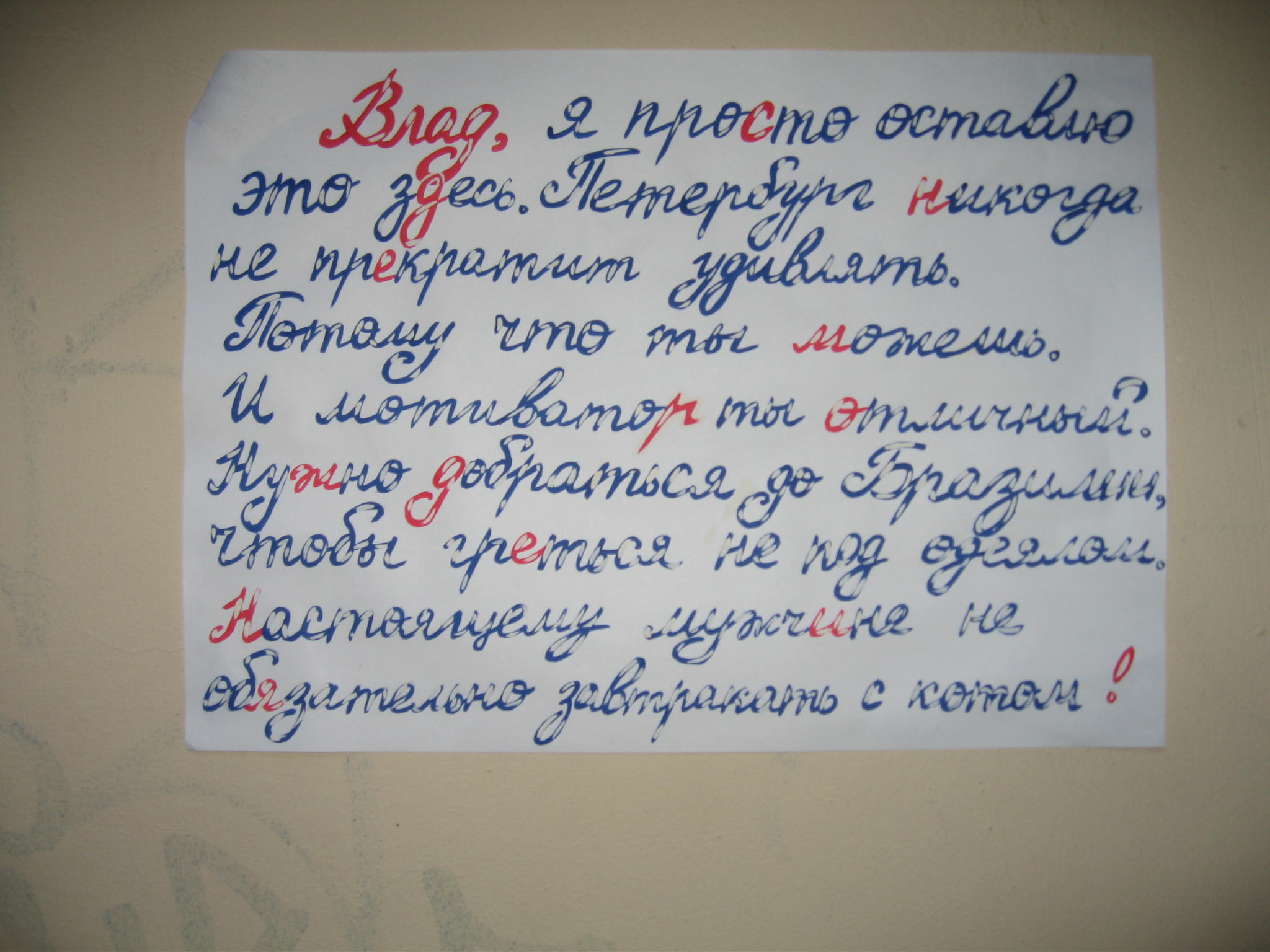
“A real man doesn’t necessarily have to breakfast with a tomcat!”

"Vlad, I am just leaving this here. Petersburg will never cease to surprise. Because you can. And you аre an excellent motivator. One has to make it to Brazil to warm up without crawling under a blanket. A real man doesn't necessarily have to breakfast with a tomcat!" Photographed in central Petrograd on November 2, 2015, by the Russian Reader

“Vlad, I am just leaving this here. Petersburg will never cease to surprise. Because you can. And you аre an excellent motivator. One has to make it to Brazil to warm up without crawling under a blanket. A real man doesn’t necessarily have to breakfast with a tomcat!” Photographed in central Petrograd on November 2, 2015, by the Russian Reader

Ayder Muzhdabaev: To the Fourteen Percent

To the Fourteen Percent
Ayder Muzhdabaev
April 4, 2015
echo.msk.ru
facebook.com

Governments, international organization, and concerned citizens in different countries have been protesting against the increasing discrimination against the Crimean Tatars. They have demanded an end to the crackdown. Only in one country have no such protests been heard.

384662233

Guess what country?

For more than a year, its citizens have pretended not to notice that their government has been behaving towards the Crimean Tatars along the lines of the Third Reich, having cast this people in the role of collective outcast. Moreover, it is not only officials and supporters of the regime who have behaved this way, but its opponents as well.

“Opposition,” “intelligentsia”: it is no longer possible to write these words in Russian without quotation marks. In this entire country of 140 million people you will hardly find ten people who have spoken out publicly in defense of the Crimean Tatars. Almost all my Moscow “friends” have been silent as well. When I appealed specifically to them here on Facebook, telling them in detail about the plight of the Crimean Tatars in Crimea, I got zero likes and zero reposts from those whom I had imagined as my addressees.

It is worth pondering this situation and evaluating it on its merits.

An entire people have been made second-class citizens in their country. People have been deprived of the chance to listen to the radio and watch TV in their own language, and children cannot even watch cartoons in this language! People are intimidated. Some of them have disappeared without a trace, others are in prison. The rest simply sit at home crying from fear, a sense of injustice, and despair. No one can be punished (at least not yet) for expressing sympathy with the Crimean Tatars. So why has the cat got your tongue, citizens?

It is just that no one really cares at all.

I think that even if the Crimean Tatars are shipped from Crimea in cattle wagons, as they were in 1944, I will read two or three posts about it in Russian on Facebook, amidst an account of sluts at a bar and snapshots of beloved doggies.

It is because of this, and not for some other reason, that I do not believe this country can essentially change for the better.

The damned eighty-six percent are to blame for everything? Is that right?

Look who is talking, fourteen percent.

Ayder Muzhdabaev is deputy chief editor of Moskovsky Komsomolets newspaper. Image courtesy of Ukraine Today

Tom of Finlandization

An anonymous reader’s comment in the September 24, 2014, edition of the Finnish daily newspaper Etelä-Saimaa:

Valtavat Tom of Finland-taulut pitkin itärajaa tyrehdyttävät Venäjän erikoisjoukkojen hyökkäyksen Suomeen.

(“Huge Tom of Finland signs along the eastern border will suppress an invasion of Finland by Russian special forces.”)

IMAG5144

Stamps designed as a tribute to homoerotic artist and gay icon Touko Laaksonen—also known as Tom of Finland—went on sale Monday [September 8, 2014]. According to the postal service company Posti, the risqué stamps are [Finland’s] biggest seller ever, with pre-orders made in 178 different countries. The stamps, which hold pride of place in the newly-opened postal museum in Tampere, attracted a long queue of individuals eagerly anticipating the first day issues.

Tom+of+Finland+postimerkki+postipaketti

From a September 12, 2014, article published on the Russian-language news site of Yle (“Yleisradio”), the Finnish public broadcaster:

In Russia, there is a law prohibiting the promotion of homosexuality. Journalists from the regional branch of Yleisradio in Tampere decided to test how Russian postal workers would react to parcels and letters adorned with ambiguous stamps featuring Laaksonen’s work. On Tuesday, two parcels and two letters pasted with the homoerotic stamps were sent to Russia.

According to Finnish postal workers, on average letters take six to nine days to get to Russia, while parcels take a little longer, fourteen to thirty days. The parcels were delivered to the international postal terminal in Vantaa on Wednesday and from there sent to Russia. 

The journalists from Tampere are tracking the movement of the parcels in real time. Readers can find about the further adventures of the “double agents” on Twitter by using the hashtag #TomofRussia.

Free Pussy Riot

2-20 The Digital Revolution in Slavic Culture: the Victors, the Vanquished, and the Collateral Damage –
Grand Ballroom Salon I
Chair: Alexandar Mihailovic, Hofstra U
Papers: Ksenia O Gorbenko, U of Pennsylvania
“Church and State on Trial: the Pussy Riot Case and Online Media”
 Julie Anne Cassiday, Williams College
“Glamazons en Travesti: Russian Drag Queens and the Internet”
 Emily D Johnson, U of Oklahoma
“Seeking Mikhail Armalinsky: Constructing and Reading the Self in an Age of Digital
Revolution”
Disc.: Eliot Borenstein, New York U
___
3-20 Contemporary Art Collectives and the Revolution Today I: Gender, the Body, and Buffoonery –
Grand Ballroom Salon I
Chair: Anna Wexler Katsnelson, Princeton U
Papers: Jonathan Brooks Platt, U of Pittsburgh
“Suspended or Suspenseful Encounters?: Gender, Politics, and the Factory of Found Clothes”
 Sara Stefani, Indiana U
“Make War, Not Love: Art Collective Voina and the Post-Soviet Bodyscape”
 Mark Yoffe, George Washington U
“Pussy Riot in the Context of the Russian National Carnivalesque Tradition: Iurodstvo and Stiob
in the Discourse of Russian Counterculture”
Disc.: Ksenya Gurshtein, National Gallery of Art
___
6-20 Orthodoxy, Pussy Riot, and (Post)Modern Russian Culture – (Roundtable) – Grand Ballroom Salon I
Chair: Nadieszda Kizenko, SUNY Albany
 Robert Bird, U of Chicago
Irina A. Papkova, Georgetown U
Wendy R. Salmond, Chapman U
Vera Shevzov, Smith College
Andrei Andreyevich Zolotov, RIA Novosti
___
7-27 Will the Revolution be Visualized? How Recent Protests have led Feature Films, Documentaries,
and Pussy Riot to Embrace or Eschew Revolutionary Visual Aesthetics – (Roundtable) – MIT
Chair: Dawn A Seckler, U of Pittsburgh
 Evgeny Gusyatinsky, Iskusstvo kino (Russia)
Andrew Harris Chapman, U of Pittsburgh
Claire L Shaw, U of Bristol (UK)
___
8-20 Contemporary Art Collectives and the Revolution Today II: Criticism and Power – Grand Ballroom
Salon I
Chair: Bettina Jungen, Amherst College
Papers: Natalie Oleksyshyn, Ohio State U
“We Will R.E.P. You: Undermining Central Ideologies in Liminal Spaces”
 Pamela Jill Kachurin, Duke U
“Is Pussy Riot Really the New Malevich?”
 Victoria Thorstensson, U of Pennsylvania
“Larger Contexts for Pussy Riot: The Kazan Cathedral Protest (1876) and the Punk Prayer ‘Mother
of God, Drive Putin Away’ (2012)”
Disc.: Jane Ashton Sharp, Rutgers U