Will Covid QR Codes Cause Petersburg to Explode?

George Losev • Facebook • January 11, 2022

It is the first working week after the tightening of anti-covid rules, and amid a new rise in infections, we can draw preliminary conclusions.

During this entire time, my QR code has been checked three times. The first and only time it was done thoroughly was at a football match at a state-owned facility on January 3. The second time was at the entrance to a Leroy Merlin store. It had been refitted so that it was impossible to enter the store otherwise, but they didn’t verify my name. The third time was at a bakery, where they also didn’t check my name.

That is, on a standard working day, I first travel an hour in a packed subway car and then in a packed minibus, then I sit in a room packed with elderly colleagues at the daily briefing, then I do the rounds of apartments [to make electrical repairs], then I travel home for another hour. And all this happens without anyone checking any QR codes. But if I stop by a Rainbow Smile cosmetics store on the way home and accidentally forget my phone, which contains my QR code, then I won’t be served.

Why not? So that I cannot infect other customers at Rainbow Smile. Or at the bakery. But I would have already infected three times as many people in the subway, on the minibus, and in the apartments I visited (although I was masked).

It is obviously no accident that people have been calling the QR codes “PR codes.” The idea may have been sound, but it has been implemented as idiotically as possible, like everything our authorities undertake, except military interventions.

On the web, I have been observing unusually ferocious and surprisingly cookie-cutter attacks on the owners and staff of establishments that have announced they are doing QR code checks.

I definitely get the feeling that Prigozhin’s trolls are carrying out a coordinated attack on these establishments — possibly with the goal of getting ahead of the curve (anti-covid riots have already happened in other countries) and channeling popular anger in the most negative direction. The focus of rage thus shifts from the authorities to the establishments forced to obey the rules.

I have no doubt that there are plenty of natural-born anti-vaxxers in our society, but the uniformity, absurd rage, and standard advice (e.g., “hire a lawyer and take them to court”) evinced by at least some of the social media commentators expose them as Prigozhin’s trolls.

The future will depend on how the QR code campaign goes. If the procedure becomes a routine matter, they start checking full names, counterfeiters are subjected to crackdowns, and everyone gradually gets used to it, then most of the population will get vaccinated.

Another option is that everyone gradually stops being afraid, and QR code checks become more and more a formality and gradually come to naught.

If revolts suddenly occur, then the left will have to decide whether to get involved in them. Most people on the left are likely to condemn the riots as conservative (the right will undoubtedly be involved), destructive (the anger will be directed against specific businesses), and harmful to the fight against the epidemic.

In my opinion, the left should be involved in such revolts as much as possible by shifting the focus to the true culprits — the authorities — and coming out with a constructive program as to what should be done.

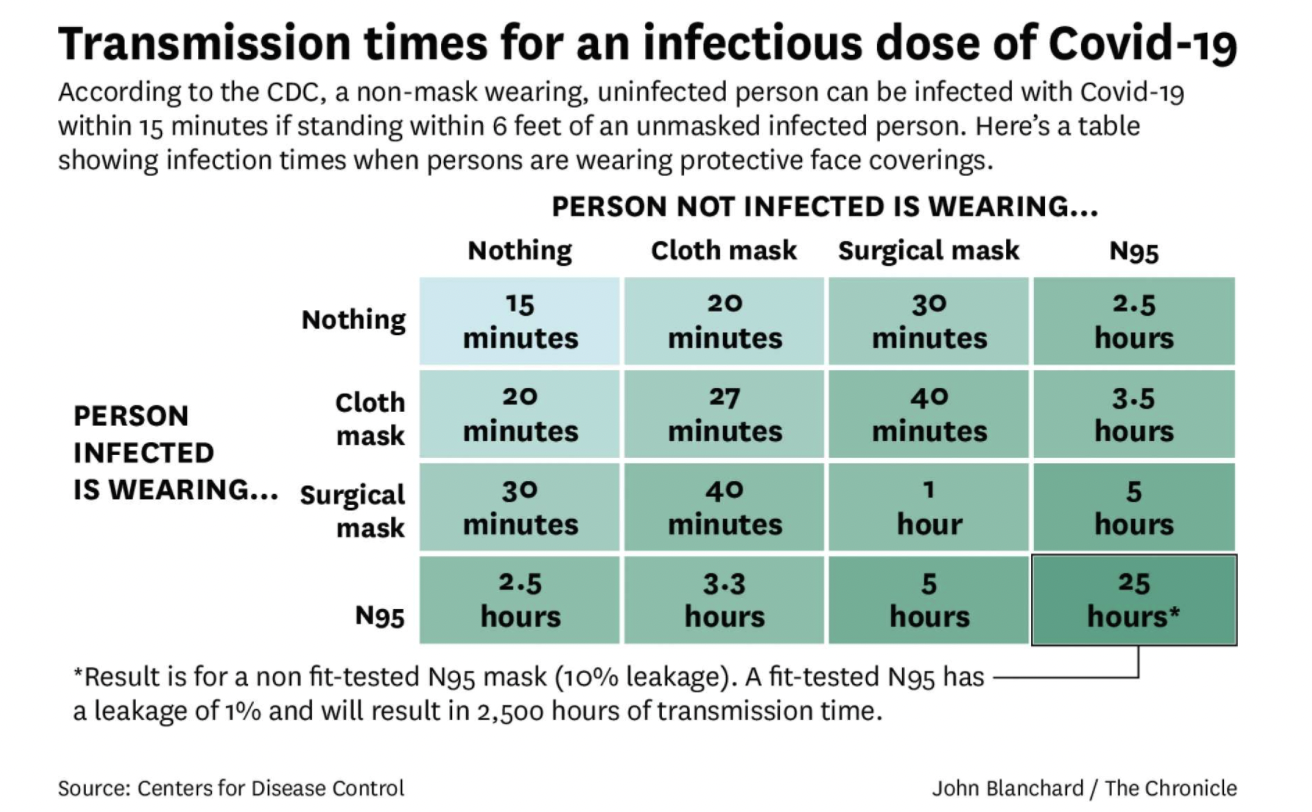
Infographic courtesy of the San Francisco Chronicle. Translated by the Russian Reader


The people are upset: Is Petersburg threatened by grassroots protests over QR codes? • Darya Kovalyonok • Delovoi Peterburg • January 12, 2022

QR codes have been mandatory for gaining entry to dining establishments and non-food stores in Petersburg since January 2. While most restaurants and retail outlets have been coping with cursing customers, counterfeit codes, and long queues, a little more than a hundred others have openly declared that they would be ignoring the new requirements. Alexander Konovalov, a Petersburg restaurateur who became famous for publishing a “map of resistance” a year ago, has now launched a website with a list of establishments that are ready to welcome customers without vaccination and immunity certificates. As this issue went to press, there were 118 establishments on the list who promised not to ask for a QR code at the entrance.

Incidentally, Konovalov’s initiative has significantly facilitated the work of the Smolny [Petersburg city hall], which has weaponized the website containing the names of the bars and shops that ignore the QR code by regularly carrying out raids on them. For its part, the Petersburg prosecutor’s office has reacted to the boycott by these establishments by reminding them that they could face administrative and criminal charges for violating the QR-code regime and other restrictive measures.

Nevertheless, in many cases, the QR-code regime is either enforced nominally or not enforced at all. Earlier this week, our correspondent interviewed more than a dozen Petersburg residents who had patronized cafes and restaurants over the holidays. The upshot is that business ask to see QR codes about half of the time, and after asking for them, they often don’t even scan them. Even in the shops and dining establishments where customers are asked to show a QR code, the customer’s identify is not always checked. Many Petersburgers who patronize such establishments take advantage of this to use someone else’s QR codes.

At the same time, the experts note, the negative attitude of Petersburgers to QR codes is not always tantamount to rejecting vaccination. Maria Matskevich, a senior researcher at the Sociological Institute of the Russian Academy of Sciences, draws attention to the fact that skepticism about the new regulations comes not only from diners and shoppers, but also from those who have to check for QR codes.

“Moreover, unlike in other countries, this practice is not accepted in our country even by those who are forced to check whether people are complying with requirements. It is a game in which there is a mutual understanding on both sides of the measure’s futility. The procedure for checking QR codes is performed with detachment: people on both sides show that this is not their own undertaking, unlike vaccination. When conflicts arise, the people performing the role of inspectors apologize for their actions, which is incomparable, for example, with a traffic police inspector fining a violator for an offense. For the time being, [the checking of QR codes] is more like a game played according to rules that are intuited by all parties,” says Matskevich.

Although the experts doubt that the QR codes themselves can trigger popular unrest, in the current circumstances, the growth of discontent is palpable at the everyday level without sociological surveys.

Vladimir Sokratilin, executive director of Solution, a consulting company, notes that the level of tension in society is rarely determined by any one factor; most often the causes are complex. Nevertheless, in the public’s mind, all these factors form an image that is denoted at the everyday level by the term “injustice.” Sokratilin argues that the point is not that people’s real incomes are stagnant or even declining, but that the majority of people imagine that “wrong actions on the part of the authorities” are the reason for this decline.

“Tension in society does not necessarily mean that people will take to the streets and protest. However, the higher the degree of tension in society, the higher the probability that society will explode. If there are opportunities and channels for interaction between the authorities and society, then the most dangerous thing that the country can expect is a political crisis. But we have observed in Kazakhstan what happens when there are no channels for negotiating.

“After all, the Kazakh authorities met the populace’s demand to reverse the increase in gas prices, but it was unclear with whom and how to negotiate. It is difficult to predict which leaders could come forward in the wake of social protest, and it is even more difficult to predict how they would behave. Let us recall that when Vladimir Lenin arrived in Petrograd in the spring of 1917, his plans were greeted with surprise even by some of his Bolshevik supporters, and many intellectuals considered him an outsider and an eccentric,” Sokratilin argues.

The introduction of QR codes, which the authorities formally declared was a means of slowing the virus’s spread, when in fact they are obviously pursuing other goals, has also become an irritating factor.

“We understand, however, that vaccinated and re-infected people can also spread the infection. So the QR codes are just a way of encouraging the populace to get vaccinated. Consequently, society receives an additional signal that the authorities are deceiving and manipulating them when it comes to a vital issue. Such an inconsistent and opaque position on the part of the authorities does not increase the populace’s confidence in it, but undermines it,” says Sokratilin.

Matskevich argues that it is not yet obvious at the grassroots level what shape dissatisfaction with QR codes could take, since there is no organizing force that would help people to comprehend and politically formalize their dissatisfaction. At the same time, an aggressive reaction has been increasingly occurring at the individual level, exacerbating social polarization.

“When confronting such major problems as the pandemic, people can show either extreme individualism or solidarity. So far, our society has displayed an extreme degree of individualism and lack of unity,” the sociologist notes.

Sokratilin adds that in such circumstances, favorable conditions are generated for unexpected people to become very famous and popular extremely quickly. “For example, the bar owner and ‘bar resistance’ organizer Alexander Konovalov is not a political figure, but a businessman. However, more and more people are avidly keeping track of what he’s doing, regardless of their attitude toward him,” says Sokratilin.

Photo by Sergei Yermokin. Courtesy of Delovoi Peterburg. Translated by the Russian Reader

Happy New Year, Veteran!

Novosibirsk city councilman asks prosecutor to investigate complicity of United Russia reps in veteran’s death
Sibir.Realii (RFE/RL)
January 7, 2022

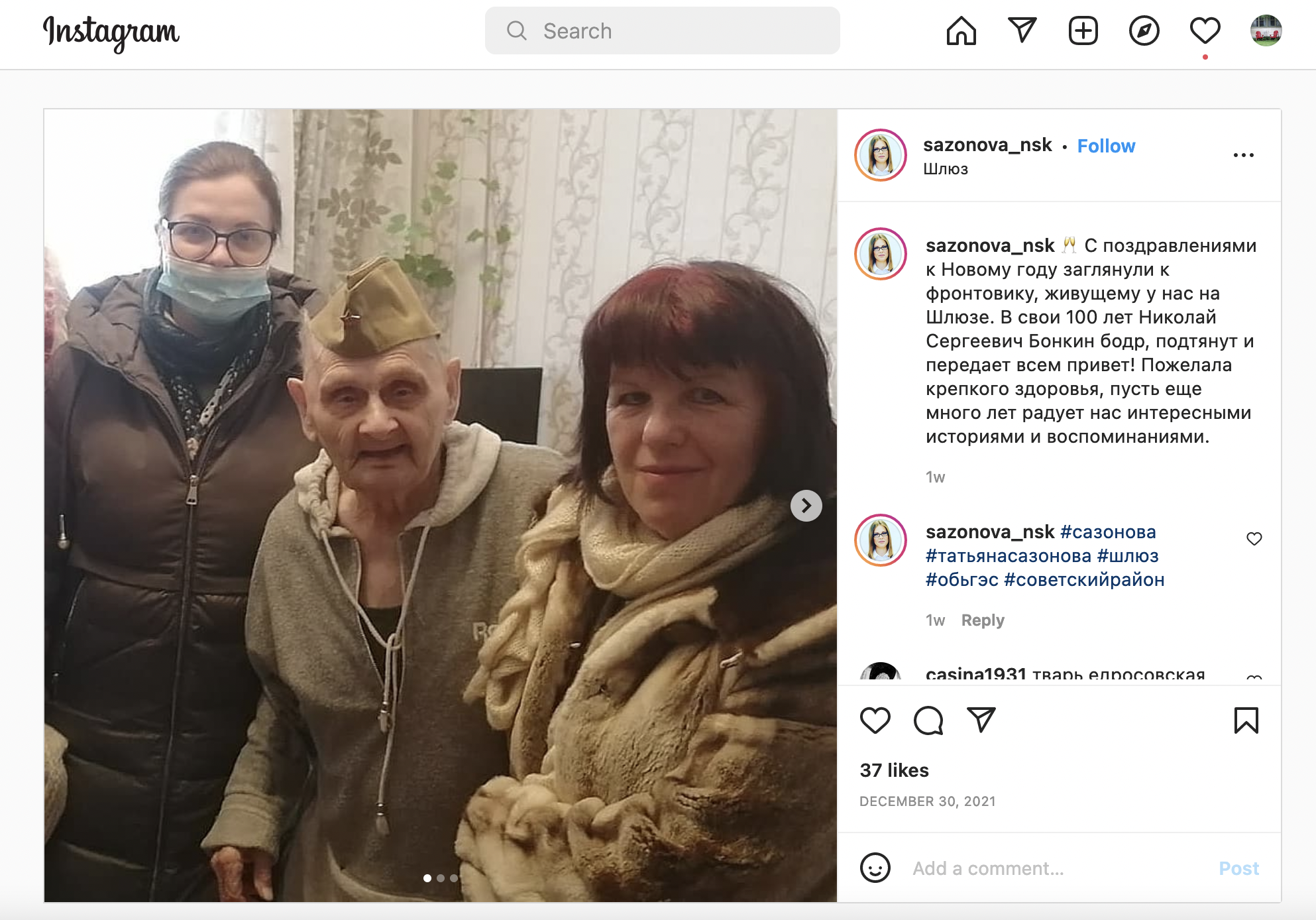
Novosibirsk city councilman Georgy Andreyev has asked the prosecutor’s office to investigate whether the United Russia party was complicit in the death of 100-year-old Second World War veteran Nikolai Bonkin. The veteran died of covid-19 five days after he was visited by United Russian party members, who congratulated him on the New Year. They were without masks and did not observe social distancing. As part of its “Happy New Year, Veteran!” campaign, United Russia congratulated hundreds of veterans in the Novosibirsk region alone.

Andreyev told Sibir.Realii that he was outraged by the carelessness of the United Russia members. Party rep Tatyana Sazonova published a report on their visit to Nikolai Bonkin. The pictures she posted on Instagram show that not all the congratulators were wearing masks. Not only did they not maintain social distancing, but they also hugged the veteran, even pressing their cheeks to his face. Packages with gifts from State Duma member Dmitry Savelyev are also visible in the snapshots.

A screen shot of Tatyana Sazonova’s Instagram post about United Russia’s allegedly fatal visit to WWII veteran Nikolai Bonkin

“A legendary war veteran has passed away: this is a great loss for the city. Five days before [his death], United Russia party ‘envoys’ had come to see him. Nikolai Sergeyevich Bonkin had survived the war, the 1990s, and the Yeltsin-Putin reforms, but he was apparently unable to survive, unfortunately, United Russia’s desire to hype itself,” Andreyev said.

The councilman appealed to the prosecutor’s office in response to this incident. (Sibir.Realii has obtained a copy of the complaint.) In addition, he has discovered that the campaign “Happy New Year, Veteran!” was a nationwide affair, and that United Russia had visited around 400 veterans in the Novosibirsk region alone. In snapshots featuring veterans, published on the party’s website, the party’s elected officials and representatives are not wearing masks and do not maintain social distancing.

Andreyev noted that in late October, when the State Duma was considering a bill to exempt war veterans from utility bills, 297 United Russia MP “simply refused to press the buttons” [and thus vote in favor of the bill]. Among them were four Novosibirsk MPs, Andreyev said.

There are four points in Andreyev’s complaint. He asks the prosecutor’s office to investigate whether United Russia rep Tatyana Sazonova was complicit in Nikolai Bonkin’s death, whether the individuals in the photos were vaccinated against the coronavirus, and whether they are currently symptomatic. The councilman also asked the prosecutor’s office to find out whether there were other Great Patriotic War veterans who died during or after the “Happy New Year, Veteran!” campaign. In addition, the councilman wants the prosecutor’s office to determine whether there were signs of genocide, [as defined by the Criminal Code,] in United Russia’s actions.

“There is a clause in the article [defining genocide in the Criminal Code] about persecuting a group of people for political reasons. I don’t see anything other than political motives in these actions,” Andreyev explained. “It is important for me to understand who initiated the visits to veterans in local communities. Where did United Russia obtain the personal data of veterans and their relatives? What were their grounds for entering the apartments of elderly people? Who are these people [who paid the visits]? Who verified whether they were political reliable?”

The regional prosecutor’s office did not return our telephone call.

Translated by the Russian Reader

Anti-Coders (#SegregationInAction)

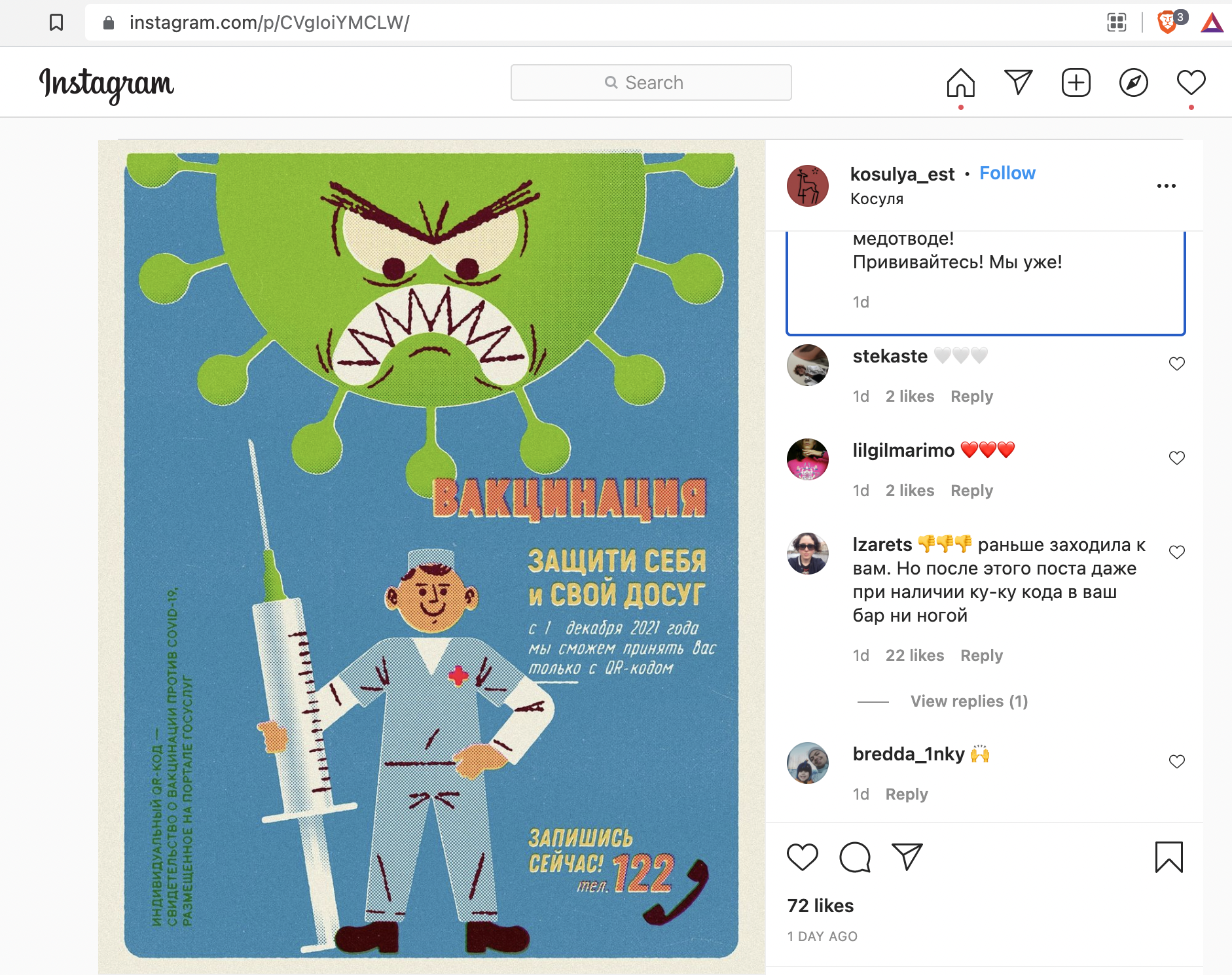
This Instagram post by Roebuck Cafe in Petersburg, explaining that it would be serving only customers with QR codes showing they have been vaccinated against the coronavirus or recovered from covid-19, and urging people to telephone 122 and sign up for a jab, elicited the ire of user Izarets, for example, who said they wouldn’t be darkening the cafe’s door anymore, even if they did have a “peekaboo code.”

______________

Opponents of QR codes stage flash mob on social networks, tagging the posts of companies #WeDon’tPatronizeThem. Etazhi in Petersburg has been targeted ||| Bumaga ||| October 27, 2021 ||| Translated by the Russian Reader

Opponents of the QR code system have launched a flash mob on social media, commenting on the posts of shopping malls, cafes and cultural clusters with the hashtags #WeDon’tPatronizeThem and #SegregationInAction.

The flash mobsters dub the QR codes “peekaboo codes” and “cuckoo codes,” criticizing businesses that have agreed to check whether their customers and patrons have them. The action has touched different cities in Russia, from Noyabrsk, located in the Yamalo-Nenets Autonomous District, to St. Petersburg.

For example, the flash mobsters commented a post on Instagram by the Petersburg cultural center Etazhi, announcing that it would be open during the lockdown, but people would be admitted to its exhibitions and observation deck only by presenting a QR code. “It is a pity that you support segregating the population too. We won’t be patronizing you anymore,” wrote one female user. Similar messages appeared under posts by Roebuck Cafe, the Youth Theater on the Fontanka, and other establishments.

Bumaga has explained in detail how the QR code system in St. Petersburg will work.

Read more about it:

  • Why do Russians not get vaccinated? How does the anti-vaxxer community operate? How do you argue with an opponent of vaccines? An anti-pseudoscience campaigner and a scholar who researches fakes answer these questions.

More Die of Heartbreak

St. Petersburg Photo Diary
Facebook
October 23, 2021

Orthodontist jumps from 9th floor of Elizabeth Hospital

The young woman made the jump in front of her fellow patients in the ward. The fact was that she had buried both of her parents in the past two weeks. They were also doctors, by the way.

Darya Khorovskaya followed in the footsteps of her parents: she had worked in her field for 10 years.

She was admitted to the Elizabeth Hospital with complications from an infectious disease just a few days after her mother’s death.

Her fellow patients in the ward said that the young women was heartbroken. She constantly talked about the deaths of her loved ones, blaming the coronavirus.

After the fall, she was taken to the intensive care unit, but they could not save her.

Photo courtesy of St. Petersburg Photo Diary. MK.RU Sankt-Peterburg reported this same story on 17 October 2021. They made clear, however, what is not clear from the Facebook post above: that Khorovskaya was being treated for covid-19 when she took her own life, and that her parents had also died of covid-19. P.S. This is a more typical post on St. Petersburg Photo Diary, which partly explains the self-censorship in their post about Khorovskaya’s suicide. Translated by the Russian Reader

COVID-free

Dear viewers,

Due to the spread of the coronavirus, a period of non-working days will be in effect in Moscow from October 28 to November 7. There will be no changes in our repertoire: we plan to hold all scheduled performances.

PLEASE NOTE!
🔻 From October 28, all performances for viewers over the age of 18 will be COVID-free [in English in the original]: you can attend these performances only if you have a QR code (confirming you are protected from COVID-19).
🔻 A QR code can be obtained:
🔻 after you have been vaccinated.
🔻 by doing a PCR test (valid for 72 hours)
🔻 after recently being ill with COVID-19 (valid for 6 months from the date of recovery).

If you do not have time to get a QR code before your planned outing to the theater, you can present a certificate showing you have received the first dose of a vaccine.

Our partners for ticket refunds:

RAMT website – https://ramt.ru/orders/
Yandex.Afisha – https://widget.afisha.yandex.ru/refund
Kassir.ru – https://msk.kassir.ru/pages/refund
Listim.com – https://listim.com/pages/for_clients_e_ticket
Ticketland.ru – return by registry tickets@ramt.ru

Please accept our apologies for the inconvenience and be healthy!

Source: email newsletter from RAMT (Russian Academic Youth Theater), 22 October 2021. Translated by the Russian Reader

Why Russia Is in No Hurry to Get Vaccinated
Kirill Martynov
Rosbalt
October 15, 2021

Vaccination in Russia is at a shamefully low level: according to official statistics, 31.4% of the country’s residents have received two doses of a covid-19 vaccine. By comparison, this figure is now 64% in Germany. In our country, this has translated into a record number of deaths and the transformation of Russia into a reservoir for the virus’s further evolution. The 42% vaccination rate among older Russians is an especially frightening figure: although they’ve had a whole year to do it, they and their relatives could not be bothered to take care of themselves. It’s as if our national motto were Viva la muerte!

But the behavior of anti-vaxxers in a country like ours is apparently rational. The main source of information about the benefits of the vaccines are government agencies and state media, about which everyone knows that, first, they lie constantly, and second, that they are never called on the carpet for their lies. They lied about the absence of Russian troops in Ukraine, and many rejoiced at this military trick. They lied about pension reform, “which will never happen, because the president is against it,” but in this case no one rejoiced.

Russians know that there is no mechanism for punishing liars. If it turned out that the vaccine was dangerous or useless, no one in the Russian government would be held responsible for it. They would just start lying about something else.

Free and fair elections, which liars can lose, are a basic institution for ensuring responsibility, but we don’t have this institution in Russia, nor is it anywhere on the horizon.

When there is a high level of distrust of everything related to the state, it is not surprising that people are in no hurry to get vaccinated. Without trust, the only way to solve this problem is by force, as was done in the Soviet Union.

On the societal scale, trust is even more fragile and valuable thing than in relationships between individuals: it has to be carefully fostered for decades. The Germans managed to pull it off after the Second World War, but we have not even have formulated this task.

This is also not surprising. A high level of trust within society makes a dictatorship impossible: it is instantly opposed by growing solidarity. For example, in Soviet Poland, this happened in particular because the authorities failed to destroy the influence of the Catholic Church and the network of parishes.

Accordingly, it is vital for a dictatorship to keep trust at a minimum level. That’s why Russia is in no hurry to get vaccinated now. It is a byproduct of authoritarianism’s self-defense against “internal enemies.”

Thanks to Paul Goble, a personal hero of mine, for flagging Martynov’s article on his website Window on Eurasia, which has been essential reading for post-Sovietologists and Russianists for the past seventeen years. Get well soon, Paul! Photo by Aleksander Avilov/Moskva News Agency, courtesy of the Moscow Times. Translated by the Russian Reader

Flattening the Curve: Why Official Russian Covid Stats Can’t Be Trusted

Covid isn’t scary anymore: how the authorities stopped reckoning with the coronavirus when it suited them
Tatiana Torocheshnikova
TV Rain
October 15, 2021

The Russian authorities are often criticized for ignoring the pandemic to the good of the political conjuncture. It was with an eye to politics, and not to the numbers for illnesses and deaths caused by covid-19, according to critics, that decisions were made to hold a referendum on amending the Constitution and lift covid restrictions in the run-up to the referendum last year. The same criticism was leveled against the Crimea annexation anniversary concert in March of this year at Luzhniki Stadium in Moscow, and the Euro 2020 matches and the Crimson Sails event held in Petersburg. How justified is this criticism? To answer this question, TV Rain studied the covid-19 task force’s official data on coronavirus infections and deaths, as well as Rosstat’s data on mortality from the spring of 2020 to the autumn of this year.

“A number of large shopping centers have already received a warning this week. And work on monitoring compliance with the mask mandate will be intensified and implemented even more vigorously,” Alexei Nemeryuk, head of the Moscow department of trade and services, said on Monday, September 27, a week after the elections to the State Duma. A week later, Prime Minister Mikhail Mishustin noted that the spread of the coronavirus caused “serious concern,” while the head of the consumer and public health watchdog Rospotrebnadzor said that the situation was “extremely tense.”

By this time, the decline in the number of new covid-19 cases, which had continued since late July, had stopped and an uptickd had begun. A similar surge in morbidity was observed in mid-June, when the more contagious delta variant began to sweep Russia. The two other waves of covid-19 epidemic occurred in the spring and autumn/winter of 2020.

How the authorities first reckoned with covid waves, then stopped
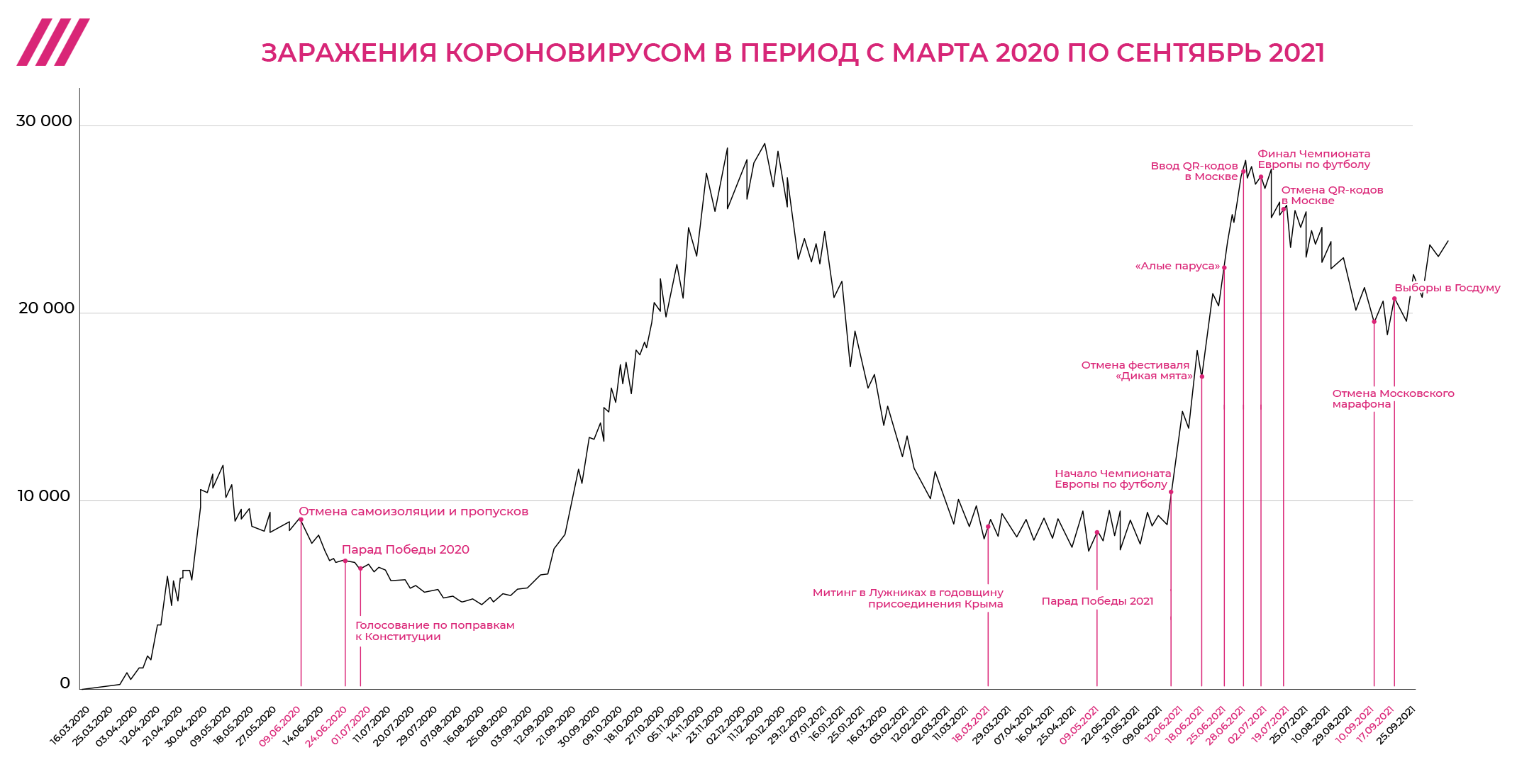
If we superimpose the most important events for the authorities in 2020 — the 75th Victory Day Parade and the vote on the Constitution — on the curve tracking incidence of the coronavirus, we can see that both events were held after the first wave of covid-19 had subsided. As this graph bears out, there was no increase in infections after these events either.

The situation was different this year. Only some of the Kremlin’s high-profile events took place in favorable epidemiological circumstances. The concert in Luzhniki, attended by Vladimir Putin, was held at a time when the increase in new cases of covid-19 was at the lowest level for this year. The same can be said about the 2021 Victory Day parade.

A new coronavirus wave kicked off in mid-June, but this did not prevent the authorities from holding UEFA Euro 2020 group stage matches, which ended on the crest of the wave of infections, in Petersburg. It would be difficult to call favorable the numbers of new infections during Petersburg’s Crimson Sails celebration for school-leavers. The cancellation of QR codes in Moscow in late July is also difficult to explain in terms of positive morbidity figures.

Coronavirus infections in Russia between March 2020 and September 2021. Key public events (and cancelled events) during this period are identified and marked in red, including the 2020 Victory Day parade in Moscow, the constitutional referendum in July 2020, the Crimson Sails celebration in Petersburg in June 2021, and parliamentary elections in September 2021. Courtesy of TV Rain
Can we trust official data on numbers of infections?
During the pandemic, demographers and epidemiologists have repeatedly drawn attention to the peculiar numbers issued by the covid-19 task force. “I always start the conversation like this: forget that there is a task force. It is pointless to discuss that today, for some reason, there were exactly one thousand fewer or more cases recorded than yesterday. Why? Because. Because the gladiolus. Because that’s the figure they thought up yesterday,” says independent demographer Alexei Raksha, one of the principal critics of the official figures. Back in July 2020, after the vote on amending the Constitution, he noted an unusual drop in the number of infections. “In late June [2020], we were told that there had been a certain decline in even symptomatic cases, and then the numbers went up again after July 1,” Raksha said.

The 2003 KVN skit by the Ural Dumplings that gave birth to the “Because the gladiolus” meme.

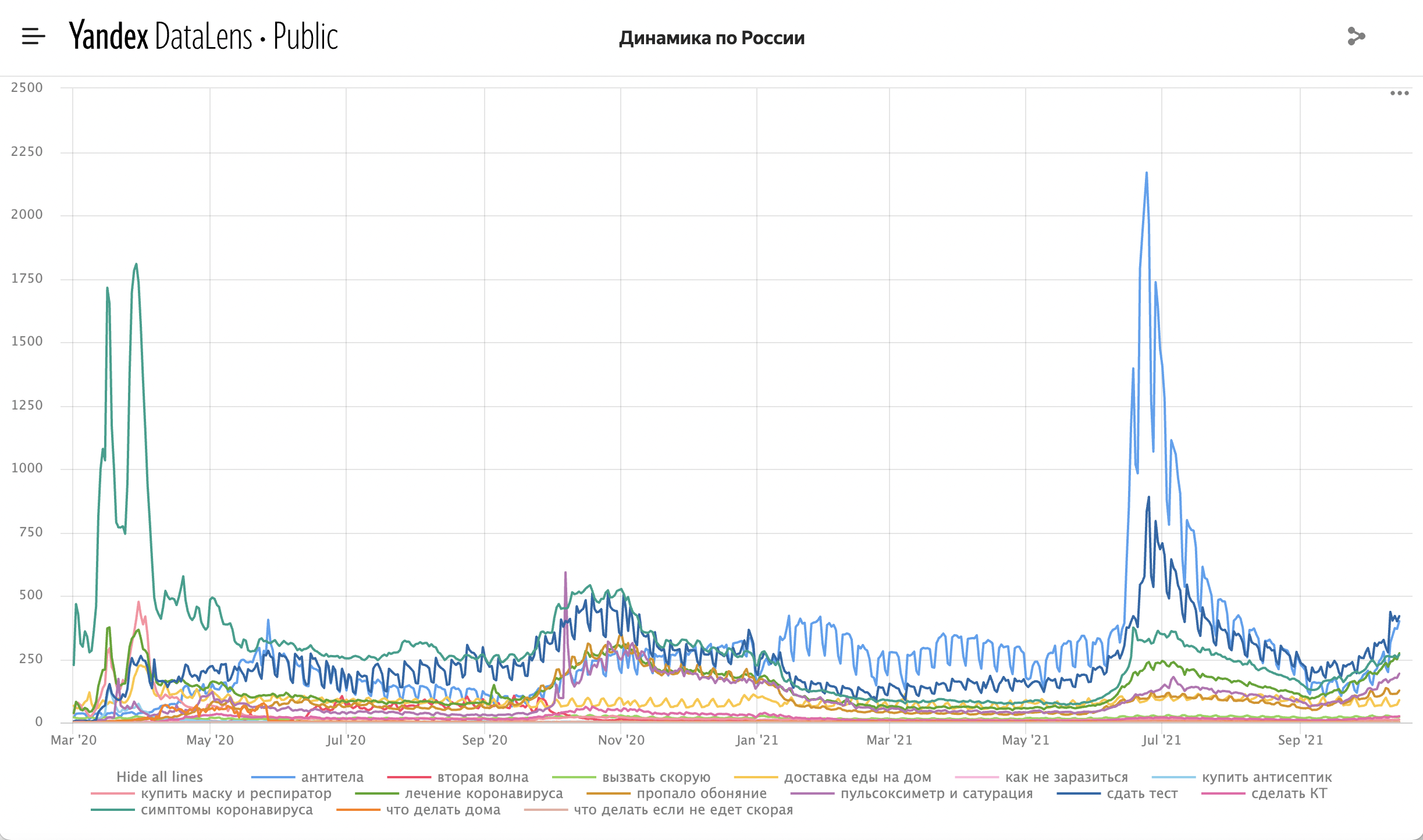
In his opinion, internet searches are the most accurate indicator of covid-19’s spread. “The incidence curve lags way behind. I use only Yandex searches — for example, searches for ‘sense of smell’ reflect the trends better than others,” he explains.

Trends for coronavirus-related searches on Yandex between March 2020 and September 2021. The searches tracked during this period included the following terms: “antibodies,” “second wave,” “call an ambulance,” “home food delivery,” “how to avoid infection,” “buy antiseptic,” “buy mask and respirator,” “coronavirus treatment,” “loss of smell,” “oxygen saturation monitor,” “get tested,”  “coronavirus symptoms,” “what to do at home,” and “what to do if ambulance doesn’t come.” Source: Yandex/TV Rain

Experts have named several possible factors for distortions in the official statistics. “First, the counting is done differently in different regions, and the epidemic moves across the country from month to month. And second, even within a particular region, the local covid-19 task force sometimes starts to do a better job of counting over time — maybe they import more tests, or they start cheating less,” says Dmitry Kobak, a data researcher from the University of Tübingen in Germany. According to him, it is also possible that the covid-19 task forces in some regions report “retroactively” — that is, for example, they issue the stats for July deaths in August.

“No one knows what deaths, exactly, are reported by the task force,” adds Sergey Timonin, a researcher at the International Laboratory for Population and Health at the Higher School of Economics. “I am not aware of regulatory documents that would explain this.”

Kobak draws attention to the fact that since the regions have started publishing statistics, so-called plateaus have regularly appeared in the data, that is, when the number of deaths has remained the same for several days, or even weeks. In September, similar “plateaus” — with the daily number of deaths hovering around 800 — appeared in the overall statistics for the country. “Previously, they showed up only within individual regions. This is interesting: it means that if the stats used to be fudged at the regional level and were added up afterwards, now, apparently, someone has been adjusting the figures after or while summing them up [for the whole country],” explains Kobak.

Verifying official mortality statistics
To get an objective picture of the coronavirus pandemic, experts use the excess mortality rate, which is the difference between real deaths and Rosstat’s forecast (that is, the number of deaths that we would expect if there were no pandemic), which, in turn, is calculated based on mortality data from previous years.

Calculations made by Alexei Raksha specially for TV Rain show that, by the end of 2020, there had been nearly 360 thousand excess deaths in Russia. At this time, the covid-19 task force’s death toll was about six times less — around 57 thousand deaths. By September 2021, excess mortality figures exceeded 675 thousand, but the covid-19 task force reported 180 thousand deaths for this same period. Since there have been no other major factors that could have had a strong impact on the life expectancy of Russians in the last two years, experts concede that it was the coronavirus that caused the serious increase in mortality in the country.

If the excess deaths graph is superimposed on the infections graph, as based on the task force’s data, we can see that they are roughly comparable. Raksha confirms this: the morbidity statistics for Russia as a whole “to some extent reflect reality when squinted at from three meters.” However, Raksha draws attention to the fact that excess mortality has been running chronologically ahead of the task force’s morbidity statistics. This may indicate that the latter are being heavily fudged, the demographer argues.

The trends for excess mortality (in dark blue, as reported by Rosstat), deaths caused by covid-19 (light blue) and covid-19 infections (pink), as reported by the Russian covid task force, between May 2020 and August 2021
The situation is different with the official data on mortality due to covid-19. When the covid-19 task force’s date is combined with Rosstat’s figures, the two curves radically diverge.

At the same time, the “hump” on the excess mortality graph in July 2020 stands out amid falling numbers of infections. Raksha believes that part of the increase in excess mortality that month was caused by the heatwave in the Urals. In his opinion, however, this factor could have added no more than five thousand deaths across the country. The rest of the difference, according to Raksha, is explained by the deliberate “flattening” of the task force’s official data.

Nevertheless, the covid-19 task force’s figures remain the only official data source available to Russians on a daily basis. And as follows from the graphs, above, this year the Russian authorities finally stopped using even these numbers as a guide when making decisions on holding large-scale events.

Translated by the Russian Reader. Just as I was finishing this post, Mark Teeter brought to my attention this article on the same subject (also featuring Alexei Raksha) in today’s edition of the Washington Post.

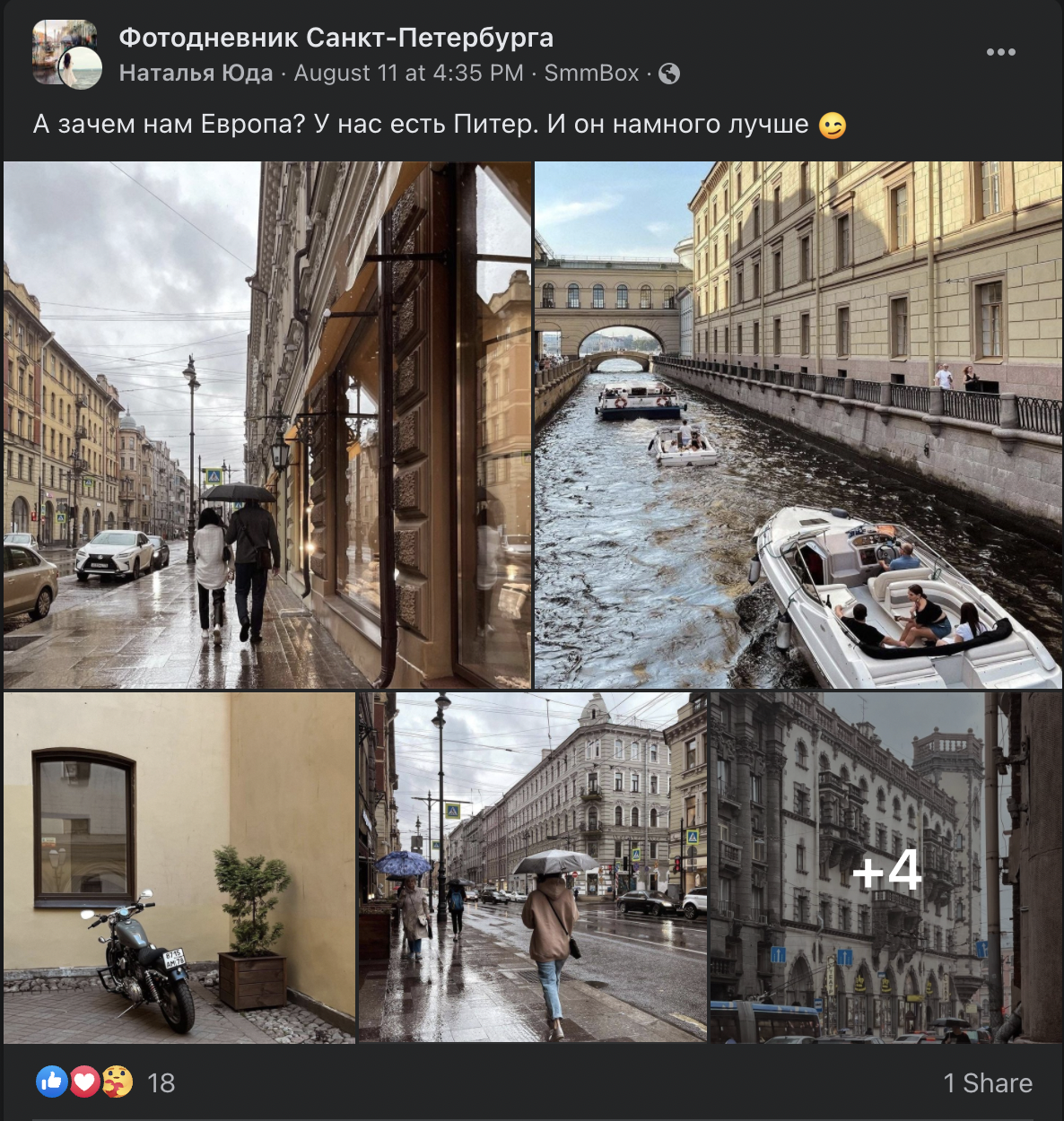
The Grass Is Always Greener on Our Side of the Fence

“What do we need Europe for? We have Petersburg. And it’s a lot better.” Source: St. Petersburg Photo Diary (public Facebook page)

Russia records highest covid-19 mortality rate for third day in a row
Radio Svoboda
August 14, 2021

For the third day in a row, Russia has recorded the highest number of deaths from the novel coronavirus infection since the beginning of the pandemic. On Saturday, August 14, the authorities reported 819 deaths, according to the federal crisis management center.

A year ago, the Russian authorities declared victory over the pandemic, but due to the low level of vaccination and the spread of new strains, the number of reported infections has increased four times, and the death toll has increased six times compared to the previous summer.

On August 14, 22,144 new cases of infection by the novel coronavirus were recorded in Russia. 19,550 people recovered. The official death toll for the entire pandemic has reached almost 170,000.

Using data from Rosstat, the Russian federal statistics agency, independent demographers and statistical researchers have estimated that the real number of deaths from the pandemic is three and a half times higher,  in excess of 600,000.

Translated by the Russian Reader

Jenya Kulakova: In Orenburg

The Sokol (“Falcon”) Widescreen Movie Theater in Orenburg, as photographed by Jenya Kulakova on August 13, 2021. She reports that the American animated feature “The Boss Baby: Family Business” was playing there today.

Jenya Kulakova
Facebook
August 13, 2021

Today I did manage to meet with Vitya [Viktor Filinkov] at Penal Colony No. 1 in Orenburg. I didn’t recognize him at first when they brought him out. He was wearing a baggy uniform that was too big, a small cap that didn’t fit on his head and, as he showed me later, huge size 45 shoes. (There all the new arrivals were given size 45 shoes. Another inmate commented on this fact as follows: “I’m trying to laugh hard about it so as not to be sad.”) My only glimpses of the usual Vitya were face (in a mask) and hands (in gloves).

He is in quarantine, where the conditions are indistinguishable from solitary confinement. All his things have been taken to the warehouse, and he has nothing to write on and nothing to read. The mattress is taken away during the day, but he can only sit on the bench when eating. They hadn’t yet taken him out for a walk during his first day there.

Upon his arrival at the penal colony, blood and urine tests were done, and an EKG was performed. Vitya is still ill, so they began giving him cough pills and antibiotics.

He is alone in the cell. He experienced no violence or threats during his first day in the penal colony.

He will be in quarantine for 14 days.

Translated by the Russian Reader. Here is a complete list of all the articles that I have published about Viktor Filinkov and the other defendants in the Network Case. Visit Rupression.com to find out how you can show your solidarity with them.

#NetworkCase #ДелоСети


Compulsory Psychiatric Treatment for Yakut Shaman Alexander Gabyshev


Alexander Gabyshev. Archive photo courtesy of Deutsche Welle

Yakutsk Court Orders Compulsory Medical Treatment for Shaman Gabyshev
Deutsche Welle
July 26, 2021

Alexander Gabyshev has been sent to a specialized medical facility as part of the case against him following accusations of violence against a Russian National Guard officer. The court issued an obiter dictum against Gabyshev’s lawyer, Olga Timofeyeva.

The court in Yakutsk ordered Gabyshev, known as the “Yakut shaman,” to undergo compulsory medical treatment “at a specialized medical facility with intensive care.” Alexei Pryanishnikov, coordinator of Open Russia Human Rights and a defense attorney for Gabyshev, informed MBKh Media of this on Monday, July 26.

According to Pryanishnikov, his defendant will remain in custody until the court order takes effect. Furthermore, the court issued an obiter dictum against Gabyshev’s lawyer Olga Timofeyeva, who stated that she “was ashamed to be taking part in this trial.”

The Gabyshev Case
It was reported in June that Gabyshev—held at the time in the Yakutsk Psycho-Neurological Treatment Clinic—had taken a turn for the worse: he reported feeling weak, dizzy and drowsy.

The shaman’s trial began on April 30. Gabyshev stood accused of using force against a Russian National Guardsman. Gabyshev had been sentenced to six months in the psychiatric clinic, a term that expired on July 27. This is precisely why the Yakutsk court was in such a hurry to review his case, according to Pryanishnikov.

Marching to Moscow
In March 2019, Gabyshev, a resident of Yakutsk, announced that he was walking to the Kremlin to “drive out Putin.” He was detained in September following six months and 3,000 kilometers of travel. The FSB opened a case into publicly calling for extremism, but did not officially accuse the shaman of anything. He was placed in the psycho-neurological clinic and declared mentally incompetent on October 3, but was later released.

In December 2019, Gabyshev again set out for Moscow, but he was detained again, and this time accused of failure to obey the police. In 2020, he underwent compulsory medical treatment in the Yakutsk Republic Psychiatric Clinic, at which point Memorial recognized Gabyshev as a political prisoner.

In January 2021 Gabyshev announced that he was preparing for a new march to Moscow, after which he was again detained and subsequently transferred to the psychiatric clinic.

Translated by the Fabulous AM