I think that most of us have not yet understood that the world of Russia has once again, like a century ago, split in two, like an iceberg, and its two halves, the bigger and the smaller, are rapidly drifting apart. It’s just that the split happened less dramatically, without the crowding onto the last steamship, without the “we departed from Crimea amidst smoke and fire” [lines from a poem by White émigré Nikolai Turoverov]. The split has been dragged out in time, and the crack wasn’t so wide at the beginning. Some people are still hopping from one iceberg to the other.
“Endless War”
And yet—that’s it. There are two Russias again. Many people—in both halves—cannot or are afraid to recognize this. It’s time to stop hopping, otherwise you’ll leap to one side and won’t be able to hop back again.
Hopes for the swift fall of the rotten regime (also just like one hundred years ago) have been disappointed. It’s plenty rotten but rot, as everyone knows, spreads.
Last time it took seventy years to root it out. This time it probably won’t take as much time; time moves more quickly in the twenty-first century, but you still have to unpack the suitcases and settle in for a long wait.
“Anticipation of White Nights”
What will happen with the ‘little’ Russia, scattered across different countries, is pretty clear. [Russians] who are younger or more active or more professionally cosmopolitan will assimilate with varying degrees of success. [Russians] who are older and professionally tied to the language and culture will sadly sing “while the light has not gone out, while the candle burns” [a line from a famous Mashina vremeni song] and will support that little flame as long as they have the life and strength for it. This work of theirs is not pointless or in vain, because in ‘big’ Russia there are still a great many people for whom that light will be precious and necessary.
In the mother country—goddamn déjà-vu—things will soon be utterly unbearable. In the longstanding two-hundred-year struggle between the Asiatic state and European culture the Horde has triumphed once again, now zealously working to asiatize the culture. (There is nothing malign about Asia and its culture, which of all people I, a specialist in Asian studies, should know; I am talking about political Asia, in which the state is everything and the individual is nothing.)
The culture of the mother country will be censored, hollowed out, thrust onto all fours and taught to wag its tail. We’ve seen it, we remember. Later, of course, a counterculture will take shape, [yielding] virtuosos of Aesopian language and furtive rude gestures. We remember that too: we had plenty of it. The emigres will coo condescendingly over any vivid manifestations of censored culture—like Nabokov did over Okudzhava. Those in Russia will secretly pass around tamizdat editions. And publish in the West using pseudonyms.
How dreadful and boring this all is, ladies and gentlemen. Russia’s national anthem: “We sowed and sowed the grain, we will stomp and stomp the grain” [lines from a Russian folk song].
For some the price will be their profession, for others poverty or emigration. The most noble will give up their freedom. And even their lives. The higher quality the person, the greater the cost.
And it is all worth it. This is what I’ve been thinking and why I wrote this text, not at all because I wanted to drive you into even greater despondency.
More so than all of us together, each of us individually is facing a big test. We can’t flunk.
Stop referring to “Asia” and “the Horde.” Why insult millions of people in the world and in Russia itself? You are not helping the “little” Russia” in any way.
I see that Akunin has again written something about Asia (where “the state is everything and the individual is nothing”) defeating European values in one particular country.
The point is that Russian intellectuals are, historically, not so fond of anything as repeating German vulgarities. And “Asian” metaphors are the favorites of Germans, and there is no degree of blatant idiocy at which they would stop.
For example, Adenauer explicitly claimed that the “Asian steppes” begin east of the Elbe. (He considered Prussia to be Asian, and so Bismarck’s triumph was an Asian conquest of Germany. Adenauer added the steppe by association.)
No matter how many decades have passed, the pre-war German spirit cannot be taken out of the Russian pamphleteer, and the fear of appearing ridiculous is as alien to them as it was to their mentors.
Quite correct thoughts in general, but there is one big catch.
How does Akunin (Chkhartishvili) differ from those Sieg Heiling in Russia when he starts using “Asia” in such a context, in such a comparison, even with a caveat? Maybe someone will say that I am wrong to try and compare him with the Sieg Heilers. Let me put it another way, then. How does a very good writer differ from those who are called white supremacists in the west?
I recently listened to a very interesting lecture on racism. The lecturer made a rather loose, but interesting ranking, singling out the racism of Soviet people as a separate species.
For some reason, some Europeans, when speaking about Asianness, “forget” about the Inquisition, concentration camps, and many other terrible events in history. Or are these also manifestations of Asianness?
We should also not forget that the current world order is also largely a product of European civilization with all its pros and cons.
One last thing, about why I decided to react in this way to Akunin’s statement, which are quite congenial to my own thoughts. It seems to me that a respected public figure should always think about the consequences of their words and deeds.
[…]
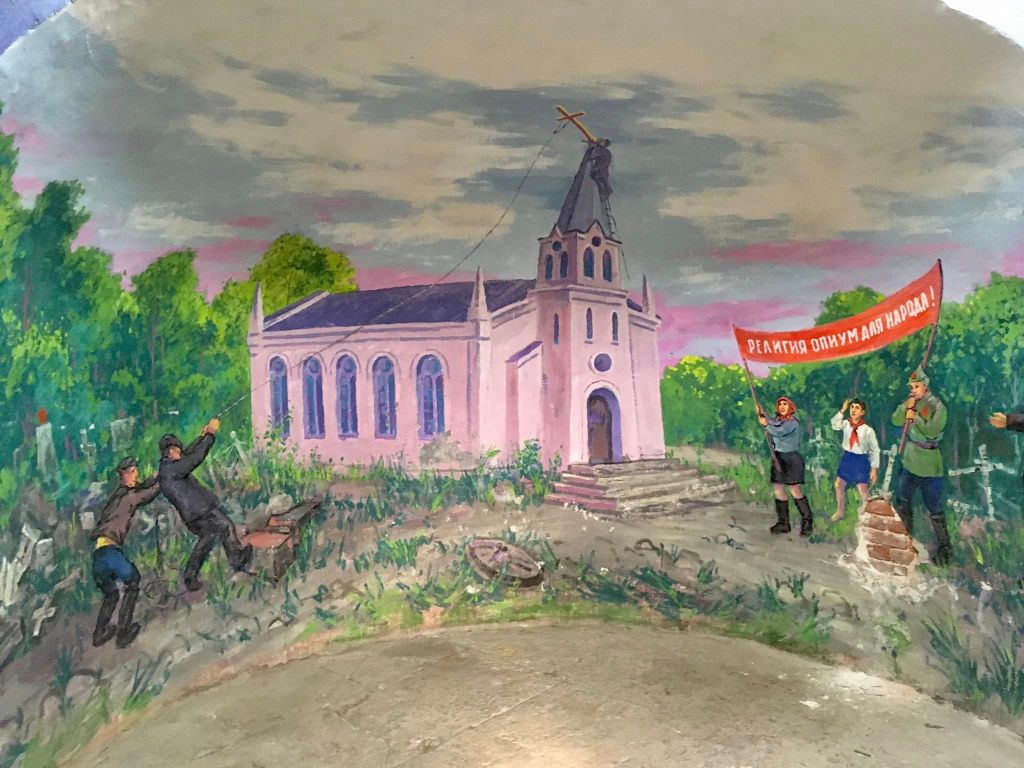
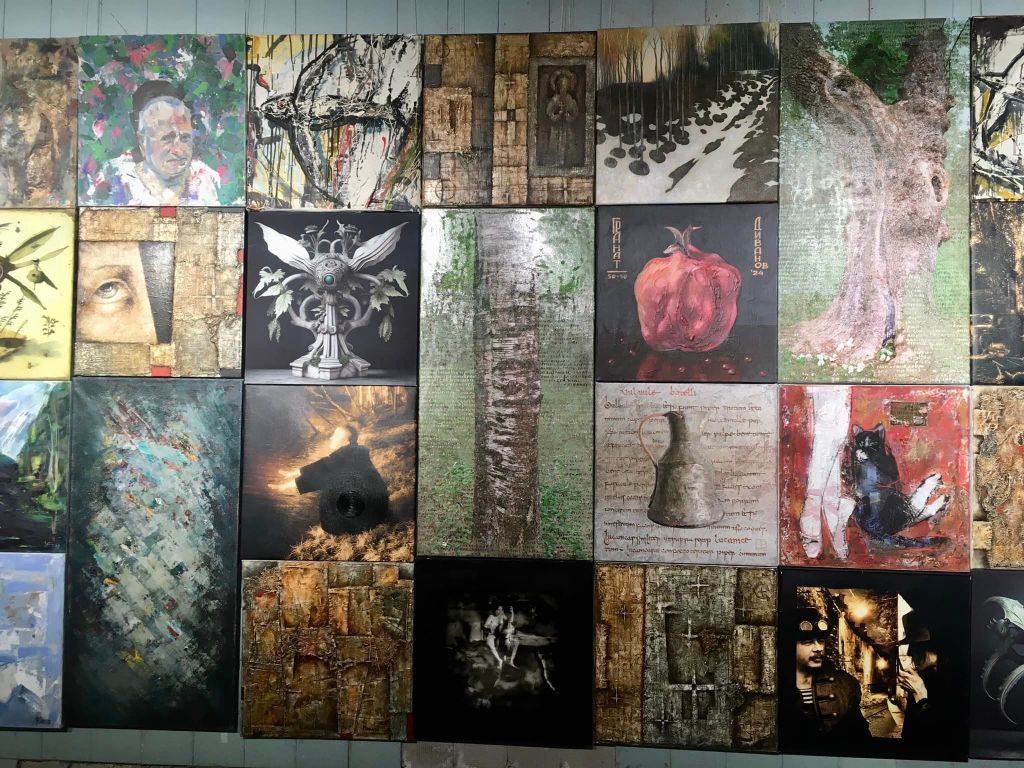
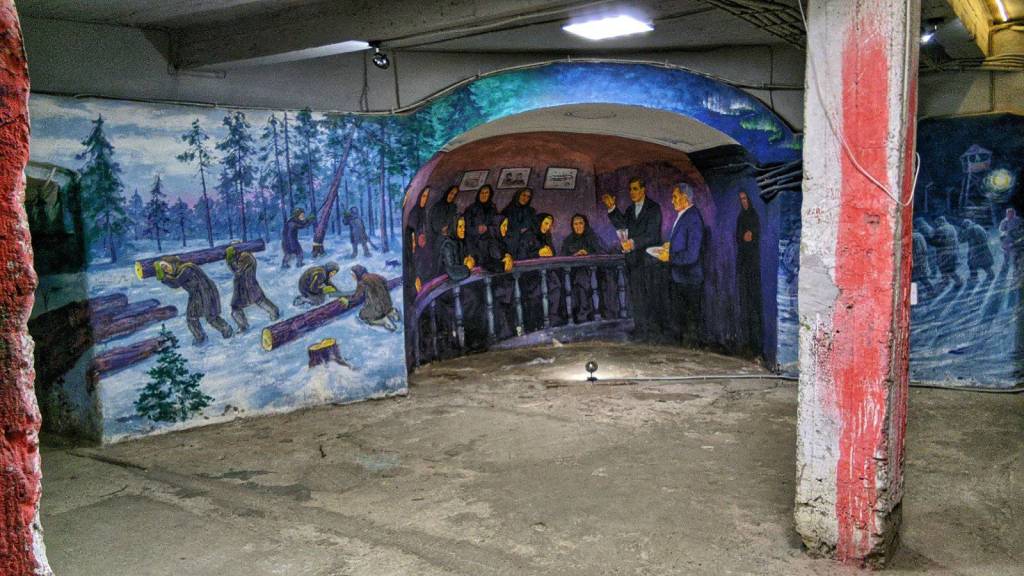
Source: Asya Rudina, “‘The world has split in two:’ the Runet discusses Akunin’s post about the two Russias,” Radio Svoboda, 1 April 2024. Translated by the Fabulous AM and the Russian Reader. The reactions, above, to Akunin’s outburst were not typical. Most of the best-selling author’s fans echoed his sentiments. The photos, above, by our friends V and M, were taken today at an exhibition currently on view in the former swimming pool and catacombs in the so-called Petrikirche on Nevsky Prospekt in downtown Petersburg. They suggest, I think, that the reality on the ground in “big Russia” (and “little Russia” as well) is slightly more complicated than Akunin would have us believe.||| TRR
The FSB has opened a criminal case on charges of “high treason” against artist and former Mediazona publisher Pyotr Verzilov. The details of the case are not yet known, but as part of their investigation, law enforcers raided the homes of a number of artists and activists across Russia. Many of those whom the law enforcers raided are not personally acquainted with Verzilov.
In the early hours of Tuesday morning, people identifying themselves as FSB officers searched the home of Petersburg artist Katrin Nenasheva and her girlfriend Natasha Chetverio. Nenasheva was taken away for questioning, while Chetverio was released, but both had their electronic devices confiscated. The homes of artist Sasha Blot, Party of the Dead activist Kristina Bubentsova, illustrator Vladlena Milkina, and architect Alexandra Kachko were also searched in St. Petersburg.
Law enforcers simultaneously raided the apartments of Verzilov’s mother Yelena, members of the art group Yav, actionist Anastasia Mikhailova (an associate of the artist Pavel Krisevich), and Pussy Riot members Rita Flores, Olga Pakhtusova, and Olga Kuracheva. The latter two were involved in the action “The Policemen Enters the Game”: along with Verzilov, they ran out onto the field of a Moscow stadium during a World Cup match there.
In Moscow, a female acquaintance of the artist Philippenzo (who is now in exile) was taken from her flat. The Yekaterinburg artist Ilya Mozgi and the Ulyanovsk artist Ilya Kholtov were both taken away for questioning after their homes were searched. Nizhny Novgorod artists Artem Filatov and Andrei Olenev were questioned. Samara artist Denis Mustafin’s home was searched. Although he was not at home, his mother’s computer was confiscated.
Some of these have already been released from interrogation (Nenasheva and Kholtov, for example), while others are still being questioned. It is known that most of them have now been designated as “witnesses” in the case against Verzilov. Many of them were asked about their connection to Verzilov: many did not know him personally and had never had much contact with him. Kristina Gorlanova, the former director of the Urals branch of the Pushkin State Museum of Fine Arts, located in Ekaterinburg, whose home was also searched, said that she had “heard nothing” about the “artist” who occasioned the search.
It is still unclear what gave rise to the criminal case. Under new legislation, however, switching to the enemy’s side during a war can be considered “state treason” can be considered as switching to the enemy’s side during a war. In an interview with Yuri Dud last year, Verzilov admitted that he had originally traveled to Ukraine as a documentary filmmaker, but now he was at the front “as a military man.”
“Verzilov: Inside [the] War,” vDud, 5 October 2023. In Russian, with English subtitles
Many of the artists whose homes were raided may never have been involved in Verzilov’s activities, but they themselves have produced works about current events in Russia and Ukraine. We wrote last year about the works of Yav and Philippenzo. Mustafin was fined for flying a a Russian flag inscribed with the phrase “Today is not my day” outside the Ministry of Defense in Moscow on 12 June 2022. Milkina made a public art piece about “people who are scared” on a Petersburg square and T-shirts with the word “Peace” on them.
Petersburg artists find ways to get their messages across even amidst strict censorship. They mount underground apartment exhibitions, “tiny pickets” on city streets, and exhibitions and performances in the woods. It all smacks of the Soviet guerrilla art and actionism from which the international stars of post-Soviet conceptualism later emerged.
Bumaga explores how street art shows have gained popularity in Russia, how guerrilla art has changed in recent decades, and how today’s actionists resemble the organizers of the notorious Bulldozer Exhibition.
Street exhibitions have been around since the 1960s. One of the first such projects was dubbed “the Soviet Woodstock”
Guerrilla street exhibitions in Russia date back to the so-called unofficial art scene of the 1960s and 1970s. Pursuing the idea of coupling art and ideology, the authorities forced undesirable artists out of public art life.
In 1962, Nikita Khrushchev cracked down on the exhibition 30 Years of the Moscow Union of Artists, at the Moscow Manege. The Soviet premier wanted to expel all of its participants from the CPSU and the Union of Artists, although almost none of them were Party or Union members. Artists and connoisseurs reacted to political censorship in the USSR by forming an artistic underground, meaning that the most progressive art was exhibited at apartment exhibitions and in salons.
The 1970s witnessed open confrontation between the art and the world authorities. The most flamboyant members of the artistic underground were the Lianozovo school, who gathered and held exhibitions in a barrack in Moscow’s Lianozovo neighborhood. The leader of the group, Oscar Rabin, organized one of the most infamous guerrilla street exhibitions in the history of Russian art, which later became known as the Bulldozer Exhibition. On 15 September 1974, the artists staged a show of paintings in a vacant lot in Moscow’s Belyayevo Forest. The authorities sicked police on the participants and attendees and destroyed the show with bulldozers.
This crackdown on artistic expression triggered an international uproar, and the Soviet authorities made concessions. Two weeks later, the artists were allowed to hold an officially sanctioned exhibition featuring an expanded list of participants in Moscow’s Izmailovo Park.
This time the police were tolerant towards the artists and their guests: no one was detained. The exhibition lasted for several hours and, thanks to the beautiful weather, it turned into a big picnic. Western journalists dubbed the event “the Soviet Woodstock.”
Soviet unofficial artists continued this tradition, and one art group published 14 volumes documenting their activities
These exhibitions were sanctioned, but the authorities still created a number of organizational obstacles for the artists. For example, only those artists who had a Moscow residence permit were allowed to show their work at the House of Culture. In addition, the authorities made the condition in which the artists worked unbearable: during the mounting of the show, the temperature in the pavilion topped forty degrees Celsius. Thirty-eight works were banned by the censorship commission. It is not known how many works were exhibited, ultimately, but a total of 145 artists participated in the show.
After the scandals provoked by the “unofficial” artists’ public appearances, the authorities began pursuing a policy of legalizing alternative art. In May 1976, the Painting Section of the Graphic Artists Committee was established, primarily to monitor and control the ideologically dangerous underground.
We should keep in mind that we do not have information about every single Soviet-era guerrilla exhibition. Many were held without leaving any trace in contemporary newspapers and other documents.
Collective Actions, a group led by Andrei Monastyrsky, did a huge amount of work in this sense. The artists compiled fourteen volumes documenting their Trips to the Countryside — actions during which various events took place in particular landscapes, including installations, performances, and minimalist interventions in nature. By going outdoors, the artists showed that art could be implicated in the space outside galleries and museums. Another important feature of the performances was the inclusion of viewers in the works: their participation and reactions were part and parcel of the conceptual actions. The way the actions were staged encouraged the spectators to focus on the processes of anticipating and comprehending the happenings. That is, the spectacle itself was an occasion for reflection, a statement meant to spark a dialogue.
In [1977], for example, Collective Actions simply hung a red banner between trees in the woods. The banner read: “I HAVE NO COMPLAINTS AND I LIKE EVERYTHING, ALTHOUGH I’VE NEVER BEEN HERE AND KNOW NOTHING ABOUT THESE PARTS.”
Guerrilla exhibitions are still organized nowadays, many of them dedicated to political prisoners
As a rule, guerrilla exhibitions and actions have a political agenda, so their organizers can be punished quite severely, even by Russian standards.
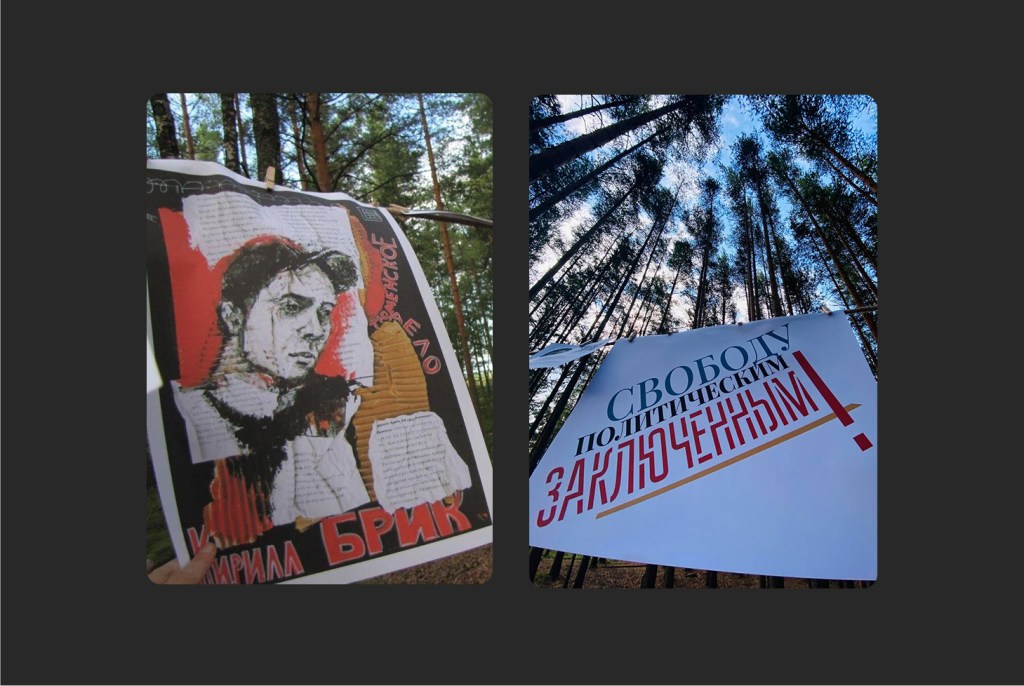
Nevertheless, there is activity in this field. For example, on 5 August 2023, Petersburg activists mounted an open-air exhibition on the Sestroretsk Ecotrail on the Day of Remembrance of the Victims of Sandarmokh [sic], a tract in the forests of Karelia where victims of the Great Terror were shot and buried in mass graves. Fifty works hung in the open air for a record time — almost an entire day.
Placards in support of Tyumen Case defendant Kirill Brik (left) and the release of political prisoners (right) at 2023 guerrilla exhibition in suburban Petersburg. Photos courtesy of 123ru.net via Bumaga
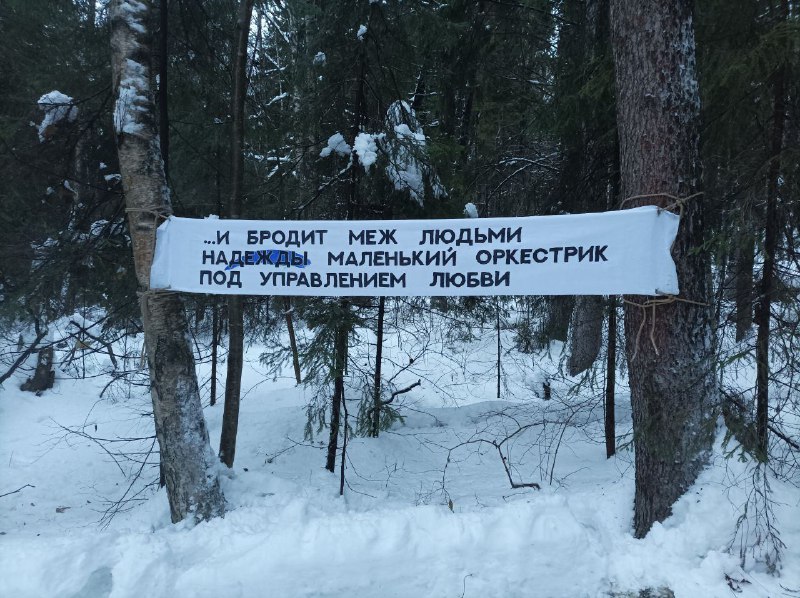
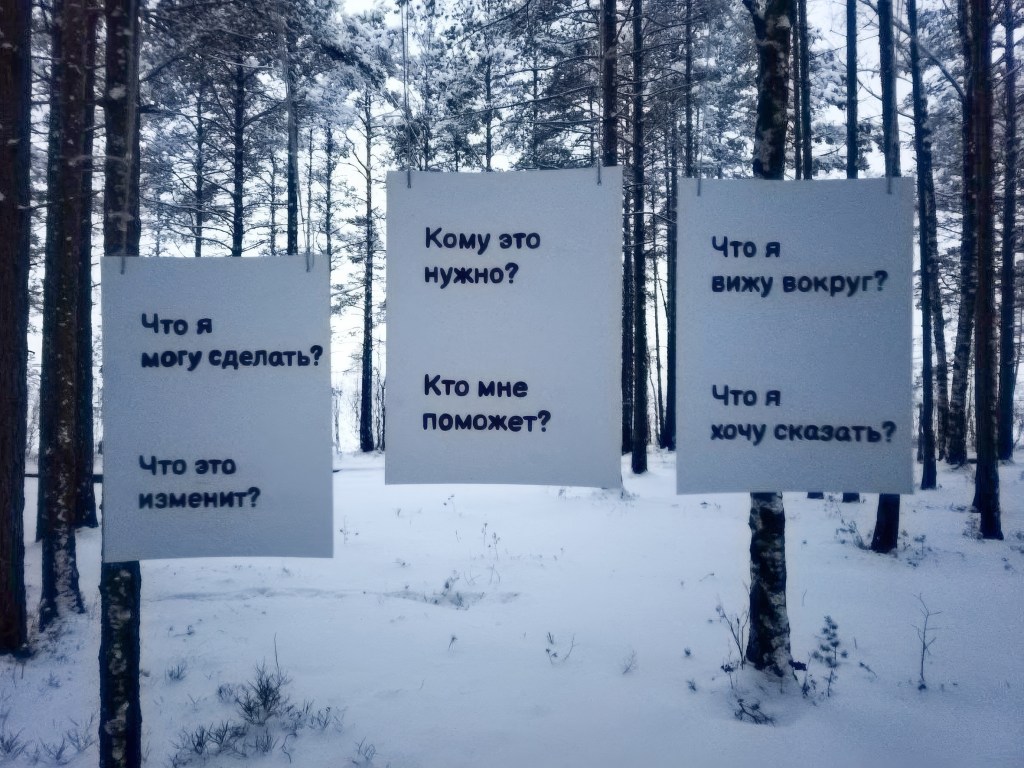
Several placards were also hung in the woods outside Petersburg this winter — for example, on December 10, Human Rights Day, the work I Dissent, Therefore I Am. And in January, an installation featuring a quotation from the Bulat Okudzhava song “Hope’s Little Band” was mounted outside the city.
“…and wandering amongst people / is hope’s little band, / conducted by love.” Photo: Bumaga reader
“What can I do? What would it change? Who would care? Who would help me? What do I see when I look around? What do I mean?” Part of the installation I Dissent, Therefore I Am. Photo: a Bumaga reader
In 2022, Petersburg hosted Carte Blanche, an international guerrilla street art festival. In addition to street works, a stationary exhibition at the abandoned Sailors Palace of Culture on Vindavskaya Street attracted great attention; it featured over twenty artists, including Vladimir Abikh, Maxim Ima, and Slava PTRK. That same autumn, Petersburg hosted the underground exhibition Continuity, dedicated to political prisoners of the past and present, including the victims of the Great Terror and those caught up in the Network Case. Some of the works were made by political prisoners themselves using improvised means and materials while they were incarcerated in pretrial detention centers and penal colonies.
Contemporary street exhibitions continue the Soviet tradition, but the state’s reaction to them has become tougher
Today’s guerrilla exhibitions in many ways are a continuation of the Soviet and post-Soviet tradition. The Bulldozer Exhibition can hardly be called an artistic event also. It was also a political event. It was a challenge to a repressive regime, “the first and most significant collective performance,” as art historian Yevgeny Barabanov wrote.
Since 2022, such exhibitions also have not only aesthetic but also political goals. Although in the Soviet and post-Soviet years, “unofficial” exhibitions, albeit with certain restrictions, could be legitimated [sic], since 2022, the state does not even attempt to compromise with artists.
Moreover, crackdowns against artists who voice alternative opinions have reached a new level. In 1991, the Moscow actionist Anatoly Osmolovsky and his group E.T.I. used their bodies to spell an indecent word for the phallus [khui] on Red Square. After the action, Osmolovsky was detained and threatened with charges of “malicious disorderly conduct.” However, thanks to the petitions submitted to the authorities by his art world colleagues and the Memorial Society, Osmolovsky was soon released.
Nowadays, petitions and statements of support are not enough to get artists acquitted. Sasha Skochilenko was sentenced to seven years in prison on charges of disseminating “fake news” about the Russian army. The young woman replaced price tags at a Perekrestok chain grocery store with anti-war messages.
“Such are the times now that if you are not in jail you cannot be considered a decent person.”
—Arkady Ippolitov, in conversation with theater critic and writer Sergei Nikolayevich, quoted with the latter’s consent
Oh, that argument sounds so much like Arkady. Although he dealt in the luxury of bygone times, sometimes he felt himself to be a proletarian of intellectual labor, and even more so, a person caught up in contemporary history. He wrote twenty-nine books and upwards of six hundred pieces of art criticism. The most well known to the general reading public are his trilogy Images of Italy (an homage to Pavel Muratov’s classic book): Especially Lombardy, Only Venice, and Just Rome.
The art critic, curator, essayist, lecturer, and writer Arkady Ippolitov was not at all a “keeper of antiquities,” as was suggested by his official position as curator of the Hermitage’s Italian prints. Like the protagonist of Yuri Dombrovsky’s eponymous novel, he sought to combine old and modern art, Robert Mapplethorpe and Jacopo Pontormo, Peter Paul Rubens and Peter Greenaway, the Italian Mannerists and Andy Warhol in his mind, in his articles, and in his exhibition projects.
In the late eighties, Ippolitov’s work appeared in Dekorativnoe iskusstvo (Decorative Art), one of the first respectable journals. There he published uncensored articles about European culture, not about decorative art (which then occupied a modest place in official Soviet art criticism). He expounded the theories of Jacob Burkhardt and Erwin Panofsky vis-a-vis the imaginary space of the local aesthetic, as if this location had a hope for ethical salvation. He explicated the optics of the complex masses and graphic art of Piranesi, with his theory of prisons and torture. (This article would later grow into an exhibition of Piranesi’s work along with the catalogue to it.) From a historical perspective, I dare say that Ippolitov’s work in the nineteen-nineties and noughties embodied some of the naivety of the Russian post-perestroika enlightenment, whose adherents believed that Russia would evolve along a European trajectory. He curated over twenty exhibitions of contemporary Russian art. (His list of exhibitions of “classical” art is much longer.) The list of his articles in Kommersant and other democratically minded newspapers and magazines of the noughties and twenty-teens is more than impressive. In the Russian artistic milieu, he sought and found direct parallels between Russia and Europe: see, for example, his project Palladio in Russia, or his last major curatorial works, Roma Aeterna: Masterpieces of the Vatican Pinacotheca, at the Tretyakov Gallery in Moscow, and Pilgrimage of Russian Art: From Dionysius to Malevich, at the Vatican Museums in Rome.
He was a successful international curator who lived an extremely modest everyday life. His wealth сonsisted of a small flat near the Hermitage and a view of the Neva River from his office at the museum. He dressed like a dandy and behaved sometimes like an aristocrat, sometimes like a bully. He loved his mother and his son very much. He had few close friends. It was not easy to make friends with him, but he was a quite loyal friend. He had two vivacious wives, an Italian and a Russian, and tons of fans and admirers of both sexes.
I have two memories of working with Arkady. The first memory is of him escorting me through the Hermitage’s staff entrance to see his exhibition Hogarth, Hockney and Stravinsky: The Rake’s Progress. It was like seeing a theater’s secret underbelly. We were kicked out by the docents for illegal entry: Arkady’s authority as a curator did not fly with them. Arkady did not get angry, though; instead, he laughed. The second memory is our strolling around Petersburg and talking about his plans for an exhibition dealing Xenia of Saint Petersburg, about how she dressed in her husband’s clothes after his death and performed miracles under his name. It was a secret conversation about transgression and transvestism in the light of metanoia.
Ippolitov was a quite Petersburgian person. The city’s coldness, melancholy and depression are reflected in his striking prose. Melancholy was one of his recurring themes both as an individual and as a curator. The capital of the former empire and its inhabitants are bound to be melancholic, in keeping with the story of Rome’s fall. In his gloomy text about the city’s Summer Gardens in November [published in 2013], in which he predicted his own death, there are, however, incredibly caustic passages about the taste and manners of the powers that be, both the Soviet regime and the current authorities. It contains this passage about [Andrei] Tarkovsky’s The Mirror, which expressed [Ippolitov’s] unfulfilled ideal: “The little boy leafing through a book about Leonardo in the autumnal gardens is what makes us who we are. He is the symbol of Russia. He is its principal value—the encounter between past and future, between child and titan, between tradition and modernity.”
Arkady’s metaphysical features shone through his earthly guise. He was a genuine angel, but one with a damaged wing as it were. In person, he was, alternately, a pure angel and a perfect demon. When polemicizing about culture and time, about beauty and truth, his severity knew no bounds. For those interested in the historical background, he had no wish to discuss the latest public statements by the director of the Hermitage, considering it beneath his dignity. I hear his peculiar intonation when I read this phrase in a 2016 interview: “Everything my director says is true a priori.” It cannot be ruled out that the Hermitage’s leadership reciprocated by ignoring him: from the mid-twenty-teens on, Arkady’s principal curatorial projects were based in Moscow.
He was so handsome, simultaneously so physically powerful (very tall, beautifully built) and so fragile, that I was amazed why he had been gifted to this fallen world at all, even before the hell into which Putin turned Russia in February 2022. Arkady meant so much to the metaphysics of beauty that I would not be surprised if he were now in the Paradise of the Renaissance artists, and not even in Limbo, in keeping with Dante’s logic.
Source: Elena Fanailova, “The Keeper of Antiquities: Arkady Ippolitov’s Angels and Demons,” Radio Svoboda, 7 November 2023. Thanks to Comrade Koganzon for the heads-up. For several years not so many years ago, it seemed as if I was constantly in the midst of translating an essay, article, or exhibition catalogue by Mr. Ippolitov. It was unfailingly a pleasure to work on these projects with him. It goes without saying that I gained much more from these collaborations than he did, but he always made me feel that the opposite was the case. \\\ TRR
[1] We walk in the woods. [2] We go to the store. [3] We trim Mode’s claws. [4] We watch a TV serial. [5] We’re at the sea. [6] And all of this will be! Happy birthday!
Source: Sasha Skochilenko (Facebook), 7 August 2023. Translated by the Russian Reader
Petersburg artist, antiwar activist and political prisoner Sasha Skochilenko, currently on trial for “disseminating fake news” about the Russian army’s actions in Ukraine and facing 10 years in prison if she’s convicted, congratulated her girlfriend Sonya on her birthday.
This is what the actual Russian antiwar movement looks like. It doesn’t look like Russians swanning around Europe and North America in search of grants and “projects” and relaxation. Accept no substitutes! ||| TRR
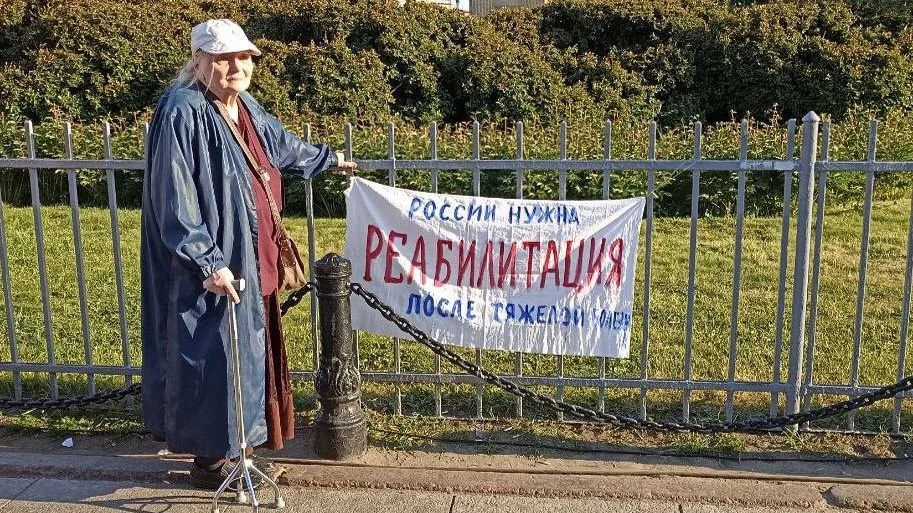
“Russian needs rehabilitation after a serious illness”: Artist Yelena Osipova picketing on Nevsky Prospekt in Petersburg on 12 June 2023. Photo courtesy of mr7.ru
A reader has informed mr7.ru that today on Nevsky Prospekt, near the Kazan Cathedral, Petersburg artist Yelena Osipova stood with a poster for a short time. On Russia Day, she asked for “rehabilitation” for the whole country. She was not detained by police.
Osipova has been staging solo protest pickets in the city center for over twenty years. She has been repeatedly detained by the police, although recently they have more often simply asked her to shut down her pickets and taken her home.
On January 31, an exhibition of the artist’s works opened in the offices of the Yabloko Party on Shpalernaya Street. The next day, however, the police came to the offices and seized the posters and paintings on display. An investigation into them was launched, whose findings were later submitted to the Investigative Committee. The works have not yet been returned to the artist.
This past spring, Osipova became ill and needed hospitalization: she suffered a stroke. The artist returned home only two weeks ago. Today she left the house for the first time since her illness.
Riders!
The cavalry charges on knotted legs, bucking their backs!
Confucius-handed and Buddha-headed
People with arms and torso
Move across the tundra
Other same-sex creatures walk around and whistle…
A light downpour pours and pours
Pitter-patter
And
Pitter-patter
And
Pitter-patter
And
Pitter-patter
And
Pitter-patter
Softly, softly, as if it isn’t water, but happiness
Under the bright sun
Of historical materialism…
Everyone is free to go.
* * *
Riders Horsemen Scouts!
The delegation from the nearby islands,
So near so near, by the edge of the red peacock,
Oohed and aahed nearby and then fell silent… Basically, we're doing great!
Buzz off, I’m a married woman, as they say.
The delegation from the islands considered the problem of
“The oppression of ethnic minorities.” It was a fruitful meeting.
Henceforth many streets will be called “avenues,”
But “rain” and “cream-colored” will remain.
It will seem odd to you, but songs shall also be sung,
And internal resources employed…
The delegation did not approve what is called “freedom.”
They started saying it was “anarchy.”
Well, of course we went for our knives… the carnage lasted for a long while!
It’s inhumane to finish off the wounded, they…
All belong to the people.
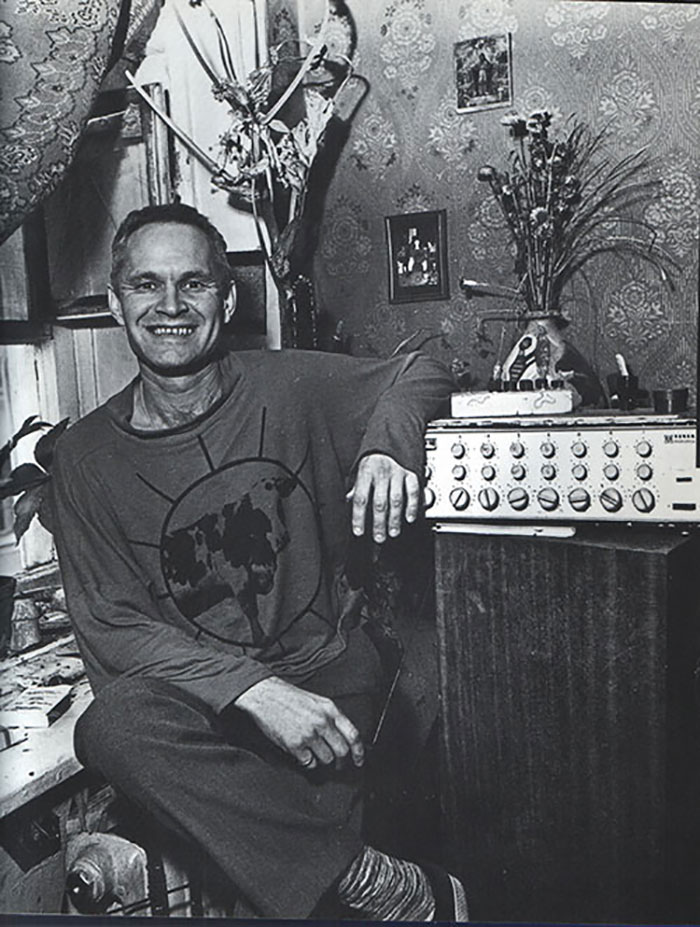
Vadim Ovchinnikov in his studio at Pushkinskaya 10 in Petersburg, early 1990s Photo by Boris Smelov. Courtesy of ov-ov.com
Born in Pavlodar (Kazakh SSR), Vadim Ovchinnikov (1951–1996) was a Leningrad/Petersburg-based artist who worked in a number of media, including painting, watercolor, collage, animation, mail art, conceptual literature, and music. His works can be found in the collections of the Russian Museum (Petersburg), the Moscow Museum of Modern Art, the Art Museum of Pavlodar, and Kai Forsblom Gallery (Helsinki). For more information on Ovchinnikov’s art and life, see the website ov-ov.com. The two poems by Mr. Ovchinnikov, above, were originally translated by Thomas Campbell for the exhibition catalogue The New Artists (Yekaterina Andreyeva and Nelly Podgorskaya, editors; Moscow Museum of Modern Art, 2012). These translations have been revised for publication here.
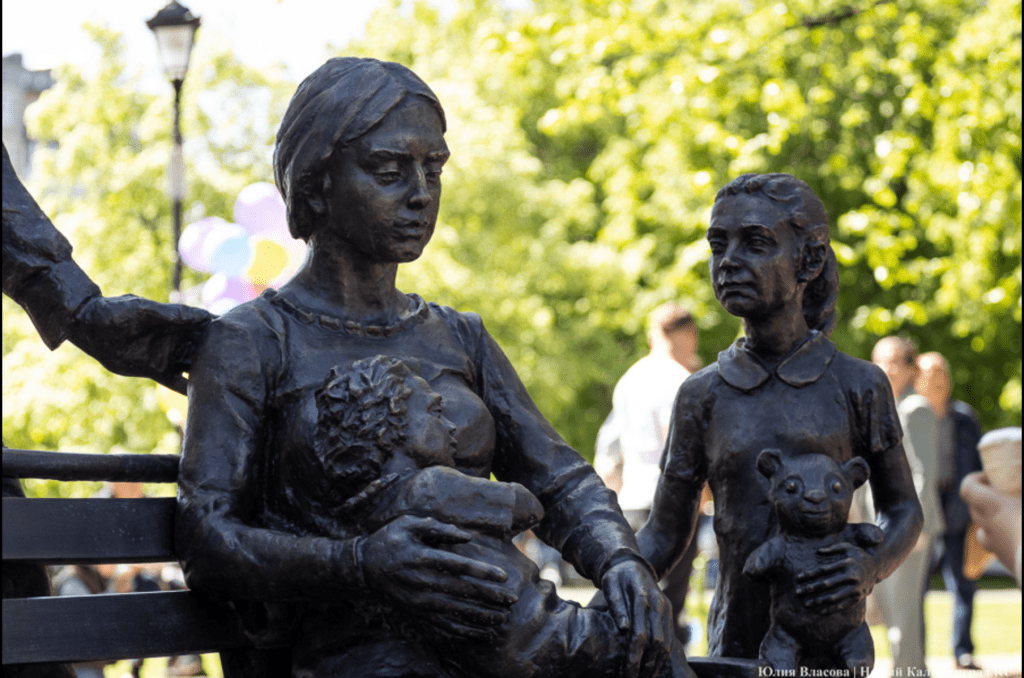
Cheburashka (center) and friends. Photo: Yulia Vlasova/newkaliningrad.ru
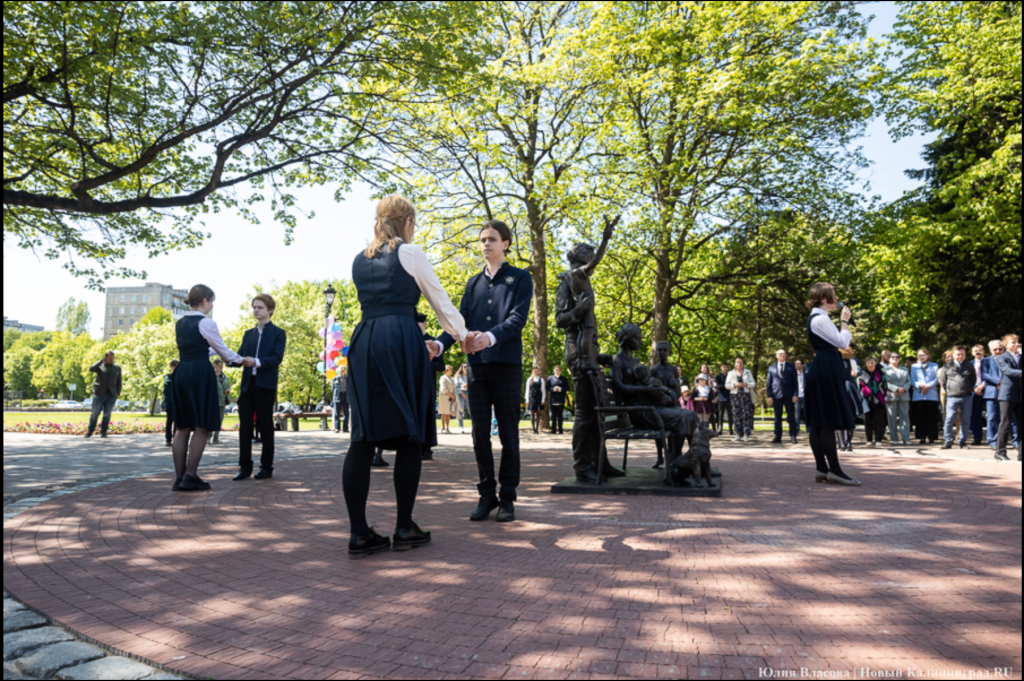
A monument entitled The Happy Family was unveiled in the park near Kaliningrad’s Lower Lake. Located between the Palace of Creativity of Children and Youth and the Regional Trade Unions Federation building, the site was transferred to the church in 2012. In 2022, the Kaliningrad Diocese of the Russian Orthodox Church applied to the Kaliningrad administration for permission to beautify the park. However, by that time the square had already actually been landscaped, only the promised sculpture was missing.
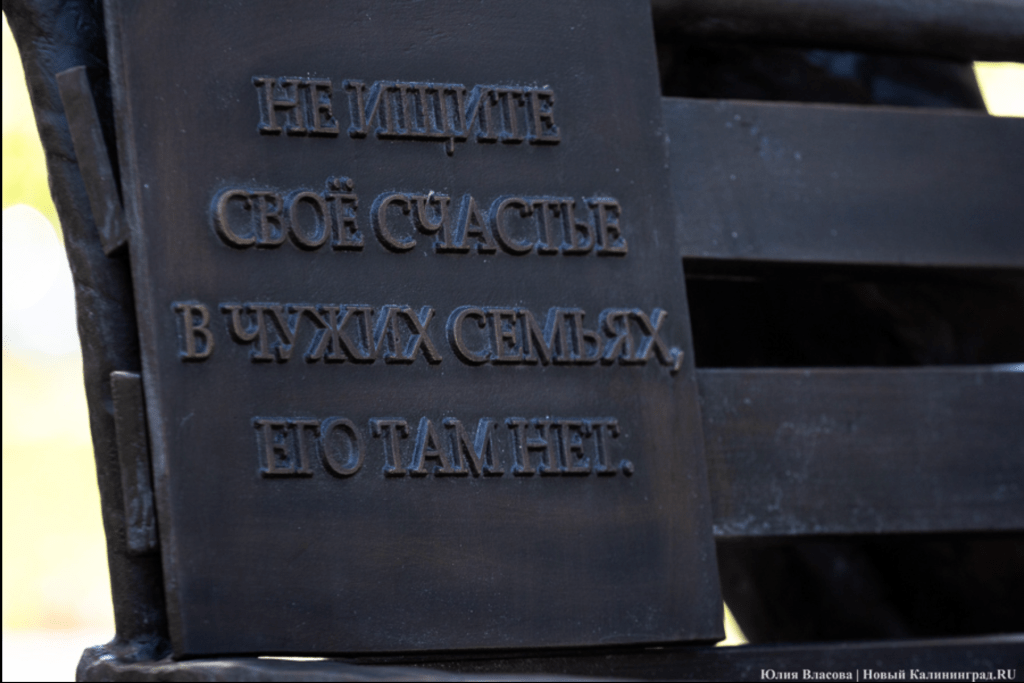
The unveiling ceremony took place on Thursday, May 11. The Happy Family is represented by a woman sitting on a bench with a small child surrounded by two more children, a man and a dog. On the same bench there is a sign saying “Do not look for your happiness in other people’s families. You won’t find it there.” A less noticeable sign is attached to the back of the bench, stating that “Happy Family Park was created by the Kaliningrad Diocese with the support of the Governor of the Kaliningrad Region Anton Alikhanov and Yevgeny Verkholaz.” Ivan Melnikov, a sculptor from Samara, authored the composition.
Both Governor Anton Alikhanov and Regional Legislative Assembly deputy Yevgeny Verkholaz joined Archbishop of Kaliningrad and the Baltics Seraphim in unveiling the monument. Verkholaz, in particular, called on everyone wishing for a happy family life to stroke the members of the sculpted nuclear family unit and make a wish, explaining that he himself, for example, had stroked the girl and fathered a daughter.
The event was also attended by the chairman of the Regional Legislative Assembly Andrei Kropotkin, the head of the Kaliningrad administration Elena Dyatlova accompanied by the new head of the city Oleg Aminov, State Duma deputy Marina Orgeeva, and Senator[sic]Alexander Yaroshuk.
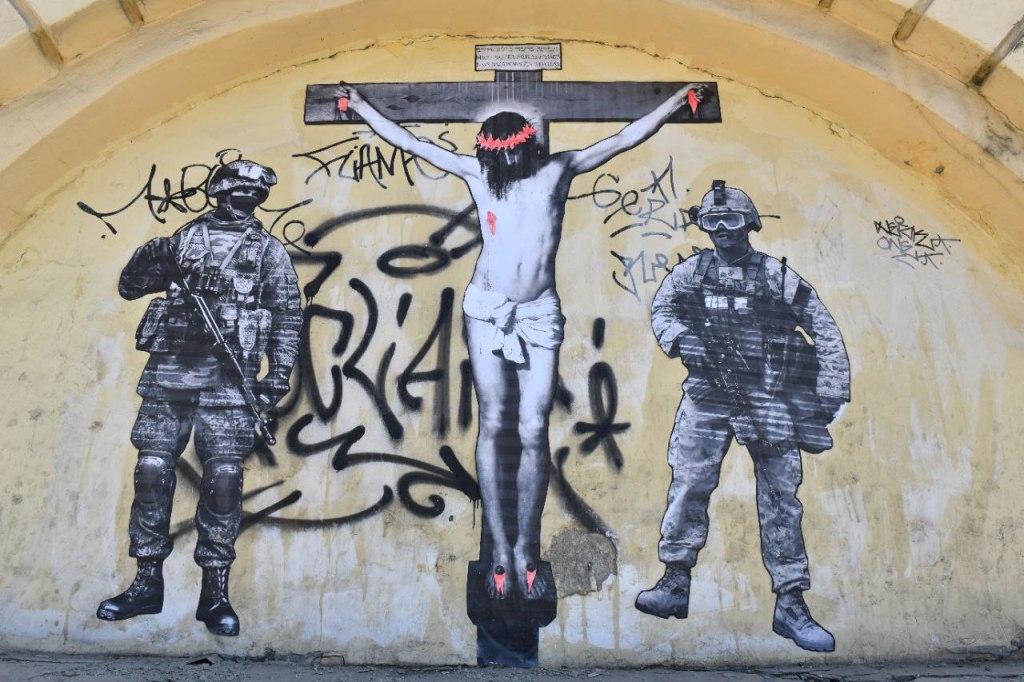
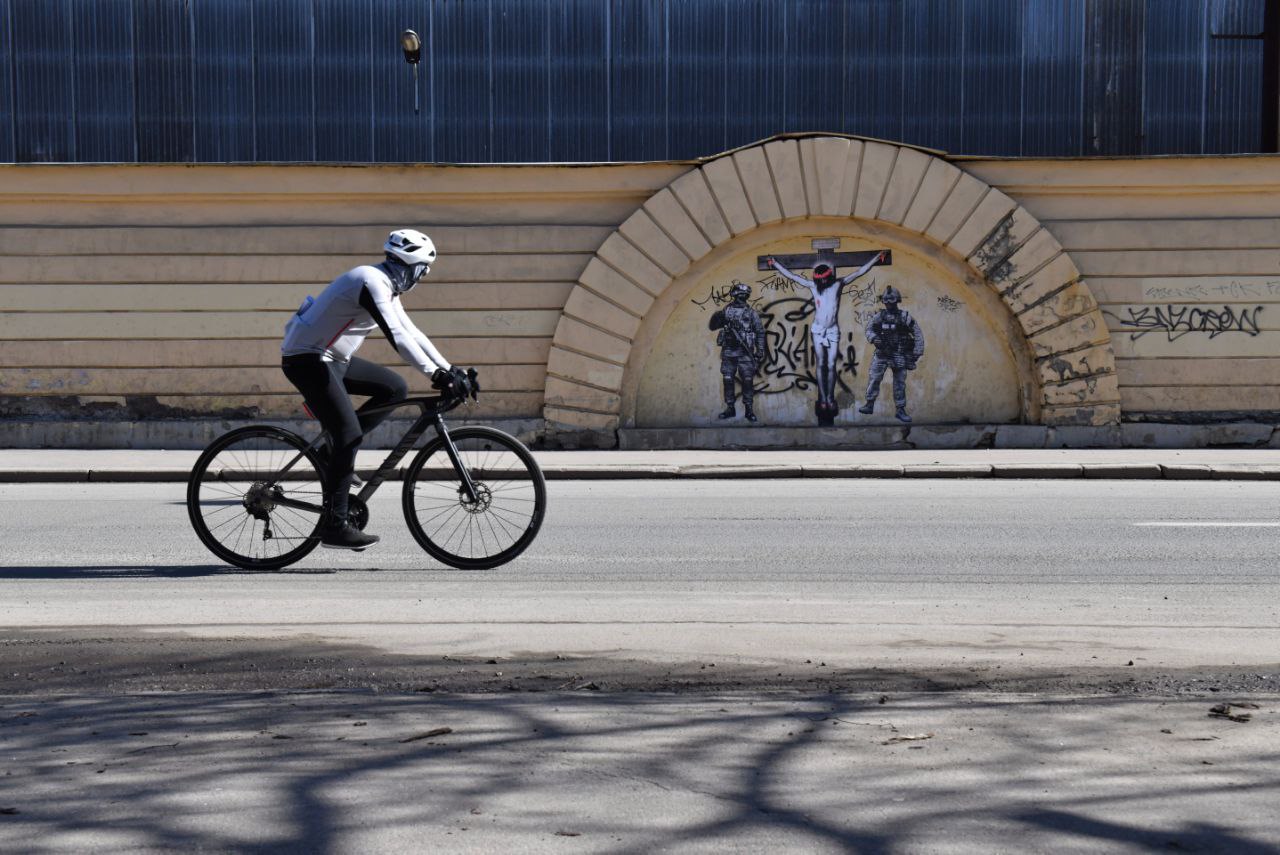
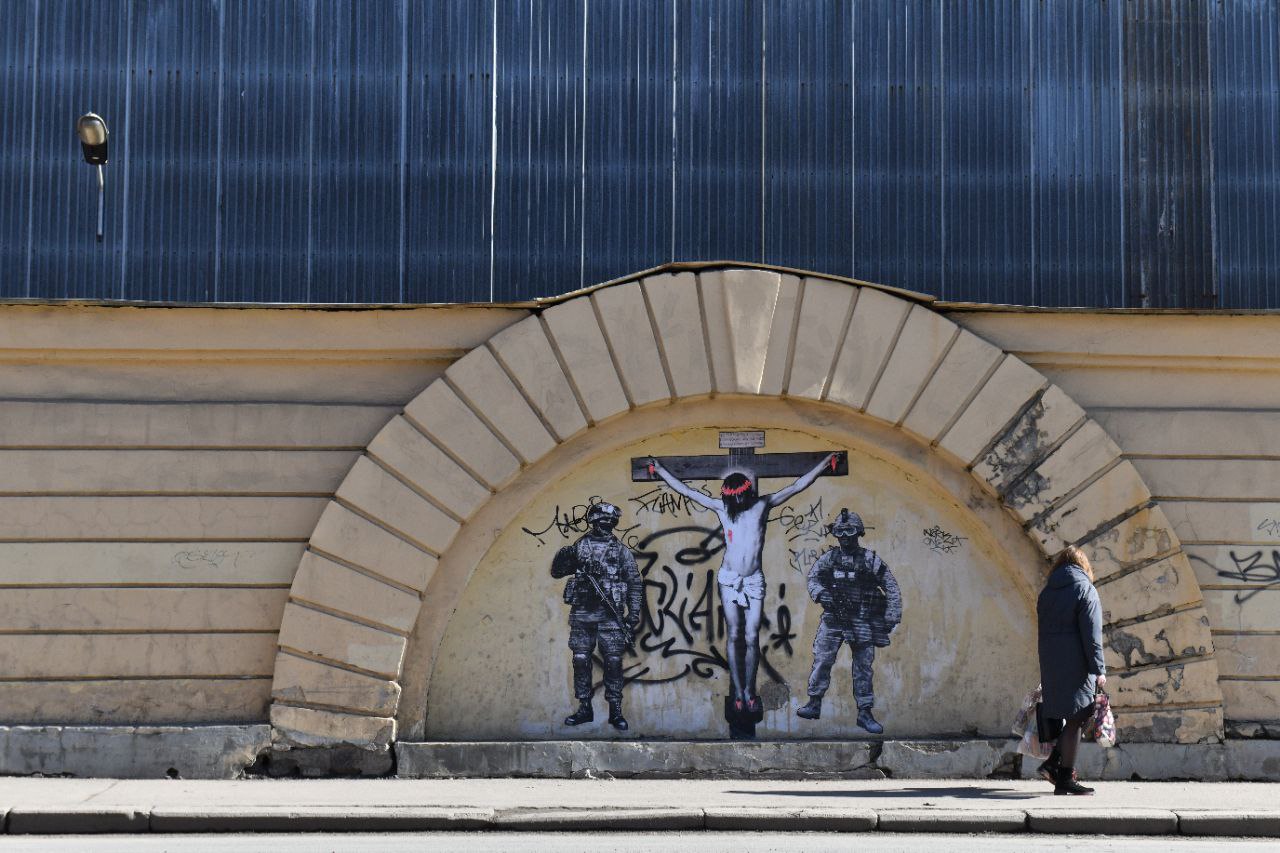
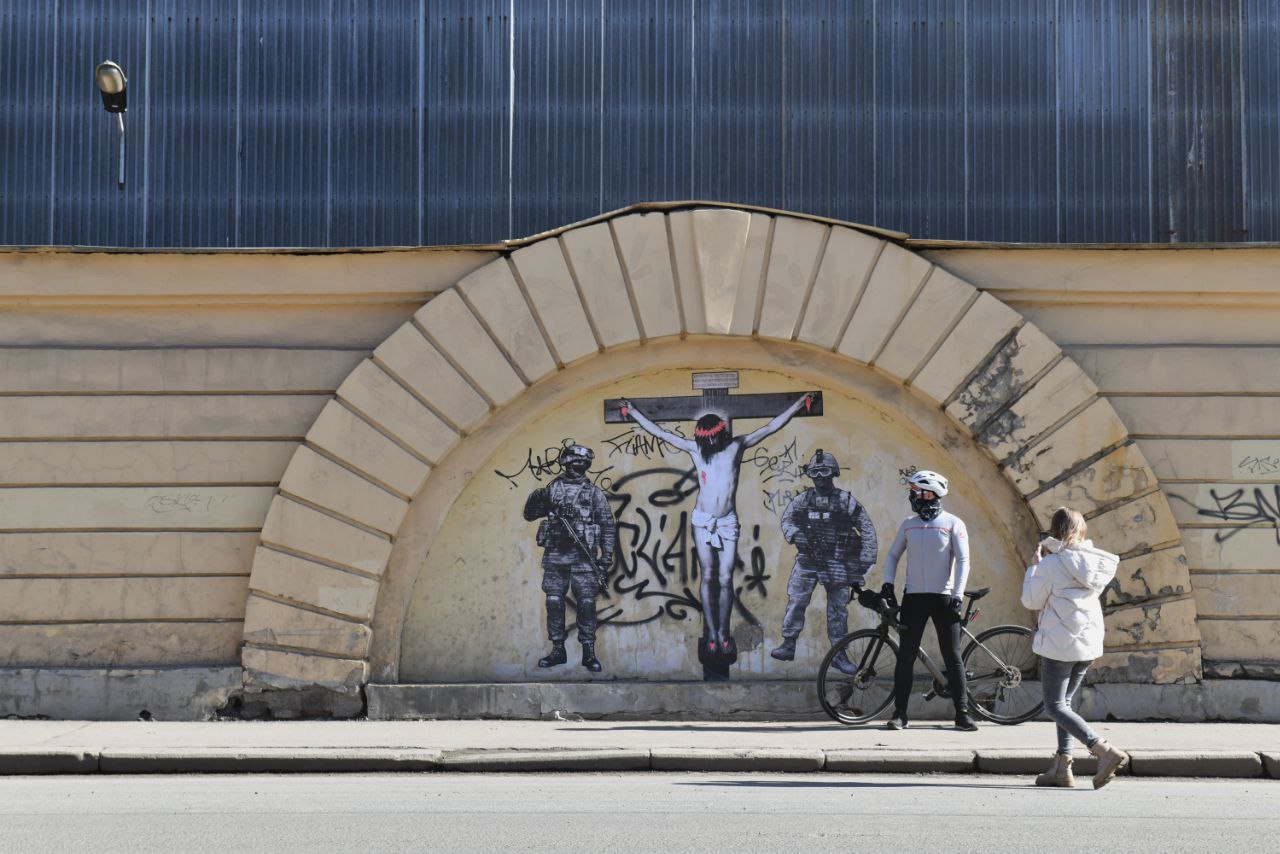
A piece of street art featuring a crucified Jesus Christ and two soldiers with no insignia on their uniforms has appeared on Vasilievsky Island’s Kosaya Liniya. As the author of the work, artist Vano Bogomaz, writes on Instagram, it is a collage that uses images from the internet and reproductions of Diego Velasquez’s painting Christ Crucified.
In his description of the work, Bogomaz quotes the words of Jesus on the cross: “Forgive them, for they not what they do.”
“Two thousand years have passed, and yet we still can’t stop doing evil,” Bogomaz writes. The work was occasioned by Good Friday.
Here we give our readers a glimpse of what the collage looks like and how passersby reacted to it.
Hi! My name is Sveta Nagaeva. Today is World Down Syndrome Day, and I have drawn a short comic strip for you.
(upper left panel): “A Conversation in the Subway” (upper right): “Look! There’s (a) Down! (middle): “Aargh!” (lower left): “Yes, it is I, John Down.” (lower right): “John Langdon Haydon Down.” “And I am Sveta Nagaeva, and this is…” “Timur!!!”
My son Timur has Down syndrome. This is no secret to anyone, especially for those who see him in person or in a photo. You can’t hide Down syndrome.
Very often Timur is identified precisely in terms of this syndrome — not as Timur, who likes drawing, pasta and ice cream. Naturally, Down syndrome is a part of our life, because Timur has it. But Timur is just a human being first of all, my favorite person. It’s a shame when people call him “(a) Down.” It sounds like an insult, and usually people pronounce the word with this strange intonation.
When Timur and I ride the subway, we usually draw. People often look askance at us, because Timur speaks quite unintelligibly for his age. I’m already used to the sidelong glances, but I would rather not get used to them.
I am an animated film director — I make cartoons — and I draw pictures for books and write texts. I have published several children’s books, including ChromoSonya, Forever?, Poisoned Words, BO Is for Lunch Today: How Tolya Ate Cougar, Matics, Valentina’s Dream, The Tail Is What Counts, and Pasha the Turtle Goes to School.
I would be glad if from now on when you say “Down” you would remember Dr. John Langdon Haydon Down, who lived in England in the nineteenth century and was the first to describe the genetic condition known today as Down syndrome.
P.S. The doctor’s surname is spelled the same as the English word “down” (meaning, “from a higher to a lower point”) resulting in the popular misconception that Down syndrome is mental retardation. In fact, the syndrome was named that in 1965 solely in honor of the doctor, with no further connotations.
Thank you for reading!
Sveta Nagaeva, filmmaker and artist
Source: Takie Dela emailed newsletter, 21 March 2023, as replicated here. Translated by Thomas H. Campbell
Academic freedom in the Putinist dictatorship is the freedom to criticize the enemy:
MARCH 17, 2020 | The media center at the Alexandrinsky Theater’s New Stage (Fontanka Embankment, 49A, St. Petersburg) will host the first event in a series of conversations between the outstanding scholars of our time, on the occasion of the European University in St. Petersburg’s 25th birthday. A conversation between historical sociologist and NYU Abu Dhabi professor Georgi Derlugian and Russian international affairs journalist, political scientist, and editor-in-chief of the magazine Russia in Global Politics Fyodor Lukyanov will open the series of encounter. The topic of their discussion is “TRUMP AND HIS DOCTRINE: HOW THE US PRESIDENT TREATS THE WORLD ORDER WITH SHOCK THERAPY.”
The freedom to imagine that a dictatorship is actually a hipster’s paradise:
MARCH 14, 2023 | The Open Living Room at the Lermontov Library (Liteiny Prospect., 17–19) will host a lecture by Yevgenia Kuziner, a graduate student at the HSE Center for Youth Studies, “POINT OF ATTRACTION: HOW, BY WHOM AND FOR WHOM ARE CREATIVE SPACES CREATED IN THE CITY?” | Starts at 6:30 p.m. | Registration required | Detailed information at https://otkrytaya-gostinaya.timepad.ru/event/2331631/
And the freedom to pretend that real sociology is possible in dictatorships:
APRIL 13, 2023 is the deadline to apply to the 19th Russian-Chinese Sociological Conference, “CONTEMPORARY CITIES AND SOCIAL GOVERNANCE IN RUSSIA AND CHINA,” which will take place April 21–22, 2023. The conference will be held in an online format and hosted by St. Petersburg State University, Russia. The languages of the conference are Russian, Chinese and English. Detailed information at https://soc.spbu.ru/images/nauka/inffo-letter_21-22.04.2023_3.pdf
Source: Excerpts from the emailed newsletter of the Center for Independent Sociological Research (CISR) in St. Petersburg, recently revamped as “The MILIEU” [sic], March 2020 and March 2023. Translated by the Russian Reader
The Forty-First is a completely original production.
It is chockablock with irony and actorly improvisation.
There will be loads of laughter, convulsive choking back of tears, fond embraces, and love gushing down the throat during this play. As it wafts into the theater’s low flies, the powerful actorly energy is instantly transmitted to the audience.
This is a restoration of Vlad Furman’s legendary production The Forty-First, based on the novel [sic] of the same name by Boris Lavrenyov.
The love story of the Red Army sniper Maria Basova (aka Maryutka), picking off “enemies” one by one (the thirty-first, the thirty-second… the forty-first!), and the White Army officer Govorukha-Otrok (who was to be her forty-first victim, but survives) is known to audiences from Grigory Chukhrai’s eponymous film version, starring Izolda Izvitskaya and Oleg Strizhenov.
Vlad Furman staged The Forty-First at the Mironov Theater in 2000. It was one of the best theatrical productions in Petersburg, and its director and performers were nominated for Petersburg’s highest theatrical honor, the Golden Spotlight.
Boris Lavrenyov’s story is incredibly timely today.
Love is severely tested by the Civil War and differences in political views.
A new generation of actors takes to the stage in this new production of The Forty-First.
Twenty years later, the production features very young artists who have been working with Vlad Furman for several years in stagings of The Merchant of Venice and Medea. The older generation of artists at the Andrei Mironov Theater joins them in this production.
Source: Bileter.ru. Still from the play The Forty-First courtesy of the Andrei Mironov Theater (St. Petersburg). Translated by the Russian Reader
In March 1942, Pierre Matisse, an art dealer and son of the artist Henri Matisse, opened the show Artists in Exile at his gallery in New York’s Fuller Building. It featured one work each by fourteen artists who had fled the rising tide of fascism and totalitarianism in Europe. Max Ernst, Marc Chagall, Fernand Léger, André Breton , Piet Mondrian, Jacques Lipschitz, Ossip Zadkine, and the other men (not a single woman was shown at exhibition) came from different countries and strata of society and represented different modernist trends in art: Dadaism, Surrealism, Cubism, and De Stijl. Since the late 1930s, these trends had been vilified and condemned, and in many cases their works had been destroyed by the Nazis as so-called degenerate art.
Many of these artists were aided by art dealers and patrons such as Pierre Matisse, and collectors such as Peggy Guggenheim. Museums also played a vital role in helping artists and their immediate families. The first director of the Museum of Modern Art Alfred Barr and his wife, the art historian Margaret Scolari Barr, worked with the Emergency Rescue Committee (ERC). The artistic community, founded as it was on humanist principles and nonviolence, generally did what it should have done: it sought to render mutual aid and fight evil.
[These two opening paragraphs seem to have been plagiarized, in translation, from this article, originally published on the website of the WWII National Museum in New Orleans, to which I have already linked above — TRR.]
Eighty-one years later, the director of the seemingly progressive Multimedia Art Museum, Olga Sviblova, appeared at the Knowledge Society Awards in the Kremlin — along with Yana Churikova, Fyodor Bondarchuk, and Polina Gagarina. Immediately after the war started, a year ago, the Garage Museum issued a high-profile essentially anti-war statement and halted all exhibitions. It could have served as an example and an impetus for other institutions to stop the widespread normalization of the war, but this has not happened. A year later, we find that museum’s statement has itself disappeared* from all official sources.
*UPD: We were mistaken. The announcement on the suspension of exhibitions remains on the museum’s website, but doesn’t appear on the main page anymore. The museum also currently shows archive-based artists projects.
Alas, we can safely say that the art community in Russia passively supports the war, living it up in the public space at venues somehow associated with contemporary art. Why is this happening? Shouldn’t the artistic community be grounded in humanist principles and nonviolence? How did it happen that (with rare exceptions) the Russian art scene, which survives mainly on government money but aspires to be part of the global community, has been silent in the midst of war? Juliet Sarkisyan, an art critic who blogs at the Telegram channel Juliet has a gun, answers these questions.
Since the war’s outbreak members of the culture community have been leaving Russia because they do not agree with the state’s current repressive and imperialist policies. They do not see any prospects here at home: they do not want to merge with the masses and have anything to do with the official agenda. They generally leave for the opportunity to speak freely and make art. But some do not see the point in producing the latter at all (at least while the war is going on), since this can free up resources and time for helping Ukrainians, as well as showing solidarity through their silence.
A narrow stratum of the artistic community underwent a reorientation — instead of the usual artistic practices, they have preferred to engage in activism, and art criticism became homogeneous. Some continue to do it anonymously in Russia, while others have been forced to leave the Russian Federation for this reason (and many others). In any case, for reasons of security, I cannot give anyone’s surnames and first names as examples. The other part of the artistic community — apparently, the prevailing one — continues to engage in the production of art, come hell or high water, within Russia’s current system. Putin recently issued a decree on the “Fundamentals of State Cultural Policy,” which is designed to reaffirm traditional values and introduce censorship for cultural events. I would like to take the liberty to criticize cultural workers (opposed to the war) who blindly continue their artistic endeavor inside Russia, while also taking into account all the difficulties and, as it were, the impossibility of choice they face. But first we need to figure out who cultural figures are and what their mission is.
What exactly is this “artistic community” face to face with this war? Are they intellectuals or an intelligentsia? In the modern use of the terms “intelligentsia” and “intellectuals,” there are two markedly pronounced trends. The first is typified by the synonymous use of terms, implying, in fact, the merging of the concepts. The second trend involves preserving and consistently distinguishing both the terminology and the concepts themselves.
Michel Foucault identifies intellectuals “in the political, not the sociological sense of the word, in other words the person who utilizes his knowledge, his competence and his relation to truth in the field of political struggles.” [This passage is not in quotation marks in the original article, although it is a direct quotation.] In the first part of the book Intellectuals and Power [a three-volume 2002 Russian-language compendium of his articles and interviews] Foucault writes: “What we call today ‘the intellectual’ […] was, I think, an offspring of the jurist, or at any rate of the man who invoked the universality of a just law, if necessary against the legal professions themselves (Voltaire, in France, is the prototype of such intellectuals). […] [T]he intellectual has a three-fold specificity: that of his class position (whether as petty-bourgeois in the service of capitalism or ‘organic’ intellectual of the proletariat); that of his conditions of life and work, linked to his condition as an intellectual (his field of research, his place in a laboratory, the political and economic demands to which he submits or against which he rebels, in the university, the hospital, etc.); lastly, the specificity of the politics of truth in our societies” [Michel Foucault, Power/Knowledge: Selected Interviews and Other Writings, 1972–1977, ed. Colin Gordon (1980), pp. 128–132].
Antonio Gramsci also spoke about the organic intellectuals mentioned by Foucault. The Italian [sic] believed that there was not one, but many different types of intellectuals. Intellectual activity does not necessarily imply devotion to the ideas of socialism. Most intellectuals, Gramsci noted, were reluctant to change or saw themselves not as conservatives or liberators, but rather as technical thinkers. Gramsci offers a convenient series of distinctions among organic intellectuals, traditional intellectuals, and intellectuals of the new type.
Organic intellectuals form a completely different type of social stratum. Their activity consists “in active participation in practical life, as constructor, organiser, ‘permanent persuader’ and not just a simple orator” (Gramsci, 1971: 10) [sic: Antonio Gramsci, Selections from the Prison Notebooks, ed. and trans. Quentin Hoare and Geoffrey Nowell Smith (1971), p. 10]. “Organic intellectuals” [quotation marks — sic] not only have special knowledge, but also become legislators of meanings: they have a special understanding of what is happening and are actively involved in politics.
(Left to right) Russian businessman Leonid Mikhelson, founder and funder of the arts organization the V-A-C Foundation; V-A-C publishing programs director Grigory Cheredov [full disclosure: Mr. Cheredov has commissioned me many times in the past several years to translate texts for V-A-C, which I happily did because he and his colleagues were easily among the most decent and professional of my Russian art world clients, at least until the war broke out and they failed to pay me for the last two jobs I had done for them before the war — TRR]; Russian president Vladimir Putin; and Moscow mayor Sergei Sobyanin, at the V-A-C Foundation’s newly opened art and culture space, GES-2 House of Culture, December 1, 2021
No matter how intellectuals are defined — as bearers of culture or as critically thinking people — it is obvious that in the twentieth century there were significant changes in the organization and nature of intellectual life. The most widespread meaning of the word “intellectual” is even narrower and includes a political dimension. Real intellectuals are those who go beyond their immediate area of expertise to intervene in public policy issues, usually in a spirit of disagreement with the authorities. This concept was first popularized by the archetypal intellectual Jean-Paul Sartre.
And Jürgen Habermas, a major theorist of the Frankfurt School of social philosophy, who has paid serious attention to the theory and practice of politics, was convinced by his own experience of the effectiveness of such an approach to political life. He has argued that “philosophers, along with writers, historians and other experts, should act in the public sphere as intellectuals and least of all as interpreters and elucidators of any one doctrine.” [This is a quotation from an 1989 interview of Habermas by Yuri Senokosov, as published, in Russian translation, in Jürgen Habermas, Democracy, Reason, Morality: Moscow Lectures and Interviews (Moscow: Academia: 1995), pp. 109–110. Judging by the peculiarly specific way it is introduced here by Ms. Sarkisyan, the wording was discovered by her in Elena Iosifovna Kukushkina, “The Intelligentsia in the Political Life of Society,”Vestnik Moskovskogo Universiteta, Series 12: Political Science, 4 (2012): 21, where the passage in question is incorrectly indicated as being on page `113 of the book —TRR.] In 1953, he took on Martin Heidegger in the wake of the latter’s newly discovered Nazi sympathies in a review of Heidegger’s book Introduction to Metaphysics. In the late fifties and early eighties, Habermas was involved in pan-European anti-nuclear movements, and in the sixties he was one of the leading theorists of the student movement in Germany, although in 1967 he actually broke with the radical core of this movement when he warned about the possibility of “leftist fascism.” In 1977 he protested against the restriction of civil liberties posed by domestic anti-terrorist legislation, and in 1985–1987 he was involved in the so-called historians’ debate on the nature and extent of Germany’s guilt in the war, condemning what he considered historical revisionism of Germany’s Nazi past. He also warned about the dangers of German nationalism in connection with the unification of Germany in 1989–1990.
Intellectuals from different countries — the scientists, writers, artists and humanists of the twentieth century — amassed a wealth of experience in solving problems on a global scale. In the period between the two world wars, they led anti-fascist movements and fought to prevent interethnic conflicts and liberate countries from colonial dependence. By initiating and being actively involved in these campaigns, the world cultural elite demonstrated the intelligentsia’s truly inexhaustible possibilities of the intelligentsia as a force capable of having a tangible impact on political processes at different levels. [This paragraph has been copied almost verbatim from page 22 of Elena Kukushkina’s scholarly article, as cited above — TRR.]
The cultural and artistic community — whether it consists of intellectuals or not — has the weight, influence, and social capital to make the fight against the current regime effective. As for their responsibility, they are capable of exposing the lies of governments and analyzing their actions in terms of causes, motives, and often hidden intentions. Privilege confers opportunity, and opportunity imposes responsibility. For me, the urgent question today is what responsibility should Russian society, in particular the intelligentsia (of which the artistic community is a part), bear when it comes to horrors of the full-scale war in Ukraine. And of course, this question (about the responsibility borne by people of the aggressor nation for the war it has launched) is not new at all.
The philosopher Noam Chomsky, for example, criticized the American government and the Vietnam War in the book [sic]The Responsibility of Intellectuals. Privilege, he argues, entails the responsibility to tell the truth and expose lies. But our intellectual culture supports this ideal only nominally. Yes, it is forbidden in Russia to publicly voice an opinion that differs from the government’s rhetoric. Otherwise, one risks criminal prosecution, which can even lead to imprisonment. What other options are left if a basic human need — freedom of speech — is taken away from us? Are there niches in which we can preserve our humanity while also avoiding tentacles of the state? It seems that during a war it is difficult to engage in aesthetics. It takes us down the path to escapism and the opportunity to close our eyes to everything that is happening around you us. In peacetime, there are trends that establish a certain regime for artists.
But since the beginning of the war, Russian public cultural activity has not undergone any structural changes or even hints of them. New galleries and cultural centers have been opening (e.g., the Zotov Center, Nakovalnya Gallery, and Seréne Gallery), and the old ones continue to operate as if nothing has happened.
Only a few such venues have curtailed their public programs (and not all of them due to political convictions): Typography Contemporary Art Center, Kerka Gallery, the space It’s Not Herе, the Sphere Foundation (the former Smirnov and Sorokin Foundation), Fragment Gallery, and the Garage Museum. Where does normalization come from? The government has been sparing no efort to hide the war crimes that it commits every day, not only with the help of propaganda, but also through attempts to preserve the normal life that existed before the war. Tomorrow will be the same as today. This illusion of normality also occurs in everyday life. The cultural realm has also played a considerable role in generating it. All the existing cultural institutions and people involved to one degree or another in the production of public life are this totalitarian regime’s witting or unwitting opportunists.
Russian curator Olga Sviblova at the Knowledge Society’s awards ceremony at the Kremlin, December 13, 2022. The society has adopted a suggestively Roman (i.e., not Cyrillic) and thus pro-war “Z” as its logo, as seen behind Sviblova.
The Russian intelligentsia, as represented by the artistic community (if it can be called that at all), is against the war in Ukraine. But even if it verbally opposes war crimes and imperialism, it supports the existing state of things in its actions, thus contradicting itself. Collaboration with institutions (especially those directly dependent on the Russian federal culture ministry, whose head in an interview called for killing Ukrainians) and the absence of discussion about rethinking the cultural field within the country suggest that the cultural community refuses to react at all to the events taking place this minute in Ukraine. It refuses to accept any responsibility for what is happening.
Fairs, exhibitions, public educational outreach, and the production of uncritical art only perpetuate the status quo and play along with the official agenda. To understand what I am talking about, look at the list of exhibitors at the Cosmoscow Art Fair in September 2022. The fair, to which Putin’s spokesman Dmitry Peskov was invited, imposed strict censorship on its participants.
This familiar pre-war environment is exactly what the government wants to see. We have seemingly begun to forget that we live in a totalitarian state, and everything we produce on its territory is part of it and monitored thanks to the presence of a single comprehensive ideology. What kind of art production can we talk about when there is strict censorship of all legal channels of information? Censorship is usually exercised in the name of so-called national security interests or as part of larger-scale campaigns to protect morality. (In our case, this is the policy to preserve and strengthen “traditional Russian spiritual and moral values.”)
Regimes try to monopolize artistic production either by co-opting artists to the point that they become mouthpieces and servants of the state, or by restricting the access of independent artists to places for displaying and implementing artistic expression. What kind of independent public art can we talk about? The usual strategies of artistic activity no longer work. It’s time to admit it.
We have begun to forget that no uncritical culture is possible at a time when the mass killings of civilians, violence, and torture are taking place daily, and the integrity of a sovereign neighboring state is being destroyed. What kind of art production in the Russian Federation is there to talk about when you are a member of the aggressor nation? Even if you adhere to an anti-war stance, how can art in state-controlled institutional venues be perceived from the outside as anything other than serving this regime?
Russian culture should be held accountable for the war in Ukraine. But people often downplay the importance of culture in political and public life, regarding it as a separate part of the personal realm rather than as a fusion of the forms of social interaction. We need to recognize that the current regime did not suddenly emerge on February 24, 2022. It had to be built up and supported for many years to officially establish itself once and for all and launch a full-scale war in Ukraine. All these years we ignored this build-up, living in a world of illusions. Unfortunately, this illusion is still maintained. In many ways, it is created by part of the cultural and artistic communities.
Russian rapper Timati and fashion designer Masha Tsigal at Cosmoscow Art Fair, September 2022
Many people who have remained in Russia might not agree with me. How can artists earn money without resorting to public utterance and without cooperating with institutions? How can galleries stop working? After all, this is their source of income (although it often does not bring in money, but vice versa). How can we just come to a standstill and not produce anything?
But does everyone really continue to work because of economic dependence, and not out of social necessity — that is, because they belong to a scene where there is a fear of losing the context that gives a person meaning? It boils down either to staying, accepting the state of things, and leading your normal life (as far as it is possible to do that at all now) or giving up on it and leaving. Of course, this dichotomy is not the only one: there are many other ways of living this war. None of us, including me, has answers to these questions. The question, rather, is whether we are aware of what kind of force and political dimension our position can have and what responsibility we should have to Ukraine. Time will pass and the question will arise: how did the Russian intellectual community behave during the war? Silence is also an answer, however.
The ruins of the Arch of Triumph (also called the Monumental Arch) in Palymra, 2010. Photo courtesy of Wikipedia
In April, the project for restoring the Arch of Triumph, the most famous structure of the Syrian city of Palmyra, should be ready and presented to the public, according to our sources involved with restoring the ancient city.
The Petersburg organizations involved in the project have been doing their design work remotely. They considered it safer because, according to the restorers, not all the terrorists in Syria have been “pacified” yet.
The restoration is coordinated by the Institute of the History of Material Culture (IIMC RAS), which signed an agreement on the restoring the arch with the Syrian Department of Antiquities in March of last year. The details of the agreement are unknown. In November of last year, the archaeological excavations were completed. The project also involves the State Hermitage Museum and the architectural firms of Maxim Atayants and Studio 44. Atayants, as a connoisseur of antiquity, is more responsible for the “theoretical” part, that is, for the choice of approach. Five specialists from Studio 44, including Nikita Yavein, the head of the firm, are involved, and they are working on technical issues. According to sources, other firms are also involved — for example, the restoration company Agio.
The Arch of Triumph itself was built during the reign of Roman Emperor Septimius Severus (193–211 CE) and, apparently, glorifies his victories. It underwent restoration involving reinforced concrete elements in the 1930s. The arch was partially destroyed in 2015, during the Syrian civil war. The central span and one of the pylons collapsed.
More alive than Buddha
Until recently, it had not been decided exactly how to restore the arch — to its state at the time when terrorists attempted to blow it up (which means reproducing the version produced by the restorers in the 1930s), or in some other way. The Venice Charter on the Conservation and Restoration of Monuments and Sites stipulates that monuments should be preserved in the form in which they have come down to our time. According to established practice, reconstruction by means of anastylosis, as the most sparing method, is permitted for ancient ruins. In this approach, the surviving stones are put back in place. But experts do not want to limit themselves only to anastylosis in the case of Palmyra.
First, it would look uninteresting: the edifice would not make the proper impression, and it is probably not worth the effort. Second, much of the stone in the lower part of the arch has been lost or compromised and would still have to be reinforced or recreated. According to the IIMC RAS, about 40% of the structure remains standing. Another 30% of the stone blocks are not in their place, but they can be used in the restoration. The remaining sections are partly or completely destroyed. That is, there is slightly less genuine material than is usually required for a restoration (i.e., 80-90% of authentic stone). UNESCO has long refused to restore the statues of Buddha blown up by the Taliban in Afghanistan (they have not yet been restored) precisely on the grounds that a significant part of the stone was lost.
Archaeological diplomacy
Meanwhile, the project for the arch must also be vetted by UNESCO since Palmyra is a World Heritage Site. Moreover, not everything is cut and dried when it comes to UNESCO, as shown, for example, by the rather critical report issued by its monitoring mission that visited Russia in 2019.
Two arguments have been drawn up to justify the design decisions to high-level international institutions. First, that the recreation would be reversible. That is, sometime in the future the arch could be disassembled again if so desired and the new inclusions (such as the “crowns” on the stone blocks) removed, and it would look more or less as it looked before it was blown up. The second argument is that the arch is a symbol of both Palmyra and all of Syria. And in the case of symbols, recreation seems to be permitted.
The issue turns out to be largely legal. Perhaps that is why Alexei Mikhailov, the deputy chair of the city’s Landmarks Use and Preservation Committee (KGIOP), known, in particular, for his work designed historical preservation zones in central Petersburg, has been appointed to the team of restorers. In a comment to the TV channel Saint Petersburg, Mikhailov drew an analogy with Notre Dame Cathedral. Located in Paris, like UNESCO’s headquarters, the cathedral is currently undergoing reconstruction after a fire in 2019.
“We are now drawing the parallel that the arch of Palmyra is as much of a symbol as Notre Dame is for Paris. And it is a reconstruction that is underway there. This is very important and must be conveyed to our international colleagues. It will determine which form of restoration will be employed,” Mikhailov said.
Our sources say that negotiations were held with Petersburg restorers about restoring other sites in Palmyra and Syria. Apparently, they intensified after the devastating earthquake that hit Syria about a month ago. (According to the Syrian Arab News Agency (SANA), aftershocks from that quake continue to occur.) Last week, Vedomosti reported, citing a diplomatic source, that Syrian President Bashar al-Assad is scheduled to visit Russia. As one of that newspaper’s sources suggests, he may ask for Moscow’s help in recovery work.
Scholars without borders
Petersburg experts agree that it is necessary to maintain world heritage. They disagree only about whether such aid is a burden or not.
“I don’t think it’s a lot of money compared to other government spending,” Alexander Kitsula, vice president of the St. Petersburg Union of Architects, told DP. At the same time, he noted that, with all due respect to the history of Petersburg, the antiquities of Palmyra “are incomparably more important than the excavations at Okhta Point.”
“It is wrong to let world culture be lost in any case, and if our country has reserves that can be sent there, it is probably the right thing to do. But, of course, our country also has huge holes in this area,” he believes. The expert emphasizes that Russia’s antiquities are no less in need of attention than foreign ones.
“My personal opinion is that we still have tons of work to do here at home. And this is far from a first-degree problem for the Russian Federation in general. But if someone has decided that it has to be done, then it has to be done,” Pasechnik added.
Alexei Kovalyov, a researcher at the Institute of Archaeology of the Russian Academy of Sciences, sees no problems in the fact that our scholars are also at work in Palmyra.
“St. Petersburg has been one of the world’s major centers for archaeology. Our expeditions are working in the South Caucasus and Central Asia, and our expedition in Iraq has just been resumed. Such projects are part of our international policy: they are usually funded per intergovernmental agreements. In the case of Palmyra, this means the Syrian side,” Kovalev explained. He also added that there are many specialists in ancient monuments working in Petersburg who know the peculiarities of the architecture of the period to which Palmyra belongs.