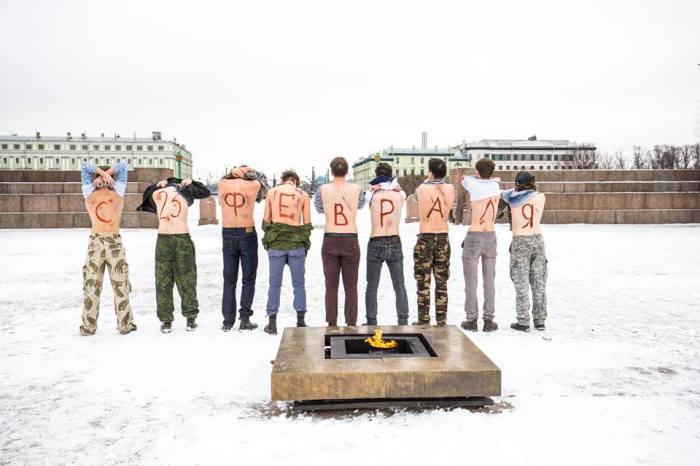
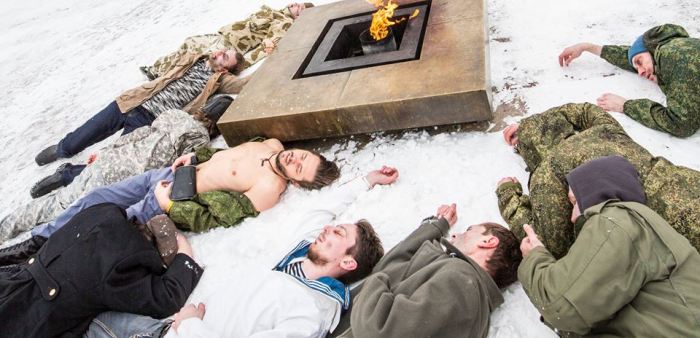
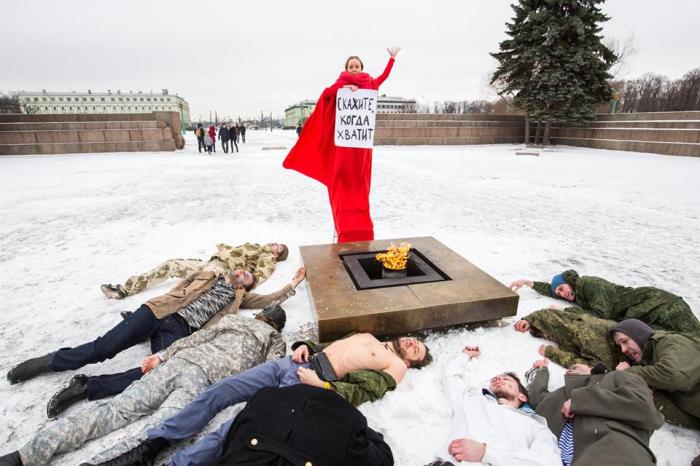
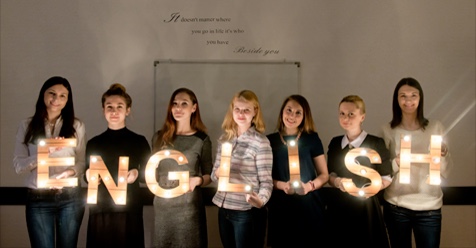
On February 23, female feminists spoke out—finally!—in defense of men.
The Eternal Flame, Field of Mars, Petersburg
“We think the very idea of ‘defenders’ is one of the pillars of oppression, whether ethnic, gender or whatever other kind. From the time they are babies, men are inculcated with the notion that they must be defenders. Actually, however, they are merely taught to behave aggressively and completely suppress their emotions. And they grow up as people prone to exercise violence and control. They become cogs used by those in power, dogs who have been taught a single command: ‘attack.’
“We believe society must change, that a more humane society is a sign of progress. Armies and armed conflicts must become things of the past, like human sacrifice and the bonfires of the Inquisition. Like the first winged chimeras, which had been built but still could not fly.”
“Say When You’ve Had Enough”
Photos by David Frenkel. Translated by the Russian Reader
Panelists: Agnieszka Holland (Director), Askold Kurov (Director), Mike Downey (Producer), Dmitry Dinze (Lawyer of Oleg Sentsov), Natalya Kaplan (Cousin of Oleg Sentsov), Sylvia Schreiber (Translator)
Thanks to Alexei Markov for the heads-up
___________________________
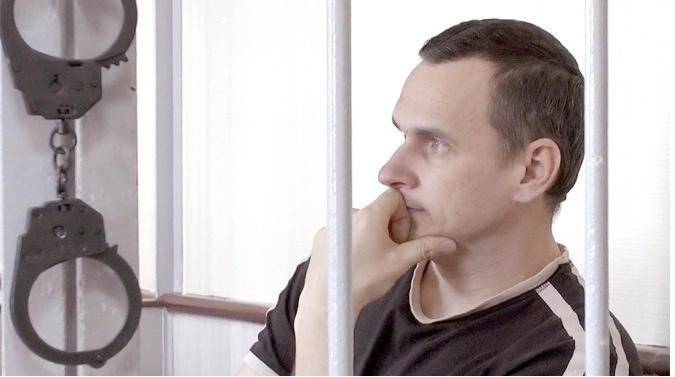
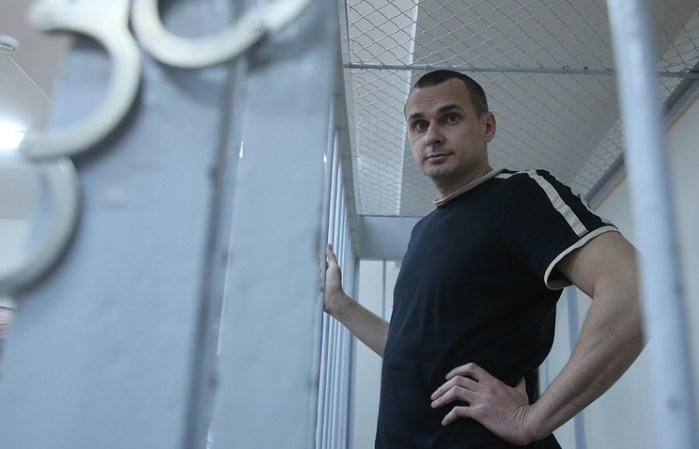
Oleg Sentsov. Courtesy of Berlin Film Festival
Berlin Film Review: ‘The Trial: The State of Russia vs Oleg Sentsov’
Owen Gleiberman Variety
February 11, 2017
A documentary about the Ukranian filmmaker imprisoned for his support of Crimean independence is a scrappy testament to the true nature of the Vladimir Putin regime.
It has to rank as one of Donald Trump’s most shocking statements — which is really saying something. Asked by the Fox News host Bill O’Reilly how he could respect Russian President Vladimir Putin, whom O’Reilly characterized as a “killer,” Trump replied, “There are a lot of killers. Boy, you think our country’s so innocent?” Over the last year, Trump has presented himself as a racist, a bully, a manhandler of women, a mocker of the disabled, and a loony-tunes conspiracy theorist. But whoever thought he’d come off sounding like the second coming of Noam Chomsky? The notion that the United States government routinely engages in “killer” behavior commensurate with that of what Russia does is, of course, a left-wing idea. (Just ask Oliver Stone, another Putin apologist who should know better.) But Trump put a new spin on it: Whatever the motivation (his desire to tilt the axis of global power against China? Burying those rumored water-sports videos?), he was so intent to claim that his new BFF Vladimir is, you know…not so bad that he was willing to hijack 50 years of radical academic moral relativism by reducing it to a Trump sound bite.
All of which makes me wish that Trump would sit down and watch “The Trial: The State of Russia vs Oleg Sentsov,” a documentary that just premiered at the Berlin Film Festival. It’s a peek into how the Russian state actually operates, and though it raises more questions than it answers, it leaves you with a shuddering chill. The central figure, Oleg Sentsov, is a Ukrainian writer and filmmaker known for his 2011 movie “Gamer.” In Russia, it made him a directorial star, but during the 2014 Crimean crisis he became part of the AutoMaidan movement, devoted to keeping Ukraine — and, specifically, Crimea — independent of Russia. He delivered food and supplies to Ukrainian servicemen, but on May 11, 2014, he was arrested and charged with organizing a terrorist cell, plotting terrorist attacks, and trafficking in illegal arms. He was held indefinitely and is now serving a 34-year prison sentence in Siberia. (The movie ends with clips of that Siberian prison. Have you ever seen Siberia? It looks like … Siberia.)
We’re shown footage of Sentsov in TV interviews during his moment of indie-film fame and then, a few years later, speaking from behind bars in the courtroom (yes, there’s a jail cell in court). Tall and husky, with dark cropped hair, popping eyes, and a grin of goofy optimism, he’s the father of two teenagers, and if you were looking for someone to play him in a movie, it might be Bradley Cooper; he has that kind of rubbery resilience. A number of noted directors — Wim Wenders, Agnieszka Holland — show up to testify to his status as a filmmaker.
In “The Trial,” Sentsov embraces his role as a political prisoner, yet the movie reveals what the stakes are: When he talks to his daughter on the phone, we see the price paid by any dissident — not just the personal agony of incarceration, but the ripped bonds of family. Sentsov was subjected to torture in prison, all to produce a confession to activities that never happened. (He didn’t confess.) The reason “The Trial” is a valuable document, even though it’s not an especially good movie, goes right back to Putin. It was Sentsov’s status as an art-house celebrity that made him a target in Russia. The regime arrested many “terrorists,” but he was held up as an example to the elite, intellectual class. The message was: If we can do this to him, we can do it you. The real terrorism came from the government, a way of driving fear into those who might speak out.
Russia swims in a daily ice bath of fake news (and real-news clampdown), which is why documentaries have been some of the only vehicles for revealing Vladimir Putin’s thug tactics. Ten years ago, the barely seen film “Poisoned by Polonium: The Litvinenko File” was the first inquiry to amass serious data suggesting that what Bill O’Reilly said about Putin is true. In “The Trial,” we see extended clips of Putin addressing the Sentsov case (a member of the Russian Parliament bows and scrapes before Putin so nervously it’s like seeing an outtake from “The Godfather, Part II”), but Putin, in public, is no glowering fascist. He comes off as impeccably civilized and almost geekishly seductive. He makes you want to be his friend. That, of course, is his version of smoke and mirrors.
Directed and shot by Askold Kurov, a Russian filmmaker as brave as his subject, “The Trial” is a thrown-together movie that doesn’t have much of an arc. It’s 75 minutes long, and to be brutally honest, I would have been just as happy watching Sentsov’s story compressed into a “60 Minutes” segment. Yet whatever its flaws, a movie like this one is necessary. It speaks the truth about the Russian regime — the truth that’s buried by Putin, and now buried by our own president, who only dreams that he could do the same thing to his enemies. More than ever, global film culture needs every documentary that lets you stare into the face of oppression with eyes wide open.
Berlin Film Review: ‘The Trial: The State of Russia vs Oleg Sentsov’
Reviewed at Cinemaxx (Berlin Film Festival), February 10, 2017. Running time: 75 min.
Production
A Ceská televise, Prag production in cooperation with the Polish Film Institute.
Crew
Producers: Max Tuula, Maria Gavrilova, Dariusz Jablonski, Izabela Wójcik, Violetta Kaminska.
Crew
Director: Askold Kurov. Oren Moverman. Camera (color, widescreen): Kurov. Editor: Michal Leszczylowski.
With
Oleg Sentsov, Vladimir Putin, Agnieszka Holland, Wim Wenders.
And now, a word from our sponsor, the common cause.
Constructing life, however, is undoubtedly tantamount to producing culture. The life that man constructs consciously is, in fact, culture. Culture is the totality of man’s advances in transfiguring the world. Culture is the world, altered by man according to his mind’s ideals.
But culture, in this case, includes not only theoretical and symbolic endeavors, as encapsulated in science and art. A significant and essential part of culture are those modes of work that really change the world around us, not merely in thought and imagination. They include economics, production, agriculture, engineering, medicine, eugenics, practical biology, education, and so on. Indeed, an overview of all the current research and trends makes plain that culture’s contents are revealed as the things people actually to change reality using these means. Culture is not only pure science and pure art, but definitely consists in applying them to production, the mining and processing industry, labor, and technology. Hence, we can say that culture’s ultimate meaning and goal are actually to improve and transform the world through nature’s rational management.
The new culture of the future involves nothing other than identifying this universal culture, revealing it as the work of transfiguring the world.
It follows that the first task, which precedes all construction and organization, is expanding the common notion of culture and including in it the modes of human endeavor that have previously been regarded as outside its scope. In other words, what must vanish are the current disjunction between culture and life, and the consequent separation of theoretical and symbolic work, which generates expressions of knowledge and ideal patterns, from work that really, by means of action, changes our environment.
To this end, we must first clearly understand the source of this pernicious disjunction. Its roots undoubtedly lie in the ancient division of the world into the supernatural world, accessible only to the mind and imagination, and the earthly, material world where human action takes place.
Due to the limitations of his outlook and the feebleness of his power over nature, man was unable to effect a real, comprehensive transformation of the environment, and so he marked off a special field of endeavor where he found it relatively easier to enact the kingdom of his reason and his moral and aesthetic ideals. This was the realm of pure knowledge and the similar realm of pure art. Here, in a special world generated by the mind and imagination, man produced the ideas and images he wanted while passively contemplating external reality and acting on it only in his own inner world by enriching his intellect and furthering his aesthetic powers. In this segregated realm, he scored victories over unreasoning, vicious nature, but what these successes lacked was the fact they led to no changes in real life except for producing generations of especially sophisticated, accomplished people who were quite remote from the mass of humanity, who continued to languish in the grip of a life that was impoverished, meaningless, and misshapen. Thus did passive contemplation and abstract philosophizing evolve. They were joined by pure science and pure art. Scientists have engaged in pure theory, forgetting their work makes sense only insofar as it really transfigures the world, and that they, accordingly, are not a self-sufficient corporation, but merely a committee of sorts, designated by humanity for a particular goal: drafting a project for the world’s transfiguration. For their part, artists have surrendered to the symbolism of images and forgotten they only make sense insofar as they are linked to reality, and that art’s purpose is to provide people with an ideal of a better world and assist in actually converting the present into such a future. Consequently, culture has become detached from life and enclosed in the narrow confines of pure creativity, remote from reality.
The outcome of the disjunction between symbolic and theoretical endeavors and real cultural work has been equally detrimental to both. Without thought, action is meaningless; thought without movement is ineffective; while knowledge, since it is applied to nothing, degenerates into abstract intellectualizing; science that has no practical end ultimately turns into an exposition of methods that have no purpose; and art that produces only dead likenesses turns into a harmful amusement. On the other hand, lawmaking and economics, as endeavors that change the material world; medicine and eugenics, which change the nature of living beings; and education, which changes their mental nature, are likewise bereft of a particular purpose and come to serve private and individual interests instead of pursuing the task of transfiguring the world.
The outcome is humanity’s atomization into a number of warring centers. Culture is no longer produced as the common cause of human efforts, while the latter develop, each in its own field, as self-contained strivings. Hence the birth of the destructive particularism we find at the heart of cultural liberalism, which was proclaimed during the Renaissance and has evolved into modern cultural chaos. In this state, the common conscious action of people, instead of blazing a course for itself through history as a single, powerful stream, has trickled away into a thousand rivulets, which have mostly ended up as standing puddles of fetid water. Each man lives only for his selfish purposes. A number of dead ends arise, discrete lives fenced off from the rest. An idol in the guise of personal prejudice or passion is erected in each such dead end. Mutual bloody war erupts in the name of the idols, tearing humanity apart with strife. However, at the same time, people are united by irrational factors, but this unity is usually based on narrow-mindedness and passivity, and crumbles when it encounters consciousness, even in its primary selfish, individual form.
These phenomena have caused the crisis now experienced by European culture. It is clear it cannot stay in a state of modern individual atomization, and just as clear that the way to past attempts at unification, based on extinguishing consciousness, is forbidden to it due to its hypertrophied modern evolution. The only way left is to produce a culture in which consciousness would not be removed from life but would projectively manage it, moreover, manage it not in the sense of separating people from each other, but, on the contrary, in the sense of uniting them as completely as possible on the basis of a common cause.
That was an excerpt from Valerian Muravyov, “A Universal Productive Mathematics” (1923), in Boris Groys, ed., Russkii kozmism (Moscow: Ad Marginem Press, 2015), 180–184
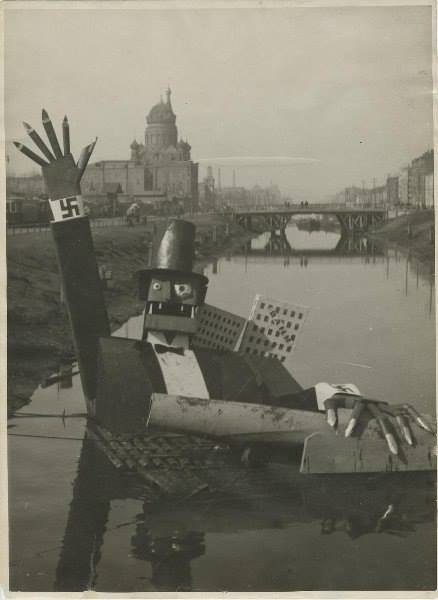
E.I. Liskovich, Capitalism in the Grips of Crisis, 1932. May Day installation on the Obvodny Canal, Leningrad. Photo courtesy of Andrey Pomulev
“Echoing the Moscow satirical installations is E.I. Liskovich’s composition Dying Capitalism, erected on the Obvodny Canal in perfect harmony with the surrounding landscape. It features the huge plywood figure of a capitalist, half submerged in the water of the canal and calling for help.”
Thinker and revolutionary, founder of Russian social democracy, and major theorist of the Russian labor movement, Georgi Plekhanov (1856–1918) occupies a prominent place in Russia’s political history. Occasioned by the 160th anniversary of his birth, the exhibition focuses on the political biography of this talented propagandist and popularizer of Marxism, showing how his views evolved as the Russian revolutionary movement (1870–1917) progressed from the Populists to the Marxists. Avoiding both apologetics for an “outstanding Russian Marxist thinker” and Soviet-era accusations of Menshevism and opportunism, the exhibition shows the socio-economic and political conditions that shaped the revolutionary’s worldview.
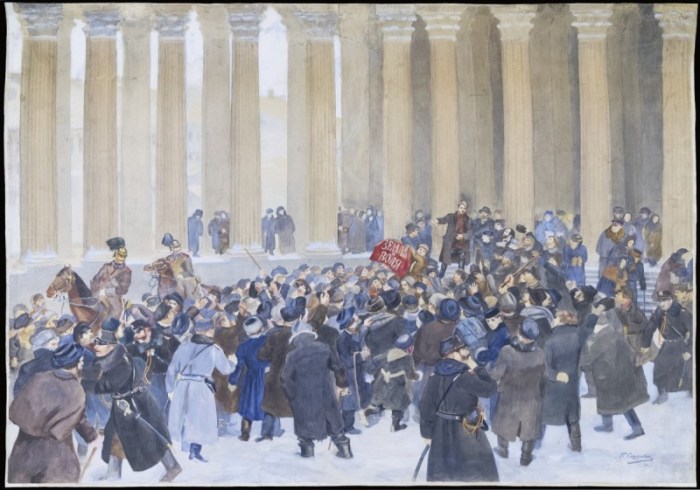
In 1876, Plekhanov was an organizer of the clandestine organization Land and Liberty, taking part in rallies and strikes, and penning proclamations. During the first political demonstration in Russia, which took place outside Kazan Cathedral in Petersburg on December 6, 1876, Plekhanov delivered a diatribe against the autocracy. He rejected terrorism as a means of struggle, and when Land and Will split in 1879, he headed the underground Populist organization Black Repartition. Fleeing from police persecution, Plekhanov went into exile abroad, spending a total of thirty-seven years in Switzerland, Italy, France, and other European countries.
In 1883 in Geneva, Plekhanov founded Emancipation of Labor, the first Russian Marxist group, which published the works of Marx and Engels and popularized Marxism. Plekhanov became a prominent Marxist theorist and a leader of the international socialist movement, participating in the congresses of the Second International, and producing numerous works of journalism, philosophy, and literary criticism. In 1900, Plekhanov and Lenin launched the underground newspaper Iskra. Plekhanov was also involved in founding the Russian Social Democratic Labor Party, but after the party split into Bolshevik and Menshevik factions in 1903, he was at odds with Lenin.
The exhibition deals at great length with Plekhanov and Lenin’s relationship, which evolved from cooperation to confrontation. Plekhanov emerged as a political antagonist of Bolshevism and a critic of Lenin and the October Revolution. (He dubbed Lenin’s “April Theses” “nonsense.”) The exhibition has also captured the fierce polemics about Marxism that Plekhanov conducted with the Populists Nikolay Mikhaylovsky and Lev Tikhomirov, the revisionist Eduard Bernstain, the Legal Marxist Pyotr Struve, and Yekaterina Kuskova, ideologist of the so-called Economists.
The exhibition features documents, photographs, and works of Georgi Plekhanov, as well as numerous exhibits on the history of the Russian revolutionary movement, including Land and Liberty’s first leaflets from the 1870s. Paintings and drawings illustrate the events to which Plekhanov responded.
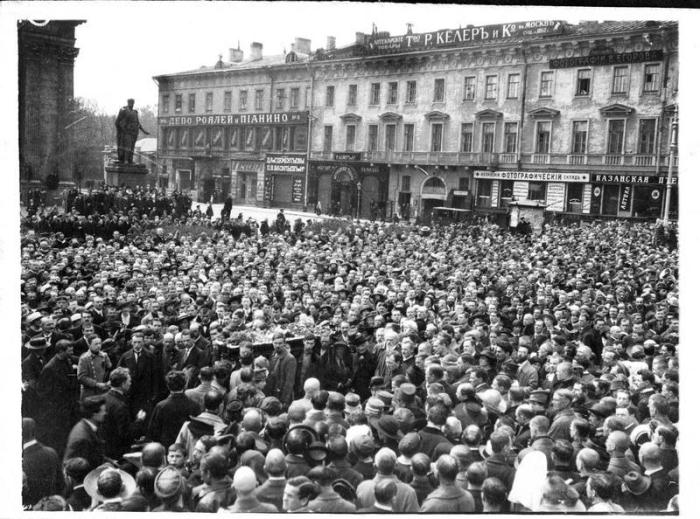
Georgi Plekhanov’s funeral, Petrograd, 1918. Photo courtesy of humus.livejournal.com
Plekhanov’s death mask and a documentary film about his funeral (provided by the Russian State Documentary Film and Photo Archive) witness the end of his life. On June 9, 1918, Plekhanov’s coffin was escorted by students, clerks, teachers, journalists, lawyers, and workers—by no fewer than ten thousand Petrograders who refused to obey the instructions of Bolshevik leaders. People of different political views and convictions marched should to shoulder in the funeral procession, including Mensheviks and Socialist Revolutionaries, Constitutional Democrats and ardent monarchists. Only the official Bolshevik authorities demonstratively refused to be involved in the funeral. One of the greatest men of his time was thus laid to rest.
On Friday, Vladimir Putin met with artists and cultural figures at a joint session of the Council for Culture and Art and the Council for the Russian Language in St. Petersburg. He added in his response to entreaties for filmmaker Oleg Sentsov’s freedom that Sentsov, one of the subjects of The Voice Project’s “Imprisoned for Art” campaign, was “convicted not for art, but for taking other functions, as investigative and court bodies say, and particularly in fact he devoted his life to terrorist activity,” that “no one convicted him for his views or his position.”
He went on to say, “We should rely on that we live in a state governed by the rule of law and such issues should be of course decided by the court system,” but that “officials who interpret works of arts may take action” because “we don’t want what happened in Paris [at Charlie Hebdo] to be repeated here.” He speculated that “maybe the artists didn’t intend to offend anybody, but they did,” and that “we must bear that in mind, and not allow that, not split the society.”
President Vladimir Putin
23, Ilyinka Street,
Moscow, 103132, Russia
Dear President Putin:
Authoritarians around the globe almost always use the same playbook—the same tactics to stifle dissent, the same type excuses to imprison those who speak out against them, even the same words. It is not original and it is quite predictable when you see enough of it, as we do in our work.
A common play is that outspoken dissidents, especially known figures such as artists, are arrested on spurious charges and imprisoned following show trials. The tactic is to make an example of the individual dissident in order to stifle dissent more widely, and it is most easily efficacious when applied to those already in the public eye, well known for their art or activism or leadership in another field. Notoriety of the target, though, is not a sine qua non, as the act of persecution and the proceedings of prosecution can themselves be heavily publicized, especially with the aid of a compliant state controlled media. The pretense for prosecution is often laughable, but the absurdity as well sends a message: that the authoritarian and the authoritarian system are not bound by rule of law, but rather rule through systemic power, and that one’s safety and well-being within the society depend on compliance, conformity and loyalty to the ruling power.
We see these tactics employed the world over and throughout history, and often now in Russia under your leadership. Pussy Riot were imprisoned not for singing a song that called you and your cronies “shit”, but rather for “hooliganism motivated by religious hatred”; Maria Baronova was arrested not for yelling at Bolotnaya Square, but for “inciting mass riots”; Sergei Magnitsky was arrested, tortured and killed not for exposing the pervasive corruption of a kleptocracy, but for “colluding with a tax evader.” And Journalist Kieron Bryan of the “Arctic 30” evidently ran afoul of your piracy laws? No, of course not, and likewise, as Heather McGill at Amnesty International has noted, the “fatally flawed” trial of filmmaker Oleg Sentsov, a figure well known because of his art, “was designed to send a message. It played into Russia’s propaganda war against Ukraine and was redolent of Stalinist-era show trials of dissidents.”
As Ms. McGill alludes to, you are far from the first to use this tactic on dissidents. Arseny Roginsky was arrested for forgery, Gunārs Astra for spying, Andrei Amalrik for pornography, Nikolay Gumilyov for conspiracy, Ephraim Kholmyansky for possession of ammunition, and Alexander Lavut for possession of a book. The tactic is not new and it is not region specific. Mussolini had Gramsci arrested in Italy not for his writings, but for supposed involvement in an assassination plot. Muhammadu Buhari imprisoned Fela Kuti in Nigeria not for being a singer of truths, but for being a smuggler of currency. As the biblical saying goes, “There is nothing new under the sun.” Oleg Sentsov’s views and activism made him a target; the notoriety from his art made him a good one.
In regard to your comments that you have not the power to free Oleg, you are right, in ways you don’t understand. You so graciously let Pussy Riot out just two months before the completion of their two-year term, but Nadya’s right here and says, “You can shove your amnesty up your ass.” Similarly, Oleg does not want us to beg for your clemency, but would rather we parade your glib hypocrisy. You misunderstand us if you think we ask for his freedom through your benevolence, rather, we demand it from your discreditation. That is what we mean by #FreeOlegSentsov.
In regard to your comment that freedom of expression requires the responsibility not to offend, you pretend to not understand that freedom requires the ability to do so. We hear this from your kind all the time, it is an old song to a bad tune—the authoritarian pretending to be a champion of freedom that is not freedom.
Your doublespeak attempts to engender doublethink. You are not the first and you are not alone in this either. You have your political technologists, your state media, and your embarrassing troll factories, the US has its think tanks, corporate media and its own embarrassing trolls, sometimes disguised as clowny demagogues who spray tan on ephemeral ideologies and syllogistic hyperbole of various offensive hues. Orwell predicted that the very concept of objective truth would fade from the world, and your kind seem hard at work to make it so, but many of us believe that in the end the truth does out because it is existentially, ontologically superior to lies. You’ve heard this before, but it doesn’t sink in. You think that imprisoning artists silences them, but each speaks more loudly because of it, loud enough for the world to hear. You think repression and brutality invoke fear, but they inspire courage and embolden action. Russia has one of the greatest traditions of dissidents of any nation on earth, you and your predecessors did that. These lessons your kind seldom learns.
As for those of us here in the States, we’ll likely have our own taste of authoritarianism before long, but we are not afraid. We have many warriors here. They are standing right now in the snow, unbroken, on the Great Plains of North Dakota. And luckily, we have learned the lessons from those like you, so we’ll act accordingly. In the meantime, we’ll abide by, and learn from the words of Oleg himself:
There is no need to pull us out of here at all costs. This wouldn’t bring victory any closer. Yet using us as a weapon against the enemy will. You must know: we are not your weak point. If we’re supposed to become the nails in the coffin of a tyrant, I’d like to become one of those nails. Just know that this particular one will not bend.
Sincerely,
Hunter Mora Heaney
Executive Director
The Voice Project
My thanks to Mr. Heaney for his kind permission to republish this letter here. TRR
Victoria Lomasko Truckers, Torfyanka, and Dubki: Grassroots Protests in Russia, 2015–2016
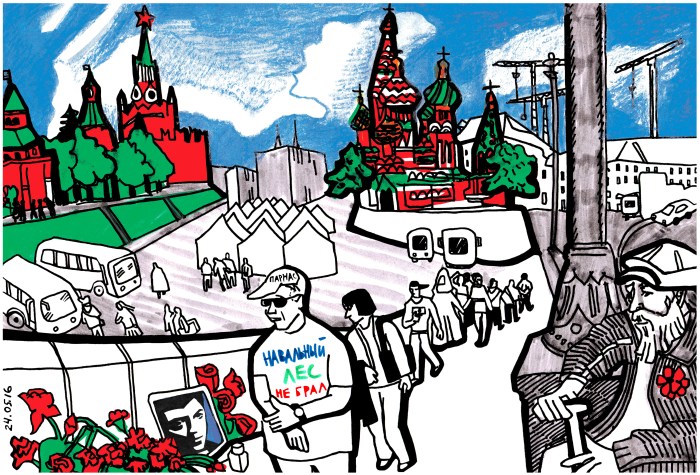
In late February 2015, politician Boris Nemtsov, a leader of the Russian opposition, was gunned down near the Kremlin.
Grassroots activists immediately set up a people’s memorial, made up of bouquets, photos, drawings, and candles, at the scene of the crime, on Bolshoi Moskvoretsky Bridge. For over a year, they have been taking shifts guarding the memorial from members of various nationalist movements and bridge maintenance workers, who routinely haul away the flowers and photos as if they were trash.
Slogan on man’s t-shirt: “Navalny didn’t steal the timber.” May 24, 2016
“The assaults on the memorial occur like pogroms in a Jewish shtetl: it’s the luck of the draw,” these two people on vigil at the memorial told me. “They pick a time when the people on duty have let down their guard, like three or four in the morning.”
Woman: “People will take to the barricades only when food runs out in the stores.” Slogan on her shirt: “The ‘Russian world’ has no use for science and education.’” Rally in defense of science and education, June 6, 2015
Headed by opposition leaders and attended by thousands of people, the 2012 rallies and marches for fair elections and a “Russia without Putin!” ended with the show trials of 2013 and 2014 against opposition leaders (Alexei Navalny and Sergei Udaltsov) and rank-and-file protesters (the so-called prisoners of May 6).
In 2015 and 2016, the Marches of the Millions have given way to small-scale rallies and protests. People far removed from politics have tried to defend their own concrete rights.
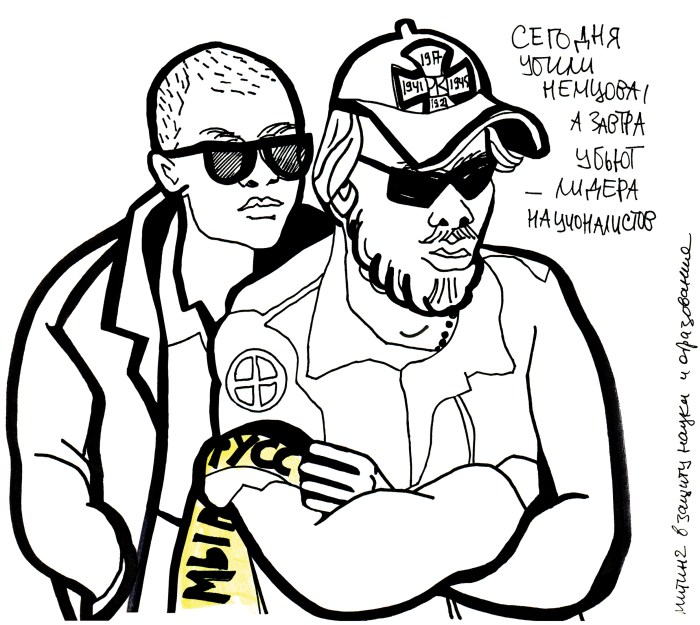
I made these drawings at a rally in defense of the Dynasty Foundation. An NGO founded to support scientific research and science education in Russia, it had been declared a “foreign agent” by the Justice Ministry.
“Today, they killed Nemtsov. Tomorrow, they’ll kill a nationalist leader.” Rally in defense of science and education
Torfyanka
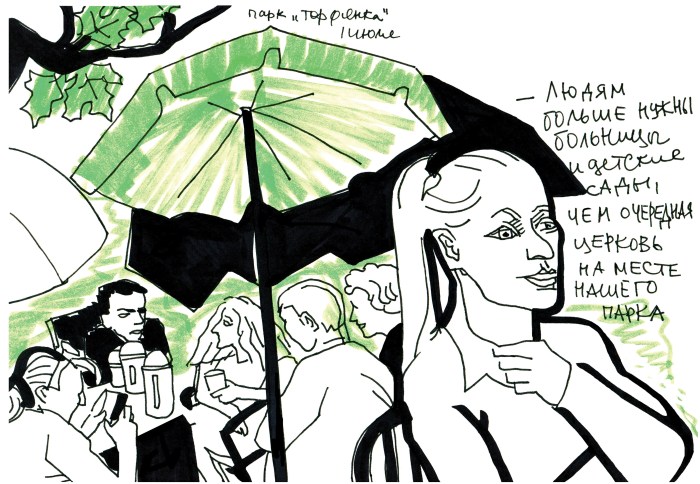
In June 2015, residents of Moscow’s Losiny Ostrov (Moose Island) District came together to stop construction of a church in their local park, Torfyanka. The building had been planned as part of the Russian Orthodox Church’s 200 Churches Program.
“People need hospitals and kindergartens more than another church on the site of our park.” Torfyanka Park, July 1, 2015
Residents set up a tent camp in the park and stood watch in shifts to keep construction equipment from entering the site. They also filed a lawsuit, asking the court to declare the public impact hearing on the construction project null and void. The hearing had been held without their involvement. Continue reading “Victoria Lomasko: Truckers, Torfyanka, and Dubki”→
A mystical coincidence. The day before yesterday, I was waiting for a green light at a crosswalk on Prospect Prosveshcheniya, near the eponymous subway station. On the other side of the street, a woman whom I didn’t know was waving at me and yelling something through the traffic zipping past us. I crossed the street and went over to the woman. She told me she had mistaken me for her son, who had disappeared four months ago.
She showed me photos and told me the story of his disappearance and her guesses as to what had happened, each one gloomier than the last, ending with the surmise that her son had been lured to Donbass, where he had been killed. The cops knew about it, and so they were not trying to look for him. Her monthly apartment maintenance fee had been reduced, meaning the housing authority knew too, and so on.
I took pictures of the photographs she was pasting on all the poles in the vicinity, and said I would put them up on the Internet. Maybe somebody knew something and would get in touch.
I was sorting through the photos now and thought, What a contrast! On the one hand, beautiful young photographers and writers meditating on the condition of being lost, on outsiders, downshifting, and French clochards. On the other hand, poor helpless mothers, for whom no one has any use, clutching photographs of their lost sons on street corners in Russian cities, peering into the face of every man they meet wearing a hoodie and hoping for a miracle.
A rows of unmarked graves bearing numbers and the abbreviation UM, “Unknown male.” These are the ones who are really lost. It was a photo like this that was lacking at the exhibition.
“Has anyone seen him? I’ve been searching since June 12. Mom. Call +7 965 048 9285.”
Just in case, the surname of the man in the photos is Kairov. He is around thirty. His mother asked me not to write his given name. She was afraid con men would call her.
I met her near the Prospect Prosveshcheniya subway station, and she lives somewhere in the neighborhood, apparently.
She told me she had made the rounds of all the local hospitals (and, probably, the morgues, too).
She has searched for him among the homeless. Her son had once had a case of memory loss, so maybe something of the sort has happened this time.
She has written to the TV program Wait for Me [which helps people find lost loved ones — TRR]. She said that since the police were doing nothing and were not searching for him, she would travel to see Putin and get an audience with him.
Sergey Yugov is a Petersburg photographer and videographer. I thank him for his kind permission to translate his story and reproduce his photographs here. Translated by the Russian Reader
P.S. After I posted this, Sergey wrote to say that there was a whole page on the Russian social network VKontakte, entitled “Person Missing,” featuring photos and notices of missing loved ones.
There are 3,290 images on the page, the first one dated January 21, 2013. The last one is dated yesterday.
“Alexei Alexandrovich Dorin. Born 1981 (35 y.o.), Moscow. Contacted loved ones for last time on October 1, 2016. Since then there has been no information of his whereabouts. Description: 165 cm tall, normal build, blue eyes. Was wearing a black artificial leather jacket and carrying a gym bag. Help find this man. Anyone who has information about the missing person is asked to call +7 800 700 5452 (toll free in Russia) or emergency numbers 02 or 102. Everyone can help!”
Evgeny Anisimov Russia’s Shame and Misfortune: Ivan the Terrible Monument Is Sacrilege Moskovsky Komsomolets
October 16, 2016
The undertaking by the Oryol authorities has left me, a historian of ancient Russia and a citizen of modern Russia, in a state of shock and amazement. Erecting a monument to Ivan the Terrible violates every conceivable ethical norm and Russian tradition.
Monument to Ivan the Terrible in Oryol. The statue was unveiled on October 14, 2016, amid great controversy.
In the 1850s, during the reign of Alexander II, a heated debate erupted among the intelligentsia and court circles over many of the historical figures proposed for inclusion on the monument The Millennium of Russia, which was to be erected in Novgorod the Great. They were unanimous on only one point. Ivan the Terrible should not be depicted on the monument in any way, for his reign had been Russia’s shame and misfortune. There had never been such a hideous villain in Russia’s history as its first tsar. And this opinion was voiced under an autocracy!
You can talk about the rivers of blood that Ivan spilled in his own country, the monstrous, cruel reprisals that he visited on his own subjects. We are talking about thousands and thousands of people. I will recall only one absolutely true story, the story of what happened to the highly respected boyar Ivan Petrovich Fyodorov-Chelyadnin, head of the Boyar Duma. Ivan accused him of a nonexistent conspiracy to seize power. He forced the boyar to don the tsar’s cloths, seated him on his throne, mocked the old man, and cut out his heart with a knife. The poor man’s body was tossed onto a pile of manure, where it was ripped to shreds by stray dogs.
But that was not enough for the tsar. He carried out a savage reprisal against Fyodorov’s relatives and servants.
As a contemporary wrote, “Having thus murdered [Ivan], his family, and all his people, the tyrant mounted a horse and for nearly a year made the rounds of his estates and villages (Fyodorov was wealthy) with a mob of murderers, sowing destruction, devastation, and murder everywhere. When he captured his soldiers and payers of tribute, the tyrant would order them stripped naked and locked in a cage. Sulfur and gunpowder would be poured into the cage and ignited so that the corpses of the poor men, lifted by the force of the explosion, seemed to fly in the air. The tyrant found this circumstance quite amusing. All the large and small animals and horses were gathered in one place, and the tyrant ordered them hacked to pieces, and some of them pierced with arrows, since he did not wish to leave even the smallest beast alive anywhere. He torched his estates and stacks of wheat, turning them to ash. He would order the murderers to rape the wives and children of those he killed as he watched, and do with them as they willed before exterminating them. As for the wives of the peasants, he ordered them stripped naked and driven into the woods like animals. However, the murders secretly waited in ambush there to torture, kill, and hack to pieces these women wandering the woods. He thus destroyed the clan and entire family of this great man, leaving not a single survivor among his in-laws and relatives.”
The tsar especially tormented women during the atrocities on Fyodorov’s estates: “The women and girls were stripped naked and in this state would be forced to catch chickens in the field.”
These recollections are confirmed by Ivan’s own written records. In later years, to beg God for forgiveness, he kept a “Synodicon of the Disgraced,” a book commemorating the people he had killed and tortured personally over a lifetime. He used a curious verb to describe the cruelest reprisals, otdelat’, “finish off.” This is how he describes Fyodorov’s people in the “Synodicon”: “In Bezhetsky Verkh, 65 of Ivan’s men were finished off, and 12 were chopped to pieces by hand.” So these last twelve people had relatively easy deaths by sword or ax, compared with the first sixty-five, who were “finished off” in some way—burned, drowned, sawed, and so on. Over three hundred of Fyodorov’s men were executed in this way.
The “Synodicon of the Disgraced,” which Ivan the Terrible kept himself, included around three and half thousand victims in one five-year period alone, including the tsar’s close relatives, famous generals, church leaders, simple peasants, and men taken captive in the fortresses taken by his army. The tsar himself conceived the brutal methods of execution and enjoyed watching as people were boiled alive, blown up on barrels of gunpowder, turned over a slow fire like kebabs, skinned alive, and impaled. Moreover, to exacerbate their torments, Ivan’s oprichniki raped the wives, daughters, and mothers in front of the men as they slowly died. None of these are fables and fairy tales, but real stories, recorded in numerous documents and the confessions of the tsar himself, who was sometimes given to bouts of remorse.
It is no wonder the Russian Orthodox Church did not even consider a recent proposal to canonize Ivan the Terrible: he mercilessly ordered the killing of hundreds of monks and priests. Look on the Internet for information about the tragic fate of Philip Kolychev, then head of the church, strangled by the tsar’s minion Malyuta Skuratov. The tsar ordered the Archbishop of Novgorod sewn up in a bearskin and baited by dogs.
Novgorod the Great suffered especially badly at the hands of the villain in 1570. Thousands of its residents, including women and children, were put to death in terrible ways. Some were drowned in the Volkhov River; Ivan’s oprichniki patrolled the river in boats and finished off anyone who floated to the surface with axes. Ivan committed a terrible sacrilege by pillaging the holiest place in Russia, St. Sophia Cathedral, a church that had stood untouched for five hundred years. The next people to rob the cathedral were German and Spanish fascists in 1941.
Ivan the Terrible was a genuine rapist and sadist. He himself bragged that he had raped a thousand girls in his life. It is important to note that he was not ill or insane. He was well aware of what he was doing. Sometimes, fear of divine punishment would scare him into repenting and writing down his sins and crimes, but then he would kill and rape again.
If everything I have written above means little to statist readers, I would underscore the fact that Ivan was a complete failure as a statesman. He botched all the good undertakings at the outset of his reign, lost all the wars he fought, forfeited all his initial conquests, and was incompetent and cowardly as a military commander, but he enjoyed finishing off captured prisoners with a spear. Ultimately, he brought Russia to the brink of ruin. His reign ended in complete failure: military, political, and economic failure. The once-flourishing country was desolated. In Northwest Russia, archaeologists are still finding numerous villages and new settlements that perished forever during Ivan’s reign.
What we know as the Time of Troubles, when Russia was invaded by enemies and plunged into civil war, was a direct outcome of Ivan’s reign. Russia sunk into oblivion for a time then, and even vanished from the map of the world, and only common folk, who had survived the hell of Ivan’s reign, saved Russia under the banner of Minin and Pozharsky. They saved Russia for us, too.
We can be amazed at the humility and patience of the martyr-like Russian people. As early nineteenth-century historian Nikolay Karamzin wrote, Russia “endured the destroyer for twenty-four years, armed only with prayer and patience. […] Generous in their humility, the sufferers died at the Lobnoye Mesto, like the Greeks at Thermopylae, for Faith and Faithfulness, having no thought of rebellion. […] The tiger reveled in the blood of lambs, and the victims, dying the deaths of innocents, demanded justice and touching commemoration from contemporaries and descendants as they took their final gaze at the pitiable country.”
We are their descendants. Was their sacrifice in vain? Was their blood not like ours, but water?
If we are alive, it means that the chain of our ancestors leads back to the time of Ivan. How many such chains the murderous tsar sundered! The people slain by Ivan the Terrible were people just like us, and we must honor their memory. The monument to Ivan the Terrible is a sacrilege against their nameless graves. All those innocent victims will no doubt someday demand a reckoning from us for this sacrilege, for erecting a monument to Russian history’s greatest villain. Oryol will pay a price for this.
At the end of his life, the tsar rotted alive, emitting a foul odor. Undoubtedly, the Lord did not let Ivan the Terrible escape hell. At the last minute, he tried to take monastic vows, which were then believed to be a sure way to save the soul. But no! The monastic dress had been laid out on the villain’s stiffening corpse, but there is no doubt he is in hell, where he belongs, not on a square in one of Russia’s wonderful, radiant cities.
Dr. Evgeny Anisimov is a full professor at the Higher School of Economics in St. Petersburg, and chief researcher at the St. Petersburg Institute of History (Russian Academy of Sciences). Translated by the Russian Reader