The Continuing Struggle of the Crimean Tatars Against Russian Oppression

Crimea’s Tatars: “They drive us from our homes, just as they did to our grandparents 80 years ago”

By Katya Aleksander, who interviewed activists supporting more than 100 Crimean Tatar political prisoners. First published in Russian by Important Stories (Vazhnye Istorii) on 18 May, the 80th anniversary of the deportation of the Crimean Tatars.


On 18 May 1944, eighty years ago, the Soviet government accused an entire people of “collaboration with the Nazis” and “betraying the fatherland” – and deported the Tatars from the Crimean peninsula. It took the Crimean Tatars more than forty years of constant struggle to return to Crimea. But in 2014 the peninsula was annexed by Russia. The war began, and, with it, repression by the new authorities on a massive scale.
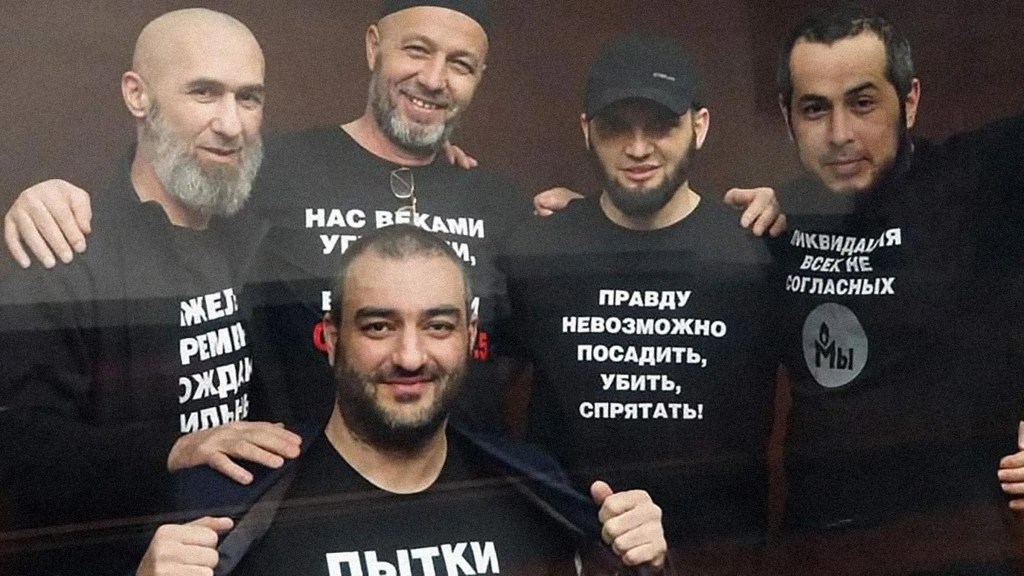
Political prisoners Tofik Abdulgaziev, Vladlen Abdelkadyrov, Izzet Abdullaev, Medzhit Abdurakhmanov and Bilial Adilov, among those falsely accused of “terrorism” and “preparation to seize state power” in 2019, and sentenced to 12-14 years’ imprisonment. Abdullaev’s T-shirt says, “the truth can not be imprisoned, killed or hidden”. Photo by Crimea Solidarity

On the anniversary of that tragedy, which Ukraine demands be categorised as genocide, Important Stories spoke with Crimean Tatars who continue the struggle to live freely in their historic homeland.

Every Crimean Tatar family has its stories of deportation. They all start in the same way. On 18 May 1944, at five o’clock in the morning, soldiers burst in to the house and gave people 5-10 minutes to collect their belongings and go to the nearest train station. No explanations. At dawn, everyone was forced into cattle wagons and taken away.

It was all over by 4:00 pm on 20 May: one of the fastest deportations in world history. All the deportees’ property passed to the Soviet state.

“Many people thought they were being taken away to be shot. The Soviet Union was an atheist regime, and many Crimean Tatars were of Islamic faith”, said Azime (her name has been changed), the wife of a present-day Crimean Tatar political prisoner. Her family were deported to Uzbekistan.

“They put everyone in cattle wagons, with no windows and locked doors. There was no sanitation. No water, no food. People died from hunger, thirst and dysentery. The soldiers just threw their bodies out at the train stations. Some people were able to hide their relatives’ bodies: those families hoped that they would soon arrive somewhere and be able to bury their loved ones like human beings.”

The transport took 2-3 weeks. About 80 per cent were taken to Uzbekistan, and the rest were sent to special places of exile in other parts of the Soviet Union.

“Part of my family was deported to Uzbekistan, part perished in those cattle wagons, and my grandfather was taken to the Urals”, said Ismail (his name has been changed), who today acts as a defence lawyer for Crimean Tatars. “Grandad said that, while he and his mother tried to find accommodation, they could not go to work for two days. And so [for breaking the labour laws] his mother was sent to prison for five years.”

Soviet propaganda prepared local people to receive the deportees. Uzbeks were advised to keep well away from the newcomers, who were “cyclops” and “cannibals”. In exile, Crimean Tatars faced hunger, dangerously unsanitary conditions and an absence of health services. Between 18 May 1944 and January 1946, about 200,000 Crimean Tatars lost their lives, according to estimates by the National movement.

The struggle to return home

People could not return to Crimea. Until 1956 the Crimean Tatars had the status of “special settlers” with limited civil rights. They had to report regularly to police commandant’s offices. They were permitted to move to a different region only by invitation from close relatives. Attempts to leave without permission were punished by up to ten years’ imprisonment.

Although their language was banned, the Crimean Tatars preserved their culture and traditions. Parents told children what their home looked like, and how to get there, so that they could find their way to it when they returned.

“Everyone lived with thoughts of going back”, Ismail said, telling his family’s story. “My uncle somehow found a way to travel to Crimea. My grandmother asked him to bring a bottle of water from home: she wanted to drink Crimean water. When my uncle got back from his trip, he realised that he had forgotten about the water. He took a bottle, filled it from the tap, and took it to Grandma [telling her it was from Crimea]. She cried. For her, that bottle was almost sacred. She kept it, and never drank a drop.”

In the 1960s, the Crimean Tatars began independently to collect information about the victims of the deportation. They demanded that the Soviet authorities revoke the slander that they were traitors, and allow them to return home. That is how the Crimean Tatar national movement was born.

On 5 September 1967, after many attempts to secure justice, came a decree of the Presidium of the Supreme Soviet of the Union of Soviet Socialist Republics (USSR), which revoked all accusations against the Crimean Tatars and allowed them to live in any part of the country. But to return to Crimea, they had to secure a residence permit, and find work. [Residence permits, linked to employment, were used to discipline labour in the Soviet Union.]

By the end of September 1967, about 2000 Crimean Tatars had already returned to the peninsula. But the majority of them could neither get a residence permit, nor any chance of work, from Crimea’s new inhabitants. Many were deported again, and brought to court for breaches of the internal passport regulations.

Azime’s family was one of the first that returned to Crimea and found a way to stay there. “My grandfather, an activist of the national movement, left behind all that he had worked for in Uzbekistan, took his four children, and went home. We are not even talking about returning to his own village, where his grandparents were buried – only returning to somewhere on the peninsula where the family would be allowed to stay. They found a place in Dzhankoi district, where several other [Crimean Tatar] families also moved in. The street was named International Street, because we, the non-Russians, lived there.”

Crimean Tatars demonstrating in support of national rights, 1988. Photo from the Mejlis of the Crimean Tatar people

Azime was born at the end of the 1980s, already back in Crimea. Among people of her age, that is very unusual, she said. “I know literally two other people [of her age] who were born back there [on the peninsula].”

[In the 1970s and 80s] the Crimean Tatars had to build their homes all over again. The homes from which their families had been deported now belonged to other people. The work they could find was always the hardest. The attitude of the new local population was hostile: they continued to accuse them of treachery.

“Our grandparents were often dismissed from work”, Azime remembers. “They were constantly searching for new jobs, in order not to be deported again. My mum went to school in Crimea: when the family returned, she was eleven years old. She was admitted to university only on the fourth or fifth attempt. The dean of Simferopol medical school told her father outright that he would not accept Crimean Tatar students, not for any amount of money.

“My mum was the only Crimean Tatar woman in her university. [When her fellow students and teachers learned that she was a Crimean Tatar], she was told to her face that she had no business being there. Many teachers simply marked her work down. Our people felt everywhere that Crimean Tatars were strangers in their own land.”

The Crimean Tatar national movement had already taken shape, and its activists fought for the right to live in Crimea and for the freedom of those imprisoned for breaches of the internal passport regulations. They monitored attacks on human rights, and took part in hunger strikes and other forms of protest. In 1978 the activist Musa Mamut burned himself to death as an act of protest: this became one of the symbols of Crimean Tatar resistance.

Crimean Tatar hunger strikers in Moscow, 1987. Photo from the Mejlis of the Crimean Tatar people

But even twenty years after the decree of 5 September 1967, the situation had hardly changed. “The mechanisms to obstruct the Crimean Tatars’ return had been so finely tuned by the Crimean authorities, that I never heard of a single instance of a new Crimean Tatar family buying a house”, the Crimean Tatar activist Bekir Umerov wrote in his memoirs. His family was also prevented from returning to Crimea: in the 1980s they moved to the Krasnodar region [of southern Russia], to be nearer to home.

After the beginning of perestroika [the reform of the Soviet system started under Mikhail Gorbachev, from 1986] in the spring of 1987, the Crimean Tatars gathered in Tashkent [in Uzbekistan] for their first All-Union Assembly. They agreed on a document that called on Mikhail Gorbachev, then the general secretary [of the Communist Party of the Soviet Union] to meet a delegation. This call went unanswered, and so on 18 May, the anniversary of the Crimean Tatars’ deportation, the activist Bekir Umerov announced a hunger strike in protest.

This met with a powerful response, and not only among Crimean Tatars. The scientist and human rights defender Andrei Sakharov mentioned the action in his call to Gorbachev to resolve the problem of Crimean Tatars being able to return home. Umerov ended his protest a month later, when the Second All-Union Assembly of Crimean Tatars elected him to a delegation that travelled to Moscow. But the Kremlin refused to meet the Crimean Tatars, as it had done before.

The activists then began protests at the Lenin mausoleum [on Red Square], at the building of the CPSU Central Committee, at the Kremlin. Each day the number of participants grew. One of the biggest rallies was held on Red Square in the middle of July 1987. The Crimean Tatars staged a peaceful sit-down protest, and the police held back from using force. A week later, on 26 July, more than 1000 Crimean Tatars took part. This time the police blocked the way to Red Square and so the demonstrators went along Vasilevsky Spusk, sat on the ground, raised their placards and shouted: “Crimea! Our homeland!” The action went on for 26 hours.

Many of the participants were arrested and deported from Moscow to the places where they lived. No official documents sanctioning a return to Crimea were issued by the authorities – but there were fewer obstructions.

The Crimean Tatar protests continued through the whole perestroika period.

Occupation of the peninsula

Many families could return to their homeland only after the collapse of the USSR. The move was difficult, even without the authorities interfering. “For more than 20 years, the Crimean Tatars had been finding their feet in the places to which they were deported. They had settled down. And now they had to leave everything again, return home empty-handed, and again start to get on their feet”, Azime explained.

“After all that had happened to our people [as a result of deportation], we stuck closer together and helped each other. My parents told me about how someone had got land in Crimea, gathered 30-40 families and built a house on it together. And then they built another. We are not just a people, we are one big family”, Ismail, the human rights defender, said.

“In general the Crimean Tatars are Muslims. This means a sense of collectivism, which means brotherhood, giving moral support to each other, good neighbourliness. These are traditions going back to the [Crimean] khanate [of the 15th-18th centuries]. The Prophet says, ‘if you laid down to sleep well-fed, and your neighbour was hungry, you will not sense the scent of paradise’. And it makes no difference whether your neighbour is Muslim or not.”

The Crimean Tatars were only able to live a relatively quiet life in their historical homeland for a little more than twenty years.

“It turned out that my generation was the only one, in the past century, who could spend their early years at home, living in peace”, Azime said. “I just recently said to my children that I could not now myself imagine how carefree those years were. We just lived, and did not think that things could be different.”

That life changed at the beginning of 2014. “I was then pregnant with my third child”, Azime recalled. “I was already preparing for the birth when I heard on the news that the Russian [armed forces] were coming. I knew that for decades Russia had imprisoned Muslims simply for professing their faith. I can not tell you how terrified I was, for my child, for my husband, for all of us. Then tanks appeared on the streets, and men in uniform, and the occupation began.”

Some Crimean Tatars decided to move to Ukrainian-controlled territory. Azime and her husband also discussed that, but decided to stay. “We both agreed that here is our home, our land, for which our parents had fought. Why should we leave? It was they who came to us, no-one asked the Russians to come here. We decided that we would not allow Russia to drive us from our homes a second time.”

Most of the Crimean Tatars were against the occupation, and boycotted the “referendum” [of March 2014, on joining the Russian Federation]. Consequently, after the annexation, the Russian authorities took repressive measures: Crimean Tatars were arrestedkidnapped, and accusations under the laws on terrorism were fabricated en masse. People were accused of membership of [the transnational Muslim organisation] Hizb ut-Tahrir, which is banned in Russia. As proof, “secret witnesses” were produced, together with the fact that the accused professed the Islamic faith.

“We did not know what to do”, Ismail remembers. “We did not know the new legal code, or what to do when three brothers by faith were falsely accused of terrorism. From the start, the new ‘authorities’ were determined to show that they would liquidate anyone who opposed Russia. They only wanted people loyal to them in Crimea.”

Ismail himself suffered intimidation and harassment. In 2015 an officer of the Federal Security Service (FSB) planted drugs on him [and he was arrested]. When being questioned, he was asked about Crimean Tatar affairs. They tried to convince him to work for the security services. Thanks to the prominent Crimean Tatar lawyer Emil Kuberdinov, the case did not go any further than the prosecutor’s office.

“At that time the Russians were still trying to work out the extent to which their hands were tied in Crimea”, Ismail said. “But I already understood what was on its way. Crimean Tatar lawyers came on the scene, not only helping people who were arrested, but also support political prisoners’ families, explaining how to send parcels to prison, what to do on prison visits and so on.”

In 2016, Crimean Tatar activists, together with lawyers, formed the Crimea Solidarity organisation.

In 2017, about one hundred Crimean Tatars across peninsula simultaneously staged one-person pickets against Russian repression. About 60 people were served with administrative summonses, for breaching the regulations on picketing (Article 20.2 Part 5 of the code on administrative offences [similar to civil law]). The hearings were all arranged on the same day, in different districts. As well as Crimea Solidarity’s lawyers, the interests of the accused were represented by civil society activists. One of these was Ismail. “People began to offer support to Crimea Solidarity. I did so myself. We had no legal education, but the lawyers helped us to prepare. So the Crimean Tatars continue to help each other.”

Repression under occupation

Criminal cases under terrorism laws have become the main instrument of repression against Crimean Tatars. Military courts deal with these cases in closed hearings that even close relatives can not attend. The sentences under these laws are 10-20 years’ imprisonment.

The Russian security forces have conducted searches at mosques, arrested clerics, cases have been put together alleging failure to inform on “terrorist groups”. Family members of political prisoners have also been subject to surveillance and harassment.

Every arrest and raid becomes a matter for the whole community. People gather at any time of day or night, often bringing children along, to support families who have been singled out for searches. Azime, along with her elder sons, has often gone to support her neighbours. She tells her children not to fear people in uniform, that those people’s fear is even greater.

Azime also prepared the family for the fact that they might be raided at home. Her husband Rinat (his name has been changed) is an activist in the national movement, has written a great deal about the repression of the Crimean Tatars, and has spoken out openly against repression and against the occupation. He had been arrested on administrative charges several times, and the family understood that sooner or later he could face criminal charges. Some time ago Azime started to sleep wearing her clothes and a hijab [expecting a raid].

The security forces came for Rinat at 6:00 in the morning, but he was not at home.

“Before sunrise every day we read prayers. My mother asked me in Tatar (in the family we use our native language) how she would be able to perform ablutions. I told her not to be afraid and to stay calm. The armed men told us that we could not speak in Tatar. That was offensive to me, as a woman and as a mother. They insulted our faith: they said that instead of ‘beating the floor’ five times a day, which should behave like normal people.”

Protesters and Russian armed forces in Crimea, 2014. Photo by Krym.Realii/RFE-RL

During the raid, Azime’s three children were much calmer than she had expected them to be. “I tried to stay confident and not to fear these men and their automatic weapons, hoping that that would also help the children to stay calm. Only my daughter was crying, at the start when she first saw the guns, she is the youngest.

“When I woke up, the room was dark, but I could see floodlights being shone from the street directly into our windows. The shadows were dancing around the courtyard. I understood that it had started. Then wild knocking at the door”, Azime recalled. “I asked my mum to dress and open the door. A big crowd of armed men in masks ran in, shouting. They turned the shelves upside down, everything from outer clothes to underwear. They paid closest attention to the books.

“My sons are still in primary school, I don’t think they understood exactly what was going on. For them it was like something out of a fairy tale, where we needed to defy evil. They did not sit in the corner like mice, but walked between these people with the automatic rifles, as though everything was OK. The men did not touch them. Just once, they tried to find out [from the children] the password for my phone, which I refused to unblock. I did not want them to see photographs of me unveiled.”

It only became clear later how stressful the children had found the raid. “For years afterward, my elder son started to fear the whole world that surrounds him. He thought that the FSB was everywhere, he saw all people as a threat. When we went into town, he would stick close by me and say, ‘I am afraid that they are going to take me away’. For a year or two, my daughter developed a nervous tic. She works with a psychotherapist, but still fears me falling asleep before her, fears being alone.

“At least the children didn’t see how their father was set upon and thrown to the ground with an automatic pointed at his temple. That’s a rare thing for a Crimean Tatar family nowadays. I have talked with the children many times, I saw to them that the Almighty is with us, and that his wisdom also oversees what is happening with their dad”, Azime said.

Wives of Crimean Tatar political prisoners

Azime’s husband was beaten, and arrested, when he travelled to Rostov to deliver parcels to other Crimean Tatar political prisoners being held there. While Rinat’s case was in court, Azime could at least see him at the hearings. But when the sentence was announced, neither Rinat’s wife nor other Crimean Tatars were admitted to court. Rinat was sentenced to nearly 20 years in a maximum security facility, under two Articles of the criminal code: “organisation of the activity of a terrorist group” and “preparation for a violent seizure of power”.

Azime said: “My husband is big, kindly man, like a bear in a cartoon. He went out to work, went to court hearings [of other arrestees], publicised the repression of our people, and always found time for our family. I lived like a princess. And now all that has finished. A new life has begun: I have to survive, and to try to understand what comes next.

“At night I cry into the pillow, so that the children can not hear. I have to learn to do things in the household that were previously done by my husband: what documents have to go where, how to pay for the electricity, how to read the meters. I have had to give up studying and my teaching work. Before all this, I had more time for the children: now I often have to leave them to look after each other.”

Azime’s health has suffered as a result of all that has happened, and she has had two operations. She is supported not only by her family but by the community. “There was a knock at the door, and a woman I don’t know was standing there, offering me eggs and cheese.  She said: ‘That’s for you, my dear. You don’t know me, but your husband gave court support to my son.’ Around here there are already many women with the same, bitter experience. I turn to them for advice, about where to buy things for prison parcels, where to send documents for this and that. I am walking along a well-trodden road.”

It is now five years since Rinat’s conviction. In that time, Azime has not been able to meet her husband once. Her only contact with him is through letters, that are passed on by his lawyer. In prison, Rinat has continued to write about the repression against the Crimean Tatars. Azime receives his articles, retypes them electronically, publishes them and sends them out. “My husband constantly writes to me, thanking the Almighty for the fact that his wife is here. He says, ‘when my book comes out, that will be your doing – you are my censor, editor, proof-reader and publisher!’

“Like the wives of other Crimean Tatars, I have chosen to continue the fight taken up by my husband. Up until 2022, we used to travel, to explain what is happening to our people. We were in Kyiv, Kherson and Mariupol. We continue to campaign now, but we can not travel anywhere. Our husbands have been deprived of free speech. Who, if not us, will speak about their cases and convey their arguments? They, also, became activists not by choice. And now we stand in their place.

“In our letters to our husbands, we sound very strong, like stone, their bastion. I always write to my husband, ‘this is your challenge from the Almighty. If you meet it, you will earn yourself a place in paradise’. It’s at night-time that I cry in my pillow. I feel sorry for my husband, and it is hard for me too. I have to be both mother and father to my children; I have to support my husband; and be an activist. But you cry, and you keep going – and that’s how I earn a place in paradise too.”

The all-out war

With the Russian army’s all-out invasion of Ukraine in Feburary 2022], many Crimean Tatars were again forced to leave their homes. The biggest exodus took place when military mobilisation was announced. According to the Mejlis of the Crimean Tatar people [the national representative council, now based outside Crimea], since September 2022 between six and eight thousand Crimean Tatars have left the peninsula. Azime said that Crimean Tatar families that have sons of conscription age try to leave Crimea. “Everyone fears that their sons will be taken by force to the war.”

Ismail said: “Many people have left because they do not want to fight on Russia’s side – although the mobilisation turned out to be more a moral pressure than a physical one. Of those who have been sent to the front from Crimea, only about 5 per cent are Tatars. I reckon that, of those who did go to the front in autumn of 2022, 60-70 per cent have already returned.”

Those who have moved to territory controlled by Ukraine can not return to Crimea, due to the risk of repressive action. In 2023 the Crimean Tatar Leniye Umerova tried to get to Crimea to see her father, who was very ill. She travelled from Ukraine via Georgia. She was arrested at the border on suspicion of spying. Umerova has already spent a year behind bars in Russia. The case will be heard in secret and she is threatened with 20 years’ imprisonment.

Since 2022, repression against Crimean Tatars has been stepped up. The Russian authorities have conducted at least 71 searches, and there have been at least 110 convictions – more than in the preceding eight years. In the autumn of 2022 a second pre-trial detention centre (SIZO) was opened in Crimea: Crimean Tatars, and Ukrainians kidnapped in the occupied territories, are sent there. Since the all-out war began, there have been a much greater number of cases, compared to the previous eight years, related to the “voluntary Noman Chelebidzhikhan battalion of Crimean Tatars”, that has been fighting on the Ukrainian side since 2014.

There was also a wave of repressive measures against Crimean Tatars when parts of Kherson and Zaporizhzhya regions were occupied: about 100 people have been arrested there. Some cases have been initiated by informers who write on the Krymsky SMERSH telegram channel that was set up in 2022.

“Informing has become a big thing in Crimea”, Ismail says. “Someone says something at the market, and that’s it, you get a knock on the door. The regional authorities have acquired an extra repressive tool against the peninsula’s citizens: the Article [in the code on administrative offences] on discrediting the army. There have been many administrative cases as a result, some for people writing comments on social media.”

Azime said: “Today, deportation of Crimean Tatar people takes a hybrid form. Now it’s not in cattle wagons: people are taken away in prison transport vans. From many families they have taken all the menfolk: for example they will take the husband, son and father. I have a neighbour who is 75, they have taken both her sons. Every time I see her she says, ‘my dream is just to be able to hug them once more in this life’.”


Azime has decided to stay on the peninsula, as long as possible. “In our lives we have seen hundreds, perhaps thousands, of families that have been broken up, which fought for so long to be able to return home. I have decided for myself that I will never leave our homeland. We understand that the repression will intensify, that whatever has to happen, will happen.

“What’s the point of cowering like a mouse, of living in fear? If they succeed in shutting our mouths, that would be a betrayal of our people who have suffered so much. We must not stay silent. As long as our husbands are imprisoned, and as long as they continue to try to destroy the Crimean Tatar people, we won’t stop fighting.”

Ismail, too, has no intention of leaving the peninsula. He continues to support Crimean Tatars in court. “I have decided for myself to take this position. I see how the families of my close friends are punished and repressed, how people are imprisoned. As a Crimean Tatar and a Muslim, how should I react? Do I sit here and say, ‘it’s nothing to do with me’ – or give some help. For me, this is a test from God.

“The best example to me in this situation is the Prophet Muhammad. Yasir’s family was taken to the desert and tortured by infidels for their religion. What did the Prophet do? He did not sit at home saying a prayer; he did not stand to one side. He went there, where Yasir’s family was under attack, and gave his support. That shows how we, today, faced with this repressive machine, need to react.

“It does not depend on us, whether they imprison a person or not. But it depends on us what we do, what support we give. Can we help the defence in court? Then we’ll go to court. Can we help the family? Then we will visit their home, bring things that they need, and money, and help with the children.

“For the Crimean Tatars it is very important to preserve our spirit of unity. We have faced many trials. When a person is left to face a problem on their own, that is very hard to bear. If someone just sits down for coffee with that person, and says, ‘you are not alone, we will help you, we are right alongside you’, this helps to deal with tragedy.

“I was recently in touch with the mother, and aunt, of a Crimean Tatar who was sentenced to ten years, in a case related to the ‘voluntary Noman Chelebidzhikhan battalion of Crimean Tatars’. They kept telling me how people had come to visit them, to help and support them, how they felt the support of our people. Without this, they said, they would have been broken.

“Russia is trying to give the appearance that everything is fine in Crimea, and now they don’t lay a finger on anybody. That is a lie. We can show the world that we have already had ten years of this. We understand, of course, that the repressive machine pays little heed to laws, let alone to moral and humanitarian values. If an instruction comes down to lock someone up, they do it, no matter what defence is presented in court.

“But we continue to go to court, to record videos showing how Crimean Tatars face harassment and intimidation. We continue to fight. We don’t keep quiet or swallow all this silently. We will take a stand and say, ‘we are not guilty’. I think that if we had not done this, if we had sat quiet, then Crimea would already have been turned into another Chechnya.”

□ Translated from the version in Russian by Important Stories (Vazhnye Istorii)

More about Crimea

The links in the article are from the original Russian version, to sources in Ukrainian and Russian. Web sites in English include the Mejlis of the Crimean Tatar people; Crimea Platform, recently launched by the Ukrainian government; the Crimea Human Rights Group; and Crimea SOS. Reports on human rights abuses have been published this year and last by the UN and the Council of Europe. A history of the Crimean Tatars, ‘A Seditious and Sinister Tribe’: the Crimean Tatars and their Khanate, by Donald Rayfield, has just been published, and reviewed. There are more than 100 political prisoners listed (Russian only) on the Crimea Solidarity web site currently detained.

Source: People and Nature, 16 August 2024. Thanks to Simon Pirani for translating this important overview of the Crimean Tatars’ struggle and for permitting me to reprint his translation here.


The Battle of Kursk

“People to people. Let’s come together to help victims in the Kursk Region. 500 ₽.
500 ₽. Ozon Electronic Certificate of Assistance (500). Buy.”

OZON

Let’s come together to help the people of the Kursk Region

Hello, Thomas!

We have issued an Ozon electronic certificate in the amount of 500 rubles [slightly less than 5 euros, at current exchange rates] to help victims from the Kursk Region.

By buying this certificate, you help residents of the Kursk Region: we will send it to one of those who are now in difficult straits.

After paying, you will receive an email confirming that the certificate has been issued and sent to a victim.

Only the recipient will have access to the certificate’s activation code — no one else will be able to use it. If the certificate is not activated in 21 days, we will refund the money to your card.

Next month, post purchase, we will write about the results of the campaign to everyone who took part: we will tell you how many people were helped and how much money was sent.

Source: Personal(ized) email from Ozon, 25 August 2024. Translated by the Russian Reader. (UPDATED, 26 August 2024) The email also included the following visual inducements (all linked to Ozon’s website) to buy goods and use the company’s other paid services.


KYIV, Aug 26 (Reuters) – Russia launched about 200 missiles and drones at Ukraine on Monday, killing five people and striking energy facilities nationwide, Kyiv said, while neighbouring NATO member Poland reported a drone had probably entered its airspace.

Power cuts and water supply outages were reported in many areas, including parts of Kyiv, as officials said the attack – 2-1/2 years into Russia’s full-scale invasion – targeted power or other critical infrastructure in at least 10 regions.

Russia dramatically stepped up its strikes on the Ukrainian power grid in March in what Kyiv has said looked like a concerted effort to degrade the system ahead of next winter when people need electricity and heating most.

Monday’s missile and drone salvo was Russia’s most intense in weeks, coming as Ukraine is claiming new ground in a major cross-border incursion into Russia’s southern Kursk region while Russian forces steadily inch forward in Ukraine’s east, closing in on the transport hub of Pokrovsk.

“It was one of the biggest combined strikes. More than a hundred missiles of various types and about a hundred Shahed drones. And like most previous Russian strikes, this one is just as sneaky, targeting critical civilian infrastructure,” President Volodymyr Zelenskiy said on Telegram.

[…]

Source: Pavel Polityuk, Tom Balmforth and Yuliia Dysa, “Russia fires huge missile, drone salvo at Ukraine’s power grid,” Reuters, 26 August 2024

When Your Child Is a Political Prisoner

Since the outbreak of Russia’s full-scale war against Ukraine, the country’s repressive apparatus has turned so severe that absolutely anyone can face serious prison time. You can evince complete indifference to events or even support the “special military operation,” but one day it could happen that a family member of yours has been captured by the security forces. Often these family members are minors. They are now being given quite “adult” prison sentences, but they have virtually no chance of being released as part of high-profile prisoner exchanges.

The number of Russians imprisoned for political offenses has been growing, and the situation is unlikely to improve in the near future. We decided to tell the stories of several family members of political prisoners in order to try and answer the simplest questions: why relatives of prisoners often need support themselves, how best to help relatives of political prisoners, what mistakes it is better to avoid making if your relative is detained by law enforcement, and the vital role played by letters to political prisoners. Ivan Astashin, a human rights activist with the project Solidarity Zone and a former political prisoner himself, and two mothers whose sons have been convicted of “terrorism” by the Russian authorities helped us to answer those questions.

Cast of characters:

Anna, Nikita Uvarov’s mother. Nikita Uvarov was a defendant in the high-profile case of the Kansk teens. The three teens charged in the case were detained by law enforcement after posting leaflets on an FSB building and organizing an anarchist “terrorist” group. Uvarov was sentenced to five years in prison.

Tatyana, Yegor Balazeikin’s mother. Yegor Balazeikin, a prep school student, was detained for allegedly throwing a Molotov cocktail at the wall of a military enlistment center in the Leningrad Region which failed to ignite. According to investigators, in February 2023, Balazeikin tried to set fire to military enlistment offices in St. Petersburg and the town of Kirovsk by way of protesting against the military mobilization. He was sentenced to six years in prison.

Ivan Astashin was a political prisoner in the high-profile 2010s criminal case against the so-called Autonomous Combat Terrorist Organization (ABTO). He spent almost ten years in prison. Nowadays, he does human rights work as part of the project Solidarity Zone, which we featured in a previous article.

Arrest and Verdict

Tatyana and Yegor Balazeikin

Tatyana, Yegor Balazeikin’s mother: The telephone rang at 11:40 p.m. on 28 February. It was an unknown number. A woman’s voice said that our son had been detained whilst attempting to torch a military enlistment office in the town of Kirovsk in the Leningrad Region. At the time [of his arrest], Yegor was in the room which we had rented for him [in St. Petersburg]. He stayed there on school days because it was near the prep school he attended. We live in the Leningrad Region, and it was quite complicated to commute there. When I heard what the woman said, I told my husband what happened and that we should get ready to go. We got ready instantly and went there. What were we feeling at that moment? We probably felt that was happening was not real because Yegor had never broken any rules, not at school or kindergarten, not at his sports club, not outside or in public places. We realized that something out of the ordinary must have happened to move him to do what he did.

We were not allowed to see Yegor when we arrived: he was with the police, the FSB, or the Investigative Committee. I don’t know exactly who was in the room with him, as none of those people introduced themselves to us. We talked with the juvenile justice officer, who took our statements. Yegor at that moment was in a separate room with law enforcement officers, and I was let in there to see him only when another juvenile justice officer had taken his statement, which either his father or I was supposed to sign. Only when Yegor had made his statement was I let into the room.

What was the hardest thing for us during the process? There were a lot of hard things, but the hardest thing was understanding that this was an injustice and that we were powerless, that we had no way to fight back and prove that an injustice was taking place. The verdict was one of the hardest stages. And for me it was not the verdict that was the scariest, but the prosecutor’s oral arguments, when he asked the court to sentence Yegor to six years. That was horrible. It was during the trial, and I had a very hard time coping with my emotions. I started crying, taking sedatives, and drinking water, because my oral arguments were next. I had to put myself together and make my speech. These six years requested by the prosecutor were the most terrible thing.

Nikita and Anna Uvarov

Anna, Nikita Uvarov’s mother: It all began on 6 June 2020. Five teens were detained in Kansk around five o’clock in the evening, and my son Nikita was amongst them. Their telephones were immediately confiscated and they were taken to the Investigative Committee. Among them was the Marxist-leaning grandson of the former mayor of Kansk, Nadezhda Kachan, and a guy who associated himself with antifa and had met the other boys online shortly before their arrests. He was the first to be approached by a police detective and asked to set up a meeting. Those two immediately turned witnesses, while Denis, Bogdan and Nikita were identified as suspects, although only two people had pasted up the leaflets. An FSB detective called me and told me that my son had been detained and that I needed to come to the Investigative Committee. When I arrived there, Nikita and five officers were sitting in an office. There, I learned that Nikita and Denis, who had asked to spend the night at our place, on the night of 5 June, after waiting for me to fall asleep, had pasted a leaflet on the treasury building that read “Their luxury guarantees your poverty!” and next to it, on the FSB building, a leaflet that read “Hands off the anarchists — the state is the main terrorist!” and included four photos of political prisoners.

I was told to sign a form giving consent to a search of our apartment and voluntarily hand over leaflets and other items. At the apartment, Nikita turned the leaflets and the sugar substitute (?) over to them, while a detective went through his notebooks and computer, which was then also confiscated. Then there was another interrogation by a detective from the department for combating extremism and terrorism, in which after examining the contents of the phones he began to ask questions about the Molotov cocktail, and Nikita’s reply that they had just been fooling around didn’t satisfy the detective.

Then there was an interrogation involving investigators and a bunch of FSB guys with a readymade record of the interrogation, which even included the date of the alleged bombing of the FSB, or the Interior Ministry. My son and I refused to sign it, and then they began to write up the arrest. It was horrible, as I realized I could do nothing to help Nikita. I couldn’t get my head around what was happening and what would happen next.

And then there was the arraignment, at which the judge read out terrible character references from the school, while the juvenile justice inspector, who had never been to our apartment and never spoken with our neighbors, nevertheless tried to describe our living conditions. After eleven months, my lawyer Vasin and I managed to get the remand in custody changed, and Nikita was free for nine months. But the lawyer immediately said that the sentence would most likely involve actual prison time, so throughout that whole time it was hard and scary for my son. The verdict was the hardest, because I had hoped for a suspended sentence, even if it was minimal, thinking that due to his age they would take pity on him, because there had been no such instances involving actual prison time, it seems, before Nikita, and these kids had already been punished for their views. The case was an obvious frame-up, and I think the judges saw that too, but they didn’t give the defense much room to make its case, and many of its motions were overruled. Still, I thought to myself that now everything would be over and we would be free at last…. The verdict was meant to make an example of my son, because he hadn’t pleaded guilty or asked for mercy.

Problems and Challenges

Ivan Astashin: Of course, it is better to learn about the problems faced by relatives of political prisoners from them. For my part, as a human rights activist, I can emphasize the fact that after a person is arrested, their relatives often either do not know where to turn, or are afraid to go anywhere for help. This is a big problem, as the initial hours and days are crucial in many respects.

Ivan Astashin

Anna, Nikita Ugarov’s mother: My main difficulties now are emotional fatigue and constant worries about Nikita, his health, and the attitudes of both the prison staff and the people serving time with him. After all, prison is a terrible place, and my son should not be in there. He has a good heart: he is not bitter now, and forgave everyone long ago. We are still coping financially: ordinary, caring people help a little, and I am very grateful to them for this. They write to me and support me, which makes me feel better. Nikita receives a lot of letters, which help him a great deal to hold on and not get discouraged. Thank God, I have not encountered bullying or stigmatization from others. No one cares at all here in Kansk. I get mostly sympathy and understanding from neighbors and the people I know, and many of them ask me to send Nikita their regards.

Tatyana, Yegor Balazeikin’s mother: There are a lot of difficulties we have faced along the way, actually. First of all, getting a decent medical examination, to which Yegor is entitled by law, because he has autoimmune hepatitis, because he has a disability, and he is entitled to certain medical care. It is very difficult to make this happen. We have struggled to get this done while he has been in the pretrial detention center in St. Petersburg. I can’t even imagine what will happen when he goes to the penal colony, because every three months he has to take tests to monitor his health.

Looking at all the political prisoners who have health problems, some of whom are already serving time, I assume that this will be very difficult to achieve. It’s probably even impossible. Psychologically, it is quite difficult, because you go through all the stages. First is the denial stage: “No, it can’t be happening, it can’t be happening to us.” Then there is the hatred stage, in which you hate everybody, just not understanding at all how it could have happened. The acceptance stage, I guess, has come to us a little bit, that is, we have accepted this situation, although we don’t agree with it. And then there is the feeling of powerlessness, the feeling that you are just a speck in this world, that you can’t protect your own child, you can’t defend his rights, you can’t prove in court that his actions were not offenses under Criminal Code Article 205 [“committing a terrorist act”], but offenses under Article 167 [“intentional destruction or damage of property under aggravating circumstances”] at most. They don’t even listen to you, because they already have their marching orders from above. And they have to execute these orders, because they have to maintain the picture they want to create—a picture of universal support for the “ruling party” and universal support for the so-called special military operation. And there is no way to fight it.

As for financial challenges, it is quite difficult financially to support a political prisoner, especially a child, given that Yegor shares a cell with boys who are often from orphanages or dysfunctional families, and they do not get care packages. We have been going to the pretrial detention center for fourteen months, and we bring a very large care package every week, which is meant not only for Yegor but also for the other five boys. Because we know that in order for our child to eat one apple from the care package, we need to pack five more apples, so that each of the boys eats an apple, and the same goes for all the other products. They are children. And we can’t feed only our own child and leave the other five hungry, so we certainly bring very large care packages, once a week. Each care package costs about seventeen to twenty thousand rubles [approx. 200 euros], and financially it is quite difficult. So, I think that financial difficulties are not the least of our difficulties either, actually.

Letters to Inmates

Ivan Astashin: Letters and correspondence are first of all personal interactions. A person in prison often does not have a telephone or internet, and is very limited in terms of personal interactions: they have their cellmates (although sometimes people are in solitary confinement) and the prison staff—that’s it. And their lawyer, if they have one, who visits them. Therefore, correspondence should be used first of all as a tool for personal interaction. In the first letter, it is better to tell them a little about yourself and your interests, so that in the future general topics for personal interaction can take shape. You can write almost anything, but the best option is to tell the inmate about your own interests, and ask them what they would be interested in finding out. Often people are interested in the news, and they have interests in a particular area. This should all be taken into account individually. And of course, you shouldn’t write anything that could harm a person by discrediting them or giving additional information to the prosecution

Anna and Nikita Uvarov

Anna, Nikita Ugarov’s mother: I would very much like people to not stop writing letters to Nikita: this aid should be the highest priority. I would advise people who would like to help political prisoners and their families to write letters to political prisoners, and if they want to find a connection with their relatives to communicate with them. Information about political prisoners is available on the Telegram channels Memorial: Supporting Political Prisoners and Solidarity Zone.

Support for Relatives

Ivan Astashin: You have to act differently in different cases. In some cases, the families need financial support to pay a lawyer or spend care packages. In other cases, this is not an issue, but emotional support is needed. I think it is always needed, in fact. In my experience, when you telephone the relatives of political prisoners, those conversations often last longer than is strictly necessary for discussing practical matters. People need to speak their mind, to share their feelings with someone. Often, they do not live in an environment in which they can share, as they are often ordinary people who don’t run inb activist circles. Emotional support is thus quite important.

Anna, Nikita Uvarov’s mother: The support of others is actually quite important, because when a person is left alone with this trouble, they can probably go crazy. I don’t know what would have happened to me if the case had not been publicized. I remember those six months of silence and fear, when there was no one I could tell and with whom I could consult, in order to feel that I was not alone…. And then I felt, I recognized how many of us there were, both those who were in such situations ourselves and people who understood everything we were going through and were willing to help and support us!

You can find information about what support Nikita Uvarov and his family need on the Telegram channel Case of the Kansk Teens.

You can send letters, books and articles to Nikita at the following address:

Uvarov Nikita Andreyevich (born 2005)
10 Krazovskaya ul., IK-31
Krasnoyarsk 660111 Russian Federation

You can also send letters to Nikita via the online service ZT and the volunteer-run project RosUznik.

Yegor Balazeikin’s parents, wearing t-shirts that say “Common cause.”

Tatyana, Yegor Balazeikin’s mother: The support of others is the most important thing we have. We have the support of our son. You wouldn’t believe it, but he manages to support us whilst he is in prison! We support him in every way we can, and he supports us. He gives us the energy to go on with our lives. But at the same time, the support of the people around you is quite important, because you realize that you are not alone in this fight, and the people around you, they understand how unjust the court’s decision is, how unjust and unfair the sentence they passed is.

In fact, we have not dealt with any direct harassment in the wake of Yegor’s criminal case from family or friends. There are people whom we don’t know who write all sorts of nasty things about both Yegor and us in the feedback chat of Yegor’s Telegram channel, but there hasn’t been any large-scale bullying. Thank God, we’ve managed to avoid that. For the most part, people support Yegor and us. They write messages of support and comments that support Yegor and us.

What advice can I give to people who would like to help? To write letters, of course: it is safe, it is inexpensive, and it can be done from anywhere in the world. And, probably, to provide financial assistance to the families of political prisoners. Because it is quite dangerous to send packages or parcels without vetting them with the families, since a prisoner may not be given a care package that their family planned if someone suddenly sends one without vetting it first. And financial assistance is quite important, because relatives know what they sent in the last care package, what they need to send in the next one, and how many kilograms they have left to send. For the time being, this does not concern Yegor: he is a minor, so there are no restrictions on care packages to him. But on 6 August he will turn eighteen and the number of care packages he can get will be strictly limited. Generally speaking, letters and financial support are absolutely necessary. But nothing should be sent to political prisoners without the consent of their support groups or their families.

You can find information about what support Yegor Balazeikin and his family need on the Telegram channel The Yegor Balazeikin Case.

You can send letters to Yegor at the following address:

Balazeikin Yegor Danielevich (born 06.08.2006)
Primorsky rayon, pos. Talagi, d. 112, FKU Arkhangelskaya VK UFSIN Rossii po Arkhangelskoi oblasti
Arkhangelsk 163530 Russian Federation

You can also send letters to Yegor via the online service ZT and the volunteer-run project RosUznik.

Mistakes to Avoid

Anna, Nikita Ugarov’s mother: I was shocked when Nikita was detained. You see, when I’d gone to bed, the kids were home and I didn’t even suspect they had done something. I asked the police officers right then and there what would happen to the kids, and they replied that they would get off scot-free since they were minors. This reassured me and so I didn’t bother to do anything, but now I very much regret that I didn’t immediately retain counsel. I was completely stunned, at the arraignment, when they read out the statements by Bogdan and Denis (Ugarov’s “accomplices” in the case — Ed.), in which they requested that Nikita be remanded in custody since they feared for their lives because they were cooperating with the investigation. It was quite hard and hurtful that Nikita was betrayed by people he considered friends. The boys had been pressured by their mothers into signing the statements, and persuaded by the investigators, who had told them that due to their age no one would been punished. They had signed confessions, on which the investigators and FSB officers had worked very hard, running back and forth between interrogation rooms and adjusting the boys’ statements so that they coincided down to the last gramme when one of the boys didn’t know or remember a particular detail. Since Nikita refused to confess, he was made the main villain, and the confessions were the basis of the charges against him. Later, though, the mothers understood the mess they had made. They hired good lawyers and we all started sticking to the same position.

Ivan Astashin: It happens that a family turns down the services of civil rights lawyers, entrusting themselves instead to the court-appointed attorney and the lead case investigator, and naturally this harms the defendant. The case of Ilya Podkamenny is a perfect illustration of this. His mother decided that telling everything straight was the best thing to do. She told the authorities that her son had been storing petrol and was also planning to torch a military recruiting office. Ilya was ultimately charged with two more crimes, including planning to torch the military recruiting office. I don’t know whether Ilya also said anything about this or not, but it’s a fact that you don’t have to say anything, especially since Article 51 of the Constitution gives you the right to refuse to testify not only against yourself but also against your close relatives. You can say nothing at all. As we know, any testimony can be used against you and your relatives.

Or there’s the case of Alexei Rozhkov, who was released on his own recognizance in 2022 and could have left Russia. His relatives were opposed to this and tried to talk him out of it. He ultimately left the country but only a few months later. After he left he had to wait several months in Kyrgyzstan for an entry visa to Europe. Whilst he was waiting he was abducted by the security forces and taken back to Russia. It is hard to talk about what “might have been,” but it is possible that, had he left Russia earlier, he would have been able to leave for Europe more quickly and would not have wound up back in a Russian remand prison. But now he’s facing over twenty years in prison.

Source: Veniamin Volin, “When Your Child Is a Political Prisoner,” Activatica, 25 July 2024. Translated by the Russian Reader. Thanks to Simon Pirani for the heads-up.

The Death of Vladislav Yurchenko

Vladislav Yurchenko

Vladislav Yurchenko, an anarchist from Russia who stood up in defense of the peoples of Ukraine, has died in battle

You may have recently read about an anarchist from Russia with the call sign Pirate who was fighting against Putin’s troops in the ranks of the Siberian Battalion. He is 22-year-old Vladislav Yurchenko. He was killed on 9 August during an amphibious assault on the occupied Kinburn Spit, according to the Telegram channel Anarchist Сombatant.

In July, the Resistance Committee published Vladislav’s remarks about his motives for fighting on the Ukrainian side.

“I have always had a heightened sense of justice. That was why, when Putin launched his imperial war against Ukraine, I decided to take up arms to defend the freedom of the Ukrainian people, and the freedom of Russian citizens and the Indigenous peoples enslaved by Russia.

“When I was 24 years old [Yurchenko changed his age to protect his identity — I.A.] I took an interest in the ideals of anarchism. It was then I realized I was living in a fascist state. I started going to rallies in support of political prisoners, but quite quickly was disillusioned with this way of fighting the regime. I studied a maritime profession and was employed on sea vessels. I had a good salary, and had something to lose, but when the war started, I could not in good conscience continue to lead my ordinary life and turn a blind eye to the crimes committed by the Russian army. That is why I am here,” Yurchenko wrote.

On 9 August 2024, Siberian Battalion soldiers took part with other units in an amphibious assault on the Kinburn Spit, which is occupied by Russian troops. Yurchenko was wounded in the battle. His comrades tried to evacuate him, but his boat was hit by an ATGM (anti-tank guided missile) fired from the Russian side, and Yurchenko was killed.

Yurchenko left behind a letter to be published in the case of his death.

“Hello to all our comrades. My name is Vladislav, call sign ‘Pirate.’ I decided to leave behind this letter in case I perished in the war against the imperial Russian regime, the war against the country in which I was born and grew up, the war against the dictator who usurped power before I was born. I want this letter to remain as a historical document of the involvement of revolutionary anarchists in the Ukrainian people’s resistance to the Russian tyranny. Like all sensible citizens of the Russian Federation, I was shocked by this war’s beginning, by the terrible injustice and crimes committed by the Russian army on Ukrainian soil. From the first days of the full-scale invasion, I thought only about what I could do to combat this injustice, how I could stop the madness that my own people were committing. When I learned that there were military units in the Armed Forces of Ukraine which had begun to sign up Russian nationals, I immediately realized that I must fight for the freedom of the Ukrainian people and our ideals in this way, under arms. And even if I don’t live to see the Ukrainian people’s victory over the occupiers, the bright anarcho-communist future, and justice and freedom for all people on Earth, I still believe. I believe that this future will definitely dawn; as long as our comrades continue to fight, totalitarianism, authoritarianism and fascism will not engulf humanity. I wish my comrades the same confidence in the fight for freedom.

“Revolution is immortal!”

Source: Ivan Astashin (Facebook), 19 August 2024. Translated by the Russian Reader

Safe Terrain

Today is my 55th birthday, and my friends at United 24 and my fellow ambassador Mark Hamill have prepared a special gift: the chance to help lead Safe Terrain.

This is a new campaign, starting right now, to help save Ukrainian lives during this terrible war by funding robots that can clear mines.

Mines are one of the most insidious killers in this war. Russians have strewn millions of mines on Ukrainian territory.  Even in places that Ukraine has deoccupied, such as the parts of Kherson region I visited last summer, sappers and others have to risk their lives to remove these mines.  Otherwise the mines will maim and kill civilians years or even decades into the future. 

In Kherson I watched sappers move carefully through the fields under the hot sun. And in Kyiv I visited people in a rehabilitation center who had lost limbs.

Here technology can help.  Robots can do this work.  In Safe Terrain, Mark Hamill and I are enlisting you to help raise $441,000 to fund thirty demining robots.  These will clear Ukrainian lands of explosive ordnance, reducing risks for sappers, and allowing people to return to their businesses, their farms, and their lives

I am spending this 55th birthday on my family’s farm.  Whenever I am here, I think of the farmers in southern and eastern Ukraine who have to struggle with the aftermath of occupation: all of the mines in their fields. These are fields that, in good times, can feed half a billion people — fields on which hundreds of millions of Asians and Africans as well as tens of millions of Ukrainians depend for their food.

I won’t be asking for any other presents today: if you want to wish me well, please make a contribution today to Safe Terrain.  The Safe Terrain fundraiser begins today at 11:00am Eastern on August 18th, right as I am posting this note.  Thank you!

Contribute to Safe Terrain

PS: If you want me to know about your contribution to Safe Terrain, feel free to mention it below, or to write me on timothysnyder13100@gmail.com.

PPS: And please share this message with friends of Ukraine who might also want to help.

Source: Timothy Snyder, “Safe Terrain,” Thinking about…, 18 August 2024

No Picnic?

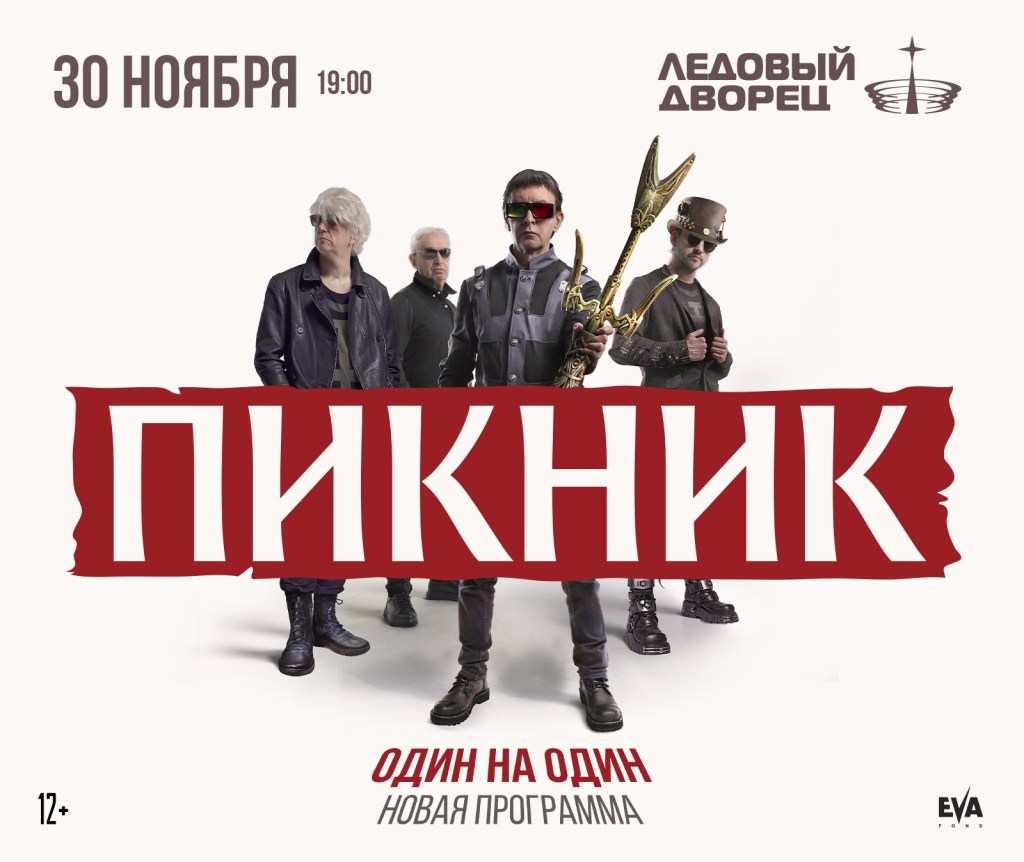
Is Picnic frontman Edmund Shklyarsky wielding a Ukrainian trident in this concert poster?

PICNIC
One on One

The band Picnic’s new concert program is entitled “One on One.”

Imagine a magic crystal with three facets. The first one is the eponymous new album. The second is video sequences and a laser show. And the third is the band’s musical calling cards: “The Egyptian,” “Kingdom of Curves,” “The Shining,” and others.

Since “the show must go on” (as the famous song says), it must go on not just any old way. The best minds from Kaliningrad to Vladivostok have been working on how to amaze you. Those who attended our concerts during The Future Awaits Us tour probably know already that Picnic’s bold claims are no empty threat. Of course, we will pull back the veil of secrecy, but only at the concert will all our secrets be revealed.

Source: Bileter.ru


[…]

Both of these stances, however, involve a lack of agency, a factor that is borne out in other research we have conducted. Indeed, reviewing nearly 100,000 substantive war-related texts from across six Telegram channels—including three generally pro-war and three anti-war channels—suggests that a lack of agency is common both to supporters and opponents of the war.

On the pro-war channels—which were dominated by reports from the front and patriotic rallying cries, but also included a number of discussions of mobilization and ways out avoiding military service—attribution of “credit” for the war was mixed. Often, the war was highly personalized: something was ordered by Putin, said by his spokesman Dmitry Peskov, or carried out by (then) Defense Minister Sergei Shoigu.

When discussing mobilization, the discussion was dry and procedural, with no discernible consideration of justice or fairness (or the irony of pro-war channels discussing ways of avoiding the fight). Almost never did commentators use the first person: things were done, said or thought by others, but not by them.

On the anti-war channels, the war was largely de-personalized. To the extent blame was attributed to Putin, it was mostly implicit: because it was Putin’s war, his role appeared to require little overt discussion. Perhaps surprisingly, discussion of military mobilization, similarly to the pro-war channels, focused on procedural consideration[s] and avoided issues of justice and fairness. Unlike in the pro-war channels, however, there was considerable use of the first person, but predominantly the first person singular, as commentators discussed their own thoughts and experiences. Use of the first person plural—“we”, with connotations of collective responsibility and action—were rare.

Given the roles played both by “system justification” and “agreeableness” among war supporters—psychological motivations that encourage people to get in line and discourage difference—the lack of a sense of agency is not surprising. Even those who write openly of their support for the war on Telegram don’t tend to see the war as something over which they have any control; while the war may be prosecuted with their support, it is prosecuted without their involvement.

It is perhaps somewhat more jarring that this lack of agency seems to extend to much of the anti-war community, however. To be certain, anti-war Russians clearly claim responsibility for their own lives and, in many cases, for assisting Ukrainian refugees, for example. Moreover, there are individuals and small groups who have attempted acts of resistance ranging from anti-war graffiti and solitary protests to outright sabotage. But there is little discussion of any potential agency over the war itself, or the idea that, if they acted, Russian citizens might be able to bring the war to an end.

Source: Bryce Hecht, Graeme Robertson, and Sam Greene, “Yes In My Name? The Problem of Agency in Russians’ Response to the War,” Russia.Post, 7 June 2024


In the first half of 2024, the average bill for entertainment tickets (excluding movies) amounted to 3,400 rubles [approx. 35 euros], which is 18.8% higher than a year earlier, reported Yandex Afisha. According to the service, this economic indicator rose by 14% last year. The largest increase in the average bill was recorded in theaters, which rose by almost a quarter, up to 3,800 rubles. The average price of concert tickets on Kassir.ru [a online ticket purchasing service] increased by 20% compared to last year, and the total price increase for the first six months of the year amounted to 16%. Market participants say the increase in ticket prices has been caused by the growing costs of organizing events, as well as by increased demand for performances by domestic artists after the departure of many foreign performers. This has led to an increase in the fees sought by Russian artists and, consequently, to an increase in ticket prices.

Source: Moscow Times Russian Service, 16 August 2024. Translated by the Russian Reader


[…]

But the continued damage to Putin’s authority after a catastrophic war and repeated shocks does not translate to an internal threat to his power. Nor is there a risk his regime might collapse in the foreseeable future, according to analysts.

Stanovaya said that many Russians, particularly members of the elite, had come to expect the worst in the war but realized that there was no alternative to Putin in Russia’s repressive political system.

“They are so used to shocking events. They’re so used to living in a very unpredictable situation, so it’s very difficult to surprise them. And they are also used to the feeling that they don’t have the power to affect anything, and they are helpless,” she said.

The crisis, she continued, had certainly undermined Putin’s authority — without necessarily undermining his grip on power.

[…]

Source: Robyn Dixon, “Kremlin response to Kursk incursion shows how Putin freezes in a crisis,” Washington Post, 18 August 2024

Pride (and Shame)

Guerneville, Calfornia, 11 August 2024. Photo by the Russian Reader

KOBLENZ, Germany (AP) — Sasha Skochilenko and Sofya Subbotina are planning to get married. That wasn’t an option in their native Russia, but it’s possible now that they live in Germany, which recognizes same-sex weddings.

“We don’t know how or in which city we will do it, but that’s the plan,” Skochilenko, 33, told the Associated Press, looking lovingly at Subbotina, who radiated happiness.

They reunited earlier this month in Germany, shortly after Skochilenko and other Russian prisoners were exchanged in a historic East-West swap — a happy if unlikely ending to an over two-year ordeal.

Skochilenko, an artist and musician, was jailed for speaking out against Russia’s war in Ukraine. Subbotina campaigned for her partner’s release while also trying to make her life behind bars as tolerable as possible.

They talked about marriage in Russia, too, but same-sex weddings have been effectively banned there. Laws restricting LGBTQ+ rights have been on the books for over a decade and intensified since the war began as part of the Kremlin’s campaign for “traditional values,” fueled by its anti-Western views and close ties to the Russian Orthodox Church.

Now, “I feel that I’m in a really free country,” Subbotina said, as they make plans for a life together in the quiet city of Koblenz in western Germany.

Skochilenko was arrested in her native St. Petersburg in 2022, just weeks after the invasion of Ukraine, for replacing price tags in a supermarket with anti-war messages like saying that Russia bombed civilian targets. She was charged with making false statements about the military, part of the massive crackdown on all dissent over the invasion.

She struggled in pre-trial detention, suffering from chronic illness, including celiac disease, requiring gluten-free meals. Subbotina commuted to Skochilenko’s jail at least twice a week, bringing food, medicine and other necessities. She and their friends made sure the case, which drew public outrage, stayed in the headlines.

Last year, Subbotina was diagnosed with cancer. “I just felt like I was giving up, and honestly, I was just ready to die,” she said.

The couple didn’t see each other for a year. Since they weren’t married, investigators made Subbotina a witness in the case and refused to allow her visits or to receive phone calls from Skochilenko.

“It is not a small thing, when a person you love can’t visit you,” Skochilenko said.

Subbotina added it was “very painful,” noting that she knows many women who married imprisoned men — often with the wedding held in pre-trial detention facilities or in penal colonies.

“It gives them the right for long visits, it gives them the right to get phone calls, short visits, because they have a certain status in the eyes of the authorities,” she said. “We’ve never had this opportunity.”

Subbotina says she eventually was allowed short visits.

They were always very open about their relationship, despite laws against any public endorsement of LGBTQ+ activities, driven by President Vladimir Putin’s close ties with the Russian Orthodox Church.

Skochilenko said it was clear in the early 2010s the Kremlin was headed in a “homophobic direction,” and some of the laws the authorities were adopting drove her to protest back then. In recent years, she said her openness was a form of activism.

People “often have distorted opinions about the LGBTQ+ community because they don’t know anyone” who loves someone of the same sex, and their views often change once they do, she said.

In November 2023, Skochilenko was convicted and sentenced to seven years in prison — an unusually harsh verdict.

This summer, while awaiting an appeal hearing at a detention center in St. Petersburg, she said there was a point when she reached a particular point of desperation about her long sentence. She said she was traumatized by the lack of freedom and privacy, the constant body searches, and the persisting hunger from being unable to eat prison food.

Subbotina visited her in July, and Skochilenko recalls bursting into tears for the first time in months.

“I told her, ‘Sonya, I’m tired of wanting to go home. Please tell me that I won’t have to serve the entire sentence, that some miracle will happen.’ And she said, ‘Yes, why don’t you hope for a miracle?’” Skochilenko said.

That same day, a prison official told Skochilenko to “urgently” apply for a presidential pardon, she said. The artist did not want to admit guilt, but the official said she could simply explain her health problems. She wrote the request and forgot about it, thinking that it would take a long time to even process.

Several days later, she was transferred to Moscow without explanation. In the same van was Andrei Pivovarov, an imprisoned opposition politician that she knew from years earlier. There was hardly any reason for them both to be transferred at the same time, so it suggested that perhaps something good was happening.

Skochilenko spent several long days in Moscow’s notorious Lefortovo Prison, where she was cold and hungry, unable to eat much of the food she was given.

Subbotina learned of the transfer and rushed to Moscow with a care package, visiting every detention center she could think of, without success.

The rest became what many Russians critical of the Kremlin describe as the first good news since the start of the war. On Aug. 1, Skochilenko and 15 others were put on a bus, driven to an airport and flown to Ankara, Turkey, where they were exchanged for eight Russians imprisoned in the West.

From Ankara, the former prisoners were flown to Germany, where Chancellor Olaf Scholz greeted them on the tarmac. The next day, Skochilenko was finally able to embrace Subbotina, who flew to Germany when she heard the news.

The days since then have been “euphoric,” Skochilenko said, filled with small pleasures like walking and buying the food she wants — but also spending time with the woman she loves.

Subbotina particularly enjoys being able to hold Skochilenko’s hand and kiss her in public without worry. In Germany, she says, it is something that is “just in the nature of things.”

They’ve settled for now in Koblenz but want to visit other cities in Germany before they decide where to live permanently. They’re eager to learn German and begin their new lives.

Skochilenko plans to return to making art, displaying sketches she drew about the prisoner swap -– a moment in history in which she became an unlikely participant. She also said she intends to seek treatment for post-traumatic stress disorder from her time in prison.

Subbotina, a nurse and a pharmacist whose cancer treatment was successful in Russia, hopes to work in the human rights field and help the hundreds of political prisoners in her former country.

Both admit that they never expected to leave Russia in the way they did.

“I don’t feel stressed about moving, because I’m very happy. I’m very happy that Sasha is with me,” Subbotina said with a smile.

Added Skochilenko: “My relationship with Russia is over. I need to accept that. I’m glad there’s a new life.”

Source: Dasha Litvinova, “Russian artist released in swap builds a new life in Germany, now free to marry her partner,” Press Democrat, 12 August 2024. (“The Press Democrat, with the largest circulation in California’s North Bay, is a daily newspaper published in Santa Rosa, California.” Santa Rosa is twenty miles from Guerneville, both of which are located in California’s Sonoma County, which I have had the pleasure of visiting three times this year.)


On Friday, Trump appeared in Bozeman, Montana, marking his first public appearance since Kamala Harris selected Tim Walz as her running mate. The former president took the stage later than scheduled, citing engine troubles on his plane. The event garnered significant attention from political pundits, especially in light of Trump’s declining poll numbers. Many speculated on how his campaign messaging might evolve. A noticeable shift emerged quickly: a heightened focus on attacking transgender people.

You can see a compilation of his attacks on transgender people here:

Erin in the Morning, “Trump Targets Trans People in Montana”

Trump’s initial attack targeted Imane Khelif, the Olympic athlete who was falsely accused by prominent right-wing figures of “being a man.” Trump commented on Khelif, saying, “I’d like to congratulate the young woman who transitioned from a man into a boxer. You saw he won—she won—the gold medal. How about the beautiful young Italian boxer? She got in there, didn’t know what was going on… she was a very good boxer, against other women. She didn’t count on this. She said, ‘OK, I had enough.’ It’s crazy what they are doing… this person won the gold medal. How crazy is this? And she wants it. She wants men to play in women’s sports.”

Imane Kehelif is not transgender, and has never transitioned. She was assigned female at birth, has always been cisgender, and was ruled out of competition by the International Boxing Association (IBA) after defeating an undefeated Russian boxer. Notably, the IBA is presided over by Umar Kremlev of Russia, and has been suspended by the International Olympic Committee due to corruption, judging scandals, and more.

Trump then shifted his focus to Tim Walz, declaring, “He signed a law letting the state kidnap children to change their gender so that they go home… I’m not talking about him, I’m talking about her. This is her ideology, this is why she picked him. And he signed a bill allowing pedophiles to claim human rights protections under the state law.”

The law Trump referenced is Minnesota’s legislation designating the state as a refuge for transgender individuals seeking care across state lines. The law does not permit the state to “kidnap children.” This misconception arises from a misinterpretation of a provision that allows Minnesota to “take jurisdiction” in cases involving youth transitions where one parent resides in a state that criminalizes such care and the other in a state where it is legal, particularly during divorce or custody disputes. As for the claim of “allowing pedophiles to claim human rights protections,” this is also false. The confusion stems from the removal of pedophilia from the definition of sexual orientation, but pedophilia remains illegal under Minnesota law.

Finally, Trump addressed schools, stating that he would “remove funding from any school pushing critical race theory, transgender insanity, and other inappropriate racial, sexual, or political content onto the lives of our children.” While this could be referring to book bans, which have proliferated in many states, Trump might also be threatening to use similar tactics against schools that allow transgender youth to use bathrooms matching their gender identity, change their names, or avoid forcibly outing trans youth to their parents.

Attacks on transgender people have little record of electoral success, with similar efforts failing in many campaigns over the last few elections. In elections where Republicans made trans people the major issue, the Republican Party faltered: 70% of Moms for Liberty and Project 1776 candidates lost their races in 2023. In Kentucky, the American Principles Project spent millions on anti-trans ads against Democratic Governor Andy Beshear, who won by a larger margin than his first election. Other losses Republicans have suffered on this issue occurred in the Virginia legislature elections, the Arizona Governor’s race, the Michigan legislature elections, the Wisconsin Supreme Court election, the Walker-Warnock Senate race, and in dozens more places. Furthermore, recent polling from GallupNavigator, and the LA Times indicates fading public support for such laws, with huge majorities of respondents seeing them as a distraction and opposing bans on trans youth care.

Despite a history of limited success with these tactics, Trump seems to be doubling down on the issue in a desperate bid to boost his poll numbers. If he succeeds and regains office, transgender individuals could face unprecedented threats as his administration intensifies its targeting of their rights and protections.

Source: Erin Reed, “Seeing Falling Poll Numbers, Trump Targets Trans People In Montana,” Erin in the Morning, 13 August 2024

Tim

Source: The Current


On Tuesday, Democratic presidential nominee Kamala Harris announced that her pick for Vice President is Tim Walz, the governor of Minnesota. In recent years, as trans and queer people have come under attack from over a thousand proposed bills, Walz is expected to serve as a source of optimism for LGBTQ+ people. The governor’s long track record on LGBTQ+ rights positions him as a strong oppositional force against what has become a national attack on LGBTQ+ people, particularly transgender individuals.

“I am proud to announce that I’ve asked Tim Walz to be my running mate. As a governor, a coach, a teacher, and a veteran, he’s delivered for working families like his. It’s great to have him on the team. Now let’s get to work. Join us,” read Harris’ statement on Twitter.

Walz has taken decisive action against attacks on transgender people in surrounding states, making Minnesota a refuge for those seeking care. In 2023, he signed an executive order protecting transgender people from out-of-state prosecution if they seek care within Minnesota’s borders. The executive order also issued a bulletin to health insurance companies, mandating coverage and initiating investigations into health insurance denials in the state.

In 2024, Walz signed a bill banning the gay and transgender panic defense. This defense is often used to help individuals avoid murder charges or receive lighter sentences by asserting that they were “deceived” by a romantic partner who was gay or transgender. According to one study, the transgender panic defense has been used at least 351 times.

Walz’s pro-LGBTQ+ record goes back much further than his time as governor. In 1999, he sponsored the first gay-straight alliance at his high school while working as a teacher. In Congress, he co-sponsored the repeal of the Defense of Marriage Act and voted to repeal Don’t Ask, Don’t Tell.

Having a Vice President with a track record of protecting trans and queer people will be important for LGBTQ+ members of the Democratic Party. Currently, 24 states have passed bans on transgender care for youth and some adults. Nationally, Republicans are attempting to negotiate over 50 anti-LGBTQ+ provisions into the national budget, including bans on federal funding for any entity offering gender-affirming care for trans youth, as well as trans military bans for dependent care, threatening to shut down the government over such provisions. Walz’s history of fighting against anti-trans and anti-LGBTQ+ provisions could aid the White House in opposing such policies should Harris be elected President.

As for LGBTQ+ allies and organizations, they appear happy with the pick. Kelly Robinson of HRC stated, “Her pick of Governor Walz sends a message that a Harris-Walz Administration will be committed to advancing equality and justice for all. That is the choice we are faced with in America. A Trump-Vance Administration that would demonize LGBTQ+ people, terrorize our families, send our rights and freedoms back to The Land Before Time and install Project 2025. Or a Harris-Walz Administration that will fight for our freedoms, defend our families, and make America a place where people don’t just get by — but can get ahead.”

Source: Erin Reed, “Tim Walz Took Historic Action To Protect Trans People, Now He’s The Dem VP Choice,” Erin in the Morning, 6 August 2024


The Replacements, “Bastards of Young” (1985)

Ah

God, what a mess, on the ladder of success
Where you take one step and miss the whole first rung
Dreams unfulfilled, graduate unskilled
It beats pickin’ cotton and waitin’ to be forgotten

Wait on the sons of no one, bastards of young
The daughters and the sons

Clean your baby womb, trash that baby boom
Elvis in the ground, no way he’ll be here tonight
Income tax deduction, one hell of a function
It beats pickin’ cotton or waitin’ to be forgotten

Wait on the sons of no one, bastards of young
Now the daughters and the sons

Unwillingness to claim us, ya got no war to name us

The ones love us best are the ones we’ll lay to rest
And visit their graves on holidays at best
The ones love us least are the ones we’ll die to please
If it’s any consolation, I don’t begin to understand them

Wait on the sons of no one, bastards of young
Daughters and the sons

Young, of young, young, young, young

Take it, it’s yours, take it, it’s yours
Take it, it’s yours

Source: LyricFind


Today Vice President Kamala Harris named her choice for her vice presidential running mate: Governor Tim Walz of Minnesota. Walz grew up in rural Nebraska. He enlisted in the Army National Guard when he was 17 and served for 24 years, retiring in 2005 as a command sergeant major, making him the highest-ranking enlisted soldier ever to serve in Congress, according to the House Committee on Veterans’ Affairs.  

He went to college with the educational benefits afforded him by the Army, and graduated from Chadron (Nebraska) State College. From 1989 to 1990, he taught at a high school in China, then became a social studies teacher in Alliance, Nebraska, where he met fellow teacher Gwen Whipple, who became his wife. They moved to Minnesota, where they both continued teaching and had two children, Hope and Gus, through IVF. 

Walz became the faculty advisor for the school’s gay-straight alliance organization at the same time that he coached the high-school football team from a 0–27 record to a state championship. The advisor “really needed to be the football coach, who was the soldier and was straight and was married,” Walz said in 2018. 

Walz ran for Congress in 2005 after some of his students were asked to leave a rally for George W. Bush because one of them had a sticker for Democratic presidential nominee John Kerry. Walz won and served in Congress for twelve years, sitting on the House Agriculture Committee, the Transportation and Infrastructure Committee, and the Committee on Veterans’ Affairs.

Voters elected Walz to the Minnesota state house in 2018, and in his second term they gave him a slim majority in the state legislature. With that support, Walz signed into law protections for abortion rights, supported gender-affirming care, and legalized the recreational use of marijuana. He signed into law gun safety legislation and protections for voting rights, and pushed for action to combat climate change and to promote renewable energy. 

Strong tax revenues and spending cuts gave the state a $17.6 billion surplus, and the Democrats under Walz used the money not to cut taxes, as Republicans wanted, but to invest in education, fund free breakfast and lunch for schoolchildren, make tuition free at the state’s public colleges for students whose families earned less than $80,000 a year, and invest in paid family and medical leave and health insurance coverage regardless of immigration status. 

While MAGA Republicans are already trying to define Walz as “far left,” his votes in Congress put him pretty squarely in the middle.  His work with Lieutenant Governor Peggy Flanagan to expand technology production and infrastructure funding in the state was rewarded in 2023, when Minnesota knocked Texas out of the top five states for business. The CNBC rating looked at 86 indicators in 10 categories, including the workforce, infrastructure, health, and business friendliness. 

Walz checks a number of boxes for the 2024 election, most notably that he hails from near the battleground states of Wisconsin, Michigan, and Pennsylvania and comes across as a normal, nice guy. He favors unions, workers’ rights, and a $15 minimum wage. He is also the person who coined the phrase that took away the dangerous overtones of today’s MAGA Republicans by dubbing them “weird.” As a student of his said: “In politics he’s good at calling out B.S. without getting nasty or too down in the dirt…. It’s the kind of common sense he showed as a coach: practical and kinda goofy.”

Walz is also a symbol of an important resetting of the Democratic Party. He has been unapologetic about his popular programs. On Sunday, July 28, when CNN’s Jake Tapper listed some of Walz’s policies and asked if they made Walz vulnerable to Trump calling him a “big government liberal.” Walz joked that he was, indeed, a “monster.” 

“Kids are eating and having full bellies so they can go learn, and women are making their own health care decisions, and we’re a top five business state, and we also rank in the top three of happiness…. The fact of the matter is,” where Democratic policies are implemented, “quality of life is higher, the economies are better…educational attainment is better. So yeah, my kids are going to eat here, and you’re going to have a chance to go to college, and you’re going to have an opportunity to live where we’re working on reducing carbon emissions. Oh, and by the way, you’re going to have personal incomes that are higher, and you’re going to have health insurance. So if that’s where they want to label me, I’m more than happy to take the label.” 

Right-wing reactionary politicians have claimed to represent ordinary Americans since the time of the passage of the Voting Rights Act—on August 6, 1965, exactly 59 years ago today—by insisting that a government that works for communities is a “socialist” plan to elevate undeserving women and racial, ethnic, and gender minorities at the expense of hardworking white men. 

Historically, though, rural America has quite often been the heart of the country’s progressive politics, and the Midwest has had a central place in that progressivism. Walz reintegrates that history with today’s Democratic Party. 

That reintegration has left the Republicans flatfooted. Trump and J.D. Vance expected to continue their posturing as champions of the common man, but on that front the credentials of a New York real estate developer who inherited millions of dollars and of a Yale-educated venture capitalist pale next to a Nebraska-born schoolteacher. Bryan Metzger, politics reporter at Business Insider, pointed out that J.D. Vance tried to hit Walz as a “San Francisco-style liberal,” but while Vance lived in San Francisco as a venture capitalist between 2013 and 2017, Walz went to San Francisco for the first time just last month. 

Head writer and producer of A Closer Look at Late Night with Seth Meyers Sal Gentile summed up Walz’s progressive politics and community vibe when he wrote on social media: “Tim Walz will expand free school lunches, raise the minimum wage, make it easier to unionize, fix your [carburetor], replace the old wiring in your basement, spray that wasp’s nest under the deck, install a new spring for your garage door and put a new chain on your lawnmower.” 

Vice President Harris had a very deep bench from which to choose a running mate, but her choice of Walz seems to have been widely popular. Representatives [sic] Alexandria Ocasio-Cortez of New York and Joe Manchin of West Virginia, who are usually on opposite sides of the party, both praised the choice, prompting Ocasio-Cortez to post: “Dems in disconcerting levels of array.” 

Harris and Walz held their first rally together tonight in Philadelphia, where Pennsylvania governor Josh Shapiro, who had been a top contender for the vice presidential slot, fired up the crowd. “Each of us has a responsibility to get off the sidelines, to get in the game, and to do our part,” he said. “Are you ready to do your part? Are you ready to form a more perfect union? Are you ready to build an America where no matter what you look like, where you come from, who you love, or who you pray to, that this will be a place for you? And are you ready to look the next president of the United States in the eye and say, ‘Hello, Madam President?’ I am too, so let’s get to work!”

Pennsylvania is a crucial state, and Shapiro issued a statement offering his “enthusiastic support” to the ticket. He pledged to work to unite Pennsylvanians behind my friends Kamala Harris and Tim Walz and defeat Donald Trump.”

Notes:

https://www.businessinsider.com/kamala-harris-vice-president-tim-walz-career-facts-2024-8#tim-walz-was-born-in-rural-west-point-nebraska-in-1964-1

https://www.thenation.com/article/politics/tim-walz-harris-vp

https://www.washingtonpost.com/style/power/2024/08/02/tim-walz-kamala-harris/

https://apnews.com/article/business-minnesota-legislature-state-budgets-government-and-politics-99f78b46d4bd90ccb9f1ce7525f759f9

https://apnews.com/article/election-2024-harris-vice-president-walz-minnesota-006bca6e18be7ce39ef4bfd97547c3b5

https://www.cbsnews.com/minnesota/news/minnesota-ranked-as-a-top-state-for-businesses/

https://www.democracydocket.com/news-alerts/tim-walz-is-kamala-harris-vp-pick-heres-his-record-on-voting-rights

https://abcnews.go.com/Technology/climate-advocacy-groups-call-harris-walz-pairing-winning/story?id=112607332

https://www.inquirer.com/politics/election/how-gov-josh-shapiro-lost-vp-kamala-harris-tim-walz-20240806.html#loaded

X:

Fritschner/status/1820874987315613913

atrupar/status/1820944764843274286

atrupar/status/1820940281572724920

Acyn/status/1820943608595493026

JoshShapiroPA/status/1820827281658446166

metzgov/status/1820872498235253035

AOC/status/1820846151920230812

salgentile/status/1820815724178285013

Source: Heather Cox Richardson, “August 6, 2024,” Letters from an American, 7 August 2024


WHY WALTZ
Josh Shapiro would seemingly have been a much more interesting choice as a vice presidential candidate for Kamala Harris, but her choice was different. Tim Walz, governor of Minnesota, won’t help with his state—Minnesota will vote Democrat anyway—but seems to pose less risk. (Although, it would seem, how much less risk could he pose?) He’s an army veteran, although he wasn’t in combat. He’s white, elderly, rural, and traditional, and he’s from a super reliable political coalition.

What I like about Waltz’s biography is that, before being elected to Congress fifteen years ago and then to the governorship, he was a teacher at a local school for over twenty years. He coached a local American football team that competed almost at the state level, and he was the head of the homosexual/non-homosexual friendship club at his school. I mean, he was just a regular, cool, interesting dude before he went into professional politics in his forties.

Source: Konstantin Sonin (Facebook), 6 August 2024

Alexander Podrabinek: Opposition Politicians Must Live in Russia to Do Their Jobs

Alexander Podrabinek in 1980

The recent prisoner swap has suddenly and quite vividly clarified the emotions and motives of the militant segment of the Russian emigration. Those who did photography in the old days will remember how you would dip a blank sheet of photographic paper into developer and gradually an image would appear on it. At first, the image would be vague, just outlines, but then it would become clearer and clearer, until finally you would pull it out from under the red lamp and hold it up to the white light: wow, you could see everything clearly!

I will avoid beeing politically correct and say everything I think. Emigrants from the so-called liberal crowd went abroad because they were afraid of going to prison in Russia. It’s an understandable fear—a valid reason, one might even say. The issue of personal security, their personal well-being and that of their families, was more important to them than Russian freedom and democracy, about which they spoke with such pathos and fervor at protest rallies, in the independent press, and on the internet. They did not have the guts, and such things happen. There is nothing laudable about it, but nothing catastrophic either. No one obliges them to sacrifice themselves, and they themselves were willing to be heroes on the podiums, but not in a real showdown with the repressive regime. All right, so they left: it’s no great loss. In any case, it is better to leave in time than to spill your guts later during an investigation.

I think most of those who have left Russia feel fine, but a certain segment of the emigration, the most militant and vocal, experiences emotional discomfort. They sense their own political inferiority, especially amidst what has happened in Russia to those who stayed, to those who have been resisting and are now in prison. To prove to themselves and others their insightfulness and to confirm the correctness of their choice to emigrate, they portray those who have remained in Russia as naive fools who don’t understand life. The very existence of political prisoners irritates them. They believe that people have been imprisoned by mistake or because they overestimated themselves. But they themselves didn’t overestimate!

Alexei Navalny’s decision to stay in Russia cut them to the quick. A month before his death, Navalny wrote in a letter from prison camp: “I have my country and my beliefs. I don’t want to give up either my country or my beliefs. I can betray neither the first nor the second. If your beliefs are worth something, you must be ready to stand up for them. And if necessary, to make sacrifices.”

The bombastic Ekaterina Schulmann just doesn’t get it. “The context of events is such that the first thought that comes to mind upon hearing the news is how he could have failed to leave [Russia] after the first [guilty] verdict, and almost the only emotion is amazement at this fact.” She is amazed: isn’t personal well-being the most important thing?

Dmitry Gudkov, a politician who is quite nimble in all respects, was even more definite at the time. “Almost all public figures, including well-known opposition figures, have been allowed to leave. But in case they didn’t get the signal, they go to jail. So if you don’t want to go to jail, you don’t have to wait for mercy from the Investigative Committee—there are flights to Tbilisi and other beautiful cities. At the slightest hint of danger, save yourself. The decision to take care of your life is always the right one.”

Gudkov and Schulmann are simple people, and they write about the benefits of cowardice in a straightforward, uncomplicated manner. But some others feel uncomfortable in such situations. They don’t like to feel as if they are fugitives saving they own skin—they need decent arguments. They want to remain on top, preferably at the heights they commanded in Russia, where everyone listened to them.

And what arguments are these? The most murderous one is that Russia is a lost country and the whole nation supports the fascist regime. As if there were not hundreds of political prisoners in camps and prisons who have chosen resistance rather than escape. As if there had not been rallies and marches throughout Russia, attended by many thousands of people, when such events could still be organized. As if the authorities didn’t have to falsify election results to avoid revealing Putin’s paltry electoral support.

Anna Rose writes about her Russian acquaintances, but it reads as if she is writing about Russians in general: “My Russian acquaintances didn’t show any sympathy for the real victims of aggression. The fact that in Ukraine, due to Russia’s fault and with their own tacit consent, people were being killed every day, that not only only cities were destroyed but also the basis for civic life in a sovereign country, seemed to them a backdrop, not the essence of what was going on.” What to do with such a worthless people? Clearly, run away from them and denounce them in the crudest possible language. And God forbid anyone should think that you are one of them yourself.

Journalist Victoria Ivleva took it a step further by attacking Vladimir Kara-Murza, Ilya Yashin, and Andrei Pivovarov on her Facebook page for talking too little and saying the wrong things about Ukraine at their press conference. “I would very much like to hear a single word of repentance from you, not stories about how Putin is to blame while the nation is wonderful and fresh. Who elected Putin time after time, was it not the nation? The war started by our Motherland has left us all with only one right—to get down on our knees.”

A well-off emigrant, Ivleva expects words of repentance from recent political prisoners who were imprisoned for their anti-war stance! Ivleva herself has nothing to do with it, she has nothing to repent for. It is they, the Russians, who should all fall on their knees as one, while those who left in time are not to blame for anything. But if we are talking about sincere repentance, shouldn’t Ivleva repent for the Soviet Union’s war against Afghanistan? That war was no less bloody than the current one, and Ivleva was then a civic-minded Soviet student and a successful journalist who was published in the Communist Youth Union’s newspaper. She didn’t protest. She didn’t get down on her knees. If we call everyone to repent for the sins of the regime, shouldn’t we turn to ourselves?

No, of course, only the people are to blame, the people who, according to Ivleva, have elected Putin time and time again. That is, the presidential elections, in her opinion, have been fair and transparent time and again: the president was elected by the people, the president is legitimate, and, therefore, the evidence of the people’s worthlessness is clear. And let’s forget about how the ballot rigging has been exposed and pretend that it didn’t happen.

The great thing about collective responsibility is that personal responsibility dissolves into universal responsibility. If everyone is to blame, then no one is to blame. It is a very convenient position. In a debate on Facebook, Konstantin Borovoy denounces the freed political prisoners: “Asking the West to lift sanctions when the regime has gone berserk and the citizens are supporting it is stupid and mean.” To say nothing of playing fast and loose with the facts (they were not talking about lifting sanctions, but about targeting them correctly), claiming that the citizenry supports the brutal regime is a sin against the truth. Some people support it and some don’t. No one knows the exact percentage, but it is certain that millions of people in Russia do not support this regime. Why should we talk about the unity of the party and the people and thus echo Putin’s propaganda? And if we are to blame everyone, shouldn’t we start with ourselves? Borovoy was a member of parliament during the crucial years and had much more sway in politics than the average man on the street. If something has gone wrong in our country, maybe we should think about our place in these processes? Or is everyone else to blame?

The premise of national guilt is not enough for successful self-affirmation. The liberated political prisoners are hysterically pointed to the plight of Ukraine and its prisoners of war in Russia, as if anyone would argue with this. But this generates the illusion that only the political emigrants are concerned about it, while no one in Russia understands any of it and no one in Russia sympathizes with Ukraine. The opinion that there are also Russian problems that require a political solution is jealously disputed: no, today there is only one problem—the war in Ukraine.

Yes, it is true that the war is the most important issue for Ukraine. But for Russia it is not the most important issue. It may be the most painful, but it is not the main one. For Russia, the primary problem is the authoritarian regime, a dictatorship which at a single person’s whim can start a war, murder dissidents, take away all freedoms, and threaten the entire world. The war in Ukraine is a consequence of Russia’s primary problem and this is what the liberated political prisoners were talking about. The fundamental solution to the issues of war and peace depends on the nature of the regime, not on military successes or defeats. Russia’s policy towards other states depends on the kind of regime it has. This is obvious.

Kara-Murza’s and Yashin’s desire to engage primarily in Russian politics and address the interests of Russia’s democratic future is understandable and rational. A democratic Russia will have no need of enemies on its borders or anywhere in Africa. It will return all annexed territories, pay reparations, and atone for and eventually redeem its guilt before Ukraine and the other countries it has attacked.

Opposition politicians must be in Russia to make this all happen. It won’t work otherwise. It’s understandable that this elicits a rabid reaction from political emigrants who label cowardice prudence and prefer glamorously clamoring in emigration to risking resistance in Russia. In my opinion, Kara-Murza explained it all quite clearly to them in an interview which he gave in March of this year while still in prison.

“A politician cannot work remotely. It is not a matter of practical efficacy; for a public figure, it is a question of ethics and responsibility to their fellow citizens. If you are calling on people to oppose an authoritarian regime, you cannot do this from a safe distance—you must share the risks with your community.”

Source: Alexander Podrabinek (Facebook), 6 August 2024. Translated by the Russian Reader. Mr. Podrabinek is a well-known dissident, journalist, human rights activist, and former political prisoner.

The Pianist (The Death of Pavel Kushnir)

Pavel Kushnir

In late July 2024, 39-year-old pianist Pavel Kushnir died in a Birobidzhan pretrial detention center. His musician friends and musicologists have no doubt he was a genius. Many of them had been unaware of his arrest in May 2024 on charges of “publicly calling for terrorist activities.” The grounds for his arrest were his anti-war videos, although his YouTube channel had only five subscribers at the time.

According to close friends, Kushnir himself had wanted to go “far from the capitals,” so he chose Birobidzhan hoping that he would not be forced to perform WWII Victory Day concerts amidst the ongoing war against Ukraine. As soon as the war started, Kushnir wrote social media posts opposing it, posted antiwar leaflets, and staged hunger strikes in protest. Before he was taken to the detention center, he had gone on at least two protest hunger strikes, one of which lasted for over one hundred days.

“He was almost a professional faster, so I don’t think he could have died in the pretrial detention center solely due to that,” his close friend Olga Shkrygunova told Okno.

“We Live in a Fascist Society”

“I am a musician, a pianist, and I graduated from the Moscow Conservatory, where I studied under Victor Merzhanov. I worked as a soloist at the Kursk Regional Philharmonic for seven years, and as a soloist at the Kurgan Philharmonic for three years. I have also tried my hand as a writer, and published an anti-war novel called ‘Russian Mash-Up’” was how Kushnir introduced himself in one of the interviews his friend Olga quoted to Okno.

Kushnir was born in Tambov, where his closest relatives still live. He studied at the music school and the Rachmaninoff Music College in Tambov. After graduating from the Moscow Conservatory, he worked in the Kursk and, later, the Kurgan philharmonic orchestras. In 2023, Kushnir was appointed soloist to the Birobidzhan Regional Philharmonic, and he was arrested in Birobidzhan in May 2024.

The person closest to him, his father Mikhail Borisovich Kushnir, a music school teacher in Tambov and a promoter of musical cognition, died several years before the Russia-Ukraine war started. Many of his friends note that had Kushnir senior lived to see this day, he definitely would not have survived his son’s death.

“They had a very close relationship. Mikhail Borisovich had great faith in him and was proud of him. They laughed a lot together, and he was very supportive of him,” Olga recalls. “The loss of his father was hard for [Pavel].”

Kushnir’s friends invariably call him super-talented, and even more often they call him a brilliant pianist.

“Pasha was just an incredible person. Ever since he was a child, everyone has talked about his incredible ear for music. For me, he was always a genius, both as a person and as a musician. A genius is an idealist who brooks no compromise, who battles on behalf of love, creativity, and freedom. His inexhaustible imagination knew no bounds. He once studied the language of Avatar and wrote a poem in it. He loved the cinema and knew it well, and he read a lot. He loved Vonnegut’s Cat’s Cradle. He wrote an anti-war novel, Russian Mash-Up: it is an original dystopia with references to Russian literature, and the main idea is to denounce the state dictatorship. Pavel was able to send me the manuscript of the new novel by mail. I hope that we friends of his can pool our efforts and publish it soon,” says Olga, who left Russia for Germany in 2012.

It was then, twelve years ago, that Kushnir last visited Shkrygunova in Moscow. In May 2012, he went to Bolotnaya Square to take part in the large-scale protests that were sparked by the fraudulent elections to the State Duma.

Kushnir’s description of his anti-war leafletting in Kurgan.

“He still believed back then that things could be fixed,” Olga says, sighing. “I know that Pavel protested the war in 2018 by going to pickets against the annexation of Crimea and the war in Donbas. When in May 2018 he went to Pushkin Square [in Moscow] holding a placard that said ‘Down with war, freedom for Russia,’ his homemade sign was torn apart [by police]. After the military invasion, he bitterly observed that nowadays [the police] would tear him apart at such a picket. So, he replaced pickets with leaflets, and leaflets with hunger strikes. They were his form of protest against fascism. He didn’t argue that we should give up picketing, but he understood that it required great courage, ‘because we live in a fascist society,'” Olga quotes her friend as saying.

As Kushnir admitted in his letters to friends, “the turning point and epiphany” for him had been Bucha.

“I think that the Bucha massacre is a disgrace to our motherland. Fascism is the death of our motherland. Putin is a fascist. Our motherland sacrificed millions of the best lives so that fascism would not exist, and we will not accept it. The criminal, despicable war which Putin’s fascism has been waging in our name is a challenge to my conscience, to all my personal hopes, to all the best things in me. I am sure I am not alone. For many people of my generation, accepting the war, ignoring the war, is unthinkable. Two nations are dying in this war. It must be stopped as soon as possible,” Olga quoted him as saying.

In 2022, Kushnir produced anti-war leaflets and posted them around Kurgan.

“At night, he put up large A4-sized leaflets, and during the day he put up small ones with peace symbols and biblical quotes in public places,” says Olga.

“Hunger Striking Is a Peaceful Form of Protest”

On 9 May 2023, Kushnir declared his first hunger strike, which was to last twenty days.

By his own admission, Kushnir did not expect a positive response from the authorities, but he hoped that other people would embrace his peaceful form of protest.

“I expect people to think hard about their attitude to the war, to end their silence. I expect a miracle,” he wrote.

According to his friends, Kushnir easily tolerated hunger and scheduled his next hunger strike, which was to last one hundred days, in the winter and spring of 2024.

“He went on and off [hunger strikes] absolutely systematically,” says Olga. “In March, when he had finished, he called us to say that everything was fine, that he felt good. He had been drinking water, apple juice, and coffee. As an illustration of his hunger strike, he suggested we imagine a glass of apple juice. So I don’t think he could have died from the hunger strike alone. I don’t believe it. I can’t rule out that they could have beaten him up in the detention center or in some other way they exacerbated his condition.”

In late May 2024, Kushnir was detained by the FSB. A criminal case was launched against him on charges of “publicly calling for terrorist activities” (per Article 205.2 of the Russian Criminal Code). The community Vkontakte page Atypical Birobidzhan was the first to report Kushnir’s arrest, claiming that four videos posted on Kushnir’s YouTube channel had served as grounds for the charges. It also reported that Kushnir was allegedly found in possession of a “homemade FBI agent’s ID.”

The short anti-war video which Pavel Kushnir posted on his “Foreign Agent Mulder” YouTube channel on 5 January 2024

“Pavel had been running the channel ‘Foreign Agent Mulder’ since 2011, and there are only four videos posted there. All of them criticized the war and the policies of the current Russian government. Before Pavel’s death, the channel had exactly five subscribers,” says one of Kushnir’s friends. “Now there are [507] subscribers.”

Many of his friends first learned of Kushnir’s death in late July and only then that he had been behind bars when he died.

“Unfortunately, Pavel’s arrest has come to light only now. I, for example, do a monitoring of court proceedings in the regions quite often, but I missed the news of Pavel’s hearing… I think this was a case when publicity could have saved the prisoner. I learned about Pavel’s death from Arshak Makichan, with whom I was involved in environmental activism; Arshak later left Russia, but he had known Pavel at the conservatory. I think that the intervention of such well-known activists in the case could have prevented Pavel from taking such a desperate step,” says Marina, an activist who corresponds with political prisoners. “Pavel’s cellmates testify that his death resulted from a dry hunger strike, and there is no reason not to trust them. As I understand it, the family is afraid of publicity, as the Moloch of the political crackdowns may strike them as well, so we don’t really know anything yet. But if you watch Pavel’s interviews and listen to his statements, I think it is clear that he was a man of genius, a talented, brilliant, and sensitive man. Unfortunately, such people do not have the ability to stand up to brute, base force, and the only protest that was available in the pretrial detention center was a hunger strike, apparently. Many anti-war activists—Ivan Kudryashov, Maria Ponomarenko, and dozens of others—have gone on hunger strike. When there is no communication with the outside world, no media contacts, alas, this is all that is left to a person. It’s scary to imagine what Pavel went through. The country has yet to realize who we have lost.”

Anna Karetnikova, a human rights activist who for many years aided prisoners as a member of the Moscow Public Monitoring Commission and, later, as a lead analyst in the Federal Penitentiary Service’s Moscow office, argues that the official cause of Kushnir’s death will not be listed as hunger strike, even if that was the cause. According to her, concealment of the real cause of death is a common practice in the Russian penitentiary system, so there are no statistics for hunger strikes in pretrial detention centers and penal colonies.

Pavel Kushnir’s messenger service announcement of a hunger strike, dated 9 May 2023 (celebrated in Russia as WWII Victory Day): “I’m going on a hunger strike. I demand the liquidation of the fascist regime, cessation of the war in Ukraine, and release of all political prisoners.”

“Pavel Kushnir’s death in the Birobidzhan pretrial detention center has been attributed to his hunger strike, a dry hunger strike in which the detainee refuses not only food, but also water. In my experience, cases of hunger strikes in places of detention are frequent and fall into two main categories: those triggered by criminal cases, and those protesting conditions of detention. They can be both for serious reasons, such as gross violations of human rights, and for trifling reasons, such as an investigating officer refusing to bring an inmates cigarettes. They can also be individual and collective. But dry hunger strikes are quite rare, because most detainees realize that it can eirquickly lead to th death,” says Karetnikova. “The law provides for a detainee’s refusal to eat, but it also stipulates what actions wardens should take in such cases. After receiving a written application for a hunger strike, the wardens at a pretrial detention center must notify the person in charge of the criminal case, as well as the supervising prosecutor. In addition, the hunger striker is entitled to a daily checkup by a doctor, during which their temperature, blood pressure, and weight are measured and recorded, and, if possible, to be placed in a separate cell from which all food has been removed. Every day, they will be brought food, which is left on a table, or on the feeder tray if it is open. Also a mentor will come and try to persuade them to give up this waste of time. Information about hunger strikers in each institution is entered daily into the penitentiary service’s overall statistical summary.”

“Forced feeding of detainees is provided for by law. Most often, in agreement with the hunger striker, they are given glucose drips, possibly with something else added to the mix to support them. If their lives are threatened, they can be force fed through a tube.”

“I don’t think hunger strike was listed as the cause of Kushnir’s death, however. I think that only his relatives and friends and cellmates knew that he was on a hunger strike. Even after the publicity, for example, a medic could be punished if he forgot to perform certain formalities— for example, doing a physical examination and taking the inmate’s temperature. He could be reprimanded and, at worst, dismissed. In a similar case, the head doctor of the hospital at the Matrosskaya Tishina prison in Moscow was fired. Of course, no one explained the reasons for his dismissal, and a different cause of death was listed . But the [inmate] had been quite emaciated, and it was feared that the truth could come out. If it had come out, [the doctor] could have been jailed for negligence, for example, or endangerment.

“Force feeding is not practiced as a matter of principle in Russia, because, for example, in order to force feed Alexander Shestun [the ex-head of the Moscow Region’s Serpukhov District (2003–2018) and chair of its Council of Deputies, Shestun was sentenced to fifteen years in a penal colony on charges of fraud and money laundering, but Memorial listed him as a political prisoner] they contacted headquarters a hundred times, since they could not understand what to do and how to do it. But they didn’t get any reasonable instructions from headquarters either, except ‘do something or we’ll punish you,'” Karetnikova says.

According to Karetnikov, the hunger striker loses weight, their vitals deteriorate, and sometimes they are unable to walk.

“There are stomach pains, different organs can fail, and in the long term, people can become confused and sometimes go crazy. Some people engage in self-harm. This is not the case with dry hunger strikers: I usually was able to convince them to give up, in exchange for my promises to do something to help, promises which I tried to keep,” says Karetnikova. “Some detainees starved for months. The longest well-known hunger strikers included Nadiya Savchenko, Alexander Shestun (who was subjected to force feeding), Sergei Krivov, and many other people who were released, but whom I don’t want to identify here. One of the hunger strikers was a stoma patient. One can live without food for about two months, on average. However, many hunger strikers took week-long breaks that enabled them to go without food for months at a time, and they were also put on IVs while on hunger strike. If you give up water too, you can die within a week.”

“He Played for God”

After Kushnir’s death, it was revealed that that he had long foreseen his own arrest, as evidenced in correspondence with his friends.

“He often wrote ‘I haven’t been jailed yet,’ and he sent me interviews where he openly spoke of the current system in Russia as fascist. I tried to persuade him, especially when he was looking for a new place to work a year ago, to come to Germany. I said we would take him in and he would find a job. He agreed but then immediately refused to write a bio, which is what you have to do if you want to play concerts. Those are laws of the music market, what can you do. But he was uncompromising: ‘I am a musician, my music speaks for me,'” Olga recalls. “Then there was the hope that he would be hired in a remote city, as he had decided to stay in Russia. Basically, he strove to be far from the capitals, so that the political pressure would be minimal. For example, he did not want to be forced to perform those selfsame Victory Day concerts.”

“Maybe I’ll be able to get a job in Russia. Anyway, I had an audition for the Philharmonic, and it seems to have gone well. Anyway, they treated me well, even though I have a ‘no war’ status on my Facebook page… or maybe they just didn’t notice it,” Pavel wrote to Olga at the start of his tenure with the Birobidzhan Philharmonic. “I traveled across the entire country on the Moscow-Vladivostok train, and I looked out the window at the nature, at the people in the parlor car. We have a tragic country, and miserable, predatory people, but so much beauty. We can’t give it to the fascists. Before the audition I ate, so my hunger strike demanding an end to the war was a waste of time. (I had held out for more than twenty days after all.) Probably, a person is free in everything except their own profession. It holds you and doesn’t let you sink, but it also doesn’t let you soar. It’s an anchor of normality.

A letter from Pavel Kushnir to a friend

Kushnir often gave interviews, and the All-Russia State Television and Radio Broadcasting Company even did a story about him. In one of his conversations with journalists, the pianist said that he planned to stay in Birobidzhan: “I had an audition [with another orchestra] but I canceled it. I decided to take a risk to stay and work here for twelve years. If I am not imprisoned, drafted into the army, or fired, I hope I will be with you for the next twelve years.”

“He just wanted to play. Without ingratiating himself to anyone, without making connections, without bending to anyone. Apparently, the ‘plain old’ cities of Russia, unlike Moscow, seemed to him better suited for this. He spoke fondly of Birobidzhan, sent me a map [of the city], and told me that he goes on walks there a lot,” Olga says. “I think he could have been happy there. He could have been happy in any place where you could just say what you think and do what you think. He had a lot of faith in God. He played for God. Maybe now he’s found that place.”

Pavel Kushnir’s concert recordings, even the most amateurish ones, garnered thousands of views, unlike his YouTube channel.

[…]

Pavel Kushnir performing Rachmaninoff’s 24 Preludes (Op. 3, 23, and 32) at the 29th Rachmaninoff Festival in Tambov in 2020

“Pasha Kushnir was in our class,” writes his Moscow Conservatory classmate Julia Wertman.

“We became friends somewhere in the middle of third year, I don’t remember exactly when,” she continues. “We lived in the dormitory, and there was a time when he would often visit my roommate and me for a glass of tea.

“Pasha would recite Brodsky from memory for hours, for days on end. Pasha had a shabby beige overcoat with a bulging pocket. Under the coat he was always dressed in black, and a half-liter bottle of vodka often stuck out of his pocket. (In most cases, it was just there for image. Pasha cultivated the image of a dissident, as if he were Venedikt Yerofeev.)

“Pasha could avoid sleeping, eating, or living, and yet still play absolutely stunningly. There’s an interview with him, linked to in the comments, in which he talks about some genius contemporaries who could prepare for a solo in half an hour under any conditions. As far as I remember, Pasha himself was like that.

“Once, at five in the morning, I went to the dorm kitchen to make breakfast. An incredible scene unfolded before my eyes. Kushnir, as clear-headed as piece of glass, stood at the open window and gazed at Malaya Gruzinskaya Street with a sad, detached look. Before him, a drunken German student with whom he had been living it up way past midnight was crawling on his knees. The German’s speech was so slurred that not even his accent was audible. He was literally sobbing a river of tears.

“‘Brother! Forgive me! Forgive me if you can, for….. Forgive me!’ [he said]. ‘Forgive my grandfather, forgive my great-grandfather, forgive me!!!’

“One Hanukkah, he brought my roommate and me a menorah and candles. I had very little idea at the time what to do with them. I only remember reading on the label: ‘The light of the Hanukkah candles reminds us of G-d’s constant presence in our lives.’

“That was when we nicknamed him ‘Hasid,’ a nickname that stuck.

“‘That’s good,’ Pasha said. ‘Yes, call me that. I think it suits me…’

“Then Hasid showed up at the prom. My favorite person and I were drinking champagne and eating leftover cake. While all the graduates were eating the cake, we danced a waltz somewhere that only we could hear. And G-d knows where Kushnir had been, but he too came have a last piece of cake.

“‘Guys! Be happy! Cheers, guys! [he said]. ‘The main thing now is not to fuck away your diploma!’

“We were only happy for a little while. Hasid went back home to his dad in Tambov, and we went to graduate school. That is, we didn’t fuck away our diplomas. On the contrary, we got PhDs. You basically know what happened after that.

“I tried several times to find the pianist Pavel Kushnir. I found show bills, all of them for concerts in provincial towns. Two years ago, I found out that he was in Birobidzhan. I thought, Well, he’s getting closer to his roots, so maybe he’ll come [to Israel] soon.

“But he didn’t come. Instead, he wound up on on an Israeli news feed, and from there, just now, he came to my attention.

“Was he a rebel? Was he openly calling for some kind of nightmare? I don’t think so.

“He always said what he wanted to say. He didn’t bite his tongue. He wasn’t swayed by stereotypes. He didn’t fit into any system. He lived his own life, thought his own thoughts, and searched his own search. He tried to get to the heart of the matter, like Pasternak. But in all other respects, he was probably more like Vysotsky.

“Hasid, I don’t know what your mother’s name was. Pavel, son of Mikhail, a great pianist, may your memory be blessed.

“And there will be Hanukkah, and there will be light.”

“We will defeat the ogres, and their descendants will ask our forgiveness again.”

[…]

Source: “‘Life is something which will never happen under fascism’: the pianist Pavel Kushnir, arrested for anti-war social media posts, has perished in a pretrial detention center in Birobidzhan,” Okno, 4 August 2024. Translated by the Russian Reader. Thanks to Comrade Koganzon for the heads-up.