Prison camp acquaintances, of course, slightly tweak the picture that can take shape when you read only anti-war media.
I talked to a friend from Krasnoyarsk today. He is currently doing time in a camp in Mari El (he was transferred there from Krasnoyarsk). He says, “A lot of people have left Mari El [for the war].” “Voluntarily?” I ask. “Voluntarily. And why not, the money is good, so they go. Plus there’s looting: they drag things back from there too.” In response to my remark that they might come back home in a coffin, he tries to explain, although he himself does not approve of their actions. “Well, a one-way ticket… People have been pushed to the limit. There’s nothing to live on. But there you can make decent money.”
Basically, you can’t argue with the material attractiveness of going to fight in the war. Here, in the countryside, some earn 20 thousand rubles a month [approx. 300 euros], but there they are promised 200 thousand [approx. 3,000 euros]. Plus looting. And there is seemingly nothing you can do about it. If they are paid, they will go. Especially because it has become harder to survive.
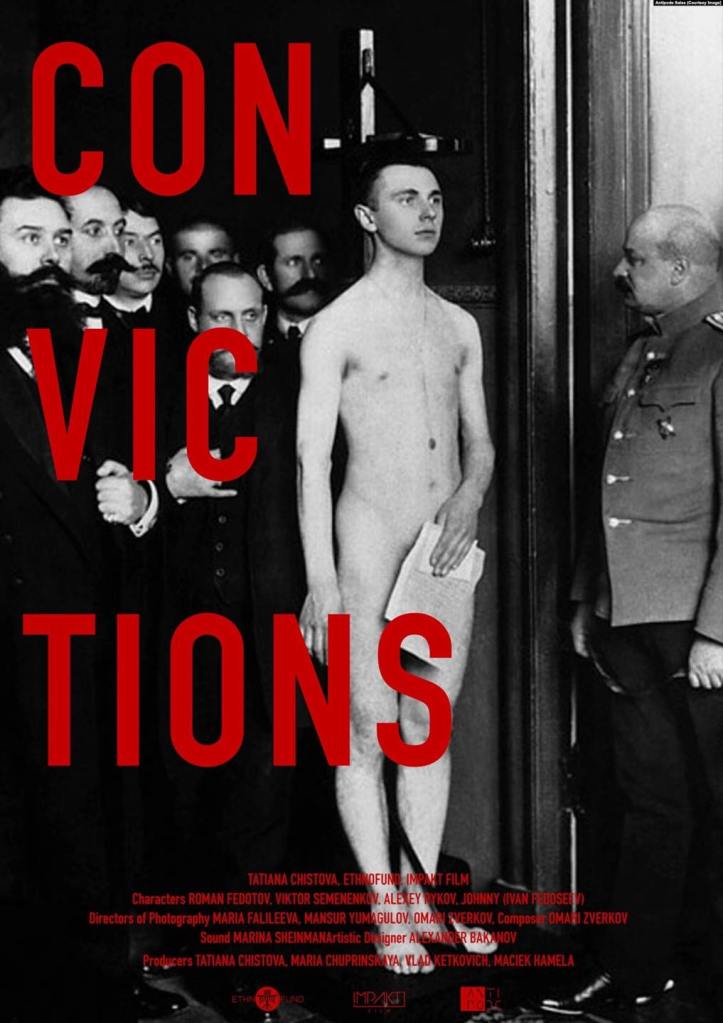
We started to make this film in 2014 during the annexation of Crimea by Russia. it seemed that by 2022 only the epigraph would remain relevant.
“You’ll pretend you were men instead of babies, and you’ll be played in the movies by Frank Sinatra and John Wayne or some of those other glamorous, war-loving, dirty old men.”
I understand how and why Russian guys from the provinces ended up in Ukraine.
Source: Tatiana Chistova, Facebook, 15 May 2022. Thanks to Jenya Kulakova for the heads-up and so much more. NB. This film is freely viewable on Vimeo only today, 15 May, apparently. Since it is a “private” video, I was unable to embed it here. UPDATE (17 MAY 2022) The film seems to be indefinitely viewable, so please take the opportunity to watch it using the URL and password listed, above. An acquaintance described it as “deadly serious and very funny too.” ||| TRR
A spontaneous memorial to those who died in Ukraine has appeared here in Krasnaya Rechka [Red River]. At the moment there are 25 photos, and yet this is far from the largest residential area in Khabarovsk.
Source: Vitaly Blazhevich, Facebook, 15 May 2022. Krasnaya Rechka is a so-called microdistrict (mikroraion) in Khabarovsk’s Industrial district, in the south of the city. Khabarovsk is home to over 600,000 people and is Russia’s twenty-sixth largest city. Translated by the Russian Reader
Ukraine Says Russia is Desperately Hiding True Death Figures – This week, the Security Services of Ukraine revealed that an intercepted phone call exposed how Russia is desperately trying to hide the actual number of Russian soldiers and Ukrainian civilians killed in the conflict in Ukraine.
According to the Ukrainian Security Services, an invading Russian soldier can be heard on the call talking about “makeshift dumpsites” where there are so many corpses piled up that they are around 6 feet high.
“It’s not a morgue, it’s a dump,” the soldier said. “They were just lying one on top of another, it was a dump as tall as a man.”
The soldier, who reportedly sounded tired and dispirited, described how he heard about the mass graveyards from the wife of a soldier who was first reported missing and eventually found at the so-called “dump.”
The wife said that thousands of bodies had been disposed of at the site and that Russians were saying that deceased soldiers left on the site were simply “missing in action.”
Russia Has a Problem – How Many Have Died?
The true number of Russian soldiers killed in the war with Ukraine is unknown, and will likely never be known thanks to the Kremlin’s efforts to hide the figure.
Estimates vary, but reports at the end of April indicated that as many as 25,900 Russian soldiers could have died so far. The number actually came from the same intercepted phone call that revealed how Russia hid the true number of deaths by declaring soldiers missing.
The number was similar to the estimate of 22,800 soldiers offered by Ukraine. The estimate, which was released last month, also suggested that 2,389 armored personnel vehicles, 431 artillery systems, 151 multiple launch rocket systems, and 970 Russian tanks had been destroyed.
As for Ukrainian civilians, the number is also unknown but will likely eventually be determined once the war comes to an end. According to the United Nations Human Rights Monitoring Mission, a total of 7,061 civilian casualties have been verified so far. Among those casualties were 3,381 deaths.
The number, however, is likely to be significantly higher.
“Overall, to date, we have corroborated 7,061 civilian casualties, with 3,381 killed and 3,680 injured across the country since the beginning of the armed attack by the Russian Federation. The actual figures are higher and we are working to corroborate every single incident,” UN spokeswoman Matilda Bogner told a press briefing in Geneva, Switzerland this week.
“We have been working on estimates, but all I can say for now is that it is thousands higher than the numbers we have currently given to you,” Bogner added about Russia’s causality figures.
Source: Jack Buckby, “Putin Is Lying: Russia May Have Lost Nearly 26,000 Soldiers in Ukraine,” 1945, 12 May 2022
Ailama Cesé Montalvo. Photo courtesy of the Lokomotiv Volleyball Club’s press service
Andrei Voronkov, the coach of the volleyball club Lokomotiv Kaliningrad, called a player on the competing team a “monkey” during Lokomotiv’s championship final match against Uralochka-NTMK. His remark has sparked a scandal, with the sports community demanding that the winning club’s skipper at least apologize.
On May 12, during a timeout in the decisive match, Voronkov chastised his players for losing the initiative and getting behind in the score. He turned to blocker Valeria Zaitseva and shouted, “Why are you trying to catch that monkey again?” Viewers of the match’s broadcast thought that the coach had directed his remark at Uralochka’s Cuban striker Ailama Cesé Montalvo, who is an important part of the Sverdlovsk team’s offensive line.
A screenshot of a video of the scandalous conversation between Coach Voronkov and player Valeria Zaitseva, as posted on Uralochka’s VK page. You can listen to Voronkov’s “pep talk” there. He does indeed audibly say what he is accused of saying.
In conversation with E1.ru, Uralochka-NTMK CEO Valentina Ogiyenko stressed that the insult could not be put down to the emotionally charged atmosphere during the Super League’s decisive match. She is sure that public apologies and the volleyball federation’s reaction will help to remedy the situation.
“Emotions are no excuse. Nikolay Vasilyevich Karpol worked [as Uralochka’s coach] for many years, but he never did such a thing, although there were much more serious and emotional matches in his career. Even at the Olympics, I have never heard such a thing from any coach. But we have three coaches in our country who excel at this behavior. […] I think that Andrei Voronkov should make a public apology in the same format as the insult was inflicted. […] He should not call Ailama and whisper ‘Sorry, dear’ in her ear. [His apology] should be broadcast on a national TV channel,” Ogiyenko said.
Uralochka’s press service also stated that the club expects an apology from the Lokomotiv coach. And the disciplinary commission, which monitors unsportsmanlike behavior during the championship, should put the matter to rest, reports Sports.ru.
Sports commentator Dmitry Guberniev has been the most categorical of all. On his Telegram channel, he called Andrei Voronkov a “racist” and a “disgrace,” saying that the Lokomotiv coach should be demonstratively banned from the profession.
The general director of the Kaliningrad team, Alexander Kosyrkov, has not yet evaluated the incident in any way.
“This is the first time I’ve ever heard about it. I was sitting in the stands and didn’t hear the break. I didn’t see that moment at all. I’m not up to reviewing videos and anything else right now. I’m not going to review the match yet. I’m a little bit not up to it now,” he told the newspaper Sport Ekpress.
Uralochka missed winning the heavily fought five-set match only on the tie-break. For the first time in six years, the team took second place in the Russian Volleyball Championship. But the Cuban athlete Ailama Montalvo will leave the team: the Ural climate does not suit her. She will continue her career at another club.
Source: “Opposing coach called Uralochka volleyballer a ‘monkey’, sports community demands punishment,” Vse novosti, 13 May 2022. Translated by the Russian Reader
Caucasian Knot reports that a court in Sochi has extended the remand in custody of Jehovah’s Witness Danil Suvorov until June 13. Suvorov’s defense counsel Sergei Yanovsky said that he had appealed the decision.
Danil Suvorov has been charged with involvement in an extremist organization (punishable under Part 2 of Article 282.2 of the Criminal Code), as well as recruiting for an extremist organization (punishable under Part 1.1 of Article 282.2 of the Criminal Code). According to criminal investigators, Suvorov attempted to recruit people to join the Jehovah’s Witnesses, “using his authority as a spiritual leader.”
The accused man’s mother, Gulnara Suvorova, was able to communicate with her son in the courtroom for the first time in over nine months.
“My son has been languishing in prison for nine months running for nothing. Or rather, for the fact that he read the Bible aloud to a person who had asked him about it. But, of course, it was just an easy excuse for law enforcement officers to catch a ‘criminal’ and earn a promotion for such a serious charge as extremism,” she told Caucasian Knot.
Suvorov’s defense moved to have the case dismissed, because, according to an expert witness, there was no extremism in the believer’s actions.
Suvorov was detained on 18 August 2021, the same day that his home and the homes of other Jehovah’s Witnesses in the Krasnodar Territory were searched. Electronic devices, personal diaries, postcards, and literature were seized from believers.
In 2017, the Russian Supreme Court ruled that the Administrative Center of Jehovah’s Witnesses in Russia was an extremist organization. It dissolved the Center and banned it from operating in Russia. Later, all Jehovah’s Witnesses branches in Russia were added to the list of banned organizations. Subsequently, a flood of criminal prosecutions against members of the confession began.
Source: OVD Info, 14 May 2022. Translated by the Russian Reader
The Mahal Mosque in Nizhny Tagil. Photo: IslamTsentr
On 12 May 2022, it transpired that in April, the Tagilstroyevsky District Court of Nizhny Tagil fined Fanis Galeyev (spelled “Galiyev” in some sources), the imam at the Mahal Mosque, under Article 20.29 of the Russian Federal Administrative Code (“distribution of extremist materials”).
An inspection conducted by the prosecutor’s office found twenty-books books included in the Federal List of Extremist Materials in the imam’s possession.
According to Galeyev, he had collected the books only to study and later destroy them.
“There is a fine line. Today these are not extremist books, but tomorrow they will be extremist. This can be determined by a spiritual person, not a secular one. These books that have been discovered cannot simply be thrown away. They must either be buried or burned.”
The imam is a member of the Nizhny Tagil Council for Combating Extremism.
There is no information about the books in question, but we should note that we consider many cases of banning Islamic literature to be unlawful.
Sources:
“Case Card No. 5-512/2022,” website of the Tagilstroievsky District Court of Nizhny Tagil, Sverdlovsk Region, May 2022 [the embedded link was inaccessible from my IP]
“Nizhny Tagil imam fighting extremism is convicted of distributing extremist literature,” 66.ru, 12 May 2022
“Nizhny Tagil imam punished for extremist literature,” Vse novosti, 12 May 2022
Source: SOVA Center, 13 May 2022. Thanks to OVD Info for the heads-up. Translated by the Russian Reader
The withdrawal of the American company Corteva Agriscience (Pioneer) from the Russian market may trigger problems in the country’s agriculture. Experts are already warning about a shortage of seeds for certain crops.
Marina Petrova, deputy chair of the Moscow Chamber of Commerce and Industry’s committee for entrepreneurship development in the agro-industrial complex and CEO of Petrova 5 Consulting, told Delovoi Peterburg that while the level of self-sufficiency with domestic grain seeds exceeds 75%, import dependence remains high for sunflower, at about 70%, and for corn, at more than 50%. Leftover seeds held by suppliers and Russian-produced varieties and hybrids are an alternative source.
“Domestic seeds often have poorer traits than foreign varieties. But Russia has a scientific base and decent domestic wheat, oat, rice and buckwheat seed products,” says Petrova. In her opinion, domestic selection and seed production is in need of structural transformation and state support. Over the past decade, the share of foreign seeds has increased significantly in Russia. This is primarily due to their higher yields. The largest players also offered package solutions involving seeds, agrochemicals, and management via digital platforms. Third-party designs may thus often be incompatible with existing ones.
Corteva Agriscience is a well-known producer of alfalfa, rapeseed, corn, cotton, rice, sorghum, soy, sunflower and wheat seeds, as well as plant protection products (including herbicides, fungicides and insecticides). According to the Leningrad Regional Committee for the Agro-Industry Complex and Fisheries, the region does not depend on Corteva Agriscience’s seeds. The committee’s press service clarified, however, that rapeseed, which is cultivated in the region, is actually grown from imported seeds. But corn and wheat seeds are domestically produced, while wheat seed is produced in the Leningrad Region itself.
Prinevskoye Breeding Farm CJSC (which grows rapeseed, among other things) reported that they had managed to purchase all the seeds they needed for the 2022 sowing campaign. “If there is no possibility of sourcing foreign rapeseed hybrids, we have a domestic analogue, Oredezh 6, which at the moment we can use to cover the needs not only of our farm, but also of the region,“ says Alexander Peretyatko, deputy general director for commercial affairs at Prinevskoye.
According to experts at the Agrophysical Research Institute, Russia has the potential to replace imported corn and rapeseed. This can also be said about wheat, which Crimea supplies in fairly large volumes. At the same time, seeds for protected soil (tomatoes, cucumbers, greens) are limited on the market. The chief researcher at the Institute’s Laboratory for Plant Biophysics, Professor Mikhail Arkhipov, recalls that back in 2016, a decree was issued ordering the production of original and elite agricultural plant seeds in the areas of domestic crop production that were highly dependent on foreign-made seeds. According to Arkhipov, the decree has still not been properly implemented.
“75% of the agricultural holdings that produce grain are owned by foreign companies. Foreign seed companies also continue to be actively involved in the Russian market. However, domestic seed growers can also solve the issue of supplying grain-growing areas with domestic wheat seeds. We have the necessary agricultural resources to produce our own seeds,” the expert notes.
In late 2021, President Vladimir Putin said that within a decade the country would be able to provide farmers at least 75% of the seeds they required. Arkhipov believes that this is a real prospect in the seed market for most agricultural crops. Petrova points out that many seed-growing enterprises need to improve their physical facilities and increase their technologization. Another problem that hinders the industry’s development is a shortage of personnel.
Source: Darya Dmitrieva, “Fresh ground: farmers prepare for shortage of imported seeds,” Delovoi Peterburg, 11 May 2022. Translated by the Russian Reader, who grew up on a farm in the Upper Midwest.
Corteva to Withdraw from Russia
Corteva has made the decision to withdraw from Russia and, having already paused new sales, is initiating a plan to stop production and business activities.
Our priorities remain the safety of our employees and global food security. Since the onset of this tragic war, we have taken all possible action to support and protect our Ukrainian colleagues and their families, our customers, and the communities in which we operate, including through direct and indirect aid to address the immediate humanitarian needs.
We have also put in place direct action to help assure as normal as possible 2022 growing season in Ukraine.
Given the war’s impact on global food security, the Company will donate seeds to Ukraine, Africa, and the Middle East region for the 2023 growing season, to lessen the impact on global food production.
Corteva joins with many others around the world in advocating for peace.
If I didn’t know it would get me into big trouble with the law, I would devote the rest of my life to physically assaulting Russian fascists until they finally cried, “Uncle!” and let this country breathe again. As it is, they and their supreme leader are quickly suffocating it.
By “Russian fascists” I don’t mean people who celebrate Hitler’s birthday and march around in silly outfits. I mean Putin’s mainly middle-class, fairly well-off, professionally educated supporters, without whom he would never have got anywhere in his ascent to immortality.
A particularly ugly encounter this evening at a shindig persuaded me once again that these people, who live mostly in the two capitals [Petersburg and Moscow], are Putin’s real base, not the mostly poor, disempowered, and utterly disabused people who live in the completely imaginary “Russian heartlands.”
What surprises me is how savvier folk than me haven’t been writing more and more often about this fact of life in Russia, which has been staring at us in the face for years.
Russia doesn’t need a proper bourgeois revolution. It needs a revolution to unseat the reflexively nationalist, increasingly fascistic bourgeoisie generated by the Putinist counterrevolution and, of course, the Putinist elite that manages and cultivates this fairly tiny nationalist bourgeoisie. Otherwise, the richest country on earth is doomed to collapse. ||| TRR, 13 May 2018, Petrograd. Photo by the Russian Reader
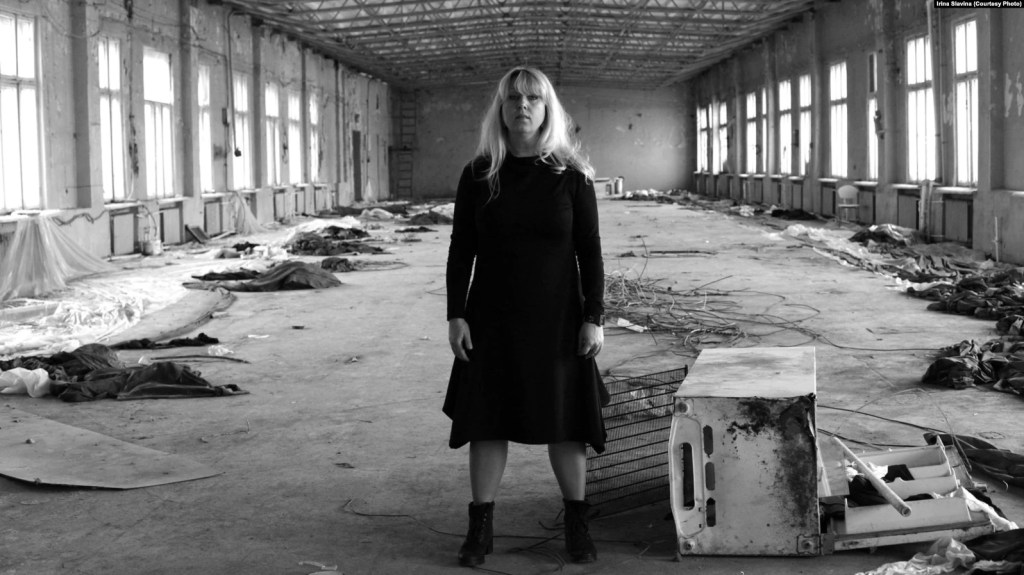
The Nizhny Novgorod authorities have refused to memorialize journalist Irina Slavina, who committed self-immolation on October 2, 2020, blaming the Russian state for her death. The journalist’s death was preceded by a search at her house as part of a criminal investigation into local businessman Mikhail Iosilevich, who was charged with “[carrying out the work of] an undesirable organization” (per Article 284.1 of the Criminal Code). In 2019, Slavina was sentenced to pay a fine of 70 thousand rubles for “involvement in the work of an undesirable organization.”
After Slavina’s death, human rights activists attempted to get the Investigative Committee to launch a criminal investigation of possible “incitement to suicide,” but the Committee turned them down on three occasions. The first time it argued that the journalist had suffered, possibly, from a “mixed personality disorder,” while the second time the Committee ruled that the suicide was the result of “emotional turmoil and a conscious wish to die.”
One of the projects undertaken by Irina Slavina, editor-in-chief of the independent Nizhny Novgorod publication Koza Press and a grassroots activist, was the rescue in 2015-2018 of a green zone near her house where the city authorities had decided to build a shopping center. The developer cut down dozens of trees, but the construction itself was stopped through the efforts of grassroots activists.
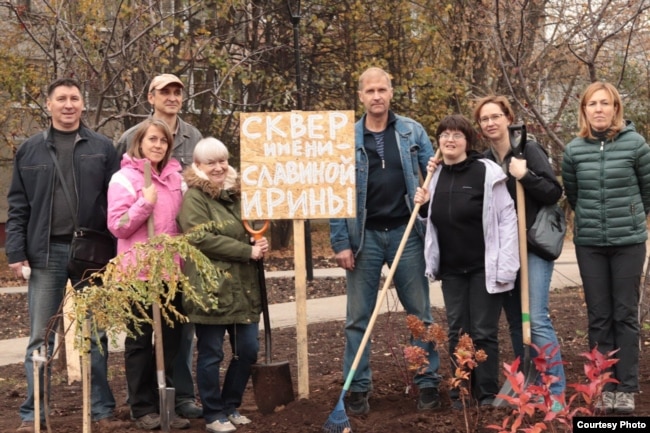
After Slavina’s self-immolation, Nizhny Novgorod residents began bringing flowers to the place of her death every Friday. Friends of the journalist planted flowers and seedlings in a small park near her house, dubbing the site “Slavina Square.”
Irina Slavina Square pressure group
At the same time, activists gathered signatures on a petition asking that the place Slavina had fought to save from redevelopment officially bear her name. The greenery in the square was also restored by the heads of the city’s Nizhegorodsky district. But these officials did not support the idea to naming the square after the journalist. They decided instead to name it in honor of the local architect Vadim Voronkov.
One of the initiators of the idea of naming the square after Irina Slavina was the Dront Ecological Center, whose employees petitioned the mayor’s office. But the authorities turned the request down, explaining that Slavina was not “an outstanding statesman and public figure or a spokesperson for science, culture, art and other public spheres who deserved broad recognition for her work.”
Local media recall that Nizhny Novgorod regional governor Gleb Nikitin had once presented Slavina with an official certificate of gratitude for her professional journalistic work and personal service and had earlier promised that he would make every effort “to ensure that the investigation of the circumstances that led to the tragedy is supervised at the highest level.”
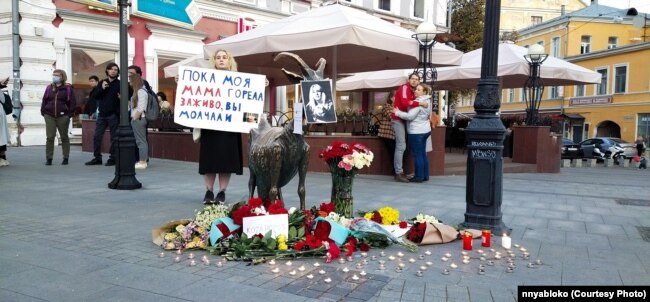
Irina Slavina’s daughter Margarita, holding a placard that reads, “While my mom was burning alive, you were silent.”
In April of this year, Dront began collecting signatures from ordinary Nizhny Novgorod residents who would like to see a Slavina Square in the city. The petition drive is still ongoing, but officials have already made their decision.
According to the newspaper Kommersant-Privolzhye, new trees were planted in the square a few days ago. The daughter of architect Vadim Voronkov, who was employed as the city’s chief architect for twenty years [in Soviet times, when it was still the closed city of Gorky], took part in the planting ceremony, which was organized by the Nizhny Novgorod State University of Architecture and Civil Engineering.
Alexei Fomenko, an activist with the project 42 — I Have the Right, called this decision by the authorities “a special operation on Slavina Boulevard.”
“For several decades, no one cared about the boulevard or the architect Voronkov. At one time, it was even decided to build the boulevard over. But then, suddenly, there is a ceremony, tree planting, and children. The mayor’s office and the deputies of the City Duma, realizing that we would not back down, and having no desire, on the one hand, to get a kick in the butt from their superiors, and on the other, getting their mugs dirty yet again, decided to resort to the good old ruse of round up some public employees, holding the necessary event hugger-mugger, and formalizing everything properly,” says Fomenko.
The plan of the authorities has not been welcomed on social media. Irina Slavina’s husband Alexei Murakhtayev was categorical in his condemnation.
“The authorities are once again doing something stupid. I do not know who the architect Voronkov was and what he has to do with this square. There must be some kind of cause and effect relationship! There is no cause, however, but the effect will be people’s discontent,” the deceased journalist’s husband argues.
The Nizhny Novgorod authorities explained their refusal to memorialize Slavina by claiming that her work “did not deserve broad recognition.” Vladimir Iordan, a friend of the journalist and a lecturer at the Nizhny Novgorod Theater School, does not agree with their appraisal.
“I have never met a more outstanding public figure capable of sacrificing their life for the sake of the ideals of justice, a more implacable campaigner against corruption and totalitarianism, a more honest and caring person. Slavina’s articles disciplined officials and deputies, and they exposed embezzlers. Governor Nikitin, when it was advantageous to him, liked to underscore that he reacted to all of Ira’s articles and requests. But Slavina was more than just a journalist — she was a real public figure in the original sense of the phrase. She was a driving force in many grassroots campaigns — against the lawlessness of tow truck operators, against the punitive beautification of parks and squares, against the redevelopment of Nizhny Novgorod’s historic center. She was a sensitive person who completely rejected injustice, lies, and hypocrisy,” says Iordan.
German Knyazev, an entrepreneur, public figure, and friend of Slavina, is sure that Slavina will not be memorialized under the current political regime.
“I think her main achievement was doing independent journalism in a totalitarian state, and my prediction is that this totalitarian state will never name a square after her,” Knyazev argues.
Meanwhile, the Iosilevich case, responsible for the humiliating search took place at Slavina’s home the day before her death, continues. Entrepreneur and activist Mikhail Iosilevich is on trial, accused of collaborating with Mikhail Khodorkovsky’s Open Russia and threatening a witness. Despite the flimsy evidence, the prosecutor has requested four and half years in a minimum security prison camp for Iosilevich. On the eve of his trial he tried to leave Russia using an Israeli passport. The attempt was unsuccessful: Iosilevich was removed from a plane bound for Tel Aviv. According to the activist, his departure would have been the “ideal option” for all parties in the trial. “But no it is then! We will go on with the oral arguments, the rebuttals, the final statement . . . and the conviction of an innocent man,” Iosilevich wrote in a telegram.
Immediately after Slavina’s self-immolation, the Nizhny Novgorod regional prosecutor’s office ruled that the search in her apartment had been lawful. The search was part of the investigation into Iosilevich, which was prompted by his alleged cooperation with Open Russia. It is still not clear what form this “cooperation” took, however.
“Today, at 6:00 a.m., 12 people entered my apartment using a blowtorch and a crowbar: Russian Investigative Committee officers, police, SWAT officers, [official] witnesses. My husband opened the door. I, being naked, got dressed under the supervision of a woman I didn’t know. A search was carried out. We were not allowed to call a lawyer. They were looking for pamphlets, leaflets, Open Russia accounts, perhaps an icon with the face of Mikhail Khodorkovsky. I don’t have any of these things,” Slavina wrote [on Facebook that day].
The next day, Slavina burned herself outside the Interior Ministry headquarters in Nizhny Novgorod. She left a suicide note on Facebook: “I ask you to blame the Russian Federation for my death.”
Source: Alexander Lugov, Radio Svoboda, 12 May 2022. Translated by the Russian Reader
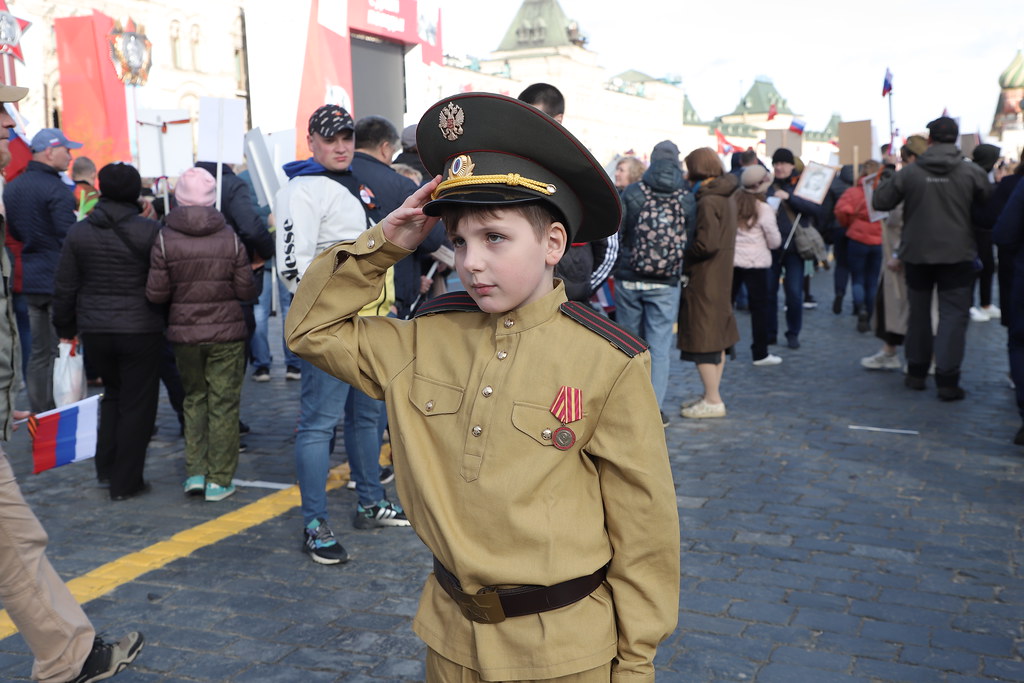
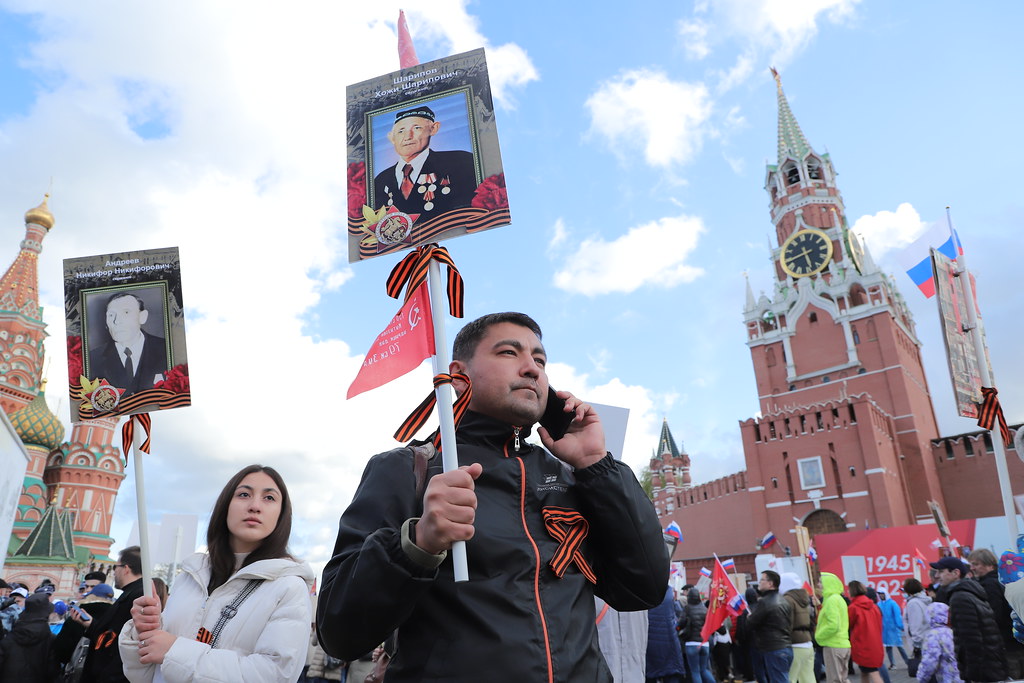
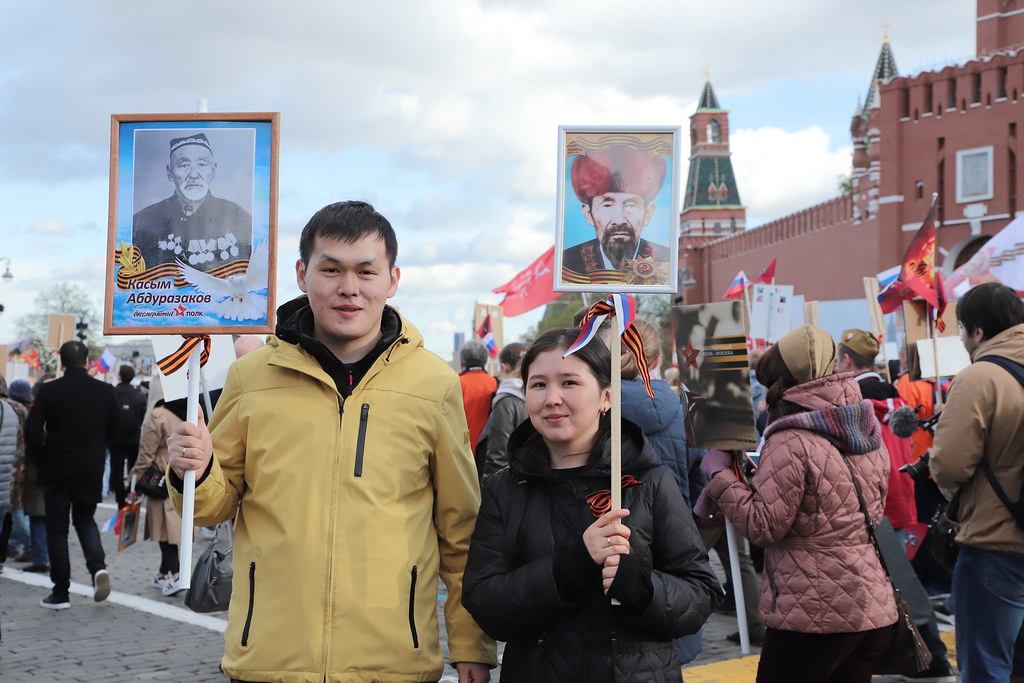
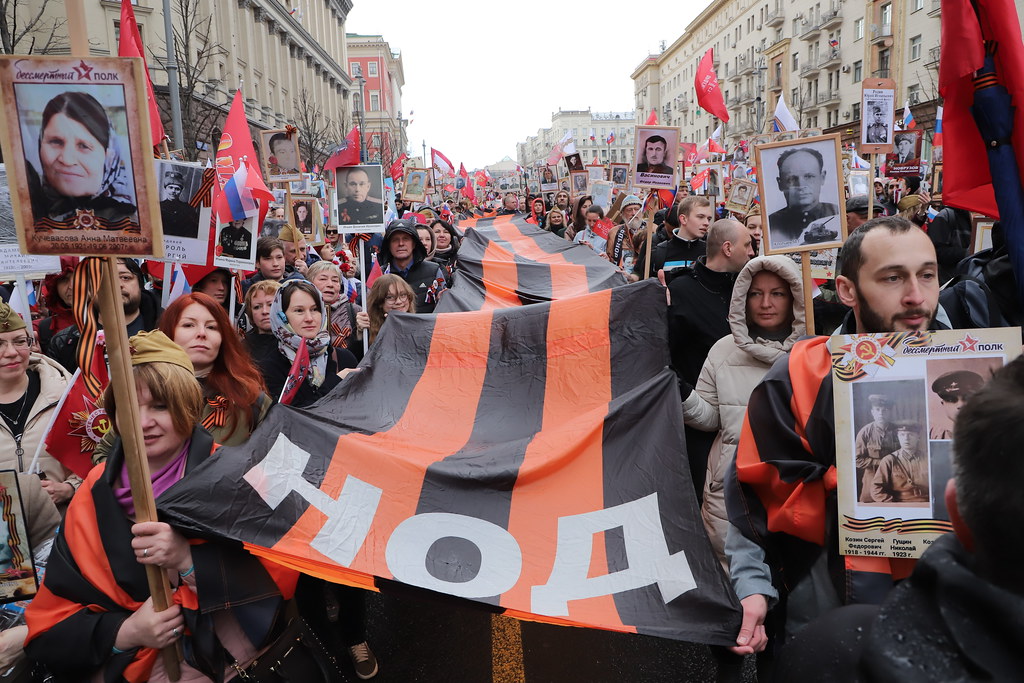
For the first time in my life (I swear!) I went to the Immortal Regiment march today. Let’s just say I was strongly encouraged to do it. I hesitated, I thought it over, but in the end my curiosity won out. I have been shooting almost nothing for more than two months, because I simply lost any sense of how to go on documenting urban life and civic activism in the new reality. What did I see and hear today? I found super polite people of all ages portraying the ideal “Russian world” in its peaceful aspect. “Nobody here wants war,” a man of about forty-five, holding a portrait of his grandfather and a flag emblazoned with an image of Stalin, told me. He is one of those who sees “pros and cons” in everything and everyone, and who, although experiencing some discomfort, still fully trusts the vision of the country’s leadership. Maybe some of the marchers were forced by their employers to go to the rally, but it seemed to me that people had gone there quite willingly. They were given free food and beverages: in exchange for such generosity, one can walk in the rain and sun for a couple of hours. The Uzbek workers seemed to be happy, because on Victory Day they are allowed to join the people of Great Russia, who for the rest of the year carefully monitor and maintain the existing division of society into “homeboys” and “aliens.” When, instead of periodic enthusiastic shouts of “Hur-ra-a-a-a-h!” or “Ru-u-u-u-sia!”, the crowd started chanting “fascism will not pass” behind me, I should have fought the good fight, but instead my instinct of self-preservation kicked in and I stupidly continued to shoot.
Source: anatrrra, LiveJournal, 10 May 2022. Introductory text translated and photos reprinted with the author’s kind permission. Go to the original post to see their completely stunning photo reportage in full. Translated by the Russian Reader
Karelian historian and human rights activist Yuri Dmitriev, who was sentenced to fifteen years in prison in late 2021, has been transferred to a maximum security penal colony in Mordovia, Interfax reports, citing Dmitriev’s attorney Viktor Anufriev as its source.
The historian will serve his sentence in Correctional Colony No. 18 in the village of Potma. Dmitriev must spend another ten years in the colony [to serve out his sentence].
The first criminal case against Yuri Dmitriev was launched in 2016. The historian was accused of making child pornography involving an adopted daughter. He denied any wrongdoing. The court acquitted Dmitriev, but in 2018 new charges were filed against him. In addition to making pornography, he was accused of sexually abusing his daughter and illegally possessing a weapon.
Yuri Dmitriev Photo: Peter Kovalev/TASS. Courtesy of Radio Svoboda
In the summer of 2020, a court in Petrozavodsk sentenced Dmitriev to three and a half years in a maximum security penal colony. In September of the same year, the Supreme Court of Karelia toughened Dmitriev’s sentence to thirteen years in a maximum security penal colony. In December of last year, the court increased Dmitriev’s sentence to fifteen years in a penal colony. The court found him guilty of producing child pornography, committing indecent acts, and illegally possessing a weapon. He had previously been acquitted on all three charges.
A historian and the head of the Karelian branch of Memorial, Dmitriev and his colleagues discovered, in the 1990s, the killing fields at Sandarmokh, where people were shot during the Great Terror. In total, about 150 grave pits were identified and marked, in which the remains of approximately four and a half thousand people could be located.
A journalistic investigation [by Proekt] alleged that the historian’s persecution was linked to Anatoly Seryshev, an aide to President Vladimir Putin, who previously headed the Karelian FSB, where he was charged, among other things, with purging the opposition from the region.