Give Them Want They Want

Putin: “Give me what I want!” Trump: “Hang on!”

Trump: “There’s a better way!” Trump: “Give him what he wants!”

Source: Moscow Times Russian Service weekly newsletter, 30 November 2025. Original by Michael de Adder. Translated by the Russian Reader


Following the shooting that claimed the life of a National Guard member last Wednesday in Washington, the Trump administration has announced it will be halting all asylum decisions and paused issuing visas for people travelling on Afghan passports. The suspect in Wednesday’s shooting that killed Specialist Sarah Beckstrom, 20, and critically wounded Staff Sgt. Andrew Wolfe, 24, is Rahmanullah Lakanwal, a 29-year-old Afghan national who worked with the CIA during the Afghanistan War and had been living in the U.S. since 2021. He applied for asylum during the Biden administration under a program that resettled Afghans after the U.S. withdrawal from the country, and was granted it this year under President Trump.

As seen in our infographic, based on data released by the U.S. Department of Justice, Afghanistan was not one of the 10 most common countries of origin for people who received asylum in the U.S. in the fiscal year 2024. Only 508 Afghans were granted asylum in the country that year, while 61 were refused. By comparison, the U.S. granted asylum to 3,605 Russian nationals, making Russia the most common nationality to get asylum in the country during that time period. This was followed by China, with 2,998 Chinese nationals receiving asylum, and Venezuela, with 2,656 successful asylum applications.

Source: Valentine Fourreau, “Who Is Granted Asylum in the United States?” Statista, 1 December 2025

Toxicity

School of Rock performs System of a Down’s “Toxicity” (2022)

Actors Martin and Janet Sheen, John Cusack and Slovenian philosopher Slavoj Žižek have signed an open letter urging Russian prison officials to end the solitary confinement of jailed activist Mikhail Kriger, who has been on a dry hunger strike for more than a week.

They join Garbage frontwoman Shirley Manson, who earlier this week called on the local prison chief to end Kriger’s isolation.

Kriger, 65, first launched a hunger strike in late September. He started a dry hunger strike — meaning abstention from both food and water — last Friday after a planned visit with his daughter was canceled.

Kriger has accused prison authorities of deliberately trying to isolate him to prevent contact with other inmates. 

The latest signatories of the letter to the head of Correctional Colony No. 5 in Russia’s Oryol region claimed Kriger’s condition “has now become critical,” according to the letter published by the exiled news website Mediazona.

“[Kriger’s] speech has slowed, his gaze is unfocused and he is extremely weak. Dry hunger strikes cause organ failure and quickly lead to shock and death,” the Sheens, Cusack and Žižek wrote.

Kriger was in 2023 sentenced to seven years in prison for “justifying terrorism” and “inciting hatred” over anti-Kremlin social media posts. The activist said during trial that he was being persecuted for his anti-war views and open pro-Ukrainian position.

The Nobel Peace Prize-winning human rights group Memorial designated Kriger a political prisoner.

The anti-Kremlin activist group Pussy Riot raised alarm over Kriger’s hunger strike earlier this week, calling on followers to write letters to him and the prison administration. 

It was not immediately clear whether authorities in the Oryol region prison colony intended to respond to the international appeals.

It was also not clear when Kriger was expected to be moved out of solitary confinement and whether his medical condition was being properly monitored.

Kriger’s support group said the activist was taken to a regional hospital on Wednesday for tests, the results of which have not been shared.

Kriger’s lawyer said he was “cheerful, wrote poems and even offered to hop on one leg to show his strength,” the support group said in an update Thursday.

“Forced feeding will only begin if he loses consciousness or doctors deem his condition critical,” Kriger’s support group wrote on Telegram.

Source: “Hollywood Stars Back Jailed Russian Activist on Hunger Strike,” Moscow Times, 17 October 2025


Yegor Shramko holding a placard that reads “No to the war with Ukraine” in Petersburg’s Palace Square

Our correspondent reports that activist Yegor Shramko did an anti-war picket in Palace Square and was detained.

The Petersburg man held a blue-and-yellow placard bearing the slogan “No to the war in Ukraine” and stood this way for around an hour. Shramko told our correspondent that although passersby supported him, the police were summoned by animateurs dressed as Russian emperors and empresses who offer to take photos with them for money on the square.

“I cannot keep silent. A life in which you have to fear everything, keep quiet, and be afraid of every little noise has no value for me,” Shramko explained to Bumaga.

He told RusNews that he had been wanting to stage the protest for four months but only worked up the nerve today.

This past summer, Shramko was jailed for twenty-four hours on charges of “displaying extremist symbols.” The “extremist symbol” in this case was the portrait of Alexei Navalny which Shramko brought to the Solovetsky Stone on the murdered politician’s birthday. At the time, Shramko told Bumaga that Navalny’s own words—”I’m not afraid, and you shouldn’t be afraid either”—had encouraged him to take the plunge and risk arrest by carrying out the proteest.

Source: Bumaga (Facebook), 17 October 2025. Thanks to Hanna Perekhoda for the heads-up.


The activist held a solo picket for about an hour. St. Petersburg residents approached him—some offered words of support, while others began arguing with him. More than 50 minutes after the picket began, security forces in full uniform arrived and detained Yegor.

Source: “Security forces detained activist Yegor Shramko, who was holding a pacifist picket | St. Petersburg,” RusNews (YouTube), 18 October 2025


As you have probably heard, recently, on a Swiss train, a Russian man (with Latvian citizenship) attacked a family. The family was speaking Ukrainian among themselves. He started threatening to kill them and their baby.

It’s easy to dismiss this as just another “fait divers” (which, in a sense, it is), but I think it says something larger. To understand his actions, you have to understand where it comes from.

For centuries, the inhabitants of the Russian state lived in a situation where order depended on fear and extreme forms of violence. This was true in much of the world, but while many countries began to change over the last century (let’s put aside the reasons behind the change), in the Russian/Soviet empire the situation actually became worse. Much worse.

The rules were never something people agreed to follow together (after all, you need to feel a part of a society and thus to share common imaginary to do it, and it is impossible to do it if you live in the empire, however much some contemporary researchers might wish it). It is something they were imposed from above, by the state, or by whoever had power over you at the moment. People learned that laws only mattered when someone strong was watching. So when a person raised in that kind of world finds themselves in a place like Switzerland, where rules work because the majority respects them voluntarily, they see the absence of fear and coercion as a sign that anything goes.

The man in that train was in a setting where no one was looking as capable to physically stop him and he took that as permission to dominate others, those people that he hates for the mere fact of their existence.

This same pattern plays out on a global scale. The Russian state elites see Europe much like that man saw the train: as a place without explicit “real” (military) force. It looks fake, easy to break, like a house of cards, because it relies on trust, and thus, in their view, on NOTHING.

People and societies shaped by fear and domination can’t imagine relationships built on any agreements (that require trust). They assume that if no one is dominating explicitly, it’s an invitation to act.

The man on the train and Putin’s crew are two versions of the same story. Both come from a social setting that sees respect as submission, peace as weakness, agreements as empty shells and absence of explicit force as an invitation to unlimited violence.

Source: Hanna Perekhoda (Facebook), 18 October 2025


Donald Trump told Ukrainian President Volodymyr Zelensky on Friday to make a deal with Russia, pouring cold water on Kyiv’s push for Tomahawk missiles as the U.S. leader pursues a diplomatic solution to the war.

Trump said as recently as last month that he believed Ukraine could take back all its territory — but a day after agreeing to meet Russian President Vladimir Putin for a new summit the American had changed his tune.

After meeting with Zelensky at the White House, Trump said on social media that their talks were “very interesting, and cordial, but I told him, as I likewise strongly suggested to President Putin, that it is time to stop the killing, and make a DEAL!”

Trump also appeared to suggest both sides should accept their current front lines. “They should stop where they are. Let both claim Victory, let History decide!” he said.

Zelensky said after the meeting that Russia was “afraid” of the U.S.-made long-range Tomahawk cruise missiles, but that he was “realistic” about receiving the weapons from Washington.

He told reporters that while he and Trump talked about long-range weapons they “decided that we don’t speak about it because… the United States doesn’t want escalation.”

‘Get the war over’

Zelensky came to Washington after weeks of calls for Tomahawks, hoping to capitalize on Trump’s growing frustration with Putin after a summit in Alaska failed to produce a breakthrough.

But the Ukrainian left empty-handed as Trump eyes a fresh diplomatic breakthrough on the back of last week’s Gaza peace deal.

Trump has appeared far more upbeat about the prospects of a deal since his two-and-a-half hour call with Putin on Thursday, in which they agreed to meet in Budapest.

“Hopefully we’ll be able to get the war over with without thinking about Tomahawks,” Trump told journalists including an AFP reporter as he hosted Zelensky at the White House.

Trump added that he believed Putin “wants to end the war.”

Zelensky, who came to the White House to push for the long-range U.S.-made weapons, said however that he would be ready to swap “thousands” of Ukrainian drones in exchange for Tomahawks.

Zelensky congratulated Trump on his recent Middle East peace deal in Gaza and said he hoped he would do the same for Ukraine. “I hope that President Trump can manage it,” he said.

‘Many questions’

Diplomatic talks on ending Russia’s invasion have stalled since the Alaska summit.

The Kremlin said Friday that “many questions” needed resolving before Putin and Trump could meet, including who would be on each negotiating team.

But it brushed off suggestions Putin would have difficulty flying over European airspace.

Hungary said it would ensure Putin could enter and “hold successful talks” with the United States despite an International Criminal Court arrest warrant against him for alleged war crimes.

Since the start of his second term, Trump’s position on the Ukraine war has shifted dramatically back and forth.

Initially Trump and Putin reached out to each other as the U.S. leader derided Zelensky as a “dictator without elections.”

Tensions came to a head in February, when Trump accused his Ukrainian counterpart of “not having the cards” in a rancorous televised meeting at the Oval Office.

Relations between the two have since warmed as Trump has expressed growing frustration with Putin.

But Trump has kept a channel of dialogue open with Putin, saying that they “get along.”

The U.S. leader has repeatedly changed his position on sanctions and other steps against Moscow following calls with the Russian president.

Putin ordered a full-scale invasion of Ukraine in February 2022, describing it as a “special military operation” to demilitarize the country and prevent the expansion of NATO.

Russia now occupies around a fifth of Ukrainian territory — much of it ravaged by fighting.

On Friday the Russian Defense Ministry announced it had captured three villages in Ukraine’s Dnipropetrovsk and Kharkiv regions.

Source: Danny Kemp (AFP), “Trump Tells Zelensky to ‘Make a Deal’ as Tomahawk Plea Misfires,” Moscow Times, 18 October 2025


All last week, Republican leaders tried to portray the No Kings protests scheduled for Saturday, October 18, as “Hate America” rallies. G. Elliott Morris of Strength in Numbers partnered with Atlanta-based science newsroom The Xylom to estimate that as many as 8.2 million people turned out yesterday to oppose the Trump administration. The mood at the protests was joyful and peaceful, with protesters holding signs that championed American principles of democracy, free speech, equality, and the rule of law. As the Grand Junction, Colorado, Daily Sentinel put it in a front-page headline: “‘This is America’ ‘No Kings’ protests against Trump bring a street party vibe to cities nationwide.”

Then last night, after the protests, the president’s social media account posted an AI-generated video showing Trump in a fighter jet with “KING TRUMP” painted on the side. The president sits in the airplane in front of something round that could be seen as a halo. He is wearing a gold crown; weirdly, the oxygen mask is over his mouth and chin, rather than mouth and nose.

Once in the air, the plane drops excrement on American cities, including what seems to be New York City. The excrement drenches protesters, one of whom is 23-year-old liberal political commentator and influencer Harry Sisson. Journalist Aaron Rupar of Public Notice, who shares media clips that reflect politics, commented: “Trump posts AI video showing him literally dumping sh*t on America.” Historian Larry Glickman noted that media outlets make much of alleged Democratic disdain for ordinary Americans, but have had little to say about the disdain for Americans embodied by Trump’s video.

Several administration videos and images have responded to Americans saying “No Kings” by taking the position “Yes, We Want Kings,” an open embrace of the end of democracy. But they are more than simple trolling. Led by Trump, MAGA Republicans have abandoned the idea of politics, which is the process of engaging in debate and negotiation to attract support and win power. What is left when a system loses the give and take of politics is force.

The idea that leaders must attract voters with reasoned arguments to win power and must concede power when their opponents win has been the central premise of American government since 1800. In that year, after a charged election in which each side accused the other of trying to destroy the country, Federalist John Adams turned the reins of government over to the leader of the opposition, Thomas Jefferson. That peaceful transfer of power not only protected the people, it protected leaders who had lost the support of voters, giving them a way to leave office safely and either retire or regroup to make another run at power.

The peaceful transfer of power symbolized the nation’s political system and became the hallmark of the United States of America. It lasted until January 6, 2021, when sitting president Trump refused to accept the voters’ election of Democrat Joe Biden, the leader of the opposition.

Now back in power, Trump and his loyalists are continuing to undermine the idea of politics, policies, and debate, trying instead to delegitimize the Democratic opposition altogether. Yesterday, during the protests, President Donald Trump, Vice President J.D Vance, and the official White House social media account posted a video of Trump placing a royal crown on his head, draping a royal robe around his shoulders, and unsheathing and brandishing a sword (an image that raises questions about why Trump wanted one of General Dwight D. Eisenhower’s swords so badly that he had the museum director who refused to hand it over fired). In the video, Democratic leaders including former House speaker Nancy Pelosi (D-CA) and what appears to be Senate minority leader Chuck Schumer (D-NY) first kneel and then bow to Trump.

Administration imagery doesn’t simply insult opposition leaders; it undermines the idea of politics by suggesting that Democrats are un-American. Last night the White House continued its racist crusade against Democratic leaders by posted an AI-generated image of Trump and Vance wearing jewel-encrusted crowns positioned above an image of House minority leader Hakeem Jeffries (D-NY) and Senate minority leader Chuck Schumer (D-NY) wearing Mexican sombreros. The caption reads: “We’re built different.”

The administration’s hostility to loyal opposition is translating into direct assaults on our government. House speaker Mike Johnson is refusing to seat a member of the opposition. Voters chose representative-elect Adelita Grijalva (D-AZ) on September 23 to fill a vacant House seat, but Johnson has come up with one reason after another not to seat her. Until she is sworn in, she has no access to government resources and cannot represent her constituents. She also cannot be the 218th signature on a discharge petition that would force a vote on whether to demand the release of the Epstein files, the final signature needed.

Grijalva recorded a video reinforcing the political system, saying: “We need to get to work, get on the floor, and negotiate so we can reopen the government.”

But Republican congressional leaders are refusing even to talk with Democrats to reopen the government, let alone to negotiate with them. They are trying to force Democrats simply to do as they say, despite the fact that 78% of Americans, including 59% of Republicans, support the Democrats’ demand for an extension of the tax credit that lowers the cost of healthcare premiums on the Affordable Care Act markets. Lindsay Wise, Anna Wilde Mathews, and Katy Stech Ferek of the Wall Street Journal reported today that more than three quarters of those who are insured through the ACA markets live in states that voted for Trump.

A video of Trump in a bomber attacking American cities carries an implied threat that the disdain of throwing excrement doesn’t erase. This morning, Trump reinforced that threat when he reminded Fox News Channel host Maria Bartiromo: “Don’t forget I can use the Insurrection Act. Fifty percent of the presidents almost have used that. And that’s unquestioned power. I choose not to, I’d rather do this, but I’m met constantly by fake politicians, politicians that think that, that you know they it’s not like a part of the radical left movement to have safety. These cities have to be safe.”

That “safety” apparently involves detaining U.S. citizens without due process. On Thursday, Nicole Foy of ProPublica reported that more than 170 U.S. citizens have been detained by immigration agents. She reports they “have been dragged, tackled, beaten, tased and shot by immigration agents. They’ve had their necks kneeled on. They’ve been held outside in the rain while in their underwear. At least three citizens were pregnant when agents detained them. One of those women had already had the door of her home blown off while Department of Homeland Security Secretary Kristi Noem watched.”

On Friday, the Trump administration pushed its attempt to use the military in Democratic-led cities, asking the Supreme Court to let it deploy troops in Chicago immediately. Chris Geidner of Law Dork notes that four judges, two appointed by Democrats and two appointed by Republicans, have rejected the administration’s arguments for why they must send in troops. Now the Department of Justice has appealed to the Supreme Court, asking for a decision on the so-called shadow docket, which would provide a fast response, but one without any hearings or explanation.

The administration’s appeal to the Supreme Court warned that there was “pressing risk of violence” in Chicago—a premise the judges rejected—and said preventing Trump from going into the city “improperly impinges on the President’s authority.”

How much difference will the No Kings Day protests, even as big as they were, make in the face of the administration’s attempt to get rid of our democratic political system and replace it with authoritarianism? What good is an inflatable frog against federal agents?

Scholar of social movements Lisa Corrigan noted that large, fun marches full of art and music expand connections and make people more willing to take risks against growing state power. They build larger communities by creating new images that bring together recognizable images from the past in new ways, helping more people see themselves in such an opposition. The community and good feelings those gatherings develop help carry opposition through hard moments. Corrigan notes, too, that yesterday “every single rally (including in the small towns) was bigger than the surrounding police force available. That kind of image event is VERY IMPORTANT if you’re…demonstrating social coherence AGAINST a fascist government and its makeshift gestapo.”

Such rallies “bring together multigenerational groups and the playfulness can help create enthusiasm for big tent politics against the monoculture of fascism,” Corrigan writes. “The frogs (and unicorns and dinosaurs) will be defining ideographs of this period of struggle.”

Source: Heather Cox Richardson, Letters from an American, 19 October 2025


System of a Down, “Toxicity” (2001)

All of Ukraine Belongs to Ukraine

Prescott Avenue, Monterey, California, 23 June 2025. Photo by the Russian Reader

In this week’s bulletin: Risks in Ukraine’s citizenship lawTrade union house grab/ Life under occupationStop Seapeak campaign/ War & dependent state formation in Ukraine/ More evidence of Russia’s indoctrination of small children/ Massive increase in Russian attacks on civilians

News from the territories occupied by Russia:  

Political prisoner Rustam Sheikhaliev turns 46, his sixth birthday behind bars (Crimea Platform, 22 June)

Banned from home for 40 years: deportations are Russia’s latest move to ‘cleanse’ Ukraine (The Guardian, June 21st)

7-year-olds in occupied Ukraine taught how to become part of Russia’s war machine (Kharkiv Human Rights Protection Group, June 20th)

Crimean sentenced to 17 years ‘for planning to blow up a Russian military helicopter’ (Kharkiv Human Rights Protection Group, June 20th)

Russian threat to co-founder of Crimea Human Rights Group (Crimea Human Rights Group, 19 June)

Russian court ignores abduction and torture, increasing huge sentence against Ukrainian for trying to rescue his mother (Kharkiv Human Rights Protection Group, June 19th)

Russia sentences 19-year-old Ukrainian to 8 years for ‘spying for Ukraine’ as a young boy  (Kharkiv Human Rights Protection Group, June 19th)

New legislation formalizes Russia’s brutal isolation of Crimean Tatar and other Ukrainian political prisoners (Kharkiv Human Rights Protection Group, June 17th)

How Putin rules in occupied Ukraine (Workers Liberty, June 16th)

Life Under Occupation (Alter Pravo, May 2025)

Life Under Occupation (Alter Pravo, April 2025)

News from the front:

Sumy defences stabilised: weekly war report (The Insider, 21 June)

News from Ukraine:

Speeches in the Verkhovna Rada: Expropriation of the trade union house (European Network for Solidarity with Ukraine, 20 June)

Kyiv Mayor Vitali Klitschko: The President’s Rival (Meduza, 17 June)

UN monitors report massive increase in Russian attacks on civilians throughout Ukraine (Kharkiv Human Rights Protection Group, June 16th)

Over 1,900 tonnes of harmful substances released into air over Kyiv and oblast in two days of Russian attacks (Ukrainska Pravda, June 16th)

Ukraine bracing for ‘painful’ reduction in US military aid after Hegseth announces cuts (Kyiv Independent, June 11th)

War-related news from Russia:

St Petersburg Economic Forum: an economic reality check (Meduza, 20 June)

Russian anti-war volunteer sentenced to 22 years (Novaya Gazeta Europe, 20 June)

How a network for selling sex with teenagers to the rich and powerful was built in Russia (iStories, 19 June)

Court claims show Russian casualties: The wave of the missing (Mediazona, 5 June) 

Analysis and comment:

Migration Policy of Ukraine: Legal Regulation and European Integration (Opora, June 20th)

Risks in Ukraine’s draft law on multiple citizenship (Crimea Human Rights Group, 17 June)

Position of human rights defenders: the draft law on multiple citizenship creates threats for residents of the occupied territories (Zmina, June 17th)

Volodymyr Artiukh and Taras Fedirko: War and dependent state formation in Ukraine (Berghahn Journals, 2025)

Housing Needs and Prospects for Social Housing in the Kalush Hromada (Cedos, June 19th)

Research of human rights abuses:

ZMINA highlights the need for accountability at Central and Eastern Europe Security Forum in Warsaw (Zmina, June 17th)

ZMINA joined the development of the Roadmap for the investigation of crimes against humanity committed by Russian forces in Ukraine (Zmina, June 16th)

International solidarity:

Australia sanctions on Russian “shadow fleet” (Crimea Platform, 17 June)

Russian fossil fuel exports: Stop Seapeak campaign (Ukraine Solidarity Campaign Scotland, 16 June)

Upcoming event:

Thursday, June 26th, from 7:30 to 9:00 PM GMT, online. Report back from solidarity visits to Ukraine. Speakers: Mike Kearney (NEU Ukraine Solidarity Network); Rui Palma (Ukraine Solidarity Campaign Steering Committee). Register for Zoom link.

==

This bulletin is put together by labour movement activists in solidarity with Ukrainian resistance. To receive it by email each Monday, email us at 2022ukrainesolidarity@gmail.com. To stop the bulletin, reply with the word “STOP” in the subject field. More information at https://ukraine-solidarity.org/. We are also on TwitterBlueskyFacebook and Substack, and the bulletin is stored online here

Source: News from Ukraine Bulletin 151 (23 June 2025)


If you are one of the few who still believe that the Russian dictator Vladimir Putin is interested in peace, please watch a few of the video clips from his performance at the St. Petersburg International Economic Forum last week.

Vladimir Putin at the 2025 St. Petersburg International Economic Forum. With English subtitles. Source: Michael Rossi

And then you will know the truth.

Here is Vladimir Putin summed up in 6 lies, all delivered within 48 hours last week.

LIE 1: “All of Ukraine belongs to Russia.”

FACT: Just go read international law, please. It really is that simple. Or ask the Ukrainians. End of discussion.

Putin’s words, the laughing and applause in the audience, the admiring smile of the ‘interviewer’ — three and a half years into the invasion — everything screams ‘red flag, attacking dictator!’ Not least because Putin’s words this week are simply a continuation of his ‘history thesis’ published in the Summer of 2021, six months before he invaded Ukraine; claiming that Russians and Ukrainians are one, and should live together within one state. Russia.

As we now know, in February 2022, Putin went on to show his ‘love’ for Ukrainians in a rather abusive way: something a la ‘you agree with me, my dear brothers and sisters, that we are one – or I will invade, murder, torture, rape and kill you, and then you will realize that we are one.’

This is, as they say in Russian, a man who is going ‘va-bank’ – for broke (‘ва-банк’).

LIE 2: Putin says that he wants to end the war as soon as possible.

“Believe me, we also want to end the war, and as soon as possible. And better – peacefully, if we could agree,” Putin said in St Petersburg.

FACT: This one is simple. The Russian dictator has broken no less than 26 ceasefires since he first invaded Ukraine in 2014. That’s every single one that has ever been agreed in 11 years.

In St. Petersburg, Putin was asked directly about the large-scale Russian offensive towards the city of Sumy in North-Eastern Ukraine. Ukraine says that Russia has amassed 60,000 troops less than 30 km from the city and all through May and June, village after village north of the city has fallen to the Russian army, edging still closer to Sumy itself.

“We have no objective to take Sumy,” Putin answered, “but in principle I do not rule it out…” Does that sound to you like a man who is keen on ending the war?

As it happens, last week marked 100 days since Ukraine accepted Trump’s proposal of an unconditional ceasefire. Putin still has not. 100 days. Instead, the Russian dictator has used those 100 days to increase the bombardment of residential areas in Ukrainian cities, often sending 4-500 drones with bombs per night. Most nights that kills 6 or 8 people, but every so often, like this past Tuesday in Kyiv, the human toll is even bigger: a drone and bomb onslaught in the early hours of Tuesday, 30 people died in their beds and 170 were injured.

That is all you need to know about Putin wanting to end the war. Or not.

LIE 3: Putin says that the Russian strikes are not on residential areas but on defense industry targets.

“The strikes were not on residential areas but precision strikes on military-industrial facilities,” Putin explained this week about the bombing of Kyiv that killed 30 people and injured 170. He has repeated such ‘explanations’ dozens and dozens of times after other horrific terror bombings.

FACT: All you need to do is watch the video.

You do not need to be a military expert to see that the Russian drone/bomb goes straight into a residential block of flats, not a military-industrial facility.

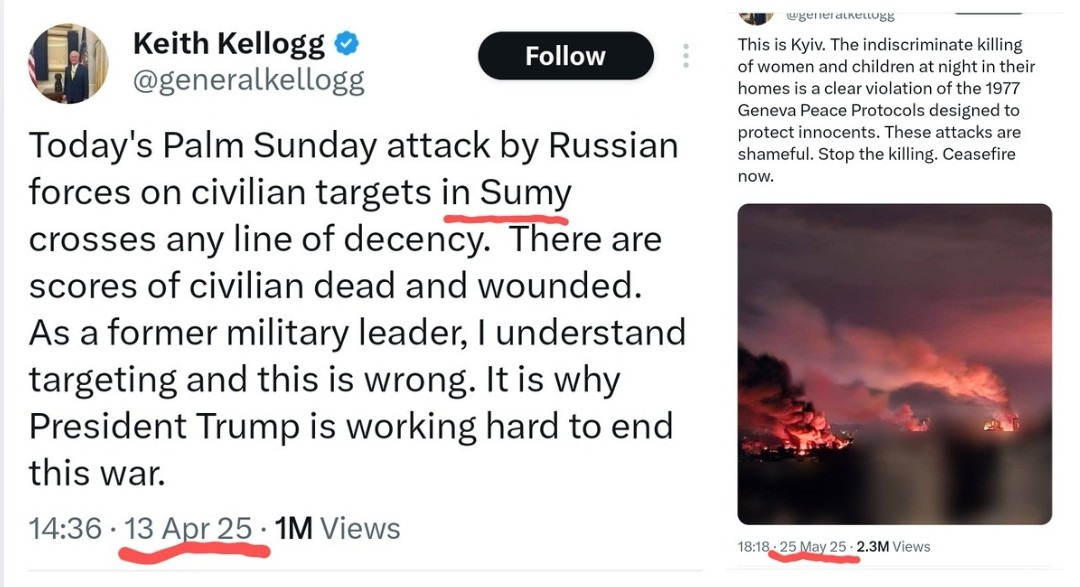
You do need to be an idiot to believe that this is not on purpose. In fact, the only person I have heard explaining such attacks as not being on purpose is — you guessed it — the U.S. President. On Easter Sunday, Russia bombed the central market square in the town of Sumy, in north-eastern Ukraine — using cluster ammunition and hitting church-goers and people on their way to celebrate Easter with their families. As a result, 31 people died. But Donald Trump explained that he had been informed that Russia had simply made a “a mistake”.

All independent experts agree that over the past months, Russia has increasingly targeted playgrounds, market squares, hospitals and residential neighborhoods. Hell, all you need to do is watch the videos being published every single morning of killed and injured Ukrainians being carried out from the rubble in their pajamas and nightgowns.

Trump’s own envoy to Ukraine, retired general Keith Kellogg tweeted is in no doubt.

LIE 4: Putin says that he is ready to meet Zelensky

“We are ready to meet… I am ready to meet with everyone, including Zelensky,” Putin said in St. Petersburg.

FACT: Putin has several times shied away from meeting the Ukrainian President, most recently in Istanbul in May where Zelensky challenged Putin to a face-to-face meeting: “There is no point in prolonging the killings. And I will be waiting for Putin in Türkiye on Thursday. Personally.

But Putin decided not to meet his much younger counterpart — who has lots of hair, no belly, no botox, dynamic, and great international press and sympathy.

LIE 5: Putin questions Zelensky’s legitimacy

“Why am I saying this?” Putin wondered aloud in St. Petersburg. “We don’t care who is negotiating, even if it’s the current head of the regime. I’m ready to meet – but only if it’s the final stage. The signature must come from a legitimate government. Otherwise, the next government will just throw it all in the trash.”

FACT: Where does one start on this one? A brutal, corrupt dictator who has been in power in Russia since 1999, and during that period has killed all signs of democracy, free expression and media, not to say most of his political opponents … accuses a popularly-elected president (Zelensky got 73% of the vote in 2019) of being illegitimate. Because he postponed elections that were supposed to have taken place in 2024, but couldn’t – because said dictator had invaded his country.

In other words, Putin will negotiate with Zelensky, he claims, but then retain the right afterwards to negate the agreement as illegitimate.

Alternatively, Putin wants to force elections in Ukraine — which would lead to instability. Of course. That is exactly why Putin wants elections. The logistics and security challenges would be insurmountable: This is a country and population in the middle of the most traumatic period in its history, with one-third of the population (12–14 million people) having been forced to flee their homes, 20% of their country occupied and hundreds of thousands of people killed and injured. Imagine running a political campaign and elections under such circumstances. Forced upon them by their invading neighbor and the country the Ukrainians thought was their main ally.

There is nothing surprising in an old KGB-hand like Putin trying this one, he has nothing to lose. The surprising thing is that Trump and several members of his administration agree with the Russian dictator that Zelensky is illegitimate and must hold elections before a peace deal can be signed. Why, oh why would you say something like that, Donald, if you really wanted to see peace in Ukraine?

LIE 6: Putin calls the Ukrainian revolution 2014 “a coup”

FACT: Sorry, Vova, I was there on the square in 2013–14, pretty much every single day for several months. There is no polite way of saying this – you are full of shit. Не пизди, Вова!

This was a true, popular uprising, involving millions of Ukrainians all over the country. The proof is in the pudding: 11 years later, it is easy to find Ukrainians who were on the Maidan during those months who today are disappointed with the outcome of the revolution. Too many of the old fat cats stayed in power, the fight against corruption has been too slow. But none of these people – millions – who saw what happened, who actually participated, call it “a coup”.

They were there. They did it. They know.

The fact is that today, 11 years after Putin invaded Ukraine for the first time, and three years and four months after he invaded Ukraine for the second time, it is difficult to find anybody who believes in his lies. Unless they are paid by the Kremlin.

Source: Michael Andersen, “Only a fool would believe that Putin wants peace,” Two Grumpy Old Men on Ukraine, 23 June 2025


Ukrainian officials have reacted with outrage to comments made by Vladimir Putin on Friday in which he told delegates to the St Petersburg International Economic Forum that “all of Ukraine is ours”.

Addressing the annual showcase for Russia’s economic development in St. Petersburg, Putin threatened a Russian nuclear response should Kyiv deploy a so-called “dirty bomb” — despite admitting that there was no evidence it was considering doing so — and portrayed the ongoing invasion of Ukraine as a defensive necessity.

Bluntly denying Ukraine’s sovereignty, Putin repeated the long-standing Kremlin narrative that Ukrainians and Russians were “one people,” a claim that has been repeatedly rejected both by Ukraine and the international community.

Putin went on to confirm that Russian forces were carving out a 10–15 kilometre buffer zone inside Ukraine’s Sumy region, following a seven-month-long incursion into Russia’s neighbouring Kursk region by the Armed Forces of Ukraine. Though he denied that Russia planned to occupy the city of Sumy itself, Putin added pointedly that he didn’t “rule it out”.

Raising the spectre of nuclear escalation, Putin warned of a devastating Russian response should Ukraine deploy a so-called “dirty bomb”, which combines conventional explosives with radioactive material, despite the fact that Ukraine is not known to possess such a device — a fact Putin himself acknowledged.

Such an attack “would be a colossal mistake on the part of those we call neo-Nazis in today’s Ukraine,” he said, adding that it “might be their last mistake”.

“Our nuclear doctrine states that we always respond to threats in kind. Therefore, our retaliation would be extremely harsh — and most likely catastrophic for both the neo-Nazi regime and Ukraine itself,” Putin continued.

Responding to the comments in his nightly address to the nation on Friday, Ukrainian President Volodymyr Zelensky said that they proved Putin had no intention of negotiating a ceasefire and that “Russia wants to continue the war,” adding that Ukrainian forces were successfully repelling Russian attacks in the Sumy region

Other Ukrainian officials also condemned Putin’s remarks, with Foreign Minister Andrii Sybiha describing his statement as “deranged” and saying that the Russian leader had shown “complete disdain for US peace efforts.”

“While the United States and the rest of the world have called for an immediate end to the killing, Russia’s top war criminal discusses plans to seize more Ukrainian territory and kill more Ukrainians,” Sybiha wrote on X.

Despite Russia’s continuing international isolation, Putin also claimed that the country’s economy remained strong, noting that GDP had grown by more than 4% annually over the past two years, poverty had dropped to 7.2%, and that unemployment had fallen to a historic low of 2.3%.

Source: Emilia Kurilova, “Outrage in Kyiv as Putin tells St. Petersburg International Economic Forum ‘all of Ukraine is ours,’” Novaya Gazeta Europe, 21 June 2025

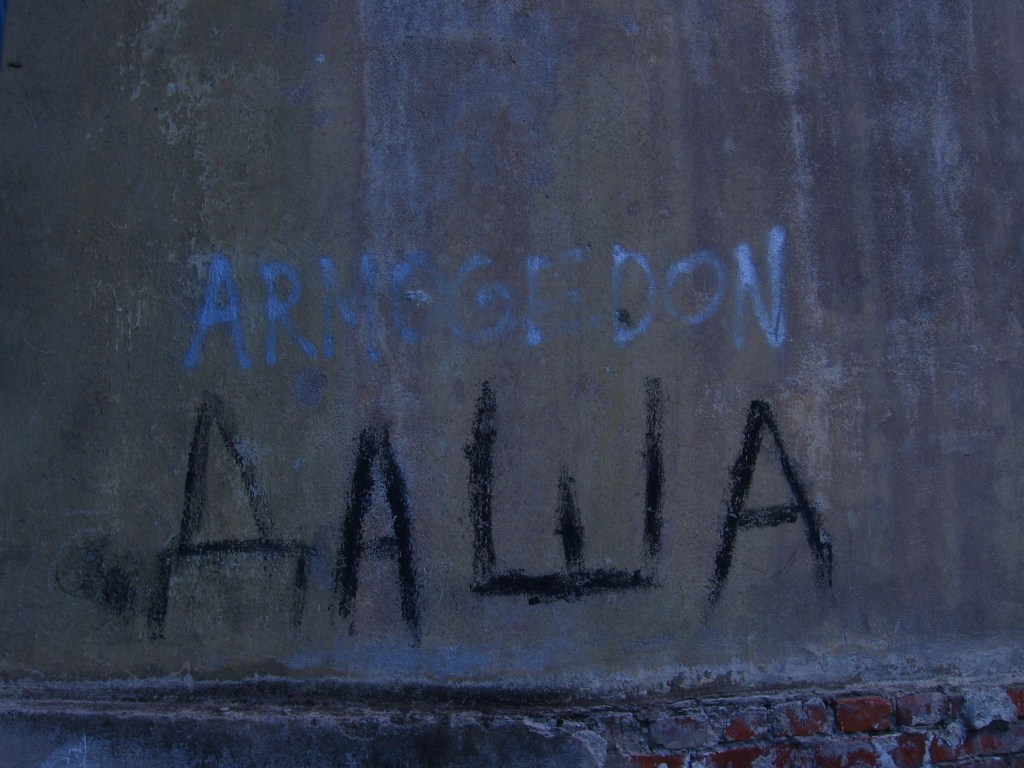
Armogedon Dasha

“Armogedon Dasha,” Kronstadt, Russia, summer 2006. Photo by the Russian Reader

If one starts from the premise that the United States was engaged in a peace process, then what we saw Americans do yesterday makes no sense. The same goes if we begin from the assumption that present American leadership is concerned about peace generally, or cares about American interests as such. But it is not hard to see another logic in which yesterday’s outrages do come into focus.

It would go like this: It has been the policy of Musk-Trump from the beginning to build an alliance with Russia. The notion that there should be a peace process regarding Ukraine was simply a pretext to begin relations with Russia. That would be consistent with all of the publicly available facts. Blaming Ukraine for the failure of a process that never existed then becomes the pretext to extend the American relationship with Russia. The Trump administration, in other words, ukrainewashed a rapprochement with Russia that was always its main goal. It climbed over the backs of a bloodied but hopeful people to reach the man that ordered their suffering. Yelling at the Ukrainian president was most likely the theatrical climax to a Putinist maneuver that was in the works all along.

This, of course, might also seem illogical, and at an even higher level. The current American alliance system is based upon eighty years of trust and a network of reliable relationships, including friendships. Supporting Russia against Ukraine is an element of trading those alliances for an alliance with Russia. The main way that Russia engages the United States is through constant attempts to destabilize American society, for example through unceasing cyberwar. (It is telling that yesterday the news also broke that the United States has lowered its guard against Russian cyber attacks.) Russian television is full of fantasies of the destruction of the United States. Why would one turn friends into rivals and pretend that a rival is a friend? The economies of American’s present allies are at least twenty times larger than the Russian economy. And Russian trade was never very important to the United States. Why would one fight trade wars with the prosperous friends in exchange for access to an essentially irrelevant market? The answer might be that the alliance with Russia is preferred for reasons that have nothing to do with American interests.

In the White House yesterday, those who wished to be seen as strong tried to intimidate those they regarded as weak. Human courage in defense of freedom was demeaned in the service of a Russian fascist regime. American state power was shifted from the defense of the victim to the support of the aggressor. All of this took place in a climate of unreason, in which actual people and their experiences were cast aside, in favor of a world in which he who attacks is always right. Knowledge of war was replaced by internet tropes, internalized to the point that they feel like knowledge, a feeling that has to be reinforced by yelling at those who have actually lived a life beyond social media. A friendship between Donald Trump and Vladimir Putin, a masculine bond of insecurity arising from things that never happened, became more important than the lives of Ukrainians or the stature of America.

There was a logic to what happened yesterday, but it was the logic of throwing away all reason, yielding to all impulse, betraying all decency, and embracing the worst in oneself on order to bring out the worst in the world. Perhaps Musk, Trump, and Vance will personally feel better amidst American decline, Russian violence, and global chaos. Perhaps they will find it profitable. This is not much consolation for the rest of us.

Excerpted from: Timothy Snyder, “The War Trump Chooses,” Thinking about…, 1 March 2025


⚡️ Foreign Ministry Spokeswoman Maria Zakharova’s comment on Zelensky’s voyage to Washington, D.C. (March 1, 2025)

💬 Leader of the neo-Nazi regime Zelensky’s visit to Washington D.C. on February 28 is an epic political and diplomatic failure of the Kiev regime.

The Russian Side has repeatedly made it clear at all levels that Zelensky is a corrupt individual who lost his grip on reality and is unable to reach and honour agreements.

❗️ The Kiev regime refused to continue talks on a political and diplomatic settlement in the spring of 2022, using lies and fake claims to justify continued hostilities and keep receiving Western military and financial aid.

With his outrageously rude behaviour during his stay in Washington, Zelensky re-affirmed his status of the most dangerous threat to the international community as an irresponsible figure that can stir up a big war. It must be clear to everyone that this kind of attacks coming from a terrorist leader are quite unambiguous.

This cynical individual will stoop to anything in pursuit of his goals and is obsessed with preserving the power he has usurped. That is why he:

🔻 has destroyed the opposition,

🔻 built a totalitarian state,

🔻 ruthlessly sending millions of his fellow citizens to death.

Under the increasingly deteriorating political situation, this figure is unable to show a sense of responsibility and is therefore obsessed with continuing the war and rejects peace, which means death to him.

Unprecedented in history of international politics and diplomacy, a dressing down given to Zelensky by the US president in the White House is also indicative of the political weakness and extreme moral degradation of the European leaders who continue to support the maniac head of the Nazi regime who has lost touch with reality.

As before, we continue to operate on the premise that a truly just and durable peace is not possible unless the root causes of the Ukraine crisis are completely eliminated.

The main ones among them include:

🔻 the West breaking its promises not to expand NATO and the alliance’s absorption of Europe’s entire geopolitical space all the way up to Russia’s borders,

🔻 the Kiev regime’s systematic elimination of everything about Russia, including language, culture, and church, just like the German Nazis did in the past.

The demilitarisation and denazification of Ukraine, as well as recognition of existing realities on the ground remain Russia’s unchanged objectives.

☝️ The sooner Kiev and the European capitals come to realise this, the closer to a peaceful settlement of the Ukraine crisis we will be.

Source: Russian Foreign Ministry (Facebook), 1 March 2025


Rick Wilson: “And I truly believe that Donald Trump will very soon offer military aid to Russia. I believe this in my heart of hearts. I want every single one of you people who think, ‘Oh, this was such a brave moment of diplomacy,’ when Donald Trump starts offering Russia intelligence, and weapons, and support, and protection, I want you to tell me if you think you still live in the America you voted for.”

Source: The Lincoln Project, “Trump and Vance ATTACK Zelenskyy in Oval Office and Align U.S. with PUTIN,” YouTube, 28 February 2025. Thanks to Mark Teeter for encouraging me to re-watch this video and note its stark conclusion.

Julia Stakhivska: Books in the Firing Line in Ukraine

Julia Stakhivska

After talking to relatives in Kharkiv, once again shelled by Russia, and hearing news of the missile strike on one of Ukraine’s largest printing plants, I touch the bindings of the books on my shelves. I think about how many of them were printed in that same city, now very much on the frontlines again. This time it was not only transport and urban infrastructure that were targeted but books as well.

Factor Druk is one of the largest full-cycle printing plants in Europe. It is part of the large Factor holding, which includes, among other companies, Vivat, one of the top Ukrainian publishing houses, which has its own network of bookstores. Factor’s customers include not only Ukrainian publishers but also such global publishers as Penguin Random House, Simon & Schuster, Hachette, and Macmillan.

I look at the kaleidoscope of photos—the burnt-out shop floors, the waves of pages, the scattered covers (one—oh, the bitter irony!—bears the title “The Club of the Rescued”)—and wonder how much a Russian missile costs. The internet, for example, reports that an Iskander runs for around three million dollars. Instead of “liberating” us from twenty thousand books a week before Book Arsenal, Ukraine’s most important book fair, the aggressors could, say, print themselves a few more copies of books by their own classic authors. This is not the first such strike, by the way. On 20 March of this year, Russian forces hit another printing plant in Kharkiv where many Ukrainian publishers also had their books printed.

The Factor Druk printing plant, damaged by a Russian missile strike on Kharkiv.
Photo: Nicolas Cleuet/Le Pictorium/MAXPPP/dpa/picture alliance

Solidarity in response to terror

But the further away they are from Ukraine, the less people in the rest of the world understand the symbolism of these events. As the well-known Ukrainian journalist Kristina Berdynskykh wrote on her Facebook page, “Three days ago, I bought the diary of Volodymyr Vakulenko, as published by Vivat. [Vakulenko’s] shot corpse was found in a grave in a forest outside Izium in autumn 2022. The diary was found by Ukrainian writer Victoria Amelina, who unearthed it in a courtyard near the house where he lived during the occupation. Amelina died [from the wounds she suffered during] the missile strike on Kramatorsk in 2023. The plant where this book was printed was destroyed by a Russian missile strike today, in 2024. ‘Volodymyr Vakulenko kept a diary during the occupation, hoping that you, the world, might be able to hear him. If you are holding this book in your hands, the writer Vakulenko has won,’ Victoria writes in the foreword. Hold books printed in Ukraine in your hands. The world will never understand all the way anyway.”

Ukrainian social networks have been overflowing with solidarity and sympathy. Thousands of people have simply gone and ordered books by their favorite publisher, Vivat, and so for a while, due to the number of orders, the publisher’s website was down, and long queues formed in some bookstores. This is probably the least that can be done now. It is the constructive fact that gathers us every day, in the midst of worries and threats, when just being is a victory in itself.

Bookshops opening in Ukraine during the war against all odds

Against all the odds, new bookshops have been opening in Ukraine amidst the war. Literary events, festivals and book fairs have been taking place. In Kyiv, one major book fair ended a month ago, another is due to start in a week, and two more are planned for the next few months. There are many reports about the growing demand for books. The other day, a bookshop manager I know commented, “People are just jumping on books. This not only furthers the culture but also helps to maintain some level of normality.”

I take one of my favorite Vivat books from the shelf—Lazarus, a novel by Svitlana Taratorina, a Ukrainian author originally from Crimea. It’s a contemporary fantasy set in an alternative magical Kyiv in the early twentieth century. The city is inhabited by both ordinary people and various “impure” creatures such as water sprites, ghouls, and werewolves. Although the book presents an interesting, intriguing and self-contained world of magical adventure, it is not hard to see its political aspect. The human beings in Lazarus come to Kyiv from the Empire. They try to impose their centralized way of life on the city, seeking to neutralizing its peculiarities and nuances, to level anything outside the imperial framework, anything “impure,” that is. This clampdown eventually and inevitably leads to an explosion. Sounds familiar, doesn’t it?

Everything can be restored but people cannot be brought back to life

It is a day of mourning in Kharkiv. Ukrainian President Volodymyr Zelensky has visited the site of the attack.

“The production facility was destroyed, and tens of thousands of books were burned by this strike. A lot of children’s literature, manuals, and textbooks…. Russian terror should never go unpunished,” he said.

Seven workers were killed at the printing plant: five women and two men who were printing children’s books that day. Twenty-one people were injured. As Elena Rybka, editor-in-chief of the publishing house, wrote, “Everything can be restored. It is impossible to bring people back to life. We sympathize with the families of the victims. We pray for the wounded. We support Ukrainian culture, because it will never be beyond politics.”

Julia Stakhivska is a Ukrainian writer who has published books of poetry and fantasy stories for children and co-edited anthologies of Ukrainian poetry.

Source: Julia Stakhivska, “War Diary: Books in the Line of Fire,” Deutsche Welle Russian Service, 25 May 2024. Translated by the Russian Reader


Russia’s strike on the Factor Druk printing house killed seven workers and left 16 wounded, according to Suspilne. The company estimates that 20,000 books were destroyed, of which 40 percent were schoolbooks. 

Factor Druk printed around half of Ukraine’s schoolbooks, CEO Serhii Polituchniy said in an interview with Radio Liberty.

“I don’t know how we will print tomorrow,” he added. The strike on the company’s printing facilities stands to reduce the volume of Ukraine’s publishing industry by 40 percent, according to Polituchniy’s estimates.

Three out of 10 leading publishing companies in Ukraine are located in Kharkiv which is constantly under Russian missile assault. Factor Druk did not evacuate its facilities from its location, around 40 kilometers from Russia’s border, due to the complexities and costs involved.

Polituchniy stated that most publishing professionals have chosen to stay in Kharkiv rather than move westward, where the right skills and knowledge are believed to be harder to find. “One should teach a professional for 4-5 years minimum,” Polituchniy said.

Industry leader

Factor Druk became a founder of Vivat Publishing House, one of the most prominent and popular book brands in the country, printing non-fiction and fiction books in the Ukrainian language. In 2023, Vivat became the seventh largest in Ukraine’s book publishing industry, with Hr. 191 million in revenue (almost $5 million), according to Pro-Consulting estimates provided to Kyiv Post.

Ukraine’s honey exports amounted to almost a third of the commodity’s imports to the EU in the last year, with China taking the leading position.

Vivat’s two bestsellers include Winston Churchill’s biography written by ex-UK prime minister Boris Johnson (50,000 books sold) and “Stus’s Case” – a novel about how the KGB arrested and tried Vasyl Stus, Ukraine’s poet, translator, literary critic, journalist, and an active member of the Ukrainian dissident movement. Around 120,000 copies of the book have been sold.

In addition to books, Factor Druk prints newspapers and magazines, booklets, catalogs, as well as stationery products such as calendars, notebooks and school diaries according to the company’s website.

The company also prints for other publishers, including:

  • Industry leaders KSD and Folio (both also Kharkiv-based)
  • Schoolbooks publishing company Ranok
  • Faith books publishing house Svichado
  • Children’s publishing house Zelenyy Pes

Vivat forms the majority of Factor Druk’s revenues. Overall, between 2017 and 2023, Factor Druk generated Hr. 230 million ($5.7 million) as an annual average, according to the company’s financial statements on Vkursi big data platform. The enterprise did not generate losses even during the first year of Russia’s full-scale invasion of Ukraine. 

Ukraine’s publishing industry includes 385 publishing enterprises of different sizes, 200 of them each generating more than Hr. 1 million (£25,000) in revenues in 2023, according to Pro-Consulting’s data provided to Kyiv Post.

Source: Olena Hrazhdan, “Russian Strike on Major Printing House Jeopardizes Industry Capacity,” Kyiv Post, 25 May 2024


Trampled by Turtles, “The Outskirts” (2004)

Well I turned around in time to see the clouds fade
Running back could only make them stay
Forward now I run down a winding road
Try to pay back everything that I have ever owed

And when your money runs, will you buy a friend?
And when your guns don’t fire, will that be the end?
With no land left to burn, and nowhere left to run
Where then can we stand when it’s all said and done?

Well I hear the thunder roll, I feel the cold winds blowing
But you won’t find me there, ’cause I won’t go back again
While you’re on smoky roads, I’ll be out in the sun
Where the trees still grow, where they count by one?

Well you take from our schools to build a bigger bomb
You tell us fiery lies about the course we’re on
And you’ll kill all the world, and you’ll reverse the sun
And which would you sell first, your soul or your gun?

But I hear the thunder roll, I feel the cold wind blowing
But you won’t find me there, ’cause I won’t go back again
While you’re on smoky roads I’ll be out in the sun
Where the trees still grow, where they count by one?

Source: LyricFind

Simon Pirani: No Path to Peace in Ukraine Through This Fantasy World

The Russian army’s meagre successes in Ukraine – such as taking the ruined town of Avdiivka, at horrendous human cost – have produced a new round of western politicians’ statements and commentators’ articles about possible peace negotiations.

Hopes are not high, because the Kremlin shows no appetite for such talks. Its actions, such as nightly bombing of civilians and civilian infrastructure, speak louder than political and diplomatic words on all sides.

The desire and hope for peace is widely shared, and I share it too. How can it be achieved?

Among “left” writers, the “campists” and one-sided “anti-imperialists”, who deny Ukraine’s right to resist Russian aggression, say that peace talks could start now … if only the western powers did not stand in the way. (By “campism”, I mean the view that the world is divided simplistically between a western imperialist camp dominated by the US, and another camp comprising China, Russia and other countries, in which some progressive potential resides.)

Mariupol, after the siege. Photo: ADifferentMan / Creative Commons

The “campist” case is made by literally ignoring what is actually going on in Ukraine, and Russia, and focusing – often exclusively – on the political and diplomatic shenanigans in western countries.

In this blog post I will look at seven recent articles by “campist” writers. All of them call for peace talks; and all claim that the main obstacle is the western powers.  

I will cover (1) the selection of subject matter by these authors; (2) what little they actually say about peace negotiations; and (3) why the claim that the western powers sabotaged peace talks in April 2022 is less convincing than they believe it to be.

The seven articles are: “Europe sleepwalks through its own dilemmas” by Vijay Prashad (Counterpunch, Brave New EuropeCountercurrents and elsewhere); “Exit of Victoria Nuland creates opportunity for peace in Ukraine” by Medea Benjamin and Nicolas Davies (Common Dreams, Morning StarConsortium News and elsewhere); “Ukraine: Pope pipes up for peace” by Andrew Murray (Stop the War coalition); “Where are the righteous Ukraine partisans now?” by Branko Marcetic (Brave New Europe); “Diplomacy is the art of compromise: that’s what’s needed for peace in Ukraine” by Alexander Hill (Stop the War coalition); “US repeatedly blocked Ukraine peace deals; is it rethinking its strategy yet?” by John Wojcik and C.J. Atkins (People’s World); and “The Grinding War in Ukraine Could have ended a long time ago” by Branko Marcetic (Jacobin).

Selection of subject matter 

None of the seven articles says one word about Russia’s political system, its politicians’ nationalist rhetoric or its war economy, which are among the central causes of the war. Not a word. Only one of the articles (Alexander Hill’s) attempts to assess Russian war aims; one more (Andrew Murray’s) makes glancing reference to these.  

Only one of the articles (Hill’s, again) touches on what Ukrainian people are thinking or doing. None of the other six articles says a word about this, despite Ukrainian popular resistance being, by any measure, a key factor in the war.

Only one of the articles (Hill’s, again) says much about what has happened on the battlefieldOne more (Branko Marcetic in Jacobin) has one paragraph on Ukrainian battlefield losses, but no mention of Russian losses. Two more (Murray’s, and Wojcik and Atkins’s) have very brief references to this.

While saying almost nothing about what is going on in Ukraine, or Russia, all seven articles discuss statements by western politicians, diplomats and/or military leaders. At length.

Five of the articles (by Medea Benjamin and Nicolas Davies, by Hill, by Wojcik and Atkins, and two by Marcetic) focus on a peace deal that was supposedly on the table in April 2022, and claim that western politicians, who twisted president Zelensky’s arm, wrecked it (see last section). On the other hand, only two of the articles (Hill and Murray) make any suggestion about what peace talks might look like (see next section).

Dear readers, I can hear you say: but you have just picked seven articles at random. No. It’s a fair sample. I searched the largest-circulation English language “left” web sites; these were the most visible articles by don’t-support-Ukrainian-resistance writers.  

The key point is that none of these writers mention how the Kremlin works. No reference to Vladimir Putin’s attitude to the world, or whether it has changed. No assessment of the deranged nationalist, even genocidal, rants about Ukraine by him, his close colleagues and high-profile Russian TV personalities. No mention of whether Russia can be considered an imperialist power or not. Not a word about the way that its invasion of Ukraine not only breached international agreements and laws, but also offends the principle of nations’ right to self-determination that socialists have held dear since the 19th century.

It is telling, too, that these “campist” writers have no interest in what Ukrainian people say or do. Nor Russian people. They don’t pretend to look at the interaction of social, political and economic forces. They are concerned largely – some of them, exclusively – with the western elite. They see themselves as its opposite and its nemesis. Russian or Ukrainian soldiers, Russian anti-war protesters, Ukrainian trade unionists on the front line, Ukrainian refugees – these are bit part players in a drama played out in Washington, London and Berlin.

The result is a fantasy world that bears only indirect relation to reality.

When I say “campists”, I mean a very narrow group among “left” writers, who embrace a fake “anti-imperialism”, historically descended from 20th century Stalinism.

They do not speak for the labour movement more broadly, or for the millions of people in western countries who think of themselves as “left wing”, or who vote for Social Democratic parties. These are powerful forces for change. But the “campist” influence is dangerous and divisive.

Of course many journalists in the mainstream press also focus exclusively on this elite world of diplomats and politicians. But they usually see themselves as part of it. The “campists” sees themselves in opposition – but only to the western powers, the US above all. For them, the American empire is the only empire worth fighting.

Whether Russia might have traits of empire, whether China might seek to construct some sort of empire, whether bloodthirsty dictators like Bashar al-Assad are tied to imperial interests – all this is excluded from the conversation. Real struggles that confront the American empire, such as the Palestinians’, are welcomed; those that face other enemies, such as Ukrainians resisting Putin, or Syrians and Palestinians resisting Assad, are shunned.

What could peace negotiations look like

Andrew Murray writes:

Moving from ceasefire to a permanent peace will of course be challenging. Russia will need to accept a sovereign and independent Ukrainian state, and Ukraine will have to accept remaining outside NATO and self-determination for minorities within its borders.

The Stop the War coalition, in which Murray is a leading voice, sets out its policies in the form of calls for UK government action. So it’s fair to assume that this, too, is a call for the UK government to take a particular stance – in this case, the most pro-Russian stance possible. Going through the points in turn:

1. “Russia will need to accept a sovereign and independent Ukrainian state” is meaningless. It did so, in the Belovezha accords that dissolved the Soviet Union (1991), and the Budapest memorandum under which Ukraine gave up its nuclear weapons (1994). Since 2014 Russia has been pounding Ukraine militarily, in breach of those agreements. Any attempts to stop the fighting in Ukraine diplomatically would have to start by recognising that reality – which is why a peace treaty, as opposed to a ceasefire or simply “freezing” the conflict, is extremely unlikely.

2. “Ukraine will have to accept remaining outside NATO” is essentially a demand for NATO to allow Russia to decide which states join (why no objection to Finland and Sweden?!). The UK government may indeed be cynical enough to take such a position, but why should the labour movement encourage it to do so? What sort of solidarity is that with the Ukrainian population – which before 2014 was in its vast majority opposed to NATO membership, but has largely come to see it as the only security arrangement that can prevent their country being invaded again and again?  

President Zelensky in Bucha, April 2022

3. “Self-determination for minorities within its [Ukraine’s] borders.” This is a distortion of the principle of the right of nations to self-determination, historically embraced by socialists. Self-determination includes the right to secession. (It is relevant that Russia killed tens of thousands of people in Chechnya in the early 2000s, to help ensure that this right would not be exercised.)

From 2014, the extreme right in Russia called for the establishment of a new state, “Novorossiya”, in south-eastern Ukraine, effectively a demand for “self-determination” of Russian people there – but the Kremlin refused to support this. Moscow was aware that the vast majority of Russian-speaking Ukrainians neither wanted “self-determination” nor regarded themselves as Russian. The exception was Crimea, where a referendum on annexation by Russia (a strange type of “self-determination”) was held under military occupation.

Long before 2014, there had been support in eastern Ukraine for greater autonomy within the Ukrainian state, and distrust of Ukrainian nationalist politicians in Kyiv. The Kremlin did its best to whip up divisions among Ukrainians on this basis. It engaged in a long campaign of disinformation, claiming to support the rights of Russian speakers in Ukraine. (I wrote about this e.g. here.) But on a diplomatic level, until 2022, the Kremlin pretended that the Russian army was not present in Ukraine, although it was, and left the status of the Luhansk and Donetsk “republics” vague. All this changed in 2022, when the Kremlin recognised the “republics” and invaded Ukraine.

In 2022, people in Donetsk, Luhansk, Kherson and Zaporizhzhyia voted – sometimes literally looking down the barrel of a soldier’s gun, and always under the shadow of the biggest military operation in mainland Europe since world war two – on accession to the Russian federation. This is the Kremlin’s version of “self-determination for minorities within Ukraine’s borders”. The Stop the War coalition has been conspicuous in its failure to denounce this violent abomination.

Why, then, demand that the UK government raise the issue of “self-determination for minorities” in peace talks? Andrew Murray can not believe there is the least chance of them doing so. The point is to preserve the fantasy world in which “campism” lives, in which Russian imperialism, Russian assaults on democratic rights and the Kremlin’s distortion of democratic principles for its political ends do not exist.

Alexander Hill writes:

The key outcome [of peace talks] will be the separation of the Russian-dominated Donbass and Crimea from the remainder of Ukraine – something that will hopefully be the cornerstone of a lasting peace in the region.

Although Hill clearly favours a ceasefire, and the Stop the War coalition opposed the Russian invasion in 2022, that is not what is under discussion here. Hill is envisaging the outcome of peace negotiations. Why endorse the imperial power’s demands in this way? Where is the evidence that, if these demands are met, “lasting peace” will ensue? How is this in the labour movement’s interests or the interests of international solidarity?

What happened in April 2022

The idea that peace talks have been blocked solely by the western powers – rather than by Russia’s war strategy – has been repeated over and over again by the “campists” over the past two years. They claim, in particular, that a deal was on the table in Istanbul in April 2022, that Ukraine was ready to sign, but that Boris Johnson, then UK premier, visited Kyiv and persuaded president Zelensky not to do so.

This version of events was demolished by Volodymyr Artiukh and Taras Fedirko in October 2022. They showed that the single source for the claim, a report in Ukrainska Pravda, had been misinterpreted, and that a mass of evidence suggested that the talks failed due to Ukrainian and Russian political factors, and the dynamics of military operations. Commentators who focus on “a magic turning point when everything could have gone otherwise” ignore that “in Russia’s repertoire, diplomacy has consistently been subordinated to the use of force”, they wrote. I urge readers to read this thoughtful, rounded argument.

Recently, accounts of the Istanbul talks have surfaced from people who were involved: the former Israeli prime minister Naftali Bennett, and the Ukrainian politicians Davyd Arakhamia and Oleksiy Arestovich. The “campists” have cherry-picked lines from these sources to revive their narrative.

Branko Marcetic of Jacobin claimed that an interview given in July last year by Bennett, who had been in touch with the Russian and Ukrainian governments, was a “bombshell”. Bennett said that in April 2022 there had been “a good chance of reaching a ceasefire”, and when asked “had they [who?] not curbed it”, “he replied with a nod”.

While it is unclear what that nod meant, and who “they” referred to, Bennett’s statement that the April deal was killed off by the revelation of the Russian army’s massacre of civilians at Bucha, outside Kyiv, is unequivocal. In Marcetic’s own words:

“Once that [Bucha] happened, I [Bennett] said, ‘It’s over,’” he recounts. Bennett pointed to the potential for such an atrocity to emerge and derail the political prospects for peace in Ukraine as proof of the importance of making haste on negotiations at the time. The Pravda report likewise pointed to Johnson’s visit as only one “obstacle” to peace, with the discovery of the Bucha killings the other.

Marcetic, writing in early August last year, chose not to look more widely at the circumstances in which Bennett gave his interview. Shortly beforehand, in June, the leaders of Comoros, Senegal, South Africa and other African nations had met with both Zelensky and Putin to propose peace talks. Putin had told them that one of their proposed starting-points for talks – accepting Ukraine’s internationally recognised borders – was unacceptable. (During this meeting, Putin held up what he claimed was the draft of the April agreement, although this has not been published before or since.)

A proper account of the failure of peace initiatives would mention not only the western powers, who of course influence decision-making in Kyiv (in recent months increasingly to constrain the war effort), but also Russia’s real intentions. Marcetic ignores that.

In November last year, Wojcik and Atkins sculpted another piece of evidence that Boris Johnson, and the western powers, were the obstacle to peace, from an interview with Davyd Arakhamia, one of the leaders of Zelensky’s Servant of the People party. They quoted Arakhamia reflecting on the Istanbul talks as follows:

“[The Russians] were ready to end the war if we accepted neutrality like Finland once did. And we were ready to make a commitment that we would not join NATO. When we returned from Istanbul, [then-British Prime Minister] Boris Johnson came to Kiev and said: ‘Do not sign anything with them at all; just go to war,’” Arakhamia said.

Now let’s look at what Arakhamia actually said, as reported by the Russian opposition web site, Meduza. Wojcik and Atkins have cut out a key passage, after the words “would not join NATO”. I have put it back, in bold type.

“They actually hoped until nearly the last moment that they could press us into signing this agreement, adopting neutrality. That was their biggest priority. They were willing to end the war if we took on neutrality, like Finland once did, and gave assurances that we wouldn’t join NATO. That was essentially the main point. Everything else was cosmetic and political embellishments about ‘denazification’, the Russian-speaking population, blah blah blah,” Arakhamia said.

When asked why Ukraine didn’t agree to Russia’s terms, Arakhamia was resolute:

First of all, to agree to this point, we would have to change the [Ukrainian] Constitution. Our path to NATO is written into the Constitution. Second of all, we did not and still do not trust the Russians to keep their word. This would only have been possible if we had security guarantees. We couldn’t sign something, walk away, everyone would breathe a sigh of relief, and then [Russia] would invade, only more prepared this time — because the first time they invaded, they were actually unprepared for us to resist so much. So we could only work [with them] if we were 100 percent confident that this wouldn’t happen a second time. And we don’t have that confidence.

Moreover, when we returned from Istanbul, Boris Johnson came to Kyiv and said that we wouldn’t sign anything with them at all, and that we should just fight.

Oh dear! The really important part – that Ukraine needed guarantees that Russia would not once again break its word and invade – went missing!!

This reminds me of Soviet censors who, when a Communist party leader fell out of favour, would cut the unhappy has-been out of official photos. Snip snip snip.

Arakhamia’s statement, in full, suggests that, with Russia’s brutal invasion at its height, the Ukrainian side needed a more substantial security guarantee than Putin’s piece of paper.  

Of course, what Arakhamia said should be treated with scepticism, as should all statements from all politicians. But it shouldn’t have vital parts surgically removed, to make it say the opposite. All the more care is needed, given the efforts by Russian state propagandists to distort Arakhamia’s meaning.

In March this year, Benjamin and Davies cited a third source – Oleksiy Arestovich, Zelensky’s former spokesman – in support of the claim that Putin’s Istanbul deal had been negotiated and “already had the champagne corks popping in Kyiv”. Again a politician, and one whose words need to be treated with special care. Readers should read his interview themselves.

But to pretend that Arestovich’s account shows that the western powers wrecked the peace talks is deceitful. Asked if Johnson twisted Zelensky’s arm, Arestovich says:

I don’t know exactly if that is true or false. He came to Kiev but nobody knows what they spoke about except, I think, Zelensky and Boris Johnson himself. I think it was the second of April, and I was in Bucha the next day. The president got in [to Bucha] one day later. […]

Arestovich here underlined his point that: “The president was shocked about Bucha. All of us were shocked about Bucha. […] Zelensky completely changed face when he came into Bucha and saw what happened.”

My conclusion is not that news of the Bucha massacre alone changed Zelensky’s mind. My best guess is that Bucha, combined with the other brutal Russian offensive operations in progress – especially the attack on Mariupol – focused the minds of Zelensky and others on the issue of security guarantees outside of NATO. And they could not see clearly what these were.

Despite the importance attached to Bucha by Bennett, Arakhamia and Arestovich, none of the “campists” mention it – except for that one dismissive reference by Marcetic (see above). They live in a fantasy world where Russian imperialism is absent, and its crimes of no consequence.

And that is not really a problem about Ukraine, but about the deep political malaise of a section of the western “left”. There is no path to real international solidarity and effective anti-imperialism through this fantasy world. And no path to peace either. SP, 8 April 2024.

Download this article, and a linked one, as a PDF

□ A linked article: Palestine, Ukraine and the crisis of empires 

Source: Simon Pirani, “No path to peace in Ukraine through this fantasy world,” People and Nature, 8 April 2024. Reprinted here with the author’s kind permission.

Old Deaf Joke

Old Deaf Joke

A Russian and a Cuban and an American were on a train
It quickly came to pass that the Russian took out a bottle of vodka and after a few swigs he tossed it out the window
The other two men exclaimed why throw still have vodka good waste why
The Russian opened his fur coat and showed them rows and rows of bottles and he said there Russia vodka plenty
The two men said oh and settled back in their seats
After a while the Cuban took out a cigar and after a few puffs he tossed it out the window
The other two men exclaimed why throw still have left good cigar waste why
The Cuban opened his suit and showed them rows and rows of cigars and he said there Cuba cigars plenty
The two men said oh and settled back in their seats
After a while a young man came whistling into the car from the next one
The American grabbed him by the collar and belt and tossed him out the window
The other two men exclaimed why throw still young good man waste why
The American made an expansive sweep with his hands and said here America hearing people plenty
The two other men said oh and settled back in their seats

Source: John Lee Clark, How to Communicate (W.W. Norton, 2022), which has been nominated for the 2023 National Book Award in Poetry and won the 2023 Minnesota Book Award for Poetry. Mr. Clark (born 1978) is an American deafblind poet, writer, and activist from Minnesota.


Apart from a detailed peace plan to end Russia’s invasion of Ukraine, President Volodymyr Zelenskiy has a less conventional idea for ending geopolitical crises like these: let dogs run the world.

In the rare downtime he gets as a wartime leader, Zelenskiy, speaking to Reuters by video link on Wednesday, suggested man’s best friend might fare better when it comes to getting along on the global stage.

“Sometimes I’m … looking at all these wars or looking at all the crisis, Middle East crisis. It’s not only Ukraine, everywhere in Africa and the Middle East.

“Sometimes I’m looking at this and think that the best way (is) if this planet will be the planet of dogs,” he said at the Reuters NEXT conference in New York, responding to a question about what still makes him laugh.

The Kremlin’s war in Ukraine, now in its 21st month, has upended Europe’s security architecture and sent ripple effects through Africa and Asia, which have seen food shortages thanks to Russia’s de facto blockade of the Black Sea.

ReutersNEXT Newsmaker event in New York

Kyiv’s Western partners have provided crucial financial and military support, but are now also dealing with the conflict in Gaza.

Along the front line, Ukrainian forces have been fighting for months to reclaim Russian-occupied territory in a counteroffensive but have made only incremental gains.

Zelenskiy, who is promoting a 10-point peace proposal, said his dogs provide much-needed relief when he spends time with his wife and children, and are “always funny”.

“Sometimes I don’t understand people, really,” Zelenskiy added with a smile.

To view the live broadcast of the World Stage go to the Reuters NEXT news page: https://www.reuters.com/world/reuters-next/

Source: “Zelenskiy hopes for “planet of dogs” to solve world’s crises,” Reuters, 8 November 2023


Today we ask you to support one specific and very important project — Navalny’s Propaganda Machine. It functions very simply: volunteers telephone people in Russia and talk with them, persuading them to turn from Putin supporters into doubters, and from doubters into opponents of Putin and the war.

The more people in Russia start asking questions and stop tacitly supporting everything that the Putin regime is doing, the better for our country. The volunteers of Navalny’s Propaganda Machine are working on this right now.

You can become a volunteer by sending an email to antiwar@navalny.com or supporting the project with a donation. A one-minute call costs two cents. That is, your $10 will turn into 500 minutes of conversation. And $20 is a thousand minutes of conversation with actual residents of Russia, who, thanks to you, can learn the truth and get motivated to fight. Make your contribution at https://acf.international.

Thank you for being on our side!
The Navalny Team

“Navalny has been in prison for 1,025 days”

Source: email newsletter from the Navalny Team (Anti-Corruption Foundation), 9 November 2023. Translated by the Russian Reader

Explainer

Source: Ukraine DAO Updates (Telegram), 5 August 2023. Thanks to Monique Camarra (EuroFile) for the heads-up.


Intensified air attacks on the Ukrainian capital following a drone strike on the Kremlin that Russia blamed on Kyiv forced Iryna, Svitlana, and Olya to spend their Ukrainian-language transition class in a cafeteria opposite the National Opera instead of the usual venue nearby, which was closed once the air alert went off.

The three women, hailing from Sevastopol, Enerhodar, and Donetsk — cities in Ukraine’s south and east occupied in various stages of Russia’s aggression — spent 90 minutes together with more than a dozen students, most of them women and also displaced, trying to elevate their Ukrainian and, as some said, to “break free” from their Russian.

Iryna has a son in the Ukrainian Army. She left her native Crimea, she said, because she “couldn’t live next to the Black Sea fleet firing missiles at our country.” She wants to switch to Ukrainian to “relieve herself of a sense of guilt.”

Svitlana came to Kyiv just two months ago. Her husband stays in Enerhodar, where he works at the Zaporizhzhya power station, Europe’s largest nuclear plant, captured by Russians at the beginning of their invasion. She is learning Ukrainian to “forget the months of occupation.”

Olya left Donetsk in 2014, the year a separatist war fomented by Moscow broke out in that region and neighboring Luhansk, hoping to return within several months. Now, after eight years away from her home in the Donbas, she is switching to Ukrainian because she decided to “focus on the future.”

Millions of similar stories make up the most rapid shift away from using the Russian language in Ukraine’s recent history. The number of Ukrainians who use Ukrainian exclusively or most of the time in their everyday life increased from 49 percent in 2017 to 58 percent in 2022, and the corresponding number for Russian dropped from 26 percent to 15 percent, according to a study conducted in December 2022 by prominent Ukrainian political scientist Volodymyr Kulyk and the Kyiv International Institute of Sociology.

The trend is even stronger in the public sphere, with 68 percent opting for Ukrainian and only 11 percent for Russian at work and during education. The transition is most significant in the south and east of the country, traditionally more Russian-speaking than western and central Ukraine, where switching to Ukrainian became the widespread sign of resistance to the occupiers.

The reality behind these numbers is more complex due to the nature of Ukrainian bilingualism, with almost everyone passively knowing both Ukrainian and Russian and many speaking their mixture, Surzhyk, minority languages such as Crimean-Tatar or Hungarian, and new trends, most notably the five-million-strong population of refugees who are developing new language practices abroad. But while many Ukrainians continue to use both languages in everyday life despite the anger at Russia that the invasion has ignited, the rapid shift from Russian to Ukrainian is apparent everywhere in Ukraine: in the streets, social media, bookstores, and, perhaps most significantly, private spaces.

Many in Ukraine celebrate the ongoing language shift, but the process, accelerated by Russia’s renewed attempts to erase Ukrainian culture and sow divisions in the country it is attacking, is far from painless.

[…]

Source: Aleksander Palikot, “‘It Will Perish When I’m Gone’: Russian Language Usage Plunges In Wartime Ukraine,” Radio Free Europe/Radio Liberty, 20 May 2023


Max Glebov, Guardians of Chaos: Invasion Armada

Mark Rich went from being a street kid in the ruins of a megalopolis on a fringe planet to being the commander of a joint squadron of two races, but the enemy has not been standing still all this time either. It looks as if the Swarm will be the first to build a ship the likes of which no one in the galaxy has seen for almost seventy years, and its newest battleship will serve as. the flagship of a revived Invasion armada.

Source: LitRes. Translated, from the Russian, by the Russian Reader. Thanks to today’s LitRes email flyer for the heads-up.