The Communist Menace

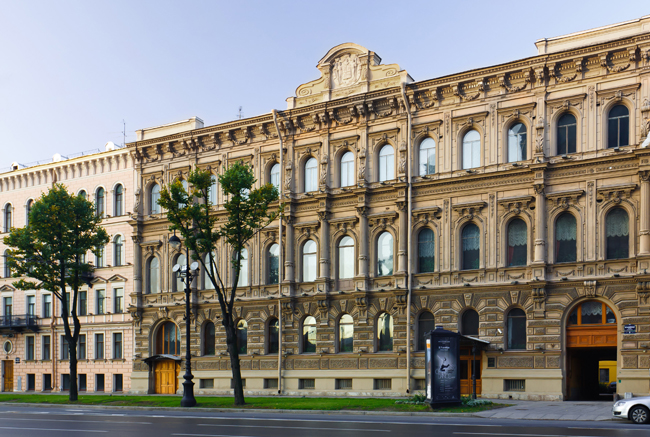
6 July 2017, St. Petersburg, Russia. Photo by the Russian Reader

[…]

And so, on Friday night, the eve of the 250th anniversary of the Declaration of Independence, Trump flew to South Dakota to deliver a speech at Mt. Rushmore in which he claimed he and his supporters are at war against an enemy here at home: communists.

Before his trip to the state, Trump posted a video showing his own likeness on a golden sculpture of Mt. Rushmore, alongside the images of George Washington, Thomas Jefferson, Theodore Roosevelt, and Abraham Lincoln, with the voiceover saying: “I will be the greatest president for many, many years to come.” The video opens with the text “Art of the vision” spelled out over an American flag, an encapsulation—although perhaps an unintentional one—of how Trump has maintained political power by selling a false image to his followers.

Trump began his speech with a series of feel-good platitudes: “These are very, very special times. And this is a very special place. You live in a very special place. Congratulations, everybody…. We are a nation of dreamers and believers, warriors and explorers, doers and fighters…. There has never been anything like us anywhere on earth.” And then he tied together MAGA’s white nationalism with the claim that Trump’s political opponents want to destroy the economy.

Trump clearly thinks there is political gain in convincing his followers that his political opponents are communists, although this is a lie made up out of whole cloth after the victory of Democratic Socialists in Democratic primaries and the popularity of New York City mayor Zohran Mamdani. Communists call for the end of private ownership of the means of production, giving the state control of private enterprises. In today’s America, it is actually Trump, himself, who is taking government stakes in private enterprises.

Democratic Socialists are not communists or socialists, who want to see the end of private property. Democratic Socialists call for a robust system of private enterprise, alongside government control of the aspects of society required for people to participate in the economy on a level playing field. While Democratic Socialists embrace a wide range of policies, they generally don’t think schools, or medical care, or roads, should be profit-making industries.

In that, they echo Americans from the 1860s, when the Republicans established public colleges, or the 1900s, when Theodore Roosevelt called for public health insurance. Indeed, what today’s Democratic Socialists call for is much more limited than what the Republicans under President Dwight D. Eisenhower wanted in 1956, when the top income tax bracket in the United States was 91%.

Nonetheless, on Friday Trump tried to convince Americans that “there is now a resurgence of the communist menace in our land, including from newcomers to our country who embrace ideas totally opposed to our way of life and our great success.” “These are not mere political disagreements like differences over taxes or regulations,” he said. “Communism is a mortal threat to American liberty. It is the greatest threat to our country, including World War I, World War II, Pearl Harbor, or even 9/11.”

He went on to say: “They don’t want good. They don’t love God and they don’t want God. They don’t love religion and they don’t want religion and they won’t have it.… They have no respect for law, justice, principle, tradition, or your God-given rights. It’s an ideology of mass theft, mass control, mass lies, and mass murder…. You can be a communist or you can be a patriot. You cannot be both.”

His false vision of the U.S. is aimed at the midterm elections. “America will never be a communist country,” he said. “We can only lose the midterms if we allow ourselves to lose the midterms, if we are foolish, stupid, and unwise.” He went on to demand that the Senate end the filibuster and Congress pass the voter-suppression SAVE America Act. If they do, he said, “we will not lose an election for a hundred years.”

On July 4, hundreds of masked white supremacists in khakis and blue shirts, carrying Confederate flags and flags with the logo of the neofascist white supremacist group Patriot Front, marched in Washington, D.C., chanting “Reclaim America.” The White House did not respond to a query from Gloria Oladipo of The Guardian about whether Trump condemns the march.

Trump continued his attacks on “communists” in a late-night speech on the National Mall after thunderstorms temporarily shut down his planned rally. “[A]ll these talks from the communists, they haven’t got a chance,” he told the drenched audience members, “not even a chance. We don’t want communists in our country.”

Trump’s drop into an anticommunism that exaggerates even the excesses of the McCarthy era seems to indicate panic rather than confidence. Today, July 5, he began posting on social media at 1:21 AM and over the course of the day posted more than 100 times, attacking Democrats and boasting extravagantly of what he says are his own successes while demanding Congress pass the SAVE Act or lose the presidency forever.

Trump’s people appear to be trying to push Trump’s vision, but it doesn’t seem to be sticking.

Interior Secretary Doug Burgum made the rounds of the Sunday talk shows today, insisting that the problems with the Lincoln Memorial Reflecting Pool were the work of vandals who have gashed its surface in multiple cuts that equal the 350 feet Trump claims and that there is video evidence, although the administration, which is famous for spinning everything to its own advantage, is choosing not to show it.

When CNN’s Dana Bash asked whether they actually had photographs of people cutting a gash in the liner, Burgum danced away from the question after commenting, “I’m not sure why you and others in the media think that you want to keep trying to question whether or not…”

And so the 251st year of American democracy begins with reality reasserting itself.

Source: Heather Cox Richardson, Letters from an American, 5 July 2026


Russia has prepared a new edition of its official history textbook for 11th graders. The Russian business news outlet RBC reviewed the new version and found that the section dealing with the United States had been significantly revised. Among the changes: the textbook now credits the Trump administration with playing a “positive role” in settling the war in Ukraine. Meduza summarizes what else has changed.

Russia’s unified history textbook for 11th graders has been updated and published on the “Moya Shkola” (“My School”) digital platform. The textbook, co-authored by Vladimir Medinsky — an aide to the Russian president and chairman of the Russian Military Historical Society — and Anatoly Torkunov, rector of Moscow State Institute of International Relations, has now reached its third edition.

The Russian business news outlet RBC compared the new edition with last year’s and found that the most heavily rewritten section is the one titled “Russia Today. Special Military Operation (SVO)).”

The passages dealing with the United States were substantially altered. The subsection formerly titled “U.S. Pressure on Russia” has been renamed simply “Pressure on Russia.”

The previous edition stated that Europe’s energy independence “did not suit the United States” — in the new version, the authors replaced “the United States” with “the collective West.” Also cut is the claim that “in the name of their corporations’ profits, the United States constantly resorted to military and terrorist methods — as it did in Iraq, Syria, and Libya, and in many other parts of the world.” Similar edits were made to the section on the war in South Ossetia.

The new edition also drops a line about the United States’ determination to “fight to the last Ukrainian.” In its place, the textbook now credits President Donald Trump’s administration with playing a “positive role” in peace negotiations, and notes that Trump has repeatedly stated the conflict between Russia and Ukraine would not have happened had he been president in 2022. A reference to the meeting between the U.S. and Russian presidents in Anchorage in August 2025 has also been added.

The section on the war in Syria has been revised as well. The previous edition stated that the Western coalition had tried to “overthrow the legitimate government of Bashar al-Assad in Syria.” The new version says the United States and NATO, using opposition forces and Islamic State terrorists, launched military operations against the government of Bashar al-Assad. The line “hundreds of thousands of civilians fell victim to the Islamists, and millions of refugees fled Syria” has been removed.

Assad’s government was toppled in December 2024, and Islamists led by Ahmed al-Sharaa came to power in Syria. Assad and many of his associates fled to Russia.

Other additions include a mention of the Defenders of the Fatherland Foundation, headed by Anna Tsivileva, Putin’s cousin’s daughter, and information about a personnel program for combat veterans called “Time of Heroes.”

The new edition also references the terrorist attack at the Crocus City Hall concert venue and “the breakthrough of elite Ukrainian Armed Forces units toward the Kursk nuclear power plant.” Added as well are accounts of the killing of Alexander Dugin’s daughter Darya Dugina and the “war correspondent” Vladlen Tatarsky, whose real name was Maxim Fomin, and the assassination attempt on writer Zakhar Prilepin.

RBC also noted that Apti Alaudinov, commander of the Akhmat battalion, has been dropped from the textbook’s list of “heroes of the SVO,” along with the line “fighters of the celebrated Chechen special unit ‘Akhmat’ strike terror into the Nazis.”

Vladislav Kononov, a staff member of the presidential administration’s department for state policy in the humanitarian sphere, described the new edition as “routine editing during a reprint — so-called topical revision,” in which the text is updated to reflect events that occurred after the previous edition was released. “There are no hidden meanings here,” he said.

The history textbook for 11th graders by Medinsky and Torkunov was first presented in 2023. In 2026, its third edition was released.

Source: “Russia rewrites its history textbook again — this time adding Trump’s ‘positive role’ in peace talks and a reference to Anchorage,” Meduza, 3 July 2026. Thanks to News from Ukraine Bulletin for the heads-up.


In recent years, “ideological diversity” has become one of the principal demands made upon American academia, not only by the yahoo right but also by many moderate conservatives and centrists. The former rarely manages to rise above crude insults of the “all professors are communists” variety, as it applauds the Trump administration’s brutal assaults on academic institutions. Unfortunately, while the latter are much more thoughtful, they often make a very misguided case. There is an argument to be made for ideological diversity—a surprisingly simple, and also limited one. But it involves giving more credence to the academic left than most critics are prepared to do.

A classic example of the case wrongly made is the report recently released by the chancellors of Vanderbilt and Washington Universities and written by a distinguished group of academics (including two Princeton colleagues). It is nuanced and careful, takes a mostly moderate tone, and certainly doesn’t deserve the label “diabolical” that some have attached to it. But it also falls into some predictable traps.

Its basic arguments are as follows. Positions in the humanities and the humanistic social sciences today are held overwhelmingly by academics on the left. These academics, especially those who define themselves as “scholar activists,” too often let political goals drive their work, thereby betraying the core mission of academia, which is disinterested inquiry. They discriminate against people who do not share these political goals. And this politicization is both inspired and justified by “relativist” post-structuralist theories that deny the very idea of objective truth.

Let’s take these points one by one. First, yes, the report is obviously correct to state that academics lean very strongly to the left. But this fact by itself says nothing about how left-leaning scholars actually function in the academy or the work they produce.

The second point is much more complicated. What does it mean for scholarship itself to be “political,” or “politicized”? You don’t have to be a dyed-in-the-wool Foucauldian to acknowledge that the production of knowledge is always, in some senses, implicitly political. Scholars, like everyone, exist within structures of power whose operations influence their conduct in ways seen and unseen. Feminist scholars did more than simply expand the scope of scholarly inquiry by bringing new attention to women, gender and sexuality. They showed how earlier generations of scholars, by not treating these subjects as even worthy of attention, participated in largely unspoken practices of exclusion. This point should not be terribly controversial. Nor should it be controversial that many past schools of scholarship that presented themselves as disinterested and objective were clearly driven by strong political motives. Just think of the “Dunning School” of American history that celebrated the southern “Lost Cause” and sought to discredit Reconstruction.

Acknowledging these points in no way means erasing the distinction between scholarship and propaganda—and contrary to widespread views on the right, this erasure has not taken place. One can accept that scholarship is implicitly political while also insisting that its production properly requires adhering to rules of evidence, and to making logical and well-supported arguments. I have been a professor for thirty-five years and have taken part in a very (!) large number of hiring decisions, promotion and tenure decisions, editorial decisions for journals and presses, personnel decisions for scholarly societies, and the like. I have occasionally seen these decisions made badly, because of personal animus, or incompetence. For what it is worth, I have never seen them made on an explicitly political basis, and very rarely even on an implicitly political one. In almost all cases, the principal criteria invoked have been classic scholarly ones: the strength of evidence, the strength of argument, the innovative and engaging qualities of the work as a whole.

Do academic fields discriminate against conservatives? It is certainly true that conservatives will not feel welcome in many fields of the humanities and social sciences. This is particularly the case for fields born out of the liberation movements of the 1960’s, such as Women, Gender and Sexuality Studies, or African-American Studies, where many scholars still define themselves in relation to the goals of these movements and proudly call themselves “scholar activists.” An opponent of abortion or affirmative action will not find these fields congenial places. But in my experience, at least, the absence of conservatives in them is almost entirely the result of self-selection, not discrimination. That element of self-selection may itself be problematic, but it does not call for the same sort of response that active discrimination would.

And it is simply a mistake to attribute the “politicization” to poststructuralist philosophy and relativism. To the extent that the alleged politicization began in the 1960’s, it began well before the heyday of poststructuralism in American humanities departments, and it has continued long afterwards. Whole generations of literary scholars have now gone through the PhD to jobs and tenure without ever reading Jacques Derrida, let alone becoming his adepts (for that matter, Derrida’s work can in no way be described as a simple denial of the idea of truth). The overwhelming majority of works derided as “woke”—at least the ones I have read—do not say that one group’s claims on truth is as good as another’s. To the contrary, they say that the claims made by a “subaltern” group are stronger and more convincing than ones generated from within an oppressive structure of power. That argument might be wrong, but it is not relativist. Jonathan Kramnick made some of these points at length in an excellent rebuttal to the Vanderbilt Report in The Chronicle of Higher Education.

In sum, whatever the massive overrepresentation of the left in academia, and despite some undoubted excesses, this overrepresentation has not resulted in an illegitimate distortion of the academic enterprise, the suppression of free inquiry, or large-scale violations of academic freedom. It would be a violation of academic freedom, on the other hand, to censor or dismiss academics for such alleged infractions. The Vanderbilt report does not call for any such disciplinary actions, although one could imagine unscrupulous university overseers citing it as justification for them.

But there is one set of academic decisions where politics does often dictate the outcome in a much more straightforward sense than in the cases just discussed: decisions on which fields to hire in. Professors do not normally make these decisions. Deans and other high-level administrators do. They do so in consultation with professors and normally take into consideration academic judgments as to which fields of inquiry look strongest and most promising. But, of necessity, they also take into consideration finances, student interest, the likely availability of expertise—and politics. To take the most prominent recent example, after the killing of George Floyd and the subsequent protests in 2020, more than half of the jobs advertised in North American history the next year were specifically for specialists in African-American history and related fields such as the history of slavery. A very high proportion of jobs advertised in French were for specialists in “Francophone” literature—i.e. literature produced outside of France, mostly in colonies and former colonies. These decisions were justifiable on academic grounds, for the fields in question are vibrant ones. But they were obviously made for political reasons, above all to address concerns about the underrepresentation of people of color in university faculties. Were these concerns themselves valid? Absolutely. It can also be argued that addressing this underrepresentation brings previously neglected points of view into academic conversations. But this doesn’t change the fact that the decisions were political ones—a response to an immediate political crisis, and to political pressure.

Again, to be clear: there was nothing illegitimate about university administrators bringing political considerations to bear. Decisions on what fields to hire in are central to a university’s identity, to the sort of community it is. Politics is inescapably part of this picture.

But if there was an argument for using hiring decisions to address racial inequalities, there is an argument for using them to address ideological imbalance as well. Even if there is nothing illegitimate about the strong leftward tilt of the humanities and humanistic social sciences, it does create a large gulf between the professors and much of the American population whom they are serving. Even if there is nothing illegitimate about certain fields being dominated by self-proclaimed “scholar activists,” it discourages students who don’t share the activists’ agendas from studying those fields. A heavy concentration of academic resources in certain areas of research leaves other areas neglected, including ones that university leaders may see as central to undergraduate education. And the heavier the emphasis on shared political goals, the easier it is to generate groupthink and stifle the sort of originality universities should be placing a premium on.

Actual hiring decisions should always be made by the specialists themselves. They are the ones with the requisite expertise. Dictating whom to hire would be a violation of their academic freedom. But that freedom does not extend to faculty themselves dictating which areas to hire in.

It would not be such a bad idea if humanities and social science departments themselves took more initiatives in this direction. In recent years, much of the hiring done for reasons of ideological diversity has taken place in new academic units such as Florida’s Hamilton School for Classical and Civic Education. Attempts to create positions within existing departments, going back to the Bass Family’s attempt to endow a “Western Civilization” program at Yale in the 1990s, have sometimes ended in messy failure. But placing the new faculty in separate units leaves the original fields dangerously exposed to damaging cuts, either for brute ideological reasons, or because they do not have enough of a constituency to protest when the budget axe swings for financial ones. It should be obvious to anyone who knows anything about the “Western tradition” that neither the thinkers in question, nor current specialists on them, are anything like homogenously conservative—hiring in the field does not mean hiring the next Harvey Mansfield. But would it be such a bad thing to hire a few more scholars who dissent from the prevailing politics of their fields? Robust political debate is generally preferable to groupthink, after all.

Source: David A. Bell, “On ‘Ideological Diversity,'” French Reflections, 6 July 2026

Bortko Jumps Overboard

bortko (gleb morev).jpgCampaign poster for Vladimir Bortko in downtown Petersburg: “Bortko: The City Has a Choice. September 8. CPRF.” Photo by Gleb Morev
Bortko Withdraws from Petersburg Gubernatorial Election, Ensuring Beglov Victory in First Round: Northern Capital’s Acting Governor Now Faces Only Two Opponents
Yelena Mukhametshina
Vedomosti
September 2, 2019

Filmmaker and Communist Party MP Vladimir Bortko has withdrawn from the governor’s race in Saint Petersburg. He announced this on Friday during a televised debate. Experts said his departure was necessary to secure a victory for acting governor Alexander Beglov in the first round of voting, scheduled for September 8.

At a press conference, Bortko said he asked the other candidates to withdraw due to possible vote-rigging after it transpired polling stations would be opened in Leningrad Region and Pskov Region.

“If I had not withdrawn, the methods for rigging the vote would have been employed to the hilt and we would have been looking at 200,000 to 250,000 extra votes. But I don’t want to get seventeen or eighteen percent and an honorable mention for second place.”

Admitting the Smolny [Petersburg city hall] had helped get him through the so-called municipal filter, Bortko said his withdrawal had been his own spontaneous decision and that the president’s first deputy chief of staff, Sergei Kiriyenko, had tried to talk him out of it.

Meanwhile, last week, Culture Minister Vladimir Medinsky wrote on Instagram that he and Bortko had discussed the idea for a new TV film about the 1812 war against Napoleon.

Bortko is the second parliamentary party candidate to withdraw from the Petersburg elections. Earlier, Oleg Kapitanov, an LDPR member of the Petersburg Legislative Assembly, accepted Beglov’s offer to take up a post in the city government. The acting governor now faces only two opponents: Mikhail Amosov (Civic Platform) and Nadezhda Tikhonova (A Just Russia).

Bortko said the Communist Party did not know about his decision. But our source inside the part said Bortko had informed party chair Gennady Zyuganov about his intentions early last week. The Communists had talked Bortko out of withdrawing but he changed his mind.

Our source admitted it was possible that Bortko had been used “without his knowledge” as “an emotional person,” but thought it was unlikely that Beglov could not have won in the first round without his help. He did not believe Kiriyenko had tried to talk Beglov out of it.

Zyuganov said the party would evaluate Bortko’s actions after the elections.

Earlier, a source close to the Kremlin told Vedomosti that Bortko’s support rating had climbed to nearly thirty percent and thus increased the likelihood of a second round.

Another source close to the Kremlin said Beglov did not have enough support to win in the first round: fewer than fifty percent of Petersburgers who were polled said they would vote for him.

Two other sources close to the Kremlin told us about the danger of a second round.

“The expectation is some older voters who supported Bortko could switch their support to Beglov,” one of them said.

Bortko’s name will now be manually stricken from the ballots. Dmitry Krasnyansky, a member of the Petersburg City Elections Commission, said the electronic ballot boxes set up at a quarter of polling stations provided for this option.

“However, this has to be done with maximum precision. If it’s a little crooked, it won’t read. It’s a real problem. In such cases, the electronic ballot box would simply be turned off,” Krasnyansky said.

One of our sources argued that, in this case, there would be “great opportunities for adjusting the final vote tallies.”

Political consultant Grigory Kazankov argued Bortkov’s withdrawal would not help Beglov in any way since Beglov was his own worst enemy.

“Beglov has no strong opponents. The situation is similar to the one faced by Governor Svetlana Orlova in the Vladimir Region in 2018. She lost to the LDPR candidate. Whether the election is legitimate or not will depend on whether it is run properly. So the question is whether the votes will be counted honestly or, as is usually the case in Petersburg, there are controversies,” Kazankov said.

Bortko’s withdrawal suits the powers that be since it will lower voter turnout. If the turnout was around thirty percent, the majority of Petersburgers who come to the polls would be pro-government voters, argued political consultant Valentin Bianchi.

“No matter what anyone says now, everyone will assume the government got Bortko to withdraw. This is a minus sign for the authorities, and for Beglov in particular. Although Bortko is a creative type, he’s a rational man. His meeting with Medinsky could be the piece of the puzzle that explains what happened,” Bianchi said.

Translated by the Russian Reader

Maria Kuvshinova: What Sentsov Could Die For

What Sentsov Could Die For
Maria Kuvshinova
Colta.Ru
May 25, 2018

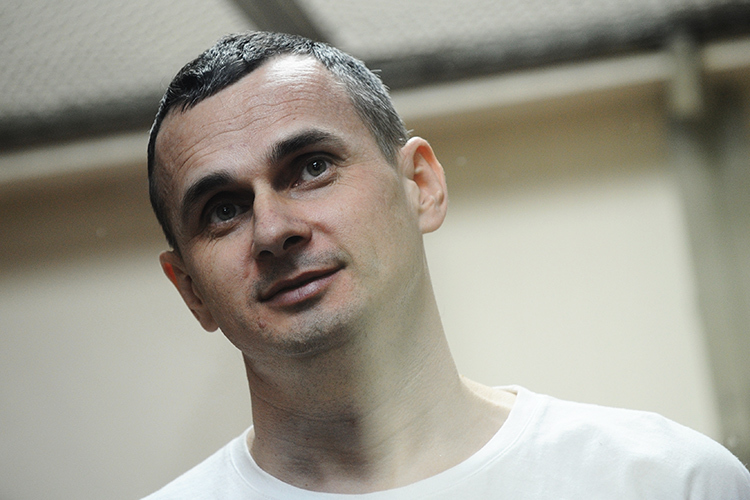
Detailed_pictureOleg Sentsov. Photo by Sergei Pivovarov. Courtesy of RIA Novosti and Colta.Ru 

On May 14, 2018, Oleg Sentsov went on an indefinite hunger strike in a penal colony located north of the Arctic Circle. His only demand is the release of all Ukrainian political prisoners in Russia. According to Memorial’s list, there are twenty-four such prisoners.

In August 2015, Sentsov was sentenced to twenty years for organizing a terrorist community and planning terrorist attacks. The second defendant in the case, Alexander Kolchenko, was sentenced to ten years in prison. Mediazona has published transcripts of the hearings in their trial. Around three hundred people have read them over the last three years. The transcripts make it plain the only evidence of the alleged terrorist organization’s existence was the testimony of Alexei Chirniy, who was not personally acquainted with Sentsov. It is police footage of Chirniy’s arrest while he was carrying a rucksack containing a fake explosive device that propagandists often pass off as police footage of Sentsov’s arrest.

Before his arrest, Sentsov was an Automaidan activist. In the spring of 2014, he organized peaceful protests against Crimea’s annexation by Russia.

“Yesterday’s ‘suicide bomber auto rally’ took place in Simferopol yesterday, but in quite abridged form,” Sentsov wrote on Facebook on March 12, 2014. “Only eight cars, six reporters with cameras, and twenty-five activists/passengers assembled at the starting point. I would have liked to have seen more. Unfortunately, most of the armchair revolutionaries who were invited were afraid to go. The traffic cops and regular police also showed up at the starting line, insisting we not leave for our own safety. We told them our protest was peaceful. We had no plans of breaking the rules, so we suggested they escort us to keep the peace for everyone’s sake.”

The second defendant, Kolchenko, admitted involvement in the arson of an office that was listed in the case file as belonging to the United Russia Party, but which in April 2014 was an office of Ukraine’s Party of Regions. The arson took place at night. It was meant to cause physical damage while avoiding injuring anyone.

The Russian authorities tried to prove both Sentsov and Kolchenko were linked with Right Sector, a charge that was unsubstantiated in Sentsov’s case and absurd in the latter case due to Kolchenko’s well-known leftist and anarchist convictions. Gennady Afanasyev, the second witness on whose testimony the charges against the two men were based, claimed he had been tortured and coerced into testifying against them.

Sentsov and Kolchenko’s show trial, like the show trials in the Bolotnaya Square Case, were supposed to show that only a handful of terrorists opposed the referendum on Crimea’s annexation and thus intimidate people who planned to resist assimilation. The Russian authorities wanted to stage a quick, one-off event to intimidate and crack down on anti-Russian forces. But two circumstances prevented the repressive apparatus from working smoothly. The first was that the defendants did not make a deal with prosecutors and refused to acknowledge the trial’s legitimacy. The second was that Automaidan activist Oleg Sentsov unexpectedly turned out to be a filmmaker, provoking a series of public reactions ranging from protests by the European Film Academy to questions about whether cultural producers would be capable of blowing up cultural landmarks. Segments of the Russian film community reacted to the situation with cold irritation. According to them, Sentsov was a Ukrainian filmmaker, not a Russian filmmaker, and he was not a major filmmaker. The owner of a computer club in Simferopol, his semi-amateur debut film, Gamer, had been screened at the festivals in Rotterdam and Khanty-Mansiysk, while release of his second picture, Rhino, had been postponed due to Euromaidan.

The Ukrainian intelligentsia have equated Sentsov with other political prisoners of the empire, such as the poet Vasyl Stus, who spent most of his life in Soviet prisons and died in Perm-36 in the autumn of 1985, a week after he had gone on yet another hunger strike. The Ukrainian authorities see Sentsov, a Crimean who was made a Russian national against his will and is thus not eligible for prisoner exchanges, as inconvenient, since he smashes the stereotype of the treacherous peninsula, a part of Ukraine bereft of righteous patriots. Sentsov’s death on the eve of the 2018 FIFA World Cup would be a vexing, extremely annoying nuisance to the Russian authorities.

Sentsov is an annoyance to nearly everyone, but he is a particular annoyance to those people who, while part of the Russian establishment, have openly defended him, although they have tried with all their might to avoid noticing what an inconvenient figure he has been. Although he was not a terrorist when he was arrested, he has become a terrorist of sorts in prison, because his trial and his hunger strike have been a slowly ticking time bomb planted under the entire four-year-long post-Crimean consensus, during which some have been on cloud nine, others have put down stakes, and still others have kept their mouths shut. Yet everyone reports on the success of their new endeavors on Facebook while ignoring wars abroad and torture on the home front. Sentsov represents a rebellion against hybrid reality and utter compromise, a world in which Google Maps tells you Crimea is Russian and Ukrainian depending on your preferences. To what count does “bloodlessly” annexed Crimea belong, if, four years later, a man is willing to die to say he does not recognize the annexation?

The success of Gamer on the film festival circuit, which made Sentsov part of the international film world, and his current address in a prison north of the Arctic Circle beg three questions. What is culture? Who produces culture? What stances do cultural producers take when they produce culture? There are several possible answers. Culture is a tool for reflection, a means for individuals and societies to achieve self-awareness and define themselves. It is not necessarily a matter of high culture. In this case, we could also be talking about pop music, fashion, and rap. (See, for example, the recent documentary film Fonko, which shows how spontaneous music making has gradually been transformed into a political force in post-colonial Africa.) On the contrary, culture can be a means of spending leisure time for people with sufficient income, short work days, and long weekends.

Obviously, the culture produced in Russia today under the patronage of Vladimir Medinsky’s Culture Ministry is not the first type of culture, with the exception of documentary theater and documentary cinema, but the founders of Theater.Doc have both recently died, while Artdocfest has finally been forced to relocate to Riga. The compromised, censored “cultural production” in which all the arts have been engaged has no way of addressing any of the questions currently facing Russia and the world, from shifts in how we view gender and the family (for which you can be charged with the misdemeanor of “promoting homosexualism”) to the relationship between the capitals and regions (for which you can charged with the felony of “calling for separatism”). Crimea is an enormous blank spot in Russian culture. Donbass and the rest of Ukraine, with which Russia still enjoyed vast and all-pervasive ties only five years ago, are blank spots. But cultural producers have to keep on making culture, and it is easier to say no one is interested in painful subjects and shoot a film about the complicated family life of a doctor with a drinking problem and a teetotalling nurse.

When we speak of the second type of culture—culture as leisure—we primarily have in mind Moscow, which is brimming over with premieres, lectures, and exhibitions, and, to a much lesser extent, Russia’s other major cities. So, in a country whose population is approaching 150 million people, there is a single international film festival staged by a local team for its hometown, Pacific Meridian in Vladivostok. All the rest are produced by Moscow’s itinerant three-ring circus on the paternalist model to the delight of enlightened regional governors. It matters not a whit that one of them ordered a brutal assault on a journalist, nor that another was in cahoots with the companies responsible for safety at the Sayano-Shushenskaya Dam, where 75 people perished in 2009. What matters is that the festival movement should go on. There is no room in this model for local cultural progress. There can be no free discussion generated by works of art when everyone is engaged in total self-censorship. After I went to Festival 86 in Slavutych, whose curators have been conceptually reassessing the post-Soviet individual and the post-Soviet space, I found it painful to think about Russian film festivals. This sort of focused conceptualization is impossible in Russia. It is of no interest to anyone.

There are two more possible answers to the question of what culture is. Culture is propaganda. Or, finally, culture is only the marquee on a commercial enterprise profiting at the taxpayer’s expense. It is not a big choice, and the kicker is that by agreeing today to be involved in churning out propaganda, milking taxpayers, supplying optional leisure time activities, producing censored works, and colonizing one’s own countrymen for the sake of money, status, and membership in a professional community, the people involved in these processes automatically stop making sense. It is naïve to think the audience has not noticed this forfeiture. It is no wonder the public has an increasingly hostile reaction to cultural producers and their work.

No one has the guts to exit this vicious circle even in protest at the slow suicide of a colleague convicted on trumped-up charges, because it would not be “practical.” The events of recent months and years, however, should have transported us beyond dread, since everyone without exception is now threatened with being sent down, the innocent and the guilty alike.

Post-Soviet infantilism is total. It affects the so-called intelligentsia no less than the so-called ordinary folk. Infantilism means being unable to empathize, being unable to put yourself in another person’s shoes, even if that person is President Putin, a man with a quite distinct sense of ethics, a man who has been studied backwards and forwards for twenty years. Apparently, the message sent to the creative communities through the arrest of Kirill Serebrennikov was not registered. If you want to be a dissident, start down the hard road of doing jail time for misdemeanor charges, facing insuperable difficulties in renting performance and exhibition spaces, becoming an outsider, and experiencing despair. If you want a big theater in downtown Moscow, play by the rules. Like your average late-Soviet philistine, Putin regarded the creative intelligentsia with respect at the outset of his presidential career. (See, for example, footage from his visit to Mosfilm Studios in 2003.) However, a few years later, he was convinced the creative intelligentsia was a rampantly conformist social group who would never move even a millimeter out of its comfort zone and would make one concession after another. A lack of self-respect always generates disrespect in counterparts.

By signing open letters while remaining inside the system and not backing their words with any actions whatsoever, the cultural figures currently protesting the arrests of colleagues are viewed by the authorities as part of the prison’s gen pop, while people who live outside Moscow see them as accomplices in looting and genocide. No one takes seriously the words of people who lack agency. Agency is acquired only by taking action, including voluntarily turning down benefits for the sake of loftier goals. The acquisition of agency is practical, because it is the only thing that compels other people to pay heed to someone’s words. I will say it again: the acquisition of agency is always practical. At very least, it generates different stances from which to negotiate.

Sentsov has made the choice between sixteen years of slow decay in a penal colony and defiant suicide in order to draw attention not to his own plight, but to the plight of other political prisoners. Regardless of his hunger strike’s outcome, he has generated a new scale for measuring human and professional dignity. It is an personal matter whether we apply the scale or not, but now it is impossible to ignore.

Thanks to Valery Dymshits for the heads-up. Translated by the Russian Reader

Civilization Won’t Be Destroyed by Extraterrestrials: On the Possible Merger of Russia’s Two Largest Libraries

Tatyana Shumilova. Photo courtesy of Rosbalt

Civilization Won’t Be Destroyed by Extraterrestrials
The consequences of merging Russia’s two largest libraries would be disastrous, argues the Russian National Library’s Tatyana Shumilova
Alexander Kalinin
Rosbalt
February 1, 2017

The idea of merging Russia’s two biggest libraries was proposed to culture minister Vladimir Medinsky by their directors, Vladimir Gnezdilov (the Russian State Library in Moscow, aka the Leninka) and Alexander Visly (the Russian National Library in Petersburg, aka the Publichka). The proposal has hardly garnered universal approval. The country’s leading authorities on librarianship have sent a letter to President Putin asking him to stop the merger from going ahead. They have been supported by Russian philologists and historians.

Tatyana Shumilova, chief bibliographer in the Russian National Library’s information and bibliography department, spoke to Rosbalt about how staff there have related to the possible merger with the Russian State Library, and whether the issue has been broached with them.

What are the possible consequences of merging the country’s two biggest libraries?

Our library would simply cease to exist in its current shape. Many people have made much of the fact that the RNL’s executive director Alexander Visly has said the changes would not give rise to a new legal entity. Of course, they wouldn’t. One legal entity would remain: the RSL. So everyone realizes it’s not a merger that is at issue, but a takeover.

So we could equate the words “merger” and “destruction” in this case?

Yes, definitely. A merger would be tantamount to the death of our library here in Petersburg. After the RNL became a branch or appendage of the RSL, our work with readers would cease to be funded. We would not be able to provide them with the full scope of services. Plus, we would have to switch to the RSL’s system, and that would be undesirable. We are told the catalogues in both libraries are structured on the same principle. That is not true. There is a big difference between them. It would be quite complicated to restructure the system. The different approaches to librarianship should be preserved.

Moscow has the administrative resources. The government is located in the capital, as is the Culture Ministry. Moscow and Moscow Region are the home of the RSL, the Russian Institute for Scientific and Technical Information (VINITI), the Russian National Public Library for Science and Technology, the State Historic Public Library of Russia, and the Russian State Library for Foreign Literature (aka the Inostranka). And, until recently, the Institute of Scientific Information on Social Sciences of the Russian Academy of Sciences (INION RAN) was running at full steam. But the Northwest Federal Region has only two major libraries, the RNL and the Library of the Russian Academy of Sciences (aka the BAN). After a merger, there would be one.

I understand that, after the merger, publishers would not have to send an obligatory copy of their books to the RNL. Only Moscow would get new books?

That is one of the cost-saving measures. Allegedly, money would not have to be spent on two sets of obligatory copies. It would be enough to have one hard copy and a digital copy. But the outcome would be that Petersburg would simply stop receiving most new books. It’s a rather cynical cost-cutting measure that would affect only our library, not the RSL, which was founded much later than the RNL. And all because it’s located in Moscow. No one says it outright, but it’s clear anyway.

But the RNL would still get a digital copy.

I really don’t understand the idea of sending a digital copy instead of a hard copy. We have a huge number of readers who for medical reasons cannot and should not use a computer. Why should we deprive them of hard copies? It’s simply indecent. Besides, we know what natural disasters electronic resources are prone to. A blackout, a power surge in the network, a server failure, and everything is lost. A library should not be dependent only on one type of resource.

People who take far-reaching, momentous decisions like to base them by alluding to the know-how of other libraries and even other countries. But nowhere do national libraries receive only digital copies of printed matter. You can probably merge libraries in Denmark, but the Russian Federation is a different country, a much larger country with a much larger population. Although the name would stay the same, the RNL would in fact cease being a national library. We already have municipal and neighborhood libraries in Petersburg. People come to us as a last resort, when there is nowhere else to go.

Nor is anyone probably really aware that digital copies relate not only to books but to magazines and newspapers as well.

Apparently, the shots are being called by people who don’t read and don’t go to libraries. Just how did the culture minister write his dissertations and books? By using the Internet? Or did someone else do it for him?

Where did the idea to merge the libraries come from?

Rumors about the merger have been circulating for a long time. They are all we have to go on, for no one has said anything officially. It’s still too early to draw any conclusions from the available facts. Now no one denies that merger talks are underway. Earlier, apparently, they were too busy to reveal this, or maybe they were ashamed or embarrassed. But now they’re not ashamed anymore.

After the Soviet Union collapsed, Vladimir Zaitsev, the then-director of the Publichka, was worried about the library’s potential plight. That was when the name Russian National Library was coined. Lots of people didn’t like it, but Zaitsev thought it would give us stability and protect us from attacks. As we see now, it didn’t work for long. The opportunity to save millions of rubles has now been identified as grounds for merging the libraries. Indeed, you could probably calculate the worth of the books and the real estate by eye. But how do you evaluate the intangible assets? How many people have been educated here? How many people, from university students to scholars, have grown up here? They wrote their dissertations and books here. If you write a research paper based on more than two sources, you are going to need a library. This is serious work.

It is believed the RNL’s current director Alexander Visly was sent to Petersburg on a “temporary assignment” in order to merge the two libraries. Do you agree?

Officials rarely condescend to explaining the reasons for their actions directly. They believe they should not be accountable to the taxpaypers. No one has announced anything to us officially. But talk of a possible merger started after Anton Likhomanov left the director’s post at the RNL in early 2016. Visly wasn’t the only person tipped for the vacancy, after all. The director of the Lermontov Interdistrict Centralized Library System, in Petersburg, and the director of the National Library of the Republic of Karelia were identified as possible candidates.

Several months passed between Likhomanov’s departure and Visly’s arrival. We don’t know what was discussed during that time. Apparently, there was some kind of horse trading underway. According to the rumors in Moscow, Visly really didn’t want to move to Petersburg, but he was nevertheless talked into going in order to perform certain functions. The fact that an executive director has not yet been appointed at the RSL, and they only have an acting director, causes one to reflect grimly on the subject.

Indeed, Visly has not taken an interest in day-to-day affairs in Petersburg. He is busy with construction, renovating the Lenin Reading Room, and he has visited the cataloguing and acquisition departments. By the way, officials have been saying the functions of these departments overlap at the RNL and RSL. So he hasn’t been dealing with the library as a whole, although he is the executive director and should be responsible for everything that happens in the RNL. Apparently, this circumstance has been agreed upon with someone. No one would reproach him for it.

Has the issue of the possible merger been discussed with RNL staff?

There have been no meetings on the topic with the workforce, and none are planned. No one keeps us in the loop. There are no general staff meetings.  There is the practice of informational meetings, to which the heads of the departments and units are invited. My comrades once expressed a desire to take part in one such meeting, but they were simply booted out. Staff members only talk about the merger amongst themselves.

What do they say?

Very little that is positive. Everyone fears for his or her future. But what can rank-and-file library staffers do? Some signed the letter supporting the library, while others didn’t. Some have signed a petition. What else can we do?  We need large-scale outside support, but how do we get it? People know very little about the merger of the libraries, after all. Even if they wanted  to  find out about the consequences of the mergers, where would they look? Yandex News. And what would they find there? News about fires, missing schoolchildren, pedestrians run over by cars, and people falling from tall buildings. There is almost no news about culture.

And how do we explain to university lecturers, university students, and schoolchildren what could happen to the library? How do we convince them that the problem concerns them, too? Even university students come to us for textbooks, because the university libraries are shortchanged when it comes to new acquisitions of books. But our customers, people to whom provide information, include the St. Petersburg Legislative Assembly, the Investigative Committee, the FSB, the Interior Ministry, and other organizations. So it turns out they could not care less, either. Or they naively believe nothing will change. Maybe they don’t understand the consequences?

Have you thought about organizing a protest rally?

Few library staffers would attend such a rally. Everyone is scared redundancies will kick off, and his or her department will be eliminated. There is the chance of winding up on the streets. There are people working here who went through the hungry 1990s on miserly wages. At least they were paid regularly. Director Vladimir Zaitsev, who constantly traveled to Moscow and literally sat in the minister’s waiting room, deserves the credit for that.

So a lot of people would not attend a rally. No one wants to lose their job. Take a look, for example, at how many people came out to defend St. Isaac’s Cathedral. A lot fewer than could have come out.

People today are surrounded by informational noise. They hear about Crimea, Ukraine, and America. Old ladies at bus stops don’t discuss cultural issues, but US Presidents Obama and Trump. Everyone in Russia is totally confused.

What consequences would the merger have for readers? For example, one of the plusses that has been mentioned is that people with RNL cards would be able to use the RSL in Moscow.

Initially, readers would have no sense of any change. They just wouldn’t understand anything. After all, we would continue to acquire some new books. Qualitative negative changes build up unnoticed. They’re not visible immediately. In Germany in 1933, not everyone realized immediately what exactly was happening, either.

Aside from the issue of conservation and security, replacing hard copies with digital copies would cause yet another exodus of readers, especially elderly people, who often don’t like or cannot read e-books. Indeed, many young readers, when you suggest they use a digital source, reply, “I don’t need your Internet. I came here to read books.” Reducing the numbers of live readers to a minimum would probably lead to the next step: closing the library altogether. “Why keep you open?” officials would say, “Nobody visits your library.”

As for a single library card for the two libraries, there wouldn’t be much advantage to it. RNL readers can easily get a card for the Leninka, and Leninka readers can easily get a card for the RNL. It’s a snap: you just need your internal passport. You don’t even have to bring a photograph to the registration desk anymore.

So is there any way out of the situation, or is the RNL’s takoever inevitable?

I don’t want to accept the fact it could happen. But RNL staff are hardly in a position to do anything. They have almost no influence on the situation. Respected people, prominent scholars and cultural figures, have to speak out, people with whom the authorities have to reckon. As it is, only Arkady Sokolov and Valery Leonov, out of the entire Petersburg library community, have spoken out on the topic. None of the museums or universities have openly supported us. It is sad.

I don’t think the city could solve the problem by talking the library under its wing. That would only delay its death. The city could not fund the RNL properly. I don’t know what other options we have for saving the library. We have let the moment passs when we could have looked for sponsors to support us financially.

What do RSL employees think of the merger?

They are silent because the merger wouldn’t affect them. They would continue to function as before and do the same things they did earlier, such as acquiring the obligatory copies, hard copies and digital copies, of everything published in Russia. The negative consequences would only affect us, meaning the Russian National Library.

The most concise definition of culture is this: culture is the transmission of tradition. Breakdowns in the production, concentration, and reclamation of the national heritage (a process in which libraries are an inalienable and quite important component) have led to the collapse of civilizations throughout history. Then people go looking for the extraterrestrials who flew in and destroyed everything. The perpetrators are actually much closer.

Translated by the Russian Reader. Thanks to Comrade VZ for the heads-up

UPDATE. Sadly but predictably, the Russian National Library has now decided to dismiss Tatyana Shumilova from her job there for granting this frank interview to Rosbalt, although ostensibly, as follows from the letter below, dated 3 February 2017 and signed by E.V. Tikhonova, acting director of the RNL, she is threatened with dismissal for, allegedly, being absent from work for four hours and thirteen minutes on 30 January 2017. Thanks to Comrade VA for this information and the scan of the letter. TRR

16388258_1765605920131726_5540994598165898435_n

UPDATE 2. Today, February 7, there have been corroborated reports that Tatyana Shumilova has been summarily dismissed from her job at the Russian National Library in Petersburg. TRR

The Unpleasant Incident

LGBT Activists Greet Culture Ministry Chief Medinsky with Rainbow Flags
October 27, 2013
www.fontanka.ru

The unpleasant incident took place in Petersburg when Culture Minister Vladimir Medinsky was taking part in the Olympic torch relay.

As Fontanka.Ru’s correspondent reports, the Culture Ministry chief took the torch in front of the Yelstin Presidential Library and carried it to the intersection with the English Embankment. During his run, two members of the LGBT movement unfurled rainbow flags, the symbol of their movement.

10

Police tried to stop the activists, but both young women managed to escape arrest and hang on to their flags.

As the LGBT activists themselves explained to Fontanka.Ru, the purpose of their action was to protest the Sochi Olympic Games [sic], to be held in 2014.

The Olympic torch rally in Petersburg started today at 11:00 a.m. The event will culminate after 7:00 p.m. with a big celebration on Palace Square.

The Showdown at Petersburg’s Zubov Institute

Editor’s Note. The latest news from the front lines in the confrontation between the Russian Institute of Art History (Zubov Institute) in Petersburg and the Russian Federal Ministry of Culture is that Jamilya Kumukova, chair of the trade union committee at the Institute, has been threatened with firing in the run-up to a protest rally scheduled for July 9.

_____

(Original at www.anticapitalist.ru)

An Academic Treasure Trove Doesn’t Want to Be a Klondike for Bureaucrats

A fight has erupted in Petersburg over the Russian Institute of Art History [also known as the Zubov Institute and abbreviated “RIII” in Russian]. The Ministry of Culture has been carrying out a hostile takeover of the institute in an attempt to get its hands on the institute’s premises, [a nineteenth-century mansion in downtown Petersburg]. Researchers and graduate students have been trying to fight off the siege.

1. zub-entrance

It all began in May 2012, when President Vladimir Putin signed a decree increasing salaries for scientists and scholars. The Ministry of Culture, which had just then been headed by Vladimir Medinsky, ordered the research institutes under its jurisdiction to increase salaries. But no funds for this increase were earmarked in the state budget. To fulfill the president’s decree, RIII director Tatyana Klyavina had to cut seventy-one positions. But that was only the beginning.

In 2013, the Ministry of Culture ordered yet another salary increase (of 28%), which would have meant dismissing a further fifteen employees. Klyavina refused to raise salaries through layoffs, for which she was subjected to a vigorous harassment campaign and eventually fired after leading the Institute impeccably for twenty-one years.

The Ministry of Culture got ready to celebrate. After all, by 2018, when salaries were slated to be increased to 200% of current levels, no one at all would have been left in the Institute. This meant it could already relocate the remaining miserable clutch of useless scholars to any old outbuilding, thus freeing the famous mansion with a view of St. Isaac’s Cathedral for more pressing needs, and merge the Institute itself with the first comer.

Today, the state has no use for research on Tchaikovsky, Scriabin, and Malevich. What it needs are people to carry out practical “monitoring” of Russian culture and compile exhibition booklets. It thus does not understand the essence and purpose of the research conducted at the institutes under its jurisdiction. Despite its incompetence, however, like a bull in a china shop it goes through the motions of “reform” and “modernization.” The main thing is not to deviate from the general line, and let the consequences be damned.

But whomever the Ministry sent to cajole the Institute’s indignant staff, it only aggravated the situation. After all, the RIII, which was founded in 1912 and in whose halls such renowned literary scholars, art historians, and musicologists as Yuri Tynyanov, Boris Eichenbaum, Boris Asafyev, Viktor Zhirmunsky, and Antonin Preobrazhensky worked, has experienced revolution, civil war, Stalin’s purges, and the Siege of Leningrad over its history. In the 1990s, it regained its autonomy and original name. The Institute’s staff has thus developed immunity to all manner of crackdowns and takeovers.

2. osminkin
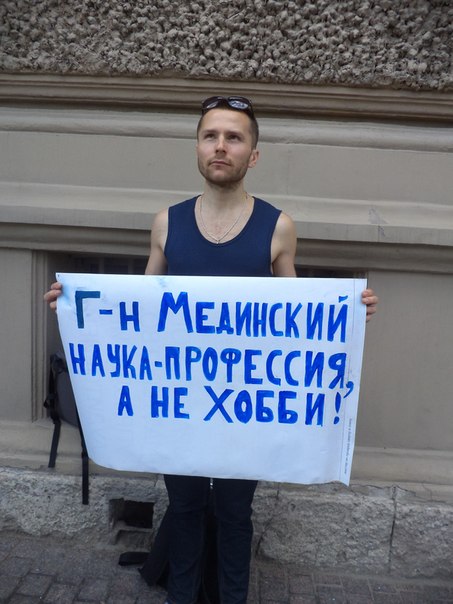
“Mr. Medinsky, research is a profession, not a hobby!”

Today, news from the Zubov Institute resembles reports from the front lines. Here is a brief chronicle of recent events.

On June 31, Culture Minister Medinsky descended on the RIII without warning. Locking himself in the director’s office, Mr. Medinsky refused to talk to staff, leaving Andrei Karpov, acting director of the Ministry’s oversight and personnel department, to act as his “hellhound” in the waiting room. Mr. Karpov, who currently heads the ministerial committee auditing the Institute, took his role as guard so seriously that he struck cinema department grad student Olga Yevseyeva, who had come to give the minister a letter written by the Institute’s graduate students.

On July 2, an emergency meeting of RIII staff took place. In the middle of the meeting, the new director, Olga Koch, appeared in the hall, accompanied by private security guards. The guards said they had been hired by the Institute’s new management to  protect historical valuables, although in the Institute’s hundred-year history not a single rare manuscript or musical score has ever disappeared from the building.

The art scholars unanimously stood up and turned their backs to Koch, stamping their feet and chanting, “Get out!” After the director ran out of the room as if she had been scalded, the assembly continued, adopting a strongly worded resolution. Here are its principal points:

1. We voice our lack of confidence in the ministerial commission headed by Andrei Karpov, who permitted himself to use force against a graduate student of the Institute.

2. We voice our indignation at Culture Minister Vladimir Medinsky’s arbitrary decision to shift the work of the Ministry’s departments to the Institute.

3. We protest against the transformation of the Institute into a high-security facility in connection with the hiring of a private security firm to work at the Institute.

4. We demand that Minister Medinsky retract his statement that the apartments in the wing of the Institute are “handed out right and left.”

5. We voice our lack of confidence in acting director Olga Koch, who publicly threatened staff with a “crackdown,” and we demand that the decree appointing her, dated June 18, be rescinded.

6. We are sending a telegram to Russian President Putin and Prime Minister Medvedev.

7. We voice our support for the Russian Academy of Sciences.

On July 3, graduate students from the RIII and the European University held a series of solo pickets in support of Institute staff and against the Ministry of Culture’s policies. The young people stood outside Petersburg city hall, the city’s legislative assembly, and the entrance to the Institute with placards reading, “Mr. Medinsky, research is a profession, not a hobby” (a play on Medinsky’s statement that the “government won’t be funding a hobby”), “Save the Zubov Institute!,” and “No to Mass Layoffs at the Zubov Institute.”

The graduate students handed out leaflets that read as follows:

For the second month running, we, researchers and graduate students at the Russian Institute of Art History, have been forced to defend our right to do research instead of doing that research. In May 2012, Russian President Vladimir Putin issued a decree ordering an increase in the wages of scientists and scholars to the average cost of living in their regions.

This good intention, however, was brought low by the total lack of additional funding. The new effective managers from the Ministry of Culture, led by Vladimir Medinsky, took the easy route and decide to fire everyone whose research was not sufficiently in demand. In their opinion, demand is nothing more than the amount of money earned. But the humanities cannot be reduced to a monetary equivalent.

By cutting back on basic research and firing specialists who are unique in their fields, Russia is rapidly turning into a peripheral power, capable only of supplying raw materials to more developed countries. What is more, it is forever losing access to the history of its art and culture, which means irrevocably losing its capacity for nurturing full-fledged individuals and citizens. So defending the Zubov Institute is for us today not just a matter of professional honor but also a civic duty.

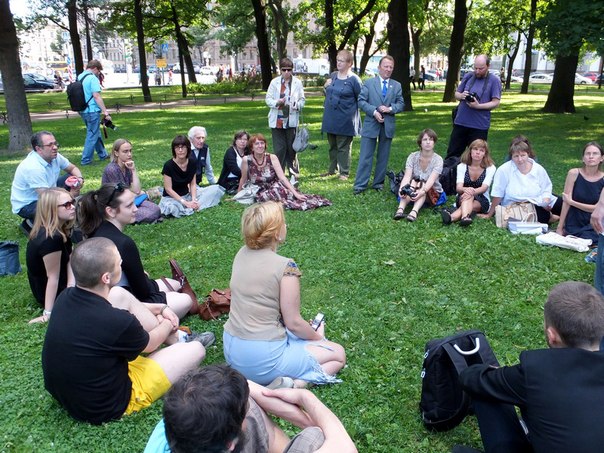
The same evening an open street conference in support of the Zubov Institute took place. It took the form of a Street University—lectures and meetings of students and teachers held outdoors and open to all comers. Street University was established in 2008 during the campaign against attempts to close the European University in Petersburg under false pretexts.

3. uu-zub
Street University in Defense of Zubov Institute, July 3, 2013

In that case, the authorities backed down, and the European University continued to operate in its old mansion on Gagarinskaya. What will happen in this case?

Both RIII staff and graduate students attended the conference, along with colleagues from friendly institutes. Tamara Ismagulova talked about the history of the Zubov Mansion, how the institute was established, and how it survived during the hard years of the Stalinist Thermidor. Yevgenia Hazdan talked about the journal Annals of the Zubov Institute, which was first published in the 1920s, lasting all of four years. Who would have thought that the recently revived journal might repeat the fate of its predecessor?

Sociologist Oleg Zhuravlev from the European University Institute in Florence argued that what is happening to the Zubov Institute is consistent with the overall trend in Europe of cutting spending on science and education, a trend that reveals the contradiction between democracy and the market economy.

Dmitry Golynko, from the contemporary artistic culture department, shared his recollections of the department’s work during the nineties, when the Institute was a hotbed for cutting-edge research in art. Pavel Arseniev and Roman Osminkin read poems, and at the evening’s conclusion a researcher from the musicology department even played several songs on the accordion, including “If I Had Mountains of Gold.” It was a quite symbolic coda, because the whole point of the conflict between the Ministry of Culture and the Zubov Institute is the Ministry’s insatiable desire to turn art scholarship into a gold mine.

5 July 2013 — Roman Osminkin, Russian Socialist Movement

_______

(Original at  www.colta.ru)

Dmitry Golynko-Volfson
3 July 2013
The Language of Violence: Scholarship and Power in the Russian Federation

Literally overnight, the Russian Institute of Art History (also know as the Zubov Institute for its founder, Count Valentin Zubov) was transformed from a quiet academic oasis (as Petersburgers are used to seeing it) into the epicenter of a scandal, a tense standoff between the academic community and managers from the Ministry of Culture. At the Ministry’s behest, Tatyana Alexeevna Klyavina, who for over twenty years had skillfully and competently managed the Institute, preserving its pleasant working environment and atmosphere of unconditional mutual respect, was fired. Thanks to her efforts, both during the momentous nineties and the stable (and allegedly sated, but in reality very sparingly state-subsidized) noughties, the RIII’s team of researchers had been able to focus on basic academic research without personally worrying about urgent economic problems. In addition, her tenure was focused on making sure the Institute maintained a well-calibrated balance between classical, traditional art scholarship and experimental, innovative, future-oriented research. Tatyana Alexeevna was also the long-time chair of the contemporary artistic culture department, which I had the good fortune to join in 1995. In the nineties, the department was a unique place where cutting-edge research in postmodernist theory was combined with the direct involvement of researchers in shaping the new culture and new art of the legendary post-perestroika period.

Открытие выставки "Тициан" в Москве
Culture Minister Vladimir Medinsky

The confrontation between Institute staff and the Ministry slowly but relentlessly escalated throughout the first six months of this year (after the newly appointed Minister Vladimir Medinsky had announced plans to reform the research institutes under his jurisdiction). The showdown between researchers and bureaucrats shifted into an active phase after Klyavina was fired, and Olga Koch, former rector of the Saint Petersburg University of Culture and Art, was named acting director. Institute staff was openly hostile to Koch’s top-down appointment and refused to cooperate with her on any issues related to academic planning. In addition, at meetings of the academic council and the staff union, which were open to the press, they passed toughly worded resolutions and proposed strategic methods for resolving the conflict (from shifting the Institute to the jurisdiction of the Russian Academy of Sciences to putting it under the care of the municipal government).

The conflict reached an obvious climax on Friday, June 28. As a result of a visit by Culture Minister Medinsky to the RIII that was deliberately kept secret from the Institute’s researchers, a monstrously absurd “brawl” took place in the waiting room of the director’s office, which was widely reported in print and online media. Unfortunately, I witnessed this shameful episode. Since the minister had locked himself in the director’s office and refused to meet with research staff, who were demanding an explanation, his aide, Andrei Karpov, acting head of the Ministry’s oversight and personnel department, began using brutal methods to pacify the researchers besieging the office—simply put, he started pushing them. In particular, this portly gentleman, intending to slam shut the door to the waiting room, pushed Olga Yevseyeva, a graduate student in the cinema department, and Anna Nekrylova, deputy director for research, who had come to Olga’s rescue, in front of numerous witnesses and the press. (Medical personnel at an emergency room attested the injuries they received.)

After the battle, Vladimir Medinsky “went out to the people” after all, reassuring staff that the Institute would be preserved, and Count Zubov’s mansion, a tasty morsel for developers, would not be expropriated. However, it was clear that a point of no return had been passed. The already difficult dialogue between scholars and culture bureaucrats had moved from the mild, evasive language of administrative accommodation, persuasion, and intimidation to the jargon of institutional violence (or “mythical violence,” to borrow Walter Benjamin’s term). Olga Serebryanaya has offered a curious analysis of this incident from the standpoint of Hannah Arendt’s theory of violence. She writes, “Medinsky does not explain his position or try to convince the researchers that he is right; [instead] he sets a limit on their involvement.” (It is telling that Medinsky pointedly refused to take a letter from the graduate student body delivered to him by Olga Yevseyeva.)

Ex-Zubov Institute Director Tatyana Klyavina

In addition to a painful emotional state, this protracted conflict has caused staff to have well-founded, troubling doubts about the Institute’s immediate future. These doubts have to do with both practical, administrative and financial, matters (whether salaries will be paid on time) and more abstract, theoretical questions — how the Institute’s academic and research policy will shape up, and what the scenario and trajectory for future fundamental changes is. In fact, the reorganization of the Zubov Institute, which has caused a flurry of discontent, is a consequence of the revamping of the entire system of the humanities in Russia, a painful revamping carried out by the authorities that, according to many experts and observers, seriously threatens to destabilize (if not destroy) this system. Against the backdrop of the massive public campaign currently unfolding in support of the Russian Academy of Sciences, the tense situation around the Zubov Institute is a vivid symptom of the communicative impasse and total absence of feedback between basic science and scholarship and the state agencies supervising it.

Over the past six months, the Ministry of Culture has changed directors in four of the five institutes under its jurisdiction. We have to assume that it is planning (and already eagerly implementing) a radical renovation of the entire infrastructure of academic art scholarship, its transition into the realm of the strictly practical and utilitarian. But what are the criteria and parameters of this renovation, aside from the rather vague demands for efficiency and optimization, regularly voiced by officials? In December 2012, the Ministry of Culture circulated a proposal for staff at its research institutes to include in their scholarly work the “creation of calculation methods, cumulative indices based on the use of expert assessments, for determining the effectiveness of institutions working in the field of the performing arts and folk art.” The Ministry of Culture envisions the future of art scholarship as part of a major government contract that would stipulate the specific cognitive services academic researchers provide to the state. The state commission launched by the Ministry of Culture suggests that a researcher’s routine work will range from calculating efficiency indices and optimization coefficients (thus equating the researcher to an economic consultant) to drafting concepts for the long-term development of the industry under the auspices of “national projects” (thus saddling the researcher with the role of manager).

6. institut
Russian Institute of Art History (Zubov Institute)

Hardly anyone today would dispute the fact that the humanities in Russia are in need of an urgent and comprehensive transformation. But the direction of such reforms should still be determined by taking into account the interests, opinions, and wishes of the humanities scholars themselves, rather than by the impulsive decisions of state officials, which paradoxically combine neoliberal technocracy with elements of Soviet economic planning. Apparently, the only chance to settle the administrative conflict that has now broken out at the Zubov Institute is to organize a dialogue between researchers and the authorities not in the “brawling” mode, but as a conceptual and ideological debate. If the authorities nevertheless do not dare to listen respectfully to the academic community and sit down to constructive negotiations with it, then I am afraid the dark and dismal prospects now looming on the horizon will become quite inevitable realities. The research institutes, the cognitive factories where academic researchers, despite many years of precarity, have been diligently engaged in producing new meanings and promoting knowledge, will gradually and inevitably be dismantled. Fighting today to save the Zubov Institute and other research institutes under the Ministry of Culture’s jurisdiction also means fighting for (the seemingly long ago reclaimed) freedom and autonomy of the humanities.

____

Footage by Sergey Yugov of the Street University in defense of the Zubov Institute, held on July 3, 2013. More footage from the event can be found here, here, here, here, and here.