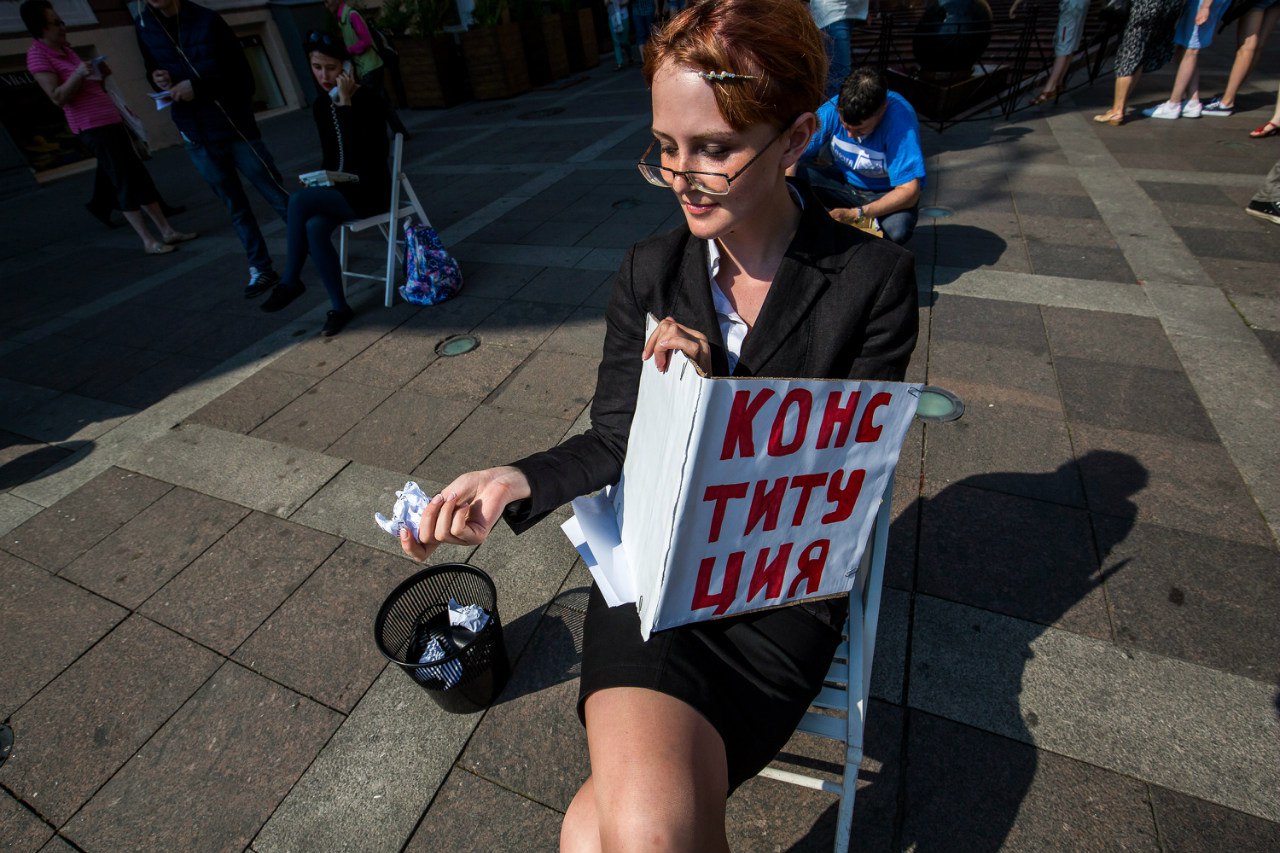
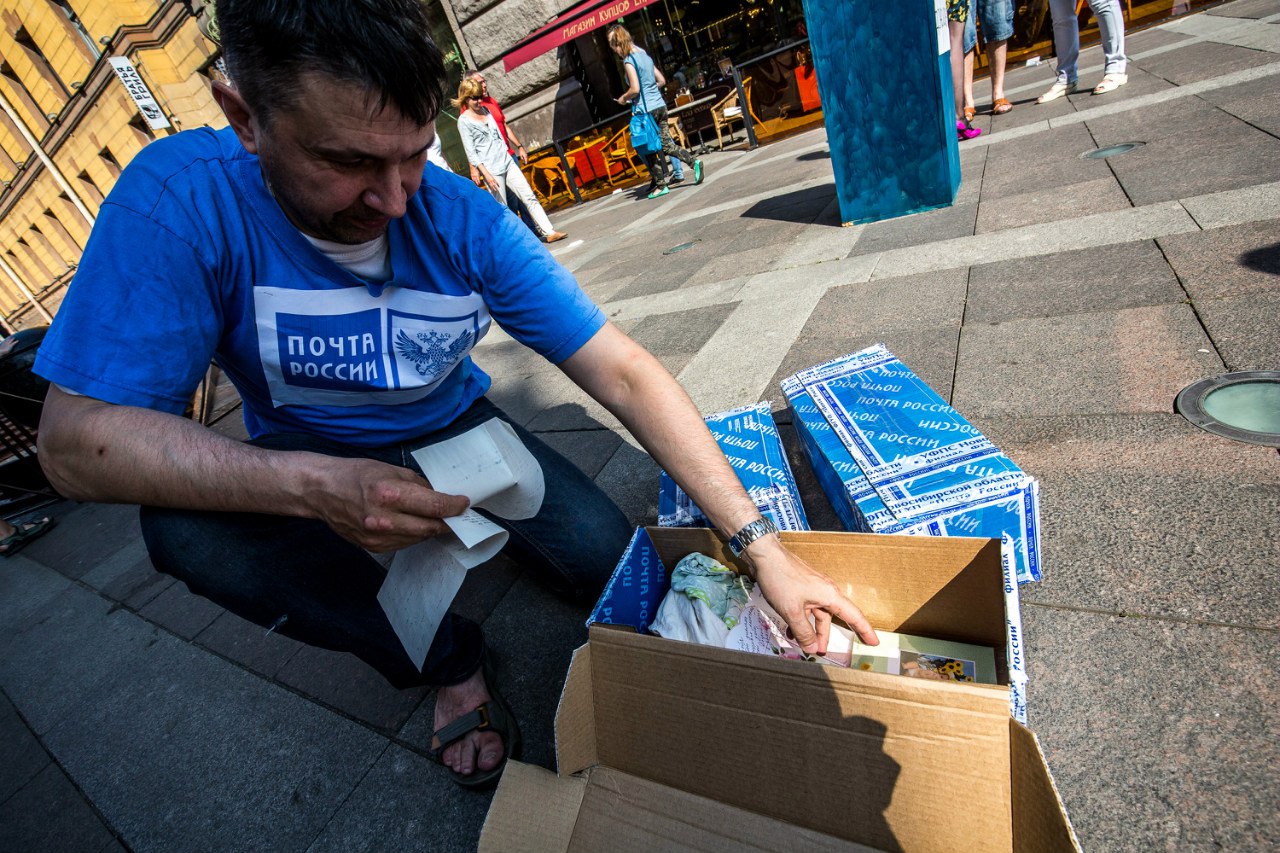
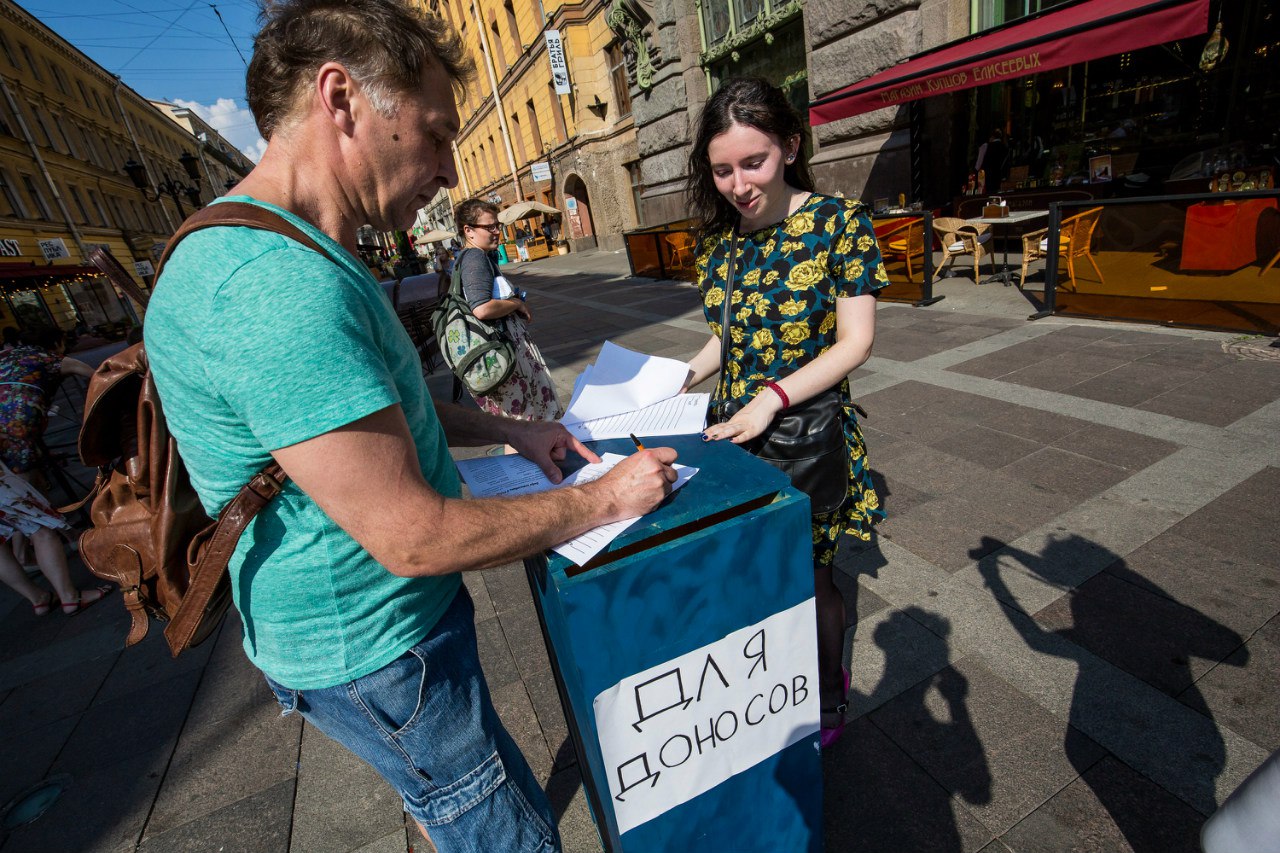
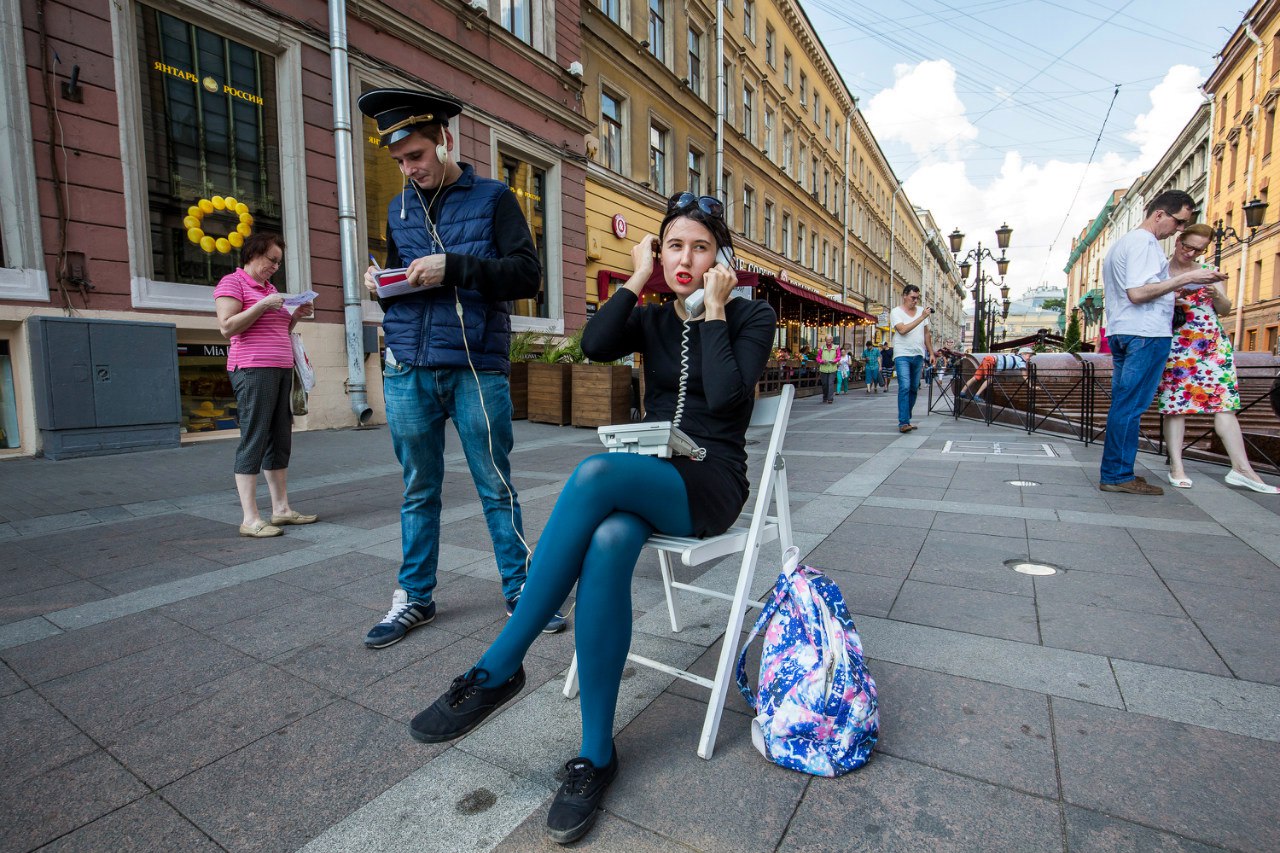
This past Sunday, “Irina Yarovaya” shred the Russian Constitution on Nevsky Prospect in Petersburg. The people’s deputy was joined by characters from her package of “anti-terrorist” laws, who had come to life for the occasion: a postal worker vetting packages, a secret policeman wiretapping a light-minded young lady’s telephone conversations, and an involved ordinary citizen encouraging passersby to write denunciations on their friends, neighbors, and coworkers.
“Postal worker” vets suspicious parcels. Downtown Petersburg, July 3, 2016. Photo: David Frenkel
The activists of the Spring Movement thus attempted to draw the attention of their fellow Petersburgers to the flagrantly repressive amendments to the Russian Criminal Code, tabled by a group of MPs led by Irina Yarovaya and now approved by both houses of the Russian parliament, the State Duma and the Federation Council.
Passerby fills out “denunciation” form. Downtown Petersburg, July 3, 2016. Photo: David Frenkel
The package of amendments will not only deal a blow to our country’s constitutional foundations but will also require huge financial subsidies during tough economic times. The screws will be tightened at our expense, at the price of impassable roads, hospitals and kindergartens that will never be built, and pension savings that the state has been confiscating once again. No scientific progress, no innovations, and no quality education are in the cards for our country: only Yarovaya and her hardcore approach to lawmaking.
“Secret policeman” wiretaps an unsuspecting young lady’s phone conversation. Downtown Petersburg, July 3, 2016. Photo: David Frenkel
If the president signs the Yarovaya package into law, “non-informing” will be criminalized, “inducing, recruiting or otherwise involving” others in the “organization of mass disturbances” will be punishable by prison terms, punishment for “extremist” posts on the web and monitoring of personal correspondence will become harsher, and postal workers will be obliged to vigorously vet parcels for prohibited items.
Translated by the Russian Reader. All photos by David Frenkel
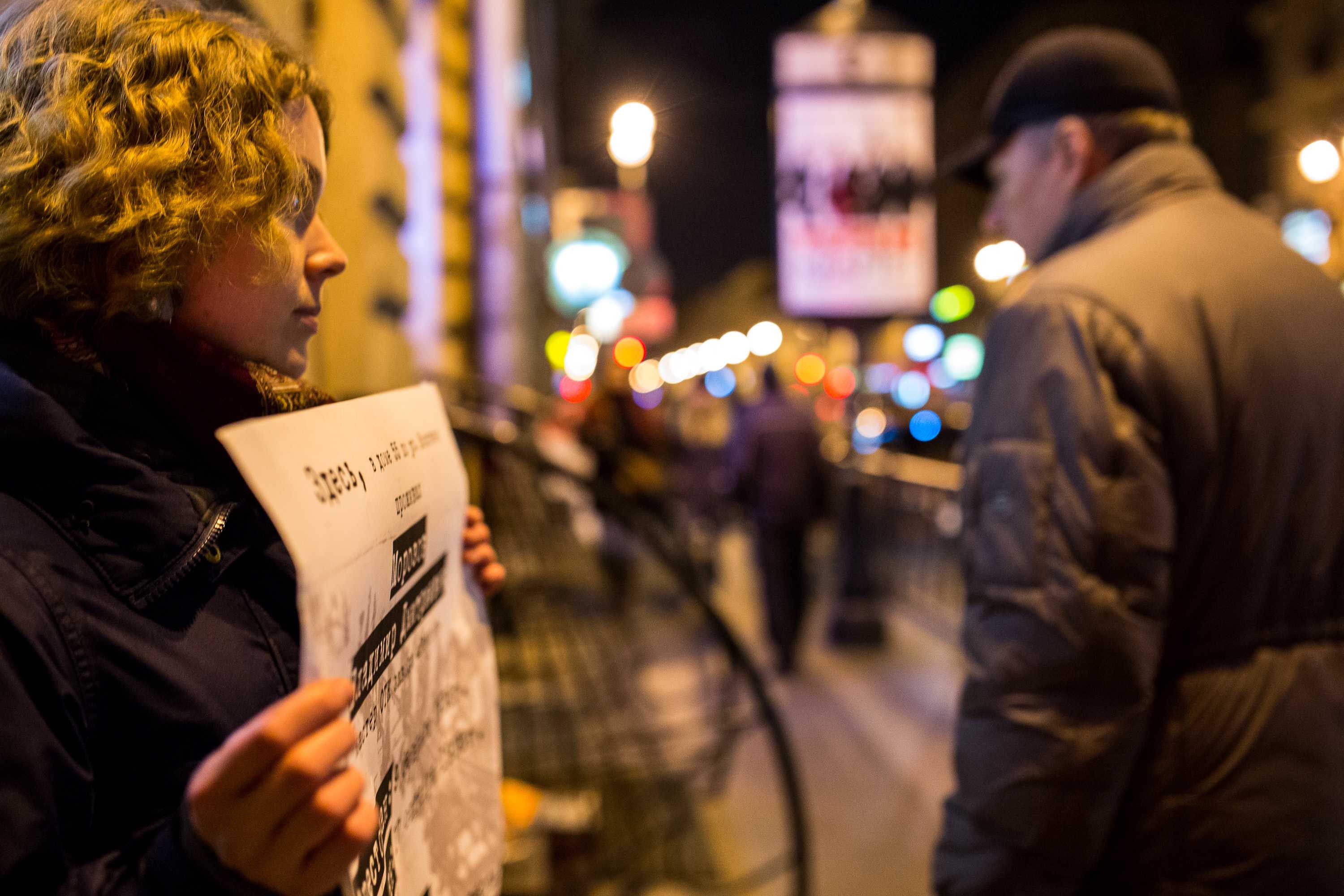
“Here, at Vosstaniya Street, 55, lived Vladimir Dmitrievich Morozov, a quality control inspector at the Etalon factory. Arrested February 9, 1938. Executed October 17, 1938.”
Remembering the Great Terror David Frenkel
Special to the Russian Reader
November 1, 2015
On October 30, the Day of Remembrance of the Victims of Political Repressions, the Vesna (“Spring”) Movement organized a memorial event entitled Immortal Gulag, by analogy with the popular annual memorial event Immortal Regiment, held on Victory Day (May 9), during which crowds of people march through the streets of Russian cities bearing portraits of their relatives who fought in the Second World War.
As solo pickets are the only form of public protest in Russia that does not require prior permission from the authorities, and most people are reluctant to attend unsanctioned street protests, Vesna decided to held series of solo pickets on Vosstaniya Street in downtown Petersburg.
The activists stood in front of buildings holding posters bearing the name of somebody who had lived in the building and was arrested and executed during the Great Terror of 1936–1938.
“Here, at Vosstaniya Street, 21, lived Alexei Ivanovich Kirishev, a clerk at Bus Depot No. 3. Arrested September 14, 1937. Executed October 15, 1937.”
Earlier in the week, the website of the political party Velikoye Otechestvo (Great Fatherland), co-chaired by the notorious pro-Putin nationalist Nikolai Starikov, published an article dubbing the memorial event a “provocation”, and its organizers “a new generation of people willing to betray the interests of their Motherland for fine talk about democracy [a]nd green paper slips [printed] with portraits of American presidents.”
The article exhorted Petersburgers to avoid Vosstaniya Square on the evening of October 30. It reminded readers that “Russia [was] striking IS positions in Syria,” and there was thus “an extremely high risk of terrorist threats in major [Russian] cities,” they “should avoid large gatherings of people whenever possible.”
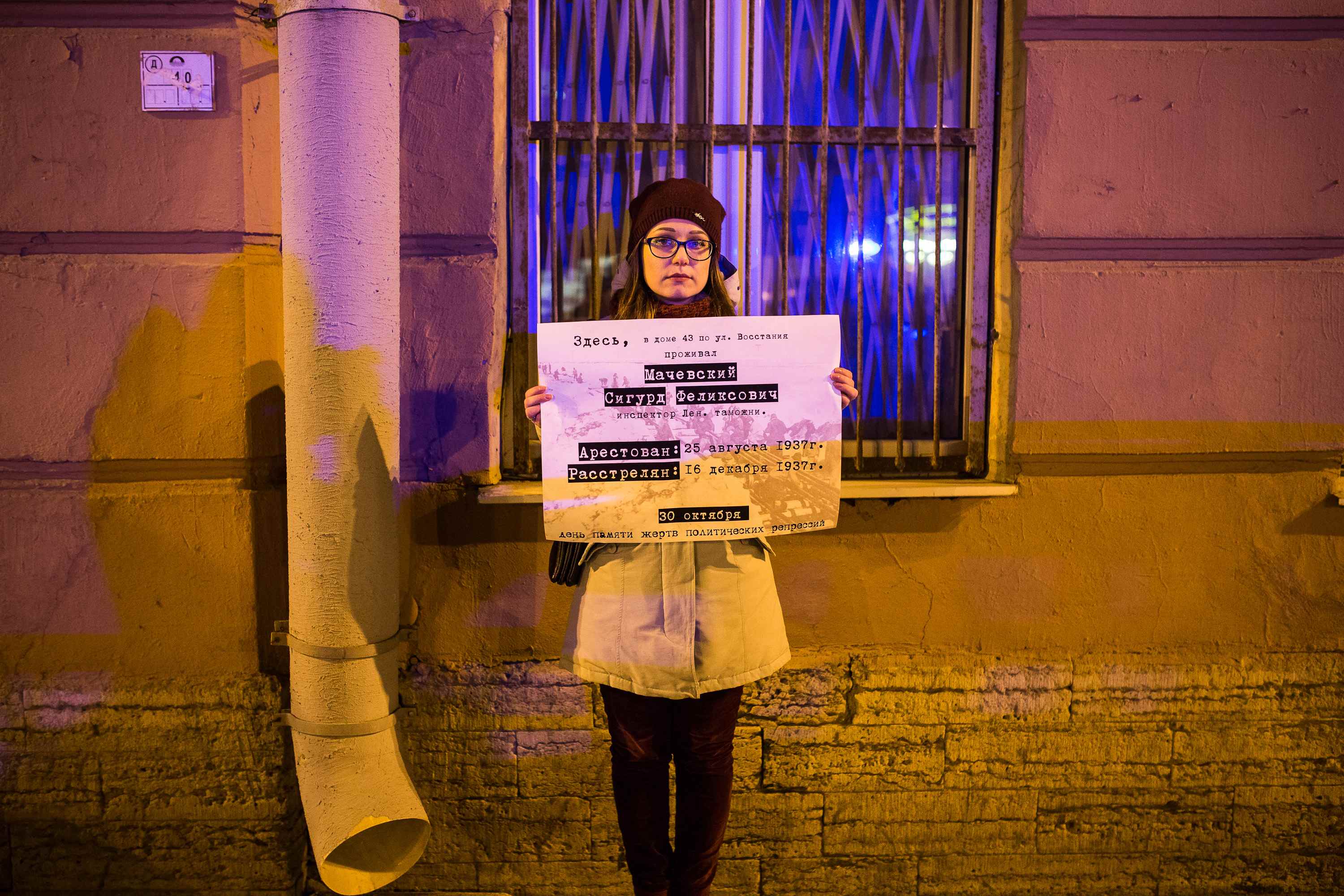
“Here, at Vosstaniya Street, 43, lived Sigurd Felixovich Machevsky, an inspector at the Leningrad Customs Service. Arrested August 25, 1937. Executed December 16, 1937.”
Despite the fact that the event had been heavily promoted, only thirty-some people took part, most of them Vesna activists and their friends.
Another disappointment was the fact that the posters contained the bare minimum of information about the Terror victims: their names, professions, and dates of birth and execution. There was only one line in small print at the bottom of each poster reminding passersby that October 30 was the Day of Remembrance of Victims of Political Repression.
A pack of torn-up posters found in a trash bin also raised eyebrows, triggering unpleasant associations with discarded “granddads on sticks” from certain Immortal Regiment events, which had provoked a storm of protest on Russia social networks.
“Here, at Vosstaniya Street, 2, lived Alexander Ivanovich Galanin, head of the special department at the Lepse Factory. Arrested August 4, 1938. Executed November 6, 1938.”
Most passersby who stopped to read the posters reacted positively. Some shared stories of their own families, while others nodded and said, “We support you.” One woman even handed out flowers to the activists.
As usual, other passersby sought to link the event with evil plots by the US State Department or the Ukrainian government, but there were few such people.
One standout among them, Andrey Yazov, posed as a journalist and attempted to “troll” the activists. He even subsequently posted a video on his page on the Russian social network VKontakte. In the video, entitled “Trolling Vesna,” he asks the activists whether the Terror victims had not, in fact, been criminals. He clearly loses his interest when he learns that Soviet authorities later exonerated all of them.
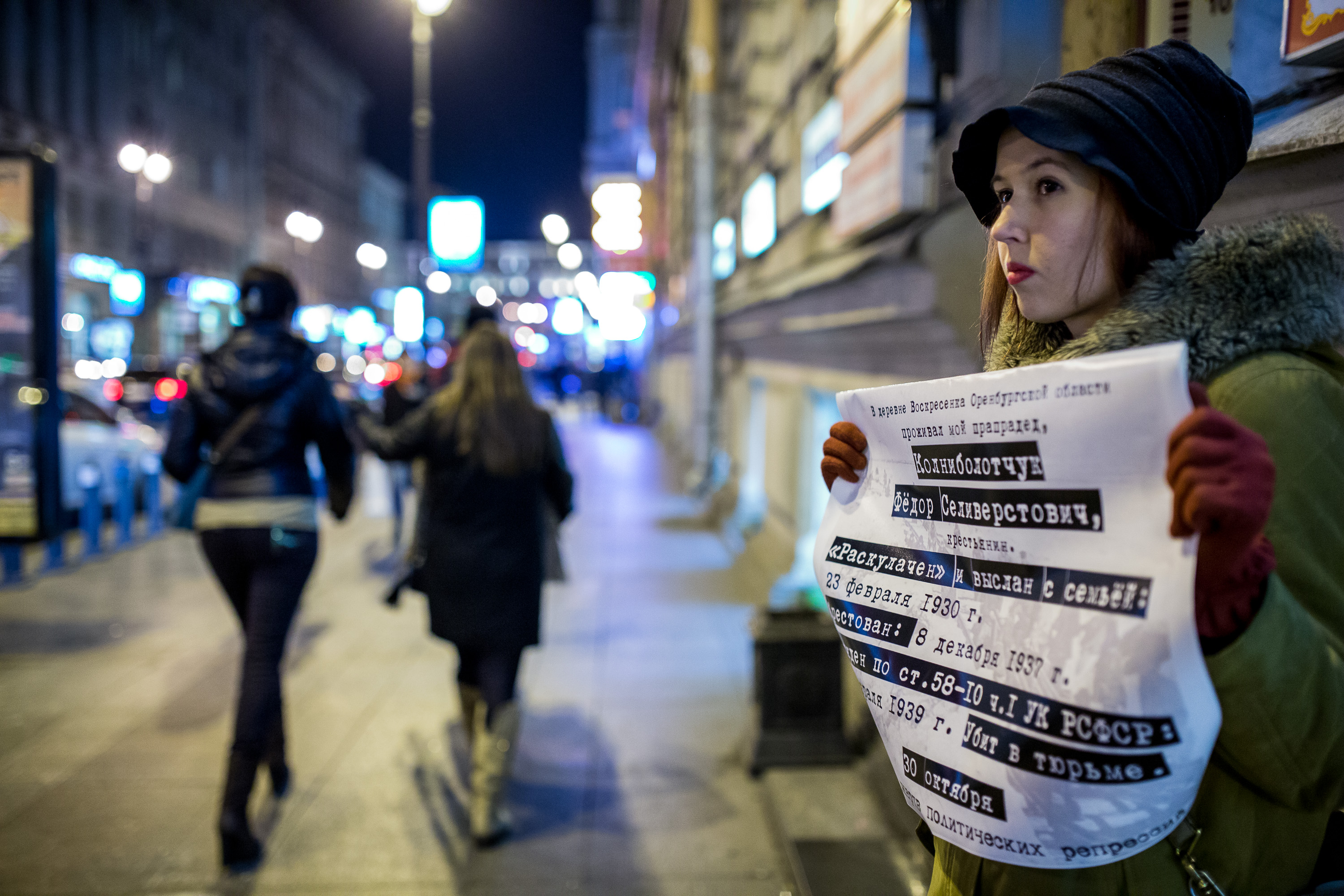
“My great-grandfather, Fyodor Seliverstovich Kolnibolotchuk, a peasant, lived in the village of Voskresenka, Orenburg Region. He was ‘dekulakized’ and exiled along with his family on February 23, 1930. Arrested December 8, 1937. Convicted under Article 58-10.1 of the RSFSR Criminal Code [anti-Soviet and counter-revolutionary propaganda and agitation] on February 10, 1939. Killed in prison.”
He does, however, reveal the sensitive fact that not all of the activists studied the biographies of the people whose posters they held. On the other hand, two participants held posters bearing the names of their own relatives.
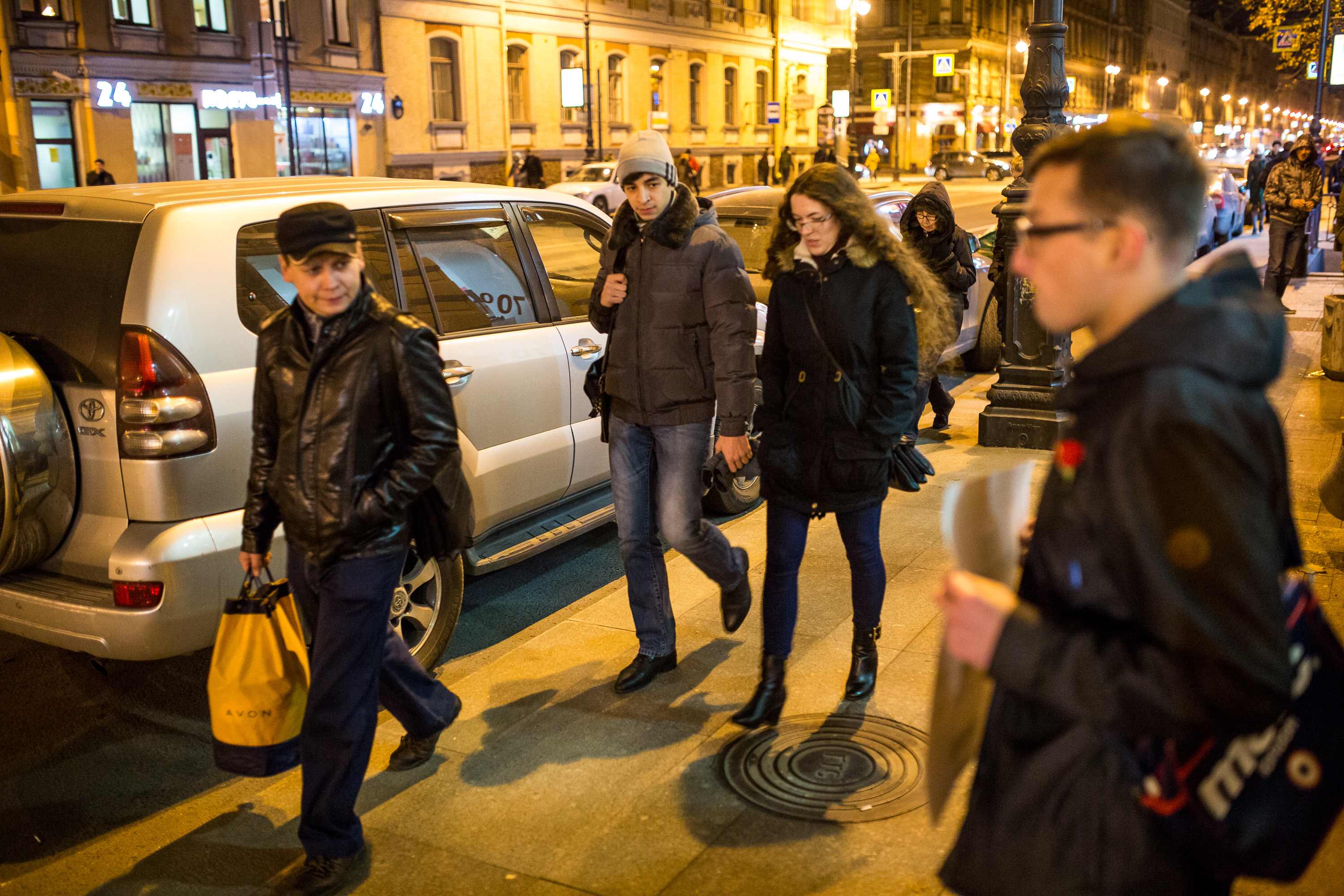
As during other such memorial events, most passersby sped past the activists without visibly paying any attention to them.
The police did not interfere. They merely asked the activists, “Why don’t you stay at home?”
Summer of Friendship Campaign Continues in Petersburg David Frenkel
Special to The Russian Reader
June 29, 2015
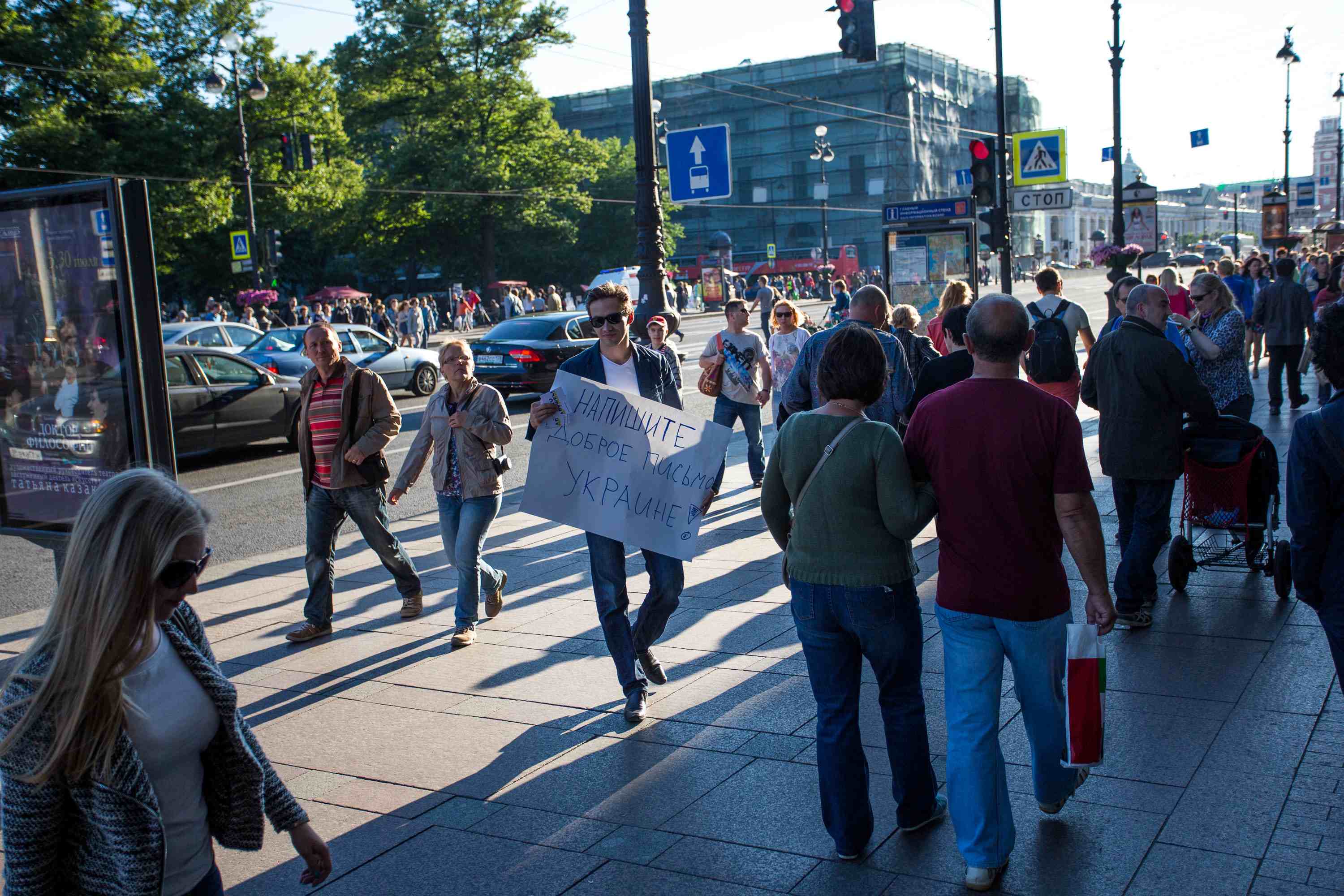
The Vesna (“Spring”) Movement has continued its Summer of Friendship campaign for peace between Russia and Ukraine.
Summer of Friendship postcard
Yesterday, Sunday, June 28, Vesna activists handed out blank postcards on the corner of Nevsky Prospect and Malaya Sadovaya Street asking people to write kind messages to Ukrainians.
The organizers claimed that members of the public dropped over two hundred “freedom postcards” into a special mailbox during the event. Our correspondent estimated that the number of postcards submitted was closer to one hundred.
“Russian Post”
“All the letters will be sent shortly to the addressees. Our colleagues in Kyiv and other cities will help us deliver them. We want to remind both Russians and Ukrainians that we are a fraternal people and must remain this way. We have many things in common: history, culture, family connections—everything but politicians. And we must overcome hatred together!” Vesna’s press secretary Anton Gorbatsevich explained in a letter to our correspondent.
Similar actions took place in Krasnodar and Tomsk, and another such event has been planned for Voronezh in a few days.
Near the graves of the victims of revolutions and civil war there has appeared a tombstone in memory of the victims of a new fratricidal war, a war between Russia and Ukraine.
Set up by the Vesna Movement, the new Tomb of the Unknown Soldier is meant to remind people of the hundreds and thousands of our compatriots who have been sent by Putin to the war with Ukraine. They are lied about. It is said they are on leave or that they resigned from the service, but more and and more evidence points to the fact that Russian soldiers have been fighting in the Donbas, and have been coming back wounded or in coffins.
Their graves are concealed, they are not talked about, and their relatives, in return for promises of compensation, lie and say the soldiers died during training exercises. The graves do exist, however. There is this one mock grave on the Field of Mars, and lots of real graves all over Russia.
We are protesting against Putin’s recent decree, making the military’s losses during “peacetime” a state secret. This hypocritical and cowardly decision is of a piece with the Russian regime’s policy of befuddling soldiers with propaganda, sending them off to war, and then lying that they had never existed. And instead of peacetime we have an undeclared war with a fraternal people.
Vladimir Putin has often been credited with the phrase, “We don’t abandon our own guys.” But we have recorded the correct version of the phrase on our memorial: “We don’t abandon our own guys, but those weren’t in fact our guys.” He easily sacrifices both his own and other people’s soldiers to achieve his political objectives.
Putin is a war criminal whose place is in the dock at the Hague Tribunal. That is certainly where he will end up, unless the fate of other dictators who fought with their own people does not catch up with him first.
“An unknown soldier who died in the Donbas during ‘peacetime.’” // “‘We don’t abandon our own guys, but those weren’t in fact our guys.’ V. Putin.” Photo by David Frenkel