Like other municipal district councils in Russia’s major cities, Petersburg’s Vladimirsky Municipal District Council has a meeting space and offices, and enough money to publish a newspaper and fund very minor improvements in the neighborhood, but it has virtually no political power and survives only at the mercy of city hall and the city’s legislative assembly. Photo by the Russian Reader
How Things Are Going for the Municipal District Opposition New politicians searching for a new agenda Maria Eismont Vedomosti
November 23, 2017
Sergei Sokolov was the only opposition member in the previous sitting of Moscow’s Konkovo Municipal District Council.
“I could not beat pro-regime council members when things were put to a vote, but I still managed to discourage them from doing things the neighborhood did not need,” says Sokolov, recalling his preceding five-year term on the municipal district council.
In September 2017, a team of Konkovo activists, led by Sokolov, won neighborhood elections, taking eight of the fifteen seats on the municipal district council. Sokolov was named head of the district, since Konkovo’s charter stipulates a simple majority of votes by council members to elect a district head, unlike other municipal districts. In other neighborhoods where the opposition won majorities on councils, their candidates for district heads ran into problems, since they needed the backing of two thirds of council members to win the posts, but they came up short on votes.
For the first time in many years, independent candidates won majorities in several Moscow municipal districts. In several instances, they won overwhelming majorities, but the question of whether grassroots self-government is possible in Moscow remains open.
The fact that Moscow’s municipal council members have scanty means at their disposal and insufficient powers was well known before and during the campaign. Yet now the new democratic politicians, who have taken power at the lowest level of Russia’s political totem pole, must show themselves and their voters that this is, in fact, the beginning of big and important changes in Russia.
Opposition politician Ilya Yashin, now head of the Krasnoselsky Municipal District, has already gone public with the new council’s first legislative undertaking. They have suggested eliminating the current system of so-called golden parachutes for outgoing municipal district council members and municipal district heads.
Konkovo’s independent council members have gone further. Within ten days of taking office, Sokolov sent the Moscow City Duma a request for 19 million rubles [approx. 275,000 euros] in additional funds for Konkovo’s budget, paid for with an increase in the allocation of personal income tax revenues.
“There are no rational explanations for the inexplicably low, discriminatory amount of personal income tax revenues allocated to the Konkovo Municipal District’s budget,” Sokolov wrote.
Council members have proposed spending the money on neighborhood improvements, accessible legal aid for low-income people, and a Southwest Moscow History Museum.
Last week, Konkovo council members came out with a legislative initiative to amend the Moscow City Law “On the Budget’s Structure and the Budgetary Process in the City of Moscow,” proposing to set the amount of allocations to municipal district budgets from personal income tax revenues at five percent. (It is currently set at 0.96%.) Economist Vladimir Milov helped draft the bill.
“I had been thinking about this initiative for a long time, and our team was organized for this purpose,” says Sokolov.
There are traces of picture frames that once held photographs of the president and prime minister on the wall in Sokolov’s office. They have been replaced by a hand-drawn portrait of slain opposition leader Boris Nemtsov.
“I have no illusions about the bill. United Russia still has a majority in the Moscow City Duma,” says Sokolov. “I don’t yet know how we are going to lobby the bill, but we will be employing our usual methods: media outreach, rallies, and similar public things.”
It is difficult to imagine the circumstances in which Moscow city officials would meet the opposition municipal districts halfway, voluntarily giving up some of their money and authority. But it seems extremely important the reform of local self-government continues to be discussed and elaborated.
I wrote a report on this Sunday’s elections. Don’t be lazy and read it to the end. You’ll learn a lot of new things.
Who Elects the Head of Adygea: A Political Portrait of the Republic’s Parliament
As you know, on Sunday, September 10, the State Council of the Republic of Adygea (in Adyghe, the Khase) will elect a new head for the republic. There are three candidates, but the outcome is predetermined. Who would doubt it? Correct me if I’m mistaken, but in the history of modern Russia this was probably the first instance when the outgoing head of a Russian region brought his own kinsman to Moscow so that Putin could view the bride, i.e. his chosen successor. Nor, we must note, were he and his kinsman immediately shown the door. This was probably taken by the petitioners from Adygea as a favorable sign.
Everything kicked off when, in March of last year, as it was about to give up the ghost, the members of the Adgyean parliament’s fifth convocation nearly unanimously voted (fifty yeas, four nays) to abolish direct, popular elections of the republic’s head, adopting a special law and making the relevant amendments to the Adygean Constitution. Having denied Adygeans the right to vote directly for head of the region, the “people’s” elected representatives formally explained their decision as a means of making the electoral process less expensive. However, no one abolished another law, a law of everyday life: cheaper doesn’t mean better.
So elections to the sixth convocation of the Adygean Khase, in 2016, took place with the understanding that it would be the new parliament, not the people, that would be picking the republic’s new head. So, the requirements for sifting out the winners were tougher than usuaul. It was boom or bust, literally, all or nothing. The powers that be backstopped its chosen candidates to the hilt, and the elections took place in a stifling climate of lawlessness, generated by the acting executive branch and the local office of the United Russia party. Functionaries of the Rodina (Motherland) party did everything they could to force the Adygean Central Elections Commission to remove the opposition party’s entire regional list of candidates from the ballot, although the party had a good chance of taking several seats in parliament. The billboards, posters, and flyers of all candidates and parties except United Russia and LDPR were destroyed hours, if not minutes, after they were posted. The vote tallies at the polling stations were skewed, and the votes received by candidates and parties that are not part of the so-called parliamentary grouping (United Russia, CPRF, A Just Russia, and LDPR) were totally nullified. The latter parties divvied up their shares of the vote totals in keeping with quotas that had been agreed in advance in Moscow. So, the current Adygean Khase consists of 38 MPs from United Russia, four MPS each from the CPRF and LDPR, and two MPs from A Just Russia. Two more MPs have to be elected in by-elections on September 10. There is no doubt that one of the two will be a United Russia member. Thus, MPs from United Russia make up 80% of the republic’s parliament, while the CPRF and LDPR have 8% of MPs each, and A Just Russia has 4% of MPs. Now let’s compare these proportion with the spread of MP mandates in the Russian State Duma. United Russia’s MPs occupy 76% of the seats; the CPRF, 9.5%; the LDPR, 8.7%; and A Just Russia, 5.8%. The Duma also has two MPs who are not members of these parties. One of them is a member of the Rodina party, the party that was successfully sent packing in Adygea. The outcomes are quite similiar, don’t you think? It’s as if the same templates had been used.
The lineup of MPs running in the 2017 elections has been thoroughly purged. Anyone who provoked the slightest doubts has been removed from the lists. Only five people who have been MPs for more than three convocations are left, and only nine MPS from the last three convocations are still in the running. Two of them are from the CPRF’s faction (Adam Bogus and Yevgeny Salov), while the rest are from United Russia. The other thirty-four MPs (out of a total of forty-eight) were elected during Aslan Tkhakushinov’s last two terms as head of the republic [he resigned in January 2017, after ten years in office], under the watchful eye of his team. In fact, they are part of his team.
Clearly, they express not the will of the people, but the will of their true masters, the men who got them elected. Thus, the clearly unelectable United Russian candidates Sergei Belokrys (District No. 16) and Rustam Kalashov (District No. 21) got the cherished mandates. During their party’s so-called primaries [the English word is used in Russian], they both took an honorable third place in their districts with 7% and 27% of the vote, respectively. Even more unelectable pawns were kinged after winning spots on United Russia’s party list.
They hardly all have the right to be called people’s representatives, if only because not all the MPs in the Khase’s sixth convocation were elected by the people on the new single voting day. Thus, seven of the winning candidates from United Russia list soon resigned for different reasons, and their mandates were automatically handed over to five new MPs from the party list (Yuri Gorokhov, Yevgenia Dyachkova, Zurab Zekhov, Azamat Mamkhegov, and Murat Shkhalakov). Two more MPs will be selected on September in single-mandate constituencies. LDPR’s list of of winners included party leader Vladimir Zhirinovsky and the party’s regional leader Denis Ogiyenko, neither of whom took their seats in the Adygean parliament. Why Zhirinovsky did this is clear enough, but Ogiyenko works as an aide to an MP in the State Duma, where everything is grown-up and they feed you caviar sandwiches. The two LDPR leaders were replaced as Khase MPs by Valentina Chugunova and Tembot Shovgenov, thus technically bypassing the will of voters.
It is interesting to compare how much the majoritarian MP mandates in the republic’s urban districts and rural districts are worth in terms of votes cast by voters. Thus, Maykop, the capital city, is divided into nine electoral districts, inhabited by a total of 132,890 voters. One majoritarian mandate is thus worth, on average, 14,776 potential votes. The Maykop Municipal District [not to be confused with Maykop per se] has three electoral districts and 46,111 voters, so an MP’s mandate is worth slightly more there: 15,370 votes. The Teuchezh District has only one majoritarian mandate, worth 13,549 votes. The Takhtamukay District is home to 51,840 votes, and so its four majoritarian mandates are worth an average of 12,960 votes. In the Giaginskaya District, the mandates are worth a bit less (12,563 votes on average), while in the neighboring Shovgenovsky District, it is worth 12,482 votes. Adygeysk’s single majoritarian mandate is worth 12,029 votes, while the Koshekhabl District’s two mandates are worth 11,407 votes apiece. The Krasnogvardeyskoye District has the “cheapest” mandates: two at 11,013 votes apiece. But strangers do not roam the homeland of the sweet couple of Aslan Tkhakushinov and Murat Kumpilov [Adygea’s acting head and Tkhakushinov’s chosen successor]. They elect only their own people and only on the advice of their superiors.
It was not entirely accurate to distribute MP mandates generally (whether from majoritarian single-mandate constituencies or party lists) in terms of the number of voters in the districts. The largest number of voters lives in Maykop (39% of all voters in Adygea), and its goes down from there. The Takhtamukay District has 15% of voters; the Maykop District, 13.6%; the Giaginskaya District, 7.4%; the Koshekhabl District, 7%; the Krasnogvardeyskoye District, 6.5%; the Teuchezh District, 4%; the Shovgenovsky District, 3.7%, and the town of Adygeysk, 3.5%. Meanwhile, the MPs from Maykop have only 30% of the mandates in the Khase; Takhtamukay District, 20%; Maykop District, 14%; Giaginskaya District, 6%; Koshekhabl District, 10%; Krasnogvardeyskoye District, 8%; Teuchezh District, 6%; Shovgenovsky District, 4%; and the town of Adygeysk, 2%. The imbalance is obvious.
The sixth convocation of the Adygean Khase has only eight MPs (16.7% of the total number) employed in the state sector. Six MPs (12.5%) are party officials. The remaining MPs (over 70%) run businesses in different sectors of the economy. The largest number of them (21 MPs out of a total of 48) earn their money in construction, commerce (including wholesale commerce), and services. Four MPs (8.3%) get their income from agriculture. Three MPs (6.3%) work in banking and investing, while two MPs each (4.2% each) are involved, respectively, in the hotel and tourism business, logging and extractive industries, and industrial manufacturing. Yet the CRPF and A Just Russia factions are dominated by party officials (four out of six), while members of United Russia have a clear advantage in all other lines of work.
The sixth convocation of the Khase includes two high-profile businessmen with criminal pasts (according to the media): United Russia member Gissa Baste (aka Voloskevich) and non-partisan MP Adam Bogus (aka Mazai), who blocks with the CRPF faction. Several well-known businessmen from United Russia have close ties with different dubious firms and people with criminal pasts. In particular, nine deputies (six from United Russia, two from the LDPR, and one from the CPRF) are involved in the construction business in the Takhtamukay District, run by Azmet Skhalyakho aka the Foreman. According to the media, he earned the nickname not on the fields of his native Takhtumukay District, but by shaking down market traders in Krasnodar during the “wild” 1990s. The notorious prosecutor Murat Tkhakushinov, son of ex-republic head Aslan Tkhakushinov, worked in the same district until recently. The Takhtamukay District’s proximity to Krasnodar, the much lower prices for land in the district than in Krasnodar, and the total control over the black market for land plots by criminal gangs, who have fused with Adygea’s government agencies, have made the construction business in the district quite profitable. Especially if you are not bothered by the legality of particular transactions, do not waste money on pollution treatment facilities, and pay no mind to the quite costly environnmental requirements.
Questions also arise when you take a closer look at the life and times of Vladimir Narozhny, head of the United Russia faction and chair of the republic’s parliament. There are strange blanks in his CV from 1981 to 1991, which for some reason he does not particularly advertise. Judging by occasional references, he ran various agricultural businesses during this period. Currently, he is associated with a number of firms, also involved in agrobusiness, in Adygea and Krasnodar Territory. They have different names and legal addresses, and yet they have the very same Primary State Registration Number and Taxpayer Identification Number. Obsessive thoughts of criminal money laundering schemes come to mind, but I have probably read too many detective novels.
As a final touch to my sketch of the current Adygean Khase, I want to focus on yet another imbalance, which testifies to a deeply embedded problem, if not a chronic disease, that affects the regional authorities in Adygea. I have in mind the distortions in personnel policy that favor the so-called titular ethnic group, the Adyghe. This phenomenon, which I would dub the Adyghization of power in the republic, was especially rampant during Aslan Tkhakushinov’s second term and has kept evolving in the present. I would not argue it has anything to do with ethnic conflicts between two great peoples, the Russians and the Adyghe, but has been caused only by attempts by specific members of the so-called Ulyap clan, who have ruled the republic for the last ten years, to ensure they will stay in power for the indefinite future. This is done both by depriving the Adygean populace of the right to elect the republic’s leaders and local government officials in direct elections, and through a deliberate personnel policy of giving preference to members of the titular ethnic group when filling vacancies in state and municipal agencies—if possible, to members of one’s own clan and numerous kinsmen. This cup has also touched the republic’s legislative branch. Whereas the republic’s population consists of approximately 63% Slavs, 25% Adyghe, 3.5% Armenians, and 8.5% other ethnic groups, the Khase is dominated by members of the titular ethnic group, who hold 28 seats (or 58.33%), while the Slavs are represented by 19 MPs (or 39.58% of seats). There is also one Armenian MP in the parliament, and no one else. I do not insist on introducing ethnic quotas. (God forbid, we have already been through such attempts at achieving parity.) I merely want to draw attention to this obviously non-random outcome as the inevitable side effect of dishonest elections.
Russian MP Oleg Shein in 2009. Photo courtesy of Wikipedia
MP: Astrakhan Region Headed for Deep Social Catastrophe Rosbalt
November 18, 2016
Astrakhan is among the regions undergoing a social catastrophe, argues MP Oleg Shein, who sits on the State Duma’s Committee for Labor, Social Policy, and Veterans Affairs. As the MP told our correspondent, both federal and regional authorities are to blame for the situation.
“Astrakhan Region is currently undergoing a fiscal disaster due to the fact the regional budget has collapsed. This year, it has been slashed by 15%, from 38 to 33 billion rubles. Next year, the regional authorities have proposed cutting the budget by another eight billion rubles. Accordingly, the budget will have shrunk by about 40% in two years. Already this year, financial aid to the poor has been completely eliminated, and subsidies for parents paying fees to kindergartens have been canceled, causing kindergarten fees to increase by one and half times. The upper grades have been eliminated in a number of schools. Schools have gone from eleven grades to nine grades, and this has caused overcrowded classes in the remaining schools. Payroll has been reduced by 7% for public sector employees: doctors, teachers, and cultural workers. Actually, 7% is the average figure; large numbers of people have had their salaries cut much more considerably. So the region really is headed downhill, and the regional government sees no ways of heading off the disaster,” said Shein.
[…]
“The regional authorities—and there is some truth to this—explain what is happening by referring to the loss of tax revenues from the oil industry. Several years ago, the State Duma—or rather, the United Russia party—freed Lukoil from paying taxes on its oil rigs in the Caspian Sea. This year as well, United Russia has voted to transfer the profits from oil production in the Caspian, the income tax revenue, from the regional budget to the federal budget. The regional authorities were really counting on the money, but they have ended up with nothing. But there is a second reason: their completely devil-may-care approach to drafting the regional budget and the loss of the local tax base. Sometimes, the regional government has literally abetted hostile takeovers of local companies, as, for example, happened to the local company Bassol, which supplies 60% of the salt to the Russian market and now pays taxes outside of Astrakhan Region. Paradoxically, the regional government welcomed this,” said Shein.
The MP said that despite its socio-economic difficulties, Astrakhan Region was also marked by high levels of corruption and the waste of money on mega projects like a musical theater and so on.
According to a rating compiled by the sociology department at the Russian Federation Government Financial University, Astrakhan was among the Russian cities with populations of 500,000 or more where the lowest indices for quality of life had been recorded. According to Astrakhanstat, during the period from January 2016 to August 2016, the real disposable income of Astrakhan Region residents was 89.4% of what it had been during the same period last year.
Translated by the Russian Reader. Thanks toValentin Urusovfor the heads-up
A Voter’s Strategy
Grigorii Golosov Polit.ru
September 6, 2016
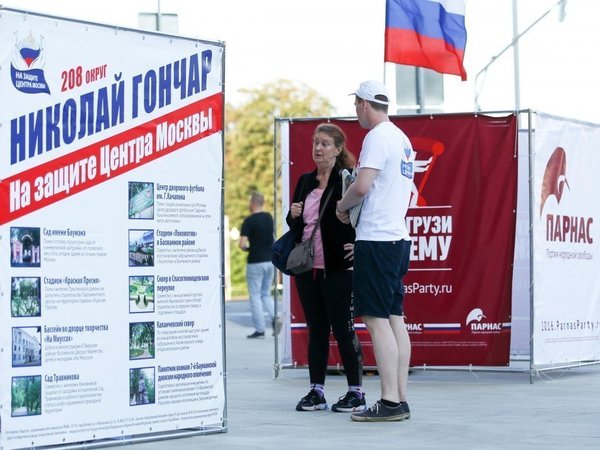
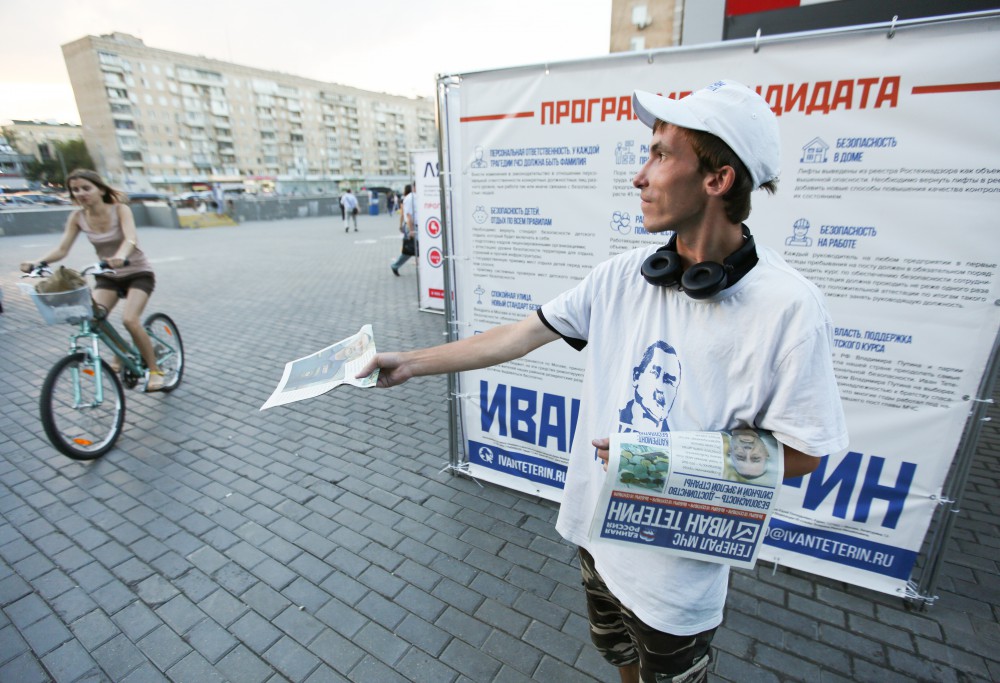
Campaigning on the streets of Moscow, August 23, 2016. Photo courtesy of Kirill Zykov and Moscow City News Agency
Compared with previous elections to the Duma, the parliamentary elections scheduled in Russia for September 18, 2016, have a number of peculiarities. And it is not only because the elections will be held under a mixed system, proportional and majoritarian simultaneously. The 2016 election campaign is different from all previous campaigns.
Grigorii Golosov, a political scientist and professor at the European University in St. Petersburg, talked to Polit.ru about the unusual aspects of the current election campaign, its likely outcome, and alternative scenarios and strategies that the politically active segment of society should keep in mind.
It is obvious what is unusual about these elections: they are taking place in September rather than December. They were not scheduled for September accidentally, of course, but to things easier for United Russia.
The election campaign has gone completely unnoticed. In addition, it is quite short compared with the campaigns we have had earlier. It is completely obvious [the regime] is counting on the fact that it will fail to catch voters’ attention at all.
Campaigning on the streets of Moscow, August 23, 2016. Photo courtesy of Kirill Zykov/Moscow City News Agency
This means people are basically expected not to have political motivations to vote in these elections. What motivations could they have if they simply know nothing about the elections or who is running in them? This, in turn, means the people organizing the election campaign are counting on the fact that the bulk of voters will be people who are obliged to vote for one reason or other, or have a material stake in voting.
We essentially know what segments of the populace these are: employees of state-funded organizations; pensioners; and employees of certain major enterprises where management may be able to influence how they vote. Since their reasons for going to vote are so unpolitical, they will vote as they are told to vote, meaning for United Russia.
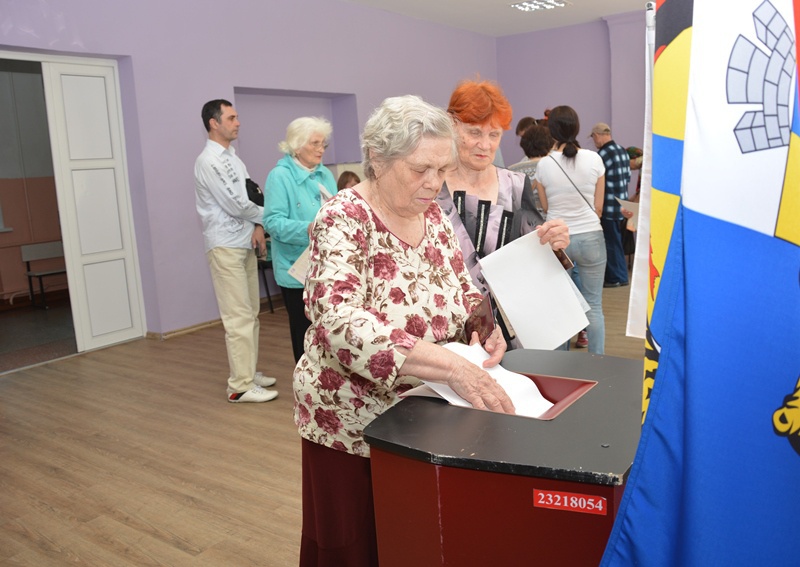
Voting during United Russia’s primaries in Khabarovsk, May 22, 2016. Photo courtesy of United Russia
Given such a scenario, it follows that United Russia will receive a substantial majority. I think this year they won’t go after the really big numbers that you can achieve only by falsifying the turnout. Probably, however, the optimal scenario for the authorities would involve United Russia’s getting fifty to fifty-five percent of the proportional vote according to party lists.
In addition, it is already clear, given the fact that the electoral districts are mainly controlled by the regional authorities, that United Russia will also get an overwhelming majority of the seats in the [single-mandate] districts. Thus, in tandem with their numbers in the proportional voting part of the ballot, United Russia will again be able to control the Duma completely and reliably support the legislation drafted by the presidential administration and the government.
The alternative scenario would consist in more people coming out to vote, and some of them coming out for political reasons.
Frankly speaking, even those people who support Vladimir Putin have no particular political motivation to vote for United Russia, because Dmitry Medvedev is heading the party in these elections. He bears no responsibility for foreign policy, whose successes have been trumpeted constantly. Both Medvedev and United Russia are linked in voters’ eyes with domestic policy and, thus, with the economic situation in Russia. A considerable part of Russian society now senses that it is getting worse.
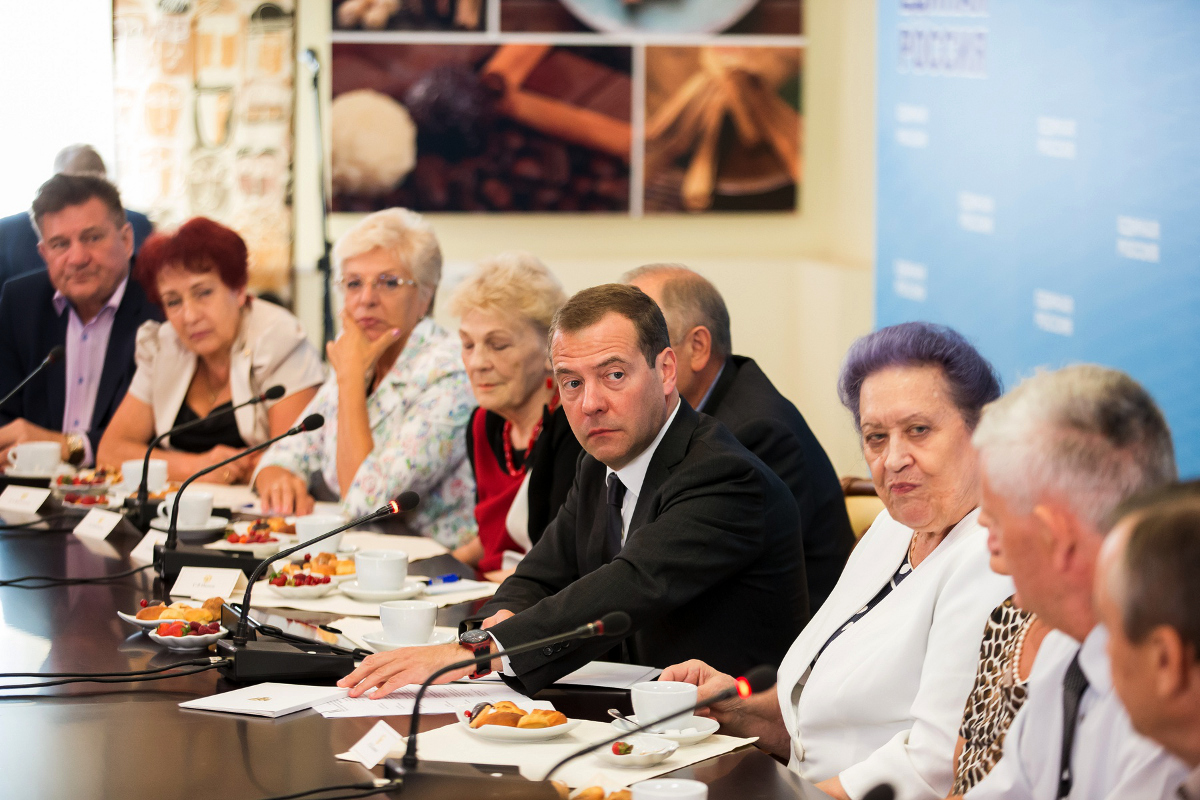
Dmitry Medvedev meeting with pensioners in Lipetsk on August 30, 2016. Photo courtesy of United Russia
However, many parties involved in these elections exhibit no less loyalty to Putin and his foreign policies than United Russia does, and under these circumstances, politically motivated voters have no particular incentive to vote for the ruling party.
We should also not forget that support even for Putin’s foreign policy is not universal in Russia, and pollsters have always recorded a fairly considerable group of people who do not support this policy in any way and oppose Putin. Strategically, the current election campaign is meant to discourage this segment of Russian voters from going out to vote at all. They have been sent a variety of signals to the effect that voting is pointless, the elections are pointless, and they had better stay home.
Will it work? It is quite likely that it will, and so I find United Russia’s optimistic scenario more plausible. However, there will undoubtedly be a certain number of politically motivated voters turning out for the elections. How many votes the United Russia list will garner in proportional voting will depend on this number.
Regardless of the published opinion poll results, the spread could be quite wide. I would suggest somewhere between forty percent (in the event that the turnout of political motivated voters is quite high) and fifty-five percent. But this will have no significant impact on the makeup of the State Duma, because in any case it will be controlled through the single-mandate MPs. Besides, many parties who might get votes from politically motivated voters are not likely to clear the five-percent barrier for entering the Duma.
However, precisely because the outcome of these elections are politically unimportant in terms of controlling the State Duma, they could be politically important as a demonstration of Russian society’s attitude toward the authorities in general, meaning the attitude of its politically engaged segment. In this sense, I would argue opposition-minded voters should understand they can reduce United Russia’s vote total, thus showing it does not enjoy unanimous support, or they can increase it by not coming out to vote.
What should they do if they do come out to vote? If they do not dislike it intensely, they can vote for the party that has adopted a directly oppositional stance, i.e., for PARNAS. Or they can vote for a party that, while generally deferent to the authorities, exercises this deference in a particular way, i.e., for Yabloko.
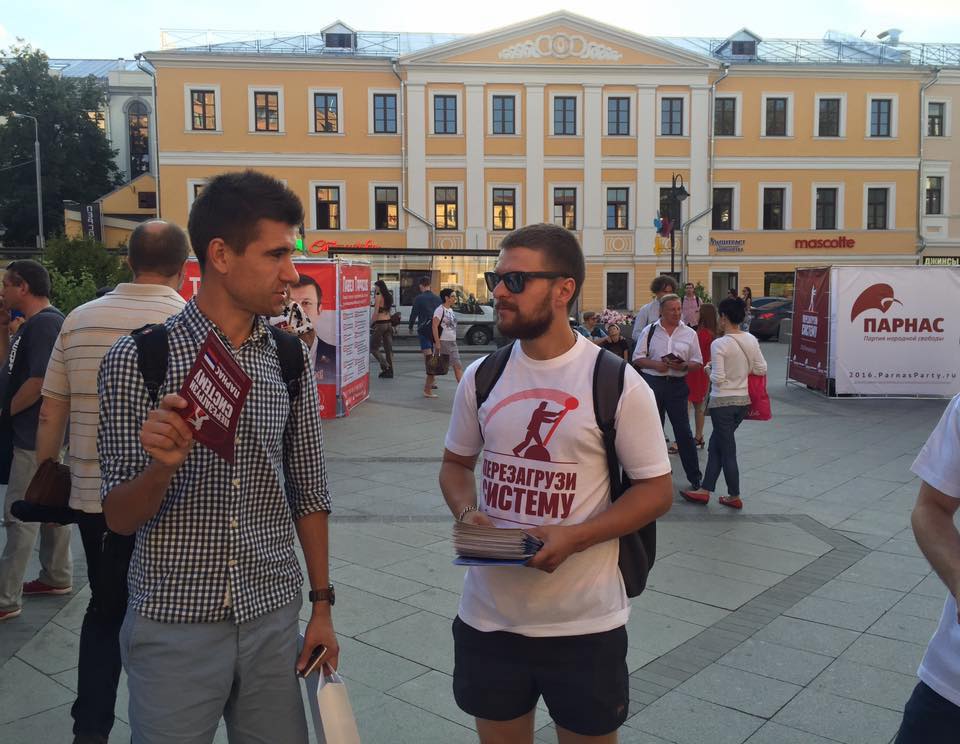
PARNAS on the campaign trail. Photo courtesy of Alla Naumcheva and PARNAS
Taking into account what I have said about small parties not clearing the five-percent barrier, voters can, nevertheless, vote for the small parties. If, for whatever reason, they definitely do not feel like voting for either PARNAS or Yabloko, they can vote for other small parties, even if they do not particularly like them.
It would probably be pointless to vote for parties who have no chance of garnering votes, but there is a limited number of minor parties that have some chances. I would identify the Communists of Russia, the Pensioners Party, the Party of Growth, and, possibly, Motherland. I have mentioned Motherland partly because there is nationalist feeling within society, and party because they ended up in the first slot on the voting ballot. During the free elections that took place in Russia in the 1990s, first place in the voting ballot always gave the party listed there a palpable bonus of about one percent of the vote.
Communists of Russia campaigner handing out the party’s pamphlets. Kirov Region, September 6, 2016. Photo courtesy of comros.info
It is not a matter of whether these parties are decent or not. During these elections, if they espouse genuinely oppositional views, the strategy of politically motivated voters should be based not on facilitating a particular candidate’s victory or impacting the breakdown of mandates. (From this point of view, it does not matter who gets into the Duma.) Their strategy should be based only on showing the policies now pursued by the Russian authorities do not enjoy unanimous support. And this can be achieved by doing what I have talked about.
Despair as a Sign of the Times The general mood of discouragement has been growing because Russia has shifted into idle, and it is unclear when and how it will end
Nikolay Mironov Moskovsky Komsomolets
September 6, 2016
Pain and despair have seized the country. Russians are losing their jobs. They cannot pay back their debts and feed their children. Due to constant problems and the lack of apparent prospects, families are falling apart. Some make desperate decisions, finally putting an end to their lives. Russia is losing people.
In July, an employee at a sports school in Trans-Baikal Territory committed suicide after he was not paid. In early August, a married couple in Blagoveshchensk, who were up to their eyeballs in debt,. jumped from a fourteenth-floor window, leaving their young child orphaned. This spring, a father of five in Kiselyovsk in Kemerovo Region hung himself because of debts. Large numbers of similar reports have been coming from different parts of the country.
Can you live on a wage of 10,000 to 15,000 rubles a month when prices are rising continuously? [15,000 rubles is currently equivalent to approximately 200 euros. — TRR.] Or on a pension of 8,000 rubles a month? How do you raise children on this kind of money? And what if, God forbid, you have emergency expenses, for example, for expensive medical treatment, whose cost exceeds the family budget many times over? Well yes, Russia has free medical care, so to speak, but we all knew what it is really like.
It has terrible consequences. The wave of cancer patients voluntarily departing from life continues. After a series of well-publicized cases in 2014–2015, the situation has not improved this year. In mid August, a man suffering from the cancer in the Moscow Region committed suicide with explosives. In June, another cancer patient committed suicide in Yaroslavl. Despite numerous similar suicides, the Russian Health Ministry continues to claim there is no link between the suicides of cancer patients and a deficit of pain medication. Just as there is no link, of course, between the despair felt by cancer patients in our country and the state of Russian medical care, which generally gives little chance to defeat the disease to those who have no money.
According to Rosstat, 24,000 to 26,000 people take their lives each year in Russia. But the causes of this and the means of remedying the situation are not discussed seriously. Instead, Rospotrebnadzor (Russian Federal Service for Supervision of Consumer Rights Protection and Human Welfare) have drafted recommendations for reporters on how to cover suicides.
Fewer and fewer people in our country know what they are going to live on tomorrow, how they will pay for rent and medical care. Russia is plunging into poverty. People have lost their sense of stability and security. The government, on the other hand, ignores these problems. It clearly has no strategy or even tactics for solving them.
There are a gazillion “public servants” in Russia, more than in the Soviet Union, but they serve only themselves and their bosses. High-ranking officials and the business clans that have fused with them live in a secure and comfortable world, whereas the common people are forced to survive alone. The civil service has lost its effectiveness. It has turned into a caste of masters and lords from whom we cannot defend ourselves, because they are the power, while we are “cattle.”
Can fear of policemen really be a norm of a civilized life, of a civilized country? Yet lawlessness on the part of the police has remained. All the talk about combating it has been just that—talk. Here is a recent case. Igor Gubanov, a resident of Magnitogorsk, protested against police lawlessness by cutting off two of his fingers. He could find no other way of making himself heard. In January, Gubanov and his wife, who live in a communal flat, were taken to a police precinct where, according to Gubanov, policemen raped his wife. A criminal investigation was launched, but soon the police investigators closed it, accusing the victimized woman of making false charges.
Despair is felt not only by people who have decided to commit shocking acts. The overall mood of discouragement has been increasing due to the fact Russia has shifted into idle and got stuck in the doldrums, and it is unclear when and how it will end.
The national anthem and memories are all that remain of the once-great country: outer space, victories, and prestige. The country’s most recent major achievements happened fifty years ago. The “unbreakable union” has been replaced by “our great power Russia,” but what is next? Great and poor, great and impoverished. Do these notions go together? How long can we live like this?
The Russian welfare state exists only on paper. Such declarations, by the way, have also been inscribed in the constitutions of Latin American, African, and Asian countries. A Brazilian in his favela reads that he lives in an wonderful welfare state, and he is amazed. The same is true of our fellow Russians, with their miserable wages and pensions. True, unlike their brothers from the country “where many wild monkeys live,” they do not live in huts yet. But, as they say, the night is young.
The main problem nowadays is that the country lacks a locomotive capable of pulling it out of crisis. The regime is concerned only with self-preservation. Officialdom is corrupt, inefficient, and lacking any strategic benchmarks. The “elite” (which I put in quotations, because they really are not the best people in the country) have been thoroughly denationalized: they have no stake in developing Russia. Until a normal and non-corrupt state makes the “elite” serve the country, it will never move it forward. In this case, what is wanted is the bloody-mindedness of a Peter the Great, who once put an end to mestnichestvo and forced the boyars and gentry to serve the country, or the statesmanship of Alexander II, who abolished serfdom over the lamentations of the landlords.
Instead, pro-government spin doctors have been increasingly ratcheing up the propaganda machine, searching for enemies, and heavily sugarcoating reality. Jingoism has already bored everyone to death. The people directing the show do not believe in it themselves, and the audience has stopped believing in it as well, despite the sunny ideology foisted on them, because Russia is running in place, and no one is solving its problems. The propaganda spiel that enemies are to blame for everything is still functioning, but even it cannot serve as a perennial explanation for each new outburst of social turmoil and, especially, the government’s extremely poor performance. So fine, Obama is a bad guy, but what does that have to do with indexing pensions?
The only thing the regime can really boast about is reinforcing itself. But it is a regime presiding over a country losing its vitality. As a priority, the self-preservation of the “elite” deprives Russia of the chance to put itself back in motion. Yet the purged political arena, in which there is almost no opposition to speak of, much less plain old independent people who think about their country, has stopped generating leaders. There is only one leader left in the country, and he presides over a multilayered horde of bosses and oligarchs, embezzlers and dolts perched on their estates and thinking only of themselves.
Except for United Russia, a product of the same regime, Russia’s political parties have no weight nationwide. The same goes for grassroots organizations. The media have been muzzled. Those who try and shout louder than the rest face either a harsh crackdown or a trivial payoff. Many people have taken to making oppositional noises in the hope they will be paid to shut up. Imitating protest has become a business, just like imitating patriotism. Amid the mob of clowns and crooks, the reasonable speeches made by the few real patriots who are rooting not for themselves but for their country are drowned out by the overall senseless din.
By eliminating potential enemies, the regime has also destroyed the very possibility of an alternative emerging, of a reboot. The current policies are clearly ineffective, but what and who should replace them? Reasonable prescriptions, for example, for supporting the national non-oil economy and import substitution, restoring consumer demand through social assistance to an impoverished population, ending capital flight, going after offshore companies, and clamping down hard on corruption have been voiced. These ideas, however, have come from second- and third-rank players who can advise the authorities but cannot demand anything from them. So the regime has ignored them year after year, thus exacerbating the crisis.
I am not trying to whip up a frenzy. I would like to say something positive, but the situation is firmly deadlocked. It is clear what reforms are needed. It also clear how to implement them and where to begin: with the “elite,” the civil service, the budget, and the tax system. The only open question is who would be capable of doing all this. We have already talked about the government. Russia’s active middle class is small, and it is extremely demoralized. We are left with the rank-and-file population, who have suffered most from the crisis and seemingly have a stake in launching reforms. But for the time being only a few ordinary people have been willing to take responsibility, allowing the regime quickly to localize protests, as happened with the farmers.
In the current environment, self-organization, society teaming up with honest people in the civil service and law enforcement, could be effective. Those honest people are undoubtedly there, but not in leadership roles. The country needs a grassroots organization, a movement, a party that could unite people and impose its own rules on the authorities. Society has to make the first move itself, which will serve as a signal to the honest people inside the system. We have to get the ball rolling.
Responsibility for what will become of the Motherland and us tomorrow lies with each of us today. As Mahatma Gandhi said, “Be the change that you wish to see in the world.”
All we have to do is not be silent, not relinquish our right to speak and act to someone else, not to count on an unknown savior of the Fatherland showing up. If he has not saved the country already, why would he do it now? And, needless to say, do not be afraid. We have to overcome our isolation to put an end to the senseless suicides, severed fingers, and broken lives, to put an end finally to the shameless plunder of the people and the export of the loot abroad. Even the smallest action, as long as it is collective, carries more weight than the most desperate individual deed.
We can, of course, wait for the moment when the country finally goes to hell in a hand basket, as in Tsarist Russia or the late Soviet Union. But do we really have to go through turmoil and destruction every time we need a new impulse to development? Are victims so necessary to the process of recovery?
The country is at a standstill, and the dump truck of history is rushing toward it. There are two options. Either we start the engine and drive, or we wait to get run over and tossed onto the roadside.
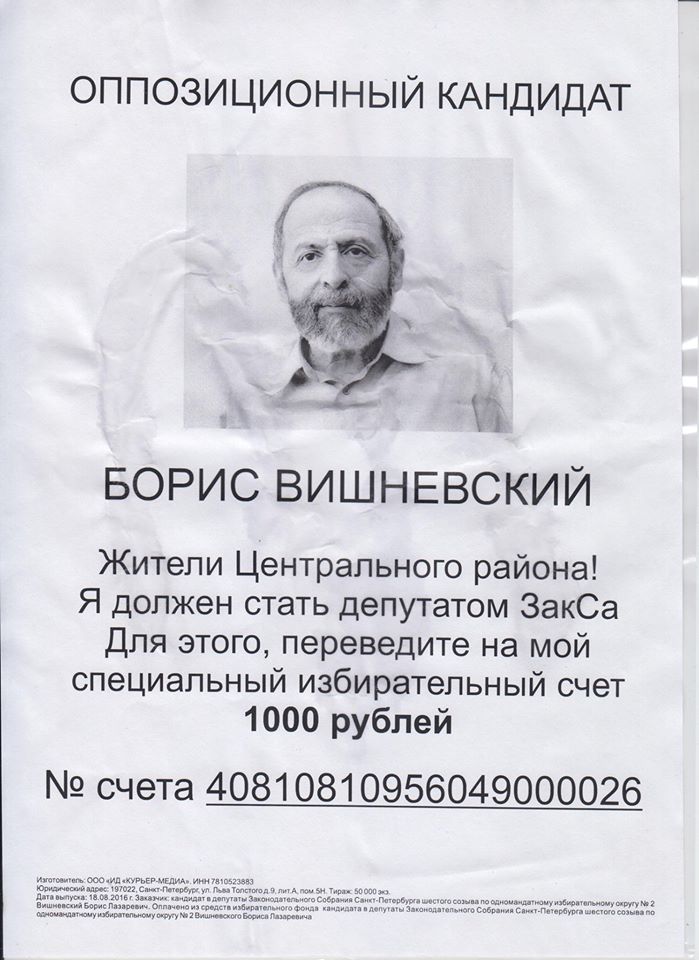
Elections to the State Duma and regional legislative assemblies throughout the country are scheduled for September 18, and the campaign, such that it is, is in full swing. Journalist and Yabloko Party member Boris Vishnevsky has behaved the way a real city councillor should during his first four years representing part of Petersburg’s giant Central District. So it is no wonder the ruling party, United Russia, has taken aim at him by running a loyalist like Maria Shcherbakova, longtime head of the Central District, against him in the city’s second single-mandate electoral district. And her campaign, it would seem, is pulling out all the dirty stops, confident it will never ever have to pay for its crimes. TRR
“Opposition candidate Boris Vishnevsky. Residents of the Central District! I must become a deputy in the [St. Petersburg] Legislative Assembly. To make this happen, transfer 1,000 rubles to my special election campaign account. Account no. 40810810956049000026.” The fine print in this counterfeit campaign poster creates the impression the poster was ordered by Vishnevsky himself and lists other fake details, such as the print run and the name of the print planting where the poster was, allegedly, printed, along with its address.
Friends and colleagues, especially those of you from the Central District:
The district has been pasted with fake ads, allegedly endorsed by me, suggesting that people transfer money to my election campaign account.
I think this is a reaction to my complaints against illegal campaigning on behalf of Maria Shcherbakova, United Russia’s candidate [for the seat in the Legislative Assembly currently held by Vishnevsky] and head of the Central District. Likely as not, the fake were posted early in the morning by employees of the housing and maintenance service. By the way, the number of the election campaign account is fake too, of course.
There is nothing surprising about this, friends. They don’t know how to campaign any other way and they won’t do it.
Complaints have been filed with the police, the prosecutor’s office, and the Municipal Electoral Commission.
First, don’t believe fakes.
Second, this is proof I have real support from people, and city hall is scared of me.
Third, when you see something like this, call my campaign headquarters immediately at +7 967 596 5021.
Maximum repost. People should be aware of dirty campaign tricks.
Translated by the Russian Reader
_________
But that is definitely not how low the regime can go. That was just a party trick, so to speak.
Meanwhile, some more productive Petersburgers have produced this nifty map of the city’s subway system. Unlike all other maps of the system, and there have been plenty since it went online in 1955, this one shows the depths, in meters, of all the stations in the subway.
The deepest, at 86 meters, is Admiralteiskaya, a relatively new station, opened in 2011, and located near Palace Square and the Hermitage, as well as, naturally, the Admiralty.
What do Petersburgers do as they ascend and descend the long escalators that take them down into and up out of the underground, rides that can take over five minutes in the most profound cases? Well, they do lots of things, including reading, chatting, meditating, listening to music, etc. One thing they are not doing a lot of, I am afraid, is thinking about the upcoming elections. But that is no accident, just as it was no accident all those fake Vishnevsky campaign posters were plastered all over downtown. TRR
Source: VKontakte; thanks to Comrade DE and others for the heads-up
Whipping Bear: Why the President Needs a “Bad” Prime Minister
Nikolay Mironov Moskovsky Komsomolets
June 1, 2016
Remember the Soviet joke about the plumber who comes to an apartment to fix a leaky radiator?
“The entire system is rotten here: the entire system has to be changed!” he concludes.
The joke is as topical now as it was then, because the system, it seems, has hit rock bottom. But the nation is clearly of two minds. It is seemingly aware of what has been happening in the country, but at the same time it maintains its loyalty to the regime that has brought us to this pass.
On the one hand, we see a president with a huge rating. On the other hand, we see a rapidly failing economy, a deteriorating social sphere, and, consequently, a high degree of public dissatisfaction with the regime. How can it be that as the foundation crumbles, the president manages to maintain his popularity?
The logic of this social attitude was, I think, nicely expressed by a cabbie who recently gave me a lift.
“Putin is going like gangbusters: the West, America, Syria, Donbas. And Medvedev is supposed to be taking care of the economy instead of fiddling with his iPhone.”
And right then and there he served me up a helping of bad news. He has been getting less work. Prices are rising. Who knows where the hell we are headed.
The taxi driver in fact reproduced the classic propaganda formula he hears every day on the TV. Aside from America, bad officials and liberals are the root of our troubles. The government is clearly underperforming, while the president is terribly busy with foreign policy and lifting Russia from its knees. He is the country’s sacred patron, its guardian angel, and the shortcomings of officials do not stick to him.
If you are thinking straight, cognitive dissonance must kick in, of course. The president has a huge number of powers. He appoints the government, and he could, if he felt like it, sack any minister, including the prime minister, without consulting with anyone. He has the power to kickstart any reforms via presidential decrees. And the Duma is at his beck and call, for United Russia holds the majority of seats there. Why does Putin not appoint a good team, dismiss corrupt officials, and announce a policy shift for the country? How will he lift the country from its knees if the economy tanks? If he is weak and incapable of doing it, why should we support him? If he just does not want to do it, that is another strike against him. But the nation, which has a weak grasp of political institutions and sees no credible alternative in sight, is willing to believe that “Putin has it rough,” that “he is fighting,” and that “they are getting in his way.”
The massive brainwashing on this point allows the regime to keep a tight lid on the system and change nothing fundamental about it, thus preserving the current inertial scenario, which is favorable to the elites. It is favorable to them because, were the government to decide to undertake economic reforms, the economic interests of the elites would inevitably take a hit, forcing them to surrender some of their comforts and excess profits.
However, while the costs of the crisis are primarily borne by the masses, somebody has to be made the fall guy, the virtual whipping boy. With the exception of defense minister Sergei Shoigu and foreign minister Sergei Lavrov, the cabinet has been appointed to this role along with abstract liberal circles, who, allegedly, have a behind-the-scenes influence on officials.
It is obvious that today the head of state cannot officially support the current course, which has resulted in rampant poverty among the population. Equating this policy with the president would be, if not tantamount to suicide, then certainly a powerful blow to his popularity. But Putin has no intention to change course for the reason given above: the interests of the elites. For this reason, on the eve of the election campaigns, the plan is to deliberately unhook the domestic agenda from the president and hang it on Medvedev and his government. Consequently, the prime minister will no longer be the number two man in Russia, but an expendable, a scapegoat.
Nikolay Mironov. Photo courtesy of the Center for Economic and Political Reform (Moscow)
Moreover, we should not identify Medvedev with United Russia. Their identities are not blurred in the propaganda, and this is no accident. All the negativity towards officials and the head of the government must not devolve on the party tasked with winning a majority in the Duma in September. United Russia members have thus even been criticizing government ministers, pretending that they and the executive branch are different animals, despite the fact they have the same leader (Medvedev) and a majority in parliament, allowing them to make any and all political appointments and legislative decisions.
This is a quite important part of the spectacle. Medvedev has to be a lightning rod for Putin, and yet United Russia, which Medvedev chairs, has to make it successfully through the campaign for the new seating of the Duma. Since this is the task at hand, the regime will do its utmost to control the volume of criticism leveled at the prime minister, including criticism voiced by opposition parties. As for attacks by forces close to the regime (e.g., the Russian People’s Front’s usual philippics against bureaucrats), they will most likely come down to a matter of tweaking the picture to help the president avoid the impact of potential criticism for the current situation. But the propagandists will avoid belittling the government excessively during the election period. “Local officials” will bear the brunt of the negativity. The government, moreover, will be given carte blanche to spend budgetary funds for populist purposes and to mitigate the crisis, including through a temporary increase in dividends paid out by large corporations. (The figures currently quoted range between 300 and 400 billion, which should be quite enough to get through the summer.)
Thus, during the Duma campaign, Medvedev will draw fire upon himself. So-called managed democracy, however, will ensure this fire will not turn into a conflagration and burn the regime and the elites. The president must remain unharmed, since his main play strategically is the 2018 presidential election, a key election for the elites.
The next act in the political spectacle will be Medvedev’s premiership after the Duma elections in September and in the run-up to 2018. Here, too, he will function as a whipping boy and political expendable, readying the way for the launch of Putin’s next presidential campaign.
After the election, the prime minister, having received formal carte blanche from the voters, can undertake unpopular measures. (Unless, of course, the oil price suddenly rises miraculously.) It is inevitable. Someone has to pay for the crisis, and, apparently, the elites are still not this someone. In any case, it is Medvedev who will have to make ends meet in the 2016 budget, with its whopping 14.7% deficit on the expenditures side, and then rob Peter to pay Paul when drafting the 2017 and 2018 budgets.
If the situation gets ugly, and the populace’s complaints attain a critical mass, Putin can dismiss Medvedev on the eve of the presidential election, appointing him to some cushy post. And he will again profit from the decision, because in the eyes of the electorate, the president will be seen as a virtual national savior. Having dampened tensions in society this way, he will be re-elected to another six-year term as president, winning an acceptable percentage of the vote. The opposition will again be confounded, and someone like Alexei Kudrin can become prime minister. This will nicely symbolize the compromise between “liberals” and “conservatives,” while also functioning as a nod to the west, whose cheap money we need desperately.
The alpha and omega of all this complicated maneuvering is preserving the system, and thus preserving the privileges and assets of the supreme elites, their lifestyle, and their ability to peaceably transfer their wealth to their children. They will be able to breathe a sigh of relief and once again enjoy the sunsets on the French Riviera and in Italy.
Only time and economic conditions will tell what comes next. If the country’s currency reserves run out, and the oil price does not increase, intrigues around choosing Putin’s successor will kick off. Or a new scapegoat will be found, and so on ad infinitum. Generally speaking, the current regime just does not plan that far ahead.
Only one question remains. What is in all of this for Medvedev himself? Does he enjoy being expendable? Here it is like the line from the classic Soviet comedy film The Pokrovsky Gate: “Life is lived not for pleasure’s sake, but for the sake of conscience.”
I think the answer that immediately comes to mind is also the most likely to be the right answer. Medvedev does his job and is loyal to his boss. He cannot imagine himself outside the system, much less as the creator of a new system.
Another joke comes to mind in this connection. President Medvedev wakes up in a sweat. His wife asks what the matter is.
“I dreamt I fired Putin,” Medvedev replies.
2011 clearly showed that staging a revolution or even serious reforms was beyond the prime minister’s scope. Medvedev’s political career consists of brief ascents followed by a series of humiliations. However, his job has numerous upsides, too. Is it so bad being prime minister of such a rich country as Russia for a whole six years?
Communists Propose Equating Feelings of War Veterans with Feelings of Religious Believers Grani.ru
May 8, 2016
A group of Communist Party MPs plans to submit a law bill to the State Duma that would criminalize insulting the feelings of war veterans and stipulate a punishment of up to three years of forced labor. As Gazeta.ruwrites, if the draft law is adopted, Article 148 of the Criminal Code (violating the right to freedom of conscience and religion) would be amended.
The newly amended article, 148.1, is entitled “Insulting the feelings of Great Patriotic War [Second World War] veterans.” The Communists will send the bill to the government and the Supreme Court for review on May 10, immediately after the holidays.
There are three paragraphs in the new law. The first paragraph stipulates punishment for “public actions expressing clear disrespect for society and committed with the intent of insulting the feelings of Great Patriotic War veterans by deliberately distorting information about the Great Patriot War, or humiliating or belittling the heroism of the Armed Forces of the USSR.”
Violation of the law would be punishable by a fine of up to 300,000 rubles, or up to 240 hours of community service, or up to one year of forced labor.
The second paragraph stipulates criminal liability for “dismantling, moving, destroying or damaging Great Patriotic War monuments,” even if they are not listed as Great Patriotic War cultural heritage sites. In this case, a violation would be punishable by a fine of up to one million rubles, or up to 360 hours of community service, or up to one year of forced labor.
The maximum penalties are prescribed in paragraph three and cover the same actions, as listed above, if they are performed on May 9, or involve the abuse of office, or are committed by someone who has already been convicted of the same violation. In this case, the offender faces a fine of up to four million rubles, or up to 480 hours of community service, or up to three years of forced labor, and a ban on holding certain positions during the period in question.
Communist Sergei Obukhov, who is spearheading the initiative, coauthored the law on “insulting the feelings of religious believers,” adopted by the Duma in 2013 in the wake of the Pussy Riot trial.
In the explanatory note to the new law, Obukhov defends the need to protect the feelings of war veterans, drawing parallels with the adoption of law on insulting the feelings of religious believers. According to him, that law “does not extend to the belief in goodness and justice, the ideals for which the veterans of the Great Patriotic War fought.”
According to Obukhov, he and his colleagues have tried to draft the most non-repressive law possible, so the punishments stipulated do not include imprisonment. Obukhov calls the bill a “full-fledged legal mechanism for defending their truth about that terrible war as well as criminal protection of their honor and dignity.”
In November 2013, A Just Russia MP Oleg Mikheyev proposed punishing those who insulted the memory of the Great Patriotic War with up to seven years in prison or a fine of one million rubles. Mikheyev submitted a draft of amendments to the Criminal Code and Criminal Procedural Code to the State Duma.
Mikheyev proposed adding an article entitled “Insulting the memory of the Great Patriotic War” to the Criminal Code. The offense was described as follows: “Actions expressing clear disrespect for society and insulting the memory of the events, participants, veterans, and victims of the Great Patriotic War, and committed at the sites of Great Patriotic War monuments and the burial grounds of those involved in the Great Patriotic War.”
The draft law stipulated a fine of between 500,000 and one million rubles or the amount of the convicted offender’s income for a period of three to four years, or a prison term of up to seven years. Mikheyev explained this choice by analogy with Criminal Code Article 148 (insulting the feeling of religious believers), “insofar as both articles deal with the spiritual realm of human life, the realm of values.” As an example of “insulting the memory” of the war, he cited the articles of journalist Alexander Podrabinek.
In April 2014, Irina Yarovaya, head of the Duma’s security and anti-corruption committee, proposed criminalizing “desecration of days of Russian military glory and memorable dates” connected with the Great Patriotic War. The United Russia MP said the relevant amendments would be inserted into a draft law on “rehabilitating Nazism” during its second reading.
“We will propose equating liability for this crime with the liability for desecrating burial sites dedicated to the fight against fascism [sic] or victims of Nazism,” said Yarovaya.
Individuals accused of “desecrating days of military glory” were to face up to three years in prison, forced labor of up to five years, arrest for a period of three to six months, or five years in a penal colony.
Yarovaya said she had found a post on a social network containing a negative assessment of the May 9 holiday.
“I think such statements should be assessed not just morally or ethically, but from the viewpoint of criminal law,” Yarovaya said in this connection. “Because it is a deliberate crime aimed at desecrating the memory of the Great Patriotic War.”
Translated by the Russian Reader. Photo, above, courtesy of Oleg Yakovlev/RBC
Nikolai Yaroshenko, Life Is Everywhere, 1888. Image courtesy of Wikipedia
The 2016 Elections: Putrefaction as the Laboratory of Life
Ilya Budraitskis OpenLeft
April 29, 2016
How do the upcoming Duma elections threaten the regime?
Today, it would seem that the upcoming September elections to the State Duma are a cause of growing concern only in the Kremlin. While polls continue to record a low level of public interest in the event, and the tiny number of parties allowed to run in the election wanly prepares to fulfill their usual roles, the president and his entourage are increasingly talking about possible threats.
The rationale of radicalization
At a recent meeting with activists of the Russian People’s Front, Putin noted that external enemies would preparing ever more provocations to coincide “with elections to the State Duma, and then with the presidential election. It’s a one hundred percent certainty, a safe bet, as they say.”
Regardless of their real value, the upcoming elections have been turning right before our eyes into a point of tension on which the state’s repressive apparatus has focused. Beginning with the establishment of the National Guard, the process has been mounting. Each security agency has now inaugurated its own advertising season, designed not only to remind the president and public of its existence but also to show off its unique capabilities, inaccessible to other competing agencies, for combating potential threats.
Prosecutor General Yuri Chaika has uncovered a plot by the Ukrainian nationalist group Right Sector, while in his programmatic article, Investigative Committee head Alexander Bastrykin essentially suggested canceling the elections since holding them could prove too dangerous. He made a direct appeal to stop “playing at pseudo-democracy” and provide a “tough, appropriate, and balanced response” to the country’s enemies “in light of the upcoming elections and the possible risks presented by the stepping up of efforts by destabilizing political forces.” With the appointment of Tatyana Moskalkova, even the previously neutral office of the human rights ombudsman has, apparently, been turned into yet another bastion of the fight against conspiracies.
This nervousness is certainly due to the fact that the growing economic and social crisis has had no visible political fallout for the time being. There have been no mass spontaneous revolts or sectoral strikes, although there has been an overall uptick in isolated labor disputes. The political realm has long ago been securely purged of any uncontrollable opposition, while the president’s personal rating has remained phenomenally high. Nothing, it would seem, portends serious grounds for political destabilization this autumn. The absence, however, of real threats itself has become a threat to the internal stability of the state apparatus.
Where does the threat lie? In recent times, it has become obvious that decision-making at all levels and whatever the occasion has been subjected to a rationale of radicalization. Its principle can be described roughly as follows: no new decision can be less radical than the previous decision. Bureaucratic loyalty is measured only by the level of severity. MPs must propose more sweeping laws against latent traitors. Law enforcement agencies must expose more and more conspiracies, while the courts must hand down rulings that are harsher than the harshest proposals made by the security officials and MPs. Permanently mounting radicalism enables officials to increase budgets, expand powers, and prove their reliability, while any manifestation of moderation or leniency can cost them their careers. This radicalization, whose causes are rooted in the political psychology of the Russian elite (which suffers from an almost animal fear of uncontrollability), has set off an extremely dangerous bureaucratic momentum. Its main problem is the inability to stop. It is not only unclear where the bottom is, but who is ultimately interested in reaching that bottom and leaving it at that.
All this generates a strange situation vis-à-vis the elections, which have generally functioned primarily as a political balancing mechanism for the Putinist system, and even now function in this way. Elections have always been a reminder—not to voters, but to the elite itself—that varying opinions within a clearly defined framework have not only been possible but have also been encouraged. This reminder has been important not out of faithfulness to an abstract principle, but as confirmation that political bodies (first of all, the presidential administration) have had the monopoly on deciding domestic policy, not a military or police junta.
Fixing the broken mechanism?
For the Kremlin, the upcoming elections are overshadowed by the political trauma of 2011, when the smoothly functioning system of managed democracy suffered a serious breakdown. The current chief political strategist Vyacheslav Volodin has more or less consistently focused on making sure the failure of five years ago is not repeated. Volodin’s mission is to fix the broken mechanism with political methods, not by force.
It is worth remembering that, for the greater part of the Putin era, parliamentary and presidential elections were parts of a single political cycle, in which the same scenario was played out. The triumphal success of the ruling United Russia party was supposed to precede and ensure the even more resounding success of Vladimir Putin. In December 2011, however, the cycle’s unity backfired against the Kremlin’s plans. The interval between elections enabled the protest movement to maintain its grassroots energy for several months.
The political rationale of Putin’s third term is now aimed not only at technically but also at conceptually disrupting this cycle. Amidst a sharp drop in confidence in the government, the Kremlin decided last summer to move parliamentary elections up from December 2017 to September 2016, and, on the contrary, postpone the presidential election from March 2017 to March 2018. The point of the maneuver is obvious. The presidential and parliamentary elections must now represent not two parts of the same script but two completely different scripts. In the first script, a limited number of parties, which make up the symphony of the Crimean consensus, will criticize the government and each other, thus competing for the sympathies of the dissatisfied populace. In the second script, the natural patriotic instinct of voters should leave no doubt as to the need to support Putin unconditionally.
The new ideological content was embodied by Volodin’s famous statement: “There is no Russia today if there is no Putin.” This personification virtually means that, as a symbolic father, Putin transcends everyday politics. You can be a liberal or a nationalist, a proponent of greater intervention in the economy or a fan of the free market. You can choose not to like the government or government officials. But the nexus Putin-Crimea-Russia is beyond any doubt. Those who fundamentally disagree with it are simply removed from the Russian political spectrum and branded “national traitors.”
In keeping with this rationale, responsibility for the sharp drop in living standards and the consequences of the neoliberal “anti-crisis” measures has been borne by ministers, MPs, and governors, by anyone except the president. Even now, when the propaganda effect of the “reunification” of Crimea has obviously begun to fade, the president’s personal rating remains high. Thus, according to the latest opinion polls, 81% of respondents trust Putin, while 41% do not trust Prime Minister Dmitry Medvedev, and 47% do not trust his government overall.
Within the new-model Crimean consensus, United Russia will no longer play the role of the backbone it played in the noughties. Untethered from the non-partisan figure of the president, it will take on the burden of unpopularity borne by its formal leader, Dmitry Medvedev, and his government. The mixed electoral system will enable candidates from local “parties of power” in single-member districts to dissociate themselves from United Russia, presenting themselves as “non-partisan Putinists” criticizing the soulless federal authorities. Volodin’s scheme involves loosening United Russia’s grip on power and slightly increasing the value of the pseudo-opposition as represented by the Communist Party and A Just Russia.
It is worth noting that the very existence of a bureaucratic mega-party previously played a stabilizing role by dampening intra-elite conflicts. Now they will inevitably come out into the open, including in the shape of inter-party struggles. Of course, the presidential administration counts on being able to effectively ensure compliance with the clear rules of this competition, but there are no guarantees. The managed multi-party system with the “father of the nation” towering over it consummates the new architecture of the Putin regime as a personalistic regime, and becomes more and more vulnerable.
In the new reality of the crisis, Putin’s depoliticization also facilitates a more intensive “natural selection” among bureaucrats at all levels by culling those who have not mastered the art of maintaining the conservative sympathies of the populace while simultaneously implementing what amount to aggressively anti-social policies. The September campaign is supposed to go off without a hitch, culminating in a predictable outcome. Having given a human face to the Central Elections Commission, which was seriously discredited by the previous leadership, Ella Pamfilova is meant to increase this manageability and predictability. It turns out that the upcoming elections are the primary pressure test of the new, post-Bolotnaya Square design of managed democracy. The future of Vyacheslav Volodin and his team, as well as Putin’s willingness to trust them with the extremely important 2018 presidential campaign, probably depends on how smoothly they come off.
From the foregoing it is clear that the objective of reestablishing the rules of managed democracy is directly at odds with the above-mentioned rationale of radicalization, whose standard-bearers are the competing law enforcement agencies. Their individual success in the internal struggle is vouchsafed by the failure of the political scenario, which would give rise to the need for a vigorous intervention by force. After all, the National Guard’s value would be incomparably increased if it put down real riots instead of sham riots, and Bastrykin’s loyalty would all the dearer if, instead of the endless absurdity of the Bolotnaya Square Case, he would uncover real extremists. To scare someone seriously, the ghosts have to take on flesh and blood.
Life is everywhere
Marx said that putrefaction is the laboratory of life. Now we see how Putinist capitalism has embarked on a process of gradual self-destruction. The upcoming elections provide a clear picture of how this has been facilitated by two opposing rationales, the political rationale (Volodin and the presidential administration) and the law enforcement rationale. Thus, the first rationale, in order to generate the necessary momentum and expand the range of opinions, must respond to social discontent by providing United Russia’s managed opponents with greater freedom to criticize. Restoring the internal political balance will inevitably lead to the fact that topics related to the crisis and the government’s anti-social policies will become the centerpiece of the entire election campaign. On the other hand, the security forces will destabilize the situation outside parliament. Together, they will do much more to undermine an already-flawed system than the long-term, deliberate efforts of any western intelligence agency.
Of course, Russian leftists should in no way count on events following an automatic course. But it is absolutely necessary to take into account the conflicts of interest within the elite and understand their decisive influence on the shape of the upcoming elections. These elections have nothing to do with the real struggle for power or traditional parliamentarianism in any shape or form. But they are directly related to the internal decomposition of an authoritarian, anti-labor, and anti-social regime. So our policy vis-à-vis these elections should be flexible and remote from all general conclusions. That means we can and should support certain leftist candidates in single-member districts. We must use all the opportunities provided by the leftist, socialist critique of the Medvedev government’s so-called anti-crisis policies. We must be ready to go to the polls. Or we must be ready to reject them, taking to the streets when the time comes.
Ilya Budraitskis is a writer, researcher, and editor at OpenLeft. Translated by the Russian Reader
Chief Rabbi Complains to Medvedev about Anti-Semitism in United Russia Party
Daniil Alexandrov Medialeaks.ru
April 15, 2016
Anti-Semite Vladislav Vikhorev speaking during United Russia primaries debates in Chelyabinsk on April 10, 2016
The Jewish community believes a speech made by United Russia member Vladislav Vikhorev during intra-party pre-primary debates has not been properly condemned. The candidate stated that ethnic Russians are being killed because they are standing “in the way of the Yids.”
According to Interfax, Russia’s Chief Rabbi Shalom Dovber Pinchas Lazar has appealed to Dmitry Medvedev, leader of the United Russia party and Russian prime minister. Rabbi Berel Lazar is outraged by the outburst by a party member taking part in the primaries in Chelyabinsk Region, Vladislav Vikhorev, who made an anti-Semitic speech. Even more than the speech itself, Lazar was dismayed by the lack of an adequate reaction to it.
“The Russian Jewish community is shocked by the anti-Semitic outburst by Vladislav Vikhorev, a participant in the United Russia primaries in Chelyabinsk Region who spoke of a ‘conspiracy of the Jews against the Russian people.’ But we are even more shocked by the fact that the primaries organizing committee limited itself to issuing a formal ‘warning’ to the anti-Semite and left him among the contenders for a place on the electoral list of the party you lead,” Rabbi Lazar wrote to the prime minister.
Vikhorev was speaking during primaries debates on Sunday, April 10. The gist of his speech was that Russia’s main problem and security threat were the Jews. A “Jewish coup” had occurred in Russian under President Boris Yeltsin, said Vikhorev, and since then the Jews had been systematically destroying ethnic Russian culture, the state, and the financial system.
“We Russians are being killed for standing in the way of the Yids,” said Vikhorev.
Vikhorev is still listed as a candidate on the primaries website. The Chelyabinskh regional branch of the party decided to leave him in the race, letting him off with a warning that ethnic slurs were unacceptable.
Members of the Jewish community believe that law enforcement, not party bodies, should assess Vikhorev’s statement. Yuri Kanner, president of the Russian Jewish Congress, told Lenta.ru that the prosecutor’s office and the courts should be involved in the case.
“It is not clear why the prosecutor’s office and the courts are not examining this, because this must be assessed by the state, not the party,” said Kanner.
Vikhorev was born in 1948 in the village of Rozhdestvenka in the Uvelsky District of Chelyabinsk Region. He graduated from High School No. 10 at Poletayevo Station on the First South Urals Railroad. Vikhorev is an old-age pensioner.
His speech has been posted on YouTube.
In January 2016, while meeting with members of the European Jewish Congress in Moscow, Vladimir Putin responded to a complaint that Jews in Europe did not always feel safe because of the influx of migrants by inviting them to return to Russia.
“In a crisis, we cannot do with you,” joked the president.
Yesterday, the first part of Russian Jews, a documentary trilogy by journalist and producer Leonid Parfyonov dealing with the history of the Jewish people in Russia from the eleventh century to the post-war Soviet Union, premiered in movie theaters.