
Actors Martin and Janet Sheen, John Cusack and Slovenian philosopher Slavoj Žižek have signed an open letter urging Russian prison officials to end the solitary confinement of jailed activist Mikhail Kriger, who has been on a dry hunger strike for more than a week.
They join Garbage frontwoman Shirley Manson, who earlier this week called on the local prison chief to end Kriger’s isolation.
Kriger, 65, first launched a hunger strike in late September. He started a dry hunger strike — meaning abstention from both food and water — last Friday after a planned visit with his daughter was canceled.
Kriger has accused prison authorities of deliberately trying to isolate him to prevent contact with other inmates.
The latest signatories of the letter to the head of Correctional Colony No. 5 in Russia’s Oryol region claimed Kriger’s condition “has now become critical,” according to the letter published by the exiled news website Mediazona.
“[Kriger’s] speech has slowed, his gaze is unfocused and he is extremely weak. Dry hunger strikes cause organ failure and quickly lead to shock and death,” the Sheens, Cusack and Žižek wrote.
Kriger was in 2023 sentenced to seven years in prison for “justifying terrorism” and “inciting hatred” over anti-Kremlin social media posts. The activist said during trial that he was being persecuted for his anti-war views and open pro-Ukrainian position.
The Nobel Peace Prize-winning human rights group Memorial designated Kriger a political prisoner.
The anti-Kremlin activist group Pussy Riot raised alarm over Kriger’s hunger strike earlier this week, calling on followers to write letters to him and the prison administration.
It was not immediately clear whether authorities in the Oryol region prison colony intended to respond to the international appeals.
It was also not clear when Kriger was expected to be moved out of solitary confinement and whether his medical condition was being properly monitored.
Kriger’s support group said the activist was taken to a regional hospital on Wednesday for tests, the results of which have not been shared.
Kriger’s lawyer said he was “cheerful, wrote poems and even offered to hop on one leg to show his strength,” the support group said in an update Thursday.
“Forced feeding will only begin if he loses consciousness or doctors deem his condition critical,” Kriger’s support group wrote on Telegram.
Source: “Hollywood Stars Back Jailed Russian Activist on Hunger Strike,” Moscow Times, 17 October 2025

Our correspondent reports that activist Yegor Shramko did an anti-war picket in Palace Square and was detained.
The Petersburg man held a blue-and-yellow placard bearing the slogan “No to the war in Ukraine” and stood this way for around an hour. Shramko told our correspondent that although passersby supported him, the police were summoned by animateurs dressed as Russian emperors and empresses who offer to take photos with them for money on the square.
“I cannot keep silent. A life in which you have to fear everything, keep quiet, and be afraid of every little noise has no value for me,” Shramko explained to Bumaga.
He told RusNews that he had been wanting to stage the protest for four months but only worked up the nerve today.
This past summer, Shramko was jailed for twenty-four hours on charges of “displaying extremist symbols.” The “extremist symbol” in this case was the portrait of Alexei Navalny which Shramko brought to the Solovetsky Stone on the murdered politician’s birthday. At the time, Shramko told Bumaga that Navalny’s own words—”I’m not afraid, and you shouldn’t be afraid either”—had encouraged him to take the plunge and risk arrest by carrying out the proteest.
Source: Bumaga (Facebook), 17 October 2025. Thanks to Hanna Perekhoda for the heads-up.
The activist held a solo picket for about an hour. St. Petersburg residents approached him—some offered words of support, while others began arguing with him. More than 50 minutes after the picket began, security forces in full uniform arrived and detained Yegor.
As you have probably heard, recently, on a Swiss train, a Russian man (with Latvian citizenship) attacked a family. The family was speaking Ukrainian among themselves. He started threatening to kill them and their baby.
It’s easy to dismiss this as just another “fait divers” (which, in a sense, it is), but I think it says something larger. To understand his actions, you have to understand where it comes from.
For centuries, the inhabitants of the Russian state lived in a situation where order depended on fear and extreme forms of violence. This was true in much of the world, but while many countries began to change over the last century (let’s put aside the reasons behind the change), in the Russian/Soviet empire the situation actually became worse. Much worse.
The rules were never something people agreed to follow together (after all, you need to feel a part of a society and thus to share common imaginary to do it, and it is impossible to do it if you live in the empire, however much some contemporary researchers might wish it). It is something they were imposed from above, by the state, or by whoever had power over you at the moment. People learned that laws only mattered when someone strong was watching. So when a person raised in that kind of world finds themselves in a place like Switzerland, where rules work because the majority respects them voluntarily, they see the absence of fear and coercion as a sign that anything goes.
The man in that train was in a setting where no one was looking as capable to physically stop him and he took that as permission to dominate others, those people that he hates for the mere fact of their existence.
This same pattern plays out on a global scale. The Russian state elites see Europe much like that man saw the train: as a place without explicit “real” (military) force. It looks fake, easy to break, like a house of cards, because it relies on trust, and thus, in their view, on NOTHING.
People and societies shaped by fear and domination can’t imagine relationships built on any agreements (that require trust). They assume that if no one is dominating explicitly, it’s an invitation to act.
The man on the train and Putin’s crew are two versions of the same story. Both come from a social setting that sees respect as submission, peace as weakness, agreements as empty shells and absence of explicit force as an invitation to unlimited violence.
Source: Hanna Perekhoda (Facebook), 18 October 2025
Donald Trump told Ukrainian President Volodymyr Zelensky on Friday to make a deal with Russia, pouring cold water on Kyiv’s push for Tomahawk missiles as the U.S. leader pursues a diplomatic solution to the war.
Trump said as recently as last month that he believed Ukraine could take back all its territory — but a day after agreeing to meet Russian President Vladimir Putin for a new summit the American had changed his tune.
After meeting with Zelensky at the White House, Trump said on social media that their talks were “very interesting, and cordial, but I told him, as I likewise strongly suggested to President Putin, that it is time to stop the killing, and make a DEAL!”
Trump also appeared to suggest both sides should accept their current front lines. “They should stop where they are. Let both claim Victory, let History decide!” he said.
Zelensky said after the meeting that Russia was “afraid” of the U.S.-made long-range Tomahawk cruise missiles, but that he was “realistic” about receiving the weapons from Washington.
He told reporters that while he and Trump talked about long-range weapons they “decided that we don’t speak about it because… the United States doesn’t want escalation.”
‘Get the war over’
Zelensky came to Washington after weeks of calls for Tomahawks, hoping to capitalize on Trump’s growing frustration with Putin after a summit in Alaska failed to produce a breakthrough.
But the Ukrainian left empty-handed as Trump eyes a fresh diplomatic breakthrough on the back of last week’s Gaza peace deal.
Trump has appeared far more upbeat about the prospects of a deal since his two-and-a-half hour call with Putin on Thursday, in which they agreed to meet in Budapest.
“Hopefully we’ll be able to get the war over with without thinking about Tomahawks,” Trump told journalists including an AFP reporter as he hosted Zelensky at the White House.
Trump added that he believed Putin “wants to end the war.”
Zelensky, who came to the White House to push for the long-range U.S.-made weapons, said however that he would be ready to swap “thousands” of Ukrainian drones in exchange for Tomahawks.
Zelensky congratulated Trump on his recent Middle East peace deal in Gaza and said he hoped he would do the same for Ukraine. “I hope that President Trump can manage it,” he said.
‘Many questions’
Diplomatic talks on ending Russia’s invasion have stalled since the Alaska summit.
The Kremlin said Friday that “many questions” needed resolving before Putin and Trump could meet, including who would be on each negotiating team.
But it brushed off suggestions Putin would have difficulty flying over European airspace.
Hungary said it would ensure Putin could enter and “hold successful talks” with the United States despite an International Criminal Court arrest warrant against him for alleged war crimes.
Since the start of his second term, Trump’s position on the Ukraine war has shifted dramatically back and forth.
Initially Trump and Putin reached out to each other as the U.S. leader derided Zelensky as a “dictator without elections.”
Tensions came to a head in February, when Trump accused his Ukrainian counterpart of “not having the cards” in a rancorous televised meeting at the Oval Office.
Relations between the two have since warmed as Trump has expressed growing frustration with Putin.
But Trump has kept a channel of dialogue open with Putin, saying that they “get along.”
The U.S. leader has repeatedly changed his position on sanctions and other steps against Moscow following calls with the Russian president.
Putin ordered a full-scale invasion of Ukraine in February 2022, describing it as a “special military operation” to demilitarize the country and prevent the expansion of NATO.
Russia now occupies around a fifth of Ukrainian territory — much of it ravaged by fighting.
On Friday the Russian Defense Ministry announced it had captured three villages in Ukraine’s Dnipropetrovsk and Kharkiv regions.
All last week, Republican leaders tried to portray the No Kings protests scheduled for Saturday, October 18, as “Hate America” rallies. G. Elliott Morris of Strength in Numbers partnered with Atlanta-based science newsroom The Xylom to estimate that as many as 8.2 million people turned out yesterday to oppose the Trump administration. The mood at the protests was joyful and peaceful, with protesters holding signs that championed American principles of democracy, free speech, equality, and the rule of law. As the Grand Junction, Colorado, Daily Sentinel put it in a front-page headline: “‘This is America’ ‘No Kings’ protests against Trump bring a street party vibe to cities nationwide.”
Then last night, after the protests, the president’s social media account posted an AI-generated video showing Trump in a fighter jet with “KING TRUMP” painted on the side. The president sits in the airplane in front of something round that could be seen as a halo. He is wearing a gold crown; weirdly, the oxygen mask is over his mouth and chin, rather than mouth and nose.
Once in the air, the plane drops excrement on American cities, including what seems to be New York City. The excrement drenches protesters, one of whom is 23-year-old liberal political commentator and influencer Harry Sisson. Journalist Aaron Rupar of Public Notice, who shares media clips that reflect politics, commented: “Trump posts AI video showing him literally dumping sh*t on America.” Historian Larry Glickman noted that media outlets make much of alleged Democratic disdain for ordinary Americans, but have had little to say about the disdain for Americans embodied by Trump’s video.
Several administration videos and images have responded to Americans saying “No Kings” by taking the position “Yes, We Want Kings,” an open embrace of the end of democracy. But they are more than simple trolling. Led by Trump, MAGA Republicans have abandoned the idea of politics, which is the process of engaging in debate and negotiation to attract support and win power. What is left when a system loses the give and take of politics is force.
The idea that leaders must attract voters with reasoned arguments to win power and must concede power when their opponents win has been the central premise of American government since 1800. In that year, after a charged election in which each side accused the other of trying to destroy the country, Federalist John Adams turned the reins of government over to the leader of the opposition, Thomas Jefferson. That peaceful transfer of power not only protected the people, it protected leaders who had lost the support of voters, giving them a way to leave office safely and either retire or regroup to make another run at power.
The peaceful transfer of power symbolized the nation’s political system and became the hallmark of the United States of America. It lasted until January 6, 2021, when sitting president Trump refused to accept the voters’ election of Democrat Joe Biden, the leader of the opposition.
Now back in power, Trump and his loyalists are continuing to undermine the idea of politics, policies, and debate, trying instead to delegitimize the Democratic opposition altogether. Yesterday, during the protests, President Donald Trump, Vice President J.D Vance, and the official White House social media account posted a video of Trump placing a royal crown on his head, draping a royal robe around his shoulders, and unsheathing and brandishing a sword (an image that raises questions about why Trump wanted one of General Dwight D. Eisenhower’s swords so badly that he had the museum director who refused to hand it over fired). In the video, Democratic leaders including former House speaker Nancy Pelosi (D-CA) and what appears to be Senate minority leader Chuck Schumer (D-NY) first kneel and then bow to Trump.
Administration imagery doesn’t simply insult opposition leaders; it undermines the idea of politics by suggesting that Democrats are un-American. Last night the White House continued its racist crusade against Democratic leaders by posted an AI-generated image of Trump and Vance wearing jewel-encrusted crowns positioned above an image of House minority leader Hakeem Jeffries (D-NY) and Senate minority leader Chuck Schumer (D-NY) wearing Mexican sombreros. The caption reads: “We’re built different.”
The administration’s hostility to loyal opposition is translating into direct assaults on our government. House speaker Mike Johnson is refusing to seat a member of the opposition. Voters chose representative-elect Adelita Grijalva (D-AZ) on September 23 to fill a vacant House seat, but Johnson has come up with one reason after another not to seat her. Until she is sworn in, she has no access to government resources and cannot represent her constituents. She also cannot be the 218th signature on a discharge petition that would force a vote on whether to demand the release of the Epstein files, the final signature needed.
Grijalva recorded a video reinforcing the political system, saying: “We need to get to work, get on the floor, and negotiate so we can reopen the government.”
But Republican congressional leaders are refusing even to talk with Democrats to reopen the government, let alone to negotiate with them. They are trying to force Democrats simply to do as they say, despite the fact that 78% of Americans, including 59% of Republicans, support the Democrats’ demand for an extension of the tax credit that lowers the cost of healthcare premiums on the Affordable Care Act markets. Lindsay Wise, Anna Wilde Mathews, and Katy Stech Ferek of the Wall Street Journal reported today that more than three quarters of those who are insured through the ACA markets live in states that voted for Trump.
A video of Trump in a bomber attacking American cities carries an implied threat that the disdain of throwing excrement doesn’t erase. This morning, Trump reinforced that threat when he reminded Fox News Channel host Maria Bartiromo: “Don’t forget I can use the Insurrection Act. Fifty percent of the presidents almost have used that. And that’s unquestioned power. I choose not to, I’d rather do this, but I’m met constantly by fake politicians, politicians that think that, that you know they it’s not like a part of the radical left movement to have safety. These cities have to be safe.”
That “safety” apparently involves detaining U.S. citizens without due process. On Thursday, Nicole Foy of ProPublica reported that more than 170 U.S. citizens have been detained by immigration agents. She reports they “have been dragged, tackled, beaten, tased and shot by immigration agents. They’ve had their necks kneeled on. They’ve been held outside in the rain while in their underwear. At least three citizens were pregnant when agents detained them. One of those women had already had the door of her home blown off while Department of Homeland Security Secretary Kristi Noem watched.”
On Friday, the Trump administration pushed its attempt to use the military in Democratic-led cities, asking the Supreme Court to let it deploy troops in Chicago immediately. Chris Geidner of Law Dork notes that four judges, two appointed by Democrats and two appointed by Republicans, have rejected the administration’s arguments for why they must send in troops. Now the Department of Justice has appealed to the Supreme Court, asking for a decision on the so-called shadow docket, which would provide a fast response, but one without any hearings or explanation.
The administration’s appeal to the Supreme Court warned that there was “pressing risk of violence” in Chicago—a premise the judges rejected—and said preventing Trump from going into the city “improperly impinges on the President’s authority.”
How much difference will the No Kings Day protests, even as big as they were, make in the face of the administration’s attempt to get rid of our democratic political system and replace it with authoritarianism? What good is an inflatable frog against federal agents?
Scholar of social movements Lisa Corrigan noted that large, fun marches full of art and music expand connections and make people more willing to take risks against growing state power. They build larger communities by creating new images that bring together recognizable images from the past in new ways, helping more people see themselves in such an opposition. The community and good feelings those gatherings develop help carry opposition through hard moments. Corrigan notes, too, that yesterday “every single rally (including in the small towns) was bigger than the surrounding police force available. That kind of image event is VERY IMPORTANT if you’re…demonstrating social coherence AGAINST a fascist government and its makeshift gestapo.”
Such rallies “bring together multigenerational groups and the playfulness can help create enthusiasm for big tent politics against the monoculture of fascism,” Corrigan writes. “The frogs (and unicorns and dinosaurs) will be defining ideographs of this period of struggle.”
Source: Heather Cox Richardson, Letters from an American, 19 October 2025
 Detail of a poster for The Color of Saffron Festival of Activist Art. The inscription reads “We can do it again. We can ban it!”
 Photo from the Merak Activist Comedy Theater’s page on VK
 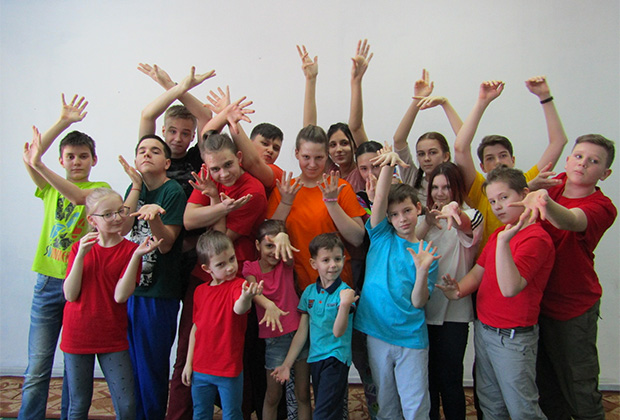 Photo from the Merak Activist Comedy Theater’s page on VK
  Photo from the Merak Activist Comedy Theater’s page on VK