A plaque memorializing Isaak Moiseyevich Mechik will be installed at 3 Dnepropetrovsk Street in St. Petersburg on Sunday, February 13, at 12 p.m. At the time of his arrest, 56-year-old Isaak Mechik worked as the manager of the workers’ dormitory of the Leningrad mirror factory, but during his life he had had many different occupations: he was involved in winemaking, had worked on the construction of the Chinese Eastern Railway, had fought in the First World War, and had laid tram rails. He was arrested in October 1937. He was shot on charges of espionage and counter-revolutionary activities in January 1938.
Isaak Mechik was the grandfather of the writer Sergei Dovlatov, who devoted the first chapter of his book Ours: A Russian Family Album [1983; English translation, 1989] to him.
More than twenty years later, my father, after a long effort, had Grandpa’s name rehabilitated “for lack of corpus delicti.” For me the question is, just what was going on back then? For the sake of what, exactly, was that delightfully senseless and amusing life cut off?
We invite you to join the plaque installation ceremony. We ask you to maintain social distancing and wear a mask to avoid exposing yourself and others to the risk of coronavirus infection. Thank you, and be healthy!
Photo courtesy of Fontanka.ru via bessmertnybarak.ru. Source of text: Last Address in St. Petersburg email newsletter, February 6, 2022; translated by the Russian Reader. Source of Dovlatov quotation: Harper’s Magazine, May 1989, p. 26; translated by Anne Frydman.
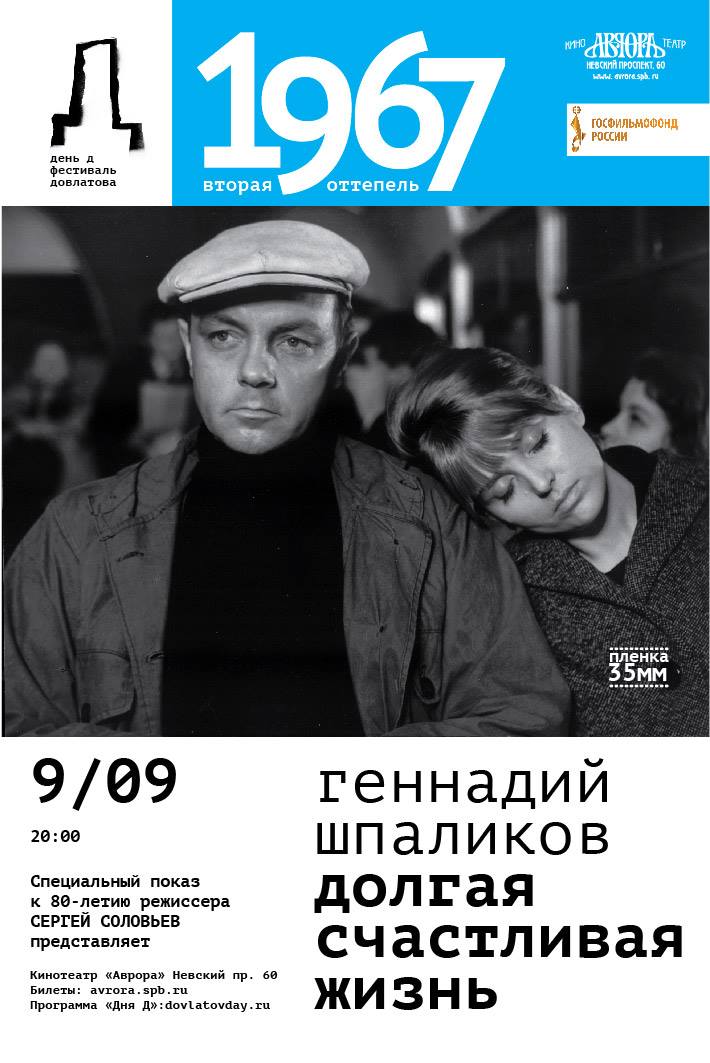
The poster for a special 35mm screening of Gennady Shpalikov’s A Long Happy Life, held in Petersburg’s Avrora Cinema on September 9, 2017, as part of a “Second Thaw” program at the annual D-Day Dovlatov Festival. The screening, ostensibly held to celebrate the 80th anniversary of Shpalikov’s birth, was to be introduced by the establishment film director Sergei Solovyov. Courtesy of the D-Day Facebook page
What’s wrong with Russia in one easy lesson.
Gennady Shpalikov was a brilliant Soviet screenwriter, poet, and lyricist, and, in his only attempt at directing, A Long Happy Life (1966), an equally brilliant filmmaker.
If you’ve ever seen the film, you probably wondered at some point how such a bleak, beautiful, and utterly hopeless masterpiece could have been made in the post-Krushchevian Soviet Union.
I don’t remember how that miracle happened, but after this and until his death by suicide in 1974 at the ripe old age of 37, Shpalikov was a man without a country and certainly a man without almost any prospects of getting decent, honest work in a country whose leadership had decided to do a little re-Stalinization after a very brief period of mostly cultural liberalization. (Hence the glorious Soviet cinematic new wave of the Krushchev period, in which Shpalikov played a key role.)
But now, even as it persecutes Kirill Serebrennikov for some of the same “faults” that Sphalikov had, the regime tries to redeem itself by resurrecting the suicided Shpalikov for an evening and rehabilitating itself in its own eyes.
I don’t doubt for a second that the utterly loyalist filmmaker Sergei Solovyov regards Sphalikov as his friend, but everything I’ve read about Shpalikov suggests he was such a charming fellow everyone liked him anyway. That is, until he was made a creative outcast by his own country’s always righteous political regime, couldn’t get work, and started hitting the bottle.
Basically, this is like an evening of films by John Cassavetes as introduced by Ron Howard.
I also don’t know what any of this has to do with Sergei Dovlatov, another talented and “troubled” fellow the great Soviet Union ejected from its sacred midst because it had no place for him, essentially, but who has also been subjected, in recent years, to one of the most extensive and absurd cooptation-cum-rehabilitation campaigns you can imagine, as if he hadn’t left the Soviet Union in 1979, or hadn’t had any good reason for leaving.
None of these frantic attempts on the part of the regime and its running dogs to save themselves in the eyes of the nonexistent intelligentsia should prevent you from watching every film Sphalikov had anything to do with (they’re all worth watching, and some are masterpieces), and reading everything Dovlatov wrote (most of it is hilarious and poignant) in the comfort of your own home.
No one needs to attend pro-Putin rallies disguised as cultural events. What else could the slogan “1967: The Second Thaw” refer to?
There was no second thaw. Only a “long happy life” that ended in 1991. ||| TRR, August 30, 2017
Gennady Shpalikov (director), A Long Happy Life (1966)
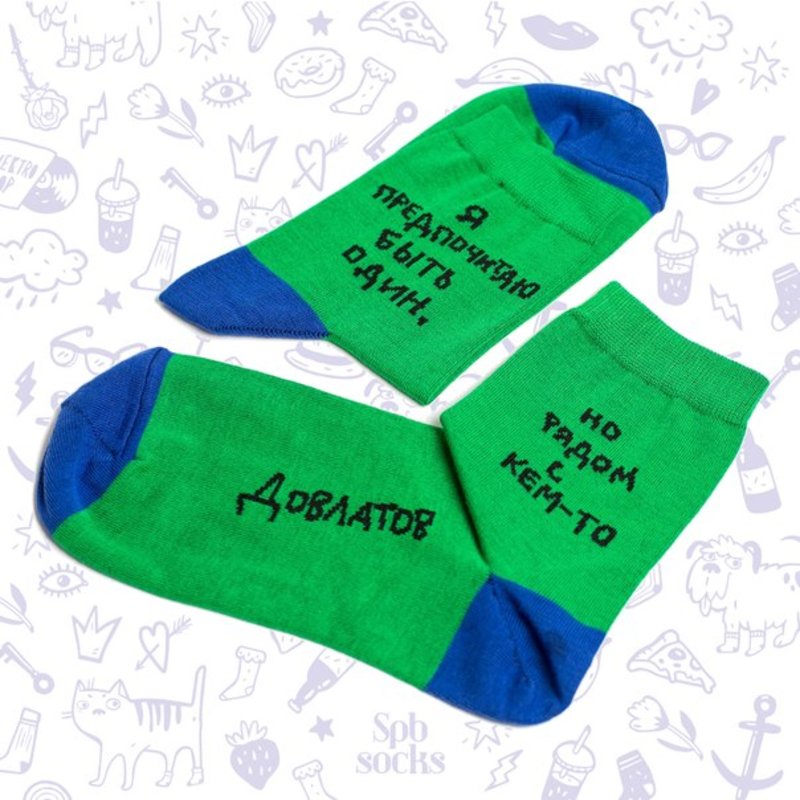
“Dovlatov: I prefer being alonе, / but with somebody next to me.” Image courtesy of SPBsocks. This pair of socks sells for 370 rubles or approximately €5.
Petersburg fashionistas with a snobbish vibe have an additional option available to them: socks emblazoned with quotations by local writers. Socks of this sort have recently gone on sale at SPBsocks, where you will find Joseph Brodsky socks, Fyodor Dostoevsky socks, and Sergei Dovlatov socks.
One of the Dovlatov socks proclaims outright, “I prefer being alone.”
There thus won’t be any more questions to the second sock, whether it is at large under the bed or lost during the wash.
“Dovlatov is the most popular. The recent anniversary, the unveiling of the monument to him in Petersburg, and the 1980 fads have all benefited the writer. We have chosen ironic, edgy quotations. You don’t get anywhere nowadays without a little controversy. Breaking the mold increases sales,” acknowledges Svetlana Suetova, founder of SPBsocks, an online designer sock store, which also runs a showroom in the Golytsin Loft at Fontanka Embankment, 20.
Regardless of whether one is a writer or a reader, one’s task consists first of all in mastering a life that is one’s own, not imposed or prescribed from without, no matter how noble its appearance may be. For each of us is issued but one life, and we know full well how it all ends. It would be regrettable to squander this one chance on someone else’s appearance, someone else’s experience, on a tautology—regrettable all the more because the heralds of historical necessity, at whose urging a man may be prepared to agree to this tautology, will not go to the grave with him or give him so much as a thank-you.
[…]
The philosophy of the state, its ethics—not to mention its aesthetics—are always “yesterday.” Language and literature are always “today,” and often—particularly in the case where a political system is orthodox—they may even constitute “tomorrow.” One of literature’s merits is precisely that it helps a person to make the time of his existence more specific, to distinguish himself from the crowd of his predecessors as well as his like numbers, to avoid tautology—that is, the fate otherwise known by the honorific term “victim of history.” What makes art in general, and literature in particular, remarkable, what distinguishes them from life, is precisely that they abhor repetition. In everyday life you can tell the same joke thrice and, thrice getting a laugh, become the life of the party. In art, though, this sort of conduct is called “cliché.”
Excerpted from Joseph Brodsky, “Nobel Lecture,” December 8, 1987, trans. Barry Rubin. Source: Nobelprize.org
Pinta Shot Bar on Stremyannaya Street in Central Petersburg
In the last ten or fifteen some years, signs of the city’s extinction have been coming hot and heavy, tumbling into view one after another. A few more years, and there will be nothing left of the late-Soviet and perestroika-era Leningrad/post-perestroika Petersburg where we misspent so many years of our youth and felt perfectly at home, despite the fact the ex-capital of All the Russias could never be described as homely. TRR
* * * * *
One of Petersburg’s Oldest Shot Bars to Close on Stremyannaya Street Bumaga
June 27, 2017
One of Petersburg’s oldest shot bars [ryumochnaya], located at 22 Stremyannaya Street, is closing. [Known officially as Pinta or “The Pint,”] it has been in operation for over thirty years.
Sources at the bar confirmed the bar’s impending closure to us, but refrained from revealing the rationale behind the decision. According to unconfirmed reports, the establishment has been purchased by a third party. It will close on Sunday.
Urban legend has it the shot bar on Stremyannaya was frequented during different periods by writers Sergei Dovlatov and Joseph Brodsky, and rock musician Mike Naumenko, since it was near the popular so-called Saigon Café. Historian Lev Lurye told Bumaga that Brodsky and Dovlatov were unlikely to have visited the bar. It opened in the mid 1980s, after both had emigrated from the Soviet Union.
Translated by the Russian Reader. Thanks to Ksenia Astafieva for the heads-up. Photo courtesy of Foursquare and Ksenia N.