Maria Ochir-Goryaeva: “Independence Is a Necessity”

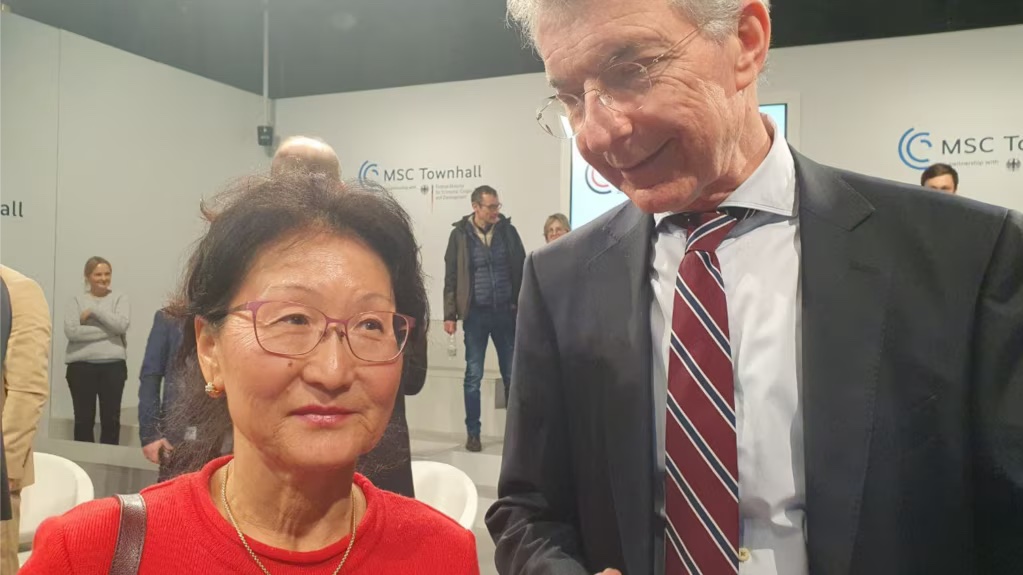
Maria Ochir-Goryaeva and Christoph Heusgen, chairman of the Munich Security Conference, February 2023. Courtesy of RFE/RL

When Russia invaded Ukraine, national movements in Russia’s regions advocating secession from Moscow were given a new impetus. A number of analysts have seriously argued that Russia could break up if there is a turning point in the war and noted the particular role of the Caucasus in this process. Kavkaz.Realii spoke with Maria Ochir-Goryaeva, Doctor of Historical Sciences, corresponding member of the German Archaeological Institute, and Distinguished Scholar of Kalmykia, about Kalmykia’s national movement, the Kremlin’s influence on the republic, and the republic’s current plight.

In 1999, Dr. Ochir-Goryaeva was awarded a competitive fellowship by Germany’s prestigious Alexander von Humboldt Foundation, and continued her research at the Eurasian Department of the German Archaeological Institute. She has published four scholarly monographs, the first of which was published in German. Every year, the archaeologist would return to Kalmykia to carry out archaeological digs in her homeland.

• • • • •

– It is the done thing in Russia to speak negatively about the support that western nonprofits and scholarly foundations provided in the 1990s to Russian academics and the Russian education system. Allegedly, it was through grants and training programs that the west inculcated its values in Russia. Tell us about your experience and what such programs did for Russian scholarship.

– Russian propaganda in general and on this issue in particular cannot be termed anything but xenophobic. In the 1990s, when many state-sector employees, including researchers at the Russian Academy of Sciences, were not paid their salaries for months on end, the grants allocated by western foundations literally saved them. In addition to the material aspect, they demonstrated the importance of researchers and their research. It was only thanks to the support of western and, later, Russian foundations that a number of academics, including me, remained in academia.

As for the “inculcation” of values, this is a distorted understanding of the purpose of such organizations. Each foundation has its own goals and values; if they are scholarly foundations, then their goals are scholarly. I have been living in Berlin for twenty-four years and I know that no one is subjected to “inculcation” here, but is given the opportunity to think and choose independently. Reality shows that people enjoy freedom of speech and the possibility of choice. These things work: everyone is eager to live in democratic countries, rather than in Iran, Afghanistan or Russia, which they leave at the first opportunity.

It is not western foundations that smack of “inculcation,” but Moscow’s imperial approach. Putin and his supporters are unable to adapt to a constantly changing world and are trying to adapt it to their needs by brute force and to make it conform to their outdated stereotypes.

– There is the opinion that this intellectual stagnation is displayed not only by country’s leadership, but also by many rank-and-file Russians, including those who disagree with Putin.

– I agree with this opinion. The wave of migrants from Russia, regardless of ethnicity, is no different from the populace who have stayed behind in Russia. Just as there, a small percentage of them are genuinely active in drawing attention to what is happening in Russia. Even here in Germany, many continue to fear for themselves, concealing their faces and names at protest rallies. The rest are either simply indifferent or they support Putin. Many have relocated in order to maintain their level of well-being and to be able to continue traveling around the world. They are, primarily, residents of Moscow who made good money.

Two things disappoint me about the new immigrants from Russia. The first thing is that few of them follow the news from the front and sincerely worry about Ukrainians. The topic never comes up in their conversations. Feelings of shame and guilt are probably unfamiliar to them. When I say something about bombing or war crimes, they immediately change the subject.
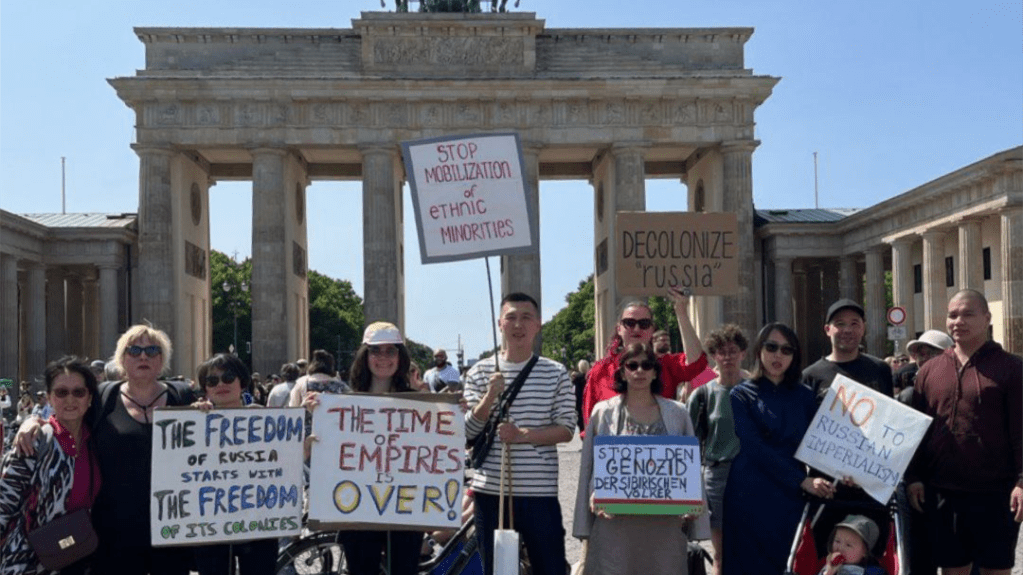
Maria Ochir-Goryaeva (left) at an anti-war protest in Berlin. Courtesy of RFE/RL

The second thing is xenophobia. Walking around Berlin, I have repeatedly heard indignation voiced by Russian speakers over why Germans tolerate the fact that Muslims here go about “in their headscarves.” Or, for example, Russians ask for help finding an apartment, but only in neighborhoods where “blacks,” as they say—meaning Arabs and Turks—do not live. This has shocked me as an Asian woman.

It seems to me that many immigrants do not assimilate the moral values of democracy and tolerance, but simply import Russia with all its stereotypes and ideology here. The problem is that Russians, with rare exceptions, are unable to understand the rationale and value of democracy. Otherwise, neither Putin, nor these decades of trampling on freedoms in Russia, nor the terrible war would have happened.

– At the same time, Putin and his entourage claim that the west has been trying to rewrite and distort history.

– We were all taught in school that in the early Middle Ages there was Kievan Rus’, a state centered around the city of Kyiv, that is, in present-day Ukraine. Then, three or four centuries later, the Grand Duchy of Moscow was formed, incorporating the lands in Moscow’s orbit. This name was the most accurate and reflects the essence of both the territory and its populace. Theoretically, it could be called Muscovite Rus’, but after its conquest of other peoples, it would be more correct to call this entity the Muscovite Empire. This state has its own history and traditions, like any other. The towns of the Golden Ring alone are worth so much! It is not that you mustn’t prize your own identity and your own statehood, but you should not appropriate someone else’s past.

Until a certain point, the Muscovites did not seek to appropriate Kievan Rus’ as part of their own history. This happened later, after Peter the Great declared himself Emperor of All the Russias. It was then that the temptation emerged to occupy not only the lands, but also the past of this foreign state.

Most of modern Russia consists of lands forcibly annexed to the Grand Duchy of Moscow and the Tsardom of Russia: the Volga region, Siberia, the Far East, and the North Caucasus have nothing to do with Kievan Rus’. They are colonies of the Russian empire. So it is the inhabitants of the Kremlin who are engaged in distorting history for the sake of political ambitions and propaganda.

– In 2022, representatives of national movements from different republics condemned the war and stressed that the conflict did not serve the interests of the Russia’s ethnic minorities. There were isolated protests in Kalmykia, but there were no large-scale protests here. Did you expect this reaction?

– Attitudes to the war in Kalmykia, according to my information, are similar to what you would find among an average sampling of opinions Russia-wide. Why should it be otherwise if the empire has been pursuing a policy of Russification and unification for centuries, thus leveling ethnic differences? There are critically minded people in every region, but there are only a few of them. And almost all of them have left the country, especially since 2022.

It is clear that if the Oirats had reached the shores of the Atlantic in the distant past and stayed here, they would probably have been part of a democratic Europe. Since our ancestors founded their Torghut Khanate on the banks of the Ijil-Idel-Edel-Volga River [these are different names for the Volga River—KR], they shared the fate of the rest of the peoples in the Evil Empire.

We could talk for a long time about the pros and cons of the arrival of the Oirats in Europe, the foundation of their khanate, the migration to Dzungaria, the peasant colonization of the khanate’s lands, the Russian Civil War… History, as you know, does not operate in the subjunctive mood. And Kalmyks have to live in those conditions, which means they are inevitably a cross-section of the society in which they find themselves today.

– How realistic are hopes for the independence of Kalmykia now? What are the decisive factors? Are Kalmyks themselves ready for it?

– Independence has ripened for a long time; it is a necessity. There are always leveling processes within large states. So, the regions of Russia, not only the republics, have to become independent, and then function like the European Union. This means that everyone has their own state, their own rules and system of governance, but when it comes to general issues—for example, environmental protection and projects aimed at the future—they would act in concert.

Disintegration into independent states is vital to all the peoples of Russia, including ethnic Russians. After all, the interests and problems of ethnic Russians living in Siberia or the Far East are clearly different from the interests and problems of Muscovites. The capital is robbing all the regions, and so the Kremlin has a huge amount of money with which to wage a large-scale war and seize foreign lands. If the money of the regions stayed in the regions themselves, the country’s leadership would not have such massive resources, and people in Russia’s hinterlands would live much better! All segments of society suffer from this centralized system.

– At the same time, the situation in the republics differs from the situation in the regions and territories.

– The ethnic republics are, constitutionally, members of the Russian Federation. Moscow not only fleeces them, like the other regions, but also pursues a frankly colonial policy toward them. For example, it redraws their borders, grabbing the best lands for itself. The lands of the Buryats were divided into three administrative regions, while two districts were confiscated from Kalmykia to create the Astrakhan Region. Industrial facilities are built everywhere, just not in the republics. Accordingly, the economy there does not grow, professionals emigrate due to lack of work, and the populace is burdened with debt.

The project to construct the Iki-Burul water pipeline from the Levokum reservoir was imposed by Moscow to increase Kalmykia’s dependence on the outside world and force it to pay the Stavropol Territory for water, although it would have been easier for the republic to extend a branch line from the village of Tsagan Aman and pump water for free from the Ijil-Volga. The longest stretch of the Tengiz-Novorossiysk oil pipeline runs through Kalmykia, but the Krasnodar Territory receives the money for the rent. People from the Kalmykian government complained that they could not change the terms of the contract and they traveled back and forth to Moscow, but the officials there were unmoved.

They do not see the economic side, but the policy of the empire also leads to the loss of identity, language, and traditional culture.

– In your opinion, why did the population of the republics, not only Kalmykia, so easily abandon the sovereignty and even independence they had obtained in the early 1990s?

– Easily abandoned: that’s a good way of putting it! But what about the two terrible wars against independent Chechnya? Moscow forcibly and harshly resurrected the imperial approach, severely cracking down on all protests. No one wanted to be deported to Siberia again, so Kalmyks actually had no choice.

What happened to Gorodovikov back in Soviet times in Kalmykia? [Basan Gorodovikov was first secretary of the Kalmyk Regional Committee of the CPSU from 1961 to 1978—KR.] He, an old general, a decorated Hero of the USSR, was escorted from the CPSU Congress hall by KGB men and immediately booted from office because he dared to suggest that the two districts taken from Kalmykia be returned. That is why, in his wake, until 1990, only envoys from were tapped to run the republic. The desire for independence among the concerned part of our people has never faded.

– Kalmykia ranks last among Russia’s regions in almost all socio-economic ratings. This has been going on for many years—it was the same under Kirsan Ilyumzhinov and Alexei Orlov as it has been now under Batu Hasikov. In your opinion, why have none of the heads of the republic been able to achieve a breakthrough in terms of its growth? Could they have done it?

– Because the colonial policy has never stopped, and it is impossible by definition to make a breakthrough in such conditions. A colony is a colony, and its construction industry, infrastructure, and social services will be worse than in the metropole. The only thing that happens in a colony is the siphoning off of resources and professionals, and total Russification is carried out in all areas, from language to the rewriting of history. This is also an imperial policy. Nations are not allowed to study their own past: Moscow imposes on them the interpretation of the past that is beneficial to Moscow.

By the way, the regional elites are also well aware of this. The governors of the regions and the heads of republics are forced to go to Moscow to bow and scrape, begging for the money which they themselves sent there in the form of taxes. So the issue of disintegration has matured not only at the grassroots, in the minds of national movement activists, but also among local elites. The ethnic Russian hinterland must understand that Moscow takes advantage of their political naivety and forces them to live in ignominious poverty. The consequences of the war with Ukraine might just be the match that ignites this inevitable process.
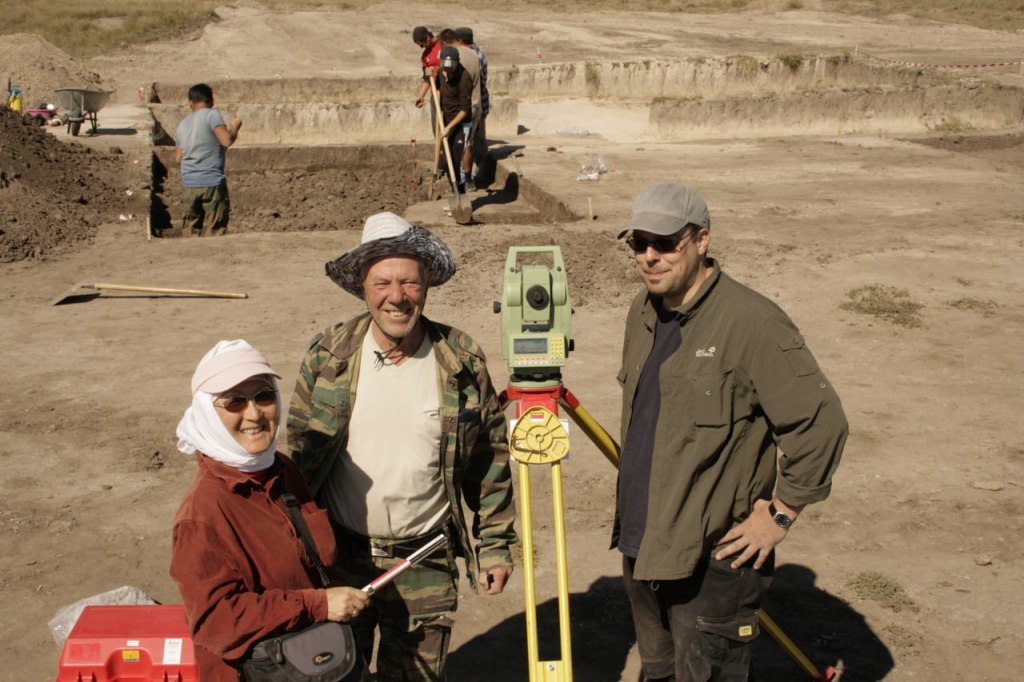
Maria Ochir-Goryaeva (left) at archaeological digs of a Bronze Age settlement with colleagues from the State Archaeology Department of Schleswig-Holstein (Germany), 2012. Courtesy of RFE/RL

– There is the opinion that Russian society massively supports this war. In your opinion, as a person observing from the outside, is this the case?

– Of course, they massively support it: people need to survive somehow, this is their priority. Everything is decided by the state system and what values it promotes. During the Third Reich, the Germans also massively supported the war. But when the system changed, the same people turned democratic. The same change can happen to Russian society, and for this to happen the system has to change. And the people as a whole easily change its opinions and habits.

I will give you an example. I spent eight years on the border of Kalmykia and the Rostov Region digging up two fortresses from the era of the Khazar Khaganate. We lived for months in a small village where the entire population is ethnically Russian. We hired the local men to do the digging. They don’t just swear there, they practically speak in obscenities. I forbade them to swear at the digging site and joke about gender issues, otherwise I would kick them out without paying them their day’s wages. And they worked for me all day for months without swearing!

What is more, nearly everyone in this village was a nationalist, in the sense that they did not like Kalmyks. But since I treated them with respect and paid them for their work every evening, they treated me and the other researchers quite cordially. People everywhere, whether they are Russians or Germans or whatever, are masters of survival. So, I don’t think you have to convince them verbally. When conditions change, ordinary people themselves figure out how it benefits them. You shouldn’t condemn ordinary people. You should cherish them and foster conditions for them to lead decent lives, whatever their ethnicity.

• • • • •

Earlier this month, Kavkaz.Realii published a report on life in Kalmykia and the impact of the war in neighboring Ukraine on it.

In October 2022, the Verkhovna Rada adopted a resolution recognizing Chechnya as a territory temporarily occupied by Russia, and also condemned the “genocide of the Chechen people.” All 287 MPs present voted in favor of the resolution. Oleksiy Goncharenko was one of the authors of the resolution.

In late October 2022, the Oirat-Kalmyk People’s Congress adopted a declaration entitled “On the State Independence of the Republic of Kalmykia.” This is not the first call for self-determination for the Russian Federation’s ethnic republics since the outbreak of the war in Ukraine. “Free Nations of Russia Forums” have been held in Warsaw, Prague and Gdansk, and representatives of ethnic groups “oppressed by the Kremlin regime” met in Kyiv.

On January 7, supporters of an independent Ingushetia met in Istanbul. The creation of the Ingush Independence Committee was announced at the meeting. The Committee’s goals include consolidating Ingush society around the idea of freedom and independence, preserving cultural and religious identity, creating the basis for building an independent Ingush state, and “preventing another deception of the people and another round of violence against them.”

Source: Andrei Krasno, “‘Independence is a necessity’: a historian from Kalmykia on the the republic’s future,” Kavkaz.Realii (Radio Svoboda), 14 June 2023. Translated by the Russian Reader. Thanks to Comrade Koganzon for the heads-up.

The Extremist Community: Nine More Years in a Penal Colony for Left Resistance Founder Darya Polyudova

Darya Polyudova, holding a placard that reads, “Ukraine, we’re with you.” Photo courtesy of The Insider

The founder of the Left Resistance movement, Darya Polyudova, has been sentenced to nine years in a penal colony on charges of “creating an extremist community.” Polyudova was already serving time on another charge, and had three years left to go in her sentence.

The Second Western District Military Court has handed down the new sentence to the activist. It agreed with the prosecution’s arguments that the Left Resistance, as created by Polyudova, was an “extremist community.” And yet, at the moment there is no such organization listed in the Russian Justice Ministry’s registry of “extremist organizations.”

In addition to “creating an extremist community” (Article 282.1.1 of the Russian Federal Criminal Code), the court found the activist guilty on two counts of “condoning terrorism” (Article 205.2.2 of the Russian Federal Criminal Code) over posts published on the movement’s social media page.

The sentence took into account Polyudova’s previous sentence of six years, which she received in 2021, writes Mediazona.

Polyudova was the first person in Russia charged under the criminal code article outlawing “calls for separatism” (Article 280.1). This accusation was brought against her in 2014 for trying to hold a “March for the Federalization of the Kuban” in Krasnodar.

One charge after another

Polyudova began her career as a political activist in Novorossiysk, where she organized Strategy 31 protests. Due to constant arrests and dismissals from work, Polyudova was forced to move to Krasnodar, and later to Moscow.

She went on pickets in support of Ukrainian and Crimean Tatar political prisoners, and the defendants in the Moscow Case and the Network Case, against the construction of a landfill in Shiyes, and against plans to build a church on a city square in Yekaterinburg.

In 2017, Polyudova was released from a work-release penal colony where she spent two years on charges of calling for separatism, and founded the Left Resistance. The description of the movement on its VK page stated that it “stands against the oppressor capitalists and for all the oppressed and the power of the working people.” The movement’s members attended protest pickets and distributed leaflets.

In January 2020, Polyudova was arrested again on charges of calling for separatism — this time for a solo picket where the activist stood holding a placard that read, “Kuriles, stop feeding Moscow! Long live the Far Eastern Republic!”

She was also charged with publicly condoning terrorism over a repost of a message about the Chechen field commander Shamil Basayev.

The calling for separatism charge against Polyudova was eventually dropped due to the liberalization of Article 280.1 of the Russian Federal Criminal Code. However, in September 2020, the activist, who by that time had been in remand prison for more than six months, was charged with a new offense.

The FSB regarded her statements about Yevgeny Manyurov, who opened fire at the FSB headquarters on the Lubyanka in December 2019, as grounds for charging Polyudova with “condoning terrorism.” Later, this charge was reduced to a charge of calling for separatism.

In May 2021, Polyudova was sentenced to six years in a penal colony on charges of publicly condoning terrorism and calling for extremism.

Polyudova was presented with new charges of “creating an extremist community” in December 2021, while she was in remand prison awaiting an appeal against the previous sentence.

Source: “Activist Darya Polyudova sentenced to nine years — this is her third prison sentence,” BBC News Russian Service, 23 December 2022. Translated by TRR


Left Resistance founder Darya Polyudova has been sentenced to nine years in a penal colony, while Left Resistance activist Kirill Kotov has been sentenced to three years probation, the Telegram channel Free Kirill Zhukov reports.

Polyudova’s sentence incorporates the previous verdict against her and will run from January 2020, when the young woman was remanded to a pretrial detention center in a previous criminal case, her lawyer Leonid Solovyov told OVD Info.

The prosecution had requested just this sentence for Polyudova, but had asked that Kotov be sentenced to three years in a penal colony.

Polyudova was accused of “creating an extremist community” (per Article 282.1.1 of the Criminal Code), while Kotov was accused of involvement in an “extremist community.” Polyudova was also charged on two counts of public calls for terrorism or “condoning terrorism” (per Article 205.2.2 of the Criminal Code).

According to the FSB, Polyudova created the Left Resistance to “plan and commit crimes, […] namely, public vindication of terrorism and public calls for extremist activity.” Investigators argued that the “extremist community” engaged in holding pickets and making posts on social media.

In addition to Kotov, four other activists have been charged with involvement in the extremist community: Sergei Kirsanov, Alyona Krylova, Igor Kuznetsov, and Andrei Romanov.

On 18 November 2021, the FSB searched two addresses as part of the case against the Left Resistance, including the house where Kotov used to live. The criminal charges against the movement were made public on 3 December 2021. Tomsk opposition activist and RusNews journalist Igor Kuznetsov was already in remand prison in connection with the case of the Telegram channel Chto-Delat! Andrei Romanov and Alyona Krylova were not in Russia, while Sergei Kirsanov and Kirill Kotov were released on their own recognizance. By this time, Polyudova had already been sentenced to six years in a penal colony in a previous case.

Polyudova was charged under the article criminalizing calls for terrorism over posts made in 2019 on the Left Resistance’s social media page, including a post entitled “Execute the traitor Putler for treason!” Forensic experts detected “calls for the violent seizure of power” and “use of violence against the security forces” in these posts. Another criminal count was based on posts made on anniversary of the annexation of Crimea and pickets in support of defendants charged with involvement in Hizb ut-Tahrir.

[…]

Polyudova founded the Left Resistance movement in 2017. Its activists said that the new left-wing organization’s purpose was to replace the “opportunistic Communist Party” and “defend genuine communist ideas.”

In May 2021, the court sentenced Polyudova to six years in a penal colony. She was found guilty on two counts: “condoning terrorism” (per Article 205.2.2 of the Criminal Code) in connection with a repost on VK, and “calling for extremist activity” (per Article 280.1 of the Criminal Code) for statements about the actions of the shooter outside the FSB headquarters building on the Lubyanka.

In 2014–2015, Polyudova was accused of calling for extremism and separatism. She was then sentenced to two years in a work-release (i.e., minimum security) penal colony.

Source: “Left Resistance founder Darya Polyudova sentenced to nine years in a penal colony,” OVD Info, 23 December 2022. Translated by TRR

You Don’t Speak for Us

A Statement by the Free Nations League

Regarding the Convocation of a Congress of People’s Deputies of the Russian Federation in Poland

From open sources, we have learned about an undertaking to convene a Congress of People’s Deputies in the town of Jabłonna, Poland (November 4–7, 2022). The delegates to the Congress are parliamentary deputies of different years and different levels who were elected in internationally recognized elections. Rejection of the war between Russia and Ukraine that began in 2014 and a willingness to change the socio-political system established in the Russian Federation are their common platform. The event’s organizers have announced that they will adopt a “Declaration on the Constitutional Principles of a Free Russia after the Putin regime’s overthrow,” a “list of priority decisions by the post-Putin Russian government,” etc.

In the light of this news:

🔹 We cannot but note the fact that [free and fair] elections in the Russian Federation disappeared long before 2014. Ethno-national political parties were banned thirteen years before Ukrainian region of Crimea was annexed. Thus, despite the fact that the Russian Federation, according to its own constitution, is a federation, and most of the ethno-national republics within the Russian Federation are nation-states with their own constitutions, parliaments, and governments, we have been deprived of the opportunity to represent and defend our interests in representative bodies for decades.
🔹 We acknowledge that the Russian Federation as a state has gone too far both in its ethno-national policy (extolling the Russian nation as chosen and endowing it with a special status in the Russian Federal Constitution) and in its foreign policy, thus completely destroying the legal space of the federation. The Russian Federation currently has no clear and legitimate borders, nor does it have legitimate representative bodies, since there are “deputies” and “senators” seated in the Federal Assembly who were, allegedly, delegated by illegally annexed foreign territories.

In light of the above considerations, we, representatives of the ethno-national and regionalist movements united in the Free Nations League, declare the following:

1. We do not recognize any political forces and hubs that would justify maintaining the Russian Federation in its current form. We have no need of arbitrators from Moscow, neither from the authorities nor from the opposition. We are open to dialogue and contact only with those who publicly support the right of enslaved peoples to establish independent States.

2. The Russian Federation cannot be re-established by cutting off what was seized by force and holding new elections. It is not elections that are at issue, but the very nature of Russian statehood: it is imperialist and exudes aggression towards its neighbors. This means that we, representatives of ethno-national republics and regions, have the right to shape our own destiny. If there is a discussion of independence for certain lands, let the people themselves hold this discussion, let them decide which confederations or unions to join, free from the intervention of federal forces, be they the government or the opposition. Any attempts at “peacekeeping,” attempts to teach us how to exercise our right to self-determination, will be rejected by us, and if they are intrusive, they will be met with a forceful response.

3. The process of forming a new Russian state should be voluntary and undertaken exclusively by those federal subjects whose legislative bodies vote to join a new federation. All federal parties currently represented among the federal authorities should be banned since they profess a misanthropic ideology that has produced thousands of victims and millions of refugees. The legislative bodies of the former federal subjects must be re-elected democratically, by open and secret ballot, with the involvement of ethno-national and regional political parties. There can be no automatic entry into the “renewed” Russia, no joining it “by inheritance.”

This appeal has been signed by representatives of the following national movements:

Bashkir

Ruslan Gabbasov, head of the Bashkir National Political Center (BNPC)

Ilshat Kinzyabayev, member of the BNPC

Buryat

Radjana Dugar-DePonte, representative of the Erhatan Buryat Democratic Movement in the USA

Cossack

Vyacheslav Demin, elder of the Cossack National Liberation Movement

Oirat-Kalmyk

Arslang Sanjiyev, chair of the Oirat-Kalmyk People’s Congress

Erentsen Dolyayev, deputy chair of the Oirat-Kalmyk People’s Congress

Batyr Boromannayev, deputy chair of the Oirat-Kalmyk People’s Congress

Vladimir Dovdanov, deputy chair of the Oirat-Kalmyk People’s Congress

Albert Sharapov

Tatar

Rafis Kashapov, deputy prime minister of the Government of Independent Tatarstan in Exile, co-founder of the Free Idel-Ural Movement

Farit Zakiyev, chair of the Tatar Public Center

Nafis Kashapov, deputy prime minister of the Government of Independent Tatarstan in Exile

Irshat Khabi

Chechen

Khamzat Grozny, a political exile in France from the Chechen Republic of Ichkeria

Erzya

Bolyayen Syres

Vitaly Romashkin

Ozhomason Kirdya

Source: Free Nations League, Facebook, 31 October 2022. Thanks to Sergey Ogurtsov for the heads-up. Translated by the Russian Reader


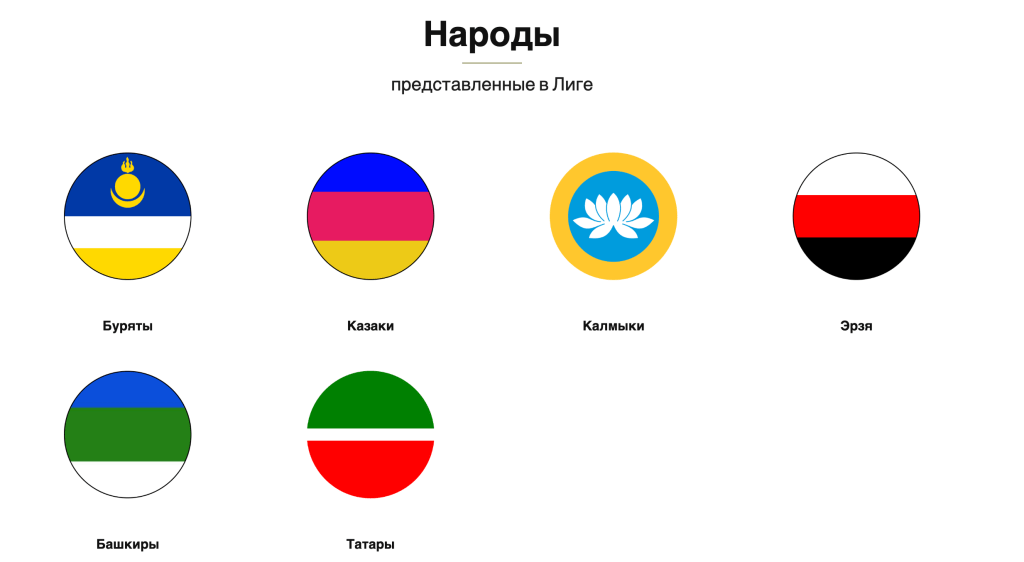
“Nations represented in the League: Buryats, Cossacks, Kalmyks, Erzya, Bashkirs, Tatars”

The FNL’s Principles

1

The Russian Federation is an empire that keeps its colonies in servitude by force. It is impossible to liberate them by holding a referendum, just as a referendum on the observance of human rights is impossible under conditions of state terror.

2

The peoples of the Russian Federation should be able to exercise their right to self-determination. Further federations or confederations can be established only a voluntary basis, not by diktat of the former federal center.

3

We declare the principle of the presumption of identity and agency [sub’ektnost’]. Accordingly, with the collapse of the current political regime in the Russian Federation, the regions have no need to appeal to anything to endow themselves with sovereignty. By definition, all regions acquire complete sovereignty and full independence from Moscow, and only then, as free territories, do they decide their future: whether they want to maintain independence, unite with other regions and republics, or create a confederation of states.

4

All subjects of the Russian Federation have the right to independently determine their future.

Source: “About Us,” Free Nations League. Translated by the Russian Reader

Be Careful What You Wish For

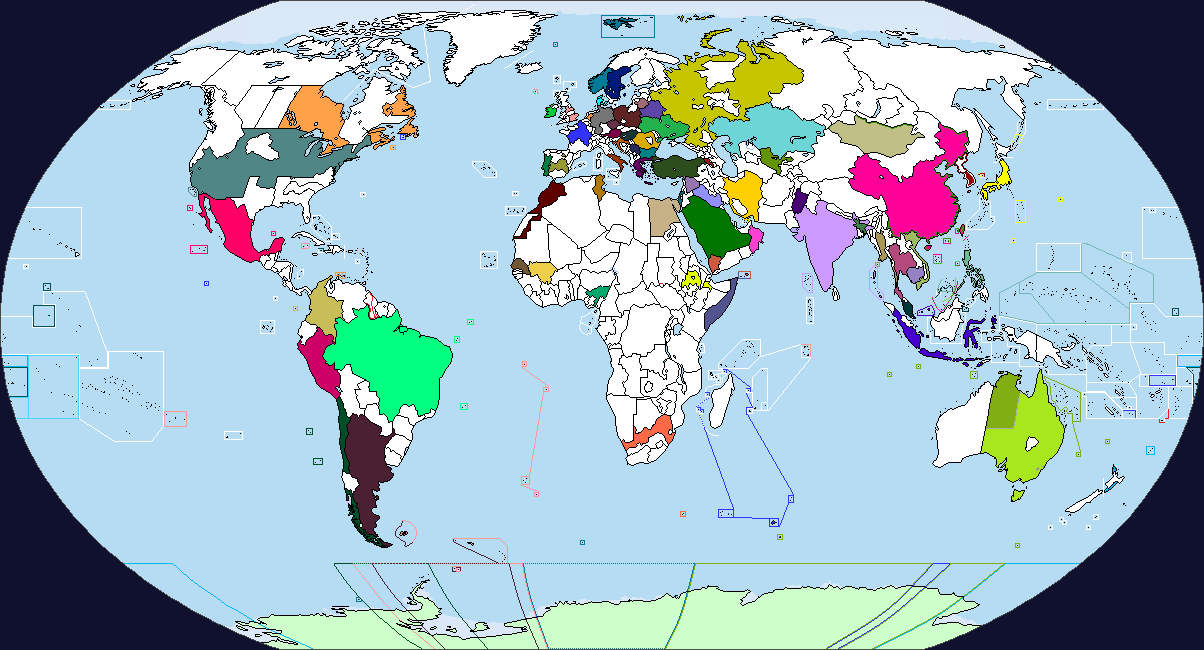
“An Alt-future map where Russia is divided. Could be Post-WW3 or after collapse due to economic sanctions etc.” Source: Reddit

Re: the “volunteer battalions.” Many people, including me, have spoken out quite harshly here [on Facebook] about the irresponsible fools who have posted map[s] of a “collapsed Russia” on the web. The centripetal forces in the country will be more powerful than the centrifugal ones for a long time to come, and if Russia collapses, those daydreamers will definitely not be involved. Nevertheless, work on its collapse is in full swing in Russia itself, and the country’s authorities are leading the effort. Understand me correctly: I am sure that Putin and his friends do not want disintegration, because Russia has become and will forever remain their only available feeding trough. However, heedlessness, as always, trumps vested interest. As in the case of covid, what the center does not cope with, it sloughs off on the regions. But if this was relatively harmless when it came to covid, it is not so harmless when it comes to the “volunteer battalions” being formed on a regional basis. When the “volunteers” return — and some of them will return, inevitably — a small but cohesive and extremely angry force with combat experience and, most likely, access to weapons, will emerge in each region. Precisely due to its local identity, it will become a convenient tool for factions seeking local power. During a social and political crisis, this desire can be realized, but not without a local armed force. And such a force will be there for the taking. The infamous Girkin proved in practice in Sloviansk that even a small group like this can easily take power in a medium-sized city if it encounters no resistance. It will be both easy and pleasant for local security forces to negotiate with “veterans” if such agreements are sanctioned by the “elites” in the towns and villages, but especially in the ethnic republics. A scenario in which Russia will break up into 80+ independent countries cannot be precluded. These countries, however, will not be benevolent democracies in the European orbit, but gangster autocracies. And Russia is being pushed in this direction not by its real or imaginary enemies, but by its own authorities.

Source: Grigorii Golosov, Facebook, 11 August 2022. Translated by the Russian Reader. Professor Golosov’s most recent book is Authoritarian Party Systems: Party Politics in Autocratic Regimes, 1945–2019 (Singapore: World Scientific, 2022).


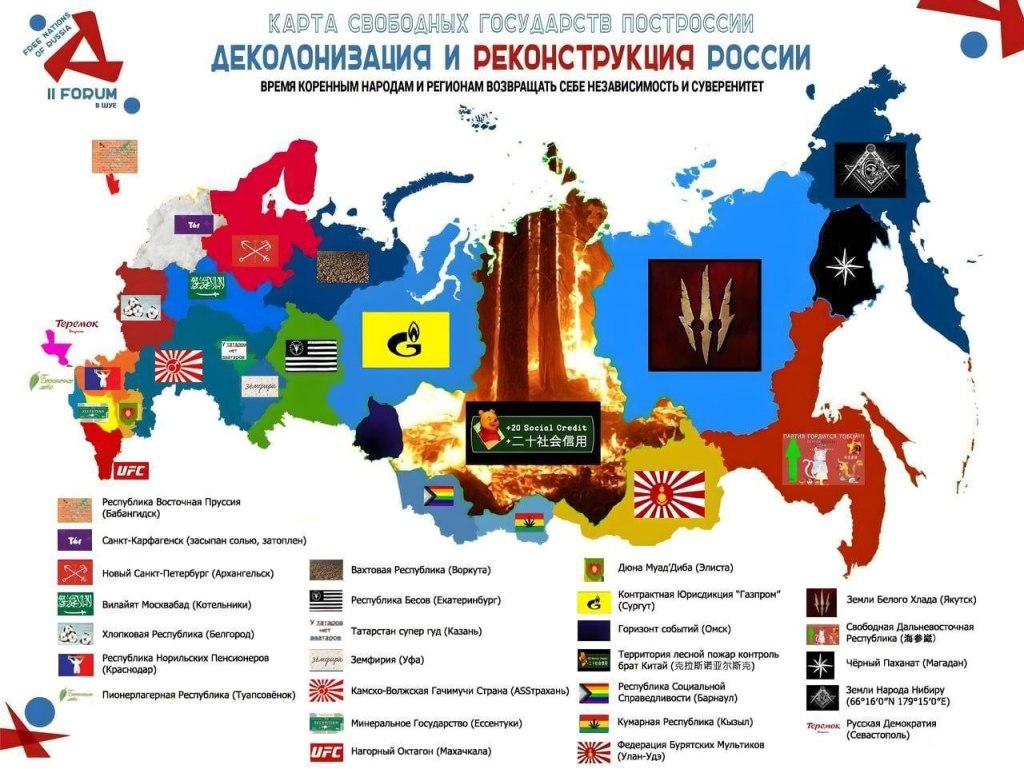
“A Map of the Free States of Post-Russia. Decolonizing and Restructuring Russia. It’s Time for Indigenous Peoples and Regions to Take Back Their Independence and Sovereignty.” Source: We Survived Mariupol, 25 July 2022, Telegram

Chechen head Ramzan Kadyrov meeting on 11 August 2022 with his military commanders. The meeting is conducted in Chechen with occasional infusions of isolated Russian words and phrases.

Western intelligence services have never really disguised their plans for our country. Their dream is Russia’s complete collapse and, in fact, the enslavement of its peoples. Our country has always been and remains the West’s number one target. The fact of the matter is that the Russian Federation’s multi-ethnic peoples have never accepted an alien ideology and have historically maintained their identity, mindset, and age-old principles.

And if at one time entire foreign institutions tried to achieve this goal by unleashing two wars in the Chechen Republic, later there were attempts to achieve it via South Ossetia and even Syria. Nothing came of them.

Now the West has played the Ukraine card. But here, too, all their efforts are doomed to utter failure. And I am very glad that the new tactical actions used by our combatants during the special military operation in the Donbass are bringing great success. I had no doubts about this initially. Today it is already obvious that the results have exceeded all expectations.

On Thursday, I met with the commanders and fighters of our detachments involved in the SMO. We once again had a warm conversation in an informal setting, discussing the successes we have achieved. We also discussed in detail the issue of improving the material resources for units from the Chechen Republic, of additionally supplying and equipping our fighters with modern weapons, equipment, and gear.

The most important thing is that [our] warriors are in great fighting spirit. The lads are clearly aware that they are fighting for the sake of all straight-thinking humanity and for the triumph of law, order, and justice. That is why, even after returning home, almost all SMO combatants are eager to go back. They have only one desire — to go all the way alongside their comrades. This is true patriotism, which means that victory will be ours! Absolutely! There is simply no other option.

Source: Ramzan Kadyrov, Telegram, 11 August 2022. Translated by the Russian Reader

Darya Polyudova

Darya Polyudova, holding a placard that reads, “Ukraine, we are with you.”
Image courtesy of Ivan Astashin

A subscriber has reported that he received a letter from political prisoner Darya Polyudova in which she told him about her court hearing in the Moscow City Court on May 12.

Let me remind you that left-wing activist Darya Polyudova is currently doing her second stint in prison on political charges.

In 2015, the activist was sentenced to two years in prison for “calling for extremist activities and separatism”: this was how the authorities viewed her preparations for a March for the Federalization of the Kuban.

After her release, Darya continued to be involved in political activism. But in January 2020 Polyudova was arrested again. In May 2021, she was sentenced to six years in prison on charges of “condoning terrorism” and “calling for terrorism.” The court regarded posts about Shamil Basayev and a phrase about the “Lubyanka shooter” Yevgeny Manyurov, who opened fire on FSB officers near Lubyanka Square in Moscow in December 2019, as evidence of Polyudova’s guilt.

In both cases, the Memorial Human Rights Center recognized Polyudova as a political prisoner.

However, the Russian state’s persecution of Darya Polyudova has not ended there. In late 2021, the FSB opened another case against the activist. Now she stands accused of “organizing an extremist community,” i.e., the so-called Left Resistance movement. Under the new charges, Darya may face another six to ten years in prison.

In this new case, Darya has been remanded in custody. Of course, she is already in custody. Without a new criminal case she would have been in a prison camp a long time ago [serving the sentence for her previous conviction], but the investigation wants her in a pretrial detention center.

Darya is appealing all the court decisions on the extension of her remand in custody. The court will consider her appeal of the latest extension on May 12.

Come and support Darya Polyudova!

11 a.m, 12 May 2022, Moscow City Court, 8 Bogorodsky Val, Room 327

Source: Ivan Astashin, Facebook, 7 May 2022. Translated by the Russian Reader

“Red Darya” Polyudova Arrested Again

“Red Darya,” the fourth episode of Grani TV’s series “Extremists,” posted on October 30, 2017

Darya Polyudova Remanded in Custody in Terrorism and Separatism Case
Grani.ru
January 16, 2020

Judge Anna Sokova of the Meshchansky District Court in Moscow has remanded in custody Darya Polyudova, leader of the Left Resistance movement, until March 13,  Moskva News Agency has reported. Polyudova has been charged with calling for separatism and vindicating terrorism.

According to the news agency, Polyudova has been charged with violating Russian Criminal Code Articles 280.1.1 (public calls for separatism, punishable by up to four years in prison) and 205.2.2 (public vindication of terrorism via the internet, punishable by five to seven years in prison).

Polyudova pleaded innocent and informed the judge of a number of procedural violations. According to Polyudova, she has been charged with “calling for separatism and a referendum on the Kuril Islands, and vindicating terrorism on social networks.”

Earlier, civic activist Alla Naumcheva reported that the investigation of the case was focused on “two video clips of some kind.”

Kuban activist Viktor Chirikov has reported that Polyudova is represented by court-appointed lawyer Galina Timofeyeva.

The record of Polyudova’s case on the Meshchansky District Court’s website lists only one charge, the alleged violation of Russian Criminal Code Article 205.2.2.

The political prisoner’s mother, Tatyana Polyudova, wrote on Facebook that her daughter had been taken to Remand Prison No. 6 in Moscow’s Pechatniki District. According to her, FSB investigator Dmitry Lashchenov was handling the investigation.

Human rights activist Irina Yatsenko told MBKh Media that on Wednesday leftist activist Kirill Kotov had been detained and questioned in the same case. He signed a non-disclosure agreement.

The day before Polyudova’s arrest, the security forces searched her dormitory room, as well as the dwelling of Gradus TV reporter Olga Sapronova, in connection with the case. Sapronova was questioned at the FSB’s Moscow and Moscow Regional Office on Bolshoi Kiselny Alley before being released. Her attorney, Olga Pelshe, was forced to sign a non-disclosure agreement on the case. Sapronova’s procedural status is currently unknown.

In 2015–2017, Polyudova served a two-year sentence at Work-Release Penal Settlement No. 10 in Novorossiysk after being convicted of publicly calling for extremism (Russian Criminal Code Article 280.1), publicly calling for extremism via the internet (Article 280.2), and publicly calling for separatism via the internet (Article 280.1.2). The opposition activist was convicted for organizing the March for the Federalization of  Kuban and solo-picketing against the war with Ukraine, and for posts she had published on the VK social network. Polyudova maintained her innocence.

After her release from prison, Polyudova moved to Moscow, where she had been organizing protest rallies.

Translated by the Russian Reader

“The Delirium of Religious Reformism”: Punitive Psychiatry Makes a Comeback in Chelyabinsk

Alexei Moroshkin. Photo courtesy of Memorial
Alexei Moroshkin. Photo courtesy of Memorial Human Rights Center

Chelaybinsk Resident Alexei Moroshkin’s Stay in Mental Hospital Extended Six Months
OVD Info
January 11, 2017

On January 10, the Soviet District Court in Chelyabinsk extended Alexei Moroshkin’s forced confinement in a psychiatric hospital for another six months, according to his mother Tatyana Moroshkina. Moroshkin had been sentenced to compulsory psychiatric treatment after having been accused of calling for violation of the Russian Federation’s territorial integrity.

According to Moroshkina, the court paid no attention to any of the arguments made by the defense, neither that her son’s actions and statements did not pose a threat to others, nor that, according to his medical record and the opinion of his physician, he was not dangerous and there was no need to hospitalize him. In making its ruling, the court was guided by the unsubstantiated opinion of court-appointed experts that Alexei Moroshkin could be dangerous, said his mother.

Moroshkin was committed to Regional Clinical Mental Hospital No. 1 in Chelyabinsk in December 2015. Prior to this, a court had considered the charges of calls for separatism made against him in connection with texts, posted on the VKontakte social network, about the need to establish a Ural People’s Republic. In November 2015, a court absolved Moroshkin of criminal liability, declaring him mentally incompetent on the basis of opinions submitted by medical forensic examiners, who during the police investigation had diagnosed him with paranoid schizophrenia, adding that he suffered from the “delirium of religious reformism.” This diagnosis was occasioned, apparently, by Moroshkin’s online publications and interviews dealing with the virtual Church of the Chelyabinsk Meteorite, which he had invented. At present, acccording to his mother, the medical experts do not mention delirium, but nevertheless consider her son mentally ill and a danger to others.

Before criminal charges were filed against him, Moroshkin had never been under a psychiatrist’s care.

According to his mother, Moroshkin’s physical condition has deteriorated: he suffers from a heart disease. The court also failed to take this circumstance into account.

In October 2016, Moroshkin was suddenly transferred to a wing with worse living conditions than before. Shortly before this, the hospital’s head physician was fined for refusing to provide information about Moroshkin to his defense attorney.

Currently, another case involving Moroshkin is under investigation. He has been accused of painting a bust of Lenin in Chelyabinsk in the colors of the Ukrainian flag and charged under Article 214.2 of the Criminal Code (vandalism).

Translated by the Russian Reader

Be Kind, Don’t Repost

Andrei Bubeyev (right) in the defendant's cage at his trial
Andrei Bubeyev (right) in the defendant’s cage at his trial

Tver Resident Sentenced to Two Years in Work-Release Penal Colony for Two Reposts on VKontakte
Takie Dela
May 5, 2016

The Zavolzhsky District Court in Tver has sentenced mechanical engineer Andrei Bubeyev to two years and three months in a work-release penal colony for extremism and separatism, writes Kommersant.

The defendant’s lawyer, Svetlana Sidorkina, said the court delivered its verdict “on all the charges summarily and taking into account the verdict in the first criminal case.” In addition, the time Bubeyev has served in a pre-trial detention facility since May 24, 2015, will count toward completion of his sentence. According to Sidorkina, the verdict will be appealed.

The basis for the charges were two reposts Bubeyev made on the VKontakte social network. He posted the article “Crimea Is Ukraine” by writer and political activist Boris Stomakhin on his personal page and a picture of a tube of toothpaste captioned “Squeeze Russia out of you.”

The prosecution argued this was a violation of Russian Federal Criminal Code Article 280.2 (public calls for extremist activities) and Article 280.1.2 (public calls for actions aimed at violating the Russian Federation’s territorial integrity) and requested that Bubeyev be sentenced to three and a half years in prison. Bubeyev pleaded not guilty.

In August 2015, the blogger was found guilty of extremism and sentenced to nine months in a work-release penal colony for reposting similar matter and pictures.

In February 2016, a court in Yekaterinburg ordered the laptop of single mother Ekaterina Vologzheninova destroyed because she had made certain likes and reposts. Investigators claimed that in 2014 Vologzheninova posted images deemed extremist by FSB officers on a social network. The investigators did not report exactly what was in the images. According to the woman’s attorney, one of the images was a caricature in which a person resembling Vladimir Putin was hunched over a map of Donbass with a knife.

Translated by My Left Foot. Image courtesy of openrussia.org

_______

Russian Jailed For Reposting ‘Extremist’ Article
RFE/RL
May 6, 2016

A court in the Russian city of Tver has sentenced a man to two years and three months in prison for reposting material about Crimea on a social media network.

The court on May 5 found that engineer Andrei Bubeyev reposted an article by publicist Boris Stomakhin that had earlier been deemed “extremist” and “threatening to Russia’s territorial integrity.”

The piece argued that the Ukrainian Black Sea region of Crimea had been illegally annexed by Russia and should be returned to Ukraine.

In April 2015, a Moscow court sentenced Stomakhin to seven years in prison on charges of promoting terrorism and extremism.

Stomakhin says the charges against him were politically motivated.

In the region of Chuvashia, investigators have accused 62-year-old Nikolai Yegorov of inciting national enmity for reposting the same Stomakhin article.

Yegorov denies the accusation and his trial is pending.

Vladimir Zavarkin, Karelian Separatist?

Separatism Charges Filed against Municipal Deputy in Karelia
July 31, 2015
Grani.ru

Заваркин
Vladimir Zavarkin. Photo courtesy of Guberniya Daily

Criminal charges have been filed against Vladimir Zavarkin, a municipal deputy in the Karelian town of Suojärvi, as reported by Guberniya Daily on Thursday. Under Article 280.1, Part 1 of the Russian Federal Criminal Code, the deputy faces up to four years in prison.

Guberniya Daily notes that Zavarkin has already given testimony in the case on four occasions. According to the article, he is being defended by a court-appointed lawyer.

At the same time, it is reported that the deputy has filed a complaint with the Russian Investigative Committee in connection with the criminal charges and is preparing an appeal to the Security Council.

Charges were filed against Zavarkin after his speech at a rally on May 20 in Petrozavodsk calling for the resignation of Alexander Hudilainen, Head of the Republic of Karelia. Over two thousand people attended the rally.

Zavarkin described the difficult social and economic situation in Suojärvi and harshly criticized Hudilainen.

He concluded his short speech with the words, “If the Russian Federation does not hear us, we will hold a referendum, I think. [If] Russia does not need Karelia, let’s separate.”

Vladimir Zavarkin’s speech at May 20, 2015, rally in Petrozavodsk, the capital of the Republic of Karelia


A day earlier, Zavarkin had posted a film about the situation in the Suojärvi District on the Vkontakte community page ”Hudilainen Resign!” The annotation to the film quotes Zavarkin’s statement in the film: “I appeal to the people of Finland and the Baltic countries: help us by sending humanitarian aid. You also have relatives in Karelia. Otherwise, we will all die out!”

Zavarkin sits on the Suojärvi Municipal Council’s committee for social issues, public order, and housing and public utilities.

Translated by the Russian Reader


Further reading:

New (Separatist) Comintern Slouches towards Moscow

Separatists Congress to Be Held in Moscow Financed by Foundation Close to Kremlin
Georgy Makarenko
September 15, 2015
rbc.ru

​On Sunday, September 20, the President Hotel in downtown Moscow will host a conference entitled “The dialogue of nations. The right of peoples to self-determination and building of the multipolar world,” [sic]. According to the meeting’s organizers, it is the “first and so far unique event for exchanging opinions among supporters of sovereignty for small nations around the world.”

According to the text of the invitation to the forum (which RBC has in its possession), in the conflict between two fundamental principles of international law—the inviolability of state borders and the right of nations to self-determination—the event’s participants come down on the side of the second position. The conference’s stated aim is the creation of an international working group for coordinating the actions of independence fighters throughout the world. The planned outcome is a communiqué defending the right of peoples to self-determination, which organizers suggest submitting as a draft resolution to the United Nations.

The Anti-Globalization Movement of Russia (ADR), a Russian NGO, is organizing the congress.

attachment

Foreign Partners
In December 2014, ADR held a similar gathering in the capital. The “anti-war” faction made up a significant portion of the foreign delegation then. The largest group of this sort was the United National AntiWar Coalition (UNAC), an American organization that advocates against police abuse at home in the States and against Washington’s military interventions abroad. UNAC was represented at December 2014 forum by five co-coordinators. One of them, Joe Lombardo, informed RBC that members of his organization had not been invited to the September conference, and even if they had been invited, the Americans were unlikely to come because of their tight schedules.

ADR leader Alexander Ionov refused to reveal the exact guest list for the September forum, citing “security concerns.” According to him, western authorities could hinder delegates from flying to Moscow. His fears are not groundless. In February 2015, the FBI raided the offices of the Texas Nationalist Movement (TNM), confiscating equipment and detaining several activists. The TNM was among the organizations involved in the December 2014 forum, and it will return to Moscow in September. [According to articles in The Houston Chronicle and The New York Times, no one was arrested during raid, which took place at a meeting of a secessionist group calling itself the Republic of Texas—TRR.]

Generally, according to ADR, this time the vast majority of delegates will represent separatist movements fighting against western governments. They include separatists from Hawaii, Puerto Rico, Catalonia, and the Western Sahara, and a delegation from the Irish party Sinn Féin, which last year proposed holding a referendum on Northern Ireland’s secession from Great Britain, citing the Scottish independence referendum. [What Sinn Féin actually proposed was “a Border poll on a united Ireland”TRR.]

The Russian Side
According the Russian Ministry of Justice, the Anti-Globalization Movement of Russia has the status of a regional nongovernmental organization and was registered on March 15, 2012.

ADR was created “to support countries and peoples who are opposed to the unipolar world’s diktat and seek to propose an alternative agenda.” Before ADR was formed, Ionov was co-chair of the Committee for Solidarity with the Peoples of Syria and Libya (which was headed by ex-State Duma deputy Sergey Baburin). In the spring of 2013, an ADR delegation traveled to Damascus, where it presented President Bashar Assad with an honorary membership in the organization. Mahmoud Ahmadinejad, the former president of Iran, is another honorary member.

​Among its partners, ADR lists the Rex Information Agency, the Novorossiya Information Agency, and Nashe Podmoskovye radio station (where Ionov hosts his own program), as well as Russian and international anti-war organizations. Since 2013, ADR’s leader has also been on the presidium of the organization Officers of Russia along with General Leonid Ivashov, actor Vasily Lanovoy, and singer Iosif Kobzon. Anton Tsvetkov, chair of the Russian Public Chamber’s security committee, heads the organization.

The President’s Patronage
According to the invitation to the forum, ADR is prepared to pay for foreign visitors’ flights, airport transfers, and accommodation in Moscow. Ionov confirmed this information to RBC. According to him, ADR and its foreign guests are NGOs with limited means, and according to an unwritten rule, the hosts take care of basic expenses, which had also been the case during the trips the Russian activists made to, say, the Middle East.

Ionov said that ADR’s two main sources of financing are donations from supporters and government grants. These funds are enough to hold an international conference at least once a year, he said.

RBC failed to find information about the grants issued to ADR in the databases of the Ministry of Justice and the Ministry of Economic Development. At the same time, ADR has regularly participated in grant competitions held by the National Charity Fund. Thus, ADR received a grant of one million rubles from the fund last year for its December forum, and this year it won an earmarked grant of two million rubles to organize the September conference. In the latter case, ADR was among ninety-nine winners from a total of over four hundred applications.

The National Charity Fund was founded in late 1999 at the initiative of Prime Minister Vladimir Putin as the National Military Fund. Its goal was the financial support of military personnel and military-patriotic projects. Lieutenant General Vladimir Nosov has been the fund’s director since 2009. Prior to this, he was first deputy head of the FSB’s military counterintelligence department. The fund’s budget is formed by voluntary contributions from the public and by grants. Donors include both public figures (e.g., Roman Abramovich and Suleiman Kerimov) and major companies (e.g., Sberbank, Lukoil, Severstal, and ONEXIM Group), and ordinary citizens may also transfer funds via SMS. The fund operates under the patronage of the President of Russia and his administration, which is stipulated on the organization’s website.

Probably because of the limited budget, it was decided to hold the event on Sunday. According to the hotel chain, rental of a conference room at the President Hotel costs 45,000 rubles an hour on the weekend, which is twenty-five percent cheaper than on weekdays. In addition, the final press conference will be held on Monday, September 21, at the Izmailovo Hotel Complex. Renting a conference room there for a period of one to four hours costs twenty to thirty thousand rubles, depending on the room.

The trait that unites all those invited to Moscow—from leftist Irish nationalists to Latin American anti-globalists—is their anti-Americanism, notes Anton Shekhovtsov, an expert at the Institute of Euro-Atlantic Cooperation (Kyiv).

Translated by the Russian Reader. Thanks to Anton Shekhovtsov for the heads-up. Map courtesy of alternatehistory.com

_________

New Law Could Punish ‘Separatist Views’ With 5-Year Prison Sentence
RIA Novosti
January 11, 2014
The Moscow Times

President Vladimir Putin signed a law makes spreading separatist views a criminal offense punishable by up to five years in jail.

Under the law submitted to the State Duma by the Communist Party, people will face a fine of up to 300,000 rubles ($9,200) for calling for action against Russia’s territorial integrity.

Lawmakers said the legislation was an effort to curb increasing public support for the idea of relinquishing mainly Muslim territories in the North Caucasus but the measure has also drawn criticism for drawing attention away from more serious problems in Russian society.