Persons of No Interest

“Pegasus over the whole world.” What’s wrong with this picture? A still from S1E1 of “Ponies”

Despite its equestrian-themed title, misfit-spies motif and occasional reference to “Moscow rules,” Peacock’s new espionage thriller “Ponies” has little in common with Apple TV+‘s “Slow Horses.” Set in Cold War Moscow, “Ponies” falls, intriguingly and occasionally uneasily, somewhere between FX’s “The Americans” and underappreciated female-empowerment comedy film “The Spy Who Dumped Me.”

Which is not surprising since it was created by Susanna Fogel and David Iserson, co-writers of “The Spy Who Dumped Me,” which the former directed and the latter executive produced.

Opening with an attempt to extract a CIA asset from the clutches of the KGB, the series centers on Moscow’s American Embassy circa 1977 (with a soundtrack and brief glimpses of a young George H.W. Bush and, later, Elton John, to prove it).

As the American operatives engage in the obligatory shoot-‘em-up car chase, two women meet in a market. Though they are each less than thrilled with their almost nonexistent lives as wives of envoys to the associate of the U.S. ambassador (i.e. the spies from the opening sequence), their contrasting attitudes and sparky, odd-couple chemistry is immediately, and a bit ham-handedly, established.

Polite, rule-following and Russian-fluent Bea (Emilia Clarke) believes her husband, Chris (Louis Boyer), when he lovingly assures her that this posting will be over in a few years and soon she will be putting her unidentified Wellesley degree to better use. (Note to whoever wrote the Peacock press notes: A Wellesley degree does not make a woman “overeducated.”)

Tough-talking, streetwise Twila (Haley Lu Richardson) is not so deferential or deluded; she pushes Bea to face down an unscrupulous Russian egg merchant with profanity-laden elan. Unsurprisingly, her marriage to Tom (John Macmillan) is more than a little rocky.

Still, when their husbands die, ostensibly in a plane crash, Bea and Twila are grief-stricken — they have lost not only their husbands but their careers as foreign service wives.

Back in the U.S., Bea is bucked up by her Russian, Holocaust-surviving grandmother (the always welcome Harriet Walter), while Twila realizes she fled her hardscrabble Indiana background for good reason.

Determined to find out what really happened to their husbands, the two return to Moscow and confront station head Dane Walter (Adrian Lester), convincing him that their status as wives — the ultimate Persons of No Interest, or “PONI” in spy parlance — offers the perfect cover.

Ignoring the historical fact that both countries have long had female undercover operatives, Dane decides (and convinces then-outgoing CIA head Bush, played by Patrick Fabian) that Russia would never consider two women (including, you know, one fluent in Russian) a threat and, by the middle of the first episode, we’re off.

Reinstalled as secretaries, Bea’s mission is to get close to new asset Ray (Nicholas Podany), Twila’s to … be a secretary. She, of course, decides to become more involved, enlisting the aid of Ivanna (Lili Walters), an equally tough market merchant.

Everything gets immediately more complicated, and dangerous, when Bea catches the eye of Andrei (Artjom Gilz), a murderous KGB leader who may be able to lead the CIA to the surveillance facility that Chris and Tom were trying to find when they died.

Clarke, returning to TV for her biggest role since her career-making turn as Daenerys Targaryen in “Game of Thrones,” is the obvious headliner. And in early episodes she does, in fact, carry the series, evoking, with as much realism as the relatively light tone of the writing will allow, a woman whose self-knowledge and self-confidence have eroded after she was sidelined into the role of wife.

Richardson, who many will remember as Portia, long-suffering assistant to Tanya (Jennifer Coolidge) in Season 2 of “The White Lotus,” is given the opposite task. Twila is, in Hollywood parlance, a “firecracker” — you know, the tough-talking dame who inevitably nurses a wounded heart. While drafting Bea as a spy makes a certain amount of sense, Twila’s skill set, as she is told, is being “fearless.” Her real talent, however, turns out to be standing up for “ordinary women,” including a string of prostitutes, murdered and forgotten.

Since neither woman receives the kind of training even most fictionally drafted civilian spies get in these kinds of stories, Bea and Twila are forced to rely on their wits, and the yin-yang balance of their good girl/tough girl relationship.

This makes for some great banter and fish-out-of-water moments, but it muddies the tone — are they being taken seriously as spies or not? — and requires significant suspension of belief (as does the Moscow setting created by Budapest; everyone keeps talking about how cold it is, but it never seems that cold). Fortunately, compared with their professional counterparts in most espionage dramas, the career agents on both sides appear, at least initially, to be quite limited in their spy craft as well.

An emerging plotline involving sex tapes and blackmail adds all sorts of tensions, as well as historical accuracy, and, as things get rolling, the spies become sharper and the notion of surveillance grows increasingly complicated and tantalizing.

Still, “Ponies” is obviously less interested in the granular ins and outs of gadgets, codes and dead drops than it is in the personal motivations of those involved and the moral morass that is the Cold War. “You came to Moscow to find truth?” an asset scoffs.

The cast is uniformly strong, the performances solid and engaging (Walter’s Russian grandma reappears midway through to show everyone how it’s done). If “Ponies” takes almost half of its eight-episode season to equal the sum of its parts, Fogel, who also co-wrote “Booksmart,” is a master spinner of female friendship, and Clarke and Richardson make it impossible not to instantly recognize, and connect with, Bea and Twila.

Their chemistry, and the absurdity of their situation, propels the story over any early “wait, what?” bumps and confusing tonal shifts into an increasingly propulsive and cohesive spy drama, with plenty of “trust no one” twists and turns, and the kind of period detail that would make “Mad Men” proud. (OK, yes, I am old enough to have tried the shampoo “Gee Your Hair Smells Terrific.”)

Fortunately, even as it moves with increasing assurance into “Tinker, Tailor” territory, “Ponies” remains a story of love. Which, as spies know only too well, can exist only when you accept, and share, the real truth about yourself. With a cliff-hanging ending, “Ponies” is betting that Bea and Twila will get another season to find their truths, even in Moscow.

Source: Mary McNamara, “‘Ponies’ elevates a Cold War spy story with emotional depth and female friendship,” Los Angeles Times, 15 January 2026


“The Shot Glass Beer Bar.” And what’s wrong with this picture? Another still from S1E1 of “Ponies”

The ryumochnaya is a purely Soviet phenomenon. It is a special snack bar in a Spartan format. It specialized in strong alcoholic drinks, with sandwiches served as appetizers or snacks. At some point, these “snack bars” turned out to be a form of “cultural recreation” available to most Soviet people.

“Men who usually drank port by their building entrances, like revolutionaries who gathered for a meeting in the basement or under a painted wooden mushroom figure on a children’s playground, could now go to a proper establishment, knock back a shot and intelligently [sic] have a bite of sandwich as a snack. Such a thing was not even dreamt of at that time,”  journalist Leonid Repin wrote in ‘Stories about Moscow & Muscovites throughout time’.

The first USSR shot bars opened in Moscow in 1954. According to Moscow historian Alexander Vaskin, this was a political move by the new head of state, first secretary of the CPSU Central Committee Nikita Khrushchev. He had to quickly win the people’s love and authority. 

“The idea to open shot bars in Moscow was not just good — it was fantastic! By creating a network of shot stores, the Party and the government showed great care for the health of the people and their cultural leisure,” Leonid Repin wrote.

They were designed to make lovers of liquor and vodka products more “cultured”, so that they did not drink in public places. But, some places became a refuge for citizens who could not find a place for themselves in the post-war USSR.

“At the corner of Mayakovskaya and Nekrasova streets [in Leningrad – ed.], there was a terrible drinking parlor full of legless invalids. It smelled of damp sheepskin, misery, shouting, fighting… it was a terrible post-war shot bar. There was a feeling that the people were deliberately made drunk there – all those ‘stumps’, ‘crutches’, former officers, soldiers, sergeants. They couldn’t find a way to keep these people warm and busy and this was one of the ways out,” writer Valery Popov speculated.

Cheap and cheerful

They poured vodka, port wine, liqueurs, wine and cognac in shot bars. Each shot was served with a modest snack – a sandwich with sausage, cheese, eggs, herring or sprat. There were four sprats on a sandwich, which was supposed to go with a 100 ml shot.

“There was only one inconvenience: after one drink, I wanted to drink some more and I had already had more than enough sandwiches. In general, it all happened like this: men stood there, knocking over shot after shot while making the ‘Leaning Tower of Pisa’ out of piles of sandwiches,”  recalled Repin. 

There were no tables or waiters in shot bars. Visitors lined up, received simple orders from the barmaid and then went to the bar tables.

Soviet writer and publicist Daniil Granin described a shot bar: “This is a glorious place – the smell of vodka, cigarettes, only men and without the forced drunkenness of bars, without molestation, sticky lingering conversations. Drank a shot, ate a sandwich, quickly and delicately.” 

Simplicity implied low prices, so almost any citizen could afford to go to a shot bar. Prices and sandwich varieties were the same throughout the Soviet Union, recalls Alexander Vaskin. 

“Prices were just kopecks. Everything happened in silence, with a sense of dignity. You drink up and then move on home or to see somebody or to the Philharmonic,” St. Petersburg historian Lev Lurie describes the advantages of a shot bar.

Overheard over a shot of vodka

In general, the visitors of such places were mostly decent.

“A factory worker and a journalist, an engineer and a plumber could all get together in a shot bar. It was not only a men’s club of interest, but also a place that attracted different people. It was possible to conduct sociological surveys and study the structure of society in them,” says Alexander Vaskin. 

And the state did study it. As Lev Lurie notes, in the 1950s, almost half of political cases were initiated because of freethinking at shot bars.

“The ryumochnaya remained a haven for skilled, intelligent workers, who determined the social appearance of the city: serious, hardworking men who go  fishing, watch soccer, take vacations in their factory’s preventorium or at the dacha. These establishments for visitors who had finished their work shift played the same role as pubs did in England,” he writes.

Shot bars today

In 1985, Mikhail Gorbachev, general secretary of the CPSU Central Committee, initiated an anti-alcohol campaign. Its active phase lasted for two years, with the country reducing the production and sale of strong alcohol.

The measures also affected the shot bars. 

The next blow to them was the collapse of the Soviet Union. The formation of the restaurant market in the country and the emergence of new formats of catering reduced the shot bars to the role of “nostalgic” establishments, frequented by an aging, but loyal audience.

“Rumochnayas were never rebuilt nor did they disappear anywhere. They remained, like the Rostral Columns, Zenith and ‘White Nights’, without changing their function. <…> The average age of visitors now is close to the retirement age: almost all of these people were brought up, knowing the simple and raw nature of a shot shop from childhood. All those who drank a lot, died, having failed to survive the 1990s. Only tough veterans now remain, who know their limit and are used to ‘cultured’ drinking,” Lev Lurie characterizes the situation in St. Petersburg. 
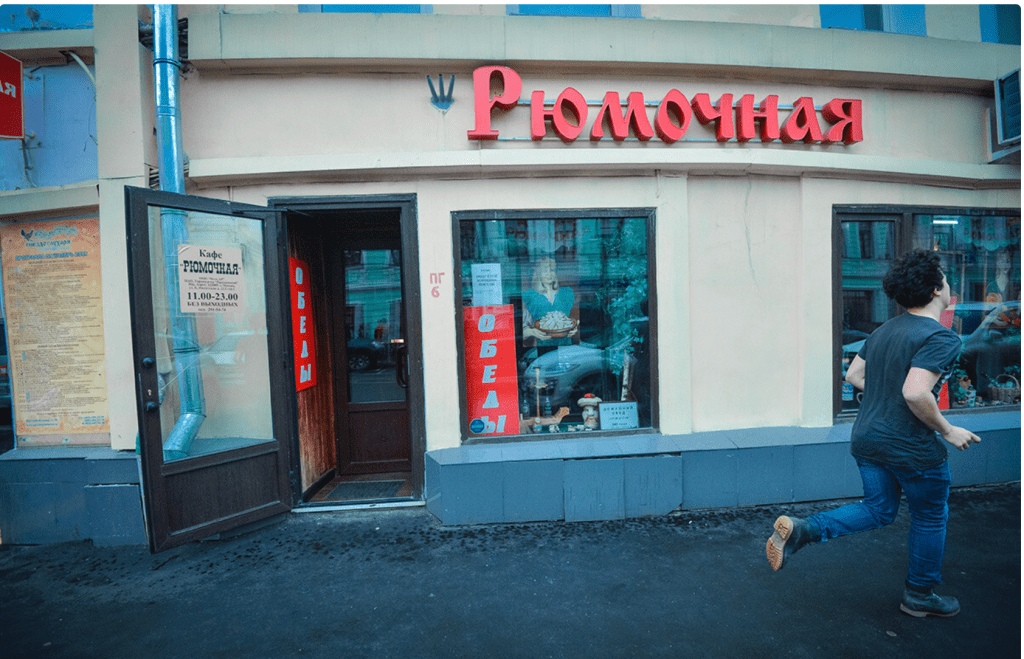
A newfangled, post-Soviet ryumochnaya. Photo: Alexey Kudenko/Sputnik via Gateway to Russia

He emphasizes that it is in the Northern Capital that the shot bars have retained their popularity: according to Lurie, there are more of them than in Moscow, yet it is difficult for old places to attract a new audience.

“Shot shops don’t lend themselves to stylization. There have been several attempts to create something in this genre for a younger and better-off audience. They’ve all failed. Young people drink much less than their fathers and grandfathers and they are not hooked on vodka. Local hipsters prefer to have a ‘shot’ in a trendy bar somewhere on Dumskaya or Fontanka. But, real connoisseurs of the genre have not rushed to the new establishments – it is expensive. The shot bars are still alive, but they are slowly dying out along with their customers, like thick table magazines or a game of dominoes in the yard,” concludes Lurie, a St. Petersburg resident.

In Moscow, St. Petersburg or any other city in Russia, it is not a problem to find a shot bar: establishments in this format continue to open. Nevertheless, not all owners adhere to the principles of “old-school” shot bars; namely, simple, cheap and democratic. And any Soviet-styled “neryumochnaya” (non-shot bars) will still correspond to modern restaurant realities in terms of its interior and menu. 

In the meantime, the genuine Soviet “ryumochnaya heritage” is hidden under inconspicuous signboards, in basements, visited by “their own” kind. It is cheap and cheerful, not fashionable at all, but authentic. The only difference is they have normal tables and chairs now.

Source: Yulia Khakimova, “The ‘ryumochnaya’: A bar of purely Soviet invention,” Gateway to Russia, 11 August 2023. Some of the claims and “factual” assertions, made above, should be taken with a grain of salt, although the overall picture painted is true to life. ||||| TRR
Fascism with a Human Face

Russian President Vladimir Putin, speaking at a session of the Valdai Discussion Club, acknowledged a decline in the real incomes of our compatriots.

He noted that the issue was being resolved in cooperation with the trade unions, RIA Novosti reports.

This dialogue continues. We see that people’s nominal incomes are growing, but real incomes have become slightly lower. Bearing in mind the state of the Russian economy, we can solve these problems and should do so in accordance with the existing plans of the Russian government.

Vladimir Putin, President of the Russian Federation

The head of state also said that it was necessary to fight for wage increases. At the same time, he addressed his appeal to both Russians and “ordinary citizens” of the United States and Europe.

Since the start of the special operation by Russian troops in Ukraine, people have experienced a loss of income and savings. Putin also noted earlier that many Russians were at risk of layoffs.

Source: Andrei Gorelikov, “Putin urged both Russians and citizens of western countries to fight for higher salaries,” Rabota.ru, 28 October 2022. Translated by the Russian Reader


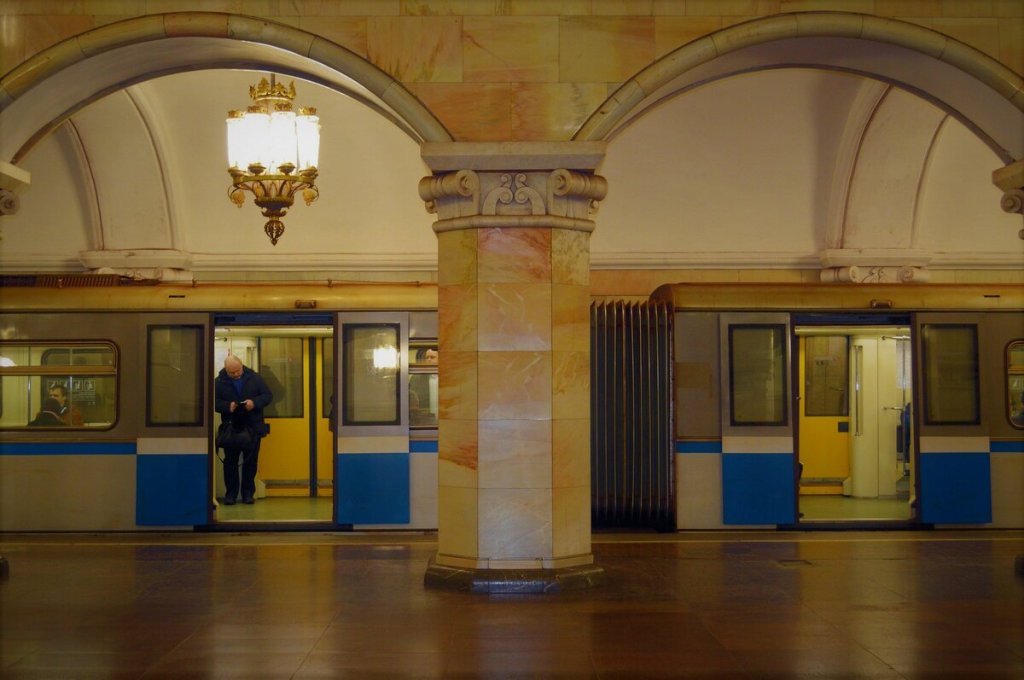
“There are more than 485 air fresheners in operation: they were installed in the air ducts of the climate control system. They spread the fragrance around the car every ten minutes. The fragrance is called ‘Moscow Metro,'” explain the metro’s press service , stressing that all the aromas were safe, hypoallergenic, and complied with regulations.

In 2019, during a vote on the project’s implementation, ninety percent of passengers surveyed said they would prefer an air-freshened carriage to a regular one. Muscovites especially wanted the smell of cherry blossoms in the subway.

Source: “Air fresheneres installed on the Filyovskaya metro line,” Russkii pioner, 3 November 2022. Photo courtesy of Russkii pioner. Translated by the Russian Reader


What attracts people [to the shot bar Fedya, the Wildfowl!]? The irony and the simplicity, but at the same time the pleasant crowd. Here you can meet people who, the day before, dined on sets [sic] of scallops and dill sauce at designer restaurants, but they are glad to eat belyash and kvass at Fedya’s. Every other table orders kebabs (from 325 rubles) and drinks tinctures and macerations. Security guards monitor everything: if you swear loudly, they will politely ask you to leave.

Source: “From brilliant shot bars to giant food halls: 12 Petersburg openings in 2022 — Vitya Bar, Noise Cabaret, Moskovsky Market, and the inclusive Outside Entrance,” The Village, 5 December 2022. Photo courtesy of The Village. Translated by the Russian Reader


The “Fedya, the wildfowl!” scene from the beloved Soviet comic crime caper The Diamond Arm (1969), starring Andrei Mironov and Yuri Nikulin

Dima Vorobyev: Forty Days

Dima Vorobyev, in a construction workers’ camp on a new housing estate, Petersburg, spring 2017.
Photo by the Russian Reader

Although I met dozens if not hundreds of people through my late friend Dmitry (“Dima”) Vorobyev (1974–2022), some of whom would become real friends, I cannot for the life of me remember when and how exactly I met Dima himself. It must have been sometime in 2005 or 2006, at the latest, because by the spring of 2007 we were already well enough acquainted to give a talk on our beloved city’s “anti-regeneration” movements at a conference on art and urbanism in Hamburg. Benedict Seymour, one of the editors of Mute magazine, was at the conference, and he kindly asked us to turn our talk into a full-fledged article, which we did. It was published the next year, somehow appropriately, in an issue featuring a picture of a cute kitten on the cover. Dima loved cats.

He also adored his hometown, Petersburg, in a wide-eyed, insatiably curious, panamorous fashion that meant endlessly exploring and enthusiastically embracing all its nooks, crannies, back alleys, abandoned lots, outskirts, dive bars, suburbs, new estates, subcultures, and courtyards. A geologist turned sociologist, he turned his “teleporting” (his coinage) from the imperial city center to the “provinces” (some of which, as it transpired, were also in the city center) into an undertaking called Sunday Cafe (in Russian, Voskresnoe kafe or V-kafe for short), a constantly mutating ensemble of serious urbanists and flighty flaneurs who went on long walks through the city that invariably featured a more or less elaborate “coffee break,” which often as not, happened outside, using a tiny camping stove and a Turkish coffee pot to make the coffee.

These walks were not “drifts” in the Situationist sense of the term. They almost always had well-defined beginning and end points (usually, subway or train stations, thus making it easier for the walkers to gather and disperse), and they often had more or less planned routes and even themes. For example, Dima and I did two “Leninist” walks as part of Sunday Cafe. The first, inspired by a book of Lenin-related addresses in Leningrad-Petersburg that I had picked up somewhere, was a fairly comprehensive tour of the Petrograd Side to all the places listed in the book while, periodically, stopping to read aloud choice passages from Lenin’s writings. The second, similarly inspired by a found bit of Leniniana (a late Soviet-era map for teenagers), recreated Lenin’s fateful journey, in October 1917, from his hideout in the Vyborg District to the Smolny Institute. Although several dozen people were with us at the start of this second Lenin walk, only five or six of us made it, several hours later, to the Smolny. I sarcastically thought at the time that this was a stark illustration of modern-day Russia’s utter lack of “revolutionary potential,” and subsequent events have only confirmed my intuition.

Like the nineteenth-century Russian revolutionary movement, Sunday Cafe was nearly always a marathon of sorts and thus prey to attrition and low attendance, especially in the “unseasonable” part of the year, which often makes up most of the year in Petersburg. But sometimes these marathons didn’t entail walking for hours “god knows where” in deplorable weather. In a memorable series of walks, Sunday Cafe saw everything there was to see on the two blocks of Pushkinskaya and three blocks of Kolomenskaya, two adjoining streets (where we both also happened to live at the time) in the city center, conducted over three Sundays in gloriously perfect summer weather. There were whole other words right under our noses, as we discovered, and to sharpen our focus Dima had printed out little tags, reading “This is good” and “This is bad,” to affix to the good and bad things we found along the way, including cars parked on sidewalks (bad) and grassroots efforts to turn parts of the downtown’s notorious labyrinth of courtyards into little oases of greenery and recreation (good).

It was also Dima who dragged me, finally, into the Soviet-era ryumochnaya (“shot bar”) right across the street from our house, the now (supposedly) “legendary” Dvadtsatochka (it was nicknamed that because it was in the commercial, first floor of house no. 20 — dvadtsat’, in Russian — on our street). For years, I had been too afraid to go in there alone, having witnessed many an outright fight there from our balcony, and seen several men removed from the establishment feet first after such scuffles or after particularly earnest drinking bouts. Dima enticed me there with the promise of cheap drinks and eats and a supremely colorful cast of regulars and staff. Although the two of us stuck out like sore thumbs — like the one and a half sociologists we were at the time — nobody minded us being there at all, while I, for one, appreciated being somewhere that the city’s burgeoning pseudo-middle class and then-upsurging hipsters still feared to tread. Unfortunately, the bar was shut down, a few years later, by the discount supermarket chain that had already taken over the old-style neighborhood grocery next door. Fittingly, just after Dvadtsatochka shut down, it served for a week as a location for a retro crime drama that was shooting in the city. Even more fittingly, my tender friend Dima persuaded the outgoing owners to give him the official sign board that had hung just inside the bar’s entrance, seemingly for decades. Among other helpful information, the board listed the categories of patrons who were entitled to be served without queuing: as I recall, they included veterans of the Great Fatherland War (World War Two) and exonerated former political prisoners, along with “invalids” (i.e., people with disabilities). Knowing how much I (literally) admired this sign, Dima presented it to me as a Christmas or New Year’s gift later that year.

It has been forty days since Dima died, which is an important milestone in the Russian mourning tradition. Today in Petersburg, Dima’s friends and loved ones convened Sunday Cafe on a route that took them to the cemetery where his remains are buried. As on the day of his funeral, over a month ago, I wish that I could have “teleported” to Petersburg to go on this walk, although, following its progress on social media in the early hours of the morning here on the other side of the planet, I couldn’t help but notice just how sad everyone looked in the photos, naturally. It is not that just Dima, had he been present, would have found a way to liven things up. (For example, by lining us against a wall and making us strike absurd poses while having our pictures taken, an entertainment he called (za)bashit’ luki.) He was one of a vanishing breed of Petersburgers, one almost never captured in the city’s world-famous “text.” The characters in the Petersburg-Leningrad writer Konstantin Vaginov‘s novels, published in the late 1920s and early 1930s, have been cited as prototypes for the city’s late-Soviet, perestroika-era and post-perestroika bohemians, and it’s true that when I came across these novels, quite by accident, in the mid-1990s, I had the distinct impression that Vaginov was describing many of my own friends and acquaintances.

But a lot happened in Vaginov’s hometown between his death in 1934 and the childhoods and youths of Leningrad’s “last Soviet generation,” in the 1960s and 1970s. Since I’m definitely not even half of a sociologist anymore, and I’m definitely not an anthropologist, I won’t venture to describe that generation at all. But I will say that its brightest and best members, especially as exemplified by Dima, are worldly, adventurous, warm, funny, open-minded and absurdly well-educated “patriots” of their city in a way that has been utterly at odds with the regime established by its now sadly most famous native son. This blog was conceived, in part, as a chronicle of the “cold civil war” between this group of Petersburgers (and Russians) and the regime, a war that now seems to have been conclusively won by the latter.

But even as I write this, solemnly and grimly, I recall an argument I had with Dima after one Sunday Cafe many years ago. We were having supper in a real cafe, a welcoming place in our neighborhood that served cheap, decent food and doubled as a venue for readings, concerts and other events (meaning that it was just the kind of “democratic,” low-profile, grassroots venture that Dima adored and was uniquely capable of discovering in every corner of the city), and there were several other V-kafeshniki with us. I must have been preachifying, as I was wont to do then, about the sad state of civil society in the face of the regime’s growing ugliness and repressiveness. Angered by my sermon, Dima said something to the effect that it wasn’t “our” (Russian? Petersburgian?) way to oppose the regime in the sense I was suggesting it should be opposed.

It’s not that now I realize he was right and I was wrong. But Dima knew a thousand times more than I did about the fine grain of Petersburg’s grassroots anti-regime and “a-regime” subcultures, and he hoped, I think, that however bad things actually were then, those communities of grassroots activists, artists and entrepreneurs would still have enough space and light and nourishment to grow into something bigger and better and more powerful that, over time, would simply shunt the regime aside and render it irrelevant.

In any case, as a friend pointed out soon after his death, there was nothing more incompatible than the lifelong pacifist Dima Vorobyev and the regime’s invasion of Ukraine and subsequent “mobilization” of Russia’s draft-age population, which, blessedly, kicked off after his death.

But there was a time — which happened to be the time when Dima and I met — when there was a hope, however faint, for a better future. The article that we wrote together reflected that strange interregnum (which was nothing of the sort, of course), and so I will close with a brief excerpt from it, below, and a plea to Dima, wherever he is, that he forgive me for writing so clumsily about him. (This is just a first draft, my friend.)

You should have known him. ||| TRR


What has caused ordinarily apolitical Petersburgers to swell the ranks of protest movements headed by political parties whose ideologies otherwise leave them suspicious or cold? The multi-pronged viral assault on the city on the part of bureaucrats and developers that we have briefly described. Strange as it may seem, in contemporary Petersburg, class conflict has been translated into opposed visions of urban renewal and historic preservation. It is precisely the preservation of Petersburg as a gigantic open-air architecture museum and the very particular places people live (with their unique ‘ensembles’ of stairwells, courtyards, archways, streets, squares, and local curiosities) that has become the point around which a more general sense of rampant social injustice has crystallised. A shattering series of crimes and indignities have been visited upon the bodies of Petersburgers in recent decades: widespread corruption, police violence, bureaucratic abuse, racist and xenophobic attacks, the dismantling of the social safety net, alcoholism and drug abuse, a high mortality rate, environmental pollution of all sorts. And yet, since Soviet times, all these risks and dangers have usually been felt to be part of life’s grim ‘common sense’ and thus inaccessible to sustained critical reflection or direct collective intervention.

Why do we see mass mobilisation in defense of the city rather than against such widespread albeit de-individualised injustices? Is it because the destruction of the city is something specific — a matter of real, lived places, places that can be seen and touched and remembered? Is it because the threat of injustice now takes the form of an alien skyscraper on a horizon that used to be peacefully uncluttered? Is it because people wake up one morning and find a fence erected around the humble square where they used to walk their dogs and play with their kids?

The answer to these questions would seem to be yes. First, the now ubiquitous and visible destruction of the city its residents are used to (which includes ‘unbecoming’ tree-filled green spaces in late-Soviet housing projects as well as neoclassical masterpieces), which we have likened to a kind of cancer or virus, has provoked an ‘anti-viral’ reaction. This reaction has taken very different forms. Future activists have followed a number of routes to mobilisation and collective action. Moreover, their first experiences of political engagement, while not always successful, have usually been ‘safe’ enough to encourage further involvement. The usually high threshold to political participation amongst ‘apathetic’ post-perestroika Russians has thus been lowered considerably.

Source: Dmitry Vorobyev & Thomas Campbell, “Anti-Viruses and Underground Monuments: Resisting Catastrophic Urbanism in Saint Petersburg,” Mute, vol. 2, no. 8 (2008)

Another End of an Era: Pinta Shot Bar to Close in Central Petersburg

27516667_Uz6EIITJ8gSeQmxiI-lO-9qtpf5au7QyC2t71lK9-a4
Pinta Shot Bar on Stremyannaya Street in Central Petersburg

In the last ten or fifteen some years, signs of the city’s extinction have been coming hot and heavy, tumbling into view one after another. A few more years, and there will be nothing left of the late-Soviet and perestroika-era Leningrad/post-perestroika Petersburg where we misspent so many years of our youth and felt perfectly at home, despite the fact the ex-capital of All the Russias could never be described as homely. TRR

* * * * *

One of Petersburg’s Oldest Shot Bars to Close on Stremyannaya Street
Bumaga
June 27, 2017

One of Petersburg’s oldest shot bars [ryumochnaya], located at 22 Stremyannaya Street, is closing. [Known officially as Pinta or “The Pint,”] it has been in operation for over thirty years.

Sources at the bar confirmed the bar’s impending closure to us, but refrained from revealing the rationale behind the decision. According to unconfirmed reports, the establishment has been purchased by a third party. It will close on Sunday.

Urban legend has it the shot bar on Stremyannaya was frequented during different periods by writers Sergei Dovlatov and Joseph Brodsky, and rock musician Mike Naumenko, since it was near the popular so-called Saigon Café. Historian Lev Lurye told Bumaga that Brodsky and Dovlatov were unlikely to have visited the bar. It opened in the mid 1980s, after both had emigrated from the Soviet Union.

Translated by the Russian Reader. Thanks to Ksenia Astafieva for the heads-up. Photo courtesy of Foursquare and Ksenia N.