Archipelagos

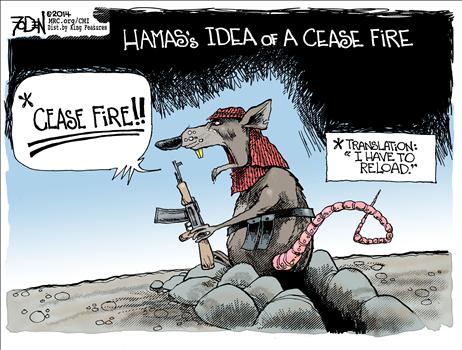
Western free society is seriously sick too. The symptoms pop up here and there, but one of the most disgusting is the massive support for the alleged “people of Palestine”—that is, Hamas—in this whole monstrous story. I really don’t understand HOW it has been possible, after the atrocities of October 7, after the taking of hostages, including children, to pretend that this was a minor trifle? That the ruthless Jews suddenly out of the blue started tormenting the unfortunate residents of the Gaza Strip?

After all, bolstered by this wave of international support, Hamas thinks it has won. This will lead to fresh terrorist attacks, of course.

Source: Boris Akunin (Facebook), 16 January 2024. Translated by the Russian Reader. Boris Akunin’s wit and wisdom have been featured in previous posts on this weblog.


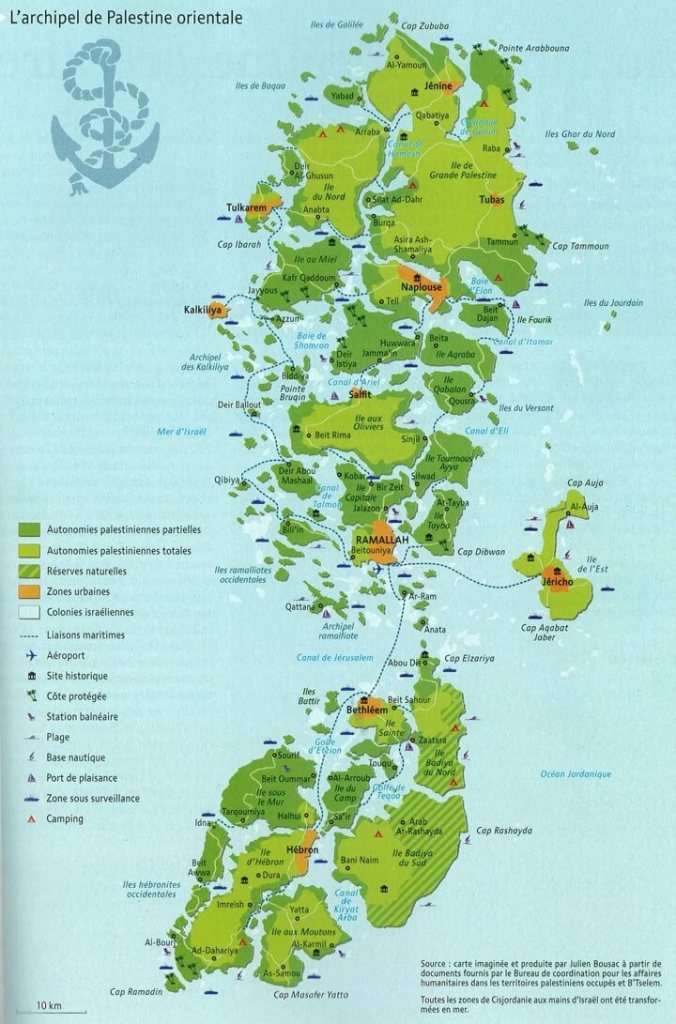
The map above shows what Palestine’s West Bank would look like if all non-Palestinian land suddenly turned into water.

All that would remain would be an archipelago of small islands with the sea of Israel to the west and the Jordanian ocean to the east.

The map is designed to show just how broken up Palestinian land in the West Bank really is. And while originally published in French, it is quite clear in the main point it’s trying to make.

Here are some key points about the map:

  1. Regions of Palestinian Authority:
    • The map shows areas of partial and total Palestinian autonomy, marked in different shades of green. The darker green areas represent total autonomy, while the lighter green areas represent partial autonomy.
  2. Israeli Settlements:
    • Areas in blue indicate Israeli settlements.
  3. Urban Zones:
    • Orange areas represent urban zones.
  4. Protected and Historical Sites:
    • Natural reserves and protected coasts are marked, along with historical sites.
  5. Geographical Representation:
    • The map depicts the West Bank as a series of islands, which illustrates the fragmented nature of Palestinian territories due to the division created by Israeli settlements, roads, and checkpoints.
  6. Symbols:
    • Various symbols denote airports, historical sites, protected coasts, beaches, and camping areas. There are also symbols indicating maritime connections, which, in the context of the map, seem to suggest metaphorical “water” crossings between different areas of Palestinian control.
  7. Geographic Features:
    • Names of regions and cities such as Ramallah, Nablus, Hebron, Bethlehem, and Jericho are mentioned, providing a sense of the location and distribution of these areas.

The map’s creation by Julien Bousac aims to highlight the challenges faced by Palestinians due to the fragmentation of their territories. The fictional archipelago metaphorically represents how the West Bank is divided and isolated, illustrating the complex political and social landscape of the region.

For books on this topic have a look at:

Source: “Palestine’s West Bank Archipelago,” Brilliant Maps, 17 June 2024


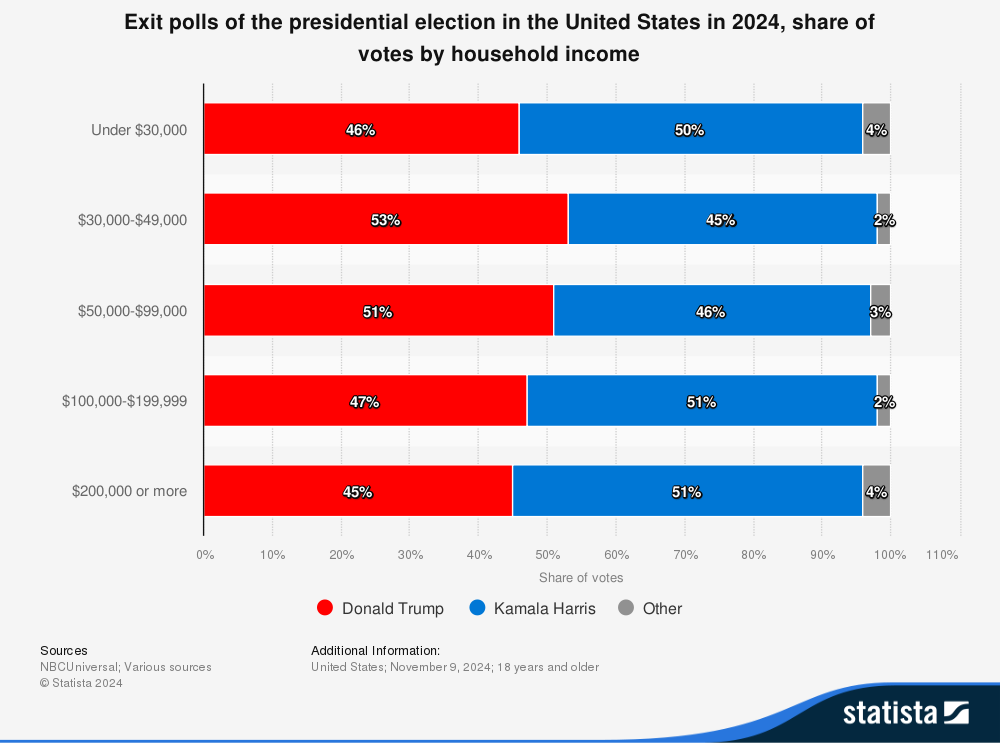
Red America and Blue America have become two different and mutually antagonistic countries sharing the same geographic space. They barely talk to each other, don’t understand one another — and while Blue America happens to be aware that both itself and Red America exist in a larger, infinitely complex world that needs both of them to be one whole for its survival, just as both of them need that larger world for theirs, Red America is not interested in and indeed is hostile to anything and anyone that is not itself and, while generally tending to be poor and perennially gripped by bitterness and resentment, derives its existential satisfaction almost exclusively from making Blue America feel bad — “owning the libs,” as Red America calls it.

Source: Mikhail Iossel (Facebook), 18 January 2024. The emphasis is mine. ||| TRR


Source: Statista


A really good series. I don’t know to what degree it straight up deserves а rating of eight, but it has interesting and fairly unique ideas, and the lead actress is pretty and acts well. We’ll see what the next episodes are like, but on the basis of the first one we can say [that the show] has fine potential. If it develops in a good direction, it could turn out to be decent.

Source: Ororo.TV. Translated by the Russian Reader

Alexander Podrabinek: Opposition Politicians Must Live in Russia to Do Their Jobs

Alexander Podrabinek in 1980

The recent prisoner swap has suddenly and quite vividly clarified the emotions and motives of the militant segment of the Russian emigration. Those who did photography in the old days will remember how you would dip a blank sheet of photographic paper into developer and gradually an image would appear on it. At first, the image would be vague, just outlines, but then it would become clearer and clearer, until finally you would pull it out from under the red lamp and hold it up to the white light: wow, you could see everything clearly!

I will avoid beeing politically correct and say everything I think. Emigrants from the so-called liberal crowd went abroad because they were afraid of going to prison in Russia. It’s an understandable fear—a valid reason, one might even say. The issue of personal security, their personal well-being and that of their families, was more important to them than Russian freedom and democracy, about which they spoke with such pathos and fervor at protest rallies, in the independent press, and on the internet. They did not have the guts, and such things happen. There is nothing laudable about it, but nothing catastrophic either. No one obliges them to sacrifice themselves, and they themselves were willing to be heroes on the podiums, but not in a real showdown with the repressive regime. All right, so they left: it’s no great loss. In any case, it is better to leave in time than to spill your guts later during an investigation.

I think most of those who have left Russia feel fine, but a certain segment of the emigration, the most militant and vocal, experiences emotional discomfort. They sense their own political inferiority, especially amidst what has happened in Russia to those who stayed, to those who have been resisting and are now in prison. To prove to themselves and others their insightfulness and to confirm the correctness of their choice to emigrate, they portray those who have remained in Russia as naive fools who don’t understand life. The very existence of political prisoners irritates them. They believe that people have been imprisoned by mistake or because they overestimated themselves. But they themselves didn’t overestimate!

Alexei Navalny’s decision to stay in Russia cut them to the quick. A month before his death, Navalny wrote in a letter from prison camp: “I have my country and my beliefs. I don’t want to give up either my country or my beliefs. I can betray neither the first nor the second. If your beliefs are worth something, you must be ready to stand up for them. And if necessary, to make sacrifices.”

The bombastic Ekaterina Schulmann just doesn’t get it. “The context of events is such that the first thought that comes to mind upon hearing the news is how he could have failed to leave [Russia] after the first [guilty] verdict, and almost the only emotion is amazement at this fact.” She is amazed: isn’t personal well-being the most important thing?

Dmitry Gudkov, a politician who is quite nimble in all respects, was even more definite at the time. “Almost all public figures, including well-known opposition figures, have been allowed to leave. But in case they didn’t get the signal, they go to jail. So if you don’t want to go to jail, you don’t have to wait for mercy from the Investigative Committee—there are flights to Tbilisi and other beautiful cities. At the slightest hint of danger, save yourself. The decision to take care of your life is always the right one.”

Gudkov and Schulmann are simple people, and they write about the benefits of cowardice in a straightforward, uncomplicated manner. But some others feel uncomfortable in such situations. They don’t like to feel as if they are fugitives saving they own skin—they need decent arguments. They want to remain on top, preferably at the heights they commanded in Russia, where everyone listened to them.

And what arguments are these? The most murderous one is that Russia is a lost country and the whole nation supports the fascist regime. As if there were not hundreds of political prisoners in camps and prisons who have chosen resistance rather than escape. As if there had not been rallies and marches throughout Russia, attended by many thousands of people, when such events could still be organized. As if the authorities didn’t have to falsify election results to avoid revealing Putin’s paltry electoral support.

Anna Rose writes about her Russian acquaintances, but it reads as if she is writing about Russians in general: “My Russian acquaintances didn’t show any sympathy for the real victims of aggression. The fact that in Ukraine, due to Russia’s fault and with their own tacit consent, people were being killed every day, that not only only cities were destroyed but also the basis for civic life in a sovereign country, seemed to them a backdrop, not the essence of what was going on.” What to do with such a worthless people? Clearly, run away from them and denounce them in the crudest possible language. And God forbid anyone should think that you are one of them yourself.

Journalist Victoria Ivleva took it a step further by attacking Vladimir Kara-Murza, Ilya Yashin, and Andrei Pivovarov on her Facebook page for talking too little and saying the wrong things about Ukraine at their press conference. “I would very much like to hear a single word of repentance from you, not stories about how Putin is to blame while the nation is wonderful and fresh. Who elected Putin time after time, was it not the nation? The war started by our Motherland has left us all with only one right—to get down on our knees.”

A well-off emigrant, Ivleva expects words of repentance from recent political prisoners who were imprisoned for their anti-war stance! Ivleva herself has nothing to do with it, she has nothing to repent for. It is they, the Russians, who should all fall on their knees as one, while those who left in time are not to blame for anything. But if we are talking about sincere repentance, shouldn’t Ivleva repent for the Soviet Union’s war against Afghanistan? That war was no less bloody than the current one, and Ivleva was then a civic-minded Soviet student and a successful journalist who was published in the Communist Youth Union’s newspaper. She didn’t protest. She didn’t get down on her knees. If we call everyone to repent for the sins of the regime, shouldn’t we turn to ourselves?

No, of course, only the people are to blame, the people who, according to Ivleva, have elected Putin time and time again. That is, the presidential elections, in her opinion, have been fair and transparent time and again: the president was elected by the people, the president is legitimate, and, therefore, the evidence of the people’s worthlessness is clear. And let’s forget about how the ballot rigging has been exposed and pretend that it didn’t happen.

The great thing about collective responsibility is that personal responsibility dissolves into universal responsibility. If everyone is to blame, then no one is to blame. It is a very convenient position. In a debate on Facebook, Konstantin Borovoy denounces the freed political prisoners: “Asking the West to lift sanctions when the regime has gone berserk and the citizens are supporting it is stupid and mean.” To say nothing of playing fast and loose with the facts (they were not talking about lifting sanctions, but about targeting them correctly), claiming that the citizenry supports the brutal regime is a sin against the truth. Some people support it and some don’t. No one knows the exact percentage, but it is certain that millions of people in Russia do not support this regime. Why should we talk about the unity of the party and the people and thus echo Putin’s propaganda? And if we are to blame everyone, shouldn’t we start with ourselves? Borovoy was a member of parliament during the crucial years and had much more sway in politics than the average man on the street. If something has gone wrong in our country, maybe we should think about our place in these processes? Or is everyone else to blame?

The premise of national guilt is not enough for successful self-affirmation. The liberated political prisoners are hysterically pointed to the plight of Ukraine and its prisoners of war in Russia, as if anyone would argue with this. But this generates the illusion that only the political emigrants are concerned about it, while no one in Russia understands any of it and no one in Russia sympathizes with Ukraine. The opinion that there are also Russian problems that require a political solution is jealously disputed: no, today there is only one problem—the war in Ukraine.

Yes, it is true that the war is the most important issue for Ukraine. But for Russia it is not the most important issue. It may be the most painful, but it is not the main one. For Russia, the primary problem is the authoritarian regime, a dictatorship which at a single person’s whim can start a war, murder dissidents, take away all freedoms, and threaten the entire world. The war in Ukraine is a consequence of Russia’s primary problem and this is what the liberated political prisoners were talking about. The fundamental solution to the issues of war and peace depends on the nature of the regime, not on military successes or defeats. Russia’s policy towards other states depends on the kind of regime it has. This is obvious.

Kara-Murza’s and Yashin’s desire to engage primarily in Russian politics and address the interests of Russia’s democratic future is understandable and rational. A democratic Russia will have no need of enemies on its borders or anywhere in Africa. It will return all annexed territories, pay reparations, and atone for and eventually redeem its guilt before Ukraine and the other countries it has attacked.

Opposition politicians must be in Russia to make this all happen. It won’t work otherwise. It’s understandable that this elicits a rabid reaction from political emigrants who label cowardice prudence and prefer glamorously clamoring in emigration to risking resistance in Russia. In my opinion, Kara-Murza explained it all quite clearly to them in an interview which he gave in March of this year while still in prison.

“A politician cannot work remotely. It is not a matter of practical efficacy; for a public figure, it is a question of ethics and responsibility to their fellow citizens. If you are calling on people to oppose an authoritarian regime, you cannot do this from a safe distance—you must share the risks with your community.”

Source: Alexander Podrabinek (Facebook), 6 August 2024. Translated by the Russian Reader. Mr. Podrabinek is a well-known dissident, journalist, human rights activist, and former political prisoner.

They Don’t Stay in Their Lane

Bizarre Beasts, “Tenrecs Will Not Stay in Their Lane”

If all crustaceans “want” to look like crabs, then tenrecs “want” to look like basically any other small mammal. These weird little guys are endemic to Madagascar—they’re native to nowhere else on Earth.

Source: Bizarre Beasts (YouTube), 7 April 2023. Thanks to Comrade Koganzon for the link and the BBC Radio 4 programme “Nature Table” for the inspiration.


Prominent Russian liberal in exile Gennady Gudkov wrings his hands over what the “coloreds” are doing to his Russian liberal fantasy “Europe”: “Europe’s new cultural (or multicultural?) code (if that really is Finland).” ||| TRR

Source: Gennady Gudkov (X), 6 July 2024


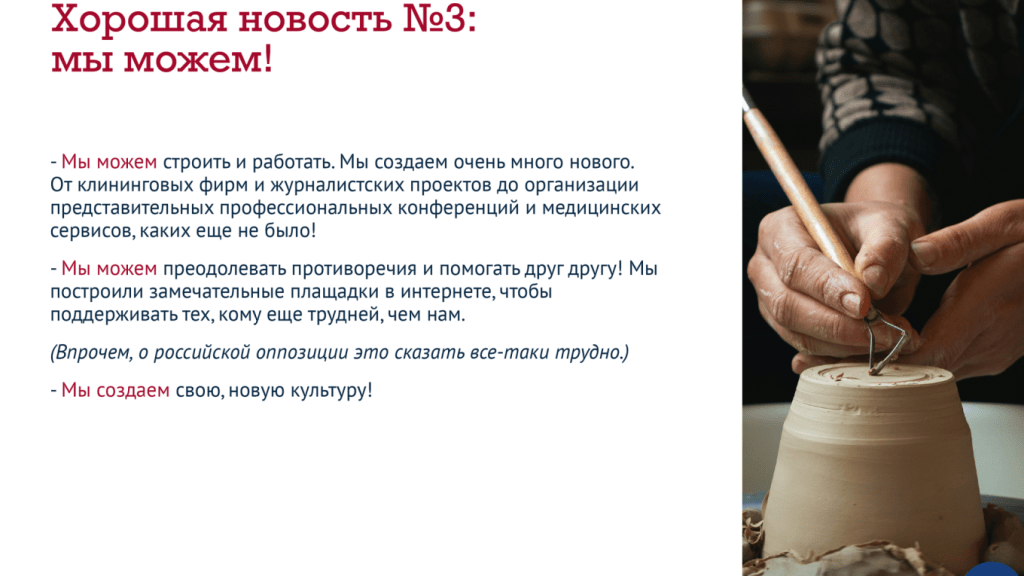
Good News No. 3: We Can Do It!

  • We can build and work. We have been creating many new things — from cleaning firms [kliningovykh firm] and journalism projects to organizing impressive professional conferences and medical services the likes of which have never been seen!
  • We can overcome animosities and help one another! We have built outstanding platforms on the internet to help those who have it worse than we do. (However, it is still difficult to say this about the Russian opposition.)
  • We are creating our new culture!

Source: “A Time Without a Place, or How to Survive New Circumstances,” Moscow Times Russian Service, 5 July 2024. Translated by the Russian Reader


Inside Russia with Ekaterina Schulmann

Sciences Po and its Provost Sergei Guriev, a world-renowned Russian academic and economist who had to flee his country in a day in 2013, were honoured to welcome ‪@Ekaterina_Schulmann‬ for a very exclusive conference on 20 April, 2023. This political scientist and social media sensation guest speaker addressed the serious matters of the Russian regime stability and the dynamics of public opinion.

Source: Sciences Po (YouTube), 8 May 2023. My question, had I been in the auditorium for this fascinating lecture, would have been to the audience: how many of you are neither Russian nationals nor speak Russian? I suspect that the numbers of such non-Russian nationals and non-Russian speakers were quite low. And why was this lecture delivered in English, not French? ||| TRR


Source: unsolicited ad on Facebook

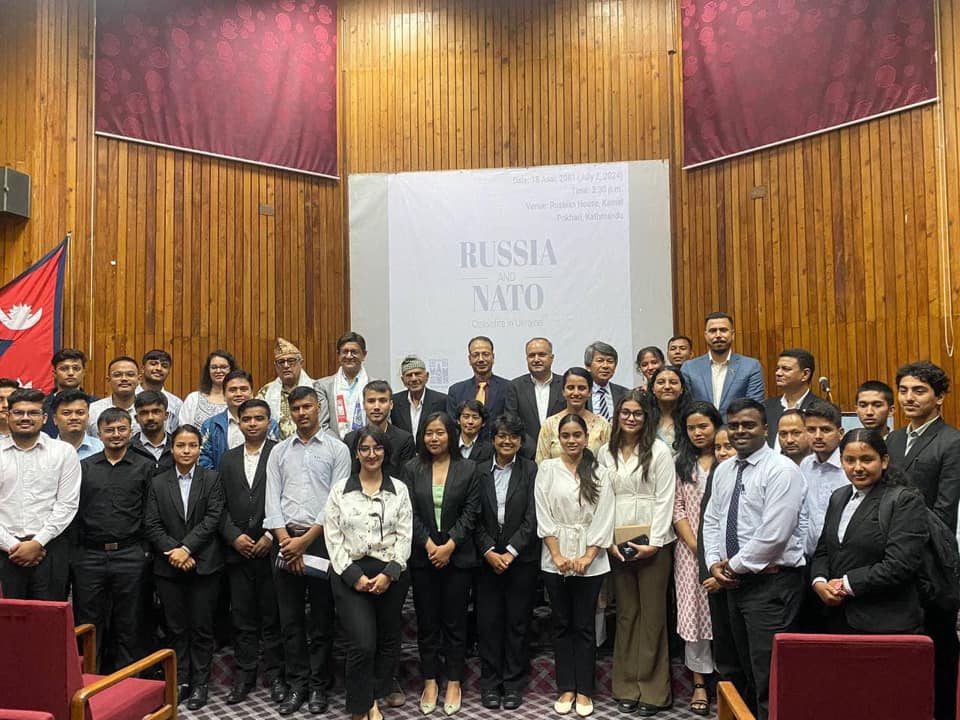
On 2 July 2024, International Law Club successfully organized an academic discourse entitled “Russia and NATO: Ceasefire in Ukraine.”

The speakers for the program included Dr. Yubaraj Sangroula (Professor of International Law), Dipak Gyawali (Former Minister of Ministry of Water Resources, Nepal), Dr. Govind Kusum (Former Secretary of Ministry of Home Affairs), Prem Chandra Rai (From Himalayan Development Affairs Council, Nepal), Yugichha Sangroula (Masters in International Humanitarian Law from Geneva), Dmitry Stefanovich (From IMEMO RAS, Moscow)

The welcoming remarks for the discourse were delivered by Anton Maslov, First Secretary and Director of the Russian House. The distinguished Chief Guest of the program was Seniormost Advocate Krishna Prasad Bhandari.

Dr. Dipak Gyawali provided valuable insights into the historical context of the Russia-Ukraine conflict, emphasizing its longstanding nature within the framework of NATO-Russia dynamics.

Professor Dr. Yubaraj Sangraoula shed light on the hegemonic influences and Western interference in global affairs, highlighting the concept of a rule-based international order that has been divisive.

Assoc. Prof. Yuggichhya Sangroula emphasized the importance of interpreting international law in a balanced manner, noting the significant contributions of Asian nations to its development alongside European nations.

Assoc. Prof. Prem Chandra Rai advocated for adherence to the UN Charter as the foundation of international law, stressing the need for inclusive peace initiatives that engage all relevant parties, including Russia.

Dr. Govind P. Kusum underscored the disproportionate impact of global conflicts on developing nations and emphasized the urgent global need for peace and security.

Mr. Dmitry Stefanovich discussed the inadequacy of mere ceasefires and called for sustainable solutions and increased global cooperation, particularly from the Global South, to address ongoing conflicts.

The subsequent question and answer session facilitated critical discussions on ceasefire strategies and institutional reform. Speakers analyzed geopolitical dynamics, and Western dominance, and proposed measures for achieving global peace and security, with a focus on strategies applicable to third-world nations.

Overall, the seminar provided a platform for robust dialogue and strategic insights into resolving international conflicts and fostering a more peaceful world order.

We sincerely express our gratitude towards the speakers, guests, and participants for their involvement.

The Club would like to thank the Russian House, especially the Director of Russian House, Mr. Anton Maslov for supporting us in organizing this academic discourse and acknowledge the presence of Ms. Alena Danilova, Press Secretary from the Russian Embassy at this program of ours.

Source: Russian House in Kathmandu (Facebook), 4 July 2024. See “How to Escape from the Russian Army” (New York Times, 27 June 2024) for a slightly less sanguine perspective on Russian-Nepalese relations.

Moral Equivalence

I found this “hilarious” cartoon attached to an essay entitled “No Moral Equivalence in the Middle East,” but it serves just as well as an illustration of the sadly predictable “liberal Russian” ruminations, below. ||| TRR


Hello, dear readers!

This is the Moscow Times weekly newsletter at your disposal. Let’s hope that our friends, acquaintances, relatives, and just plain Israelis survive the barbaric attack by terrorists from Hamas and Islamic Jihad with minimal losses. We’ll discuss the role the Russian Federation played in this attack below, immediately after a preview of this issue.

You will read:

  • about debt-ridden Russians;
  • about the demographic disaster in the Russian Federation;
  • about the civil war in Moscow thirty years ago.

But let’s go back to Israel. Yes, it has to be said that the Israeli special services, often called the best in the world, failed to fulfill their principal mission this time round. They were asleep at the wheel in the face of the most serious danger, and the country has paid for it with the lives of not only soldiers, but also of ordinary people. Israel has already lost at least 300 people, and many more have been seriously injured, while Palestine [sic] says there have been 250 victims [among Palestinians?], but the military [sic] operation against Hamas has only just begun.

Commentators have especially focused on the number of rockets that Hamas has managed to stockpile, and see in this the undoubted support of Iran and, possibly, Syria. Without its involvement, weapons or parts of weapons would simply not have got from Iran to Palestine [sic]. It’s geographically unlikely.

Here is what the Iranian Foreign Ministry had to say: “The protection of their land and shrines from occupation, aggression, daily crimes and terrorism on the part of the Zionist regime is the natural and legitimate right of the oppressed Palestinian nation.” And here are the words with which Vladimir Putin justified the invasion of Ukraine: “The purpose of the special operation is to protect people who have been subjected to bullying and genocide by the Kiev regime for eight years.” Putin has also repeatedly called the Ukrainian leadership “terrorists.”

Russia, unlike most European countries and the United States, does not consider Hamas a terrorist organization, and Moscow received its leader Ismail Haniyeh with all possible honors just a year ago. Now Haniyeh says that Hamas is going to seize Jerusalem—and the Russian Foreign Ministry officially agrees with him: Palestine [sic] should be returned to its 1967 borders and have its capital in East Jerusalem.

But the point, of course, is not in the verbal support that the Russian Federation has provided to Hamas. Russia, by unleashing a war in Ukraine, has shown that international law and diplomatic methods of conflict resolution can be ignored. We should also not fail to point out the consistent indecision of Western countries in response to Russian aggression. This indecision was undoubtedly noticed by Iran, which freely supplies weapons to the Russian Federation, and by Azerbaijan, which blockaded and then conquered Nagorno-Karabakh, and by Palestine [sic], which stockpiled a gigantic arsenal and has put it to use. The Russian Federation has shattered the world order with its actions, and considerable efforts will be required to return to the situation of three years ago, if at all it is possible to return to it.

Let’s finish with the statement made by the Taliban movement, who have also received a warm welcome in the Kremlin. The Taliban appealed to Iran, Jordan, and Iraq to let their troops go help Hamas conquer Jerusalem.

[…]

The Hamas attack is Israel’s Pearl Harbor for Israel, military expert Sergei Migdal argues [in his opinion piece] about the causes and consequences of the attack, written hot on its heels. If you want to read about the background of what is happening, then here is an almost academic article by Ze’ev Khanin, in which he clearly answers the question of whether it is worth negotiating with terrorists.

[…]

Source: Moscow Times Russian Service weekly email newsletter, 8 October 2023. Translated by the Russian Reader, who reminds his readers that the opinions expressed in the texts published in this almost-sixteen-year-old Russian zeitgeist chronicle may not coincide with his own. But how else would his readers find out that “liberal” Russians don’t regard Palestinians and many other Arabs (e.g., Syrians) as full-fledged human beings who can lay claim to the same rights and freedoms as “just plain Israelis” and “liberal” Russians?

Surrender

“A Declaration of Russian Democratic Forces”

Declaration Russian Democratic Forces started this petition

In this tragic hour, we declare our strategic goals to be the cessation of aggression against Ukraine and the creation of a free, law-governed, federated Russia. To accomplish this, we deem it necessary to coordinate our actions more vigorously. We declare our commitment to the following principled positions:

1. The war against Ukraine is criminal. Russian troops must be withdrawn from all occupied territories. Russia’s internationally recognized borders must be reinstated. War criminals must be brought to justice, and compensation must be paid to the victims of the aggression.

2. The Putin regime is illegitimate and criminal. Therefore, it must be eliminated. We envision Russia as a country in which the rights and freedoms of individuals are guaranteed, and in which the possibility of usurping state power is excluded.

3. The pursuit of imperialist policies inside and outside the country is unacceptable.

4. Political prisoners and prisoners of war should be released, forcibly displaced persons should be able to return home, and abducted Ukrainian children should be returned to Ukraine.

5. We express our solidarity with those Russians who, despite the monstrous crackdown, have had the courage to publicly voice anti-Putin and anti-war stances, and with those tens of millions who refuse to be accomplices in the regime’s crimes.

The signatories of the Declaration espouse the values of a democratic society and respectful discussion. They acknowledge human rights and freedoms and the principles of diversity and equality, and they reject discrimination.

The signatories refrain from public conflicts within the democratic and the anti-war movements.

We commit ourselves to supporting this Declaration until our common strategic goals have been achieved.

Berlin, 30 April 2023

Signed publicly by:

  1. La Asociación de Rusos Libres (Spain)
  2. Stuttgart Activist Group
  3. The Flame of Freedom Movement
  4. Мedia Partisans
  5. Russie-Libertés (France)
  6. Mikhail Khodorkovsky, politician
  7. Yevgeny Chichvarkin, member of the Russian Action Committee
  8. Garry Kasparov, co-founder of the Free Russia Forum, Russian Action Committee
  9. Boris Zimin
  10. Yevgenia Chirikova
  11. Anastasia Burakova, founder of the Ark
  12. Sergey Aleksashenko
  13. Yulia Latynina, writer, journalist
  14. Alfred Koch
  15. Mark Feygin
  16. Sergei Guriev
  17. Dmitry Gudkov, politician
  18. Yevgeny Kiselyov
  19. Kirill Rogov
  20. Ivan Tyutrin
  21. Maxim Reznik
  22. Elena Lukyanova
  23. Andrei Illarionov
  24. Leonid Gozman
  25. Demyan Kudryavtsev
  26. Yuri Pivovarov, historian
  27. Marat Guelman, SLOVONOVO Forum of Russian Culture in Europe

[and 64 other signatories]

Source: Change.org. Thanks to Boris Romanov for the heads-up. Translated by the Russian Reader


Cheap Trick, “Surrender” (1978)
[Intro]

[Verse 1]
Mother told me, yes, she told me
I'd meet girls like you
She also told me, "Stay away
You'll never know what you'll catch"
Just the other day I heard
Of a soldier's falling off
Some Indonesian junk
That's going 'round

[Chorus]
Mommy's alright
Daddy's alright
They just seem a little weird
Surrender
Surrender
But don't give yourself away
Hey, hey

[Verse 2]
Father says, "Your mother's right
She's really up on things
Before we married, Mommy served
In the WACS in the Philippines”
Now, I had heard the WACs recruited
Old maids for the war
But Mommy isn't one of those
I've known her all these years

[Chorus]
Mommy's alright
Daddy's alright
They just seem a little weird
Surrender
Surrender
But don't give yourself away
Hey, hey

[Verse 3]
Whatever happened to all this season's
Losers of the year?
Every time I got to thinking
Where'd they disappear?
But then I woke up, Mom and Dad
Are rolling on the couch
Rolling numbers, rock and rollin'
Got my KISS records out

[Chorus]
Mommy's alright
Daddy's alright
They just seem a little weird
Surrender
Surrender
But don't give yourself away
Hey, hey
Away
Away

[Outro]
Surrender (Mommy's all right)
Surrender (Daddy's all right)
But don't give yourself away
Surrender (Mommy's all right)
Surrender (Daddy's all right)
But don't give yourself away
Surrender (Mommy's all right)
Surrender (Daddy's all right)
But don't give yourself away
Surrender (Bun E.’s alright)
Surrender (Tommy’s alright)
But don't give yourself away (Robin’s alright, Rick’s alright)
Surrender (We’re all alright)
But don't give yourself away (We’re all alright, We’re all alright)
Surrender (Mommy's all right)
Surrender (Daddy's all right)
But don't give yourself away
Surrender (Mommy's all right)
Surrender (Daddy's all right)
But don't give yourself away

Source: Genius

Access Code

Liberal Russian journalist Yulia Latynina, a columnist for liberal newspaper Novaya Gazeta, during the 31 July 2021 broadcast of her weekly show (“Access Code”) on the nominally liberal radio station Echo of Moscow:

I want to tell the Lithuanians that it is really quite simple to combat illegal migrants. You just need to put every illegal violator who has crossed the border, not in prison, for God’s sake, just in some place surrounded by a fence, give him a loaf of bread and two liters of water, and put each additional [violator] there as well. When the number of detainees exceeds ten people per square meter, and the amount of food in the form of bread and water remains the same, then everyone who cannot remember where they came from and what their names are – all these wonderful people will immediately voice the desire to return to their homeland. And new ones will mysteriously stop coming.

Igor Yakovenko: Ordinary Racism

Censored-Stamp

____________________________

Ordinary Racism: What Vladimir Solovyov, Andrey Illarionov and Mark Solonin Have in Common
Igor Yakovenko’s Blog
June 10, 2020

First, three quotes.

Quote No. 1. “I’m waiting for when Russia’s ‘beautiful people’ go to kneel before African Americans and repent. But where will they go? The US embassy? There’s not much space there. Maybe it would be better to go to the Pushkin monument [in downtown Moscow]? After all, [Pushkin’s] great-grandfather was brought from Abyssinia by force.” (Vladimir Solovyov, TV presenter)

Quote No. 2. “Non-punishment (or less severe punishment) for similar crimes by criminals of one group, who enjoy their privileged position, leads to impunity and, consequently, to an even greater increase in crimes and even greater aggressiveness on the part of this group of criminals.” (Andrey Illarionov, economist)

Quote No. 3. “At their own expense and effort, white people, often risking their lives (storms, crocodiles, snakes, virus-bearing mosquitoes) transported many, many Negroes from Africa to the very best (yes, yes!) country in the world. Compared with those who remained in Africa, the descendants of the people who were shipped away live in paradise.” (Mark Solonin, writer) 

These words were written by three very different people, who evoke contradictory feelings.

Solovyov has become a mascot of the Putinist information wars and incitement to hatred, deserves the deepest contempt and a criminal trial.

Illarionov has evoked respect and sympathy for his profound, scrupulous analyses, and his clear and consistent anti-Putinist stance.

Solonin, a meticulous researcher of the Second World War and a furious debunker of the official Soviet-Russian version, has furnished important food for thought about a crucial event in Russian history.

What all three men have in common is that they are racists.

Solovyov’s racism fits seamlessly into his overall profile. And this additional touch to a notorious scoundrel’s portrait would not be worthy of separate consideration if this exact same mockery of kneeling by American police officers and officials had not become a mass phenomenon, encompassing Russians with reputations as liberals, humanists and democrats, as so-called decent people.

The whole world watched the slow sadistic murder by a white police officer of a detained African American man, who was lying face down in handcuffs and clearly was not putting up any resistance. Police officials initially defended their sadistic police officer, saying that the victim had resisted, although the video showed that there was no resistance, and police “experts” initially lied that Floyd had died not as a result of suffocation, but due to the consequences of an incorrect lifestyle and bad habits. Only after the protests began, and the protests turned into riots, was the sadistic police officer dismissed from his post and charged with murder.

This story has many aspects, which we should examine separately, point by point. Solovyov and the “decent” people who have sided with him find it quite hilarious that police officers and politicians in the United States have been taking a knee in protest against racism. Many “decent” people are indignant, wondering why these officials should repent for something that was not their fault.

In 1970, German Chancellor Willy Brandt knelt before the monument to the victims and heroes of the Warsaw ghetto during a visit to Poland. Brandt was not personally involved in the Third Reich’s crimes. On the contrary, he had spent his entire adult life fighting Nazism and was involved in setting up the anti-fascist underground. Hitler’s government stripped him of his German citizenship. Brandt was one of those Germans who had every moral right not to feel responsible for the Holocaust and the Third Reich’s other crimes. But he did not explain to the Poles and Jews that he wasn’t a Nazi, and that post-war Germany was not anything like the Third Reich. And by making that gesture, by kneeling, he clearly showed that he was not a Nazi and that Germany was not the same as the Third Reich. I think it is the same story with kneeling in the United States. People just want to visibly and demonstratively delineate themselves from racism and racists. In my opinion, they have succeeded.

Quote No. 2 is taken from Andrey Illarionov’s article “Institutional Racism in Reverse, or The Privileged Position of Black Criminals,” which was published on the websites Kasparov.ru and Echo of Moscow. The article is chockablock with statistics intended to prove that, although many more African Americans per million are killed by the police than other Americans, this is because African Americans are much more likely to resist and try to escape the police, and much more likely to commit violent crimes than the average white person.

Although Illarionov stipulates in his article that he does not touch on the “philosophical and ethical issues,” these issues simply scream from every line. Their essence is in the paragraph I have quoted, in which every word is a gem: “Non-punishment [of black criminals], who enjoy [!] their privileged position, leads to impunity and, consequently, to a even greater increase in crimes.”

The way George Floyd enjoyed his privileged position for eight minutes and forty-six seconds has been seen by millions of people on the planet. And unabashedly using their privileged position, American Blacks die on average several years earlier than their white fellow citizens. I was not able to find exact data on the distribution of deaths from Covid-19 in the United States as a whole (they write that there is no such data), but in some regions the statistics look like this. Blacks make up 30% of the population in Chicago, but they constitute 70% of coronavirus-related deaths in the city. African Americans make up 15% of the population in Illinois, but they constitute 43% of the coronavirus-related deaths in the state. And so on.

Illarionov’s article is meant as a commentary on the events triggered by an African American’s agonizing death. Illarionov writes that Blacks in the United States “enjoy their privileged position.” What has to be wrong with your brain to write something like that?

When statistics are used selectively and purposefully, they can “prove” anything or almost anything, prompting the most monstrous conclusions. For example, one of the favorite games of anti-Semites is counting up the number of Jews who were involved in the October Revolution, as well as who of them served in the Cheka and its successor agencies. True, the game usually involves tons of typical anti-Semitic lies, but even if for some reason we count honestly, it is quite possible that the percentage of Jews in these organizations was higher than the percentage of Jews in the overall population. And what of it? What conclusion does this statistic suggest unless it is part of a serious historical analysis? That “the Jews destroyed Russia”?

From Illarionov’s statistical analysis it directly follows that “the Blacks have gotten out hand,” that they “enjoy their privileged position,” their “impunity”, and that means the police should act more harshly towards Blacks to even the balance, as it were.

Andrey Nikolayevich, are you sure that pushing such conclusions on your readers is not tantamount to pouring fuel on the fire?

Mark Solonin writes how noble whites, risking their lives, brought ungrateful Blacks to the best country in the world. At first, I thought Solonin was being sarcastic, but then I looked over the entire text and realized the writer was absolutely serious. Over the course of 400 years, whites sold more than 17 million blacks into slavery and transported them across the Atlantic in the holds of ships. One in six died along the way, and of those who survived, half perished from disease and the sadism of slaveholders.

Solonin writes, “Compared with those who remained in Africa, the descendants of the people who were shipped off live in paradise.” In other words, Solonin does not seem to understand that people tend to compare their lives not with those who live in another continent, but with those who live in another neighborhood of the same city. He is apparently unable to understand the trauma of others, a trauma brought on by centuries of slavery and subsequent decades of discrimination, things that have ended just now, during our lifetimes, and as discrete manifestations have not yet ended. Solonin, apparently, is unfamiliar with the concept of historical and social inertia, which shadows the lives of the young men and women who grew up in Black neighborhoods, with their criminal subculture, poverty and drugs.

The spotlight of American racial upheaval has shone on the Russian “liberal” crowd, revealing spatters of racism even in places where it was categorically impossible to suspect they would be found. Viktor Shenderovich, a person for whom I have a great deal of respect, wrote that he considers it “a collective dislocation of the brain” to condemn a journalist who, when asked about his attitude to the slogan “Black Lives Matter,” replied that “all lives matter.” His detractors reminded the journalist of the Holocaust, asking him how he would respond to the claim that since not only Jews were killed, there was no need to “overhype” the Jews, because all lives matter.

Shenderovich’s reaction should be quoted in full.

“It is a monstrously vulgar analogy. And a false analogy. It would have been accurate in the time of the slavers or the Ku Klux Klan’s heyday, but none of this can be observed today. Blacks in the United States are not burned in ovens and do not have distinguishing insignia sewn on their clothes.”

Historically, in the milieu to which Shenderovich, Illarionov, Solonin, Solovyov (no matter how disgusting that might sound), and your humble servant belong, anti-Semitism is regarded as an absolute evil, an extremely indecent disease that must be carefully concealed. This is understandable, given the fact that the Holocaust swept through our land, many of our compatriots were its victims, and it was followed by decades of official anti-Semitism in our country. Therefore, someone who gives off the faintest odor of anti-Semitism immediately becomes an outcast. The tragedy of Blacks took place across the ocean. So, in my Facebook feed, I have no trouble finding the wildest racist statements, such as the proposal to “send all that biological waste back to Africa.” And the main thing is that, on the social media pages of quite “decent” people, such racism provokes no resistance.

Shenderovich thinks that the comparison between the Holocaust and the tragedy of Blacks in America is a “monstrously vulgar” comparison. “Blacks in the United States are not burned in ovens and do not have distinguishing insignia sewn on their clothes”? Nor is this the case with Jews at the moment. Despite the fact that any analogy is always lame by definition, the historical tragedy of the Jewish people and the Black population of the United States is quite comparable in terms of the number of victims and the depth of the trauma suffered by these peoples.

What is happening now in the United States and generates such profound misunderstanding among the Russian “liberal” crowd is not a “collective dislocation of the brain,” but a further development of humanism, in which the West is still at the forefront of humanity. The whole history of humanism is its expansion, the extension of empathy to more and more categories of Others, who are made equal not only in terms of legal rights, but also in terms of their right to empathy and compassion.

The fact that a person with a criminal past has become the symbol of the protest movement is a manifestation of the further evolution of the humanism that is so bitterly rejected by the majority of Russians, including the Russian “liberal” crowd. It is telling that even those Russian human rights activists who quite rightly speak out in defense of inmates who are beaten by guards in Russian penal colonies, insist that the victim “was not a moral person”—although at the time of his death, George Floyd had already served his time and was on the straight and narrow.

What the American spotlight has highlighted in Russian society, including its enlightened segment, bears a strong resemblance to a deep pathology. It is as if an old floorboard has become accidentally dislodged and a stench has filled the room. Either there is an old corpse below the floor, or the sewer pipes have burst. Life in our little Facebook and YouTube world had been so nice and amicable: it was so cozy when everyone could chew out Putin and Stalin in unison. And then the damned Americans screwed it all up with their problems!

Translated by the Russian Reader

Alexander Skobov: The Myth of “Good” Liberals in Power

toppala

Alexander Skobov
Facebook
August 18, 2019

I have to reiterate my fundamental disagreement with mainstream liberal political analysts. Stated briefly, their big idea is that the Russian political elite consists of two parties, so-called civic liberals, who support bourgeois modernization, and the security forces, who support the restoration of the Soviet Union in both its manifestations—as a totalitarian political regime and as an economy totally subordinated to the state. All recent events are thus interpreted in the light of the alleged struggle between the two parties, i.e., the party of the security forces has gone on a decisive offensive.

This is a liberal myth. The Russian liberal crowd, who are mainly right-wing liberals, concocted the story that increasing crackdowns and the Putin mafia state’s transition from a soft-core authoritarian imitation democracy to a hard-core authoritarian regime has been opposed by a party of court (systemic) liberals, a party informally led by former Russian finance minister Alexei Kudrin.

Can anyone produce even a single bit of evidence corroborating the so-called Kudrin party’s opposition to the policy of increasing crackdowns? Right-wing liberals would tell me the Kudrinistas are forced to act out of the public eye and play by the rules governing infighting among courtiers (apparatchiks). The fact this infighting has no outward manifestations is no proof that there is no showdown between the two parties, they would argue.

Let’s assume this is true. Where, however, did Russia liberals get the idea there is even one cause for such a showdown? Kudrin and other systemic right-wing liberals have always advocated an authoritarian modernization in which a “progressive” elite imposes unpopular social and economic reforms on the unwashed masses with an iron hand. By and large, their ideal is shared by the so-called Russian fascists, i.e., the “patriots” and statists. The occupation regime running mainland China carried out the very same economic reforms after crushing dissenters on Tiananmen Square in 1989.

Has Mr. Kudrin ever said publicly that he is a principled opponent of such methods of strangling the opposition? He has not. Then why have Russian liberals decided he opposes the mass detention of peaceful citizens for protesting in public at certain times?

Liberals should stop imagining they have intercessors in the top ranks of the Putin organized crime group. There are no such intercessors.

Translation and photo by the Russian Reader

Alexei Tsvetcoff: The Myth of Moscow’s “Bourgeois Liberal” Protesters

vadim f. lurie-10 august-fuck off-2.jpg“Fuck Off, Putin!” Protesters at the August 10 fair elections rally in Moscow. Photo by Vadim F. Lurie

Alexei Tsvetcoff
Facebook
August 14, 2019

I have to say something about the extremely tenacious, contagious myth that bourgeois liberals are the only people protesting at present. They are strangers to regular folks, so the myth goes, and thus the cops, who come from the common people, take such pleasure in beating them black and blue.

The myth is not borne out by the facts. Among the most malicious “street extremists,” the people who have had criminal charges filed against them, there are an unemployed man, a construction foreman, and several students from a variety of colleges, some of which are not so posh.

There are, of course, also a couple of programmers and a manager in the group of people who have been arrested and charged, meaning it is a cross-section of the Moscow populace, with no class dominating one way or another. If you have been to the protest rallies you will have seen that members of nearly all social groups were in attendance except for oligarchs, officials of the current regime, and the cops, who are on the other side.

When you present this simple empirical evidence to proponents of the “elite protest” myth, they have one last argument, also fallacious, up their sleeves.

Okay, they say, maybe Muscovites of all stripes really have taken to the streets, but their leaders, the people who encouraged them to come out, who led them onto the streets, are definitely bourgeois liberals who are strangers to simple blokes.

There is no evidence of this, either. Among those who spoke at the rallies and somehow represent the protesters, there were people who espouse completely different political views and come from all walks of life. It would be hard to pigeonhole municipal district council member and independent candidate Sergei Tsukasov as a bourgeois and liberal, wouldn’t it? And what about Alexei Polikhovich?  I could go on but I would have to list nearly all the speakers.

To see “liberals” and “agents of the west” in this extremely diverse group of people, who share only one demand (the same rules for everyone: the universal right to nominate candidates for public office, vote for them, and run for public office themselves) you have to be willing to see the world the way the Putinist TV channels paint it.

As for the cops, they retire at a completely different age, earlier than ordinary folks. The current oligarchic regime provides them with apartments and tons of other perks. So, there is no way they could be classified as ordinary people.

They have such great fun waving their billy clubs at any and all dissenters because they have a very specific material interest. The thievish regime need only toss them scraps from its table for them to have an excuse to be really cruel to anyone who threatens the regime’s privileges.

Meaning, simply, that the cops are in on the take. They do a good job of guarding their master, who keeps them well fed. They could not care less who this master is. In this sense, it is completely pointless to reason with them, shame them, and appeal to their conscience.

Returning to the popularity of the myth that it is snobby liberals raising a ruckus on the streets nowadays, I should point that, first, although the myth is at odds with the obvious facts, it is so persistent because it is propped up by two crutches, not one. And, second, it relies on the regime’s ubiquitous propaganda. In this case, the oligarchic regime has no argument but that everyone who opposes it is an enemy of ordinary people.

So, the choir of Solovyovs, Kiselyovs, and hundreds of other agitprop yes men sing this song at a deafening volume, competing with each other in the process, because how loud they sing probably has something to do with how close they will get, in the end, to the feeding trough and, thus, with being able to be as far from the selfsame hoi polloi as they can. There is no way people like them want to get mixed up with the broad popular masses, to sink to their level. They want to keep on living the good life of propagandists with all the foreign real estate, offshore bank accounts, and other perks that working as professional fans of the Motherland entails.

But that was the second reason the myth of anti-populist liberals is so persistent. The first reason is completely different. It is the perfect excuse for the political passivity and political fear experienced by people in our atomized society with its extreme shortage of solidarity and self-respect.

The Russian man in the street says something like this to himself.

Of course, I see what has been going down. I see how the haves have divvied everything up among themselves and where things are going. Why don’t I go out and take my stand against them? Maybe it’s because I’m a bit of a chicken?

But that hurts and I don’t want to think about it. I need another, more flattering argument . . . Right, that’s it.  I don’t go to protest rallies and avoid getting messed up in politics because all the people who do go out and protest are—

(He reaches for a lifesaver in the shape of his TV set’s remote control or a Kremlin-funded website.)

—all liberals and agents of the west. (Thanks for the prompt!) Employees of the US State Department and enemies of the common folk, they want to bring back the nineties. Elections are only a cover.

I am no fool. I would never go anywhere with these people and demand anything. I am smart and discerning, and now I have an alibi for when I look at myself in the mirror. And since I want to stay this way forever, I am going write the treasured mantra on the inside of my door: “Better the devil you know than the devil you don’t.”

Thanks to Sergey Abashin for the heads-up. Photo courtesy of Vadim F. Lurie. Translated by the Russian Reader
P.S. You are probably wondering why a pro-common people myth-buster such as Mr. Tsvetcoff would resort, in the end, to trotting out the sock puppet of the Russian “man in the street” (obyvatel’) who, allegedly, believes everything he sees on Kremlin-controlled Russian TV. This is because, whether liberal, leftist (like Mr. Tsvetcoff), nationalist or none of the above, almost no one in the country’s self-styled opposition has figured out that you oppose a terrifying, destructive, criminal regime like the Putin regime with superior political organization, not with a sense of your own moral and intellectual superiority.

Since the Russian opposition is inordinately fond of protest rallies and marches, you would think it would pull out all the stops to get as many people to them as possible and, thus, scare the hell out of the regime. But if there is anything the Russian opposition hates more than the Putin regime, it is grassroots political organizing, meaning knocking on doors, stopping strangers on the street, buttonholing friends, neighbors, and workmates, and persuading them to do something most of them will not want to do at first: protest publicly against the regime. As nearly no one does the dirty work of getting people to rallies, almost no one goes to them.

Rather than blame themselves for their unwillingness to mobilize people and thus organize a movement that could, eventually, be capable of confronting the regime and perhaps defeating it, the opposition is fond of blaming the unwashed masses and “men in the street” for their passivity and timidity. When opposition liberals play this blame game, they usually target public sector employees, the lumpenproletariat, and residents of Russia’s far-flung hinterlands, who, allegedly, constitute Putin’s electoral base.

I would have thought opposition leftists would know better than to make what amounts to the same argument, but I was wrong. // TRR

Exodus

DSCN3281Human capital is fleeing Russia. Since President Vladimir Putin’s ascent to the presidency, between 1.6 and 2 million Russians—out of a total population of 145 million—have left for Western democracies and some new destinations where they can be freer with their skills put to better use. This emigration sped up with Putin’s return as president in 2012, followed by a weakening economy and growing repressions. It soon began to look like a politically driven brain drain, causing increasing concern among Russian and international observers.

In this report, the Atlantic Council’s Eurasia Center offers a comprehensive analysis of what we are calling the Putin Exodus and its implications for Russia and the West. It is supported by a pioneering sociological study of new Russian émigrés now living in four key locations in the United States and Europe, through a 100-question survey and a series of focus groups.

[…]

There are two particularly important findings. On the one hand, the new Russian émigrés living in different locations are very similar in the way they use their high cultural capital to adapt to new life and employment in a postindustrial society. At the same time, there is a distinct disparity between those who emigrated before 2012 and those who left later: among other things, the latter demonstrate a growing pro-Western and liberal orientation and greater politicization in general, including stronger support for the anti-Putin “non-systemic” opposition.

John Herbst and Sergei Erofeev, The Putin Exodus: The New Russian Brain Drain (Atlantic Council, Eurasia Center, 2019), p. IX

Although I am the last person who thinks you can find out what people really think using opinion polls, questionnaires, and focus groups, this new report from the Atlantic Council does, at least, deal with something real that has been underreported and little discussed in Russia and elsewhere. Since I have had lots of conversations with many different Russian immigrants over the years, I am also skeptical about the report’s optimistic conclusions about their alleged “liberalism.” Nevertheless, it is worth reading. Thanks to the invaluable Mark Teeter for the heads-up. Photo by the Russian Reader//TRR