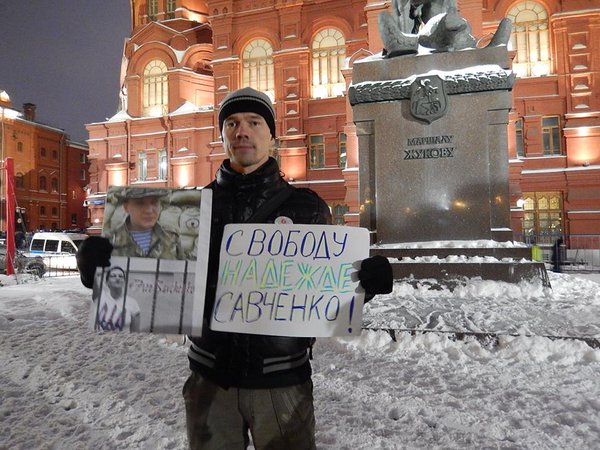
Ildar Dadin, protesting the imprisonment of Ukrainian fighter pilot Nadja Savchenko. Photo courtesy of Russian Avos
Maria Eismont The Case of Ildar Dadin Why Society Has Not Ignored a Story about Torture in Prison Vedomosti
November 10, 2016
The controversy provoked by activist Ildar Dadin’s letter about the torture and abuse to which he and other prisoners have been subjected in the Segezha prison colony has been simmering for two weeks. The longer the topic of the inhumane treatment visited on people in penitentiaries occupies the media, including state TV channels, which have been forced to join the discussion of Dadin’s plight, the more likely society will be able to change things. Daily publications containing fresh testimonies about torture in Russian prisons have shown Dadin’s case is not unique. However, no controversies over violence in prisons have yet led to serious reforms of the penitentiary system or even a significant descrease in the number of “torture” colonies.
So what is different about the Dadin case? First, even Dadin’s ideological opponents have recognized him as a prisoner of conscience. Who seriously believes in the necessity of sending somone to prison for a series of peaceful solo pickets? Second, his obvious innocence in the eyes of the rank and filke attracts the attention of people unable to sympathize with criminals to torture in prisons. Third, Dadin has declared he is fighting not just for himself but for all convicts who are beaten and humiliated. He has conveyed via his lawyer that he has no wish to be transferred to another prison.
“He is convinced he has no right to be saved if he doesn’t help those who stay in the colony,” said Ksenia Kostromina, his attorney.
His conviction, bordering on obstinancy, his idealism on the verge of naïveté, and his sincere willingness to sacrifice himself to save others have made Dadin a much greater threat to the system than its consistent and predictable foes.
“Dadin and the prison wardens are two different worlds, worlds that do not understand each other. And when Dadin speaks about constitutional rights from a libertarian viewpoint, the prison wardens think they are being mocked in a sophisticated way,” Igor Kalyapin, member of the Human Rights Council, told Vedomosti.
This difference in outlooks manifested itself recently in the trial of Nizhny Novgorod policemen accused of employing violence against detainees. (Ultimately, they got off with probationary sentences.) Their defense attorney assured the court they had in fact been “fulfilling the president’s May decrees,” while the accused themselves claimed they had been “defending the Motherland.”
Yet there are reasons to regard the situation with cautious optimism. One of them is the offer made to Anna Karetnikova, the most active member of the Moscow Public Monitoring Commission’s last three rosters, to work in the Federal Penitentiary Service. The second is the unexpected encounter between activists who had gathered outside the Federal Penitentiary Service’s central office, after the publication of Dadin’s letter, with Valery Maximenko, deputy head of the service, and his public promises to meet regularly with the activists to discuss pressing issues. The third is the proposal to hold primaries for the Public Monitoring Commissions, which could result in the return of prominent human rights activists to the commissions. All this will be possible if civil society maintains its interest in the topic.
Translated by the Russian Reader. Thanks to Comrade Uvarova for the heads-up.
“Not Gonna Get Us,” t-shirt in souvenir shop and news stand at Petersburg’s Pulkovo Airport, October 23, 2016. Photograph by the Russian Reader
Budget Expenditures on Security Forces to Grow to Two Trillion Rubles by 2019
Vladimir Dergachov and Elizaveta Antonova RBC
October 23, 2016
The authorities have decided not to save money on the security forces, despite the difficult economic situation in the country. The draft budget shows that annual spending on national security will grow to 2 trillion rubles by 2019.
The government has inserted an increase in expenditures from 1.94 trillion rubles to 2 trillion rubles [approx. 30 billion euros] by 2019 under the line item “National Security and Law Enforcement.” These figures are contained in the draft budget for 2017-2019, as submitted by the Finance Ministry. (RBC has the relevant memorandum in its possession.) These expenditures also include the secret part of the budget, which this year grew to 22.3%.
Total budgetary provisions for national security are supposed to reach 1.943 trillion rubles in 2016. Over the next three years, a spending increase in this sector has been laid into the budget. In 2017, 1.967 trillion rubles will be spent on the security forces; in 2018, 1.994 trillion rubles; and in 2019, 2.006 trillion rubles. That is, spending on national security will increase by 63 billion rubles [approx. 933 million euros] over three years.
The “National Security and Law Enforcement” section of the budget has fourteen subsections, including prosecution and investigation authorities (the Prosecutor General’s Office and Russian Investigative Committee, the Justice Ministry, the Interior Ministry, security, border guards, Interior Ministry Troops, drug police, and the penal system). The section also includes spending on emergency situations, migration policy, civil defense, and specialized applied research.
A government spokesperson forwarded RBC’s questions about spending on law enforcement to the law enforcement agencies.
RBC found out which ministries would benefit from the allocation of funds after the latest reforms in the law enforcement sector.
How Creation of the National Guard Impacted the Budget
In early April 2016, President Vladimir Putin abolished the Federal Drug Control Service (FSKN) and Federal Migration Service (FMS) as free-standing entities, incorporating them into the Interior Ministry. The Interior Ministry, in turn, lost part of its powers. Its internal troops and special forces units were turned into a new security agency, the National Guard of Russia. The National Guard acquired, in particular, the OMON (Special Purpose Militia Detachment or riot cops), the SOBR (Special Rapid Deployment Unit), the Licensing and Permit Center, and the Extra-Departmental Security Service.
As a result, the line item for spending on drug control agencies has been eliminated. (The subsection contains dashes after 2016, in which 27.3 billion rubles were allocated.)
The draft budget also incorporates a spending decrease in the line item entitled “Police Agencies,” from 683.4 billion rubles in 2016 to 625 billion rubles in 2019. (Hereinafter, expenditures are given for the period from 2016 to 2019.)
Spending on the line item “Internal Troops” will nearly double due to the formation of the National Guard: from 114.6 billion rubles to 206.6 billion rubles.
When asked about the growth in spending on this line item, National Guard spokesman Yevgeny Kubyshkin suggested that RBC readdress their question to the government officials who drafted the document.
Among other significant changes in spending due to agency and ministerial shake-ups is the more than tenfold reduction on “Migration Policy,” from 33.7 billion rubles to 285.5 million rubles. This line item incorporates spending on the Federal Migration Service, which has been merged with the Interior Ministry.
The Russian Interior Ministry’s press office confirmed to RBC that appropriations were reallocated when the budget for 2017-2019 was drafted. Monies were reallocated to pay for the Interior Ministry units transferred to the National Guard. Sources at the ministry also confirmed that spending on the abolished FMS and FSKN had been accounted for in the ministry’s budget.
“Thus, the parameters of the draft federal budget of the Russian Interior Ministry for 2017-2019, excluding pension funds, are 695.1 billion rubles in 2017; 691.9 billion rubles in 2018,; and 689.7 billion rubles in 2019. This testifies to the fact that federal financing of the Russian Interior Ministry will remain nearly at the levels of 2015-2016,” a source at the ministry told RBC.
Prosecutors Get More, Security Officers Less
The line item for “Prosecuting and Investigative Authorities” stands out among the expenditures, with an increase from 86 billion rubles to 94.8 billion rubles.
The growth of spending on prosecutors and investigators is due to the fact that, as of January 1, 2017, military investigators will be merged with the Investigative Committee and will be financed out of their budget, Investigative Committee spokeswoman Svetlana Petrenko explained to RBC. RBC is waiting for a response to its questions from the Prosecutor General’s Office.
Spending on the line item for the “Penal System” will be slashed from 196.3 billion rubles to 176.8 billion rubles. Federal Penitentiary Service (FSIN) spokeswoman Kristina Belousova declined to comment.
The subsection “Security Agencies” (which includes the FSB) will be also be cut, from 306.4 billion rubles to 292 billion rubles. RBC’s request for information from the FSB’s Public Relations Office went unanswered.
The line items for “Justice Authorities” and “Border Guards” have been marked for slight decreases in spending. Over the three years, spending on the Justice Ministry will decrease from 43.4 billion rubles to 42.6 million rubles, while the border guards’ budget will be reduced from 124.2 billion rubles to 119 billion rubles. The Justice Ministry promised it would answer RBC’s inquiries at a later date.
According to the government’s draft budget, spending on “Protecting the Populace from Emergency Situations” will be reduced from 81.2 billion rubles to 70.1 billion rubles. On the other hand, spending on “Fire Safety” will be increased from 109.9 billion rubles to 119.4 billion rubles. RBC has sent an inquiry to the Emergency Situations Ministry and is still waiting for a reply.
“Non-Transparent” Expenditures Grow by Two and a Half Times
However, expenditures on “Other National Security and Law Enforcement Issues” will grow by two and a half times, from 108.4 billion rubles in 2016 to 237 billion rubles in 2019. According to the budget classification codes, this subsection includes expenditures having to do with the “leadership, management, and provision of support for activities such as the development of overall policy, plans, programs, and budgets, as well as other undertakings in the field of national security and law enforcement not covered by other subsections in this section.”
The Russian budget already contains a voluminous secret section, and line items like “Other Expenses” make expenditures even less transparent, Vasily Zatsepin, head of the military economy lab at the Gaidar Institute for Economic Policy, told RBC. According to Zatsepin, this subsection could contain anything whatsoever, for example, “financial assistance to certain districts in the Donetsk and Lugansk regions [of Ukraine].”
However, the subsection “Applied Research in the Field of National Security and Law Enforcement” will be slashed from 27.5 billion rubles to 22.3 billion rubles, respectively.
Security Priorities
The government memo makes clear that overall allocations for the entire national security section of the budget amount to 2.3% of GDP. Their share of total federal spending is 11.8%.
Although spending in this category in terms of GDP will drop from 2.3% to 2% by 2019, spending on national security in terms of overall spending will increase over the next three years, from 11.8% in 2016, to 12.2% in 2017, to 12.5% percent in 2018, and to 12.6% in 2019. This is more than combined spending on education, health care, culture, sports, media, and environmental protection.
The regime’s priority is to redistribute the budget toward foreign policy and the deep state, as well as social welfare payments to the populace to maintain stability, Nikolay Mironov, head of the Center for Economic and Political Reform told RBC.
“Everything else is overlooked, although education, health care, and the national economy, whose line items have been cut, are strategic areas. Investment in them does not pay off in the current year, but always pays off later,” argued Mironov.
Translated by the Russian Reader
The Prison Blog of Ildar Dadin’s Fiancée: First Visit, January 14 Zekovnet.ru
Nastya Zotova and Ildar Dadin had agreed to get married in January 2015, when Ildar was detained. Imprisoned Russia continues its publication of his fiancée’s blog.
Nastya Zotova & Ildar Dadin. Photo courtesy of openrussia.org
I got permission to meet with Ildar from Judge Natalya Dudar on December 30, and I went for my first short visit on January 13. A short visit is not like a date at a cafe or the movies. There is no hugging and kissing. You see each other only through the glass, and there is also a metal grille on top of the glass.
Getting a “date” was not as difficult as I thought. I went to the pretrial detention facility at nine in the morning and handed over the authorization from the judge and the application form, which was printed on the same piece of paper. Then I waited until eleven for one of facility’s wardens to come. He collected everyone’s internal passports and took us to the fifth floor, where there were about fifteen cubbyholes with glass in the middle.
The visit lasted two hours. You can discuss a lot in that time, both life in prison and personal affairs. Apart from me, nine other people had come for visits. Most were women, some of them with children in tow.
Before the visit, a little boy showed me a drawing.
“I drew this for Dad. This is me, this is Mom, and this is Dad. And this is our home.”
Ildar was finally led in. The feelings provoked by such visits are mixed. On the one hand, there he was, my beloved one, whom I had not seen for five weeks. He was safe and sound, without a bruise on his face. The first few minutes we stared at each through the glass and smiled like fools. On the other hand, it was hard. I wanted to hug and kiss him. But talking with him through the glass was still better than nothing.
I quizzed him about prison life. It turned out that the inmates were often worried about the simplest problems, which were hard to solve imprison. For example, your socks are torn. If you were at home, you would grab a needle and thread and darn them. But there are needles and thread in the detention facility. You might be able to borrow a needle, but thread is totally inaccessible and is not allowed in care packages.
Or you have run out of toilet paper. You will have to wait until someone buys it in bulk through the Federal Penitentiary Service store. Toilet paper is not allowed in care packages. According to Ildar, the wardens should issue toilet paper to inmates, but in Pretrial Detention Facility No. 4 it is “not done.”
Or you need to write complaints and appeals in triplicate or quintuplicate. There is no printer, so you have to write everything by hand. You could use carbon paper, but for some reason it is also not allowed in care packages.
The inmates entertain themselves in peculiar ways. Whereas Oleg Navalny caught pigeons, Ildar and his cellmates catch mice. They are ordinary gray mice that run under the bunks at night.
To catch a mouse you need an empty milk carton. You cut a little hole and plant the bait inside. When the mouse enters the cartoon, you close the hole with your hand and then transfer the little beast to a plastic ice cream pail.
They managed to catch two mice in this simple way. Ildar’s cellmates decided to put them on trial and “sentenced” them to four days in prison. They were to serve their sentence in the plastic ice cream pail. Afterwards, they planned to “release” the rodents by throwing them out a third-floor window. But the prisoners escaped by gnawing a hole in their cell.
Smoking is another serious issue. There are eleven men in Ildar’s cell. Five of them are smokers, and they smoke right in bed. The others, who are nonsmokers, are not happy, to put it mildly.
There are only eight beds for the eleven inmates. They take turns sleeping. According to Ildar, however, this is even a good thing, because you can borrow a second blanket from someone. Otherwise, it is too cold to sleep. It got cold in the cell on January 1, so the thermal underwear that I bought on the advice of Alexei Polikhovich, who was convicted in the Bolotnaya Square case, was a real godsend. But Ildar is warm in it only if he sleeps under two blankets. And he still has to survive the transfer to the penal colony where he will serve his sentence—in winter in a cold train car!
After sleep, the second most important issue is food. Ildar admits the food is better than at the special detention center. However, the portions per inmate are not very big. It is not that he is completely hungry, but he would like more. He says that some cellmates eschew the prison food, and so the other prisons divvy up their helping among themselves. They can even warm the food up. A boiler is placed in a pot with water, and a plate with the food on it is place over the pot. The food is thus heated over a water bath.
I have been trying to figure how best to fatten up my inmate through care packages. Ildar already rejected hot meals ordered through the FPS website, and then canned buckwheat kasha with meat. I don’t feel like sending him instant mashed potatoes and noodles (which in prison are called “steamers”).
“Maybe you’d like more cheese? More sausage?”
Ildar frowned.
“I look at the prices in the FPS store and feel offended at how these thugs prey on us. I would rather eat the regulation hundred grams of soup, then shop there,” he said.
This is especially because, according to Ildar, all the care packages are put in the “kitty,” to which everyone has access, so Ildar himself does not end up with so much.
Ultimately, we agreed that I would cooperate with the relatives of other inmates, and that together we would buy food in bulk at ordinary stores and then pass it on to the lads in the cell, since there was a common pot there anyway. Regard the FPS store, Ildar nevertheless admitted that sometimes he wanted something sweet: chocolate, sweetened condensed milk or soda. He was very grateful to Olga Romanova for the garlic she sent him. Garlic was the best thing for you, he said, because it was full of vitamins! All his cellmates were ill, but he wasn’t.
There is no shower in the cell. The inmates are taken once a week to the shower room. But there is a sink, so they can wash up and launder their clothes. As Ildar put it, the toilet is “luxurious”: there are walls on two sides, and a door on the third up to the waist.
I asked Ildar how he spent his time at the detention facility, whether he had been writing complaints. Ildar admitted that he had stopped for the time being. The wardens had hinted to him as it were that if he continued, they could take it on his cellmates.
“However, maybe I’ll soon have to make an important decision: to be a living scoundrel or die,” he said.
Ildar did not explain what was the matter: our conversation was bugged. But he did promise in any case to send a letter, written in his own hand, indicating that under no circumstances was he planning to commit suicide. He believed this would protect him from the “accidents” that happen in Pretrial Detention Facility No. 4.
Despite this eerie message, Ildar was more or less optimistic and was planning to read books.
“I have a lot to learn: political science, economics . . . When I get out, we will change the country for the better,” he said hopefully.
Before his arrest, Ildar said he wanted to be a lawyer and specialize in human rights.
UPDATE
On the night of January 14, it transpired that immediately after our visit, Ildar was removed from his cell along with his things. According to the tentative information we have, he has been transferred to another cell in the same pretrial detention facility.
UPDATE: January 15
As it turned out, Ildar has been transferred to a special cellblock in the same facility. (Meaning greater scrutiny from the wardens and better living conditions.) Meanwhile, our marriage application is ready to submit to the registrar.
Ildar Dadin and Nastya Zotova’s marriage application. Image courtesy of Imprisoned Russia
Translated by the Russian Reader
__________
Russia: Peaceful activist sentenced under repressive new law must be released Amnesty International
December 7, 2015
Russia’s jailing of a peaceful opposition activist for violating the country’s new law on public assemblies is a shocking and cynical attack on freedom of expression, Amnesty International said today.
Ildar Dadin was sentenced to three years in jail by a Moscow court for repeated anti-government street protests. He is the first person to be jailed using the law, which was introduced in 2014 and punishes repeated breaches of public assembly rules.
“The shocking sentencing of Ildar Dadin shows that the Russian authorities are using the law on public assemblies to fast-track peaceful protesters to prison,” said John Dalhuisen, Europe and Central Asia Director at Amnesty International.
“This cynical move shows that compared to the drawn out criminal proceedings against peaceful protesters in the past, the authorities have now created a shortcut for imprisoning activists. It is more dangerous to be a peaceful activist in Russia than at any time in recent years.”
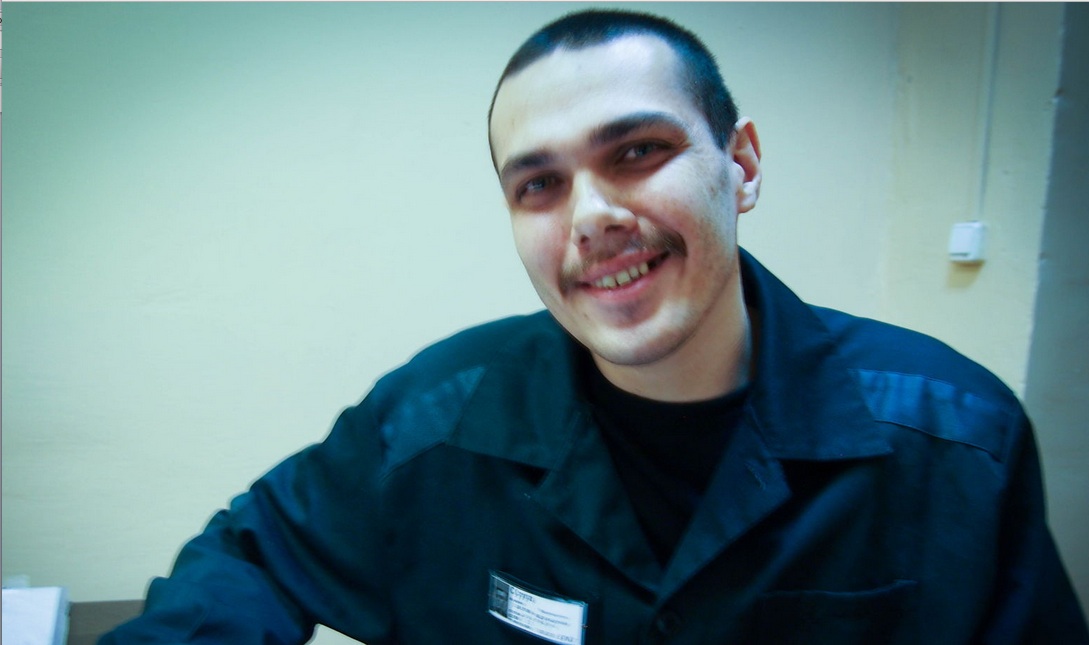
Alexei Sutuga, December 10, 2015. Photo courtesy of Svyatoslav Khromenkov
PERSCECUTION No medical treatment, no letters, no visits. A political prisoner’s life in a penal colony. Zoya Svetova and Alexei Glukhov investigated the conditions of antifascist Alexei Sutuga’s imprisonment
December 14, 2015 Open Russia
29-year-old Muscovite Alexei Sutuga is an antifascist activist known among antifa by the nickname Socrates. On September 30, 2014, the Zamoskorechye District Court in Moscow sentenced Sutuga to three years and one month in prison for disorderly conduct for his alleged involvement in a fight at a Sbarro restaurant in the city. Sutuga’s defenders believe the criminal case was revenge on the part of Center “E” officers who had already tried to put Sutuga behind bars for his alleged involvement in a fight at the Moscow nightclub Vozdukh, for which he had been amnestied.
The Memorial Human Rights Centre has declared Alexei Sutuga a political prisoner.
In March 2015, the antifascist was sent to Correctional Colony No. 14, a medium-security facility, to serve his sentence. He was soon put in solitary confinement, and two months later he was sentenced to a new type of punishment, a year’s imprisonment in a single-space cell. Now Sutuga is serving his sentence at Correctional Colony No. 2 in Angarsk, Irkutsk Region.
Olga Sutuga, Alexei’s mom, explained to Zoya Svetova how and why her son is being pressured in the colony.
Solitary confinement and single-space cells are forms of penitentiary repression. Is this improvisation on the part of local wardens or are there orders from above? Is there a plan to break your son?
It began in Moscow, when the FSB wanted Alexei to cooperate with them. They came to him while he was still in the remand prison and suggested he collaborate. They said he would serve his sentence in far from the best conditions, in a colony far from Moscow Region. That is what happened: he was sent to Siberia. And there, in the remand prison, he was again visited by two Center “E” officers who suggested he collaborate and promised that in exchange he would do his time in the Irkutsk Remand Prison and get parole. But he did not agree to these proposals.
What exactly do they want from him? To snitch on anarchists?
Apparently, yes, because he knows a lot of people, is a fairly authoritative person in that world, and has his own opinion. Not only anarchists but also other activists listened to him. He is a very inconvenient person for the secret services. He always spoke the truth, and they decided it was vital to break him and force him to cooperate with them.
How do you keep in touch with your son? He is not allowed visits, letters, and telephone calls. How do you find out what is happening with him in the penal colony?
Only through his lawyer. When his lawyer battles his ways through to see him, he finds out that Alexei has not been getting letters from his wife, from me or from his friends. On November 30 he was released from solitary confinement, where he had spent ten days. Now he is in a single-space cell in Correctional Colony No. 2 in Angarsk, Irkutsk Region. He is supposed to spend a year there—until May 2016.
Is he considered a repeat offender of prison rules?
Here are some of the violations he has been charged with: not making his bed, having his nametag torn from his clothing, and sleeping during the daytime while sitting on a stool. For all these things he was deemed a repeat offender. When in late May he was transferred for a year to the single-space cell, the warden of the single-space cell facility told him he would not be getting out of there, that he would be spending the rest of his sentence in the “jug,” that he would not be returning to the medium-security facility, although by the verdict of the court he should be serving his sentence in a medium-security penal colony.
Is Alexei in solitary?
No, there are four people in there.
How can we help him?
He has asked that people do not stop paying attention to the whole situation, because if they do not write and talk about it, the prison wardens will see they can do anything they like and will use even more repressive methods against him.
How long does he have till the end of his sentence?
One year and five months.
Do members of the Public Monitoring Commission (PNC) visit him?
Employees of the PNC come to see him every two or three months. They constantly file complaints about violations of his rights with the Federal Penitentiary Service. But it does not help: no one pays any mind to the complaints.
Those violations of the rules in the remand prison for which he has been punished, were they real or contrived?
It is impossible to comply with all the rules there one hundred percent. Maybe the nametag really was torn off his clothing. But Alexei definitely did not have a shiv, because when he was transferred from the remand prison to the penal colony, six people searched him, and the trip from the prison to the colony takes half an hour. [Angarsk is forty kilometers away from Irkutsk — Open Russia.] So it is completely unclear how he could have got hold of a shiv if he was in a paddy wagon with guards the entire half hour.
When is your next visit with him?
I was authorized to visit him in October but I was unable to go. I will go in late December. I wanted to get to see him during the January holidays. But I am not sure it will work out. When the lawyer went to see the head warden of the colony and find out whether I might be able to get this visit, the warden replied there would be no visits due to the fact that Sutuga was socially dangerous.
Is that even legal?
No, of course not. By law I have the right to visit him. I wrote to the head warden of the colony asking him to give me a visit. If he does not respond to me within fifteen days, then we will file another complaint. Unfortunately, though, complaints have no impact. We write to the Federal Penitentiary Service, the prosecutor’s office, and the court.
How does Alexei spend his time? Is it true he has no books and is unable to get periodicals?
The prison does not accept books sent to him, and it also does not give him the periodicals we subscribed to for him. I wrote to the warden and asked what happened to the periodicals that were sent by mail in my son’s name to the penal colony. After all, we had paid money for the subscriptions. It smacks of petty theft.
What is his mood?
When attorney Svetlana Sidorkina went to see him in October, she said that Alexei was very depressed, sick, and his knees were swollen and painful. He was diagnosed with acute arthritis and tossed out of the infirmary back into the cell. He receives no medical treatment or medical examinations. Sidorkina brought him letters from me and from his friends. That supported him. The local lawyer, who visited him the other day, says that Alexei’s mood has improved. Generally, he is a very active person, and if he has no opportunity to do anything he gets depressed. But now, apparently, he has realized we are fighting for him, his friends wrote that he has not been forgotten, and so his mood has been normal and he is holding up. He will turn thirty on January 24. It’s a big birthday.
How Alexei Sutuga Was Made a Repeat Offender
After his trial in Moscow, Alexei was sent to the Irkutsk Remand Prison. When the prison staff confiscated his personal belongings and letters, Sutuga protested by declaring a hunger strike and demanding to be transferred to a penal colony. Three days later, Sutuga was transferred to Correctional Colony No. 14 in the city of Angarsk, Irkutsk Region.
However, as soon as Alexei arrived at the colony, a shiv was found on him. Sidorkina believes prison colony staff planted the shiv on him.
Before his transfer from the remand prison, Sutuga was undressed completely, all his personal belongings were examined, and the procedure was filmed on a video recorder. No forbidden items were found. The paddy wagon in which he was transported in the company of three guards was also inspected.
At the penal colony, Sutuga was immediately taken to the search room, where in the presence of ten colony staff he was again forced to strip and put all his things on a table. As Sutuga was undressing and simultaneously replying to the questions of penal colony staff, one of them suddenly discovered a sharpened metal object in Sutuga’s cap. Sutuga claimed he had nothing to do with the shiv.
Sutuga was placed in solitary confinement for seven days.
Over the next month, Sutuga received three more disciplinary reprimands: for not wearing a badge, for not reporting to the on-duty guard, and for not cleaning his room.
Due to these clearly fabricated violations, Sutuga was declared a repeat offender of prison rules and was first transferred to a high-security cell, then to a single-space cell.
What Is a Single-Space Cell?
Sutuga is now imprisoned in a single-space cell [edinoye pomeshchenie kamernogo tipa or EPKT] at Correctional Colony No. 2 in Irkutsk Region.
Single-space cells were instituted in penal colonies after July 1997. Previous to this, each penal colony had contained an “internal prison”—a cell-like space [pomeshchenie kamernogo tipa or PKT]. Now single-space cells have been devised that are no longer managed by the particular correctional facility, but by the regional office of the Federal Penitentiary Service. Prisoners placed in single-space cells are often in the process of transfer to another city and sometimes another region. But Alexei Sutuga has been left in the very same city, in Angarsk.
Members of the Irkutsk Public Monitoring Commission reported what they saw at Correctional Colony No. 2 in June 2015.
“There were heaps of construction debris in the yard in front of the entrance to the space. The cells were dimly lit, there was no ventilation, and the radio was not working. The tables were ninety by fifty centimeters, and there were benches ninety by twenty centimeter benches on each side. They were in the middle of the room, so it was problematic for four people to fit in the room at the same time. There was also very little space to move around. The drinking water was poured from the tap into tanks in the rooms.”
Top brass at the Irkutsk Regional Office of the Federal Penitentiary Service reacted to the remarks, but as of October 2015 the construction debris had not been removed. In conclusion, the PMC wrote:
“Slag mixed with ash that is loosened up every day is scattered near the entrance to the building and around the entire perimeter of the room. It is not only that the slag exudes harmful substances (sulfates, phenol, etc.) but also that the dust from the slag and ash gets into the air and from there, through the windows, into the cells and exercise yards, harming the health both of convicts and staff.”
Alexei Sutuga Does Not Receive Medical Treatment in Prison
The antifascist has several ailments that require treatment.
“In October, the public monitors established that Alexei was not being given packages with medicaments: they were being sent back. Staff at the facility explained that they do not let packages through if the permitted number of them is exceeded. And yet they do not look inside to determine whether they contain medicaments or not, but just send them back. They say the sender has to personally come to the facility and submit the package through the infirmary,” recounts Irkutsk human rights defender Svyatoslav Khromenkov.
In the presence of members of the PMC, Sutuga was prescribed an x-ray. At the time of the visit Sutuga was in the facility’s medical solitary confinement cell with a foot injury. According to him, he had an old sports injury, which had flared up after he had struck his foot against a nightstand. Sutuga also complained about lung problems: he said he was having trouble breathing. He believed he had pneumonia.
Lawyer Denis Ivanets says the trauma specialist in the infirmary at Correctional Colony No. 6 diagnosed Sutuga with first- and second-degree severe arthritis in both knee joints. This is a chronic illness. Civilian trauma specialists told the lawyer that, given such a diagnosis, medication was insufficient. Sutuga would also need physiotherapy, including massage, as well as special orthopedic aids.
On December 10, 2015, the public monitors once again visited the antifascist. He said he had been given the package of medicaments that had been brought to the prison personally by his comrades. Sutuga was very happy that he had finally got the pills. According to Sutuga, a doctor, who had told him there was no need for an immediate operation, had examined him and it could wait until his release.
Lawyers and Public Monitors Are Often Not Allowed to See Alexei Sutuga
During the course of the calendar week (five working days) beginning November 25, 2015, lawyer Denis Ivanets and human rights defenders constantly attempted to visit the political prisoner.
Every time the visitors appeared at the headquarters of Correctional Colony No. 2, the Federal Penitentiary Service officers found a pretext to turn them away. Either the warden of the facility, who had to sign the lawyer’s request to visit the convict, was not there (although, as later transpired, he had been in his office having an intercom meeting with the head office), or the warden of the single-room cell facility was gone all day, and he was allegedly the only staff member who could escort the lawyer to the premises behind the barbed wire (although the warden of Correctional Colony No. 2 had signed off on the paperwork for visiting the convict).
Now members of the Irkutsk PMC are appealing in court Correctional Colony No. 2’s ban on holding a personal conversation with Alexei Sutuga under conditions of acoustic isolation from penal colony staff. The law “On Public Monitoring” directly stipulates this right.
Letters and Newspapers Are Not Delivered to Sutuga
According to lawyer Denis Ivanets, “Alexei’s mom says her son does not reply to letters from his spouse, parents, and friends. When I talked to him about it, it turned out that more than two thirds of the letters had simply not got to him! These letters had been sent to Alexei over a month ago.”
According to Article 91.2 of the Russian Federal Correctional Code, letters, postcards, and telegrams sent and received by convicts are censored by the wardens of the correctional facility, after which they must be given to the convicts.
In addition, Sutuga’s relatives took out subscriptions to several newspapers and magazines (Kommersant, Novaya Gazeta, Rossiiskaya Gazeta, GEO,Vokrugsveta), but Sutuga had not been receiving them. Staff in the warden’s office at Correctional Colony No. 2 could not give the lawyer an intelligible answer as to why this had been happening. According to the Article 95.1 of the Russian Federal Correctional Code, convicts are permitted to receive stationery supplies in parcels and packages, purchase literature through retail distributors, and subscribe to newspapers and magazines without limitation at their own expense.
Socrates Has Not Surrendered
Alexei Sutuga was placed in solitary confinement from November 20 to November 30 for his latest “rules violation.” As his lawyers report, the number of reprimands grows with each passing month, and this will make it impossible for him to be paroled.
On December 10, 2015, the members of the PMC were able to chat with Sutuga, who sent greetings to everyone, especially his loved ones, his mom, wife, and child. Sutuga asked for new photographs of them, as well as books on psychology, sociology, and political science.
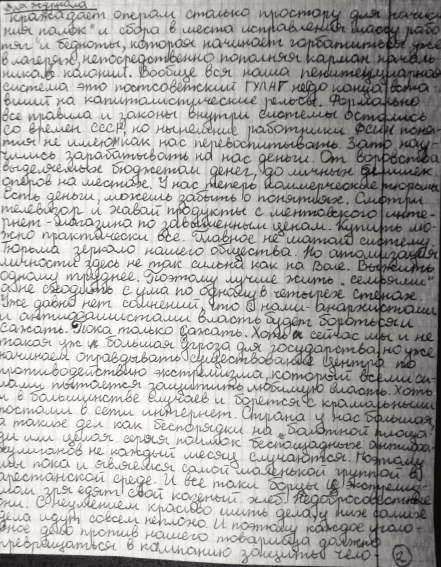
You can imprison us but you can never break us. We are not neo-Nazis who when they find themselves in prison try to slash their wrists, hang themselves, and swallow razor blades right off the bat. And who in the camps quickly join the “goats” (kozlyatnya), the prison household work brigades. We can be part of the general prison population. We don’t have to fear that our fingers will be beaten off with a hammer or we will be whacked upside the head with a slipper, because we haven’t done anything “gross.” We don’t judge people by ethnicity, color, and creed. Here in prison we are all “wogs” and “bandits” in the eyes of the law, because we valued honor and truth more than liberty. We are not Moscow chumps who imagined they were Aryan Vikings, but who as soon they went into the system realized they were not fascists but were like everyone else here. No, in Russia there will never be an Aryan Brotherhood like in the US. In our prisons there is a friendship of peoples.
Alexei Sutuga
Moscow Babylon has seduced, hoodwinked, and punished all the poor fellows from all over the Soviet Union. Now we all hate those greasy pushers in suits flashing IDs, the stupid cops who have involuntarily become polizei, and we laugh at each other when we tell the stories of how we ended up here. Now, as in the years of the Soviet-era Great Terror, there are entire social groups getting run through the system for the same crimes. This is no fight against crime. It is a war with competitors for control of business and against their own (potential) poverty. The law enforcement agencies are doing business when they jail businessmen and officials for fraud (Article 159 of the Criminal Code). They nick their businesses from them and get rid of competitors who got caught with their hands in the till and did not cut them in on the action. Since the entire Russian business world is built on financial scams and fraudulent schemes, there is no shortage of new criminal cases.
The same is true in drugs trafficking. The terrible Criminal Code Article 228, Parts 3 and 4 (drug dealing), introduced by the president, has made it possible to populate the prisons and camps with Central Asian nationals, which has done nothing at all to disrupt the well-regulated flow of drugs, but justifies the work of the Russian Federal Drug Control Service and the entire Russian Federal Penitentiary Service. And such a time-honored crime among prisoners as theft (Article 158) gives police investigators wide berth for padding solved cases stats and packing the penitentiaries with mobs of working stiffs and poor folk, who bust their humps in the prison colonies, thus directly lining the pockets of the wardens.
Our entire penitentiary system is a post-Soviet Gulag that has not fully embarked on the capitalist path. Formally, all the system’s rules and regulations have remained as they were in Soviet times, but the current Federal Penitentiary Service employees has no clue how to rehabilitate us. On the other hand, they have learned how to make money off us, from embezzling allocated funds to the personal deals made by criminal investigators at the local level. Russia now has commercial prisons. If you have money, you can forget about the unwritten “understandings” that once reigned. Watch TV and tuck into groceries ordered from the cops’ online store at inflated prices. Almost anything can be bought. Just don’t rock the system.
Prison is a mirror of our society. But the atomization of the individual is not as forceful as it is on the outside. It is harder to survive alone. That is why it is better to live in “families” than to go crazy alone between four walls. For a long time there has been no doubt that the regime plans to combat and jail us anarchists and anti-fascists. For the time being they are only jailing us. Though now we are not such a big threat to the state, we justifiy the existence of the Center for Extremism Prevention (Center “E”), which does everything it can to defend its beloved regime. Although in most cases this amounts to combating seditious posts on the Internet.
Manuscript of Sutuga’s letter
Our country is big, and things like the riots on Bolotnaya Square or the capture of ruthless antifa hooligan do not happen every months. So for the time we are the smallest group in the prison community. And yet the anti-extremism police eat their government-issued bread for nothing. They are unscrupulous. Although they are clumsy at fabricating cases, they are doing quite well for themselves. And so every criminal case against a comrade of ours must be turned into a campaign to defend the individual from the state’s power over him or her. All the punitive institutions of the state should be subjected to attack. We and the people are on one side, and this leviathan with legs and dressed in a uniform is on the other.
Thanks to Vladimir Akimenkov for the heads-up. If you follow this last link you will find information, in Russian, about Sutuga’s address at the prison colony in Angarsk where he is currently serving his sentence, where and how to send letters to him, and how you can help him and his family financially.
Alexei Sutuga is an anti-fascist and member of the Autonomous Action anarchist movement. In April 2012, he was arrested on suspicion that on December 4, 2011, he and a group of anti-fascists had assaulted a group of young nationalists, and that on December 17, 2011, he and his friend the anti-fascist Alexei Olesinov had assaulted security guards at the Vozdukh Club in Moscow. The accused and people who had been attending a concert at the club testified that the security guards had themselves provoked the fight and used weapons. In 2013, police investigators admitted that Sutuga had had nothing to do with the incident on December 4, 2011. In the summer of 2013, he was released on bail from remand prison, and in January 2014 the case against him was closed as part of an amnesty. Afterwards, according to Sutuga, Center “E” officers threatened him with “problems.”
In April 2014, Sutuga was detained by Center “E” operatives after an anti-fascist concert in Moscow’s Izmailovo district. According to a report by the For Human Rights Movement, ten other people were detained besides Sutuga. The pretext was a crime committed by a person unknown in the vicinity of the concert, but according to the human rights activists, therewere no grounds for suspecting the anti-fascists. Sutuga was asked about a trip to Maidan as he was being detained. All the other detainees were soon released, but a disorderly conduct report was filed against Sutuga and he was kept at the police station. He was later charged with having delivered multiple blows with a chair, his feet, and an improvised hammer to several people during a fight at a Sbarro chain restaurant outlet on January 2, 2014. Sutuga himself claimed that he had been trying to separate the people involved in the fight, which, according to him, had taken place between a group of right-wing youth and another group of young people, and that in the process of pulling them apart he had struck someone once. On October 1, 2014, Sutuga was sentenced to three years and one month in a medium-security penal colony. On December 17, 2014, an appeals court upheld the judgment.
In April of this year, Antti Rautiainen reported the following to Infoshop News (which I have summarized).
Sutuga has been transferred to the Irkutsk Region. He has refused to do household work in prison (which could reduce his sentence), unlike neo-Nazis Maxim Martsinkevich and Roman Zheleznov, as this form of collaborating with prison wardens is impossible for an anarchist.
Sutuga is twenty-nine years old. His sentence will end in May 2017.
On March 17, Sutuga went on hunger strike, demanding that his confiscated letters and books be returned to him and that he be transferred from the remand prison in Irkutsk, where he was incarcerated, to a prison colony.
On March 22, Sutuga was transferred to Prison Colony No.14 in Angarsk.
The Memorial Human Rights Center declared Sutuga a political prisoner on March 20.
Sutuga has a wife and child who live in Ukraine. His spouse is studying for a PhD and raising their child.
The cost of a two-way flight to Angarsk for his wife and son is about 60,000 rubles (approx. 1,200 euros). Only one long-term conjugal/family visit is permitted every three months. Alexei’s family needs money for sending parcels of food and other necessities to the prison colony.
Even today, January 30, 2015, the Russian Federal Penitentiary Service maintains lists of volunteers obliged, if necessary, to shoot those sentenced to death. The moratorium, after all, is a temporary understanding. State Duma deputy speaker Lebedev’s comment that if Russia exits the Council of Europe, it will have the right to restore capital punishment, is a good occasion to discuss how executions technically happen. The door to secret room 2/0 has not creaked for a long time in the depths of the Crosses Prison.
[…]
In the second cross at the Crosses there is a wing that previously held prisoners sentenced to death. Now those sentenced to life imprisonment wait there to be transferred.
The wing is known as 2/1. It is harder to access than the other sections of the prison. The corridor is shorter than in the others, containing not thirty cells, but something like twenty-five. One “cell” there is exceptional. Its door looks like the other doors, but it leads into a secret basement codenamed 2/0.
I have no idea what governs departmental orders in early 2015, but under the Soviet regime the guidelines for selecting executioners had an ideological tinge. Only volunteers could execute prisoners. The guidelines stressed that volunteers would receive no perks or, God forbid, any monetary remuneration.
The takers were few, of course. Age and length of service also had to be taken into account. You could not send a young officer to do the job. Thus, when drawing up the annual lists, the warden at the Crosses would summon veterans and tell them someone had to do it.
People at the prison would guess who was on the list, but it was bad form to gab about it. The incognitos [sic] themselves signed nondisclosure agreements.
When the time came, the officer had the right to examine the case file, to peruse photo records of dismembered bodies or strangled children. It mattered that hand and heart did not tremble in doubt.
At the right time in the evening, the condemned man was visited in solitary confinement by the prison warden, the responsible prosecutor, a doctor, two attending officers and himself [sic]. The prosecutor would briefly read out the Supreme Court’s final decision and denial of clemency. The guards quickly snapped handcuffs on the criminal. Hands behind the back.
At this moment the condemned man’s behavior would become clear. Some would go into a trance and become wobbly, while others would go berserk. It was then that a towel would be thrown over their heads and tied at the back so their screams and curses would be inaudible.
“What kind of towel?” I asked, somewhat surprised, in my conversation with a prison officer.
“A white honeycomb towel, the kind issued to all the prisoners,” he replied.
And the man would be dragged to where he no longer existed [sic], to the door of “cell” 2/0.
It is [sic] already open, the steps leading down. He [?] didn’t count how many. The march ends. A dimly lit basement space with a container in it, something like a trough. The head is bent down, the command is given, a shot from a Makarov pistol, the doctor’s diagnosis.
They say that it would happen that the first bullet didn’t kill. Then it would happen again: command, shot, diagnosis.
The body would be wrapped and, accompanied by a document reading “This transport not subject to checks,” would be taken in a prison vehicle to a cemetery. In Soviet times, this would have been [Petersburg’s] Northern Cemetery. A pit had already been dug in advance, whose significance only the cemetery director knew. The body would be buried and forgotten.
In the archives, this place will forever be designated by a three-digit secret number.
It’s all humdrum. None of the myths about drawing lots or firing squads in which only man’s gun is loaded with live rounds [is true.]
“I come home once after this, and my wife is partying with guests in the kitchen. They’re listening to ABBA on a tape recorder. I take off my coat, sit down, and peck at a salad. My wife starts in on me: ‘Why are you spoiling our mood?’ What could I say to her?” an executioner recalled to me twenty-five years ago or so.
That’s right: if you destroy a dozen unknown boys in battle you’re a hero, but if you kill a maniac you’re a hangman.
That door—to cell 2/0—has not opened since the moratorium was announced in 1996.
The state is sturdily organized: the moratorium is not a dogma, but a timeout. The formal lists of firing squad members are constantly drawn up and amended depending on personnel changes at the Federal Penitentiary Service for Saint Petersburg and Leningrad Region.
So if push comes to shove, they could be ready today, January 30, by nightfall.
Since I’m not a very good translator, it is hard for me to convey the hard-boiled relish with which Fontanka.ru journalist Yevgeny Vyshenkov, an ex-cop, contemplates the return of capital punishment in Russia. Maybe this will do the trick instead:
Here, Alexei Didenko, deputy leader of the LDPR faction in the Russian State Duma, excitedly reports that within “24 hours” of exiting the Council of Europe and its Parliamentary Assembly all the legal mechanisms would be in place for executing “millions and millions of perverts, rapists, and pedophiles.”
Since the prison population in Russia was reported as 671,700 inmates as of December 1, 2014, one wonders where Didenko is going to find all those “millions and millions of perverts.”