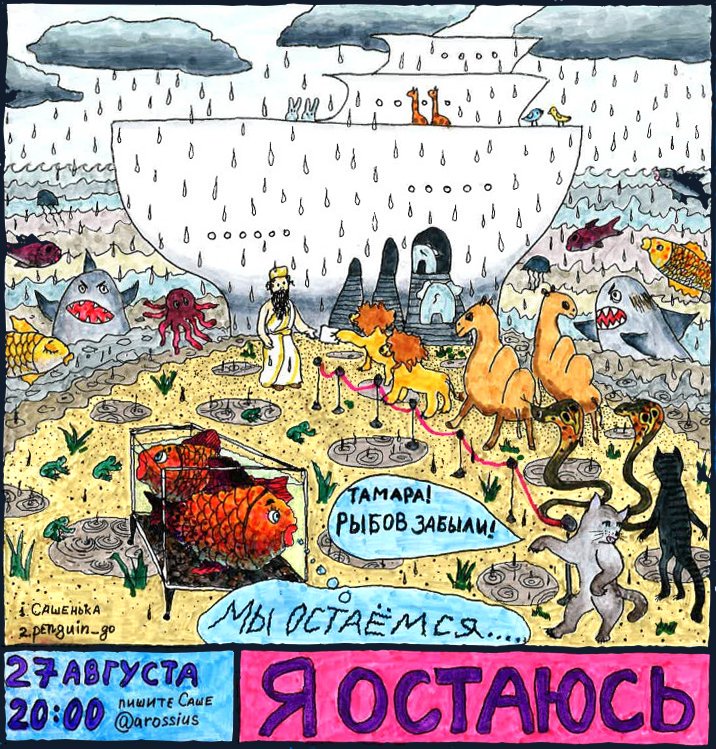
Gray cat, on right: “Tamara! We forgot the fish!” Goldfish, on left: “We’re staying…” I’M STAYING, 27 AUGUST, 8:00 P.M. WRITE TO SASHA @arossius
Six months ago, my friends started leaving Russia. More and more loved ones ended up far, far away from me. I had to make a difficult decision. Did want to leave with the others, or should I stay in Russia?
After much thought, I came to the conclusion that I had to stay. In those days, I listened to Anatoly Krupnov’s song “I’m Staying” all the time and was amazed at how accurately the song conveyed my feelings. Therefore, when the girls and I were developing the concept of a support group for activists who, like us, had decided not to leave, I suggested calling our project “I’m Staying.”
The “I’m Staying” community has been around for four months. In addition to the support groups, we also became a kind of cultural project. We held a concert, and in the near future we are going to put on a theatrical performance.
But recently, the song “I’m Staying” has been used by completely different people for completely different purposes. Many people have seen the cover of this song by pro-government musicians. In my opinion, it’s a very bad cover, but that’s not the point. They now want to make the song “I’m Staying” a tool of propaganda, completely distorting its original message.
I don’t want to let propaganda steal the song from us. Therefore, I remind you that “I’m Staying” is us. And our next meeting, the twenty-first in a row, will take place this Saturday, August 27. If you want to come, write to me on Telegram @acrossius and send me links to your social networks.
See you!
Source: Aleksandra Rossius, Facebook, 26 August 2022. Thanks to Yana Teplitskaya for the link. Translated by the Russian Reader
Anatoly Krupnov and Black Obelisk, “I’m Staying” (1994; remixed, 2018)
We are at a standstill again, and there is water in the hold, And you keep telling me to run again, And you’re saying again that you have to go there, Where the keel is even, it is dry, and there is air to breathe. But even here there is a chance, albeit one in ten, Maybe time moves forward here at a crawl, not a run, And maybe it’s more difficult to stay here than to leave, I still believe that I will be lucky…
And I-I-I-I-I, I’m staying, Where I want to be, And even though I’m a little afraid, But I, I’m staying, I’m staying to live!
You say there’s enough evil here, And you’re in a hurry to get out as soon as possible, You say that bondage is sweet to me, And you firmly believe in the truth of the other way, Run, swim, fly — where it doesn’t matter, If only to where we are not and haven’t been, You say everything died here a long time ago, And there are too many strangers among us…
But I, I’m staying, Where I want to be, And even though I’m a little afraid, But I, I, I’m staying, I’m staying to live! I’m staying! I’m staying!
I’m used to it here, even though it’s like I’m in the service, I can see everything, even though there are few lights here, And here I stand so firmly on my feet, And to stand, I have to stick to my roots. I’m used to it here, I’m not so lonely here, At least sometimes I see my kind, When the last bell starts ringing, I’ll be here if I’m alive…
For I, I’m staying, Where I want to be, And even though I’m a little afraid, But I, I’m staying, I’m staying to live! I’m staying! I’m staying!
Source: Teksty Pesenok. Translated by the Russian Reader. Anatoly Krupnov died in February 1997, aged thirty-two, from a heart attack.
This is “social democracy,” Russian fascist style, as exemplified by A Just Russia — For Truth party leader Sergei Mironov, as translated by a mindless unpaid robot:
The leader of the Fair Russia — For Truth party, Sergei Mironov, proposed to take away the property of Russians who decided to emigrate from Russia.
He noted that this can be done within the framework of the presidential decree of March 1, 2022 “On additional temporary economic measures to ensure the financial stability of the Russian Federation.” According to it, Russian citizens who “have left or live in unfriendly countries cannot dispose of their real estate on the territory of Russia.”
At the same time, Mironov proposed not to be limited only to “unfriendly” states and to apply a measure in the event of a person leaving for any country.
“The essence of their act does not change from this. I think it makes sense to extend the restrictions to all travelers, regardless of where exactly they have pricked up their skis.“
The head of the party added that he considers the current flight of “our homegrown rich people” abroad to be a cleansing of society. In his opinion, only “obvious traitors” or “owners of criminally obtained fortunes” can leave Russia.
“Although one easily combines with the other. So I see only a positive aspect in the fact that these gentlemen are ridding us of their presence. The air will be cleaner,” he concluded.
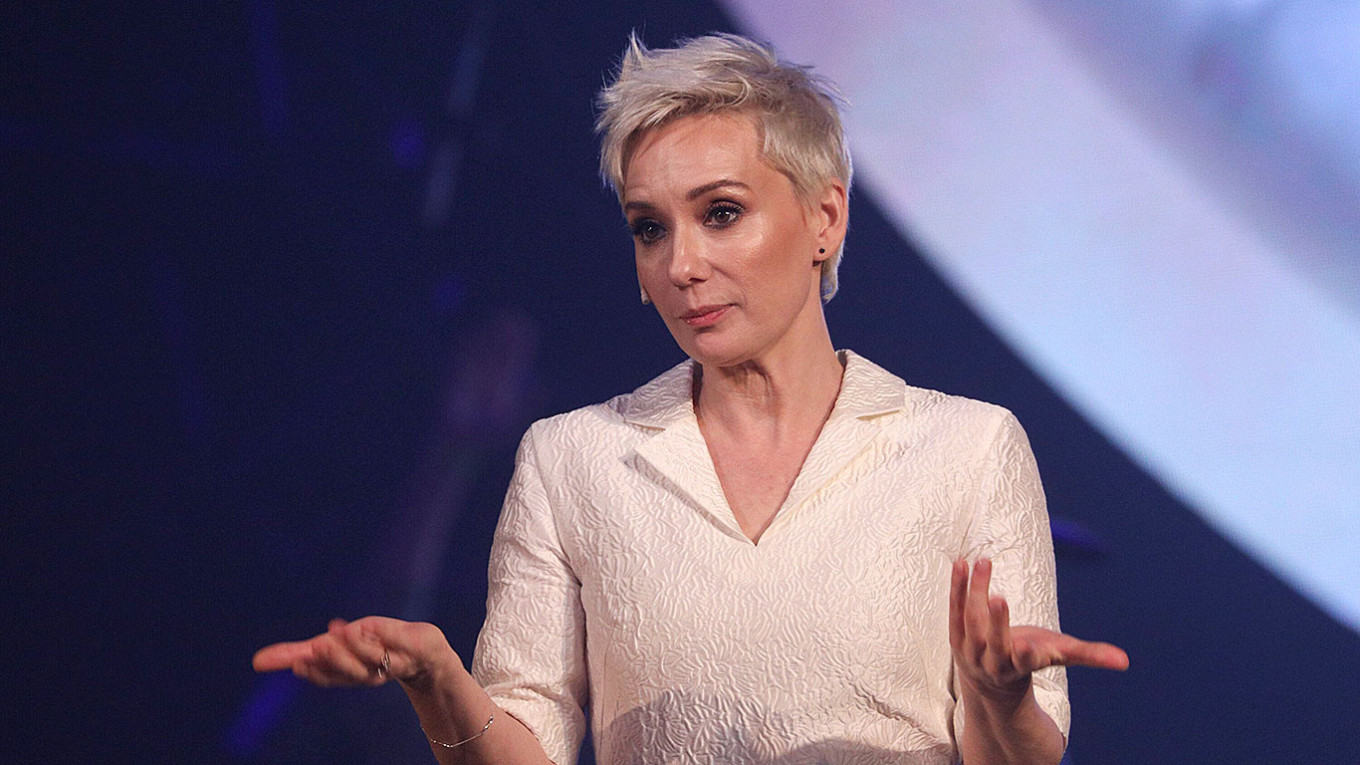
Russian “social democrat” Sergei Mironov. Photo courtesy of the Moskva Agency and the Moscow Times
Here are the “social democratic” fascist robot’s remarks in the original Russian:
Лидер партии «Справедливая Россия — За правду» Сергей Миронов предложил отбирать собственность россиян, решивших эмигрировать из России.
Он отметил, что это можно делать в рамках указа президента от 1 марта 2022 года «О дополнительных временных мерах экономического характера по обеспечению финансовой стабильности РФ». Согласно нему, российские граждане, которые «уехали или живут в недружественных странах, не могут распоряжаться своей недвижимостью на территории России».
При этом Миронов предложил не ограничиваться только «недружественными» государствами и применять меру в случае отъезда человека в любую страну.
“Суть их поступка от этого не меняется. Полагаю, есть смысл распространить ограничения на всех выезжанцев в независимости от того, куда именно они навострили лыжи.”
Руководитель партии добавил, что считает очищением общества нынешнее бегство «наших доморощенных богатеев» за границу. По его мнению, из России могут уехать лишь «очевидные предатели» или «обладатели состояний, полученных криминальным путем».
«Хотя одно легко сочетается с другим. Так что в том, что эти господа избавляют нас от своего присутствия, я вижу только положительной момент. Воздух будет чище», — заключил он.
John Candy and Joe Flaherty have a finer grasp of Russian social revolutionary traditions than Sergei Mironov does. If Mr. Mironov’s (thoroughly counterrevolutionary and reactionary) compatriots weren’t so similar unmindful of their own history, Mr. Mironov might have thought twice before making the transformation from a mild nuisance to an enthusiastic Putinist henchman.
We have made the difficult decision to stay in Russia. I can’t leave my beloved parents. I can’t leave my younger sister, who is planning to apply to the Academy of Arts this year. They are dear to our own little family, and we are dear to them. Why do we need another, freer life if our loved ones will be far away? How can I deprive my children of unconditional love and their extended family?
If we leave, who will stay here? Everyone is fleeing thinking that it won’t be for long, that they will return home. But I feel that it will be a one-way ticket for many.
I look at the Ukrainian refugee families who are rushing home from Europe, even though their homes are no longer there, at those Ukrainians who won’t agree to go even to the most hospitable homes and remain under bombardment with their relatives.
I look at those who are fleeing Russia, because it is difficult to endure the tension, shame, fear, condemnation, and uncertainty.
I think that this is the first time that I have felt such love for my unhappy country and the people here.
We are not afraid of everyday troubles and the danger of losing our jobs. Much more terrible is the fact that people are voluntarily drawing the symbol of the war [“Z”] on their cars. The criminalization of society, which is already beginning to gain momentum, is frightening. The propaganda in the schools scares me.
I have friends who have gone from being poor to being almost beggars. There are those whom I can help just with my presence, hugs, and the opportunity to say what they think.
This disaster has united us even more, and I will live in the hope that together we will survive it all.
[…]
I’m sorry that I’m writing incoherently — I don’t even remember the last time I got a good night’s sleep.
Source: a private communication to a close friend of mine from an acquaintance in Petersburg, 8 March 2022. Although the author gave me permission to translate and publish the letter, and to identify them by name, I decided to conceal their identity for their own safety and to omit certain parts of the letter. Translation and photo by the Russian Reader
Mitya is infinitely right. All these years I have been constantly saying that all people of good will should leave the Russian Federation. How can one imagine a “theory of small deeds,” say, in the Third Reich? All conscientious Germans left Germany in the 30s, and to one degree or another joined various resistance forces. Such regimes are not destroyed from the inside, but only by blows from outside —military, economic, political and cultural.
Until recently, a segment of the Russian intelligentsia and the upper middle class had a favorite toy — the “theory of small deeds.” In practice, it meant that they said: yes, we cannot defeat the dictatorship, which means we need to do something useful in spite of that — save sick children, create foundations, hold cultural events, publish literature, defend human rights wherever possible. They had the hope that everyone would be able to influence the state and society as a whole doing what they do best, and these little drops would come together to make a sea, so to speak. Well, in the process, of course, they would have to cooperate with the state.
It all turned out to be baloney. Here is another historical lesson — do not collaborate with tyrants. Never. Under any circumstances. Don’t lend them legitimacy. Even for the sake of sick children.
Because you will never turn that debit into a debit. You will save 10 thousand children who have cancer only for the dictatorship to kill 100 thousand children sooner or later. It’s already killing them, and not only Ukrainian children. It’s killing Russian children, too, whom it will now be impossible to save without western drugs and equipment.
In a dictatorship, small deeds happen only in the toilet.
________________
Chulpan Khamatova. Kirill Zykov/Moskva News Agency. Courtesy of the Moscow Times
Actress and Activist Chulpan Khamatova Has Left Russia
She joins dozens of Russian cultural figures who have left the country. Moscow Times
March 21, 2022
The Russian stage and screen actress Chulpan Khamatova told Ekaterina Gordeyeva in an interview released on Monday that she would not be going back to Russia.
Khamatova, who heads the Gift of Life charity foundation, was abroad when Russia began its attack on Ukraine. “For the first few days I didn’t know what to do,” she said in the interview. At first I just wanted to stay some place and wait for it to end, but then I was led to believe that it might not be safe for me to return. I’m in Riga for now. I am certainly not a traitor. I love my homeland very much,” she said.
Khamatova is one of Russia’s most celebrated actresses who has acted in dozens of films and television series — most recently playing the lead role in the screen version of Guzel Yakhina’s novel “Zuleikha.” She also plays Raisa Gorbachev in the hit play “Gorbachev” at the Moscow Theater of Nations.
She is just one of dozens of Russian cultural figures who have left the country since the war began.
Earlier this month the music director of the Bolshoi Theater, Turgan Sokhiev, resigned his post in Moscow and in Toulouse, France. He wrote that he felt he was being forced “to choose between my beloved Russian and beloved French musicians” and so “decided to resign from my positions at both the Bolshoi in Moscow and Orchestre National du Capitole de Toulouse.”
At the same time two foreign ballet dancers at the Bolshoi, Jacopo Tissi and David Motta Soares, put in their resignations.
This was followed by the announcement that Bolshoi prima ballerina Olga Smirnova left for the Dutch National ballet.
Russian television has also lost several of its best-known on-screen personalities: Channel One colleague Zhanna Agalakova quit her job as Europe correspondent for Channel One, and both Lilia Gildeyeva and Vadim Glusker quite NTV. Gildeyeva had worked at the channel since 2006, and Glusker had been there almost from the start, for 30 years.
Dmitry Linkin, the head designer for Channel One for 24 years, also quit. “I was taught that human life is invaluable,” he said.
________________
In an interview with Ksenia Sobchak, broadcast on TV Rain in June 2012, Chulpan Khamatova said that she would rather live in “North Korea” than have her own country go through another revolution.
No Political Harmony Among Cultural Elite
Alexander Bratersky Moscow Times
February 19, 2012
As Prime Minister Vladimir Putin enters the home stretch of his campaign to return to the Kremlin, he is relying on the support not only of the blue-collar electorate, but also members of the cultural elite, who are helping to market his bid for the presidency.
Putin’s extended campaign team has about 500 participants, including famous musicians, actors and writers who appear in pro-Putin commercials and at rallies. But political analysts and experts said their participation has divided the cultural elite itself.
Several dozen prominent celebrities, among them world-famous piano player Denis Matsuyev, St. Petersburg Mariinsky conductor Valery Gergiev, jazz musician Igor Butman and opera star Anna Netrebko have thrown their lot in with Putin.
When contacted to explain the reasons behind their choice of candidate, most have declined to comment. The situation has even split families: in one case a well-known rock musician sided with Putin, while his brother, also a rock star, is for the opposition.
Supporting Putin, who is seen by his opponents as an authoritarian leader, might damage a performer’s reputation and can become a source of controversy. The liberal media has attacked prominent actress Chulpan Khamatova for appearing in a Putin commercial, in which she thanks the prime minister for supporting her charity that aids children with cancer. Although Putin’s spokesman Dmitry Peskov told reporters that Khamatova appeared in the commercial voluntarily, sources at the charity said she was forced into the recording.
The public response against the video was so negative that even liberal Novaya Gazeta had to defend Khamatova in one of its latest articles. Khamatova has declined to discuss her endorsement for Putin. “Let everyone stick to his own vision,” she said, RIA Novosti reported.
Iosif Prigozhin, a prominent music producer and show business insider has also defended the actress.
“Khamatova is an absolutely sincere person. But imagine that I had helped you. Would you do the same for me?” he told The Moscow Times.
It is very difficult for me to write this letter. I don’t want to say goodbye at all. To my great regret, I was forced to leave Russia and resign as the director of Nochlezhka. Of course, I will help my colleagues remotely as much as I can, but it would be strange to try and run everything from afar. Danya Kramorov, our longtime volunteer, coordinator, and until recently the head of fundraising and PR, will replace me as head of our organization.
Twenty years ago, I came to Nochlezhka myself as a volunteer, and in 2010 I became an employee. Back then it was a lovely and proud little organization. That hasn’t changed, but the scale of our work has. Currently, we are helping 480-490 people in Petersburg and Moscow every day. Together we have opened free showers, laundries, warming-up spots, and rehabilitation shelters. In our approach to helping people in need, we have grown into providing psychological assistance, employment programs, training in new professions, and a dedicated rehabilitation shelter for homeless people suffering from alcohol addiction. Just as twenty years ago, everyone who comes to us for help or provides assistance in any of our current projects is treated like a human being. I’m confident that things will always be like this at Nochlezhka. It is a huge effort by many people, and if you are reading this, you are one of them. I would very much like to list everyone by name, but only last year Nochlezhka was supported by donations from over 20,000 people. Thank you very much!
Nochlezhka’s 2013 This Side of Life campaign hasn’t lost its relevance. Photo courtesy of Nochlezhka
Nochlezhka is much bigger than Grisha Sverdlin. Nochlezhka is my colleagues, a wonderful, professional team of eighty people. Nochlezhka is the hundreds of volunteers from all over the world who respond to our call. Nochlezhka is the thousands of people who donate money and medicines, food and clothes to us, who read our news and don’t believe the stereotypes [about homeless people and homelessness]. Nochlezhka is the companies that provide their services for free. Nochlezhka is you.
With the help of this huge cool team, just last year we helped 8,165 people in need. No matter what happens, this year we will definitely keep all our projects running so that anyone who turns to us can keep their health and dignity and return to a normal life. Moreover, this summer we will be opening a shelter for elderly homeless people in the Leningrad Region, and in late March we will launch the long-awaited restaurant Street Entrance, where the residents of our rehabilitation shelters will master new trades that will enable them to continue getting their lives back together.
I’m terribly sorry that I won’t be at the grand opening. I had planned to spend most of my salary at our restaurant. It’s incredibly cozy and the food is very, very tasty. But enjoy yourselves there for me, please! And I will wait for the day when we can meet at the bar and discuss the good news.
Nochlezhka will continue to operate even if the earth crashes into the celestial axis. And I will continue to classify myself as a Nochlezhkin, remaining a volunteer and donor of this organization so dear to my heart. Unfortunately, more and more people will need our help in the coming months. And since that is the case, we will continue to help them, of course.
Yours,
Grisha Sverdlin
Source: Nochlezhka email newsletter, 15 March 2022. Translated by the Russian Reader. I was a volunteer at Nochlezhka and its (now defunct) “street newspaper” Na Dne (The Depths) in the mid-nineties. Although I included the original link in Mr. Sverdlin’s letter to Nochlezhka’s donations page, it would seem that people outside Russia can no longer donate money to the organization, as they could only a short time ago. I tried just now to donate 1,000 rubles using a European-issued MasterCard, but the transaction was declined. However, I immediately got a message from Nochlezhka saying that they could see that I had tried to donate but that something had gone wrong on their bank’s end. I write this not by way of soliciting donations for Nochlezhka but to illustrate the difficulties charitable organizations in Russia now find themselves in. And, although he doesn’t mention this in his letter, Mr. Sverdlin has written on social media that he left the country because several reliable sources told him that he was in danger of arrest. ||| TRR
UPDATE (3.15.22) Nochlezhka’s project coordinator has written to me to confirm that, indeed, it is no longer possible to make donations to them using non-Russian bank cards and non-Russian payment systems. She cited the advice to donors that Nochlezhka published on its website earlier today. The last two paragraphs of that advice read as follows:
Payment via Google Pay, Samsung Pay and Apple Pay has been blocked for Visa and Mastercard cardholders. This means that one-time and regular donations that were issued in this way are no longer valid. Please re-register your donation if it has been made using one of the methods listed. You can manually sign up for a new donation payment using the form on our website.
Currently, bank cards from foreign banks cannot be used to donate money for our work. We are no longer receiving money transferred through Global Giving and PayPal. We will look for new ways [to donate] for anyone who does not have a Russian bank card, and we will definitely inform you as soon as we find them.
I was ten years old but I remember August 1991 well. And I remember how many people asked, after that unique celebration of unity and freedom, what would have happened had the coup emerged victorious.
Russia 2019 is the answer to this question. It is a country in which the coup has emerged victorious, [a country ruled by] a dozen paranoid old men, their hands trembling in fear.
Yes, the new coup has lasted longer than three days, but not much longer. The first chords of Swan Lake have already sounded.
Translated by the Russian Reader. Image courtesy of 123RF
_______________________________________________
A friend of mine asked me the other day what I thought about the new fair elections protests in Moscow. First, I feel solidarity with the protesters. Otherwise, I would not have bothered to translate and edit eleven posts (so far) about the protests and their ugly aftermath.
But I don’t understand the point made by Alexei Navalny’s comrade Leonid Volkov, an otherwise sensible person, in the Facebook post, as quoted above.
I could very well be wrong, and, actually, I do hope I am wrong, but I see very little difference between the mostly lacksadaisical fair elections protests of 2011–2012 and the relatively fierce but tiny fair elections protests of 2019.
The numbers are, in fact, the main problem. Despite the strange argument made by a talking head from the Carnegie Center Moscow, as quoted in the Moscow Times, that fifty thousand is a number of protesters the Russian authorities cannot ignore, there is no question of their ignoring anything. The Putin regime did not ignore the protests of 2011–2012. It waited until Putin had secured a new term as president before cracking down hard on protesters and quickly adopting a whole raft of laws designed to make public protests and dissent much more dangerous.
In 2019, the crackdown has begun almost immediately, but there is no sign the regime will cave and force the Moscow City Elections Commission to reinstate the candidates it barred in July from running in the September elections to the Moscow City Duma, much less collapse altogether.
Since it is the world’s largest country, it seems funny to say it, but Russia is one of the most insular, isolated places on earth. International news is a genre that barely exists in the country’s mainstream or alternative press nor does it usually make much of an impression on the chatocrats who set the tone in Russia’s remarkably hysterical, dispiriting, troll-infested social media.
It also does not help that places mainly or completely populated by what many Russian liberals regard as subhumans almost never figure in the news in Russia at all. Otherwise, political and media activists like Volkov would think twice before seeing the demise of Putin’s twenty-year-old “putsch” in yet another series of relatively minuscule gatherings of righteous Muscovites brandishing clever placards and getting their pictures taken for Instagram.
If there were real international news in the Russian press, the Russian fair elections movement and its would-be leaders and strategists, like Volkov, would think about the recent, incomparably more numerous, and demonstrably more effective protests in Puerto Rico and Hong Kong, for example. When half a million people protest against the powers that be on an island populated by 3.5 million people, the authorities really cannot ignore them, just as Beijing could not pretend all was well in Hong Kong, a city of 7.3 million people, when two million people there took to the streets to protest the former enclave’s shrinking autonomy and the PRC’s attacks on its laws and democratic institutions.
Puerto Rican officials have already seen the writing on the wall and surrendered to the demands of the fierce, fearless, relentless protest movement there. The Hong Kong protest movement faces a much stronger enemy, of course, but I think there is a far greater chance we will witness democracy emerging all over China in our lifetimes than we will see the reemergence of democracy in Russia.
Despite the fact the Russian intelligentsia likes to hypnotize itself with dubious theories about history and regime change—namely, that great historical turnabouts have always been powered by tiny but energetic minorities—real democratic change in Russia will only happen when many more people join a movement that, in fact, exists only as a notion, not as a real grassroots movement.
A real grassroots movement, after all, would be capable of mobilizing considerably more than fifty thousand people in a city of twelve million people.
The second big problem with the Russian protest non-movement is that, like many of the Russians who make usually brief appearances in its ranks, it is wildly impatient. Liberal, educated Russians regard themselves as the most “European” and “western” people on the planet, hindered from realizing their true destiny as saviors and leading lights of the nonexistent west only by a thousand years of unrelenting, savage tyranny, an endless dark stormy night punctuated only here and there by occasional, short-lived bursts of sunlight.
Since they are essentially not practically “Europeans” and “westerners” (unlike most actual Europeans and westerners, who, in their view, have given up the west’s civilizing mission by letting their countries be overrun by Puerto Ricans, Chinese, and Muslims, among other miserables), many Russians think they deserve to live in a democratic country right now without doing most if any of the things other societies do to establish and fortify democracy and the rule of law at home.
The flip side of this blatantly anti-western “westernism” is that droves (or, at least, very large dribbles) of Russians have been leaving or semi-leaving Russia in recent years, knowing nothing can change for the better under Putin and despairing that the post-Putin era will not dawn anytime soon. Like most of the really important things going in Russia, this story has been underreported, although anyone who has hundreds of Russian acquaintances or who lives in one of the handful of cities on earth that liberal Russians consider civilized (Berlin, Paris, and New York, e.g.) will know what I mean.
In yet another “only in Russia” twist, many people in this new wave of émigrés and exiles are not battle-hardened veterans of the amorphous protest non-movement, but the most politically apathetic people you could ever hope to meet.
This is not to say there are not lots of good eggs among them. Likewise, this blog’s mission has been to reiterate constantly the well-missed point that there are other Russians besides Putin and other Russias besides “Putin’s Russia,” whatever that is. But since I am not a politician and, thus, a sophist, like Leonid Volkov and his friend Alexei Navalny (the first, a well-informed commentator whose reflections I have shared on several occasions with my reader; the second, a smart cookie who might also be nearly the only person in the ragtag Russian opposition who really understands politics and has an inkling of how to build grassroots political movements), I am under no obligation to paint a pretty picture of “democracy in Russia” when what is called for is a horrorshow.
Lastly, fifty thousand people protested in downtown Moscow for the right to vote for their own candidates to a Russian regional parliament in a country where all that parliaments, city councils, municipal district councils, and village councils ever do is rubber-stamp the executive branch’s decisions. At exactly the same time, Russian warplanes were trying hard to finish off the last stronghold of a genuinely popular revolution in what they hoped would be the final chapter in a four-year-long military intervention in a majority Muslim country. And yet Putin’s criminal entanglement of his country’s well-equipped armed forces in Syria has been so uninteresting to liberal Russians that they have never protested in numbers greater than three or four at a time, and you can count those times on one hand.
The irony of this non-coincidence will be lost on Leonid Volkov and his comrades in the Russian protest non-movement, a non-movement that imitates the civil disobedience of the Indian independence movement and the US civil rights movement, for example, while blithely ignoring their superior political, strategic, and organizational aspects. Like the overall ignorance among Russians about today’s protest movements and popular revolutions in Syria, Hong Kong, and Puerto Rico, this might be because they were movements led and sustained by people of color. // TRR