The recent prisoner swap has suddenly and quite vividly clarified the emotions and motives of the militant segment of the Russian emigration. Those who did photography in the old days will remember how you would dip a blank sheet of photographic paper into developer and gradually an image would appear on it. At first, the image would be vague, just outlines, but then it would become clearer and clearer, until finally you would pull it out from under the red lamp and hold it up to the white light: wow, you could see everything clearly!
I will avoid beeing politically correct and say everything I think. Emigrants from the so-called liberal crowd went abroad because they were afraid of going to prison in Russia. It’s an understandable fear—a valid reason, one might even say. The issue of personal security, their personal well-being and that of their families, was more important to them than Russian freedom and democracy, about which they spoke with such pathos and fervor at protest rallies, in the independent press, and on the internet. They did not have the guts, and such things happen. There is nothing laudable about it, but nothing catastrophic either. No one obliges them to sacrifice themselves, and they themselves were willing to be heroes on the podiums, but not in a real showdown with the repressive regime. All right, so they left: it’s no great loss. In any case, it is better to leave in time than to spill your guts later during an investigation.
I think most of those who have left Russia feel fine, but a certain segment of the emigration, the most militant and vocal, experiences emotional discomfort. They sense their own political inferiority, especially amidst what has happened in Russia to those who stayed, to those who have been resisting and are now in prison. To prove to themselves and others their insightfulness and to confirm the correctness of their choice to emigrate, they portray those who have remained in Russia as naive fools who don’t understand life. The very existence of political prisoners irritates them. They believe that people have been imprisoned by mistake or because they overestimated themselves. But they themselves didn’t overestimate!
Alexei Navalny’s decision to stay in Russia cut them to the quick. A month before his death, Navalny wrote in a letter from prison camp: “I have my country and my beliefs. I don’t want to give up either my country or my beliefs. I can betray neither the first nor the second. If your beliefs are worth something, you must be ready to stand up for them. And if necessary, to make sacrifices.”
The bombastic Ekaterina Schulmann just doesn’t get it. “The context of events is such that the first thought that comes to mind upon hearing the news is how he could have failed to leave [Russia] after the first [guilty] verdict, and almost the only emotion is amazement at this fact.” She is amazed: isn’t personal well-being the most important thing?
Dmitry Gudkov, a politician who is quite nimble in all respects, was even more definite at the time. “Almost all public figures, including well-known opposition figures, have been allowed to leave. But in case they didn’t get the signal, they go to jail. So if you don’t want to go to jail, you don’t have to wait for mercy from the Investigative Committee—there are flights to Tbilisi and other beautiful cities. At the slightest hint of danger, save yourself. The decision to take care of your life is always the right one.”
Gudkov and Schulmann are simple people, and they write about the benefits of cowardice in a straightforward, uncomplicated manner. But some others feel uncomfortable in such situations. They don’t like to feel as if they are fugitives saving they own skin—they need decent arguments. They want to remain on top, preferably at the heights they commanded in Russia, where everyone listened to them.
And what arguments are these? The most murderous one is that Russia is a lost country and the whole nation supports the fascist regime. As if there were not hundreds of political prisoners in camps and prisons who have chosen resistance rather than escape. As if there had not been rallies and marches throughout Russia, attended by many thousands of people, when such events could still be organized. As if the authorities didn’t have to falsify election results to avoid revealing Putin’s paltry electoral support.
Anna Rose writes about her Russian acquaintances, but it reads as if she is writing about Russians in general: “My Russian acquaintances didn’t show any sympathy for the real victims of aggression. The fact that in Ukraine, due to Russia’s fault and with their own tacit consent, people were being killed every day, that not only only cities were destroyed but also the basis for civic life in a sovereign country, seemed to them a backdrop, not the essence of what was going on.” What to do with such a worthless people? Clearly, run away from them and denounce them in the crudest possible language. And God forbid anyone should think that you are one of them yourself.
Journalist Victoria Ivleva took it a step further by attacking Vladimir Kara-Murza, Ilya Yashin, and Andrei Pivovarov on her Facebook page for talking too little and saying the wrong things about Ukraine at their press conference. “I would very much like to hear a single word of repentance from you, not stories about how Putin is to blame while the nation is wonderful and fresh. Who elected Putin time after time, was it not the nation? The war started by our Motherland has left us all with only one right—to get down on our knees.”
A well-off emigrant, Ivleva expects words of repentance from recent political prisoners who were imprisoned for their anti-war stance! Ivleva herself has nothing to do with it, she has nothing to repent for. It is they, the Russians, who should all fall on their knees as one, while those who left in time are not to blame for anything. But if we are talking about sincere repentance, shouldn’t Ivleva repent for the Soviet Union’s war against Afghanistan? That war was no less bloody than the current one, and Ivleva was then a civic-minded Soviet student and a successful journalist who was published in the Communist Youth Union’s newspaper. She didn’t protest. She didn’t get down on her knees. If we call everyone to repent for the sins of the regime, shouldn’t we turn to ourselves?
No, of course, only the people are to blame, the people who, according to Ivleva, have elected Putin time and time again. That is, the presidential elections, in her opinion, have been fair and transparent time and again: the president was elected by the people, the president is legitimate, and, therefore, the evidence of the people’s worthlessness is clear. And let’s forget about how the ballot rigging has been exposed and pretend that it didn’t happen.
The great thing about collective responsibility is that personal responsibility dissolves into universal responsibility. If everyone is to blame, then no one is to blame. It is a very convenient position. In a debate on Facebook, Konstantin Borovoy denounces the freed political prisoners: “Asking the West to lift sanctions when the regime has gone berserk and the citizens are supporting it is stupid and mean.” To say nothing of playing fast and loose with the facts (they were not talking about lifting sanctions, but about targeting them correctly), claiming that the citizenry supports the brutal regime is a sin against the truth. Some people support it and some don’t. No one knows the exact percentage, but it is certain that millions of people in Russia do not support this regime. Why should we talk about the unity of the party and the people and thus echo Putin’s propaganda? And if we are to blame everyone, shouldn’t we start with ourselves? Borovoy was a member of parliament during the crucial years and had much more sway in politics than the average man on the street. If something has gone wrong in our country, maybe we should think about our place in these processes? Or is everyone else to blame?
The premise of national guilt is not enough for successful self-affirmation. The liberated political prisoners are hysterically pointed to the plight of Ukraine and its prisoners of war in Russia, as if anyone would argue with this. But this generates the illusion that only the political emigrants are concerned about it, while no one in Russia understands any of it and no one in Russia sympathizes with Ukraine. The opinion that there are also Russian problems that require a political solution is jealously disputed: no, today there is only one problem—the war in Ukraine.
Yes, it is true that the war is the most important issue for Ukraine. But for Russia it is not the most important issue. It may be the most painful, but it is not the main one. For Russia, the primary problem is the authoritarian regime, a dictatorship which at a single person’s whim can start a war, murder dissidents, take away all freedoms, and threaten the entire world. The war in Ukraine is a consequence of Russia’s primary problem and this is what the liberated political prisoners were talking about. The fundamental solution to the issues of war and peace depends on the nature of the regime, not on military successes or defeats. Russia’s policy towards other states depends on the kind of regime it has. This is obvious.
Kara-Murza’s and Yashin’s desire to engage primarily in Russian politics and address the interests of Russia’s democratic future is understandable and rational. A democratic Russia will have no need of enemies on its borders or anywhere in Africa. It will return all annexed territories, pay reparations, and atone for and eventually redeem its guilt before Ukraine and the other countries it has attacked.
Opposition politicians must be in Russia to make this all happen. It won’t work otherwise. It’s understandable that this elicits a rabid reaction from political emigrants who label cowardice prudence and prefer glamorously clamoring in emigration to risking resistance in Russia. In my opinion, Kara-Murza explained it all quite clearly to them in an interview which he gave in March of this year while still in prison.
“A politician cannot work remotely. It is not a matter of practical efficacy; for a public figure, it is a question of ethics and responsibility to their fellow citizens. If you are calling on people to oppose an authoritarian regime, you cannot do this from a safe distance—you must share the risks with your community.”
Bizarre Beasts, “Tenrecs Will Not Stay in Their Lane”
If all crustaceans “want” to look like crabs, then tenrecs “want” to look like basically any other small mammal. These weird little guys are endemic to Madagascar—they’re native to nowhere else on Earth.
Новый культурный (или мультикультурный?) код Европы (если это правда Финляндия). https://t.co/ktnP1D1fp0
— Геннадий Гудков Gennady Gudkov (@gudkov_g) July 7, 2024
Prominent Russian liberal in exile Gennady Gudkov wrings his hands over what the “coloreds” are doing to his Russian liberal fantasy “Europe”: “Europe’s new cultural (or multicultural?) code (if that really is Finland).” ||| TRR
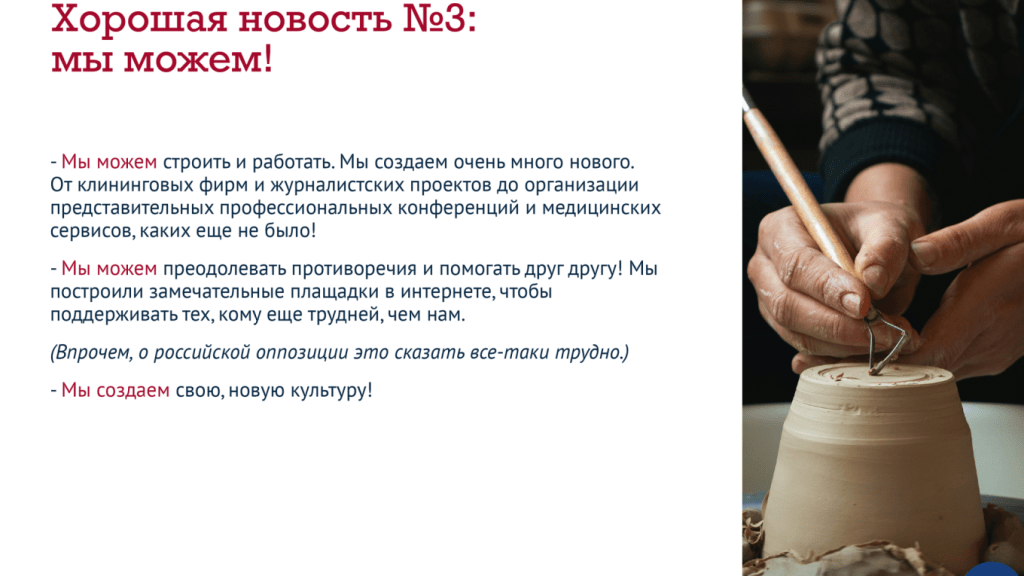
We can build and work. We have been creating many new things — from cleaning firms [kliningovykh firm] and journalism projects to organizing impressive professional conferences and medical services the likes of which have never been seen!
We can overcome animosities and help one another! We have built outstanding platforms on the internet to help those who have it worse than we do. (However, it is still difficult to say this about the Russian opposition.)
Sciences Po and its Provost Sergei Guriev, a world-renowned Russian academic and economist who had to flee his country in a day in 2013, were honoured to welcome @Ekaterina_Schulmann for a very exclusive conference on 20 April, 2023. This political scientist and social media sensation guest speaker addressed the serious matters of the Russian regime stability and the dynamics of public opinion.
Source: Sciences Po (YouTube), 8 May 2023. My question, had I been in the auditorium for this fascinating lecture, would have been to the audience: how many of you are neither Russian nationals nor speak Russian? I suspect that the numbers of such non-Russian nationals and non-Russian speakers were quite low. And why was this lecture delivered in English, not French?||| TRR
Source: unsolicited ad on Facebook
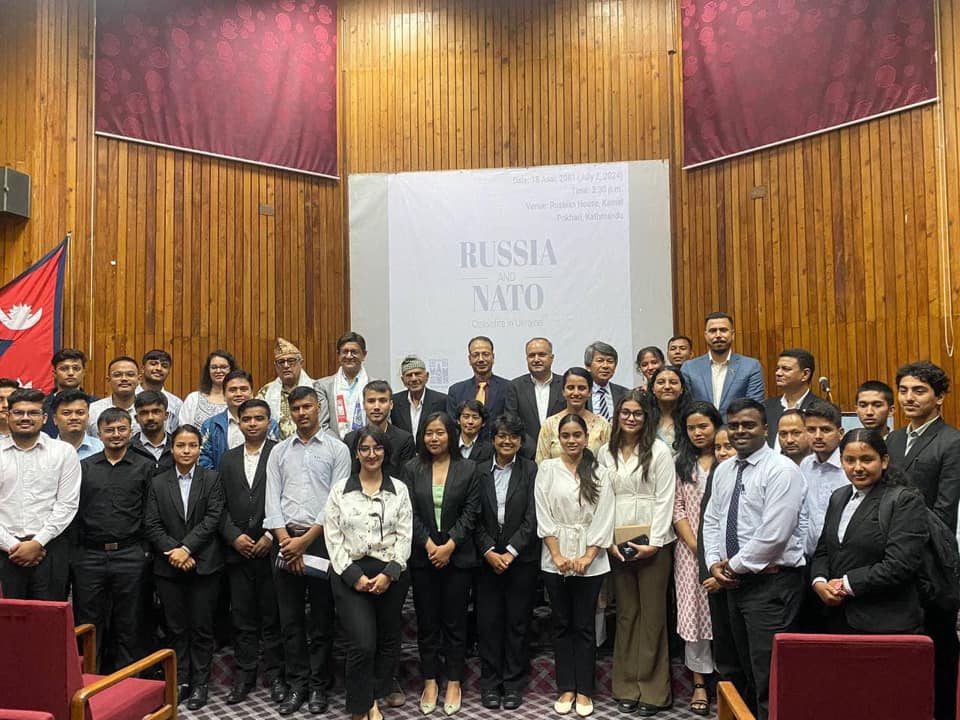
On 2 July 2024, International Law Club successfully organized an academic discourse entitled “Russia and NATO: Ceasefire in Ukraine.”
The speakers for the program included Dr. Yubaraj Sangroula (Professor of International Law), Dipak Gyawali (Former Minister of Ministry of Water Resources, Nepal), Dr. Govind Kusum (Former Secretary of Ministry of Home Affairs), Prem Chandra Rai (From Himalayan Development Affairs Council, Nepal), Yugichha Sangroula (Masters in International Humanitarian Law from Geneva), Dmitry Stefanovich (From IMEMO RAS, Moscow)
The welcoming remarks for the discourse were delivered by Anton Maslov, First Secretary and Director of the Russian House. The distinguished Chief Guest of the program was Seniormost Advocate Krishna Prasad Bhandari.
Dr. Dipak Gyawali provided valuable insights into the historical context of the Russia-Ukraine conflict, emphasizing its longstanding nature within the framework of NATO-Russia dynamics.
Professor Dr. Yubaraj Sangraoula shed light on the hegemonic influences and Western interference in global affairs, highlighting the concept of a rule-based international order that has been divisive.
Assoc. Prof. Yuggichhya Sangroula emphasized the importance of interpreting international law in a balanced manner, noting the significant contributions of Asian nations to its development alongside European nations.
Assoc. Prof. Prem Chandra Rai advocated for adherence to the UN Charter as the foundation of international law, stressing the need for inclusive peace initiatives that engage all relevant parties, including Russia.
Dr. Govind P. Kusum underscored the disproportionate impact of global conflicts on developing nations and emphasized the urgent global need for peace and security.
Mr. Dmitry Stefanovich discussed the inadequacy of mere ceasefires and called for sustainable solutions and increased global cooperation, particularly from the Global South, to address ongoing conflicts.
The subsequent question and answer session facilitated critical discussions on ceasefire strategies and institutional reform. Speakers analyzed geopolitical dynamics, and Western dominance, and proposed measures for achieving global peace and security, with a focus on strategies applicable to third-world nations.
Overall, the seminar provided a platform for robust dialogue and strategic insights into resolving international conflicts and fostering a more peaceful world order.
We sincerely express our gratitude towards the speakers, guests, and participants for their involvement.
The Club would like to thank the Russian House, especially the Director of Russian House, Mr. Anton Maslov for supporting us in organizing this academic discourse and acknowledge the presence of Ms. Alena Danilova, Press Secretary from the Russian Embassy at this program of ours.
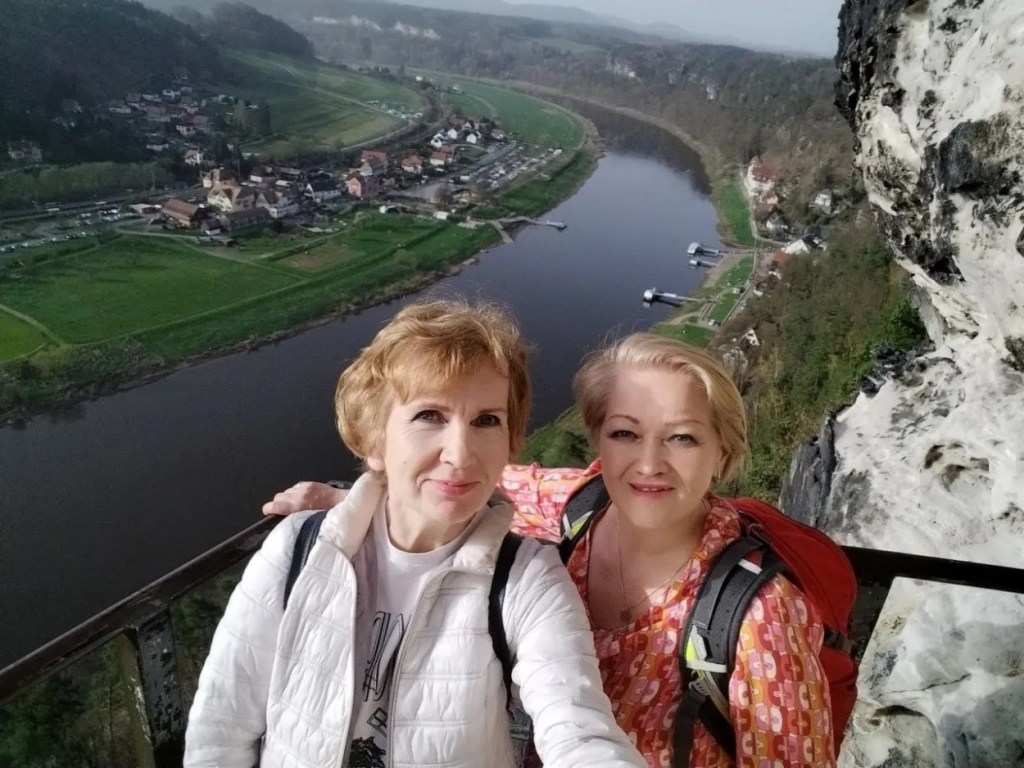
Pensioners Irina Nippolainen and Anna Trusova, friends and residents of the small Karelian town of Segezha, fled Russia in the spring of 2023 after the FSB came to search their homes. Anna and Irina were forced to make a long trek to Azerbaijan via Belarus before making their way to Germany, where they now have residence permits and social housing, and where they hope to find work. Meanwhile, back in their home country their relatives have been summoned for questioning in the criminal investigation against them. Journalists at the website Okno tell the story of the two women, who chose forced emigration over unfreedom.
ESCAPE
On 20 March 2023, 60-year-old Irina and 58-year-old Anna said goodbye after taken a stroll and went home. A few minutes later, Irina called Anna and told her that the FSB had come to see her. Anna rushed to her house after Irina’s call.
“As soon as I rang Irina’s doorbell, I immediately turned on the video on my phone to put the squeeze on them: Who the hell are you guys? The FSB guys saw that I was filming on my phone and immediately called someone, saying, ‘She’s here, come over.’ Anyway, it transpired that they had come for both of us.”
During the search, the FSB officers confiscated their phones and computers from the two pensioners. The search warrant stated that the searches were part of a criminal investigation into “public calls to engage in activity threatening state security.” Anna and Irina guessed that the case had been triggered by a denunciation. They both had written many posts on their VKontakte pages about their opposition to war, and in response had received a “barrage of hatred” from those who had read the posts.
“It was stressful. I lost eight kilograms during that time: I was so worried, I didn’t eat, and I didn’t know what would happen. I knew that people in Russia are sent to pretrial detention centers at any age even for sneezing at the authorities, and I did not know what exactly the law enforcers would find in the devices they confiscated and how they would interpret what they found. As soon as we were searched, my children immediately got involved in the problem, checking out everything they could: internet sites, their acquaintances, and then their acquaintances who had left the country. They decided how we should proceed—where and how to get asylum or other options. After analyzing everything, they decided that a humanitarian visa was the best option. We had to decide where to go, where to stay, and what to take with us,” says Irina.
They considered fleeing to two countries—Finland and Germany—but decided on the latter because it was easier to get a visa there.
But first Irina and Anna went to St. Petersburg, because they had to get papers for Anna’s dog Ramona. They stayed with an acquaintance of Anna’s, but the woman was very afraid that she would be “prosecuted for her connection” with the fugitive opposition activists, so they had to move out.
Irina, Ramona, and Anna
“Our children, who were assisting us, gave us the contact information for a man who did not know us at all but who wrote, ‘Come and stay as long as you want’. He helped us out and fed us, and we spent all that time while we were taking care of business at his house,” they explain.
Anna and Irina stayed in St. Petersburg for a week before departing for Azerbaijan.
They did not travel to Baku directly. For security reasons, they got themselves new cell phones, discussed the route, decided not to buy plane tickets in Russia, but to do it in Belarus, and went to Belarus by cab, paying 20,000 rubles [approx. 200 euros] for the fare.
“We took everything into account because we didn’t know how quickly they would come for us. In fact, we were very surprised that they didn’t nab us right away. We also chose Belarus because the dog was with us, and we felt bad about putting her in the luggage hold. Belavia is one of the few airlines that allow passengers to transport small animals in a carrier on a seat in the passenger cabin,” says Irina.
Irina and Anna flying from Minsk to Baku
After taking a cab to Minsk, they immediately went to the airport, bought tickets, and flew to Azerbaijan at night. In Baku, Irina and Anna initially settled in a small hotel.
“I was in such a state that my hair stood on end. For Anna, it was like an adventure, but for me it was like a misfortune, because I had left my home, my husband, and my pets. I didn’t want to leave my home or my country. That’s why I was very anxious. I even reached out to a psychologist from an aid organization, but she didn’t help me much,” Irina says.
Anna’s mood was a little different.
“I’m generally a traveler, but I hadn’t been able to travel lately. First there was the pandemic, then this whole thing happened. Not that I was freaking out about it, of course; I was freaking out for other reasons. But when it happened, I put three bathing suits in my suitcase—Ira makes fun of me—and went to the airport. I assumed I might have difficulties in Russia due to my intemperate tongue: I supposed that I would have to leave. I have a daughter in the Czech Republic, but the Czech Republic has a very bad attitude towards Russians, and they wouldn’t give me a visa. I thought that I would go to India, it’s quiet and peaceful there. My suitcase was initially packed with summer clothes. Of course, I was a bit nervous about the dangers. But basically, I always try to stay positive and hope for the best,” says Anna.
Anna, Ramona and Irina on the beach in Baku
Irina and Anna ultimately stayed in Baku for four months. They submitted the paperwork for humanitarian visas to Germany quite quickly, and had been approved by early June. But due to the local and the German bureaucracies they had to wait a long time for their papers. During this time, the pensioners already had their own circle of contacts—their landlady, their neighbors, and other refugees from Russia.
“And while there was uncertainty as to whether we would be granted a visa or not, we were already considering Azerbaijan as a place to live, because we could have lived there on our pensions. We had already found some channels for cashing money there, because our bank cards didn’t work there anyway. But still, we didn’t consider ourselves safe there,” Irina explains.
“GOD, HOW DID YOU BEAR IT ALL?”
In July, all their papers were in hand, so Irina and Anna began packing for Germany. They decided to make their way to Georgia first, since it was cheaper to fly to Germany from Tbilisi than from Baku. They went to Georgio by bus, stayed in Tbilisi for a couple of days before flying to Germany.
“When we arrived in Germany, I was already on VKontakte recounting all our adventures. And people wrote, “God, how did you bear it all?” Because there were a lot of hard moments. Personally, I was constantly stressed out, but it had become a way of life, you know. Anya is fine, she’s easygoing, but I can’t improvise when it comes to serious matters, I have to prepare and think things over. If I hadn’t followed all those rules, maybe we could have flown to Germany more easily, who knows. I’m a thorough person, I don’t want to lose money and end up stranded at the airport not knowing what to do. That is, I was preparing, I was checking out all the chat rooms and websites, seeing what papers we needed to get and where to go. There was a lot of preparation just for the dog. Without the dog, we would have done it all ten times easier, if not more. Because in different countries there are particular papers and certain vaccinations you have to have, and the airlines have certain requirements for the carrier. Ramona is a basically a ‘homeowner’—she had three portable houses,” Irina says.
“The atmosphere is cool”
“For the first time in her life, probably, when leaving Baku, Irina took sedatives because the dog in its carrier had to be placed in the trunk of the bus. And I was so worked up that even I took them too,” Anna remarks.
Anna and Irina flew to Frankfurt, where they were met by a friend of Irina’s who had lived in Germany for a long time. They had to get to their initial placement site, the town of Suhl in Thuringia, which is a three-hour drive from Frankfurt.
“But when we arrived there, we were told that pets were not permitted. Ukrainians used to bring pets there with them, but since now there are few Ukrainians in this camp and mostly Muslims, who have a bad attitude to dogs and are afraid of them, it is prohibited. So we urgently began looking for help on the chat rooms. A Ukrainian family agreed to take Ramona in for a while. They lived right next to the camp, and so we would go to their house to walk the dog. But then this young woman found out she had allergies, so Ana’s daughter quickly came from the Czech Republic and took Ramona away,” Irina explains.
A room in a German dormitory for refugees
The refugee camp where the pensioners were initially placed was a complex of five buildings, mostly inhabited by people from Arab countries.
“It was a bit scary to live in such an unfamiliar environment, given that the doors to the room in which we were put were unlocked. The police even came once because of a conflict in the building. We also had our passports taken from us and there was a risk that we would be processed in a different status—as refugees, even though we had ‘humanitarian visa’ stamped on our papers. We wrote everywhere, because they said that if we were registered as refugees, we could change this status only through the courts, and the courts could take years. That was scary. I said that we could not even return to Russia without a passport. Basically, it was a massive problem. I’d only recently been released, and I had put on two or three kilograms, because one thing or another was causing stress, but there was no getting around it,” Irina recounts.
Everything worked out well, ultimately. After a week, they were moved to the town of Greiz, a two-hour drive from Suhl. There they were allocated a social apartment, started to receive an allowance, were insured, and were issued social security numbers. By October, Anna and Irina had received residence permits for three years. During all this time, however, the pensioners had to confront the famous German bureaucracy more than once.
“They have an algorithm, as it were. But the human factor often gets in the way. People who work in this system, they do not know all the laws, or often they do things just to check off the boxes. But our case was quite peculiar for them: we are Russian pensioners, we have humanitarian visas, and they probably have a million other refugees here. Things were difficult, but when you look back, you think, What was there to worry about?” said Anna and Irina.
After the paperwork was completed, the friends moved again, but not far—to the city of Gera, thirty kilometers from Greiz. Each of them found rented accommodation there, which is paid for by the municipality. The apartments there are rented empty, with no furniture or appliances.
“When we moved from one place to another, they stopped paying us in the old place, but here they hadn’t started paying us yet, and it took two months to process the registration. So for two months we were without money or furniture,” Irina explains.
Since she had not yet been discharged from social housing, they could still live there together legally for some time and work on furnishing their new homes.
“The Ukrainians who live here have set up a help chat room and chat rooms for selling different things. I bought a bed and a chest of drawers from Ukrainians. I got some things for free. Germans often sell things they don’t need for very cheap. For example, I bought a complete kitchen set for only 100 euros, which is practically nothing. Now I’m looking for a bigger refrigerator,” Irina says.
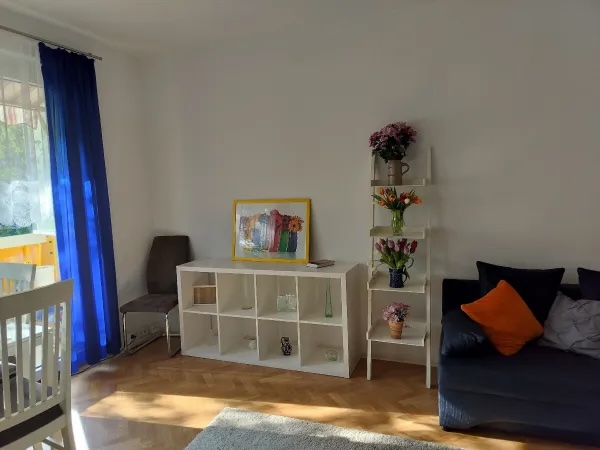
Irina’s apartment after she furnished it
Anna, on the other hand, found an app similar to the Russian website Avito, where used furniture was sold, and bought almost everything she needed at wholesale prices.
“The only thing I was left without was a kitchen. I didn’t have a stove, but I got a microwave, and I could survive with a microwave. I bought a kettle. And that’s how I lived for the first few months,” she said.
The pensioners were at pains to point out that no one refused to help them. People who had also immigrated to Germany, some twenty years earlier and others two years earlier, offered them bedding, dishes, and household supplies. When Irina and Anna had settled in, they passed some of these things on to a family from Ukraine.
Expiring products are given to immigrants for next to nothing
People who have been granted humanitarian visas in Germany can choose not to work and live on benefits. But they can try to find a job if they want. Before they retired, Anna was involved in marketing cosmetics, while Irina helped animals. After ten years at the official municipal animal shelter, she ran a mini-shelter for five dogs, one of which she ultimately adopted. Finding a job in Germany is still difficult for them.
“We don’t speak German, so the opportunities to find work are few and far between for the time being. I am registered at the job center, while Irina is now registered with the Sozialamt, and she can live on her pension in peace, but I will only go on 31 July to test the level of my German. God willing, I will test out at A1, since I almost got A’s in German back in school. After taking this test, I do not know when I will be able to take German-language classes. Many emigrants take these courses two or three times. Then again, I’m old, so things don’t stick in my head nowadays. Of course, I would like somehow to learn the language faster and integrate faster,” Anna says, laughing.
Irina says that she has not been assigned to an integration course, so for the time being she is also living without knowledge of the German language and therefore jobless. While she was still living in Greiz, she worked a two-hour trial day as a seamstress in a local factory . Irina liked it very much. When she moved to Gera, she also wrote to one of the factories there, but was told that German was required. Getting a job is likewise important to Irina because she wants to invite her husband, who stayed behind Russia, to join her in Germany, which is impossible to do if she is unemployed. Irina’s husband would also need to know German, but how and where he can learn it and pass the test for the simplest level is still unclear. Irina herself attends German language courses, but they are run by volunteers and thus unofficial.
Anna and Irina say that even without jobs they have enough to do—they have traveled all over the area.
“We have been traveling a lot since day one. While we didn’t have papers, we used to walk, and then we got the chance to buy transit passes that enable us to travel by rail, buses, trams, and subways,” says Irina, who has also been to travel to Finland to visit her children, and to Stockholm and Copenhagen to meet friends.
Anna has bought a sewing machine and begun sewing.
“I used to do needlework, but in recent years things had not been coming together. Now I have started knitting curtains, and I will start weaving; I want to do a lot of things. I knitted myself a sweater. I bought brushes and paints and started drawing a bit, but have given it up for the time being. Mostly, I want to walk more. We are from Karelia and have a tradition of walking as the first thing one needs to do. And I had a dog then. Here I bought a bicycle as soon as I got the furniture: I jumped on the bike and went riding. You have to see everything around you. It takes a lot of time to see everything, to photograph it, to edit it, to upload it to the internet. So there is not enough time,” she explains.
By the way, both pensioners are each on their third VKontakte page: their previous pages had been blocked by the Russian authorities.
“DID THEY WRITE ABOUT BUCHA?”
Karelian law enforcement never forgot Irina and Anna.
In April 2024, it transpired that a criminal case had been opened against the two émigrés on charges of disseminating “fake news” about the Russian army. They found out about it because Irina’s husband was summoned to testify, for some reason, in the criminal investigation against Anna. Only when he met with the investigator, it transpired that Irina was also being prosecuted on the same charge. The husband refused to answer the investigator’s questions, invoking Article 51 of the Constitution (which permits an individual not to testify against themself or their spouse). Anna’s sister was then summoned for questioning in the same investigation. A little later, it transpired that both Anna and Irina had been put on the federal wanted list. And shortly before this interview, a person unknoiwn, who introduced himself as a policeman, wrote to Anna via WhatsApp and asked her where she was.
How many criminal “fake news” cases have been launched in Russia
In March 2022, after invading Ukraine, Russia adopted laws that criminalized disseminating “fake news” about the Russian army and “discrediting:” its actions. As of February 2024, 402 such cases had been brought. Dozens of Russians have been sentenced to lengthy prison terms for allegedly violating the law. According to human rights activists, this is tantamount to military censorship.
It is still unknown why the criminal case was launched. The relatives were asked during questioning what Irina and Anna had written on their first VKontakte pages. They made a special point of asking, “Did they write about Bucha?”
“It’s no fun feeling like a criminal. Although we all know what it means now in this [sic] country. In short, the crackdown continues: you are on the right side, and they are on the wrong side. They have to do something: there’s probably no one left in Karelia to sink their claws into anymore, but they need fulfill quotas. It’s a crackdown for its own sake. I feared for my relatives, because way back in 1938 there were so-called enemies of the people, and children, wives, and husbands of enemies of the people. I’m afraid lest it come to this,” Irina says.
The human rights activists consulted by Anna and Irina have advised them not to return to Russia before the regime changes, otherwise they will be sentenced to hard time in prison.
“FOR THREE DAYS I BAWLED LIKE A BELUGA”
Both émigrés follow the news from Russia closely. They argue that the country is “hurtling into an abyss.”
“What is happening is simply absurd. It feels like the country exists in a kind of distorted reality in which good is evil, and black is white. They are engaged in such insanity, frankly, and you don’t understand how it is possible to support all of this. And then there are the people who have gone crazy on a nationwide scale and who think everything is fine there, that it’s the way it should be. I worked at a polling place for many years and I used to say all the time that when we socialize only with our own kind, we don’t see what the rest of the people are like, but I saw all kinds of people at the polling station. I know that might sound kind of arrogant, but I saw how massively ignorant people were. I’ve always been skeptical of the claim that the Soviet Union had the best education system. I don’t know how it was the best if it didn’t teach people to think, and if people blindly trust the authorities. The authorities are king and god to them, as this whole situation has shown. Basically, you get the feeling that all people have come down with insanity, and some are immune. The analogy with Hitler’s Germany immediately comes to mind, where the people were fooled in the same way, gulled by propaganda. Maybe there is still hope that if the regime changes and they tell folks on TV how it really was, then…. We are now like spectators looking at Russia from the outside, and it’s scary to watch what is happening there,” Irina says.
When asked how they reacted to the news of politician Alexei Navalny’s death, Anna is unable to reply. She immediately starts crying.
“That’s how we reacted,” Irina explains, crying too.
“It’s good that my daughter was here that day: we went to Munich with her. I spent the whole day with them. But in the evening they went to a concert, and I got on the Munich chat rooms and found out that there would be a rally on Freedom Square and went there,” says Anna.
Alexei Navalny’s Death
The news of Alexei Navalny’s death came on 16 February 2024. He had been serving a nineteen-year sentence for “extremism,” after being convicted on seven criminal charges, including “creating an extremist community.” During his imprisonment, he was sent to a punishment cell twenty-seven times, spending almost 300 days there. After the politician’s death, pickets to mourn his passing were held in Russian cities, and the picketers were detained by the police en masse. The authorities refused to hand over his body to his relatives for a long time, demanding that they bury him in secret. Navalny’s associates argue that he was murdered and blame President Vladimir Putin for his death.
“I bawled like a beluga for three days. I still can’t even look at the photos of him calmly,” Irina adds.
“In the past, Ira, you used to say, ‘Navalny will be released and I’ll go home,'” her friend remarks.
Irina doesn’t make any predictions now that she has emigrated.
“I don’t make any predictions and I don’t listen to them. My motto now is: do what must be done and what will be will be. And I would also add: do what you have to do and what you are able to do. What matters most is saving yourself and your loved ones. We don’t know how long this will last. Analyzing things even as they stand now, I can confidently say that nothing good is going to happen…. Well, how should I put it? Nothing good is going to happen quickly. But I’m not ruling out either possibility: that I’ll stay here, or that I’ll go back there. I’ll go home as soon as I can. If nothing changes there, I’ll stay here.”
Anna, however, says that she has almost no one left in Russia: her daughter emigrated to the Czech Republic back in 2016, and she hardly communicates with her relatives who stayed behind in Russia.
“I will be better off here anyway. As long as they don’t kick me out, I’ll stay here,” she adds.
The pensioners nevertheless try to keep involved in Russian politics. They traveled to Leipzig to sign a petition supporting Boris Nadezhdin’s presidential candidacy and then to Berlin to vote in the presidential election.
Irina signing a petition in support of Boris Nadezhdin’s presidential bid
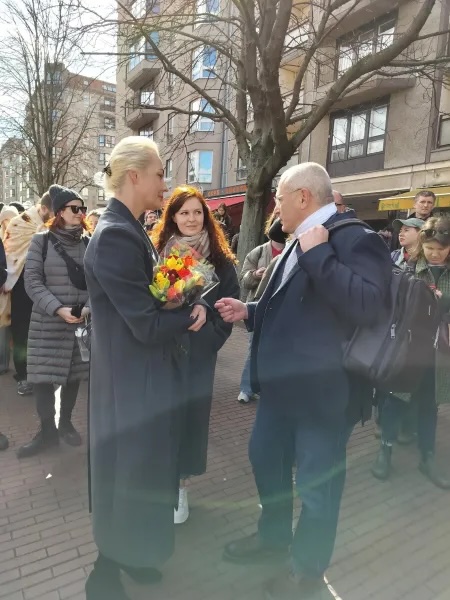
“There was such a huge queue. Because we were afraid of missing the train, we cut the queue a bit. A lot of people could not vote because, I think, only two polling stations were open in Germany—in Berlin and in Bonn. There were a lot of people who wanted to vote. We stood in line there with Yulia Navalnaya. And I talked to Mikhail Khodorkovsky, and we had our pictures taken with Ekaterina Schulmann. There were so many celebrities, and the queue itself was very cool. There were a lot of young people, all chanting “Russia without Putin.” But there were also a few pro-Putin people who have lived in Germany for twenty years and go vote for Putin, and we trolled them a little bit. But this is life, this is reality,” says Irina.
Irina Navalnaya, Kira Yarmysh, and Mikhail Khodorkovsky
What do Anna and Irina dream of?
“Grandchildren!” Anna answers immediately. “And first of all, of course, that the war end!”
“The first thing I wish for is that the war end. And the second is for me to go home,” says Irina.
Impact of Discrimination on Integration of Emigrants From the Aggressor Country (with Ivetta Sergeeva)
Following the full-scale invasion of Ukraine in 2022, up to one million Russians fled their homeland, marking the most significant brain drain since the Soviet Union’s collapse. While some host countries view the highly educated and politically active migrants as an asset, integrating nationals of the aggressor state has presented challenges. Many migrants face institutional restrictions aimed at sanctioning Russia, alongside varied experiences of discrimination from local populations. This study delves into the effect of discrimination on the assimilation intentions of Russian migrants, focusing on language learning as a key indicator. Laitin’s model of identity building suggests that migrants’ willingness to assimilate depends on the perceived benefits, including acceptance by the host society. Following the model, Sergeeva assumes that discrimination signals to migrants that the host country’s society does not accept them, making learning the local language a less rational choice.
Utilizing a cross-sectional panel survey, the study establishes a link between discrimination and integration, differentiating between the effects of discrimination experienced from local citizens and local institutions on language acquisition. Findings reveal that societal discrimination significantly dampens migrants’ willingness to learn local languages and diminishes their trust in and attachment to host societies, unlike institutional discrimination, which shows no such effect on language learning. These insights contribute to an understanding of the impact of nationality-based discrimination, highlighting the role of societal acceptance in the successful integration of political migrants.
This event will be hosted in person and virtually on Zoom. Register for the Zoom meeting here. Non-NYU affiliates must RSVP for in-person campus access.
Ivetta Sergeeva is a PhD candidate at the European University Institute in Florence. She specializes in political behavior, civil society, and Russian emigration. She is a co-founder and co-principal investigator of OutRush and ViolenceMonitor (a series of surveys on intimate partner violence in Russia). She also has eight years of experience supervising projects in civil society and human rights organizations in Russia. Website: www.ivettasergeeva.com. Email: ivetta.sergeeva@eui.eu.
Date: 29 April 2024 4:00 PM – 5:30 PM
Speaker: Ivetta Sergeeva
Location: Jordan Center, 19 University Place, New York
Professoressa on the Pole* is the result of Polina Kanis’ investigation into the perceptual transformation of the female body in Russia following the onset of the full-scale invasion of Ukraine and subsequent ideological shift within Russian society. As part of this investigation the artist trained as a pole dancer and worked at a strip club.
The exhibit includes photographs documenting Kanis’ three-month stint at a strip club, the club’s rules of conduct for strippers, and a video re-enactment of the artist’s stage performance. The project marks the latest chapter in Kanis’ ongoing research into the changing role of a female teacher in Soviet and post-Soviet Russia, where limitations imposed by the state can only be counter-balanced by imagination.
*Professoressa (Italian: female teacher) refers to the 1967 manifesto Letter to a Teacher (Letters a una Professoressa), which harshly criticizes the power structure and classism of the educational system in 1960s Italy.
location: Expo
price: €5, tickets for a performance of the CARTA ’24 festival give free admission
duration: 5h
extra info: wed – sun: 14:00 – 19:00, evening performances until 22:00
Nadya Tolokonnikova, an artist who is founder of the feminist collective Pussy Riot, has long been persecuted in Russia for her conceptual performances and artistic protest against the Putin regime. Her performance Punk Prayer in the Christ the Savior Cathedral in Moscow, recognized by The Guardian as one of the most important artworks of the twenty-first century, ended for her and her colleagues with imprisonment for “hooliganism motivated by religious hatred.”
OK LINZ is bringing Nadya Tolokonnikova’s art to the museum, presenting her haunting works dealing with resistance, repression, and patriarchy for the first time to the European public.
Tolokonnikova’s oeuvre encompasses objects, installations, and performative works in which she processes her traumatic experiences during her life under Putin. Out of a state of repression, she has developed a visual language that rebels against aesthetical and political realities: anarchic and radical, yet also moving and witty.
“Being from Russia brings me pain. Most of my life, even after 2 years imprisonment following my art protest, I chose to stay in Russia, even though I had plenty of opportunities to immigrate, I tried to change Russia, make it a country that I would be proud of—peaceful, prosperous, friendly, democratic, loving, a country that values human life, art and happiness. First with Voina Group, later with Pussy Riot, I’ve been in performance art since 2007, for 17 long years—years filled with joy of protest and comradery, harassment, arrests. I watched my friends being murdered and revolutions suffocating under Putin’s boot.“ —Nadya Tolokonnikova
An oversized blade hangs like a sword of Damocles over visitors to the OK. “Shiv” is the title, American prison slang for an improvised knife. It stands for the precarious situation of artists and activists in Russia who, like Tolokonnikova herself, live in constant fear of persecution by the Russian judiciary. The exhibition will spotlight a selection of Situatioinist actions by Pussy Riot. At the center is Tolokonnikova’s 2022 performance Putin’s Ashes in which she joined forces with twelve women from Ukraine, Belarus, and Russia who experienced repression and aggression at the hands of the Russian president to burn a portrait of Vladimir Putin in a desert, collecting the ashes in small bottles.
“This art is a weapon,” says Tolokonnikova of her works, analyzing and exploring in this way the role that her art and she herself can play in the context of international power structures.
Curators: Michaela Seiser / Julia Staudach
Source: e-flux mailing list, 22 April 2024
Akhmatova’s Orphans International conference Princeton University 3-5 May 2024
May 3
4:00 pm–5:00 pm. Location: Firestone Library
The Anatoly Naiman Papers. Visit to the Special Collections
Presentation by Thomas Keenan-Dormany, Slavic Librarian
5:00 pm–6:30 pm. Location: McCosh 50
Rock. Paper. Scissors (2023)
Documentary film screening
Q&A with the co-author Anna Narinskaya
7:00 pm
Reception at the Levings’ residence (Shuttle provided)
May 4
Location for all talks: 245 East Pyne
9:30 am
Breakfast at East Pyne
Session 1
10:00 am–12:00 pm
Veniamin Gushchin, Columbia University
Late Akhmatova and Philology: Intertextuality, Interpretive Communities, and Effective History
Evgeny Soshkin, Free University / Brīvā Universitāte (Latvia)
Akhmatova’s Dead Orphans: Toward the History of a Paradox
Gleb Morev, Independent researcher
Akhmatova and Brodsky
12:00 pm–1:00 pm
Lunch
1:00 pm–1:40 pm
Keynote speech
Roman Timenchik, The Hebrew University of Jerusalem / PrincetonUniversity
Akhmatova’s Orphans and the Literary Orbit of the 1960s
Session 2
2:00 pm–4:00 pm
Dmitry Bobyshev, University of Illinois Urbana-Champaign [via Zoom]
On the so-called ‘Akhmatova’s Orphans’
Emily Lygo, University of Exeter
Dmitry Bobyshev’s Poetry of the Turn of the Century
Marco Sabbatini, University of Pisa
“Out of the Magic Choir”: Viktor Krivulin and the Leningrad Underground Poetry on Akhmatova and her Orphans
4:00 pm–4:30 pm
Coffee break
4:30–5:50 pm
Sofia Guerra, Princeton University
Anatoly Naiman’s Translations from Giacomo Leopardi
Benjamin Musachio, Princeton University
Estrada as a Fault Line: Akhmatova and Company vs. Evtushenko
6:00 pm–7:30 pm
Location: East Pyne 010
Akhmatova’s Orphans. Disassembly (2024)
Documentary film screening
Q&A with the director Yuri Leving
7:30 pm
Dinner
May 5
Location for all talks: 245 East Pyne
9:30 am
Breakfast at East Pyne
Session 1
10:00 am–12:00 pm
Maya Kucherskaya, Jordan Center, New York
Solo in a ‘Magic Choir’: The Case of Joseph Brodsky
Michael Meylac, StrasbourgUniversity [via Zoom]
An Enchanting (!) Chorus (?): Different Poets of Dissimilar Fortunes
Alexander Dolinin, University of Wisconsin-Madison
Brodsky’s Poem “Darling, I left the house today…” in the Context of Poetic Tradition
12–1 pm
Lunch
1:00 pm–1:40 pm
Leningrad Poetic Circles of the 1960s Through the Camera Viewfinder
Roundtable devoted to photography of Boris Shwartzman, Mikhail Lemkhin and Lev Poliakov
Session 2
2:00 pm–4:00 pm
Polina Barskova, Berkeley University [sic!]
Depiction of Links and Ruptures of Time in Evgeny Rein’s Poetry
Oleg Lekmanov, Princeton University
On Evgeny Rein’s Poem “In the Pavlovsky Park”
Anna Narinskaya, Independent researcher, Berlin
The Orphans and Jews
4:00 pm–4:30 pm
Coffee break
Session 3
4:30 pm–6:45 pm
Translating Poetry of “Akhmatova’s Orphans” into English
An Open Workshop: Kathleen Mitchell-Fox, Emma George and Ilya Kaminsky, Princeton University
Lev Oborin, Berkeley University
Anatoly Naiman’s “Vegetation”: Towards Poetology of Branching
Maria Rubins, University College London
Is Brodsky a Poet for Our Time?
6:45 pm
Dinner
Organizing Committee:
Yuri Leving, Chair
Ekaterina Pravilova, Ilya Vinitsky and Michael Wachtel
Sponsored by REEES, PIIRS, and Department of Slavic Languages and Literatures, Princeton University
@george.spb wrote the following comment when Eva Morozova posted the cartoon, above, on their Instagram page:
I always say that I am from Russia, even though I am [an ethnic] Georgian. I have never got a single unfriendly look. At most, they might somehow make a good-natured joke about it. All foreigners are well aware that not all people in Russia support the military action, especially those who have left. The only thing I won’t do is demonstrate Russian symbols or sing the Russian anthem until the war is over, a correct assessment of what happened has been made, and the perpetrators have been justly punished. I can’t change anything else; I was born there. And if a person is biased about it, then it’s not my problem anymore.
@intelligent_beauty_paris wrote:
It happened once here: – Vous êtes d’où? – Where are you from? – De la Russie. From Russia. – C’est pas grave! / No big deal/ It happens/ Don’t worry about it!
YALTA, Crimea, Aug 29 (Reuters) – In years past, Siberian Viktor Motorin could hop on a plane and arrive in Crimea just four hours later to relax at his holiday apartment. Now he must fly first to Moscow and then spend a day and a half on the train.
The war in Ukraine, now 18 months old, is making it harder for many Russians to reach their favourite summer haunts in the Black Sea region of Crimea, which Moscow seized and annexed from Ukraine in 2014.
And safety is a factor for some, especially after two major Ukrainian attacks since last October on the 19 km (12 mile) Crimean Bridge that links Russia by road and rail to the peninsula.
But after weighing up such concerns, Motorin, from the city of Khanty-Mansiysk in western Siberia, said he decided that making his annual trip was still a risk well worth taking.
“We calculated that it was reasonably safe, especially when my colleagues had already come here in June, early July. They said it was all calm here with no problems on the Crimea Bridge. The goods, the prices, everything is like before,” he said.
In 2022, the year when Russia’s full-scale invasion of Ukraine began, more than 4,300 people renounced their Russian citizenship, the highest such figure for the last three years. Among them were several major Russian businessmen, including [former] Troika Dialog CEO Ruben Vardanyan, venture capitalist Yuri Milner, and Tinkoff Bank founder Oleg Tinkov. However, the Russian Foreign Ministry said that the increase in “refuseniks” was due to the pandemic that raged earlier, claiming that “there are no particular changes in the numbers of requests to withdraw from Russian citizenship from abroad.” And the Russian Interior Ministry recently proposed reviewing the cases of people who have renounced Russian citizenship, that is, theoretically, a person’s citizenship could be forcibly reinstated. Farida Kurbangaleyeva talked to people who decided not to be Russian nationals anymore and found out why it mattered to them.
“If I have the sudden urge to live in Russia I’ll get a residence permit”
Andrei Kreinin, USA, renounced his Russian citizenship
I’ve wanted to emigrate to the USA since I was fifteen, when I saw the good old American movie Short Circuit 2. Spoiler alert: it ends with a scene of the main characters taking the oath of citizenship. I went to the States many times on a tourist visa, and in 2011 my family and I won a green card and moved to Chicago. In Moscow, I worked in telecommunications and I got a job in the same field in our new home.
The decision to renounce citizenship was made on February 25, 2022—after the brutal bombing of Kharkov, when people were hiding in the subway there. Firstly, because there is such a thing as a conscience, and secondly, my mother was born in Kharkov, and it was impossible for me to remain a Russian national. My family said, “We won’t do this. If you want to, do it, but then don’t pine for Russia.” I said I understood them perfectly. I had a couple of friends from Russia who called me bad words on social media, and I had to ban them. But mostly the attitude ranged from neutral to understanding: “It’s your business, Andrei.”
To renounce your citizenship, you need to do two main things—deregister your place of residence [in Russia, where everyone is required to register their place of residence] and get a paper stating that you owe no back taxes in the Russian Federation.
They say that it can be difficult to deregister remotely, so in June 2022 I flew to Russia. I took care of transferring my real estate and deregistering from my apartment. Basically, I covered all the important bases to the max. Before the trip, I carefully monitored the situation: I understood that there would be a mobilization. I actually thought it would be announced on May 9 [celebrated as Victory Day in Russia].
When I had collected all the paperwork, I took it to the consulate in New York. It did not go smoothly. About three months later, I received a letter saying my application had not been approved, because, according to the Interior Ministry’s databases, I was still registered—although I even had a stamp in my [internal] passport stating I had been deregistered. Consequently, I spent two or three sleepless nights, due to the time difference, trying to get through to the proper authorities in Russia. They said, “Send us your application again and a photo of the discharge stamp.” I sent them, and two days later I received a reply that I had been removed from the residence register.
Andrei Kreinin Photo courtesy of Mr. Kreinin via Republic
I forwarded the whole thing to the consulate again, hoping that they would accept the documents online. But they said, “No, you’ll have to come to New York again.” I went again, resubmitted [my application], and after another two and half months I was informed that my application had been approved. I was told to report to the consular department and hand over my [internal and foreign travel] passports, which I did.
I have heard that the [Russian] state does not like people like me, because it is one thing to renounce Russian citizenship in a country where it is a necessary condition for obtaining the local citizenship, for example in Germany or the Netherlands, and another thing when you could retain your Russian citizenship, but you renounce it of your own free will.
But I didn’t notice any particularly negative attitude on the part of the staff at the Russian consulate. They behaved absolutely normally.
When I was in Russia, I forgot to withdraw my military registration. I had to call the military enlistment office. “This is how it is, guys, I’m renouncing my citizenship,” I said. Surprisingly, they did not yell at me or call me a traitor to the motherland, although I expected it. They just said, “Theoretically, we don’t do this sort of thing, but as soon as you complete the procedure, send us your military registration card, a copy of the certificate of renunciation of citizenship, a copy of your US passport, and a written request to be removed from military registration.” There is no mail service between the US and Russia nowadays. I had to make use of different “private couriers”: there are special Facebook groups for [arranging pickups and deliveries of letters and parcels]. Three weeks later, a letter from the military enlistment office addressed to me arrived in Moscow, saying I’d been removed from the register.
I have now applied for a Russian visa, which is granted to US citizens for up to three years. Not that I was planning to go there, but, as the Ukrainians say, schob bulo[“just in case”]. Plus, my father is still in Russia. He has already sent me an invitation to me, but he says, “Just please don’t come.”
I have no plans to reinstate my Russian citizenship under any circumstances. If I have the sudden urge to live in Russia, I can easily get a residence permit. It’s more than enough for me.
As my experience in dealing with the Russian Federation shows, it is better, paradoxically, to be a foreigner—you have fewer obligations.
A residence permit grants a person the same privileges as citizenship [sic], except the right to vote. On the other hand, no one can force me to do military service. The civil service will also be closed to me, but I’ve never aspired to join it either in Russia or the US.
The grandfather of renowned Crimean Tatar historian Shukri Seitumerov was executed during Stalin’s Terror for supposed ‘counter-revolutionary terrorist propaganda’. Eighty years later, Russia’s FSB came for Shukri’s two elder sons, Seitumer and Osman Seitumerov, as well as his wife Lilia’s brother, with the ‘terrorism’ charges they faced no less politically motivated. Such arrests and subsequent sentences of up to 20 years are part of Russia’s ongoing attack on the Crimean Solidarity human rights movement and are also simply ‘good for FSB statistics’. For the next round of victims, armed Russian FSB burst into the Seitumerov home yet again at 4 a.m. on 24 August, this time taking Shukri and Lilia’s last son away from them.Abdulmedzhit Seitumerov is just 23 and became a father less than 2 months ago.
Armed and masked enforcement officers carried out multiple ‘searches’ in the early hours of 25 August, with six Crimean Tatars taken away. All are now facing the huge sentences that have become a standard part of Russa’s most cynical conveyor belt of repression in occupied Crimea. Ruslan Asanov (b. 1975); Remzi Nimetulayev (b. 1985); Seidamet Mustafayev (b. 1995); Abdulmedzhit Seitumerov (b. 1999); Ametkhan Umerov (b. 1986) and Eldar Yakubov (b. 1980) are Crimean Solidarity activists who had previously faced administrative prosecution for peaceful acts of solidarity with other political prisoners.
This is one of the many identical elements in these cases which have been internationally condemned as politically motivated persecution. The ‘armed searches’ are invariably carried out without the men’s lawyers allowed to be present, and with the FSB most often bringing the so-called ‘prohibited religious literature’ that they then claim to have found. The men are generally forced to the ground, often in front of their terrified children, and then taken away as though criminals, although none is accused of any recognizable crime.
The charges are equally predictable with the Crimean Tatars accused solely of unproven ‘involvement’ in Hizb ut-Tahrir. This peaceful transnational Muslim organization was declared ‘terrorist’ by Russia’s Supreme Court in 2003, with the ruling passed in secret and probably politically motivated (making it easier for Russia to send refugees back to Uzbekistan where they faced religious persecution for involvement in Hizb ut-Tahrir). No explanation has ever been provided for why an organization not known to have committed terrorist attacks anywhere in the world should be so labelled, and the organization has always been legal in Ukraine.
Despite the lack of any grounds and in clear violation of international law which prohibits Russia from applying its legislation on occupied Ukrainian territory, Russia has been imprisoning Crimean Tatars (and a few other Ukrainian Muslims) on these charges since 2015. The sentences have been getting longer and longer (up to 20 years), as Russia openly targets Crimean Solidarity journalists and activists speaking out about repression in occupied Crimea.
In all such ‘cases’, at least one man is invariably charged with the more serious Article 205.5 § 1 of Russia’s criminal code (‘organizing a Hizb ut-Tahrir group’), while the others face the lesser charge of ‘involvement’ in the purported ‘group’, under Article 205.5 § 2. There is plenty of evidence from previous ‘trials’ that the more serious charge (carrying sentences of 17-20 years at present) are often laid in reprisal, for example, against Raim Aivazov for refusing to remain silent about the torture he faced from the FSB. The men will likely also be charged with ‘planning a violent uprising’ (Article 278). Once again, this is purely based on the 2003 Supreme Court ruling, with none of the political prisoners having ever been accused of actions or direct plans to commit any action aimed at ‘overthrowing the Russian constitutional order.’
The ‘evidence’ is as flawed as the charges. It hinges on FSB-loyal ‘experts’ providing ‘assessments’ of innocuous conversations about religion, Russian persecution, etc. to fit the prosecution and ‘anonymous witnesses’, whose testimony cannot be verified, and who may have never met the men.
Six families have been ripped apart, with children left traumatized and elderly parents facing never seeing their sons again.
Russia uses such arrests and ‘trials’ as a weapon against the Crimean Solidarity human rights movement and as an instrument of terror and propaganda against Crimean Tatars who have from the outset demonstrated so clearly their identification with Ukraine. The FSB are known to get promotion or bonuses for providing such ‘cases’ and can boast of ‘good statistics on fighting terrorism’.
Abdulmedzhit Seitumerov (b. 1999) was just 20 when the FSB came for his brothers, Seitumer Seitumerov (b. 1988) and Osman Seitumerov (b. 1992) and their uncle, Rustem Seitmemetov (b. 1973). For his parents, this was already a terrible blow, especially since Russia illegally imprisons the men thousands of kilometres from their homes. Now all three sons have been taken from them, and, if Russia is not stopped, Abdulmedzhit’s son Khamza, born on 5 July this year, will spend most of his childhood without his father. Abdulmedzhit had been active in Crimean Solidarity, speaking out in defence of his brothers and other political prisoners.
Ametkhan Umerov (b. 1986)
The 37-year-old Crimean Solidarity activist was detained and fined in July 2019 for a picket in Moscow in support of four Crimean Tatar political prisoners. He was one of 21 Crimean Tatars detained inh November 2021 for trying to stand outside an occupation ‘court’ during the appeal hearing in the case of three other political prisoners. Then in February 2022, he was jailed for several days for trying to attend a purportedly open (but political) ‘court’) hearing.
Ametkhan has three daughters and a son, all of them very young: Zamira (b. 2015); Khatidzha (b. 2017); Ali (b. 2019) and Zainab (b. 2021).
Seidamet Mustafayev (b. 1995)
Seidamet is just 28, but has faced several administrative prosecutions since 2017, when he was jailed for 10 days for taking part in what the occupation regime called an unsanctioned meeting (in fact, people standing outside in solidarity) during an armed search of the home of (now) political prisoner Seiran Saliyev. In 2021, he was also detained and fined for having tried to stand outside an occupation ‘court’ during a political hearing. In February 2022, he was also jailed for several days for trying to attend a purportedly open (but political) ‘court’) hearing.
Seidamet has four small children: Suleiman (b. 2014); Salsabil (b. 2016); Latifa (b. 2020) and Osman (b. 2023).
He has five daughters: Aishe (b. 2009); Anife (b. 2019); Adile (b. 2013); Yasmina (b. 2016) and Alime (b. 2020).
Eldar Yakubov (b. 1980)
The 43-year-old was detained and fined on 25 October 2021 outside the Crimean occupation military ‘court’ during an appeal hearing against the sentences passed on three political prisoners.
He has four daughters and two sons: Safiye (b. 2004); Khalid (b. 2008); Meryem (b. 2013); Khamza (b. 2017); Selime (b. 2018) and Asiya (b. 2021).
Ruslan Asanov (b. 1975) is also a Crimean Solidarity activist.
It’s two degrees of separation from a dubious article (excerpted below), published this past Friday in the Moscow Times, to the Facebook page of the “NODA community” (aka OK Russians), who apparently somehow induced the Times to run their thinly disguised advertisement, to the community’s website, which, as you can see (above) is janky to the point of inaccessibility. ||| TRR
[…]
According to reporting in The Moscow Times, up to 1 million people have fled Russia in the wake of the full-scale invasion of Ukraine. Hailing from a diversity of backgrounds but united by an impassioned opposition to the invasion and unequivocal support for Ukrainian sovereignty, the anti-war Russian diaspora has established itself as a massive force driven by tireless emigres committed to justice.
None of the Soviet and immediate post-Soviet emigration waves was able to form a capable diaspora united by shared values and goals. They failed to offer their compatriots who stayed behind a coherent reform program and effective assistance.
What Is To Be Done?
Russia’s latest emigration wave can do better. Since the summer of 2021 the Russian authorities have sharply increased their attacks on independent media. As a result, many media outlets, educational and human rights projects have relocated outside Russia or are in the process of doing so. If all those who have left are able to coordinate their effort, their influence on those remaining in Russia will consolidate. This would disable Putin’s propaganda machine and pave the way for Russia’s democratic transition.
The problem is that all emigrants from Russia are in one way or another poisoned by the Soviet and post-Soviet legacy. The older those émigrés are, the more of this poison they carry. This legacy includes:
egocentrism and a disinclination to engage in horizontal social connections;
a low level of trust in people, altruism, and empathy; a disinclination to volunteer or invest in local communities;
poor development of political culture, including critical thinking skills and media literacy, along with an aversion to participating in political debate (many are exposed to conspiracy theories);
the prevalence of “survival values” at the expense of “self-expression” and “cooperation” values—in the terminology of the late American social scientist Ronald Inglehart.
Emigrants from Russia (and Belarus) have no experience of living in a liberal democracy. Many of them do not know why it is necessary to be interested in politics, to participate in political and civil life.
Living in a liberal democracy, even for a long time, does not automatically create a liberal democratic mindset. The high level of support for right-wing nationalist parties demonstrated by emigrants from the USSR who have been living in Germany for decades is testament to that. A certain disregard for the local culture exhibited by some of the Russians who have fled to Georgia and Armenia runs in the same vein. An ingrained imperial arrogance is not easily eradicated from one’s way of thinking. Many cannot accept responsibility for the emergence of a dictatorial regime in Russia and the war it unleashed.
Changing habits of mind requires a lot of work. Russian-language educational programs aimed at the new migrants could help in that direction. These programs might consist of two parts. The first would focus on national specifics, on mastering the culture, literature, history, traditions, and customs of the host country. The second part would be more universal and would provide an introduction to political theory, philosophy, and social sciences, civic education, critical thinking, women’s rights, environmental and media literacy. All this could be done through training courses and seminars, debates, printed handouts, Instagram stories—all forms are good. In parallel, communities would be expected to emerge in which people were connected and could provide social support to one another.
If the new Russian emigration succeeds in organizing projects of this kind, then we can be somewhat optimistic about the future of Russia. For Russians, even well-educated ones, cultivating the skills of living in a democracy and social solidarity is long overdue.
Yesterday, during a dinner conversation, I was asked why I’d been silent, why I hadn’t been writing anything about the war. Was it because I was afraid of going to jail, or was it something else? These questions were posed point blank albeit sympathetically.
I’ve been asking myself this question for many months. On the one hand, it’s stupid to deny that watching as my acquaintances are given devastating prison sentences does not affect me in any way. It makes an impression, of course.
On the other hand, I wonder what would I write or say now if the level of state terror had remained at least at pre-war levels. I realize that I would still write or say nothing. I can hardly squeeze this text out of myself. I’m just explaining myself because yesterday was not the first time I’ve been asked why I haven’t been writing anything about the war.
I feel that words have lost their meaning.
One of the ideologues of the war, who constantly makes allegations about the “genocide of the Russian language,” writes bezpilotnik, obezpechenie, na primer, and ne obezsud’te. [Instead of the correct spellings bespilotnik, obespechenie, naprimer, and ne obessud’te — meaning, respectively, “drone,” “provisions,” “for example,” and “don’t take it amiss.”] No one corrected him for a year. Compared to him, I’m a total expert on the Russian literary language, but I don’t have the words to stop cruise missiles or send soldiers home, while his bezpilotnik turns residential buildings into ruins in a second.
I do not know what words to find for a mother who, conversing with her POW son, regularly interjects “bitch” and “fuck.” Or for a mother who, as she sees off her son, smiles at the camera and says what actually matters is that she didn’t raise him to be a faggot, and basically, if push comes to shove, she has another child. Moreover, the supplies of such people are really endless.
Now, sadly, only the Ukrainian Armed Forces can “explain” anything. I am not trained in military affairs. So I am silent.
Separately on Friday, police briefly detained Yevgeny Levkovich, a reporter for Radio Svoboda, RFE/RL’s Russian service, at his home in Moscow, and charged him with “discrediting the army,” according to newsreports and Facebookposts by Levkovich.
[…]
In Moscow, police detained Levkovich for about five hours at the Teply Stan police station and charged him under Article 20.3.3 of the Administrative code for allegedly discrediting the army; convictions for that offense can carry a fine of up to 50,000 rubles (US$613).
Levkovich wrote on Facebook that his trial was scheduled for Monday, but he did not plan to attend because he did not “see the point” in contesting the charge.
Radio Svoboda wrote that the charge was likely related to Levkovich’s posts on social media, but did not say whether authorities had specified any posts prompting the charge. On his personal Facebook page, where he has about 36,000 followers, Levkovich recently wrote about Russia’s war on Ukraine.
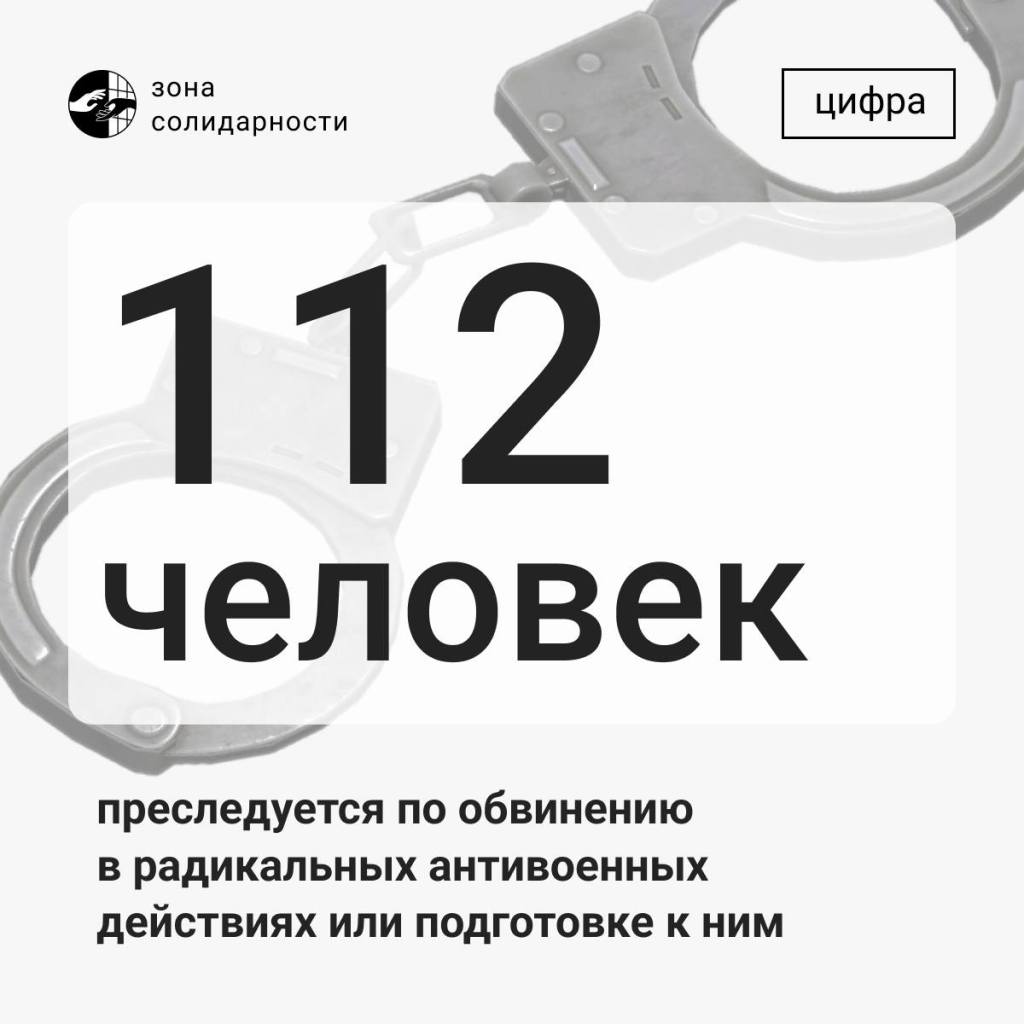
These are the numbers. I want to do something so that people don’t get caught, and even more actively support those who do get caught. But in the first case, it is unclear what these people are reading, and where the safety recommendations should be published so that they are accessible to such people. And we are already working on the second case, but we lack the human resources.
Those arrested for radical anti-war protest are heroes, although sometimes the charges are completely trumped-up. In any case, all of them deserve support. Solidarity Zone regularly writes about such political prisoners, publishes addresses where you can send them letters, and raises funds to pay their lawyers. Sign up to get news of what is happening to these people and, if possible, get involved in supporting them.
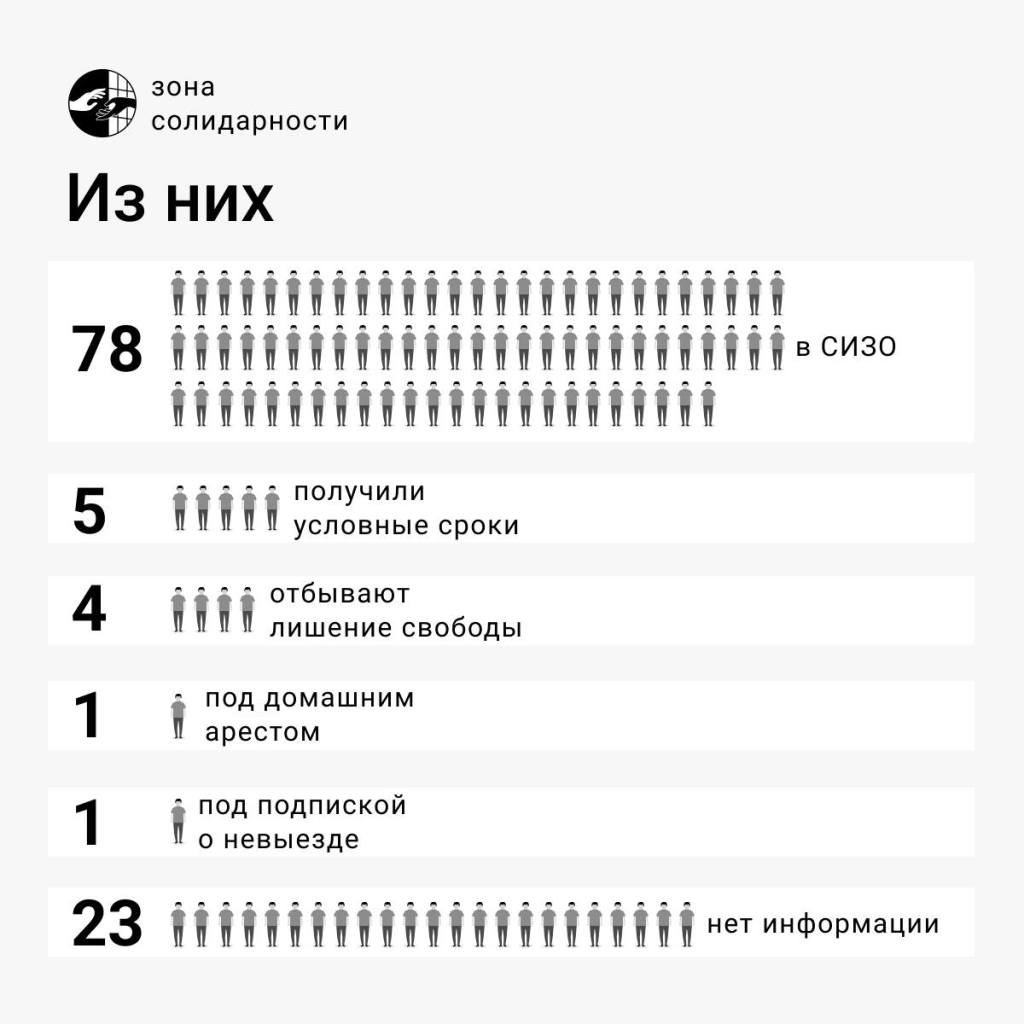
112 people are being prosecuted on charges of carrying out or planning radical anti-war acts.
Solidarity Zone counted how many people have been criminally charged with setting fire to military enlistment offices, sabotaging the railroads and other militant anti-war actions, or planning them, in the year following [Russia’s] full-scale invasion of Ukraine.
What police investigators allege these people have done to warrant criminal prosecution:
1 — “other”
7 — torched vehicles marked with the letter Z
17 — planned arsons of military enlistment or other government offices
36 — sabotaged the railways
51 — torched military enlistment or other government offices
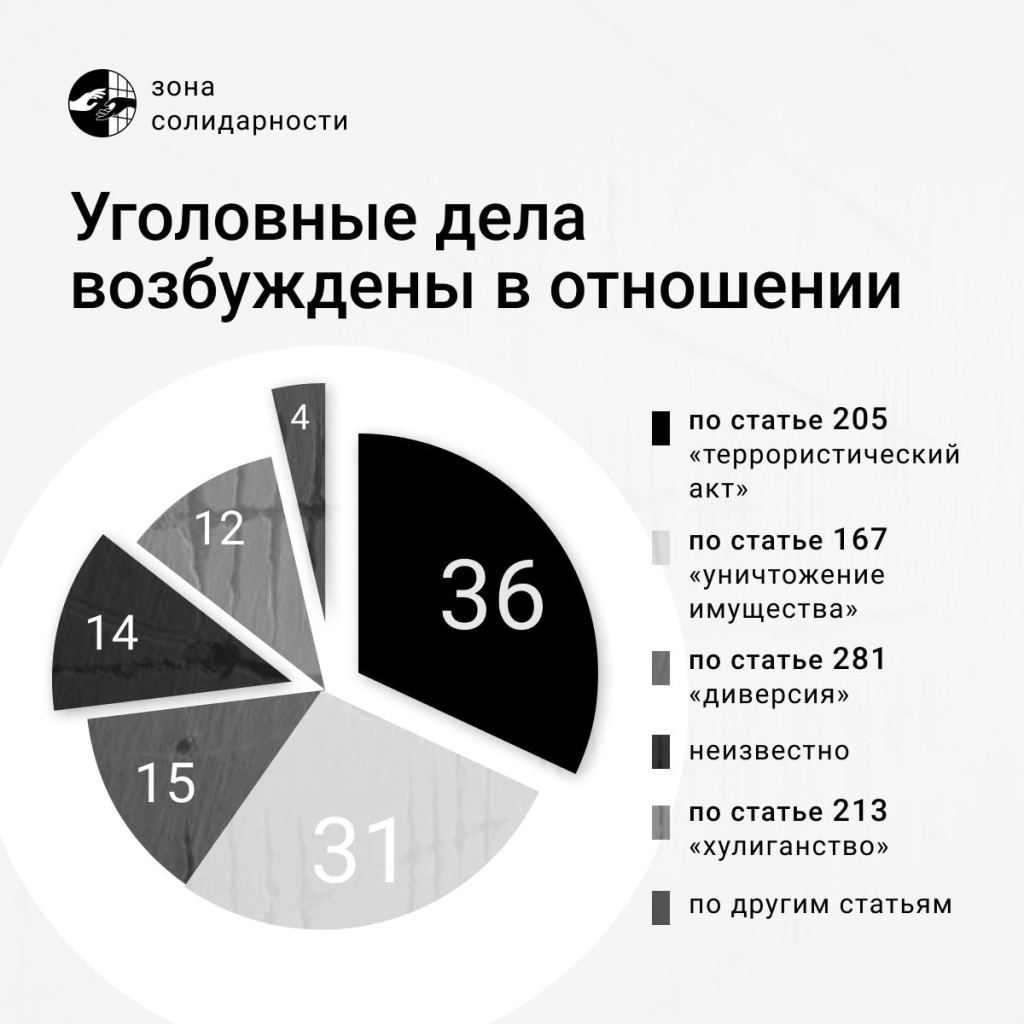
Articles of the Russian criminal code under which these people have been charged:
36 — Article 205: Terrorist Act
31 — Article 167: Destruction of Property
15 — Article 281: Sabotage
14 — Unknown
12 — Article 213: Disorderly Conduct
4 — Other Criminal Code Articles
Of these people:
78 are being held pretrial detention centers (remand prisons).
5 have been sentenced to parole.
4 are serving prison sentences.
1 is under house arrest.
1 has been released on their own recognizance pending trial.
There is no information about 23 of them.
Our statistics are incomplete because the Russian authorities do not always report new criminal cases. Sometimes we only get reports that people have been detained, with no mention of their names or the charges against them, and these reports are thus extremely hard to verify.
Our statistics do not include people who were killed by the security forces during arrest or people prosecuted on administrative charges.
Source: Solidarity Zone (Facebook), 24 February 2023. Translated by the Russian Reader. Here, by way of comparison, are OVD Info’s statistics for numbers of people criminally (as opposed to administratively) prosecuted for “non-radical” anti-war actions since 24 February 2022:
Total defendants: 465 in 77 regions (we include occupied Crimea and Sevastopol in our data because we monitor activities of repressive Russian government authorities that operate there).
Women among the defendants: 90 (19%)
Minors among the defendants: 6 (1%)
(Section 3, Article 207.3 of the Criminal Code) Prosecuted for “spreading fakes about the Russian army” (ie talking about the war in an unsanctioned manner): 141 (30%)
(Section 3, Article 280.3 of the Criminal Code) Prosecuted for “discrediting the Russian army”: 54 (12%)
Convicted: 119 (26%)
Imprisoned upon conviction: 26 people
In pre-trial detention: 108 people
Under house arrest: 17 people
Convicted and given a non-custodial sentence: 62 people
It thus follows that a total of 577 Russians have faced criminal prosecution for anti-war actions of all kinds (violent and nonviolent) since the start of their country’s invasion of Ukraine. As Ivan Astashin, a former political prisoner himself, argues, above, all these people are, indeed, heroes. It’s another matter that they constitute a statistically insignificant segment of the world’s ninth most populous country. Again, by way of (invidious) comparison, at least 1,003 Americans have been charged with crimes for their alleged involvement in the 6 January 2020 riot at the US capitol.
I would argue that those who were forced to leave Russia due to Putin’s unleashing of illegal aggression against Ukraine could file a class action lawsuit against the Russian Federation or the ruling elite of the Russian Federation demanding compensation for the moral anguish and economic harm suffered as a result of these events. The Russian federal authorities must fully compensate them for expenses incurred by forced relocation, such as the cost of airplane and other tickets, accommodation in hotels and rented accommodation abroad, and other expenses. Compensation could also include the irreparable losses suffered by citizens within the country due to forced relocation — for example, the loss of a job or a business. Compensation for emotional suffering is a separate issue.
Payments could be made from the Russian federal budget, through the sale of the property of officials directly responsible for unleashing the war, or at the expense of business income from entrepreneurs who have directly supported the illegal aggression. Naturally, compensation for this damage is possible only after full payment of the reparations necessary to restore Ukraine’s economy and civil infrastructure. What do you think about this? #nowar#netvoine
[two selected comments + one response by the author]
Zmey Gurevich A difficult question. It’s true that the monstrous war forced me to leave Russia. But to my incredible surprise, I have have become happy here [in emigration]. Perhaps it’s immoral to be happy when rivers of blood overflow their banks. It’s been eating at me. But the painful departure has led me a new happiness. Some vital knots have been untied… No, I have nothing to bill [the Russian authorities] for. My friends empathize with me and ask me how things are going here. I can’t tell them the truth. I am ashamed. But my departure has turned into a happy time for me. I don’t know what will happen next.
Vlad Shipitcyn Zhenya! Did you go to at least one protest rally against Putin in Russia over [the last] 22 years? No, you didn’t. Did you ever stand on the stand on the street holding a [protest] placard? No. So no one owes you anything, not a kopeck. You too are responsible for both the regime and the war. You let them happen. So calm down.
Evgeny Krupitsky Hi! Yes, I am responsible for this war: it happened due to my connivance, indifference and cowardice. And I said it right away: https://www.youtube.com/watch?v=GsAFChc2HSI And my protest was that on March 6, exactly a year ago, I left the Russian Federation having abandoned everything, because I felt sick and ashamed. Okay, maybe it’s not such a big deal in terms of significance and courage, but I am proud of my little protest. I know you went to the rallies long before the start of the war, that you were detained, beaten and fined, and I respect and admire you for that! But someone will say that they suffered more than you did, that they did more to prevent this war, etc. We need to consolidate, rather than argue about who is more to blame!
Evgeny Krupitsky, “My take on what’s happening (2 April 2022) #nowar #netvoine”
Some people in Russia are living a normal life, but they feel the lack of real normality, and this causes them discomfort. Others live with a sense of catastrophe, but they feel the absence of a real catastrophe, and this also causes discomfort. Consequently, everyone is on edge. The sensible approach is to live normally with a sense of disaster. But this useful attitude is hard to achieve, and if you don’t have it, then I do not even advise you to start. When it takes shape, it will no longer be relevant.
The four members of this “countryside hub” are among hundreds of Russian opposition activists of various political leanings who have fled their country to Georgia throughout the past year. Some left in the months prior to Moscow’s invasion of Ukraine last February as repression grew to unprecedented levels in the Putin era. Others came after the war began, realizing that with their dissenting opinions, they could no longer live in what they deem a fascist totalitarian state.
In Tbilisi, they have created or joined new anti-war resistance organizations, which operate on Western grants and employ hundreds of volunteers. Working around the clock, these groups offer services in real time to Ukrainians refugees as well as Russian activists and military deserters fleeing their respective countries. The help comes in the form of evacuation routes, therapeutic services, legal guidance, shelters and resettlement plans.
[…]
From her volunteering as an election monitor in Russia’s 2011 elections to offering pro-bono legal support to activists arrested during protests in subsequent years, Burakova’s career followed a linear trajectory. Degrees in political science and law equipped her with the legal know-how to aid political opponents, and now exiles, over how to wrestle with and escape an authoritarian system that often invents new laws to persecute citizens. As of 2022, “discrediting the Russian army” is now an offense that has landed countless people in prison for sharing anti-war posts on social media.
[…]
“To conduct these types of congresses and host mock parliamentary votes on Russia’s future while in exile just looks a bit cringe-ova,” Burakova tells me, using the popular English word that has been appropriated into the Russian language. Her husband Egor Kuroptev shares the sentiment.
M., one of my smartest interlocutors, arrived from Moscow Time. “Well, what is your final conclusion? Why?” he asked me. I told him that now I see three points that we simply missed, that ended up in our blind spot. The first point is that of course everyone worked hard during these years, enthusiastically; everyone had an articulated mission in life, etc. But it was seemingly taken as a natural given that each of us was the client of someone a few floors above us. Now everyone looks back and discovers that their mission has been burned for a long time, and their belonging to one or another Moscow (or regional) clan shines forth in their biography. For some reason, it was automatically believed that, in the nineties, we operated in a world in which, when difficulties arose, we should turn to “the man from Kemerovo” (in the words of Grebenshchikov’s song). In the noughties, however, all this was allegedly vanquished. In reality, nothing was “vanquished”: it was simply transformed into large-scale state clans. That is why now everyone who was engaged in charity, book publishing, media development, etc., has suddenly shifted the emphasis in their reflections on life: wait a second, I worked for Abramovich (or Gusinsky, or Potanin, etc.). The system consisted entirely of a network of clients.
The second point: the language of pragmatic communication. It was a completely abusive language. The smash-mouth jargon permeated everything. Roughly speaking, the country was governed in the language of American rappers (i.e., the Solntsevo mob). All communications! Not only the special communications among those in power, but also all communications in the liberal, academic realm, in civil society. The cynical jargon of abuse reigned everywhere, and it was absolutely acceptable even in highly cultured milieux. And we did not see what consequences this would have.
The third point: “populism.” The automatic perception of the “common people” [narod], which had its origins in the late-Soviet and perestroika periods, was a colossal mistake. It was tacitly assumed, first, that there was a “common people”; second, that the “common people” would determine their own fate; and third, that the “common people” naturally triumph over evil because they themselves are good. It was this “populism” that served as the basis for the compromise with the state when it began to take institutional shape in Yeltsin’s wake.
All three of these points were “organic” in some sense. They were a part of ontology: they were taken for granted without any reflection and criticism. And all three played a fatal role in the process of “slowly boiling the frog alive.”
I had problems,
I had gone way too far.
The lower depths of the deepest hell
Didn't seem so deep to me.
I called my mom,
And Mom was right.
She said, "Straightaway you've got to call
The man from Kemerovo."

He is a man of few words, like de Niro.
Only a wacko would argue with him.
You can't pull one over on him,
He knows all the insides and outs.
The sky could crash to the ground,
The grass could stop growing,
He would come and silently fix everything,
The man from Kemerovo.

Adam became a refugee,
Abel got on a mobile connection,
Noah didn't finish what he was building,
Got drunk and fell face down in the mud.
The history of humankind
Wouldn't be so crooked,
If they had thought to get in touch
With the man from Kemerovo.

I got a call from Kyiv,
I got a call from Kathmandu,
I got a call from the opening of the plenum —
I told them I would not come.
You have to drink two liters of water at night,
To have a fresh head in the morning.
After all, today I'm going to drink
With the man from Kemerovo.
Only one conclusion follows from Stalin’s death: woe is the country where tyrants die natural deaths while still in power.
Source: Roman Osminkin (Twitter), 5 March 2023. Translated by the Russian Reader. Mr. Osminkin’s remarks were occasioned by the social media commemoration of the anniversary of Stalin’s death, yesterday, which often as not consisted of replicating the meme “That one croaked, and this one will croak too.” This means, apparently, that the entire “plan” of the “Russian anti-war movement” and the “anti-Putin opposition” consists in waiting for the current Russian tyrant to die a natural death. It’s a frank admission to be sure. ||| TRR
Source: personal email, December 2022, This is the first time I’ve heard from Raffeisenbank in several years, especially since my account with them has been essentially dormant since well before I left Russia in 2019. ||| TRR
Foreign managers are quitting Petersburg hotels: they are resigning their positions amid the withdrawal of international hotel companies from the Russian market.
In particular, the post of general manager of the five-star Four Seasons Lion Palace has recently been filled by Ekaterina Saburova, who had worked as marketing director at the Four Seasons Moscow Hotel. In an interview with Kommersant-SPb, a spokesman for the Petersburg hotel noted that the previous general manager, Richard Raab, had gone on to work at another hotel in the chain.
Similar personnel changes have taken place at the Grand Moika 22 Hotel, which until recently was part of the Kempinski international chain. The hotel is now headed by Yevgenia Nagimova, and the operations director and Russian staff are responsible for day-to-day operations. The previous general manager, Oliver Kuhn, initially took a similar position at the Kempinski Hotel in Cairo, before running a hotel in the Seychelles. He explained that he had left Russia to transfer to another hotel in the chain. The general director has also been replaced at the Radisson Royal and Park Inn Nevsky: instead of Rune Nordstokke, the hotels are now headed by Mikhail Grobelny, who previously worked as the general manager of the Radisson Blu Belorusskaya Hotel in Moscow.
Experts note that, amidst the departure of international hotel chains [from Russia], industry players have basically lost the need for the position of a general manager responsible for liaising with company management. According to Andrei Petelin, general director of the Hotel Saint Petersburg, the personnel changes may be related to the desire of owners to reduce costs during the crisis [sic], since foreign managers earned more than their Russian counterparts, and also received compensation for housing rental and their children’s education.
Some foreigners still continue to work in Petersburg hotels: Eric Pere, general manager of the Corinthia Hotel St. Petersburg; Gerold Held, general director of the Hotel Astoria and the Angleterre Hotel; and Jaehyuk Yang, manager of Lotte Hotel St. Petersburg. Some industry reps have concerns that further resignations by foreign managers may have a negative impact on the level of service. Andrei Petelin, however, is confident that Petersburg-based managers are able to maintain high standards, because they not only have experience working abroad, but also better understand the needs of Russians coming to the Northern Capital to relax.
Speaking of which, since the beginning of 2022, seven million tourists have visited St. Petersburg. Vice-Governor Boris Piotrovsky noted that in November, bookings at the city’s hotels consistently exceeded the sixty-percent mark.
A few weeks ago, DPwrote about how the Smolny [Petersburg city hall] was again thinking about introducing a resort fee. Hoteliers stated that they considered this step reasonable, but only if the revenues generated were used properly.
620,251 views • Dec 2, 2022 • President Vladimir Putin’s war in Ukraine is causing major changes back home. Hundreds of thousands of Russian men are being mobilized to fight and tens of thousands have already been killed or injured. Meanwhile, many Russians have left their country and millions of Ukrainians are thought to have arrived. What impact will these changes have on the Russian population? And could the public response lead to Putin’s downfall? We discuss these questions and more with UCLA’s Oleg Itskhoki in this DW Business Special.
Olga Nazarenko, a university lecturer in Ivanovo, risks going to prison for simply hanging the Ukrainian flag in the window of her own flat. Neighbors from the building opposite regularly complain about her. Nazarenko goes on anti-war pickets, where aggressive fellow citizens attack her. And the pickets have already triggered a criminal case against her. Repeated visits and searches by police officers at night and early in the morning have become routine for her children. Nazarenko sees the situation in Russia as nearly hopeless. She is amazed at how the country’s maternal instinct has even been destroyed: Russians dutifully send their children off to die for nothing. Despite all this, she considers it her duty to talk to people. She remains in Russia, and has no plans to emigrate.
Recently, the police rang at Nazarenko’s door at three o’clock in the morning. They demanded to be let in so that they could remove the Ukrainian flag. It has been hanging for six months on the balcony of the activist’s flat in an ordinary multi-storey residential building in the city of Ivanovo. Nazarenko refused to let the police in without a search warrant. Through the door, the night visitors informed her that neighbors had filed another complaint about the Ukrainian flag. The law enforcement officers left, only to return at seven in the morning and knock on the door for a long time. Nazarenko did not unlock the door, but wrote a complaint against the police to the prosecutor’s office.
Over the past two months, the police have visited the well-known anti-war protester at least four times. In the autumn, two criminal cases were opened against Nazarenko, one of them under the so-called Dadin article of the Russian criminal code. The medical school at which the activist has worked for almost twenty-four years has suspended her employment. The university lecturer is currently listed as a “suspect” by the authorities. Despite the fact that term of her undertaking not to leave the country, which went into effect after the criminal case was launched, has recently expired, she has no plans to leave Russia. She talked to Radio Svoboda about her principled choice.
Olga Nazarenko, holding a placard that reads: “If those who oppose the war are imprisoned, fascism has won. Alexandra Skochilenko face five to ten years in prison for anti-war stickers…” Photo courtesy of Radio Svoboda
— How did you find out that you had been identified as a suspect in a criminal case?
— I learned that a criminal case had been launched against me under Article 280.3 of the Russian Federal Criminal Code (“Public actions aimed at discrediting the deployment of the Armed Forces of the Russian Federation”) from the Center “E” officers who came to my workplace at around eleven a.m. on September 20. They obliged my colleagues to to serve as witnesses, searched my desk, and found two placards. Before that, my laptop was seized without my knowledge. The bigwigs at the medical school wanted to conceal it at first, but I made a fuss. It transpired that the Center “E” officers did not even give our management rep a copy of the report for the seizure of the laptop, nor did he demand one from them. Then we went to my house; fortunately, there were no handcuffs on me. There they carefully rummaged for a long time: they took our phones (even the phone of my young son), a computer, old leaflets, our personal money, and the savings of our daughter, who is a university student. The money was returned to her, but the police kept our funds for themselves, and they are not planning to give them back to us, apparently.
— How did your children react to the search of your home?
— My son was in a little shock, especially since they took something that belonged to him. My daughter behaved calmly. She talked to the police a little. She asked whether their “assistant” was an adult: the computer technician they brought with them looked quite young. A Center “E” officer replied tersely that they were all adults and all officers. My daughter is already an adult, and she understands everything and supports me. My family took the search well, because this was not my first encounter with the relevant authorities due to politics. In the spring, at seven a.m., the riot police came to search the flat since I had been identified as a witness in a vandalism cased launched against another activist. Then they tried to prevent me from calling a lawyer, seized my phone, my computer, 138 posters, and the Ukrainian flag from the window. The law enforcement agencies’ interest in me had already become something routine.
Оlga Nazarenko in her office at the medical school. Photo by Oskar Cherdzhiyev. Courtesy of Radio Svoboda
— How long has the Ukrainian flag been hanging in the window of your flat?
— Every year since 2014, I had hung up the flag of Ukraine on the country’s Independence Day. Last year, I put it in the window and decided not to take it down. Police officers visited me after complaints were made, and they demanded explanations about the flag. I refused to explain anything to them. In the spring, after my apartment was searched, and they took the Ukrainian flag with them. I sewed a new one and hung it in the window again. I did the same thing after the search in the autumn.
— Why did you do that?
— For reasons of principle: if I support Ukraine, then I support it. And most importantly: no one in uniform and flashing a badge gets to decide what hangs in my window.
— What was the first criminal case brought against you for?
— They think that I posted anti-war leaflets in Ivanovo. I refused to give evidence by citing Article 51 of the Constitution.
— Were you not intimidated when they launched a criminal case and searched your flat?
— All this was to be expected. And no, it didn’t intimidate me. I continued going to anti-war pickets and rallies in support of those who have been persecuted for making anti-war statements, and I talked to people on the streets. A second criminal case was soon launched against me under the so-called Dadin article (i.e., Article 212.1 of the Russian Federal Criminal Code: “repeated violation of the established procedure for organizing or holding a meeting, rally, demonstration, march, or picket”). In October, Center “E” officers and the investigator who was running the first criminal case against me came again to search my flat. They were accompanied by several people in black masks and bulletproof vests. It’s hot in our flat, and I saw sweat on their faces, probably from overexertion. I even felt sorry for them. The search was superficial; they didn’t see anything new, apparently. They again seized our phones and a couple of posters. Once they got into the flat, they immediately rushed to the balcony and again pulled down the Ukrainian flag. I told them that I hadn’t violated the law when I hung up the flag, since I wasn’t infringing on the building’s communal property. The Center “E” guys replied that I should understand how turbulent the situation was now. They asked me why I was hanging the flag up. I said that it reflected my position and my aesthetic tastes.
— Do you like the colors yellow and blue?
— Yes, they are my favorite colors: the sky and the sun. The next day I sewed another Ukrainian flag and hung it out.
— Do you usually sew Ukrainian flags on a sewing machine?
— Yes. There are many shops in Ivanovo where you can buy fabric. I found a good one and bought three sets at once. It will last for a long time.
— Why do you think that it is the neighbors who filed complaints against over the flag?
— Only residents of the house located opposite mine can see the flag all the time. The denunciations are probably written by neighbors and residents of the neighboring house. I saw one complaint. The poor lady wrote: “I see the Ukrainian flag every morning and I consider it unacceptable in such a situation as we have now.” I even felt sorry for her. After I hung out the Ukrainian flag, the neighbors living in the apartments below and above mine hung out Russian flags. After the search, a “Z” was again written on my apartment’s mailbox and a note was tossed in it that said, “Ukraine is no more. Take down your rag and dry yourself with it.”
– How did the medical school react to the criminal cases against you?
– The management suspended me on the grounds that the articles of the Criminal Code brought against me hinder my work as a lecturer. My colleagues were upset. We have worked together for many years. Besides, now they have to do my duties. My colleagues do not talk about politics. Most of my colleagues are apolitical. But they have voiced their support to me and hope that everything will be resolved somehow. I studied at the medical school for six years, and after graduation I stayed on there to work. That is, my entire adult life, almost thirty years, has been connected with the medical school.
— Have you been able to get another job?
— Due to the criminal cases, I cannot tell an employer how long I would be able to work for them. So, I will look for something temporary, and then my professional career will depend on the court’s decision.
— How many pickets did you hold in the autumn?
— In September and October, I held four or five pickets. Since the second criminal case was launched, I have not yet gone out to protest, but I’m going to continue to voice my civic stance.
— Why are you going to continue to hold anti-war pickets, despite the serious risks of ending up in a Russian prison?
– I have beliefs, and I will act in keeping with them. As long as I can talk, I’ll keep doing it. What is the point of having principles if you don’t act on them, regardless of the risks?
— Do you have the support of friends, family, and associates?
— I have moral support from friends, and there are also simple acquaintances who support me and help me raise the money for fines. I am being defended by attorney Oskar Cherdzhiyev.
— Aren’t you annoyed by like-minded people who emigrated instead of getting involved in anti-war protests with you?
— If the question is about ordinary Russian citizens, and not about protest leaders, then I’m not annoyed. I understand that nothing will change in the near future. People in difficult circumstances choose the best option for themselves. We have one life, and everyone has the right to live it as they please. Besides, emigration is now a rational, appropriate solution. Many of those who have gone abroad continue their protest activities: they go to anti-war protests at Russian embassies, help refugees from Ukraine and Russia, and work on publicity.
— But why is it the best option for you to stay in Russia and go to anti-war pickets, rather than worry about your own safety?
— My choice is based on the fact that I can do more in terms of working with people in Russia than I could in emigration. I’m rubbish at information technology. It’s easier for me to talk to passersby at street protests in the hope of getting my message to them. Russia is my country, and I won’t let them kick me out. I have the right to my own country and I don’t want to leave Russia for anywhere else. I will stay here and do what I think is necessary, voice my position. If I left, I would feel bad because I got scared and ran away.
— Do you think your long-term street activism has produced any results?
— If we’re talking about changing people’s minds, I don’t see any particular results. The war is so propagandized that a few people who publicly voice a different viewpoint cannot shift the minds of the majority in the other direction. My protests are meant to have an effect on the people who are having doubts. I have succeeded in making such people think. But the main purpose of my protests is to support like-minded people among Russians and Ukrainians. Thanks to my actions, among other things, friends in Ukraine know that not everyone in Russia is an “orc.”
— How has the reaction of passersby to your pickets changed since the war with Ukraine began?
— I’ve observed that people have become more guarded and scared. They usually dash past me quickly, averting their eyes. The reactions of those who do not hide them have become quite polarized. Either passersby are emotionally grateful, or they almost pounce on me, fists flying, and call me a Banderite. At the last picket, a man grabbed my placard and tore it up. There have been more negative reactions to my pickets than friendly ones, but this is not surprising. It is amazing how, with such propaganda, one hundred percent of people don’t react negatively to anti-war protests.
— How do you manage to be so tolerant towards people whose views differ from yours?
— I would not call my attitude towards them tolerant. I just understand what motivates their behavior: a lack of critical thinking skills, plus the fear and the reverence for the authorities that is inscribed in their subcortex. Powerful state propaganda combines with excessive loyalty to those in power. Thus, Russian citizens support all decisions by high-ranking officials.
Olga Nazarenko in the lobby of the Ivanovo Regional Office of the Interior Ministry. Photo by Oskar Cherdzhiyev. Courtesy of Radio Svoboda
– Are you able to understand why the parents of conscripts did not come out in droves to protests after the mobilization was announced?
— It’s beyond my comprehension. The maternal instinct is a powerful biological mechanism. As conceived by nature, it should be stronger than any propaganda. Apparently, there has been a real degradation in our society over the past twenty years. Total state propaganda, which includes not only the media, but also the education system, has aimed to completely distort values. Fear and reverence for power, submission to it, which never disappeared in many Russians, have now resurfaced especially strongly. Unfortunately, learned helplessness has overcome the maternal instinct. I do not know if such people can change anything.
— This is not the first year that you have been constantly going out to protest. Perhaps you have a hope that Russia will become a free country?
— It’s hard to say. Historically, Russia has been going in circles all the time, rather than developing in a spiral. But I still want to hope that Russia will become a developed and free country. However, this won’t happen soon, perhaps in one hundred years.
At first glance, massive emigration reduces the potential for political change, because it mechanically subtracts from society the part of society that is critical of the authorities. To a large extent, of course, this is true, but we shouldn’t overestimate this factor.
My subjective observations tell me that one of the leading motives for emigration (let’s put the existential threat of mobilization aside for now) has been the loss of hope for a “normal” life. People have been fleeing because they felt things would only get worse, and that their former relatively prosperous (and sometimes quite lovely and promising) lives were collapsing, along with all their plans.
If you think about it, there is no potential for political change in this worldview. You can’t be a gravedigger of the old regime at the same time as you grieve for the opportunities lost in it.
Let’s take a hypothetical employee of the progressive wing of the Moscow Department of Transport (or any other corporation, bank, etc.) with liberal views, who remembers what a cool project he worked on in 2018 (or even in 2022), but now is leaving the country, because such projects will definitely not happen in the future. He went to protest rallies, voted for the opposition, watched [Maxim] Katz’s YouTube channel, and donated to OVD Info, so his departure is a loss for the opposition. But it’s not a loss for the revolution, because “I want everything to be the way it was before, only with no war and crackdowns, but with fair courts and honest elections” is essentially a reactionary demand. It’s about preserving things, not changing them..
It would be a mistake to think that revolution leaves us along with the emigration: resentment over the supposedly lost prospect of a prosperous Russia, which was stolen from us, is unsuitable fuel for revolution. The political emigration has no political program, because there is no bridge to the “normality” that supposedly existed before 2022 (or 2020, 2018, 2014, 2011, etc.). The emigration’s picture of the world completely excludes the social, economic and political contradictions that have brought us to the present moment and are leading us further, so now it contains nothing but shock, fear, and individual salvation.
Revolution cannot emerge from the failure of an evolutionary project. It will emerge as an alternative to the brutal dictatorship at a fatal crossroads in the country’s history, prompted by the need to radically solve the pressing issues of our coexistence. But the remnants of failed evolutionary trends will surely still play their own reactionary role.
Source: Alexander Zamyatin, Facebook, 29 September 2022. Mr. Zamyatin is a popularly elected member of the Zyuzino Municipal District Council in Moscow and the editor-in-chief of the website Zerkalo. Translated by the Russian Reader