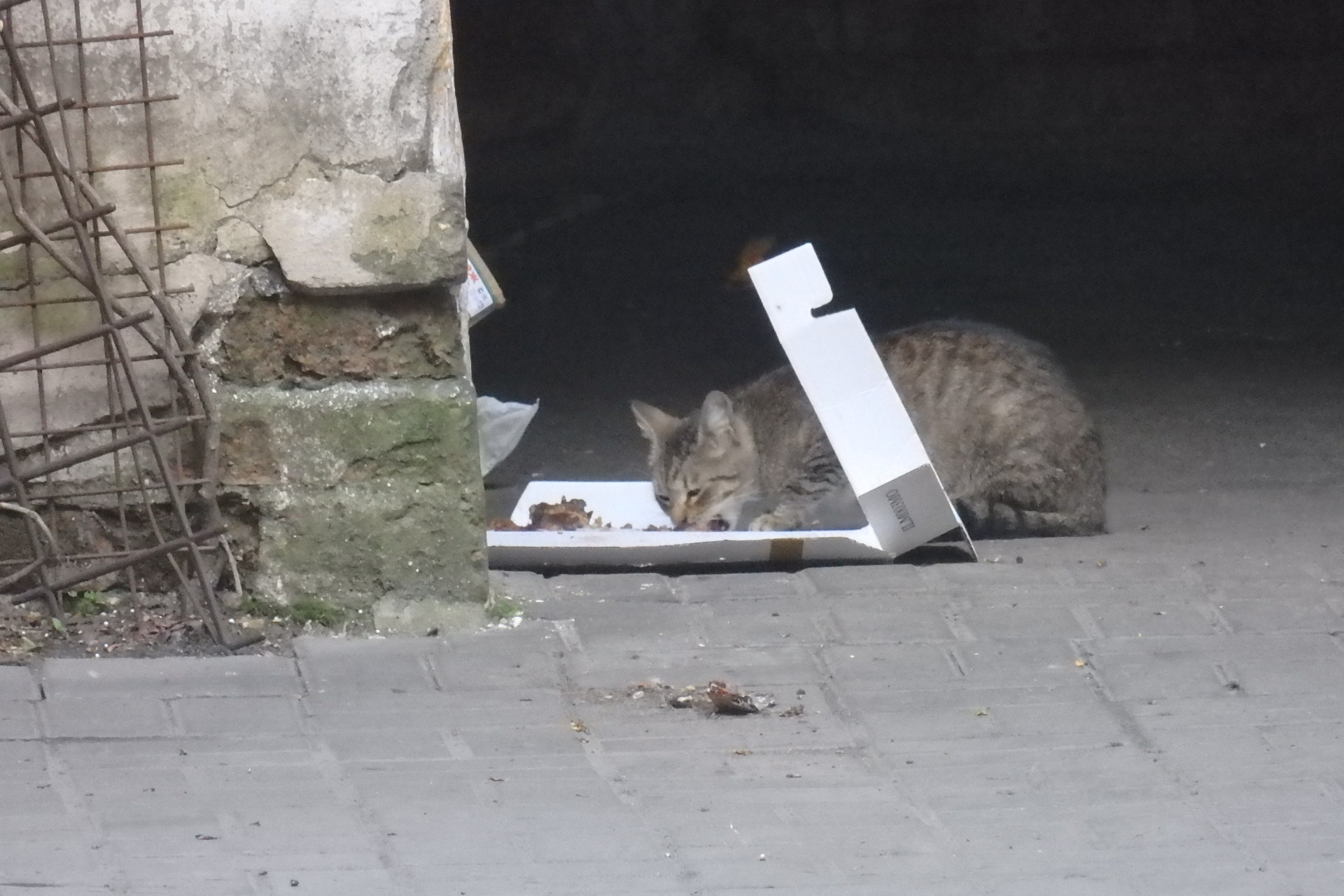
Cat eating scraps from pizza box on May 24, 2016, in Petersburg. Photo by the Russian Reader
Zero Sum When nothing is produced, all power belongs to the man who divides and distributes
Maxim Trudolyubov Vedomosti
May 27, 2016
It is probably already clear to everyone that the implicit “social contract,” about whose existence it was customary to natter in the fat years, was a hoax. Rejecting political subjectivity, ordinary folks and not-so-ordinary folks, big business, and regional elites were able to enrich themselves and, in the consumerist sense, converge with Europe.
It was not, however, a one-off deal with a perpetually fixed rate of profit, but a protracted process. We voluntarily became political zeroes. We gave up free speech, the right to elect and be elected, and the right to demand accountability from our politicians, and part of the population gave up the right to funded pensions. But the unit of prosperity we got in return was given to us not as property but was lent to us. Now the government has collected the debt. The zeroes remain, but the unit will soon run out. The government has no other sources for funding projects, but unpredictable and expensive projects—military campaigns as in Syria, for example, and infrastructural projects like the Kerch Strait Bridge—are the whole point of Russian politics.
The authorities supported the population during the crisis of 2008, but by 2011, dissatisfaction with government policy and the Putin-Medvedev castling move had sparked protests. The Kremlin learned its lesson, and it is ordinary people who are now primarily bearing the burden of the crisis, not the state. Having surrendered their rights to the Kremlin, people will now have to surrender not only their pension savings but also their savings accounts and, so to speak, the fat they have saved up on their bodies if they do not decide to take back their political rights. People’s well-being is, in fact, the “source of growth” that President Putin has asked his economic advisers to find. Actually, he was kidding: the source has never been lost.
When the president, in May 2016, summons his economic council, having forgotten about its existence for two years or so, and says the country needs new sources of growth, how are we to understand this? How were we supposed to understand his proposal to reduce economic dependence on the oil price, which he voiced in the autumn of 2015? It is like offering to grow oneself a new liver after sixteen years of binge drinking.
The Kremlin has created the current situation by consistently rejecting any measures that could have, long ago, reduced dependence on oil and generated stable sources of growth beyond the extractive and defense industries. It is impossible to fix in a month what has been done over sixteen years. Moreover, the very same people have been summoned to do the fixing, people still divided by irreconcilable contradictions. What joint effort at seeking ways out of the crisis are Alexei Kudrin and Sergei Glazyev capable of mounting? The sum of their efforts will inevitably be zero.
It would appear this zero quite suits the Kremlin, as economist Konstantin Sonin argued in a recent interview with Slon.ru. Incidentally, efforts are also needed to maintain zero growth, and those efforts are being made. Certain malcontents might not like the “zero” economy, but the Kremlin really likes it, because it strengthens the power of the front office, where decisions about redistribution are made. When nothing is produced, all power belongs to the man who divides and distributes.
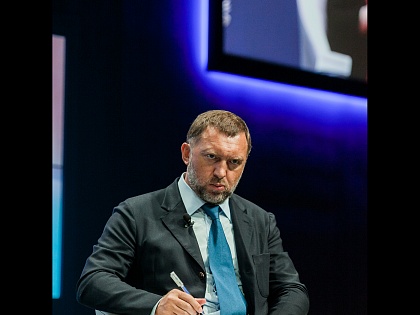
“I believe that it takes just 100 people to change a country for the better provided that these people are driven professionals capable of creating something new. I am sure that in Russia there are far more than 100 such people, so let’s join forces and work together.”
—Oleg Deripaska
_________
Deripaska’s Company Releases Sales Figures for “Olympic” Apartments
Natalya Derbysheva RBC
May 27, 2016
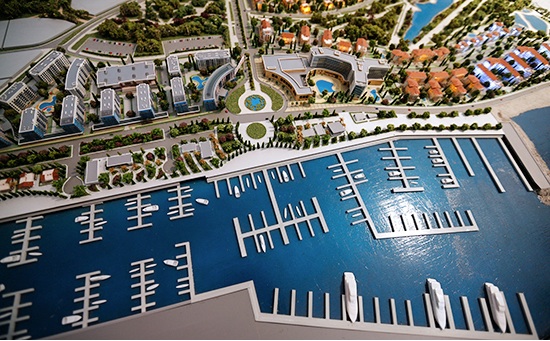
Mockup of the Sochi Olympic Village’s Coastal Cluster. Photo: Andrei Golovanov and Sergei Kivrin/TASS
Oleg Deripaska’s company RogSibAl has sold 20% of the luxury apartments it built on the Black Sea coast in Sochi for the Winter Olympics. The company believes this is a good result.
RogSibAl, a subsidiary of Oleg Deripaska’s Basic Element, built 2,700 luxury apartments on the Black Sea coast for the 2014 Winter Olympics in Sochi. Athletes lived in the apartments during the competition. According to Vnesheconombank, the project’s budget was 25.3 billion rubles, 22.3 billion rubles of which RogSibAl borrowed from Vnesheconombank.
The coastal Olympic Village is now known as the Imereti Resort District. It consists of four quarters, the Coastal Quarter, the Maritime Quarter, the Park Quarter, and the Reserve Quarter. Apartments are available for purchase in all four quarters. The price per square meter ranges from 152,000 rubles to 195,00 rubles [approx. 2,070 euro to 2,650 euros per square meter—TRR].
Since the apartments went on sale in 2013, 20% of them have been sold, a Basic Element spokesman told RBC, meaning that over 500 apartments in all have been sold. Basic Element’s spokesman added that the company had sold 118 apartments from January to May 2016. The company plans to have sold 350 apartments for a total area of 25,000 square meters on the year.
Basic Element has been renting out the unsold apartments. According to the company’s spokesperson, the rental demand for the 2016 summer season is 97–100%.
The sales figures are worse than what Basic Element had planned in 2011. Igor Yevtushevsky, RogSibAl’s general director, had then toldVedomosti that the company was planning to sell 50% of the apartments before the start of the Olympics, and the other half in 2014–2015.
Basic Element’s spokesman said it would be unfair to compare current sales figures with projections made in 2011.
“The project has undergone big changes,” he explained.
The company cites data from the MACON Realty Group, according to which 387 business- and luxury-class real estate transactions were concluded in Sochi from January to May 2016, meaning that the Imereti District’s share of this business was 23%.
The government has discussed the conditions of restructuring the loans issued by Vnesheconombank for building Olympic sites, RBC’s sources told it earlier this week. A federal official explained that Deripaska’s companies were in the most complicated circumstances in terms of loans, since the demand for apartments was not great.
Basic Element has not disclosed the figures of the income from its sales of the properties. Its spokesman did say, however, that all the proceeds were being wholly turned over to Vnesheconombank in repayment of the loan and that RogSibAl had been fulfilling all its obligations to the bank.
Given that sales usually begin at the design and construction stage of a property, 20% sales in the second year after a property has been operation is hardly satisfactory, argues Marina Udachina, director of the Institute for Innovations, Infrastructure and Investments. According to her, the situation is partly due to a slowdown in economic growth and a reduction in the demand for luxury properties.
Only 20% of the apartments in the Olympic Village have been sold in two years.
Here is what we wrote about this a month before the Games:
“The site is being built by oligarch Oleg Deripaska, one of the few private investors in the Olympics. Only he is building with public money. Twenty-two of the twenty-five billion rubles in the project’s budget has been secured with a loan from state-owned Vnesheconombank. Derispaska’s company is planning to pay back this money by selling the village as a residential complex after the Games. It will be hard for them to find buyers. A single bed in the village costs as much as a two-room flat in Moscow.”
Of course, the crisis, sanctions, and being “surrounded by enemies” have inevitably led to a drop in demand for fairly pricey holiday apartments. On the other hand, this was offset by the fact that demand was supposed to shift to the domestic market from Greece, Cyprus, Turkey, and other countries where housing had become almost twice as expensive for Russians.
As a result, sales did not take off, which is a pity. I know that after the Games a good person, familiar to a lot of my people on my wall, worked on the project.
We can also add to this news the latest about Sberbank, which after agonizing for a long time has today finally sold the Mountain Carousel ski resort on the installment plan to the former governor and current minister Tkachyov* and his young but quite talented son-in-law. The joke there is that Sberbank invested 25 billion rubles into Mountain Carousel, while Vnesheconombank loaned it 55 billion rubles. Vnesheconombank fiercely resisted the sale, because it is one thing when Sberbank is in hock to you to the tune of 55 billion rubles, and quite another when it is Tkachyov and family. Apparently, Gref is tougher and stronger than the moribund Vnesheconombank, although it does not make our lives any easier.
Since for some reason business has not been booming at nearly all the former Olympic sites, the government has authorized the repayment of Olympic loans over a period of 25 years at a reduced 5% interest rate. And to keep Vnesheconombank from kicking the bucket altogether, the Finance Ministry will give it another 150 billion rubles straight from our pockets.
P.S. I’m going to do a little populism practice. Anyone in Russia want a twenty-five-year mortgage at five-percent interest? Ask Tkachyov, Potanin, Deripaska, and Vekselberg “how.” )))
* On August 2, 2012, Tkachyov announced plans to deploy a paramilitary force of Cossacks in Krasnodar Krai, beginning September 2012, as vigilantes to discourage internal immigration by Muslim Russians. In a speech to police, he stated, “What you can’t do, the Cossacks can. We have no other way—we shall stamp it out, instill order; we shall demand paperwork and enforce migration policies.”
Pyotr Pavlensky rang in 2015 by starting a bonfire on a Moscow quay.
“You spend the year the way you ring it in,” said Pavlensky as he left the Guelman Gallery, where we were seeing in 2015, and went off to an icy quay on the River Yauza to start a fire.
In November 2015, Petya pulled off the biggest art action of the year by torching the doors of the FSB. Pavlensky will greet the New Year in a cell at Butyrka remand prison.
As 2015 ended, arrests in the Bolotnaya Square case continued. Anarchist Dmitry Buchenkov was arrested on December 3. The defense claims he was not at Bolotnaya Square on May 6, 2012.
Gallerist Guelman held a charity auction at his gallery in support of the Bolotnaya Square prisoners. The result was that the Guelman Gallery was no longer Guelman’s gallery. He was not forgiven by the powers that be for the auction, and the gallery was wrested away from him.
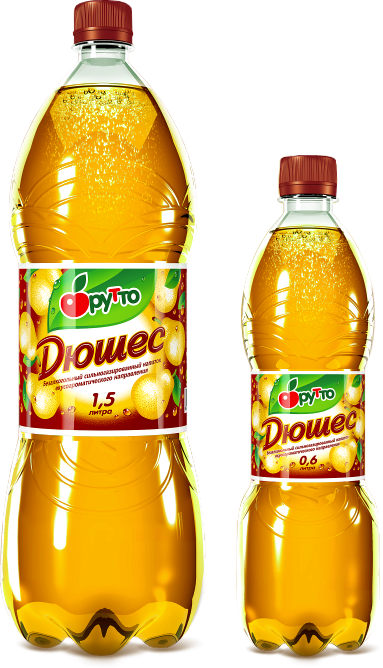
And, while you are sleeping, to dream of Pyotr Pavlensky, Oleg Navalny, and Bolotnaya Square political prisoner Alexei Gaskarov celebrating the New Year in their prison cells and pouring Duchesse, a domestic carbonated beverage, into recycled plastic instant mashed potato cups.
Amen.
Translated by the Russian Reader. Image of Duchesse soda bottles courtesy of Frutto
Ten Telling Statistics about the Petersburg Economy
Mikhail Karelov
November 3, 2015 The Village
1–2%
According to city hall’s forecasts, the city’s gross regional product will grow this much by the end of 2016.
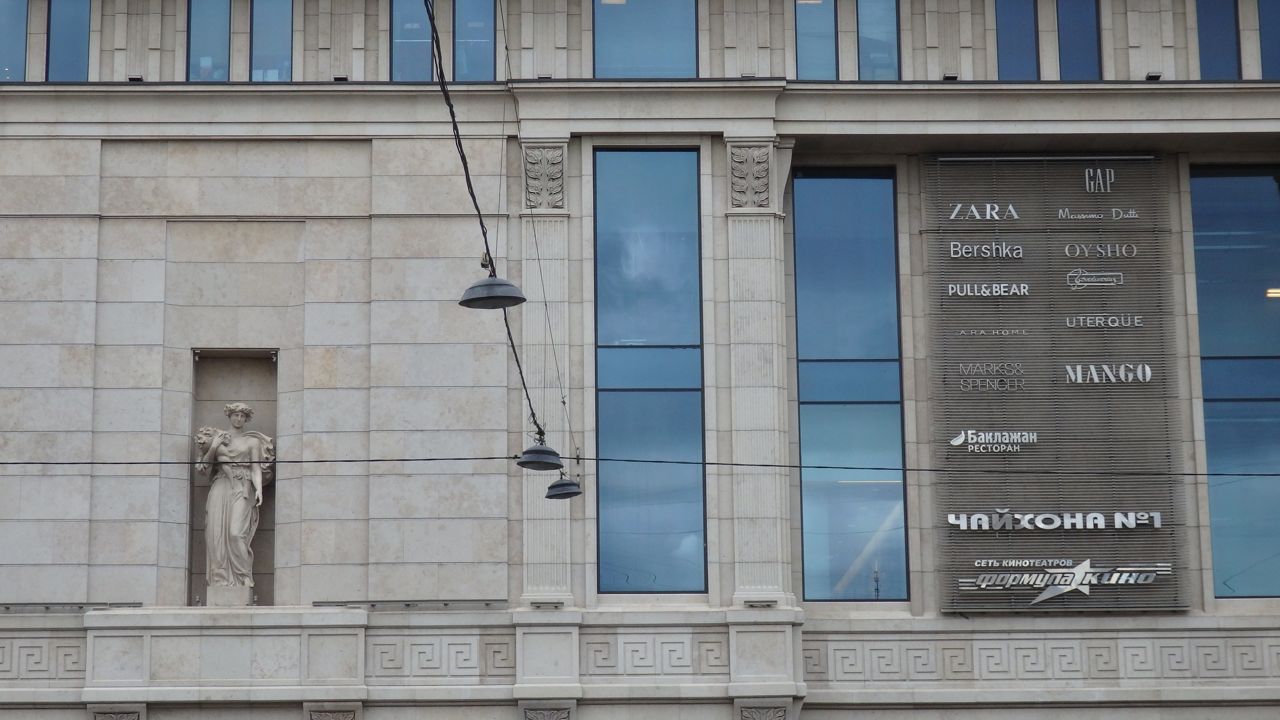
Facade of Galeriya shopping center, downtown Petrograd
50,600,000,000 rubles [approx. 71 million euros]
Petersburg’s budget deficit in 2016.
“Crushing food in a city that survived a siege is shameful!” “What do you mean?”
8.9%
Decrease in Petersburg’s industrial production index year to date.
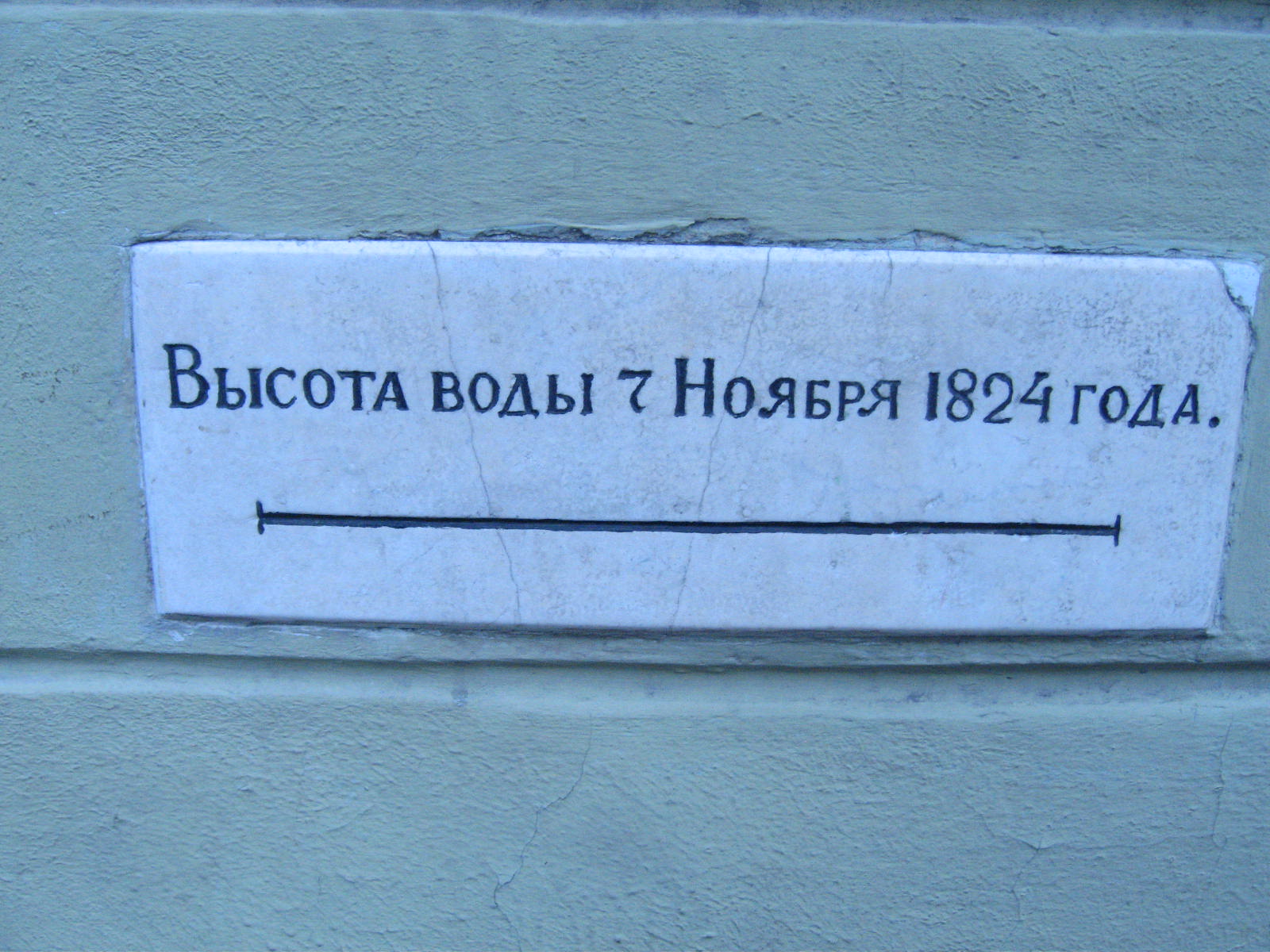
“Water level on November 7, 1824.”
19.3%
Decrease in production at Petersburg’s automotive production cluster year to date.
Facade of building in Greenlandia residential complex, Devyatkino, Lenoblast
13.8%
According to forecasts, Petersburg’s inflation rate as of January.
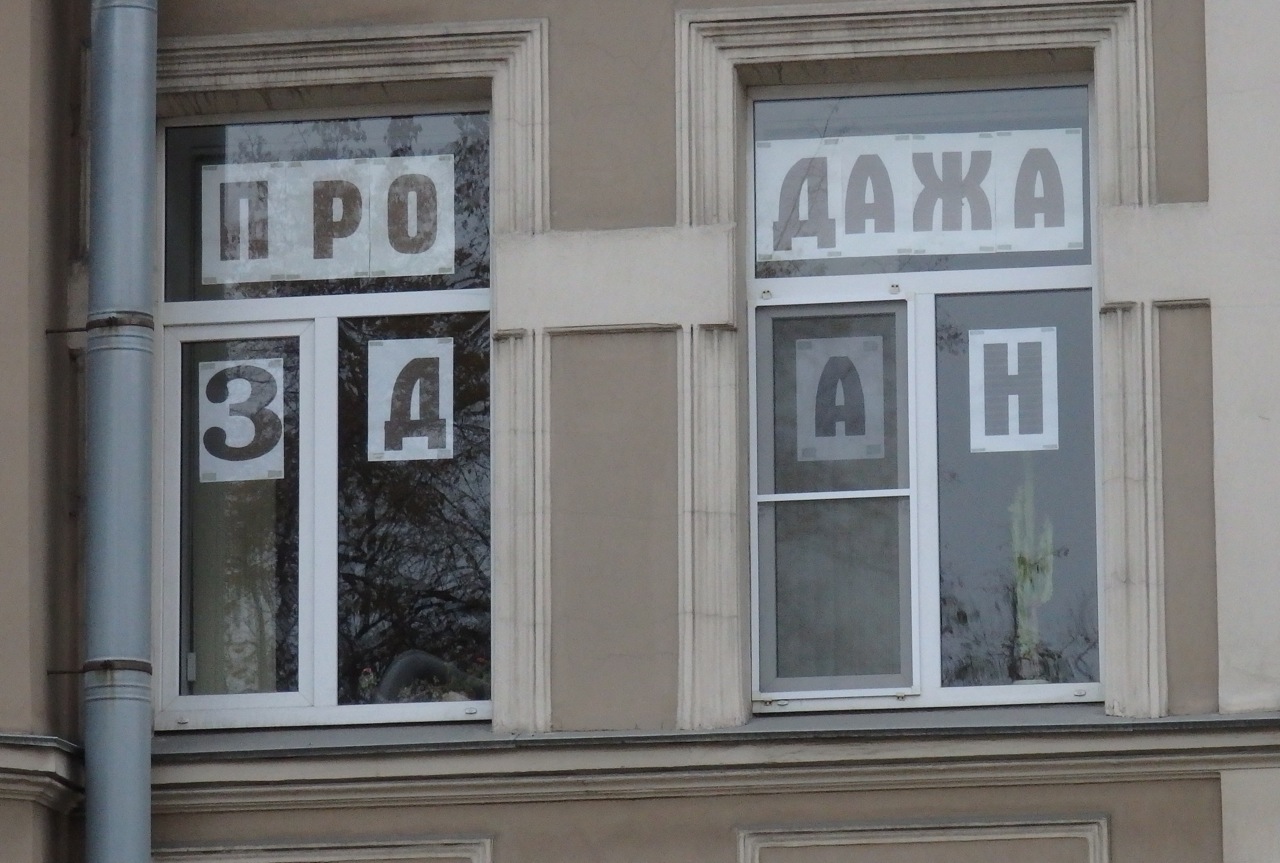
Advertisement in top-floor window at Kirov Palace of Culture, Vasilyevsky Island
9.3%
Decrease in the average monthly wage in Petersburg year to date.
Photogenic cat in courtyard off Suvorov Prospect, downtown Petrograd
42,656 rubles [approx. 600 euros]
Current monthly average wage in Petersburg.
“Simbirtseva, Apt. 29. Pay your debt, rat!”
28,700,000,000 rubles [approx. 40 million euros]
Amount banks lent to Petersburg residents in the third quarter of 2015.
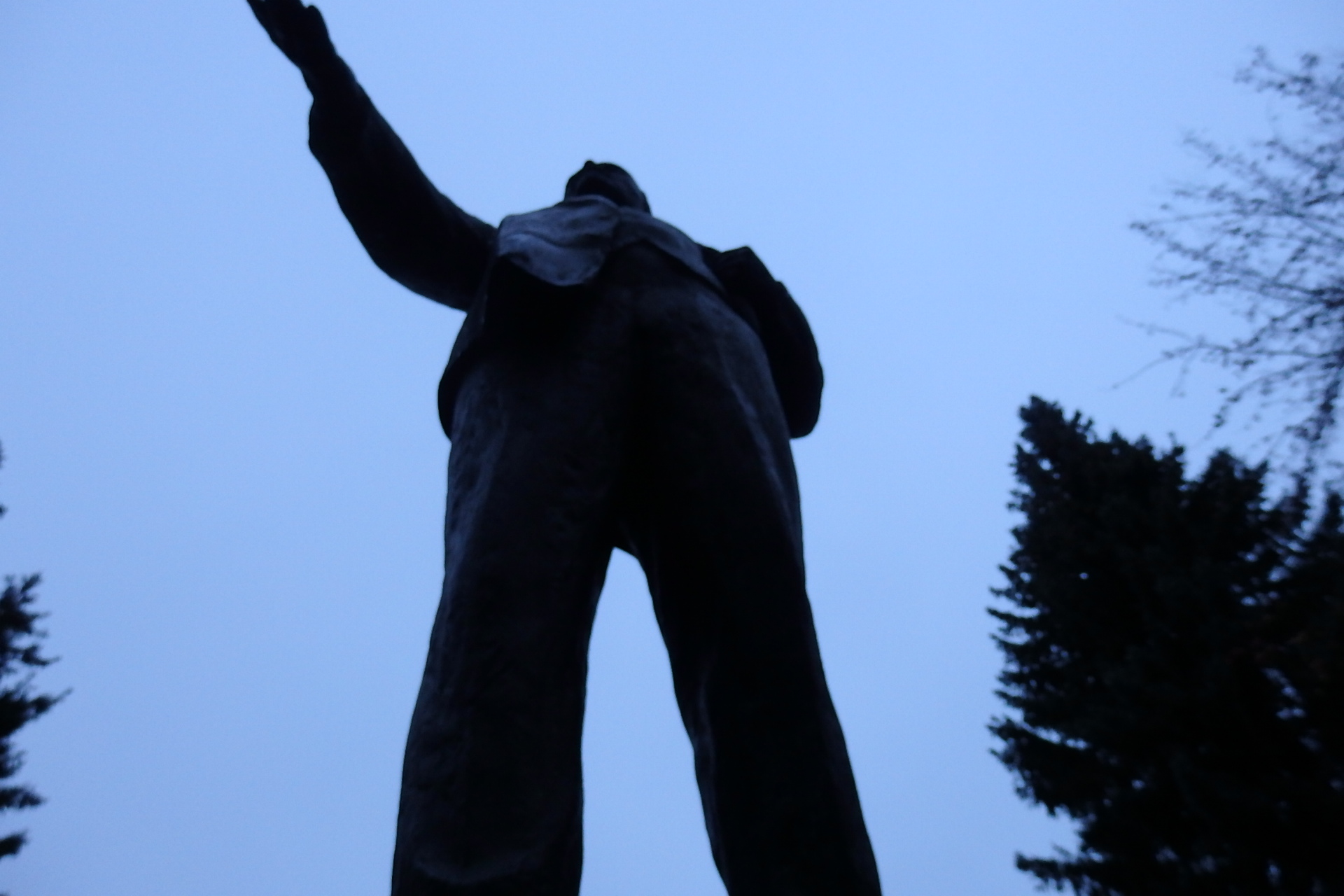
Monument to Vladimir Lenin, Detskoye Selo State Farm, Pushkin
6.5%
Increase in the amount of utilities tariffs in Petersburg, according to the “index of changes in the average amounts to be paid by citizens for municipal services in various parts of the Russian Federation in 2016.”
“Building for sale”
11%
Increase in electricity costs for individual consumers in Petersburg in 2016.
Adapted and translated by the Russian Reader. Photos by the Russian Reader
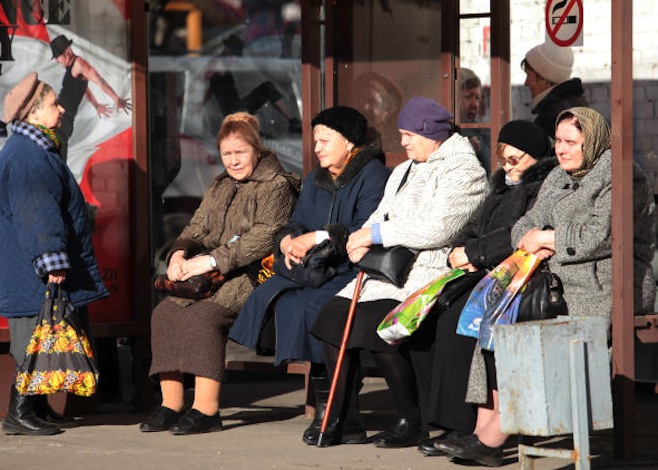
Russia’s old-age pensioners: menace to Russian liberal democracy?
Slava Rabinovich
October 2, 2015 Facebook
#ConcreteWall
Inflation: 14-17% in rubles.
Consumer basket inflation: 25-70% in rubles (depending on the specific consumer basket).
Currency devaluation: 50%. The value of foreign currency has risen 100%.
The government has decided to index pensions for inflation only by 4% in 2016.
Pensioners vote for Putin.
Putin has stoked and burnt their money in Crimea, Donbass, and Syria, and on an insane military and security services budget, and has stolen trillions right from the same budget.
Pensioners vote for Putin.
Putin has lucked out with pensioners.
________
And yet a little over ten years ago, it was the old-age pensioners (rather than portfolio investors like Mr. Rabinovich or the “rising middle class”) who mounted the first serious, massive grassroots challenge to Putin’s policies and his rule.
Maybe the old-age pensioners have gone silent now and no longer want to mount such challenges to Putin’s rule. But it is quite amazing to observe so many able-bodied and mentally competent folks in the prime of their life engaged in casting around for whole (mostly imaginary, mostly disempowered, mostly lower) classes of people to blame for Russia’s slide into totalitarianism lite. What sense does it make to say that any whole class of people “votes” for Putin and constitutes his “base,” when we know that elections in Russia are rigged six ways to Sunday?
This is not say that Russia’s old-age pensioners shouldn’t be distressed by their deteriorating economic fortunes, as reflected in the distressing and real figures cited by Mr. Rabinovich, above, but the search for the “rubes” who have buttressed Putin’s rise to minor godhood should start with the classes of Russians who have really benefited from his rule. It has most signally not been the mass of old-age pensioners who have made out like bandits, although they may be more vulnerable, in some instances, to Putin’s propaganda machine and, at the local level, to the blandishments offered by the United Russia electoral machine.
But it must be nice for Russia’s worldly and well-heeled urban hipsters, thirty- and fortysomethings, and go-getters (whose brains, again in my limited experience, are no less addled by the popular prejudices of the Putin era, and whose bodies are no less averse to putting themselves in harm’s way) to imagine that Putin’s “base” is made up of old-age pensioners, the chronically poor, blue-collar workers, and residents of the Russian hinterlands.
__________
Putin Reforms Greeted by Street Protests
Steven Lee Meyers
January 16, 2005 New York Times
KHIMKI, Russia, Jan. 15 – Mikhail I. Yermakov, a retired engineer, has never before taken to the streets to protest — not when the Soviet Union collapsed, the wars in Chechnya began, the ruble plummeted in 1998 or President Vladimir V. Putin last year ended his right to choose his governor.
On Saturday, however, he joined hundreds of others in the central square of this gritty industrial city on the edge of Moscow in the latest of a weeklong wave of protests across Russia against a new law abolishing a wide range of social benefits for the country’s 32 million pensioners, veterans and people with disabilities.
Demonstrations were held in at least three other cities in the Moscow region, in the capital of Tatarstan and, for the fourth straight day, in Samara in central Russia. In St. Petersburg, several thousand demonstrators blocked the city’s main boulevard, with some calling for Mr. Putin’s resignation.
Taken together, the protests are the largest and most passionate since Mr. Putin came to power in 2000. They appear to have tapped into latent discontent with Mr. Putin’s government and the party that dominates Parliament, United Russia.
“It is spontaneous, and this is the most dangerous thing for the authorities,” said Mr. Yermakov, 67, as speakers denounced the government from a step beneath a hulking bust of Lenin. “It is a tsunami, and United Russia does not understand that it is going to hit them.”
The law, which took effect on Jan. 1, replaced benefits like free public transportation and subsidies for housing, prescriptions, telephones and other basic services with monthly cash payments starting at a little more than $7.
In a sign of bureaucratic inefficiency, some of those eligible have yet to receive any payments.
Mr. Putin and United Russia’s leaders have defended the law as an important reform ending a vestige of the old Soviet Communist system, but they clearly failed to anticipate the depth of opposition from those who relied most on the subsidies: millions of Russians living on pensions of less than $100 a month.
The protesters have denounced the payments as insufficient to cover the cost of the benefits and as miserly for a country that recently reported a budget surplus of nearly $25 billion.
As the protests unfolded in city after city across Russia, the Patriarch of the Russian Orthodox Church, Aleksei II, who typically allies himself with what is known here as “the party of power,” questioned the law and the government’s handling of it.
“What counts is that this policy should be fair and effective,” he said in a statement on Thursday. “It should be met with understanding by the people. The latest events show that these principles are not observed in full.”
Aleksei P. Kondaurov, a Communist member of the lower house of Parliament, said the law and the protests underscored the shortcomings of the political system that had evolved under Mr. Putin, one dominated by United Russia, which has refused to debate with opposition parties, let alone compromise with them.
“It was clear that it was not carefully calculated,” Mr. Kondaurov said of the new law in an interview.
Mr. Kondaurov predicted the protests would grow and spread to other pressing social issues, which he said Mr. Putin’s government and United Russia were ignoring.
At a minimum, the protests have raised doubts about Mr. Putin’s other proposed reforms, including those in banking, housing and electricity, which were supposed to be the centerpieces of his second term.
“It’s not going to be like Ukraine,” Mr. Kondaurov said, drawing a parallel, as some have here, to the far larger demonstrations that overturned the election there for president in November. “But it is clear to me that a political and economic crisis is taking shape in Russia.”
After first brushing off the protests, United Russia’s leaders have begun scrambling to respond. They have accused the Communists and other parties of inflaming tensions and have tried to deflect blame to regional governments, which they say are responsible for implementing the benefit changes.
Some local governments, most prominently the Moscow city administration, have vowed to reinstate the benefits stripped at the federal level, but few other regions are wealthy enough to afford to do so.
On Friday, the chairman of Parliament’s social and labor committee, Andrei N. Isayev, said that next week, lawmakers would consider raising pensions by 15 percent in February, rather than 5 percent in April, as now planned.
Others in United Russia have also tried to distance themselves from Mr. Putin’s new government, which has been in place for only 10 months. The deputy speaker of Parliament, Lyubov K. Sliska, said Friday that she did not rule out the dismissal of Prime Minister Mikhail Y. Fradkov and his cabinet.
But the protests have continued to grow. They began quietly, with a rally organized by the Communist Party in Solnechnogorsk, near Moscow, on Jan. 9, the 100th anniversary of the 1905 uprising.
A day later, here in Khimki, several hundred people briefly blocked the main highway to St. Petersburg in what several of those involved called a spontaneous uprising. After a scuffle with the police, 12 elderly protesters were arrested, but initial threats to prosecute them were quickly dropped.
Since then the protests have erupted in at least a dozen other cities, drawing thousands. In Tula, 110 miles south of Moscow, aging protesters clashed with bus conductors who refused to allow them to board city transport without paying, prompting the city to post police officers on the buses.
In Novosibirsk, in Siberia, a dozen pensioners mailed their cash payments for transit — the equivalent of a little more than $3 — to Boris V. Gryzlov, the leader of United Russia and parliamentary speaker, according to the Regnum news agency.
The protesters here in Khimki’s central square on Saturday represented those who have fared the worst in Russia’s post-Soviet transition.
Mr. Yermakov’s monthly pension equals roughly $85 a month. As a resident of the Moscow region, a separate administration from that of the city government, he qualified for a supplement of $7 to replace the subsidies lost under the new law. The bus fare for three trips to the small tract of land he is allowed for planting a vegetable garden, four miles away, will take nearly half that amount.
Vladilena T. Berova, whose given name is an homage to Vladimir Lenin, served at the end of World War II as a corporal in Soviet intelligence and went on to work as a psychotherapist for five decades in Moscow. Now 78 and widowed, she survives on 2,000 rubles a month, about $71.
“The fascists took my youth,” she said, referring to the war. “And now these people are taking away my old age.”
The protests have included something still rare in today’s Russia: personal criticism of Mr. Putin, who has remained popular by projecting an image of stability, one carefully protected by officials and state television.
“Instead of listening to us, he is listening to an organ,” Mr. Yermakov said, referring bitingly to Mr. Putin’s participation in the unveiling of a newly restored organ in St. Petersburg on Friday with Germany’s president, Horst Köhler.
The benefits law has already been credited, at least in part, with a slip in Mr. Putin’s ratings, as well as a general decline in the public’s mood.
A poll by the Levada Center, released on Saturday, said that only 39 percent of Russians considered Mr. Putin the most trusted politician. That is still higher than anyone else, but a drop from 58 percent a year ago.
Sergei Y. Glazyev, a member of Parliament who challenged Mr. Putin during the election for president last year, said in an interview that “the people’s struggle for social rights” should be decided in a national referendum, rather than imposed by the Kremlin and its governing party. Voters, he said, had been fooled.
“A majority of those who voted for Putin,” he said, “had a quiet different expectation of what they would get.”
Mr. Rabinovich’s Facebook post translated by the Russian Reader. Image, above, courtesy of the Moscow Times
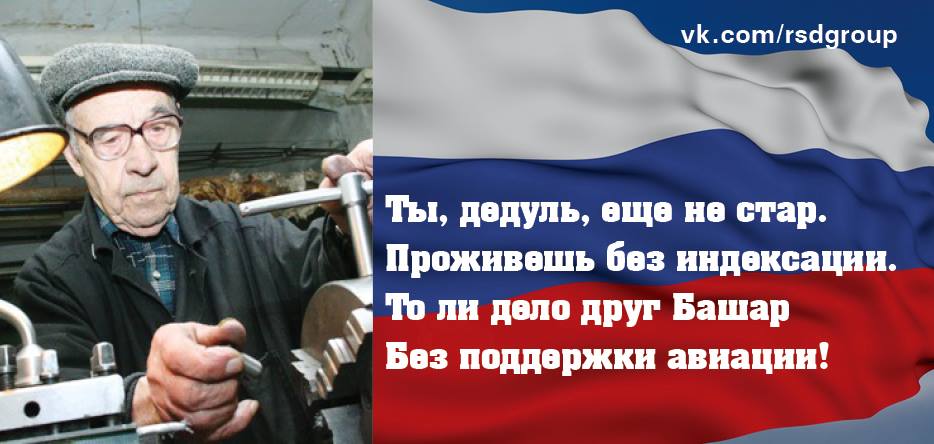
“You, Grandpa, are still not old. / You’ll live without indexation. / It’s not the same for our friend Assad / Who can’t live sans our aviation.” Courtesy of Ivan Ovsyannikov and the Russian Socialist Movement (RSD)
_________
State Duma Rejects Indexation for Working Pensioners
October 9, 2015 Lenta.Ru
Photo: Alexander Kozhokhin/RIA Novosti
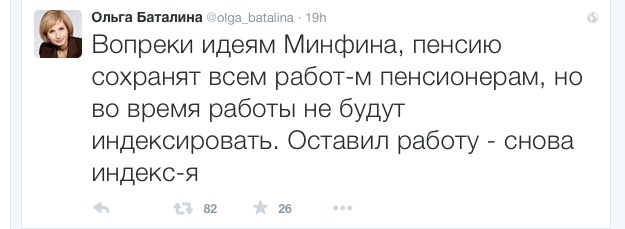
The pensions of working pensioners will not be indexed for inflation. Olga Batalina, head of the State Duma’s Committee on Labor, Social Policy and Veterans Affairs, made the announcement on Twitter.
“Despite the Finance Ministry’s ideas, the pension will be preserved for all working pensioners, but will not be indexed [while they are still working]. You quit work, indexation kicks in again.”
She noted that all working pensioners would continue to receive payments, but the payments would not be raised while they are employed.
“You quit work, indexation kicks in again,” added Batalina.
Earlier, on October 9, she announced that the government had to decided index pensions twice in 2016. Batalina explained this would be done so that pensions would increase to the level of inflation for 2015.
On October 8, however, Deputy Prime Minister Igor Shuvalov noted that the possibility of a second indexation next year would depend on the Russian economy’s growth.
On the same day,the government approvedthe draft budgetfor 2016. It is expected thatrevenueswill reach13.58trillion rubles, expenditures, 15.76trillion. The deficitis projected at2.8percent of GDP(2.18 trillion rubles).
A part of the treasury’s expenditures will be covered by a freeze on pension savings. Another cost-saving measure is reducing the indexation of pensions (to 4 percent at an expected inflation rate of 12 percent). Moreover, the idea of terminating pension payments to working pensioners was considered.
Translated by the Russian Reader
_________
Balancing Russia’s Budget Could Cost Pensioners $46 Billion
Anastasia Bazenkova
June 24, 2015 The Moscow Times
Russia’s roughly 40 million pensioners receive on average 12,900 rubles ($240) in state pension payouts. Photo: Denis Abramov/Vedomosti
Russia’s economic crisis is forcing the government to consider sweeping savings on pension payouts, a move that could go down badly with a core part of President Vladimir Putin’s electorate.
The Finance Ministry this week floated a proposal to save more than 2.5 trillion rubles ($46 billion) over three years by raising pensions at less than the rate of inflation.
The measure comes as the ministry struggles to slash spending amid an economic recession that is eroding budget revenues.
A steep devaluation of the ruble has meant that prices have grown much faster over the past year than salaries, and since payroll taxes are the main source of income for the pension system, the Finance Ministry has said continuation of inflation-linked pensions could threaten the country’s state-run pension fund.
In May, average nominal incomes were 7.3 percent higher than in May 2014, while prices were on average 15.8 percent higher, according to the Rosstat state statistics service.
“If the income of the fund continues to grow slower than its payouts, it could break the entire pension system,” the Vedomosti newspaper quoted Deputy Finance Minister Maxim Oreshkin as saying last month.
The government is already subsidizing a 3.3 trillion ruble ($60 billion) hole in the pension fund, said Pavel Kudyukin, an associate professor at Moscow’s Higher School of Economics.
“This is no longer affordable for the state,” he said.
Pre-Crisis Thinking
According to documents for a government meeting on Monday obtained by news agency RBC this week, the Finance Ministry has drawn up plans to curb planned pensions increases from 7 percent to 5.5 percent in 2016; from 6.3 percent to 4.5 percent in 2017 and from 5.1 percent to 4 percent in 2018.
That means that payments will be increased not in the line with the actual inflation, which is expected to fall back into single digits early next year, but according to inflation forecasts made in early 2014, before Western sanctions over the Ukraine crisis and a sharp decline in global oil prices pushed Russia’s economy into recession. Russian GDP is expected to shrink by around 3 percent this year.
These changes, together with cuts to some other undisclosed social spending items, would save around 2.5 trillion rubles over 2016-2018, RBC reported, citing the Finance Ministry documents.
The government has said no decision has yet been taken.
The changes may require changes to legislation, which requires that Russian pensions are indexed twice a year in line with inflation.
Political Consequences?
Spending on pensions has risen rapidly in recent years as President Putin has sought to use booming oil revenues to raise living standards of pensioners and low-paid state employees.
Pensions were raised even in 2009, during Russia’s last economic crisis, Kudyukin said.
Russia’s roughly 40 million pensioners receive on average 12,900 rubles ($240) in state pension payouts, according to the data from Russia’s pension fund.
The Finance Ministry’s proposal to abandon the link between pensions and inflation aroused sharp criticism from other ministries.
Maxim Topilin, the labor minister, demanded that money be found for the indexation of pensions for next year and the following years and for an analysis of the effectiveness of spending, news agency RIA Novosti reported Tuesday.
Analysts polled by the Moscow Times doubted that the measure would be implemented, as pensioners provide a bedrock of support for President Putin ahead of planned elections in 2018.
“Pensioners are the current government’s main electoral support,”said Pavel Salin, head of the political science center at the Financial University. “The authorities will not reduce pension payments on the eve of the election period.”
Unwillingness to alienate voters is why another Finance Ministry proposal, to cut government expenses by increasing the retirement age of civil servants from 60 to 65 years, has little chance of approval, analysts said.
Hiking the retirement age has been on the agenda for several years — the idea has been repeatedly promoted by former Finance Minister Alexei Kudrin — but has never gained traction.
But even if the Finance Ministry succeeds in making savings on pensions, any discontent would not lead to dramatic political consequences, experts said.
The move could cost Putin a few percentage points off his rating, but not dozens, Salin said.
Putin could afford that — the president’s approval rating is at a record high of 89 percent, according to a poll by the Levada Center released Wednesday.
Given the political apathy of Russians and a surge in patriotic feeling that followed Moscow’s annexation of Crimea from last year, people will bear less generous pensions, Kudyukin said.
“The question is, for how long will they bear them?” he added.
Stuck on the needle: oil and gas account for 98% of Russian corporate profits
Pavel Miledin
September 24, 2015 rbc.ru
RBC’s rating of the 500 largest Russian companies shows the real value of the oil and gas industry to the domestic economy. The contribution of all other companies to total gains—46 billion rubles in 2014—amounted to less than two percent
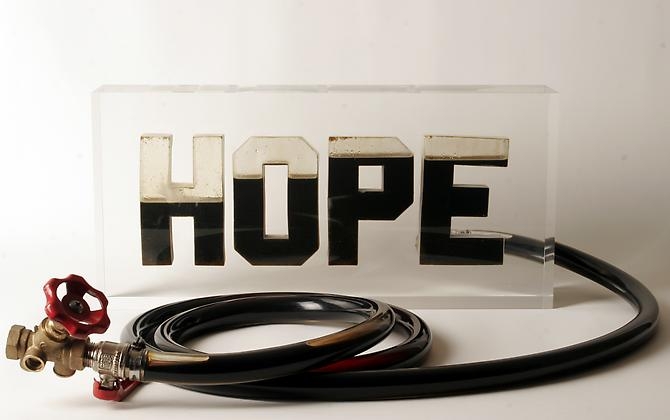
Andrei Molodkin, Hope, 2009. Acrylic block filled with Russian crude oil, edition of eight, 56 x 20 x 11 cm. Image courtesy of priskapasquer.com
According to Rosstat, Russia exported almost 500 billion dollars’ worth of goods in 2014; oil and natural gas accounted for 42% of this sum. In 2014, oil and gas revenues accounted for 7.4 trillion rubles or 51.3% of the country’s budget. If you look inside the corporate sector, the dependence on the oil and gas sector is even more impressive.
According to data from the RBC 500, a rating of the largest Russian companies, released on Wednesday, the total revenue of oil companies in 2014 amounted to 19.8 trillion rubles or 35.3% of the total revenue of all the companies in the rating, but 97.7% of all net profit, or 1.98 trillion rubles. All other sectors accounted for a mere 46 billion rubles of net profit. If only net profit is taken into account as the outcome of domestic business activity, there are, essentially, no other industries in Russia.
Our Everything
According to Oleg Buklemishev, director of the Economic Policy Research Center at the Moscow State University economics department, the date once again reveal the key story of the interaction between the Russian economy and the state, the agent that redistributes oil revenues.
“The whole history of attempts to diversify the economy has come precisely to this,” says Buklemishev.
This once again confirms that talk of diversifying the economy has just been talk, he adds.
Andrei Movchan, director of the Economic Policy Program at the Carnegie Moscow Center, thinks there is nothing unusual about all this.
“Russia is an exporting country, and all other sectors of industry dwell in the shadows of the oil industry,” he says.
According to Movchan, this is particularly noticeable during a crisis, when currency prices for commodities continue to allow the oil sector to profit.
The oil and gas sector’s net profit in 2013 was also huge, but not to the same extent. Then it amounted to 79.2% of the overall net profit of companies listed in the RBC 500.
“The devaluation of the ruble is having an impact,” explains Natalya Orlova, chief economist at Alfa Bank.
Oil and gas companies, which sell their products for hard currency, have weathered the collapse of the national currency better.
Buklemishev draws attention to the fact that the beginning of 2014 was generally good for the economy, and the effect of the sanctions and falling oil prices began to impact Russian business in the second part of the year. As late as June 2014, Brent crude oil cost $114 a barrel, which helped the oil sector show good results.
It is all a matter of revalued hard currency, argues Oleg Vyugin, board chairman of MDM Bank.
“Oil companies are chockablock with hard currency,” he says by way of explaining their brilliant 2014 results.
It is no wonder the most profitable company was Surgutneftegaz. Due in large part to its revalued hard currency savings, it made 885 billion rubles of net profit, 43% of all profits among the RBC 500.
Crisis More Noticeable
Falling corporate profits among the RBC 500 companies reveal the crisis more vividly than official data. Profits fell by nearly half (45%) from 2013 to 2014: from 3.7 trillion rubles to 2 trillion rubles. However, according to Rosstat’s data, in 2014, profits of Russian companies fell by a mere 10%, from 6.5 to 5.9 trillion rubles. Moreover, according to official statistics, 72% of companies were profitable, while 28% made a loss. Among the RBC companies, the split was slightly different: 81% were profitable, while 19% were loss making.
Movchan argues the difference in the numbers may be due to several factors. There is a “sector bias” in the rating of the largest companies. By the end of 2014, the crisis had not yet reached several sectors, for example, the service sector, which is not represented in the rating due to the absence of large companies there. Buklemishev says the more noticeable drop in profits among RBC 500 companies speaks to the fact that business has been going through difficult times.
“Profit is still a controllable variable, and in a bad situation corporations might try and show less profit in order to pay fewer taxes,” he argues.
But a revenue growth of 14%—the RBC 500 companies earned 56 trillion rubles in 2014—is merely the outcome of high inflation.
“It is practically zero in terms of tangible results,” says Movchan.
Oleg Vyugin agrees with him. According to Rosstat, inflation in 2014 was 11.4% and GDP grew by 0.6%.
“The RBC 500 data, which show a slight real growth in revenue and a fall in profits, correspond broadly to the situation in the economy,” he argues.
Small Improvements
There are a few other things worth remarking on in the RCB 500 rating. In terms of revenue (or rather its equivalent, operating income), the financial sector came in second place after oil and gas. Banks and financial companies earned 6 trillion rubles in 2014, outpacing metals and mining. It would seem that a good result for the financial sector testifies to the diversification of the oil economy.
Movchan and Buklemishev note, though, that the financial system is a function of cash flows from the oil industry, just like, however, transport and retail trade. According to Buklemishev, in 2015, the performance of banks will not be so impressive, and the sector itself will make a loss. (In 2014, the banks and financial companies in the RBC 500 showed a profit of 13.1 billion rubles.)
Another trend economists are watching is the strong growth and high net profit margins (the ratio of net income to revenue) in the Internet and online retail sector (e.g., Yandex, Yulmart, Mail.Ru Group, and Wildberries). Here, net profit is more than 50% of revenue. The telecommunication sector has also performed well in terms of profitability (11%). With a profit margin of 10%, the oil and gas industry is only in third place.
The growth of e-commerce is, apparently, one of the few trends showing that a market economy can develop normally in Russia. Oleg Kuzmin, chief economist at Renaissance Capital, argues that growth in this sector is quite understandable: cash flows from the ordinary goods and services sector are being redirected to the Internet. Another reason is that the public has been attempting to reduce its expenditures by buying cheaper goods on the web. It is no wonder that economists have pointed out the low profit margin in the retail segment—3.5% in 2014.
It is interesting to see what yields more profit to foreign companies operating in Russia. Last year, they received 7.2 trillion rubles in revenue here and earned 211 billion rubles in profit. Despite the low margins, most of their profits came from retail trade (17%), the production and sale of alcohol and tobacco (17%), and finance (10.8%). How is that not a diversified economy within Russia’s oil economy?
Translated by the Russian Reader
__________
Russia rejects criticism of greenhouse gas plan, will not amend – top Putin adviser
Andrey Kuzmin
September 23, 2015 Reuters
MOSCOW, Sept 23 (Reuters) – Russia has rebuffed calls for a more ambitious plan to cut its carbon dioxide emissions after environmentalists branded its current pledge inadequate and backward looking.
The world’s fourth largest emitter of greenhouse gases, Russia pledged in March to keep its emissions at 25–30 percent below the level it generated in 1990, the year before the Soviet Union and its vast industrial complex collapsed.
Green groups say the pledge, made ahead of a global warming summit in Paris in December, is far too easy for Moscow to fulfill because 1990 was a time when Soviet industry was a notoriously prolific polluter whereas Russia’s industrial base today is much smaller.
A group of four global climate research groups, known collectively as Climate Action Tracker, have rated Russia’s pledge as ‘inadequate’, worse than the ‘medium’ assessment they have handed out to other big polluters such as China, the United States and the European Union.
But President Vladimir Putin’s top adviser on global warming dismissed such criticism during an interview on the sidelines of a Moscow meeting of the United Nations’ International Panel on Climate Change this week.
“It is their opinion, it does not reflect anything and is not objective,” Alexander Bedritsky told Reuters, saying Russia would stick to its current plan.
“They can say whatever they want, but our commitments are based on around 70 scenarios of how the climate system will be developing.”
It is unfair to compare the Kremlin’s commitments to those of developed economies such as the United States or European Union member states because Russia is still an economy in transition, he added.
Russia’s pledge stresses the importance of increasing energy efficiency and boosting the use of renewables.
“If the contribution of Russian forests is fully taken into account, limiting greenhouse gas emissions to 70-75 percent of 1990 levels by 2030 does not create any obstacles for social and economic development,” it says.
“TRAGIC PLEDGE”
With its gigantic reserves of oil, gas and coal, Russia emits 2 gigatonnes of CO2 equivalent a year, making it the fourth largest producer of greenhouse gases after the United States, China and India.
According to Greenpeace, 85 percent of CO2 equivalent emissions in Russia come from its energy industry.
They and other green groups say Russia’s current programme is far too unambitious because the Soviet Union was on the brink of collapse in 1990—the year the programme is pegged to—and its greenhouse gas emissions therefore fell sharply as the country’s industrial base shrank.
“This pledge is a tragedy, a catastrophe,” said Vladimir Chuprov, head of Greenpeace’s energy programme.
“With this 25–30 percent commitment they are basically saying: ‘Guys, we’re staying in the 20th century with our carbon-centered technology’.”
Chuprov and fellow environmentalists want Russia, the world’s biggest country by territory, to do much more, noting that its richest company—state-owned Gazprom—is the world’s leading corporate emitter of greenhouse gases.
Andrei Molodkin, Gazprom, 2012. Image courtesy of Orel Art, via Art Paris Art Fair
Specifically, Chuprov says Russia needs to expand its use of renewable energy and try to develop new power generating technologies or risk missing out on another technological revolution.
Currently, Russia gets 90 percent of its energy from carbon fuels such as oil, gas and coal, Chuprov said. Green groups estimate that only around 1 percent of the country’s energy needs comes from renewable sources.
Green groups such as Greenpeace or the World Wildlife Fund complain that central government in Russia does not consult them enough when it comes to formulating climate change policies.
Under its existing plan, Russia would fail to meet the goal set out by the United Nations’ International Panel on Climate Change to cut emissions to 50–80 percent below 1990 levels by 2050, he said.
Bedritsky said Russia was already making good progress and that its greenhouse gas emissions would peak at 25 percent below 1990 levels by 2020. They will then fall or stay flat until 2030, he added.
“Our preparations for the (Paris) summit are not just good, we have achieved excellent results, announced our commitments on time up until the year 2020, and until 2025 and 2030,” said Bedritsky. “We will definitely fulfill our promise.”