Lev Schlosberg’s lengthy interview with Ksenia Sobchak, released last week, predictably kicks off with a discussion of his condemnation of his former allies. In August of this year, Lev Schlosberg lashed out on Facebook at the emigrant liberals who had welcomed the Ukrainian army’s offensive in the Kursk Region, calling writer Dmitry Bykov, journalist Sergei Parkhomenko, and politician Garry Kasparov comrades in the “someone else’s blood” party. His post sparked a freewheeling discussion, demonstrating once again to both onlookers and participants how far apart they were, even though they are still citizens of the same country. While the outcome of the Russian-Ukrainian military conflict will supposedly be determined by the newly re-elected Donald Trump, the Kremlin has long since won the war on the invisible front.
Caution: Sobchak, “Lev Schlosberg: Why is it important for a politician to stay in Russia?” (in Russian; no subtitles)
It was beyond the strength of the majority to resist the Kremlin’s propaganda. How fortunate for the minority, who had honestly declared before the war that they had no soul, only a paycheck.
Three months later, Schlosberg felt the need to continue the conversation, choosing as his interlocutor Ksenia Sobchak, about whose views on war and peace there can be no two opinions: what Vladimir Putin finds ambiguous also seems ambiguous to the breeding bulls in his herd. But the question is why the veteran democrat Schlosberg decided to hang a huge bell around his neck next to the “foreign agent” disclaimer. Was it vanity or fear? As becomes clear in the first half hour of the high-minded conversation, however, the cause, as always, is run-of-the-mill stupidity. Schlosberg really thinks what he says. It is even sadder to watch his rantings than it is to watch the criminal proceedings against him.
Explaining his stance as a compassionate fellow traveler (which, as we remember, can be summarized in Akhmatova’s famous line about one’s own people, on whose side one should be both in happy times and during the Special Military Operation), Schlosberg recalls Leo Tolstoy’s famous essay “Bethink Yourselves!,” published in 1904 after the outbreak of the Russo-Japanese War. According to Shlosberg, love for a fragile peace distinguishes the authentic Russian writer from the fake one. For this reason, Shlosberg has no hesitation in ejecting Dmitry Bykov from the company of engineers of Russian souls, and, it seems, from the human race altogether. A similar fate befalls the other participants of the Free Russia Forum. Typically, Sobchak, an experienced investigator-slash-provocateur, cajoles Lev Markovich into making public his entire list of traitors to the Motherland (probably to check it against the firing squad list, lest there be an extrajudicial error).
It is worth nothing that all the ideological opponents mentioned by Schlosberg* did not differ much from the great elder from Yasnaya Polyana in their appeals to the silent audience. Since then, however, much water (demagoguery) has flowed under the bridge, along with the lives of millions of people. No wonder that the cardboard humanism of the captive Yabloko Party now looks, if not ridiculous, then simply ugly. Schlosberg and Yavlinsky suggest that we still eat from the fruit of the tree of knowledge, which was chosen as the symbol of their so-called political association. And it seems to have been known for a long time that this fruit is a pure stage prop, a fruit plate from a Moscow Art Theater performance, but its contents continue to rot and to reek, frankly.
“Myth: that Ukraine remains a victim doesn’t fit the historical facts”: Lev Schlosberg, as featured on Ksenia Sobchak’s YouTube program (via Republic)
We are all victims of this war, Schlosberg claims. Vladimir Putin and Volodymyr Zelensky, the United States and Europe had the same opportunities to prevent the war. “But the mincemeat of history cannot be cranked backwards,” he continues, indulging in inventive parallels, “the cutlet will not turn back into the cow.” Yes, of course, the “Russian World” will never be the same again, but only because thinkers like Schlosberg, as Circe did to Odysseus’s companions, have been turning Russians into ungulates with their pseudo-Christian speeches. It is other people, of course, who have been leading them to the slaughter, but the Yabloko Party, alas, bears a considerable share of the blame.
Dubbing himself “the people,” Schlosberg wants to escort the popular masses on a journey to the end of the night, i.e., he suggests that they wander together until they are blue in the face in the pitch darkness and sprinkle the ashes of their ideals on each other’s heads, even though they should sprinkle “mother earth” on their heads. Schlosberg imagines collective euthanasia as a therapy in which there is no room for hatred. What’s the difference between dying with calls to love one another on your lips and dying while calling for violence? There is a difference, Schlosberg contends. In the first case, our church cemetery will finally become a true “brotherly” [i.e., mass] grave.
There used to be a Three Hierarchs Street in Kyiv. It was renamed after the October Revolution, of course. In 1919, it was called Victims of the Revolution Street in memory of the Bolsheviks who had been led down it to their executions. The street bore this tragic name until 1955, when someone competent finally showed up at city hall and explained to them how the name was ambiguous. City hall agreed and renamed it Heroes of the Revolution Street. But you can’t fool the people, and so the name “Victims of the Heroes of the Revolution” stuck to the street like glue. Old-timers still referred to it as they had in the old Soviet days. “Can you tell me how to get to the outpatient clinic?” “Go straight down Victims of the Revolution….” In the early 1990s, when the powers that be were getting rid of abominable “Red” place names, the street was given back its old name, Three Hierarchs Street.
I was reminded of this by the recent incident involving Lev Schlosberg, who explained in an interview with Ksenia Sobchak that Ukraine cannot be considered a “victim” [zhertva]. This has happened in the context of the Yabloko Party’s now-familiar cry “Both of you stop immediately!” Here is what Schlosberg said, verbatim:
Ukraine is resisting. State and individuals are victims [zhertva] until the minute, until the second they start resisting. Ukraine started resisting on the morning of February 24 [2022]. It is a resistance supported by dozens of foreign countries with their money, their equipment, their specialists, with everything they have. This had led to the fact that Ukraine has equalized the situation. Today, the military forces — the combined military forces of Ukraine (taking into account the allies, their weapons and their money) and the combined military forces of Russia — are roughly equal. Whoever resists is not a victim [zhertva]. A victim [zhertva] does not resist. A victim [zhertva] allows itself to be killed. The myth that Ukraine is a victim does not fit the historical facts. If Ukraine were a victim, Ukraine would not exist now. It would simply not exist.
Of course, we could go on at length about Shlosberg and the Yabloko applesauce* in his head, but he has gotten enough pushback. He has talked a load of nonsense and still goes on, so God be his judge. “Why do we listen to him? Let’s eat him.” I’m in favor of not listening to anyone at all, since there came a point when everyone started talking in commonplaces. Schlosberg is no exception: his leitmotif is well rehearsed and has long been familiar. But this paragraph about victims and non-victims is peculiar. Not politically peculiar (not at all), but it is quite peculiar as a mirror reflection of illiteracy.
Lev Markovich managed to cram a lot of nonsense into one paragraph, both about equalizing the situation and about western assistance. But that’s not what I have in mind. What I have in mind is the fact that even the well-spoken Schlosberg has no linguistic sense at all, as it turns out. And he’s not alone in having this handicap, although it is not remotely acceptable for him as a politician to have it.
The whole passage about the victim, I think, meant the opposite of what its author was been lambasted. He was rightly lambasted, generally, but he didn’t mean to strip Ukraine of its status as a victim of aggression. “Victim of aggression” and “sacrificial victim” are different things. The concept of the sacrificial victim is as old as sacrifice itself and is widely employed in the Old Testament as an inalienable part of the love for God. The Old Testament is chockablock with sacrifice, beginning with Abraham’s sacrifice of his son Isaac.
It would be odd, of course, to assume that Schlosberg was talking about biblical connotations in his conversation with Sobchak (and it is doubtful the interviewer has ever thoughtfully read the Bible), but it is almost certain that this was the notion of zhertva which he had in mind. A sheep to the slaughter is apparently Lev Markovich’s idea of a textbook victim. The sheep does not resist: that’s a fact. Ukraine has been resisting, and that’s also a fact. From Schlosberg’s point of view, it all makes sense. If he had said that Ukraine was not a victim of aggression, then he would have become a deserving punching bag forever. But he wanted to make a graceful compliment to Ukraine while not deviating from Yabloko Party’s twee “peace and good will to all — just stop shooting!” In the Old Testament sense of the word, Ukraine is truly not a victim: it is a heroic scrapper, a country as hard as nails. But what Schlosberg said was understood as it should have been understood.
A politician should know the value of words and the cost of his linguistic blunders. The Schlosberg incident is such an obvious example of linguistic deafness that it should be included in political rhetoric textbooks — someday, of course, not now. A politician should realize that words addressed to the public are always heard as they are commonly understood, and that few people will use zhertva [“victim”] in the Old Testament sense [of “sacrifice”].
Once upon a time, a rookie journalist was brought on at the newspaper where I worked. His first article was about a theater event that had turned out to be a chummy gathering at which only the in-crowd got the jokes. The article ended with the following sentence: “The result was an event only for those who could get to it through the box office window.” I immediately pictured a man trying to Winnie-the-Pooh his way through a tiny window. When the journalist noticed that I was editing the sentence, he was indignant.“Why?! It’s clear as it is,” he said, “it’s about the people who managed to get their hands on complimentary tickets.” “Yes,” I replied, “it is clear. But not immediately clear, like it should be.” The guy held a grudge against me for a long time, not understanding the point of my objection.
The feeling for language is an innate thing, like a sense of pitch. But if it is weak, it must be trained, just like the sense of pitch. Andrei Mironov, who sang countless songs on screen and on stage, had no ear for music, but he worked until the point of exhaustion, singing the same lines a hundred thousand times until he could hit the notes. Only the people close to him and the directors who worked with him knew that he lacked a sense of pitch.
When I hear an advertisement for “tonal cream” [foundation cream], I am amazed at how one could fail to anticipate that every other person would hear “anal cream.” We can attribute this to a common lack of linguistic pitch, of which there are countless examples. It is essentially a habitual neglect of language, of its purity. “Anal cream” is a harmless example. “Phyto tea for women with hog uterus” [i.e., Orthilia secunda, or wintergreen, whose common name is matkaborovaya] is basically harmless, too, just like most of the complete misunderstandings of “how our words will be heard” which we encounter at every turn.
The Schlosberg incident is a quintessential example of the damage which carelessness can do to a public figure. Lev Markovich already has a catastrophically dwindling number of allies, given his inappropriate Leopold the Cat-like appeals and dubious patriotic outbursts. After his latest musings, this number has precipitously plunged. “Alas, they didn’t understand me,” the annoyed Schlosberg must say, playing the victim.
* Although the Yabloko Party‘s name was derived from the surnames of its three founders (Grigory Yavlensky, Yuri Boldyrev, and Vladimir Lukin), the word thus formed, yabloko, means “apple” in Russian.|||TRR
The Russian Justice Ministry has once again designated Republic a “foreign agent.” This happened for the first time in 2021, but at that time a legal entity with which we soon severed ties was placed on the register of foreign agents. Now the publication itself has been put on the register. We are charged with “shaping a negative image of the Russian Federation,” as well as publishing “inaccurate information about the decisions taken by Russian federal officials and the policies they pursue.” I would like to remind you that Republic has always been financed solely by subscriptions, and Justice Ministry’s unjust ruling is a great reason to subscribe (if you are not subscribed already) or to renew your subscription.
And now, as usual on Saturdays, here are links to our latest articles and the best stories of the past week.
In “Power,” Ivan Davydov attempts to explain the psychology of Russians who have taken a position neither for nor against the war, but are “unopposed” to it. They probably make up the majority, but what explains their stance? A habitual mindset that regards political power as a force of nature, with which nothing can be done and which is better to ride out. “This stance is ethically vulnerable, but it is warranted by the know-how of several generations and supported by the self-preservation instinct,” argues Davydov.
[…]
Dmitry Kolezev, Editor-in-Chief, Republic
P.S. This is my last newsletter as editor-in-chief of Republic. I am leaving the post of my own free will. I announced my resignation a week ago: it has nothing to do with the Justice Ministry’s decision. I thank the authors, editors, and readers of Republic for the three years we have spent together. As they say in such cases, take care of Republic. And take care of yourselves, too.
Source: Republic Saturday newsletter, 1 June 2024. Translated by the Russian Reader, who has (mostly) happily subscribed to Republic for several years running. I will definitely be renewing my subscription later today to show them my support.
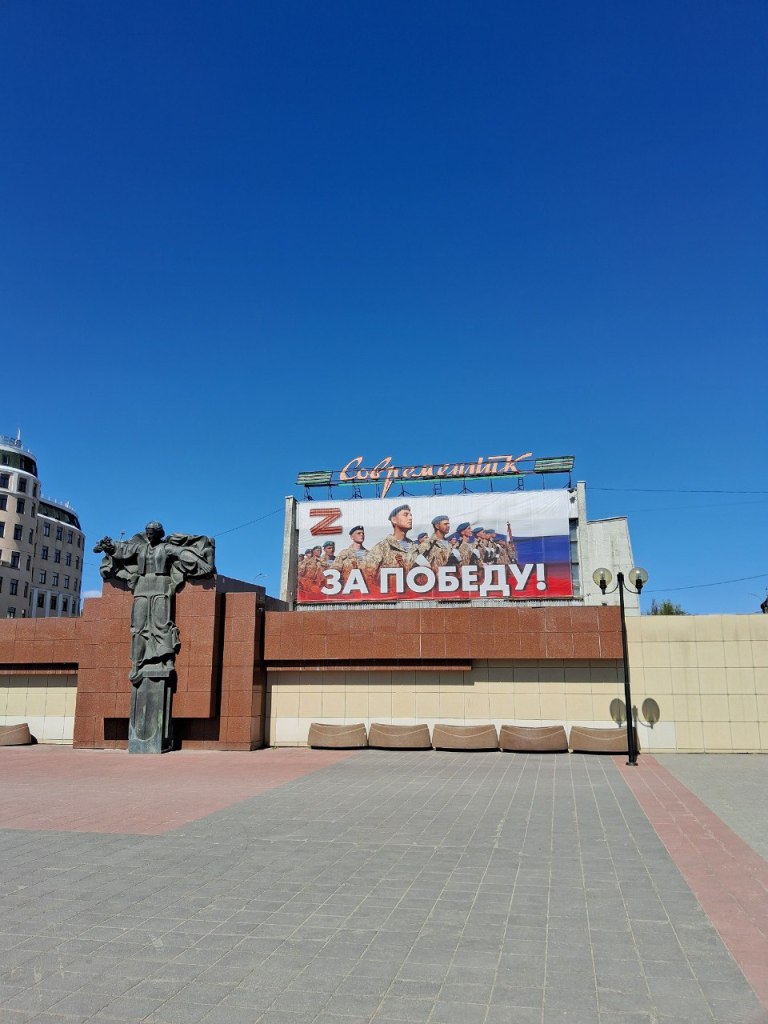
A “For Victory!” banner on the facade of the Contemporary, a long-shuttered movie house in Ivanovo, Russia. Photo: Ivan Davydov/Republic
Since the death of public opinion polling, people who are professionally obliged to speculate about Russian politics and make predictions about the future have been looking for signs literally everywhere, gradually turning from analysts into soothsayers.
For example, a respected opposition political scientist based in Europe recently wrote that “General Popov’s arrest may generate serious friction between society and the authorities.” By the way, this same political scientist has also been trying to gauge the mindset of Russians by counting the poop (excuse me!) and other unpleasant emojis that Russians (presumably) post as comments on the Telegram channels of Russian government officials and pro-regime propagandists.
He is an optimist, of course, confident that the regime is about to collapse. Poop emojis don’t lie!
Another political scientist, a pessimistic lady, on the contrary, gazes at Russia from her distant American vantage point, but does not even condescend to comment—she simply reposts a photo from a certain bookstore where Darya Dugina’s works are displayed on a separate shelf.
And really, what good are words? One glance at the photo is enough to get the whole point, to forget forever about terrible present-day Russia and wave it goodbye.
Nor am I an insider, alas. I’m not endowed with secret knowledge, and it has been a long time since I perused the “real polls” said to be commissioned by the presidential administration and other important agencies. Frankly speaking, I’m not even sure that such studies are still being conducted.
But there are still some advantages to being a participant observer, a person looking at Russia from the inside. In any case, I will risk sharing my own observations.
Has the Russian state been expanding into the cultural realm (since we mentioned bookstores)? Does it seek to reshape culture for propaganda needs? Yes, undoubtedly. It would be foolish to deny the obvious. And it has been invading more and more realms, where, until recently, it seemed one could sit back and wait out the storm. It has finally gone after “bad” books in a big way, it seems. Museums have also been toeing the line. Right now, for example, there are two exhibitions related to the special military operation underway in Moscow: Behind the Lines, a large-scale project at the Russian State Historical Museum, in whose launch [pro-war TV presenter] Vladimir Solovyov personally had a hand; and War Correspondents, at Zaryadye Park, in which the work of today’s TV correspondents is shown as a continuation of the work of journalists during the Second World War, in full compliance with the basic propaganda narratives. Regional museums have not been lagging behind the capital’s museums either.
Although television has indeed reduced the number of programs dealing with the ins and outs of the special military operation, even now they take up most of the airtime on the major channels.
The information warriors have been firing all guns. The only question is their firepower’s effectiveness.
In February and March 2022, the special military operation was undoubtedly the main topic of all conversations, from television studios to kitchens. Emotions were voiced in a variety of ways (and I wouldn’t say that enthusiastic support prevailed in the kitchens and subways), but rather quickly it all shifted to the outskirts of public opinion. There has been a “normalization” (that’s the accepted term, it seems) that has equally outraged both the vocal pacifists and the supporters of an immediate nuclear strike on Washington, the latter, perhaps, even more so. Complaints that no one on the home front cares about the war front are the leitmotif of many posts on the social media channels of the Zeds [Russian pro-war activists].
The zed (since we are on the subject of signs) is also an important sign. Nowadays you can find this letter in ordinary Russian cities, but it is no longer as prolific as it once was. There is, as a rule, one, big, main zed (Z) somewhere on a government building in the city center, but that’s all. And even that one is faded, mounted there long ago and thus overly familiar to the point of invisibility.
There are, of course, the Defense Ministry posters for recruiting contract soldiers. But they seem out of context as it were, speaking as they do about the chance to “join up with people just like you,” solve your financial and social problems, and, ultimately, rake in hefty paychecks. They are outside of time and devoid of specifics, of references to reality. We see a rugged-looking man in soldier’s kit, the Russian tricolor flag, tantalizing numbers….
If we speak, as is fashionable, of the current Russian regime as restorationist, we can argue that the country’s masters have succeeded in restoring only one thing—total depoliticization, the leadership’s fear of any doings that might be unwieldy and thus regarded as political. This was typical of the late-period Soviet Union (and ended overnight, we should note, when Gorbachev loosened the screws a bit). Cities that are like enclaves, people who are like atoms, the plight of the Russian opposition in the twenty-teens, and the isolated (yes, as yet isolated) crackdowns have vividly reminded the doubters what happens to eager beavers.
In this sense, nothing has changed in recent years. Perhaps the intensifying propaganda shows that the authorities have new ideas in this regard, that they have decided to make their words about the nation’s unprecedented unity mean something. It is unclear why, though: the regime will get nothing but problems by politicizing the populace. So far all these efforts have failed, however. The Master and Margarita and 1984, not the works of the Dugin family, are still atop the Russian bestseller lists. Brought to museums by their teachers, schoolchildren yawn and poke at their smartphones, while adults are almost absent. The escalating propaganda makes people neurotic rather than political, but since Soviet times the populace has had a remedy—an effective remedy—for countering this neuroticization.
It’s all the business of the folks in power. As long as it doesn’t directly concern you, don’t make a move, nothing good will come of your flailing. Political power is a force of nature, an element beyond human control, so try to have as little contact with it as possible. When asked whether you are for or against something, answer evasively, “I’m unopposed to it.” Better yet, hang up immediately if pollsters call you. The times are such that they can be even more dangerous than bank fraudsters.
Talking to crooks may make you poorer, but it certainly won’t get you sent to prison.
This stance is ethically vulnerable, but it is warranted by the know-how of several generations and supported by the self-preservation instinct. This stance poses obvious problems for the future—for any future, both the one cherished by fans of rights and freedoms and the one imagined by armchair slayers of Washington.
“‘The Arab world is not just beautiful ethnic costumes, exquisite dishes, and other One Thousand and One Nights-type stuff, but also brutal dictatorships, poverty, a high tolerance of violence, and sometimes outright racism and religious fanaticism. According to my observations, however, this second facet is almost always bracketed off by Europeans when describing the countries of the “global South” or is guiltily dished up as a consequence of the traumatic colonial past.’ Essayist Andrei Sapozhnikov (“Department of Culture”) connects the abnormally high support for Hamas’s invasion of Israel in the Western world with this peculiarity.”
Source: Email newsletter from the online Russian magazine Republic, 8 November 2023. Translated by the Russian Reader
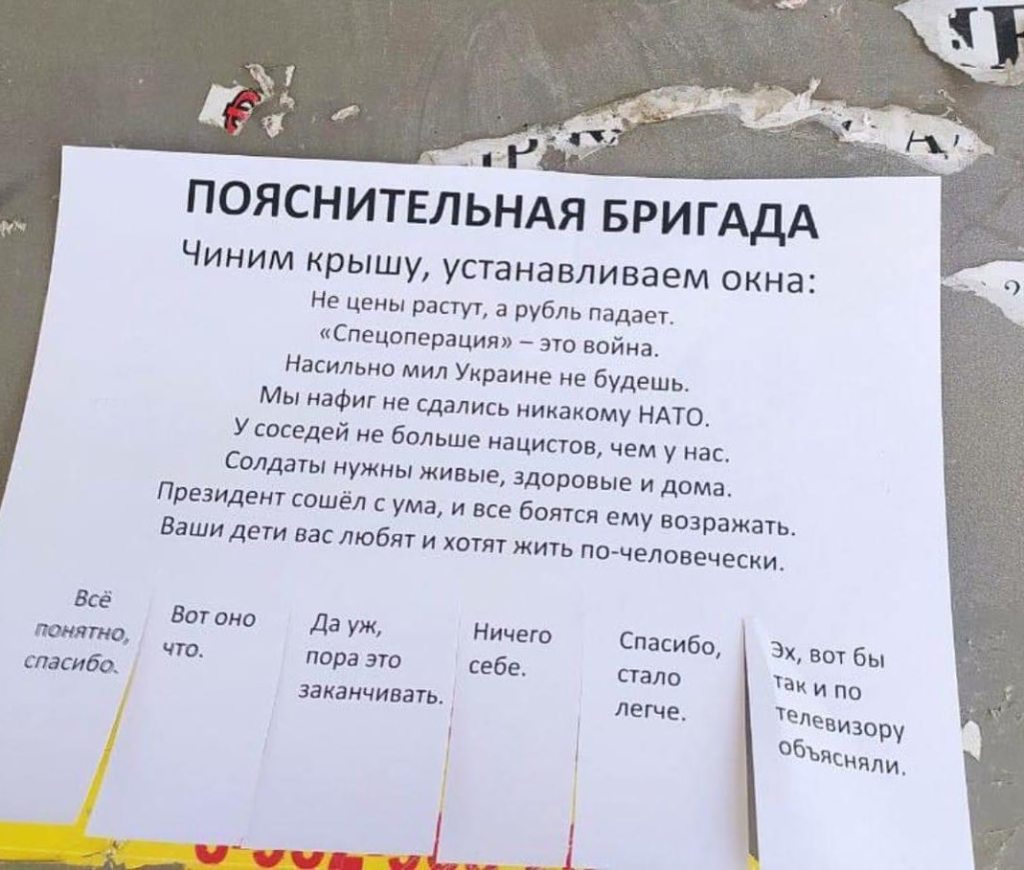
It’s not the prices that are rising — it’s the ruble that is falling. The “special operation” is a war. You can’t force Ukraine to like you. We haven’t surrendered to NATO. The neighbors have no more Nazis than we do. Soldiers should be alive, healthy, and at home. The president has gone mad, and everyone is afraid to contradict him. Your children love you and want to live like human beings.
That’s it, thank you. So that’s how it is. Yeah, it’s time to end it. Wow. Thanks, I feel relieved. Oh, would that they would explain it that way on TV.
The war has made us take a look around. In whose midst do we live? Do our fellow citizens think the same way we do? Public Sociology Lab (PS Lab) is a research team that studies politics and society in Russia. In 2022, it launched a project to study the attitudes of Russians to the war.
How do people explain the conflict’s causes to themselves? How does their attitude to politics affect their personal interactions and self-perception? Do they have a political position at all? We talked about this with researchers at PS Lab. Svetlana Erpyleva works at the Center for Eastern European Studies at the University of Bremen, while Maxim Alyukov, a political sociologist, works at the Institute for Russian Studies at King’s College London.
How is your research on the attitude of Russians to the war with Ukraine set up?
Svetlana Erpyleva: Qualitative methods are the main difference between our team and the other teams doing systematic research on perceptions of the war. We have long conversations with our informants and try to find out not only their attitude to the war directly, but also many other things related to it — what sources of information they trust, how they interact with loved ones, their fears and hopes, and so on.
We searched for respondents using social networks, ads, and the “snowball” method (that is, when an informant helps us set up a conversation with their ow friends). It was a big help in contacting people who do not often reflect on politics.
Some people responded enthusiastically to the ads we placed about finding informants — they wanted to talk to us themselves. Moreover, these are not only people who have a clear stance for or against the war and are willing to share it, but also those who feel that their opinion is not represented in public discussion. Such people do not see other people who think like them on social networks or in the media and want to put themselves on the map.
For example, during the the second stage of our research, in the autumn of 2022, we realized that dividing people into “supporters of the war,” “opponents,” and “doubters” (as we had done in the spring) was no longer warranted. Our sources support some decisions by the authorities, but not others. They regard the war as necessary in some ways, but some things about it terrify them, while other things cause them to doubt. Our interviews, which last about an hour (sometimes longer), have in fact enabled us to understand the peculiarities of how the war is regarded by Russians, with all their contradictions and complications.
Our other goal is to study the dynamics of how the war is regarded. We conducted the first series of interviews in the spring of 2022. We did the second series between October and December 2022. It is important to note here that in the autumn we spoke only with “non-opponents of the war,” that is, with those whom in the spring we had provisionally labeled “supporters” and “doubters.”
Maxim Alyukov: I would also make another important clarification. When people talk about studying perceptions of the war, they often have in mind representative surveys. Using them, we can indeed more or less accurately describe the range of opinions around the country. But polls cannot show how opinions about the war are shaped, or what emotions people experience. We are going deep rather than wide. Yes, we cannot draw large-scale conclusions about public opinion in general, but, unlike the polling projects, it is easier for us to talk about specific mechanisms — what emotions tend to shape certain positions, how different types of media consumption affect perceptions of the war, and so on.
What is the difference between how people regarded the war in the spring and the autumn?
SE: On the one hand, we see from the autumn interviews that perceptions of the war had not changed radically. Almost none of the people with whom we had repeat conversations had changed their attitude to the war from “plus” to “minus” and vice versa. Of course, there have been small shifts in this regard. For example, some of the springtime convinced supporters remained “optimists,” while others had become “pessimists.” The former believe that the “special operation” is going in the right direction, despite all the shortcomings, while the latter criticize the chaos in the army, the chaos during the mobilization, retreats by Russian troops, and so on.
But we shouldn’t deceive ourselves: the pessimists have not stopped supporting the war. Rather, they want Russia to act tougher and more effectively, and ultimately win.
In the first series of interviews in the spring, we identified a group of so-called doubters. But it is clear that even back then different informants in this group were closer to one or the other pole of opinion. Some doubted, but were inclined to support the war, while others were against it. In the autumn, there were fewer informants who were completely unsure of their position. Those who had been closer to the supporters of the war had often begun to support the war a little more. The same thing happened to those who had been more against the war than not: many of them had become a little more strongly opposed to the war (without turning into unambiguous opponents).
On the other hand, the ways people have for justifying the war have changed. Some of the old methods are losing popularity, while others are emerging.
For example, one of the new justifications for war involves imagining it as a natural disaster. We feel sorry, of course, for those who perish in a flood. We cannot regard this other than negatively. But it is impossible for us to oppose it. The same thing has happened with the war.
From the viewpoint of the informants who have resorted to this excuse, the war just happened. It is a terrible reality that we can only accept.
Another new way of rationalizing the war involves turning its consequences into its alleged causes, as when our informants say, “Ukraine has been bombing our border cities, so we need to continue the war,” or, “The war has shown that we are fighting not with Ukraine, but with the collective West. We are fighting not with a fraternal people, but with our perennial enemy, so it is right that we started this war.” The second statement had also come up in the spring, but it has become much more popular. The rationale behind such justifications involves arguing that events that happened after the war started seemingly reveal the enemy’s true identity.
MA: Attitudes towards sources of information have also changed. There are two trends: polarization and stabilization. At the war’s outset, people tried to seek out information, including information from the “opposite camp.” For example, those who supported the war sometimes read opposition and Ukrainian media, because they understood that the Russian state media are propagandistic. Now, on the contrary, many people are so weary that they have not only reduced their consumption of information in general, but also have stopped following sources that reflect the opposite opinion.
At the beginning of the war, the following idea was often discussed: information about the destruction, civilian casualties, and losses among Russian soldiers would gradually undermine the effect of propaganda. Now we see that, over time, the simultaneous consumption of information from pro-government and opposition sources, which paint radically different pictures of the world, has had the opposite effect. It causes discomfort, which leads to the fact that people who are less involved try to shield themselves from information about the war in general, while more involved people consume propaganda and stop paying attention to alternative sources. This is a conscious choice: they realize that they are consuming propaganda. I remember the words of one informant: “There are different points of view, but the brain tends to stick to one theory. I’m inclined to choose the theory of my country, of the state media, so that my brain follows it.”
It transpires that the person understands perfectly well that they are consuming propaganda, and they consciously choose it amidst conflicting explanations that cause discomfort.
Do these changes produce any practical actions? Maybe people stop talking to certain people or get involved in charity?
SE: There are only a few volunteers among our informants.
People can have a positive view of charity, and worry about their country, but most of them do not take any action themselves.
And yet, volunteering that involves assistance to the mobilized is certainly seen positively by our informants (that is, by “non-opponents” with very different views of the war). Such volunteering is regarded not as involvement in the war, but as support for “our boys,” for “our country.” This is not surprising: there are always significantly fewer “activists” and volunteers than there are sympathizers. Only a few people are involved in protests, too.
Changes have also been taking place in the way people talk about the war with their loved ones. For example, many of our informants described the summer as a carefree time when the war had completely disappeared from their lives: they stopped discussing it. The mobilization was the “new February 24” for those informants (who were most often people remote from politics). The topic of war had returned to everyday conversations again. The informants were discussing the events even with strangers. For example, one of our sources told us that even at work meetings with her clients she had occasion to discuss the mobilization.
Do attitudes to specific events affect everyday practices? For example, the mobilization began and people decided to check whether their foreign travel passports were still valid.
SE: Unfortunately, we didn’t talk much about everyday practices in our interviews. Probably the most common reaction to the mobilization’s announcement was anxiety and, simultaneously, the absence of concrete action: “Whatever will be will be, but I hope that nothing bad happens.” Some of our informants who did not want to be sent to the front changed their places of work and residence, but we didn’t often encounter such people in our interviews. (It is important to understand that we were talking to “non-opponents” of the war.)
MA: It’s also worth recalling that a minority of Russians have the possibility of leaving the country. According to our research on social networks (this is another project that my colleagues and I are doing), the most common reaction to the mobilization has been evasion.
Is it possible, then, to talk about a desire for inneremigration among those who have remained in Russia? For example, a person says, “Actually, I have a lot more important and valuable things in my life [than the war], and I want to pursue them.”
SE: It was the presence of this desire among people in the spring of 2022 that made us single out the doubters as a separate group. All of them were typified by the notion that the “distant war” was secondary compared to more important values — work, loved ones, and family. But in the autumn, we saw that fewer and fewer of our informants were able to take a neutral stance, to completely distance themselves from assessing the war. Our informants talked about pressure: they seemed to feel that society demanded that they voice their opinion. In this sense, as Maxim has said, the polarization of views has been increasing.
But our informants assess [this polarization] in different ways. Many supporters of the war say that it is awesome because people are becoming more united, more interested in what is happening around them. The “anti-patriots” will leave the country, but patriotic Russians will remain. Others complain that it is hard for them to cope with the pressure. They would like to take a neutral position, but they cannot manage it. One of my sources described it this way (I’m quoting from memory, of course, but nearly verbatim): “I would like not to take a side, but my smart friends say that the war should be continued. And I understand that they are right, that one should support one’s country in such circumstances. I’m unable to take a back seat.” But a little later she said: “I’m afraid that time will pass and [people] will come and ask me, ‘Have you been reading Meduza? Have you been watching Channel One? Whose side are you on?’ And I won’t have any answer.” This situation even makes her think about emigrating. That is, on the one hand, she chooses to side with supporters of the war; on the other hand, she is afraid to make this choice.
MA: I would add that the desire for neutrality remains. One respondent put it this way: “There is war all round, but I try to maintain peace on my VKontakte page.” He moderates disputes there and shares links to articles about the importance of neutrality. For him, this is a way of creating a space for himself in which there is the possibility of remaining neutral, since he doesn’t have this possibility in other contexts. It is another matter that there are fewer and fewer opportunities for such neutrality.
You say that your respondents feel pressure. Where do they feel this pressure? In interactions with loved ones and colleagues, or somewhere else?
SE: It is often the pressure of their immediate environment. Many opponents of the war have left the country, and the doubters thus have fewer contacts with their viewpoint. They are surrounded, as a rule, more by supporters of the “special operation.” But the cause of such pressure may be an inner conflict. For example, our sources tell us that they were taught at school that when the country is in difficult straits, the worst stance is neutrality. But now they have found themselves in exactly this position. It is really difficult for them: they see the propaganda on both sides, but do not feel strong enough to resist it. This can be illustrated as follows: “Maybe Russia was right to attack, or maybe it was wrong to do so. Maybe Ukraine is the enemy, or maybe it isn’t the enemy. I don’t understand what’s going on at all. But how can I fail to take a stance?”
In such circumstances, people turn to what seems certain to them — for example, to their Russian identity. You may not know who is right, but you have a native country and it must be supported.
MA: This feeling of pressure consists of two parts. The first is personal interaction, about which we have said our piece. The second is the influence of the media, in which you can constantly see appeals and reminders of the war. This background encourages a person to clearly articulate their position.
Is the official newspeak (“special operation”, “line of contact,” etc.) incorporated into the explanations given by the “non-opponents” of the war? Is the state discourse generally used to justify it?
MA: Yes and no. It does happen that our sources literally quote propaganda narratives. For example, they start saying on TV that there are fakes everywhere, and a person repeats this idea. But at the same time, an absolute minority of our sources trust state broadcasts, although there are such people among them. They have doubts and come up with their own hypotheses. But it is important to take into account that our informants live in large cities, so it is likely that, for example, in smaller cities far from the capitals, the ratio is different, that there are fewer people there who are like the majority of our respondents, and more people who trust propaganda.
SE: You also have to understand that there are different types of support for the war, and therefore different explanations for it. There are people who accept the explanations given by the state media. Most often these people are elderly: they regularly watch TV, and then rehash the rhetoric of the propagandists. But there are other kinds of people — for example, those whom we call “committed supporters.” Their attitude to the Russian-Ukrainian conflict was shaped back in 2014, or even in 2004. They can be quite critical of propaganda narratives and are fond of saying, “We have bad propaganda. It is incapable of explaining anything.” Such people are able to explain the war’s causes on their own. And there are, for example, people who are remote from politics, who might watch TV sometimes, but it doesn’t convince them. They can even rehash propaganda cliches, but they do not adopt them, they do not present them as their own words. For example, they say, “We were told that…” or “We are told that…”
Is it possible then to say that, despite propaganda, polarization, and state pressure, even those who are not against the war are in a gray area? In other words, there are no views that could unite people, and accordingly, that is why they cannot unite and make demands.
SE: Yes, that’s right. Unless “convinced supporters” could try to create some kind of association. But I’m sure they’re a minority. Most people are busy with their daily affairs: they are not interested in political positions and movements. We are currently preparing a second analytical report on the results of the autumn stage of our study, and there we even try to avoid the word “position.”
Most of our informants have no “position.” Their attitude to the war is a bundle of fears, doubts, hopes, and other feelings. Such people may want Russia to win, but sincerely worry about the victims of the shelling in Ukraine.
One of our informants said, “If I had been subject to the mobilization I would have been out of Russia in three minutes.” And yet she, for example, wants Russia to win.
MA: Especially since propaganda does not just attempt to impose a certain point of view. It also generates a multitude of contradictory narratives that simply confuse people. This is a paradox of authoritarian propaganda: the state needs this vital demobilizing effect to maintain control, but it also prevents it from generating broad support for the war.
You mentioned sympathy for the victims of the shelling. In your spring report, some of your sources say that they would tolerate a decline in the material standard of living, because for them what matters are spiritual values. Since they are so clearly aware of losses, can we say that Russians perceive themselves as victims?
SE: We rarely see people regarding themselves as victims directly. They say, “The situation has become worse in Russia as a whole, but everything is fine with me. Yes, people are being mobilized, and that’s scary, but my loved ones aren’t being mobilized. Prices have gone up, but we’re coping.” Our sources often regard Russia as a whole as a victim. They are offended on Russia’s behalf: it was forced into the conflict, and it is humiliated everywhere and considered an aggressor. That is, they don’t think “[international] brands have abandoned me,” but those brands have abandoned “poor Russia.”
MA: Ukrainians are also regarded as victims. “The poor residents of Ukraine are being used by NATO. Would that it were over as soon as possible.” In many ways, this is part of the propaganda narrative that Ukraine has become a firing range on which NATO and Russia are fighting using Ukrainians as proxies. But this is, rather, a propaganda cliche that people simply repeat without thinking through their own position on this issue.
It follows that “non-opponents” of the war do not regard it as part of their personal lives?
SE: This is a generalization, of course, but I would say that it is basically true. For the opponents of the war, on the contrary, the war has become an existential challenge. Sometimes they even make themselves experience it as such: “I cannot live an ordinary life. I must remember that there is a war going on.”
But isn’t there a contradiction here? The “non-opponents” of the war do not regard it as a personal matter, but we are saying that they feel pressure from their loved ones, are trying to find their own identity, and are grasping for rationalizations.
SE: This is a difficult question, but let’s try thinking about it. Compared to opponents, supporters and doubters are more likely to try to rid themselves of negative thoughts, to distance themselves from the war. And yet it regularly makes its presence felt. The latter is a new trend, and many of [our respondents] do not like it: they would prefer to live their lives without being reminded about the war. But it has become more difficult to do this.
MA: In our research on how the war is seen by Russians, we have been observing what I had observed in my pre-war research. People, if they are not politicized, rarely hold consistent positions at all. I will give an example from my research on Russian perceptions of the conflict between Russia and Ukraine prior to February 24. A person has a smorgasbord of different political ideas. He supports all the decisions made by the authorities, including the annexation of Crimea and military backing for the so-called DPR and LPR. And yet half an hour later he says, “Basically, it would be a good idea to withdraw the troops and leave Ukraine alone. It’s bad for us.” It’s just that he hadn’t needed to make connections between his disparate views on this issue before. This necessity emerged during our conversation.
We have been observing the same thing now. People are trying to push the war out of their lives. They need arguments in favor of the war — not because it is their political position, but because it is safer to live that way. For many of our respondents, the interview was like an exam in which they were forced for the first time to think about logical chains and formulate at least some kind of a clear opinion about the war, which they had not tried to formulate before.
What goes on in your mind?
I think that I am falling down.
What goes on in your mind?
I think that I am upside down.
Lady, be good, and do what you should,
you know it'll work alright.
Lady, be good, do what you should,
you know it'll be alright.

I'm goin' up, and I'm goin' down.
I'm gonna fly from side to side.
See the bells, up in the sky,
Somebody's cut the string in two.
Lady, be good, and do what you should,
you know it'll work alright.
Lady, be good, do what you should,
you know it'll be alright.

One minute one, one minute two.
One minute up and one minute down.
What goes on here in your mind?
I think that I am falling down.
Lady, be good, and do what you should,
you know it'll work alright.
Lady, be good, do what you should,
you know it'll be alright.
Throughout Putin’s war on Ukraine, the attitudes of the Russian public toward the regime and the conflict have been the subject of much scrutiny. This talk addresses this question by analyzing data released by the Presidential Administration that summarizes monthly correspondence received from the public from January 2021 through December 2022. While the identity of these correspondents is not known, their decision to send non-anonymous appeals to the President suggests that they support or tolerate the Putin regime. The data demonstrate that after an initial period of uncertainty about the war’s economic impact, these concerns abated until the announcement of mobilization in September. Since then, the appeals depict a Russian public that is increasingly concerned about conditions of military service and the war’s impact on service members and their families. At the same time, the data indicate that the Kremlin’s strategy to shift the blame for mobilization from the President to regional authorities appears successful.
Pollsters argue over how many Russians support the Ukraine war
Since the Russian invasion of Ukraine, sociologists have grappled with the question of how many Russians support the Russian army in Ukraine. Both independent and state-run pollsters claim they are the majority, and these studies are frequently referenced in Western media. However, at the same time, a group of independent sociologists have pointed out that these polls may not be representative — many Russians are reluctant to speak freely about their thoughts on the conflict due to draconian wartime censorship laws.
Independent researchers from the Khroniki project recently presented the findings from their latest survey, which suggest using a percentage of how many Russians support the war may not be a very meaningful statistic. In their view, this figure comprises a misleadingly wide spectrum of people: from those who volunteered to fight in Ukraine to those afraid of repression. Moreover, at least half of those who are opposed to the war are afraid to speak out, the Khroniki sociologists said.
To identify the core pro- and anti-war groups in Russia, the pollsters devised a series of questions. The results of their survey suggests that the core support group represents 22% of the population, while the core opposition is 20.1%.
Separately, researchers stress that “the fridge counters the effects of the TV,” and this effect is felt more and more with each passing month. The level of support for the war among TV viewers who are encountering economic pressures is falling. Among TV viewers who have encountered at least one economic problem, support for the war was down 11 percentage points in February.
Other polls, however, show that a vast majority of Russians support the war. For example, according to state-run pollster VTsIOM, 68% of Russian residents welcomed the invasion of Ukraine and just 20% are opposed to it. And leading independent polling agency Levada Center published results in January that suggested 75% of Russians support the war — to varying degrees.
Why the world should care:
It’s not easy to work out exactly what proportion of the Russian population supports the war, but Khroniki is certain that the pro-war lobby is far smaller than polls from leading agencies would suggest. If that is true, it casts doubt on the widely-held belief in the west that the war in Ukraine is supported by most Russians who remain inside the country.
On 1 September 2022, I returned to Russia after almost a year away. The war that began six months ago had been present in my life daily: in the news, in conversations with friends and colleagues, and in the Ukrainian flags on the streets of the European city where I lived. But there was no trace of the war in the town near Moscow where I grew up, and where my parents still live. I did not see pro-war or anti-war graffiti or slogans; war was not mentioned in the streets or by my friends and acquaintances. As I sank into the familiar rhythm of my childhood town, I caught myself thinking that perhaps I was beginning to forget about it too. That all changed on September 21, the day ‘partial mobilisation’ was announced. Suddenly, the war was being mentioned all around me, or rather whispered about, in the cafe where I listened to Putin’s address, in the local library, in the street, on the train from Moscow to St. Petersburg. The war seemed to have reappeared in Russian society instantaneously, with the snap of a finger.
I had observed something similar before, not around me, but as a researcher: in the data my colleagues and I collected. Our Public Sociology Lab began conducting a qualitative study on Russians’ perceptions of the war on February 27, 2022, just three days after the full-scale invasion of Ukraine began. During the first months of the war, we conducted (link in Russian) over 200 interviews with supporters of the war, its opponents and doubters. At that moment, many of our informants, including those who were far from being exclusively anti-war, also said that they had been shocked by the news of the start of the ‘special military operation’ and had tried to make sense of events in their conversations with friends and relatives. But after a few weeks, the emotions of shock and confusion began to fade. The war became routine and faded into background noise.
So we knew that the ‘return of war to society’ following the announcement of mobilisation would also likely be temporary. We waited a few weeks and, on October 11th, conducted our first interview as part of the second stage of our research into Russians’ perceptions of war. Between October and December 2022, we conducted 88 interviews with ‘non-opponents’ of the war, deciding this time to focus the study on support for and disengagement from the war, rather than resistance to it. Forty of these interviews were repeated conversations with supporters of the war as well as its doubters doubters, with whom we had already spoken in the spring.
We were driven by the desire to understand how perceptions of, and predominantly support for, the war were evolving. From the interviews conducted in the spring of 2022, we roughly divided all ‘non-opponents’ of the war into supporters and doubters. Despite the fact that among supporters of the war, there were interviewees who were convinced to a greater or lesser extent, all of them found some means to justify the ‘special military operation’. Some were staunch supporters of ‘the Russian world’ and believed that the war would push the geopolitical threat away from Russia’s borders and strengthen the country’s position; some were worried about loved ones in Donbas and rejoiced at the prospect of an imminent resolution to the longstanding conflict; some, viewers of Russian TV channels, spoke of ‘combating fascism’ and ‘protecting the Russian-speaking population of Donbas’; many expressed confidence or, at the very least, hope: ‘if our government started the war, then it must have been necessary’. Although these people were worried about the casualties caused by the war and looked with apprehension at a future defined by isolation and sanctions, they remained supporters of the ‘special operation’.
It seemed to us, as it did to many others, that the announcement of mobilisation might fundamentally change something in the way Russians viewed the war. However, in addition to mobilisation, the war was marked by a series of other events, each of which could have left an impression on Russian society: the seizure of new territories and their subsequent annexation to Russia, the retreat of Russian troops, the bombing of the Crimean bridge, news of the bombing of Russian border regions. All this occurred against a backdrop of increasing Western sanctions, muddled explanations from the authorities as to why the country was at war, repression of dissenters, and increasing polarisation of views on the war in society. In such a state of affairs, we assumed that the views of the war held by ordinary Russians could not be sustained. In some ways, our assumptions were right, and in other ways, we were wrong.
It was not without reason that we waited a few weeks after the announcement of mobilisation and the swift ‘return of the war to society’ before we began the second stage of our research. The October interviews showed that the emotions associated with the announcement of mobilisation were as strong as they were fleeting. After a few weeks, they began to subside, and ‘partial mobilisation’ became normalised as a part of the new everyday reality. But, most interestingly, despite the negative attitudes towards mobilisation expressed by many of our informants who were not opposed to the war, their dissatisfaction with mobilisation rarely translated into dissatisfaction with the ‘special military operation’.
Protest rally in Abakan against plans to raise the retirement age. Photo by Alexander Kryazhev. Courtesy of RIA Novosti and Republic
The Russian Protest Federation: How Moscow Has Stopped Shaping the Political Agenda. Will Ordinary Russians Realize Pension Reform and Geopolitical Triumphs Are Linked?
Ivan Davydov Republic
September 27, 2018
The people who took to the streets long ago on Moscow’s Bolotnaya Square and Sakharov Avenue deserve the credit for the reinstatement of gubernatorial elections in Russia. It was a time that would be unimaginable now. There was no war with Ukraine. Crimea had not been annexed. No one had given Syria a second thought. It still makes you wonder why the Kremlin took fright then, albeit briefly. Instead of guessing, we should note it was the capital that led the national protest movement then, confirming yet again the centripetal nature of life in Russia. Over a 100,000 people attended the first two protest rallies in Moscow, on December 10, 2011, and February 4, 2012. Petersburg took second place, sending 25,000 people onto the streets for its February 2012 rally, but no one other city was even close. Protests took place in dozens of cities, including all the major ones, but the best the regions achieved was something on the order of 5,000 people in attendance. In most places, the average crowd numbered around a thousand people.
The opposition failed just like the regime. It transpired the national agenda and the agenda of Muscovites were the same thing. The farther you went from Moscow, the less people were worried about the issues exercising newspaper reporters. Least of all were they worried about their own real problems, about local issues, and thus there was no chance of changing things in Russia.
But the credit for transforming gubernatorial elections into something really resembling elections, albeit quite remotely, must go to the regions. The takeaway message is that the regime’s electoral fiasco in the regions on September 9 is a nationally significant event. The rank-and-file voters there, who cast their ballots for sham candidates from parties other than United Russia as a way of registering their disgust with the local political bosses, have turned circumstances inside out. The regions are now dictating their agenda to Moscow, as governors who seemed invulnerable only recently look shaky, and even Putin himself has been forced to break a sweat.
Airbag
As befits a myth, the Moscow myth that, putting it as succinctly as possible, Moscow is not the real Russia, is not true at all. But, like any good myth with life in it, it is based on real things. As I write this column, water is gurgling in the radiators of the standard Moscow high-rise where I live, because the heating season has kicked off. It is ten degrees Celsius outside, and Moscow’s tender inhabitants would freeze otherwise. Meanwhile, all the news agencies are reporting as their top news item that a place in the queue to buy the new iPhone at Moscow stores will set you back 130,000 rubles [approx. 1,700 euros]. That is expensive, of course, but you would let yourself be seen as an outdated loser at your own peril.
Muscovites protest often, although in fewer numbers than during the fair elections movement. To outsiders, however, protesting Muscovites almost always look like whimsical people who are too well off for their own good. Everyone knows Moscow has wide pavements, new subway stations, the Moscow Central Ring, and perpetual jam festivals and nonstop carnivals on Nikolskaya Street. People who live in places where even today anti-tank trenches pass for roads, and the mayor nicked the benches from the only pedestrian street (urbanism is ubiquitous nowadays, no longer a Moscow specialty) and hauled them to his summer cottage, find it really hard to take seriously people who are up in arms over a new parks whose birches were imported from Germany, and holiday lighting whose cost is roughly the same as the annual budget of an entire provice somewhere outside the Black Earth Region. The residents of “construction trailer accretions” (you will remember that during one of President Putin’s Direct Lines, the residents of a “construction trailer accretion” in Nyagan came on the air to complain) find it hard to understood people protesting so-called renovation, as in Moscow, that is, people who protest the demolition of their old residential buildings and being resettled in new buildings. For that is how it appears when geographical distance obscures the particulars.
The regime has skillfully manipulated this gap. Remember the role played by the “real guys” from the Uralvagonzavod factory during the fair elections movement, or the out-of-towners bussed into the capital for pro-Putin rallies on Poklonnaya Hill and Luzhniki Stadium. But the gap functions as yet another airbag for the Kremlin even when it makes no special effort to manipulate it. Moscow is part of Russia when we are talking about national issues and the fact those issues are debated in Moscow as well, but since any sane non-resident of Moscow believes Moscow is no part of Russia, the big issues end up being issues that exercise Muscovites, but do not interest people beyond Moscow.
The Main Political Issue
Alexei Navalny has bridged the gap slightly. His attempt to set up regional presidential campaign offices seemed absurd since everyone, including Navalny, realized he would not be allowed on the ballot and there would be no reason to campaign. He ran a campaign anyway, and his campaign offices turned into local pockets of resistance, into needles that hit a nerve with the regime while simulatneously stitching Russia together and removing Moscow’s monopoly on national politics. His campaign offices are manned by bold young people willing to take risks and good at organizing protest rallies. Of course, even now more people in Moscow attend Navalny’s protest rallies than in other cities, but people have still been taking to the streets in dozens of cities for the first time since the fair elections protests of 2011–2012. Navalny’s campaign offices splice issues that the locals get with national issues, thus producing the fabric of real politics. When I discussed the subject of this column with the editors of Republic, one of them joked Navalny was a “franchise.” The joke has a point, but the point is not offensive.
It was Vladimir Putin, however, who really turned the tide or, rather, the federal authorities, of which Putin is the living embodiment. The pension reform has made it abundantly clear the Russian authoritarian state no longer intends to be paternalist. The state has suddenly discovered what people actually liked about it was the paternalism. Or they put up with the paternalism. It is hard to say what word would be more precise. But they did not put up with it due to its victories on the geopolitical front.
The pension reform has erased the line between the big issues, debated by well-fed people in Moscow, and the real issues that constitute the lives of real people. This is quite natural, since being able to claim Russia’s miserly pensions a bit earlier in life is more important in places where life is harder. Moscow is definitely not the worse place in Russia to live. Despite the myth, Moscow is no heaven on earth, either, but the central heating has already been turned on, for example.
So, even a dull, boring, well-rehearsed formality like gubernatorial elections has become an effective tool of protest. The regime made a single mistake, a mistake to which no one would have paid attention to a year ago. (Since when has vote rigging seriously outraged people in Russia? Since days of yore? Since 2011?) The mistake set off a chain reaction. The new single nationwide election day had been a boon to the Kremlin, its young technocrats, and its not-so-young handpicked “businesslike” governors. If the elections had not taken place simultaneously everywhere, and the fiasco in the Maritime Territory had occurred at the outset of the elections season, it is not clear how powerful a victory the no-name candidates from the loyal opposition would have scored.
Maybe Zyuganov and Zhirinovsky would have had to disband their parties for fear of reprisals from the regime, since, the way they have long seen things, there is nothing more terrifying than success, and nothing more dangerous than real politics.
A Moscow municipal district council member from the opposition can easily make a coherent, meaningful speech about how the war in Syria has impacted the clumsiness of Mayor Sobyanin’s hired hands, relaying the tile in some unhappy, quiet alley for the third time in a single year. The council member’s speech would elicit laughter, and the laughter would be appropriate. But amidst the customary laughter we need to be able to discern the main question of a reemergent Russian politics.
The issue is this. Will ordinary Russians understand—and, if so, how quickly—that the pension reform (the first but not the last gift to the common folk from their beloved leaders) is part and parcel of the mighty Putin’s geopolitical triumphs, their inevitable consequence, rather than a betrayal and a rupture of the social compact, as certain confused patriotic columnists have been writing lately?
Ultimately, it is a matter of survival for Russia and for Putin. One of the two must survive. As in the films about the immortal Highlander, only one will be left standing at the end of the day.
Ivan Davydov is a liberal columnist. Translated by the Russian Reader




 Protest rally in Abakan against plans to raise the retirement age. Photo by Alexander Kryazhev. Courtesy of RIA Novosti and Republic