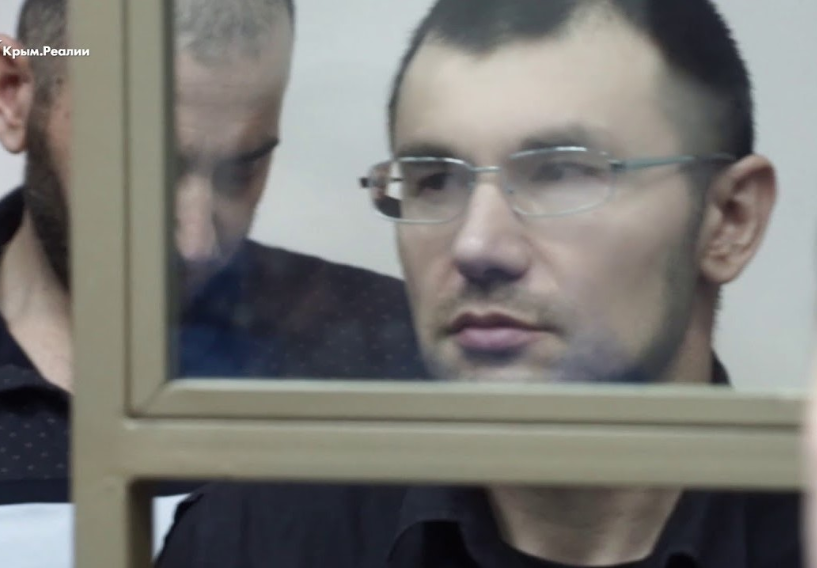
Emir Hussein Kuku: 23 Days on Hunger Strike

274381Emir Hussein Kuku

Anton Naumlyuk
Facebook
July 19, 2018

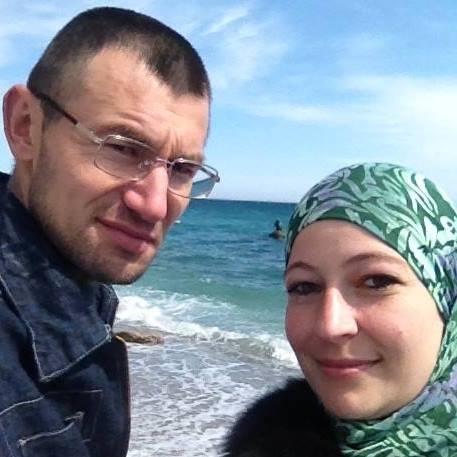
Emir Hussein Kuku

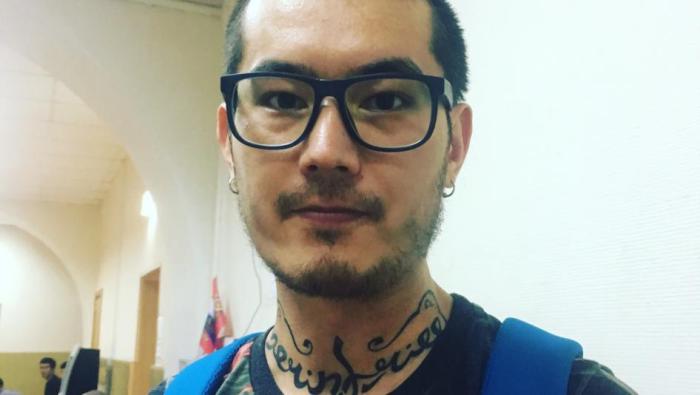
Guards did not give Emir Hussein Kuku the baby food his wife Meryem brought and tried to have delivered to her husband,  hoping that, if he did not stop his hunger strike, he would at least ease up a bit. Kuku has been on hunger strike for 23 days. He has demanded the release of all Ukrainian political prisoners in Russia. The guards initially took the care package from his wife, but they quickly returned it, since Kuku refused to quit his hunger strike.

Kuka has written himself about the state of his health.

“On the 22nd day of my hunger strike, my condition leaves much to be desired, to put it mildly. My left kidney (which FSB Special Forces officers beat in 2015) really hurts, as does my heart and something under my left ribs and in the front of my chest; my pancreas, probably. The area around my liver and my right kidney hurt, but they hurt less. I feel the pain if I stand up or sit reading. If I lie down, the pain subsides, but it doesn’t go away entirely. It’s hard to fall asleep. I toss and turn, sleepless, almost until morning. I won’t bother mentioning trifles like dizziness, the weakness I feel when I take five steps in my cell, the constant thirstiness, the vile taste in my mouth, and the smell of acetone.

“On July 16, I was again transported to the hospital for inmates with TB. The doctors have not divulged the outcome of the tests and ECG, but their faces tell me the news is not good. Actually, for several days, the doctors in the remand prison have stopped talking to me about my condition. They have even stopped weighing me. Apparently, this is due to publication of my statement about my health. The big shots with the stars on their epaulettes banned them from playing into the hands of ‘enemies of the state.’ All I found out in the TB hospital was that my ‘official’ weight was 67.8 kilograms, meaning I have lost 11 kilograms. Although, according to my calculations, I should weigh around 66 kilograms, since I weighed 68.5 kilograms on July 12, and I’ve been losing 0.6 kilograms a day.

1530198608-9959Emir Hussein and Meryem Kuku

“They have not been giving me any maintenance therapy—no glucose, no vitamins, nothing. Apparently, top-ranking officials do not want a second Sentsov, someone who would be able to drag out a hunger strike for months if he got care in the form of glucose and vitamins. They realized the mistake they made [with Senstov]. They have to break me quickly.

“Earlier, I was warned that if I didn’t give up the hunger strike, they would be forced to hospitalize me in the TB hospital, a place teeming with inmates infected with tuberculosis and HIV. It’s a TB hospital, after all.”

The trial of the so-called Yalta group in the Hizb ut-Tahrir case is currently underway in the North Caucasus Military District Court [in Rostov-on-Don].

Photos courtesy of 112.International and Unian. Translated by the Russian Reader

Anything Goes

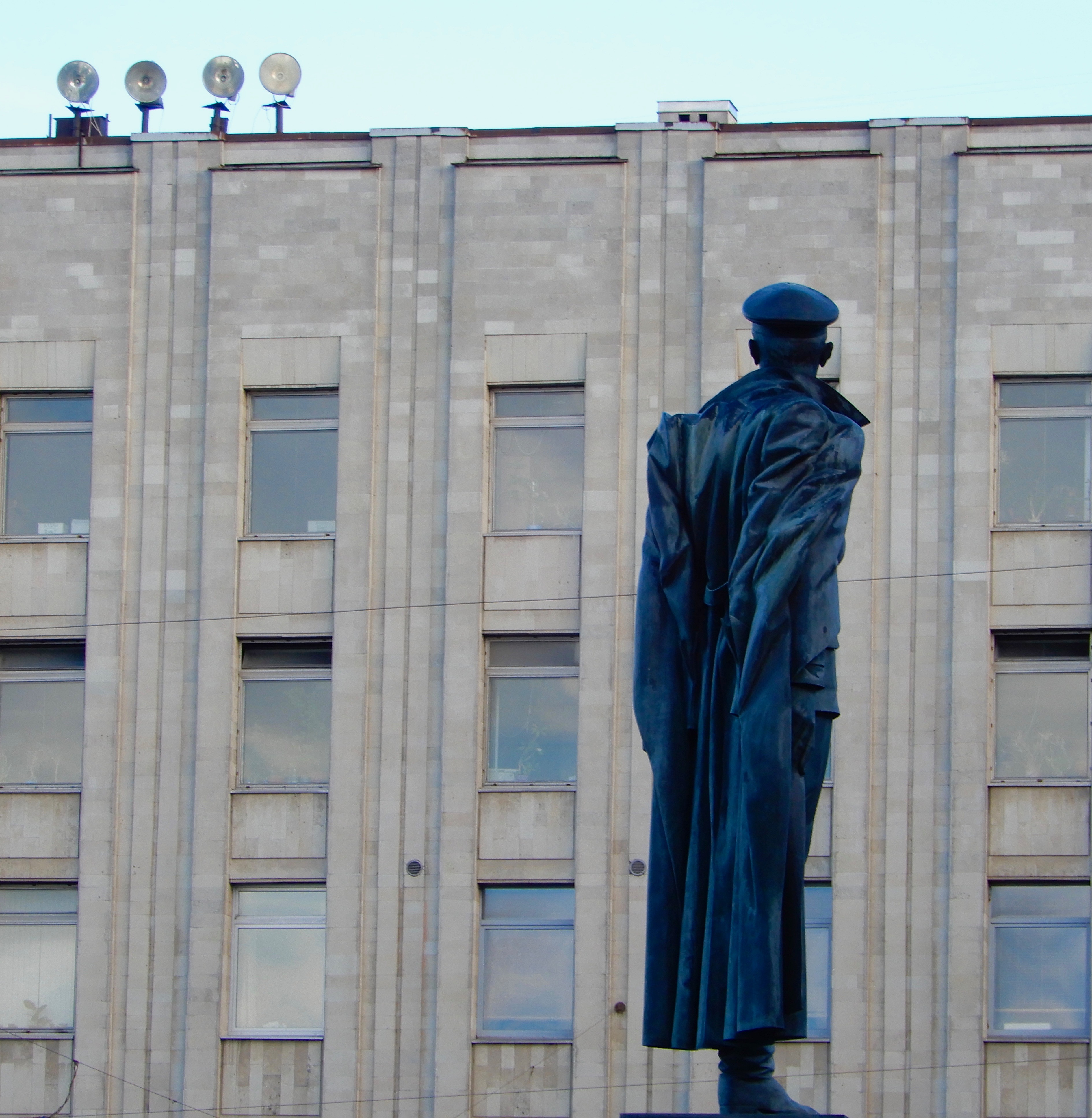
DSCN6137A monument to Felix Dzerzhinsky, founder of the Soviet secret police, in central Petersburg, 6 May 2018. Photo by the Russian Reader

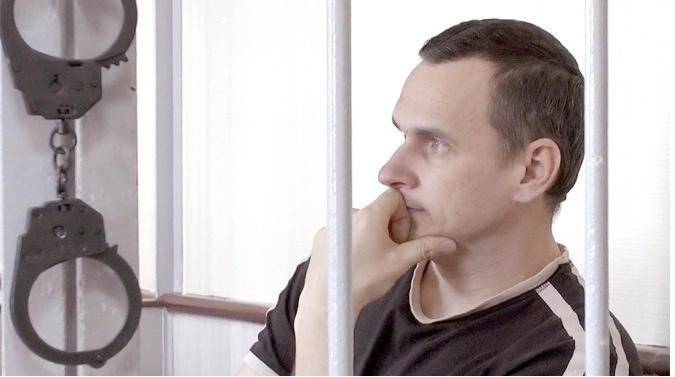
Ukrainian political prisoner Oleg Sentsov has been on hunger strike for sixty-six days.

Can you imagine not eating for sixty-sixty days? I can’t.

Instead of supporting Mr. Sentsov, most of the world decided to turn its back on him by staying glued to their TV sets during Vladimir Putin’s expensive celebration of his despotic regime’s extraordinary ability to pull the wool over nearly everyone’s eyes.

Certainly he didn’t get any pushback yesterday from the putative “leader of the free world,” who is a vain, spineless traitor who has probably never heard of Oleg Sentsov.

Solidarity with Oleg Sentsov doesn’t mean you have to stop eating, too, but it should mean not having your cake and eating it, too.

The World Cup was cake. Nobody can live for a month on a diet of cake without getting sick. The world has just done it, and now, at least as I see it, the world is a lot sicker than before the World Cup.

When infants are baptized in the Lutheran church, the priest asks the godparents and parents whether they “renouce the Devil and all his ways.”

Putin is a devil. You cannot embrace some of his ways while denouncing others. You either take the whole package or reject it. If you reject it, you show a little bit of willpower—for the sake of Crimean political prisoners Vladimir Balukh and Oleg Sentsov, for the sake of people bombed by the Russian airforce in Syria, for the sake of persecuted Karelian historian Yuri Dmitriev, for the sake of Russian Jehovah’s Witnesses, now branded “extremists” and subject to increasingly numerous arrests, for the sake of the innocent young people framed in the New Greatness and Network “terrorist” cases, for the sake of ordinary Russians everywhere fighting the government’s plans to drastically raise the pension age—and you don’t have anything to do with the World Cup or anything else sponsored, promoted, and supported by the current Russian regime.

The sheer number of people, including my own acquaintances, who could not bear to show solidarity with any of these people at all, if only for one month, has shocked me.

Please don’t pretend now that you’re really opposed to the Putin regime. You’ve shown your true colors.

Anything goes, right? || TRR

“He’s Lost Fifteen Kilos on the Hunger Strike”: Oleg Sentsov’s Cousin Visits Filmmaker in Prison

oleg

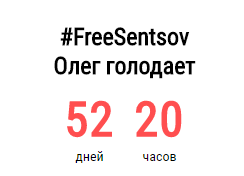
“Oleg has been on hunger strike for 52 days and 20 hours.”

“He Has Lost Fifteen Kilos during the Hunger Strike”: Oleg Sentsov’s Cousin Visits Filmmaker in Prison
Novaya Gazeta
July 5, 2018

Natalya Kaplan, cousin of Ukrainian filmmaker Oleg Sentsov, has visited him at the Polar Bear Penal Colony in Labytnangi, reports Gromadskoe.

“I met with Oleg. We chatted for two hours. It was a short visit. Oleg, who is 190 centimeters tall, now weighs 75 kilos. He has lost 15 kilos during the hunger strike,” said Ms. Kaplan.

According to her, Mr. Sentsov’s health is currently listed as satisfactory. His lab results are not good, but “there is nothing critical.”

“Yesterday, he felt quite sick. Today, he was fine. He came to the meeting on his own. He feels worse in the evenings. He says he now has a much easier time of it. The first three weeks of the hunger strike were the most agonizing period. He has been getting IVs now. He would not survive without them. He has no plans of ending the hunger strike. His outlook is optimistic. He believes what he is doing has a purpose. And he believes he will win,” said the filmmaker’s cousin.

Kaplan added that Sentsov has asked the public not to visit him in prison, but to visit the other political prisoners for whom he has been fighting.

Mr. Sentsov was convicted in Russia on charges of planning terrorist attacks in Crimea. He has been on hunger strike since May 14, demanding the Russian authorities release all Ukrainian political prisoners in their custody except him. Many Russian and international cultural figures and human rights activists have voiced their support for him.

In recent weeks, the Russian and Ukrainian sides have been trying to agree on a prisoner exchange and iron out a schedule of visits to penal colonies. Lyudmila Denisova, the Verkhovna Rada’s human rights ombudsman, has voiced Ukraine’s willingness to implement an exchange of twenty-three prisoners from each side.

Thanks to Dmitry Dinze and Askold Kurov for the heads-up.

___________________________________________________________________

Here is what Novaya Gazeta omitted from the original article as published on the Gromadskoye website.

[…]

Natalya Kaplan told Oleg that Emir Hussein Kuku had joined his hunger strike and about the demonstrations supporting him.

“He is really grateful there have been so many rallies in his support, that people have not given up and keep on fighting. At the same time, however, he is quite disappointed very little attention has been paid to the other political prisoners. He thinks that if he alone were released, it would be a complete failure,” she said.

[…]

“In particular, he asked Ombudsman Denisova, Father Kliment, the independent doctors, and consular officials who have tried to visit him to go visit the other political prisoners, so that no one forgets them,” said Ms. Kaplan.

[…]

According to her, he has television for entertainment, and he has also been writing and editing his old diary entries. He asks that no more books be sent to him. He has lots of books as it is.

It has transpired the former so-called prosecutor of Russia-annexed Crimea, Natalia Poklonskaya, was involved in Mr. Sentsov’s illegal trial in the Russian Federation, during which he was sentenced to twenty years in prison.

On June 29, Mr. Sentsov’s attorney, Dmitry Dinze, reported Mr. Sentsov was in the prison infirmary, but his condition was stable.

Mr. Dinze also reported Russia had received two requests to pardon Mr. Sentsov.

On June 15, Ms. Denisova was not allowed to see Mr. Sentsov. Subsequently, Ms. Denisova was also not allowed to see Ukrainian political prisoner Mykola Karpyuk, imprisoned in the Russian city of Vladimir.

On June 21, the Ukrainian Embassy in Russia demanded Ms. Denisova be granted priority access to the prisons where political prisoners Oleg Sentsov, Stanislav Klykh, Alexander Kolchenko, and Vladimir Balukh have been incarcerated.

On June 21, Ukrainian President Petro Poroshenko again talked on the phone with Russian President Vladimir Putin, urging him to release the Ukrainian political prisoners.

The ambassadors of the G7 countries have expressed deep concern about the circumstances of Mr. Sentsov and the other Ukrainian political prisoners incarcerated in Russia.

On June 14, the European Parliament passed a resolution demanding the immediate release of Mr. Sentsov and the Kremlin’s other Ukrainian political prisoners.

On June 19, President Putin’s press secretary, Dmitry Peskov, said the Kremlin’s position on Mr. Sentsov had not changed after an appeal to release him was made by prominent Russian cultural figures.

Sixty-four Ukrainian political prisoners are currently being held in Russia and annexed Crimea, twenty-seven of them in Russia proper. Fifty-eight of them were either arrested in Crimea or arrested on charges involving Crimea. These numbers do not take into account the currently held in the self-proclaimed Republics of Donetsk and Luhansk.

Translated by the Russian Reader. Image courtesy of Gromadskoye


Tango Noir: Full List of MEPs Who Voted against Resolution on Political Prisoners in Russia

Full list of Members of the European Parliament who voted against the resolution on political prisoners in Russia
Tango Noir (Anton Shekhovtsov)
June 16, 2018

On 14 June this year, the European Parliament adopted a resolution that, in particular, demanded “that the Russian authorities immediately and unconditionally release Oleg Sentsov and all other illegally detained Ukrainian citizens in Russia and on the Crimean peninsula.”

Oleg Sentsov is a Ukrainian filmmaker who lived in Crimea. He stayed there after Russia had annexed the Crimean peninsula; shortly after the annexation, Sentsov was arrested, forcibly “granted” Russian citizenship, falsely charged with terrorist activities and sentenced to 20 years.

Oleg Sentsov

On 14 May 2018, Sentsov went on an indefinite hunger strike demanding the release of all Ukrainian political prisoners held in Russia and Crimea: there are more than 70 of them. Sentsov is dying right now.

Out of 627 Members of the European Parliament (MEPs), 485 voted for the resolution, 76 voted against, and 66 abstained. Here is a full list of MEPs who voted against the resolution on political prisoners in Russia and Crimea. It is hardly a coincidence that almost all the MEPs listed here represent the pro-Putin “red-brown alliance.”

NAME PARTY IDEOLOGY GROUP
 
Bulgaria
Georgi PIRINSKI Bulgarian Socialist Party Far-left S&D
 
Czech Republic  
Kateřina KONEČNÁ Komunistická strana Čech a Moravy Far-left GUE-NGL
 
Cyprus
Neoklis SYLIKIOTIS Progressive Party of Working People Far-left GUE-NGL
 
France
Marie-Christine ARNAUTU Front national Far-right ENF
Nicolas BAY Front national Far-right ENF
Joëlle BERGERON Independent [Front national] Far-right EFDD
Dominique BILDE Front national Far-right ENF
Marie-Christine BOUTONNET Front national Far-right ENF
Steeve BRIOIS Front national Far-right ENF
Aymeric CHAUPRADE Les Français Libres [Front national] Far-right EFDD
Jacques COLOMBIER Front national Far-right ENF
Mireille D’ORNANO Les Patriotes [Front national] Far-right EFDD
Sylvie GODDYN Front national Far-right ENF
Bruno GOLLNISCH Front national Far-right NI
Jean-François JALKH Front national Far-right ENF
France JAMET Front national Far-right ENF
Patrick LE HYARIC Front de Gauche Far-left GUE-NGL
Gilles LEBRETON Front national Far-right ENF
Dominique MARTIN Front national Far-right ENF
Bernard MONOT Front national Far-right ENF
Sophie MONTEL Les Patriotes [Front national] Far-right EFDD
Joëlle MÉLIN Front national Far-right ENF
Younous OMARJEE L’union pour les Outremer Far-left GUE-NGL
Jean-Luc SCHAFFHAUSER Rassemblement bleu Marine Far-right ENF
Mylène TROSZCZYNSKI Front national Far-right ENF
Marie-Christine VERGIAT Front de Gauche Far-left GUE-NGL
Marie-Pierre VIEU Front de Gauche Far-left GUE-NGL
 
Germany
Stefan ECK Independent [Partei Mensch Umwelt Tierschutz] Far-left GUE-NGL
Cornelia ERNST Die Linke Far-left GUE-NGL
Sabine LÖSING Die Linke Far-left GUE-NGL
Jörg MEUTHEN Alternative für Deutschland Far-right EFDD
Martina MICHELS Die Linke Far-left GUE-NGL
Martin SCHIRDEWAN Die Linke Far-left GUE-NGL
Helmut SCHOLZ Die Linke Far-left GUE-NGL
Gabriele ZIMMER Die Linke Far-left GUE-NGL
 
Greece
Nikolaos CHOUNTIS Popular Unity [Syriza] Far-left GUE-NGL
Georgios EPITIDEIOS Golden Dawn Far-right NI
Lampros FOUNTOULIS Golden Dawn Far-right NI
Stelios KOULOGLOU Syriza (Coalition of the Radical Left) Far-left GUE-NGL
Kostadinka KUNEVA Syriza (Coalition of the Radical Left) Far-left GUE-NGL
Konstantinos PAPADAKIS Communist Party of Greece Far-left NI
Dimitrios PAPADIMOULIS Syriza (Coalition of the Radical Left) Far-left GUE-NGL
Sofia SAKORAFA Independent [Syriza] Far-left GUE-NGL
Eleftherios SYNADINOS Independent [Golden Dawn] Far-right NI
Sotirios ZARIANOPOULOS Communist Party of Greece Far-left NI
 
Ireland
Luke Ming FLANAGAN Independent Far-left GUE-NGL
 
Italy
Mara BIZZOTTO Lega Nord Far-right ENF
Mario BORGHEZIO Lega Nord Far-right ENF
Angelo CIOCCA Lega Nord Far-right ENF
Eleonora FORENZA Lista Tsipras-L’Altra Europa Far-left GUE-NGL
Danilo Oscar LANCINI Lega Nord Far-right ENF
Curzio MALTESE Lista Tsipras-L’Altra Europa Far-left GUE-NGL
Giancarlo SCOTTA’ Lega Nord Far-right ENF
Barbara SPINELLI Independent [Lista Tsipras-L’Altra Europa] Far-left GUE-NGL
Marco ZANNI Independent [Movimento 5 Stelle] Far-right ENF
 
Latvia
Andrejs MAMIKINS “Saskaņa” sociāldemokrātiskā partija Centre-left S&D
 
Netherlands
Marcel de GRAAFF Partij voor de Vrijheid Far-right ENF
André ELISSEN Partij voor de Vrijheid Far-right ENF
Olaf STUGER Partij voor de Vrijheid Far-right ENF
Auke ZIJLSTRA Partij voor de Vrijheid Far-right ENF
 
Portugal
João FERREIRA Partido Comunista Português Far-left GUE-NGL
António MARINHO E PINTO Partido Democrático Republicano Centre-right ALDE/ADLE
Marisa MATIAS Bloco de Esquerda Far-left GUE-NGL
João PIMENTA LOPES Partido Comunista Português Far-left GUE-NGL
Miguel VIEGAS Partido Comunista Português Far-left GUE-NGL
 
Spain
Xabier BENITO ZILUAGA PODEMOS Far-left GUE-NGL
Javier COUSO PERMUY Izquierda Unida Far-left GUE-NGL
Tania GONZÁLEZ PEÑAS PODEMOS Far-left GUE-NGL
Paloma LÓPEZ BERMEJO Izquierda Unida Far-left GUE-NGL
Maria Lidia SENRA RODRÍGUEZ Alternativa galega de esquerda en Europa Far-left GUE-NGL
Lola SÁNCHEZ CALDENTEY PODEMOS Far-left GUE-NGL
Estefanía TORRES MARTÍNEZ PODEMOS Far-left GUE-NGL
Miguel URBÁN CRESPO PODEMOS Far-left GUE-NGL
 
United Kingdom
Janice ATKINSON Independent [UKIP] Far-right ENF
James CARVER UKIP Far-right EFDD
Steven WOOLFE Independent [UKIP] Far-right NI

_____________________________________________________

Editor’s Note: Oleg Sentsov has been on hunger strike for 35 days as of today, June 17, 2018. // TRR

#FreeSentsov
#SaveOlegSentsov

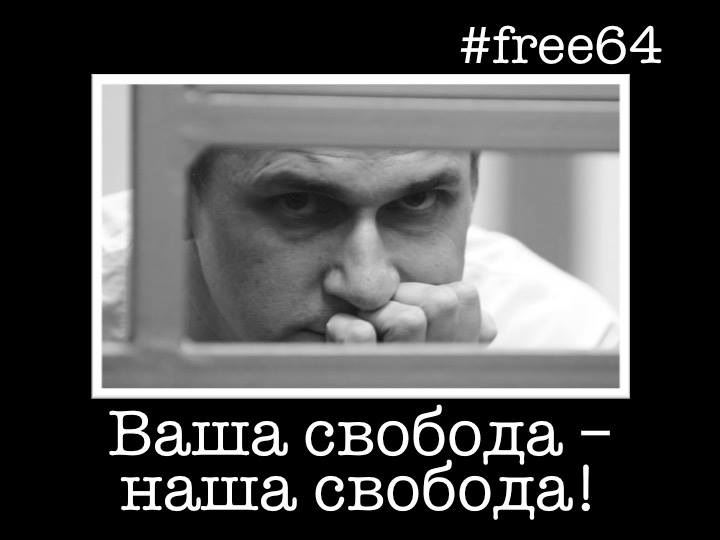
#free64

sentsov-free 64

The logo, above, was designed by the fabulous Petersburg activists Grigory Mikhnov-Voytenko and Natalia Sivohina, who had it printed on t-shirts.

You should do the same.

The slogan on the bottom reads, “Your freedom is our freedom.”

“64” refers to the number of Ukrainian political prisoners currently incarcerated by the Russian Federation. (Although there are claims that the Kremlin has imprisoned 69 Ukrainian political prisoners.)

Ukrainian political prisoner and filmmaker Oleg Sentsov, who is currently serving a 20-year sentence of trumped-up charges in a maximum-security prison camp north of the Arctic Circle, has been on an indefinite hunger strike for nearly three weeks. His only demand is that the Kremlin release all the Ukrainian political prisoners it has in captivity.

So, as some of Grigory and Natalia’s interlocutors suggested on Facebook, the hashtag could read, “#Free64_SaveSentsov.”

In any case, if you write to them via Facebook, they will be happy to send you the full-sized file of the logo for printing on t-shirts, cloth bags or any other convenient, publicly visible surface.

sentsov-sivohinaGrigory and Natalia modeling the Oleg Sentsov solidarity t-shirts they designed. Photo courtesy of their Facebook pages. All of progressive humanity should be wearing t-shirts like these to bring attention to Sentsov’s struggle against the Kremlin.

Brazil

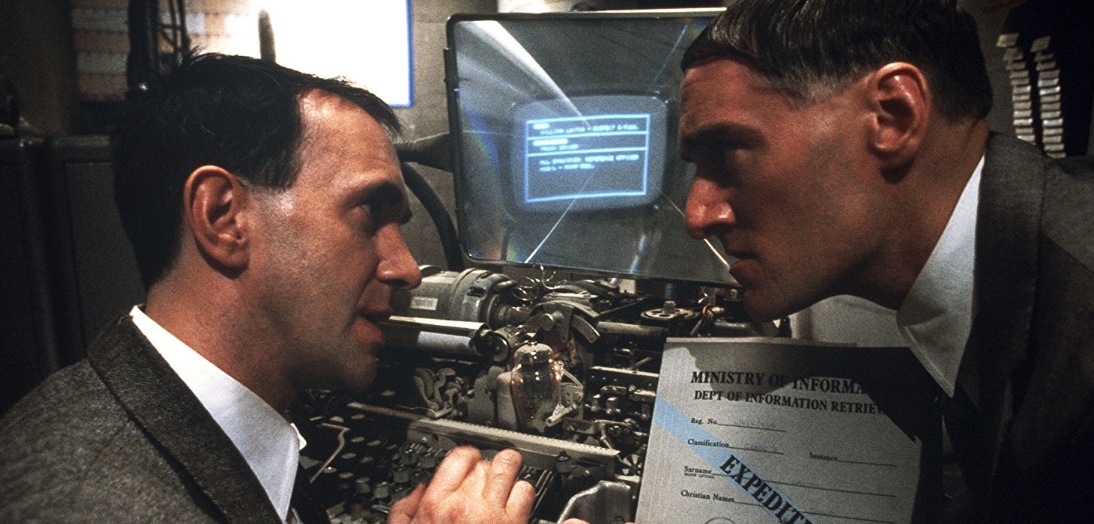
brazil.jpegJonathan Pryce and Terry McKeown in Brazil (1985). Courtesy of imdb.com

Authorized to Remain Silent
Why We Know Nothing about the Outcome of Most Criminal Cases and Verdicts against People Who, According to the Russian Secret Services, Planned or Attempted to Carry Out Terrorist Attacks 
Alexandra Taranova
Novaya Gazeta
April 27, 2018

High-ranking officials from the Russian Federal Security Service (FSB), the Russian Interior Ministry (MVD), and the Russian National Anti-Terrorist Committee (NAK) regularly report on the effective measures against terrorism undertaken by their agencies. If we add reports of constant counter-terrorist operations in the North Caucasus, especially in Dagestan and Chechnya, operations involving shootouts and the storming of houses, we might get the impression the level of terrorism in Russia is close to critical, resembling the circumstances somewhere in Afghanistan, the only difference being that Afghanistan does not have the FSB, the MVD, and the NAK to protect it.

Over the past two weeks, there were at least two such stories in the news.

A few days ago, the FSB reported it had “impeded the criminal activity of supporters of the international terrorist organization Islamic State, who […] had begun planning high-profile terrorist attacks using firearms and improvised explosive devices.”

The FSB’s Public Relations Office specified the terrorist attacks were to be carried out in goverment buildings in Stavropol Territory.

Earlier, TASS, citing the FSB’s Public Relations Office, reported that, since the beginning of the 2018, six terrorist attacks had been prevented (including attacks in Ufa, Saratov, and Ingushetia), while three crimes of a terrorist nature had been committed (in Khabarovsk Territory, Dagestan, and Sakhalin Region), and this had been discussed at a meeting of the NAK. Other media outlets quoted FSB director Alexander Bortnikov, who claimed that last year the security services had prevented twenty-five terrorist attacks, but four attacks, alas, had gone ahead.

For the most part, however, it is impossible to verify these reports, because, with rare exceptions, the terrorists, either potential terrorists or those who, allegedly, carried out terrorist attacks, are identified by name. Neither the Russian Investigative Committee (SKR) nor the FSB informs Russians about subsequent investigations, about whether all the terrorists and their accomplices have been rounded up. Likewise, with rare exceptions, we know nothing either about court trials or verdicts handed down in those trials.

Novaya Gazeta monitored reports about prevented terrorist attacks from November 2015 to November 2017. We analyzed all the media publications on this score: the outcome of our analysis has been summarized in the table, below. The veil of secrecy makes it extremely hard to figure out what reports merely repeat each other, that is, what reports relate to one and the same events, and we have thus arrived at an overall figure for the number of such reports. Subsequently, by using media reports and court sentencing databases, we have counted the number of cases that officially resulted in court sentences.

Most news reports about prevented terrorist attacks in Russia are not followed up. For example, at one point it was reported (see below) that five people with ties to Islamic State had been apprehended in Moscow and Ingushetia for planning terrorist attacks, and this same news report mentioned that a criminal case had been launched. But only the surname of the alleged band’s leader was identified, and he was supposedly killed while he was apprehended. There is no more information about the case. Over a year later, we have no idea how the investigation ended, whether the case went to trial, and whether the trial resulted in convictions and verdicts.

Other trends also emerged.

During the two-year period we monitored, reports about prevented terrorist attacks and apprehended terrorists encompassed a particular group of Russian regions: Moscow, Crimea, Petersburg, Kazan, Rostov, Baskortostan, Volgograd, Yekaterinburg, and Krasnoyarsk. When we turn to verdicts handed down in such cases, this list narrows even further. Rostov leads the country, followed by Crimea. There are two reports each from Krasnoyarsk and Kazan, and several isolated incidents. The largest number of news reports about terrorist attacks and acts of sabotage, i.e., 30% of all the reports we compiled and analyzed, originated in Crimea.

  FSB MVD NAK Russian Security Council (Sovbez)
Number of reports of prevented terrorists, November 2015–November 2017 3,505 reports (18,560 identical reports in the media) 1,702 reports

(3,571 identical reports in the media)

492 reports

(852 identical reports in the media)

236 reports

(1,122 identical reports in the media)

Outcomes: arrests, criminal charges, verdicts, etc. 13 verdicts,

14 arrests

3 verdicts,

2 arrests

2 incidents: in one case, it was reported that all the detainees had been killed; in the other, that the detainees awaited trial, but were not identified by name. It is impossible to find out what happened to any detainees, since no information was provided about them. The exception is Lenur Islyamov, who is currently at large and vigorously pursuing his objectives.

The Triumps of the Special Services with No Follow-Up
Here are the most revealing examples.

On November 12, 2016, RBC reported the security services had apprehended a group of ten terrorists, migrants from Central Asia. According to the FSB, they planned “high-profile terrorist attacks” in heavily congested areas of Moscow and Petersburg. Officials confiscated four homemade bombs, firearms, ammunition, and communications devices from the militants. The FSB claimed all the detainees had confessed to their crimes.

In the same news report, the FSB was quoted as having reported that on October 23, 2016 “there occurred an attack on police officers, during which two alleged terrorists were shot dead” in Nizhny Novgorod. The report stressed that, three days later, the banned group ISIL claimed responsibility for the attack, just as it had taken responsibility for an attack on a traffic police post in Moscow Region on August 18, 2016.

There were no names and no details. The outcomes of the investigations, the plight of the detainees, and judicial rulings were never made public, nor did state investigators or defense counsel share any information.

This same RBC article mentions that, four days before the alleged incident in Nizhny Novgorod, the SKR had reported the apprehension of an ISIL supporter who had been planning a terrorist attack at a factory in Kazan, while Interfax‘s sources reported the apprehension of a man who had been planning a terrorist attack in Samara.  It was also reported that in early May 2016 the FSB had reported the apprehension of Russian nationals in Krasnoyarsk who were “linked to international terrorist organizations and had planned a terrorist attack during the May holidays.”

No names were mentioned at the time. Later, however, details of the case were made public.

Thus, on April 7, 2017, Tatar Inform News Agency reported that the Volga District Military Court in Kazan had handed down a verdict in the case of Robert Sakhiyev. He was found guilty of attempting to establish a terrorist cell in Kazan. The first report that a terrorist attack had been planned at an aviation plant in Kazan was supplied by Artyom Khokhorin, Interior Minister of Tatarstan, during a meeting of MVD heads. According to police investigators, Sakhiyev had been in close contact with a certain Sukhrob Baltabayev, who was allegedly on the international wanted list for involvement in an illegal armed group. Using a smartphone, Sakhiyev had supposedly studied the plant’s layout via a satellite image.

On August 2, 2017, RIA Novosti reported that a visting collegium of judges from the Far East District Military Court in Krasnoyarsk had sentenced Zh.Zh. Mirzayev, M.M. Abdullayev, and Zh.A. Abdusamatov for planning a terrorist attack in Krasnoyarsk in May 2016 during Victory Day celebrations. Mirzayev was sentenced to 18 years in prison; Abdullayev, to 11 years in prison; and Abdusamatov, to 11 years in a maximum security penal colony. According to investigators, Mirzayev worked as a shuttle bus driver in Krasnoyarsk and maintained contact with Islamic State via the internet. Mirzayev decided to carry out a terrorist attack by blowing up a shuttle bus.

On January 26, 2017, TASS reported the police and FSB had identified a group of eight people planning terrorist attacks in Moscow in the run-up to State Duma elections. Oleg Baranov, chief of the Moscow police, had reported on the incident at an expanded collegium of the MVD’s Main Moscow Directorate.

We know nothing more about what happened to the “identified” would-be terrorists.

On January 31, 2017, RBC issued a bulletin that the Russian secret services had prevented an attempt to carry out terrorist attacks in Moscow during the 2016 Ice Hockey World Championships. The source of the news was Igor Kulyagin, deputy head of staff at the NAK. The militants were allegedly detained on May 2.

“We succeed in catching them as a result of a vigorous investigative and search operation in the city of Moscow,” the FSB added.

The names of the militants were not reported nor was there any news about an investigation and trial.

In the same news item, Mr. Kulyagin is quoted as saying, “In total, Russian special services prevented around [sic] 40 terrorist attacks, liquidated [sic] about [sic] 140 militants and 24 underground leaders, and apprehended about [sic] 900 people in 2016.”

According to Mr. Kulyagin, in Ingushetia on November 14, 2016, the authorities uncovered five militants who “had been planning terrorist attacks in crowded places during the New Year’s holidays, including near the French Embassy in Moscow.”

Again, the reading public was not provided with any names or information about the progress of the investigation. The only alleged terrorist who was identified was Rustam Aselderov, who had been murdered.

“According to the special services, [Aselderov] was involved in terrorist attacks in Volgograd in 2013 and Makhachkala in 2011.”

We have no idea whether an official investigation of his murder was ever carried out.

Lenta.Ru reported on February 1, 2017, that FSB officers in Krasnodar Territory had prevented a terrorist attack. The supposed terrorists had planned an explosion at New Year’s celebrations. A possible perpetrator of the terrorist attack, a 38-year-old native of a Northern Caucasus republic, was apprehended. No other particulars of the incident were reported, and they still have not been made public to this day.

On October 2, 2017, Russia Today, citing the FSB, reported an IS cell had been apprehended in Moscow Region. Its members has allegedly planned to carry out “high-profile terrorist attacks” in crowded places, including public transport. The FSB added that foreign emissaries had led the cell, whose members had included Russian nationals.

No names or details were subsequently provided to the public.

The same article reported that, on August 31, 2017, the FSB had apprehended two migrants from Central Asia, who had been planning terrorist attacks in congested places in Moscow and Moscow Region on September 1. RIA Novosti reported the same “news” in August 2017. The detainees were, allegedly, members of IS.

According to the FSB, one of the men had “planned to attack people with knives.” His comrade had planned to become a suicide bomber and blow himself up in a crowd. Supposedly, he had made a confession.

We know nothing about what happened to the two men and the criminal case against them.

On November 7, 2017, Izvestia reported MVD head Vladimir Kolokoltsev’s claim that a Kyrgyzstani national had been apprehended in the Moscow Region town of Khimki. The man had, allegedly, been planning to carry out a terrorist attack outside a subway station using a KamAZ truck. The detained man was not identified. We know nothing about what has happened to him or whether the investigation of the case has been completed.

Trials of Terrorists
On July 19, 2016, RIA Novosti reported the Russian Supreme Court had reduced the sentence (from 16 years to 15.5 years) of one of two radical Islamists convicted of plotting a terrorist attack in the mosque in the town of Pyt-Yakh in the Khanty-Mansi Autonomous Okrug. 

“The panel of judges has decided the verdict of the court, which sentenced Rizvan Agashirinov and Abdul Magomedaliyev to prison terms of 16 and 20 years, respectively, should be mitigated in the case of Agashirinov, and left in force in the case Magomedaliyev.”

On August 31, 2016, TASS reported the North Caucasus District Military Court had sentenced Russian national Rashid Yevloyev, a militant with the so-called Caucasus Emirate, to six years in a penal colony for planning terrorist attacks.

On February 15, 2017, Moskovsky Komsomolets reported the Moscow District Military Court had sentenced Aslan Baysultanov, Mokhmad Mezhidov, and Elman Ashayev. According to investigators, after returning in 2015 from Syria, where they had fought on the side of ISIL, Baysultanov and his accomplices had manufactured a homemade explosive device in order to carry out a terrorist attack on public transport in Moscow.

Baysultanov was sentenced to 14 years in prison; Ashayev, to 12 years, and Mezhidov, to 3 years.

On May 10, 2017, Interfax reported the North Caucasus District Military Court in Rostov-on-Don had sentenced ISIL recruiters who had been apprehended in Volgograd Region. The alleged ringleader, Raman Radzhabov, was sentenced to 4 years in prison after being found guilty of recruiting residents of Volgograd Region. His accomplices—Azamat Kurkumgaliyev, Gayrat Abdurasulov, Nurken Akhetov, and Idris Umarov—were found guilty of aiding and abetting Radzhabov, and given sentences of of 2 to 2.5 years in prison.

On May 30, 2017, RIA Novosti reported the ringleader of a failed terrorist attack in Kabardino-Balkaria, Adam Berezgov, had been sentenced to 7 years in prison. The defendant was found guilty of “planning a terrorist attack, illegally acquiring and carrying explosive substances or devices, and illegally manufacturing an explosive device.”

On July 27, 2017, TV Rain reported the Russian Supreme Court had increased by three years the sentence handed down to Ruslan Zeytullayev, who had been convicted and sentenced to 12 years for organizing in Crimea a cell of Hizb ut-Tahrir, an Islamist group banned in Russia. Zeytullayev’s sentence is now 15 years in prison.

On July 31, 2017, RIA Novosti reported the North Caucasus District Military Court had sentenced Ukrainian national Alexei Sizonovich to 12 years in a penal colony for involvement in planning a terrorist attack that was to have taken place in September 2016. The court ruled the 61-year-old defendant and an “unidentifed person” had, allegedly, established a group in Kyiv “for the commission of bombings and terrorist attacks in Ukraine and the Russian Federation.” It was reported the defendant “repented.”

On August 11, 2017, Lenta.Ru reported the North Caucasus District Military Court had sentenced 19-year-old Ukrainian national Artur Panov to 8 years in a medium-security penal colony for terrorism. Panov was found guilty of facilitating terrorism, planning a terrorist attack, and illegally manufacturing explosive substances. His accomplice, Maxim Smyshlayev, was sentenced to 10 years in a maximum-security penal colony.

At the trial, Panov pled guilty to calling for terrorism, and manufacturing and possessing explosives, but pled innocent to inducement to terrorism. Smyshlayev pled innocent to all charges.

On September 18, 2017, RIA Novosti reported a court in Rostov-on-Don had convicted defendants Tatyana Karpenko and Natalya Grishina, who were found guilty of planning a terrorist attack in a shopping mall. Karpenko was sentenced to 14.5 years in prison, while Grishina was sentenced to 9 years.

“The investigation and the court established Karpenko and Grishina were supporters of radical Islamist movements. […] From October 2015 to January 2016, the defendants planned to commit a terrorist attack in the guise of a religious suicide,” the Investigative Directorate of the SKR reported.

Fakes
On April 17, 2017, Memorial Human Rights Center issued a press release stating the case of the planned terrorist attack in the Moscow movie theater Kirghizia had been a frame-up. The human rights activists declared the 15 people convicted in the case political prisoners. It was a high-profile case. Novaya Gazeta wrote at the time that the MVD and FSB had insisted on pursuing terrorism charges, while the SKR had avoided charging the suspects with planning a terrorist attacking, accusing them only of possession of weapons in a multi-room apartment inhabited by several people who barely knew each other. It was then the case was taken away from the SKR.

Whatever the explanation for the trends we have identified, it is vital to note that Russian society is exceedingly poorly informed about the progress of the war on terrorism conducted by Russia’s special services, despite the huge number of reports about planned terrorist attacks. Due to the fact the names of the accused are hidden for some reason, and the court sentences that have been handed down are not made public in due form (even on specially designated official websites), it is impossible to evaluate the scale of the threat and the effectiveness of the special services, and to separate actual criminal cases from those that never went to court because the charges were trumped-up. Meanwhile, using media reports on prevented terrorist attacks for propaganda purposes contributes to an increase in aggressiveness and anxiety among the populace, who has no way of knowing whether all the apprehended terrorists have been punished, and whether this punishment was deserved.

Thanks to George Losev for the heads-up. Translated by the Russian Reader
Solidarity with Persecuted Russian Antifascists and Anarchists in NYC and Minneapolis

27540850_322877634890103_3528138355329883641_n

Metropolitan Anarchist Coordinating Council – MACC
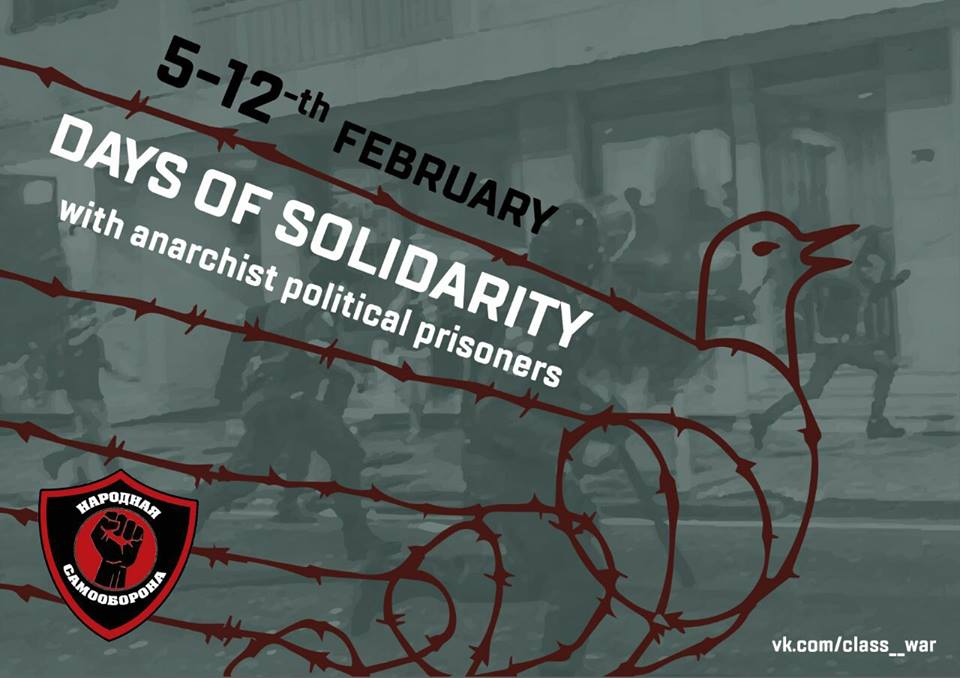
As part of the week of solidarity with Russian anarchist political prisoners there will be a demo at the Russian Consulate, 91st Street, today, February 7, 2:30 PM–4:00 PM.

#Antifa #Antifascism

More information on the recent arrest and torture of anarchist and antifascist political prisoners here:

https://freedomnews.org.uk/russia-arrests-and-torture-of-anarchists-and-antifascists/

•••••••••••

Solidarity with Russian Anarchists
The Base
1302 Myrtle Avenue, Brooklyn, New York 11221
7 PM–10 PM, February 8, 2018

Six anarchists have been arrested in Penza, Saint Petersburg, and Crimea, from October 2017 to February 2018, by officers of the Russian Federal Security Service (FSB) on charges of involvement in a terrorist group. During this period, there have been raids on the homes of anarchists and antifascist all over Russia. The arrested anarchists have been tortured into falsely confessing their involvement in the imaginary network. This is clearly a state-fabricated conspiracy being used to eradicate the anarchist movement.

As the support team says, “These repressions can only intimidate people and crush the anarchist movement. In this case it’s necessary to show that we are not afraid and we can’t be destroyed by their force. Otherwise, the repressions will be used every time when the anarchist movement attracts the notice of the FSB. We must show them that the stronger their crackdowns are, the more furious our resistance is.”

We are hosting a movie and information session about the broader anarchist and antifascist movement in Russia, and talking in more detail about this particular case.

About the movie
Antifascist Attitude is the first-ever documentary film on the emerging Russian antifascist movement made by activists themselves. The movie features moderate NGO activists and radical grassroots activists and anarchists from three cities: Moscow, St. Petersburg, and Irkutsk. It also features the antifascist lawyer Stanislav Markelov, murdered by neo-Nazis in Moscow on January 19, 2009.

Come and learn about what’s happening and ways to support our comrades in Russia!

•••••••••••

Solidarity Dinner with Russian Antifascists
Twin Cities IWW General Defense Committee Local 14
5:30–8:00 p.m., Saturday, February 17, 2018
2101 Hennepin Ave, Minneapolis, MN, United States

Join the General Defense Committee for a dinner, discussion, and letter writing to support antifascists targeted by the FSB crackdowns in Penza and St Petersburg.

The far right rises in the US, in Russia, and across the world, attacking oppressed peoples, immigrants, and working class revolutionaries. Antifascists are fighting against nationalist hate across borders, and facing attacks from the ruling class’s governments. In Russia, the FSB (Federal Security Service) are hard at work arresting, torturing, and framing antifascist activists in Penza, St. Petersburg, and elsewhere.

The Anarchist Black Cross in Moscow and St. Petersburg has asked for international solidarity with the Russian anarchists facing repression. We will be holding a dinner in the IWW offices at 2101 Hennepin Avenue South, Suite 101, Minneapolis, on Saturday, February 17, 2018, from 5:30 p.m. to 8:00 p.m.

We’ll discuss the situation in Russia as well as the repression faced by anarchists in Belarus, Ukraine, and other countries. We’ll collect donations, provide a space for letter writing to the defendants, and facilitate discussion on further international solidarity work with political prisoners, labor organizers, and anti-authoritarians.

https://libcom.org/news/support-anarchist-antifa-prisoners-stpetersburg-penza-31012018

https://itsgoingdown.org/call-international-days-solidarity-russian-anarchist-political-prisoners-feb-5th-12th-2018/

https://avtonom.org/en/news/how-stability-has-really-been-achieved-russia

I Can’t Get No Satisfaction

Ali Feruz, a gay Moscow-based journalist threatened with deportation to Uzbekistan, where he faces possible torture and death. Photo courtesy of Human Rights Watch 

Memes of Solidarity
Silly and Serious Acts of Civic Solidarity Will Be Needed for a Long Time to Come
Maria Eismont
Vedomosti
January 25, 2018

The Satisfaction Challenge, a internet flash mob in support of cadets at the Ulyanovsk Civil Aviation Institute, who filmed and uploaded a parody of Benny Benassi’s music video “Satisfaction,” has entered its second week. The institute’s administrators accused the cadets, who are shown dancing in briefs and pilot caps, of “mocking the sacred” and “humiliating the industry,” declaring they had no place in aviation.

Since then, scores of videos supporting the cadets have been posted daily. The latest was filmed by the Novosibirsk hockey club Sibir. Before an auditorium packed to the gills with fans, the club’s mascot, Snowman, dances to “Satisfaction” along with security guards and cleaners. Before Snowman, there were videos by female pensioners in a Petersburg communal flat, costumed theater students in the Russian Far East, horsemen, swimmers, cadets at the Academy of the Emergency Situations Ministry, construction workers, doctors, students at an agriculture college, schoolchildren, housewives, and the presenters of the TV show Evening Urgant. Consequently, a talk show on the TV channel Rossiya 1 and US magazine The New Yorker have identified the Satisfaction Challenge flash mob as a significant event in Russia public life.

“Welders from the Urals Filmed a Satisfaction Challenge Video.” Published January 24, 2018

Obviously, the flash mob has touched some important strings. It is not so much a matter of discussing the boundaries of free self-expression, the clash of different views on what is permitted and appropriate, which, judging by the varying degrees of frankness on the part of the flash mobbers, are also quite different. The key here is solidarity, which has proven the best weapon against bureaucratic stupidity and official hypocrisy. Solidarity with the persecuted is a vital tool for upholding freedom and withstanding crackdowns, for maintaining and reinforcing social connections in an atomized society.

The flash mob in support of the Ulyanovsk cadets is probably the most vivid and funny solidarity campaign in today’s Russia, but it is hardly the only or most important solidarity campaign. The cadets were threatened with explusion, but Novaya Gazeta journalist Hudoberdi Nurmatov aka Ali Feruz, who has already spent five months in a temporary detention center for foreigners awaiting a review of his appeal to the European Court of Human Rights, is threatened with torture and even death in connection with false charges of cooperating with terrorists if he is deported to Uzbekistan, say his relatives, colleagues, and human rights activists.

The solidarity campaign in support of Ali Feruz kicked off this past August, when the Moscow City Court decided to deport him. His colleagues rightly believe that the longer they bring up the case and the more loudly they discuss it, the better are the chances for a positive outcome. So, last week, Theater.doc held another reading of Feruz’s diary, written in the temporary detention center for foreigners. The first reading, entitled “My Friend Ali Feruz,” was held as a sign of solidarity by journalists in late October. During last week’s antifacist march in memory of attorney Stanislav Markelov and journalist Anastasia Baburova, slain by neo-Nazis nine years ago in downtown Moscow, some of the marchers bore placards demanding Ali Feruz’s release. On Wednesday came the news the Russian Supreme Court had overturned the Moscow City Court’s decision to deport Feruz to Uzbekistan and remanded the matter for a new hearing.

The solidarity campaign in support of Karelian historian Yuri Dmitriev, which has ranged from petitions and videos in his defense to organized trips to his trial in Petrozavodsk, has been underway since society learned of his arrest on charges of taking pornographic photographs, charges that carry no weight with anyone who knows him well. If it had not been for the public outcry, there might not have been a second forensic examination, which ruled the photographs in question were not pornographic, nor would there have been a court decision to release Dmitriev from police custody, where he has spent the last year, on his own recognizance.

Currently, Oyub Titiev, head of the Grozny branch of Memorial, is in bad need of solidarity and support. Arrested on drugs possession charges, Titiev managed to warn society any confession he made would only mean he had been tortured into giving it.

“We regard Oyub Titiev’s circumstances as extremely dangerous,” the board of the International Memorial Society said in an appeal to Russian society and the international community. “The only thing we can do under the circumstances is ask Russian society and the international community to monitor Titiev’s case with the same acute interest as has occured in the Dmitriev case.”

Solidarity is one of the few effective tools left in Russian civil society’s arsenal for confronting official coercion. We will have recourse to it again and again for a long time to come. It’s a good thing that sometimes, as in the case of the cadets, it’s also fun.

Translated by the Russian Reader

Psychiatry as a Tool of Political Repression in Crimea

Elena Lysenko
A picket for the release of Crimean lawyer Emil Kurbedinov on 31 January 2017 in Simferopol, Ukraine. Photo by Elena Lysenko

Psychiatry as a Tool of Political Repression in Crimea
Madeline Roache
Special to The Russian Reader
April 9, 2017

Lawyers and human rights activists claim the Russian authorities in annexed Crimea have been persecuting human rights activists, most of whom belong to the Muslim Crimean Tatar community. The Crimean Tatars, who make up about 15% of Crimea’s population, have vocally opposed Russia’s occupation of the Ukrainian peninsula since February 2014. As a result, the group has been specially targeted by Russian authorities. Many Crimean Tatars have been forced to leave the region to avoid harassment and arbitrary arrest.

According to a new report, presented on March 23 by Ukrainian advocacy group Crimea SOS, a total of 43 local activists have been abducted since Russian troops occupied Crimea in February 2014—allegedly, by the Russian authorities and their accomplices. Eighteen of those who were abducted are still missing and six have been found dead.

Robert van Voren, a Dutch human rights activist and political scientist, said that, since the annexation, many Crimean Tatar activists who oppose the occupation have been arrested and subjected to abuse and imprisonment in psychiatric institutions.

“Since the annexation of Crimea, Russian authorities have prosecuted and forced into exile virtually all those who oppose the Russian occupation, including key leaders and activists within the Crimean Tatar community”, he said.

Emil Kurbedinov, a prominent Crimean lawyer, told the Guardian that, between December 2016 and March 2017, twelve Crimean activists were forcibly admitted to psychiatric hospitals in Crimea. Four of them remain in hospital, while the rest have either been transferred to prison or discharged.

According to Kurbedinov, Crimean activists are treated in a degrading way and face appalling conditions in psychiatric hospitals.

“Some are placed in isolation and are denied their basic needs, such as access to a toilet. Others are housed with numerous people suffering from severe mental illnesses. The activists are interrogated about their alleged involvement in ‘extremism’ and their views of the government. They are also deprived of the right to speak with their families or meet their lawyers on a one-to-one basis without a guard being present. All of this violates international law,” he said.

All of the Crimean activists were arrested on suspicion of involvement in Hizb ut-Tahrir, which Russia, unlike Ukraine and other countries, has declared a terrorist group. The Kharkiv Human Rights Protection Group (KHPG) asserts there is no evidence to suggest the organisation has anything to do with terrorism, nor is there any proof the men were even involved in the group.

Kurbedinov says their arrest was illegal and a breach of protocol, as it was not sanctioned by a judge but ordered by a police investigator.

According to KHPG, a further 19 Crimean activists are currently in custody, accused of involvement in Hizb ut-Tahrir. Memorial, a Russian human rights organization, has declared all the activists in custody political prisoners. KHPG claims that one of the detainees, Emir Kuku, was most likely arrested due to his work for the Crimean Contact Group on Human Rights, which provides legal assistance and support to members of Muslim groups.

Last year, Kurbedinov defended Ilmi Umerov, a Crimean Tatar activist who openly opposed the Russian occupation. Umerov was sent against his will to a psychiatric hospital in August 2016. Russia’s Federal Security Service (FSB) detained Umerov in May 2016 in the Bakhchysarai District and charged him with separatism. Umerov is also a representative in the Mejlis of the Crimean Tatar People, an elected body that was suspended by Moscow after it annexed Crimea. Human Rights Watch heavily criticized the case, calling it “a shameful attempt to use psychiatry to silence [Umerov] and tarnish his reputation.” Umerov was released twenty days after his confinement.

Kurbedinov argues that these cases have “acutely raised the issue of the vulnerability of ordinary citizens who have no civil rights whatsoever before the legal and judicial monolith.”

Soviet Psychiatry
The practice of punitive psychiatry in the present day is particularly disturbing given its historical use as a tool of rampant political repression the in the later decades of the Soviet era. Psychiatry was used to systematically confine and punish Soviet dissidents. However, under President Vladimir Putin, cases of the alleged political abuse of psychiatry have resurfaced, leading many to believe that the Soviet-era practice has returned.

The involuntary hospitalization of protestor Mikhail Kosenko in Russia in 2012, is just one of many modern-day cases that has been widely held up as an example of the political abuse of psychiatry. Kosenko was convicted on charges of rioting and assaulting a police officer during the Bolotnaya Square anti-Putin protests in Moscow on May 6, 2012. The case sparked international attention from human rights activists, who asserted the charges were fabricated and that Kosenko’s hospitalization was unnecessary.

The abuse of psychiatry in Russian criminal trials is not uncommon, according to Yuri Savenko, psychiatrist and head of the Independent Psychiatric Association (IPA) in Russia.

“Psychiatry is now frequently part of the procedure in criminal trials where there is no concrete evidence: it is more economical in terms of time and effort just to obtain a psychiatric diagnosis,” he says.

This disturbing phenomenon is of particular concern to the Federation Global Initiative on Psychiatry (FGIP), a human rights organization that protects human rights in mental healthcare. FGIP closely monitors the practice and is currently compiling a report about cases of psychiatric abuse in the post-Soviet states, to be published later this month.

Madeline Roache is a London-based freelance journalist focusing on human rights conditions in the former Soviet Union. Her work has been published in The Guardian, The Times of Central Asia, and Euromaidan Press.

“The Trial: The State of Russia vs Oleg Sentsov” (Panel Discussion, Berlinale 2017)

Panelists: Agnieszka Holland (Director), Askold Kurov (Director), Mike Downey (Producer), Dmitry Dinze (Lawyer of Oleg Sentsov), Natalya Kaplan (Cousin of Oleg Sentsov), Sylvia Schreiber (Translator)

Thanks to Alexei Markov for the heads-up

___________________________

oleg-sentsov
Oleg Sentsov. Courtesy of Berlin Film Festival

Berlin Film Review: ‘The Trial: The State of Russia vs Oleg Sentsov’
Owen Gleiberman
Variety
February 11, 2017

A documentary about the Ukranian filmmaker imprisoned for his support of Crimean independence is a scrappy testament to the true nature of the Vladimir Putin regime.

It has to rank as one of Donald Trump’s most shocking statements — which is really saying something. Asked by the Fox News host Bill O’Reilly how he could respect Russian President Vladimir Putin, whom O’Reilly characterized as a “killer,” Trump replied, “There are a lot of killers. Boy, you think our country’s so innocent?” Over the last year, Trump has presented himself as a racist, a bully, a manhandler of women, a mocker of the disabled, and a loony-tunes conspiracy theorist. But whoever thought he’d come off sounding like the second coming of Noam Chomsky? The notion that the United States government routinely engages in “killer” behavior commensurate with that of what Russia does is, of course, a left-wing idea. (Just ask Oliver Stone, another Putin apologist who should know better.) But Trump put a new spin on it: Whatever the motivation (his desire to tilt the axis of global power against China? Burying those rumored water-sports videos?), he was so intent to claim that his new BFF Vladimir is, you know…not so bad that he was willing to hijack 50 years of radical academic moral relativism by reducing it to a Trump sound bite.

All of which makes me wish that Trump would sit down and watch “The Trial: The State of Russia vs Oleg Sentsov,” a documentary that just premiered at the Berlin Film Festival. It’s a peek into how the Russian state actually operates, and though it raises more questions than it answers, it leaves you with a shuddering chill. The central figure, Oleg Sentsov, is a Ukrainian writer and filmmaker known for his 2011 movie “Gamer.” In Russia, it made him a directorial star, but during the 2014 Crimean crisis he became part of the AutoMaidan movement, devoted to keeping Ukraine — and, specifically, Crimea — independent of Russia. He delivered food and supplies to Ukrainian servicemen, but on May 11, 2014, he was arrested and charged with organizing a terrorist cell, plotting terrorist attacks, and trafficking in illegal arms. He was held indefinitely and is now serving a 34-year prison sentence in Siberia. (The movie ends with clips of that Siberian prison. Have you ever seen Siberia? It looks like … Siberia.)

We’re shown footage of Sentsov in TV interviews during his moment of indie-film fame and then, a few years later, speaking from behind bars in the courtroom (yes, there’s a jail cell in court). Tall and husky, with dark cropped hair, popping eyes, and a grin of goofy optimism, he’s the father of two teenagers, and if you were looking for someone to play him in a movie, it might be Bradley Cooper; he has that kind of rubbery resilience. A number of noted directors — Wim Wenders, Agnieszka Holland — show up to testify to his status as a filmmaker.

In “The Trial,” Sentsov embraces his role as a political prisoner, yet the movie reveals what the stakes are: When he talks to his daughter on the phone, we see the price paid by any dissident — not just the personal agony of incarceration, but the ripped bonds of family. Sentsov was subjected to torture in prison, all to produce a confession to activities that never happened. (He didn’t confess.) The reason “The Trial” is a valuable document, even though it’s not an especially good movie, goes right back to Putin. It was Sentsov’s status as an art-house celebrity that made him a target in Russia. The regime arrested many “terrorists,” but he was held up as an example to the elite, intellectual class. The message was: If we can do this to him, we can do it you. The real terrorism came from the government, a way of driving fear into those who might speak out.

Russia swims in a daily ice bath of fake news (and real-news clampdown), which is why documentaries have been some of the only vehicles for revealing Vladimir Putin’s thug tactics. Ten years ago, the barely seen film “Poisoned by Polonium: The Litvinenko File” was the first inquiry to amass serious data suggesting that what Bill O’Reilly said about Putin is true. In “The Trial,” we see extended clips of Putin addressing the Sentsov case (a member of the Russian Parliament bows and scrapes before Putin so nervously it’s like seeing an outtake from “The Godfather, Part II”), but Putin, in public, is no glowering fascist. He comes off as impeccably civilized and almost geekishly seductive. He makes you want to be his friend. That, of course, is his version of smoke and mirrors.

Directed and shot by Askold Kurov, a Russian filmmaker as brave as his subject, “The Trial” is a thrown-together movie that doesn’t have much of an arc. It’s 75 minutes long, and to be brutally honest, I would have been just as happy watching Sentsov’s story compressed into a “60 Minutes” segment. Yet whatever its flaws, a movie like this one is necessary. It speaks the truth about the Russian regime — the truth that’s buried by Putin, and now buried by our own president, who only dreams that he could do the same thing to his enemies. More than ever, global film culture needs every documentary that lets you stare into the face of oppression with eyes wide open.

Berlin Film Review: ‘The Trial: The State of Russia vs Oleg Sentsov’
Reviewed at Cinemaxx (Berlin Film Festival), February 10, 2017. Running time: 75 min.

Production
A Ceská televise, Prag production in cooperation with the Polish Film Institute.

Crew
Producers: Max Tuula, Maria Gavrilova, Dariusz Jablonski, Izabela Wójcik, Violetta Kaminska.

Crew
Director: Askold Kurov. Oren Moverman. Camera (color, widescreen): Kurov. Editor: Michal Leszczylowski.

With
Oleg Sentsov, Vladimir Putin, Agnieszka Holland, Wim Wenders.