The Things They Say

Lavrov said that Prigozhin’s armed mutiny could not be termed anything more than a “scrape.” Well, yeah… After the rebels seized the headquarters of the Southern Military District, which coordinates the main grouping of Russian federal forces waging war in Ukraine, along with Deputy Defense Minister Yevkurov, seized Rostov-on-Don, a city of one million people, and a military airfield, shot down six combat helicopters and one military aircraft, and were a mere 200 kilometers from Moscow; after all the supreme authorities in Russia shit their pants in unison, instituted a counter-terrorist operation in Moscow and three other regions, and were planning to impose martial law, after this total disgrace, after catching their breath and changing their diapers, they declare the whole thing a “scrape.” Amen to that!

Source: Alexander Zhelenin (Facebook), 1 July 2023


On Tuesday, Russia killed three children and nine adults in Kramatorsk. Everyone has probably heard the remark made by Colonel General Andrey Kartapolov, former Russian military commander and current member of the Russian State Duma: “The strike on Kramatorsk showed pizzazz, I tell you. I tip my hat to whoever planned it. It was just like a song—my old military heart rejoices.”

The general was probably referring to “The Death Aria” from the film The Star and Death of Joaquin Murieta: “You have to have pizzazz in this case, / Your own signature style.”

But my old heart and brain refuse to believe that General Kartapolov and I are members of the same species.

Source: Vladimir Ananich (Facebook), 30 June 2023


After Putin podcast: “‘When I grow up, everything will change’:
What schoolchildren think about Russia and why we should listen to them.” In Russian, without English subtitles

We have talked a lot on this podcast about what lies in store for Russia and how to make this future better. Now we will talk about the future with the people who will be tasked with building it—with teenagers.

We met with these sixteen- and seventeen-year-olds a year and a half ago, in the summer of 2021. Back then, propagandists, op-ed writers, and rank-and-file netizens were vigorously discussing why schoolchildren were attending protest rallies. We decided to ask high school students themselves what they thought about the country in which they had been born and grown up, but in which they had not made any of the crucial choices.

In this episode, you’ll hear the conversation we had with these young people in 2021. They talk about whether they see their future in Russia or in emigration, what annoys them most about Russia, and how they talk about politics with their relatives. And we explain what is special about these teenagers and why we should listen to them.

The next episode features a conversation with the same young people, recorded in early 2023. During the intervening period, they were transformed from schoolchildren into university students, and almost a whole year of the war had passed. We asked them what had changed over the past year and a half about their attitudes towards Russia and whether they still saw a future for themselves in their homeland.

You can also listen to this podcast at: https://podcast.ru/1622370694

Source: After Putin podcast (Moscow Times Russian Service), “‘When I grow up, everything will change’: What schoolchildren think about Russia and why we should listen to them,” 5 April 2023 (YouTube). Annotation translated by the Russian Reader. Thanks to Marina Vasilieva, the moderator and producer of the podcast, for the heads-up.


When Russian warlord Yevgeny Prigozhin started a ‘march on Moscow’ with his Wagner forces, the world—and Russia—was shocked. Was this a coup? A rebellion?

Now Prigozhin is supposedly in Belarus and the Kremlin is trying to retake control of the narrative—all while Ukraine’s counter-offensive grinds on. But how should we understand the weekend’s drama? And what is really going on now?

Join our experts to find out how they’re making sense of the rebellion-that-wasn’t.

Hear from:

🔹Elizaveta Fokht: BBC Russian Service reporter who has reported extensively on the Wagner Group

🔹Hanna Liubakova: Journalist and analyst from Belarus and non-resident fellow at the Atlantic Council

🔹Jeremy Morris: Professor of Russian & Global Studies at Aarhus University, Denmark. He is the author of Everyday Postsocialism: Working-Class Communities in the Russian Margins

🔹Chair, Thomas Rowley: Lead editor of oDR, openDemocracy’s project on the post-Soviet space

Source: openDemocracy, “Prigozhin, Putin and what is really happening in Russia,” 29 June 2023 (YouTube). Don’t forget to donate money to oDR’s crowdfunding campaign to help them keep doing the great work they’ve been doing.


[…]

Boris Groys: We shouldn’t exaggerate the role of the nation in this case. Any nation is a multitude of people who are busy surviving from day to day, and the struggle to survive usually takes twenty-four hours a day. Look at France in the 1940s: there was Vichy, and there was de Gaulle, and each camp had a small group of political supporters. But the bulk of the populace lived as quietly under de Gaulle as they had lived under the Vichyites. It was the same under the Nazis in Germany. The populace usually accepts the regime that history offers it. Ordinary people want to survive, and loyalty to the authorities is part of their strategy for surviving. It is not, therefore, a matter of ordinary people and their subjectivity or lack of subjecthood. The central problem is how a country’s political class is formed and how it functions. Greece and, later, Rome proposed what was, at the time, a completely new mode of forming cultural and political elites—a competitive mode—unlike the Eastern despotisms, in which there was no competitive model for shaping the political class. Accordingly, there was no integration of successful people into the system of power. Note that when someone succeeds in the West, people immediately get behind them and start writing about them. An athlete, for example, sets a new record in the hundred-meter dash. Immediately, companies line up to use the athlete’s name in their advertising. The athlete is invited to appear on CNN and is profiled by the New York Times. That is, there is an immediate positive reaction to any success. In Russia, on the contrary, success elicits only one reaction: “There is probably someone behind it. They should be exposed and totally shunned.” So, there’s not much point in talking about the common folk in this case. It makes sense, rather, to talk about the principles for forming the political class. The current ruling class in Russia is a monstrous sight. The only thing there that more or less functions there, as I said, is the economy.

Andrei Arkhangelsky: In the 1930s, the defining factor in the Soviet Union was the impetus for “life-building” (zhiznestroenie), for remaking world and self, as you write. Nowadays, however, apathy and indifference prevail in Russian society. And yet, is apathy also a kind of energy, only negative, that blocks positive energy? And the second question: does the current energy of “life-building” in Russia remind you more of the 1970s or of the 1930s? Because denunciations and large-scale crackdowns have again become the norm.

Boris Groys: First of all, the current era has nothing to do with the time of Stalin, which was an era of socialism. It was a time when everything was state-owned, and all individuals were the property of the state. Stalin mobilized the populace in order to complete the country’s industrialization at an accelerated pace. The crackdowns were aimed at achieving specific goals. Now, on the contrary, there is total apathy. First of all, because people have been given private property. Accordingly, they have been given things to care for as individuals. When I read the current Russian press, I am usually struck by the argument, which is voiced there especially often, that private property makes a person a political subject. In reality, the exact opposite is the case. The bourgeoisie is always conservative and always serves the regime. The bourgeoisie has a stake in stability, in ensuring that nothing changes. After all, why is the proletariat a revolutionary force? Because it has nothing to lose except its chains. The Soviet Union was in a similar state as it neared its demise: people had nothing to lose and so they had no interest in maintaining the regime. The regime did not guarantee them anything because they had nothing. And it was these people who made it possible for the regime to fall within two days. The current regime, in my opinion, looks different because many people have something to lose. They have something to take care of and something to protect. And they align themselves emotionally with the conditions that guarantee their preserving of this status quo.

Andrei Arkhangelsky: Your argument sounds rather paradoxical. For many years, the principal reproach to the Putin regime was that Russia had not become bourgeois enough. The country’s bourgeoisie, as Victor Pelevin wrote, had emerged from the tiny cadre of people who served the interests of the oligarchs. Russia formally lived under capitalism, but the authorities had suffocated the emerging spirit of capitalism with all their might. The majority of people had received the bulk of their property—their apartments—for free. They thus did not pay for capitalism. But now you say that it is the bourgeoisie, the burghers, who are the glue of stability in Russia.

Boris Groys: In the West, the bourgeoisie and capitalism also originally arose through nationalizations of feudal and ecclesiastical lands; that is, they were also the outcome of revolutionary processes, not of commercial transactions. So, there is no particular difference in this instance. Private property from which people receive a little income is not necessarily bourgeois. I remember how, in the 1970s, people in the Soviet Union idolized their garden plots, not because they brought these people any benefit, but because they gave them a sense that they were theirs and theirs alone. Here is another example: the most massive protest movement in Putinist Russia was sparked by the unwillingness of people to get vaccinated. Why? Because, under capitalism, my body is my property. It may be sick and ugly, but it is mine. And yet the state wanted to invade people’s bodies with a syringe! It was a vivid manifestation of the Russian people’s commitment to the principle of private property. We can say that nowadays the property in question is quasi-private property, which nevertheless also makes the present system resilient because everyone understands perfectly well that this property is guaranteed not by law but by the current political regime. And that when a new order arises, it could easily come and confiscate what people have. It could demand that people give back the very same apartments you just mentioned. It would show up at their doorsteps and say: you didn’t pay for your apartment, so give it back. Is this possible? Of course, it is possible. So, by no means should such a regime come to power.

[…]

Source: Boris Groys and Andrei Arkhangelsky, “‘Russia Has Put Itself in an Impossible Situation’: A Conversation,” e-flux Notes, 21 June 2023. Translated by Thomas H. Campbell
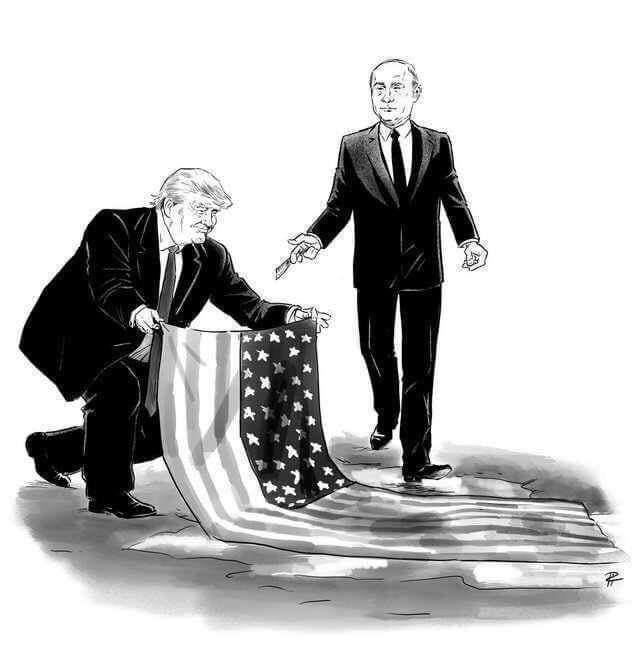
The Media’s Russia Obsession?

trumputin

Let’s talk about the media’s so-called Russia obsession for a few minutes.

What is meant by this is that the mainstream press have devoted tons of coverage to the substantial allegations that the Kremlin mounted a massive operation, mostly via social media, to influence the outcome of the 2016 US presidential election and, further, that the campaign of the candidate who won the election actively colluded with the Kremlin, among other things, in order to discredit the candidate’s main opponent in the election. The press has also focused a lot on Robert Mueller’s special investigation of these allegations.

Is all of this press coverage sterling? No. Does the press get the story wrong sometimes? Yes.

But this has always been the case with the nominally free press in nominally democratic societies ever since the free press emerged in the eighteenth century in a few countries groping their way towards democracy. It always been biased, prone to mistakes, and otherwise wildly imperfect. And yet it has always been subject to intense scrutiny, at least in my lifetime—and the really infantile desire on the part of certain social and political forces that it be perfect—that is, perfectly biased and ventriloquizing only their viewpoints—although these same forces are rarely so critical of either themselves or other important social institutions.

In this case, the social and political forces that routinely complain about the media’s so-called Russia obsession seem to mean, in fact, that the mainstream press and the press in general should simply stop covering what is surely the story of the century: allegations that the world’s largest country massively intervened in a presidential election in the world’s most powerful country, and that the man who won the election and members of his campaign and transition team were in close contact with agents of the world’s largest country during the campaign and transition.

What kind of press would we have if they completely ignored this story?

We would have a press much like the press in the world’s largest country, which routinely ignores or severely undercovers really big stories—such as the country’s involvement in putting down a popular revolution in a third country whose people have never down anything bad to the people of the world’s largest country—or which engages in outright Goebbels-like propaganda nearly every day, leaving the really important stories to opposition liberal newspapers and online media outlets that are read and accessed by a tiny fraction of the country’s populace.

Finally, the mainstream media have not been obsessed with Russia itself, but with the alleged actions of the Kremlin, Russian secret services, and Russian internet trolls in connection with the 2016 US presidential election. Period.

There is a another Russia, populated by 143 million people, that had nothing whatsoever to do with the story of the century. They did nothing to skew the outcome of the 2016 US presidential election and, in the main, their lives, aspirations, and actions are roundly ignored by the so-called mainstream media in the west and Russia itself. They are roundly ignored by the so-called alternative media, too, for the simple reason that much of the alternative media in the west operate under the delusion that Putin is an “anti-imperialist.” By definitions, Russians who oppose his sagacious rule must be “puppets of the west.”

If all of this weren’t the case, I would have expected that one or more of these “Russia-obsessed” or “anti-Russian-obsessed” newspapers, magazines, TV channels or websites would have picked up and covered, for example, the shocking story of the Penza-Petersburg “terrorism” case aka the Network case, in which eleven young anarchists and antifascists have been accused of involvement in a “terrorist community” dubbed “the Network.”

Most of the accused men have told the same grisly tale of being abducted by FSB-KGB field agents, who took them to remote areas in minivans or to the basements of their headquarters and tortured them for hours, using tasers and bare electrical wires, and severe beatings, attempting to force them to memorize the “confessions” they would later make (or, in some cases, refuse to make) to FSB investigators, who would then petition the courts to send them to remand prisons, where all of them are still imprisoned to this day.

The allegations of torture have been confirmed by Russian civil rights activists and defense attorneys who spoke with some of the men soon after their arrests and, in a few cases, they were also confirmed by physicians who examined the men when their wounds were still fresh.

In any case, a small but growing group of very determined people, including the men’s parents, friends, reporters, human rights activists, and concerned citizens, have been working as hard as they can over the last year to bring the case to the attention of the wider Russian public, force prosecutors to investigate the allegations of torture by FSB officers, and otherwise prove that, as seems to be the case, the FSB conjured the entire tale of the “terrorist community” from whole cloth and then handpicked a dozen or so completely innocent young men to be the fallguys, trying to torture and pummel them into admitting their “guilt” although they were guilty of no crime at all.

You would think the “Russia-obsessed” corporate media would jump on a story like this, but except for one article in the New Yorker, the western corporate media have utterly ignored the story of the Network “terrorists,” despite the efforts of actual alternative media like openDemocracyRussia (oDR) and my own blog, the Russian Reader, to write about it any chance we can and translate Russian coverage of the case, as published in such as liberal, leftist and civil rights media outlets as Mediazona, OVD Info, and Novaya Gazeta.

The campaign to save the Network boys scored a minor victory the other day during a meeting of the Presidential Council for Civil Society and Human Rights, when several members of the council brought up the case and a similar case no less shocking, the New Greatness case, and forced President Putin to talk about them.

A KGB-FSB officer to the core, Putin pretended not to have heard of the cases, which both pivot on allegations of extreme entrapment, torture, and fabrication by other KGB-FSB officers.

Putin hemmed and hawed, lied and prevaricated, feigned that he couldn’t believe what he was hearing, etc., but he did promise to look into the cases and get to the bottom of them.

It’s entirely possible he won’t do that, but it’s just as possible he will make the cases quietly go away to avoid embarrasment.

Who knows.

What I do know, though, is that western mainstream and alternative media, all of them “obsessed” with Putin (but not Russia) in their own way, have shown no interest in this story and thousands of other similar and dissimilar but no less fascinating stories from the real Russia inhabited by most Russians.

There was a slight uptick in their interest in grassroots Russia during the 2011–2012 fair elections protests, but since that movement was roundly defeated, western press coverage has been firmly refocused on the beloved hated figure of the supreme leader, thus once again denying nearly all the other 143 million Russians of agency, their own opinions, and their own lives.

If you’re interested in the Network case and related stories, please check out the coverage on oDR and the Russian Reader. Outside of Russia, practically speaking, there has been no coverage of the case anywhere else, and most things you read on international anarchist and antifascist websites are reprints of the stories we have translated and published.

So, let’s put this canard about the media’s Russia obsession to rest, okay? It’s deeply offensive to ordinary smart Russians, whose numbers are much greater than you would be led to think by the mostly lazy coverage of the country in the western press, and just as offensive to the handful of non-Russians who care deeply about what goes on here. {TRR}

P.S. You can support the Network suspects and their families concretely by donating to a solidarity campaign organized by comrades in London on their behalf. Your support will help to offset their legal costs, organizing humanitarian support for the arrested and offering support to their relatives. The resources gathered have so far been distributed according to the financial circumstances of the respective families and the needs of the arrested. Further financial support is being distributed according to the choices made by those arrested throughout the investigation.

Cartoon courtesy of JA and Union Thugs 

Let’s Give In to Russian Blackmail

nod-constitution day-1“The Russian Constitution: The Basic Law or Legal Sabotage?” Front page of a newspaper handed out on the streets of Petersburg by memberx of NOD (National Liberation Movement) on December 12, 2018, celebrated as Constitution Day in Russia. This article argues that Russia’s current constitution, adopted in 1993, was drafted by CIA agents working under the cover of USAID. Their goal, allegedly, was to colonize Russia by subjugating its sovereignty to international law.

___________________________

Don’t Let Russia Leave the Council of Europe
Yuri Dzhibladze and Konstantin Baranov
oDR
December 13, 2018

Those who wish to punish the Kremlin for its aggressive actions in Ukraine and elsewhere are missing the target: it is not the Russian government, but the Russian public who will suffer if the country leaves the Council of Europe.

After the Kerch Strait incident, proponents of pushing Russia out of the Council of Europe seem to have got additional justification for their position in a discussion that rages in the Council’s Parliamentary Assembly (PACE). In fact, the potential costs of this departure appear to be too high and far-reaching—not only for the Russian society, but for the whole of Europe.

More than four years since its delegation has been deprived of voting and participation rights in the PACE, Russia is now a step away from leaving the Council of Europe – either at its own initiative or as a result of expulsion for non-payment of its membership fees. In recent months, the situation has reached a deadlock due to an uncompromising position of both the Russian authorities and their critics in the PACE.

Those who wish to punish the Kremlin for its aggressive actions in Ukraine and elsewhere miss the target: it is not the Russian government, but the Russian public who would suffer the most should the country leave the Council of Europe. Since 1996, when Russia joined the organisation, for millions living in the country (including nationals of other states), the European Court of Human Rights (ECtHR) has been an ultimate hope for justice, which they cannot find in Russia. In this period, almost 2,500 judgements have been delivered to Russia. In 2017 alone, the state paid over 14.5 million euros as just satisfaction to victims. The judgments have had a significant positive impact on Russian laws and judicial practice, despite their implementation being far from ideal and counting to roughly one-third of cases. Should Russia depart from the Council of Europe, the scope of human rights problems in the country will grow exponentially, including a threat of speedy reinstatement of the death penalty.

The potential consequences would go far beyond the deterioration of the internal situation. This move would not resolve the issue of the annexed Crimea or put an end to the armed conflict in Donbass. On the contrary, expelling the violating country would demonstrate the weakness of the European system of protection of human rights and the rule of law in dealing with such gross violations.

What is more, Russia’s withdrawal would definitely worsen conditions of citizens of Ukraine and other countries who are held in Russian prisons and face unfair trials, torture and inhuman and degrading treatment. It would also result in a denial of the protection of the European Convention on Human Rights (ECHR) to inhabitants of Russia-controlled Crimea. It would eliminate effective guarantees from deportation for refugees and asylum seekers from Syria, Afghanistan and Central Asia. Finally, the practice of expulsion of a member state might trigger other countries to leave the Council and deter Belarus from returning to a special observer’s status at the PACE.

Politicians should assume full responsibility for making the choice that may define Europe’s future and work towards a solution that would preserve the common European legal framework and space for critical dialogue aimed at promoting human rights, democracy and the rule of law on the entire territory of Europe, including Russia.

We do not demand to “give in to blackmailing.” Lifting all restrictions on the Russian delegation in the PACE would be indeed unprincipled. However, finding a reasonable solution, in our view, would be a courageous decision to take responsibility and to advance the core values of the organisation by allowing the critical dialogue to continue. Amending the PACE rules of procedure – restricting national delegations’ rights only within the Assembly itself and not depriving them of the voting rights in elections of non-PACE mandates—including ECtHR judges, Commissioner for Human Rights and Secretary General—appears such a legally sound and reasonable solution.

Threats by Russian officials to leave the Council of Europe are not just a bluff to raise the bargaining stakes. There are many influential people in the Russian political establishment in favour of isolationist policies who actually want the country to withdraw. If a reasonable solution is not found before next spring, Russia’s authorities will not wait for the official discussion of its potential expulsion at the Committee of Ministers in June 2019 and will announce the withdrawal from the Council before.

It should be clear to everyone: Russia’s departure from the Council of Europe would not stop human rights violations and halt the authoritarian backslide in our country, or prevent the Kremlin’s aggressive behaviour in the international arena. Instead, it would put an end to a difficult struggle of Russian civil society to make Russia an important part of Europe on the basis of shared norms and values of democracy, rule of law and respect for human rights. It will turn a large territory in Europe into a legal “grey zone” for decades to come.

The authors represent a group of Russian human rights defenders who recently issued a Memorandum on the crisis in relations between the Council of Europe and the Russian Federation.

About the authors

Yuri Dzhibladze is a founder and president of Moscow-based Centre for the Development of Democracy and Human Rights and advocacy coordinator at the EU-Russia Civil Society Forum. He has worked on human rights, democracy, and international organisations since the late 1980s.

Konstantin Baranov is member of the Coordinating Council and international advocacy coordinator at the Youth Human Rights Movement, an international NGO enjoying participatory status with the Council of Europe. He is an expert on the protection of civil society space and fundamental freedoms in Russia and the post-Soviet area.

NB. This article was originally published by oDR under a Creative Commons Attribution 4.0 International licence

___________________________

When will Russia stop behaving like the enemy of Western Europe?
Dima Vorobiev, I worked for Soviet propaganda
Quora
Answered Feb 18

Russia is not the enemy of the Western Europe. The disruptive policy of President Putin is aimed at (1) weakening the political and military dominance of the US in Europe and/or (2) full or partial acceptance by the West of the following list of Russia’s political objectives:

  • Recognition of Crimea as Russian territory
  • Total freeze on expansion of NATO. No membership for Sweden, Finland, Ukraine or Georgia.
  • No NATO bases in the Baltics, Poland, Czech republic and Slovakia, Romania and Bulgaria. Removal of the American anti-ballistic bases in Central Europe.
  • Finlandization of Georgia, Ukraine and guarantees of such arrangement for Belarus, in case it gets a pro-Western government in the future.
  • Guarantees of unhindered land connection through Lithuania between the Russian heartland and the exclave of Kaliningrad. The unhindered transit through the Suwalki gap would be very useful for Russia as a gauge of the level of determination on the part of NATO in the case of a swift escalation in tensions.
  • Recognition of Russia’s right to permanent military presence in the Mediterranean (through bases in Syria and possibly in Libya or other places)
  • Repeal of all sanctions against Russian oligarchs, their companies and sectoral interests.

If the West won’t agree to such a new global security arrangement, the current confrontation will continue, with variations only in the level of tensions. Because of the technological gap, the Russian military-industrial complex will increasingly depend on China for high-tech components for our weapons systems. Russian economy will also be more and more streamlined to accommodate the needs of Chinese manufacturing.

This stalemate can continue for many years, unless one of the following happens:

  1. Unexpected massive deterioration of economy in Russia.
  2. Low-probability, high-impact catastrophe in the US or Europe that makes the West seek help from Russia
  3. Power shift in Russia with full revision of national policy. (Highly unlikely with President Putin still in power).

Three Years Later: Suicide by Crimea

Suicide by Crimea
Nikolay Klimenyuk
oDR
March 17, 2017

As long as Russia maintains its grip on the Ukrainian peninsula, significant changes for the better at home are impossible.

In the three years that have passed since the annexation of Crimea, a consensus has taken shape in Russia. Everything having to do with the Ukrainian peninsula is Russia’s internal affair, and far from the most important one.

The “accession” of Crimea has even quite succesfully happened in the heads of the regime’s opponents. In November 2016, while arguing on Facebook with Crimean Tatar journalist Ayder Muzhdabaev, Mikhail Khodorkovsky expressed a stance then supported by many publicly prominent liberals, including activists and intellectuals. Russian society, he argued, wants to deal with other problems. The opposition’s biggest task is regime change, but returning Crimea to Ukrainian jurisdiction by democratic means would be impossible because public opinion would be opposed. Crimea is not mentioned at all in Alexei Navalny’s 2018 presidential campaign platform.

Russian media outlets generally considered “liberal” (these media usually eschew the word “opposition”) havealso swallowed the annexation and most of the rhetoric surrounding it without a peep. TV Rain, RBC (even before its top editors were replaced), and the online Meduza, which operates out of Latvia and is not not subject to Russian laws, have all long routinely called and depicted Crimea as part of Russia. The standard explanation—it is required by Russian law, and insubordination is fraught with penalties—sounds like an excuse. The law does not require that questions about Crimea be included in a quiz on knowledge of Russian cities (which was amended after public criticism) or that reporters term the annexation a “reunification” (Meduza edited the latter term to “absorption.”)

At the same time, Russian reporters usually have no problem demonstratively violating Ukrainian laws (which require them to enter the occupied territory through the checkpoint at Perekop) and flying to Crimea from Russia (as Deutsche Welle reporter Yuri Resheto did), because it’s cheaper, faster, and simpler, and because Ukraine’s rules are cumbersome, inconvenient, and nonbinding.

After that, you can write critical reports on human rights violations in Crimea till the cows come home, but it won’t change what matters. The voluntary observance of inconvenient Ukrainian rules is tantamount to acknowledging Ukraine’s sovereignty over Crimea, and hardly anyone in Russia wants to do that.

In fact, the seizure of Crimea has been the cause of many pressing problems in Russia that have been on the Russian opposition’s agenda. It has laid bare peculiarities of Russian society that existed longer before the attack on Ukraine.

For example, not only did the extent of imperialist moods become clear but also Crimea’s place in how Russians see themselves as a society and a nation. The imperial myth, still alive and well in Russia, was concocted during Catherine the Great’s reign. From the moment they were implemented, Peter the Great’s reforms had provoked a mixed response. They smacked of “sycophancy,” and modeling the country on Holland seemed somehow petty.

Catherine, on the contrary, conceived a great European power, rooted in antiquity, Byzantine’s direct heir, the Third Rome, a Europe larger than Europe itself. Her ambitious Southern Project, which involved defeating Turkey, uniting all the Orthodox countries in a single empire, and installing her grandson the Grand Duke Constantine on the throne in Constantinople, was brought low by political reality. The only one of her great fantasies she made come true was seizing the Crimean Khanate, in 1783.

The conquest was extremely atypical of Russia. A troublesome neighbor was not subjugated. Rather, the annexed lands were completely reimagined and rewritten. The rewriting was attended by the first mass expulsion of the Crimean Tatars. They did not fit at all into the pictures of the radiant past that Grigory Potemkin was painting in reality on the annexed lands. Crimea was resettled with Plato and Aristotle’s Orthodox descendants: Pontic Greeks, Great Russians, and Little Russians (i.e., Ukrainians). Naturally, all these particulars have been forgotten long since. What has not been forgotten is Crimea’s central place in the self-consciousness of a “great European nation,” as manifest, for example, in the absurd, endlessly repeated expression, “Crimea has always been Russian.”

The saying perfectly illustrates the peculiarities of historical memory in Russia. Crimea’s current “Russianness” is the outcome of over two hundred years of the uninterrupted genocide and displacement of the “non-Russian popuation,” which culminated during the Second World War. After the two Soviet deportations of 1941 and 1944 (ethnic Germans, Greeks, Bulgarians, Italians, Armenians, Karaites, and Crimean Tatatrs were deported), losses during battles, and the Nazi extermination of Jews and Crimeans, only a third of Crimea’s pre-war inhabitants were left. It was resettled with people from Russia and Ukraine, especially by military officers and veterans of the Party and the secret services.

Naturally, few people in Russia today regard Crimea as a conquered and ravaged country, in which a full-fledged state existed until relatively recently, an indigenous culture was long maintained, and Russians were never the ethnic majority even during the lifetimes of the present elder generation.

Regarding Crimea as a territory, not a society, and treating Crimeans as an annoying inconvenience, was a habit in Catherine’s times and has survived into the present. The formal excuse for the Russian incursion was the “defense of Crimea’s Russophone population,” and yet the “Crimea is ours” attitude of Russians to the peninsula’s residents has been quite skeptical from the get-go. They imagine the main business of Crimeans is leaching off tourists, and the only thing that attracts them about Russia is high wages.

Moreover, this opinion is common across the entire political spectrum. Sergei Parkhomenko, a liberal journalist and public figure, expressed it in a very telling way.

“If first you take five days to explain to the population of Crimea that if they return to Ukraine’s jurisdiction, their wages and pensions will be increased, and they’ll also be permitted to build even more chicken coops for holidaymakers in the coastal zone, and only then you ask them to vote in a referendum, 95% will vote for going back. […]  These people have proved they could not care less what country they belong to. And if there is anyone for whom I now feel not an ounce of sympathy as I read about how they are being fooled, robbed, milked, and put under the rule of gangsters pretending to be officials and bosses, it is the population of Crimea.”

The massive support of Russians for the annexation has much more serious and immediate consequences than a display of deeply rooted chauvinism. Having signed off on “Crimea is ours,” Russians have deemed their own power above the law and sanctioned its use in violating all laws and treaties for the sake of higher interests or “justice.” The Russian authorities had behaved this same way previously, but now they have obtained the relevant mandate from society. Quite naturally, the crackdown following the seizure of Crimea has been chockablock with spectacular acts of lawlessness.

One such act was the demolition of commercial kiosks and pavilions in Moscow, which happened despite legalized property rights and court rulings. There was nothing accidental about the fact the Moscow authorities justified their actions by citing the law adopted for settling real estate disputes in Crimea. And the twenty-year-sentence handed down to Oleg Sentsov set a new ceiling for verdicts in political trials. Before Crimea, activists would get a dvushechka (two years) for especially vigorous protests. After Crimea, the Russian authorities have been sentencing people for reposts on VK and holding solo pickets.

Actually, any regime that tasks itself with establishing the rule of law in Russia will first have to annul this “mandate to lawlessness.” The Russian opposition’s attitude to Crimea shows the rule of law is not among its priorities at all. Bewitched by the figure of Putin, the opposition does not regard regime change as a product of the rule of law. The fact that it cannot offer a realistic scenario for regime change is not a problem in itself. Russia’s currrent regime does not presuppose a peaceful change of power. Systemic change might happen as it did in the Soviet Union, at the behest of the bigwigs and under the impact of external circumstances: the state of the economy, public sentiment, foreign policy factors.

The opposition’s most serious problem is that it doesn’t have a meaningful outline of what would come next.

If we believe the alternative to Putin is neither Navalny, Khodorkovsky nor anyone else, but a democratic state based on the rule of law, there are two obstacles in our way: Crimea and Chechnya. The opposition has no vision of how to establish control over Chechnya and incorporate it into Russia’s legal system, but it is possible in theory, at least. There is no such possibility with Crimea. It is impossible to hope for international recognition of the peninsula as part of Russia, and if we keep regarding it as part of Russia, it will thus remain a legal anomaly. Moreover, no rule rule of law is even formally possible without observance of international law.

When discussing Crimea, the Russian opposition evinces a notion of democracy that differs little from Putin’s, although it is consonant with the rhetoric of Donald Trump and the European populists: that democracy is rule based on majority support and not burdened by the observance of laws, procedures, and international obligations. Khodorkovsky, for example, considers “democratic procedure” not the restoration of law, but the adoption of a decision on Crimea based on the opinion of the majority, which, allegedly, is against giving Crimea back to Ukraine. Navalny has suggested holding a new, “normal” referendum.

Yet what the majority really thinks, whether there is such a thing as public opinion on any issue and how to measure it, obviously means nothing at all either to Khodorkovsky, Navalny or many other members of the opposition. By the same token, since Putin is supported by the majority of the Russian population, there is nothing for the opposition to do at all. All these contradictions can be eliminated only by unconditionally recognizing both the illegality of Crimea’s annexation and the total impossibility of keeping it in the Russian Federation on any grounds.

With Crimea in tow, Russia has no positive alternative to the current regime. And as long as the Russian opposition is concerned only about regime change and avoids discussing Crimea, the only thing it can offer is a Putinist Russia sans Putin. Whoever ends up in his place, however, the changes won’t be too noticeable.

Nikolay Klimenyuk writes about politics and culture in Germany and Russia. He was an editor at Forbes Russia, Bolshoi Gorod, and other periodicals. He has lived in Berlin since 2014 and writes for Frankfurter Allgemeine Zeitung and other German mass media. Translation and photo by the Russian Reader