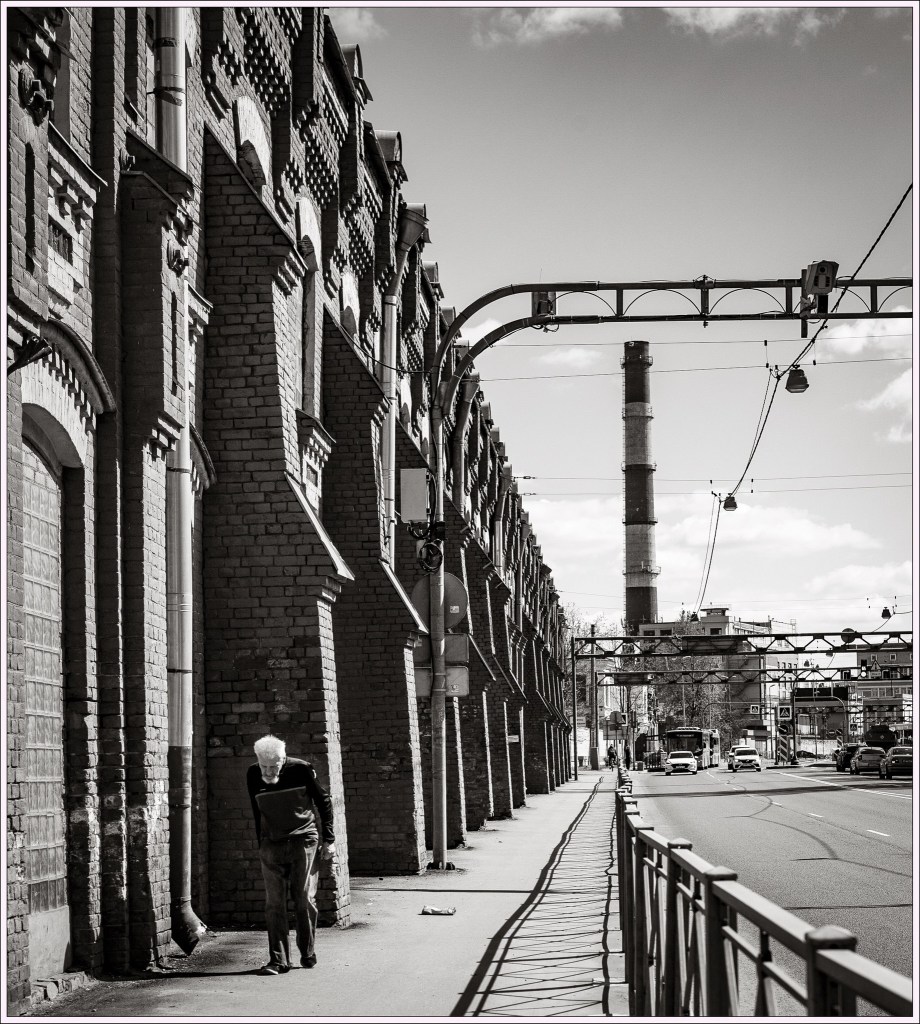
Victory Day 2025

Sergei Podgorkov, Outside the Obukhov Factory (St. Petersburg), 9 May 2025

Source: Sergei Podgorkov (Facebook), 9 May 2025


On Friday, May ninth, Treptow Park was perhaps the most heavily guarded place in Berlin. Hundreds of police officers kept the peace at Germany’s most famous memorial to Soviet soldiers on the day Russia marked the eightieth anniversary of the end of the Second World War in Europe, known as the Great Patriotic War in the Soviet tradition. Because Russia has employed symbols of that earlier war in its current war against Ukraine, visitors were banned from displaying or wearing Soviet and Russian flags, military uniforms, and St George’s ribbons at the Berlin memorial this year. An exception was made for veterans and diplomats.

Soviet May ninth traditions and German pacifists

At about half past ten in the morning, a wreath was laid at the monument to the Soviet soldier by Russia’s ambassador to Germany, Sergei Nechayev. The day before, when Germany remembered the Wehrmacht’s surrender and the end of the war, Nechayev and the Belarusian ambassador were not invited to the memorial event at the Bundestag. In his speech, German President Frank-Walter Steinmeier thanked the Allies for liberating his country and recalled the Red Army’s sacrifices, but harshly criticized Russian attempts to justify the war in Ukraine in terms of the fight against the Nazis in the Second World War.

The flood of people in Treptow Park seemed endless: hundreds were there at any one time, and thousands came and went over the course of the day. Many brought scarlet carnations, while some bore wreaths. Russian and German were heard. Most of the visitors were elderly—immigrants from the former USSR living in Germany and Germans. There were also many leftist and ultra-leftist German political activists brandishing placards opposing NATO and calling for “peace with Russia.”
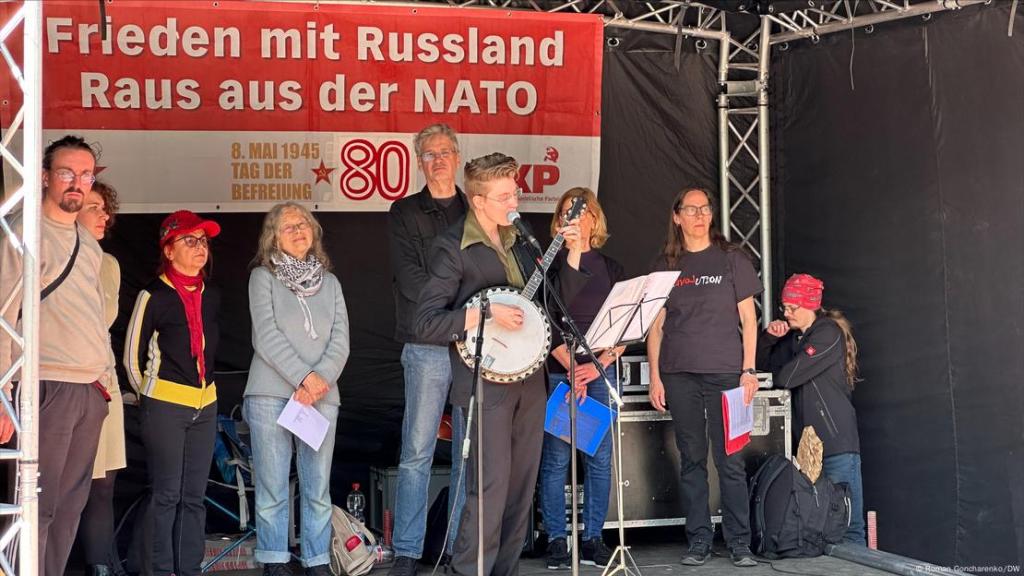
German ultra-leftists rally for “peace with Russia” and Germany’s exit from NATO, 9 May 2025.
Photo: Roman Goncharenko/Deutsche Welle

Against this backdrop, the scene resembled a mixture of a traditional Russian May ninth celebration and a political protest by German pacifists, many of whom had clearly lived most of their lives in the GDR.

“I was a policeman in the GDR,” said a man in his sixties who held a placard that read “Thank you” in Russian. The policemen asked him to doff his Soviet cap, which sported a red star and a St. George’s ribbon.

“All people want peace, so the politicians should don their own military uniforms and crawl into the trenches,’ the man said.

Soviet wartime songs sounded from loudspeakers and were played live. One man, aged forty-five, climbed atop a mound to get a better view, but a policeman asked him to get off the lawn, explaining, “This is a grave.” The man cursed in Russian but climbed off the mound.

Another man played played “Arise, Great Country” on his clarinet. When he began quietly playing the melody of the Soviet and Russian national anthem, the police literally took him aside, after which he returned to the group of people who had gathered. They were outraged at the restrictions that had been adopted. From time to time, someone chanted “Russia, Russia!” and many other people would join in.
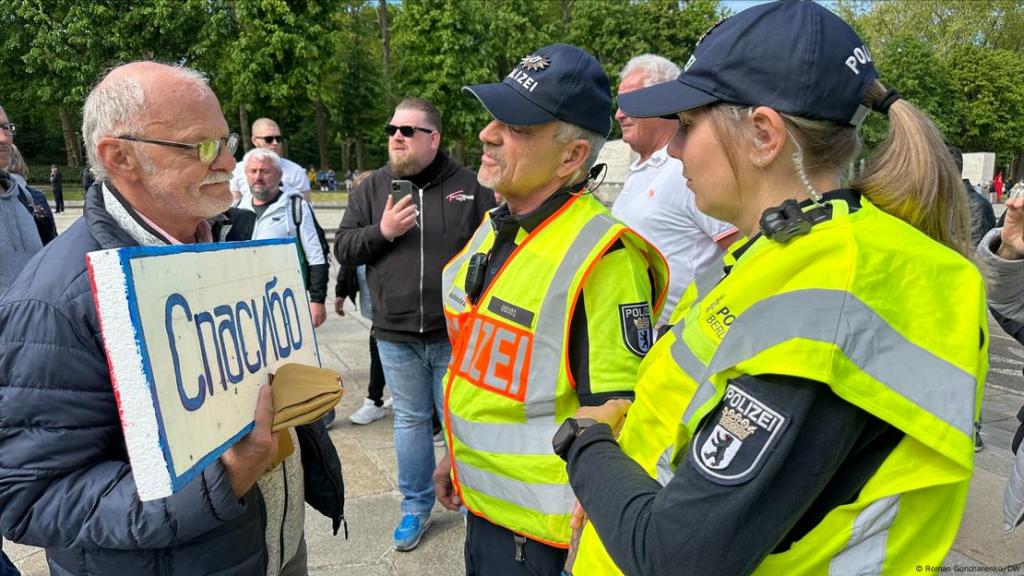
An ex-East German police office (holding a sign that says “Thanks!” in Russian): “All people want peace.”
Photo: Roman Goncharenko/Deutsche Welle

Bikers in Treptow Park

Your correspondent saw men and a woman in leather jackets who looked like bikers from the Russian motorcycle gang Night Wolves. They were in small groups and were escorted by a large number of police officers. They posed for pictures in front of the wreaths and left. They could have been someone from a local “support group.” The Berlin press had written that only a small group of bikers made the trip to Berlin to visit the Soviet memorials this year. No incidents had been reported as this article went to press.

Treptow Park, 9 May 2025. The crimson and gold banners at the back of the crowd are inscribed with the names of the various “fronts” in the Red Army’s campaign against the Wehrmacht. Photo: Roman Goncharenko/Deutsche Welle

For the first half of the day, at least, things seemed relatively calm. Your correspondent had the impression that most people had come to Treptow Park not for political reasons, but to commemorate the war. And yet the atmosphere was tense. To the right and left of the monument to the Soviet warrior stood a dozen and a half activists holding placards and the flags of Ukraine and NATO.
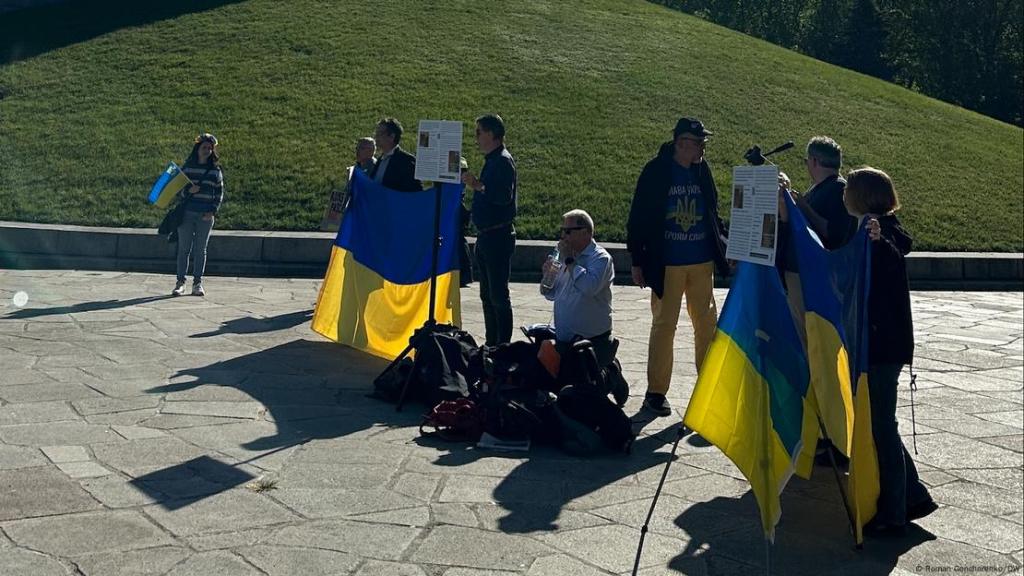
Activists with placards and Ukrainian flags at the monument to Soviet soldiers in Treptow Park, 9 May 2025.
Photo: Roman Goncharenko/Deutsche Welle

They said they wanted to draw attention to the Ukrainian Red Army soldiers who had perished in the Second World War, as well as to Russia’s war against Ukraine.

“I am here to prevent this event from being turned into a Russian propaganda stunt,” said a woman, aged thirty-five. According to her, insults had been hurled at her and the pro-Ukrainian activists.

“Some people regard our presence here as a provocation,” said the woman. “We are not here to change anyone’s mind, but to make Ukraine visible.”

One of their posters read: “Russia has usurped the memory of May eighth and ninth. But it was not Russia who liberated us from the yoke of National Socialism eighty years ago in Berlin. It was the Red Army, in whose ranks many Ukrainians served.”

The poster tells the story of Ukrainian soldier Fyodor Karpenko, who left his name on the walls of the destroyed Reichstag building in May 1945.

Source: Roman Goncharenko, “May Ninth in Berlin’s Treptow Park: A War of Words,” Deutsche Welle Russian Service, 9 May 2025. Translated by the Russian Reader


Since the Maidan uprising and Russia’s illegal annexation of Crimea in 2014, Kremlin propaganda has consistently portrayed Ukrainian leaders as Nazis or fascists. Russia also accused the Ukrainian authorities of “genocide” of the population of Donbass. On 24 February 2022, while announcing the full-scale invasion, the “denazification” of Ukraine was presented as the primary goal of the war, which is itself portrayed merely as a continuation of the Great Patriotic War: a conflict embedded in a cyclical conception of time in which Russia, eternally under threat from a Western enemy, fights for its very survival — on Ukrainian soil.

On the ground, there is no evidence to support Moscow’s accusations: nobody has ever documented a “genocide” against ethnic Russians or Russian speakers, whether in Ukraine or elsewhere. As for the Ukrainian far-right, its political influence remains minimal: in the 2019 parliamentary elections, the main ultra-nationalist parties, running together on a joint list, received just over 2% of the vote, well below the threshold required to enter Parliament. In short, the image of a “Nazi regime” in Kyiv is based on a glaring mismatch between rhetoric and reality.

So why do the Russian authorities repeatedly invoke references to the Second World War — or, in Russian parlance, the “Great Patriotic War” — when speaking about Ukraine? Understanding this memory dynamic is essential to grasp the power of a rhetoric that, despite lacking any factual basis, continues to shape the official Russian worldview.

The Soviet and Russian insistence on using the term “Great Patriotic War” to refer exclusively to the period from 1941 to 1945 erases the twenty-one months that preceded Nazi Germany’s invasion of the USSR. Between the Molotov–Ribbentrop Pact of August 23, 1939, and Operation Barbarossa on June 22, 1941, Moscow and Berlin were de facto allies: they engaged in extensive economic cooperation, diplomatic coordination, jointly invaded and partitioned Poland in September 1939, and the Soviet Union proceeded to annex the Baltic countries and wage war against Finland. By reducing the war to the period 1941–1945, the USSR and Russia could deny any responsibility in the outbreak of the Second World War and present itself solely as the victim of Nazi aggression and the primary liberator of Europe.

The Great Patriotic War — and especially the victory in 1945 — became the founding event of Soviet history and the cornerstone of collective memory. Yet this memory, often portrayed as monolithic and universally shared, is anything but uniform. A Ukrainian from the west, who endured two successive occupations between 1939 and 1944, remembers a war very different from that of an eastern Ukrainian, whose experience was shaped primarily by Nazi destruction. The memory of a Russian bears little resemblance to that of a Crimean Tatar, who was deported along with his entire community and denied the right of return for decades. As for Soviet Jews, whose families and communities were annihilated in the Holocaust, they were long forced to remain silent — official narratives left no room for the specificity of their suffering.

The collective experience of the war and the official discourse surrounding it deeply reshaped the Soviet population’s understanding of “fascism” and “antifascism.” Rather than referring to a specific political doctrine of the inter-war period, the term “fascism” had become a catch-all label for the ultimate enemy. Trotsky or the British Conservatives could just as easily be branded as “fascists,” as well as domestic and international opponents after 1945 — including even the Chinese Communists. The word “Nazi” itself was rarely used. In everyday life, calling someone a “fascist” served more as the gravest possible insult rather than as a statement of ideological substance.

Under Vladimir Putin, the cult of the Great Patriotic War has been revived. Following the pro-democracy protests of 2011 and Putin’s bid for a third presidential term in 2012, the regime instituted a deliberate policy of historical narrative construction, aimed at grounding its legitimacy in a vision of the nation as under siege. The glorification of the 1945 victory also allowed the regime to purge collective memory of its specifically socialist elements: by retaining only the narrative of national triumph, the Soviet period could be seamlessly integrated into a continuous national history without any revolutionary rupture. At the same time, the rehabilitation of Joseph Stalin as a legitimate victor served to validate autocracy. The mass repressions and genocidal policies that claimed millions of lives were reframed as a tragic but necessary step: they had made the USSR a global superpower, capable of defending civilization against the “brown plague.”

The Kremlin has multiplied its legal instruments to enforce this narrative. Since 2020, the Russian Constitution mandates “respect for the memory of the defenders of the Fatherland” and prohibits “diminishing the importance of the heroism” of the Soviet people. In April 2021, Putin signed a law increasing penalties for “insults” or “false claims” about the Second World War and its veterans. In December 2019, Putin himself gathered some leaders of post-Soviet states around a pile of archival documents that he said proved historical truths long ignored in the West — selectively quoting them to justify, in retrospect, the USSR’s annexation of Poland and the Baltic states. In this way, Putin has weaponized history, which has become inseparable from national interest. To challenge his interpretation is tantamount to treason.

Every year on May 9, Russians march in the Immortal Regiment carrying portraits of relatives who fought between 1941 and 1945. Increasingly, the faces of those who fought — or died — in the war against Ukraine are added to these ranks, as though both wars were part of a single, endless struggle. Past and present warfare are merged, and the victory of 1945 becomes the lens through which all events — past, present, and future — are interpreted in a continuous historical timeline. This symbolic fusion also explains the surreal images of Russian occupation forces who, in recent weeks, have placed propaganda banners in destroyed Ukrainian cities. An uninhabitable Bakhmut was transformed into a stage for celebrating the 80th anniversary of Russia’s victory in the “Great Patriotic War.” 

The cult of victory is not only a central element of the Putinist imaginary — it functions as an operating system for both domestic governance and external aggression, with all of Russia’s actions on the international stage framed as part of an eternal war against fascism. A telling example of this is the installation of a giant screen on the Estonian border, broadcasting Victory Day celebrations in a loop — an attempt to remind Estonians, as well as Latvians and Lithuanians, that the Soviet victory represents an unassailable moral superiority. In the Russian collective imagination, the word “fascism” has lost all connection with a specific political ideology and now refers only to an abstract, absolute threat: the desire to destroy Russia. It has become synonymous with “enemy” or “Russophobe,” always denoting the Other, never a historically defined movement. This separation between word and meaning allows the regime to simultaneously glorify the antifascist victory and openly promote xenophobic, homophobic, or ultraconservative rhetoric, without any perceived contradiction.

The word “denazification,” used by Vladimir Putin on February 24, 2022, to justify the invasion, initially puzzled many Russians, most of whom were unfamiliar with the term in this context. Shortly afterwards, the state news agency RIA Novosti published an article by Timofey Sergeytsev — “What Russia Should Do with Ukraine” — aimed at clarifying its meaning: “denazification” was described as a “total cleansing,” targeting not only alleged Nazi leaders but also “the popular masses who are passive Nazis,” deemed guilty of having supported the “Nazi government.” According to Sergeytsev, modern Ukraine is able to hide its Nazism behind aspirations for “independence” and “European development.” To destroy this Nazism, he argues, is to “de-Europeanise” Ukraine. In this logic, denazification becomes synonymous with eliminating all Western influence from Ukraine and dismantling the country’s existence as a nation-state and a distinct society. Incubated on official state platforms, this narrative reveals the true scope of “denazification”: a large-scale project aimed at erasing any trace of Ukrainian singularity, a blueprint for the genocide.

The article recently published on the official website of the Russian Foreign Intelligence Service (SVR), entitled “Eurofascism, Today as 80 Years Ago, Is a Common Enemy of Moscow and Washington,” strikingly illustrates the expansion of the “denazification” discourse far beyond Ukraine. The accompanying image depicts a grotesque hybrid monster: its body is shaped like a black swastika with the EU’s circle of stars in the centre, while its head is a caricature of Ursula von der Leyen. The creature, with its blood-stained claws outstretched, is caught between two bayonets — one American, the other Russian/Soviet. This grotesque image is not merely a provocation: it reflects a narrative deeply entrenched in Russian state propaganda, where “Eurofascism” becomes an operational concept encompassing all European societies.

“Eurofascism, Today as 80 Years Ago, Is a Common Enemy of Moscow and Washington.” Screenshot courtesy of Meduza

The 2022 tipping point revealed these discourses for what they truly are: the ideological foundation of a large-scale invasion, long prepared within the informational sphere. Today, part of European society — particularly elements of the pacifist left — is falling into the same trap: underestimating or ignoring the ongoing propaganda dynamic. But the machine is already in motion. The language of fascism is being broadened daily to include new designated enemies, and the ideological war is shifting: it is no longer stopping at Ukraine — it is now targeting all of Europe. In the face of this brutal reconfiguration of the official Russian narrative, complacency or passivity have themselves become forms of strategic blindness.

Source: Hanna Perekhoda, “From Kyiv to Brussels: The Great Patriotic War as Putin’s Propaganda,” in “Victory Day: Three Interventions from the Left,” Posle, 7 May 2025. Ms. Perekhoda is a Ukrainian historian, researcher, and activist.


Russia’s consolidated military registration registry website, Reestrpovestok.rf, is fully operational. On Friday, 9 May 2025, the human rights project Get Lost, which helps Russians avoid conscription into the army, reported that the notifications that it was operating in test mode had disappeared from the website, and the online resource appeared to have been fully launched.

Upon arrival on the website, users can log in to their personal accounts, check summonses, and obtain copies of records. Earlier, the website indicated that it was functioning in beta mode only in three regions—Sakhalin, Ryazan, and the Republic of Mari El. This notification has now disappeared.

“So far no one who has received a summons through this site or faced automatic restrictions has contacted us,” the human rights activists added. The registry’s launch has not been officially announced.

Recipients of summonses to face restrictions if they fail to report to military recruitment center

The law establishing a consolidated registry of persons subject to conscription and introducing electronic summonses was signed by Russian President Vladimir Putin in April 2023. The text of the document, in particular, states that conscripts who do not report to a military enlistment office within twenty days of receiving a summons may be prohibited from registering as an individual entrepreneur, registering vehicles and real estate, driving a vehicle, and getting a bank loan. In addition, they will not be able to leave Russia until they report to a military enlistment office.

A screenshot of the military enlistment summons website, outlining the penalties imposed on Russians who fail to respond.

The full-fledged launch of the electronic summonses registry was planned for last autumn, but was subsequently postponed.

The registry contains data on all Russian nationals who are already registered and are subject to military registration, as well as those who are not yet registered but are obliged to do so. Lawyers stress that the law and the decree apply to the delivery of any summonses, both for compulsory service and to clarify military registration status, and as part of the wartime mobilization, which Putin has not yet signed a decree to end.

This data will be collected from military enlistment offices. The decree digitizing their databases was signed by Putin back in November 2022. As Defense Ministry officials told the Federation Council, various databases are used for this purpose, including those of the Interior Ministry, the Federal Tax Service, civil registries, and pension funds.

Source: Daniil Sotnikov, “Electronic summonses registry fully operational in Russia,” Deutsche Welle Russian Service, 9 May 2025. Translated by the Russian Reader
GOOP

Veterans of the special military operation and combat veterans will be able to teach the new subject “Fundamentals of the Security and Defense of the Motherland” in schools after undergoing retraining at the State University of Education (GOOP), according to Education Minister Sergei Kravtsov, who was speaking at a plenary session during the Russian national pedagogical forum “Memory Is Sacred.”

“A center for retraining veterans of the special military operation and combat veterans as teachers was created this year at GOOP to implement a new subject area with a priority on practical training in the new subject ‘Fundamentals of the Security and Defense of the Motherland,'” Kravtsov said.

The official logo of the State University of Education (GOOP)

According to the minister, the basic military training module would be enhanced in this subject, which is being implemented as part of the “Fundamentals of Health and Safety” curriculum. The new subject would be trialed this year, and it would be taught in schools beginning in the next academic year, he added.

On June 30, Kravtsov said that, as part of the subject, schoolchildren would gain knowledge of the “role the defense of the country plays in its peaceful socio-economic development and the current complexion of our our Armed Forces.” Schoolchildren would be introduced to concepts such as “military duty” and “military service.” The minister emphasized that the load on schoolchildren would not increase—the number of classroom hours would remain the same.

GOOP’s acting rector Irina Kokoyeva told Vedomosti that the Apex Center for Military-Patriotic Education had been operating at the university since September 1. One of the center’s focus areas is the professional development and retraining of special operation veterans as coordinators of military-patriotic clubs and teachers of the subject “Fundamentals of the Security and Defense of the Motherland.” “We plan to recruit a pilot group in this focus area. Information about the conditions and criteria for recruitment will be posted on the university’s official website in the near future,” she added.

Tuition for veterans of the special operation will be free, Olga Kazakova, head of the State Duma’s education committee, told Vedomosti. According to her, the program at the training center will help veterans who don’t have the requisite knowledge in the fields of child psychology or pedagogy. The deputy also recalled that it was the education committee’s initiative to establish the center. “Together with the State Duma’s defense committee, we are forming a working group on the teaching of this subject. And, of course, we will be directly involved in the process of preparing the curriculum, teachers, and the facilities and resources for these lessons,” she added.

All people, regardless of whether they were involved in the special operation, must undergo special psychological tests to be cleared to work with children, says clinical psychologist Ilya Gavin. “It is good practice to check any category of people working with children. People come in all shapes and sizes, including those with PTSD [post-traumatic stress disorder],” the expert said.

Per the Health Ministry’s standing order No. 342n, all teaching staff are required, as of 1 September 2022, to undergo a psychiatric examination to be cleared to work with children. Previously, teachers were only required to undergo an annual medical examination, as well as an examination when applying for a job. Prior to 2022, employees of educational institutions underwent psychiatric examination at least once every five years.

According to Gavin, the time it takes to recover from PTSD and return to everyday life directly depends on the severity of the disorder, because it can also be accompanied by the emergence of addictions. “The rehabilitation period can vary from three months to a year. The PTSD treatment protocol also includes ten to fifteen sessions of work with a psychologist once a week,” Gavin concluded.

Source: Anastasia Mayer, “Duma readying retraining program for special operation veterans to teach in schools: soldiers will gain knowledge in child psychology and pedagogy,” Vedomosti, 7 September 2023. Translated by the Russian Reader


GENEVA, June 15 (Reuters) – A group of U.N. experts said on Thursday they had written to Moscow raising concerns about the use of torture by Russian military forces on Ukrainian civilians and prisoners of war.

The U.N. experts said in a statement the torture included electric shocks, hoodings and mock executions and had been carried out to extract intelligence, force confessions or in response to alleged support for Ukraine’s forces.

It had resulted in damage to internal organs, cracked bones and fractures, strokes and psychological traumas, they said.

A spokesperson for Russia’s diplomatic mission in Geneva did not immediately respond to a request for comment. Moscow has previously denied torturing or mistreating prisoners of war and says it does not deliberately target civilians in Ukraine.

While torture allegations have previously been levelled against both sides in the 15-month conflict, the team of U.N. independent experts said Russian forces’ methods may be “state-endorsed”.

The consistency and methods of alleged torture suggested “a level of coordination, planning and organisation, as well as the direct authorisation, deliberate policy or official tolerance from superior authorities”, according to U.N. Special Rapporteur on Torture Alice Jill Edwards, who sent the letter on 12 June alongside several other independent experts.

“Obeying a superior order or policy direction cannot be invoked as justification for torture, and any individual involved should be promptly investigated and prosecuted by independent authorities,” she said.

Under the U.N. system, a government has 60 days to give a formal response.

Source: “UN experts raise ‘widespread’ torture concerns with Russia,” Reuters, 15 June 2023

A More (or Less) Perfect Union

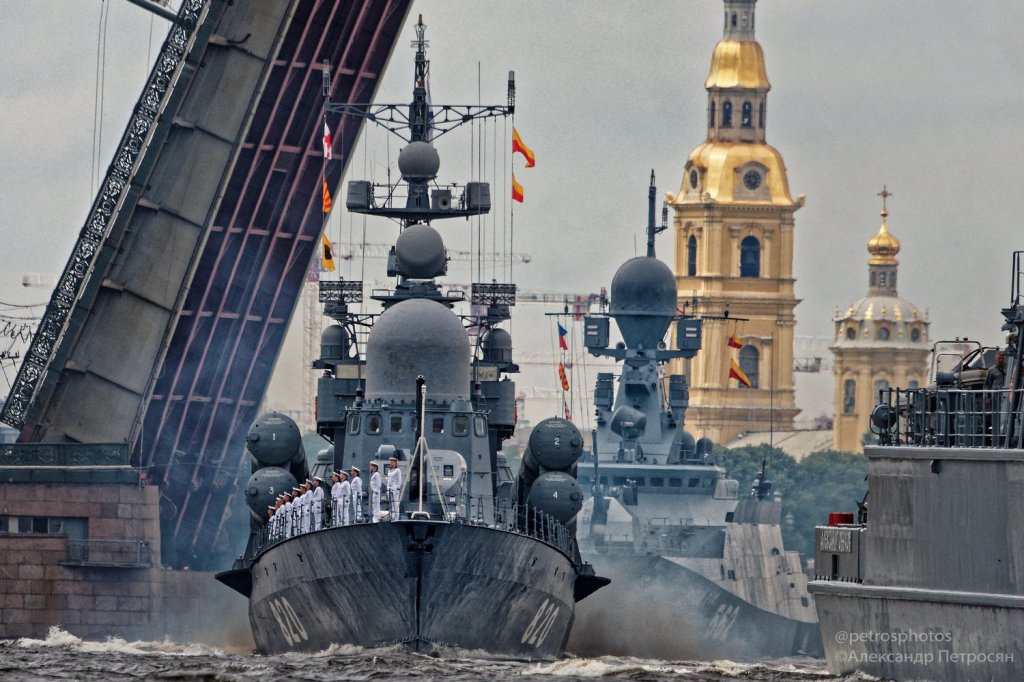
Russian naval vessels on parade on the Neva River in downtown Petersburg, July 2022. Photo: Alexander Petrosyan

I dreamt that all wars had ended and a united humankind was amicably celebrating good’s victory over human nature’s age-old curse.

Since my dream took place in Petersburg, the warships had been turned in recreational vessels, equipped with swimming pools, gyms, spas, dance halls, hotels, bars, restaurants, etc.

The towering masts were outfitted with convenient spots for those wishing to photograph the city’s river embankments from above. The deck was dotted with deck chairs, and the holds, instead of rockets and shells, housed barrels containing every variety of alcohol from around the globe!

I remember strolling around one of these ships, shooting a reportage about the triumphantly heavenly lives of its inhabitants, but I was not able to finish the dream. As always in the morning, the cat’s meowing and the children waking up on time woke me up. Otherwise, I would have been late for my next photo shoot.

Source: Alexander Petrosyan, Facebook, 25 July 2022. Translated by the Russian Reader


[…]

I never would have thought that I would speak out in defense of the Soviet Union. But now I am forced to do it.

I grew up in a small village in the middle of Russia. The adults in my life did not read samizdat and tamizdat, nor did they oppose the system — they just lived their lives. But from their conversations, loose talk, and slips of tongue, I was able to draw conclusions. I realized that I didn’t have to unconditionally believe the agitprop posters and the folks on the TV. Life was more complicated and, apparently, worse than the picture that the big bosses were trying to foist on us.

And yet there were certain things I took for granted. I knew that my country had clear, intelligible notions of good and evil, of how everything should work, and I considered them correct. Socialism had to emerged victorious. We didn’t seem to be doing everything right, but we knew what we were supposed to being doing.

To a large extent, of course, this belief was also based on a complete ignorance of how people actually lived outside the socialist bloc. There were simply no people in our midst who had seen it and could tell us about it. In our village, perhaps the only person who had visited this capitalist hell was my grandfather. He was in Vienna when the war ended. But he died before I was born, and besides, as my elders told me, he was a taciturn person and did not like to reminisce about his life.

I knew — just like Leonid Brezhnev, the guy on TV, who had fought in a real war — that it was wrong to even hint at using nuclear weapons. Nuclear war was terrible and the end of everything.

I also knew that we would never attack anyone. The Soviet Union had a militarist bent, and a sense of the coming war’s inevitability filtered into my childish mind. But there was only one possible scenario: the enemy would come to us, maybe even occupy our country, but then we would throw them out, win the war, and clean up the motherland. There was no other way. We wouldn’t attack first.

The Soviet Union, by the way, was bashful about its wars. It concealed its involvement in conflicts abroad. Only the Afghan War broke through the curtain of lies. I don’t know whether it was because of the magnitude, or because the giant was on its last legs and had even forgotten how to tell a fib.

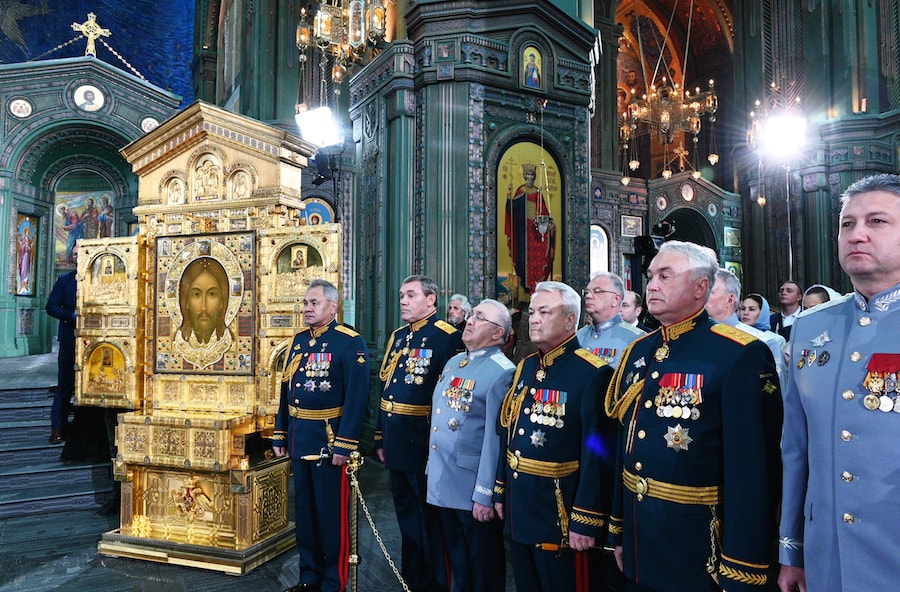
Russian Defense Minister Sergei Shoigu (far left) and Russian military officers at the consecration of the Main Cathedral of the Russian Armed Forces, 14 June 2020. Photo courtesy of Spektr

Modern Russia is not shy. Go to the Main Cathedral of the Russian Armed Forces in Patriot Park. It is worthwhile and instructive. There are mosaics depicting Russian soldiers and heroes — the heroes of the Battle of Kulikovo, the Patriotic War of 1812, the Great Patriotic War … and a huge panel depicting the heroes of the wars that the Soviet Union waged after the Second World War. The figures in the foreground are easily identifiable as “Afghans,” but the picture’s authors quite clearly hint that it’s not just about veterans of the war in Afghanistan.

Soviet ideology was putrid and phony, but there was also a real humanism in it that filtered through the rot and falsity.

Modern Russia doesn’t even have this going for it.

[…]

Source: Ivan Davydov, “An apology for the Union: which USSR Vladimir Putin is resurrecting,” Republic, 21 July 2022. Translated by the Russian Reader

De-Escalation

idlibSmoke rises after an airstrike hits a city center in Syria’s northwestern Idlib Province on March 13, 2019. Photo by Ahmet Rehhal. Courtesy of Anadolu Agency and the Middle East Monitor
Commander of Russian Airborne Forces Lands in Syria: Andrei Serdyukov Takes Charge of Russian Forces in Republic 
Ivan Safronov
Kommersant
April 12, 2019

Kommersant has learned that Lieutenant General Andrei Serdyukov, commander of Russian Airborne Forces, has taken charge of Russian troops in Syria. He replaces Lieutenant General Sergei Surovikin, commander-in-chief of Russian Aerospace Forces, who commanded the Russian military in the republic the last several months.

As we have learned, Serdyukov’s priority will be coordinating joint patrols by Russian military police and Turkish servicemen in the Idlib de-escalation zone, in which over 35,000 insurgents are amassed and over thirty facilities containing chemicals [sic] are located.

Several high-ranking military and diplomatic sources told Kommersant about Serdyukov’s appointment. They said he had taken up his new duties on April 10, replacing Suvorikin who, according to our sources, would again focus on his immediate responsibilities (commanding Russian Aerospace Forces) after returning from his latest Syrian deployment.

Yesterday, the Russian Defense Ministry refrained from official comments on the shuffle.

Our sources explained Suvorikin had spent over a year in total commanding Russian forces in Syria, longer than any of the other high-ranking officers who have occupied the post. While the Syrian campaign was underway, he was promoted from the post of commander of the Eastern Military District to the post of commander-in-chief of Russian Aerospace Forces (see our November 1, 2017, issue), but even after his promotion, he was rotated in and out of Syria to command not only the Russian air force but also regular combat troops and special ops units.

In keeping with the practice of rotating senior command personnel, Serdyukov could have been sent to Syria as early as September 2017. (Our sources said his combat experience in Chechnya and the operation to annex Crimea were significant advantages.) However, shortly before this was to take place, Serdyukov’s official vehicle, while returning from exercises in Murmansk Region, brushed against a car in the oncoming lane at full speed. Serdykov’s car flipped over several times and slid into a ditch. In hospital, he was diagnosed with head and back injuries, including a closed vertebrae fracture.

The general underwent a long convalescence during which there was no question of deploying him to a combat zone. Ultimately, Lieutenant General Alexander Zhuravlov, current commander of the Western Military District, was dispatched to Syria instead.

Serdyukov has now been deployed to Syria to perform a specific mission, said one of our sources. He will focus on accelerating the Russian-Turkish agreement to organize joint patrols in the demilitarized and deescalation zones in Idlib Province. Ankara and Moscow reached the agreement in 2018. They had originally planned to launch joint patrols of Russian military policemen and Turkish servicemen on October 15. However, as one of our sources noted, the Turkish side took responsibility for withdrawing insurgents and heavy weapons from the Idlib de-escalation zone into the demilitarized zone. The plans were thwarted, however. Due to an intensification of attacks by insurgents (especially those controlled by the Al-Nusra Front, an organization banned in the Russian Federation [sic]), the joint patrols did not begin on schedule, while insurgents remained in the demilitarized zone along with their heavy weapons.

The highest level of military diplomacy was put into motion to remedy the situation. Thus, in February 2019, Russian Defense Minister Sergei Shoigu and Turkish Defense Minister Hulusi Akar signed a supplementary memorandum outlining the actions to be taken by Russian and Turkish troops during their joint patrols. According to our sources, on March 8, Turkish troops began patrolling the demilitarized zone as situated between the Turkish observation posts at Barkum, Tel Tukan, and Surman. As of March 17, their patrols were extended to areas west of Aleppo and north of Hama and the mountains of Latakia. As of yesterday, according to our sources, a coordinated patrol by joint convoys of Russian and Turkish servicemen should have begun patrolling the contact line between the warring parties in the area between the Turkish posts at Barkum and Surman.

If these maneuvers are deemed successful, the two countries will commence joint patrols in the northeastern part of the de-escalation zone after April 20.

“We are counting on being able to launch coordinated patrols in the form of joint convoys inside the demilitarized zone in May,” our source in the Russian army added.

He said the de-escalation zone was divided into parts: into a withdrawal zone 3,300 kilometers square in area, containing 511 towns and villages, and over two million people, and a demilitarized zone as such. According to our source, the demilitarized zone had an area of 3,100 square kilometers and a total of 341 towns and villages, with an approximate population of 1,690,000 people.

Our source said the situation was exacerbated by several factors simultaneously. Aside from civilians in Idlib Province, there were over 35,000 armed insurgents. There were around 8,900 militants on the western front, and almost 15,000 on the southern front. They regularly carried out raids. The last raid took place in the wee hours of April 10, when the militants shelled the towns of Tall Al-Maktal (Idlib Province), Safsafa (Latakia Province), and Hamdaniya (Hama Province).

However, according to the Russian military, the Idlib de-escalation zone contains over thirty sites where chemicals are stored [sic]. Serdyukov would also have to try and solve this problem in cooperation with the Turkish military command, our source added. He specified that an invasion of Idlib by Russian ground forces was out of the question.

Translated by the Russian Reader

______________________________________

The Takeaway

Why would I translate and publish this dry-as-dust article from Kommersant about the new commander of Russian forces in Syria and how he will be handling joint patrols with the Turks in the Idlib demilitarized zone?

1. Whenever the Russian press has anything to say about Russia’s decisive, murderous adventure in Syria, it says it in this utterly depersonalized way, as if the real subject were an upcoming corporate merger.

2. Nevertheless, the only people who ever emerge as full-blown human beings in these scanty reports are members of the Russian high military command. Notice how General Serdyukov, the new Russian commander in Syria, has been given the loving touch by Kommersant.

3. Although I would argue that Russia’s successive invasions of Ukraine and Syria have had extraordinarily bad consequences for Russians back at home, especially the working class and the political opposition, you will search high and wide for meaningful discussions of Russia’s role in Syria in Russia’s opposition press and burgeoning social media.

4. The charitable way of putting this is that Syria is a taboo subject for Russians. I’ve already written about the uncharitable way of putting this so many times I’ve lost count, but it has no visible effect on anyone.

Most Russians are convinced Syria doesn’t matter to them. In fact, Putin’s Syrian campaign has probably destroyed the last chances they had at living in a more or less prosperous, democratic country in our lifetime.

5. It’s a timely reminder that the holy blessed “anti-imperialist” martyr Julian Assange has been supporting this regime of fascist Starship Troopers for years. This is not even a secret. If you demand Assange’s release while claiming solidarity with the Syrian Revolution, I think you should have your head examined.

6. But I wouldn’t insist on it, unlike the Putin regime’s satraps, who have increasingly resorted in recent years to compulsory psychiatric hospitalization of their opponents, evoking some of the darkest pages of Soviet history. {TRR}

P.S. My comrade Dick Gregory, who has published the blog News of the Revolution in Syria since 2012, posting a total of 4,036 entries during that time, had these important corrections to make to my remarks and, especially, Kommersant‘s exercise in pro-Putin and pro-Assad propaganda.

Obviously, there are a number of untruths [in the article], from the joint patrols, which they announced a couple of weeks ago and turned out to be entirely separate patrols, through the non-existent Al Nusra Front to the nonexistent chemical weapons in Idlib.

A piece in the Syrian Observer got me thinking. I actually tweeted the portion where the Syrian opposition spokesman was saying it was important for rebel groups not to fight each other; but I began to think Russia is not trying to start an offensive in Idlib, but wants to leave enough confusion about its activities, and to massively retaliate against civilians when there is any action by the rebels, in order to protect Assad against the possibility of the rebels launching an offensive, so Assad can be kept in power despite Russia having no real plan to restabilize the regime.

Al Nusra doesn’t exist, as it was shut down in 2016 by its former leadership as part of the break with Al Qaeda, and an attempt to broaden the appeal of that brand of Islamic jihadism. So, partly the Russians are just being as lazy as many westerners by continuing to use the old name. But the Russian bombing campaign in support of Assad, always presented as combating the threat from terrorists, was initially very largely directed at specifically FSA groups (to which the US may well have given them the coordinates,, supposedly so then they wouldn’t bomb them). That’s why the surviving rebel groups in Idlib are largely Islamist, because the Russians bombed out of existence the specifically secular ones.

Andrei Kolesnikov: Hooked on Militarism?

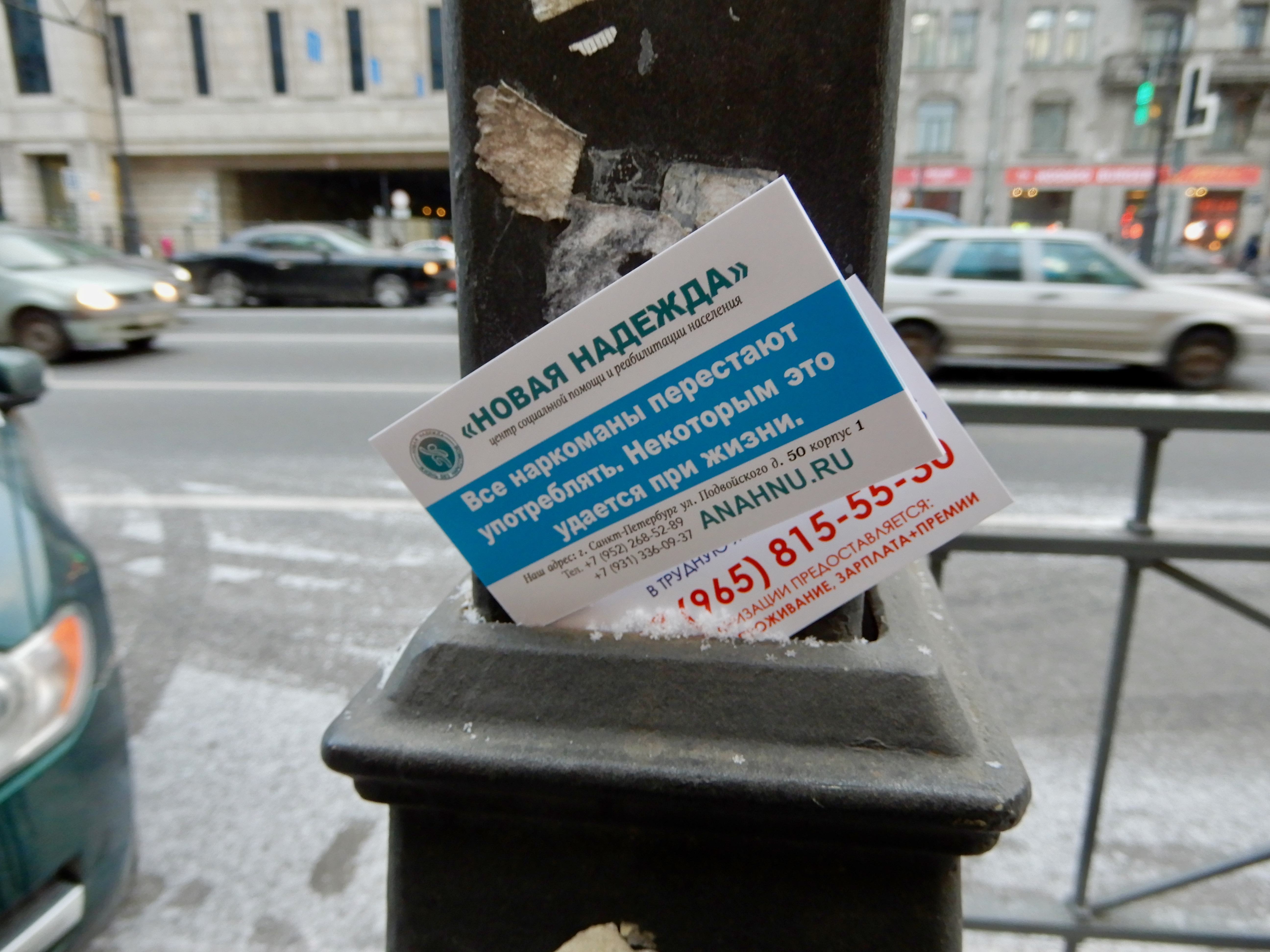
new hope“New Hope. All drug addicts quit using. Some manage to do it while alive.” Photo by the Russian Reader
Where Militaristic Infantilism Leads
Society’s Losing Its Fear of War Is More Dangerous Than What Happens in the Absence of an Anti-War Movement
Andrei Kolesnikov
Vedomosti
November 28, 2018

The “polite people” in the Russian military have taken to ramming ships, shedding their politesse. A military coming out has happened. Either so-called hybrid war has become more hybridized in terms of the variety of its methods or it has become more like good old-fashioned war, involving actual armed clashes. Politically, Russia has become not merely toxic but hypertoxic. A premonition of war prevails among more timid folks, although the footage of the ramming at sea, as painless and triumphal as a military parade on Red Square or a football match (“Crush him!”), still make military operations appear unscary and toylike. We will carry the day in any case, sans victims and blood (ours, that is), as in a cartoon by Putin.

This militaristic infantilism—the loss of the fear of war, the loss of the idea that war is terrible—is the worst outcome of our country’s daily intoxication with the thought of its own greatness for several years running. The army is greatly respected nowadays. People need to trust someone, and the armed forces have bypassed another institution, the presidency, in trustworthiness ratings.

Does this mean Russians are ready for a real war? To put it more plainly, are Russian parents willing to let their eighteen-year-old boys be called up to fight Ukrainian boys just like them? Does anyone understand what they would be fighting for? Is it really all about cementing the nation, “Crimea is ours!” and the personal ambitions of several high-ranking figures in the Russian establishment?

Since 2012, Russia’s collective identity has been built on negative foundations, on awakened resentment, which had been dozing, but had no thought of waking up. The plan has worked quite well. This resentment, however, is verbal and fictitous. Public opinion supported “coal miners” and “tractor drivers” verbally. In Syria, the official army and private military companies fought, or so Russians imagined, at their own risk. The proxy war with the US has gone very far at times, but in the summer of 2018 it did not stop the majority of Russians from abruptly improving their attitude [sic] to the States and the west in general.

But suddenly there is the threat of a real war. On the other side of the border, in the country [i.e., Ukraine] that the Russian imperialist mind never really considered sovereign, a mobilization is underway and martial law has been declared. Is this reality capable of changing popular opinion and rousing Russian civil society, which has a lot going for it except an anti-war movement? No, because so far the war has not been regarded as real.

Identification with the military is the last bullet in the Russian regime’s gun, but it is a blank or, rather, a prop. Exploiting what Russians regard as sacred—i.e., privatization of the memory of the Great Patriotic War [WWII] by a particular group—is a tool that is still in play, but militarism as such has lost its power to mobilize and consolidate Russians. If “German POWs” are marched around Novgorod on January 20, 2019, in an absurd attempt to reenact the NKVD’s Operation Grand Waltz, and on January 29, a military parade is held in St. Petersburg to mark the latest anniversary of the lifting of the Siege of Leningrad, it will not raise Putin’s approval rating from 66% to 80%. Those days are gone. So, the props have been dropped in favor of direct action in the Kerch Strait, but its power to mobilize people is not at all obvious.

You can cynically throw the ashes of those who perished in the Siege of Leningrad to stoke the furnace of fading ratings as much as you want. You can march people dressed up as German POWs round Novgorod as much as you like. When, however, pollsters ask Russians between the ages of eighteen and twenty-four what countries they regard as role models, they list Germany, China, and the US. This is not because young Russians are unpatriotic, but because not everything comes to down to the top brass feeding on the poisonous corpse of the Stalinist past. The present day, progress, and visions for the future matter, too.

Can we do it again? We cannot. Nor is there any reason to do it. Infantilized by the regime, Russian society’s maturation will be measured by the numbers of people who are convinced that we cannot and should not do it again.

Andrei Kolesnikov is program director at the Moscow Carnegie Center. Translated by the Russian Reader

Lilia Shevtsova: Gutting Russia

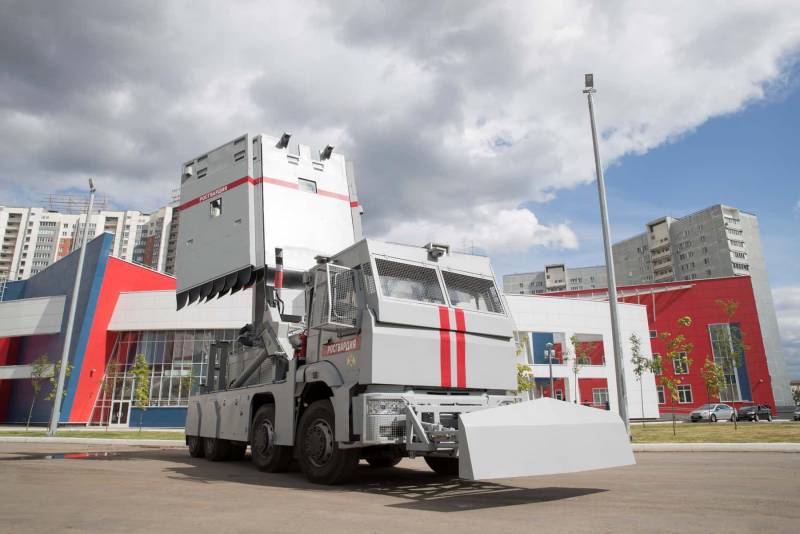
1535459018_stena-1The Wall, one of the Russian National Guard’s new toys for crushing popular unrest. Photo courtesy of Voennoe obozrenie
Lilia Shevtsova
Facebook
September 27, 2018

Gutting the State
“They are crazy!” we wail as we gaze at the regime’s latest stunts.

“What stupidity!” the commentators exclaim in horror as they compile the Kremlin’s list of shame: raising the retirement age; a high-ranking silovik threatening to kill Navalny in a duel; the fiasco of the so-called Salisbury tourists; vote rigging in the Maritime Territory; the Russian fighter plane shot down by the Syrians with our own rocket; the hole in our spaceship, patched up with epoxy; threats to ban use of the US dollar in Russia; more lies about Malaysian Airlines Flight 17; and Navalny’s latest arrest.

The regime’s attempts to rectify its blunders only exacerbate the circumstances, turning them into farces. Did annulling the election in Vladivostok restore people’s faith in elections? Were the elections in Vladimir Region and Khabarovsk Territory not turned into farces when the winners did their level best not to win? And what about the televised interview with the Salisbury tourists? What should we make of attempts to blame Israel for downing the Russian warplane, and the Americans for punching a hole in the Soyuz capsule? The latest act of shooting ourselves in the foot was supplying the Syrians with a S-300 surface-to-air missile system, which is a threat to Israel and, of course, the US. (The Israelis will most certainly respond.)

If we regard all these topsy-turvy achievements as the outcomes of stupidity, the hope emerges that we can fix the stupidity by purging the ranks of officialdom, which is exactly what the Kremlin, in fact, sunk its teeth into today. Actually, what we regard as failure and stupidity have long become the new normal. What we see are the outcomes of a monopoly on political power, which has turned its own replication into an end in itself, and of a negative selection of members of the political elite based on the loyalty principle. In short, a duelist in charge of the Russian National Guard, and poisoners disguised as tourists are the new Russian normal. They are logical and inevitable consequences.

The wailing about a crisis at the top is, therefore, groundless. Russia skipped over the crisis stage. A crisis is a natural turn of events that compels society to look for new solutions and new people to implement them. When this does not happen, society and its superstructures rot. This stinky viscous goo is our current location. Decay prevents collapse: what is rotting cannot collapse. But decay also prevents our country from finding the strength to change.

The ruling class can seemingly take it easy, for the system somehow hobbles along. There are no large-scale protests, and the protests that do occur can either be ignored or quashed, especially since the National Guard has special new crowd-control armored vehicles at its disposal like the Shield, the Storm, the Wall, and so on.

In reality, things have taken a serious turn for Russia. By seeking to ensure its endlessness, the regime has been destroying the Russian state. That is a whole other ballgame. We have reached the point at which the ruling class has been rocking the pillars of statehood, destroying its own guarantee of survival in the bargain.

By outsourcing violence to volunteer oprichniki, the regime has deprived the state of one of its vital attributes: a monopoly on violence. By making Russia a global scarecrow, the regime has undermined the country’s international status and the external habitat in which it dwells. By rejecting strategic planning in favor of tactical maneuvers, the regime has stripped the country of the capacity for progress. By making the Russian state a tool of clan domination, the regime has destabilized the country, since society has been forced to defend its own interests by protesting on the streets.

Finally, by destroying institutions and making the rules of the game relative (there is more than one way to “get things done: in Russia), the regime has plunged the country into a state of lawlessness. When lawlessness ensues, no one is safe from it.

Do the guys in the Kremlin not realize how things will end? Apparently, they do understand, but they are incapable of stopping.

The autocracy survived in 1991 by scrapping the Soviet state. The autocracy has now been trying to survive by turning the post-Soviet Russian state into a lip-synched song about superpowerdom.

Lilia Shevtsova is a well-known Russian political scientist. Translated by the Russian Reader

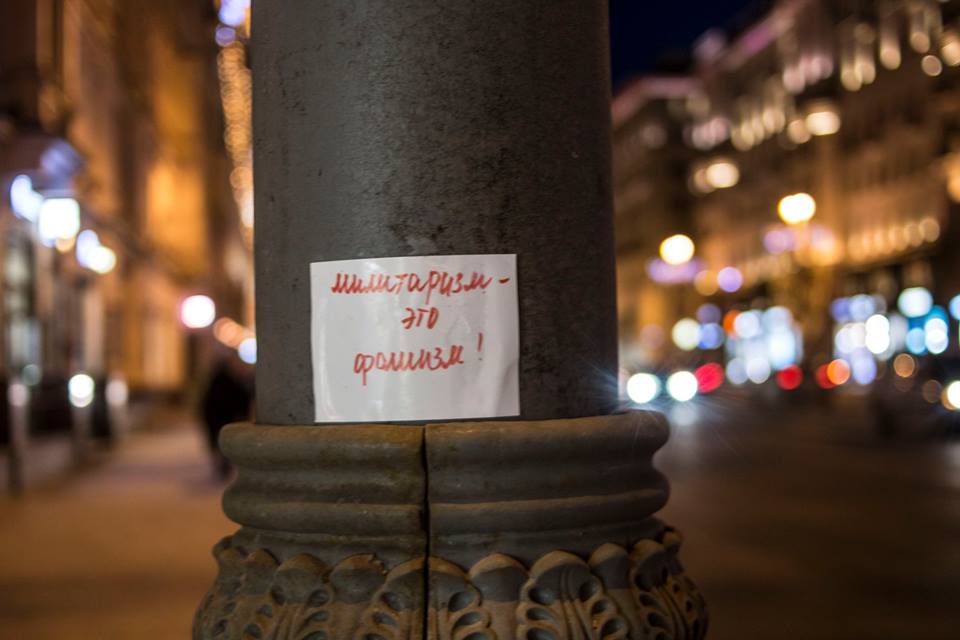
Militarism Is Fascism

Vadim F. Lurie
Facebook
March 19, 2018

An endless stream of Muscovites and out-of-town visitors headed to the concert marking the anniversary of Crimea’s “annexation.” And only the lonely voice of a man, heard by a few and jotted on a piece of paper on Tverskaya, quietly resisted the general hysteria.

Photograph by Vadim F. Lurie. Thanks for his kind permission to reproduce it here and translate his annotation. Translated by the Russian Reader

On the Warpath

21616160_10155926858106842_5598854945675305387_n

Andrey Kalikh
Facebook
September 19, 2017

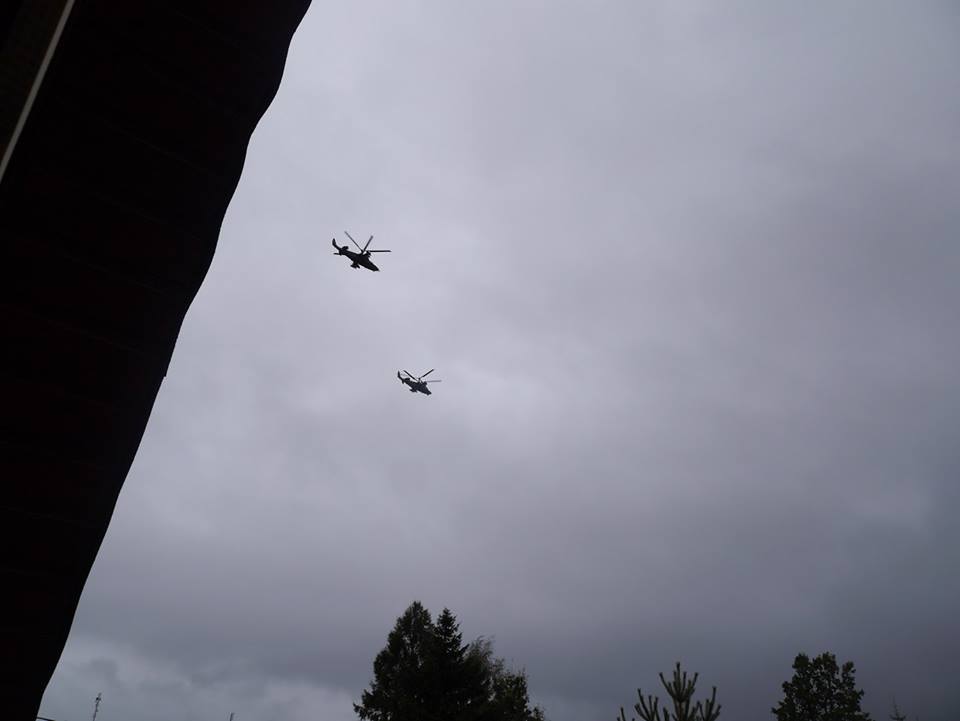
They are f***ed in the head. They are flying in droves over our house. They are launching rockets at random. They are Soviet rockets and they might fall on somebody. The wife urgently wants us to insure the house and wonders whether insurance would cover a chopper crashing in the garden.

Rusty jet engines are now roaring at the long-mothballed airfield in Siversky.

The roar of explosions is audible forty kilometers from the Luga Firing Range.

The apotheosis happened on the afternoon of the fifteenth, when Pavel Antonov and I were having a round table on Skype with European prosecutors. (A little cheeky, of course.) Suddenly, the house shook with a roar, black shadows flashed on the ground, and a multi-gunned monster flew out of the Mshinsk Marshes. Our sons counted twenty-four fully-equipped battle helicopters.

You in the west are quite right to be tense. But hang on. This country will destroy itself. That is how it has always been.

Translated by the Russian Reader. Photos courtesy of the author

21752583_10155926858131842_1066546113740130728_o

One Solution: Demolition

4561128
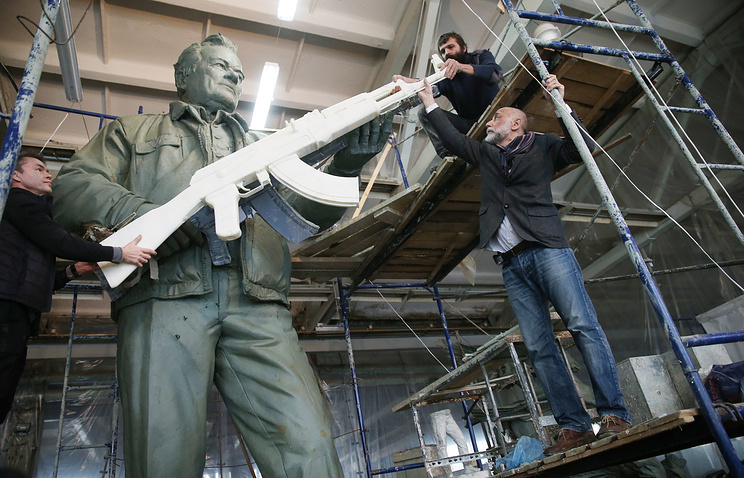
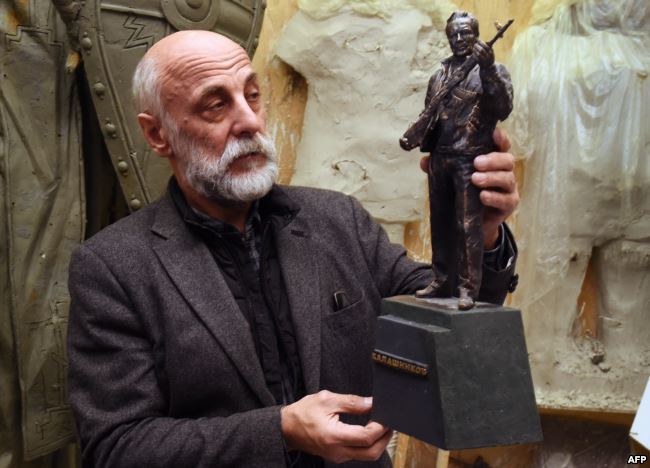
Sculptor Salavat Shcherbakov putting the final touches on his monument to weapons designer Mikhail Kalashnikov. Photo courtesy of Valery Sharifulin/TASS

Sergey Abashin
Facebook
September 19, 2017

Everything about the new monument in Moscow is disgusting. Once again, it is huge, and it shows us a non-military man holding a rifle. As an obvious symbol of militarism, it looks savage in the downtown of a major city. And then there is the very man the monument commemorates, who besides giving his surname to a lucrative arms brands apparently did nothing else for his country, let alone for a city in which he never lived.

Debates are underway about what to do with monuments when the context in which we view them has changed. Should we demolish them? We are not obliged to destroy them: we could move them to places where their symbolic baggage vanishes. Or would it be better to recode monuments where they stand by building something around them and thus imparting a new meaning to them? In my opinion, we have no choice in this case. There is no way to remedy this abomination. It can only be demolished.

Sergey Abashin is British Petroleum Professor of Migration Studies at the European University in St. Petersburg. His most recent book is Sovetskii kishlak: Mezhdu kolonializmom i modernizatsiei [The Soviet Central Asian village: between colonialism and modernization], Moscow: Novoe literaturnoe obozrenie, 2015. Translated by the Russian Reader

___________________

Moscow To Unveil Statue Of AK-47 Inventor Mikhail Kalashnikov
Tom Balmforth
RFE/RL
September 18, 2017

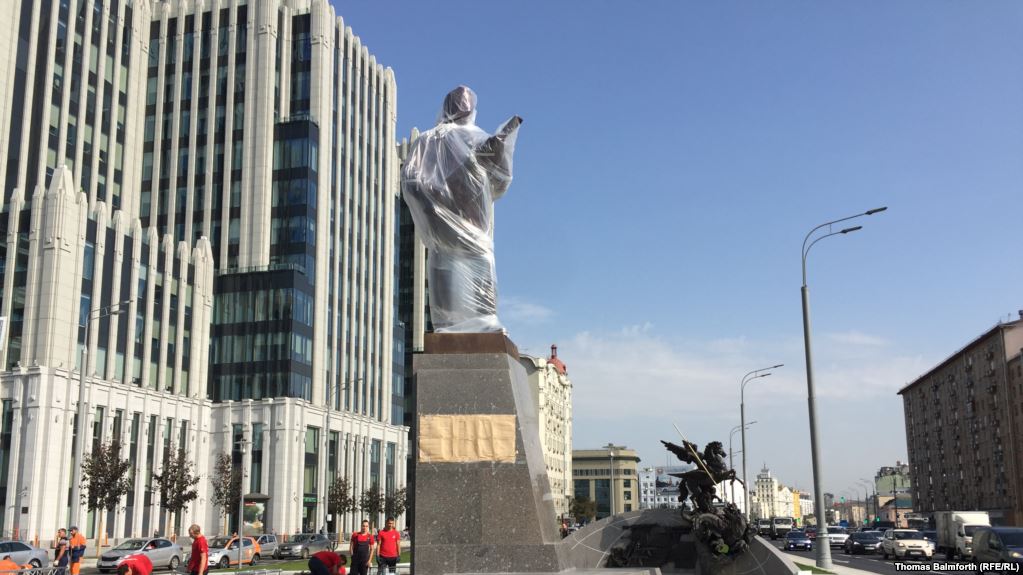
75AC53AB-0E8F-47DE-BC13-452E78BD5FBF_w1023_r1_sThe 7.5-meter tall statue to Mikhail Kalashnikov, which stands on a northern intersection of the Garden Ring around central Moscow.
MOSCOW — After several false starts and some grumbling from locals, a prominent statue of a gun-toting Mikhail Kalashnikov, designer of one of the world’s most ubiquitous weapons of war, is set to be unveiled in an official ceremony in the Russian capital on September 19.

The 7.5-meter metal likeness — still covered in plastic — features Kalashnikov cradling his eponymous AK-47 assault rifle and looking west down the Garden Ring that loops around central Moscow.

The statue was hoisted onto its plinth over the weekend beside a new business center.

A second metalwork sculpture, of St. George slaying a dragon with a spear tipped with a rifle sight with AK-47 written on it, stands nearby.

The Kalashnikov statues’ sculptor, Salavat Shcherbakov, is also the artist behind a towering 17-meter statue of Prince Vladimir the Great that was erected — amid controversy — outside the Kremlin in November at a ceremony attended by President Vladimir Putin.

A4E87823-7F31-405E-A58C-7FE440CBDC33_w650_r0_sRussian sculptor Salavat Shcherbakov presents a model for a monument to Mikhail Kalashnikov, Russian designer of the AK-47 assault rifle, at his workshop in Moscow on November 10, 2016.
Shcherbakov told TASS news agency that the rifle was added to his original plan for the Kalashnikov statue because people might not recognize him without his signature contribution to the Soviet Army.

“So we dared to include the rifle after all,” Shcherbakov said.

Other prominent statues in the vicinity include statues to poets Alexander Pushkin and Vladimir Mayakovsky.

Russian Culture Minister Vladimir Medinsky presented plans to Putin for the Kalashnikov statue in September 2016 during a tour of the Kalashnikov arms manufacturer, headquartered in Izhevsk, the capital of the republic of Udmurtia.

The project was backed by the Russian Military-Historic Society, which is chaired by Medinsky and Rostec, the state weapons and technology conglomerate run by powerful Putin ally Sergei Chemezov.

Moscow Mayor Sergei Sobyanin, Medinsky, Chemezov, and Kalashnikov’s daughter, Yelena Kalashnikova, were expected to attend the unveiling ceremony on September 19.

The statue was originally meant to be unveiled on January 21, marking the day in 1948 when Soviet Defense Minister Dmitry Ustinov signed a decree ordering the construction of an experimental batch of Kalashnikov rifles.

But the ceremony was moved because of inclement weather to May 8, ahead of Victory Day, and then to September 19, Gunmaker Day.

Not everyone is on board with the project.

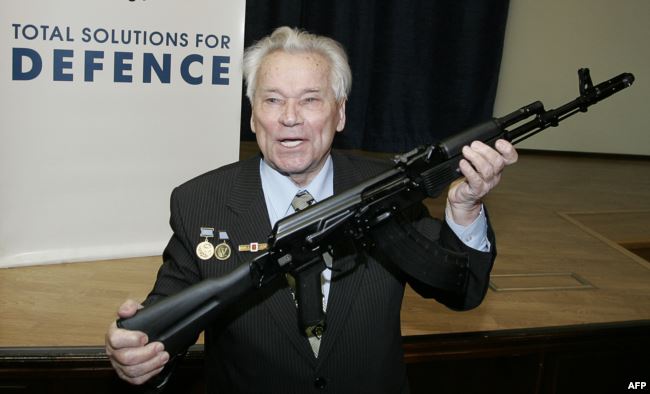
7926FEAF-D770-479A-84A0-0FB57CC87D96_w650_r0_sMikhail Kalashnikov with one of his fabled assault rifles in 2006.
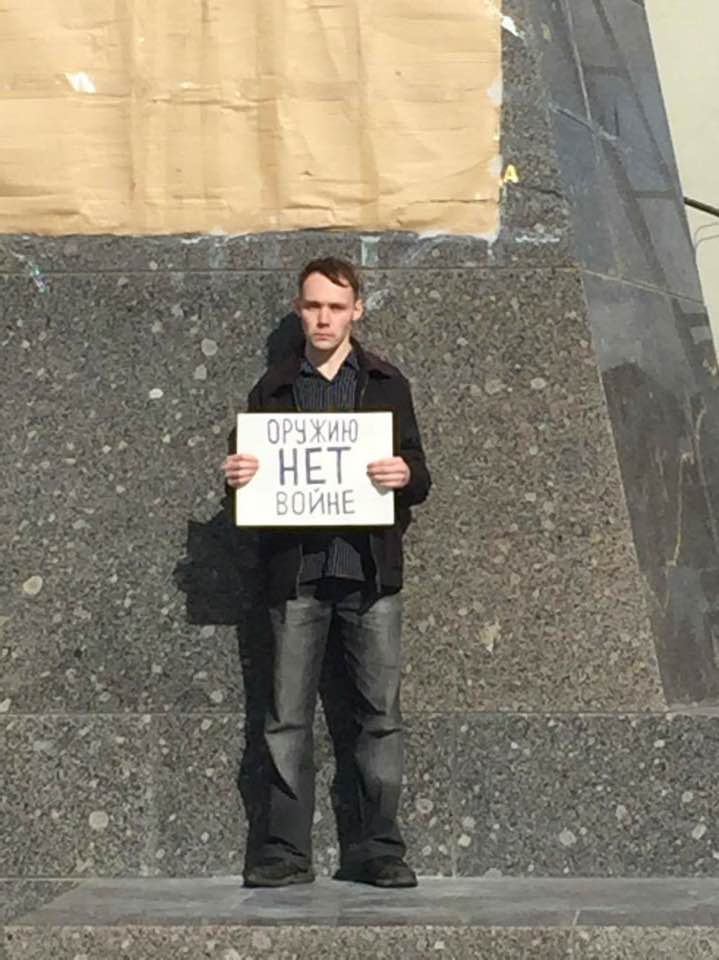
Veronika Dolina, a local resident, posted a photograph of an apparent protester at the still-shrouded Kalashnikov statue holding a sign that said, “No to weapons, no to war.” She wrote: “Man at Kalashnikov pedestal. Humble hero, no posing.”

21731069_1536832173044144_5241152260190270688_n
“No to weapons, no to war.” Photo courtesy of Veronika Dolina/Facebook

Resident Natalya Seina told 360, a local media outlet, “This is not artistic, to put it mildly. This is trash. It’s loathsome.” She also noted how Kalashnikov had lived his life in Izhevsk, not Moscow, unlike playwright Anton Chekhov and poet Aleksandr Pleshchev. “These are probably more worthy people than the creator of a rifle.”

There are estimated to be as many as 200 million Kalashnikov rifles around the world —prompting one expert to label it “the Coca-Cola of small arms” — and they are manufactured in dozens of countries.

Mikhail Kalashnikov died in 2013 at the age of 94.

Defenders of the Fatherland: Yunarmiya and the Personality Cult

Russia Has Surpassed the Soviet Union: I Would Only Learn German Because Putin Spoke It
Liana Turpakova
Vechorka
February 24, 2017

Russian TV channels were dominated by the February 23 holiday yesterday. The topic of war and patriotism was off the scale at a concert held to mark the holiday, as broacast on Channel One.

Yunarmiya performing during Defender of the Fatherland Day concert, 23 February 2017, Moscow. Still from youtube.com
I watched Flight Crew, but switched to NTV during the advertising breaks. NTV was showing a film about a cop. The ad breaks on RTR and NTV would coinicide sometimes, and I would switch to Channel One. I switched one too many times and ended up watching a performance by the Katyusha Children’s Center for Aesthetics and Beauty and the patriotic organization Yunarmiya (“Youth Army”). I never did figure which was which. They are like the Young Pioneers, apparently. The kids were reciting poems with feeling and a sense of meaning, and pausing at all the right spots,  adoration beaming from their faces.

One girl recited a poem in the style of Mayakovsky, which ended as follows: “And though I were an old man getting on in years, really, in fact, basically, I would learn to speak German only because Putin had spoken it.”

The audience applauded, of course, and the camera switched to a shot of VVP and Defense Minister Shoigu, seated in the first row. They didn’t smile, but looked on seriously. Shoigu said something to Putin.

I was a Young Pioneer during the Brezhnev era. We recited lots of poems with a patriotic filling, and if they mentioned the names of Soviet leaders, those leaders were dead. I am talking about Lenin. At the time, there were no panegyric verses about the then-General Secretary of the Soviet Communist Party. Words of gratitude were spoken, and there were slogans, but children, at least at my school, did not memorize anything of the sort. Odes to the living leader of the country were composed and declaimed only under Stalin. The parallels are obvious. And they say that insanity flourished in the Soviet Union.

I’ll take another potshot at this ecstatic orgy. How do you like the idea of building a mock-up of the Reichstag, in Patriot Park in Kubinka, for the Yunarmiya kids to storm? As Shoigu noted, they would thus have “a specific location to storm, not just any old place.” We’re talking about the same Yunarmiya kids who performed the doggerel about Putin. I am sure they fought it amongst themselves over how who would get to recite the punchline about the country’s biggest VIP. It was the girl who gets straight A’s at school and whose comportment is impeccable.

The Reichstag in Berlin. Photo courtesy of dw.com

I’m not against promoting love for one’s country. But this business about German and Putin is clearly overkill. By the way, it used to be a joke. Now it’s a patriotic poem. The times have changed.

Holiday Concert in Celebration of Defender of the Fatherland Day, 23 February 2017, in its entirety. Originally broadcast on Channel One in Russia

Translated by the Russian Reader