Kyrgyzstan: Pro-Russian Outpost in Central Asia and Cannabis Heaven?


When Sadyr Japarov took power in Kyrgyzstan in 2020, he was a young, energetic nationalist president determined to build his own authoritarian power vertical—the first leader to pull it off since Askar Akayev. For decades the country had been notoriously unstable: storming parliament was practically a standard feature of the political repertoire.

Japarov had already begun edging closer to Moscow before 2022, but Russia’s full-scale invasion of Ukraine handed him a historic opportunity. Kyrgyzstan quickly became one of the Kremlin’s main cryptocurrency hubs for shadow trade. The scheme was orchestrated by Ilan Shor, the fugitive Moldovan oligarch notorious for the “billion-dollar theft” from Moldova’s banking system. At the same time, Moscow and Shor built a propaganda network in the country under the brand “Eurasia.”

Yet loyalty to Moscow has so far delivered Bishkek surprisingly few tangible dividends. Kyrgyz citizens working in Russia face the same harassment and discrimination as other Central Asian labor migrants. The only concrete assistance the Kremlin has provided is a few hundred school buses and plans to build nine Russian-language schools.

The War and “Our Own”

Which post-Soviet state drew markedly closer to Moscow after Russia’s full-scale invasion of Ukraine? Georgia immediately comes to mind—and for good reason. After years of rule by the “Georgian Dream” party, society proved unable to resist a corrupt system that had steered the country toward Moscow. Politicians warned citizens that any show of solidarity with Ukraine could turn Batumi into another Mariupol. Today Prime Minister Irakli Kobakhidze openly recounts how he was pressed to open a “second front” against Russia, even as the Georgian Border Police simultaneously denies entry to both anti-war Russians and residents of Crimea and Donbas carrying Russian passports.

But there is another mountainous nation that has followed a strikingly similar path. Once the most volatile and politically turbulent state in Central Asia—where pro-Russian and pro-Western media and NGOs coexisted—Kyrgyzstan has transformed into a textbook post-Soviet autocracy.

You can still enter Kyrgyzstan on a Russian internal passport, but if you are an opposition activist the authorities may simply hand you back. The human-rights project “Ark” advises its clients not to remain in the country even temporarily. This is not standard practice among Moscow’s formal allies: in Kazakhstan, the odds of avoiding deportation are noticeably better, and local activists are far more willing to assist Russians.

telling case is that of a young Kyrgyz man named Samat. He held dual citizenship—his parents had obtained Russian passports while he kept his Kyrgyz one. After completing compulsory military service in 2019, he signed a contract with Russia’s Defence Ministry and failed to terminate it before the war began, despite trying. In March 2022 he managed to flee back to Bishkek. Smart cameras linked to the CIS wanted-persons database spotted him at the airport. He was arrested and taken to a pre-trial detention center in Bishkek. What happened to him next is unknown; no media outlet ever followed up.

Ironically, local residents who volunteered to fight for Russia—whether as regular contract soldiers or Wagner mercenaries—have also ended up behind bars. Outcomes vary. Askar Kubanychbek uulu was sentenced to ten years for mercenaryism but was released on a three-year probation period. He promptly returned to Russia and signed another Defence Ministry contract.

Such legal contradictions are common across Central Asia, but they have flourished most extravagantly in Kyrgyzstan thanks to pervasive corruption and a weak judiciary. Even so, Bishkek still maintains a certain distance from Moscow’s direct orders. In Tajikistan, for example, not a single citizen has been charged with mercenaryism for fighting in Ukraine; the prosecutor-general explained last year that anyone who accepts Russian citizenship must “observe the requirements and obligations of that state.”

Reliable data on Central Asians recruited into the Russian army come from the Ukrainian project “I Want to Live“: Uzbekistan (4,955), Tajikistan (3,489), Kazakhstan (2,420), Kyrgyzstan (1,474), and Turkmenistan (581). The relatively modest Kyrgyz figure reflects simple demography—a small country with a modest population. Yet by every other measure of loyalty, Kyrgyzstan now ranks among Moscow’s most reliable post-Soviet partners, second only to Belarus.

Just Don’t Irritate Them

In the first days after the invasion, every Eurasian state felt the ground shift. Even in Central Asia, where leaders usually comment on global affairs only in the vaguest terms, governments were forced to take a position.

Japarov, then in office for barely a year, chose the safest possible tone. “The situation is complex and has worsened in recent days,” he told parliament. “We are a small country with no influence to stop the conflict, so we must remain neutral. We are already seeing rising food and fuel prices and a stronger dollar. In these difficult times we need unity.”

He repeated the “small country” line in an April interview with the state news agency Kabar. That appears to be Bishkek’s genuine stance: no hidden agenda, no double game. Claims that Japarov “condemned Kyiv’s failure to implement the Minsk agreements” or “supported Russia’s decisive actions” should be left to the Kremlin’s press service.

Kyrgyzstan’s version of neutrality, however, has its own flavor. Compare it with neighboring Kazakhstan, where President Kassym-Jomart Tokayev consistently affirms international law and maintains contact with Volodymyr Zelensky. Even after the lavish welcome he gave Putin in Astana in May 2022—calling the Russian leader’s mission “fateful for the Russian people and the Russian state”—Kazakhstan’s position could still be described as neutrality, albeit with a clear northern tilt.

In Bishkek, neutrality is simpler: do nothing that might annoy those who can make life difficult. Above all, that means Moscow and Beijing. The Japarov government regards relations with those two capitals as the only ones that truly matter.

Kyrgyzstan cannot expect serious Western investment anytime soon, so it has little to lose by keeping its head down. Besides, Japarov built his political career in large part by confronting Western capital. One of his signature achievements was the nationalization of the Kumtor gold mine from Canada’s Centerra Gold. The mine passed fully under state control in 2022, though experts question how effectively the new owners are running it.

Japarov has continued tightening state oversight of foreign investment, limiting the list of deposits open to foreigners and drafting a new Mining Code. Curiously, he has proposed using British law to resolve disputes; a special International Dispute Resolution Centre based on UK rules opened in February 2025 in the Tamchy investment zone on Lake Issyk-Kul.

Had Japarov’s background been different, he might have joined the conversation about rare-earth metals that Donald Trump loves so much. But at the first Central Asia-US summit in Washington, the Kyrgyz president was noticeably more restrained than his colleagues. While Tokayev told Trump he was “sent from above” and Uzbekistan’s Shavkat Mirziyoyev declared that only the American president could stop the war in Ukraine, Japarov spoke through a Kyrgyz-language interpreter and focused on the digital economy and artificial intelligence—both in the main session and in his brief one-on-one meeting with Trump.

Among the issues raised by Sadyr Japarov was hydropower—in particular, preparations for launching the Kambarata hydroelectric power station. Mining was conspicuously absent from his remarks. That is hardly surprising: Kyrgyzstan has virtually no remaining deposits attractive enough for the kind of large-scale joint ventures Donald Trump prefers.

The Authoritarian Turn

Kyrgyzstan’s growing distance from the West has allowed its new elites to extract maximum value from Russia while consolidating domestic power without apology. Japarov’s rise in 2020 marked the republic’s decisive shift to a rigid vertical of power and full-blown authoritarian rule. According to Freedom House, Kyrgyzstan was still rated “partly free” in 2019 with a score of 38 out of 100. It has since fallen to 25 points—firmly in the “not free” category.

During this period the country adopted a new constitution that dramatically expanded presidential authority, along with a law on non-commercial organizations that many describe as a local version of Russia’s foreign-agent legislation. The logic is identical: any NGO receiving foreign funding must register as a “foreign representative” and be placed on a public list. The registry went live in September 2024 but has grown slowly—starting with three organizations and now standing at just five. For now, NGOs apply for inclusion themselves. The law is also easily circumvented by re-registering as a limited-liability company (OOO), the Kyrgyz equivalent of an LLC.

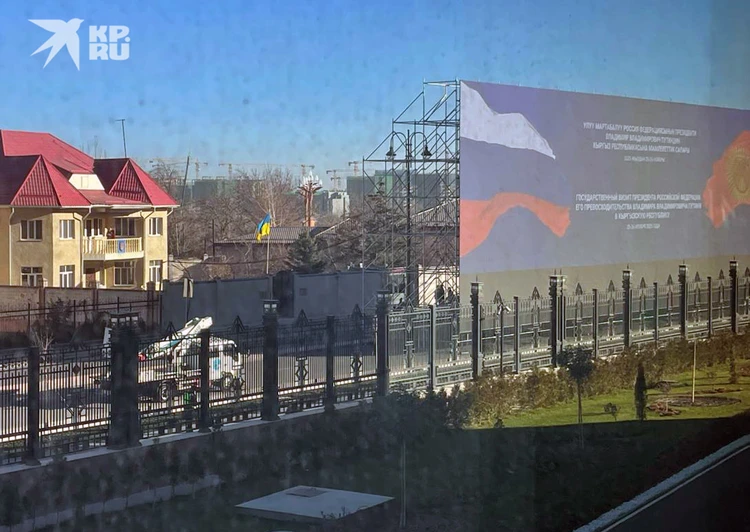
A vivid illustration of Bishkek’s loyalty to Moscow came during Vladimir Putin’s visit to Bishkek in November 2025. The new presidential residence sits next to the Ukrainian embassy. To ensure that Putin, walking along the avenue to the main entrance, would not see the Ukrainian flag—and that Ukrainian diplomats would not see the leader of the aggressor state—authorities erected a massive screen directly in front of the embassy. It displayed the flags of Russia and Kyrgyzstan along with greetings to the Russian president.

The Kremlin’s Financial Hub

Kyrgyzstan’s self-proclaimed “neutrality” has turned the country into a convenient instrument for Moscow to evade Western sanctions, including in the military-technical sphere. Setting up a legal entity in Kyrgyzstan is straightforward—especially an LLC. Russian businesses no longer need local partners; they can simply incorporate their own company and route transactions through it. Corrupt customs procedures and notably liberal currency and cryptocurrency regulations only add to the appeal.

In 2022, Kyrgyz exports to Russia jumped 2.5 times to $920 million. The subsequent surge never materialized; trade volumes stabilized. By the end of 2025, exports had actually declined 13.4 percent. Analysts attribute the drop to a deliberate reduction in re-exports.

Western sanctions began hitting Kyrgyz firms in 2023, when the U.S. Treasury added Weitmann Handeln Allianz LLC—a supplier of computers to Russia—to its list. Other equipment exporters followed, but banks only came under fire in 2025.

The first and most prominent target was the state-owned Keremet Bank. According to the U.S. Treasury, it assisted Russia’s Promsvyazbank (PSB) with overseas operations. PSB is the financial backbone of the Russian military and defense industry; its chairman is Pyotr Fradkov, son of former prime minister and ex-SVR chief Mikhail Fradkov.

The same Treasury notice mentioned another notable name: Moldovan oligarch Ilan Shor. After siphoning roughly a billion dollars from Moldova’s banking system, Shor relocated to Russia and threw himself into political projects. He has worked with PSB since at least 2024, using the bank to funnel money into Moldova ahead of elections. It was therefore no surprise that Keremet appeared in the same schemes.

Later, the Financial Times published an investigation into the ruble-pegged stablecoin A7A5, created by PSB specifically to circumvent sanctions. Trading in the coin took place on Grinex, an exchange registered in Kyrgyzstan. In April 2025 the exchange suffered a cyberattack that wiped out roughly a billion rubles’ worth of user funds. By then, its ties to both PSB and Shor were an open secret. Project head Oleg Ogienko had stated in February that up to 10 percent of Russia’s foreign-trade settlements flowed through the coin.

A parallel instrument with a similar name also exists: the payment agent A7, another PSB-linked project that allows businesses and individuals to transfer money abroad without SWIFT. Its CEO is likewise Ilan Shor.

After the U.S. sanctions, Britain and the European Union followed suit against Keremet. London also targeted two other Kyrgyz banks—Capital and the Eurasian Savings Bank—along with the state brokerage firm and a virtual-asset issuer. The same institutions (plus Tolubay) appeared in the EU’s 19th and 20th sanctions packages.

The most significant consequence of the EU’s 20th package for Kyrgyzstan was the introduction of sectoral restrictions: the bloc now prohibits exports of CNC machine tools and data-transmission equipment (switches and routers). This is the first such precedent and could have a noticeable deterrent effect on the willingness of regional states to provide Russia with technical assistance. While Kyrgyzstan itself has few high-tech industries, the restrictions could deliver a serious blow to neighboring Kazakhstan and Uzbekistan.

According to Moldovan outlets Rise Moldova and IPN, Shor has become deeply embedded in Kyrgyz elites; President Japarov himself has reportedly used aircraft from Shor’s companies. The Russian investigative outlet Proyekt claims that Roman Abramovich serves as Shor’s patron within Russian elite circles. It was with Abramovich’s backing, the outlet asserts, that Shor launched both the A7 project and the large-scale sanctions-evasion scheme built around cryptocurrency in Kyrgyzstan.

The Humanitarian Dimension

When asked about helping Russia circumvent sanctions, Kyrgyz officials usually respond with flat denials. Last year President Japarov reframed the issue in familiar terms—combating “foreign agents.”

“We suggested that Ambassador [of the United States] Vigeri invite independent auditing firms to examine Keremet and Capital banks, review the results together, and then make a decision,” he declared. “They refused… They simply claimed to have certain information. But we know perfectly well where it comes from. It comes from local NGOs and our internal adversaries who send them anonymous false reports.”

There was one notable exception. Speaking at SPIEF-2025, Temir Sariyev, chairman of Kyrgyzstan’s Chamber of Commerce and Industry, openly acknowledged that “when the special military operation began, the first country that extended a hand without fear was the Kyrgyz Republic. Others followed later. This prompts Russia to regard the KR as its most reliable partner—in both business and politics. Reliability is a very rare and scarce commodity.” Sariyev did not spell out the nature of the assistance, but everyone in the room understood: he was referring to the provision of loopholes for gray imports and parallel financial transactions.

Such candor is driven by straightforward pragmatism. Bishkek had hoped that loyalty would bring tangible benefits for Kyrgyz labor migrants in Russia. Officials have repeatedly complained that EAEU membership has not delivered the expected advantages—particularly access to medical care and schooling for children.

The introduction of mandatory Russian-language testing made the situation worse for all children with foreign citizenship living in Russia. Kyrgyz representatives raised the issue without success. From next year onward, Russia is imposing even stricter rules on migrants, with an exemption granted only to citizens of Belarus. In all regions except Moscow and Moscow Oblast, the hiring of foreigners will be permitted solely through organized, targeted recruitment programs.

At the same time, Moscow announced in 2023 plans to build nine joint Russian-Kyrgyz schools in Kyrgyzstan with mixed teaching staffs. Three are promised for 2027. Any mention of the project reliably irritates Russian nationalists, yet the Kremlin uses the rapprochement with Bishkek to bolster its image among the Kyrgyz population as well.

It is in Kyrgyzstan—according to the limited polling available—that public solidarity with Moscow over Ukraine is highest. A 2024 Paper Lab survey found that 36 percent of respondents blamed Ukraine for the war, 14 percent blamed Russia, and 13 percent blamed the United States. These figures largely reflect media consumption patterns: Russian outlets dominate the foreign-media landscape. In 2024 Bishkek launched the pro-Russian television channel Nomad, which is linked to both Ilan Shor and RT and is headed by a former RT employee.

Another Shor project, the non-profit organization Eurasia, has also expanded significantly. In other post-Soviet states it has mainly organized propaganda tours for young people, flying selected students and schoolchildren to Moscow for lectures by pro-Kremlin speakers. In Kyrgyzstan, thanks to the authorities’ accommodating stance, the organization has been able to operate locally. Bishkek now boasts an Eurasia Park, a Russian-language support center, and a network of social stores under the same brand. In September 2024 the organization donated 50 school buses to rural districts.

The newest objective of ANO Eurasia in Kyrgyzstan is the creation of a unified educational space with Russia. The initiative, according to Kyrgyz officials, came from Bishkek rather than Moscow—and specifically from President Japarov. At SPIEF-2025, First Deputy Prime Minister Daniyar Amangeldiev stated: “Vladimir Vladimirovich supported the initiative of our president. I know that ANO Eurasia is already working on this issue; let us define our joint next steps.”

One practical outcome appears to have been the recent meeting of the Russian-Kyrgyz expert-consultative council on history, organized in Moscow by the Russian Military-Historical Society. Scholars from both countries discussed the content of school textbooks and clashed sharply over whether the period of Russian imperial rule in Central Asia should be described as the “colonization” of the Kyrgyz people. The Russian side, as expected, insisted on alternative wording—”administration” or “administrative measures”—that the Kyrgyz scholars found unacceptable. Academician Abylabek Asankanov remarked: “You are setting us an extremely difficult task—to abandon the word ‘colony.’ That is very hard to do.”

Such friction was predictable. Despite Bishkek’s calculations that closer ties with Moscow would solve financial problems and provide protection, nationalist and anti-imperial sentiments remain strong in Kyrgyzstan. They are also an important part of Sadyr Japarov’s own political brand. In April, for example, he promised to rename the remaining villages that still bear Russian names—only for his press service to disavow the statement the following day.

In seeking to consolidate personal power in a traditionally turbulent country, Japarov has bet on Moscow as a source of external legitimacy. While some of his efforts have been appreciated in the Kremlin, he should not count on serious long-term support. Years of experience have shown that the Kremlin never clings to any particular politician in Kyrgyzstan; it assumes the country is already firmly within Russia’s orbit. Yet by his actions Japarov is helping Moscow entrench itself still more deeply in the republic.

The combination of Russian propaganda among the population and the corrupt ties linking local officials and banks to Russian structures provides a sufficiently reliable guarantee that Kyrgyzstan will remain the most pro-Putin country in Central Asia for the foreseeable future. The price is secondary sanctions and the risk of falling behind in the development of genuinely competitive economic sectors.

Source: Roman Chernikov, “Putin’s Outpost in Central Asia,” Riddle Russia, 6 June 2026


In his 1986 novel Plakha, translated into English as The Scaffold, Chingiz Aitmatov, Kyrgyzstan’s great writer, tells the story of Avdiy Kallistratov, an idealistic young man who joins a group of drug smugglers travelling to a remote corner of Central Asia. To Kyrgyzstan, to be precise, where large swathes of cannabis grow wild in the picturesque Issyk-Kul region.

Aitmatov describes in vivid detail the brutal process of harvesting and trafficking the drug by a criminal group. But how close is this depiction to reality?

This is a question I put to Gulzat Botoeva, Associate Professor of Criminology at Swansea University and an expert on illegal economies in Eurasia, including cannabis production in Kyrgyzstan. We discuss how the harvesting began, who benefits from it, and how local authorities respond to the phenomenon. Is there any incentive in Kyrgyzstan to legalise the crop?

Here is a list of Gulzat’s publications on the topic:

Botoeva, G. (2014). Hashish as cash in a post-Soviet Kyrgyz village. International Journal of Drug Policy, 25(6), 1227-1234.

Botoeva, G. (2019). Use of language in blurring the lines between legality and illegality. In Governance Beyond the Law: The Immoral, The Illegal, The Criminal (pp. 67-83). Cham: Springer International Publishing.

Botoeva, G. (2021). Multiple narratives of il/legality and im/morality: The case of small-scale hashish harvesting in Kyrgyzstan. Theoretical Criminology, 25(2), 268-283.

Source: Agnieszka Pikulicka, “Episode 41: Hashish and survival in rural Kyrgyzstan,” Turan Tales, 4 June 2026


Botoeva, G. (2015). The monetization of social celebrations in rural Kyrgyzstan: on the uses of hashish money. Central Asian Survey34(4), 531–548. https://doi-org.mpc.idm.oclc.org/10.1080/02634937.2015.1092742

This article focuses on the embeddedness of hashish production in the local economy of Toolu, a village in Kyrgyzstan. It explores how transformations in social relationships and the monetization of gift giving put constant pressure on families to find cash in a semi-subsistence agricultural economy. Although not produced on an industrial scale in the community, hashish is used as a cash crop in times of deficit. Based on a mixed-methods study combining ethnographic fieldwork with survey data, I show how the hashish economy is intertwined with different forms of reciprocal relationships based on gift-giving practices and the monetization of social relationships. In doing so, I illustrate how the hashish economy is embedded in local livelihoods and shapes emerging forms of economic morality in Kyrgyz society.

Source: EBSCO Host


This documentary is an ethnobotanical and cultural exploration. It does not promote or facilitate the sale of cannabis or cannabis-related products. In Episode 3, the expedition moves deeper into Kyrgyzstan’s highlands as the Strain Hunters cross paths with one of Central Asia’s most iconic cultural gatherings — the world-famous Nomad Games. Set against the dramatic mountain landscape, the games offer a rare glimpse into the traditions, skills, and nomadic heritage that have shaped life in this region for centuries. Leaving the celebrations behind, the team continues their journey into increasingly remote terrain. As they explore valleys and high-altitude environments shaped by wind, cold, and time, the Strain Hunters encounter some of the most promising wild cannabis populations of the expedition — plants that show clear adaptation to their harsh surroundings. Through careful observation and documentation, the team identifies ancient landrace traits that reflect cannabis’ long history in Central Asia. These encounters represent a key moment in the journey, deepening our understanding of cannabis diversity and reinforcing the importance of preserving rare genetics before they disappear. This expedition is brought to you by Green House Seed Co. and GH Medical, continuing our mission to explore the planet, preserve rare genetics, and document cannabis culture worldwide.

Source: Strain Hunters and Green Seed Co (YouTube), 25 December 2026


BISHKEK — Kyrgyz cannabis is reputed to be among the most potent in the world, making it a lucrative cash crop for drug traffickers.

It appears ironic, then, that a homegrown addiction specialist in Bishkek wants marijuana to be legalized to reduce the number of Kyrgyz drug addicts, fight organized crime, and increase tax revenues.

Jenishbek Nazaraliev, a former presidential candidate who opened Bishkek’s first private narcology clinic in 1993, wants the Kyrgyz government to consider a pilot program for the legal production of cannabis near Lake Issyk-Kul.

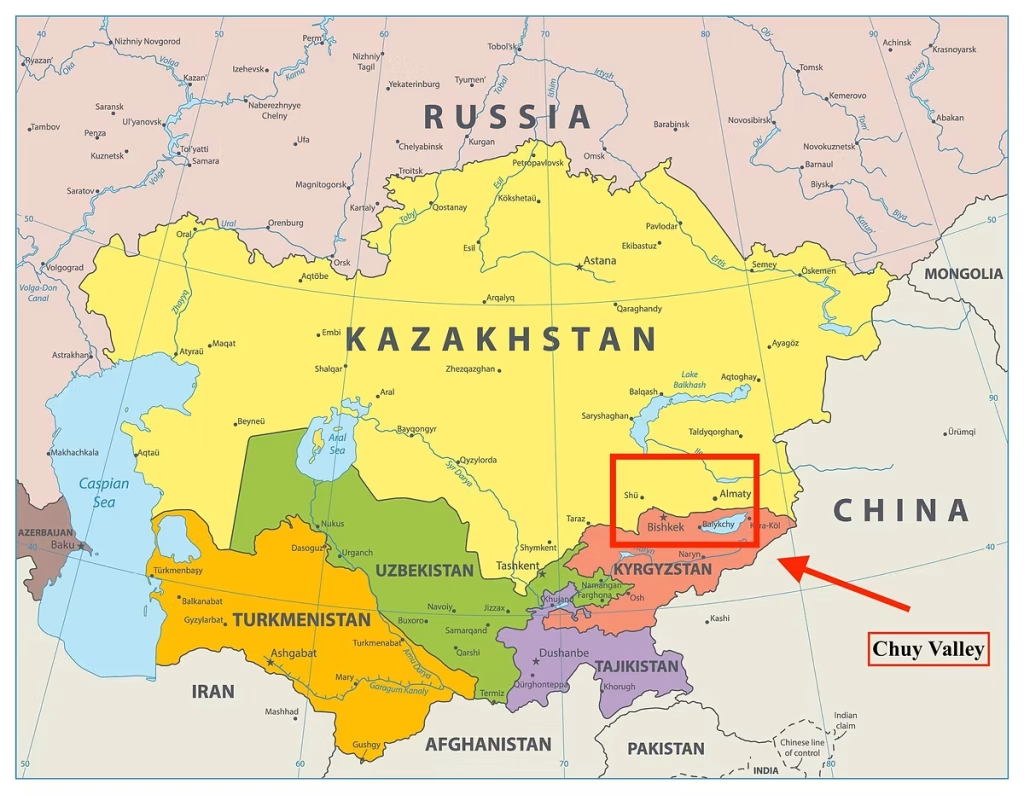
Rivaling the potency of marijuana from Afghanistan, international experts say cannabis is already being harvested by about two-thirds of all the families in Kyrgyzstan’s Issyk-Kul and Chui regions.

Pot plants grow wild on thousands of hectares of land there. During the first eight months of 2013, up through the annual August harvest, Kyrgyz authorities say they destroyed more than 154 tons of cannabis in the Issyk-Kul region alone.

Nazaraliev says more effective regulation over the production and sale of marijuana is an issue that eventually must be tackled by the government.

He says the illegal drug market in Kyrgyzstan is now “fully controlled by the black economy.”

Nazaraliev also argues that the producers, sellers, and consumers of cannabis could be better controlled — and that the government would bolster its tax revenues — if pot were legalized.

But Kyrgyzstan’s State Drug Control Service disagrees. Authorities there say winning the battle against drug traffickers is the key to social stability and development in Kyrgyzstan.

And they argue that legalization won’t rein in organized criminal traffickers because Kyrgyz-grown cannabis is exported through a network that extends far beyond Kyrgyzstan’s borders — a smuggling route for illegal Afghan cannabis, opium, and heroin that passes through Kyrgyzstan on its way to Russia and the European Union.

Naked Harvest

RFE/RL’s Kyrgyz Service has spoken with villagers in the Tiup and Ak-Sui districts around Lake Issyk-Kul who are involved in the harvest and sale of Kyrgyz cannabis.

For centuries, cannabis has been harvested in Central Asia by horsemen who would ride naked through wild cannabis patches and then scrape the resin from their skin and the hair of their horses.

But most villagers around Lake Issyk-Kul now harvest the drug by rubbing cannabis plants between their palms to get a layer of black resin that they scrape off with a knife and package in matchboxes.

Local dealers buy the drugs from the harvesters and then sell them to bigger dealers who tour the area, forwarding their purchases abroad through international trafficking channels.

Kyrgyz villagers who harvest cannabis every August make no secret about paying bribes to police who turn a blind eye.

For their part, local police tell RFE/RL it would be impossible to eradicate a trade that is integral to the survival of so many people.

Former Kyrgyz Vice President and Prime Minister Feliks Kulov — who also headed the National Security Service — suggested during the 1990s that state-managed cannabis farms near Lake Issyk-Kul could help the authorities control drug production in the country.

But Kulov’s proposal was derailed by critics who cited the negative experiences of opium growers in Afghanistan.

Nazaraliev, the narcologist who wants the authorities to reconsider legalization, ran in Kyrgyzstan’s 2009 presidential election under the campaign slogan “Everything is Within your Reach.”

He is now asking the authorities in Bishkek to consider whether “progressive European countries” and U.S. state governments that decriminalize marijuana care more about the health and welfare of their citizens than Kyrgyzstan.

Source: “Addiction Doctor Wants Kyrgyzstan To Legalize Pot,” RFE/RL Kyrgyz Service, 7 January 2014
Central Asia and Russia(n): Is It Farewell?

Excerpt from “Tashkent: The End of An Era” (Mark Weil, 1996). A full, subtitled copy of the film can been seen here.

Recent trends in world politics have led several analysts to emphasize the idea of the retreat or recession of Russian power abroad. Yet few have commented on a key aspect of this retreat, namely the growing movement across Central Asia to unseat the Russian language from its position, often enshrined in law, as an official language on a par with the native tongue. Trends across the region demonstrate state action to diminish the role of the Russian language, growing political discussion of the issue, or socio-economic trends working to reduce the hegemony of the Russian language. These trends also display both Russia’s mounting anxiety about such trends and its increasingly visible inability to reverse or stop them.

BACKGROUND

Russia’s recent reversals in Syria, Venezuela, the Caucasus and potentially Iran have triggered a flood of articles proclaiming the retreat of Russian power. However, none of these writings noticed the parallel ongoing dethronement of the Russian language from its previous eminence in Central Asia. Nevertheless, this epochal development, like Russia’s aforementioned geostrategic defeats, possesses profound political as well as cultural significance.  Given the importance of linguistic policies in the Tsarist, Soviet, and now post-Soviet regimes, the retreat of the Russian language from a position of linguistic-political primacy in Central Asia signifies major political and cultural transformations.

Specifically, Kazakhstan’s new constitution subtly but overtly downgrades the status of Russian as an official language. Article 9 of the new constitution establishes Kazakh as the dominant language of the country, relegating Russian to the status of an official language used by the government “alongside” Kazakh. This new constitution obtained massive public support although much of it was probably engineered from above, forcing Putin to congratulate President Tokayev on its ratification.  However, those congratulatory remarks, as Tokayev and his team well know, probably came through clenched teeth and were preceded by much Russian public criticism of Kazakhstan’s language policies.

An analysis of Russian press perspectives on the return of Kazakhstan’s Latin alphabet, originally introduced in the 1920’s, from the Cyrillicization of the alphabet during the height of Stalinism, displays a politicized perspective where this process is seen as a repudiation of a Russian orientation in favor of a Turkic-Western one. Insofar as Turkey and Western powers like the EU and the U.S. have stepped up their presence and interest in Kazakhstan and Central Asia as a whole, this politicized perspective sees language and alphabet policies as manifestations of the growing regional presence of those parties at Moscow’s expense. Thus, Russian press coverage warns Central Asian audiences against alleged foreign plots of an imperialist nature.

Russian media also minimize or deny the agency of Kazakhstan and other Central Asian states in formulating and then executing their own alphabet and language policies while implicitly and often overtly extolling the superior, imperial role of Russia’s language and culture as a vehicle for connecting Central Asia with modern civilization and culture. In other words, much of this literature reflects an imperial echo with deep roots in late Tsarist and then Soviet imperial policies that Russian elites seek to preserve.

IMPLICATIONS

Kazakhstan’s assertion of its linguistic sovereignty challenges the Russian dream of maintaining its cultural-political hegemony over Central Asia because it is losing the means to enforce that claim on Kazakhstan and because Astana’s example is being replicated across Central Asia, e.g. in Uzbekistan and Kyrgyzstan. In Uzbekistan, as a 2024 paper makes clear, Russian must coexist if not compete with Uzbek and Tajik while English, a global lingua franca, is rapidly gaining on it as well. In Kyrgyzstan, Kazakhstan’s example has simultaneously stimulated debates on emulating its language policy.

Predictably the Russian government, sensing another threat to its receding hegemonic pretensions, has reacted strongly. On March 19, its embassy in Bishkek forcefully demanded that Kyrgyzstan’s government suppress “provocative statements of certain public figures” about the place of Russian in Kyrgyz society. The statement also complains about “language patrols” where vigilantes purportedly try to intimidate people to stop speaking Russian and speak only Kyrgyz. The embassy deemed such calls incitement to ethnic hatred and a threat to Russo-Kyrgyz strategic partnership and, in a conscious echo of Soviet propaganda, “deep alliance between our fraternal peoples and countries – Russia and Kyrgyzstan.”

This atavistic employment of Soviet tropes is no accident. Whereas Lenin’s language policies, likely inspired by his father’s work in teaching Orthodoxy to Muslims, wagered that teaching socialism would lead Soviet Muslims to socialism; Stalin decisively imposed Russification by giving the Russian language primacy and Cyrillicizing Central Asian alphabets. Putin’s consistent attacks on Lenin’s nationality policies, many of which stemmed from an appreciation of socio-political realities during the early Soviet period, reflect his clear preference for the centralizing, Stalinist, and more openly imperialist policies of Stalin and his successors.

Nevertheless, a generation after independence and having devoted much effort to fostering large-scale national identification among their populations, Central Asian leaders are openly moving to assert not just their foreign policy sovereignty, but also their linguistic nationalism. The use of Russian across Central Asia will likely remain pervasive because of the benefits it offers in economic relations with Russian and possibly Central Asian entities. However, Russian will not be the only regional lingua franca or the language of Russian imperial hegemony either in the Caucasus or in Central Asia. Since we can readily imagine a similar outcome in Ukraine due to Russia’s war against the country, which underlies many of the causes for the retreat of Russian hegemony, the trends discernible in Central Asia go far beyond its borders.

CONCLUSIONS

Even as the Russian government is currently discussing legislation allowing it to intervene anywhere abroad on behalf of its citizens, Central Asian developments presage the ongoing erosion of Russian cultural and thus political power. The whole idea of the “Russkii Mir” (Russian World) based on speakers of the Russian language that furnishes a pretext for interventions abroad is rapidly falling to pieces. From Tsarist and Soviet times, Russian authorities consistently regarded Russian as the sole “civilized” and therefore hegemonic language of the empire and often sought to enforce that hegemony by coercion. Those days are visibly ending as Central Asian governments are, with increasing confidence, asserting their own native tongues while also opening up to greater economic-cultural interaction with other countries. While Russian will not disappear in Central Asia; it is being decentered and increasingly deprived of its superior legal-political standing.

This process is clearly linked to the global recession of Russian power even as Russia fights to retain its erstwhile imperial and global great power status. For its rulers, expression of that status through all the forms of cultural power, e.g. alphabets and languages, was a critical component of empire. Yet what we see today, despite Moscow’s threats or even forceful efforts to arrest or reverse that decline, is an imperial sunset that evidently cannot be stopped either in culture or in hard power.

AUTHOR’S BIO

Stephen Blank is a Senior Fellow with the Foreign Policy Research Institute, www.fpri.org.

Source: Stephen Blank, “The Retreat of the Russian Language from Central Asia,” Central Asia-Caucasus Analyst, 23 April 2026


When anthropology researcher Ashley McDermott was doing fieldwork in Kyrgyzstan a few years ago, she says many people voiced the same concern: children were losing touch with their indigenous language. The Central Asian country of 7 million people was under Russian control for a century until 1991, but Kyrgyz (pronounced kur-giz) survived and remains widely spoken among adults.

McDermott, a doctoral student at the University of Michigan, says she also heard that some kids in rural villages where Kyrgyz dominated had spontaneously learned to speak Russian. The adults largely blamed a singular force: YouTube.

McDermott and a team of five researchers across four universities in the US and Kyrgyzstan have released new research they believe proves the fears about YouTube’s influence are valid. The group simulated user behavior on YouTube and collected nearly 11,000 unique search results and video recommendations.

What they found is that Kyrgyz-language searches for popular kid interests such as cartoons, fairy tales, and mermaids often did not yield content in Kyrgyz. Even after watching ten children’s videos featuring Kyrgyz speech to demonstrate a strong desire for it, the simulated users received fewer Kyrgyz-language recommendations for what to watch next than, surprisingly, bots showing no language preference at all. The findings show YouTube prioritizes Russian-language content over Kyrgyz-language videos, especially when searching or browsing children’s topics, according to the researchers.

“Kyrgyz children are algorithmically constructed as audiences for Russian content,” Nel Escher, a coauthor who is a postdoctoral scholar at UC Berkeley, said during a presentation at the school last week. “There is no good way to be a Kyrgyz-speaking kid on YouTube.”

McDermott recalls one frustrated Kyrgyzstani mother in 2023 explaining that she paid the internet bill a day late each month to regularly have one day without internet and, thus, YouTube at home.

YouTube, which has “committed to amplifying indigenous voices,” did not respond to WIRED’s requests for comment. The researchers are attempting to meet with YouTube’s parental controls team to discuss the potential for language filters, according to Escher.

The researchers say their work is the latest to show how online platforms can reinforce colonial culture and influence offline behavior. Under Soviet control, people in Kyrgyzstan had to learn Russian to succeed. Today, many adults are fluent in both Russian and Kyrgyz, with Russian remaining important for commerce. Kids are required to learn at least some Kyrgyz in school. But many spend several hours a day online, and watching YouTube is the leading activity, McDermott says. Quoting from Russian language videos is common, whether creators’ refrains like “Let’s do a challenge,” adaptations of American words such as “cringe,” or parroting accents and syntax.

In one of the researchers’ experiments, they searched for several subjects which are spelled the same in Russian and Kyrgyz, including Harry Potter and Minecraft. The results were predominantly Russian. Overall, just 2.7 percent of the videos the research team analyzed appeared to even include ethnically Kyrgyz people.

YouTube “socializes youth to view Russian as the default language of entertainment and technology and to view Kyrgyz as uninteresting,” the researchers wrote in a self-published paper accepted to a social computing conference scheduled for October.

The researchers say there is ample Kyrgyz-language children’s content for YouTube to promote. In 2024, the 35th-most viewed channel on YouTube across the world was D Billions, a Kyrgyzstan-based children-focused content studio with a dedicated Kyrgyz-language channel that has nearly 1 million subscribers.

Azamat Duishenov, head of the program management office for D Billions, tells WIRED that their team believes Kyrgyz content helps promote the language. Duishenov suspects YouTube may find it worthwhile to err toward recommending content in Russian because Russian speakers outnumber Kyrgyz ones.

The researchers suggest potential remedies to parents such as creating playlists of Kyrgyz-language content or sharing devices with their children. When the researchers simulated adult users watching non-kid’s content in Kyrgyz, they received predominantly Kyrgyz-language recommendations. Then, when kids later used the same device, they experienced a moderate uptick in exposure to Kyrgyz-language videos, despite younger users gravitating toward Russian content during their sessions.

Source: Paresh Dave, “This Indigenous Language Survived Russian Occupation. Can It Survive YouTube?” Wired, 1 May 2026


The Hidden Face of the Confessional Empire: Islamophobia in Russia | A book talk by Paolo Sartori

Thursday, May 7, 2026 | 12:00 PM — 1:15 PM CT

Online

Please join the East Asia Research Forum as they host a Zoom talk with Paolo Sartori.

Description:

In May 1854, the Russian imperial authorities arrested Ishan Muhammad Sharif Mansurov on suspicion of conspiratorial activities. The investigation, which lasted about nine years, sparked a media frenzy and rumors of possible mass unrest in the Kazakh steppe on religious grounds, and drew public attention, including from ruling circles. Why was the figure of the Sufi Mansurov of such interest to the colonial administration, and what danger did he pose? What knowledge did government officials possess regarding Sufism in the Kazakh steppe at that time? By analysing the documentary traces left by the Mansurov case, I offer a set of reflections on the relationship between the Russian confessional state and Islamophobia.

Speaker Bio:

Paolo Sartori (PhD 2006) is Distinguished Fellow of the Austrian Academy of Sciences where he presides over the Committee for the Study of Islam in Central Eurasia. He is the author of A Soviet Sultanate: Islam in Socialist Uzbekistan (1943-1991) and, more recently he has guest-edited a theme issue on Russian Colonialism for the Slavic Review.

Please register for this online event.

Source: PlanIt Purple Events Calendar (Northwestern University)


My guest today was born in 1991, the same year as the independent states of Central Asia. A few years ago, he set out to explore what’s happened in the former Soviet republics since the collapse of the USSR, and whether they have flourished over the last 35 years without the “big brother” Russia.

His book, Farewell to Russia: A journey through the former USSR, has just been published in the UK and the US. His name is Joe Luc Barnes, and you might also recognise his voice from our audio documentaries. In this episode, we talk about his book, travelling and living in Central Asia, and the (often problematic) craft of travel writing.

Source: Agnieszka Pikulicka, “Episode 33: Lessons on independence from the former Soviet republics,” Turan Tales, 18 March 2026


Mark Weil, who has died aged 55 after being stabbed on his way home from a rehearsal, was the founder and director of the first independent theatre in the Soviet Union – the Ilkhom, in the Uzbek capital, Tashkent. To this day, the Ilkhom remains the only venue for original, uncensored drama in a country where freedom of expression is severely limited. An extraordinary man, he created an artistic space in which people could ask questions and explore their experience.

Born in Tashkent, Mark was not an Uzbek but a Russian Jew, part of the world of central Asian Russians that is now disappearing. Russian-speaking, but with much of the style and gentleness of Asia, these people were insiders, but often with the outsider’s powers of perception. Russian traders had first come south to central Asia during the Arab empires (a cross-cultural theme that Mark loved) but the Russian presence really took off in the Soviet era. An intellectual, nonconformist scene began to grow. Solzhenitsyn’s time in Tashkent (in 1953) became Cancer Ward. Mikhail Bulgakov’s widow managed to hide the manuscript of The Master and Margarita until it was safe to publish.

This eclectic, offbeat world was Mark’s heritage. He studied drama in Moscow and St Petersburg in the early 1970s, but returned to take his MA in history and artistic theory in Tashkent in 1974. In 1976, he opened the Russian-speaking Ilkhom – the word means “inspiration” in Uzbek – with a piece of improvisation that came straight from central Asian street culture, called Makharaboz-76 (Clown 76). Throughout the Brezhnev era, he staged the debuts of young playwrights at the Ilkhom, the only theatre in the Soviet Union that had no state funding.

After the collapse of the USSR and birth of the new country of Uzbekistan, Mark made contacts with foreign theatre groups, thrilled to meet experimental, thoughtful people from all over the world. The Ilkhom company took its shows to France, Germany and Italy. In 1988, he visited Seattle and held workshops at US universities. But along with new freedoms came disappointments. President Islam Karimov’s rule became ever more authoritarian.

Most Russian-speaking intellectuals queued for Russian passports and got out. Mark did not. “This is my city, I was born here, and I will never leave,” he often said. But he never courted collision with the authorities. He simply got on with his work.

In the 1990s, Mark set about a huge project close to his heart, a documentary history of Tashkent. He hunted down and restored lost archive of the city, and added his own footage. Laughing wryly, he told me how he went out to film part of the medieval quarter that was being ripped down and built over with flats. “I was just standing quietly, filming, when the foreman saw me. With no warning, the shovel swivelled round and tipped its load over my camera and tripod, and broke it.”

With the government denouncing “foreign” entertainment, the Ilkhom produced Brecht (a constant in the repertoire) and Gozzi (1992). It put on a musical version of John Steinbeck’s Tortilla Flat (1996). It staged Edward Albee’s Zoo Stories (2005). It examined the forbidden theme of homosexuality through the short stories of the Uzbek writer Abdullah Kadiri. Mark relied heavily on foreign partnerships, including the British Council, to fund these ventures, but money was extremely tight. The actors worked for almost nothing.

Disaster struck Uzbekistan in May 2005, when thousands gathered to call for jobs and a better life in the ancient eastern city of Andijan. The army moved in and shot dead about 500 people, almost all of them unarmed. The government denied this account – it said it had scotched an Islamic uprising – but refused an international inquiry. It then closed down many foreign agencies, while others left in protest. For the Ilkhom, its vital sources of funding were reduced still further.

Mark was attacked on his way home from the dress rehearsal of Aeschylus’s tragedy, the Oresteia. It was to have been a triumphal start of a new season, in the bleakest times, and he was thrilled by the production and its exploration of revenge and the rule of law. He is survived by his wife Tatyana and daughters, Julia and Aleksandra. His death has not been reported in Uzbekistan.

· Mark Yakovlevich Weil, theatre director, born January 25 1952; died September 7 2007

Source: Monica Whitlock, “Mark Weil,” Guardian, 10 October 2007

Little Kyrgyzstan

Moscow’s Little Kyrgyzstan (2017)

Since the collapse of the Soviet Union in 1991, the Russian Federation has become one of the most important destinations for immigration in the world, second only to the United States and equal to Germany. Unlike Europe, however, the majority of people going to Russia aren’t political refugees and asylum seekers, but economic migrants looking for employment opportunities.

Most of the migrants are from the former Soviet space, with Central Asia at the forefront of this massive human flow. Tens of thousands leave the republics of Kyrgyzstan and Tajikistan every year to find seasonal employment in Russia’s main cities. Many stay for years, others never return, but their remittances form an important share of their country’s economy. The World Bank estimates that, in 2014, money sent back home by migrants represented 36% of Tajikistan’s GDP, and 30% of Kyrgyzstan’s.

Moscow’s Little Kyrgyzstan presents the story of ten immigrants from Kyrgyzstan living in Moscow, showing the diverse reality of millions of immigrant workers in Russia in their own words. It also broaches various themes that affect their everyday lives, such as the overbearing and corrupt Russian bureaucracy, harassment from the police, and anti-immigrant sentiment among the general population. It looks into the effect of the current economic crisis in Russia on the lives of migrant workers and the changes that followed Kyrgyzstan’s entry into the Kremlin-led Eurasian Economic Union in August 2015.

To provide context, the stories of the ten characters are punctuated by comments from two leading Russian experts on migration—Dmitry Poletaev and Valery Solovei—as well as an exchange between participants to a round table in Moscow on the need to introduce a visa regime for Central Asian migrants to Russia.

Credits:
Franco Galdini, Producer & scriptwriter
Chingiz Narynov, Director
Susannah Tresilian, Narrator
Soundtrack by Salt Peanuts

For more on the story visit:
https://thediplomat.com/2017/03/a-glimpse-into-moscows-little-kyrgyzstan/

_________________

Thanks a billion to Bermut Borubaeva for the heads-up. The extraordinary challenges faced by Central Asian migrants in Russia have been an abiding theme of this website over the nearly thirteen years of its existence and will continue to be in the future. // TRR

Migrant Worker Blues

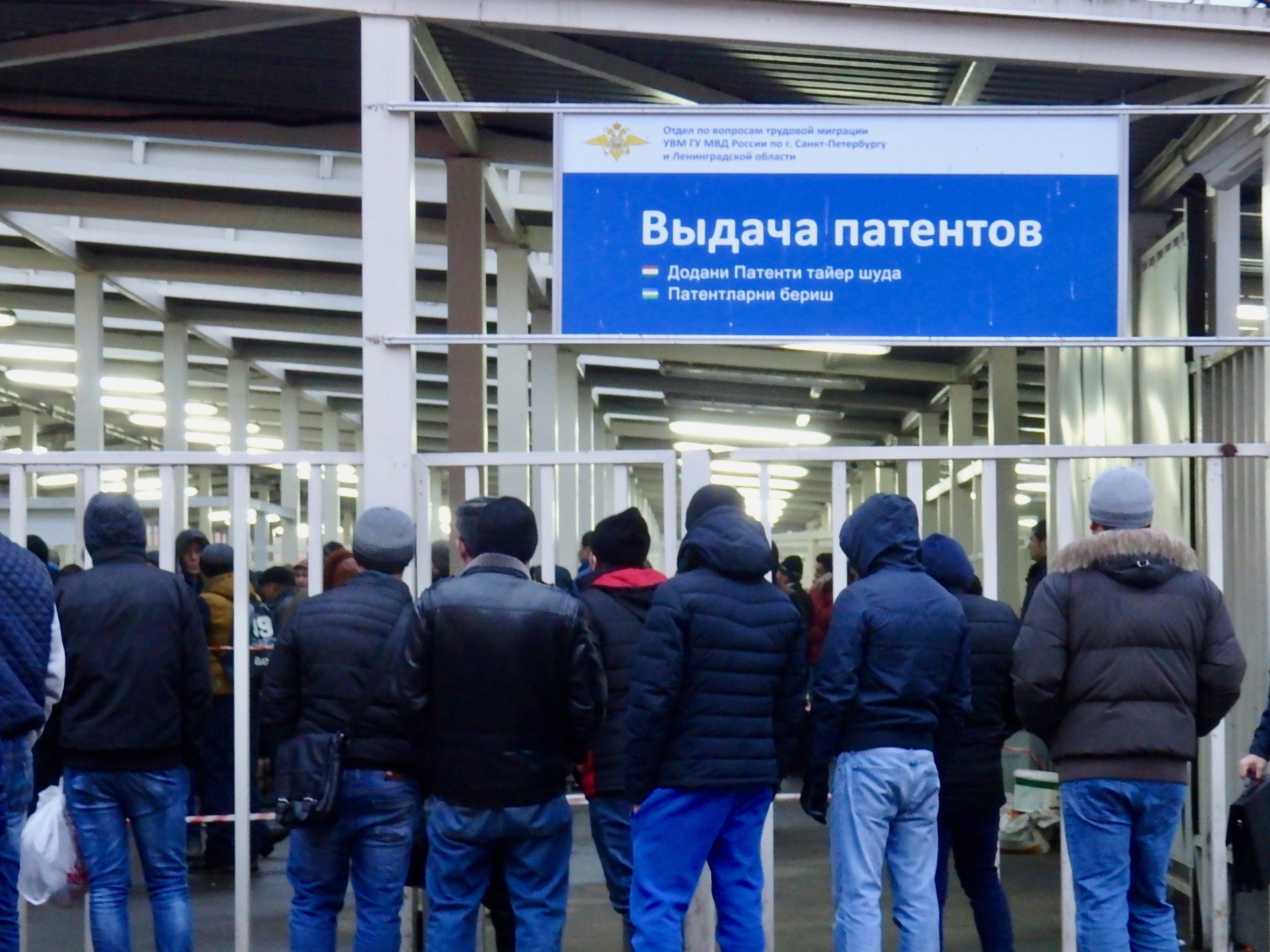
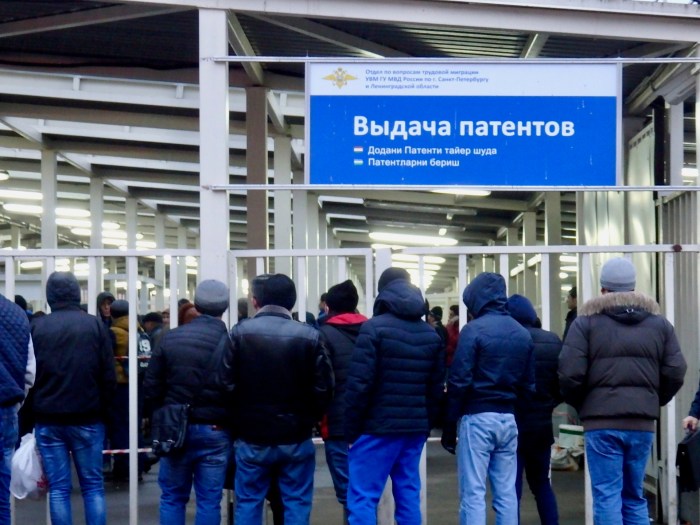
OLYMPUS DIGITAL CAMERACentral Asian migrant workers queuing outside the Russian Interior Ministry’s work permit application center on Red Textile Worker Street in St. Petersburg. Photo by the Russian Reader

Should Everyone Disappear into the Shadows? What the Fee Increase for Migrant Worker Permits Entails
Yekaterina Ivashchenko
Fergana News
November 29, 2018

The license [in Russian, patent] system for foreign nationals seeking permission to work in Russia was introduced in 2015. The cost of a work permit has varied from one region to the next. In Moscow, for example, it initially cost 4,000 rubles a month. In 2016, the price rose by 5% to 4,200 rubles, and in 2018, it rose by 7% to 4,500 rubles.

It is absolutely necessary to have a work permit. Without it, a migrant worker faces up to 7,000 rubles in fines, expulsion from Russia, and a ban on entering the country for a period of three to ten years. Employers who hire employees without work permits are punishable by fines, and their operations can be suspended for up to ninety days.

Something important happened on November 21, 2018. The Moscow City Duma approved a law bill increasing the cost of a work permit in Moscow. In 2019, it will rise by 500 rubles (11%) and cost 5,000 rubles a month (approx. $75).

The next day, November 22, Moscow Mayor Sergei Sobyanin said the city’s revenues from legal migrant workers had been growing and would exceed 16 billion rubles ($241 million) by year’s end.

“By paying such a high price for permits, migrant workers have come to occupy a fair position vis-à-vis Russian nationals [rossiyane] working in Moscow, because in the past they paid nothing at all, and, of course, it was profitable to employ them, but the situation has changed today,” said the mayor.

On January 1, 2019, the cost of a license for migrant workers seeking employment in Moscow Region will increase by 450 rubles. The Moscow Region work permit, which cost 4,300 rubles ($64.60) in 2018, will cost 4,750 rubles ($71.50) per month in 2019.

Taras Yefimov, chair of the Moscow Regional Duma’s budget, finance and tax committee, said the measure would enrich the region’s coffers by around one billion rubles [approx. $15 million]. In 2018, Moscow Region made six billion rubles [approx. $90.5 million] on migrant work permits.

St. Petersburg has decided to raise the price of the work permit from 3,500 to 3,800 rubles a month. City officials noted the decision was made because foreign nationals had begun earning considerably more money.

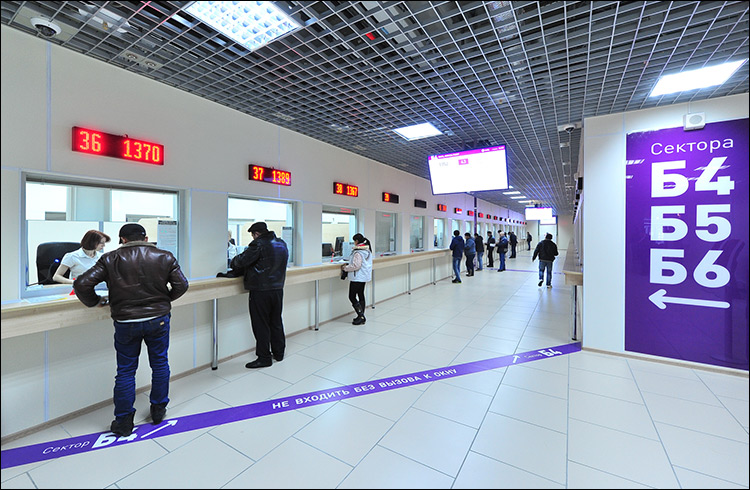
Filling out the forms for extending a work permit. Photo courtesy of Fmskam.ru and Fergana News
Wages Are Not Growing
Svetlana Salamova, director of Migranto.ru, a website for migrant workers looking for jobs and employers seeking to hire migrant workers, has not seen the real growth in the wages of migrant workers that officials have cited.

“The wages of foreign nationals who are employed on the basis of work permits has remained at the level of 29,000 rubles to 35,000 rubles [$435–$525] a month. Maybe the Moscow authorities are focused on high-profile specialists who make 168,000 rubles a month officially?” Salamova sarcastically wondered.

Salamova has noticed wage increases only among Kyrgyz nationals. After Kyrgyzstan joined the EAEU (Eurasian Economic Union), employers offered them 40,000 to 45,000 rubles a month.

“But they work without permits. (EAEU nationals can work in Russia without permits as long as they have an employment contract — Fergana News.) Besides, many Kyrgyzstanis agree to low wages of 19,000 to 20,000 rubles a month. They work part time in several places at once, and so ultimately they make a decent amount of money,” explained Salamova.

Salamova did not discount the possibility that fees for work permits have been raised in light of the fact that employers must index wages for inflation as of the new year. Perhaps the authorities decided to increase the cost of permits for foreign national because they took into account this indexation of wages on the Moscow job market.

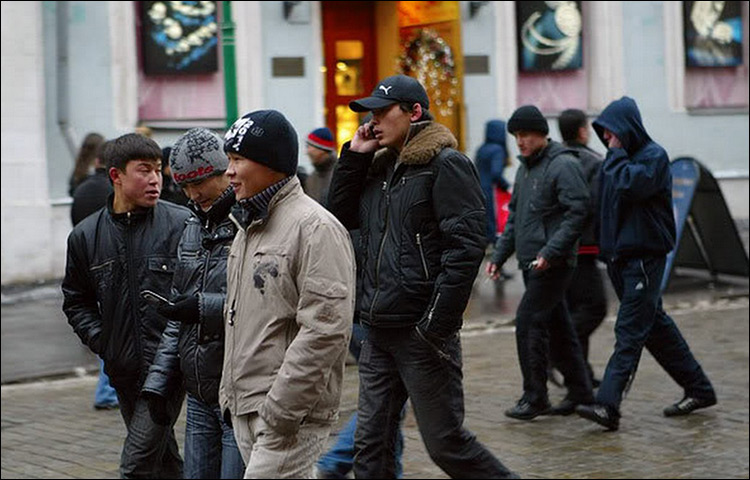
Immigration center in Moscow. Photo courtesy of Mos.ru and Fergana News
But what do migrant workers themselves have to say about it?

“Since 2015, the fee for the work permit has increased three times, but I have not even once received a raise. We spend little as it is: 4,500 rubles for the permit, plus the fee for residence registration; 6,000 rubles on rent, 5,000 on groceries, 2,000 on transportation. I sometimes buy clothes and medicines, and there are unforeseen expenses, like when my phone stops working. So, I have only 10,000 rubles left over from my monthly salary of 35,000 rubles. The latest 500-ruble increase will definitely affect my expenses. 6,000 rubles a year is a lot of money: an average family in Tajikistan could live for a month on that amount. It means my relatives back home will have to get by one month of the year without receiving a remittance from me,” said Magomed, who comes from Khujand, Tajikistan’s second-largest city.

Pushed into the Gray Economy
In June 2017, Mayor Sobyanin said the problem of illegal migrant workers in Moscow had been solved and had ceased to be a source of concern for Muscovites. Most migrant workers were employed legally and duly paid their taxes.

Experts believe the increase in the price of the work permit could lead to a rise in the number of foreign workers who decide not to pay taxes.

“The cost of the work permit will increase by 11%. An extra 6,000 rubles a year might not seem like a huge amount of money. But for migrant workers, who earn this money literally with their blood, living far from their families, and undergoing numerous hardships and risks, this is not a small amount at all: the overall cost of a permit for a year will be 60,000 rubles or $900. Some migrant workers will thus decide to go off the books. Consequently, Moscow’s budget is unlikely to get a huge boost, but the city will be supporting a policy of pushing migrant workers into the gray economy with all the attendant social consequences,” says Professor Sergey Abashin.

“It is odd that Moscow MPs say we will start earning more. Every migrant worker pays around 12,000 rubles to get a work permit in the first place. Then every month he pays for the work permit and his residence registration, he pays the rent, and he buys groceries. He even has to pay bribes to the police. People are taking money from us at every turn. What will we have left to send home?” said Muhammad, who is originally from Samarkand.

Batyrzhon Shermuhammad, a lawyer and founder of the website Migrant, also sees no signs of a wage increase.

“If you look at the want ads, you will see that the wages of migrant workers who are employed on the basis of work permits range from 25,000 rubles to 35,000 rubles a month. We monitor the job market, and no one mentions anything about a salary of 40,000 rubles a month. On the contrary, the economic crisis in Russia has been deepening. There is inflation, and the dollar/ruble exchange rate has been rising, which affects the remittances sent by migrant workers,” Shermuhammad said.

The latest increase in the cost of the work permit will force migrant workers to retreat into the shadows, he argues.

“One could understand the increase if the economic situation had improved, but the trends are negative: the prices in shops have increased, and the dollar has become more expensive vis-à-vis the ruble. People have no money, and so they have been having problems with residence registrations. Also, by law you cannot be late paying for your work permit even by a day. If a migrant worker is paid his wages late, he cannot pay the fee for his work permit, and he has no way of shelling out approximately 12,000 rubles to have a new work permit drawn up. While introduction of the work permit system brought migrant workers out of the shadows, the subsequent tightening of immigration laws and the increase in their expenses has been leaving migrant workers with fewer chances to stay legal, even if they would want to,” Shermuhammad said.

Migrant workers from Kyrgyzstan. Photo courtesy of Kloop.kg and Fergana News

“Even though I make good money, a 6,000-ruble increase in the price of the work permit is a serious expense, and I have huge expenses aside from the permit. My mother, sister, and I pay 33,000 rubles a month for a place to live. That is 11,000 rubles per person, plus utilities. In addition, I have to pay the fees for my studies twice a year: that is another 100,000 rubles each time. We don’t spend a lot on food, no more than 10,000 rubles per person a month. I also spend money on transportation, clothes, and gifts, and I spend 5,000 to 7,000 rubles a month for English lessons. Lately, we have not been sending a lot of money home, $200 to $300 per month at most. Mom and I used to be able to save money, but in the last six months our expenses have skyrocketed, and after the new year they will increase even more due to the work permit. Basically, the increase in the work permit fee means I won’t be able to pay for English lessons for a month,” said Ilkhom, who hails from Tashkent.

“For migrant workers, 500 rubles is a mobile phone connection for a month,” said human rights active Karimjon Yorov. “It is the cost of a week’s worth of subway trips. It is two lunches, finally. For families with children, it means being able to buy school supplies or pay for school lunches. In short, 500 rubles is a lot of money.”

Yorov argues that raising the cost of the work permit will make migrant workers not want to pay for it, meaning that revenues to Moscow’s coffers will actually decrease.

“Migrant workers will prefer to work without a permit and cross the border every three months. Currently, a trip to the border and back (i.e., exit and re-entry) costs 8,000 rubles in total, while the cost of a work permit for three months is 13,500 rubles, meaning they save 5,500 rubles by exiting Russia and re-entering it. This comes to 22,000 rubles, plus 12,000 rubles for the initial paperwork. The total is 34,000 rubles, which is the same as the cost of round-trip plane ticket to Uzbekistan. When you do the maths, it makes more financial sense for migrant workers to be off the books. The authorities themselves are forcing migrant workers underground, especially now that the laws on immigration registration have been tightened. Whether you get a work permit or not, if you do not live at the address where you are registered, you will be deported. Migrant workers will emerge from the underground only when the law on immigration registration has been abolished,” Yorov concluded.

Thanks to Sergey Abashin for the heads-up. Translated by the Russian Reader

Sergey Abashin: Remittances by Central Asian Migrant Workers in Russia during the First Quarter of 2018

central asian migrant workerCentral Asian migrant workers hard at work on a roof in central Petersburg on a Sunday in early May.
Sergey Abashin
Facebook
June 18, 2018

Finally I’m writing again about migrant workers, a subject that right at the moment interests very few people.

Data on remittances by private individuals from Russia to other countries for the first quarter of 2018 has been released by the Russian Central Bank after a great delay. Here is the picture they present.

Uzbekistan was the leader among the CIS countries. Its nationals remitted $726 million, which is 17% more than in the first quarter last year.

Tajikistan came in second place with $487 million, which is 15% more than the same time last year.

Kyrgyzstan took third place with $434 million, 9% up from the first quarter last year.

The figures thus show a significant increase in remittances, which testifies to an growth in the wages paid to migrant workers and an increase in the numbers of migrant workers themselves. Remittances to Kyrgyzstan have been growing more slowly, but in fact that means a large portion of the money earned by Kyrgyz nationals now stays in Russia to be spent on setting up their lives here.

P.S. By the way, the champion in terms of private remittances received from Russia is Switzerland—to the tune of $1.7 billion.

Photo and translation by the Russian Reader

Sergey Abashin: Reading About Migrant Workers

Central Asian migrant workers queueing to obtain work “patents” at the Russian Interior Ministry’s migrant workers processing center on Red Textile Worker Street in central Petersburg, March 10, 2017. Photo by TRR

Sergey Abashin
Facebook
March 19, 2017

Very few people are interested in reading about migrant workers in Russia. True, many people readily believe the myths and repeat them, but they don’t want to get to the bottom of things, even if you hand them the data on a silver platter. This apathetic attitude to figures and facts is also typical of how migration is regarded.

I wrote yesterday [see below] about the trends in the numbers of migrant workers from the Central Asian countries in Russia for 2014–2016. Let me remind you that the number of Kyrgyz nationals first fell and then began to grow, exceeding the previous highs by 10%. The figure is now about 0.6 million people. (I am rounding up). The number of Tajik nationals has decreased by 15–25% and has been at the same level, about 0.9 million people, for over a year, while the number of Uzbek nationals has decreased by 30–40%, to 1.5 million people.

Now let us look at the data on remittances, all the more since the Central Bank of Russia has published the final figures for 2016. In 2016, private remittances from Russia to Kyrgyzstan amounted to slightly more than $1.7 billion, which is 17% less than during the peak year of 2013, but 26% more than in 2015. Meaning that, along with an increase in the number of migrants, the amount of remittances has grown quickly as well, even at a faster pace. Remittances to Tajikistan amounted to slightly more than $1.9 billion in 2016, which is 54% less than the peak year of 2013. The amounts have been continuing to fall, although this drop has slowed as the number of migrant workers has stabilized. Remittances to Uzbekistan were slightly more than $2.7 billion in 2016, which is 59% less than in the peak year of 2013. Meaning the largest drop in the number of migrants has led to the largest drop in remittances.

*****

Sergey Abashin
Facebook
March 18, 2017

Data on the number of foreign nationals living and working in Russia has not been made public since April 2016, when the Federal Migration Service was disbanded. But this does not mean there is no such data. The figures exist, and they become available from time to time. For example, an article published in RBC [on March 16, 2017] supplies some data as of February 1, 2017. What follows from the figures?

The number of Kyrgyz nationals has increased since February 2016 by 5.6%, and since February 2015 by 8.9%, and amounts to 593,760 people.

The number of Tajik nationals increased by 0.7% over the past year, and by 13.3% over two years, and amounts to 866,679 people.

The number of Uzbek nationals has decreased over the past year by 15.2%, and by 31.7% over two years, and now amounts to 1,513,694 people.

So we see three different trends. After Kyrgyzstan joined the Eurasian Economic Community [now, the Eurasian Economic Union], the number of its nationals in Russia has continued to grown. After a decline of 15–20%, the number of Tajik nationals has stabilized, while the number of Uzbek nationals has fallen by 30–40%.

There are slightly less than a total of 3 million people from Central Asia living and working in Russia. (I did not take Turkmenistan and Kazakhstan into account. If I had, the figure would have come to about 3.6 million people.)

Sergey Abashin is British Petroleum Professor of Migration Studies at the European University in Saint Petersburg. His most recent book is Sovetskii kishlak: Mezhdu kolonializmom i modernizatsiei [The Soviet Central Asian village: between colonialism and modernization], Moscow: Novoe literaturnoe obozrenie, 2015. Translation and photo by the Russian Reader

The Russian National Idea

Putin Proclaims National Idea
Fontanka.ru
February 3, 2016

In Russia, there can be no other unifying idea than patriotism, argues President Vladimir Putin, as reported by TASS.

“This is, in fact, the national idea,” the head of state announced during a meeting with the Leaders Club, which brings together entrepreneurs from forty of the country’s regions.

According to Putin, this idea is not ideologized and is not linked to the work of a particular party, reports RIA Novosti.

“It is a common rallying point. If we want to live better, the country has to be more attractive to all citizens and more effective,” the president stressed.

_________

Who Killed a Transsexual in Ufa and Why?
Ufa1.ru
February 2, 2016

On Monday, February 1, Angela Likina was stabbed in the chest and killed in Ufa. The Ufa resident had gained notoriety in 2014, when a video recorded on a traffic police dashcam entitled “Ufa Traffic Cops Stop a Transvestite” [sic] went viral on the Web. Ufa1.ru found out who killed Oleg Vorobyov, who had changed his sex and become Angela Likina, and why.

2-z23-8ba7384a-0952-45c2-a705-e03be67de8d4
Angela Likina. Photo courtesy of Ufa1.ru

The controversial video from the traffic police car dashcam recorded an inspector checking the papers of a female motorist. It transpired, however, that the motorist’s name, according to his internal passport, was Oleg Vorobyov. The inspector was very surprised by this. The motorist was a transsexual who had been preparing for a sex change operation for several years, becoming Angela Likina. The restricted video was leaked to the Web.

Later, the State Auto Inspectorate conducted a review of the incident, because the restricted footage should have not ended up on the Web. Angela Likina also commented on the video herself. She was surprised the incident had provoked so much interest among Web users.

“People die in accidents, children get hurt, cars are stolen, blood is needed to save someone’s life. Gentlemen, why are you setting records for likes and reposts about me? I honestly don’t understand,” said Likina, adding, “I don’t care how you live, what you do, and so on, so long as you are alive, healthy, and happy. But my life does not concern you in absolutely any way.”

How Did Oleg Live?
Ufa1.ru spoke with friends and acquaintances of Angela Likina, who talked about the life of the murdered woman. We found out this sad ending had emerged from a number of factors. Before becoming Angela Likina, Oleg Vorobyov had been married. Acquaintances confess that, outwardly, the couple were seemingly happy. They were raising two daughters, now aged fourteen and nine. The family lived in a private house, which also housed Oleg’s auto repair garage. Many of the people with whom we spoke said automobile owners were satisfied with Oleg’s work, that he had a magic touch.

Over five years ago, Oleg realized he was living in someone else’s body. He understood he wanted to change his sex and become the person he thought he was. Oleg began calling himself Angela Likina and started the complicated process of preparing to change his sex. He took hormone pills and began dressing like a woman. According to his internal passport, however, he remained Oleg Vorobyov. He could only change his name after finally changing his sex.

Five years ago, the Vorobyovs divorced, but the former husband and wife and their two children kept living under the same roof. The house was the wife’s property, and her former husband had an established business there. Several of the family’s acquaintances believe that Angela did not want to lose her income from the auto repair garage and spend money on renting a place to live. After all, she had to save up a large sum of money for the operation, and the medicines she took to prepare for the procedure were expensive. Close friends emphasize that Angela worked a lot, sometimes seven days a week.

At the same time, Ufa1.ru’s sources noted the Ufa resident simply had no choice.

“He once tried to rent a flat, but was kicked out. A neighbor had said, ‘I don’t want my children to see this!’ Consequently, he was evicted and didn’t even get his money back,” said one of our sources.

Friends of the family noted that those who have lived under the same roof with ex-spouses can imagine the atmosphere that prevailed in the Vorobyov house. Some say that the rows over living arrangements caused the Vorobyovs to come to blows. Things were aggravated by the fact that the head of the family had become a woman. Their children also became the targets of reproaches and ridicule at school.

“They would come home in tears, and sometimes refuse to go to school, but Angela loved her daughters and gave them a lot of time,” acquaintances noted.

Who Killed Angela?
According to friends, a boyfriend came to visit Oleg’s ex-wife on the ill-fated evening. The criminal investigation will shed more light on what exactly happened in the house. For now, the family’s acquaintances have their own hypotheses. Perhaps the man intervened in yet another family row. Maybe he stood up for his girlfriend and wanted to intimidate Angela by demanding she pack her things and leave. The row, however, escalated into something bigger.

“She was stabbed in the chest near the heart. She did not die immediately. She made it to a neighbor’s house, told him what had happened and who had done it, and an ambulance was summoned. Then Angela died in the neighbor’s arms. It was apparently too late to help her. I don’t know what was happening in the family. Angela was a good person, but strangers often beat her up. Her neighbors respected her choice. It is a bad thing when a person steals, kills or rapes, but everything else is a private matter,” said an acquaintance of Angela’s.

“The best human qualities—kindness, fairness, compassion, and unselfishness—were powerfully manifested in her. Unfortunately, that is a rarity nowadays. And she really never held a grudge against anyone, although there were a fairly large number of people who wished her ill. Most of them, it is true, were people who did not know her at all. They insulted and mocked her. You could say she was understanding about it: far from everyone in our city, or even our country, is ready to comprehend the decision to have a sex change. And that is another reason I have endless respect for her: the determination to go her own way to the end, to change her life fundamentally, the willingness to take one and overcome all the difficulties,” another girlfriend of Angela’s confided to Ufa1.ru.

“Apparently, Angela sensed her impending death. Not long before this she had asked forgiveness from her wife for all the rows that had happened between them,” said another family acquaintance.

__________

Fire at Moscow workshop kills 12 people, including 3 children
Boston Globe
January 31, 2016

ASSOCIATED PRESS, JANUARY 31, 2016, MOSCOW — A fire at a textile workshop in Moscow has killed 12 people, including three children, officials said.

The victims were not identified but were reportedly immigrants.

The Investigative Committee, the top state investigative agency, said the fire broke out late Saturday in northeastern Moscow, damaging more than 32,000 square feet of the structure.

Investigators said they are looking at negligence or arson as possible causes.

Russia’s children’s rights ombudsman, Pavel Astakhov, said Sunday on his Twitter account that three children were among those who died, including a baby. He said the victims were migrant workers who lived next to their workplace.

Several dozen fire engines responded to the blaze, and it took firefighters about five hours to extinguish the blaze.

Investigators continued to sift through the rubble Sunday for evidence.

Many immigrants work in Russian factories, some of which have been investigated for hazardous working conditions. In April, a blaze on the outskirts of Moscow killed 17 migrant workers.

__________

The death toll of Kyrgyz citizens (according to the Embassy of the Kyrgyz Republic in the Russian Federation):

1. Sajida Masaliyeva, born 1988. Home address: Village of Kyzyl-Bel, Batken District, Batken Region.

2. Toktokan Saliyeva, born 1983. Home address: Village of Tayan, Batken District, Batken Region.

3. Uulkan Saliyeva, born 1997, sister of Toktokan Saliyeva.

4. Isa kizi Aizat, born 1995. According to available information, Isa was a native of the Village of Kaiyndy, Batken Region.

5. Milikajdar uulu Koshonbay, born 1990.

6. Tologon Kozuyev, born 1991.

7. Manas, born 1995; brother of Tologon Kozuyev; no other details.

8. Daniel, 4-5 years old, son of Ergeshbay Japarov, a Russian national who perished in the fire; born in the village of Rout, Batken District, Batken Region; according to the victims, Daniel was a citizen of the Kyrgyz Republic.

Source: Radio Azzatyk

__________

The four-minute-and-twenty-five-second rap version of Alexei Navalny’s exposé of Russian prosecutor general Yuri Chaika, as performed by Nadya Tolokonnikova. Thanks to Comrade SC for the heads-up.

_________

[Elena Bobrova:] You are something of a patriot yourself?

[Nikolai Kolyada:] How else should I relate to Russia? I love her whatever she be like. Like Gogol I can tell the whole unvarnished truth about her. And Nikolai Vasilyevich said such awful things about Russia. He sobbed bloody tears when thinking about the country. But not because he hated it. On the contrary, because he loved it. When foreigners start speaking badly about Russia, I begin to boil: “Shut up, it is none of your business. I have the right to say anything about her, but you do not.” Well, it is okay when Europeans or Americans sling mud at us: they have a hard time coping with the fact we are different, unpredictable, and freer than they are. But when our own people hate their own country, that is terrible. This morning, I was reading Facebook and I thought, “Why do you live here if you hate Russia so much?”

[Bobrova:] But you just said yourself we have a right to chew out Russia because we live here.

[Kolyada:] Chew out but not hate. But Facebook is just seething with hatred.

—Excerpted from “20% of the Petersburg audience are loonies,” Gorod 812 (print edition), February 1, 2016, page 34

Items one, two, four, and six translated by the Russian Reader

Victoria Lomasko: A Trip to Kyrgyzstan

A Trip to Kyrgyzstan
Victoria Lomasko
August 25, 2014
soglyadatay.livejournal.com

Kyrygzstan/Kirghizia

I had come to visit Bishkek Feminist Сollective SQ.

“Are there really feminists in Kirghizia?” my mom had wondered before I left.

On the way from the airport to Bishkek the collective’s leader, Selbi, corrected my speech several times.

“It’s not Kirghizia, but Kyrgyzstan, and Kyrgyz, not Kirghiz.”

In fact, the local Russians speak the way they are used to, and no one pays any mind to their use of “Kirghiz.” But when a Kyrgyz says it, it is insulting and even offensive. It means someone who is Russified and has forgotten the traditions of their people. Besides, the word “kirghiz” means “forbidden to enter.”

01_Gusia.png
Gusya, a member of Bishkek Feminist Collective SQ: “My parents told me that at school they were forbidden to speak Kyrgyz.”

“You don’t live in Kirghizia, but in the Soviet Union, one country for everyone,” Russian teachers would explain.

The majority of people in the capital of Kyrgyzstan still speak Russian. While I was in Bishkek, I heard from several Kyrgyz that Russians had symbolic capital, because they were seen as more cultured and educated. The local Russians I met said they were not the titular nation, and a glass ceiling inevitably awaited them in the civil service, for example. But they had not encountered serious harassment in daily life.

The Problem of Migration

02_Gulmira.png

“How can you develop the country when half its population doesn’t live in it?”

I was invited to draw at the Mekendeshter Forum (“Compatriots” Forum), organized by the ex-President of Kyrgyzstan Roza Otunbayeva. The forum dealt with the issue of emigration from the country. It was held in the spacious, beautifully designed Kyrgyz-Turkish Manas University, which the Turks opened in Bishkek in 1997. On one side of the stage hung a large portrait of Ataturk; on the other side, an image of Manas, the Kyrgyz epic hero. The forum program included a separate discussion on cooperation between the “fraternal countries” of Kyrgyzstan and Turkey. Many Kyrgyz have in recent years preferred to go to work in Turkey. Several speakers emphasized that in Turkey, compared to Russia, there was much more respect for the Kyrgyz diaspora. The Islamization of Kyrgyzstan has accompanied Turkey’s growing influence.

Almost half the speakers at the forum spoke in Russian. There wasn’t a separate panel on cooperation with Russia, but the subject constantly came up, first of all, in connection with Kyrgyzstan’s possible accession to the Eurasian Customs Union.

03_ministr.png

Woman on left: “Our government is promoting the interests of a foreign country and is prepared to restrict the freedoms of its own citizens.” Kyrgyz Prime Minister (at lectern): “It’s only an economic union.”

Many speakers criticized the decision.

04_flags.png

(in Kyrgyz) “The borders of the Customs Union are the borders of the Iron Curtain. Will we be turning our back on other countries?”

Will accession to the Customs Union impact the country’s domestic policies? Members of the Kyrgyz parliament are already pushing through bad imitations of Russian laws, for example, a law on “foreign agents,” almost identical to the Russian law, or introduction of criminal liability for disseminating information about LGBT. Moreover, the law would cover not only “propaganda among minors,” as in the Russia “18 and over” law.

During my stay in Bishkek, there was a scandal at a contemporary art show. In his Spider-Man series, the artist Chingiz had depicted a spider in Kyrgyz national headdress. He was immediately summoned to the GKNB (the State Committee on National Security, the local version of the FSB) and bombarded with threats on the Internet.

05_Chingiz.png

Chingiz: “I’m threatened with violence for insulting the national heritage.”

Joining the Customs Union will make it easier to travel to Russia to work and increase emigration many times over. However, speakers at the forum said that Kyrgyzstan already suffered from a lack of specialists and, in some areas, just plain laborers.

06_Roza.png
Ex-President Roza Otunbayeva: “There has been and will continue to be a growing demand for Kyrgyz migrant workers in Russia.” 

You can find what Russian citizens have to say about Kyrgyzstan’s accession to the Customs Union by doing a Google search. Most often, they are predictably outraged by “parasite wogs” or happy about “reunification of the Russian lands.” There are also a few liberal comments to the effect of “but somebody has to do the dirty work for us.”

Toi

07_toi.png

“The money earned by migrant workers is not spent on their children’s educations.”

Most often, the money earned by migrant workers is not spent on their own education, healthcare, buying real estate or starting a small business. Money earned over several years can be spent in a single month on a toi.

A toi is a celebration with plenty of refreshments. Its main difference from an ordinary holiday feast is that there must be so much food that the guests will not be able to eat it all and will take food home with them. When a circumcision is celebrated, guests come for a month. To do a toi at a wedding, a loan is taken out which is then paid back for years on end.

08_mountains.png

The closing of the forum was held at the Supara Ethno Complex in the outskirts of Bishkek. The refreshments and alcohol never once ran low. The party ended around midnight. Guests took the leftover food home in special toi bags.

Feminism Kyrgyz Style

09_girls.png

Baktygul, Daria, and Meerim

These are Girl Activists of Kyrgyzstan. Members of the group are between thirteen and seventeen years old. They are preparing to apply for a grant to the FRIDA Young Feminist Fund. If they get the grant, they will hold a manaschi contest for girls.

Manaschis are male reciters of the Epic of Manas. However, female reciters have recently emerged.

10_manas-chi.png

Baktygul (reciting the Manas) and Daria

Baktygul, a member of the Girl Activists, is a manaschi. According to her, boys are specially trained, and their teachers serve as judges on reciting contest juries. Girls study on their own, and they have virtually no chance of winning at general competitions.

I asked the girls about ala kachuu, bride kidnapping. Two of them said their mothers had been kidnapped.

“It was a schooltime romance. My mom wanted to study, but she had to get married,” one of them said.

“My cousins in the twenty-first century kidnapped brides,” said Daria. “Four guys tried to kidnap my female cousin. She is very big, and she tried to fight them off. They could barely handle her.”

“Aren’t you afraid of being kidnapped?” I asked.

“No. There is a law. We’ll tell them, ‘Articles 154 and 155 of the Criminal Code. Do you want to get sent up for ten years?'”

The punishment was toughened in 2013. Previously, kidnappers of underage “brides” had faced three to five years in prison, but only a fine if the girl had turned seventeen. Two years of advocacy by the Women’s Support Center and Open Line, as well as the activism of women’s groups around the country, had led to the law’s amendment. Bishkek Feminist Collective SQ held one of the biggest protest actions in the campaign in downtown Bishkek. They planted 19,300 little flags. 9,800 flags stood for the number of women abducted in a single year. 2,000 white flags stood for the number of women raped during abduction, while 7,500 purple flags stood for the number of women who had reported domestic violence.

11_Eid.png

Selbi (left) and Farida: “Girls stop being taken to Eid celebrations from the age of nine.”

This is Farida, a Dungan and a member of Bishkek Feminist Collective SQ. I visited her home during the Muslim festival of Eid, which takes place after Ramadan. Families stop taking girls along for holiday visits, because they begin serving at the celebrations by cooking and cleaning up after the numerous guests.

Dungan families are very large: several generations live together, and there is rigid hierarchy among members. The lives of girls and women are subordinated to the household. As a child, Farida was used to getting up at six in the morning to work in the house. She was not allowed to play with other children.

“The house was my only space,” she said.

Farida had to fight for the right to go to school. When she met the feminists and took up activism herself, pressure from family members was so strong she had to run away from home. Farida had been one of the main organizers of the flags rally.

After a year of living in the feminist community, Farida returned home. Influenced by her daughter, Farida’s mother, Sofia, had become interested in women’s rights and was able to change how things were done in their home.

12_Maria.png
Farida’s younger sister Maria has free time. She can play with other children, draw, and go to school. Maria: “If a cat looks at someone who is eating, it can take his life.”

13_topchanka.png

“A week after giving birth, Dungan women go back to work in the fields.”

Young Kyrgyz women made the following comments about the drawing above.

“They have too much time off!”

“My grandmother gave birth in the field and just went on working.”

“Kyrgyz women are hardier!”

Hard female and child labor still persists in Kyrgyz villages.

“When they are six, children must think about providing for themselves. When they are nine, they have to earn money for textbooks and school uniforms. Teenagers are hired to pick raspberries and other berries. They work every day for ten hours.”

LGBT

14_dance.png

Officially, there are no LGBT in Kyrgyzstan. Homosexuality is permissible for Russians, but certainly not for Kyrgyz.

I visited the only LGBT club in Bishkek and, probably, in Kyrgyzstan. Nearly all the patrons were Kyrgyz. There were only a few female couples: lesbians are even more closeted in Kyrgyzstan than gays.

15_singer.png

As in Russia, beatings, rapes, and murders of gays, lesbians, and transgenders are widespread in Kyrgyzstan. After passage of the homophobic law in Russia, attacks on LGBT activists have become more frequent.

I talked to several patrons at the club, but I won’t write anything about them. Bishkek is a small city, and mentioning any particulars could be dangerous.

16_kiss.png
“We are constantly faced with humiliation and insults. We can’t imagine how to go on living. How do we find a partner? How do we tell our parents? Or how do we make sure our parents don’t find out? How do we leave the club safely?

During debates about the law bill proposing criminal liability for “promoting” homosexuality, Kyrgyz MPs claimed they were standing together with Russia to protect the Eastern world against the Western world. Many middlebrows probably appreciate this stance. They don’t follow events in Russia and don’t know that if we allow the state to infringe on the rights of one social group, we are no longer able to stop the flood of laws censoring all areas of our lives. It would be sad if the same future awaits Kyrgyzstan’s nascent civil society.

__________

Recent publications in English by and about Victoria Lomasko:

10525860_677126315697233_7878652583730474759_n

Victoria Lomasko (center) at a drawing workshop in Bishkek earlier this month. Photo courtesy of Bishkek Feminist Collective SQ Facebook page.