Lev Schlosberg’s lengthy interview with Ksenia Sobchak, released last week, predictably kicks off with a discussion of his condemnation of his former allies. In August of this year, Lev Schlosberg lashed out on Facebook at the emigrant liberals who had welcomed the Ukrainian army’s offensive in the Kursk Region, calling writer Dmitry Bykov, journalist Sergei Parkhomenko, and politician Garry Kasparov comrades in the “someone else’s blood” party. His post sparked a freewheeling discussion, demonstrating once again to both onlookers and participants how far apart they were, even though they are still citizens of the same country. While the outcome of the Russian-Ukrainian military conflict will supposedly be determined by the newly re-elected Donald Trump, the Kremlin has long since won the war on the invisible front.
Caution: Sobchak, “Lev Schlosberg: Why is it important for a politician to stay in Russia?” (in Russian; no subtitles)
It was beyond the strength of the majority to resist the Kremlin’s propaganda. How fortunate for the minority, who had honestly declared before the war that they had no soul, only a paycheck.
Three months later, Schlosberg felt the need to continue the conversation, choosing as his interlocutor Ksenia Sobchak, about whose views on war and peace there can be no two opinions: what Vladimir Putin finds ambiguous also seems ambiguous to the breeding bulls in his herd. But the question is why the veteran democrat Schlosberg decided to hang a huge bell around his neck next to the “foreign agent” disclaimer. Was it vanity or fear? As becomes clear in the first half hour of the high-minded conversation, however, the cause, as always, is run-of-the-mill stupidity. Schlosberg really thinks what he says. It is even sadder to watch his rantings than it is to watch the criminal proceedings against him.
Explaining his stance as a compassionate fellow traveler (which, as we remember, can be summarized in Akhmatova’s famous line about one’s own people, on whose side one should be both in happy times and during the Special Military Operation), Schlosberg recalls Leo Tolstoy’s famous essay “Bethink Yourselves!,” published in 1904 after the outbreak of the Russo-Japanese War. According to Shlosberg, love for a fragile peace distinguishes the authentic Russian writer from the fake one. For this reason, Shlosberg has no hesitation in ejecting Dmitry Bykov from the company of engineers of Russian souls, and, it seems, from the human race altogether. A similar fate befalls the other participants of the Free Russia Forum. Typically, Sobchak, an experienced investigator-slash-provocateur, cajoles Lev Markovich into making public his entire list of traitors to the Motherland (probably to check it against the firing squad list, lest there be an extrajudicial error).
It is worth nothing that all the ideological opponents mentioned by Schlosberg* did not differ much from the great elder from Yasnaya Polyana in their appeals to the silent audience. Since then, however, much water (demagoguery) has flowed under the bridge, along with the lives of millions of people. No wonder that the cardboard humanism of the captive Yabloko Party now looks, if not ridiculous, then simply ugly. Schlosberg and Yavlinsky suggest that we still eat from the fruit of the tree of knowledge, which was chosen as the symbol of their so-called political association. And it seems to have been known for a long time that this fruit is a pure stage prop, a fruit plate from a Moscow Art Theater performance, but its contents continue to rot and to reek, frankly.
“Myth: that Ukraine remains a victim doesn’t fit the historical facts”: Lev Schlosberg, as featured on Ksenia Sobchak’s YouTube program (via Republic)
We are all victims of this war, Schlosberg claims. Vladimir Putin and Volodymyr Zelensky, the United States and Europe had the same opportunities to prevent the war. “But the mincemeat of history cannot be cranked backwards,” he continues, indulging in inventive parallels, “the cutlet will not turn back into the cow.” Yes, of course, the “Russian World” will never be the same again, but only because thinkers like Schlosberg, as Circe did to Odysseus’s companions, have been turning Russians into ungulates with their pseudo-Christian speeches. It is other people, of course, who have been leading them to the slaughter, but the Yabloko Party, alas, bears a considerable share of the blame.
Dubbing himself “the people,” Schlosberg wants to escort the popular masses on a journey to the end of the night, i.e., he suggests that they wander together until they are blue in the face in the pitch darkness and sprinkle the ashes of their ideals on each other’s heads, even though they should sprinkle “mother earth” on their heads. Schlosberg imagines collective euthanasia as a therapy in which there is no room for hatred. What’s the difference between dying with calls to love one another on your lips and dying while calling for violence? There is a difference, Schlosberg contends. In the first case, our church cemetery will finally become a true “brotherly” [i.e., mass] grave.
There used to be a Three Hierarchs Street in Kyiv. It was renamed after the October Revolution, of course. In 1919, it was called Victims of the Revolution Street in memory of the Bolsheviks who had been led down it to their executions. The street bore this tragic name until 1955, when someone competent finally showed up at city hall and explained to them how the name was ambiguous. City hall agreed and renamed it Heroes of the Revolution Street. But you can’t fool the people, and so the name “Victims of the Heroes of the Revolution” stuck to the street like glue. Old-timers still referred to it as they had in the old Soviet days. “Can you tell me how to get to the outpatient clinic?” “Go straight down Victims of the Revolution….” In the early 1990s, when the powers that be were getting rid of abominable “Red” place names, the street was given back its old name, Three Hierarchs Street.
I was reminded of this by the recent incident involving Lev Schlosberg, who explained in an interview with Ksenia Sobchak that Ukraine cannot be considered a “victim” [zhertva]. This has happened in the context of the Yabloko Party’s now-familiar cry “Both of you stop immediately!” Here is what Schlosberg said, verbatim:
Ukraine is resisting. State and individuals are victims [zhertva] until the minute, until the second they start resisting. Ukraine started resisting on the morning of February 24 [2022]. It is a resistance supported by dozens of foreign countries with their money, their equipment, their specialists, with everything they have. This had led to the fact that Ukraine has equalized the situation. Today, the military forces — the combined military forces of Ukraine (taking into account the allies, their weapons and their money) and the combined military forces of Russia — are roughly equal. Whoever resists is not a victim [zhertva]. A victim [zhertva] does not resist. A victim [zhertva] allows itself to be killed. The myth that Ukraine is a victim does not fit the historical facts. If Ukraine were a victim, Ukraine would not exist now. It would simply not exist.
Of course, we could go on at length about Shlosberg and the Yabloko applesauce* in his head, but he has gotten enough pushback. He has talked a load of nonsense and still goes on, so God be his judge. “Why do we listen to him? Let’s eat him.” I’m in favor of not listening to anyone at all, since there came a point when everyone started talking in commonplaces. Schlosberg is no exception: his leitmotif is well rehearsed and has long been familiar. But this paragraph about victims and non-victims is peculiar. Not politically peculiar (not at all), but it is quite peculiar as a mirror reflection of illiteracy.
Lev Markovich managed to cram a lot of nonsense into one paragraph, both about equalizing the situation and about western assistance. But that’s not what I have in mind. What I have in mind is the fact that even the well-spoken Schlosberg has no linguistic sense at all, as it turns out. And he’s not alone in having this handicap, although it is not remotely acceptable for him as a politician to have it.
The whole passage about the victim, I think, meant the opposite of what its author was been lambasted. He was rightly lambasted, generally, but he didn’t mean to strip Ukraine of its status as a victim of aggression. “Victim of aggression” and “sacrificial victim” are different things. The concept of the sacrificial victim is as old as sacrifice itself and is widely employed in the Old Testament as an inalienable part of the love for God. The Old Testament is chockablock with sacrifice, beginning with Abraham’s sacrifice of his son Isaac.
It would be odd, of course, to assume that Schlosberg was talking about biblical connotations in his conversation with Sobchak (and it is doubtful the interviewer has ever thoughtfully read the Bible), but it is almost certain that this was the notion of zhertva which he had in mind. A sheep to the slaughter is apparently Lev Markovich’s idea of a textbook victim. The sheep does not resist: that’s a fact. Ukraine has been resisting, and that’s also a fact. From Schlosberg’s point of view, it all makes sense. If he had said that Ukraine was not a victim of aggression, then he would have become a deserving punching bag forever. But he wanted to make a graceful compliment to Ukraine while not deviating from Yabloko Party’s twee “peace and good will to all — just stop shooting!” In the Old Testament sense of the word, Ukraine is truly not a victim: it is a heroic scrapper, a country as hard as nails. But what Schlosberg said was understood as it should have been understood.
A politician should know the value of words and the cost of his linguistic blunders. The Schlosberg incident is such an obvious example of linguistic deafness that it should be included in political rhetoric textbooks — someday, of course, not now. A politician should realize that words addressed to the public are always heard as they are commonly understood, and that few people will use zhertva [“victim”] in the Old Testament sense [of “sacrifice”].
Once upon a time, a rookie journalist was brought on at the newspaper where I worked. His first article was about a theater event that had turned out to be a chummy gathering at which only the in-crowd got the jokes. The article ended with the following sentence: “The result was an event only for those who could get to it through the box office window.” I immediately pictured a man trying to Winnie-the-Pooh his way through a tiny window. When the journalist noticed that I was editing the sentence, he was indignant.“Why?! It’s clear as it is,” he said, “it’s about the people who managed to get their hands on complimentary tickets.” “Yes,” I replied, “it is clear. But not immediately clear, like it should be.” The guy held a grudge against me for a long time, not understanding the point of my objection.
The feeling for language is an innate thing, like a sense of pitch. But if it is weak, it must be trained, just like the sense of pitch. Andrei Mironov, who sang countless songs on screen and on stage, had no ear for music, but he worked until the point of exhaustion, singing the same lines a hundred thousand times until he could hit the notes. Only the people close to him and the directors who worked with him knew that he lacked a sense of pitch.
When I hear an advertisement for “tonal cream” [foundation cream], I am amazed at how one could fail to anticipate that every other person would hear “anal cream.” We can attribute this to a common lack of linguistic pitch, of which there are countless examples. It is essentially a habitual neglect of language, of its purity. “Anal cream” is a harmless example. “Phyto tea for women with hog uterus” [i.e., Orthilia secunda, or wintergreen, whose common name is matkaborovaya] is basically harmless, too, just like most of the complete misunderstandings of “how our words will be heard” which we encounter at every turn.
The Schlosberg incident is a quintessential example of the damage which carelessness can do to a public figure. Lev Markovich already has a catastrophically dwindling number of allies, given his inappropriate Leopold the Cat-like appeals and dubious patriotic outbursts. After his latest musings, this number has precipitously plunged. “Alas, they didn’t understand me,” the annoyed Schlosberg must say, playing the victim.
* Although the Yabloko Party‘s name was derived from the surnames of its three founders (Grigory Yavlensky, Yuri Boldyrev, and Vladimir Lukin), the word thus formed, yabloko, means “apple” in Russian.|||TRR
[Ksenia] Sobchak: You want your children to live in a stable country without revolution?
[Chulpan] Khamatova: Without revolution. It could be some kind of changes in mindset. Without revolutions. I don’t want revolution. I’m categorical on this point, because the heads of completely innocent people fly in revolution and all these wars. I don’t think it’s right. Both sides have to do their utmost to avoid this.
Sobchak: But would you accept any compromise for the sake of avoiding revolution? Figuratively speaking, I don’t know whether you have any notion of geopolitics or not, whether you understand what’s happening in North Korea. People eat grass, and there’s a city within a city where officials live, while [ordinary] people live a completely different life without electricity. It’s just that I’ve been there, and so I know what I’m talking about. To put it starkly, which would you choose—living in a country like North Korea, for example, or revolution?
Khamatova: I would choose North Korea. I don’t want victims. It means that the people who oppose this regime lack certain tactics, know-how, and wisdom, that’s all.
Russian holiday-goers are set to be the first known tourists allowed into North Korea since it closed its borders as a pandemic response in early 2020. A five-day jaunt was arranged by an agency in Primorsky Krai after the eastern region’s governor visited the hermit kingdom’s capital for talks. The countries pledged closer ties after a series of meetings in September.
Friends, we apologize for replacing the video. The Zygar channel team reposted it due to a factual textual error, but the time codes remain the same.
Since I am a writer, I think that in the near future I will have to write a book which could be called The Empire Must Die, but only about another empire—Putin’s Russia.
And, of course, in this book one of the most important characters will be Chulpan Khamatova, the actress and co-founder of the Gift of Life charitable foundation.
She was one of the first to protest against the war with Ukraine and leave Russia.
Chulpan will talk about her life, starting the foundation, her encounters with Putin, and fighting for the lives of children, friends, and her own honor.
[…]
You can help children with cancer and donate an affordable amount to the Gift of Life Foundation: https://podari-zhizn.ru/ru.
00:00 – First meeting with Putin 09:57 – The germ of charity 13:30 – Anton Chekhov in the Kremlin 17:47 – Meeting Yuri Shevchuk 21:40 – The foundation’s first concert 24:31 – On medicine, doctors, and building a new hospital 26:41 – Putin and the PR move 30:22 – The Friendship Medal and the search for the missing money 33:20 – The relationship between Putin, the doctors and the clinic 36:53 – Canceling Matvienko and Gref’s speech 40:10 – Putin’s meeting with the creative intelligentsia 42:07 – Putin on democracy and freedom 45:24 – Chulpan, Putin, and the breast pump 48:48 – President Dmitry Medvedev in the lives of charitable organizations
49:44 – Medvedev’s meeting with foundations, the story about the hamsters and beads 1:01:51 – Putin’s election campaign 1:07:05 – “This clinic should be turned over to the doctors.” 1:09:57 – Decentralization of hospitals, opening the center in Yekaterinburg 1:14:50 – Bullying and depression 1:18:58 – “Chulpan chooses North Korea”: the problematic headline 1:25:50 – “If I chose North Korea, why didn’t I stay there?” 1:28:53 – Reorganizing the foundation”from a church into a McDonald’s” 1:31:32 – Unholy Chulpan and Dima Yakovlev’s Law 1:35:53 – One-on-one with Putin 1:44:23 – Petition for the annexation of Crimea 1:45:53 – Offer to become children right’s ombudsperson 1:54:44 – Kirill Serebrennikov and detention 2:01:22 – Last meeting with Putin 2:05:56 – “Should I be afraid?” 2:09:56 – War in Ukraine: 24 February 2023 2:16:23 – The difficulty of emigration
“For our series of reports on relations between Finland and Russia, we head to the border area. The two neighbours were strong trading partners until the 2022 invasion of Ukraine led Helsinki to cut off business ties. Russian tourists are no longer welcome and with EU sanctions in place, Finland is on the frontline in checking goods crossing its 1300 km long border with Russia. FRANCE 24’s Julien Sauvaget and Clovis Casali report.” France 24 (YouTube), 14 June 2023.
People in Russia don’t have time to think about world events, explains a Russian young man at the Vaalimaa border crossing. There are plenty of goods in St. Petersburg, despite the sanctions. This kind of me-centric luxury does not exist for Ukrainians.
If I were an autocrat, I would provide these border crossers with a thorough guided tour of the massacres in Mariupol and Bucha. The price would include a night of experiences, i.e., a month-long air raid simulation every night. I could think of a lot of other empathy exercises, though I don’t think they’ll do any good.
This is a comment on the news report, above, by a Finnish friend of mine, living near the Finnish-Russian border, who wishes to remain anonymous. Translated, from the Finnish, by the Russian Reader
“Steak House”: a still from yesterday’s episode of the MCU, supposedly set in Moscow but clearly not filmed there.
Navalny, as a politician, is making a systemic mistake by hoping to turn people against the war in three to four months, because in a fascistic society the tools of democracy (canvassing, persuasion, solidarity campaigns ) just don’t function.
These tools presuppose democracy, and Navalny has not been a candidate standing for elections for a long time, but a political prisoner. And yet behaves as if it’s 2018 and his team will go door to door campaigning against the war.
“Let’s fantasise a little,” writes Navalny, “if every tenth of the 1.5 million who left the country since the beginning of the war […] and [the] 1 million who stayed in Russia but are not afraid, joined the campaign against candidate War, then this army of 400,000 canvassers could reach 12 million citizens per month […] Such a strong canvassing machine would dramatically change the public mood in the country in three or four months.”
To this end, Navalny wants to recruit “100 pioneer volunteer canvassers” ready to act “according to the laws and techniques of good election campaigns [b]y polling everyone, targeting hundreds of different groups, finding an approach to each and every one of them, identifying the waverers and persuading them to change their minds.”
Navalny is going to defeat the manipulators of public opinion on their own field by using a “canvassing machine” and counter-manipulation (finding an approach, targeting, and persuading), as if it were a matter of finding the right tools of influence and the right political strategies.
These are the illusions of a systemic politician who still hopes to win by following the rules for running elections and interacting with his electorate aboveground, in the open. But there is no “electorate,” no “elections,” and no conditions for “canvassing” in Russia right now. The fascist reality is completely different.
It would have been rather strange to call on “brave Germans” to go door to door canvassing against the war and the Fuehrer in 1943. Heroic people (we know their names) tried to do this in Berlin by scattering leaflets, and they were finished off by the Gestapo. They were heroes, of course, but the effectiveness of persuading people with words and leaflets in a fascizoid society is zero.
Only the regime’s defeat by outside forces, when the failure of the state is translated into “pain and suffering” for the so-called common folk, can reformat Zombieland.
History knows no other way to impact the zombified brains of the “common folk.” The task of the opposition in Russia, therefore, is to call for the destruction of the state and defeat in the war as soon as possible. We need to donate money to the Ukrainian Armed Forces and raise funds for the transfer of cutting-edge weapons to Ukraine, because crazy “Russian women” (the wives and mothers of war criminals) will not be persuaded by leaflets and conversations, but by coffins and funerals.
The losses suffered by the occupiers are the only key to peace.
And the dreams of the systemic politician (with all due respect to Navalny’s steadfastness) cannot come true. The mythical “army of canvassers” will simply end up in adjoining jail cells, like the brave picketers who protested on the streets.
In fact, Navalny proposes to his thousands of supporters the model of behavior he followed when he bet on the system’s sticking to rules of the game when he returned to Russia. By that time, however, there were no rules (as the FSB’s Novichok should have convinced him). We all remember what end his faith in the system (the ability to defend oneself in open court and hold large-scale protest rallies, and reliance on the power of aboveground regional organizing hubs) came to.
Playing at systemic politics with fascism ended with a “life” term in prison. Unfortunately, neither Navalny nor Yashin draw the right conclusions. They are free to make their own decisions for themselves, but daydreaming about “canvassers” who will go out and agitate among the common folk in keeping with the “laws of good election campaigns” is tantamount to being divorced from reality.
Unfortunately, it is clear why. The systemic opposition in Russia still clings to the illusion of “persuading” Russian society without defeating the state. But betting on the “internal forces” of the rotten imperial óchlos (which calls itself a society) is another illusion that renders the opposition’s politics toothless.
Alexei Navalny has launched a big political campaign against Putin and the war. Using modern technology we will create a real truth machine that will help us reach out to Russians.
In this video, Leonid Volkov explains how the campaign will be set up and how you can get involved.
[…]
Source: Alexei Navalny (YouTube), 20 June 2023. The video, above, includes English subtitles, which can be turned on by toggling the "CC" button on the bottom of the screen. Even more curiously, the annotation, above, is also in English.
Hi, it’s Navalny.
Today marks the beginning of yet another trial, which will greatly increase my total sentence. However, I don’t want to use this day simply to draw sympathy for myself and other political prisoners. I want to call everyone to action, and use this day to announce our new, very important project. The big propaganda machine. The truth machine. We don’t just intend to make it, we will definitely create it in order to join forces against Putin’s lies and the Kremlin’s hypocrisy. We really need you. Join us.
Why is today the right day for this announcement? Because my trial itself proves the rightness and necessity of such a project. What is the most important thing about this trial? Not lawlessness, not “phone justice”, not the obedience of unscrupulous judges and prosecutors. The main thing is its format: it is a trial inside a prison. Putin doesn’t shy away from jailing the innocent, and he’s not afraid that I might be taken back by rebellious mobs during a court session in Moscow. However, he is afraid of what I have to say. Even if they are obvious words known to all. He is afraid of the word. Not just mine, of course, which is why Kara-Murza and many others were also tried in a closed trial.
Putin is afraid of any word of truth, he hates speeches that turn into Internet memes, he is furious at the “last words” [i.e., the closing statements of defendants at political trials] that get an audience of millions. In essence, the task of strengthening and prolonging Putin’s power is accomplished by shutting up those who dare to speak the truth. This goal is the subject of almost everything that has been done in Russian politics over the last few years. And since the start of the war, the regime has not thought about anything else. People get jailed for their posts, for defamation, for spreading misinformation, there are endless arrests and blockings, everyone gets labelled as “foreign agents” or “undesirable organisations”. Why not let people talk though? When the government fights rallies that it considers dangerous, there is some logic to it, but what exactly is the problem with chatter on the Internet or even over the phone?
It may even seem that this way, discontent goes to waste. Keyboard warriors spend their time leaving likes instead of building barricades. But that’s not really how politics works.
Putin has proven to be a fool in the military sphere, a talentless military leader, but he is no fool when it comes to politics. He knows that the backbone of any political action is an idea and a word. Canvassing and persuasion. This is very evident during elections, especially those that are highly competitive. Whatever the specifics of the state, its political traditions and agenda issues, during elections it still comes down to canvassers going door-to-door, making phone calls, persuading people on social media and messengers. And during every US presidential election, with all their high technology and huge budgets, the candidates themselves volunteer at call centres to encourage their supporters to also come there and call, explain and persuade.
Because in terms of the power of persuasion, nothing has or will ever beat the most basic kind of campaigning – simply talking to people, providing them with examples and arguments.
People like to claim that they are not influenced by election campaigning, that they already know exactly what they want and that they cannot be persuaded. But this is not true. A large part of the electorate makes their choice at the polling station, so a good canvasser can sow doubt, persuade, and change their minds. This has long been proven. And we ourselves have conducted experiments in this field.
So what is there to campaign for when there is no election? There is actually plenty to campaign for, and the stakes are very high. We will campaign against the war. And against Putin. That’s right. We will conduct a long, hard, exhausting, but fundamentally important campaign to turn people against the war.
Against war and everything related to it. Against the deadlock that Putin so madly and stupidly spiralled into on February 24, 2022: deaths, casualties, mobilisation, war crimes, isolation, sanctions, tens of thousands dead and millions leaving the country. Degradation of the economy and decline in living standards, criminals fighting at the frontlines and penniless mobilised soldiers, lots of wounded and killed.
This is a very precise task, and I have no doubt that our work will be successful. Here is the most important table and the main figure from one of our surveys:
Every fifth person has relatives or acquaintances who died in this war. Sadly, these figures will only continue to grow, changing public perceptions. Tens of thousands of wounded and disabled people. Hundreds of thousands of mobilised men who have seen Putin’s war for themselves: the talentless thieving generals, the shortage of everything from socks to shells. They return home, their stories are listened to and retold. This does not at all mean that these people automatically become anti-war activists. But it certainly means that they can become them with our help. We have a good reason to talk to them about important issues, and many will be willing to talk.
We will change many people’s minds and raise doubts in almost all of them. This is a campaign against the candidates War and Putin. And we will do it according to the laws and techniques of good election campaigns. By polling everyone, targeting hundreds of different groups, finding an approach to each and every one of them, identifying the waverers and persuading them to change their minds.
I strongly doubt the huge numbers of “war support” reported by Kremlin sociologists. The main reason is that it is unclear what the term “support for the special military operation” actually means. I ask to be sent everything that Strelkov and Prigozhin write and say, I read it very thoughtfully. Are they pro-war? Of course they are. But despite all their mutual dislike, I can’t find any clearer anti-Putin and anti-Kremlin statements from anyone else. And frankly, some of their statements are already close to anti-war. Have you seen Prigozhin’s interview? As savage as it is, it’s still anti-war. Putin’s cook says expressly the war is already lost. A scenario of victory – in his words, the “optimal” scenario, in which we manage to keep what we have already grabbed – is hardly possible. The elites have stolen everything and their children are abroad. The generals are stupid thieves. Our weapons are bad, there are no shells. This is actually the style that the ACF has always spoken in, but now this comes from the main supporter of the war and one of its main commanders who is speaking.
So whenever a voter repeats all this to us, our task is to ask him ingratiatingly: well then, maybe to hell with this war? Why did we even start it? Yes, many people dislike not war itself, but a lost war, or a meaningless war. OK, any anti-war campaign relies on that too, as was the case with the Vietnam and Iraq wars.
I agitate the cops the best I can over here. Naturally, they say they are pro-war. That’s to be expected: our conversations are recorded on their body cams. It is useless to talk to them about war crimes, Bucha, aggression, and sanctions. They do not care about those suffering. But when I ask: “Where are the shells though? Where has your Putin, who has been in power for 23 years, having a ton of money, wasted all the shells, socks, bulletproof vests and quadcopters?” – they have no answer. “It wasn’t me who asked about the shells first. It was your Prigozhin, whom you were kowtowing to when he came here to recruit prisoners for the war. And if your government is so fucked up that there’s no intelligence, no commanders, no border, no air defence, no shells, no socks – then why the hell did you start this war? To bury a million people in the ground?” They don’t put me on a pedestal after such talk, but they do start thinking and having doubts.
So we are going to find a personal approach to everyone, without using the same language to talk to a programmer from Moscow, a young mother from Orel, and a retired serviceman from Chelyabinsk. This is a campaign against candidate War, and it can only be conducted successfully with the support of an army of tens, and preferably hundreds of thousands, of motivated, diligent, hard-working people who believe in success. People who don’t burn out every five minutes, who don’t faint when their interlocutor tells them to piss off, who don’t get demotivated when facing an average voter and don’t expect them to be logical, intelligent, educated, polite, and quick to change their minds. This is a smart, subtle and difficult long term job, and I encourage those who want to do some real work and make a real contribution, rather than endlessly whining on Facebook and Twitter where we try to re-convince ourselves, to join us.
We already oppose the war, there are already several million of us, we have already learned how to organise and finance our own actions. Let’s fantasise a little: if every tenth of the 1.5 million who left the country since the beginning of the war and mobilisation, 1.5 million who left after 2014 and 1 million who stayed in Russia but are not afraid, joined the campaign against candidate War, then this army of 400,000 canvassers could reach 12 million citizens per month, even if each of them only makes one contact a day, i.e. does not overwork in the slightest. Such a strong canvassing machine would dramatically change the public mood in the country in three or four months.
But let us stop imagining things now. Because this is not likely to happen in practice. People are lazy, they have their own things to do. The most vociferous of them, those who demanded “real action”, will be the first to disappear. The idlers, as always, will find excuses for themselves along the lines of “that’s no real action, I would gladly derail some trains, but this is rubbish”. And they will concentrate on criticism without ever derailing a single train. And so on. These things happen during any election campaign. Nevertheless, we do realise that there are tens of thousands of people who are prepared to devote at least one hour a day to work diligently and persistently for the common good. This is a colossal force. It will not be easy to organise such a canvassing machine – one of the largest in the world. However, all things are difficult before they are easy. I am confident that we can set ourselves the first task of reaching 10 million voters with our campaign against the war and Putin. That will already guarantee a noticeable shift in public opinion. No one can predict what effect this will have on the political situation. But our work will certainly not be in vain.
Let’s move on to specifics. What instruments of persuasion are available to us within Russia? Rallies or pickets – no. Door-to-door visits – no. Calls from one’s own phone if the caller is inside Russia – no. Call centres inside Russia – no. As you can see, the basic arsenal of traditional election campaigns is not available to us. We rationally acknowledge this.
However, there are new opportunities, new technologies. Offshore call centres, decentralised call centres. Messengers – campaigning through them can be amazingly effective, given that every granny already has WhatsApp and Telegram. Campaigning on Kremlin-controlled social networks is also possible if the risks are properly avoided. Thus, a rough description of the campaign machine that we will be building is as follows: it will be a system that will allow you (the canvassers) to join it at any convenient time, from anywhere, and (while preserving your anonymity if you wish) communicate with voters within Russia that fit the required parameters (gender, age, city, occupation, etc.) by voice or text. The system will teach you how to canvass, drawing on previous experience and suggesting a pattern of conversation, facts and phrases. In a way, it’s like creating and training artificial intelligence. We have to create and train a system of collective intelligence, convincing voters to oppose the candidates we hate – War and Putin.
«Woah!», — you might say.
Well, yes, it is an ambitious task. However, it is nothing unrealistic or previously unseen. Marketers, advertisers and political strategists have been doing this for decades. All those cold calls, warm contacts and sales funnels are well known to all. It is just that, more often than not, marketers do not go to prison for such things. Our activities, of course, will be declared illegal and subversive. All the forces of the state apparatus will be rushed to combat it. Very well, we will throw all our energy into the fight against the apparatus of war, corruption and stupidity.
There is a lot of technical work to be done. Nothing like this exists yet. The system must be very flexible and have qualities that would appear to be mutually exclusive. It should be a user-friendly database of contacts, but it must be designed in such a way that would rule out any possibility of it leaking out and causing problems for people. Anyone should be able to get involved quickly, but we need to be able to weed out the provocateurs, the crooks, the stupid, the hotheads and so on as quickly as possible. A large number of one-time accounts will have to be created, but this should not turn into a spam machine. The propaganda machine should be able to adapt instantly to blockages and any opposition, and be as creative as possible. My colleagues and I have been doing or trying to do some elements of such a thing since 2012 – old-timers may remember the Good Truth Machine project, which I announced at one of the rallies back in the day.
However, the scale of this project is such that there has always been a lack of time, knowledge, money and staffing. I think this is one of my biggest political mistakes: I did not make the Good Truth Machine a priority and we did not manage to build it after the 2013 elections, being constantly distracted by other things. And now we simply don’t have a choice. Neither political (what could be more important than stopping a war and a government living a war?) nor organisational (hundreds of thousands of the most active and literate citizens have been forced into emigration). They are ready to do something, but what? We get thousands of messages: “Guys, give us some work, useful work that can be done from abroad or in Russia, but without too much risk.”
So, we start inventing, we start building, we start hiring, we start raising money. We need you very much. First and foremost, we need those who understand the technical, logistical and organisational side of what I have described. We are collecting opinions, expertise and ideas. We will soon organise hackathons in various cities. And, of course, we need the most resilient and the most patient, the most understanding, those who will become the heart and essence of this system. A technical shell is being built, but must be filled with people.
In order to campaign successfully, we need to have conducted thousands of hours of conversations by the time we build and launch a full-fledged machine. We need to listen through them and analyse them, determine micro-targeting parameters, create, try, modify and improve hundreds of scripted conversations for different target groups.
We’re looking for 100 pioneer volunteer canvassers who are ready to tackle this awesome, but challenging, task, especially amidst the inevitable chaos and mess of the first steps.
Email antiwar@navalny.com if you are:
– an IT specialist willing to invest a lot of time into creating technology solutions for our campaign system;
– a marketer, sociologist or political scientist willing to invest a lot of time into creating conversation scripts, engagement funnels, etc.;
– a supporter willing to donate a substantial amount of money to this particular canvassing project;
– a volunteer willing to be in the first hundred people who will invest a lot of time conducting conversations, working out scripts and finding the words and approaches that take voters away from candidate Putin and candidate War.
Write about yourself in sufficient detail, stating where you are from, where you live now and how much time you have for this job. We will get back to you shortly.
This is a long-term project. Putin’s military defeat is inevitable. But no one knows what it will look like or what its consequences will be. Those at the very top of power, the ones who are ready to wage war for the sake of money and strengthening their position, are not going anywhere. They will not pack up and fly off to the moon. Their response to a lost war will be hysteria and preparation for a new war. That is what they will brainwash the citizens with. No one but us can enter this fight for the hearts and minds of our fellow citizens. So, we must enter it and win it.
While thousands of Ukrainians were fleeing their submerged homes after a catastrophic dam explosion last week, high-society Russians gathered for a glitzy restaurant festival in the Black Sea resort of Sochi, just 500 miles away from the devastating flooding.
The event, called Gastreet, saw some 5,000 citizens pay up to $2,000 dollars for the opportunity to listen to some of Russia’s top businessmen, restaurant owners, and influencers over the course of five days. The event also included concerts, lavish nightlife experiences, and gourmet dinners.
If there’s one thing that was made clear at the Sochi resort, it’s that no amount of Western sanctions, Kremlin restrictions, or spillover violence within Russia can stop the country’s rich and famous from living large—despite the raging war in neighboring Ukraine.
Take Ksenia Sobchak, Putin’s rumored goddaughter and one of the VIP Gastreet guests who spoke at the Sochi resort last week. The Russian influencer—who reportedly made over $3 million from her media holding company, Careful Media, last year—has continued to promote products on her Instagram page in the lead-up to the event, even though the app has been banned in Russia.
One of her latest marketing campaigns is for Primepark, a luxury real estate complex in the heart of Moscow.
“Just imagine, valet meets you in the parking lot, bellmen carry your shopping bags to your apartment, housekeepers help with all your routine around the house—I always said that comfort is made by details,” Sobchak wrote under photos of herself in designer outfits, wandering around luxury apartments. (The comment sections are flooded with responses blasting Sobchak with “reminders” of the countless missiles descending on Ukraine.)
“Mikhail Ivanov: ‘A million have left. 139 million stayed,'” Tell Gordeeva (YouTube), 20 June 2023. In Russian, with no English subtitles
Mikhail Ivanov is a star of the Russian book market and the subject of the new episode of Tell Gordeeva. Ten years ago, he reinvented the old Soviet bookstore Subscription Editions and made from St. Petersburg fashionable. Why write, read and sell books in a world where there seems to be no cultural values left anymore? And who needs books when a war is underway? We talk with Ivanov about why he continues to live and work in Russia and on whose behalf he does it.
Contents:
00:00 How Misha visited the store he now owns for the first time 2:48 “Books smell of danger, freedom, and freshness” 4:27 “On my fifth birthday I ran away from home to see the battleship Aurora” 5:47 “She likes it, but she didn’t believe it until the bitter end”: how Misha’s grandmother handed him control of Subscription Editions 7:27 “It was hard for me to concentrate on reading” 9:24 Harry Potter’s graphic art secret 13:46 Subscription Editions’ business model 14:59 “Here you could drink tequila from someone’s navel right at the bar”: what happened to Subscription Editions in the 2000s? 17:02 “Mom and Grandma gave me 2.5 million rubles to buy the store in 2013” 18:12 How to get round all the restrictions 20:57 “I’m Mikhail Ivanov: I work in a bookstore and publish books. I have nothing to do with it” 24:30 “I promised to stay with my employees. I can’t leave” 26:12 “We know who owns what fur coats, buildings and planes, but we were not offered an alternative”: on the opposition 28:03 “I am a citizen of Russia, I pay taxes here. But I don’t associate myself with the Russian Federation” 30:09 “How can you do public opinion polls when they can inform on you?” 32:26 “I’ve been dreaming of going to a Monatik concert for 10 years” 33:22 Top 5 books of 2022 in Russia 34:09 Why do some bookstores hide books by “foreign agents” and do they have to do this by law? 37:26 “The employees of Subscription Editions treated me like my grandmother’s grandson” 40:30 Who Katerina Alexandrovna is and why her favorite books are important to us 42:12 “4,000 people come to our store every day” 43:02 “We had our biggest earnings in March and April 2022” 44:27 “We will close the libraries and smuggle out the books” 48:02 “Where to find a haystack?”: how Subscription Editions’ unique Instagram is created 52:18 What did people do in the bookstore behind a closed grate? Yes, yes! 53:08 “We are a catalogue of the good books published in Russia” 55:05 “We are from Petersburg, and only then from Russia” 1:00:04 Installing a lift in a bookstore for 6 million rubles: what???!!!! 1:02:42 “Our growth strategy doesn’t allow us to stumble”1:04:05 “Do your job and sell books” 1:06:45 “A long strange courtyard that no one knows about”: Mikhail Ivanov gives a tour of Petersburg’s pass-through courtyards 1:08:36 “We show that you can live differently” 1:12:02 St. Petersburg’s Books Quarter 1:15:05 Why is Margarita Simonyan’s book selling so badly? 1:17:24 “I won’t say and do things I don’t believe in” 1:20:01 “How can I lose the meaning of what I am myself?”: on emigration 1:21:09 How Ivanov came up with the postcard “From Petersburg with apathy and indifference” 1:23:55 “There is a separate room with padded walls for bookmen in paradise”
Ksenia Sobchak has equated the cruelty and violence against a woman who was kicked in the stomach by a riot policeman with the violence and cruelty against a riot policeman’s helmet, which was kicked around [during Saturday’s anti-Putin rallies] by “radicals.”
“This is all, or almost all, that you need to know about Ksenia Sobchak’s mental makeup,” writesIgor Yakovenko. It’s almost everything, because Sobchak’s short text contains another interesting tidbit. She also argues that resistance to tyranny is not only futile, but also harmful, because it pushes tyranny to get tougher. The “unbroken generation” will simply have to be “broken.” The bloodthirsty lady recommends relaxing and having fun.
In some ways, however, it is worth heeding Sobchak. We should not, indeed, hope for a “thaw,” for concessions from the authorities. The Putin regime is organically incapable of this, for the whole thing is built on criminal grandstanding. The very flesh and blood of the “new Putin elite,” Sobchak knows what she is talking about.
The criminal grandstanding is just a shell. The bottom line is that Putin’s regime carried the germ of fascism from the get-go, and now this “alien” is finally hatching from the egg. The ruling class abhors liberal democracy, with its rule of law and its prioritization of human rights. It hates everything that limits its power over the serfs, and now it is trying to finally tear off the “hybrid” liberal-democratic bunting.
A riot policeman in Petersburg kicks a woman in the stomach when she attempts to ask why they have detained the young man they are escorting, January 23, 2021. Video: Fontanka.ru. Courtesy ofMediazona
Of course, the regime will respond to the protests with a further tightening of the screws—with new criminal cases, with new pogroms of opposition organizations, with new repressive and prohibitive laws. It will try and break the unbroken generation broken. I’m afraid that the new generation will not manage to avoid having this life experience. It must firmly understand that the current regime is an enemy with which compromise is impossible, and so everyone is faced with an extremely simple and tough choice of what way to choose in life.
One way is to capitulate, relax, have fun, and eventually become an accomplice of riot policemen who kick women in the stomach. The other way is to stand up for your own dignity, despite the price you have to pay for it, to resist by all available means, and ultimately to overthrow Putin’s fascist regime. And not worry about the fact that, meanwhile, some people are kicking a riot policeman’s helmet around.
The prospect of such a tough choice scares those who are used to living according to the principle voiced by a character in the epoch-making TV series Gangster Petersburg, a corrupt cop who was fond of saying, “I’m mean, but in moderation.” The fascist system increasingly and imperiously demands that they go beyond the moderate meanness that they are used to deeming permissible for themselves. And they feel uncomfortable about it.
Hence Sobchak’s long-standing complaints about escalating confrontation and mutual bitterness, about black-and-white thinking that admits no shades of gray. She now has to solve a truly existential question: who is she? A woman, or a riot police helmet?
Sobchak has not said anything fundamentally new. She has consistently defended the Putin regime from revolution. After all, revolution is worse than when a woman is kicked in the stomach. Revolution is when a riot policeman’s helmet is kicked around.
Protesters snowballing riot police on Tsvetnoy Boulevard in Moscow yesterday, January 23, 2021. Courtesy of Ksenia Larina’s Facebook page
The power of today’s protest was far from enough for revolution. Its reserves of strengths are unknown. In any case, it proved much more powerful than those who believed Fukuyama had expected. No one can predict when and why Putin’s autocratic fascist regime will be overthrown, and who will overthrow it. We must be prepared for a long period of resistance under a repressive dictatorship.
To avoid coming apart during this period, we must nurture in ourselves not only faith in the beautiful Russia of the future, but also a hatred of lies, meanness, and violence—a hatred for the powerful scoundrels who have trampled law and justice to death, a hatred for riot police who kick a woman in stomach, and a hatred for their helmets.
Five days ago, Alexander Skobov reported on his Facebook page that he had been summoned by the FSB for questioning at 2 p.m., January 27, 2021, at its Petersburg headquarters. Translated by the Russian Reader
Artist Yelena Osipova, protesting on the corner of Nevsky Prospect and Malaya Sadovaya in Petersburg four hours ago. Her placard reads, “2018, the 21st century. A filmmaker gets twenty years [in prison] for dissidence. Oleg Sentsov is on hunger strike. He demands the release of sixty-four Ukrainians from Russian prisons. Save him. Don’t be silent.” Photo by Yekaterina Bogach.
UPDATE. Yelena Osipova was detained by police two hours later. Grigory Mikhnov-Voytenko captured the arrest on video. Thanks to Comrade Nastia for the heads-up.
______________________
Fears grow for hunger-striking Ukrainian film director Sentsov AFP
June 1, 2018
Fears grew on Thursday for the health of Ukrainian film director Oleg Sentsov who has declared a hunger strike in a Russian prison, with a politician who spoke to him via video link saying he appeared unwell and warning “this could end badly.”
The 41-year-old went on hunger strike on May 14, demanding that Moscow release all its Ukrainian political prisoners as Russia prepares to host the 2018 World Cup next month.
Sentsov, a pro-Ukrainian activist and documentary director, was detained in Crimea in 2014 after Russia annexed the peninsula. He was accused of masterminding arson attacks.
Sentsov, who denied the allegations, is serving a 20-year sentence after being convicted on terrorism charges.
Politician and media star Ksenia Sobchak said she spoke to Sentsov in a video call on Thursday and tried to persuade him to halt his hunger strike but he refused.
“I am horrified because I understand that he looks like a man who will go all the way,” she told liberal radio Echo of Moscow.
“And, honestly speaking, this frightened me,” she said, adding that her mother, Lyudmila Narusova, [a member of the Federation Council], helped organize the call to Sentsov’s prison.
“I have a feeling that this hunger strike will end badly,” she said.
“He is very pale, very thin,” she said, adding that his teeth have begun to crumble.
On Monday, Russia’s prison service said Sentsov agreed to “receive supportive therapy,” without providing further details.
The prison service said his condition was “satisfactory.”
Sentsov’s lawyer Dmitry Dinze said on Thursday he had no recent contact with his client but was going to visit him on Monday.
He said the director was stable, but confirmed Sentsov had lost two teeth.
“The climate does not agree with him,” he said, adding that there was no dentist in his prison so teeth have to be pulled out.
Top opposition leader Alexei Navalny, who is serving a 30-day sentence over organising an illegal protest, called on President Vladimir Putin to release more than 60 “Ukrainian political prisoners” including Sentsov.
“His feat, and his sacrifice, and his death will put him on a par with Bobby Sands, (Anatoly) Marchenko, and other titans of humankind,” he wrote on his blog, adding Putin should want to avoid this.
Irish nationalist Sands died in prison in 1981 after 66 days on hunger strike, while Soviet dissident Anatoly Marchenko died in prison in 1986 after a three-month-long hunger strike for the release of Soviet prisoners of conscience.
Poster: “March 18, 2018. Russian Presidential Election. Russian Central Election Commission.” || Graffiti: “This is not an election.” Dixie grocery store, Central District, Petersburg. Photo by the Russian Reader
I wrote so often about the election or, rather, the non-election, that it is time to sum up.
I admit I had hoped for a qualitative decrease in turnout, but it is true we did not manage to achieve this.
Of course, the feverish ideas (I heard them voiced more than once, alas) that if it were not for the boycott, the “forces of good” either would have returned a mystical 10% of the vote tally (whatever for?) or made it into the second round (yes, yes, I read such claims with my own eyes) have nothing to do with reality. The fact the turnout was a few percentage points less, and Putin got a few percentage points more, makes no difference at all to anyone.
Nevertheless, I continue to regard the boycott as the right choice. Here is the reason for my stubbornness.
It is self-evident the election—not the day of March 18, but the process—was god knows what, only it was not an election.
Accordingly, the feeling of disgust kept many people from voting. Disgust is a worthy emotion. But that is not my point here.
In so-called normal countries, candidates and parties fight over half a percentage point, and a threepercent difference is deemed a crushing victory or crushing defeat. In our archaic autocracy, the regime and the populace communicate with each other in a language of symbols. As soon as it transpired the Kremlin was planning to fight for a 70% turnout and 70% of the total vote tally, I immediately realized the Kremlin wanted fifty percent of all possible voters, plus or minus one percent, to come out and vote for Putin and—voilà!—a 65% turnout and a 75% share of votes cast is exactly 50% of all potential voters. Meaning the Kremlin’s statement was purely symbolic and qualitative. Qualitative, symbolic collective action was, likewise, the only possible counterargument. It largely did not come off, but there were no other gestures of resistance except the boycott. The attempt to talk back to the regime quantitatively—for example, Yabloko’s responding to the argument “we have half of all voters” with the rejoinder “but we have 10% of everyone who voted” (i.e., “you have 50%, but we have a whole 5%”)—was ridiculous. Now, if it had been possible to counter the claim “we are robustly supported by half of the populace” with the countargument “ha-ha, you have the support of no more than a third of the populace,” but, alas, it proved impossible.
It is clear the numerous violations, committed here and there by zealots who were not thinking straight, generated a certain stench on election day, but I don’t imagine they had a serious impact on the outcome. It was the outcome that sincerely floored me.
The issue of voter turnout, so hysterically raised by the regime, had nothing to do with a fear of Navalny and the boycott, but with the fact that in the absence of real suspense and real rivals, Russians would be reluctant to go out and vote for Putin, who would be elected anyway. After Navalny was not allowed to run, it was impossible to generate any suspense, so the regime combined the carrot and the stick. Russians were driven and dragged to polling stations by the gazillions.
I would like to make a slight digression. First of all, you can make people who are subordinate and dependent—state employees and employees of state corporations—vote by forcing them or threatening them. The state’s share in the economy has been growing continuously: in 2005, the state controlled 35% of the Russian economy, while it now controls around 70%. That means the numbers of dependent Russians have also been growing.
The Kremlin felt it was vital to drag lazy Russians to the polls whatever the cost. As for voting as they should, they would do that all on their lonesome. The Kremlin knew they would do it, but I didn’t. I thought more or less that people would feel their weekend had been ruined. They had been forced to go somewhere and then forced to report back to their superiors. How swinish! So these people would do something spiteful: vote for Grudinin, vote for Sobchak, vote for Yavlinsky, vote for a four-letter word.
No, since they were dragged all the way to the polling stations anyway, enticed with carrots and prodded with sticks, they voted for Putin.
This is an important albeit gloomy outcome. It means the regime relies on a not terribly active but quite considerable majority. It means the regime can do whatever it likes with whomever it likes, and will be able to do so for a long time to come. Previously, it could do a lot of things, but not everything. Now, however, it can do anything. Strictly speaking, things have been this way for several years, but now it has been proven in a large-scale, expensive experiment. It is like in the Arabian tales: destroy a city, build a palace, jail a director, close a university, etc., just for the heck of it, just for the fun of it. This does not mean the regime will immediately start throwing its bulks around in all directions, but it can. A clear awareness of this circumstance should make us feel bleak.
“March 2018. Russian Presidential Election: We Elect a President, We Choose a Future!” || “March 2018. Russian Presidential Election: Nice Scenery, Bad Play!” Photo courtesy of the Russian Socialist Movement (RSD)
Russian Socialist Movement (RSD) Facebook
March 19, 2018
What Has the “Election” Shown Us?
It has shown us that the system for mobilizing dependent Russians (employees, servicemen, etc.) by management at all levels still functions, and that the managers in question (governors, factory directors, and heads of state-sector institutions) are still loyal to the regime. Putin’s personal power rests on the vulnerability of workers, who in Russia have been deprived of the right to strike. It also rests on the loyalty of the bureaucratic caste and corrupted business world, apathy and conformism, and control of the media.
In managed democracy’s topsy-turvy world, voter turnout and Putin’s total share of the vote are indices of political indifference, while boycotting the spectacle is a manifestation of civic activism. Elections in Russia have finally transmogrified into something like an oath of allegiance to the so-called national leader, which has nothing to do with a democratic expression of the popular will.
Undoubtedly, along with the administrative resource, the conservatism of a generation traumatized by the chaotic 1990s, the post-Crimea syndrome, and the careful casting of Putin’s opponents played their role. The Kremlin did its all to divide the forces of protest. Strawberry king Pavel Grudinin served as a scarecrow for voters who did not want a return to the Soviet Union, while Ksenia Sobchak exacerbated the fears of pro-Soviet conservatives vis-à-vis Yeltsinite liberals.
Supporters of the boycott were targeted for assaults and crackdowns. Despite the fact the Voters Strike did not produce a drop in the turnout (too many powerful forces were put into play for that to happen), non-participation in ersatz democracy was the only viable stance, the best option among a host of bad choices. Serving as polling station monitors on election day, we saw what props up both “voluntary” and forced voting. We are glad we did not support this well-rehearsed stunt with our own votes. Russia faces another six years of disempowerment, poverty, lies, and wars—but not in our name.
Only those people who were hoping for a miracle could be disappointed today. Grudinin, whose fans predicted he would make it into the second round, returned worse results than Gennady Zyuganov did in 2012. Some analysts expected that the candidate of the patriotic leftist camp would steal votes from Putin’s conservative electorate, but that did not happen. Nor did Grudinin convince chronic non-voters to go to the polls, since he did not offer them anything new.
Presidential elections, obviously, are not a focal point of politics and an opportunity for change. They are a mode of manipulating public opinion meant to leave everything the way it was.
We need a new politics that undermines the power structures making it possible to manipulate the populace in the interests of the elite. We need a politics that takes on the power of management over employees, the power of the patriarchy over women and young people, and the power of the bureaucracy over local self-government. Since electoral politics has essentially been banned, the democratic leftist movement must rely on nonconformist communities opposed to Putinism in the workplace, education and culture, city and district councils, the media, and the streets.
Only in this way, not as the result of yet more heavy-handed maneuvering by the regime or the opposition to fill the ever more obvious void of popular democratic (i.e., leftist) politics, can a force emerge that is a real alternative to the system. We are going to keep working on shaping that force.
There Are Elections That Build Democracy, and Elections That Kill It: The Tricks Is Not to Confuse Them
Igor Averkiev igor-averkiev.com
March 13, 2018
1. If you relate to elections solely as a value, you will never grasp their essence. You will never tame them.
2. In the modern world, the presence of elections per se in a particular country is neither an achievement nor a value, except for liberal democratic fundamentalists. In the modern world, it is the political outcome of elections that is an achievement and value. In some countries, elections build democracy, while in other countries they kill democracy. In Russia, they kill democracy.
3. There are about two hundred countries in the modern world. The vast majority of them (around one hundred and eighty) hold elections more or less regularly. Around fifty countries in this vast majority are more or less classic democracies. There are another forty countries that hold elections and are more or less classic authoritarian regimes. The other hundredsome countries that hold elections are ruled by a variety of transitional, semi-authoritarian, and hybrid regimes. Meaning that elections per se do not vouchsafe democracy at all. Morever, in most of the world’s countries, people voting in elections does not produce democracy.
4. Elections are merely a social know-how that can be used by anyone for any purpose. Know-how is a simple thing: if you wield it, you can profit from it in keeping with your interests. An axe is similar in this respect. It matters who wields it: a carpenter or a killer. In the hands of some people, elections produce a democratic regime, while in the hands of others they produce an authoritarian regime. Democracy is not programmed into electoral know-how itself. Democratic elections thus coexist on our planet with authoritarian elections: everything is decided by the person who presides over the elections. If you want elections in Russia to produce democracy, first you have to gain control of them. Elections serve democracy only when they are monitored at all phases by political forces with a stake in democracy. Nor is it only a matter of monitoring the tallying of votes.
5. Elections serve democracy only when the question of power has already been resolved to the benefit of pro-democratic forces or during an unstable transition period in which an authoritarian regime is still in power, but can longer dismiss pro-democratic forces out of hand. Therefore, in order to use elections to advance democratic interests, they must first be taken away from the old authoritarian boss. Or he must be so scared he has to take the interests of pro-democratic forces into account when elections are held. There is no other way. This is how things are done the world over, but millions of freedom-loving Russians for some reason still believe that regularly going to vote in elections presided over by someone else will in itself hasten democracy’s victory in Russia.
6. What is democracy? I won’t go into high-flown arguments, but the democracy that freedom-loving Russians like so much gels only when the country is run by politicians who have no desire to restrict political competition. They are willing, if push comes to shove, to lose elections; moreover, they are willing to accept defeat until the next elections. That’s all there is to it. That is why there is no democracy in Russia: because the people in power restrict political competition and have no intention of losing elections under any circumstances, much less accepting defeat. They are assisted in their restriction of political competition by the selfsame democratic know-how and institutions. It is just that without democratic politicians inhabiting them, this know-how and these institutions are only formally democratic, not democratic in fact.
7. The pro-democratic forces include not only the liberal democratic parties but also all political and civic organizations—leftist, nationalist, imperialist, religious, environmentalist, alternative leftist, alternative rightist, etc.—whose political interests are not bound up with Vladimir Putin’s personalist regime, who have no plans to limit political competition in Russia, and are willing, depending on the outcomes of elections, not only to come to power but also to cede power. Putin’s authoritarian regime can be opposed only by a broad pro-democracy coalition, without necessarily becoming a formal coalition. The trial version of this broad pro-democracy coalition presented itself to the country during the nationwide protest movement that kicked off in December 2011. We should not expect extremely well-coordinated joint actions from a broad pro-democracy coalition. (The “Decembrists” overplayed their hand in this respect.) It is enough to head in the same direction along more or less parallel routes, coordinating actions at certain critical points.
8. An electoral authoritarian regime, such as Russia’s, is organized quite simply. All the democratic know-how a modern country is supposed to have—elections, representation, separation of powers—functions smoothly, but not all comers have access to it. It is even simpler than that. An authoritarian regime simply does not allow potential competitors, that is, leaders and organizations, to get on their feet politically and grow organizationally to the extent they would be able to surpass the two- or three-percent minimumthreshold of votes needed for admission to the political arena. It does this by refusing to register parties, intimidating leaders, limiting freedom of speech and freedom of assembly in a pinpoint fashion, etc. If, despite everything, they nevertheless grow and thrive, they are simply not admitted to elections, as I have mentioned. In Russia, therefore, democratic procedures do not serve democracy. The soul of democracy is not know-how, procedures, and institutions, but people willing to use them in a particular way. In Russia, politicians interested in democracy simply do not make it into formal democratic politics. Thanks to the political regime built by Vladimir Putin, year after year only pro-authoritarian political forces make it into Russia’s formally democratic politics, and year after year they limit the involvement of pro-democratic forces in democratic procedures. It is a vicious circle. There is democracy, and there is no democracy at the same. Putin’s authoritarian regime is even elegant after a fashion.
9. Elections in authoritarian countries do not increase the supply of democracy, nor do they prepare the way for it, since they do not facilitate competition, do not put the opposition through its paces, and do not put rank-and-file voters in circumstances where the country’s fortunes depend on the choices they make. In authoritarian countries, elections function as a full-fledged authoritarian institution for legitimizing the regime. In authoritarian countries, elections are required only as a source of power, nothing more. Everyone involved in these elections is involved solely in legitimizing the regime. They are doing nothing else.
10. In authoritarian and hybrid countries, including modern Russia, elections have another vital political function. Elections are also an outlet for the liberal public, a valve, installed by the regime, for releasing oppositional steam and keeping opposition politicians busy somehow. The Putin regime has used elections to satisfy the need many freedom-loving Russians have to “fight for democracy” in a safe, comfortable way, a way that lets them feel like decent dissidents honestly doing their duty. Everyone comes out on top. The liberal public engages in self-actualization, and the regime does not find it frightening.
11. If the liberal democratic opposition’s sole aim is symbolic involvement in election campaigns within the authoritarian regime, but year after year the regime does not permit it to grow politically and organizationally, and does not allow it to run in elections, the opposition will gradually wither and become marginalized. This, in fact, is the kind of opposition we have nowadays. If we realize, however, that elections serve democracy only after the question of power has been decided to the benefit of pro-democratic forces, it means we need a different opposition altogether, one radically different from the opposition that has filled the niche the past fifteen years. We need a liberal democratic opposition that is not hung up on being involved in meaningless elections governed by someone else’s hostile rules. We need an opposition focused on vigorous, direct political action and a propaganda duel (a fight over values) with the regime in order to command the attention and respect of the so-called Putinist majority, those very same “ordinary people” who, when a window of opportunity opens, would at least not oppose the new, free-minded political alternative. There is a big problem with the word “new,” however.
12. The creation of a new, free-minded opposition is encumbered by the liberal democratic fundamentalism that holds sway in the minds of Russia’s freedom-loving public. One manifestation of this fundamentalism is, in fact, the irrational cult of elections: all elections are good, regardless of their political essence and their consequences. Two other burdens are the extreme political impracticality and even archaicism of today’s liberal democratic platform. Currently, we have nothing to offer people from the standpoint of a future regime. Here is a simple question. What can we offer the average Russian family, something they would really need and value, that the Putin regime either cannot give them or promise them? The keywords in this case are “really need and value.” Moreover, in the obviously adverse conditions of a post-Putin Russia, the current liberal democratic prescriptions would necessarily lead the country into new crises the very first year they were implemented and, consequently, to new outbursts of the conservative revolution. It is ridiculous to discuss this with educated people, but thinking outside the box is now more important than doing things. At very least, it is more important than running off to vote in Putin’s elections.
13. For free-minded Russians and Russian politicians, the issue today is not how to win Putin’s authoritarian elections, but how to behave and build a reputation in society today in order to win future democratic elections in which the former so-called Putinist majority would be among the voters. If you want to facilitate the collapse of the Putin regime, you need to work less with the Putinist state and more with the Putinist majority.
14. The main problem freedom-loving Russians face in the impending presidential election is not what choice to make, whether to vote or not, and certainly not who they should vote for. The main problem is that whatever choice each of us makes—to vote or not vote, to vote for Yavlinsky or Sobchak—it will have no impact whatsoever on the fortunes of Vladimir Putin and his political regime. Any electoral action we take will change nothing about the election or the regime. Judging by various opinion polls [sic], there are between ten and fifteen million of us in Russia. Even if we assume the incredible—that all of us would act in concert in this election, and thanks to our monitoring the elections themselves would be extraordinarily fair—we cannot have a significant impact on the outcome of the election, even if each of us to the last man boycotted it or we all voted for Ksenia Sobchak or Grigory Yavlinsky.
15. Everything is seemingly quite simple. In Putin’s Russia, elections have nothing to do with building democracy and vanquishing the Putin regime. Why, however, does something so evident not get through to many advocates of liberty and diversity in Russia? How did the perverted cult of mandatory involvement in all elections take hold among such a considerable segment of the Russian liberal public? There are explanations. First, many opposition politicians, speakers, opinion leader, and experts have a professional stake in Putin’s elections. Some of them try and run in these elections (the simplest way of being an opposition politician in an authoritarian regimes), while others assist the elections professionally, serve as polling station monitors, analyze the whole megillah or write about it. This entire mob would simply be out of a job, in the broad sense of the word, if the opposition-minded public did not vote in authoritarian elections. Thus, in the opposition milieu, they are the principal propagandists and agitators for the idea of voting in these demonstrative non-elections. Since, as a rule, they are the most intelligent, energetic, and authoritative people in opposition-minded communities, their opinion is quite important. Second, as I have mentioned, above, involvement in authoritarian elections (“but they are elections all the same”) has served a considerable segment of the liberal public as a safe, comfortable way to “fight for democracy,” a way that lets them feel like decent dissidents honestly doing their duty. The notion that it is foolish and nasty for an advocate of democracy to vote in authoritarian elections immediately nullifies the opposition’s semantic space, the space of election enthusiasts, plunging them into the “desert of the real.” Everything is so painful and disturbing in that desert. You have to acquire a new civic faithfulness to yourself, redefine yourself in terms of the meanings and tools of your opposition, what normal risks are, who your supporters and opponents are within the opposition, and so on. “No, it’s better to vote in Putin’s elections.”
16. On the other hand, if nothing really depends on us in Putin’s elections, is it worth persuading our allies not to vote in them? Why hassle people? Why prevent them from doing what they deem important? Because things won’t get any worse for us if they do vote in the election anyway, right? I think it is still worth pestering them. Politics, after all, depends on political sentiments and emotions, and thoughts are tangible things even when they are not true. If millions of people who hunger so much for freedom and diversity in Russia think, “How can I vote in authoritarian elections the right way, so that it benefits the opposition’s cause?” that is one kind of opposition. But if millions of people who hunger so much for freedom and diversity in Russia think, “What else, besides voting in authoritarian elections, can I do to dismantle the Putin regime and bring about the victory of freedom and democracy in Russia?” that is a completely different opposition.
Igor Averkiev is the chair of the Perm Civic Chamber. Photo courtesy of Igor Averkiev. Thanks to Comrade Koganzon for the heads-up. Translated by the Russian Reader
This is literally the only Ksenia Sobchak campaign poster I have seen in Petersburg since the Russian presidential campaign officially kicked off.
The poster, which reads, “For Sobchak. For Truth. For Freedom,” was half hidden in the gateway of a residential building on a street in my neighborhood when I photographed it a week ago today.
I imagine the people working in the city’s housing maintenance and street cleaning services have standing orders to tear down any and all “visual agitation” on behalf of the other so-called candidates (each and every one of them vetted and approved by the Kremlin) running in the so-called Russian presidential election, an utterly rigged farce scheduled for this Sunday, March 18.
The world’s largest country should be ashamed to conduct important national business in such a creepy, petty fashion, but until the self-declared heir apparent to the Romanov throne and his gang of crooks and thieves are chased out of town, there can be no movement on that front, alas.
Or any other front, for their matter, even though I have lots of friends on the left here who think the country is pullulating with “social movements” unfairly ignored by the general populace. To their mind, the rank-and-file Ivans and Natashas currently gumming up the future socialist works should magically learn about these nearly invisible social movements and just as magically support them, without my friends the leftists having to build and deploy anything that resembles even the shadow of an effective grassroots political organization that could reach out to the allegedly benighted Russian rank and file, enlighten it, and give it a doable road map to a better future.
One of the few people in Russia who understands something about political organization and tactics, Alexei Navalny, has been leading a boycott of the presidential election or what he calls a Voters Strike. For their pains, the election boycott activists, most of them young Russians, have been increasingly targeted in a crackdown by Russian security services and police. The plan seems to be to put as many of them as possible in jail on trumped-up charges and keep them there until after March 18, at the least.
My friends on the left, who claim not to like Navalny for his nationalist views, but really resent him because he knows a thing or two about national grassroots political organizing, while they seemingly know next to nothing about it, although they talk about it incessantly, are in no hurry to express their solidarity with the mostly “liberal” activists who have been mowed down by the Kremlin’s dragnet. (In Russia, “liberal” is a powerful swear word employed by leftists and rightists alike.) Their sense of solidarity extends only to those people who more or less share their political views and their lifestyles.
The most shameful thing is how many seemingly intelligent Russians are sanguine about this desperate state of affairs and think talking seriously about domestic politics (although they are often, on the contrary, extraordinarly keen to talk about politics in other countries) is like holding forth in great detail at a swanky dinner party about your daily bowel movements. TRR
“They want a turnout for Putin that is as huge, wild, and unnatural as a giant hogweed plant.”
Voter Turnouts: Who the Russian Authorities Want to See at the Polls and Who They Do Not Want to See
Lev Schlosberg Pskovskaya Guberniya Online
March 12, 2018
On March 18, Vladimir Putin plans to become president of Russia once again. The unnatural political system created under his rule is not meant to produce any other outcome. Realizing this, many people do not want to vote in an election whose outcome is a foregone conclusion. The anger and desperation of these people can be understood and explained. Nevertheless, we must take part in the procedure [sic] scheduled for March 18. We must take part because the tally makes a difference. You can lose on points, but you cannot lose by a knockout, because life could depend on those points.
Amidst increasing stagnation, only the numbers of dissenting citizens whose votes were officially recorded by election commissions, albeit in a dishonest election, can protect dissenters from such things as physical harassment and destruction.
It is all too obvious and extremely dangerous.
Putin will never change. He will not become kinder or smarter. He will not repent for his misdeeds. He will not become a believer in democracy. He will not begin defending the rights and liberties of his fellow Russian citizens.
Putin is a cynic. Like all cynics, he understands only thing: strength. In elections, this strength consists, in the most literal sense, in numbers, in votes.
Russia is tired of Putin. Putin himself is tired of Russia and, in this sense, he is particularly dangerous. He does not inspire people. Votes for Putin are votes cast not enthusiastically, but votes cast in despair. “If not Putin, who else?” people wonder aloud. But no one else in Russia gets round-the-clock press coverage.
In order to protect himself from all risks, Putin has purged the political arena and poured it over with concrete. Any living thing that pushes it way up through the concrete lives despite the system Putin has built. But these living things cannot grow to their full height. Democracy is impossible without the sunlight of liberty. It exists in the old Soviet national anthem, but not in real life in Russia. Putin and freedom are incompatible, because he is a product of unfreedom.
Putin’s likely victory in the upcoming election is as tedious as the man himself, who has long contributed nothing new to Russia and the world except flagrant military threats.
The government’s desperate campaign to get out the vote in the presidential election is founded on the understandable, humdrum intentions of officials, which are in full keeping with the big boss’s desire to paint a ballot, whose outcome was announced before the election, as the result of sincere grassroots enthusiasm.
People forced to watch and listen to this bacchanalia might imagine that voter turnout in this election is the most important objective pursued by officials.
“Our” Voter for “Our” President
Does this mean the Russian authorities want all voters to turn out on March 18, whatever their political preferences? No, it does not mean that at all. The Russian authorities desperately want Vladimir Putin’s voters to show up for this election and no one else. They want a turnout for Putin that is as huge, wild, and unnatural as a giant hogweed plant. Everyone who prevents them obtaining this unnatural percentage of votes are superfluous when it comes to the election. The authorities do not want to see them at polling stations. They will tolerate only the convinced supporters of the other registered candidates, whom they cannot stop from voting.
The omnipresent official election advertisements and the propaganda message that you can vote wherever you want on March 18 are bound to nauseate all decent, self-respecting people. They are a carefully planned and professionally implemented tactic on the part of the authorities. They are like a missile with multiple warheads.
This dull and simultaneously aggressive advertising is meant to help the authorities drag voters obedient to Putin out of their houses on March 18. Such people really do wait for the authorities to tell them what to do, where to go, and what box into which to drop their ballot papers. Programmed by the lies and violence of total propaganda, they reflexively execute direct instructions. So, the authorities have a single objective: to reach out to these votes whatever the cost, through all the windows, doors, attics, cellars, and cracks state propaganda is able to penetrate. This means directly zombifying people whose antennas, so to speak, are tuned to the regime’s transmitter. The authorites send a command to people capable of picking up simple, repetitive signals: go and vote.
Likewise, the deliberate promotion of the election in this digusting manner is meant to turn off people from voting who are independent, self-sufficient, and critical of the regime. Unfortunately, it really does prevent them from voting. Such people do not like being shepherded anywhere, much less to polling stations.
The regime thus kills two birds with one stone. It gets the electoral partisans loyal to Putin out to vote and radically reduces the turnout of democratic voters.
We encourage our people to vote and discourage their people from voting. This is the recipe for so-called victory.
It is sad to see millions of energetic people, sensitive to insincerity and fraud, falling into this primitive psychological trap.
It is sad to see democratic politicians, who will be the first to succumb to the hardly virtual mudslide generated by the absence of democratic politics in Russia, vehemently campaigning for a so-called voters’ strike, which absolutely satisfies the authories. It as if these democratic politicians had lost the capacity to understand events and their consequences, because they are calling for democratic voters to sit out the election, rather than people planning to vote for Putin, Zhirinovsky or Grudinin. This is a self-inflicted wound, a provocative call for democrats to eliminate themselves.
It is unacceptable to let the authorities exploit you as a useful idiot, as the Bolsheviks cynically did with the intelligentsia back in the day.
If democrats sit out elections, they are absent from politics as well.
You Don’t Want a Second Round?
State-driven polling in Russia has become part of the system of state propaganda and popular deception. It is the loyalist “public opinion” polls that have forecast a turnout of 81% of eligible voters, Putin’s share of the tally reaching the desired 70% threshold, and the votes cast for all his opponents squashed into a gamut that runs from 0.1% to 7%.
In reality, as borne out by other public opinion polls whose results are not made public, the voter turnout in many regions of Russia will barely crawl above the 50% mark, which should be expected amidst public apathy and socio-economic crisis, while Putin’s share of the tally will not be much higher than 50%, and a second round-like scenario has been predicted in many cities, meaning Putin will receive less than 50% of the vote there. Even the loyalist pollsters at VTsIOM have reflected this turn of events. Putin’s support rating has been falling throughout the election campaign and will keep on falling, because the public manifestation of alternative political views undermines Putin’s monopoly. Things are getting serious.
What should the democratic voter do in these circumstances? Go vote and support a democratic candidate, thus reducing the share of votes cast for Putin and increasing the number and percentage of votes cast for democrats and democracy.
No one know the numbers of democratically minded citizens there are currently in Russia. Only general elections can show how many there are, but the majority of democratic voters have rejected voting in general elections a long time ago. They continue to refuse to vote nowadays, thus throwing in the towel and relieving themselves of all responsibility for what happens to all of us.
Not only that, but it also makes makes the chances of democratic politicians extremely low in elections. We thus find ourselves in a classic vicious circle: no voters > no results > no voters.
As D’Artagnan said, a thousand devils. How can this be incomprehensible to educated, informed people? But, as we can see, it is incomprehensible.
I cannot fail to remind readers that democrats have learned how to win Russian elections such as they are now. The know-how that was on display in Karelia, Petersburg, Pskov, Yekaterinburg, Yaroslavl, and Moscow has shown that when a large amount of hard work is invested, voters are energetic, and voting is strictly monitored, democrats can win elections. Yes, it is hard. But we do want to win, don’t we?
Does Putin have a plan for Russia?
Yes, he does. On March first, he laid out his plan to the entire world. His plan is as simple as an old grammar school primer: guns instead of butter, and grief to dissenters. Grief to consenters, too, however. It is just that they have not figured it out yet. Putin is the president of war.
Is there anything that can stop or at least limit Putin in his maniacal willingness to sacrifice not only our country but also the entire world to his virtual reality?
There is only one thing: the votes of Russian citizens who disagree with him.
Operation Fiasco
If democratic voters do not turn out to the polls on March 18, the consequences will be enormous. Not subject to any political restrictions, dependent on the bureaucracy and the security services, listening only the counsel of imperialists and Stalinists on the back of the election results, Putin will cross the line, perhaps more blatantly than he himself intends to right now.
If there is a fiasco on the democratic political flank as the result of the presidential ballot, everything will be caught up in it, both those who voted and those who did not vote. There will be a single political pit for everyone, a mass grave for soldiers killed in war.
In conditions of unfreedom, all that people who do not want violence can do is vote for freedom while the possibility still exists.
Because if it transpires that next to no one wants freedom, the changes that occurr in Russia will be extreme, sending us in a free fall towards the unforgettable Soviet Union, which perished in political and economic paralysis only twenty-six years ago, but which is currently undergoing a political reincarnation.
Will the March 2018 election be honest at least when it comes to tallying the votes? On the whole, no, but the percentage of rigged votes is fairly well known. In approximately fifteen regions of Russia, the so-called electoral sultanates, election results have nothing to do with how citizens vote. In those regions, the final official tallies are simply fabricated, giving the authorities around 10% of the votes of all voters on the rolls nationwide.
In other regions, however, the results do depend on how people vote to a greater or lesser degree. After massive civic outrage over the results of the 2011 parliamentary elections, vote rigging has become much harder, thanks in part to tougher laws.
Who achieved all this? The Russians who went to protest rallies in defense of their votes. The 2011–2012 protests were primarily a civic protest of voters whose votes had been stolen. That is why the authorities took it seriously [sic], and it lead to reforms in the voting system. Criminal penalties for so-called carousel voting were adopted after the protests.
What can supporters of the voters’ strike defend at a protest rally? Nothing. They did not vote. What impact can they make by not voting? None at all. They do not have any arguments, because they have no votes or, rather, they gave up their votes.
Who will notice the 10% of voters who do not go to the polls on Sunday? No one. The numbers will not be recorded anywhere. But it would be impossible not to notice the 10% of votes cast by democratic voters, since they will be recorded in the official final vote tallies. The ballot paper is the citizen’s main weapon.
No one will take into account the people involved in the voters’ strike. But it will be impossible to ignore the votes of four, five or six million people.
Russian democrats have one main objective in the 2018 presidential election: to show that we exist, that we do not agree with Putin’s politics, and that we see Russia’s future differently. This means defending ourselves, our loved ones, friends, and comrades, giving ourselves and the entire country the chance for a normal future, a chance that war will not break out, a chance for peace, a chance to save the lives of people who are still alive.
Elections are a public action, an expression and movement of the popular will. They are the only peaceable means of regime change. Often, things do not work out in single step. But we cannot stand in place. We have to keep moving.
The Russian regime will not change on March 18, 2018, unfortunately. But on that day millions of democratic voters in Russia can save the country’s and their own chance for freedom.
P.S. Sometimes it’s useful to carefully rehearse and examine arguments that strike you as just plain wrong—in this case, the argument that “Russian democrats” (whoever they are) will surrender their place in Russian “politics” (as if there is politics in Russia) if they boycott the presidential ballot scheduled for this Sunday.
This argument is made by one of Russia’s smartest cookies and bravest democratic politicians, Lev Schlosberg, in his latest column for Pskovskaya Guberniya Online.
Unfortunately, Mr. Schlosberg is reduced to such a queer combination of sophistry and outright bullying that one recalls the remark Tolstoy supposedly made about the writer Leonid Andreyev: “He tries to scare us, but I’m not frightened.”
This is not to say that the political conjuncture in Russia is not objectively frightening. But Mr. Schlosberg’s argument that the “ballot paper is the citizen’s main weapon” rings hollow when even he admits the extent to which vote rigging and coercion will be big factors in Sunday’s vote.
Finally, Mr. Schlosberg urges Russian democrats (let’s assume they really exist) to vote for “democrats” in the presidential election, which immediately begs the question, What democrats does he mean? Grigory Yavlinsky, the de facto leader of Mr. Schlosberg’s own Yabloko party since its founding in 1993 and a man who has run for president so many times I’ve lost count? Or does he mean Ksenia Sobchak, Vladimir Putin’s real-life god-daughter? She talks the good talk once in awhile, but under what real democratic “procedures” were she and the perennial Mr. Yavlinsky nominated to run for president? Meaning by what democratic majorities?
And this is the real problem. There is no democracy in Russia not because of the villainy of Putin and his satraps, although of course they really have done everything in their power over the last eighteen years to make Russian undemocratic.
The real problem is so-called Russian democrats either have no idea what democracy really entails or they’re all too willing to sell the farm for a penny so they can get the chance to run, with the Kremlin’s approval and vetting, of course, in rigged elections whose outcomes are foregone conclusions.
Can a serious man like Mr. Schlosberg really imagine that a few more percentage points here or there for Ms. Sobchak and Mr. Yavlinsky will genuinly serve as a bulwark against the hell that will be unleashed after March 18, when Putin imagines he is invincible and has yet another six years to do as he likes?
What a naive if not utterly specious argument. TRR


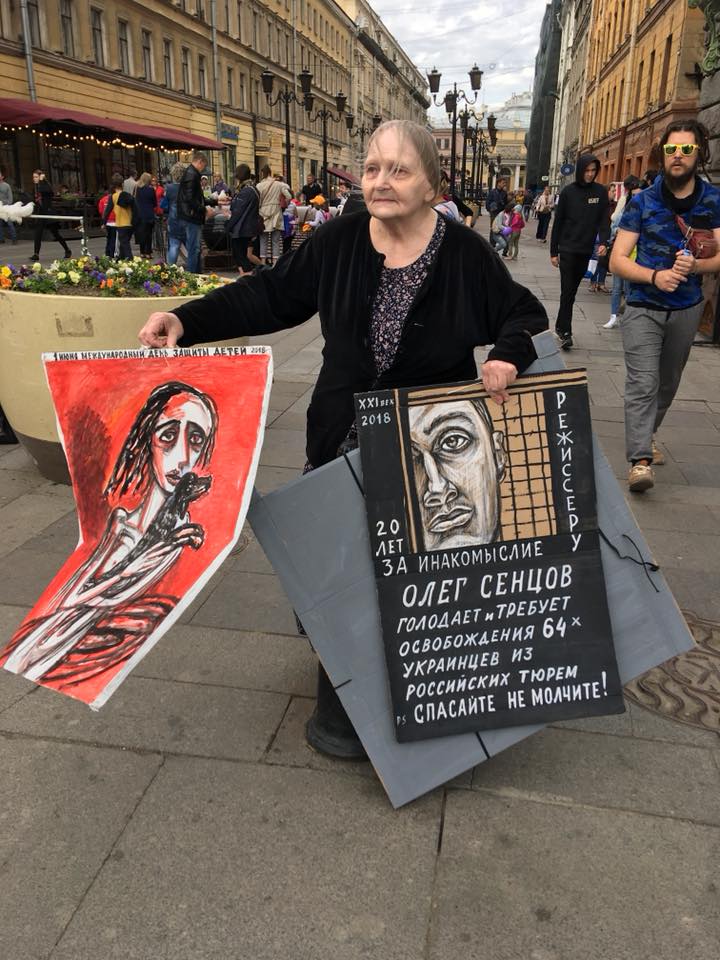 Artist
 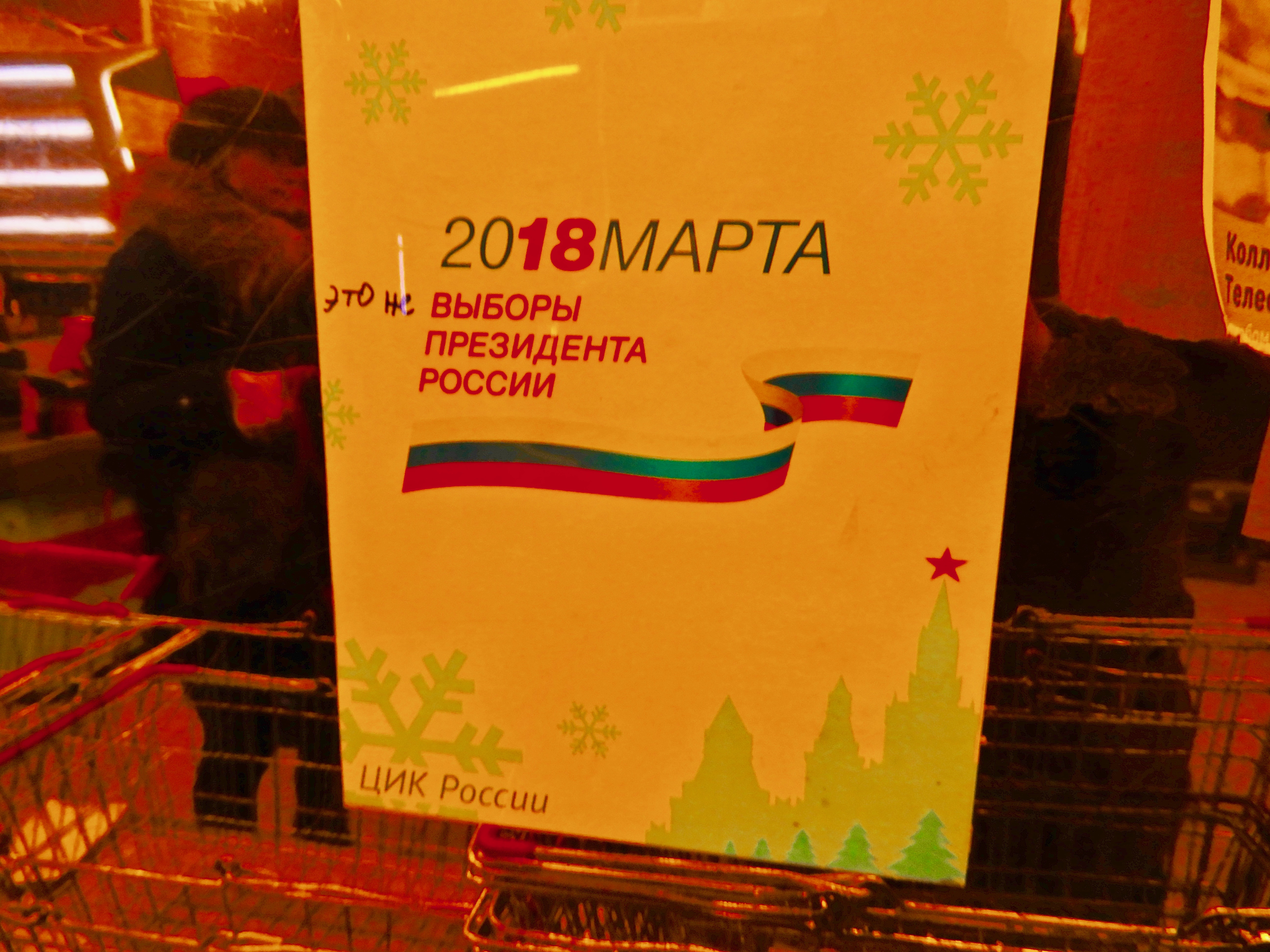 Poster: “March 18, 2018. Russian Presidential Election. Russian Central Election Commission.” || Graffiti: “This is not an election.” Dixie grocery store, Central District, Petersburg. Photo by the Russian Reader
 Igor Averkiev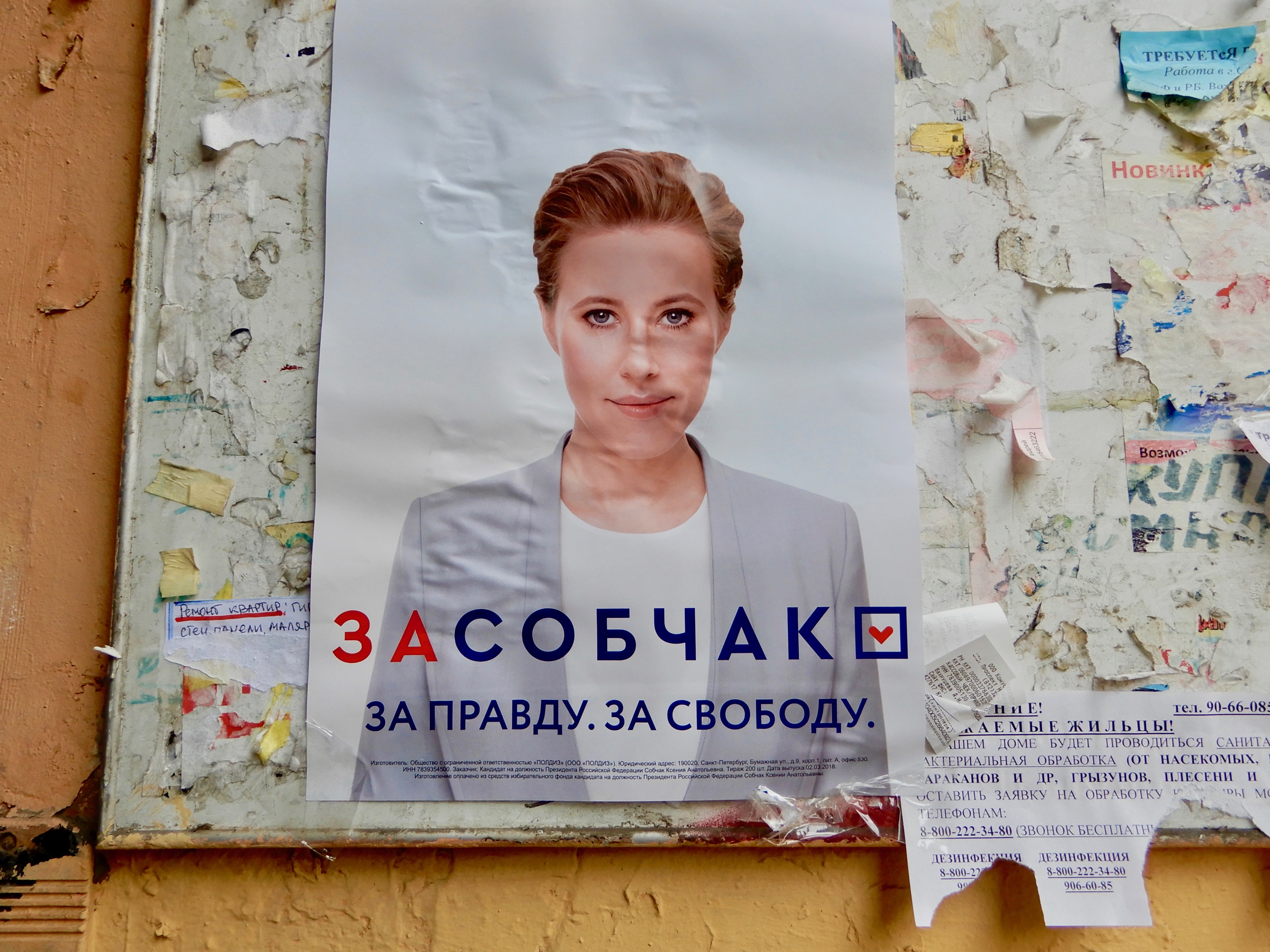
 “They want a turnout for Putin that is as huge, wild, and unnatural as a giant hogweed plant.”