Sparta F.C.

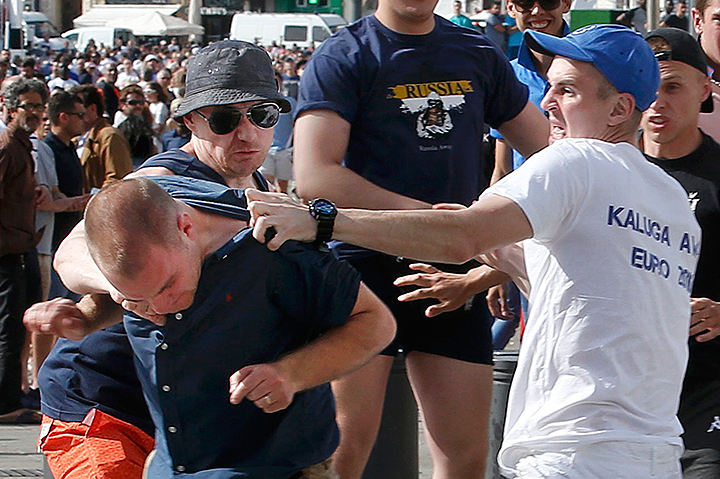
Russian football hooligans attacking an opponet in Marseille. Photo courtesy of tribuna.sports.ru
Russian football hooligans attacking an opponent in Marseille. Photo courtesy of tribuna.sports.ru

Come on I will show you how I will change
When you give me something to slaughter
Shepherd boy (Hey!)
Everybody sing (Hey!)
Better act quick (Hey!)

Be my toy
Come on have a bet
We live on blood
We are Sparta F.C.

The Russian National Football Hooligans Squad: The Russia They Represent in Marseille
Sergei Medvedev
Forbes.ru
June 14, 2016

Russia has fought yet another small victorious war. On the eve of the national squad’s first match in Euro 2015, a couple dozen Russian fans routed the numerically superior forces of the English fans in the Old Port of Marseille. A day later, right after the match, they went berserk in the English sector at the stadium, beating up everyone in their path, including spectators with families and elderly people. The results were distressing. At least thirty-five people were injured, and a fifty-year-old English fan who was crowbarred over the head is at death’s door. As punishment, UEFA has provisionally suspended the Russian team until the end of Euro 2016 (if the violations are repeated, we will be completely disqualified from the championship) and fined the Russian Football Union 150,000 euros, including for the racist behavior of the Russian sector during the match against England. On June 14, French police detained fifty people from the Russian Union of Supporters, led by the notorious Alexander Shprygin (aka Kamancha) and held them for twenty-four hours. Russian fans made the top world news headlines (isn’t it what they wanted?), and Russia’s chances of losing the right to host the 2018 World Cup have seriously increased.

This shameful episode perhaps should not deserve such attention. Football hooliganism has long ago turned into a sanctuary of violence and a near equivalent of world war. Fans of all countries fight and run rampant, and massacres happen too, like the tragedy at Heysel Stadium in Brussels, which left thirty-nine people dead and led to all English clubs being banned from UEFA competitions for five years. And Marseille well remembers the English fans during the 1998 World Cup, who staged a donnybrook with fans from Tunisia and smashed up half the town.

But the difference lies elsewhere. While in England, supporters are unanimously condemned by society and politicians in the wake of such scandals, over the last few days the football hooligans have figured almost as national heroes in Russia. Dmitry Yegorov, a reporter for Soviet Sport, live tweeted the carnage, commenting it like a football match and admiring the organization and physical training of the Russians. Social media have been buzzing with approval for the supporter, who smacked the spineless English upside the head and stood up for Russia like the three hundred Spartans at Thermopylae. A blog by sports journalist Andrei Malosolov entitled “Why the Victory of Russian Supporters in the Port of Marseille Is Cool!” has been especially popular.

What is even more curious, the Russian hooligans have enjoyed the backing of high-ranking officials. Russian Investigative Committee spokesman Vladimir Markin commented on the reaction of the Marseille authorities on Twitter, calling the Russian fans “well-trained fighters.”

“A normal man, as he should be, surprises them,” he wrote. “They’re used to seeing ‘men’ at gay parades.”

LDPR State Duma deputy Igor Lebedev (whose aides include Shprygin aka Kamancha), a member of the Russian Football Union’s executive committee, wrote, “I don’t see anything terrible about fans fighting. On the contrary, our guys were great. Keep it up!”

“If [Russian sports minister Vitaly] Mutko had been with the fans in the stands, he would have fought too,” Lebedev suggested later, in an interview.

Here we have to acknowledge one unpleasant thing. The fans in Marseille supply a honest picture of official policy and conventional wisdom in post-Crimea Russia.

They are waging the same hybrid so popular in our propaganda, infiltrating well-trained fighters, skilled in hand-to-hand combat and disguised as “holidaymakers,” into France, using force selectively and purposefully, attacking in unexpected places. The web is now full of rumors the hooligans were really Russian military intelligence (GRU) special ops units, who had infiltrated the championship to intimidate Europeans, so pumped-up, organized, and sober did the Russian hooligans appear in the numerous videos, but we shall leave this hypothesis to fans of conspiracy theories. As I imagine it, a joint detachment of so-called ultras from different “firms” of fans, fighters experienced in street brawling, converged in Marseille, attacking beer-bellied English “Kuzmiches,” i.e., simple fans who had come not fight, but to cheer and show off, some accompanied by their families.

One Russian fan admitted as much in an interview that our guys had come to fight.

“It doesn’t matter what cities our fans are from and what teams they support. What matters is that we are from Russia and are going to fight against the English. They have always said they are the main football hooligans. We are here to show that English fans are girls.”
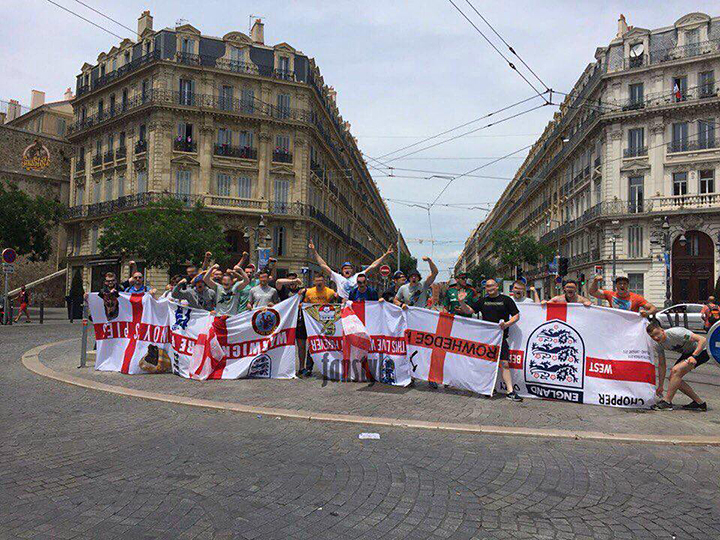
Russian football hooligans displaying captured English flags. Photo courtesy of tribuna.sports.ru

So even if the Russian assault was not really a planned military operation, such rumors do not come out of nowhere. First, Russia is not a novice at “hybrid” interventions in social movements in Europe. It has organized rallies and agitprop campaigns, worked skillfully through the media to fuel anti-immigrant sentiments, cooperated with right-wing radical and neofascist movements, and supported scandalous populists and European separatists. Just as in Soviet times the Comintern engaged in subversion in western countries, Russia has been worming its way into the cracks and fissures of European society. It has been trying to weaken the west from within, explaining it in terms of a total “information war.” Alarmed Europeans see the Russian ultras in this light.

Second, football supporters really are one of the combat units of the regime, which has an irresistible attraction to various groups of mummers who try and make a show of strength, such as Cossacks, bikers, and football supporters. Members of these stern fraternities are invited to drink tea with high officials. They are identified as exemplars of patriotism. They are awarded civil society development grants. And when push comes to shove, they are sent out on so-called Russian Marches and sicked on opposition rallies and individual dissidents. However, the football hooligans are as alien to the football tradition as the Surgeon’s latex bikers, with their Orthodox banners and Saint George’s ribbons, are to the rebellion and freedom of Easy Rider, and the paunchy “Cossacks,” with their glued-on topknots and cardboard medals, specialists in fighting gays and theater productions, are to the honor and glory of Russian Cossacks. They are all fakes in the era of Putin and Pelevin. When “the public” is a total simulation, protest countercultures turn into vehicles for dull officialdom and perfunctory patriotism, into tamed grant recipients.

Finally, the Russian fans (at least the ones who are photographed by reporters) are the readymade products of official propaganda, reproducing on their clothes and bodies all the typical corny kitsch of the era of Crimea and “getting up off our knees”: t-shirts emblazoned with slogans like “polite people” and “we don’t abandon our own,” budyonovkas and earflap caps twinkling with red stars, banners displaying toothy bears and Slavic Siegfrieds, kids in Armata tank t-shirts and, as the apotheosis of all this patriotic trash, a gigantic tricolor, covering half the Russian sector at the stadium, inscribed with the message “YOU’RE FUCKED.” Apparently, these people see this as the new Russia’s national idea.

This mayhem, however, kicked off long before Crimea. Russian fans have usually reserved the most boorish displays of great-power chauvinism and racism for trips abroad. In the Czech Republic, Russian hockey fans unfurled banners emblazoned with tanks and the promise to reprise 1968. In downtown Warsaw in 2012, football supporters staged a march in honor of Russia Day, nearly provoking a battle royal with Polish ultras. Fueled by beer and egged on by propaganda, Russian resentment shows itself to the hilt in the stands at football and hockey matches, taking symbolic revenge for the Soviet empire. Yeah, we forfeited a great power and never have learned how to play football, but we can smash chairs and smack Europeans in the kisser, “kick the shit” (otbutskat) out of them, as Vladimir Putin once put it, invoking a football supporter coinage. Ultimately, wasn’t it Putin who shared a bit of popular wisdom drawn from a tough childhood in Petersburg’s courtyards, i.e., you have to hit first?

The fans in Marseille did just that, and in this sense they are worthy ambassadors of Putin’s Russia.

As MP Lebedev would have it, they should be greeted at the airport as heroes, just as the bikers have been greeted when they return from their patriotic motorcycle rallies. They should be secretly awarded state honors, as the “polite people” were in their time for bringing Crimea back into the fold. And they should be elected to seats in the Public Chamber and State Duma. Football hooliganism is a matter of national importance in hybrid Russia.

The term “football hooliganism” (okolofutbol) quite precisely reflects the essence of events. Despite the adult budgets of its premier league teams and national squad, despite the purchase of international stars (a typical strategy of superficial modernization), Russia has remained an average performer in the world rankings, both in terms of its own national championship and the performances of its national team. Before the start of the Euro 2016, our country was ranked twenty-ninth in FIFA’s world ratings. But, at the same time, a fan movement based on the British model has very quickly and naturally put down roots in Russia. Books by Dougie Brimson, who has written authoritatively on England’s football fan culture, have achieved cult status among Russian supporters. Without becoming a world football power, Russia has succeeded brilliantly in hybrid football hooliganism, spewing its entrenched and publicly recognized culture of violence onto the international arena.

But Russia has been engaged in the same hybrid “football hooliganism” in Ukraine, where it has not been waging an open war, but delegating well-trained groups of fighters, and in Syria, where it arrived with its own agenda and has been bombing targets for reasons known only to it, and in Europe, where it has banked on populism, separatism, and breaking up the European Union.

Football hooliganism substitutes fair play, real work, and the painstaking cultivation of institutions with violent action and demonstrative bullying. This is not the first year the entire Russian state has been playing at football hooliganism. The hooligans in Marseille are merely its away side.

Sergei Medvedev is a journalist, historian, and faculty member at the Higher School of Economics (HSE) in Moscow. Translated by the Russian Reader

__________
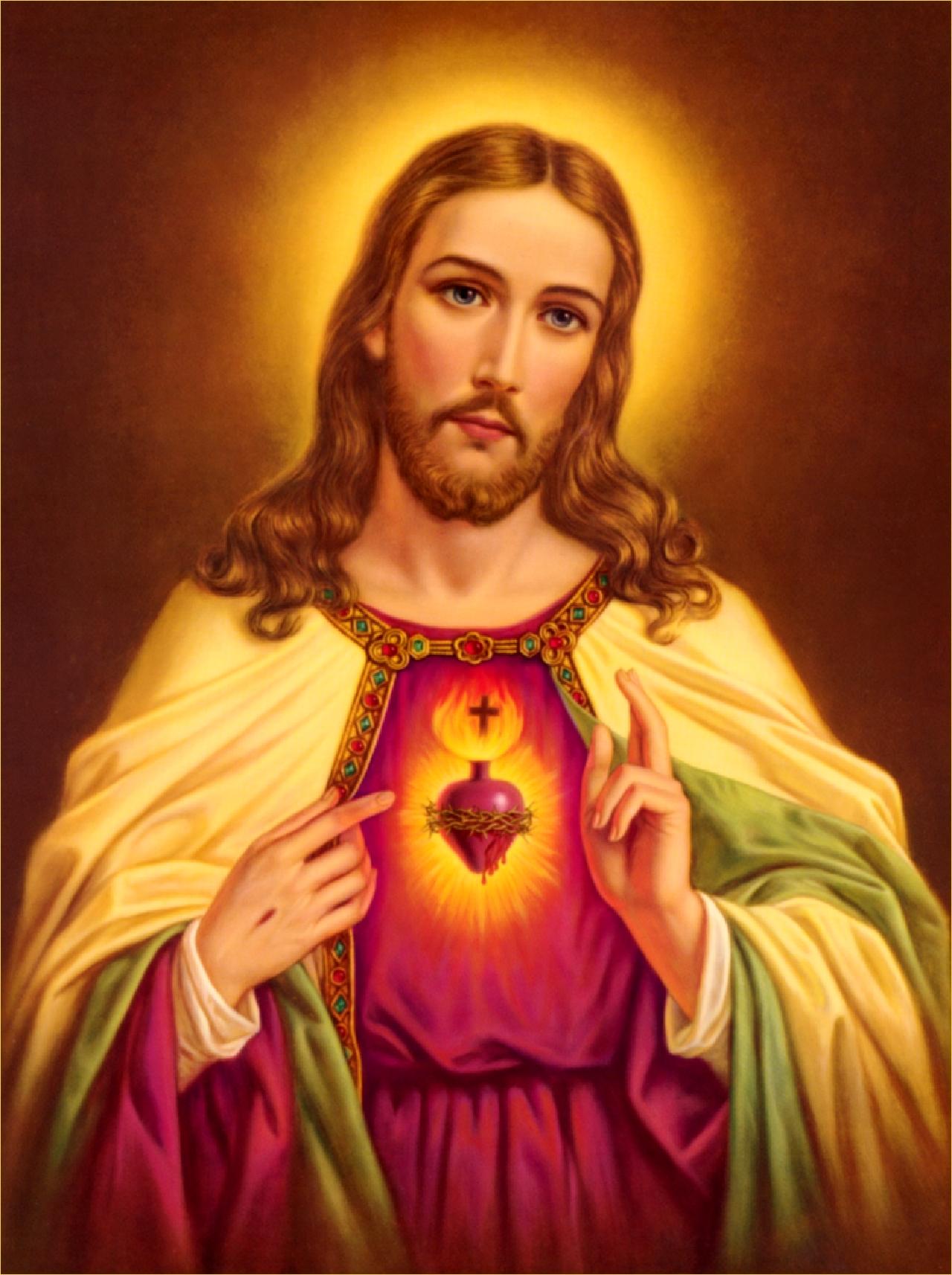
Russian Communism Today (Let Jesus into Your Heart)

Jesus Christ, the first Russian Communist

Putin Asked to Deploy Missiles in Cuba
TV Zvezda
April 27, 2016

The Communist Party of the Russian Federation has proposed deploying Russian missiles in Cuba, reports RIA Novosti.

Communist Party MPs Valery Rashkin and Sergei Obukhov have sent the relevant appeal to President Vladimir Putin, Foreign Minister Sergei Lavrov, and Defense Minister Sergei Shoigu.

The CPRF members have suggested reopening the Lourdes SIGINT Station and deploying missiles on the Island of Freedom to protect the interests of Russian and its allies in the Collective Security Treaty Organization.

The MPs thus propose responding to a Reuters report that the US plans to deploy HIMARS rocket launchers in southeastern Turkey in May.

“First of all, we are talking about deploying Russian rocket launchers of a similar or even greater range in Cuba. Also, an asymmetrical response to Washington by way of reactivating the SIGINT station in Lourdes seems appropriate,” the MPs write in their appeal.

_________

Zyuganov Considers Christ “First Communist in History”
TASS
April 20, 2016

The head of the CPRF Central Committee called the feast of Christ’s Resurrection an “amazing, wonderful holiday” that “is in no way at odds with workers’ solidarity.”

CPRF leader Gennady Zyuganov confirmed that the Communists do not intend to forego involvement in May Day rallies despite reports that they might be cancelled in a number of Russia’s regions due to Easter.

“Official processions are cancelled, but as for public organizations, no Aksyonov [head of Crimea Sergey Aksyonov] can cancel them,” Zyuganov told TASS.

He recalled that May 1 is International Workers’ Day, a holiday that “came into being in defense of working people’s rights,” and is an official holiday in the Russian Federation.

“And no administrator can cancel this holiday,” argues the leader of the Communist Party.

“Workers have no other way to defend their rights except solidarity. They have every right to gather on May 1 and voice their opinion. We are going to be involved in these events, and our Crimean organization will also be involved,” said Zyuganov.

As for Orthodox Easter, which this year also falls on May 1, Zyuganov called the feast of Christ’s Resurrection an “amazing, wonderful holiday” that “is in no way at odds with workers’ solidarity.”

“Because Christ was the first communist in modern history. He raised his voice for orphans, for the needy, for the sick, for the wretched, for everyone who had it bad. In this sense, if he were alive, he would be marching with us,” said the head of the Central Committee of the Communist Party of the Russian Federation.

Earlier, the head of the Republic of Crimea Sergey Aksyonov* said that Crimean authorities would not be holding official May Day demonstrations and rallies due to Orthodox Easter.

“This year, May Day coincides with the Easter holiday. Many of us will be spending the night before May first in churches at Easter services, and many will be celebrating the Holy Resurrection of Christ with their families. The authorities of the Republic of Crimea are not planning May Day demonstrations and rallies this year. There will not be any official celebrations. But people may decide for themselves how they will celebrate the Holiday of Spring and Labor,” Aksyonov said in a statement released by his press office.

The media have also reported the trade unions of Surgut and Tambov have decided not to hold May Day events for the same reason. May Day rallies in Russia have usually been organized by trade union organizations, mainly the Federation of Independent Trade Unions of Russian (FNPR), which has nearly twenty million members.

Translated by the Russian Reader. Image courtesy of Jesus Wallpaper


Sergey Aksyonov has led efforts to stamp out dissent among ethnic Crimean Tatars over the annexation, saying “All activities aimed at non-recognition of Crimea’s joining to Russia and non-recognition of the leadership of the country will face prosecution under the law and we will take a very tough stance on this.”

Aksyonov says homosexuals “have no chance” in Crimea, and that “we in Crimea do not need such people.” He also promised that if gays tried to hold public gatherings, “our police and self-defense forces will react immediately and in three minutes will explain to them what kind of sexual orientation they should stick to.”

Source: Wikipedia

Tatiana Kosinova: Manmade Savagery (The Murder of Dmitry Tsilikin)

Manmade Savagery
Tatiana Kosinova
April 7, 2016
Cogita.ru

Tonight, police detectives in Petersburg arrested student Sergei Kosyrev, who confessed to the murder of journalist Dmitry Tsilikin. Kosyrev has dubbed himself the Cleaner and claims his motive for committing the murder was hatred.

Slain Petersburg journalist Dmitry Tsilikin. Photo courtesy of Cogita.ru

On the morning of April 7, 2016, the website of the Russian Federal Investigative Committee’s Petersburg office reported that the office had detained a suspect in the murder of journalist Dmitry Tsilikin.

Tsilikin’s death was discovered on March 31, 2016. Relatives founded his body, covered with multiple stab wounds, in his own apartment. Investigators opened a case under Article 105.1 (murder) of the Russian Federal Criminal Code.

Fontanka.ru’s Yevgeny Vyshenkov chronicled the search for Sergei Kosyrev in the early hours of April 7, 2017. Vyshenkov writes that after studying billing recordings of the journalist’s mobile telephone,  investigators intercepted the 21-year-old Kosyrev, who had called Tsilikin on the morning of March 27. Investigators had established that the journalist bled to death at five p.m. on March 27, 2016.

According to an article published today by Fontanka.ru, the murder suspect “called himself the Cleaner during questioning, and his life a crusade. Sergei Kosyrev, a 21-year-old student at the Hydrometeorological University, explained that the crime was a mission […] a crusade against a particular social group, […] and the feeling he had when he, allegedly, killed Tsilikin, was not dislike, as written in the arrest report, but hatred.”

Investigators have informed the media that Kosyrev holds right-wing views and is a fan of the Norwegian black metal band Emperor, whose “drummer stabbed a man to death in Lillehammer in for ideological reasons” in 1992.* Komsomolskaya Pravda writes that Kosyrev might turn out to be a “serial killer of gays.”

The gloomy stories involving the unsolved deaths and injuries of gays in recent years cry out to be seen as symptomatic.

As Masha Gessen wrote in The New York Times yesterday, “What no one has written in response to any of these deaths is that the Kremlin’s antigay campaign, which simultaneously pushes people underground and communicates to the public that homophobic violence will go unpunished, ensures that these shameful killings continue.”

Like the rest of the country, Sergei Kosyrev, a student at the Hydrometeorological University, has lived for the last four years in an atmosphere of increasing hatred for LGBT, “fifth columns,” “foreign agents,” and a whole list of official aliens and others compiled by official propagandists and state media. The security services do not see their actions as incitement of hatred and enmity, because they are busy searching for “extremists” among opposition-minded journalists, politicians, and lone picketers. However, the atmosphere of hatred and savagery is manmade, and sooner or later culpability will catch up with the people who have generated it in the shape of a war of all against all.

Translated by the Russian Reader

Correction. When this post was originally published, it contained a link to a different article on Fontanka.ru, not the article containing the passage cited by Tatyana Kosinova, in which it is alleged that suspected killer Sergei Kosyrev referred to himself as “the Cleaner,” etc., during question by police. I apologize for my error. May 18, 2016. TRR

* On 21 August 1992, [Bård “Faust” Eithun] stabbed Magne Andreassen, a gay man, to death in a forest just outside Lillehammer. Eithun was visiting his family there. He went to a pub and had a drink, but “the atmosphere didn’t suit him, so he decided to head home.” According to Eithun, while walking in the Olympic park, “this man approached me – he was obviously drunk and obviously a faggot […] it was obvious that he wanted to have some contact. Then he asked me if we could […] go up to the woods. So I agreed, because already then I had decided that I wanted to kill him, which was very weird because I’m not like this.” Eithun carried a knife because, as he explained: “It’s better to have a knife you don’t need than to not have one when you need it.” Once in the woods, Eithun stabbed Andreassen 37 times and then kicked him in the head repeatedly as he lay on the ground.

Eithun claimed that he felt no remorse at the time. In the late 1990s, he said of the murder: “I was outside, just waiting to get out some aggression. It’s not easy to describe why it happened. It was meant to happen, and if it was this man or another man, that’s not really important.” Ihsahn, his bandmate in Emperor, said that Eithun “had been very fascinated by serial killers for a long time, and I guess he wanted to know what it’s like to kill a person.”

The media has linked the murder to black metal and speculated that Eithun was motivated by Satanism or fascism, but in a 2008 interview he explained: “I was never a Satanist or fascist in any way, but I put behind me the hatred and negativity. Those feelings just eat you up from inside.” In a 1993 interview he had said “I am not a Satanist, but I praise the evil.” In an interview for the book Lords of Chaos he explained he had been “interested in Satanism but there are other things as well. Basically, I don’t give a shit.”Jørn Tunsberg of the band Hades Almighty said that the murder was “an impulse killing” and that “it had nothing to do with black metal.”

Source: Wikipedia

Drawing to Go on Living

iva-1

Drawing to Go on Living
Yuri Ivashchenko
November 3, 2015
Mediazona

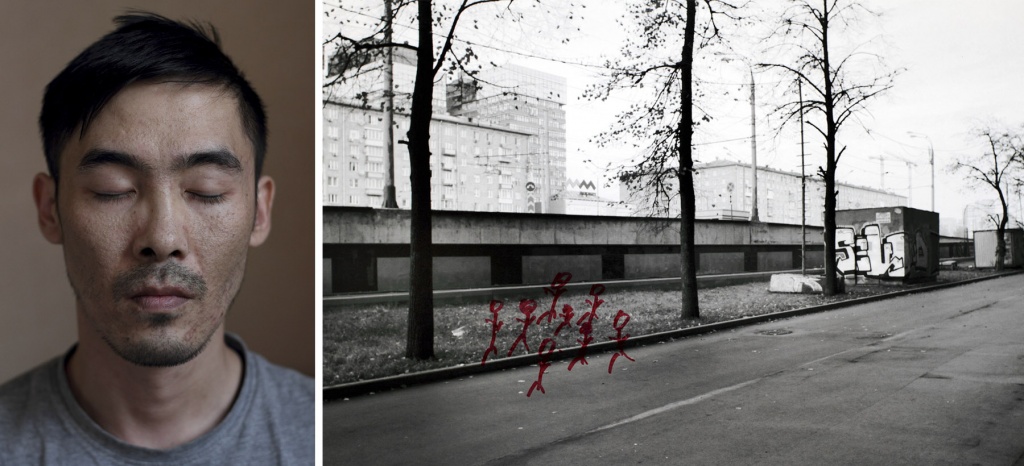
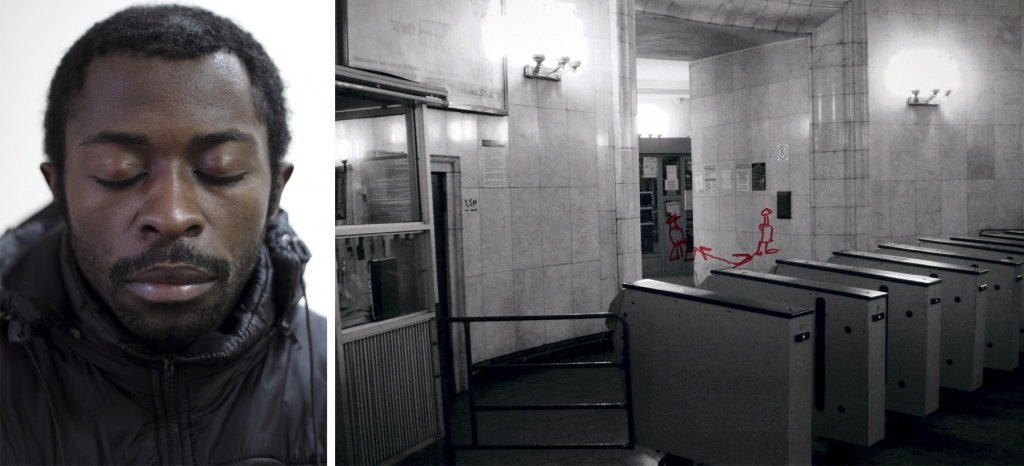
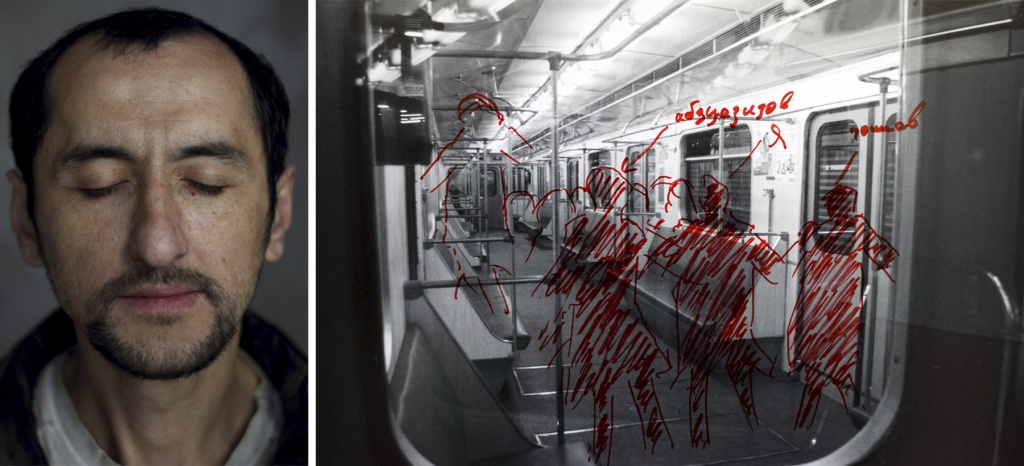
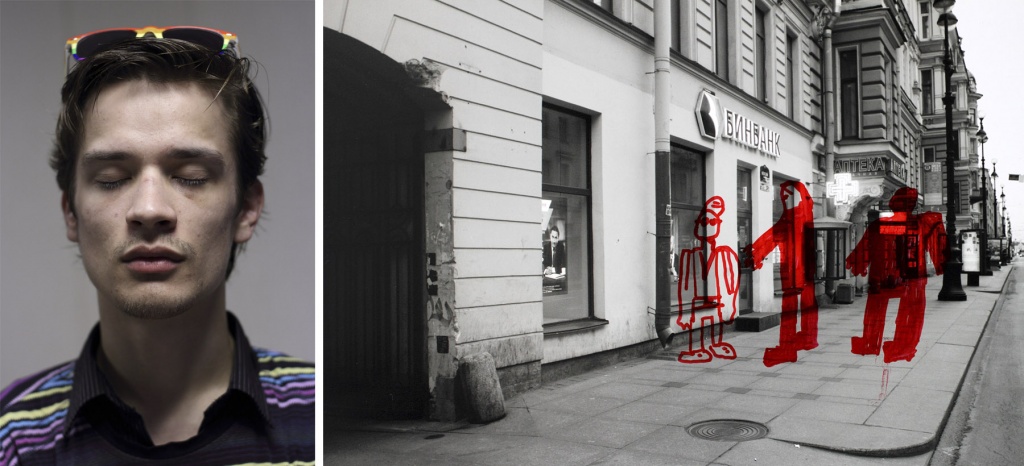
Photographer Yuri Ivashchenko looks for people who have been assaulted by racists and homophobes in Russia. He asks them to make a schematic drawing of what happened to them on a snapshot of the crime scene.

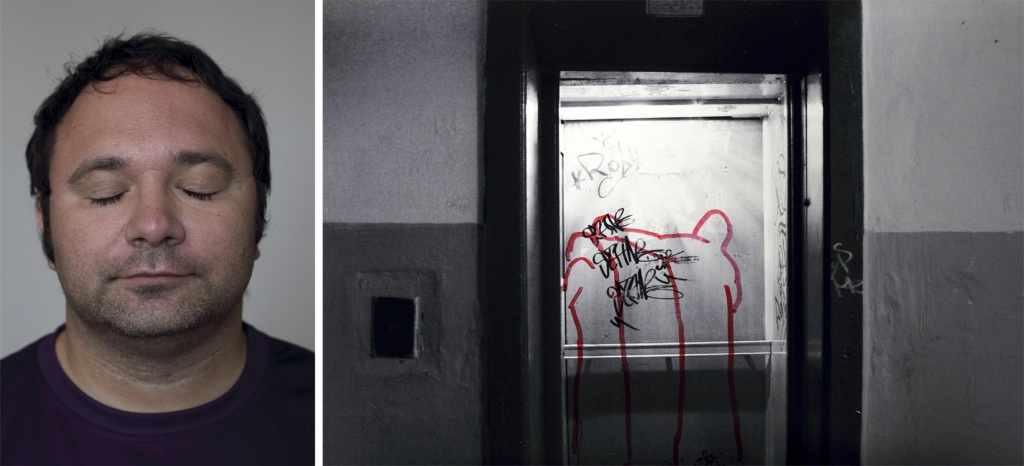
Mikhail Tumasov, Russia. Assaulted April 2012 in Samara

Mikhail came out to a new friend, who violently assaulted him. Mikhail spent a week in the hospital. A magistrate judge rejected Mikhail’s lawsuit, since Mikhail had not listed the assailant’s birthplace, registered address, and other personal data.

iva-2

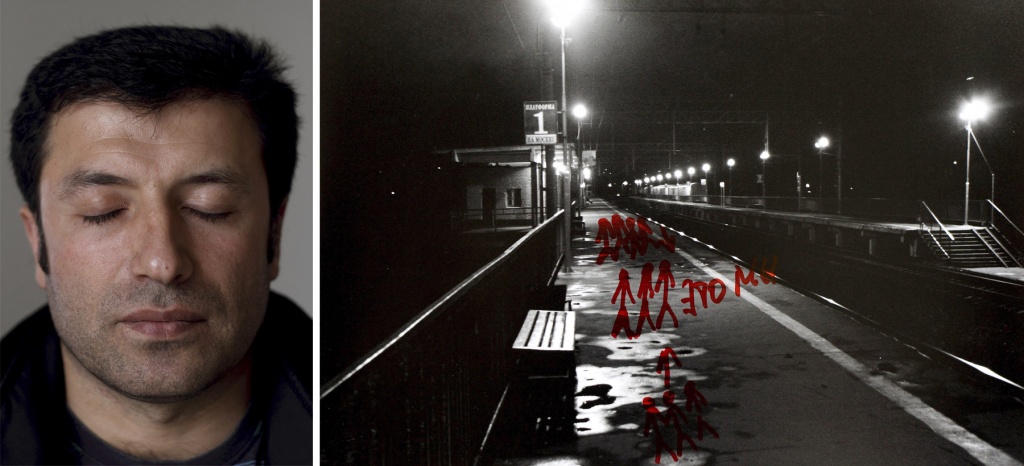
Ibrahim Yunusov, Uzbekistan. Assaulted on October 3, 2008, at Sokolovskaya railway platform in the Moscow Region

Ibrahim and his brother, immigrants from Central Asia, were assaulted at the railway platform, where they had gone to see off a Belarusian friend. When eyewitnesses of the assault called the police, the officers who arrived on the scene suspected the brothers had been involved in a recent rash of telephone thefts on commuter trains. Despite eyewitness testimony corroborating the Yunusovs’ alibi, a court found them guilty of stealing other people’s property and sentenced Ibrahim to a year of probation. His brother Rustam was sentenced to six months of probation. The six months they had spent in a pretrial detention facility was deducted from their sentences.

iva-3

Alexander Lee, Uzbekistan. Assaulted June 17, 2014, on Leningrad Highway in Moscow

Alexander was standing at a tram stop when several men attacked him. Fighting them off, he ran towards the Sokol subway station. Screaming, “Kill him!” ten to fifteen young men chased Alexander. They caught up with him and surrounded him on a lawn. One of the assailants hit Alexander in the back. He fell to the ground and was beaten up by the mob. The assailants took Alexander’s telephone and wallet, which contained around 10,000 rubles. Later, passersby called an ambulance. Alexander was taken to hospital, where he spent over a month.  Doctors have diagnosed Alexander with a bruised spinal cord. A criminal investigation of the assault is underway, and there are suspects in the case.

iva-4

Mele, Cameroon. Assaulted November 30, 2013, at the Novoslobodskya subway station in Moscow

Mele was attacked in the late evening at the turnstile to the subway by a man shouting racist slogans.

The assailant was arrested. He confessed his guilt in court and was released after reaching a settlement with Mele that involved paying him compensation and apologizing.

iva-5

Anvar Yusupov, Tajikistan. Assaulted January 16, 20112, in the Moscow subway

A group of drunken young men, their faces covered in scarves, attacked Anvar and two of his friends when they were returning home from work. Noticing the young men were wielding knives, Anvar decided to defend himself with a beer bottle and managed to wound one of the assailants. Subsequently, the wounded young man was arrested in Saint Petersburg for stealing tennis shoes and testified about the incident in the subway. The court, however, found Yusupov guilty and sentenced him to six months’ imprisonment in a penal colony, which was later commuted to a fine. 

iva-6


John, Russia. Assaulted April 18, 2015, near Nevsky Prospect, 184, in Saint Petersburg

John was walking down the street in rainbow-colored glasses when he drew even with two young men. One of them bumped John hard with his shoulder. John asked the passerby why he had done this. The man replied that he hated “fags” and head-butted John. John responded by pepper-spraying the assailant, who fled the scene with his companion. The police refused to open a criminal investigation into the incident.

iva-7

Translated by the Russian Reader


How Dante Got Punched in the Kisser

Dante Teodori
October 26, 2015
Facebook

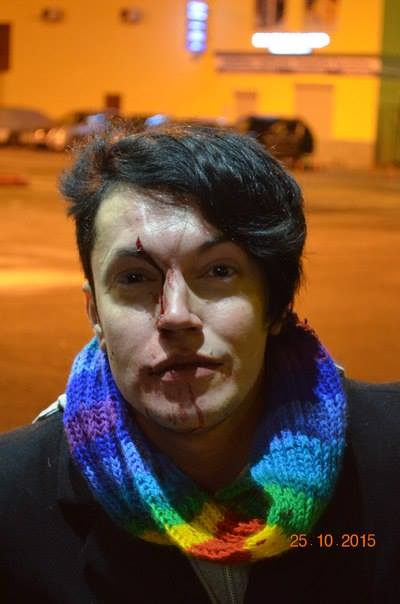
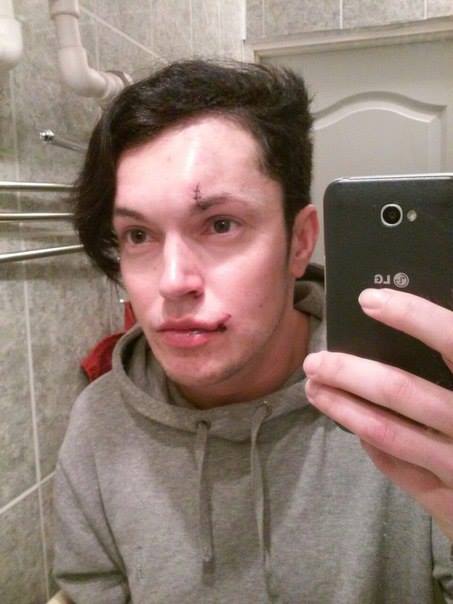
This is the story of how Dante got punched in the kisser and now bears all the hallmarks of an alleged real man.

Petersburg LGBT activist Dante Teodori

I was going to the Rainbow Coffee Klatch on the subway today. I looked and saw this one guy eyeing me quite maliciously. The fellow was well built and dressed in sport clothes but dressed decently. After a while, he came up and leaned over me. (I was sitting down.) He told me either I could take off my scarf and scram from the car or he would kick my ass. (I have omitted the obscenities.) I refused. He smacked me in the face and split my lip. I took the second blow on the head and it split my eyebrow. Then some dude pushed him away.

I got out at a station and looked for the cops or some other official service, but there was no one. I got back on the train and pushed the hotline button to connect me to the driver, but it didn’t work. Well, okay, I thought, I will just go as I am. I asked people for napkins and telephoned the guys to come meet me in the subway, since I thought my nose was broken and I wouldn’t be able to see anything because of the blood. When I got there, the guys suggested calling an ambulance, since we didn’t know where the first-aid station was.

They took me to the hospital, since they didn’t like the look of the epic lump on my forehead. At the hospital, I was examined, stitched up, and sent home to heal.

dante-2

What is the moral of this story? I could have taken the scarf off. I could have have got out of the car. I had the chance. But I think this is the wrong position to take. “It’s about how hard you can get hit and keep moving forward; how much you can take and keep moving forward. That’s how winning is done!” That is first and foremost.

Second, the scarf was not in the LGBT colors. It was knitted and given to me by a very nice woman with whom I was detained for waving the Ukrainian flag. What does this mean? That technically anyone wearing colorful clothes can get the crap beat of them.

And the most important thing. I think the only chance we have of getting closer to the future we want is to live as if it has already arrived.

Translated by the Russian Reader. Thanks to Gabriel Levy for the suggestion. Photos courtesy of Dante Teodori’s Facebook page. This story has been covered widely in the local media. See, for example, “LGBT activist beaten over colorful scarf,” Paperpaper.ru, October 26, 2015 (in Russian).

Is There Life on Mars?

OSIRIS_Mars_true_colorOne of the joys of the web is being able to catch glimpses of life on different planets.

Gieselman dumped the girlie name bestowed at birth, asked friends and teachers to use Rocko, the tough-sounding nickname friends had come up with, and told people to use “they” instead of “he” or “she.” “They” has become an increasingly popular substitute for “he” or “she” in the transgender community, and the University of Vermont, a public institution of some 12,700 students, has agreed to use it.

While colleges across the country have been grappling with concerns related to students transitioning from one gender to another, Vermont is at the forefront in recognizing the next step in identity politics: the validation of a third gender.

The university allows students like Gieselman to select their own identity — a new first name, regardless of whether they’ve legally changed it, as well as a chosen pronoun — and records these details in the campuswide information system so that professors have the correct terminology at their fingertips.

—Ulie Scelfo, “University Recognizes a Third Gender: Neutral,” The New York Times, February 3, 2015

__________

Russia Blacklists LGBT Teen Online Support Group
The Moscow Times
February 2, 2015

A Russian web site that served as a support group for LGBT teenagers has been blacklisted by the authorities and will likely be blocked within the country, news reports said Monday.

The site’s name Deti-404 (Children 404), after the online HTTP error message for “page not found,” may prove portentous if Russia’s Internet watchdog Roskomnadzor considers the site to be in violation of a federal law that regulates online content.

Russian news site Ura.ru reported on Monday, citing Roskomnadzor, that the Deti-404 web site will be blocked because it disseminated information on committing suicide.

Deti-404.com and as its eponymous groups on social networks Facebook and VKontakte were still accessible in Moscow at press time Monday evening.

Ura.ru published a post contained on Deti-404’s Facebook page showing a young woman’s scratched-up arm with the numbers “404” writing in black ink. The caption reads: “I want to die, to disappear, so that I simply never existed.”

Deti-404’s founder, Yelena Klimova, said last week that she was fined 50,000 rubles ($780) for violating Russia’s controversial law against the “propaganda of nontraditional sexual relations among minors.” The site’s blacklisting may be linked to that case.

Roskomnadzor opened a case against Klimova last November after it claimed to have received some 150 complaints from “citizens and organizations” about Deti-404’s pages on social media networks.

Photo courtesy of Wikipedia

News of South Karelia, Finland

Two Russian Homosexuals Awaiting Asylum in Lappeenranta
January 19, 2015
Lappeenrannan Uutiset

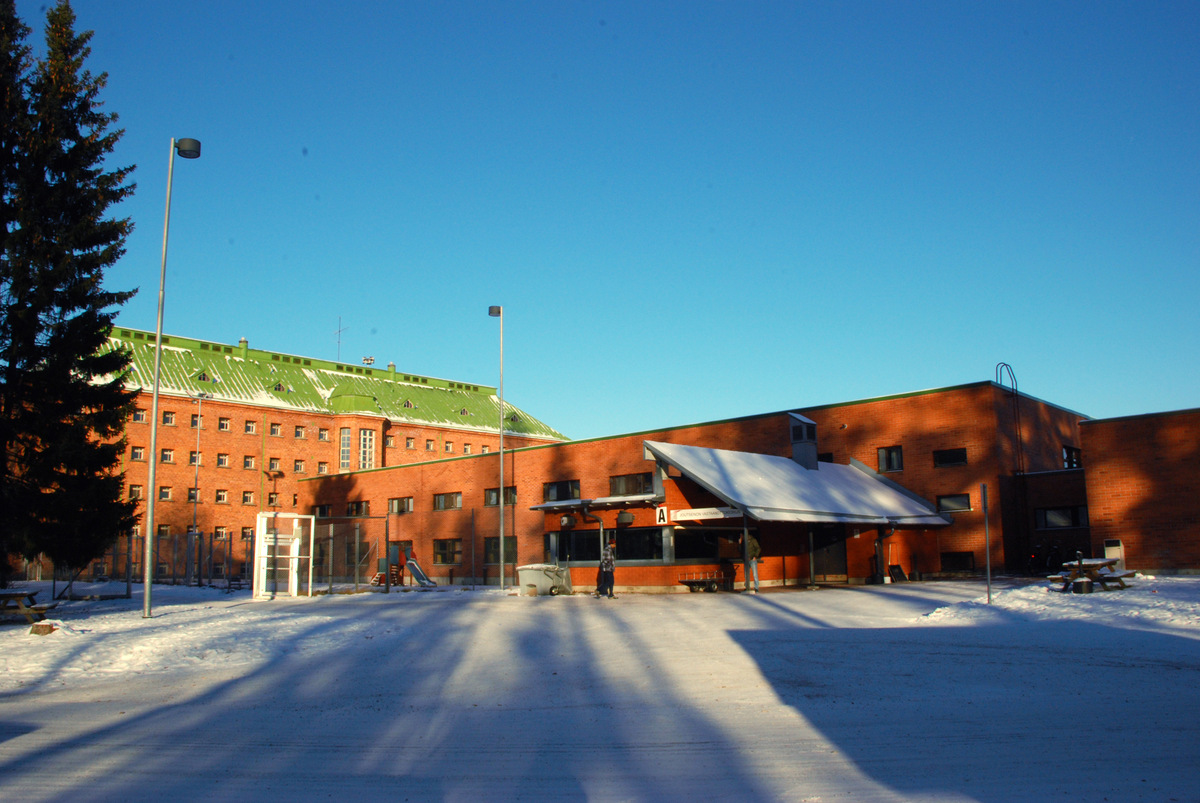
vastaanottokeskusThe men are awaiting asylum at the Konnonsuo reception center. Photo by Janne Koivisto

Two Russian gay men are seeking asylum in Finland.

They are currently waiting at the Konnonsuo reception center in Lappeenranta, where they have been since September.

According to the men, they have been treated very badly in Russia. In recent years, Russia has made laws against homosexuals more severe.

The men are 24 and 36 years of age.

______

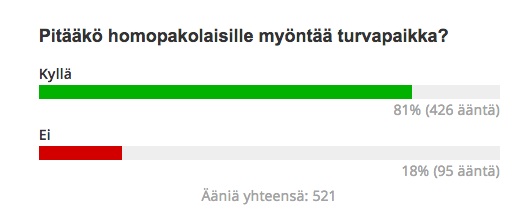
Lappeenranta Uutiset has asked its readers whether gay refugees should be granted asylum.

As of five p.m. Finnish time on January 21, 2015, 81% of readers who responded to the poll said that yes, gay refugees should be granted asylum.

turvapaikka

Two Minutes Hate

Reaction, with Valery Tatarov
Saint Petersburg TV
September 29, 2014

The West’s Love

Since I was surprised myself, I intend to surprise you as well. Good evening, friends. Did you know that there are areas to which Europe’s sanctions against Russia do not apply? On the contrary, our western partners—who no longer conceal their dislike of Russia and [ethnic] Russians, who call the leader of our country a “führer,” who are pounding whole sectors of the economy and finance with sanctions, actually causing a rise in prices here—on certain issues these same people are ready at the drop of a hat to come here to Russia, to Petersburg, in particular, and send convoy after convoy with humanitarian missions.

And whom, do you think, the West continues to passionately love in Russia amid total sanctions? You’ll never guess. I myself was amazed by this fact, because the West, so I imagined, was now more than ever principled in its hatred of all things Russian. From Barak Obama to, dare I say this surname, [President of Lithuania Dalia] Grybauskaite, we hear insults directed towards Russia and [ethnic] Russians, and people have felt this on their skin. I mean the sanctions. A photo of men [with the slogan] “Sanctions against Russia are sanctions against me” [painted on their backs] has been making the rounds of the Internet.

So, just think, at the same time as hundreds of artists have been banned from traveling to Europe—in England, for example, the local “bodybuilders” have called for a boycott of Gergiev’s concerts—signs reading “No Russians allowed” are hung at cafes in Eastern Europe, Norway has left the “evil empire,” as it deems Russia, without the famous Norwegian salmon, Holland [has left Russia], without the famous Dutch cheese, and Sweden [has left Russia], without the ensemble ABBA, humanitarian assistance and close contacts continue in the area of . . . sexual partnership. And not traditional [sexual partnership] of some kind, but namely extremely perverted, gayropean [sexual partnership].

Miss Heidi Olufsen, the Norwegian consul general in Petersburg, personally greeted a recent Petersburg festival of sexual minorities or, more simply, perverts, with a heartfelt speech.

[Olufsen, in Russian:] “People should learn to respect and accept a person for who they are.”

Аs did Deputy Consul General of Sweden Björn Kavalkov-Halvarsson.

[Kavalkov-Halvarsson, in Russian:] “To eliminate prejudices what is needed are bold politicians who stand up for human rights and make laws that do not lead to the emergence of second-class citizens.”

A whole group of English-speaking western comrades decided to personally show solidarity and love for those they consider humiliated and subject to repression in Russia. Meaning—and this is important—officials who approve of repressions against Russia single out perverts as a special group of people who need special love and pity.

You remember the obscene anecdote about the sparrow that warmed itself in winter—I really apologize for this—in cow dung and was dragged out of the dung by a cat. [The moral of the story was that] the one who pulls you out of the shit is not your friend, and the one who covers you in it is not your foe. If there have to be three or four percent of the population with this abnormality of loving the same sex, then we will tolerate them and even feel sorry for them, but we will not let them into schools and kindergartens.

There used to be Doctors without Borders and Peace in Exchange for Food [sic], and now there is Sex instead of Food and Homosexualism [sic] without Borders. And most importantly, it is all so out of place, so ill timed. In the Ukraine, people are perishing. Everyone knows that at the forefront of the misanthropes are an outted faggot,* Supreme Rada deputy Oleg Lyashko, and a closet faggot, interior minister Arsen Avakov. Their sexual orientation really wouldn’t bother anyone if they hadn’t declared their fierce hatred of Russia and the friendship between Ukrainians and [ethnic] Russians. But it is just these “comrades” who are behaving heinously in Donbass.

And if one of those people who are sympathetic to the sexual “Mensheviks” would give them some good advice [and tell them that] at such a difficult time for the country not to show off in the company of Russia’s official enemies from Western Europe, but, on the contrary, protest against the actions of Lyashko and Avakov, which discredit the honest name of, so to speak, internationalist faggots. But no, instead they are also trying to convert them into fighters against the traditions of their own motherland.

In this context, the pass made to the faggots and lesbians by Petersburg [human rights] ombudsman Alexander Shishlov, who essentially greeted them in a special communiqué, appears completely dubious and politically mistaken. You know, back in the old days, the Soviet Communist Party general secretary would greet gatherings of student work teams in Siberia. So anyway, Mr. Shishlov—I quote BaltInfo—“sent greetings to the organizers of [Queerfest], a festival of gay culture taking place […] in Saint Petersburg.”

So, “among the stated objectives [of Queerfest] is the creation of an effective public space devoid of homophobia, xenophobia, and other forms of discrimination, and the promotion of dialogue”—this is very important—“between members of different groups, organizations, minorities, and communities. These objectives are dear to all [‘of us,’ Tatarov adds] who consider human rights supreme values.”

Do you really want dialogue? Well, what kind of dialogue can there be here? Some get sanctions and hatred from the West, others—the ones in Donbass—get mass graves of civilians, and still others get touchy-feely. Will this actually make things better for the perverts? I am not worried about them: it’s a question. I don’t think it will make things better for them. So, friends, I will finish the anecdote about the sparrow eaten by the cat, which is obscene, like this whole topic of sexual perverts. The one who shits on you is not your foe, and the one who pulled you out of the manure is not your friend. But if you wind up in [shit], just sit there and don’t tweet!

Take care!

*Translator’s Note. Here and throughout, the word in the original Russian is pederast (педераст), which despite its obvious origins and appearance is simply an offensive term for “homosexual,” although perhaps it has, as friends have noted, a slightly “pseudo-scientific” or “old-fashioned” ring to it that its popular and commonly used derivatives pidoras and pedik do not. (They are wholly offensive and thus, apparently, “not fit for TV,” especially after passage of the new law on swearing.) But as one of my friends writes, “He [Tatarov] says pederast so that everyone will hear will pidoras. His intention is to insult, and everyone understands it that way. Otherwise, he would have said sodomit [sodomite] or muzhelozhets [ditto]. […] But when the linguistic expertise is conducted [in connection with a possible criminal investigation, see below], it will turn out that he did not offend anyone.” This is a long way of saying there is no one perfectly good way of translating the word, especially in this context.

 __________

Queerfest Demands Apology from TV Channel
October 29, 2014
comingoutspb.com

Organizers of the human rights LGBT festival Queerfest have demanded that Saint Petersburg TV publicly condemn statements containing hate speech and hostility towards gays, lesbians, bisexuals, and transgenders (LGBT). These statements were made in the program “Reaction,” presented by Valery Tatarov, which the channel broadcast on September 29, 2014. The program, which dealt with Queerfest 2014, is still available on the channel’s official web site: http://topspb.tv/programs/v10655.

According to the activists, the program contained utterances (“perverts,” “faggots,” “if you wind up in manure, sit there and don’t tweet”) that were not only humiliating but could also be deemed incitements of hatred and enmity against a social group (LGBT).

The organizers and participants of Queerfest sent Saint Petersburg TV’s editor-in-chief a written request to make an official comment containing the editorial staff’s position on the program aired on September 29.

If it transpires that the humiliation of LGBT people and instigation of hatred and enmity against them was done intentionally and with the knowledge of the channel’s editorial staff, the organizers and participants of Queerfest intend to request that the Investigative Committee open a criminal case under Article 282 of the Russian Federal Criminal Code, as well as contact the Press Complaints Board, which is the journalistic community’s body for reviewing complaints of ethical violations by journalists.

__________

Editor’s Note. Wholly owned and financed by the city administration of Saint Petersburg, Saint Petersburg TV, which began broadcasting in October 2010, is available on cable, satellite, and the Internet. In 2011, it was reported to have a potential audience of 1.7 million people, a figure that has probably risen considerably as the wholesale digitalization of TV broadcasting and reception in the city has continued.

In an August 2012 interview, Sergei Boyarsky, the channel’s then-new general manager, described Saint Petersburg TV’s editorial philosophy as follows:

I don’t agree that the only way to get ratings is by criticizing. I think all this talk about free media only benefits the poor [sic]. Our country is rife with freedom of speech. If you turn on Echo of Moscow [radio station], you can sometimes feel sick, so tactlessly and harshly do the guests and some of the presenters sound off about the political system, about the government, and personally about the country’s leader. If you think that is healthy, I don’t think so. We will present information objectively, but I won’t allow flagrant rudeness and showing favor to a particular side.

Boyarsky is the son of popular Soviet singer and movie actor Mikhail Boyarsky, who is well known for his demonstrative support of the current regime.

Curiously, in September 2013, the channel launched a section on its web site featuring selected news stories overdubbed in English, with accompanying English-language transcripts. The channel abruptly ceased posting these reports in August 2014.

Queer Art Threat

Sodom Sabbath-3968

QueerFest, a Russian queer pride event, opened today [September 18, 2014] in St. Petersburg with a bang. Over 160 people made it, despite the last minute change of venues, attacks by provocateurs, and insults by the usual guest—Vitaly Milonov.

Yesterday, the organizers learned of planned actions to foil the event by infamous homophobic activists, some of them, such as Enteo and the crew, coming especially for the festival from Moscow.

The police and the Petersburg human rights ombudsman were alerted.

Today started with a call from the main venue, receiving threats. An hour and a half before the festival was scheduled to open, the owner of the building (the same building that hosts the Manifesta 10 biennale headquarters) informed us through his representative that our contract was annulled. The reason given was “compromised integrity of the arch over the entrance into the building, which may result in its collapse.” Needless to say, this public threat did not impede all other events in the building to proceed as planned.

Volunteers of the festival moved the exhibition and equipment to a new venue in under one hour.

The ceremony was a success. While QueerFest’s security barricaded the door from Vitaly Milonov and his friends, who proceeded to insult and push guests, representatives of human rights organizations and European and the US diplomatic missions in St. Petersburg spoke of the importance of respect for human rights and non-violence.

About twenty hooligans sprayed guests with a green substance and some sort of stinky gas. At one point, two foreign guests were being pulled into the venue by security while being pulled out by their feet by the perpetrators.

The police, who comported themselves professionally, took numerous statements from the victims, while the Petersburg ombudsman urged more people to document violations.

Unfortunately, the second venue also ceded to pressures, and most events are now homeless. But the organizers remain optimistic.

“We feel exhausted and exhilarated. Thanks to the work of 40 volunteers, partners, and random kindness by strangers and by passersby, our event was a success. People—their rights—but also their light and kindness, is what our festival is all about. And there are more of them around us every day. That is why we will prevail,” says Polina Andrianova, one of the festival organizers.

The organizers thank all partners, friends, volunteers, colleagues, and participants for today’s support.

source: QueerFest

The press release above has been edited slightly for republication on this blog. Photo by Sergey Chernov. Reprinted here with his kind permission.


Kirill Kalugin: “My Freedom Defends Yours”

On August 2, 2013, Russian Paratroopers Day, Kirill Kalugin, a Petersburg university student, took to the city’s Palace Square alone to protest the country’s new anti-gay laws. He was immediately set upon by reveling paratroopers (or as he himself suggested, by national activists masquerading as paratroopers), an incident captured on video by Petersburg news web site Paper Paper.

Kalugin returned to Palace Square this year on August 2 to protest Russia’s increasing militarism and imperialist misadventures in Ukraine. He was roughly detained by police some fifteen seconds after attempting to unfurl a rainbow flag emblazoned with the slogan, “My freedom defends yours.” Despite the fact that Kalugin held his anniversary protest right next to Manifesta 10’s provocative metallic Xmas tree, his protest has so far gone unremarked by progressive humanity (i.e., the international contemporary arts community) and the foreign press.

The interview below was published in August 2013 on the local Petersburg news web site Rosbalt three weeks after Kalugin’s first protest on Palace Square. Unfortunately, it hasn’t lost any of its timeliness, especially given the total absence of an anti-war movement in Russia and the singularity of Kalugin’s bravery and insight.

__________

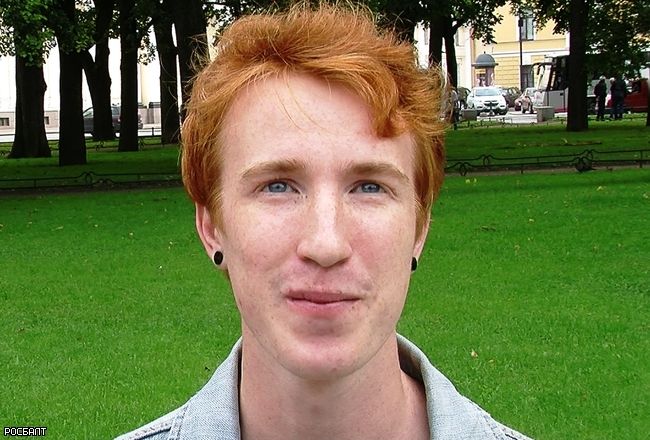
Saint Petersburg State University student Kirill Kalugin is half the age of his eminent opponent, Petersburg Legislative Assembly member Vitaly Milonov, although he is also a redhead. But hair color is not the only thing the outspoken homophobe and outspoken gay have in common. Both claim they love their motherland Russia and will never leave it. 

Rosbalt’s Yevgeny Zubarev met with Kalugin in the city center, on Arts Square. It’s a safe place because it is always chockablock with police. There were also lots of police on Palace Square on August 2, [2013], when Kalugin came there alone and unfurled a rainbow flag, but even a platoon of riot police was not immediately able to wrest him away from an agitated crowd dressed in striped shirts for Russian Paratroopers Day.

 — Why did you do it, Kirill? Weren’t you frightened?

— I was frightened. Actually, there were supposed to be four of us out there, but then I ended up going out alone. If there had been several people, the police could have charged us with holding an unauthorized rally, but this way it was a solo picket, which doesn’t require permission. As soon as I unfurled the rainbow flag, men in [traditional Russian paratrooper] striped shirts grabbed me. But I don’t think they were paratroopers: I had seen many of the assailants earlier at anti-LGBT protests. I think they were nationalist activists masquerading as paratroopers. The police pulled me from the crowd and put me in a car, but we couldn’t leave right away: the crowd blocked the car, demanding that the police give me up. The riot police intervened and cleared a path, and I was taken to the 78th police precinct.

kNxhDMBR-650

— What did police charge you with? How were you punished?

— I don’t understand it myself. At first they wouldn’t let me make a phone call. The sergeants behaved rudely, and I couldn’t figure out what my status was, whether I had been detained, arrested or was considered a suspect. Right there at the police station one of the detained paratroopers rushed me: he wanted to beat me up, but the police held him back. Then the brass arrived and everything immediately changed: the police started talking with me politely. It turned out I wasn’t being charged with anything. They even let me file an assault complaint. But how that case has turned out, I don’t know: it has been twenty days, but I have had no word from the police.

— After this incident, Russian Orthodox patriots wrote several petitions to Saint Petersburg State University demanding your expulsion.

— I’m a student in the physics department, specializing in medical physics and bioengineering. It’s a tough department, and there is a lot of studying to do. What matters to the deans is that students take all their exams and tests on time, but they are unconcerned about their private lives. Generally, it is not kosher in the scientific community to tell people how they should behave in the intimate realm. So I’m confident all these petitions are pointless.

— Your family must have seen how you were beaten on Palace Square on the Web or on TV. What was their reaction?

— I was born to an ordinary Russian family in the town of Krasnoturyinsk in the Urals. My father is an officer in the Russian armed forces, my mother, a philologist. After the 2008 crisis, life in our town got really bad and we moved to Petersburg, where I finished high school, enrolled at the university, and began to live separately from my family. It was only then I told my parents I was gay. My parents were upset, especially my father, but they recognized my right to live as I see fit. My brother also said it was my choice. When I went out on Palace Square, they heard about it in the media. They called me and were worried, of course. But I assured them I was not in danger.

— How many times have you been beaten up in Petersburg for being gay?

— Never, except for the incident at Palace Square. My classmates at university and my employers at the restaurant where I work part time as a bartender do not care what I do in bed. Of course, after this incident I could have been recognized on the street and beaten up, but that hasn’t happened yet.

— There are thousands of commentators on the Web who are sure you went out on Palace Square to secure the right to emigrate to the west as a discriminated person.

— I don’t intend to leave Russia. I am sure all these homophobic laws will be repealed sooner or later, and all Russian citizens will be able to live normally regardless of sexual orientation. There were similar laws in Sweden thirty years ago, and gays were persecuted throughout the world the way they now are in Russia. But then the situation changed. I am sure that Russia also has to follow this path, and so I’m not going to leave. But change doesn’t happen by itself—people have to take to the streets and speak out about this problem.

— Why do you act alone? There are lots of public organizations in Russia that support gays. Many of them receive foreign grants. You could get this money to fight for equality and all that, no?

— I don’t want to. I’ve had offers to join various organizations like that, but I don’t want to. I’m not a politician. I just don’t want there to be discrimination against people like me. Besides, it is easier for the state to punish organizations than lone individuals. Organizations are more vulnerable. What are they going to do with an ordinary guy like me?

— When you finish university you’ll find that jobs in your scientific specialty are poorly paid and dead ends. This is another reason, aside from sexual orientation, for going abroad.

— I still won’t leave. I know how things are going with financing for science in Russia, but I don’t want to leave. In the end, there are grants given to scientists for in-demand research. And in fact, Russia is changing for the better; the situation is improving in science, too.

— You have the opportunity to address Rosbalt’s thousands of readers. What would say to all these people?

— I would appeal to people like me. Don’t sit quiet as mice. At least come out. Let your loved ones know that you exist.

 — Why can’t you sit quiet and keep a low profile? Why do you come up with these public protests during which you can be beaten or even killed? After all, there is no practical sense to them.

 — Can I quote Goethe? “He alone deserves liberty and life who daily must win them anew.”

— How old are you?

 — Twenty-one.

Originally published, in Russian, by Rosbalt on August 22, 2013. Photo courtesy of Rosbalt

__________

Explaining his protest [on August 2, 2014], Kalugin said it was directed against both the lack of civil freedoms and the growing militarism in Russia during the ongoing conflict in Ukraine.

“The suppression of any civil freedoms and the growth of imperial chauvinism in Russia are interconnected, and the issue has one and the same root,” he said.

“As long as there remains at least one group that is seen as ‘second-rate people’ in the country, the rest cannot call themselves free. Even if they enjoy some preferences now, this system can hit them, too, sooner or later.

“All this has grown so much that it has already started spreading into the neighboring states. The same people, who cried ‘Death to gays’ and hailed the laws banning ‘gay propaganda’ and restricting public assemblies, ended up shouting ‘Crimea is ours’ and going to Donetsk and Luhansk.”

Airborne Troops Day in St. Petersburg is known for the large number of airborne veterans gathering in the city center, drinking, swimming in fountains and, at times, getting out of control, with the police usually ignoring any misconduct.

Kalugin said that he chose to stage his protest on that day because he sees the festivities as the “climax of militarism and chauvinism.” He said it was also his reaction to homophobic jokes, where LGBT people were mockingly invited to hold their protests on Airborne Troops Day—the underlying notion being that they would be immediately be beaten by homophobic airborne veterans.

“It’s an old joke from the times when LGBT pride events were held in Moscow, [Moscow’s anti-gay ex-mayor Yury] Luzhkov used to say that he would only agree if it was held on Aug. 2,” Kalugin said.

source: St. Petersburg Times